INDIA IN THE NEW KNOWLEDGE ECONOMY
The Changing Scenario
Dr. Naresh Trehan
Chairman, CII National Committee on
Healthcare & Executive Director
Escorts Heart Institute and Research
Centre, New Delhi, India
INDIA IN THE NEW KNOWLEDGE ECONOMY
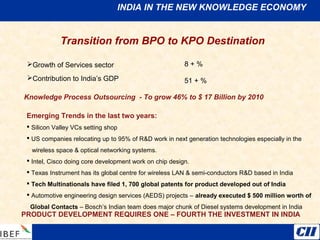
Transition from BPO to KPO Destination
Growth of Services sector
Contribution to India’s GDP
8 + %
51 + %
Knowledge Process Outsourcing - To grow 46% to $ 17 Billion by 2010
Emerging Trends in the last two years:
 Silicon Valley VCs setting shop
 US companies relocating up to 95% of R&D work in next generation technologies especially in the
wireless space & optical networking systems.
 Intel, Cisco doing core development work on chip design.
 Texas Instrument has its global centre for wireless LAN & semi-conductors R&D based in India
 Tech Multinationals have filed 1, 700 global patents for product developed out of India
 Automotive engineering design services (AEDS) projects – already executed $ 500 million worth of
Global Contacts – Bosch’s Indian team does major chunk of Diesel systems development in India
PRODUCT DEVELOPMENT REQUIRES ONE – FOURTH THE INVESTMENT IN INDIA
INDIA IN THE NEW KNOWLEDGE ECONOMY
 Healthcare
 Pharma & Biotechnology
 Information & Communication
Technology (ICT)
Indian Healthcare : The Changing Scenario
Current Healthcare Landscape
Indian Healthcare : The Changing Scenario
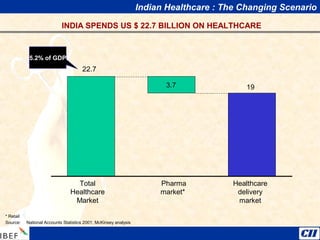
INDIA SPENDS US $ 22.7 BILLION ON HEALTHCARE
3.7 19
22.7
5.2% of GDP
Total
Healthcare
Market
Pharma
market*
Healthcare
delivery
market
* Retail
Source: National Accounts Statistics 2001; McKinsey analysis
Indian Healthcare : The Changing Scenario
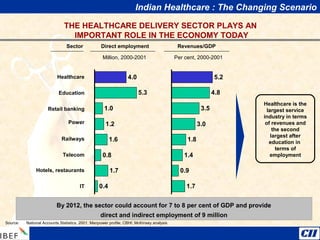
THE HEALTHCARE DELIVERY SECTOR PLAYS AN
IMPORTANT ROLE IN THE ECONOMY TODAY
Sector Direct employment Revenues/GDP
Million, 2000-2001 Per cent, 2000-2001
4.0
5.3
1.0
1.2
1.6
0.8
1.7
0.4
5.2
4.8
3.5
3.0
1.8
1.4
0.9
1.7
Healthcare
Education
Retail banking
Power
Railways
Telecom
Hotels, restaurants
Source: National Accounts Statistics, 2001; Manpower profile; CBHI; McKinsey analysis
IT
Healthcare is the
largest service
industry in terms
of revenues and
the second
largest after
education in
terms of
employment
By 2012, the sector could account for 7 to 8 per cent of GDP and provide
direct and indirect employment of 9 million
Indian Healthcare : The Changing Scenario
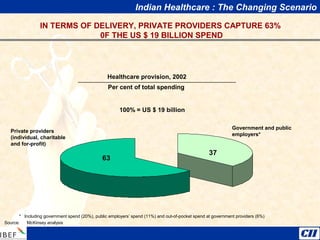
IN TERMS OF DELIVERY, PRIVATE PROVIDERS CAPTURE 63%
0F THE US $ 19 BILLION SPEND
63
37
Government and public
employers*
Healthcare provision, 2002
Per cent of total spending
Private providers
(individual, charitable
and for-profit)
100% = US $ 19 billion
* Including government spend (20%), public employers’ spend (11%) and out-of-pocket spend at government providers (6%)
Source: McKinsey analysis
Indian Healthcare : The Changing Scenario
INDIA: AN EMERGING HEALTHCARE HUB
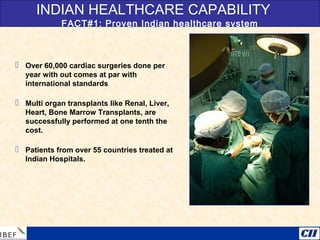
 Over 60,000 cardiac surgeries done per
year with out comes at par with
international standards
 Multi organ transplants like Renal, Liver,
Heart, Bone Marrow Transplants, are
successfully performed at one tenth the
cost.
 Patients from over 55 countries treated at
Indian Hospitals.
INDIAN HEALTHCARE CAPABILITY
FACT#1: Proven Indian healthcare system
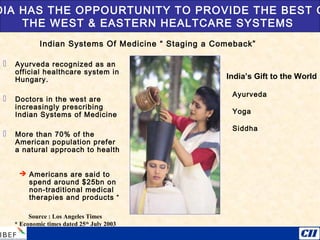
 Ayurveda recognized as an
official healthcare system in
Hungary.
 Doctors in the west are
increasingly prescribing
Indian Systems of Medicine
 More than 70% of the
American population prefer
a natural approach to health
 Americans are said to
spend around $25bn on
non-traditional medical
therapies and products *
Source : Los Angeles Times
* Economic times dated 25th
July 2003
Ayurveda
Yoga
Siddha
India’s Gift to the World
DIA HAS THE OPPOURTUNITY TO PROVIDE THE BEST O
THE WEST & EASTERN HEALTCARE SYSTEMS
Indian Systems Of Medicine “ Staging a Comeback”
“Physicians, Nurses, Medical Technicians and Other Scientific Occupations
will Become Growth Industries to Rival the IT Sector within the Next Decade”
- India Vision 2020 Report
HEALTHCARE….THE SUNRISE INDUSTRY
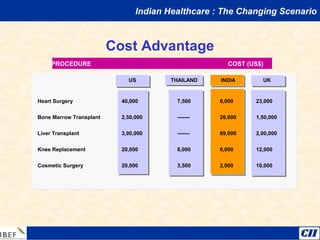
PROCEDURE COST (US$)
THAILANDTHAILAND INDIA
Heart Surgery
Bone Marrow Transplant
Liver Transplant
Knee Replacement
Cosmetic Surgery
7,500
-------
-------
8,000
3,500
6,000
26,000
69,000
6,000
2,000
USUS
40,000
2,50,000
3,00,000
20,000
20,000
UK
23,000
1,50,000
2,00,000
12,000
10,000
Indian Healthcare : The Changing Scenario
Cost Advantage
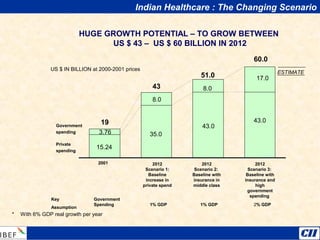
HUGE GROWTH POTENTIAL – TO GROW BETWEEN
US $ 43 – US $ 60 BILLION IN 2012
* With 6% GDP real growth per year
US $ IN BILLION at 2000-2001 prices
2001
Private
spending
Government
spending
ESTIMATE
2012
Scenario 1:
Baseline
increase in
private spend
2012
Scenario 2:
Baseline with
insurance in
middle class
2012
Scenario 3:
Baseline with
insurance and
high
government
spending
19
43
51.0
60.0
3.76
15.24
8.0
8.0
17.0
35.0
43.0
43.0
Key
Assumption
1% GDP
Government
Spending 1% GDP 2% GDP
Indian Healthcare : The Changing Scenario
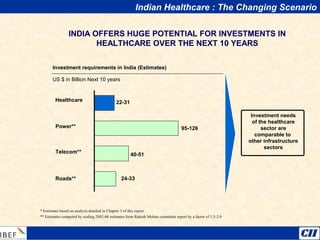
INDIA OFFERS HUGE POTENTIAL FOR INVESTMENTS IN
HEALTHCARE OVER THE NEXT 10 YEARS
Investment requirements in India (Estimates)
US $ in Billion Next 10 years
Healthcare
Power**
Telecom**
Roads**
22-31
24-33
40-51
95-126
* Estimates based on analysis detailed in Chapter 3 of this report
** Estimates computed by scaling 2002-06 estimates from Rakesh Mohan committee report by a factor of 1.5-2.0
Investment needs
of the healthcare
sector are
comparable to
other infrastructure
sectors
Indian Healthcare : The Changing Scenario
India’s Growth Sectors -
Pharmaceuticals & Biotech
INDIA IN THE NEW KNOWLEDGE ECONOMY
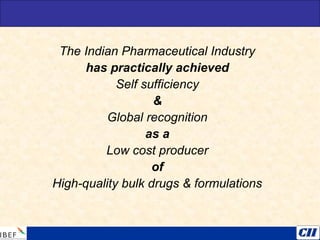
The Indian Pharmaceutical Industry
has practically achieved
Self sufficiency
&
Global recognition
as a
Low cost producer
of
High-quality bulk drugs & formulations
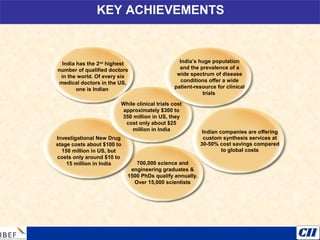
KEY ACHIEVEMENTS
India has the 2nd
highest
number of qualified doctors
in the world. Of every six
medical doctors in the US,
one is Indian
700,000 science and
engineering graduates &
1500 PhDs qualify annually.
Over 15,000 scientists
Investigational New Drug
stage costs about $100 to
150 million in US, but
costs only around $10 to
15 million in India
Indian companies are offering
custom synthesis services at
30-50% cost savings compared
to global costs
While clinical trials cost
approximately $300 to
350 million in US, they
cost only about $25
million in India
India’s huge population
and the prevalence of a
wide spectrum of disease
conditions offer a wide
patient-resource for clinical
trials
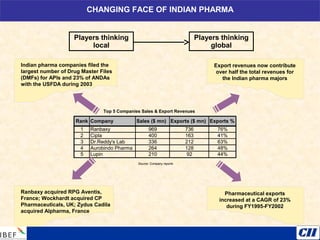
CHANGING FACE OF INDIAN PHARMA
Players thinking
local
Players thinking
global
Top 5 Companies Sales & Export Revenues
Source: Company reports
Rank Company Sales ($ mn) Exports ($ mn) Exports %
1 Ranbaxy 969 736 76%
2 Cipla 400 163 41%
3 Dr.Reddy's Lab 336 212 63%
4 Aurobindo Pharma 264 128 48%
5 Lupin 210 92 44%
Pharmaceutical exports
increased at a CAGR of 23%
during FY1995-FY2002
Indian pharma companies filed the
largest number of Drug Master Files
(DMFs) for APIs and 23% of ANDAs
with the USFDA during 2003
Ranbaxy acquired RPG Aventis,
France; Wockhardt acquired CP
Pharmaceuticals, UK; Zydus Cadila
acquired Alpharma, France
Export revenues now contribute
over half the total revenues for
the Indian pharma majors
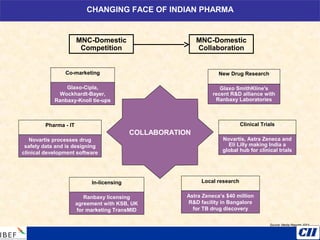
CHANGING FACE OF INDIAN PHARMA
MNC-Domestic
Competition
MNC-Domestic
Collaboration
New Drug Research
Glaxo SmithKline's
recent R&D alliance with
Ranbaxy Laboratories
Clinical Trials
Novartis, Astra Zeneca and
Eli Lilly making India a
global hub for clinical trials
Co-marketing
Glaxo-Cipla,
Wockhardt-Bayer,
Ranbaxy-Knoll tie-ups
In-licensing
Ranbaxy licensing
agreement with KSB, UK
for marketing TransMID
Pharma - IT
Novartis processes drug
safety data and is designing
clinical development software
Local research
Astra Zeneca’s $40 million
R&D facility in Bangalore
for TB drug discovery
COLLABORATION
Source: Media Reports, E&Y
CHANGING FACE OF INDIAN PHARMA
BIOTECHNOLOGY
INDIA IN THE NEW KNOWLEDGE ECONOMY
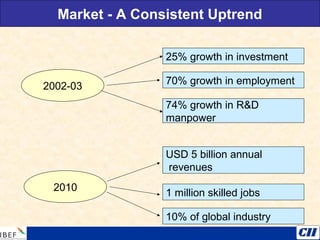
Market - A Consistent Uptrend
2002-03
2010
25% growth in investment
70% growth in employment
74% growth in R&D
manpower
10% of global industry
1 million skilled jobs
USD 5 billion annual
revenues
Source: Confederation of Indian Industry (CII)
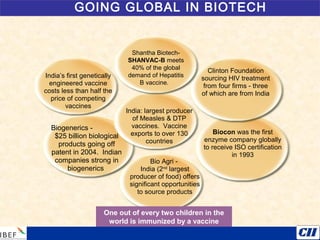
SOURCE FROM INDIA
India’s first genetically
engineered vaccine
costs less than half the
price of competing
vaccines
Bio Agri -
India (2nd
largest
producer of food) offers
significant opportunities
to source products
Biogenerics -
$25 billion biological
products going off
patent in 2004. Indian
companies strong in
biogenerics
Biocon was the first
enzyme company globally
to receive ISO certification
in 1993
India: largest producer
of Measles & DTP
vaccines. Vaccine
exports to over 130
countries
Clinton Foundation
sourcing HIV treatment
from four firms - three
of which are from India
Source: Newspaper Reports
One out of every two children in the
world is immunized by a vaccine
made in India
Shantha Biotech-
SHANVAC-B meets
40% of the global
demand of Hepatitis
B vaccine.
GOING GLOBAL IN BIOTECH
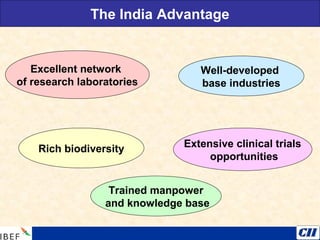
The India Advantage
Trained manpower
and knowledge base
Rich biodiversity Extensive clinical trials
opportunities
Excellent network
of research laboratories
Well-developed
base industries
Information & Communication
Technology (ICT)
INDIA IN THE NEW KNOWLEDGE ECONOMY
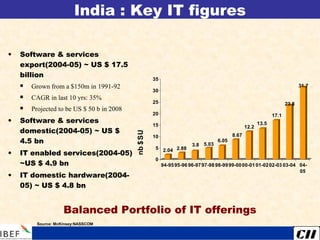
India : Key IT figures
• Software & services
export(2004-05) ~ US $ 17.5
billion
 Grown from a $150m in 1991-92
 CAGR in last 10 yrs: 35%
 Projected to be US $ 50 b in 2008
• Software & services
domestic(2004-05) ~ US $
4.5 bn
• IT enabled services(2004-05)
~US $ 4.9 bn
• IT domestic hardware(2004-
05) ~ US $ 4.8 bn
Source: McKinsey:NASSCOM
Balanced Portfolio of IT offerings
2.04 2.88
3.8 5.03
6.05
8.67
12.2
13.5
17.1
23.8
31.7
0
5
10
15
20
25
30
35
94-9595-96 96-9797-98 98-9999-0000-01 01-0202-03 03-04 04-
05
US$bn
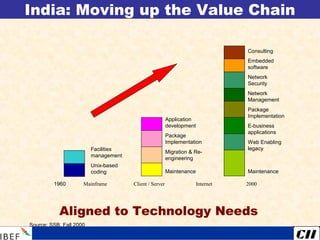
India: Moving up the Value Chain
Source: SSB, Fall 2000
1960 2000Client / Server InternetMainframe
Facilities
management
Unix-based
coding Maintenance
Migration & Re-
engineering
Package
Implementation
Application
development
Web Enabling
legacy
Consulting
Maintenance
Package
Implementation
E-business
applications
Embedded
software
Network
Management
Network
Security
Aligned to Technology Needs
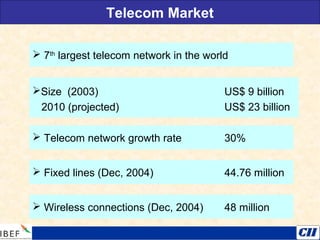
Telecom Market
 7th
largest telecom network in the world
 Telecom network growth rate 30%
 Fixed lines (Dec, 2004) 44.76 million
 Wireless connections (Dec, 2004) 48 million
Size (2003) US$ 9 billion
2010 (projected) US$ 23 billion
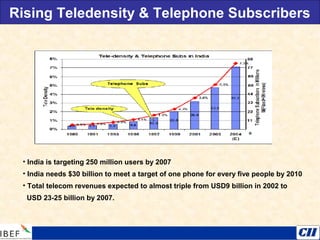
Rising Teledensity & Telephone Subscribers
Sot
• India is targeting 250 million users by 2007
• India needs $30 billion to meet a target of one phone for every five people by 2010
• Total telecom revenues expected to almost triple from USD9 billion in 2002 to
USD 23-25 billion by 2007.
47
Mn
19
Mn 7
Mn
3Mn
5Mn
3Mn
India
Bangladesh
PakistanIran
Brazil
Mexico
Philippines
5Mn
4Mn
Vietnam
2Mn
Turkey
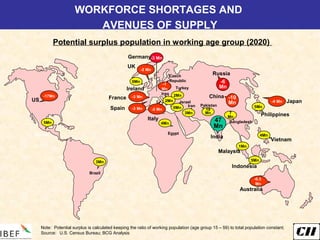
Potential surplus population in working age group (2020)
-10
Mn
China
-6
Mn
Russia
5Mn
Indonesia
1Mn
Malaysia
0Mn
Ireland
Israel
0Mn
Iraq
2Mn
-1
Mn
Czech
Republic
Note: Potential surplus is calculated keeping the ratio of working population (age group 15 – 59) to total population constant;
Source: U.S. Census Bureau; BCG Analysis
4Mn
Egypt
-17Mn
US
-2 Mn
UK
-2 Mn
Italy
-3 MnFrance
-9 Mn Japan
-0.5
Mn
Australia
-3 MnSpain
-3 MnGermany
WORKFORCE SHORTAGES AND
AVENUES OF SUPPLY
THANK YOU

Dr trehan

  • 1.
    INDIA IN THENEW KNOWLEDGE ECONOMY The Changing Scenario Dr. Naresh Trehan Chairman, CII National Committee on Healthcare & Executive Director Escorts Heart Institute and Research Centre, New Delhi, India
  • 2.
    INDIA IN THENEW KNOWLEDGE ECONOMY Transition from BPO to KPO Destination Growth of Services sector Contribution to India’s GDP 8 + % 51 + % Knowledge Process Outsourcing - To grow 46% to $ 17 Billion by 2010 Emerging Trends in the last two years:  Silicon Valley VCs setting shop  US companies relocating up to 95% of R&D work in next generation technologies especially in the wireless space & optical networking systems.  Intel, Cisco doing core development work on chip design.  Texas Instrument has its global centre for wireless LAN & semi-conductors R&D based in India  Tech Multinationals have filed 1, 700 global patents for product developed out of India  Automotive engineering design services (AEDS) projects – already executed $ 500 million worth of Global Contacts – Bosch’s Indian team does major chunk of Diesel systems development in India PRODUCT DEVELOPMENT REQUIRES ONE – FOURTH THE INVESTMENT IN INDIA
  • 3.
    INDIA IN THENEW KNOWLEDGE ECONOMY  Healthcare  Pharma & Biotechnology  Information & Communication Technology (ICT)
  • 4.
    Indian Healthcare :The Changing Scenario Current Healthcare Landscape
  • 5.
    Indian Healthcare :The Changing Scenario INDIA SPENDS US $ 22.7 BILLION ON HEALTHCARE 3.7 19 22.7 5.2% of GDP Total Healthcare Market Pharma market* Healthcare delivery market * Retail Source: National Accounts Statistics 2001; McKinsey analysis
  • 6.
    Indian Healthcare :The Changing Scenario THE HEALTHCARE DELIVERY SECTOR PLAYS AN IMPORTANT ROLE IN THE ECONOMY TODAY Sector Direct employment Revenues/GDP Million, 2000-2001 Per cent, 2000-2001 4.0 5.3 1.0 1.2 1.6 0.8 1.7 0.4 5.2 4.8 3.5 3.0 1.8 1.4 0.9 1.7 Healthcare Education Retail banking Power Railways Telecom Hotels, restaurants Source: National Accounts Statistics, 2001; Manpower profile; CBHI; McKinsey analysis IT Healthcare is the largest service industry in terms of revenues and the second largest after education in terms of employment By 2012, the sector could account for 7 to 8 per cent of GDP and provide direct and indirect employment of 9 million
  • 7.
    Indian Healthcare :The Changing Scenario IN TERMS OF DELIVERY, PRIVATE PROVIDERS CAPTURE 63% 0F THE US $ 19 BILLION SPEND 63 37 Government and public employers* Healthcare provision, 2002 Per cent of total spending Private providers (individual, charitable and for-profit) 100% = US $ 19 billion * Including government spend (20%), public employers’ spend (11%) and out-of-pocket spend at government providers (6%) Source: McKinsey analysis
  • 8.
    Indian Healthcare :The Changing Scenario INDIA: AN EMERGING HEALTHCARE HUB
  • 9.
     Over 60,000cardiac surgeries done per year with out comes at par with international standards  Multi organ transplants like Renal, Liver, Heart, Bone Marrow Transplants, are successfully performed at one tenth the cost.  Patients from over 55 countries treated at Indian Hospitals. INDIAN HEALTHCARE CAPABILITY FACT#1: Proven Indian healthcare system
  • 10.
     Ayurveda recognizedas an official healthcare system in Hungary.  Doctors in the west are increasingly prescribing Indian Systems of Medicine  More than 70% of the American population prefer a natural approach to health  Americans are said to spend around $25bn on non-traditional medical therapies and products * Source : Los Angeles Times * Economic times dated 25th July 2003 Ayurveda Yoga Siddha India’s Gift to the World DIA HAS THE OPPOURTUNITY TO PROVIDE THE BEST O THE WEST & EASTERN HEALTCARE SYSTEMS Indian Systems Of Medicine “ Staging a Comeback”
  • 11.
    “Physicians, Nurses, MedicalTechnicians and Other Scientific Occupations will Become Growth Industries to Rival the IT Sector within the Next Decade” - India Vision 2020 Report HEALTHCARE….THE SUNRISE INDUSTRY
  • 12.
    PROCEDURE COST (US$) THAILANDTHAILANDINDIA Heart Surgery Bone Marrow Transplant Liver Transplant Knee Replacement Cosmetic Surgery 7,500 ------- ------- 8,000 3,500 6,000 26,000 69,000 6,000 2,000 USUS 40,000 2,50,000 3,00,000 20,000 20,000 UK 23,000 1,50,000 2,00,000 12,000 10,000 Indian Healthcare : The Changing Scenario Cost Advantage
  • 13.
    HUGE GROWTH POTENTIAL– TO GROW BETWEEN US $ 43 – US $ 60 BILLION IN 2012 * With 6% GDP real growth per year US $ IN BILLION at 2000-2001 prices 2001 Private spending Government spending ESTIMATE 2012 Scenario 1: Baseline increase in private spend 2012 Scenario 2: Baseline with insurance in middle class 2012 Scenario 3: Baseline with insurance and high government spending 19 43 51.0 60.0 3.76 15.24 8.0 8.0 17.0 35.0 43.0 43.0 Key Assumption 1% GDP Government Spending 1% GDP 2% GDP Indian Healthcare : The Changing Scenario
  • 14.
    INDIA OFFERS HUGEPOTENTIAL FOR INVESTMENTS IN HEALTHCARE OVER THE NEXT 10 YEARS Investment requirements in India (Estimates) US $ in Billion Next 10 years Healthcare Power** Telecom** Roads** 22-31 24-33 40-51 95-126 * Estimates based on analysis detailed in Chapter 3 of this report ** Estimates computed by scaling 2002-06 estimates from Rakesh Mohan committee report by a factor of 1.5-2.0 Investment needs of the healthcare sector are comparable to other infrastructure sectors Indian Healthcare : The Changing Scenario
  • 15.
    India’s Growth Sectors- Pharmaceuticals & Biotech INDIA IN THE NEW KNOWLEDGE ECONOMY
  • 16.
    The Indian PharmaceuticalIndustry has practically achieved Self sufficiency & Global recognition as a Low cost producer of High-quality bulk drugs & formulations
  • 17.
    KEY ACHIEVEMENTS India hasthe 2nd highest number of qualified doctors in the world. Of every six medical doctors in the US, one is Indian 700,000 science and engineering graduates & 1500 PhDs qualify annually. Over 15,000 scientists Investigational New Drug stage costs about $100 to 150 million in US, but costs only around $10 to 15 million in India Indian companies are offering custom synthesis services at 30-50% cost savings compared to global costs While clinical trials cost approximately $300 to 350 million in US, they cost only about $25 million in India India’s huge population and the prevalence of a wide spectrum of disease conditions offer a wide patient-resource for clinical trials
  • 18.
    CHANGING FACE OFINDIAN PHARMA Players thinking local Players thinking global Top 5 Companies Sales & Export Revenues Source: Company reports Rank Company Sales ($ mn) Exports ($ mn) Exports % 1 Ranbaxy 969 736 76% 2 Cipla 400 163 41% 3 Dr.Reddy's Lab 336 212 63% 4 Aurobindo Pharma 264 128 48% 5 Lupin 210 92 44% Pharmaceutical exports increased at a CAGR of 23% during FY1995-FY2002 Indian pharma companies filed the largest number of Drug Master Files (DMFs) for APIs and 23% of ANDAs with the USFDA during 2003 Ranbaxy acquired RPG Aventis, France; Wockhardt acquired CP Pharmaceuticals, UK; Zydus Cadila acquired Alpharma, France Export revenues now contribute over half the total revenues for the Indian pharma majors
  • 19.
    CHANGING FACE OFINDIAN PHARMA MNC-Domestic Competition MNC-Domestic Collaboration New Drug Research Glaxo SmithKline's recent R&D alliance with Ranbaxy Laboratories Clinical Trials Novartis, Astra Zeneca and Eli Lilly making India a global hub for clinical trials Co-marketing Glaxo-Cipla, Wockhardt-Bayer, Ranbaxy-Knoll tie-ups In-licensing Ranbaxy licensing agreement with KSB, UK for marketing TransMID Pharma - IT Novartis processes drug safety data and is designing clinical development software Local research Astra Zeneca’s $40 million R&D facility in Bangalore for TB drug discovery COLLABORATION Source: Media Reports, E&Y CHANGING FACE OF INDIAN PHARMA
  • 20.
    BIOTECHNOLOGY INDIA IN THENEW KNOWLEDGE ECONOMY
  • 21.
    Market - AConsistent Uptrend 2002-03 2010 25% growth in investment 70% growth in employment 74% growth in R&D manpower 10% of global industry 1 million skilled jobs USD 5 billion annual revenues Source: Confederation of Indian Industry (CII)
  • 22.
    SOURCE FROM INDIA India’sfirst genetically engineered vaccine costs less than half the price of competing vaccines Bio Agri - India (2nd largest producer of food) offers significant opportunities to source products Biogenerics - $25 billion biological products going off patent in 2004. Indian companies strong in biogenerics Biocon was the first enzyme company globally to receive ISO certification in 1993 India: largest producer of Measles & DTP vaccines. Vaccine exports to over 130 countries Clinton Foundation sourcing HIV treatment from four firms - three of which are from India Source: Newspaper Reports One out of every two children in the world is immunized by a vaccine made in India Shantha Biotech- SHANVAC-B meets 40% of the global demand of Hepatitis B vaccine. GOING GLOBAL IN BIOTECH
  • 23.
    The India Advantage Trainedmanpower and knowledge base Rich biodiversity Extensive clinical trials opportunities Excellent network of research laboratories Well-developed base industries
  • 24.
    Information & Communication Technology(ICT) INDIA IN THE NEW KNOWLEDGE ECONOMY
  • 25.
    India : KeyIT figures • Software & services export(2004-05) ~ US $ 17.5 billion  Grown from a $150m in 1991-92  CAGR in last 10 yrs: 35%  Projected to be US $ 50 b in 2008 • Software & services domestic(2004-05) ~ US $ 4.5 bn • IT enabled services(2004-05) ~US $ 4.9 bn • IT domestic hardware(2004- 05) ~ US $ 4.8 bn Source: McKinsey:NASSCOM Balanced Portfolio of IT offerings 2.04 2.88 3.8 5.03 6.05 8.67 12.2 13.5 17.1 23.8 31.7 0 5 10 15 20 25 30 35 94-9595-96 96-9797-98 98-9999-0000-01 01-0202-03 03-04 04- 05 US$bn
  • 26.
    India: Moving upthe Value Chain Source: SSB, Fall 2000 1960 2000Client / Server InternetMainframe Facilities management Unix-based coding Maintenance Migration & Re- engineering Package Implementation Application development Web Enabling legacy Consulting Maintenance Package Implementation E-business applications Embedded software Network Management Network Security Aligned to Technology Needs
  • 27.
    Telecom Market  7th largesttelecom network in the world  Telecom network growth rate 30%  Fixed lines (Dec, 2004) 44.76 million  Wireless connections (Dec, 2004) 48 million Size (2003) US$ 9 billion 2010 (projected) US$ 23 billion
  • 28.
    Rising Teledensity &Telephone Subscribers Sot • India is targeting 250 million users by 2007 • India needs $30 billion to meet a target of one phone for every five people by 2010 • Total telecom revenues expected to almost triple from USD9 billion in 2002 to USD 23-25 billion by 2007.
  • 29.
    47 Mn 19 Mn 7 Mn 3Mn 5Mn 3Mn India Bangladesh PakistanIran Brazil Mexico Philippines 5Mn 4Mn Vietnam 2Mn Turkey Potential surpluspopulation in working age group (2020) -10 Mn China -6 Mn Russia 5Mn Indonesia 1Mn Malaysia 0Mn Ireland Israel 0Mn Iraq 2Mn -1 Mn Czech Republic Note: Potential surplus is calculated keeping the ratio of working population (age group 15 – 59) to total population constant; Source: U.S. Census Bureau; BCG Analysis 4Mn Egypt -17Mn US -2 Mn UK -2 Mn Italy -3 MnFrance -9 Mn Japan -0.5 Mn Australia -3 MnSpain -3 MnGermany WORKFORCE SHORTAGES AND AVENUES OF SUPPLY
  • 30.

Editor's Notes

  • #12 Notes for chairman
  • #21 <number>
  • #22 Exports, investment and employment in the sector have been showing a consistent uptrend. - The total investment in the sector has in fact increased by 25% over the previous year . - Employment has risen by nearly 70%. - In terms of pure numbers, the R&D manpower has grown over 74%. - The biotechnology business in India has the potential to generate annual revenues of US$ 5 billion and one million skilled jobs by 2010. - By these accounts the industry is guesstimated to account for almost 10% of the global industry as against the 1% at present.
  • #24 Convergenceof a host of enabling factors such as : - skilled human resources, - world-class infrastructure, - active government support - increased investment - both public and private have imparted dynamism to the sector leading to new companies being registered, larger product pipelines, increased patent filings and several product launches. India’s rich human capital is believed to be the strongest asset for this knowledge-led industry. - It is estimated that 15% of the scientific population of pharmaceutical and biotechnology companies in the US is of Indian origin. - 3 million graduates, 700,000 post graduates and 1500 PhDs qualify in the scientific stream each year in India. - 15000 scientists are estimated too be engaged in India`s biotechnology sector.
  • #25 <number>
  • #26 <number> The software industry has grown in the last 10 years at an average of 42% CAGR. This is a phenomenal figure. You may like to emphasise this figure