By Alex Chamberlain
Contents
When
and
where
was
Nelson
born?
Nelson's
Primary
Education
Nelson's
Childhood
ANC
1962
1964
Life in
prison
Campaigning
for Nelson's
release
1990
Becoming
president
Retirement
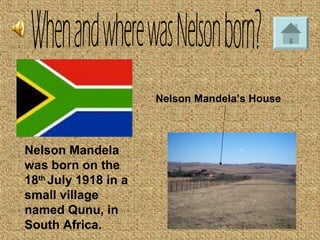
Nelson Mandela’s House
Nelson Mandela
was born on the
18th
July 1918 in a
small village
named Qunu, in
South Africa.
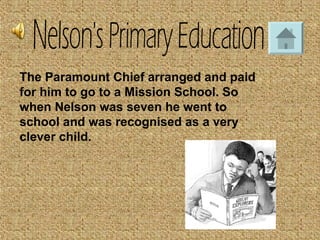
The Paramount Chief arranged and paid
for him to go to a Mission School. So
when Nelson was seven he went to
school and was recognised as a very
clever child.
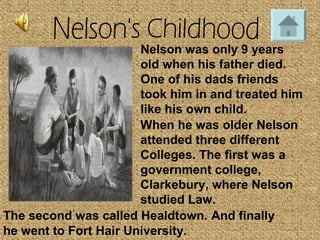
Nelson was only 9 years
old when his father died.
One of his dads friends
took him in and treated him
like his own child.
When he was older Nelson
attended three different
Colleges. The first was a
government college,
Clarkebury, where Nelson
studied Law.
The second was called Healdtown. And finally
he went to Fort Hair University.
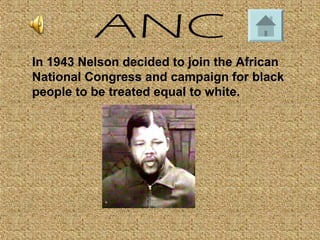
In 1943 Nelson decided to join the African
National Congress and campaign for black
people to be treated equal to white.
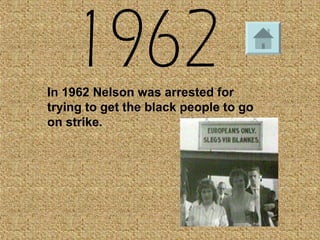
In 1962 Nelson was arrested for
trying to get the black people to go
on strike.
Two years later he was charged
with an even more serious
offence; trying to overthrow the
government of South Africa; he
was sentenced to a life in
prison.
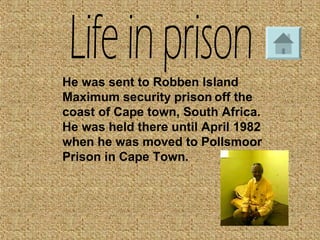
He was sent to Robben Island
Maximum security prison off the
coast of Cape town, South Africa.
He was held there until April 1982
when he was moved to Pollsmoor
Prison in Cape Town.
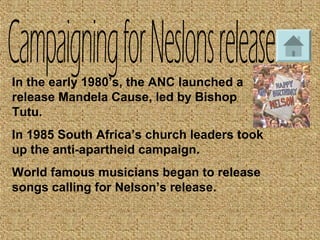
In the early 1980’s, the ANC launched a
release Mandela Cause, led by Bishop
Tutu.
In 1985 South Africa’s church leaders took
up the anti-apartheid campaign.
World famous musicians began to release
songs calling for Nelson’s release.
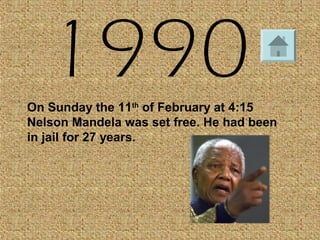
On Sunday the 11th
of February at 4:15
Nelson Mandela was set free. He had been
in jail for 27 years.
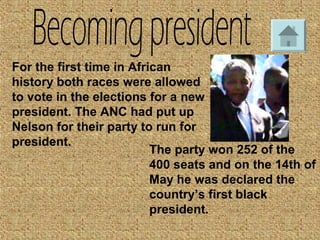
For the first time in African
history both races were allowed
to vote in the elections for a new
president. The ANC had put up
Nelson for their party to run for
president.
The party won 252 of the
400 seats and on the 14th of
May he was declared the
country’s first black
president.
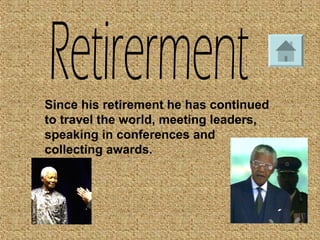
Since his retirement he has continued
to travel the world, meeting leaders,
speaking in conferences and
collecting awards.

Alex nelson mandela

  • 1.
  • 2.
  • 3.
    Nelson Mandela’s House NelsonMandela was born on the 18th July 1918 in a small village named Qunu, in South Africa.
  • 4.
    The Paramount Chiefarranged and paid for him to go to a Mission School. So when Nelson was seven he went to school and was recognised as a very clever child.
  • 5.
    Nelson was only9 years old when his father died. One of his dads friends took him in and treated him like his own child. When he was older Nelson attended three different Colleges. The first was a government college, Clarkebury, where Nelson studied Law. The second was called Healdtown. And finally he went to Fort Hair University.
  • 6.
    In 1943 Nelsondecided to join the African National Congress and campaign for black people to be treated equal to white.
  • 7.
    In 1962 Nelsonwas arrested for trying to get the black people to go on strike.
  • 8.
    Two years laterhe was charged with an even more serious offence; trying to overthrow the government of South Africa; he was sentenced to a life in prison.
  • 9.
    He was sentto Robben Island Maximum security prison off the coast of Cape town, South Africa. He was held there until April 1982 when he was moved to Pollsmoor Prison in Cape Town.
  • 10.
    In the early1980’s, the ANC launched a release Mandela Cause, led by Bishop Tutu. In 1985 South Africa’s church leaders took up the anti-apartheid campaign. World famous musicians began to release songs calling for Nelson’s release.
  • 11.
    On Sunday the11th of February at 4:15 Nelson Mandela was set free. He had been in jail for 27 years.
  • 12.
    For the firsttime in African history both races were allowed to vote in the elections for a new president. The ANC had put up Nelson for their party to run for president. The party won 252 of the 400 seats and on the 14th of May he was declared the country’s first black president.
  • 13.
    Since his retirementhe has continued to travel the world, meeting leaders, speaking in conferences and collecting awards.