Asynchronous Transfer Mode
1
Answer three basic Questions :
2
What? – what is ATM
How ? – how it works.
Why? -- why it’s used (benefits)
Presentation Objectives
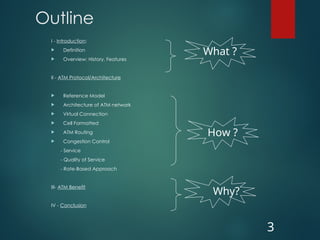
Outline
I - Introduction:
 Definition
 Overview: History, Features
II - ATM Protocol/Architecture
 Reference Model
 Architecture of ATM network
 Virtual Connection
 Cell Formatted
 ATM Routing
 Congestion Control
- Service
- Quality of Service
- Rate-Based Approach
III- ATM Benefit
IV - Conclusion
3
What ?
How ?
Why?
ATM Definition
Asynchronous Transfer Mode (ATM)
A high-performance, cell-oriented switching and multiplexing technology that
utilizes fixed-length packets to carry different types of traffic.
Asynchronous Transfer Mode (ATM) is a high-speed, cell-switching, packet-
oriented networking technology designed to support the simultaneous
transmission of voice, video, and data over the same network infrastructure. It
was developed in the late 1980s and became a core technology for
broadband Integrated Services Digital Networks (B-ISDN).
4
ATM Overview
ATM:
 ATM was designed in early 1990s
 ATM aim is to expedite the process of integrating AMT into the
market.
 It is designed for high-performance multimedia networking.
 It enables carriers to transmit voice, video, and future media
applications.
 It’s suitable for bursty traffic.
 It allows communication between devices that operate at different
speeds.
 It can be offered as an end-user service by service providers, or as
a networking infrastructure
 It is a set of international interface and signaling standards defined
by ITU-T Standards Sector.
5
ATM Overview
So far, ATM has been implemented in :
 PC, workstation, and server network interface cards
 Switched-Ethernet and token-ring workgroup hubs
 ATM enterprise network switches
 ATM multiplexers
 ATM-edge switches
 ATM-backbone switches
6
ATM Features
Main features of ATM
 Service is connection oriented, with data transferred over a VC
 A cell-switched network (architecture).
 Fixed-size cell (53-Bytes)
 Uses Asynchronous time-division multiplexing (Asynchronous TDM)
 The Quantity of Service (QofS) enable carriers to transmit voice,
data, and video.
 ATM is independent of the transmission medium. ATM cells can be
sent on a wire or fiber, and can also be packaged inside the
payload of other carrier system.
7
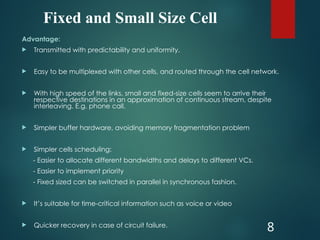
Fixed and Small Size Cell
Advantage:
 Transmitted with predictability and uniformity.
 Easy to be multiplexed with other cells, and routed through the cell network.
 With high speed of the links, small and fixed-size cells seem to arrive their
respective destinations in an approximation of continuous stream, despite
interleaving. E.g. phone call.
 Simpler buffer hardware, avoiding memory fragmentation problem
 Simpler cells scheduling:
- Easier to allocate different bandwidths and delays to different VCs.
- Easier to implement priority
- Fixed sized can be switched in parallel in synchronous fashion.
 It’s suitable for time-critical information such as voice or video
 Quicker recovery in case of circuit failure.
8
Fixed-Size and Small Cell
Disadvantage:
 Processing overhead as messages are segmented into
cells
 Segmentation mismatch, as the last cell in a fragmented
message may not be fully used. This effect will decrease
as the message length increases.
9
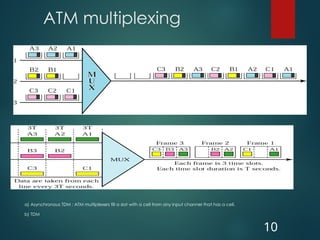
ATM multiplexing
a) Asynchronous TDM : ATM multiplexers fill a slot with a cell from any input channel that has a cell.
b) TDM
10
ATM
11
How does ATM work ?
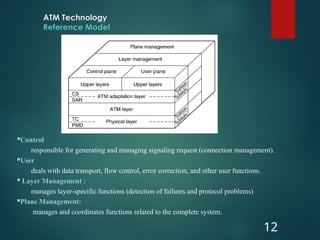
ATM Technology
Reference Model
12
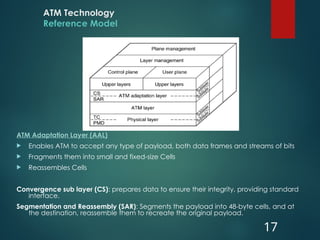
Control
responsible for generating and managing signaling request (connection management).
User
deals with data transport, flow control, error correction, and other user functions.
 Layer Management :
manages layer-specific functions (detection of failures and protocol problems)
Plane Management:
manages and coordinates functions related to the complete system.
ATM Technology
Reference Model
13
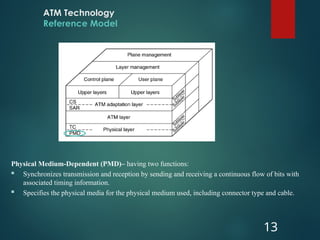
Physical Medium-Dependent (PMD)– having two functions:
 Synchronizes transmission and reception by sending and receiving a continuous flow of bits with
associated timing information.
 Specifies the physical media for the physical medium used, including connector type and cable.
ATM Technology
Reference Model
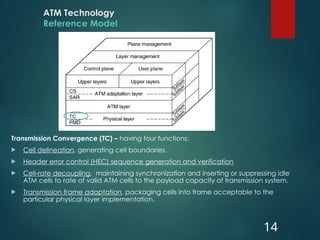
Transmission Convergence (TC) – having four functions:
 Cell delineation, generating cell boundaries.
 Header error control (HEC) sequence generation and verification
 Cell-rate decoupling, maintaining synchronization and inserting or suppressing idle
ATM cells to rate of valid ATM cells to the payload capacity of transmission system.
 Transmission frame adaptation, packaging cells into frame acceptable to the
particular physical layer implementation.
14
ATM Technology
Reference Model
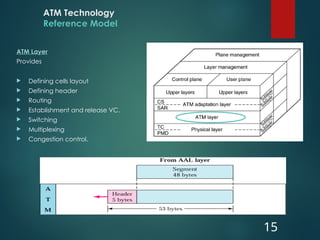
ATM Layer
Provides
 Defining cells layout
 Defining header
 Routing
 Establishment and release VC.
 Switching
 Multiplexing
 Congestion control.
15
ATM Technology
Reference Model
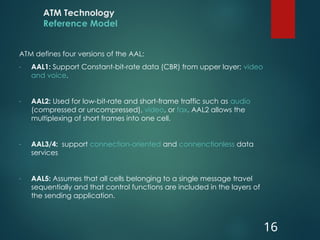
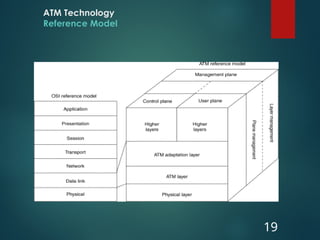
ATM defines four versions of the AAL:
- AAL1: Support Constant-bit-rate data (CBR) from upper layer; video
and voice.
- AAL2: Used for low-bit-rate and short-frame traffic such as audio
(compressed or uncompressed), video, or fax. AAL2 allows the
multiplexing of short frames into one cell.
- AAL3/4: support connection-oriented and connenctionless data
services
- AAL5: Assumes that all cells belonging to a single message travel
sequentially and that control functions are included in the layers of
the sending application.
16
ATM Technology
Reference Model
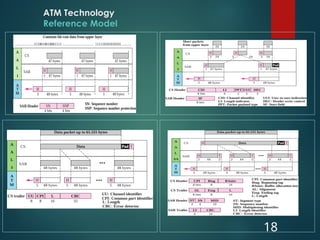
ATM Adaptation Layer (AAL)
 Enables ATM to accept any type of payload, both data frames and streams of bits
 Fragments them into small and fixed-size Cells
 Reassembles Cells
Convergence sub layer (CS): prepares data to ensure their integrity, providing standard
interface.
Segmentation and Reassembly (SAR): Segments the payload into 48-byte cells, and at
the destination, reassemble them to recreate the original payload.
17
ATM Technology
Reference Model
18
ATM Technology
Reference Model
19
ATM Technology
Architecture of ATM Network
20
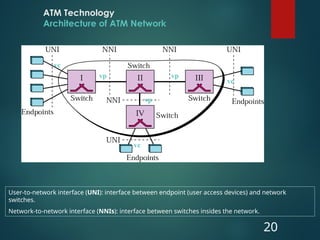
User-to-network interface (UNI): interface between endpoint (user access devices) and network
switches.
Network-to-network interface (NNIs): interface between switches insides the network.
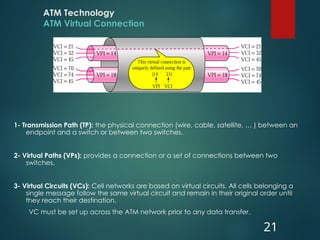
vc
vc
vc
vp vp
vp
ATM Technology
ATM Virtual Connection
1- Transmission Path (TP): the physical connection (wire, cable, satellite, … ) between an
endpoint and a switch or between two switches.
2- Virtual Paths (VPs): provides a connection or a set of connections between two
switches.
3- Virtual Circuits (VCs): Cell networks are based on virtual circuits. All cells belonging a
single message follow the same virtual circuit and remain in their original order until
they reach their destination.
VC must be set up across the ATM network prior to any data transfer.
21
ATM Technology
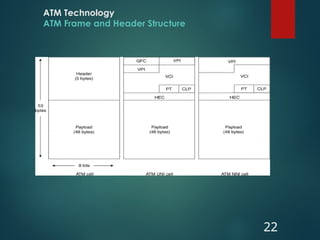
ATM Frame and Header Structure
22
ATM Technology
ATM Frame and Header Structure
23
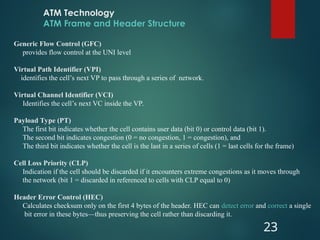
Generic Flow Control (GFC)
provides flow control at the UNI level
Virtual Path Identifier (VPI)
identifies the cell’s next VP to pass through a series of network.
Virtual Channel Identifier (VCI)
Identifies the cell’s next VC inside the VP.
Payload Type (PT)
The first bit indicates whether the cell contains user data (bit 0) or control data (bit 1).
The second bit indicates congestion (0 = no congestion, 1 = congestion), and
The third bit indicates whether the cell is the last in a series of cells (1 = last cells for the frame)
Cell Loss Priority (CLP)
Indication if the cell should be discarded if it encounters extreme congestions as it moves through
the network (bit 1 = discarded in referenced to cells with CLP equal to 0)
Header Error Control (HEC)
Calculates checksum only on the first 4 bytes of the header. HEC can detect error and correct a single
bit error in these bytes—thus preserving the cell rather than discarding it.
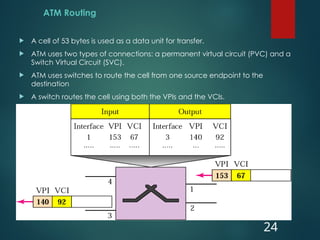
ATM Routing
 A cell of 53 bytes is used as a data unit for transfer.
 ATM uses two types of connections: a permanent virtual circuit (PVC) and a
Switch Virtual Circuit (SVC).
 ATM uses switches to route the cell from one source endpoint to the
destination
 A switch routes the cell using both the VPIs and the VCIs.
24
ATM
25
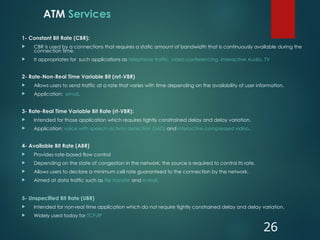
ATM Services
1- Constant Bit Rate (CBR):
 CBR is used by a connections that requires a static amount of bandwidth that is continuously available during the
connection time.
 It appropriates for such applications as telephone traffic, video conferencing, interactive Audio, TV
2- Rate-Non-Real Time Variable Bit (nrt-VBR)
 Allows users to send traffic at a rate that varies with time depending on the availability of user information.
 Application: email.
3- Rate-Real Time Variable Bit Rate (rt-VBR):
 Intended for those application which requires tightly constrained delay and delay variation.
 Application: voice with speech activity detection (SAD) and interactive compressed video.
4- Available Bit Rate (ABR)
 Provides rate-based flow control
 Depending on the state of congestion in the network, the source is required to control its rate.
 Allows users to declare a minimum cell rate guaranteed to the connection by the network.
 Aimed at data traffic such as file transfer and e-mail.
5- Unspecified Bit Rate (UBR)
 Intended for non-real time application which do not require tightly constrained delay and delay variation.
 Widely used today for TCP/IP
26
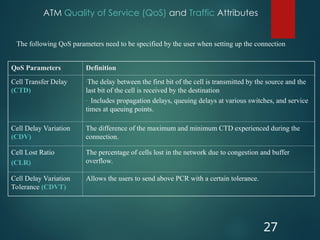
ATM Quality of Service (QoS) and Traffic Attributes
27
The following QoS parameters need to be specified by the user when setting up the connection
QoS Parameters Definition
Cell Transfer Delay
(CTD)
-The delay between the first bit of the cell is transmitted by the source and the
last bit of the cell is received by the destination
- Includes propagation delays, queuing delays at various switches, and service
times at queuing points.
Cell Delay Variation
(CDV)
The difference of the maximum and minimum CTD experienced during the
connection.
Cell Lost Ratio
(CLR)
The percentage of cells lost in the network due to congestion and buffer
overflow.
Cell Delay Variation
Tolerance (CDVT)
Allows the users to send above PCR with a certain tolerance.
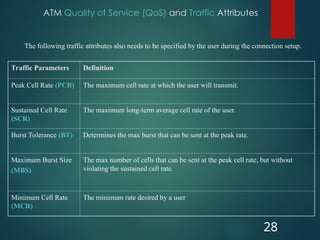
ATM Quality of Service (QoS) and Traffic Attributes
28
Traffic Parameters Definition
Peak Cell Rate (PCR) The maximum cell rate at which the user will transmit.
Sustained Cell Rate
(SCR)
The maximum long-term average cell rate of the user.
Burst Tolerance (BT) Determines the max burst that can be sent at the peak rate.
Maximum Burst Size
(MBS)
The max number of cells that can be sent at the peak cell rate, but without
violating the sustained cell rate.
Minimum Cell Rate
(MCR)
The minimum rate desired by a user
The following traffic attributes also needs to be specified by the user during the connection setup.
ATM Quality of Service (QoS) and Traffic Attributes
29
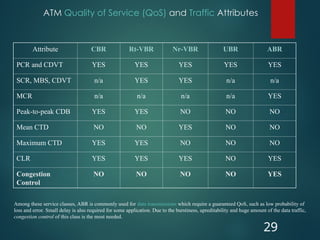
Attribute CBR Rt-VBR Nr-VBR UBR ABR
PCR and CDVT YES YES YES YES YES
SCR, MBS, CDVT n/a YES YES n/a n/a
MCR n/a n/a n/a n/a YES
Peak-to-peak CDB YES YES NO NO NO
Mean CTD NO NO YES NO NO
Maximum CTD YES YES NO NO NO
CLR YES YES YES NO YES
Congestion
Control
NO NO NO NO YES
Among these service classes, ABR is commonly used for data transmissions which require a guaranteed QoS, such as low probability of
loss and error. Small delay is also required for some application. Due to the burstiness, upreditability and huge amount of the data traffic,
congestion control of this class is the most needed.
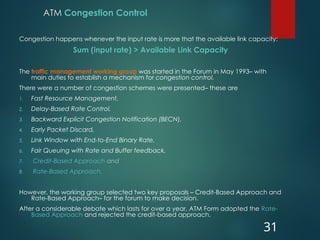
ATM Congestion Control
 Support a set of QoS parameters and classes for all ATM services
 Minimize network and en-system complexity while maximizing the network
utilization.
30
Objectives of Congestion Control ?
ATM Congestion Control
Congestion happens whenever the input rate is more that the available link capacity:
Sum (input rate) > Available Link Capacity
The traffic management working group was started in the Forum in May 1993– with
main duties to establish a mechanism for congestion control.
There were a number of congestion schemes were presented– these are
1. Fast Resource Management,
2. Delay-Based Rate Control,
3. Backward Explicit Congestion Notification (BECN),
4. Early Packet Discard,
5. Link Window with End-to-End Binary Rate,
6. Fair Queuing with Rate and Buffer feedback,
7. Credit-Based Approach and
8. Rate-Based Approach.
However, the working group selected two key proposals – Credit-Based Approach and
Rate-Based Approach– for the forum to make decision.
After a considerable debate which lasts for over a year, ATM Form adopted the Rate-
Based Approach and rejected the credit-based approach.
31
ATM Congestion Control
The following is the main selection criteria used to sort out the above proposal:
1- Scalability:
The scheme should not be limited to a particular range of speed, distance, number of
switches, or number of VCs. The scheme should be applicable for both LAN and
WAN.
2- Optimality
A fair share of bandwidth among sources, which is based on such fairness criteria as
Max-Min
3- Fairness Index
The share of bandwidth for each source should be equal to or converge to the
optimal value according to some optimality criterion.
4- Robustness
The scheme should be insensitive to minor deviations such as slight mistuning of
parameters or loss of control messages. It should also isolate misbehaving users and
protect other users from them.
5- Implementability
The scheme should not dictate a particular switch architecture. It also should not be
too complex both in term of time and space it uses.
32
ATM Congestion Control – Rate-Based Approach
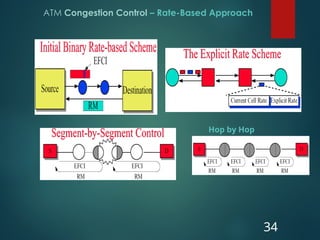
Rate-Based Approach’ basic concept:
 This approach controls the rate by which the source can transmit.
 If the network is light loaded, the source are allowed to increase its cell rate.
 If the network is congested, the source should decrease its rate.
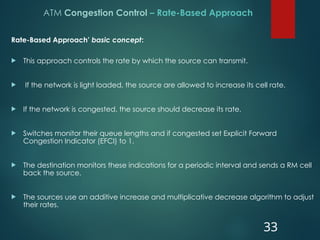
 Switches monitor their queue lengths and if congested set Explicit Forward
Congestion Indicator (EFCI) to 1.
 The destination monitors these indications for a periodic interval and sends a RM cell
back the source.
 The sources use an additive increase and multiplicative decrease algorithm to adjust
their rates.
33
ATM Congestion Control – Rate-Based Approach
34
Hop by Hop
ATM Congestion Control – Rate-Based Approach
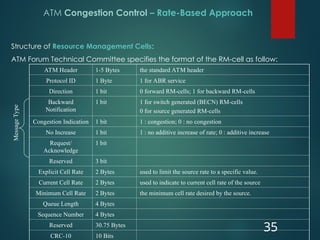
Structure of Resource Management Cells:
ATM Forum Technical Committee specifies the format of the RM-cell as follow:
35
ATM Header 1-5 Bytes the standard ATM header
Protocol ID 1 Byte 1 for ABR service
Direction 1 bit 0 forward RM-cells; 1 for backward RM-cells
Backward
Notification
1 bit 1 for switch generated (BECN) RM-cells
0 for source generated RM-cells
Congestion Indication 1 bit 1 : congestion; 0 : no congestion
No Increase 1 bit 1 : no additive increase of rate; 0 : additive increase
Request/
Acknowledge
1 bit
Reserved 3 bit
Explicit Cell Rate 2 Bytes used to limit the source rate to a specific value.
Current Cell Rate 2 Bytes used to indicate to current cell rate of the source
Minimum Cell Rate 2 Bytes the minimum cell rate desired by the source.
Queue Length 4 Bytes
Sequence Number 4 Bytes
Reserved 30.75 Bytes
CRC-10 10 Bits
Message
Type
ATM
36
Why ATM is used ?
ATM Benefits
 Revenue opportunities
 Reduces infrastructure costs through efficient bandwidth management,
operational simplicity, and the consolidation of overlay networks.
 High performance via hardware switching
 Dynamic bandwidth for bursty traffic
37
Conclusion
ATM is a flexible and powerful technology which integrates the cell-switching and
multiplexing functions, and enables transmissions over a variety of carrier system.
It’s designed for high performance multimedia networking, and suitable for bursty
traffic.
ATM technology is a powerful common platform for LAN and WAN to increase
productivity, to reduce costs and to implement new applications and service.
Thus, the potential demand for ATM is a direct result of the widespread of LANs and
WANs, massive demand for file transfers, and growing interest in “paperless
office” technologies.
The growing in multimedia market is another huge potentiality of ATM.
However, the success of ATM will be determined by two sequential events: first how
fast the
standard is finalized and then how fast can vendors bring ATM products to the
market.
38
Question
1 - Which field in the ATM header can check the header error?
39
Answer : HEC – Header Error Control (HEC)
2 – What is the size of ATM frame ?
Answer : 53 Bytes

lecture 5_.ppt, Asynchronous Transfer Mode

  • 1.
  • 2.
    Answer three basicQuestions : 2 What? – what is ATM How ? – how it works. Why? -- why it’s used (benefits) Presentation Objectives
  • 3.
    Outline I - Introduction: Definition  Overview: History, Features II - ATM Protocol/Architecture  Reference Model  Architecture of ATM network  Virtual Connection  Cell Formatted  ATM Routing  Congestion Control - Service - Quality of Service - Rate-Based Approach III- ATM Benefit IV - Conclusion 3 What ? How ? Why?
  • 4.
    ATM Definition Asynchronous TransferMode (ATM) A high-performance, cell-oriented switching and multiplexing technology that utilizes fixed-length packets to carry different types of traffic. Asynchronous Transfer Mode (ATM) is a high-speed, cell-switching, packet- oriented networking technology designed to support the simultaneous transmission of voice, video, and data over the same network infrastructure. It was developed in the late 1980s and became a core technology for broadband Integrated Services Digital Networks (B-ISDN). 4
  • 5.
    ATM Overview ATM:  ATMwas designed in early 1990s  ATM aim is to expedite the process of integrating AMT into the market.  It is designed for high-performance multimedia networking.  It enables carriers to transmit voice, video, and future media applications.  It’s suitable for bursty traffic.  It allows communication between devices that operate at different speeds.  It can be offered as an end-user service by service providers, or as a networking infrastructure  It is a set of international interface and signaling standards defined by ITU-T Standards Sector. 5
  • 6.
    ATM Overview So far,ATM has been implemented in :  PC, workstation, and server network interface cards  Switched-Ethernet and token-ring workgroup hubs  ATM enterprise network switches  ATM multiplexers  ATM-edge switches  ATM-backbone switches 6
  • 7.
    ATM Features Main featuresof ATM  Service is connection oriented, with data transferred over a VC  A cell-switched network (architecture).  Fixed-size cell (53-Bytes)  Uses Asynchronous time-division multiplexing (Asynchronous TDM)  The Quantity of Service (QofS) enable carriers to transmit voice, data, and video.  ATM is independent of the transmission medium. ATM cells can be sent on a wire or fiber, and can also be packaged inside the payload of other carrier system. 7
  • 8.
    Fixed and SmallSize Cell Advantage:  Transmitted with predictability and uniformity.  Easy to be multiplexed with other cells, and routed through the cell network.  With high speed of the links, small and fixed-size cells seem to arrive their respective destinations in an approximation of continuous stream, despite interleaving. E.g. phone call.  Simpler buffer hardware, avoiding memory fragmentation problem  Simpler cells scheduling: - Easier to allocate different bandwidths and delays to different VCs. - Easier to implement priority - Fixed sized can be switched in parallel in synchronous fashion.  It’s suitable for time-critical information such as voice or video  Quicker recovery in case of circuit failure. 8
  • 9.
    Fixed-Size and SmallCell Disadvantage:  Processing overhead as messages are segmented into cells  Segmentation mismatch, as the last cell in a fragmented message may not be fully used. This effect will decrease as the message length increases. 9
  • 10.
    ATM multiplexing a) AsynchronousTDM : ATM multiplexers fill a slot with a cell from any input channel that has a cell. b) TDM 10
  • 11.
  • 12.
    ATM Technology Reference Model 12 Control responsiblefor generating and managing signaling request (connection management). User deals with data transport, flow control, error correction, and other user functions.  Layer Management : manages layer-specific functions (detection of failures and protocol problems) Plane Management: manages and coordinates functions related to the complete system.
  • 13.
    ATM Technology Reference Model 13 PhysicalMedium-Dependent (PMD)– having two functions:  Synchronizes transmission and reception by sending and receiving a continuous flow of bits with associated timing information.  Specifies the physical media for the physical medium used, including connector type and cable.
  • 14.
    ATM Technology Reference Model TransmissionConvergence (TC) – having four functions:  Cell delineation, generating cell boundaries.  Header error control (HEC) sequence generation and verification  Cell-rate decoupling, maintaining synchronization and inserting or suppressing idle ATM cells to rate of valid ATM cells to the payload capacity of transmission system.  Transmission frame adaptation, packaging cells into frame acceptable to the particular physical layer implementation. 14
  • 15.
    ATM Technology Reference Model ATMLayer Provides  Defining cells layout  Defining header  Routing  Establishment and release VC.  Switching  Multiplexing  Congestion control. 15
  • 16.
    ATM Technology Reference Model ATMdefines four versions of the AAL: - AAL1: Support Constant-bit-rate data (CBR) from upper layer; video and voice. - AAL2: Used for low-bit-rate and short-frame traffic such as audio (compressed or uncompressed), video, or fax. AAL2 allows the multiplexing of short frames into one cell. - AAL3/4: support connection-oriented and connenctionless data services - AAL5: Assumes that all cells belonging to a single message travel sequentially and that control functions are included in the layers of the sending application. 16
  • 17.
    ATM Technology Reference Model ATMAdaptation Layer (AAL)  Enables ATM to accept any type of payload, both data frames and streams of bits  Fragments them into small and fixed-size Cells  Reassembles Cells Convergence sub layer (CS): prepares data to ensure their integrity, providing standard interface. Segmentation and Reassembly (SAR): Segments the payload into 48-byte cells, and at the destination, reassemble them to recreate the original payload. 17
  • 18.
  • 19.
  • 20.
    ATM Technology Architecture ofATM Network 20 User-to-network interface (UNI): interface between endpoint (user access devices) and network switches. Network-to-network interface (NNIs): interface between switches insides the network. vc vc vc vp vp vp
  • 21.
    ATM Technology ATM VirtualConnection 1- Transmission Path (TP): the physical connection (wire, cable, satellite, … ) between an endpoint and a switch or between two switches. 2- Virtual Paths (VPs): provides a connection or a set of connections between two switches. 3- Virtual Circuits (VCs): Cell networks are based on virtual circuits. All cells belonging a single message follow the same virtual circuit and remain in their original order until they reach their destination. VC must be set up across the ATM network prior to any data transfer. 21
  • 22.
    ATM Technology ATM Frameand Header Structure 22
  • 23.
    ATM Technology ATM Frameand Header Structure 23 Generic Flow Control (GFC) provides flow control at the UNI level Virtual Path Identifier (VPI) identifies the cell’s next VP to pass through a series of network. Virtual Channel Identifier (VCI) Identifies the cell’s next VC inside the VP. Payload Type (PT) The first bit indicates whether the cell contains user data (bit 0) or control data (bit 1). The second bit indicates congestion (0 = no congestion, 1 = congestion), and The third bit indicates whether the cell is the last in a series of cells (1 = last cells for the frame) Cell Loss Priority (CLP) Indication if the cell should be discarded if it encounters extreme congestions as it moves through the network (bit 1 = discarded in referenced to cells with CLP equal to 0) Header Error Control (HEC) Calculates checksum only on the first 4 bytes of the header. HEC can detect error and correct a single bit error in these bytes—thus preserving the cell rather than discarding it.
  • 24.
    ATM Routing  Acell of 53 bytes is used as a data unit for transfer.  ATM uses two types of connections: a permanent virtual circuit (PVC) and a Switch Virtual Circuit (SVC).  ATM uses switches to route the cell from one source endpoint to the destination  A switch routes the cell using both the VPIs and the VCIs. 24
  • 25.
  • 26.
    ATM Services 1- ConstantBit Rate (CBR):  CBR is used by a connections that requires a static amount of bandwidth that is continuously available during the connection time.  It appropriates for such applications as telephone traffic, video conferencing, interactive Audio, TV 2- Rate-Non-Real Time Variable Bit (nrt-VBR)  Allows users to send traffic at a rate that varies with time depending on the availability of user information.  Application: email. 3- Rate-Real Time Variable Bit Rate (rt-VBR):  Intended for those application which requires tightly constrained delay and delay variation.  Application: voice with speech activity detection (SAD) and interactive compressed video. 4- Available Bit Rate (ABR)  Provides rate-based flow control  Depending on the state of congestion in the network, the source is required to control its rate.  Allows users to declare a minimum cell rate guaranteed to the connection by the network.  Aimed at data traffic such as file transfer and e-mail. 5- Unspecified Bit Rate (UBR)  Intended for non-real time application which do not require tightly constrained delay and delay variation.  Widely used today for TCP/IP 26
  • 27.
    ATM Quality ofService (QoS) and Traffic Attributes 27 The following QoS parameters need to be specified by the user when setting up the connection QoS Parameters Definition Cell Transfer Delay (CTD) -The delay between the first bit of the cell is transmitted by the source and the last bit of the cell is received by the destination - Includes propagation delays, queuing delays at various switches, and service times at queuing points. Cell Delay Variation (CDV) The difference of the maximum and minimum CTD experienced during the connection. Cell Lost Ratio (CLR) The percentage of cells lost in the network due to congestion and buffer overflow. Cell Delay Variation Tolerance (CDVT) Allows the users to send above PCR with a certain tolerance.
  • 28.
    ATM Quality ofService (QoS) and Traffic Attributes 28 Traffic Parameters Definition Peak Cell Rate (PCR) The maximum cell rate at which the user will transmit. Sustained Cell Rate (SCR) The maximum long-term average cell rate of the user. Burst Tolerance (BT) Determines the max burst that can be sent at the peak rate. Maximum Burst Size (MBS) The max number of cells that can be sent at the peak cell rate, but without violating the sustained cell rate. Minimum Cell Rate (MCR) The minimum rate desired by a user The following traffic attributes also needs to be specified by the user during the connection setup.
  • 29.
    ATM Quality ofService (QoS) and Traffic Attributes 29 Attribute CBR Rt-VBR Nr-VBR UBR ABR PCR and CDVT YES YES YES YES YES SCR, MBS, CDVT n/a YES YES n/a n/a MCR n/a n/a n/a n/a YES Peak-to-peak CDB YES YES NO NO NO Mean CTD NO NO YES NO NO Maximum CTD YES YES NO NO NO CLR YES YES YES NO YES Congestion Control NO NO NO NO YES Among these service classes, ABR is commonly used for data transmissions which require a guaranteed QoS, such as low probability of loss and error. Small delay is also required for some application. Due to the burstiness, upreditability and huge amount of the data traffic, congestion control of this class is the most needed.
  • 30.
    ATM Congestion Control Support a set of QoS parameters and classes for all ATM services  Minimize network and en-system complexity while maximizing the network utilization. 30 Objectives of Congestion Control ?
  • 31.
    ATM Congestion Control Congestionhappens whenever the input rate is more that the available link capacity: Sum (input rate) > Available Link Capacity The traffic management working group was started in the Forum in May 1993– with main duties to establish a mechanism for congestion control. There were a number of congestion schemes were presented– these are 1. Fast Resource Management, 2. Delay-Based Rate Control, 3. Backward Explicit Congestion Notification (BECN), 4. Early Packet Discard, 5. Link Window with End-to-End Binary Rate, 6. Fair Queuing with Rate and Buffer feedback, 7. Credit-Based Approach and 8. Rate-Based Approach. However, the working group selected two key proposals – Credit-Based Approach and Rate-Based Approach– for the forum to make decision. After a considerable debate which lasts for over a year, ATM Form adopted the Rate- Based Approach and rejected the credit-based approach. 31
  • 32.
    ATM Congestion Control Thefollowing is the main selection criteria used to sort out the above proposal: 1- Scalability: The scheme should not be limited to a particular range of speed, distance, number of switches, or number of VCs. The scheme should be applicable for both LAN and WAN. 2- Optimality A fair share of bandwidth among sources, which is based on such fairness criteria as Max-Min 3- Fairness Index The share of bandwidth for each source should be equal to or converge to the optimal value according to some optimality criterion. 4- Robustness The scheme should be insensitive to minor deviations such as slight mistuning of parameters or loss of control messages. It should also isolate misbehaving users and protect other users from them. 5- Implementability The scheme should not dictate a particular switch architecture. It also should not be too complex both in term of time and space it uses. 32
  • 33.
    ATM Congestion Control– Rate-Based Approach Rate-Based Approach’ basic concept:  This approach controls the rate by which the source can transmit.  If the network is light loaded, the source are allowed to increase its cell rate.  If the network is congested, the source should decrease its rate.  Switches monitor their queue lengths and if congested set Explicit Forward Congestion Indicator (EFCI) to 1.  The destination monitors these indications for a periodic interval and sends a RM cell back the source.  The sources use an additive increase and multiplicative decrease algorithm to adjust their rates. 33
  • 34.
    ATM Congestion Control– Rate-Based Approach 34 Hop by Hop
  • 35.
    ATM Congestion Control– Rate-Based Approach Structure of Resource Management Cells: ATM Forum Technical Committee specifies the format of the RM-cell as follow: 35 ATM Header 1-5 Bytes the standard ATM header Protocol ID 1 Byte 1 for ABR service Direction 1 bit 0 forward RM-cells; 1 for backward RM-cells Backward Notification 1 bit 1 for switch generated (BECN) RM-cells 0 for source generated RM-cells Congestion Indication 1 bit 1 : congestion; 0 : no congestion No Increase 1 bit 1 : no additive increase of rate; 0 : additive increase Request/ Acknowledge 1 bit Reserved 3 bit Explicit Cell Rate 2 Bytes used to limit the source rate to a specific value. Current Cell Rate 2 Bytes used to indicate to current cell rate of the source Minimum Cell Rate 2 Bytes the minimum cell rate desired by the source. Queue Length 4 Bytes Sequence Number 4 Bytes Reserved 30.75 Bytes CRC-10 10 Bits Message Type
  • 36.
  • 37.
    ATM Benefits  Revenueopportunities  Reduces infrastructure costs through efficient bandwidth management, operational simplicity, and the consolidation of overlay networks.  High performance via hardware switching  Dynamic bandwidth for bursty traffic 37
  • 38.
    Conclusion ATM is aflexible and powerful technology which integrates the cell-switching and multiplexing functions, and enables transmissions over a variety of carrier system. It’s designed for high performance multimedia networking, and suitable for bursty traffic. ATM technology is a powerful common platform for LAN and WAN to increase productivity, to reduce costs and to implement new applications and service. Thus, the potential demand for ATM is a direct result of the widespread of LANs and WANs, massive demand for file transfers, and growing interest in “paperless office” technologies. The growing in multimedia market is another huge potentiality of ATM. However, the success of ATM will be determined by two sequential events: first how fast the standard is finalized and then how fast can vendors bring ATM products to the market. 38
  • 39.
    Question 1 - Whichfield in the ATM header can check the header error? 39 Answer : HEC – Header Error Control (HEC) 2 – What is the size of ATM frame ? Answer : 53 Bytes

Editor's Notes

  • #7 Cell-based Transmission: ATM divides all transmitted information into fixed-size packets called cells. Each ATM cell is 53 bytes long — 5 bytes for the header and 48 bytes for the payload (data). The fixed size allows for predictable transmission delay and efficient switching. Asynchronous Operation Unlike synchronous systems, ATM does not transmit data at regular intervals. Cells are sent only when data is available, making bandwidth usage more efficient. Connection-Oriented Service A virtual circuit (either Permanent Virtual Circuit – PVC or Switched Virtual Circuit – SVC) must be set up before communication. Ensures Quality of Service (QoS) and reliable delivery. Scalability and Flexibility Can handle speeds from a few Mbps to multiple Gbps. Suitable for Local Area Networks (LANs), Wide Area Networks (WANs), and metropolitan networks.