Packet Switching
(X.25 Protocol)
Prepared by:
Miles Kevin B. Galario
Packets
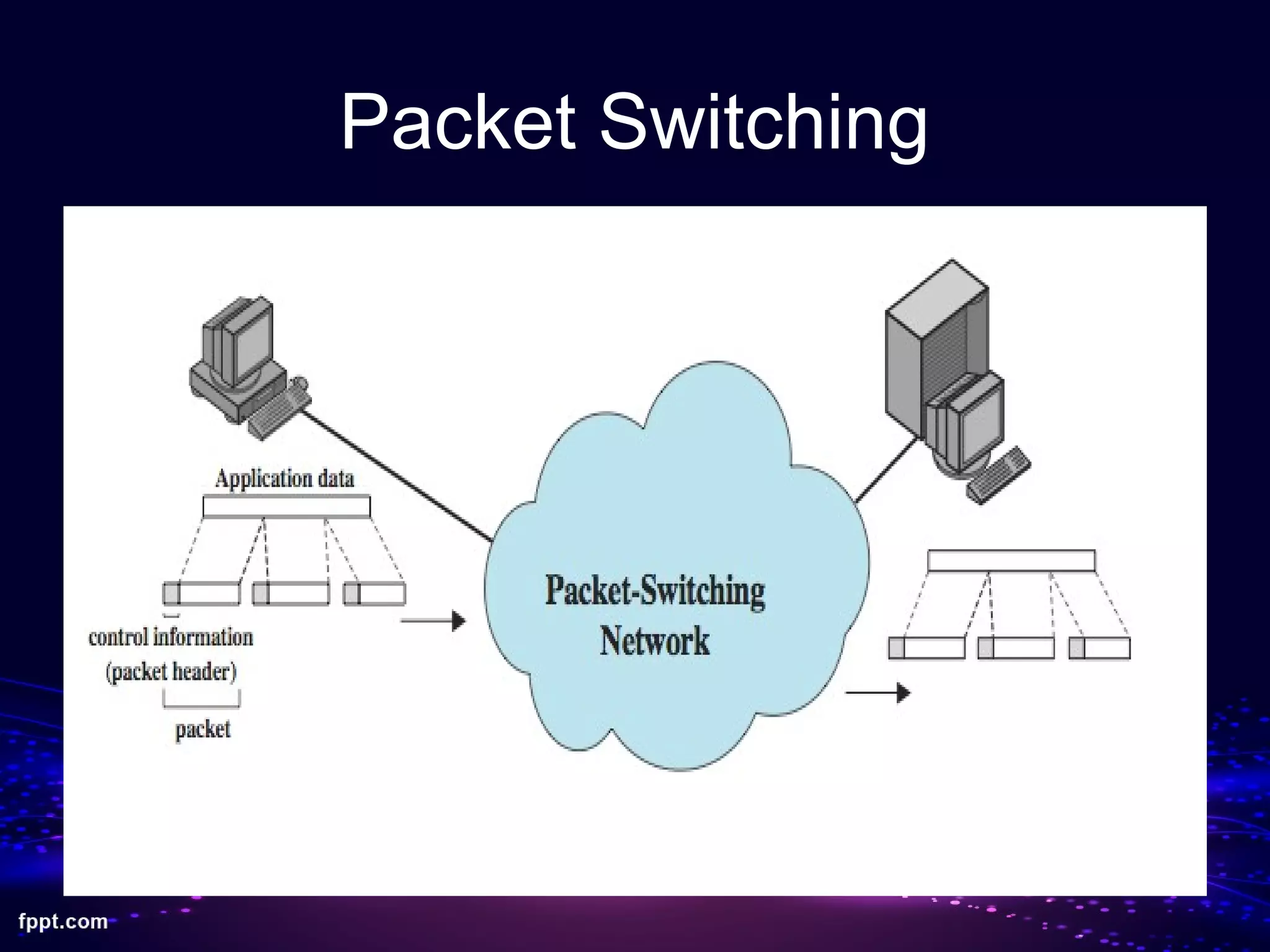
• Network packet is a formatted unit
of data carried by a packet-switched
network.
• Consist of 2 types of data:
– Control information
– User data
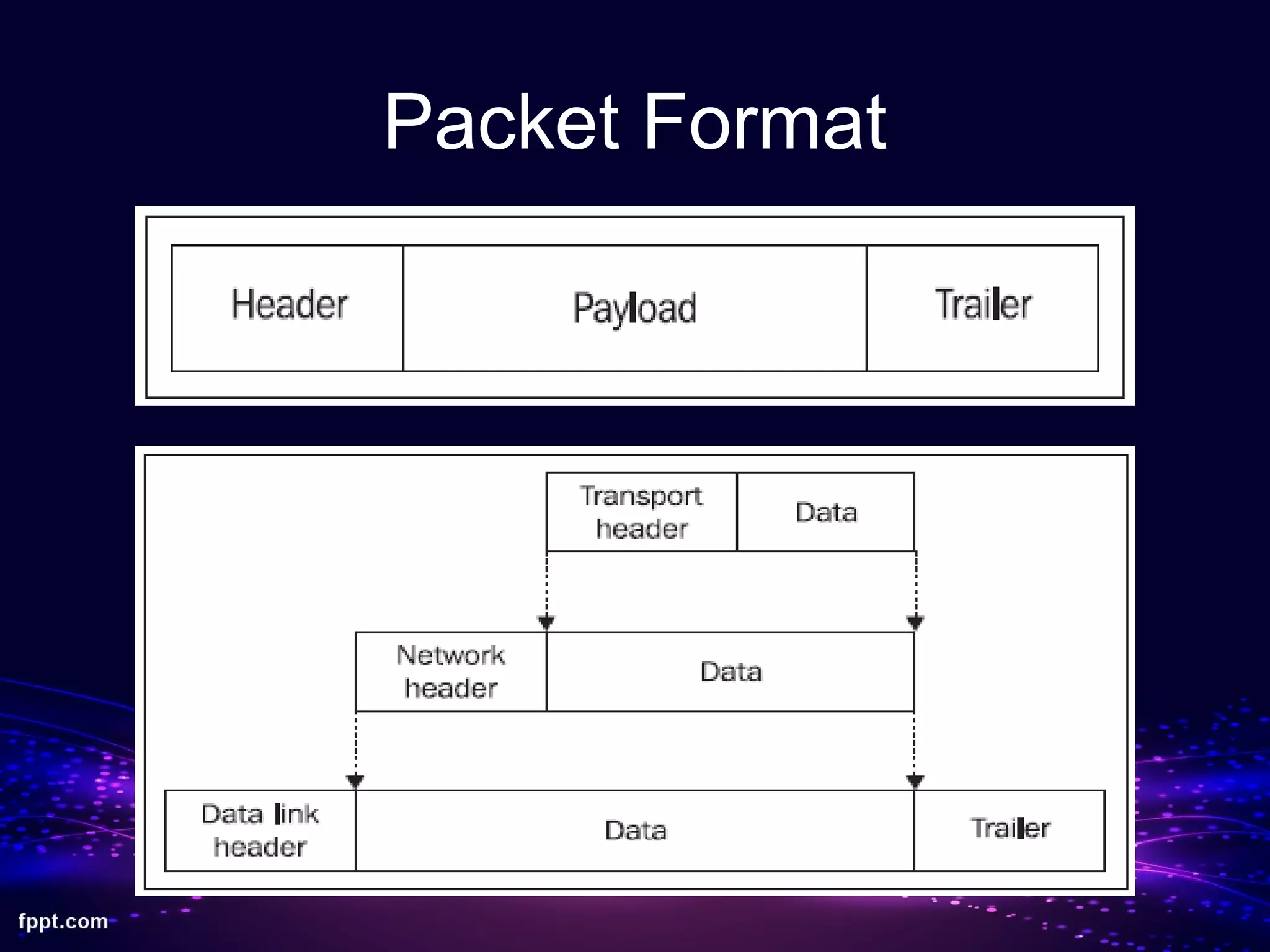
Packet Format
Asynchronous data transmission
Packet Switching
Packet Switching
• Began around early 1960’s
• First developed by Paul Baran
• Is a digital networking communications
method that groups all transmitted data -
regardless of content, type, or structure –
into suitably-sized blocks, called packets.
Advantages of Packet Switching
• Line efficiency
• Data rate conversion
• Packets are accepted even when network
is busy
• High data transmission quality
• When it comes to billing:
– Fee is just the duration of connectivity
Disadvantages of Packet Switching
• More complex
• Data Transmission Delays
• Packets may be lost on their route
(Datagram)
Packet
Switching
Datagram
Approach
Datagram Packet Switching
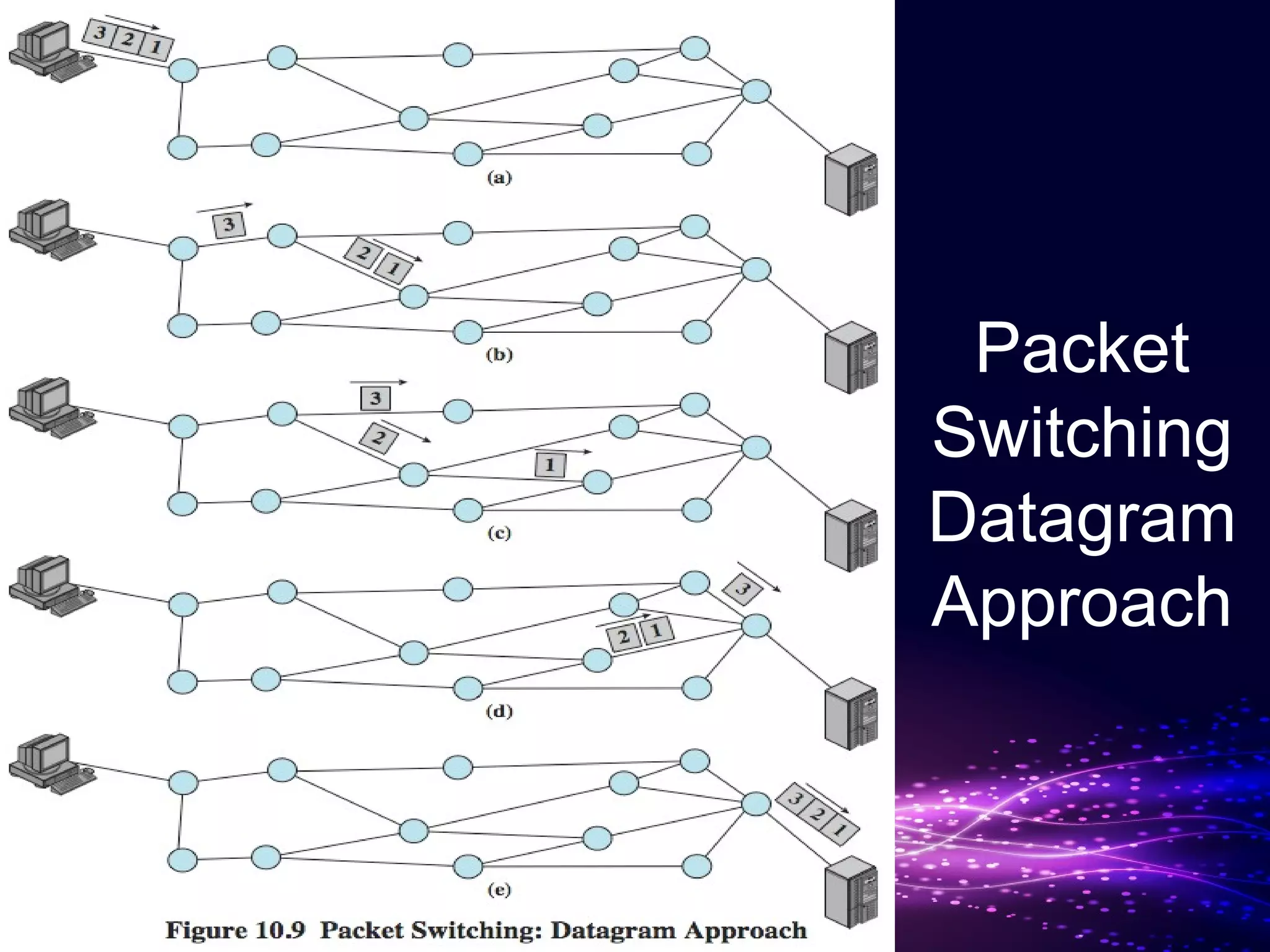
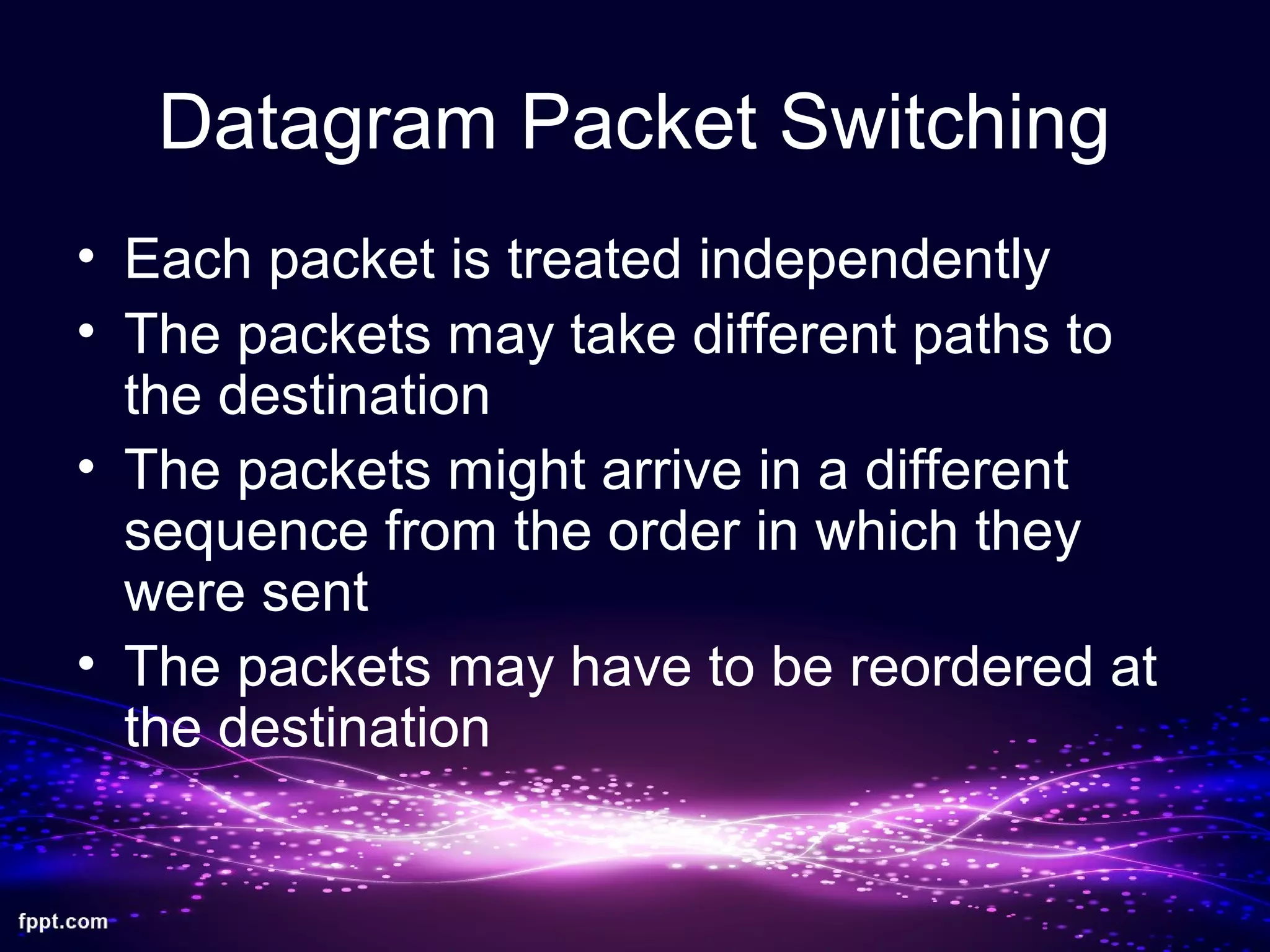
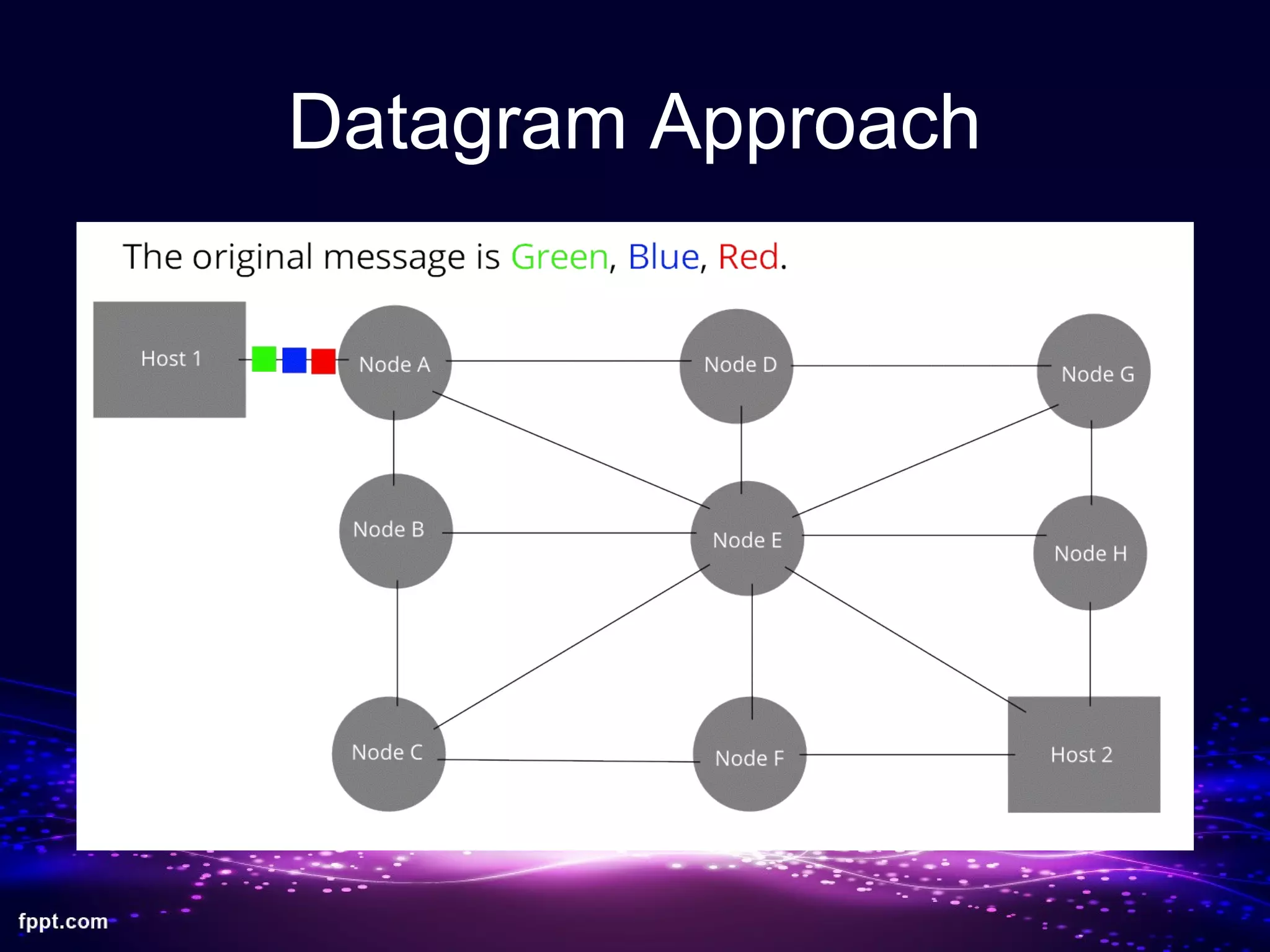
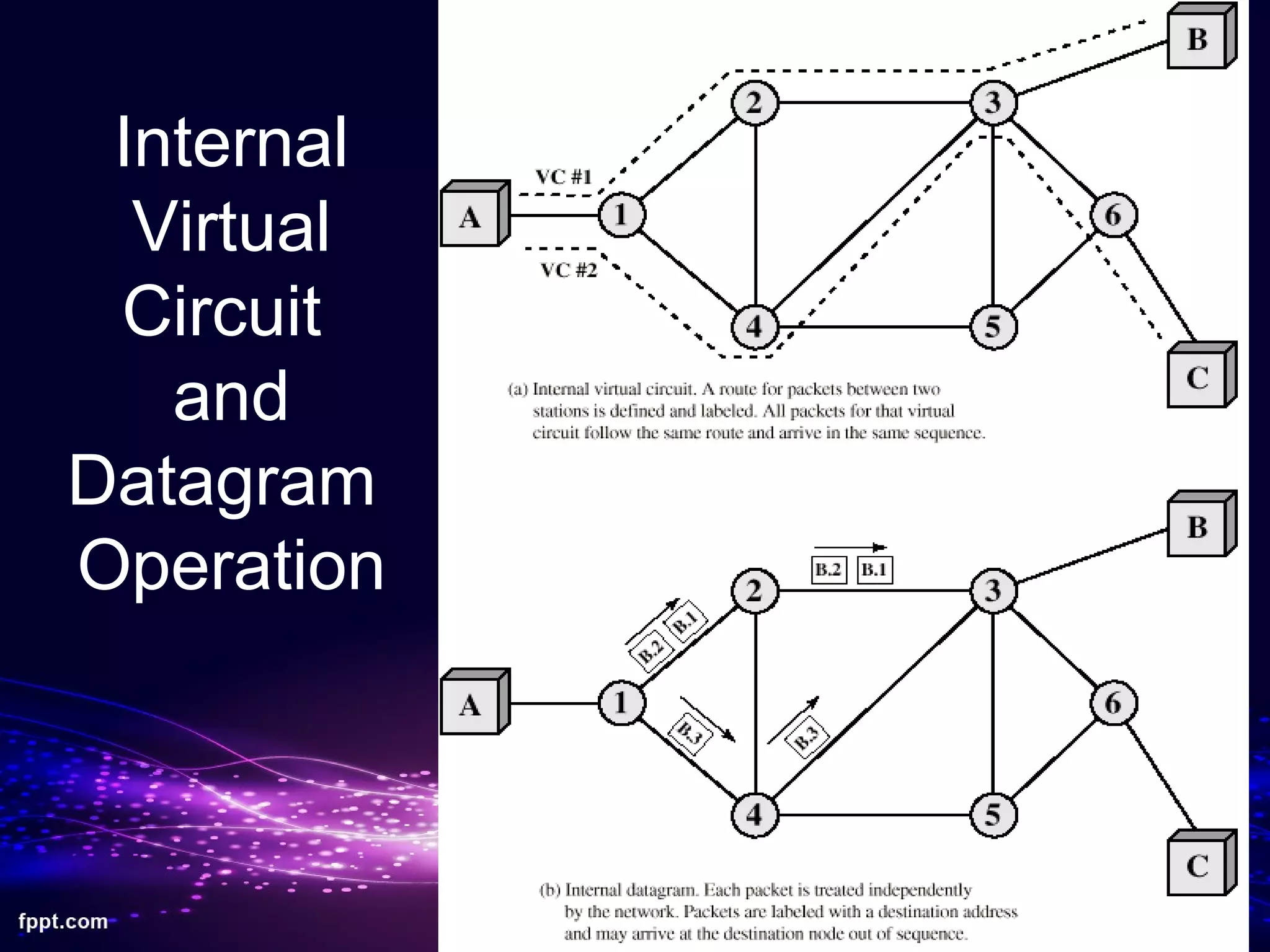
• Each packet is treated independently
• The packets may take different paths to
the destination
• The packets might arrive in a different
sequence from the order in which they
were sent
• The packets may have to be reordered at
the destination
Datagram Approach
Packet
Switching
Virtual
Circuit
Approach
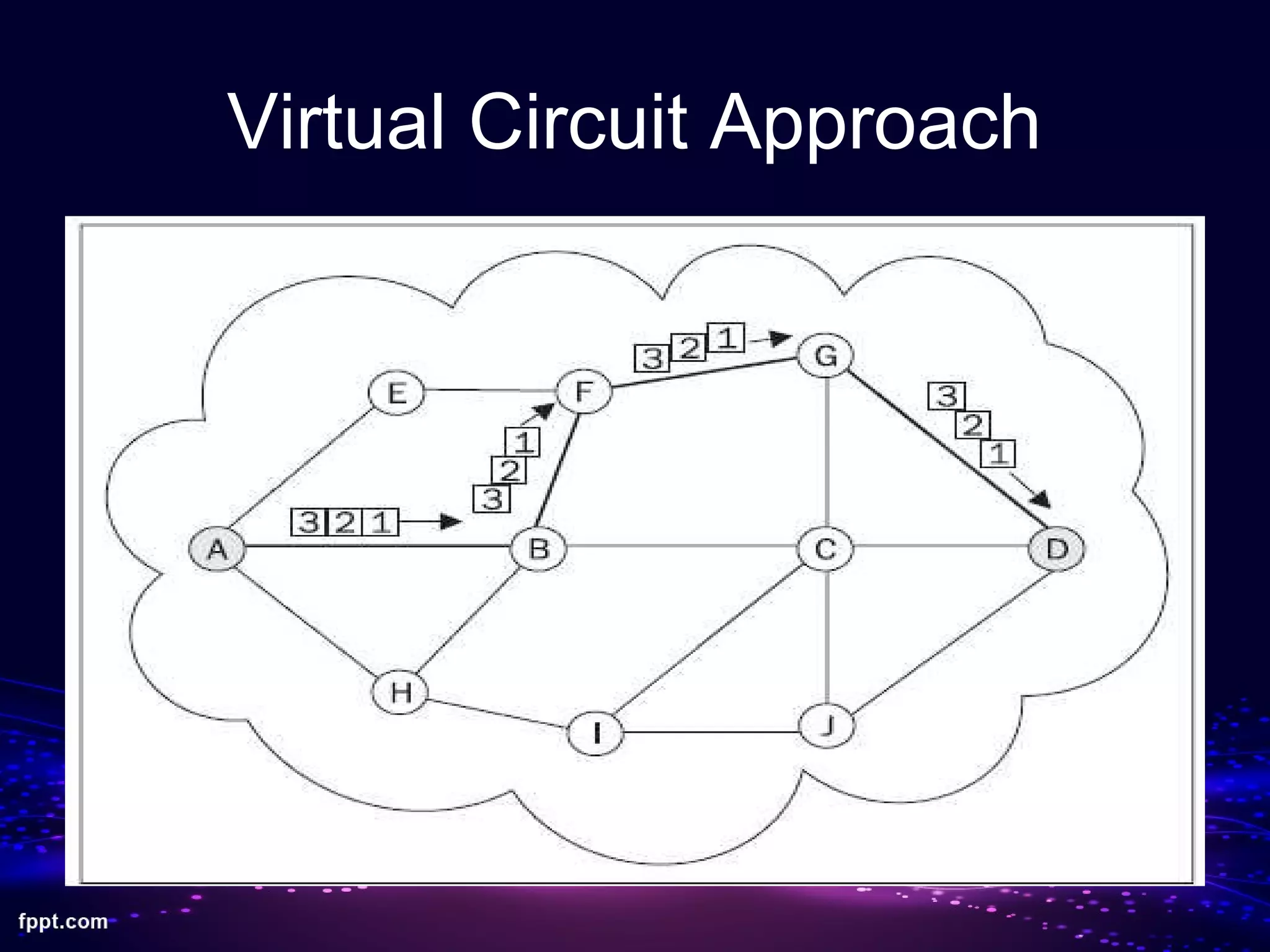
Virtual Circuit Packet Switching
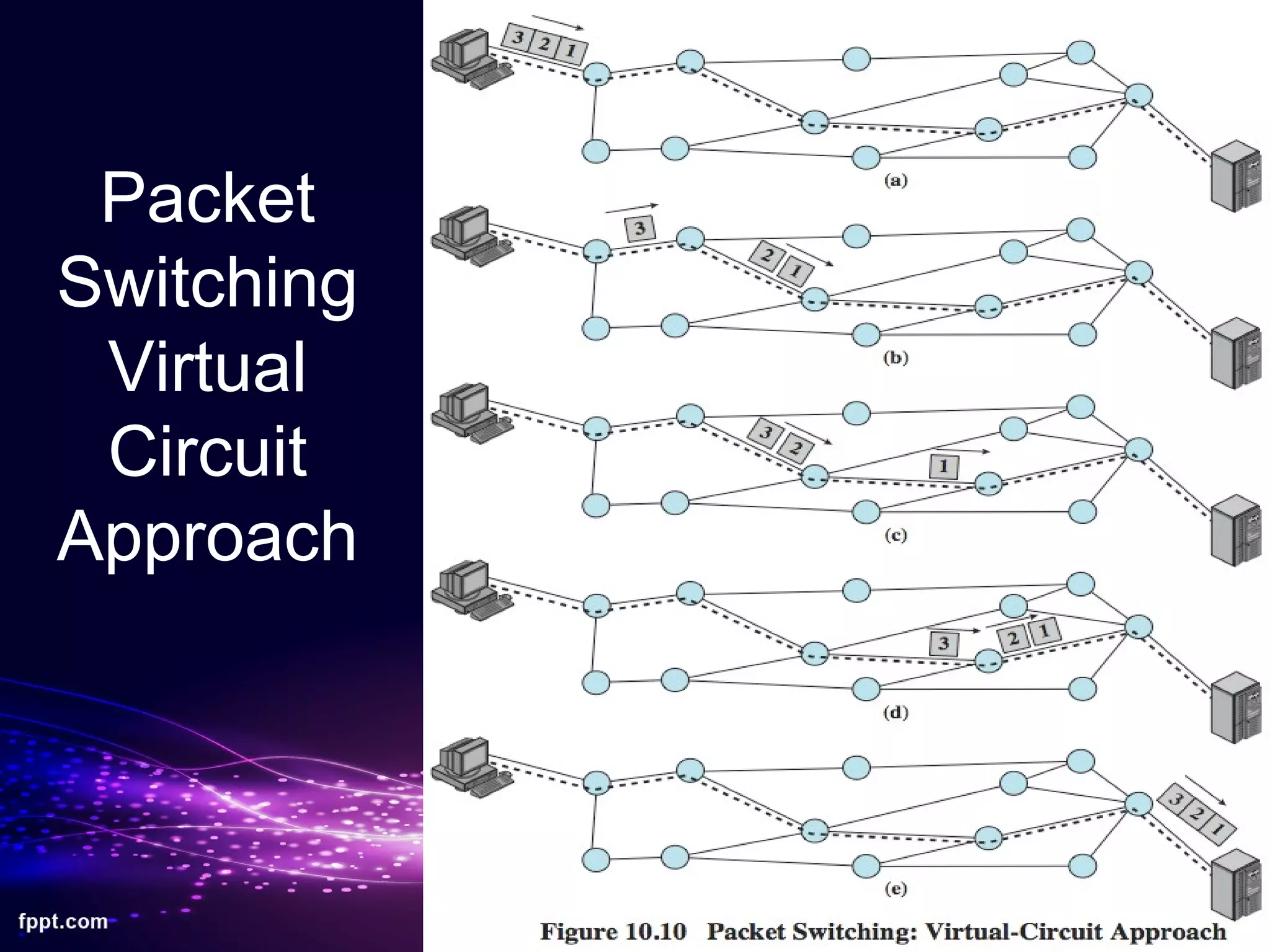
• A logical connection is established before
any packets are sent
• All packets follow the same path through
the network
• This does not mean that there is a
dedicated path, as in circuit switching
• There is a call set up before the exchange
of data (handshake).
Virtual Circuit Approach
SVC vs. PVC
• Switched Virtual Circuit (SVC)
• Permanent Virtual Circuit (PVC)
16
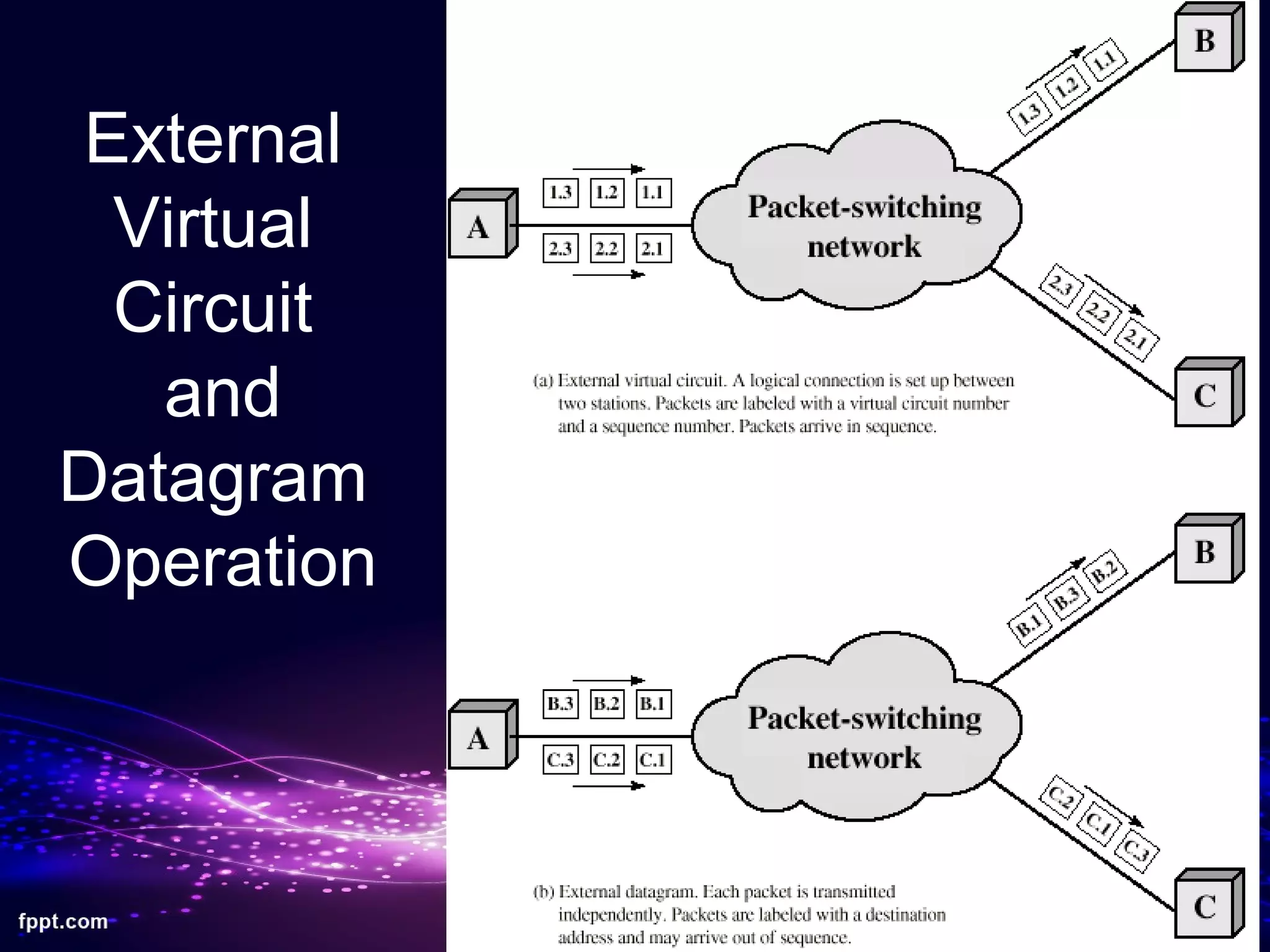
External
Virtual
Circuit
and
Datagram
Operation
17
Internal
Virtual
Circuit
and
Datagram
Operation
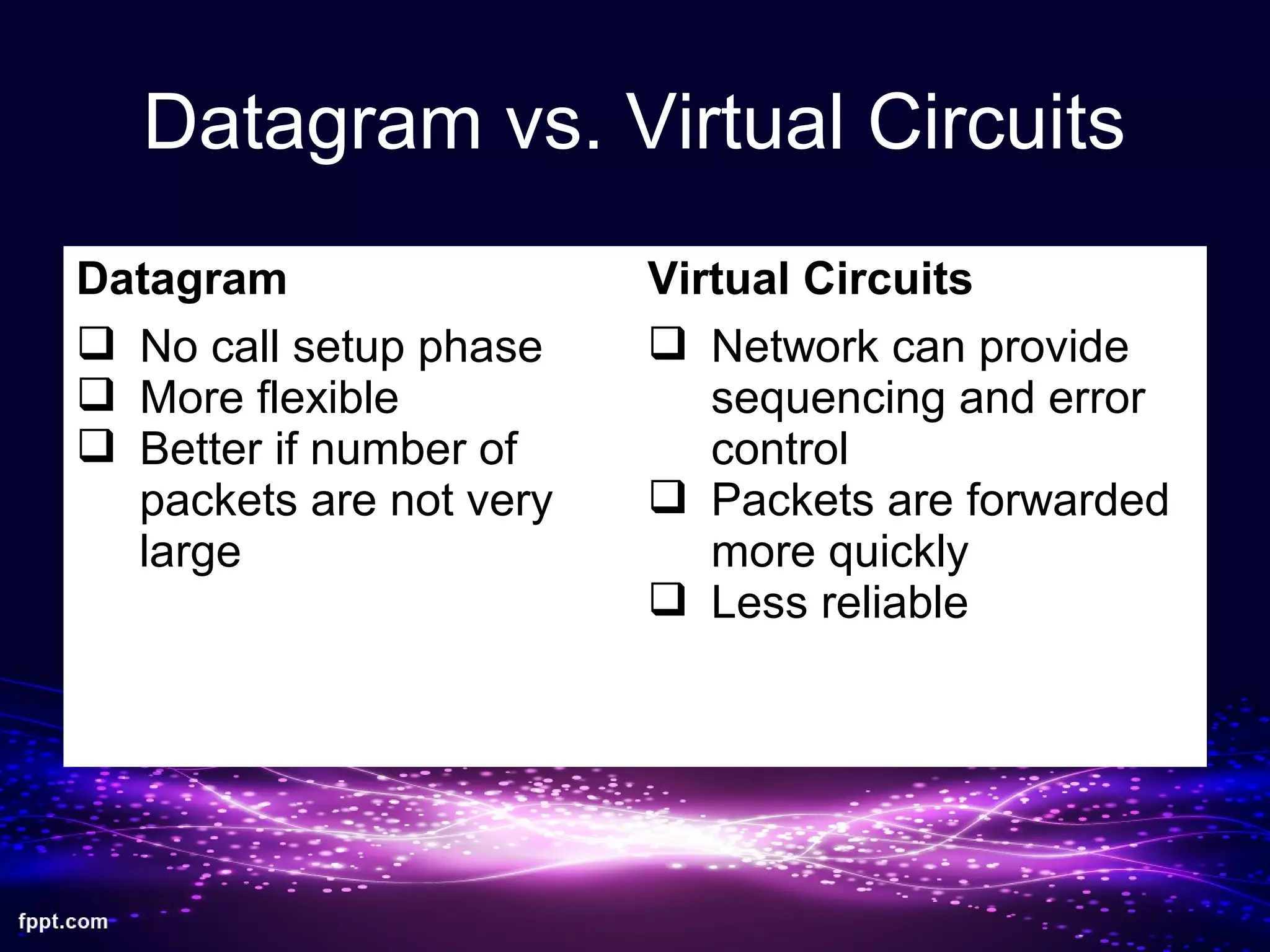
Datagram vs. Virtual Circuits
Datagram Virtual Circuits
 No call setup phase
 More flexible
 Better if number of
packets are not very
large
 Network can provide
sequencing and error
control
 Packets are forwarded
more quickly
 Less reliable
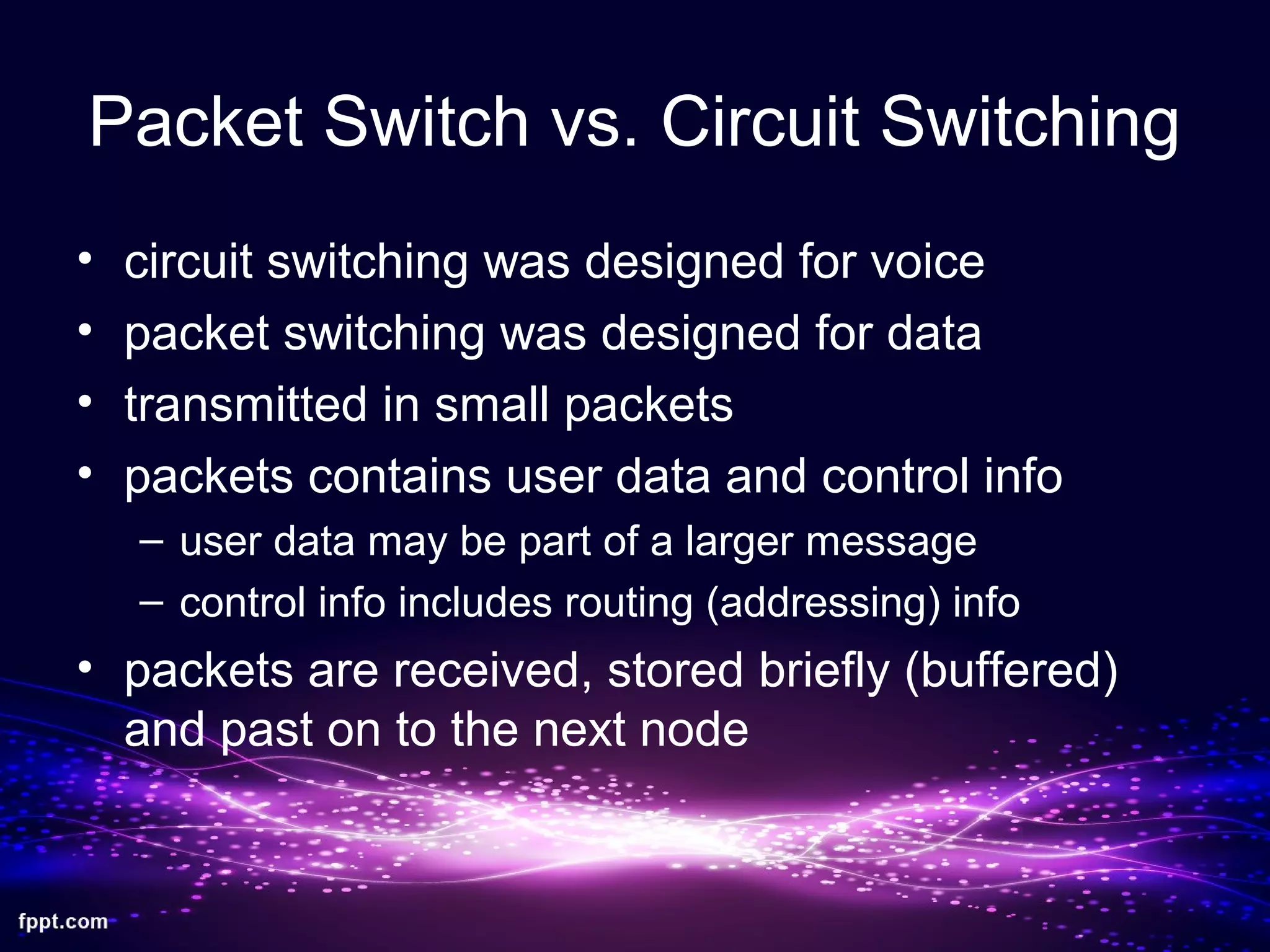
Packet Switch vs. Circuit Switching
• circuit switching was designed for voice
• packet switching was designed for data
• transmitted in small packets
• packets contains user data and control info
– user data may be part of a larger message
– control info includes routing (addressing) info
• packets are received, stored briefly (buffered)
and past on to the next node
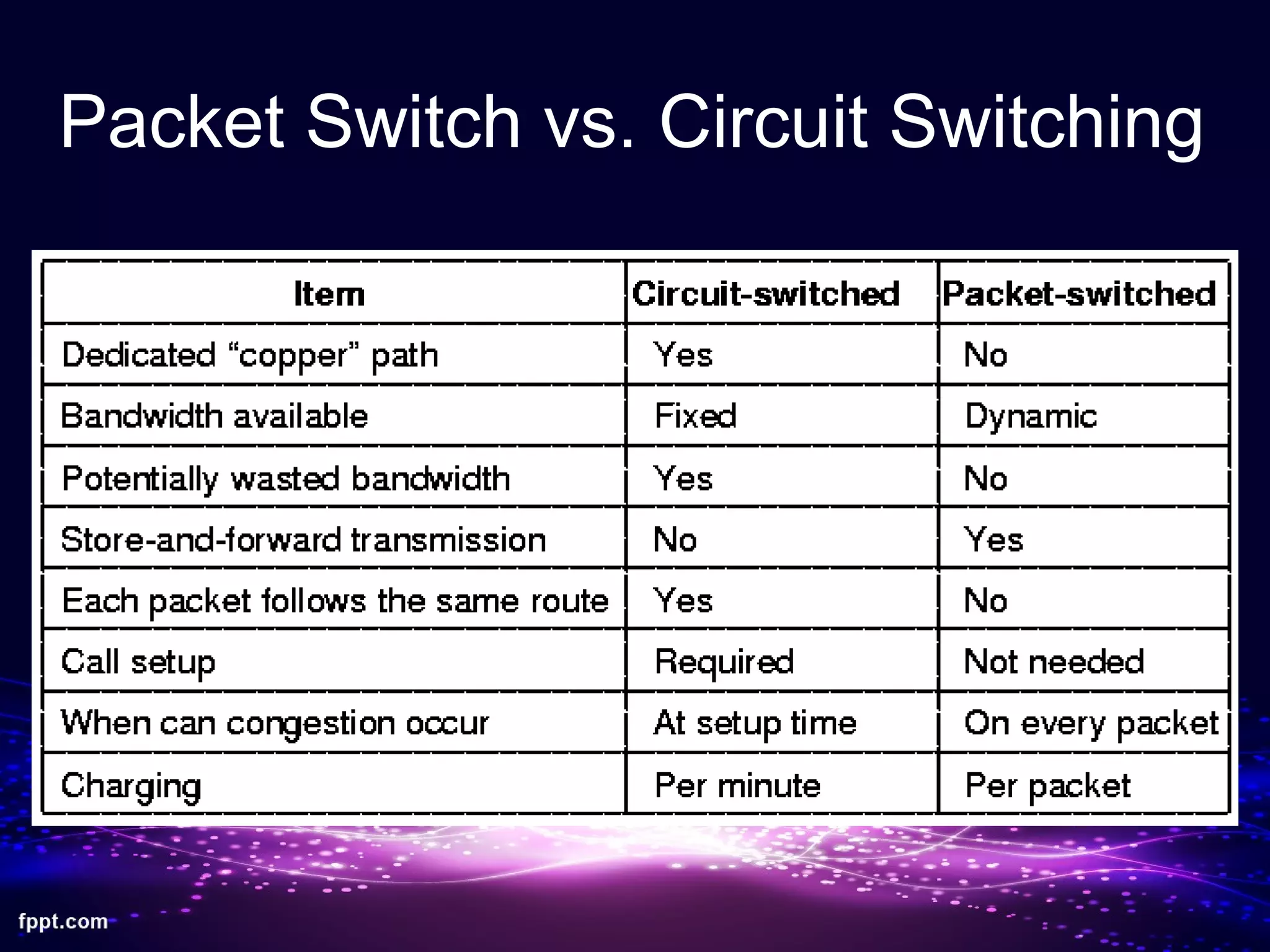
Packet Switch vs. Circuit Switching
Packet Switching Service Protocols
• There are five protocols in use for packet-
switched services:
– X.25
– Asynchronous Transfer Mode (ATM)
– Frame Relay
– Switched Multimegabit Data Service (SMDS)
– Ethernet/IP packet networks
X.25 Protocol
• ITU-T standard for interface between host
and packet switched network
• Oldest packet switched service.
• Almost universal on packet switched
networks and packet switching in ISDN
• X.25 offers switched virtual circuit and
permanent virtual circuit services.
X.25 Protocol
• X.25 is a reliable protocol, meaning it
performs error control and retransmits bad
packets.
• Although widely used in Europe, X.25 is
not in widespread use in North America.
The primary reason is the low
transmission speed, now 2.048 Mbps (up
from 64 Kbps)
.
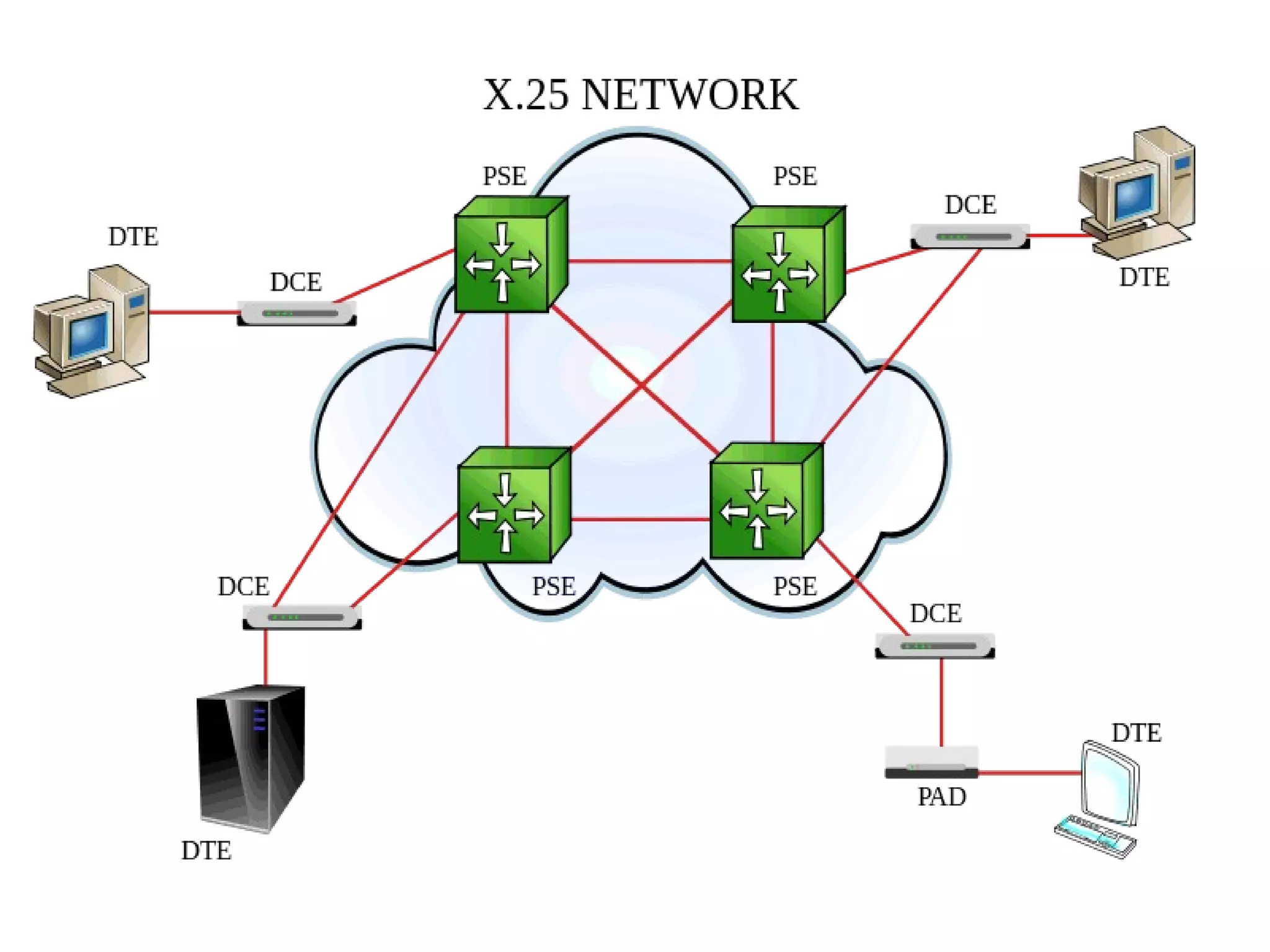
PAD
• Packet Assembler/Disassembler
–is a communications device which
provides multiple asynchronous terminal
connectivity to an X.25 (packet-
switching) network or host computer.
X.25 - Physical
• Interface between station node link
• Two ends are distinct
– Data Terminal Equipment DTE (user
equipment)
– Data Circuit-terminating Equipment DCE
(node)
• Physical layer specification is X.21
• Can substitute alternative such as EIA-232
X.25 - Link
• Link Access Protocol Balanced (LAPB)
• Provides reliable transfer of data over link
• Sending as a sequence of frames
X.25 - Packet
• Provides a logical connections (virtual
circuit) between subscribers
• All data in this connection form a single
stream between the end stations
• Established on demand
• Termed external virtual circuits
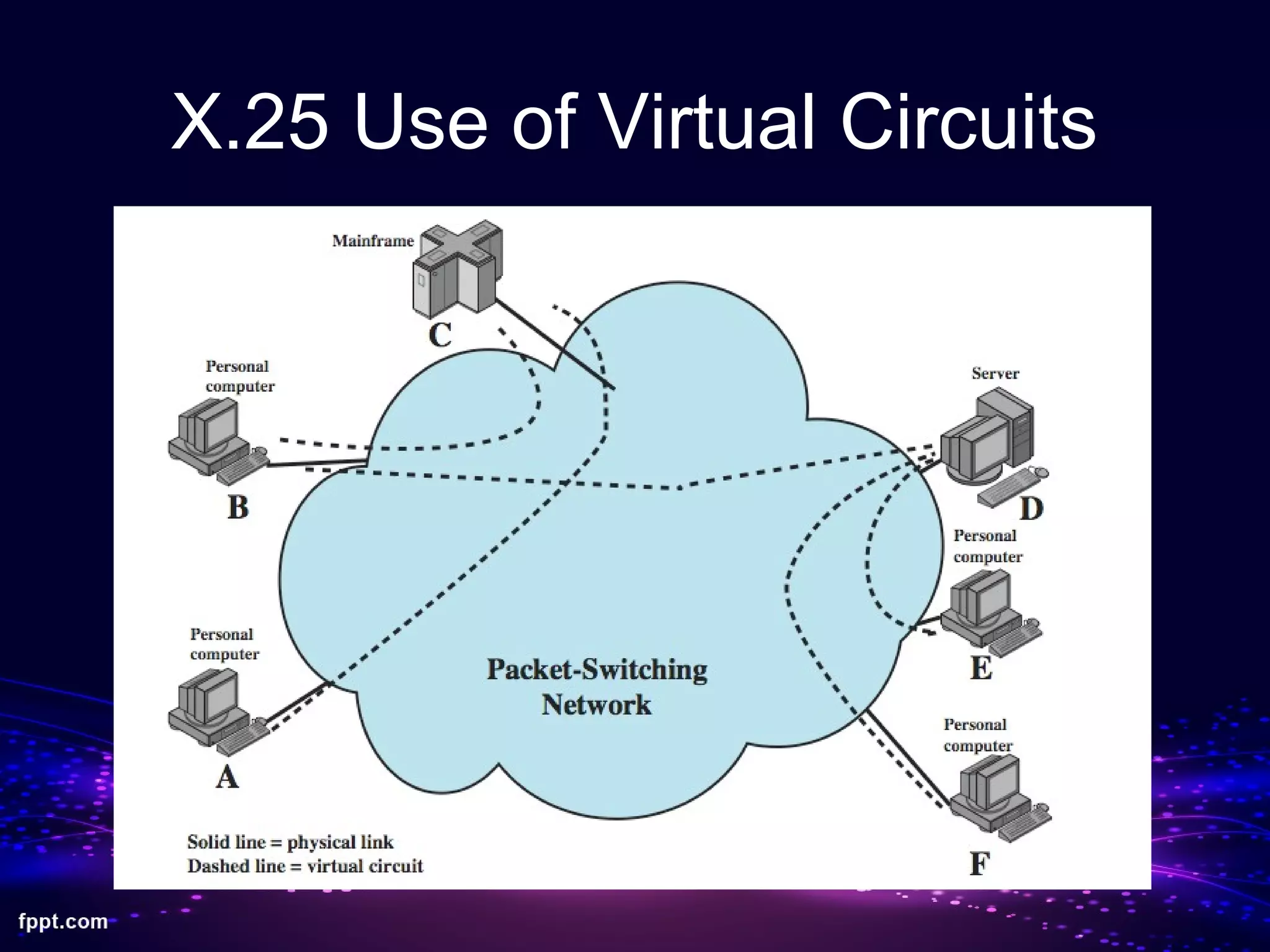
X.25 Use of Virtual Circuits
Asynchronous Transfer Mode (ATM)
• Asynchronous transfer mode (ATM) is a
newer technology than X. 25.
• ATM for the MAN/WAN environment
operates in a similar way to its operation
over backbone networks discussed in the
last chapter.
X.25 vs. ATM
• 4 differences between ATM and X.25 are:
–ATM performs encapsulation of packets,
so they are delivered unchanged across
the network.
–ATM is unreliable; i.e., it provides no error
control, so error control must be handled
at another layer (typically by TCP).
X.25 vs. ATM
• ATM provides quality of service
information enabling priority setting for
different transmissions types (e.g., high
for voice, lower for e-mail).
• ATM is scalable, since basic ATM circuits
are easily multiplexed onto much faster
ones.
Issues with X.25
• key features include:
– call control packets, in band signaling
– multiplexing of virtual circuits at layer 3
– layers 2 and 3 include flow and error control
• hence have considerable overhead
• not appropriate for modern digital systems
with high reliability
User Data and X.25 ProtocolUser Data and X.25 Protocol
Control InformationControl Information

Packet Switching and X.25 Protocol

  • 1.
  • 2.
    Packets • Network packetis a formatted unit of data carried by a packet-switched network. • Consist of 2 types of data: – Control information – User data
  • 3.
  • 4.
  • 5.
  • 6.
    Packet Switching • Beganaround early 1960’s • First developed by Paul Baran • Is a digital networking communications method that groups all transmitted data - regardless of content, type, or structure – into suitably-sized blocks, called packets.
  • 7.
    Advantages of PacketSwitching • Line efficiency • Data rate conversion • Packets are accepted even when network is busy • High data transmission quality • When it comes to billing: – Fee is just the duration of connectivity
  • 8.
    Disadvantages of PacketSwitching • More complex • Data Transmission Delays • Packets may be lost on their route (Datagram)
  • 9.
  • 10.
    Datagram Packet Switching •Each packet is treated independently • The packets may take different paths to the destination • The packets might arrive in a different sequence from the order in which they were sent • The packets may have to be reordered at the destination
  • 11.
  • 12.
  • 13.
    Virtual Circuit PacketSwitching • A logical connection is established before any packets are sent • All packets follow the same path through the network • This does not mean that there is a dedicated path, as in circuit switching • There is a call set up before the exchange of data (handshake).
  • 14.
  • 15.
    SVC vs. PVC •Switched Virtual Circuit (SVC) • Permanent Virtual Circuit (PVC)
  • 16.
  • 17.
  • 18.
    Datagram vs. VirtualCircuits Datagram Virtual Circuits  No call setup phase  More flexible  Better if number of packets are not very large  Network can provide sequencing and error control  Packets are forwarded more quickly  Less reliable
  • 19.
    Packet Switch vs.Circuit Switching • circuit switching was designed for voice • packet switching was designed for data • transmitted in small packets • packets contains user data and control info – user data may be part of a larger message – control info includes routing (addressing) info • packets are received, stored briefly (buffered) and past on to the next node
  • 20.
    Packet Switch vs.Circuit Switching
  • 21.
    Packet Switching ServiceProtocols • There are five protocols in use for packet- switched services: – X.25 – Asynchronous Transfer Mode (ATM) – Frame Relay – Switched Multimegabit Data Service (SMDS) – Ethernet/IP packet networks
  • 22.
    X.25 Protocol • ITU-Tstandard for interface between host and packet switched network • Oldest packet switched service. • Almost universal on packet switched networks and packet switching in ISDN • X.25 offers switched virtual circuit and permanent virtual circuit services.
  • 23.
    X.25 Protocol • X.25is a reliable protocol, meaning it performs error control and retransmits bad packets. • Although widely used in Europe, X.25 is not in widespread use in North America. The primary reason is the low transmission speed, now 2.048 Mbps (up from 64 Kbps) .
  • 25.
    PAD • Packet Assembler/Disassembler –isa communications device which provides multiple asynchronous terminal connectivity to an X.25 (packet- switching) network or host computer.
  • 26.
    X.25 - Physical •Interface between station node link • Two ends are distinct – Data Terminal Equipment DTE (user equipment) – Data Circuit-terminating Equipment DCE (node) • Physical layer specification is X.21 • Can substitute alternative such as EIA-232
  • 27.
    X.25 - Link •Link Access Protocol Balanced (LAPB) • Provides reliable transfer of data over link • Sending as a sequence of frames
  • 28.
    X.25 - Packet •Provides a logical connections (virtual circuit) between subscribers • All data in this connection form a single stream between the end stations • Established on demand • Termed external virtual circuits
  • 29.
    X.25 Use ofVirtual Circuits
  • 30.
    Asynchronous Transfer Mode(ATM) • Asynchronous transfer mode (ATM) is a newer technology than X. 25. • ATM for the MAN/WAN environment operates in a similar way to its operation over backbone networks discussed in the last chapter.
  • 31.
    X.25 vs. ATM •4 differences between ATM and X.25 are: –ATM performs encapsulation of packets, so they are delivered unchanged across the network. –ATM is unreliable; i.e., it provides no error control, so error control must be handled at another layer (typically by TCP).
  • 32.
    X.25 vs. ATM •ATM provides quality of service information enabling priority setting for different transmissions types (e.g., high for voice, lower for e-mail). • ATM is scalable, since basic ATM circuits are easily multiplexed onto much faster ones.
  • 33.
    Issues with X.25 •key features include: – call control packets, in band signaling – multiplexing of virtual circuits at layer 3 – layers 2 and 3 include flow and error control • hence have considerable overhead • not appropriate for modern digital systems with high reliability
  • 34.
    User Data andX.25 ProtocolUser Data and X.25 Protocol Control InformationControl Information

Editor's Notes

  • #2 A type of Public Domain Networks (PDN). became one of the fundamental networking technologies behind the Internet and most local area networks. The concept of switching small blocks of data was first explored independently by Paul Baran at the RAND Corporation in the US and Donald Davies at the National Physical Laboratory (NPL) in the UK in the early to mid-1960s.
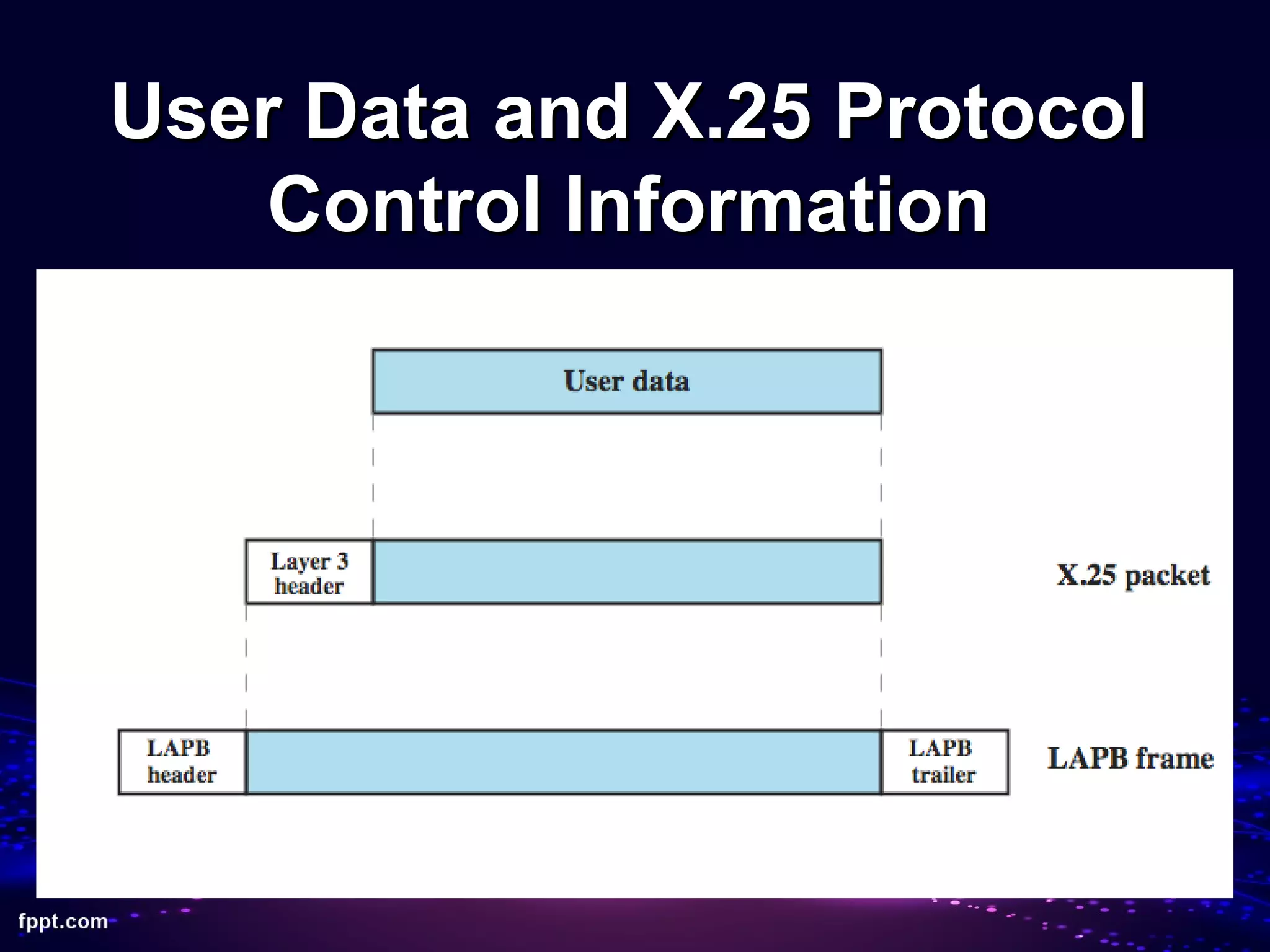
  • #3 A frame carries the destination link address, source link address, and other control information in the header. The trailer usually contains the checksum of the transported data. By using the checksum, we can find out whether the payload has been damaged during transfer. The network-layer packet is usually included in the payload.
  • #5 One packet always carries data of one particular application (of one connection). It is not possible to guarantee bandwidth, because the packets are of various lengths. On the other hand, we can use the bandwidth more effectively because if one application does not transmit data, then other applications can use the bandwidth instead.
  • #6 The route of a packet is decided by network layer protocols.
  • #7 Packet Switching refers to protocols in which messages are divided into packets before they are sent. Packet switching features delivery of variable-bit-rate data streams (sequences of packets) over a shared network. Each packet is then transmitted individually and can even follow different routes to its destination. Once all the packets forming a message arrive at the destination, they are recompiled into the original message.
  • #8 Line Efficiency – Single node to node link can be shared by many packets over time Packets queued and transmitted as fast as possible This will result to less bandwidth wastage. Data rate conversion - Each station connects to the local node at its own speed. Nodes buffer data if required to equalize rates Packets are accepted but delivery may slow down High data transmission quality Because it’s error free because data is checked and error detection is employed during data transmission
  • #9 1. More complex so packet switching requires more processing time. 2. The amount of time required to push all of the packet's bits into the wire. 3. Sequence number are required to identify missing packets.
  • #14 In the Virtual Circuit approach a pre-planned route is established before any packets are sent. There is a call set up before the exchange of data (handshake). All packets follow the same route and therefore arrive in sequence. Each packet contains a virtual circuit identifier instead of destination address More set up time No routing decisions required for each packet - Less routing or processing time Susceptible to data loss in the face of link or node failure Clear request to drop circuit Not a dedicated path
  • #19 Virtual Circuit No routing decisions to make Loss of a node looses all circuits through that node Datagram Better if few packets Routing can be used to avoid congested parts of the network
  • #22 X.3 X.7 X.21 X.25 – Public Data Networks (Dedicated circuit) X Series is for data networks, open systems communication and security. 1 – 100: Public Data Networks 101 – 200: Open Systems Interconnection
  • #23 One technical aspect of packet-switching networks remains to be examined: the interface between attached devices and the network. We have seen that a circuit-switching network provides a transparent communications path for attached devices that makes it appear that the two communicating stations have a direct link. However, in the case of packet-switching networks, the attached stations must organize their data into packets for transmission. This requires a certain level of cooperation between the network and the attached stations. This cooperation is embodied in an interface standard. The standard used for traditional packet-switching networks is X.25, which is an ITU-T standard that specifies an interface between a host system and a packet-switching network. The functionality of X.25 is specified on three levels: Physical level, Link level, and Packet level.
  • #26 It’s like modem. It collects data from a group of terminals and places the data into X.25 packets (Assembly) It takes data packets from packet-switching network or host computer and returns them into a character stream that can be sent to the terminals (Disassembly).
  • #27 The physical level deals with the physical interface between an attached station (computer, terminal) and the link that attaches that station to the packet-switching node. It makes use of the physical-level specification in a standard known as X.21, but in many cases other standards, such as EIA-232, are substituted.
  • #28 The link level standard is referred to as LAPB (Link Access Protocol - Balanced). LAPB is a subset of HDLC (see Chapter 7). The link level provides for the reliable transfer of data across the physical link, by transmitting the data as a sequence of frames.
  • #29 The packet level provides a virtual circuit service. This service enables any subscriber to the network to set up logical connections, called virtual circuits, to other subscribers. In this context, the term virtual circuit refers to the logical connection between two stations through the network; this is perhaps best termed an external virtual circuit. Earlier, we used the term virtual circuit to refer to a specific preplanned route through the network between two stations; this could be called an internal virtual circuit. Typically, there is a one-to-one relationship between external and internal virtual circuits. However, it is also possible to employ X.25 with a datagram-style network. What is important for an external virtual circuit is that there is a logical relationship, or logical channel, established between two stations, and all of the data associated with that logical channel are considered as part of a single stream of data between the two stations.
  • #30 An example of X.25 virtual circuits is shown in Figure 10.13 (compare Figure 10.1). In this example, station A has a virtual circuit connection to C; station B has two virtual circuits established, one to C and one to D; and stations E and F each have a virtual circuit connection to D. As an example of how these external virtual circuits are used, station D keeps track of data packets arriving from three different workstations (B, E, F) on the basis of the virtual circuit number associated with each incoming packet.
  • #34 The traditional approach to packet switching makes use of X.25, which not only determines the user-network interface but also influences the internal design of the network. The following are key features of the X.25 approach: •Call control packets, used for setting up and clearing virtual circuits, are carried on the same channel and same virtual circuit as data packets. •Multiplexing of virtual circuits takes place at layer 3. •Both layer 2 and layer 3 include flow control and error control mechanisms. The X.25 approach results in considerable overhead. At each hop through the network, the data link control protocol involves the exchange of a data frame and an acknowledgment frame. Furthermore, at each intermediate node, state tables must be maintained for each virtual circuit to deal with the call management and flow control/error control aspects of the X.25 protocol. All of this overhead may be justified when there is a significant probability of error on any of the links in the network. This approach is not suitable for modern digital communication facilities.