MATH 107
Section 3.2
Polynomial Functions
2© 2010 Pearson Education, Inc. All rights reserved
Definitions
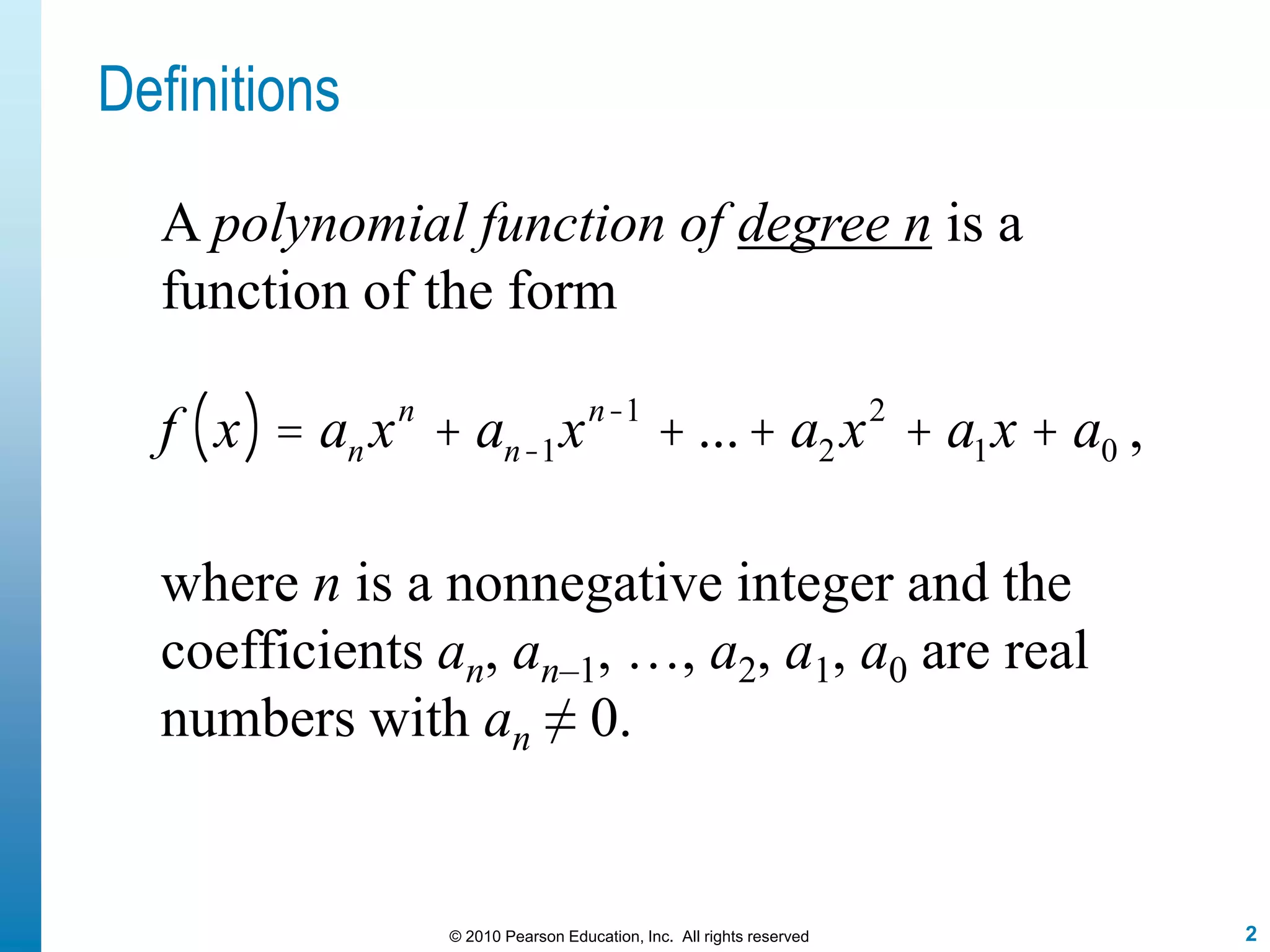
A polynomial function of degree n is a
function of the form
where n is a nonnegative integer and the
coefficients an, an–1, …, a2, a1, a0 are real
numbers with an ≠ 0.
f x( ) = an xn
+ an-1xn-1
+ ...+ a2 x2
+ a1x + a0 ,
3© 2010 Pearson Education, Inc. All rights reserved
Definitions
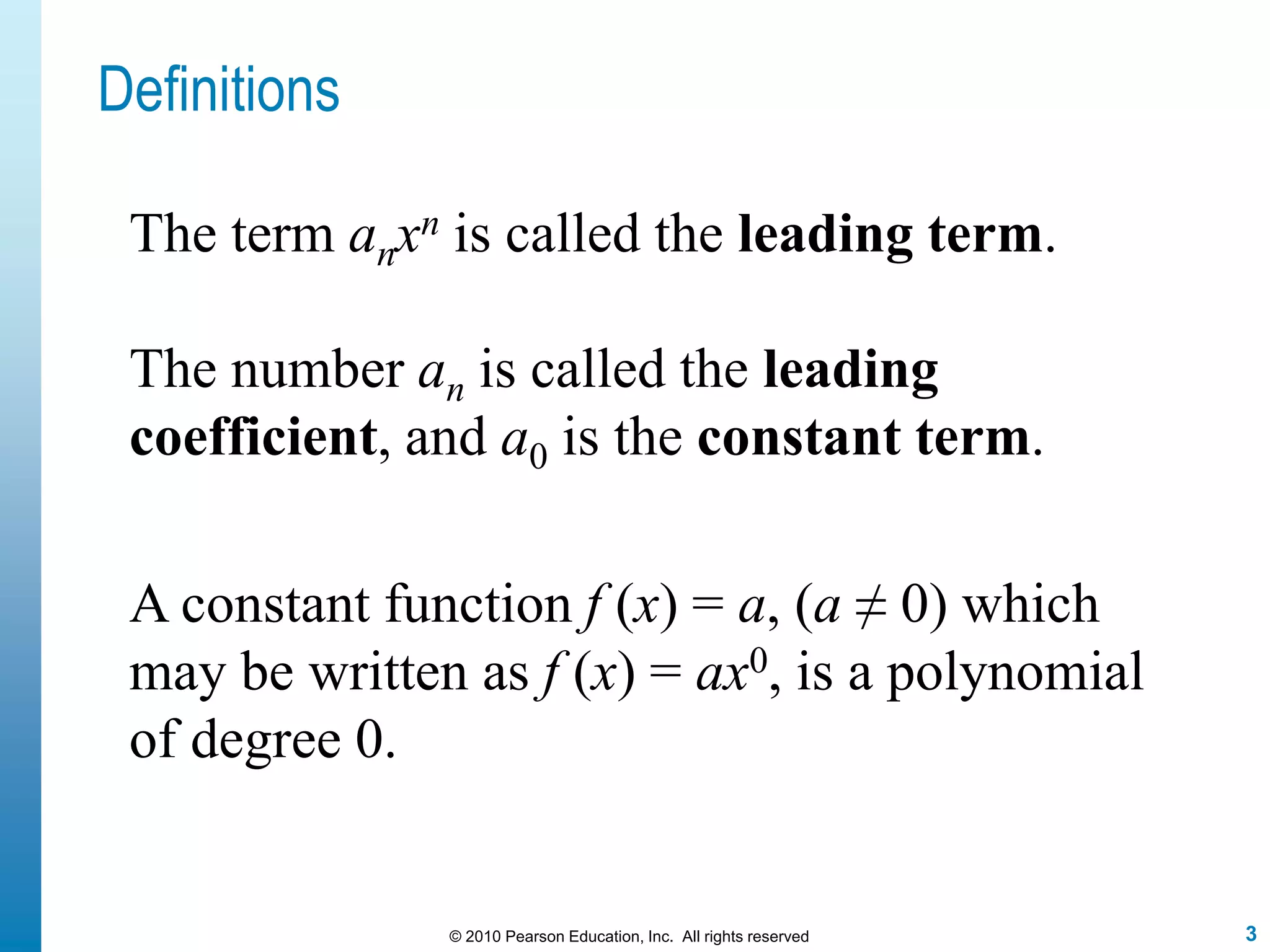
A constant function f (x) = a, (a ≠ 0) which
may be written as f (x) = ax0, is a polynomial
of degree 0.
The term anxn is called the leading term.
The number an is called the leading
coefficient, and a0 is the constant term.
4© 2010 Pearson Education, Inc. All rights reserved
Definitions
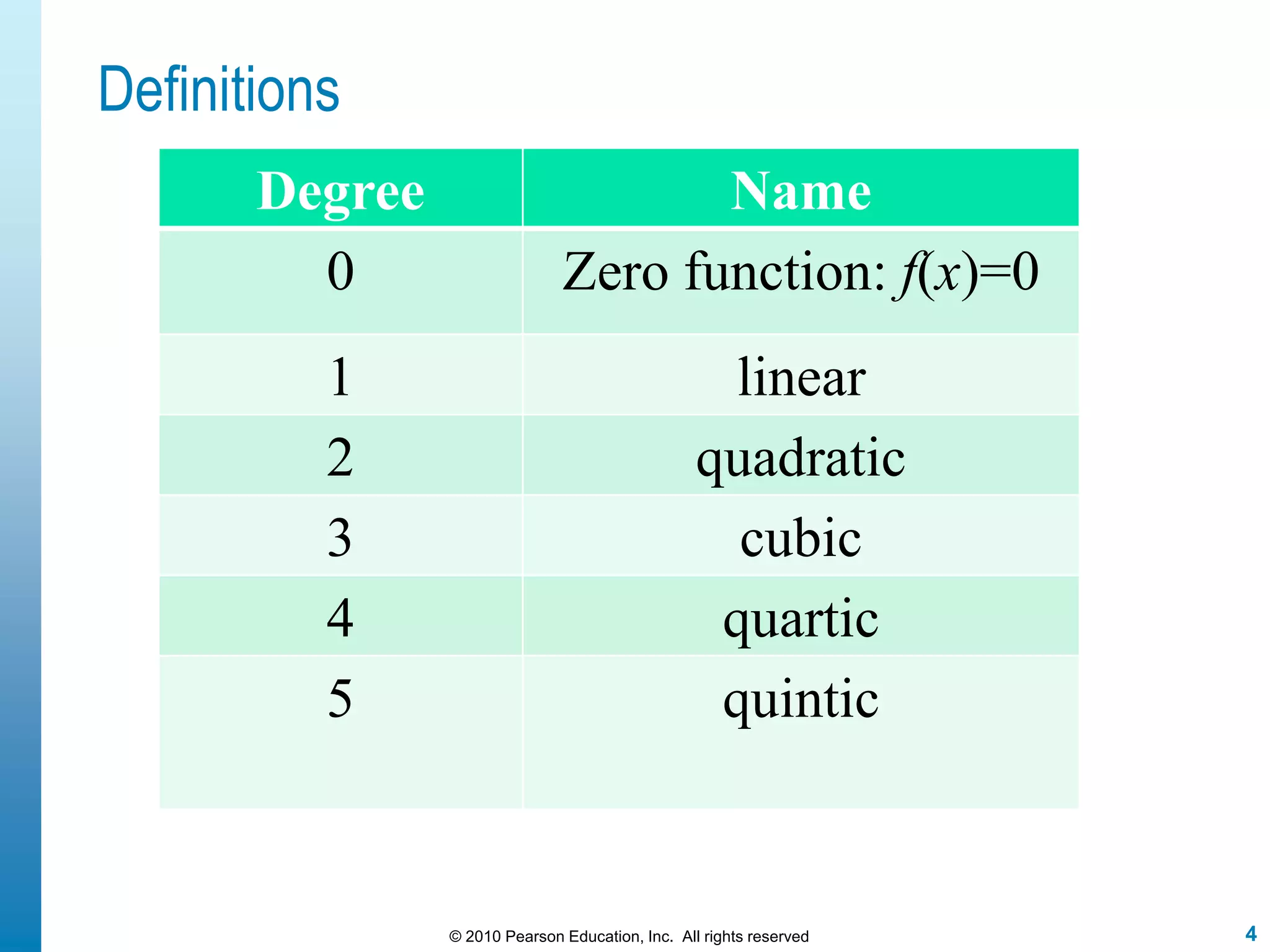
Degree Name
0 Zero function: f(x)=0
1 linear
2 quadratic
3 cubic
4 quartic
5 quintic
5© 2010 Pearson Education, Inc. All rights reserved
COMMON PROPERTIES OF
POLYNOMIAL FUNCTIONS
1. The domain of a polynomial function is the
set of all real numbers.
6© 2010 Pearson Education, Inc. All rights reserved
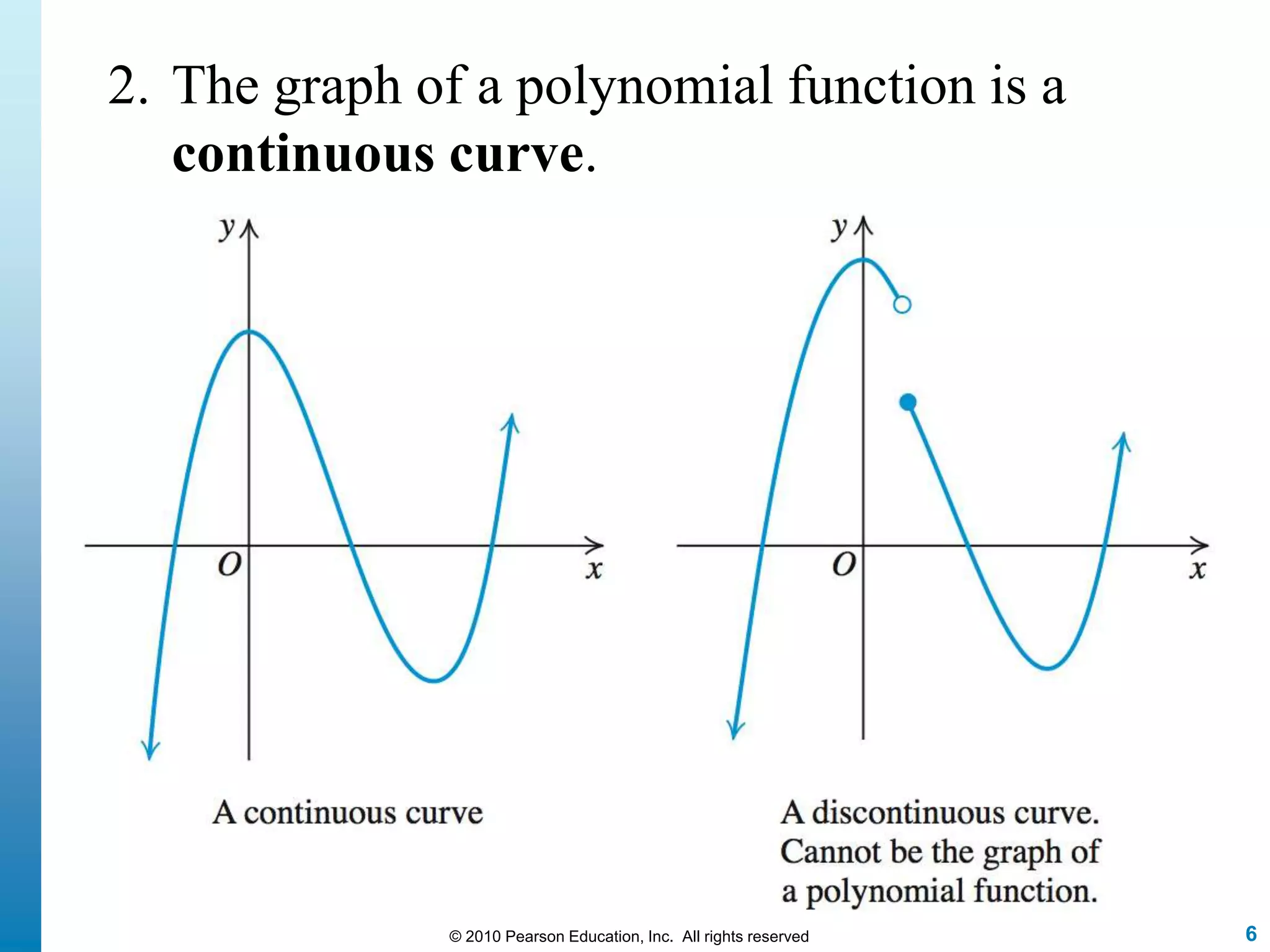
2. The graph of a polynomial function is a
continuous curve.
7© 2010 Pearson Education, Inc. All rights reserved
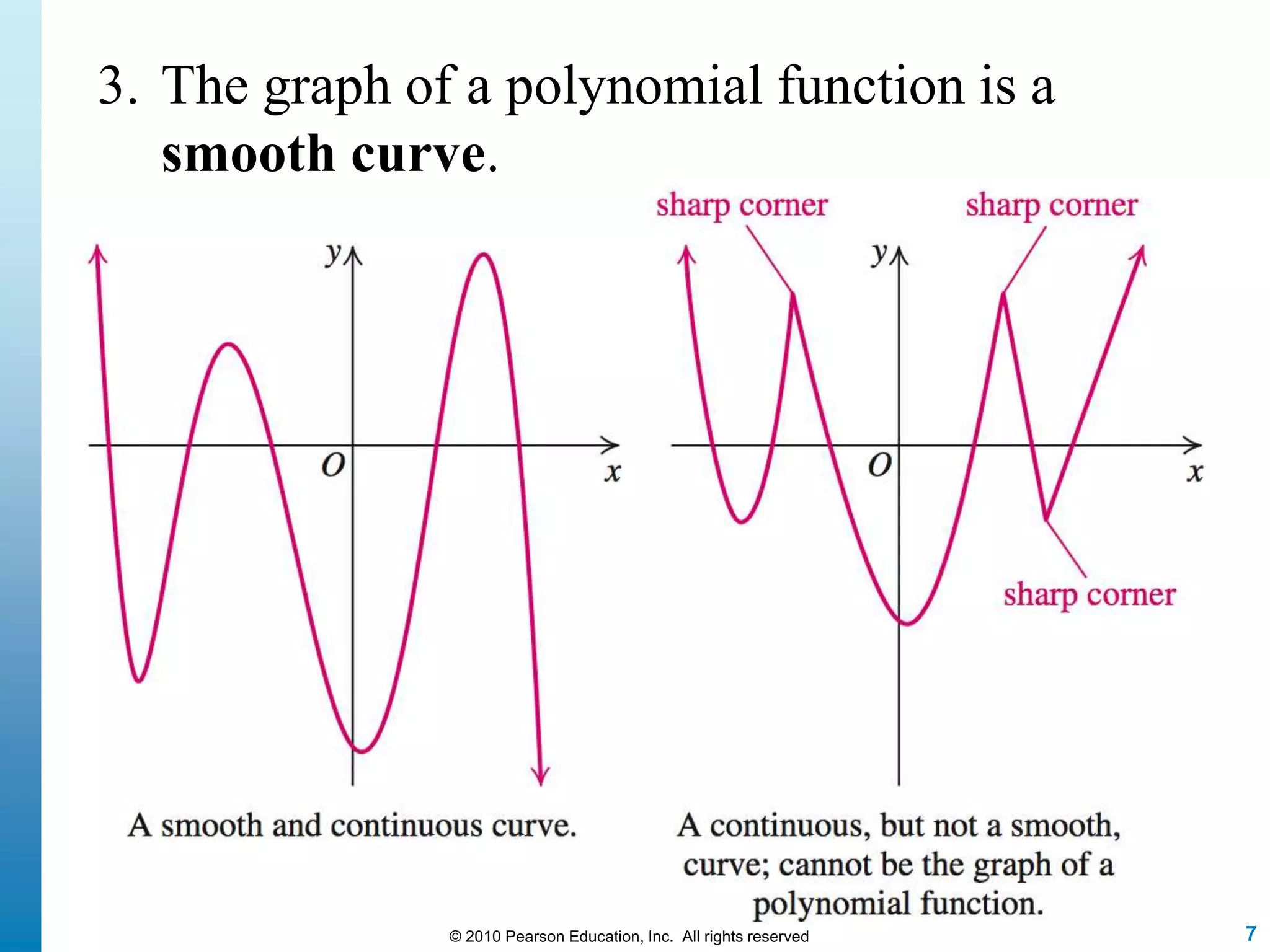
3. The graph of a polynomial function is a
smooth curve.
8© 2010 Pearson Education, Inc. All rights reserved
EXAMPLE 1 Polynomial Functions
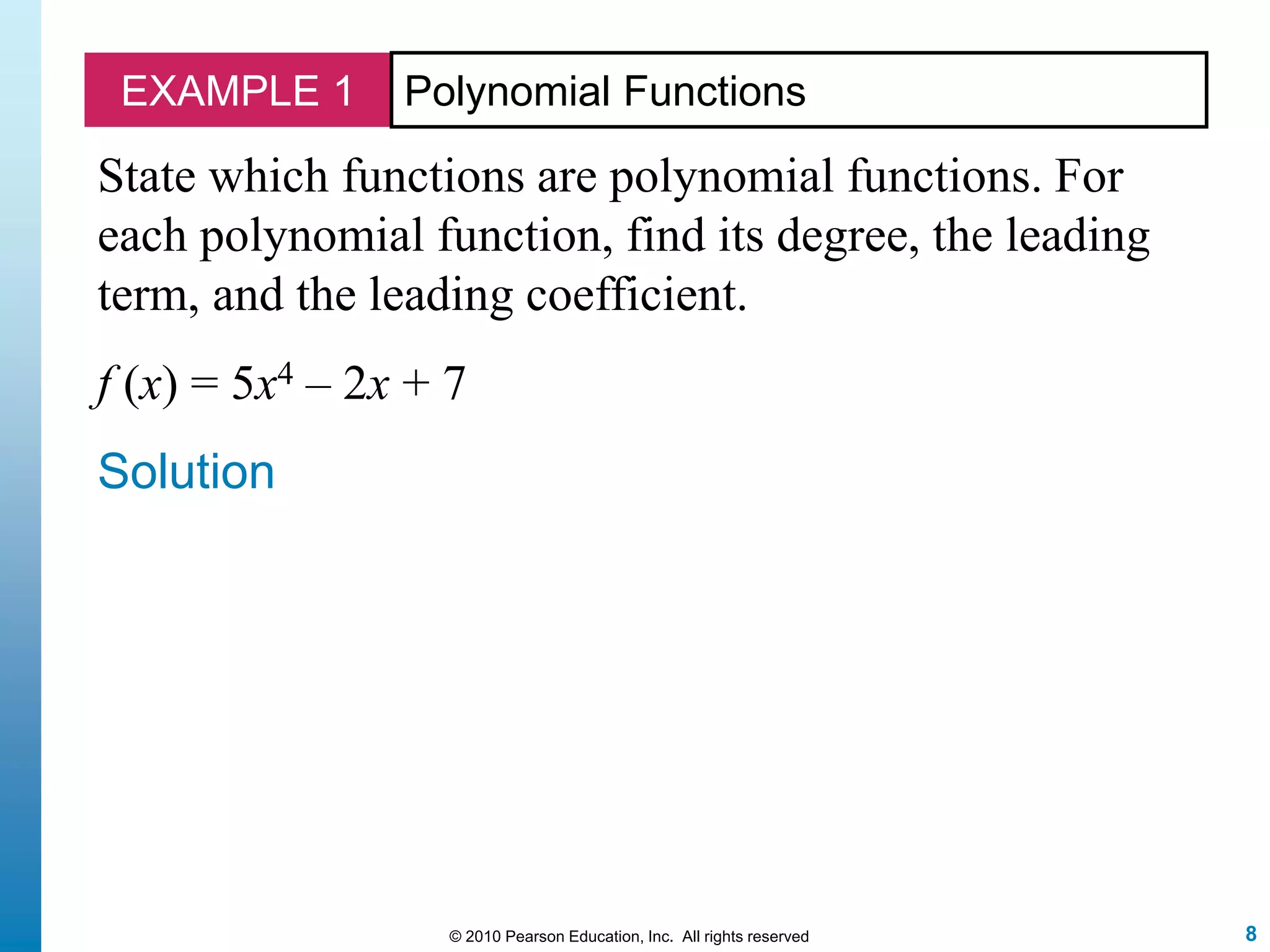
State which functions are polynomial functions. For
each polynomial function, find its degree, the leading
term, and the leading coefficient.
f (x) = 5x4 – 2x + 7
Solution
9© 2010 Pearson Education, Inc. All rights reserved
END BEHAVIOR OF POLYNOMIAL FUNCTIONS
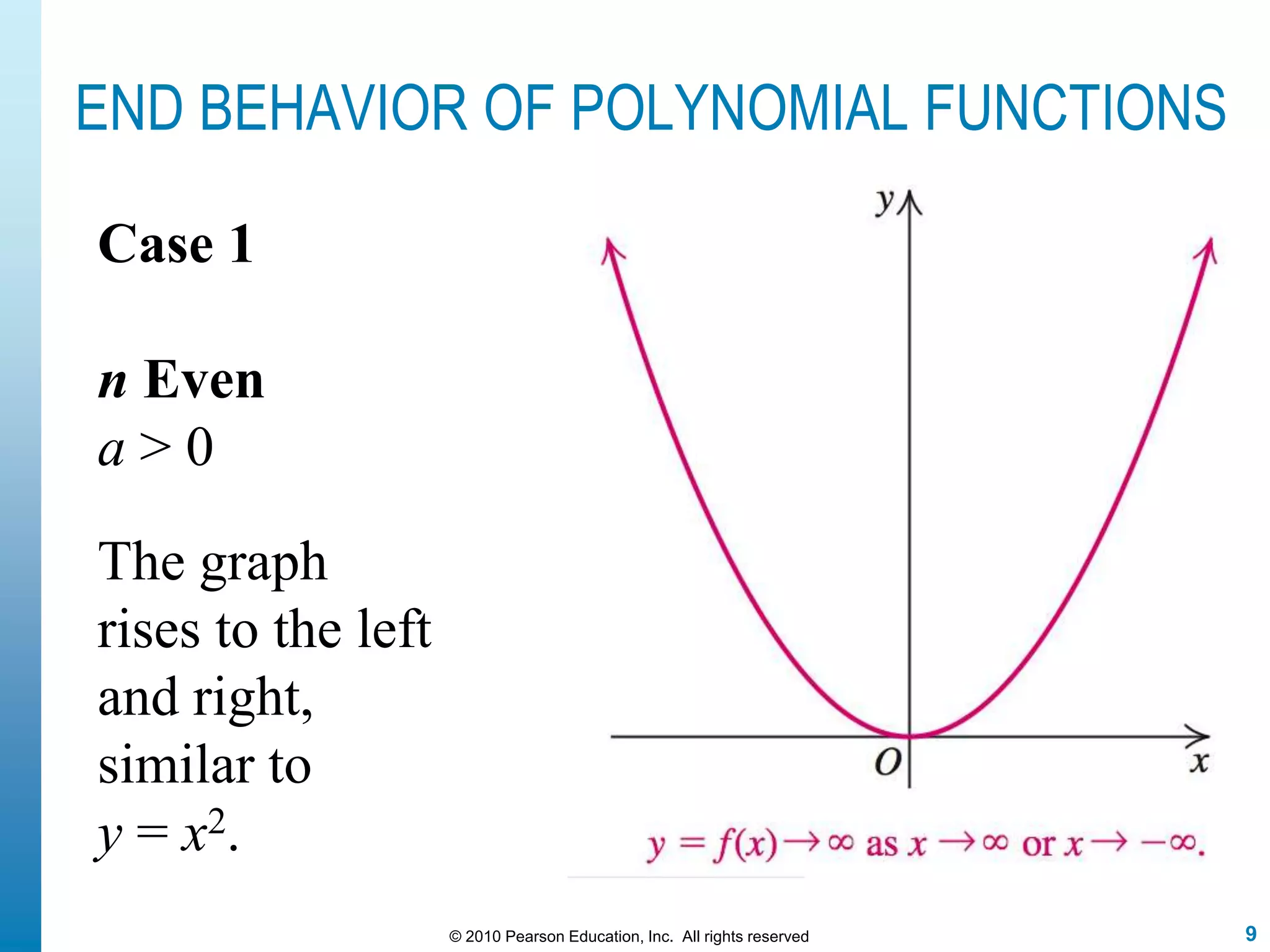
Case 1
n Even
a > 0
The graph
rises to the left
and right,
similar to
y = x2.
10© 2010 Pearson Education, Inc. All rights reserved
END BEHAVIOR OF POLYNOMIAL FUNCTIONS
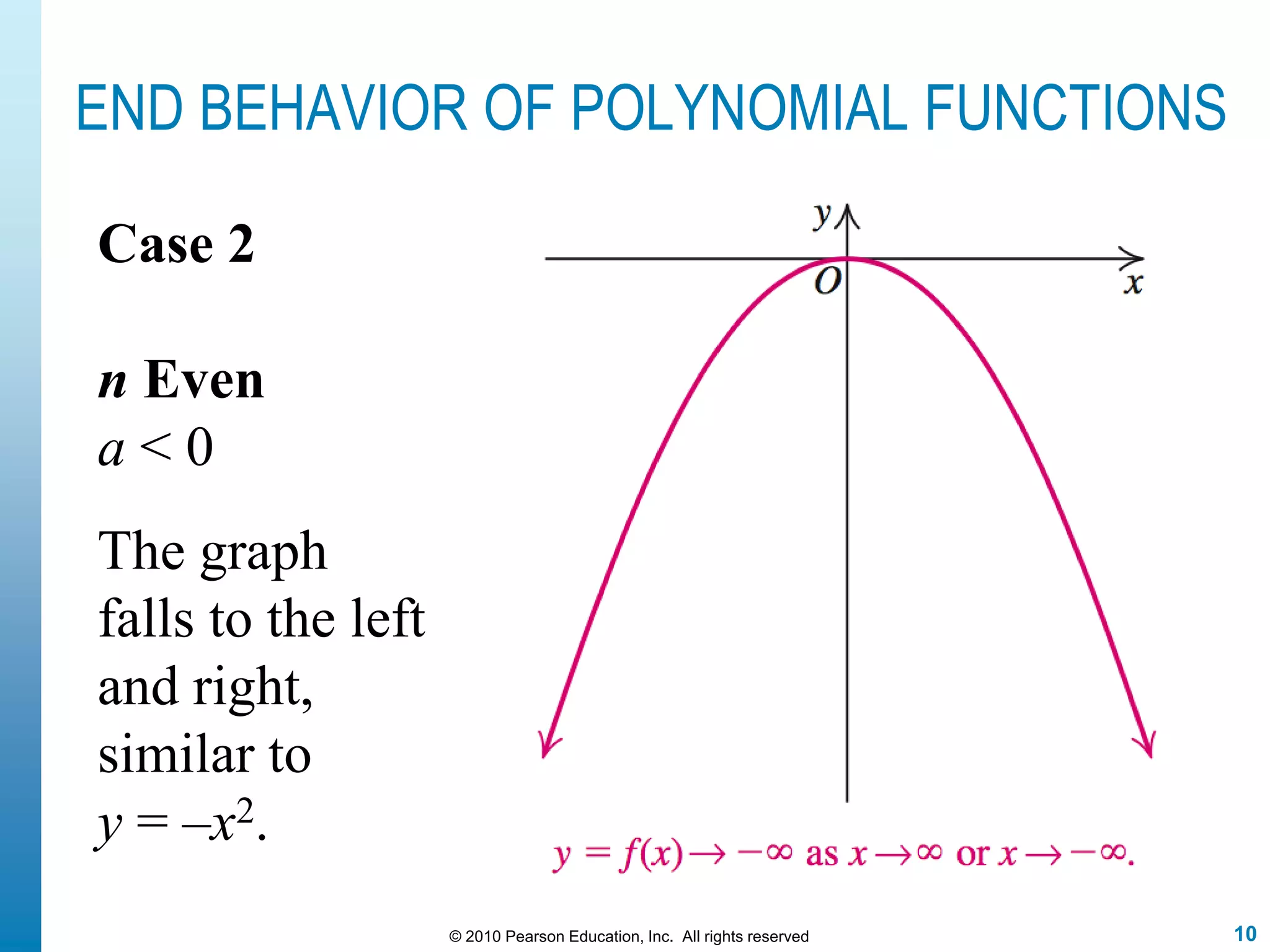
Case 2
n Even
a < 0
The graph
falls to the left
and right,
similar to
y = –x2.
11© 2010 Pearson Education, Inc. All rights reserved
END BEHAVIOR OF POLYNOMIAL FUNCTIONS
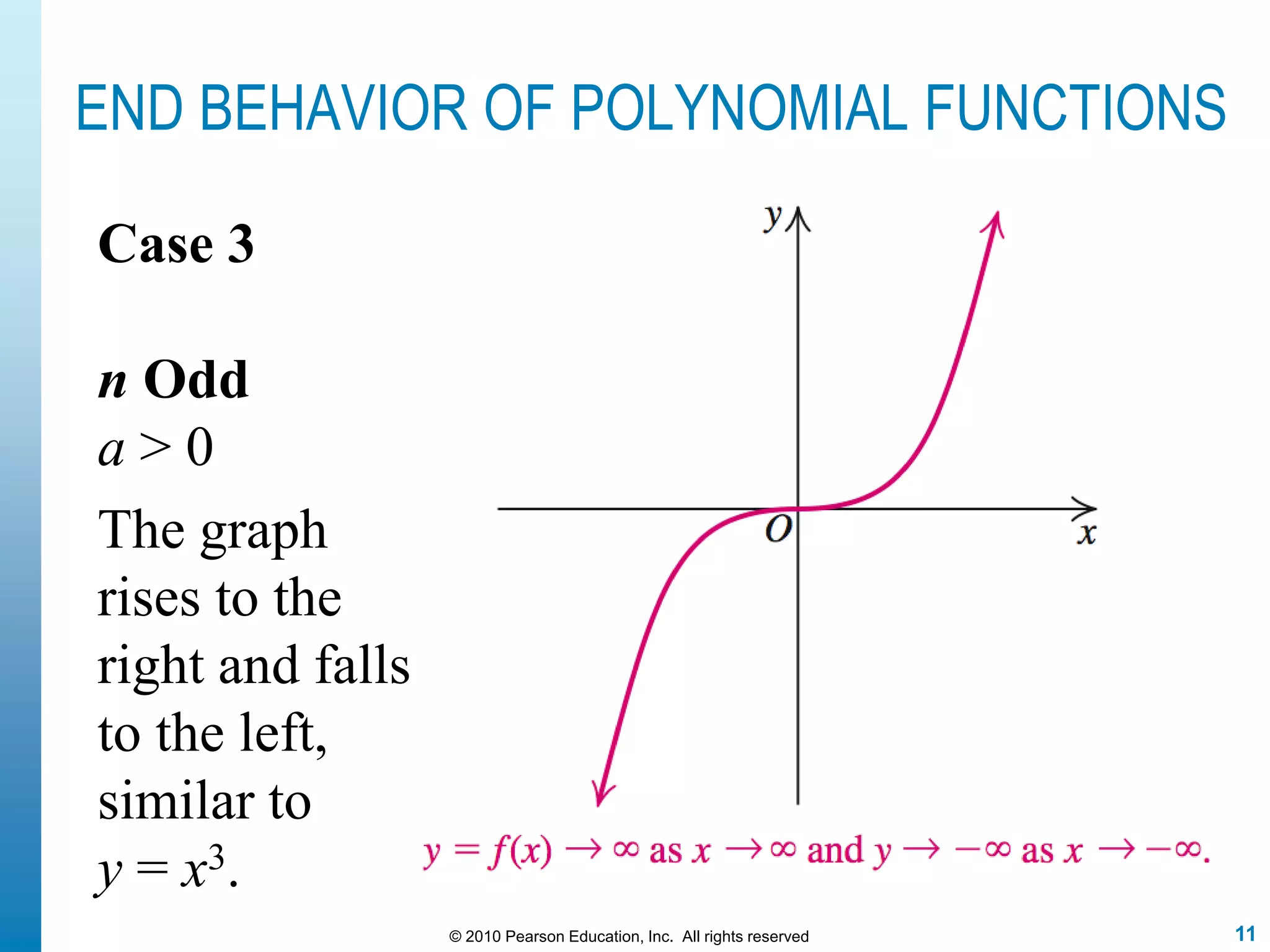
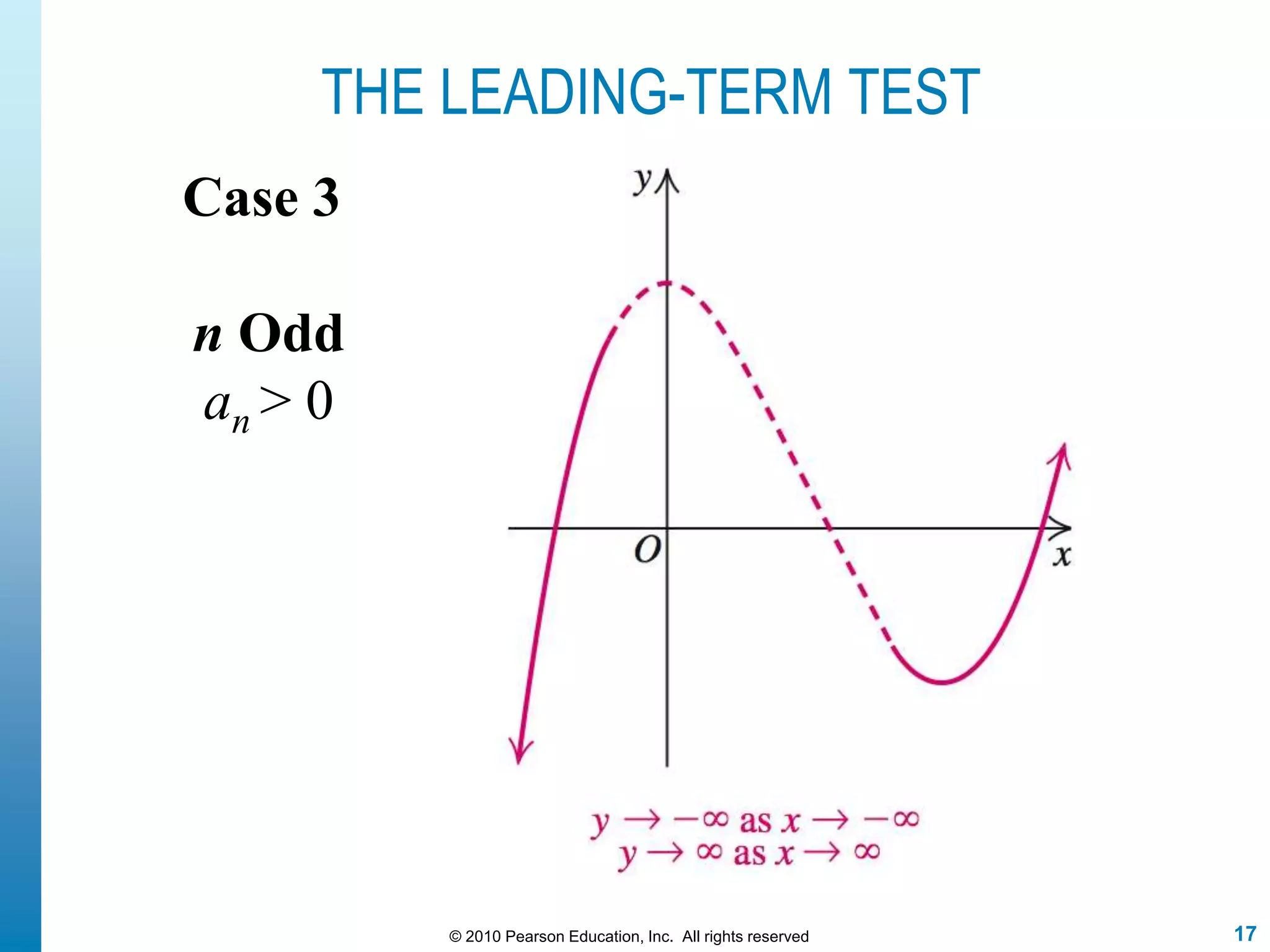
Case 3
n Odd
a > 0
The graph
rises to the
right and falls
to the left,
similar to
y = x3.
12© 2010 Pearson Education, Inc. All rights reserved
END BEHAVIOR OF POLYNOMIAL FUNCTIONS
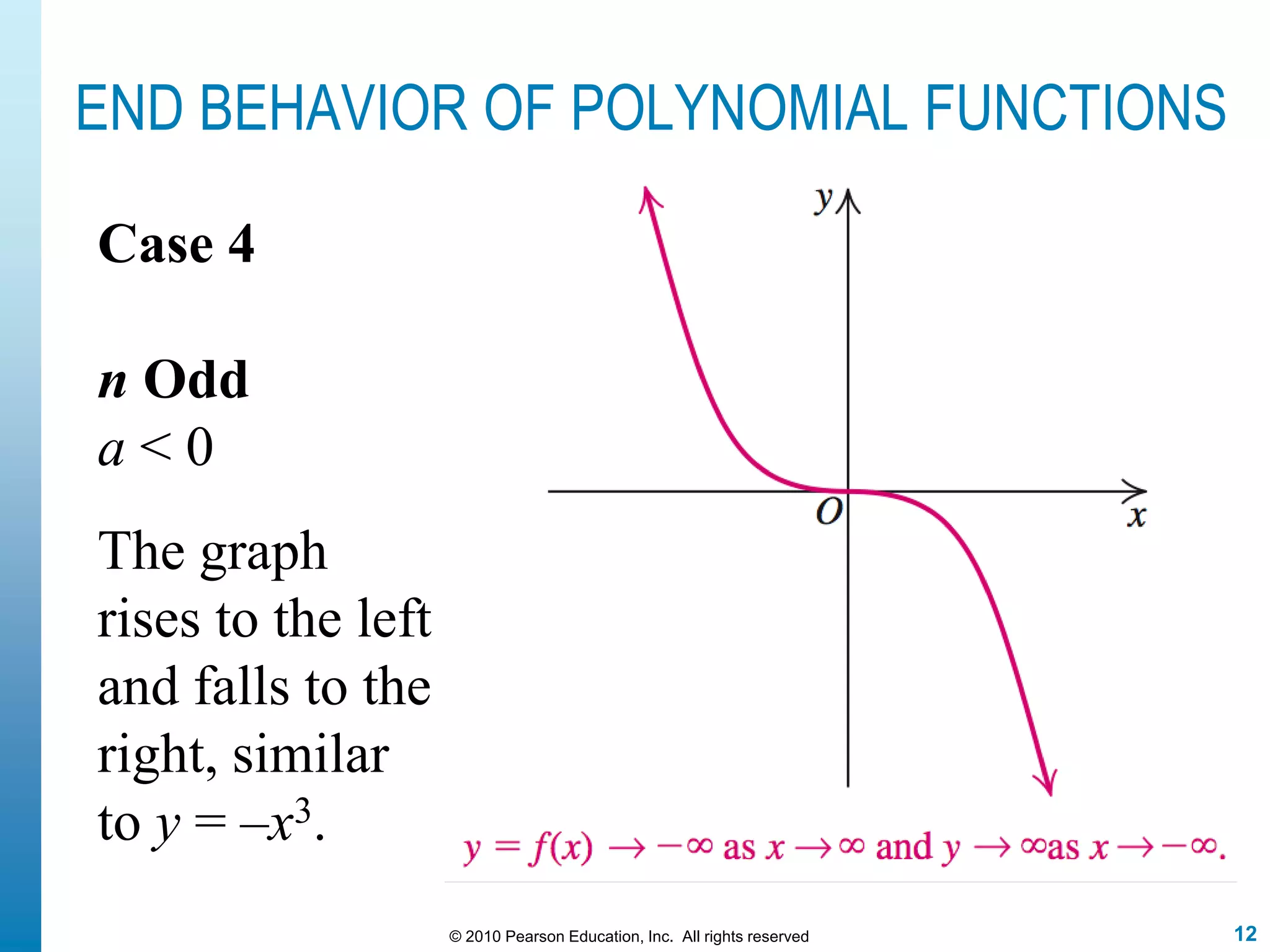
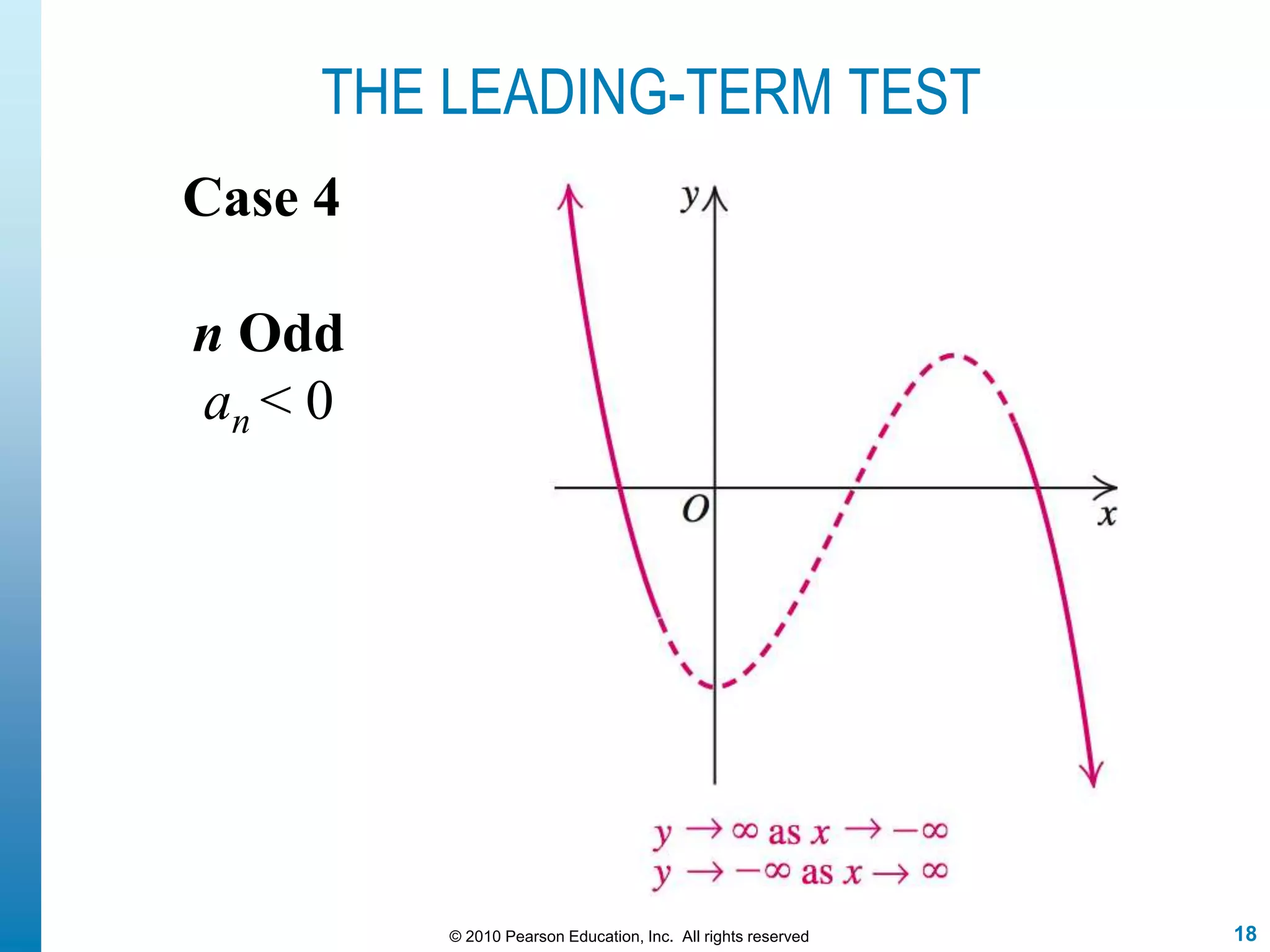
Case 4
n Odd
a < 0
The graph
rises to the left
and falls to the
right, similar
to y = –x3.
13© 2010 Pearson Education, Inc. All rights reserved
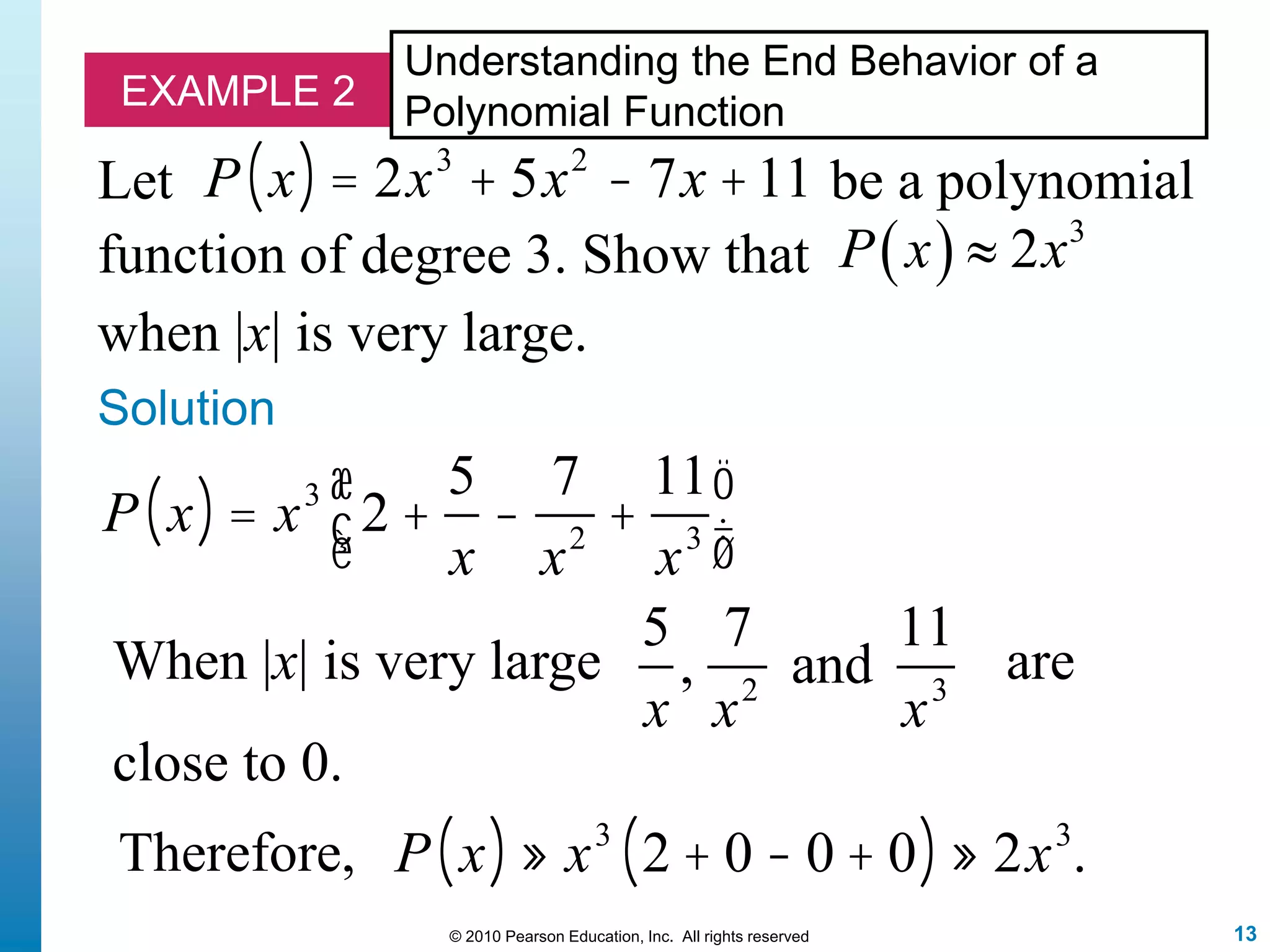
EXAMPLE 2
Understanding the End Behavior of a
Polynomial Function
Let
function of degree 3. Show that
P x( ) = 2x3
+ 5x2
- 7x +11 be a polynomial
  3
2P x x
when |x| is very large.
Solution
P x( ) = x3
2 +
5
x
-
7
x2
+
11
x3
æ
èç
ö
ø÷
When |x| is very large
5
x
,
7
x2
and
11
x3
are
close to 0.
P x( ) » x3
2 + 0 - 0 + 0( ) » 2x3
.Therefore,
14© 2010 Pearson Education, Inc. All rights reserved
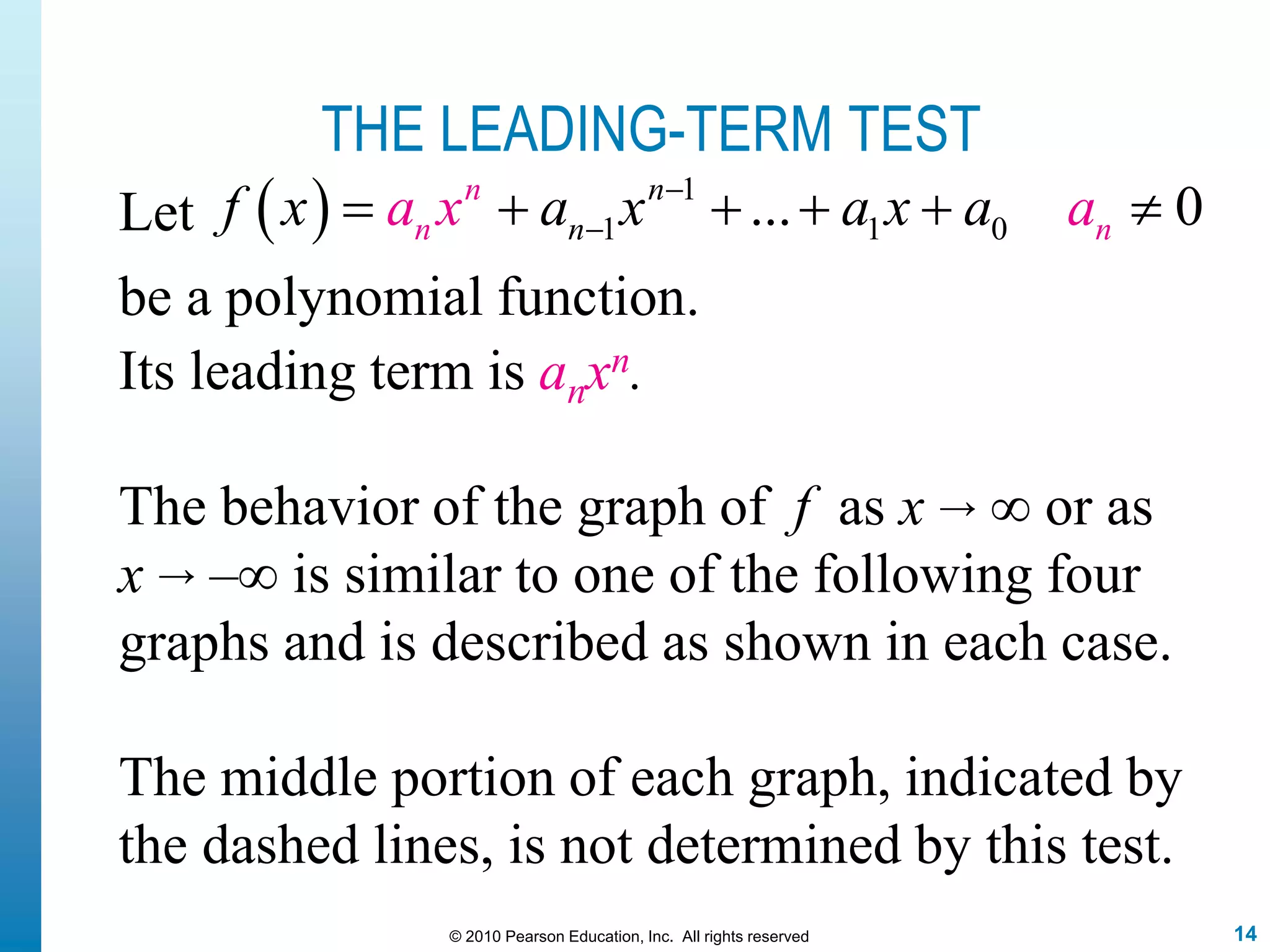
THE LEADING-TERM TEST
Its leading term is anxn.
The behavior of the graph of f as x → ∞ or as
x → –∞ is similar to one of the following four
graphs and is described as shown in each case.
The middle portion of each graph, indicated by
the dashed lines, is not determined by this test.
Let   1
1 1 0... 0n n
nn nf x a x ax ax aa 
     
be a polynomial function.
15© 2010 Pearson Education, Inc. All rights reserved
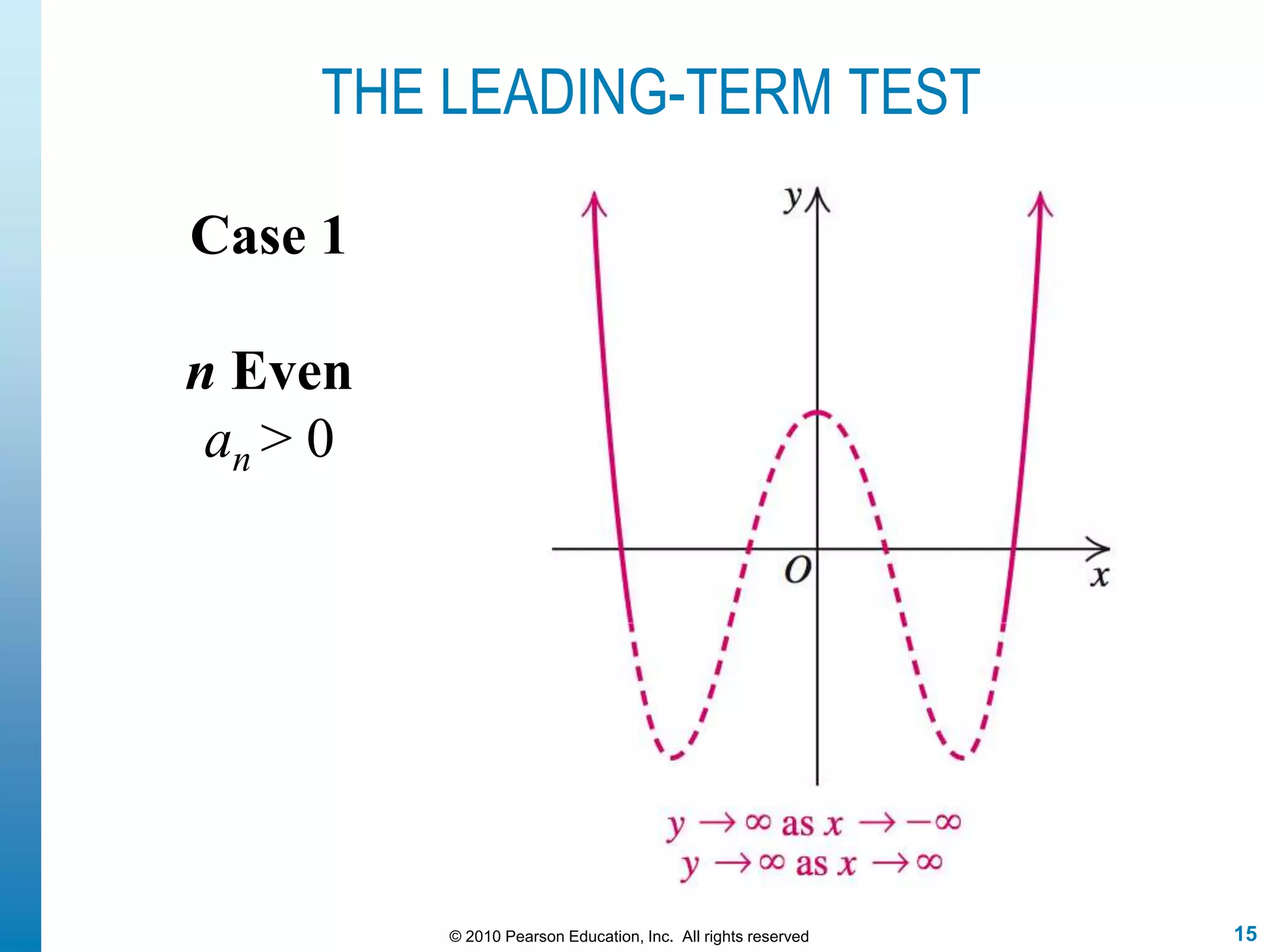
Case 1
n Even
an > 0
THE LEADING-TERM TEST
16© 2010 Pearson Education, Inc. All rights reserved
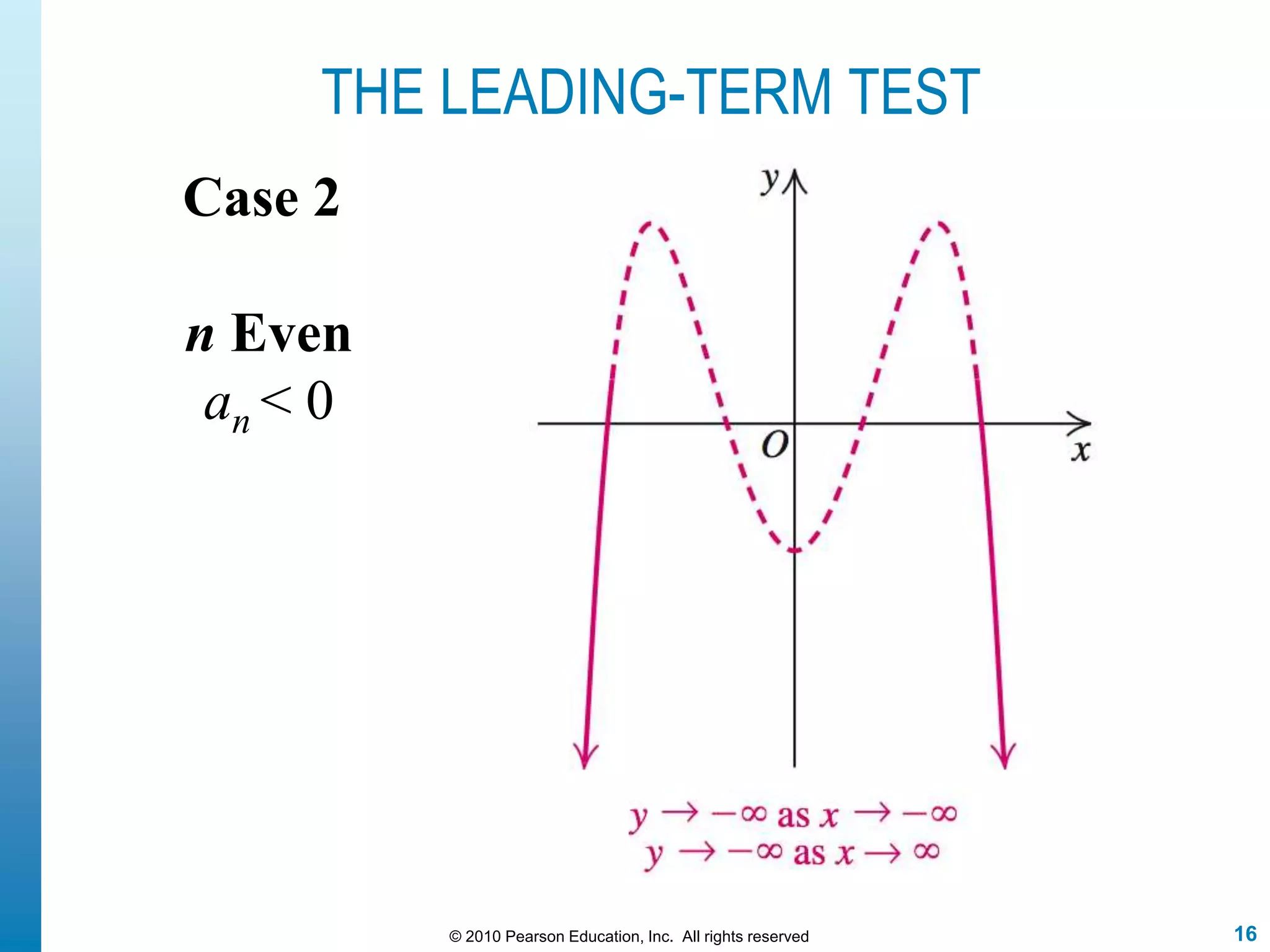
Case 2
n Even
an < 0
THE LEADING-TERM TEST
17© 2010 Pearson Education, Inc. All rights reserved
Case 3
n Odd
an > 0
THE LEADING-TERM TEST
18© 2010 Pearson Education, Inc. All rights reserved
Case 4
n Odd
an < 0
THE LEADING-TERM TEST
19© 2010 Pearson Education, Inc. All rights reserved
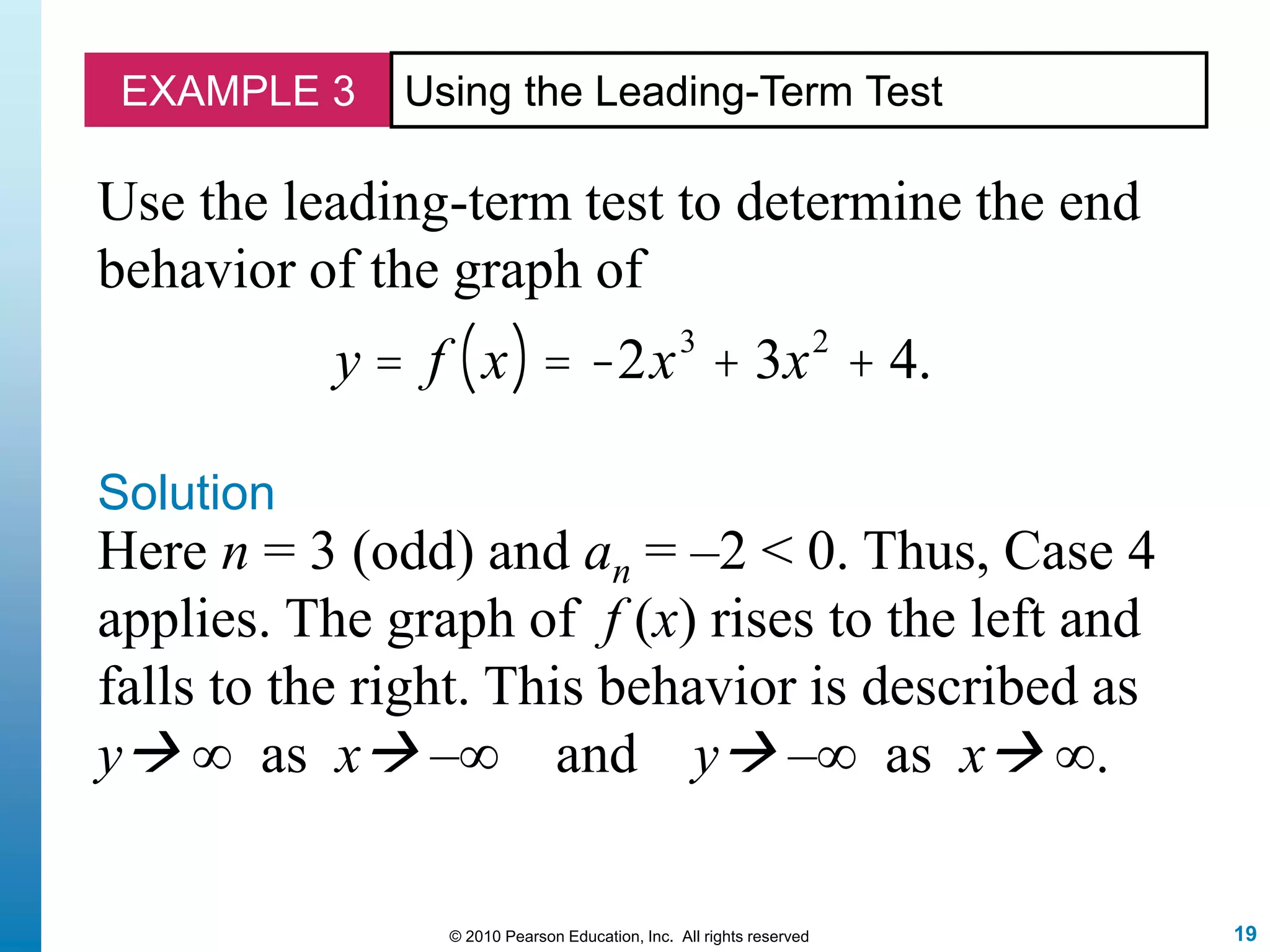
EXAMPLE 3 Using the Leading-Term Test
Use the leading-term test to determine the end
behavior of the graph of
y = f x( ) = -2x3
+ 3x2
+ 4.
Solution
Here n = 3 (odd) and an = –2 < 0. Thus, Case 4
applies. The graph of f (x) rises to the left and
falls to the right. This behavior is described as
y ∞ as x –∞ and y –∞ as x ∞.
20© 2010 Pearson Education, Inc. All rights reserved
REAL ZEROS OF POLYNOMIAL FUNCTIONS
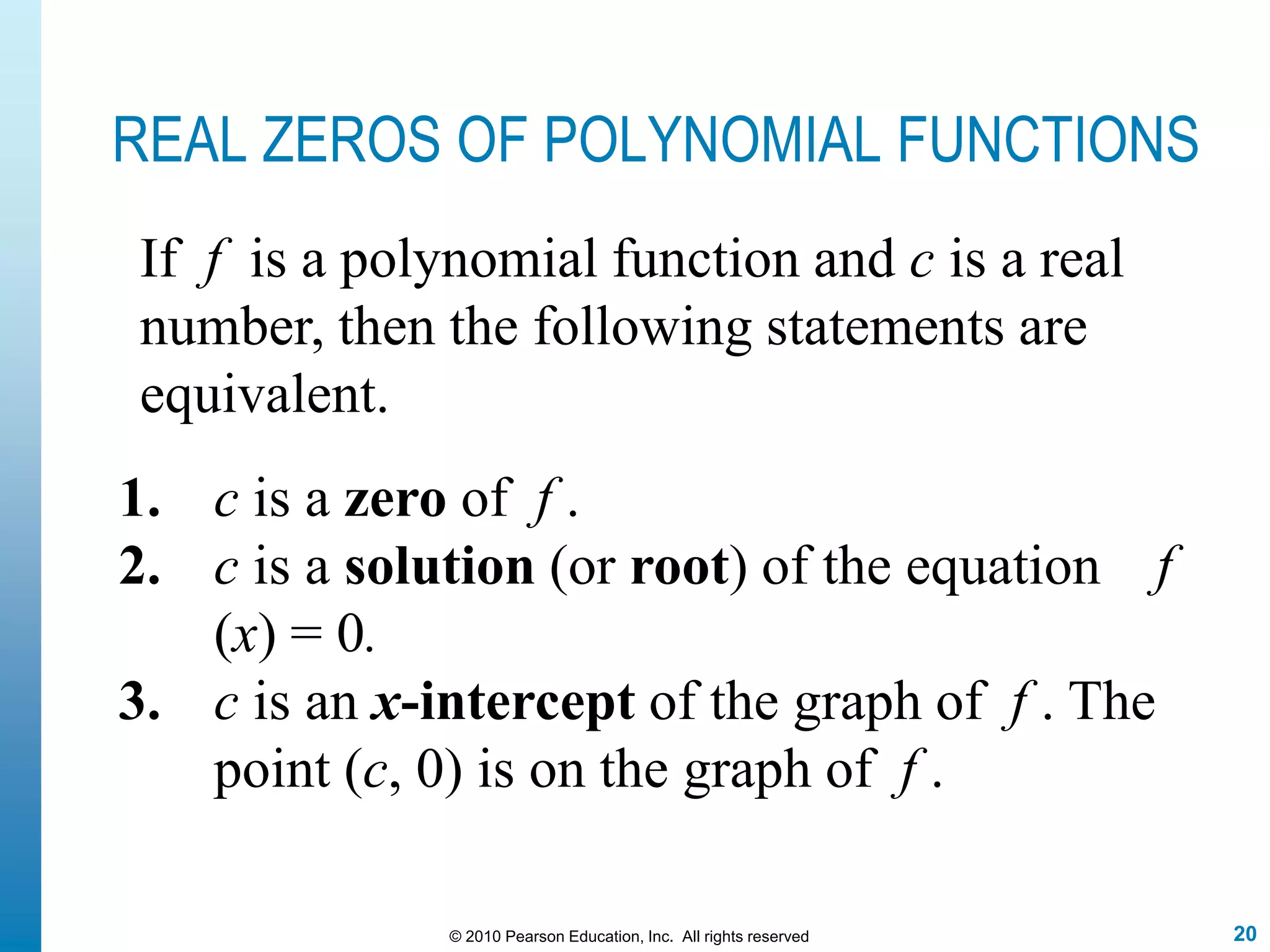
1. c is a zero of f .
2. c is a solution (or root) of the equation f
(x) = 0.
3. c is an x-intercept of the graph of f . The
point (c, 0) is on the graph of f .
If f is a polynomial function and c is a real
number, then the following statements are
equivalent.
21© 2010 Pearson Education, Inc. All rights reserved
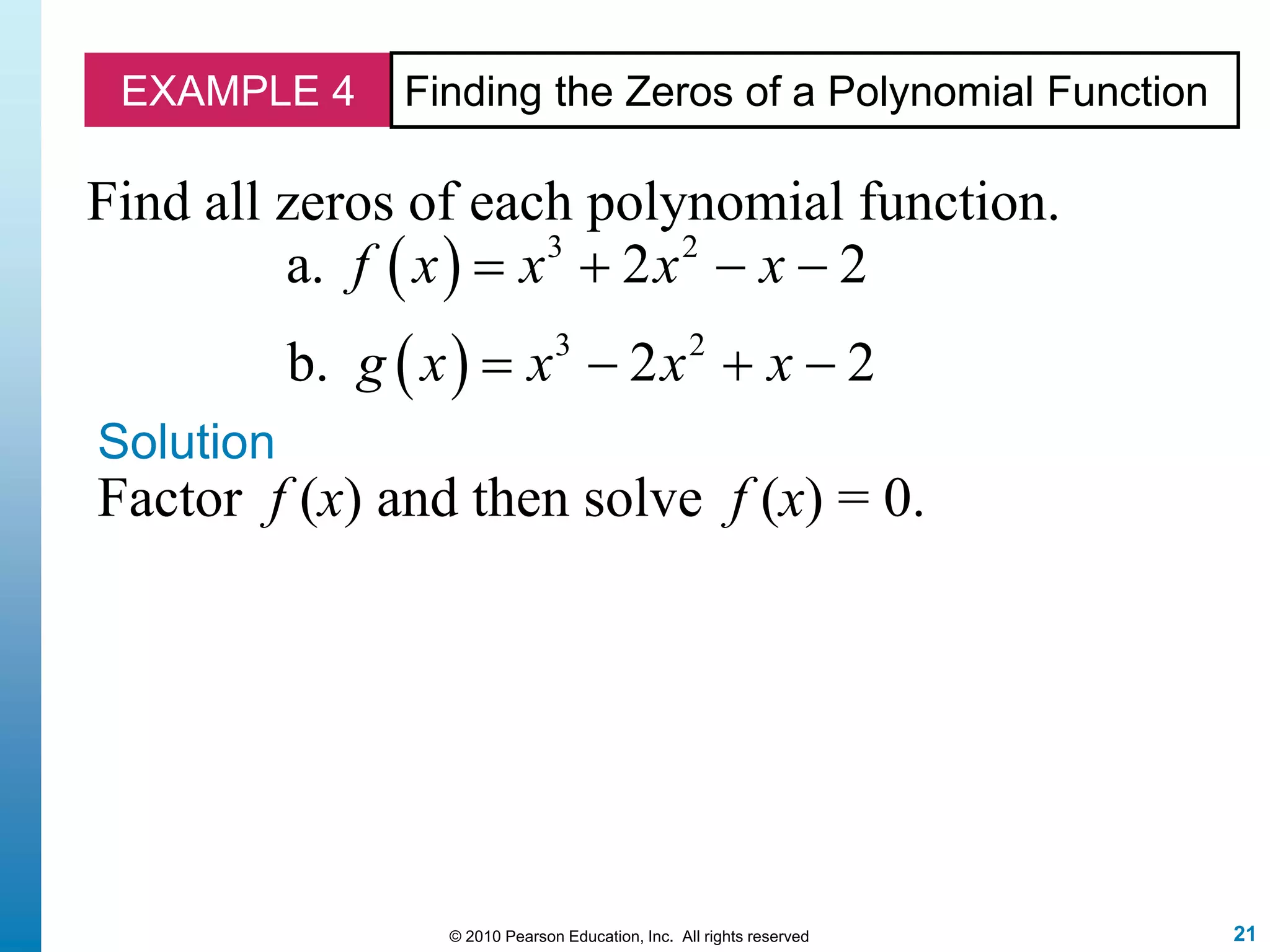
EXAMPLE 4 Finding the Zeros of a Polynomial Function
Find all zeros of each polynomial function.
 
 
3 2
3 2
a. 2 2
b. 2 2
f x x x x
g x x x x
   
   
Solution
Factor f (x) and then solve f (x) = 0.
22© 2010 Pearson Education, Inc. All rights reserved
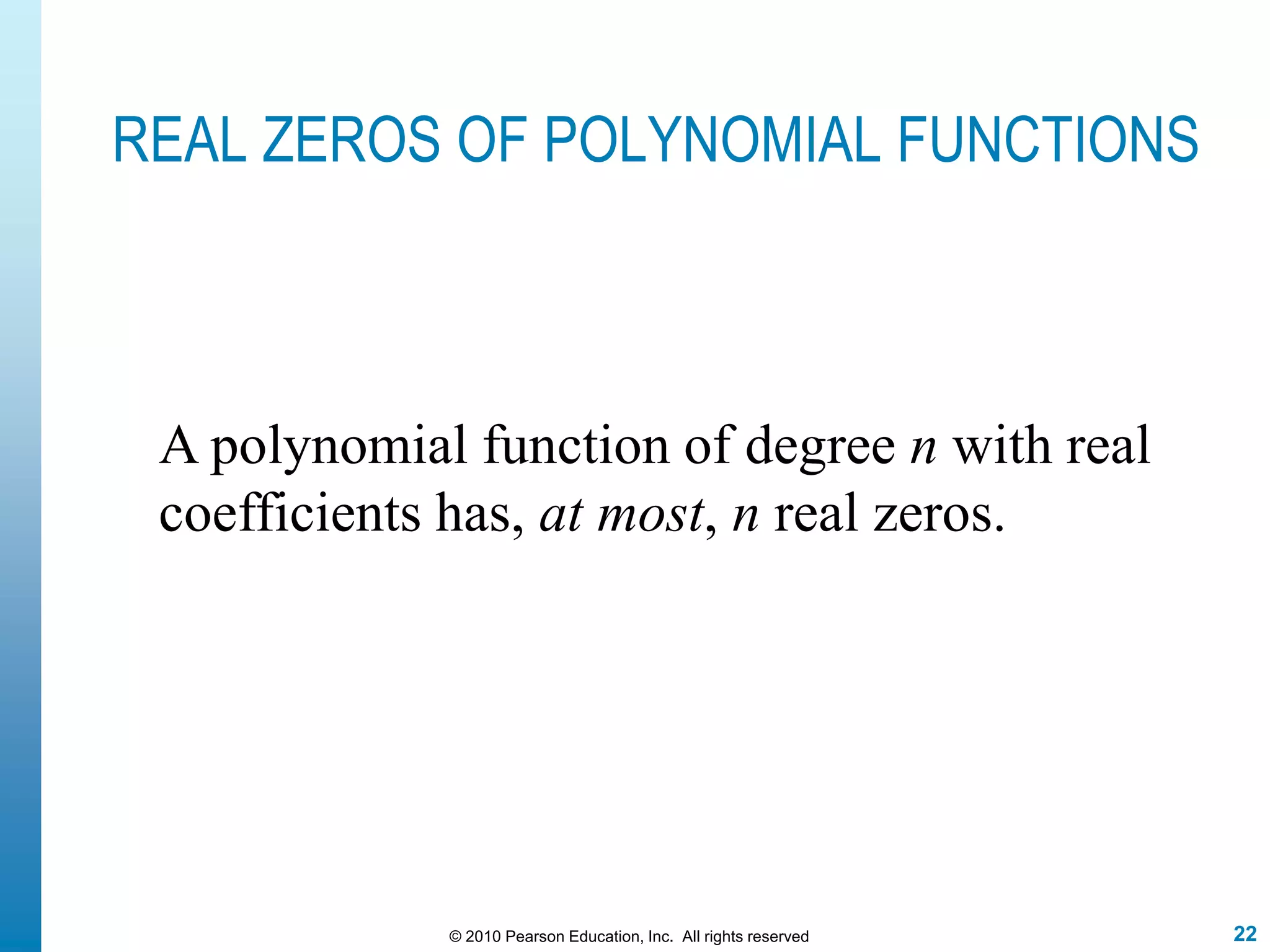
REAL ZEROS OF POLYNOMIAL FUNCTIONS
A polynomial function of degree n with real
coefficients has, at most, n real zeros.
23© 2010 Pearson Education, Inc. All rights reserved
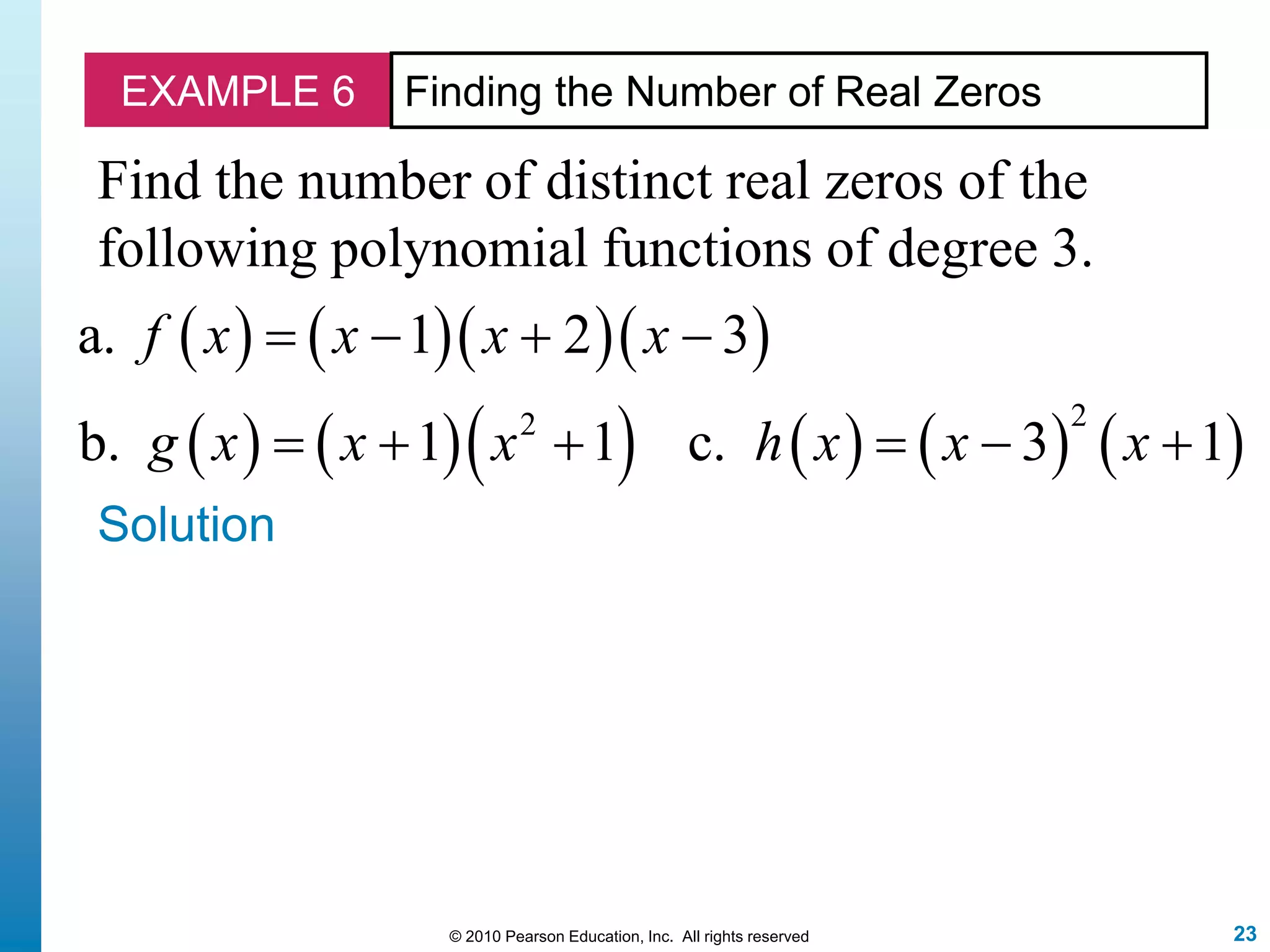
EXAMPLE 6 Finding the Number of Real Zeros
Find the number of distinct real zeros of the
following polynomial functions of degree 3.
Solution
     
          
22
a. 1 2 3
b. 1 1 c. 3 1
f x x x x
g x x x h x x x
   
     
24© 2010 Pearson Education, Inc. All rights reserved
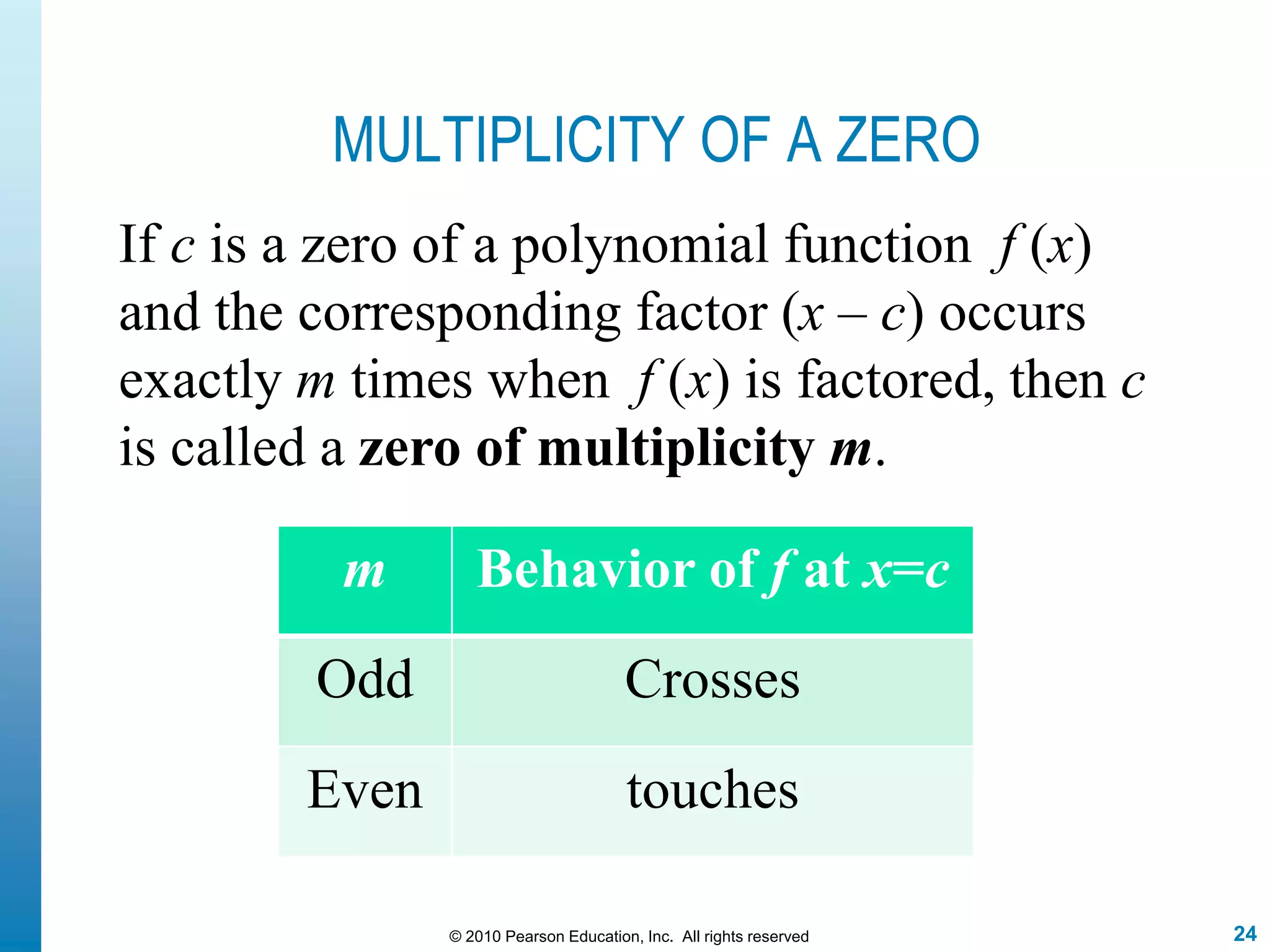
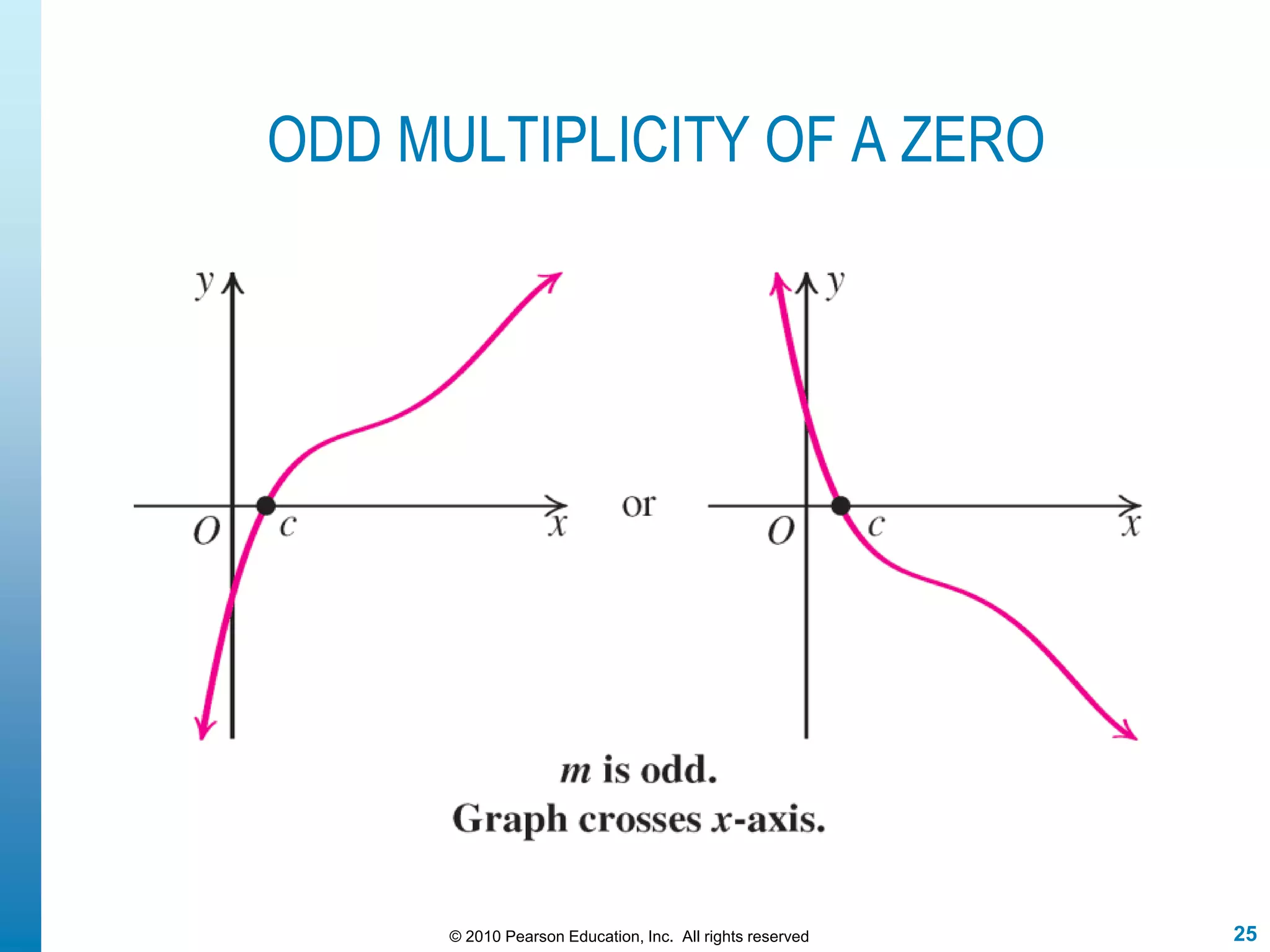
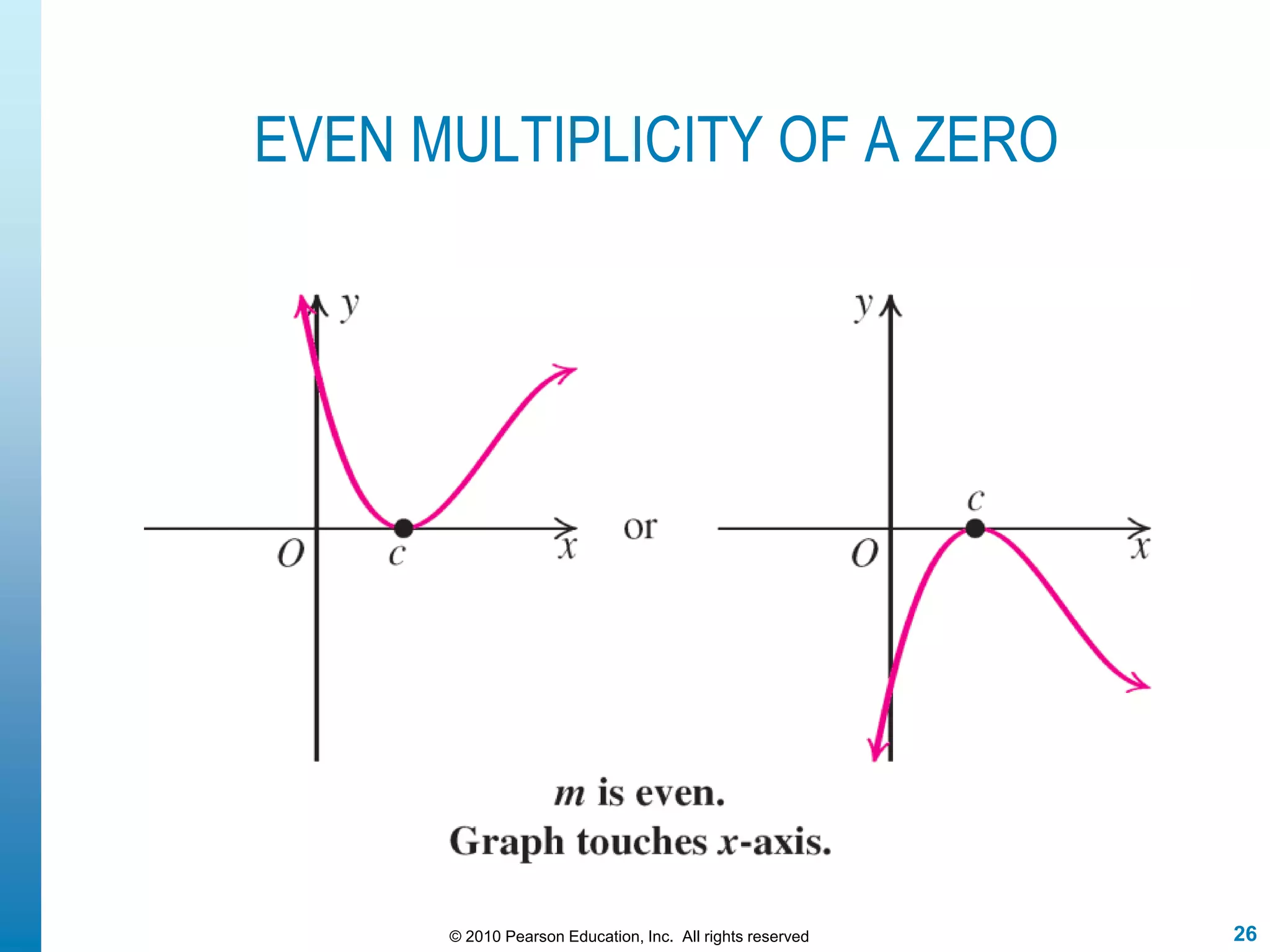
MULTIPLICITY OF A ZERO
If c is a zero of a polynomial function f (x)
and the corresponding factor (x – c) occurs
exactly m times when f (x) is factored, then c
is called a zero of multiplicity m.
m Behavior of f at x=c
Odd Crosses
Even touches
25© 2010 Pearson Education, Inc. All rights reserved
ODD MULTIPLICITY OF A ZERO
26© 2010 Pearson Education, Inc. All rights reserved
EVEN MULTIPLICITY OF A ZERO
27© 2010 Pearson Education, Inc. All rights reserved
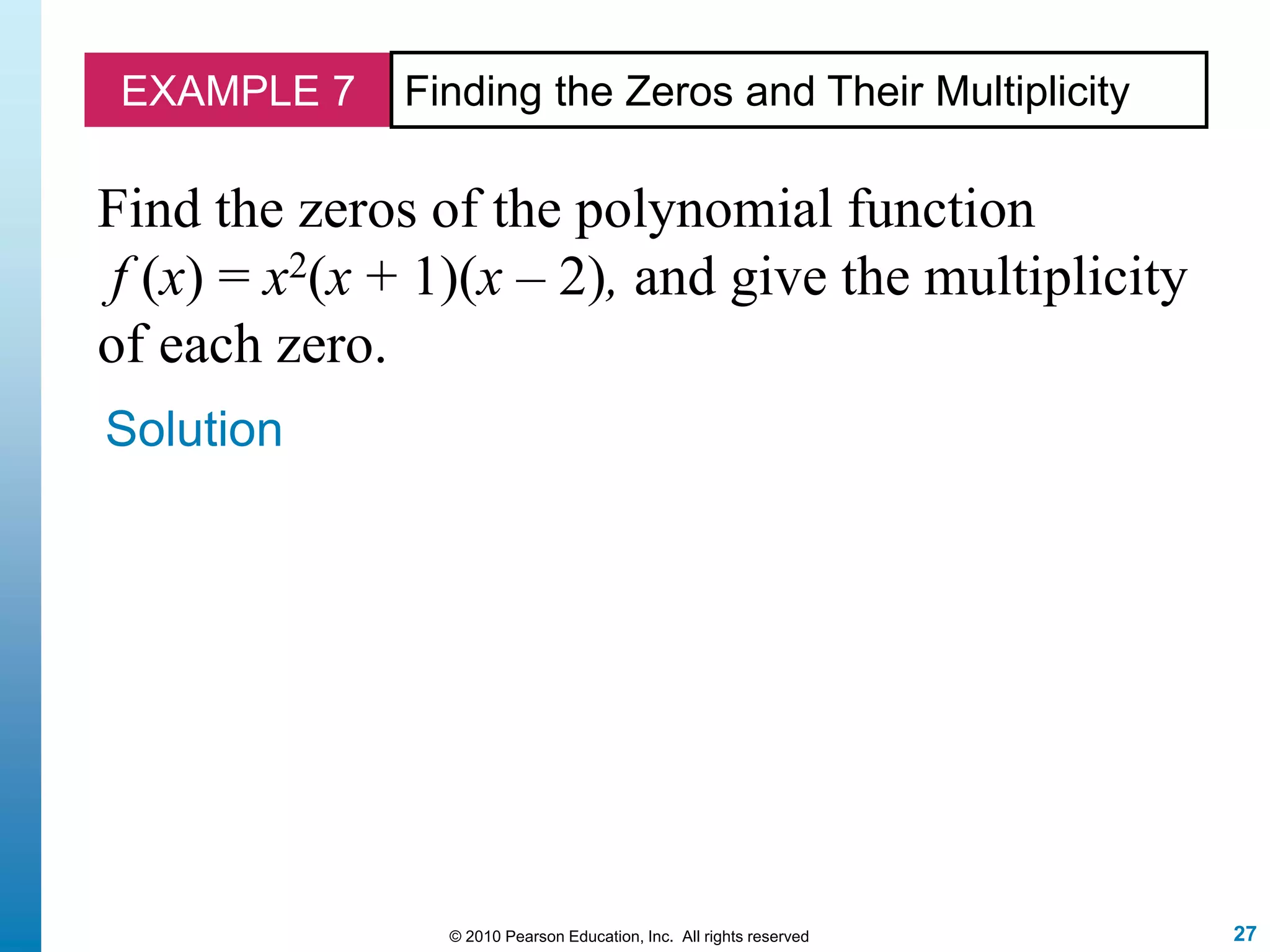
EXAMPLE 7 Finding the Zeros and Their Multiplicity
Find the zeros of the polynomial function
f (x) = x2(x + 1)(x – 2), and give the multiplicity
of each zero.
Solution
28© 2010 Pearson Education, Inc. All rights reserved
TURNING POINTS
A local (or relative) maximum value of f is
higher than any nearby point on the graph.
A local (or relative) minimum value of f is lower
than any nearby point on the graph.
The graph points corresponding to the local
maximum and local minimum values are called
turning points. At each turning point the graph
changes from increasing to decreasing or vice
versa.
29© 2010 Pearson Education, Inc. All rights reserved
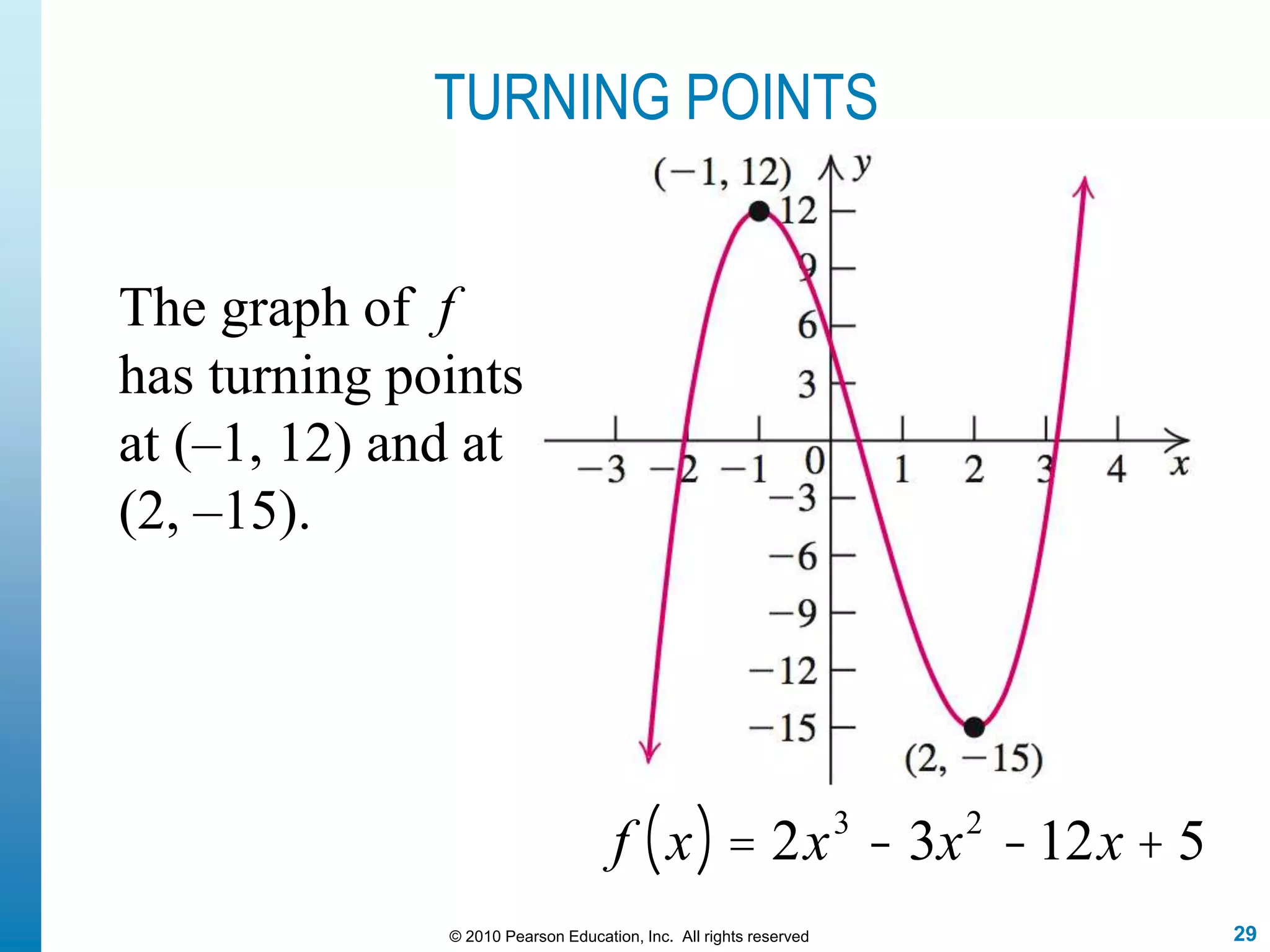
TURNING POINTS
The graph of f
has turning points
at (–1, 12) and at
(2, –15).
f x( ) = 2x3
- 3x2
-12x + 5
30© 2010 Pearson Education, Inc. All rights reserved
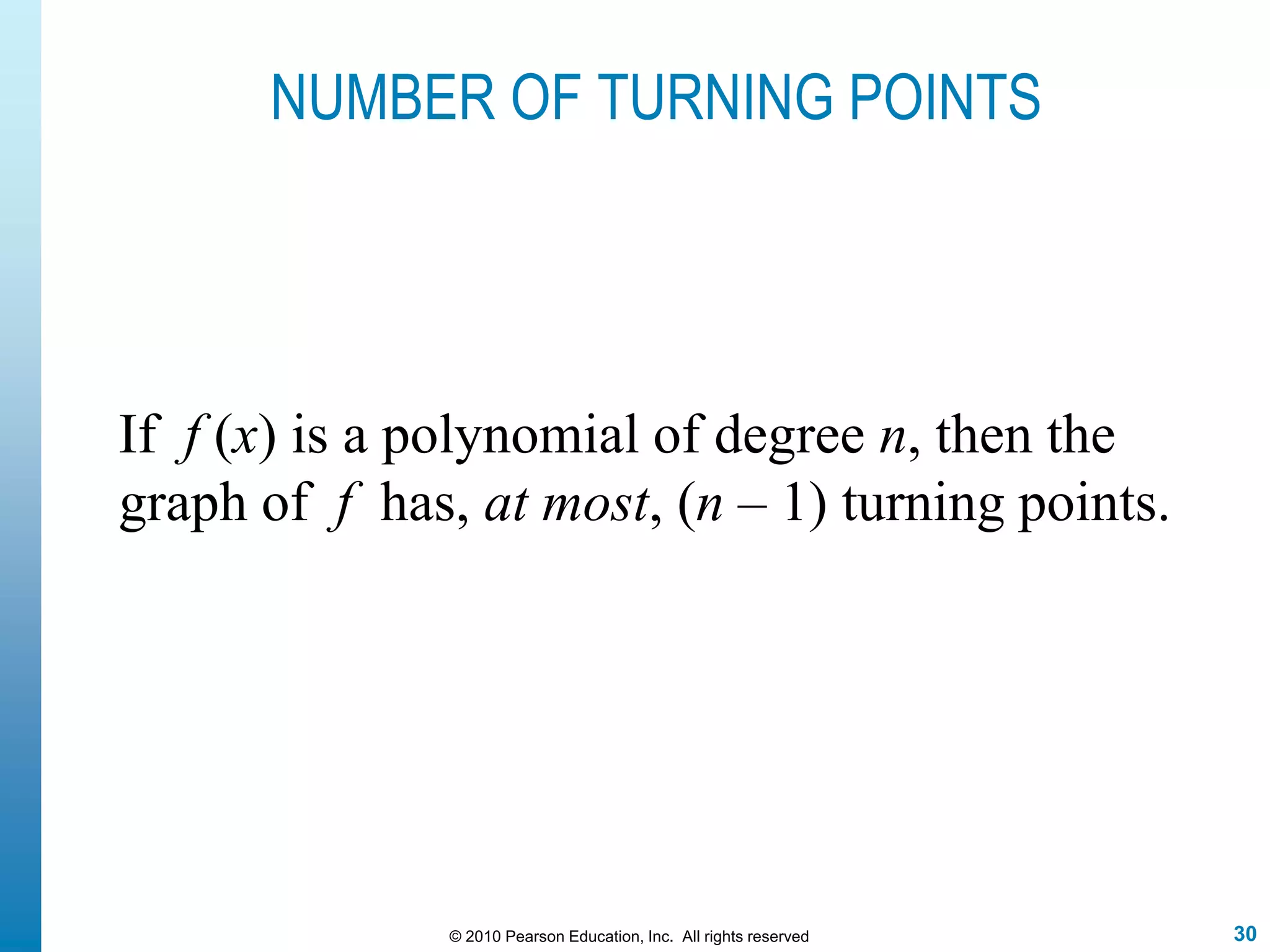
NUMBER OF TURNING POINTS
If f (x) is a polynomial of degree n, then the
graph of f has, at most, (n – 1) turning points.
31© 2010 Pearson Education, Inc. All rights reserved
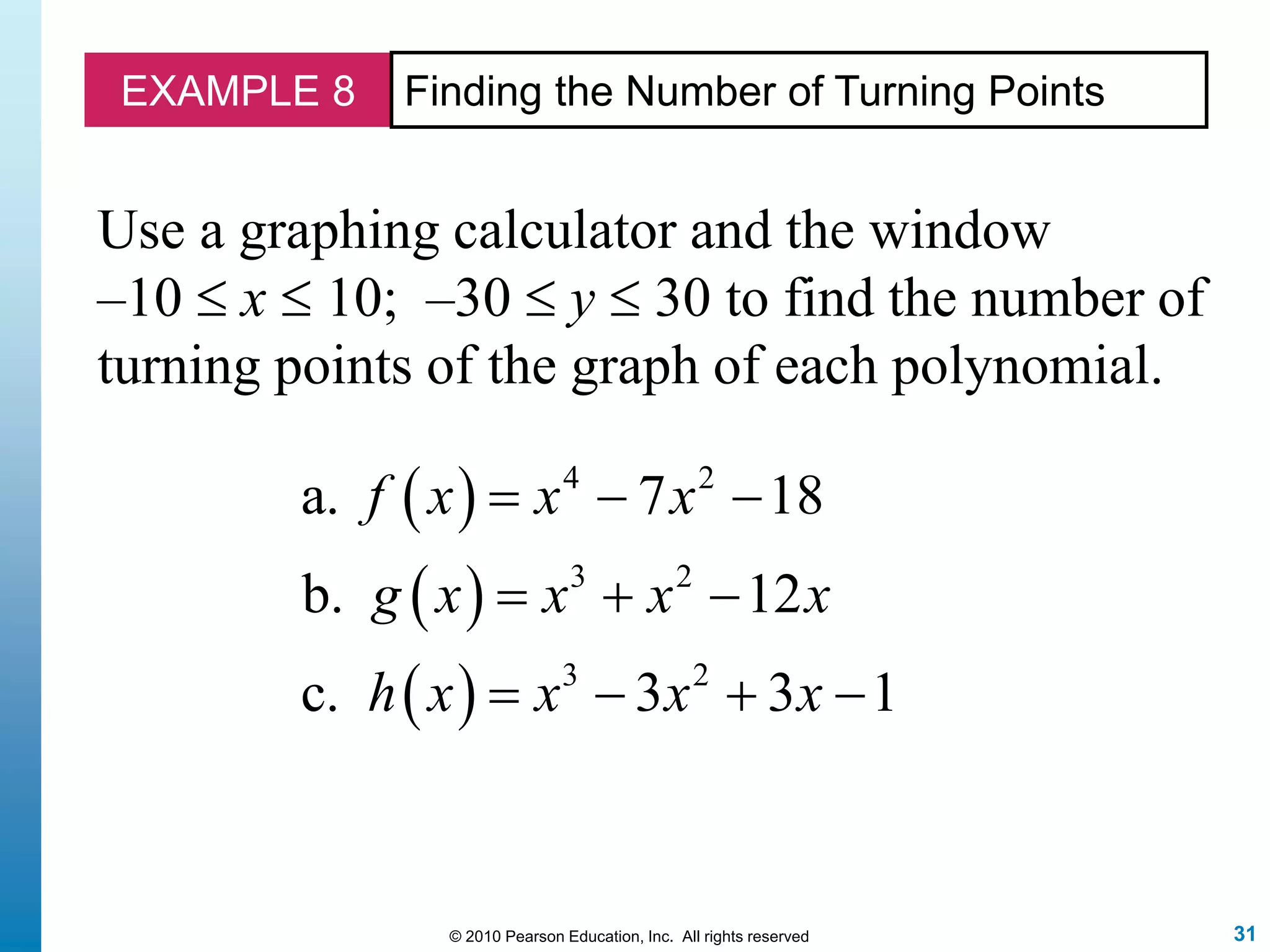
EXAMPLE 8 Finding the Number of Turning Points
Use a graphing calculator and the window
–10  x  10; –30  y  30 to find the number of
turning points of the graph of each polynomial.
 
 
 
4 2
3 2
3 2
a. 7 18
b. 12
c. 3 3 1
f x x x
g x x x x
h x x x x
  
  
   
32© 2010 Pearson Education, Inc. All rights reserved
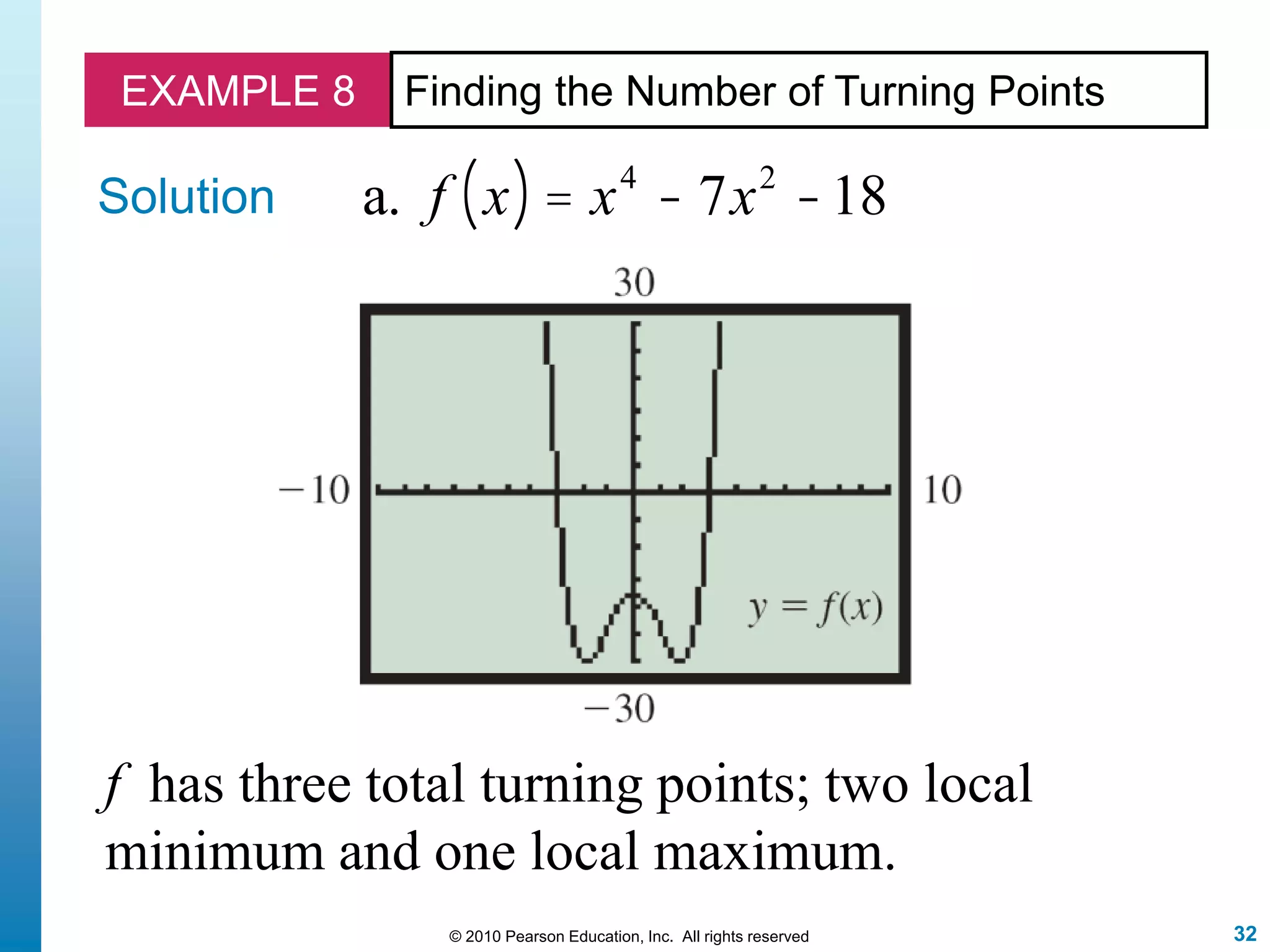
EXAMPLE 8 Finding the Number of Turning Points
Solution
f has three total turning points; two local
minimum and one local maximum.
a. f x( ) = x4
- 7x2
-18
33© 2010 Pearson Education, Inc. All rights reserved
EXAMPLE 8 Finding the Number of Turning Points
Solution continued
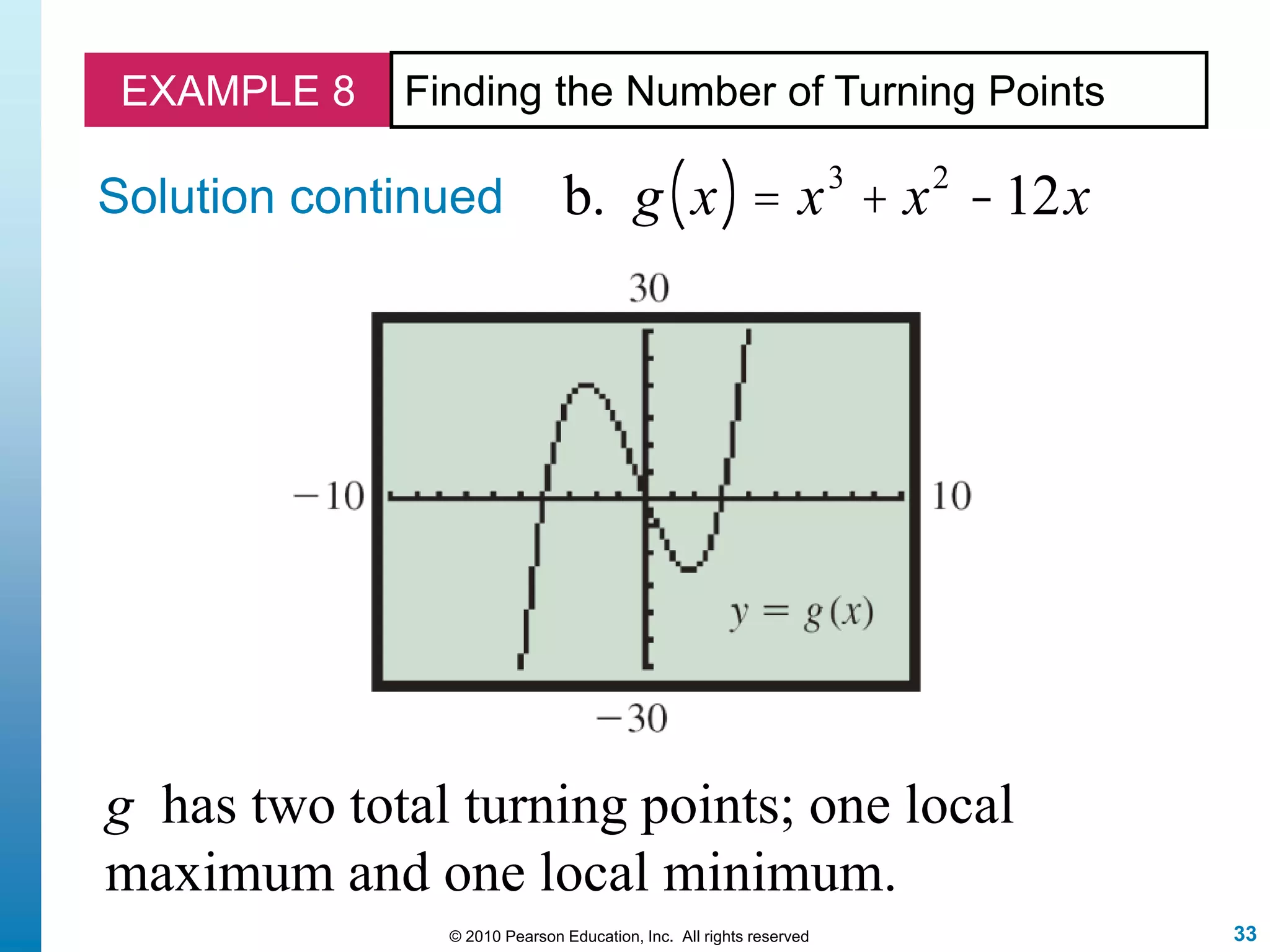
g has two total turning points; one local
maximum and one local minimum.
b. g x( ) = x3
+ x2
-12x
34© 2010 Pearson Education, Inc. All rights reserved
EXAMPLE 8 Finding the Number of Turning Points
Solution continued
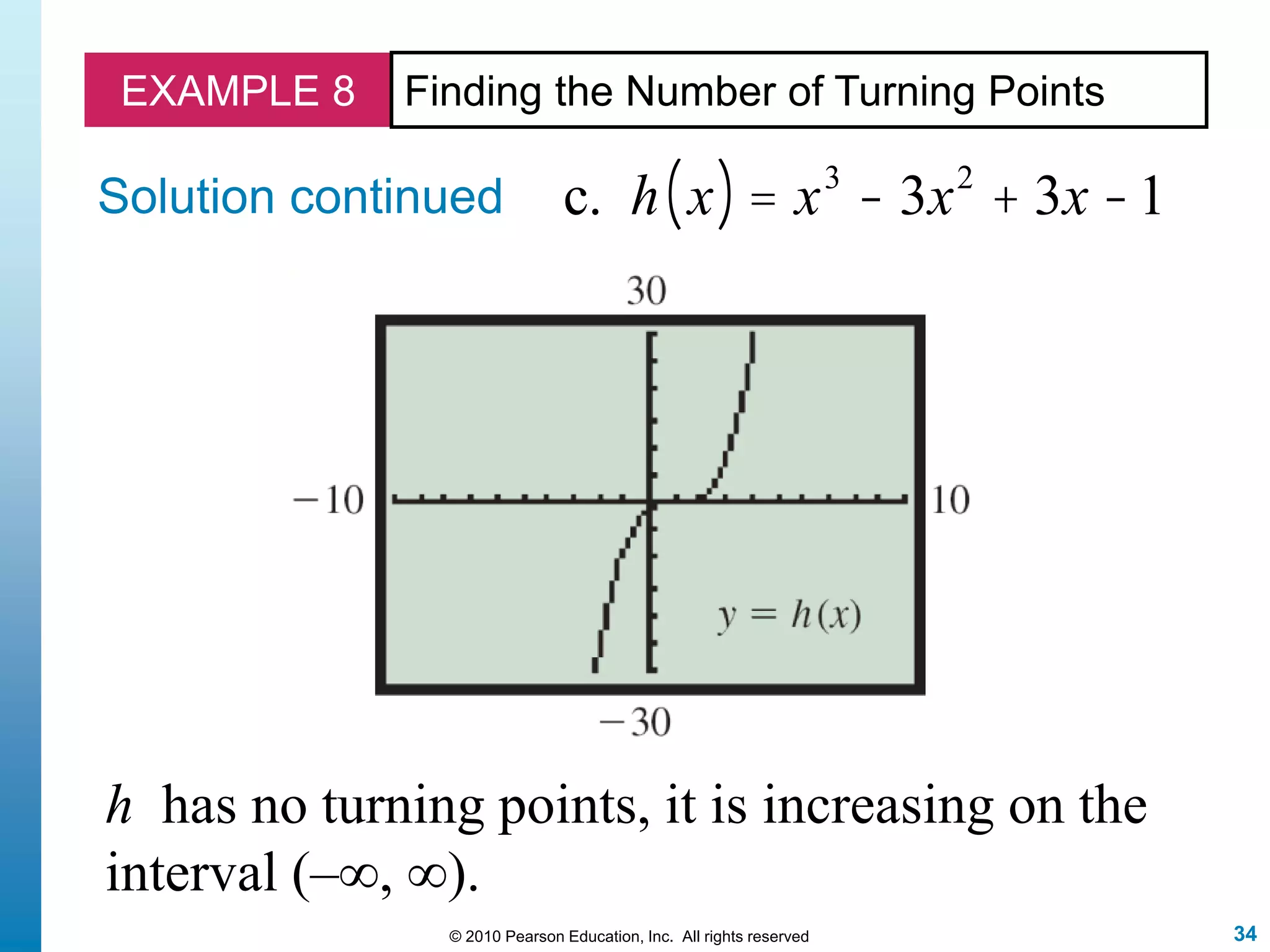
h has no turning points, it is increasing on the
interval (–∞, ∞).
c. h x( ) = x3
- 3x2
+ 3x -1
35© 2010 Pearson Education, Inc. All rights reserved
GRAPHING A POLYNOMIAL FUNCTION
Step 1 Determine the end behavior. Apply
the leading-term test.
Step 2 Find the zeros of the polynomial
function. Set f (x) = 0 and solve. The
zeros give the x-intercepts.
Step 3 Find the y-intercept by computing
f (0).
36© 2010 Pearson Education, Inc. All rights reserved
Step 4 Draw the graph. Use the multiplicities
of each zero to decide whether the
graph crosses the x-axis.
Use the fact that the number of turning
points is less than the degree of the
polynomial to check whether the graph
is drawn correctly.
37© 2010 Pearson Education, Inc. All rights reserved
EXAMPLE 9 Graphing a Polynomial Function
Sketch the graph of   3 2
4 4 16.f x x x x    
Solution
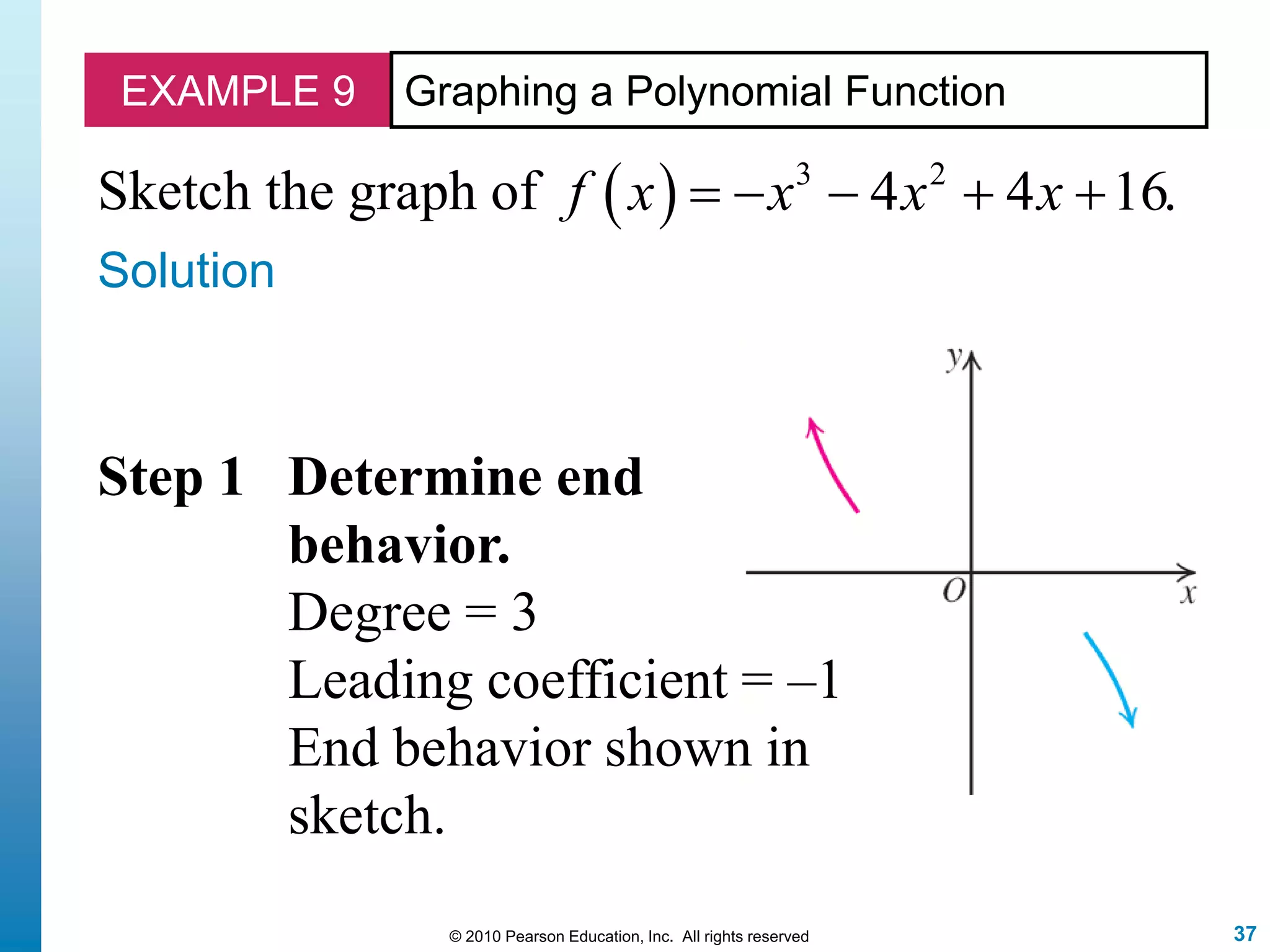
Step 1 Determine end
behavior.
Degree = 3
Leading coefficient = –1
End behavior shown in
sketch.
38© 2010 Pearson Education, Inc. All rights reserved
EXAMPLE 9 Graphing a Polynomial Function
Solution continued
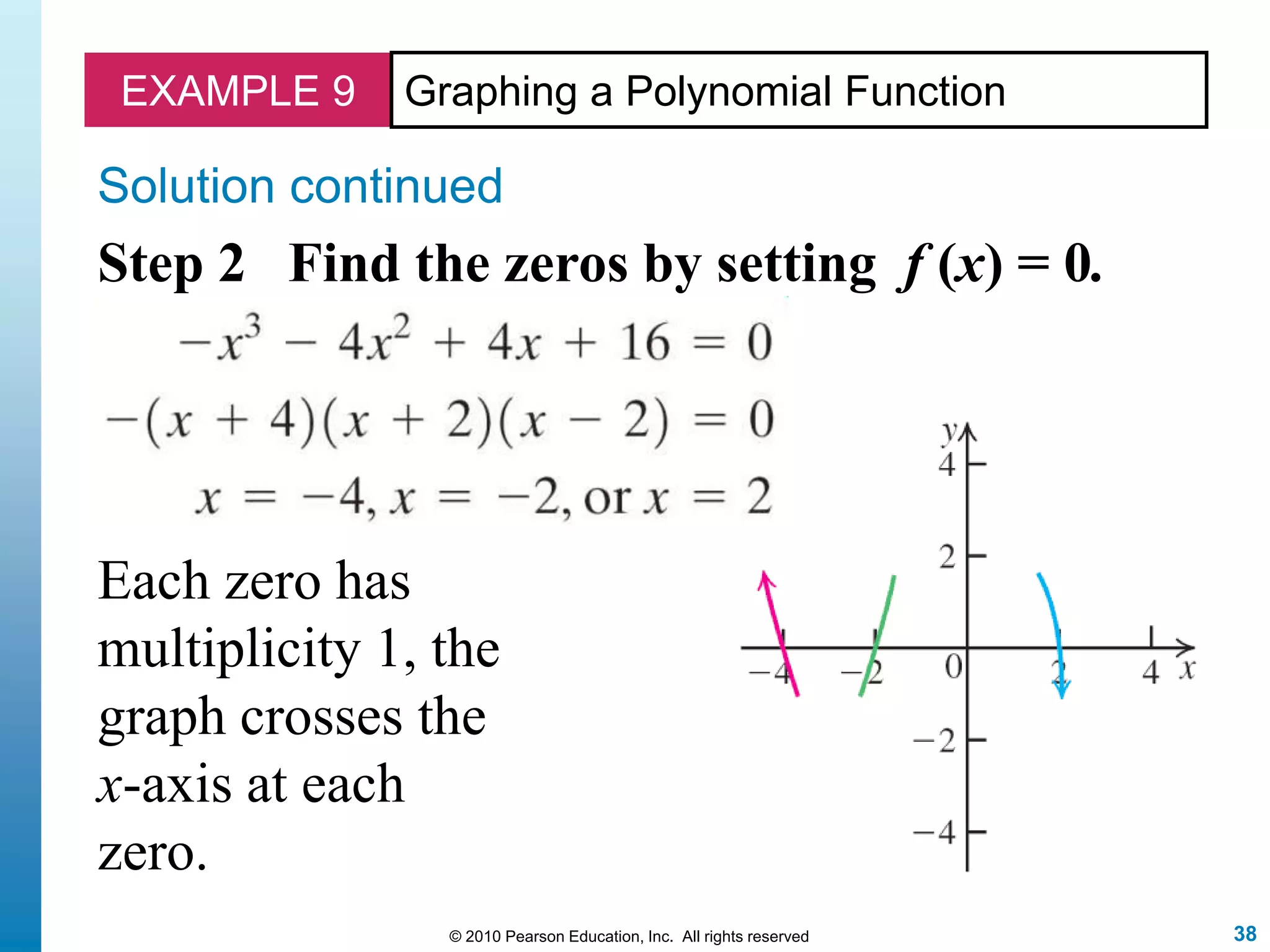
Step 2 Find the zeros by setting f (x) = 0.
Each zero has
multiplicity 1, the
graph crosses the
x-axis at each
zero.
39© 2010 Pearson Education, Inc. All rights reserved
EXAMPLE 9 Graphing a Polynomial Function
Solution continued
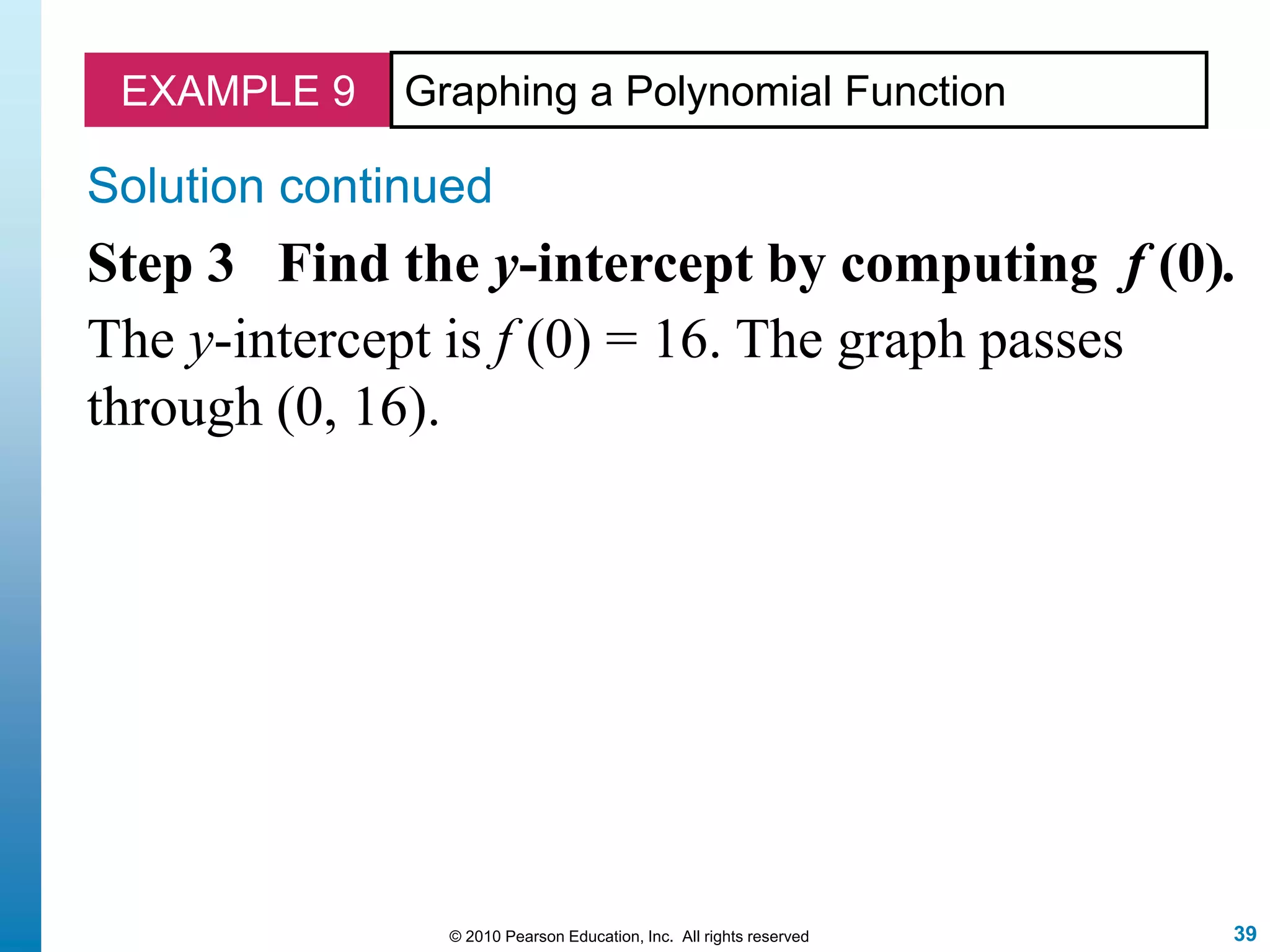
Step 3 Find the y-intercept by computing f (0).
The y-intercept is f (0) = 16. The graph passes
through (0, 16).
40© 2010 Pearson Education, Inc. All rights reserved
EXAMPLE 9 Graphing a Polynomial Function
Solution continued
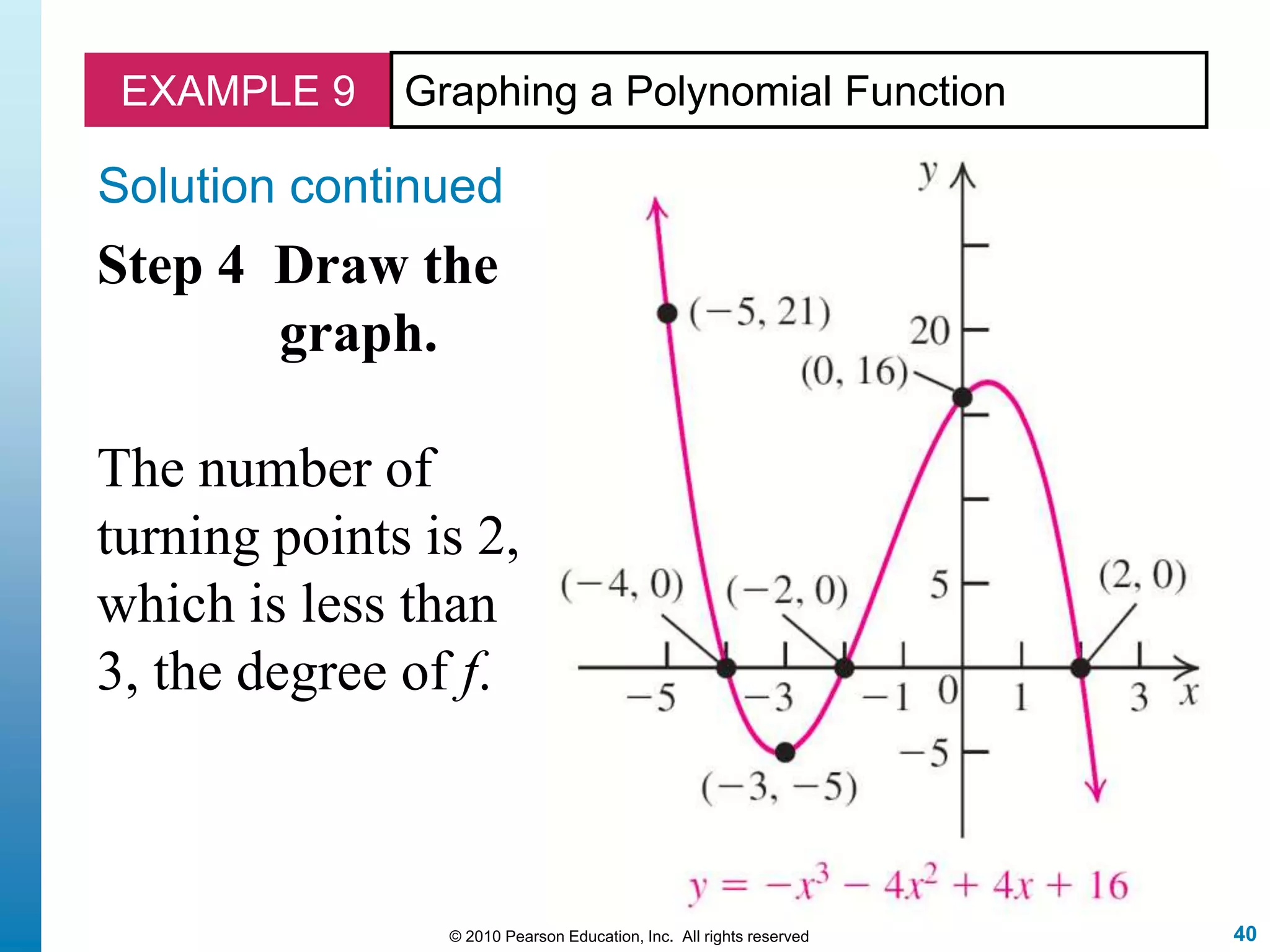
Step 4 Draw the
graph.
The number of
turning points is 2,
which is less than
3, the degree of f.

Lecture 8 section 3.2 polynomial equations

  • 1.
  • 2.
    2© 2010 PearsonEducation, Inc. All rights reserved Definitions A polynomial function of degree n is a function of the form where n is a nonnegative integer and the coefficients an, an–1, …, a2, a1, a0 are real numbers with an ≠ 0. f x( ) = an xn + an-1xn-1 + ...+ a2 x2 + a1x + a0 ,
  • 3.
    3© 2010 PearsonEducation, Inc. All rights reserved Definitions A constant function f (x) = a, (a ≠ 0) which may be written as f (x) = ax0, is a polynomial of degree 0. The term anxn is called the leading term. The number an is called the leading coefficient, and a0 is the constant term.
  • 4.
    4© 2010 PearsonEducation, Inc. All rights reserved Definitions Degree Name 0 Zero function: f(x)=0 1 linear 2 quadratic 3 cubic 4 quartic 5 quintic
  • 5.
    5© 2010 PearsonEducation, Inc. All rights reserved COMMON PROPERTIES OF POLYNOMIAL FUNCTIONS 1. The domain of a polynomial function is the set of all real numbers.
  • 6.
    6© 2010 PearsonEducation, Inc. All rights reserved 2. The graph of a polynomial function is a continuous curve.
  • 7.
    7© 2010 PearsonEducation, Inc. All rights reserved 3. The graph of a polynomial function is a smooth curve.
  • 8.
    8© 2010 PearsonEducation, Inc. All rights reserved EXAMPLE 1 Polynomial Functions State which functions are polynomial functions. For each polynomial function, find its degree, the leading term, and the leading coefficient. f (x) = 5x4 – 2x + 7 Solution
  • 9.
    9© 2010 PearsonEducation, Inc. All rights reserved END BEHAVIOR OF POLYNOMIAL FUNCTIONS Case 1 n Even a > 0 The graph rises to the left and right, similar to y = x2.
  • 10.
    10© 2010 PearsonEducation, Inc. All rights reserved END BEHAVIOR OF POLYNOMIAL FUNCTIONS Case 2 n Even a < 0 The graph falls to the left and right, similar to y = –x2.
  • 11.
    11© 2010 PearsonEducation, Inc. All rights reserved END BEHAVIOR OF POLYNOMIAL FUNCTIONS Case 3 n Odd a > 0 The graph rises to the right and falls to the left, similar to y = x3.
  • 12.
    12© 2010 PearsonEducation, Inc. All rights reserved END BEHAVIOR OF POLYNOMIAL FUNCTIONS Case 4 n Odd a < 0 The graph rises to the left and falls to the right, similar to y = –x3.
  • 13.
    13© 2010 PearsonEducation, Inc. All rights reserved EXAMPLE 2 Understanding the End Behavior of a Polynomial Function Let function of degree 3. Show that P x( ) = 2x3 + 5x2 - 7x +11 be a polynomial   3 2P x x when |x| is very large. Solution P x( ) = x3 2 + 5 x - 7 x2 + 11 x3 æ èç ö ø÷ When |x| is very large 5 x , 7 x2 and 11 x3 are close to 0. P x( ) » x3 2 + 0 - 0 + 0( ) » 2x3 .Therefore,
  • 14.
    14© 2010 PearsonEducation, Inc. All rights reserved THE LEADING-TERM TEST Its leading term is anxn. The behavior of the graph of f as x → ∞ or as x → –∞ is similar to one of the following four graphs and is described as shown in each case. The middle portion of each graph, indicated by the dashed lines, is not determined by this test. Let   1 1 1 0... 0n n nn nf x a x ax ax aa        be a polynomial function.
  • 15.
    15© 2010 PearsonEducation, Inc. All rights reserved Case 1 n Even an > 0 THE LEADING-TERM TEST
  • 16.
    16© 2010 PearsonEducation, Inc. All rights reserved Case 2 n Even an < 0 THE LEADING-TERM TEST
  • 17.
    17© 2010 PearsonEducation, Inc. All rights reserved Case 3 n Odd an > 0 THE LEADING-TERM TEST
  • 18.
    18© 2010 PearsonEducation, Inc. All rights reserved Case 4 n Odd an < 0 THE LEADING-TERM TEST
  • 19.
    19© 2010 PearsonEducation, Inc. All rights reserved EXAMPLE 3 Using the Leading-Term Test Use the leading-term test to determine the end behavior of the graph of y = f x( ) = -2x3 + 3x2 + 4. Solution Here n = 3 (odd) and an = –2 < 0. Thus, Case 4 applies. The graph of f (x) rises to the left and falls to the right. This behavior is described as y ∞ as x –∞ and y –∞ as x ∞.
  • 20.
    20© 2010 PearsonEducation, Inc. All rights reserved REAL ZEROS OF POLYNOMIAL FUNCTIONS 1. c is a zero of f . 2. c is a solution (or root) of the equation f (x) = 0. 3. c is an x-intercept of the graph of f . The point (c, 0) is on the graph of f . If f is a polynomial function and c is a real number, then the following statements are equivalent.
  • 21.
    21© 2010 PearsonEducation, Inc. All rights reserved EXAMPLE 4 Finding the Zeros of a Polynomial Function Find all zeros of each polynomial function.     3 2 3 2 a. 2 2 b. 2 2 f x x x x g x x x x         Solution Factor f (x) and then solve f (x) = 0.
  • 22.
    22© 2010 PearsonEducation, Inc. All rights reserved REAL ZEROS OF POLYNOMIAL FUNCTIONS A polynomial function of degree n with real coefficients has, at most, n real zeros.
  • 23.
    23© 2010 PearsonEducation, Inc. All rights reserved EXAMPLE 6 Finding the Number of Real Zeros Find the number of distinct real zeros of the following polynomial functions of degree 3. Solution                  22 a. 1 2 3 b. 1 1 c. 3 1 f x x x x g x x x h x x x          
  • 24.
    24© 2010 PearsonEducation, Inc. All rights reserved MULTIPLICITY OF A ZERO If c is a zero of a polynomial function f (x) and the corresponding factor (x – c) occurs exactly m times when f (x) is factored, then c is called a zero of multiplicity m. m Behavior of f at x=c Odd Crosses Even touches
  • 25.
    25© 2010 PearsonEducation, Inc. All rights reserved ODD MULTIPLICITY OF A ZERO
  • 26.
    26© 2010 PearsonEducation, Inc. All rights reserved EVEN MULTIPLICITY OF A ZERO
  • 27.
    27© 2010 PearsonEducation, Inc. All rights reserved EXAMPLE 7 Finding the Zeros and Their Multiplicity Find the zeros of the polynomial function f (x) = x2(x + 1)(x – 2), and give the multiplicity of each zero. Solution
  • 28.
    28© 2010 PearsonEducation, Inc. All rights reserved TURNING POINTS A local (or relative) maximum value of f is higher than any nearby point on the graph. A local (or relative) minimum value of f is lower than any nearby point on the graph. The graph points corresponding to the local maximum and local minimum values are called turning points. At each turning point the graph changes from increasing to decreasing or vice versa.
  • 29.
    29© 2010 PearsonEducation, Inc. All rights reserved TURNING POINTS The graph of f has turning points at (–1, 12) and at (2, –15). f x( ) = 2x3 - 3x2 -12x + 5
  • 30.
    30© 2010 PearsonEducation, Inc. All rights reserved NUMBER OF TURNING POINTS If f (x) is a polynomial of degree n, then the graph of f has, at most, (n – 1) turning points.
  • 31.
    31© 2010 PearsonEducation, Inc. All rights reserved EXAMPLE 8 Finding the Number of Turning Points Use a graphing calculator and the window –10  x  10; –30  y  30 to find the number of turning points of the graph of each polynomial.       4 2 3 2 3 2 a. 7 18 b. 12 c. 3 3 1 f x x x g x x x x h x x x x          
  • 32.
    32© 2010 PearsonEducation, Inc. All rights reserved EXAMPLE 8 Finding the Number of Turning Points Solution f has three total turning points; two local minimum and one local maximum. a. f x( ) = x4 - 7x2 -18
  • 33.
    33© 2010 PearsonEducation, Inc. All rights reserved EXAMPLE 8 Finding the Number of Turning Points Solution continued g has two total turning points; one local maximum and one local minimum. b. g x( ) = x3 + x2 -12x
  • 34.
    34© 2010 PearsonEducation, Inc. All rights reserved EXAMPLE 8 Finding the Number of Turning Points Solution continued h has no turning points, it is increasing on the interval (–∞, ∞). c. h x( ) = x3 - 3x2 + 3x -1
  • 35.
    35© 2010 PearsonEducation, Inc. All rights reserved GRAPHING A POLYNOMIAL FUNCTION Step 1 Determine the end behavior. Apply the leading-term test. Step 2 Find the zeros of the polynomial function. Set f (x) = 0 and solve. The zeros give the x-intercepts. Step 3 Find the y-intercept by computing f (0).
  • 36.
    36© 2010 PearsonEducation, Inc. All rights reserved Step 4 Draw the graph. Use the multiplicities of each zero to decide whether the graph crosses the x-axis. Use the fact that the number of turning points is less than the degree of the polynomial to check whether the graph is drawn correctly.
  • 37.
    37© 2010 PearsonEducation, Inc. All rights reserved EXAMPLE 9 Graphing a Polynomial Function Sketch the graph of   3 2 4 4 16.f x x x x     Solution Step 1 Determine end behavior. Degree = 3 Leading coefficient = –1 End behavior shown in sketch.
  • 38.
    38© 2010 PearsonEducation, Inc. All rights reserved EXAMPLE 9 Graphing a Polynomial Function Solution continued Step 2 Find the zeros by setting f (x) = 0. Each zero has multiplicity 1, the graph crosses the x-axis at each zero.
  • 39.
    39© 2010 PearsonEducation, Inc. All rights reserved EXAMPLE 9 Graphing a Polynomial Function Solution continued Step 3 Find the y-intercept by computing f (0). The y-intercept is f (0) = 16. The graph passes through (0, 16).
  • 40.
    40© 2010 PearsonEducation, Inc. All rights reserved EXAMPLE 9 Graphing a Polynomial Function Solution continued Step 4 Draw the graph. The number of turning points is 2, which is less than 3, the degree of f.