NAMING & FORMULA WRITING
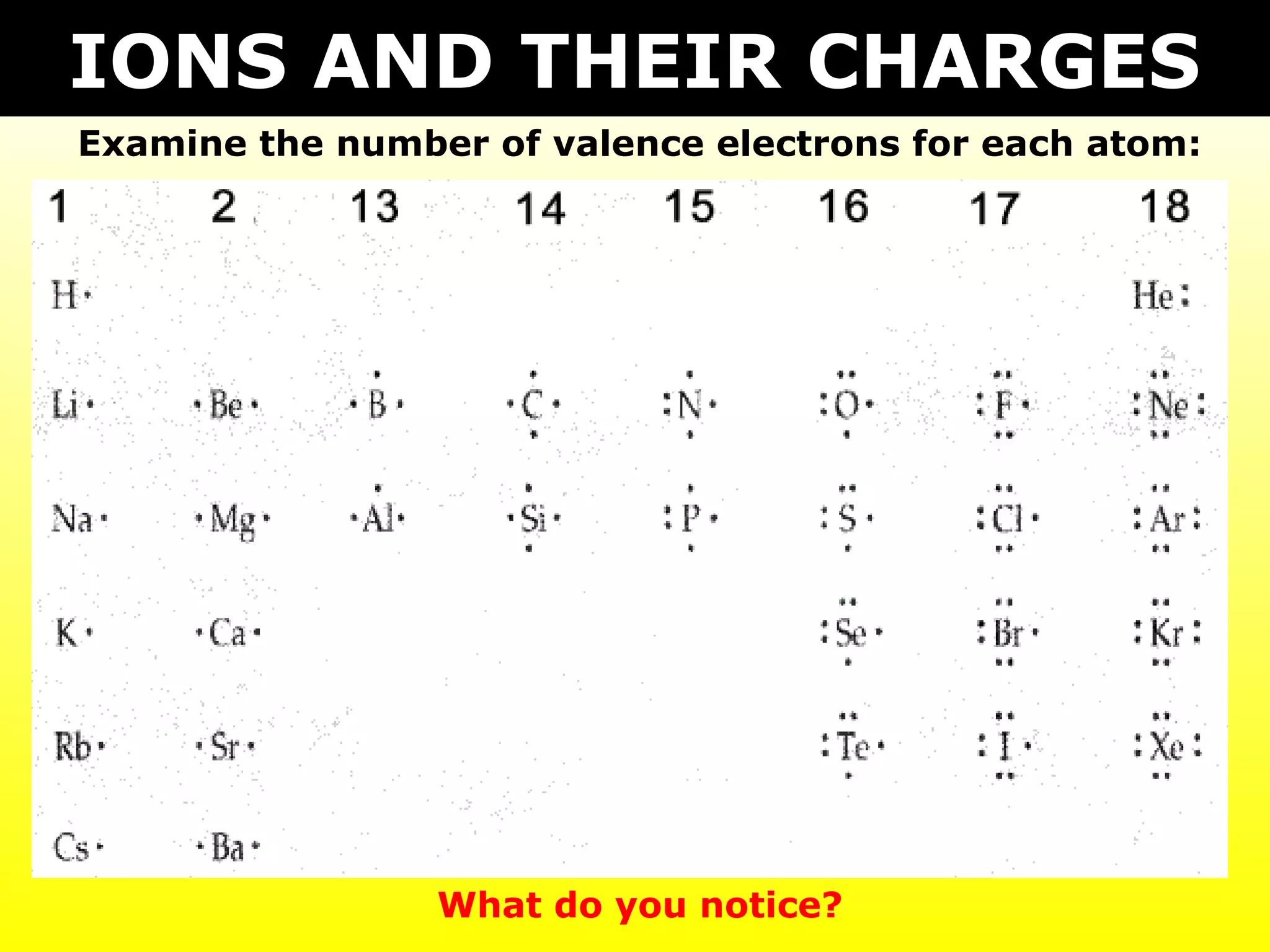
Examine the number of valence electrons for each atom:
What do you notice?
IONS AND THEIR CHARGES
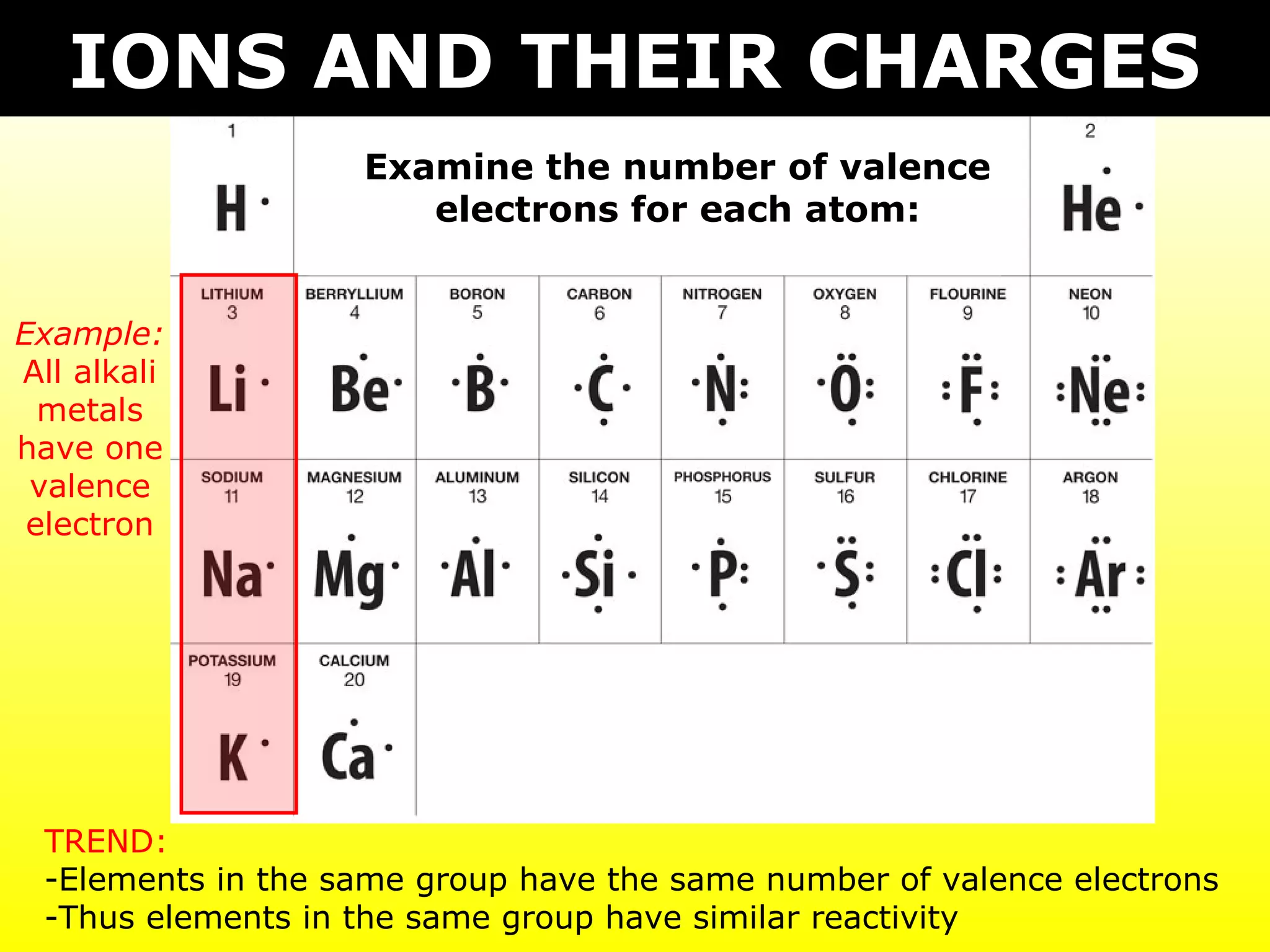
TREND:
-Elements in the same group have the same number of valence electrons
-Thus elements in the same group have similar reactivity
Examine the number of valence
electrons for each atom:
Example:
All alkali
metals
have one
valence
electron
IONS AND THEIR CHARGES
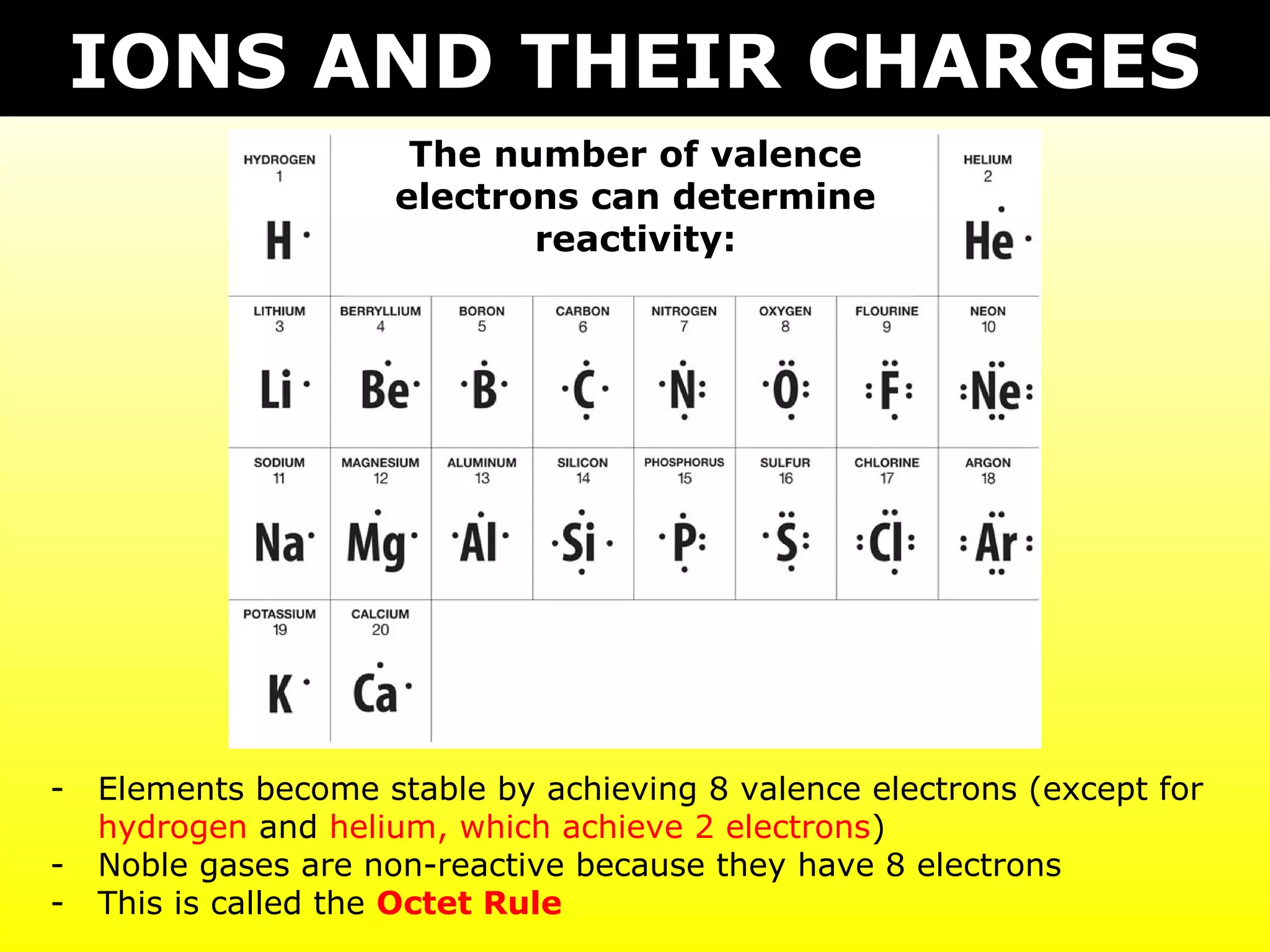
- Elements become stable by achieving 8 valence electrons (except for
hydrogen and helium, which achieve 2 electrons)
- Noble gases are non-reactive because they have 8 electrons
- This is called the Octet Rule
The number of valence
electrons can determine
reactivity:
IONS AND THEIR CHARGES
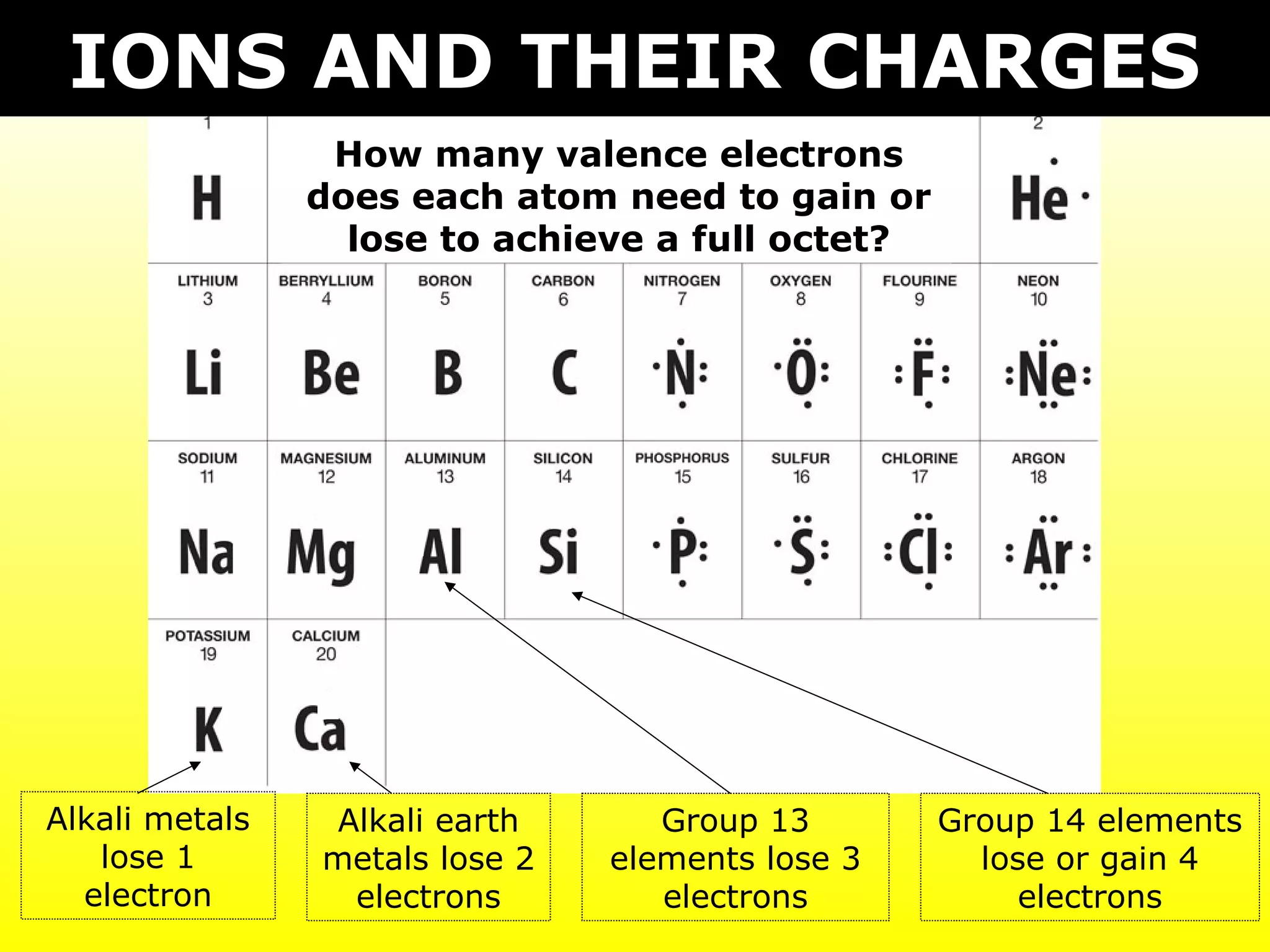
How many valence electrons
does each atom need to gain or
lose to achieve a full octet?
Alkali metals
lose 1
electron
Alkali earth
metals lose 2
electrons
Group 13
elements lose 3
electrons
Group 14 elements
lose or gain 4
electrons
IONS AND THEIR CHARGES
How many valence electrons
does each atom need to gain or
lose to achieve a full octet?
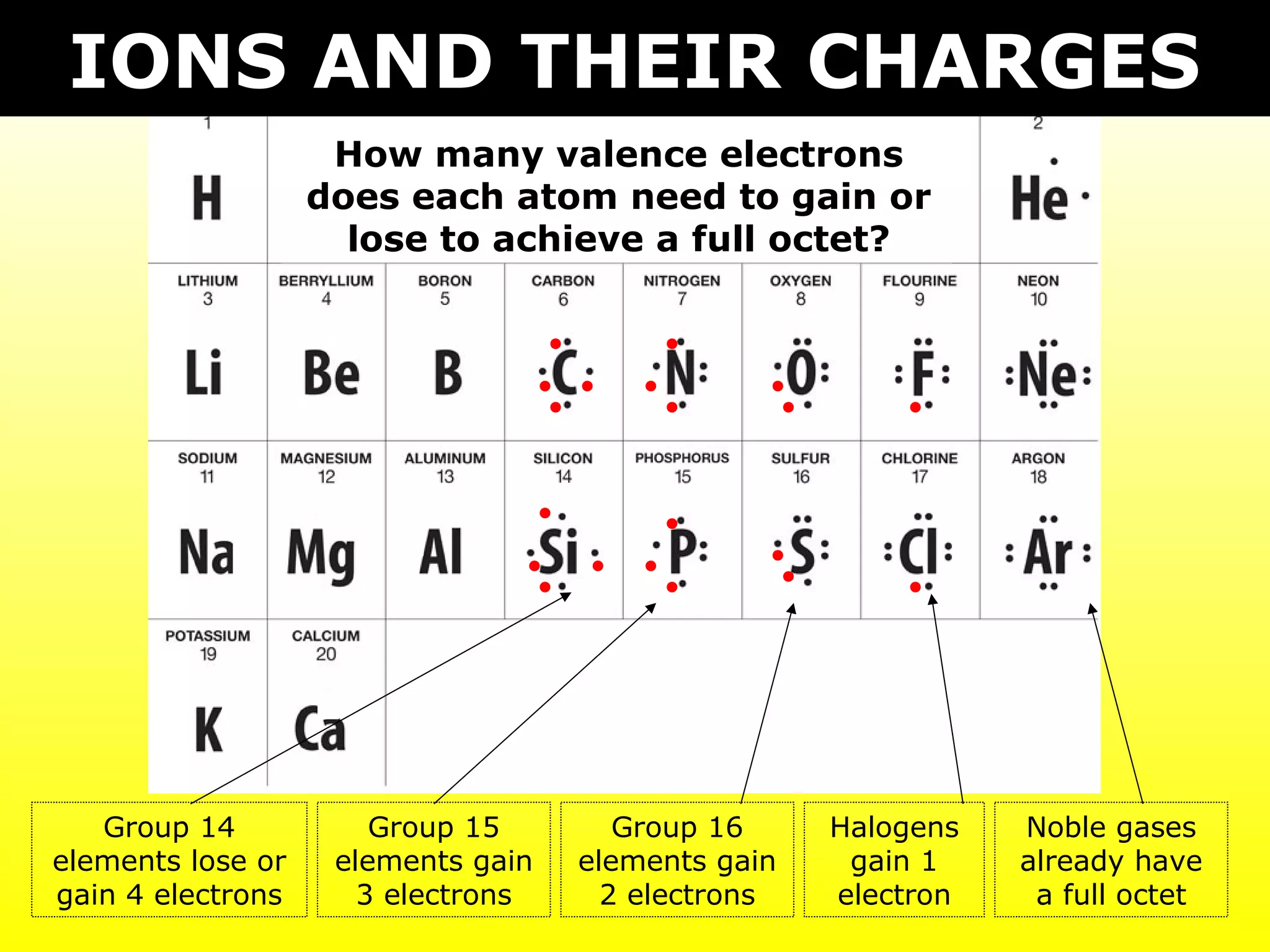
Group 14
elements lose or
gain 4 electrons
Group 15
elements gain
3 electrons
Group 16
elements gain
2 electrons
Halogens
gain 1
electron
Noble gases
already have
a full octet
IONS AND THEIR CHARGES
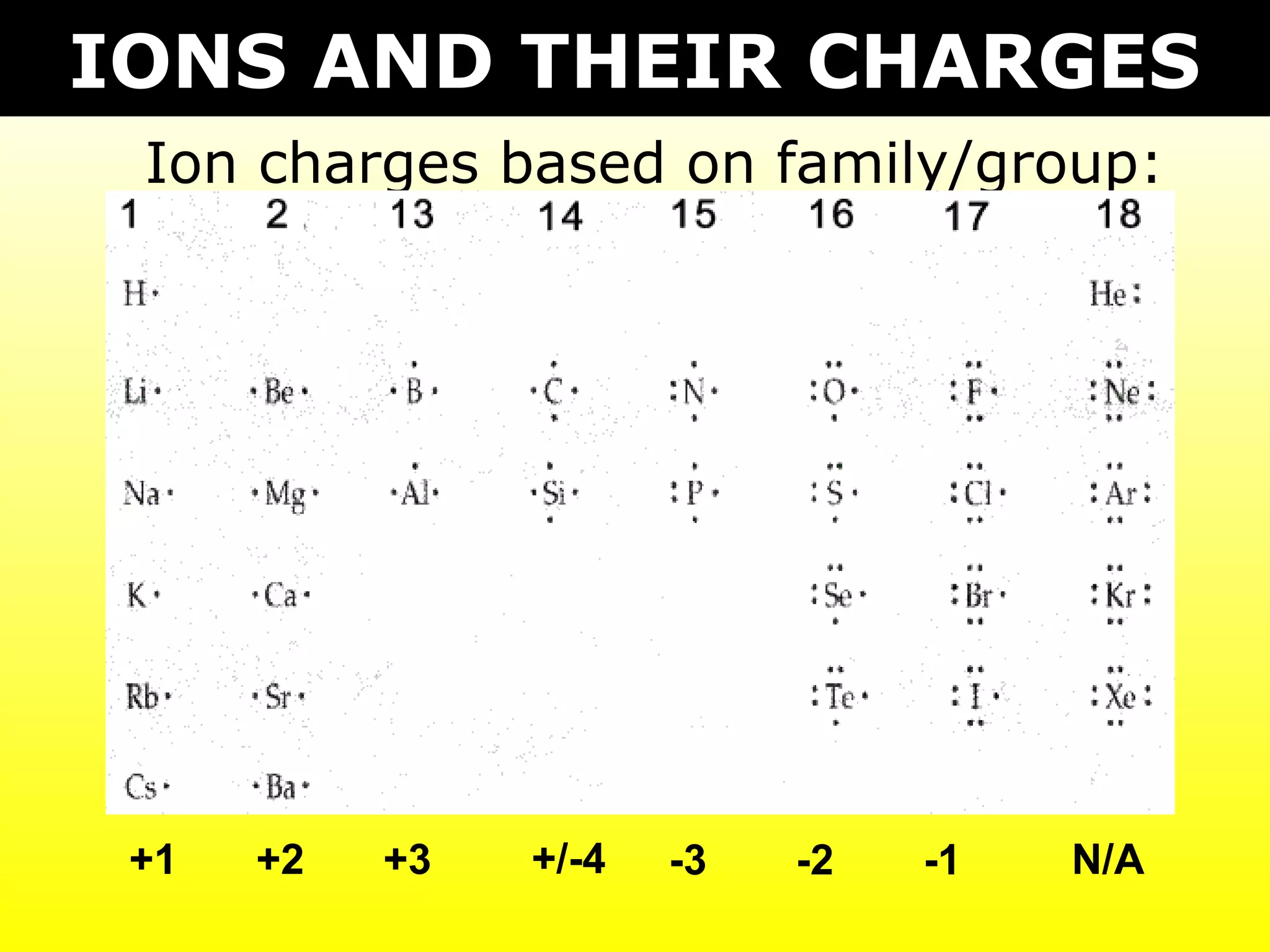
Ion charges based on family/group:
+1 +2 +3 +/-4 -3 -2 -1 N/A
IONS AND THEIR CHARGES
BINARY IONIC COMPOUNDS
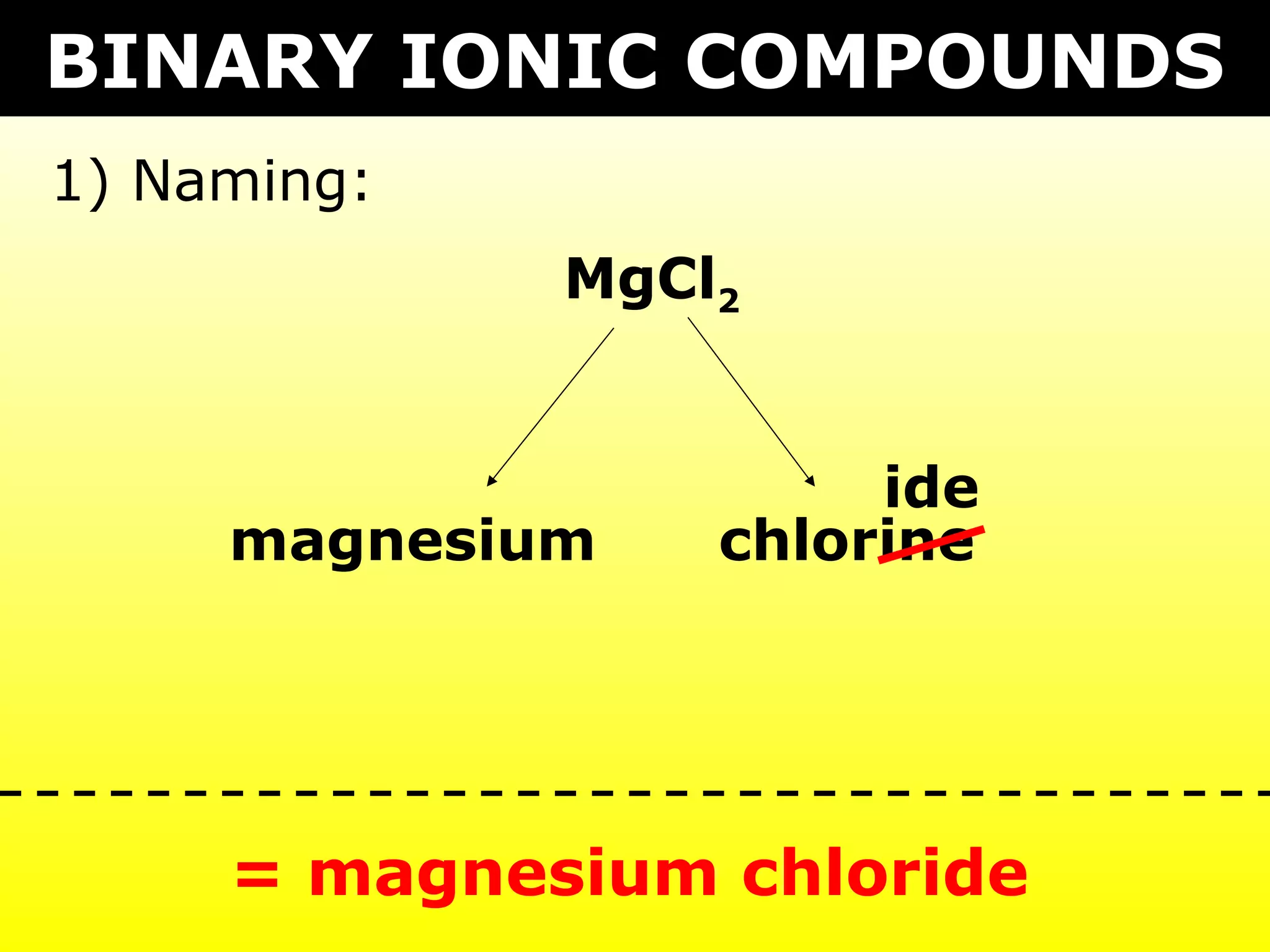
MgCl2
magnesium chlorine
ide
= magnesium chloride
1) Naming:
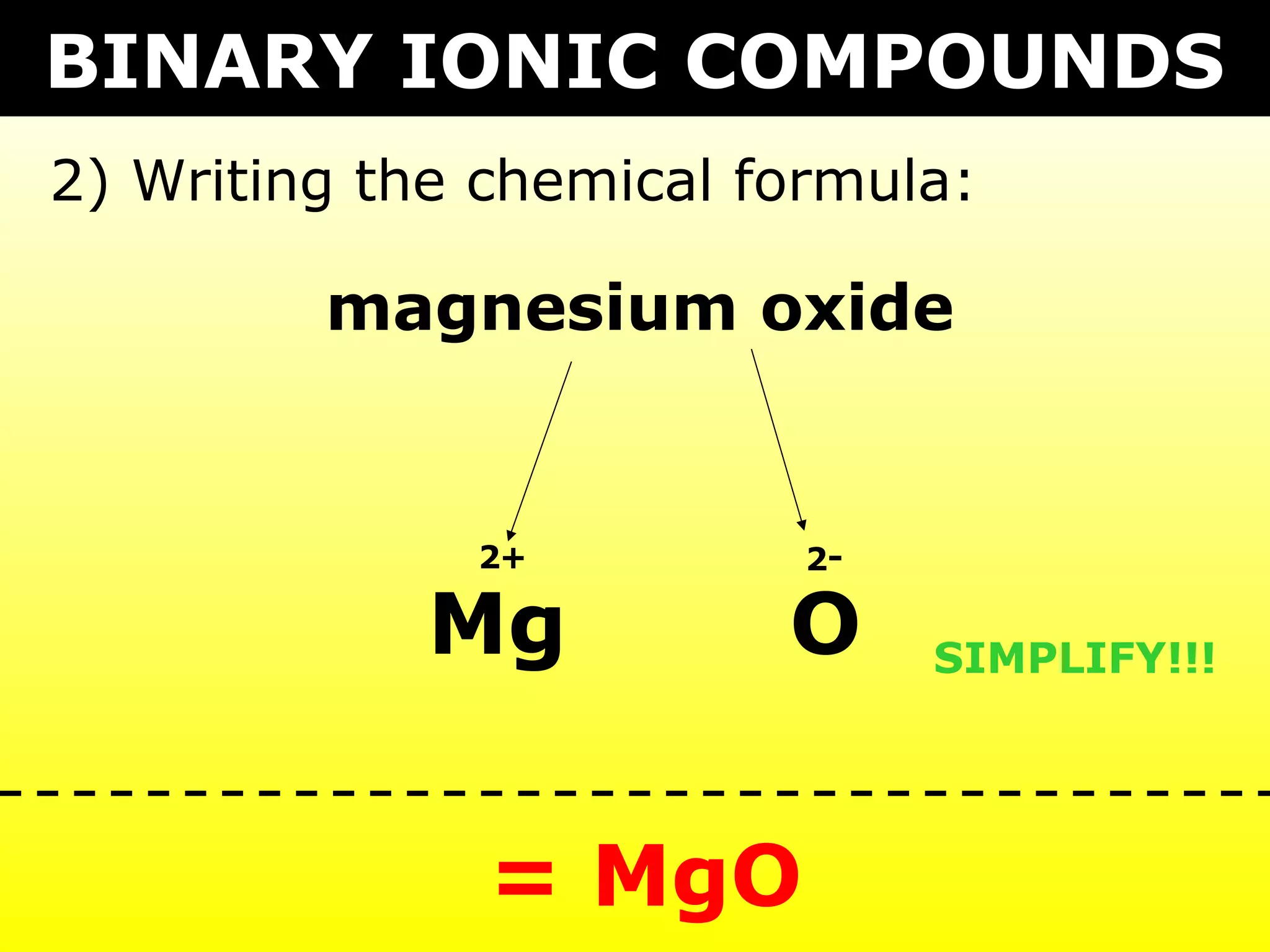
magnesium oxide
Mg O
2 2+ -
SIMPLIFY!!!
= MgO
2) Writing the chemical formula:
BINARY IONIC COMPOUNDS
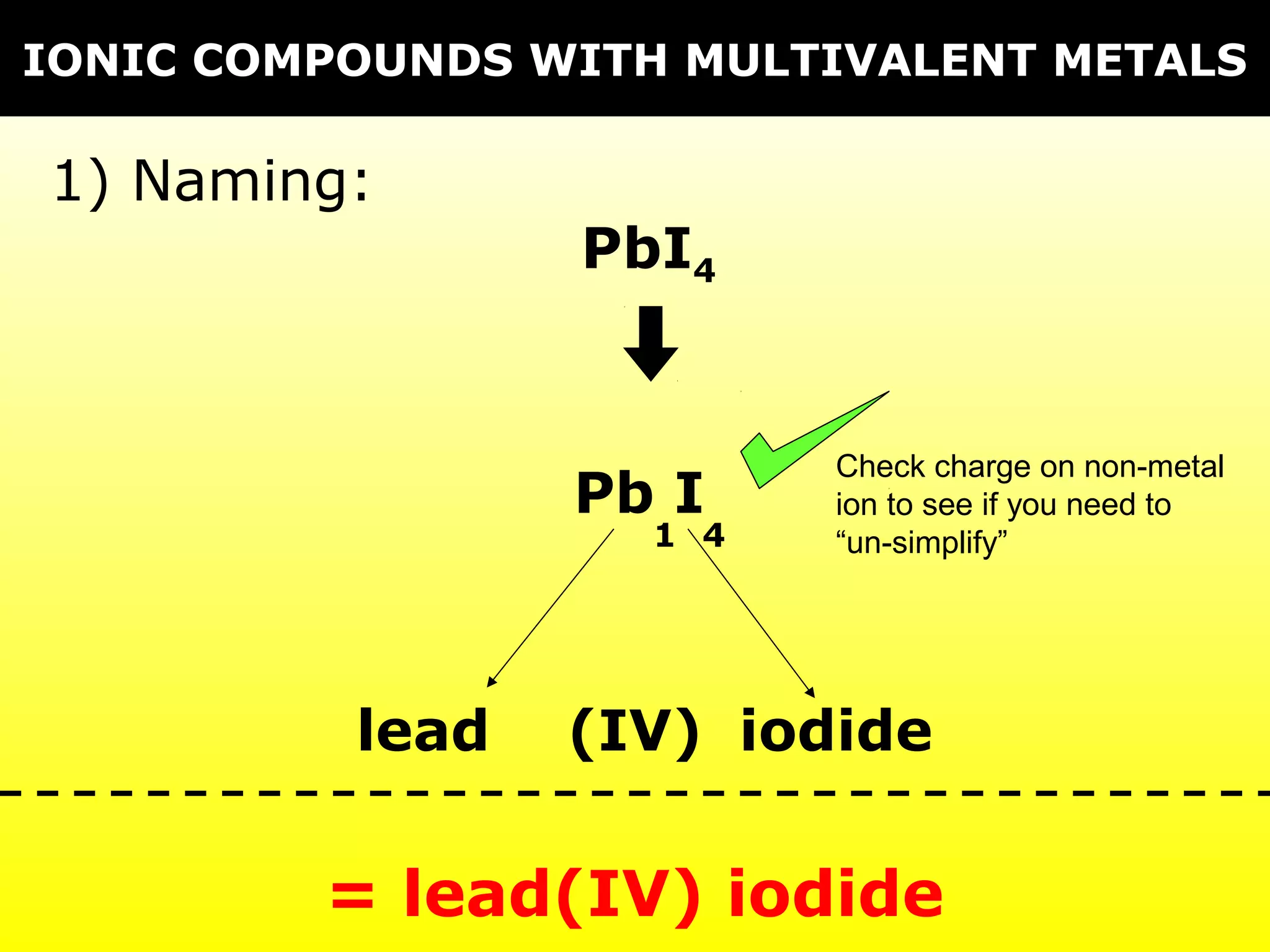
PbI4
lead iodide
Pb I
41
Check charge on non-metal
ion to see if you need to
“un-simplify”
(IV)
= lead(IV) iodide
IONIC COMPOUNDS WITH MULTIVALENT METALS
1) Naming:
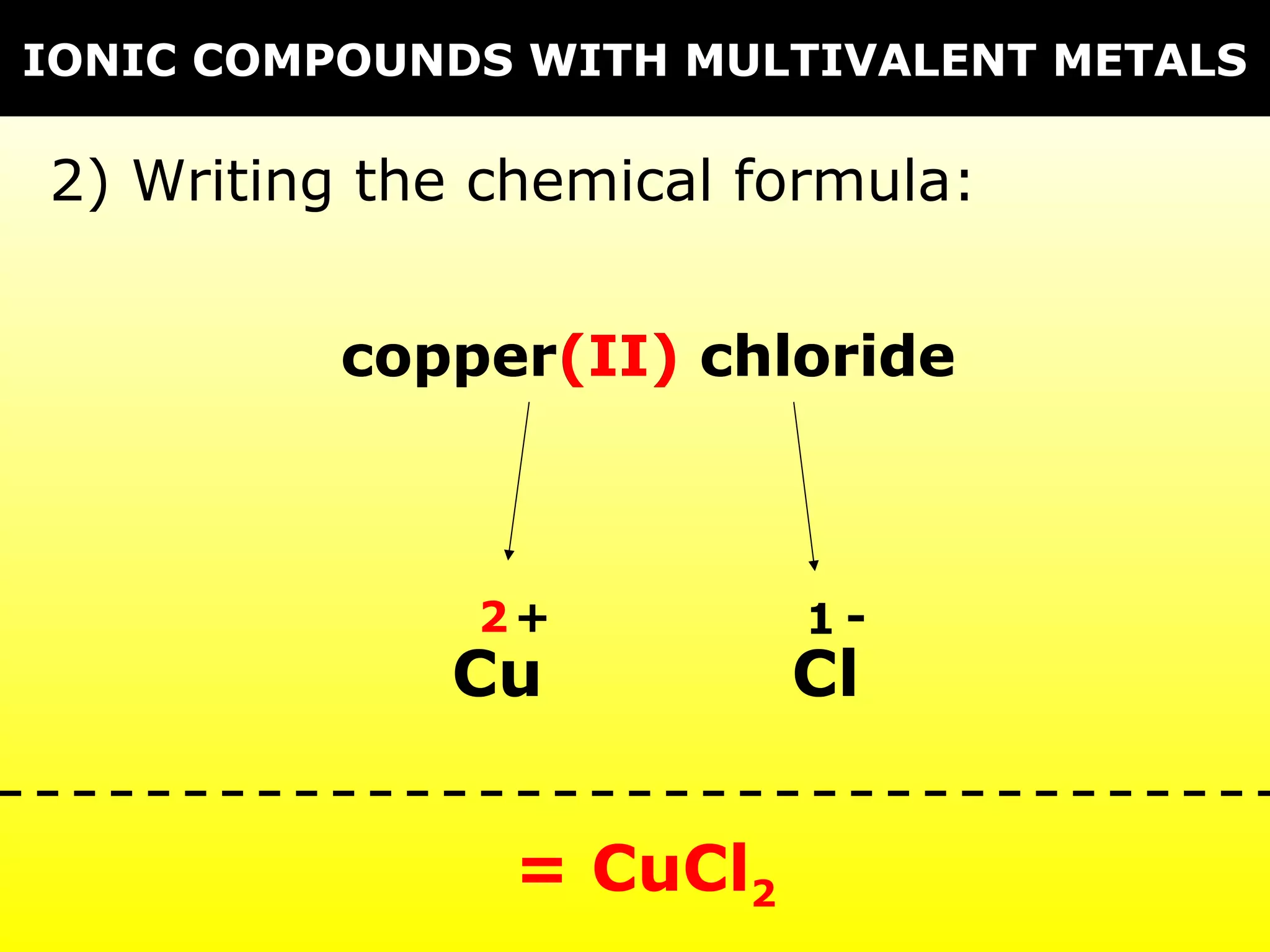
copper(II) chloridecopper(II) chloride
Cu Cl
2 1+ -
= CuCl2
2) Writing the chemical formula:
IONIC COMPOUNDS WITH MULTIVALENT METALS
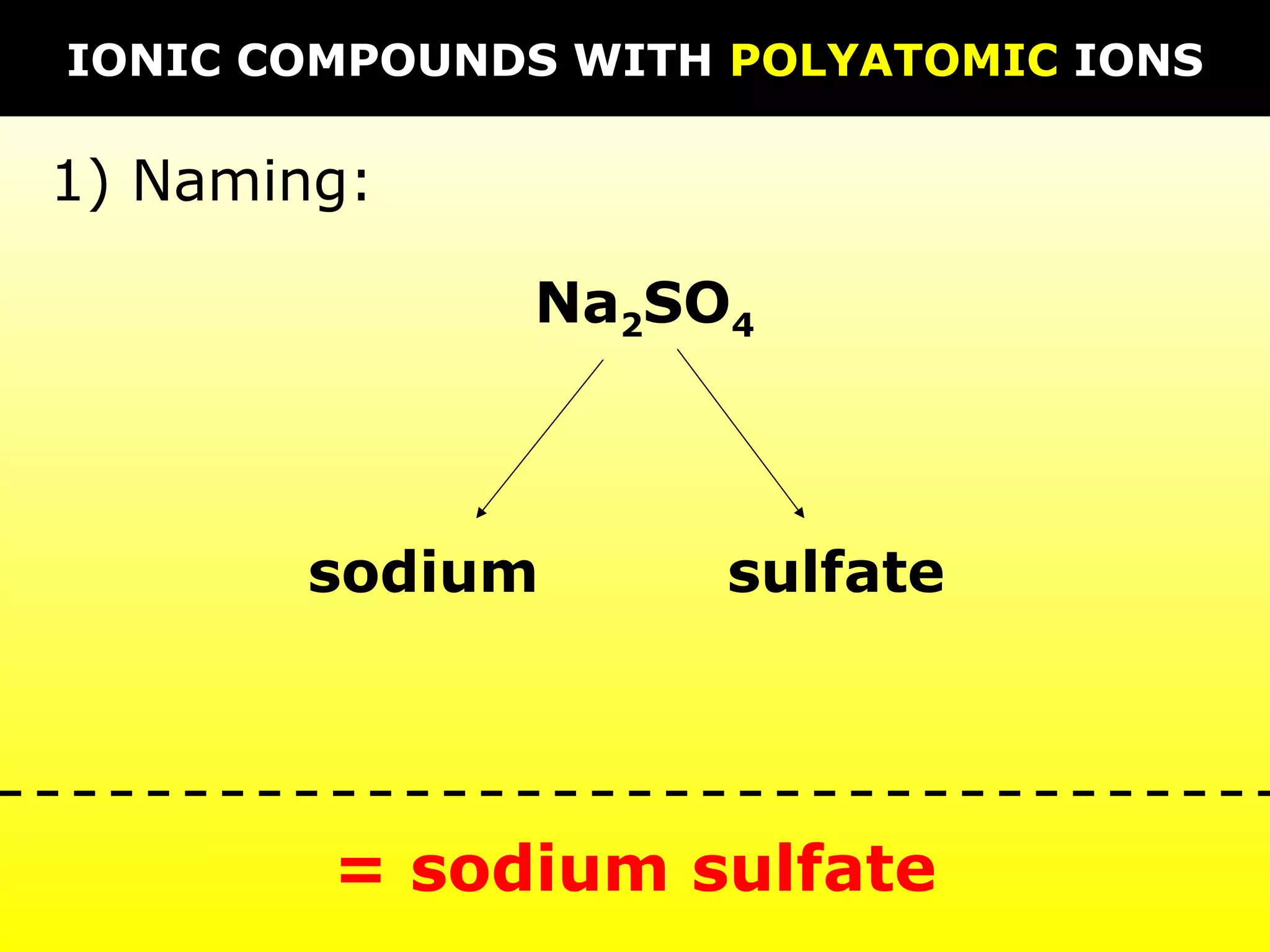
Na2SO4
sodium sulfate
= sodium sulfate
1) Naming:
IONIC COMPOUNDS WITH POLYATOMIC IONS
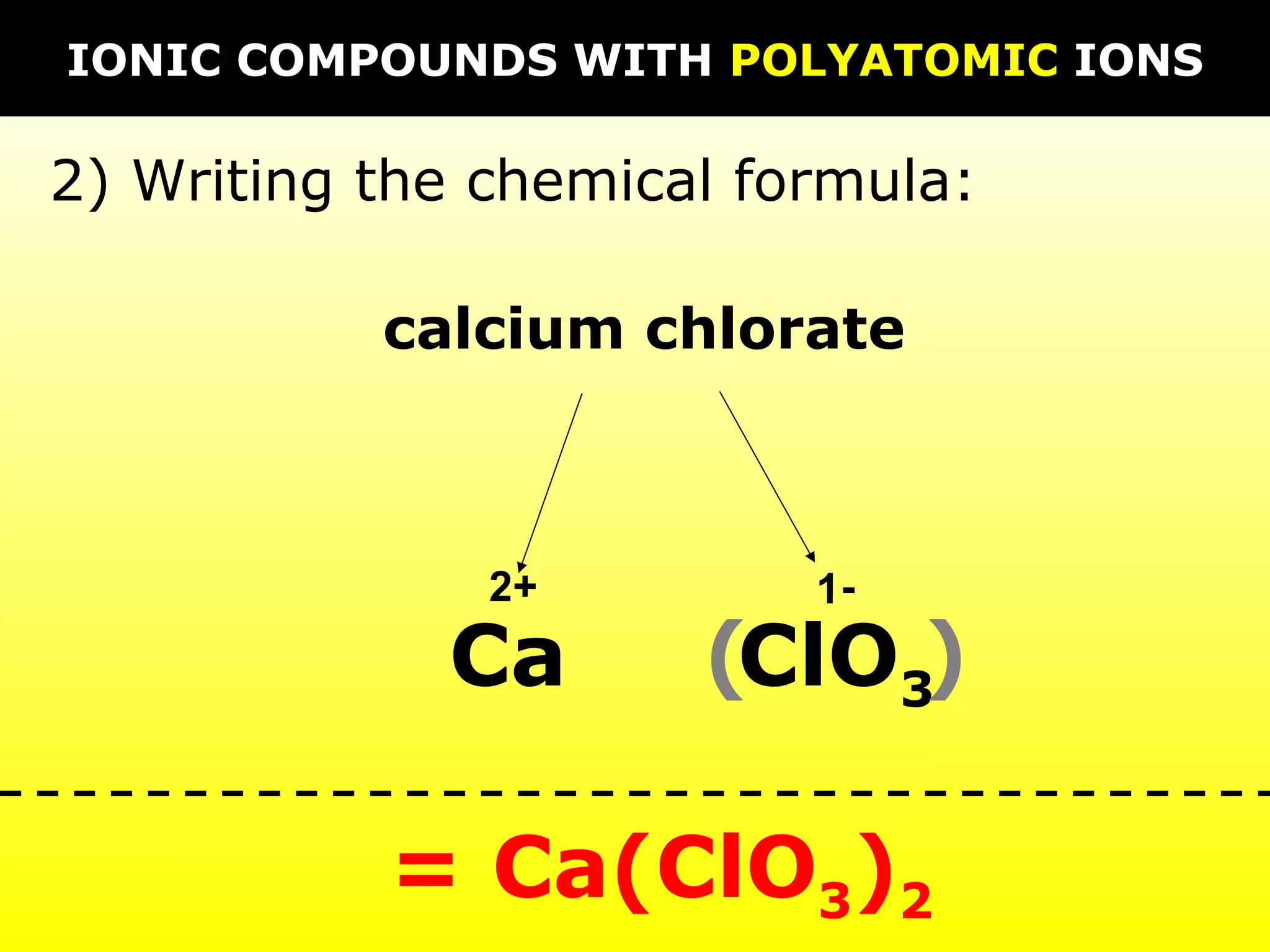
calcium chlorate
Ca ClO3
2 1+ -
= Ca(ClO3)2
2) Writing the chemical formula:
IONIC COMPOUNDS WITH POLYATOMIC IONS
( )
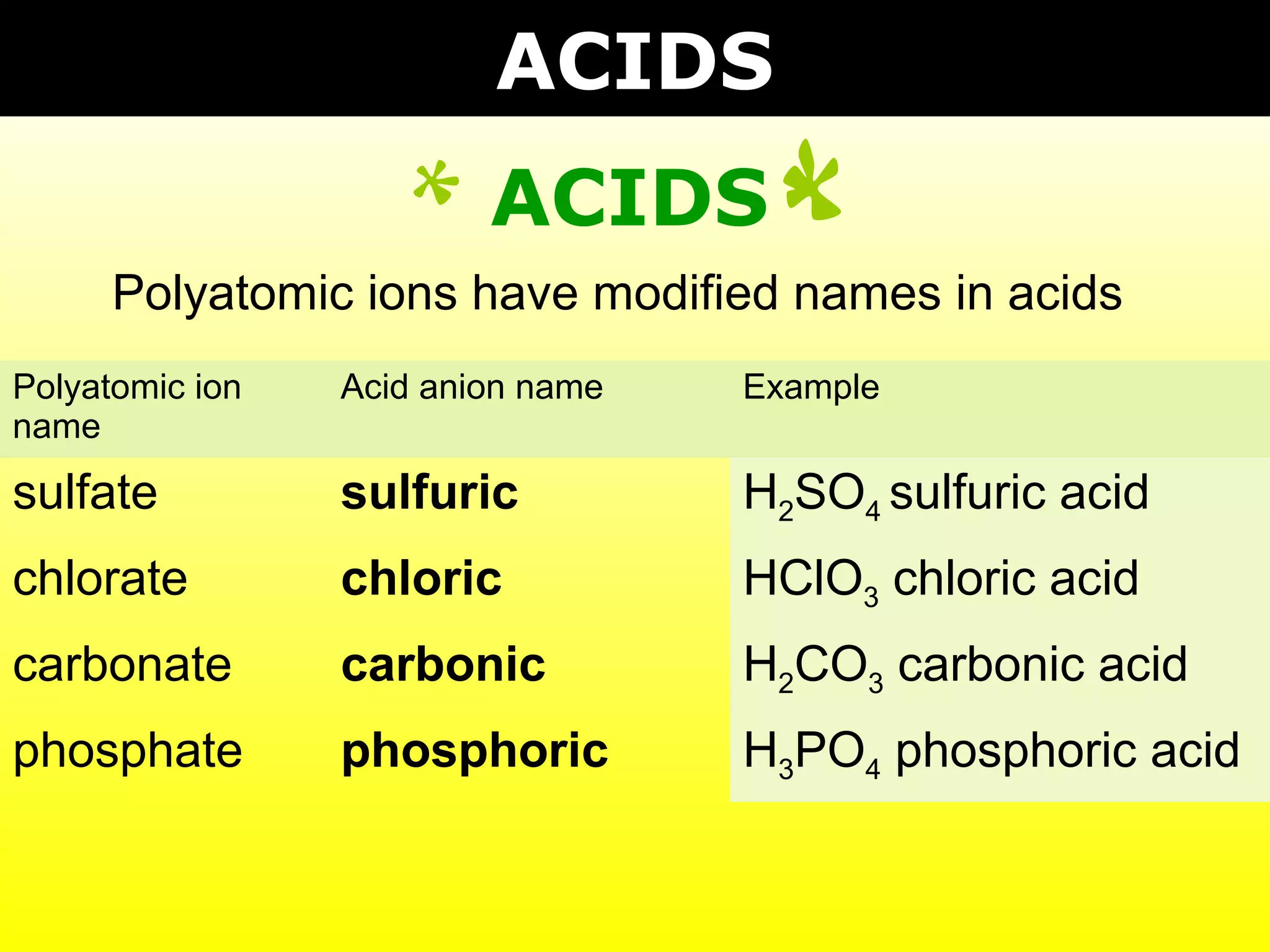
ACIDS
Polyatomic ions have modified names in acids
Polyatomic ion
name
Acid anion name Example
sulfate sulfuric H2SO4 sulfuric acid
chlorate chloric HClO3 chloric acid
carbonate carbonic H2CO3 carbonic acid
phosphate phosphoric H3PO4 phosphoric acid
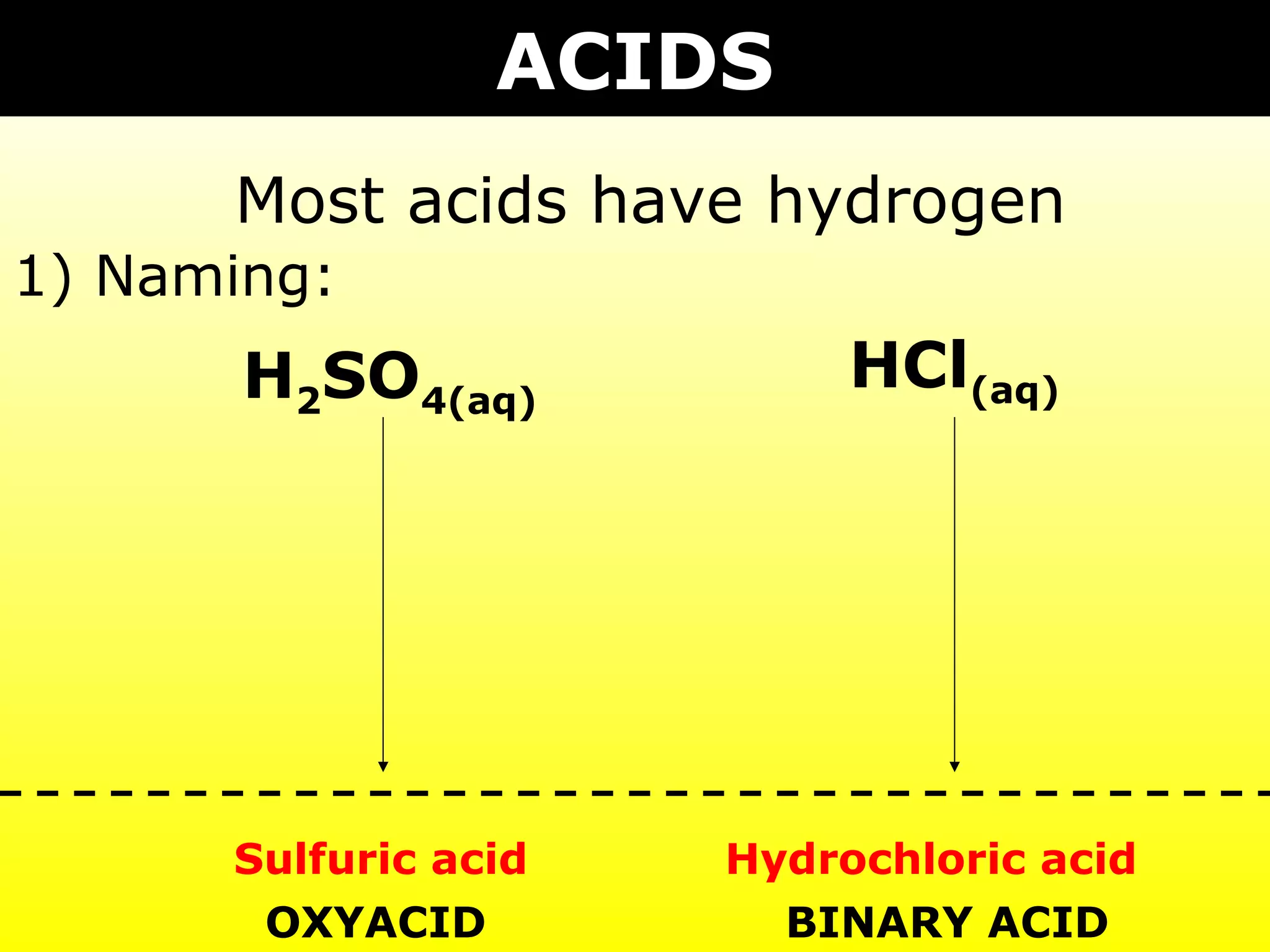
ACIDS
H2SO4(aq)
Sulfuric acid
OXYACID
Most acids have hydrogen
HCl(aq)
Hydrochloric acid
BINARY ACID
ACIDS
1) Naming:
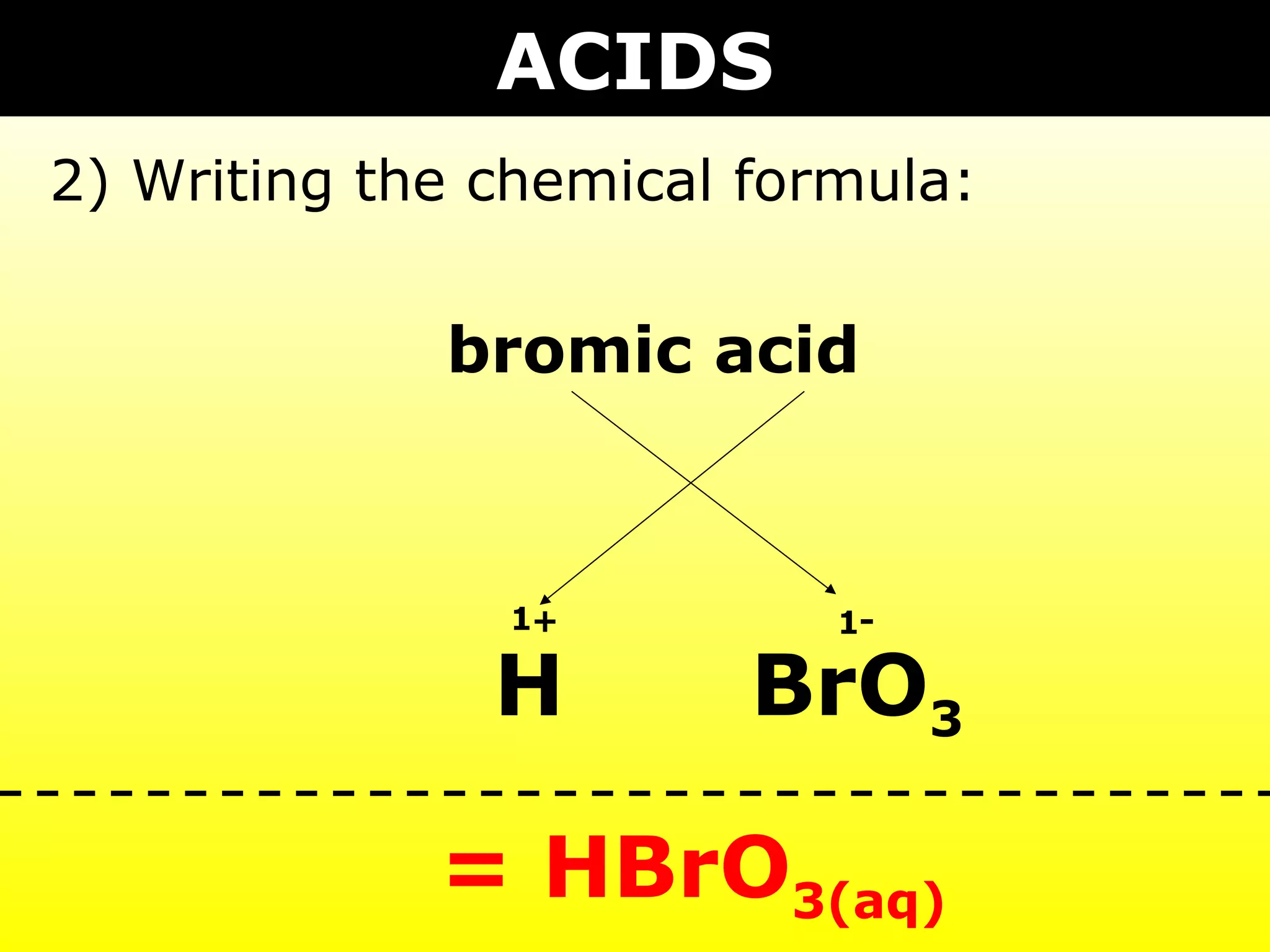
bromic acid
BrO3H
1 1+ -
= HBrO3(aq)
ACIDS
2) Writing the chemical formula:
mono
di
tri
tetra
penta
hexa
hepta
octa
nona
deca
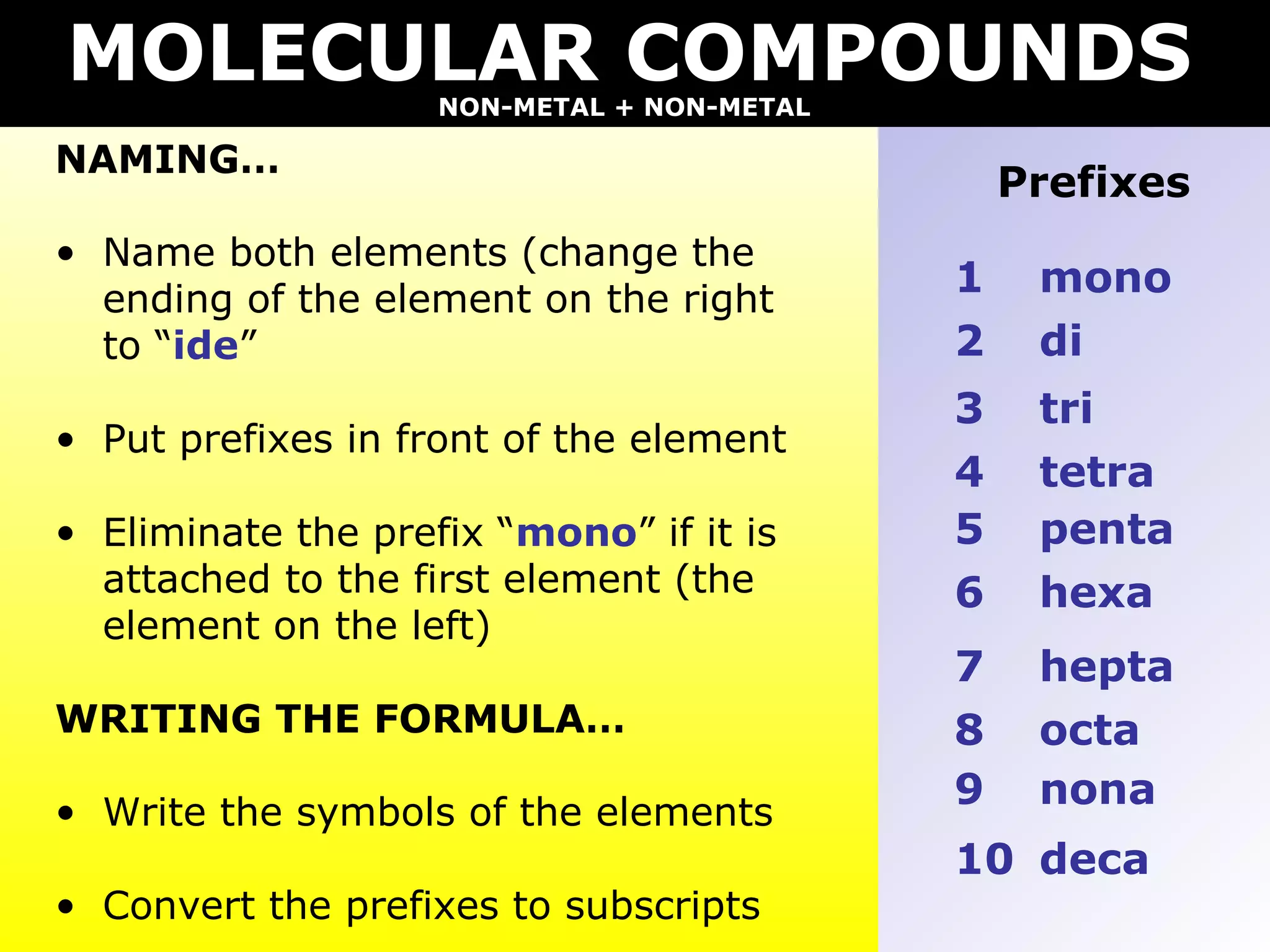
NAMING…
• Name both elements (change the
ending of the element on the right
to “ide”
• Put prefixes in front of the element
• Eliminate the prefix “mono” if it is
attached to the first element (the
element on the left)
WRITING THE FORMULA…
• Write the symbols of the elements
• Convert the prefixes to subscripts
MOLECULAR COMPOUNDSNON-METAL + NON-METAL
Prefixes
1
2
3
4
5
6
7
8
9
10
mono
di
tri
tetra
penta
hexa
hepta
octa
nona
deca
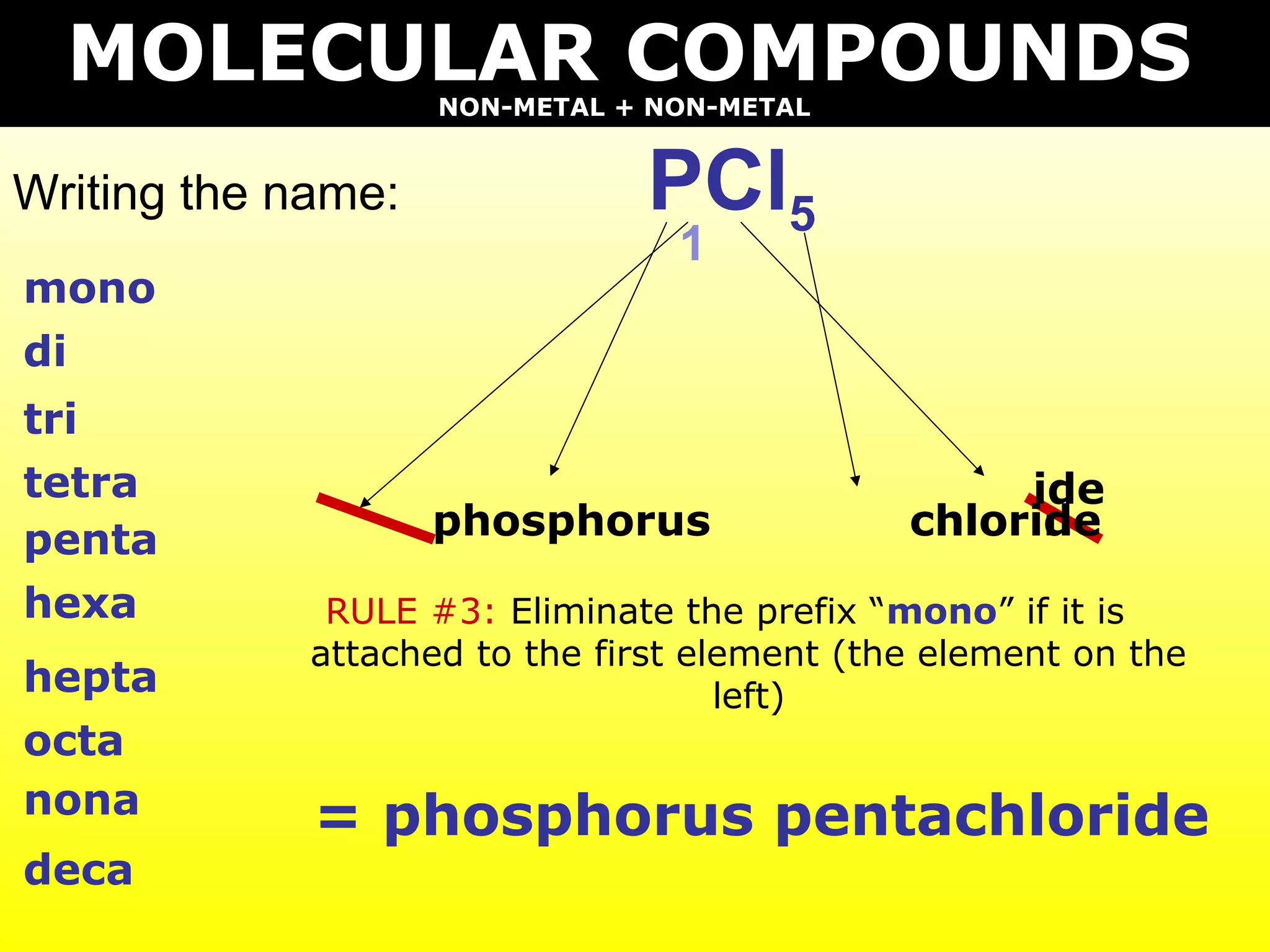
Writing the name: PCl5
MOLECULAR COMPOUNDSNON-METAL + NON-METAL
phosphorus chlorine
ide
chloride
1
RULE #3: Eliminate the prefix “mono” if it is
attached to the first element (the element on the
left)
= phosphorus pentachloride
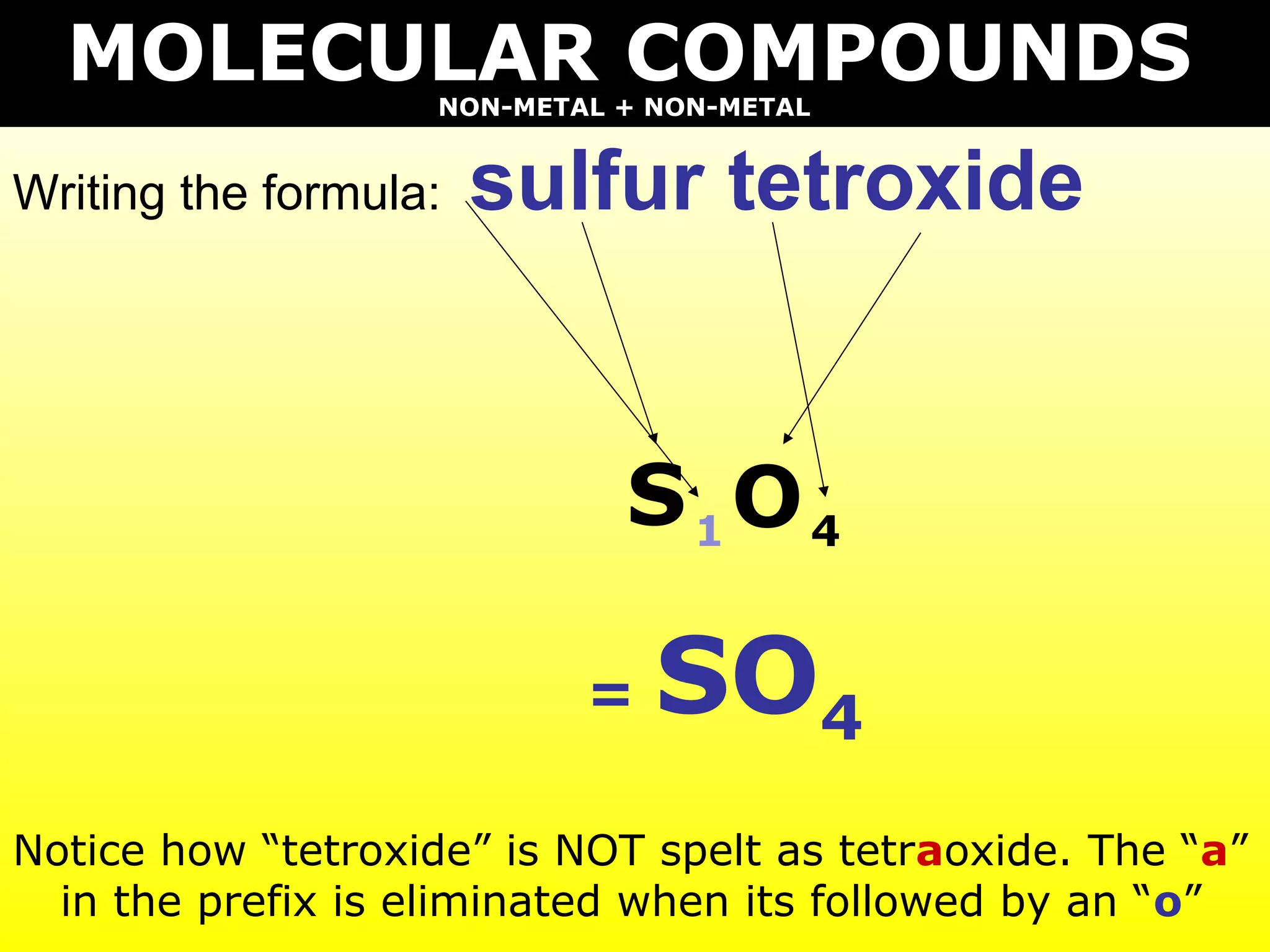
Writing the formula: sulfur tetroxide
MOLECULAR COMPOUNDSNON-METAL + NON-METAL
S O1 4
= SO4
Notice how “tetroxide” is NOT spelt as tetraoxide. The “a”
in the prefix is eliminated when its followed by an “o”

02 c naming and formula writing

  • 1.
  • 2.
    Examine the numberof valence electrons for each atom: What do you notice? IONS AND THEIR CHARGES
  • 3.
    TREND: -Elements in thesame group have the same number of valence electrons -Thus elements in the same group have similar reactivity Examine the number of valence electrons for each atom: Example: All alkali metals have one valence electron IONS AND THEIR CHARGES
  • 4.
    - Elements becomestable by achieving 8 valence electrons (except for hydrogen and helium, which achieve 2 electrons) - Noble gases are non-reactive because they have 8 electrons - This is called the Octet Rule The number of valence electrons can determine reactivity: IONS AND THEIR CHARGES
  • 5.
    How many valenceelectrons does each atom need to gain or lose to achieve a full octet? Alkali metals lose 1 electron Alkali earth metals lose 2 electrons Group 13 elements lose 3 electrons Group 14 elements lose or gain 4 electrons IONS AND THEIR CHARGES
  • 6.
    How many valenceelectrons does each atom need to gain or lose to achieve a full octet? Group 14 elements lose or gain 4 electrons Group 15 elements gain 3 electrons Group 16 elements gain 2 electrons Halogens gain 1 electron Noble gases already have a full octet IONS AND THEIR CHARGES
  • 7.
    Ion charges basedon family/group: +1 +2 +3 +/-4 -3 -2 -1 N/A IONS AND THEIR CHARGES
  • 8.
    BINARY IONIC COMPOUNDS MgCl2 magnesiumchlorine ide = magnesium chloride 1) Naming:
  • 9.
    magnesium oxide Mg O 22+ - SIMPLIFY!!! = MgO 2) Writing the chemical formula: BINARY IONIC COMPOUNDS
  • 10.
    PbI4 lead iodide Pb I 41 Checkcharge on non-metal ion to see if you need to “un-simplify” (IV) = lead(IV) iodide IONIC COMPOUNDS WITH MULTIVALENT METALS 1) Naming:
  • 11.
    copper(II) chloridecopper(II) chloride CuCl 2 1+ - = CuCl2 2) Writing the chemical formula: IONIC COMPOUNDS WITH MULTIVALENT METALS
  • 12.
    Na2SO4 sodium sulfate = sodiumsulfate 1) Naming: IONIC COMPOUNDS WITH POLYATOMIC IONS
  • 13.
    calcium chlorate Ca ClO3 21+ - = Ca(ClO3)2 2) Writing the chemical formula: IONIC COMPOUNDS WITH POLYATOMIC IONS ( )
  • 14.
    ACIDS Polyatomic ions havemodified names in acids Polyatomic ion name Acid anion name Example sulfate sulfuric H2SO4 sulfuric acid chlorate chloric HClO3 chloric acid carbonate carbonic H2CO3 carbonic acid phosphate phosphoric H3PO4 phosphoric acid ACIDS
  • 15.
    H2SO4(aq) Sulfuric acid OXYACID Most acidshave hydrogen HCl(aq) Hydrochloric acid BINARY ACID ACIDS 1) Naming:
  • 16.
    bromic acid BrO3H 1 1+- = HBrO3(aq) ACIDS 2) Writing the chemical formula:
  • 17.
    mono di tri tetra penta hexa hepta octa nona deca NAMING… • Name bothelements (change the ending of the element on the right to “ide” • Put prefixes in front of the element • Eliminate the prefix “mono” if it is attached to the first element (the element on the left) WRITING THE FORMULA… • Write the symbols of the elements • Convert the prefixes to subscripts MOLECULAR COMPOUNDSNON-METAL + NON-METAL Prefixes 1 2 3 4 5 6 7 8 9 10
  • 18.
    mono di tri tetra penta hexa hepta octa nona deca Writing the name:PCl5 MOLECULAR COMPOUNDSNON-METAL + NON-METAL phosphorus chlorine ide chloride 1 RULE #3: Eliminate the prefix “mono” if it is attached to the first element (the element on the left) = phosphorus pentachloride
  • 19.
    Writing the formula:sulfur tetroxide MOLECULAR COMPOUNDSNON-METAL + NON-METAL S O1 4 = SO4 Notice how “tetroxide” is NOT spelt as tetraoxide. The “a” in the prefix is eliminated when its followed by an “o”