SUPPLY

 Supply is the willingness and ability of
 producers to make a specific quantity of
 output available to consumers at a particular
 price over a given period of time.
Law of supply

 A decrease in the price of a good, all
  other things held constant, will cause a
  decrease in the quantity supplied of the
  good.
 An increase in the price of a good, all
  other things held constant, will cause an
  increase in the quantity supplied of the
  good.
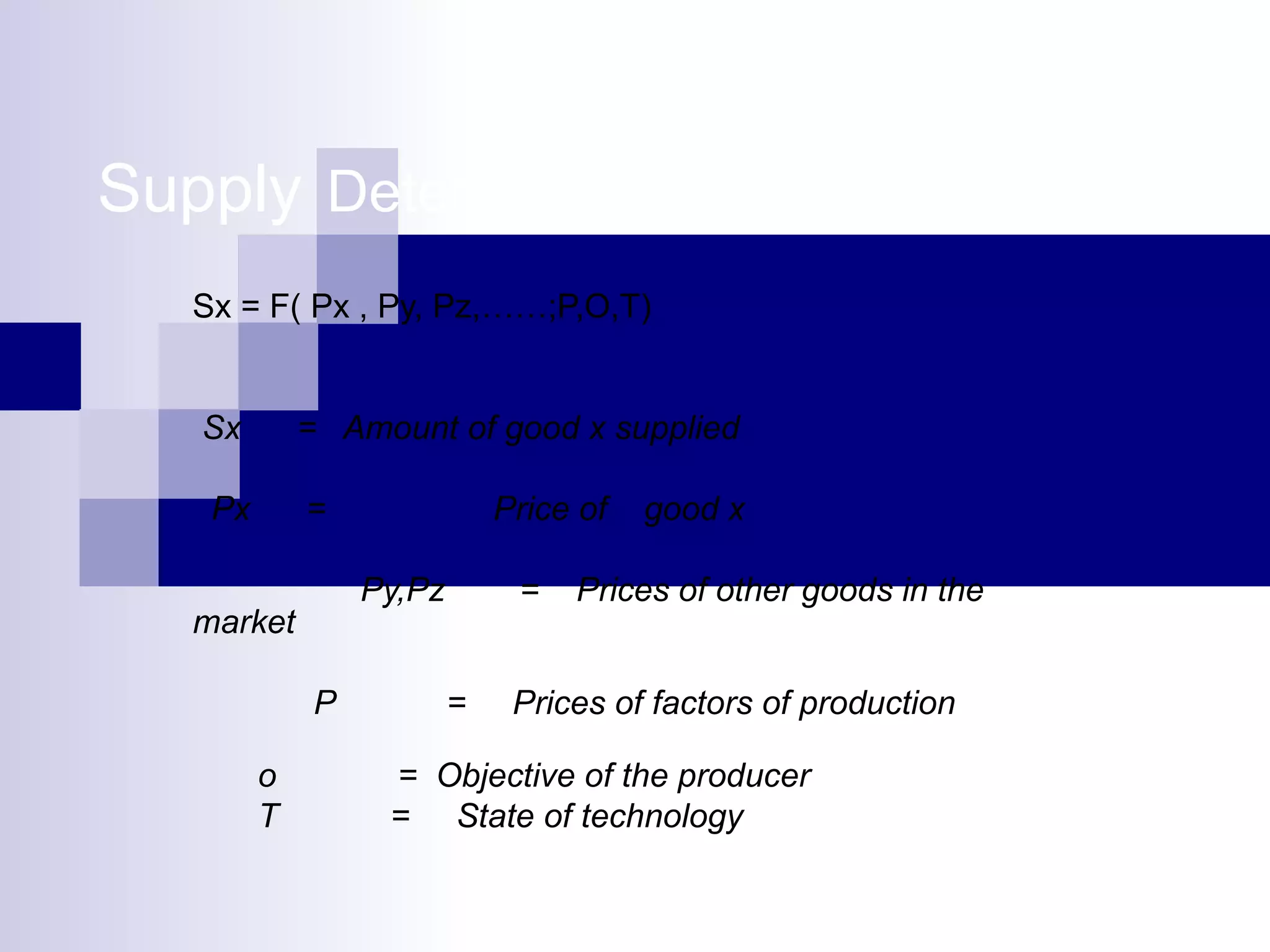
Supply Determinants
   Sx = F( Px , Py, Pz,……;P,O,T)


   Sx        = Amount of good x supplied

    Px       =                Price of   good x

                  Py,Pz        =   Prices of other goods in the
   market

              P           =    Prices of factors of production

         o         = Objective of the producer
         T         = State of technology
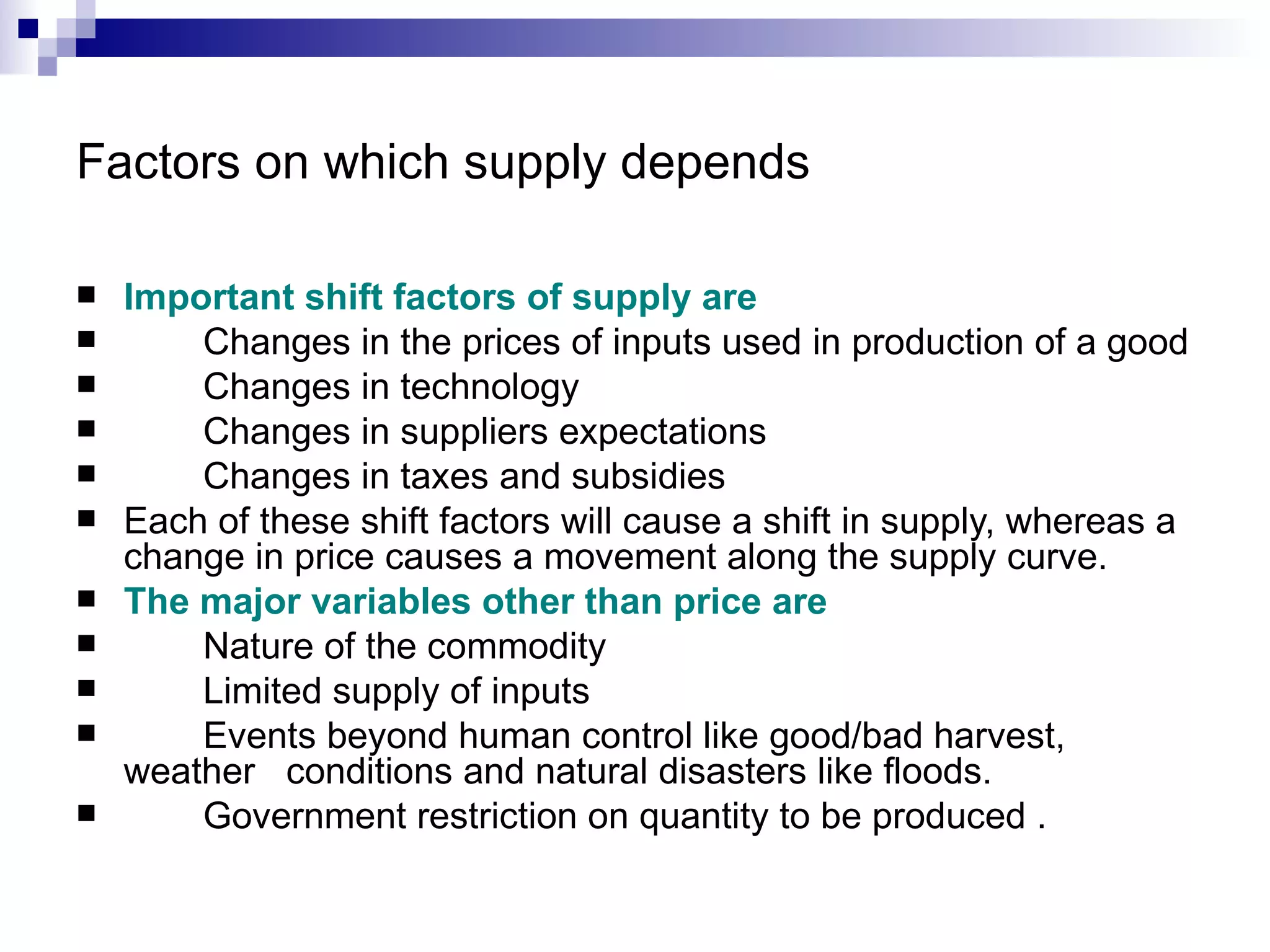
Factors on which supply depends

   Important shift factors of supply are
       Changes in the prices of inputs used in production of a good
       Changes in technology
       Changes in suppliers expectations
       Changes in taxes and subsidies
   Each of these shift factors will cause a shift in supply, whereas a
    change in price causes a movement along the supply curve.
   The major variables other than price are
       Nature of the commodity
       Limited supply of inputs
       Events beyond human control like good/bad harvest,
    weather conditions and natural disasters like floods.
       Government restriction on quantity to be produced .
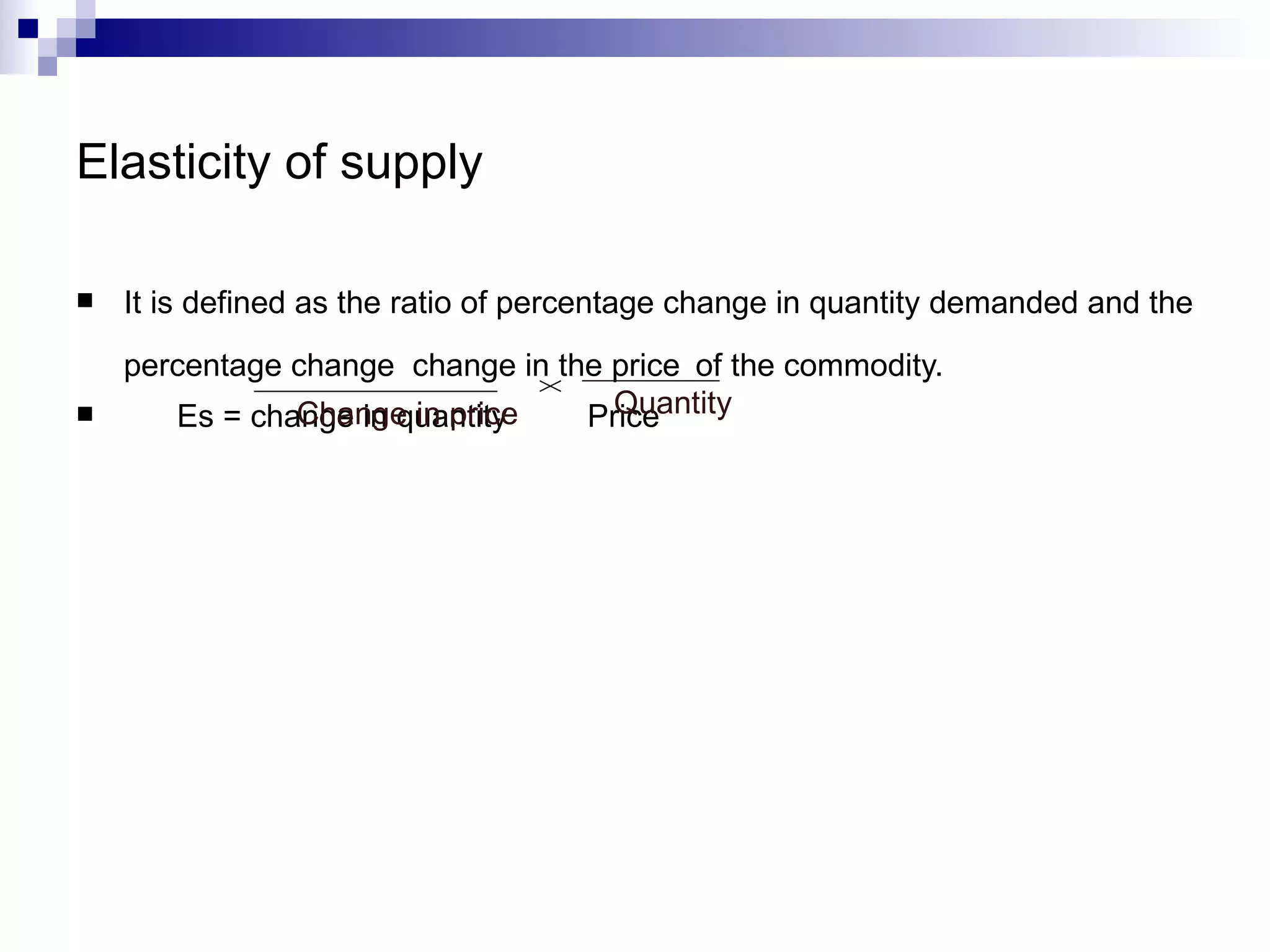
Elasticity of supply

   It is defined as the ratio of percentage change in quantity demanded and the
    percentage change change in the price of the commodity.
              Change in price
       Es = change in quantity      Quantity
                                  Price
Elasticity
 The responsiveness of one variable to
  changes in another
 When price rises, what happens
  to demand?
 Demand falls
 BUT!
 How much does demand fall?
Elasticity
 If price rises by 10% - what happens to
  demand?
 We know demand will fall
 By more than 10%?
 By less than 10%?
 Elasticity measures the extent to which
  demand will change
Elasticity . . .

 x … is a measure of how much buyers
 and sellers respond to changes in market
 conditions
 x … allows us to analyze supply and
 demand with greater precision.
 xJournal Question-Name 3 necessities
 and 3 luxuries that you would buy.
Determinants of Elasticity
   Time period – the longer the time under
    consideration the more elastic a good is likely to
    be
   Number and closeness of substitutes –
    the greater the number of substitutes,
    the more elastic
   The proportion of income taken up by the
    product – the smaller the proportion the more
    inelastic
   Luxury or Necessity - for example,
    addictive drugs
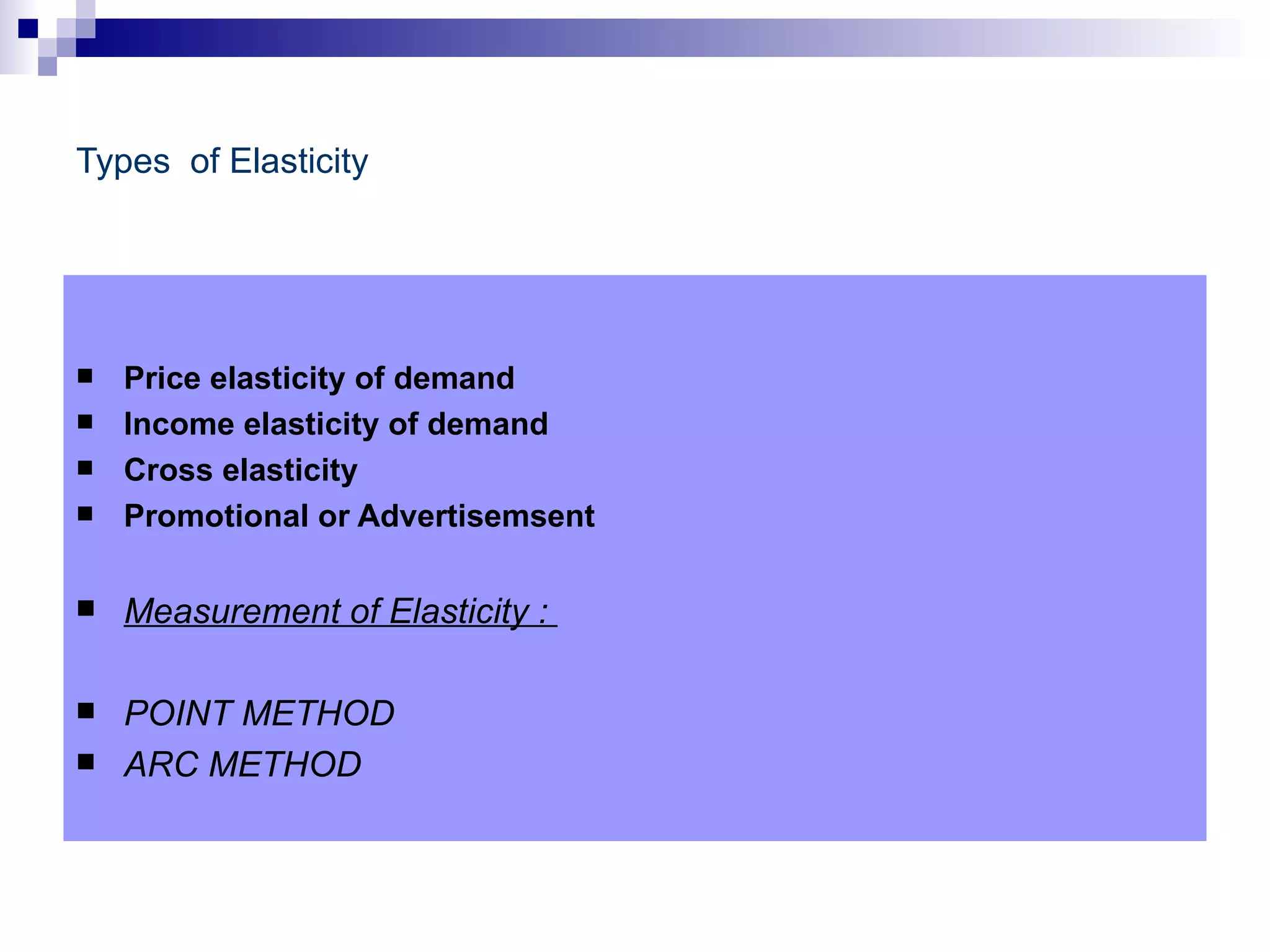
Types of Elasticity


   Price elasticity of demand
   Income elasticity of demand
   Cross elasticity
   Promotional or Advertisemsent

   Measurement of Elasticity :

   POINT METHOD
   ARC METHOD
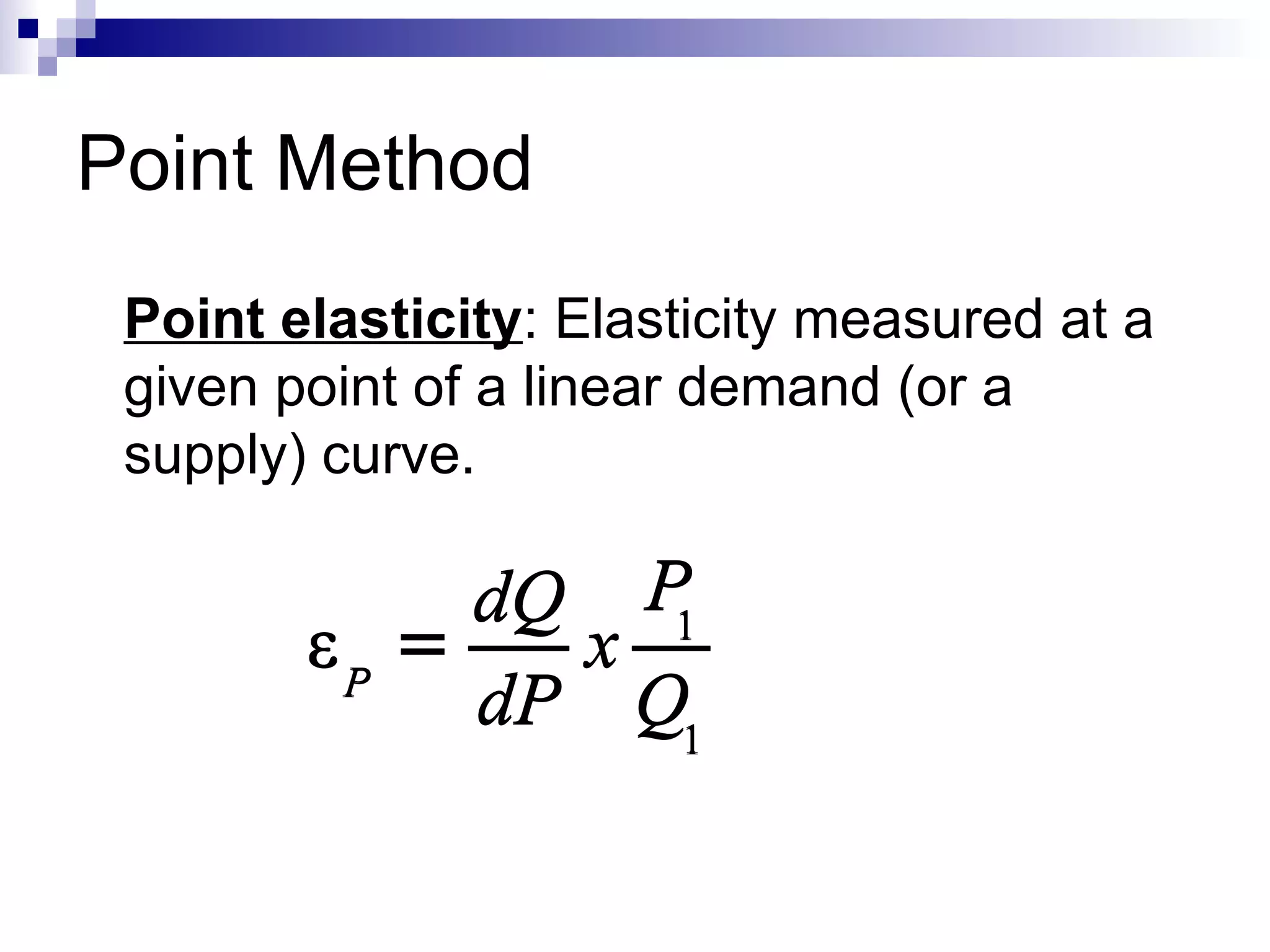
Point Method
 Point elasticity: Elasticity measured at a
 given point of a linear demand (or a
 supply) curve.

             dQ P
        εP =   x 1
             dP Q1
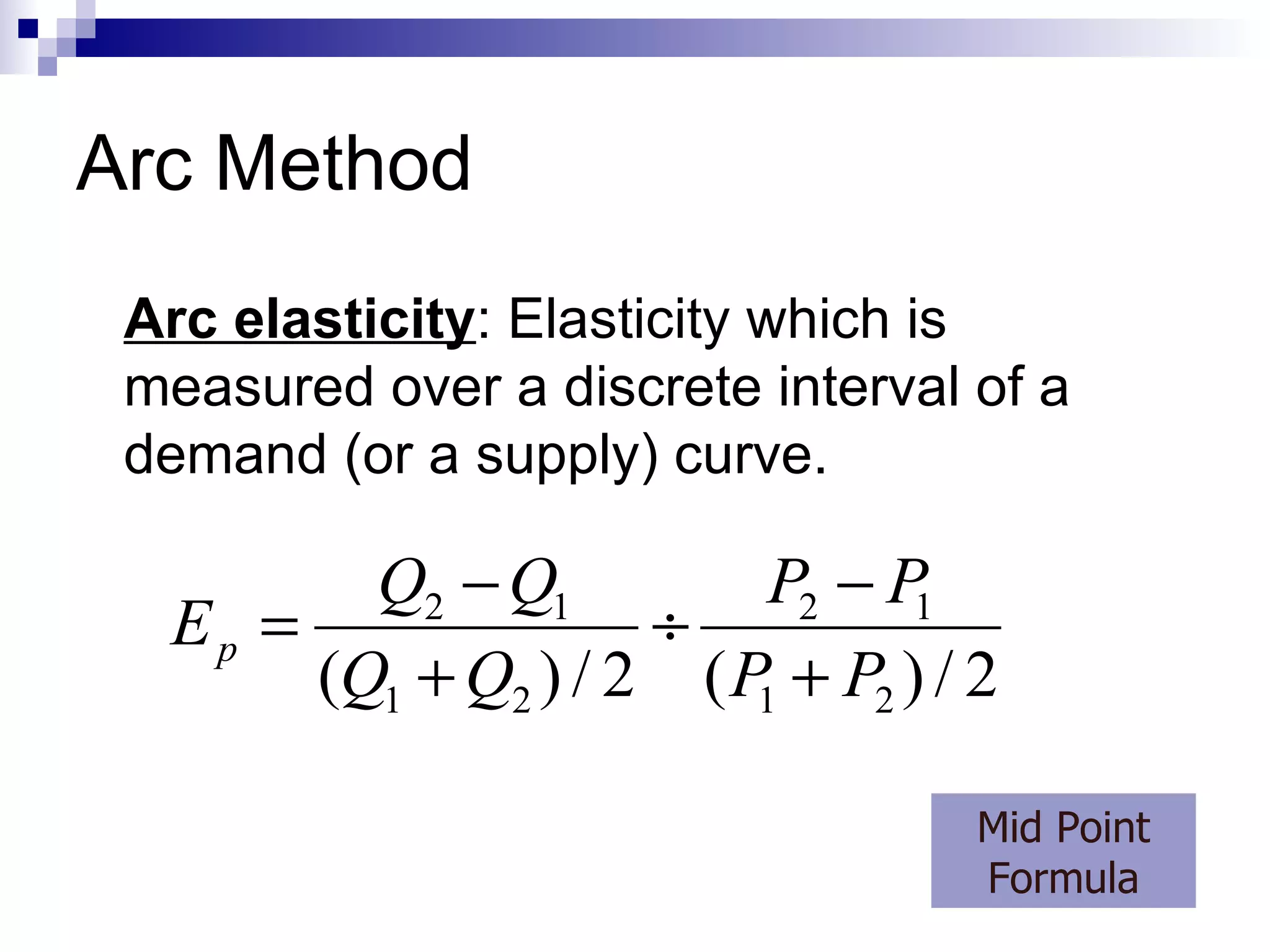
Arc Method
 Arc elasticity: Elasticity which is
 measured over a discrete interval of a
 demand (or a supply) curve.

         Q2 − Q1          P2 − P
  Ep =               ÷          1
       (Q1 + Q2 ) / 2 ( P + P2 ) / 2
                         1


                                   Mid Point
                                   Formula
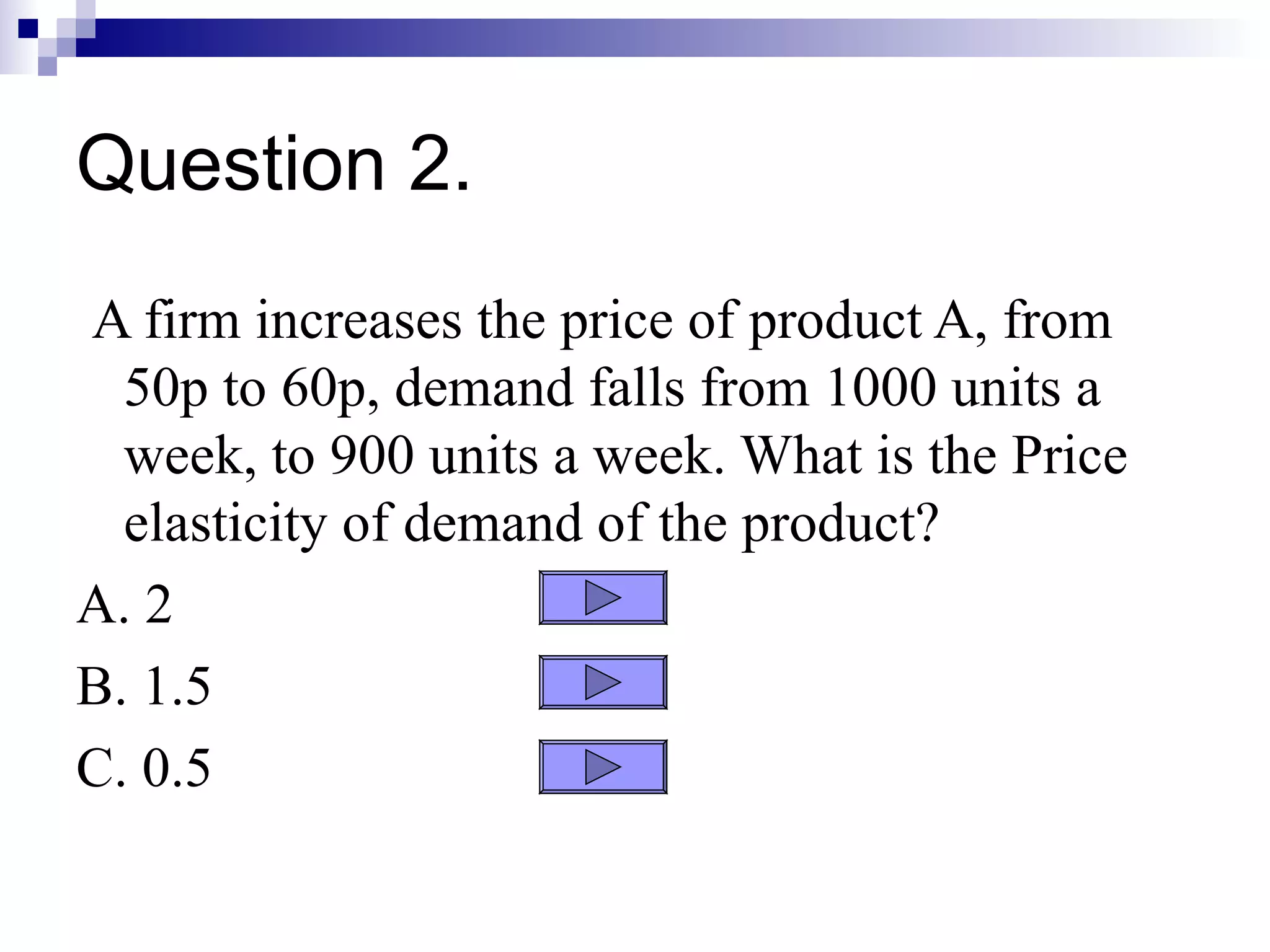
Question 2.
A firm increases the price of product A, from
  50p to 60p, demand falls from 1000 units a
  week, to 900 units a week. What is the Price
  elasticity of demand of the product?
A. 2
B. 1.5
C. 0.5
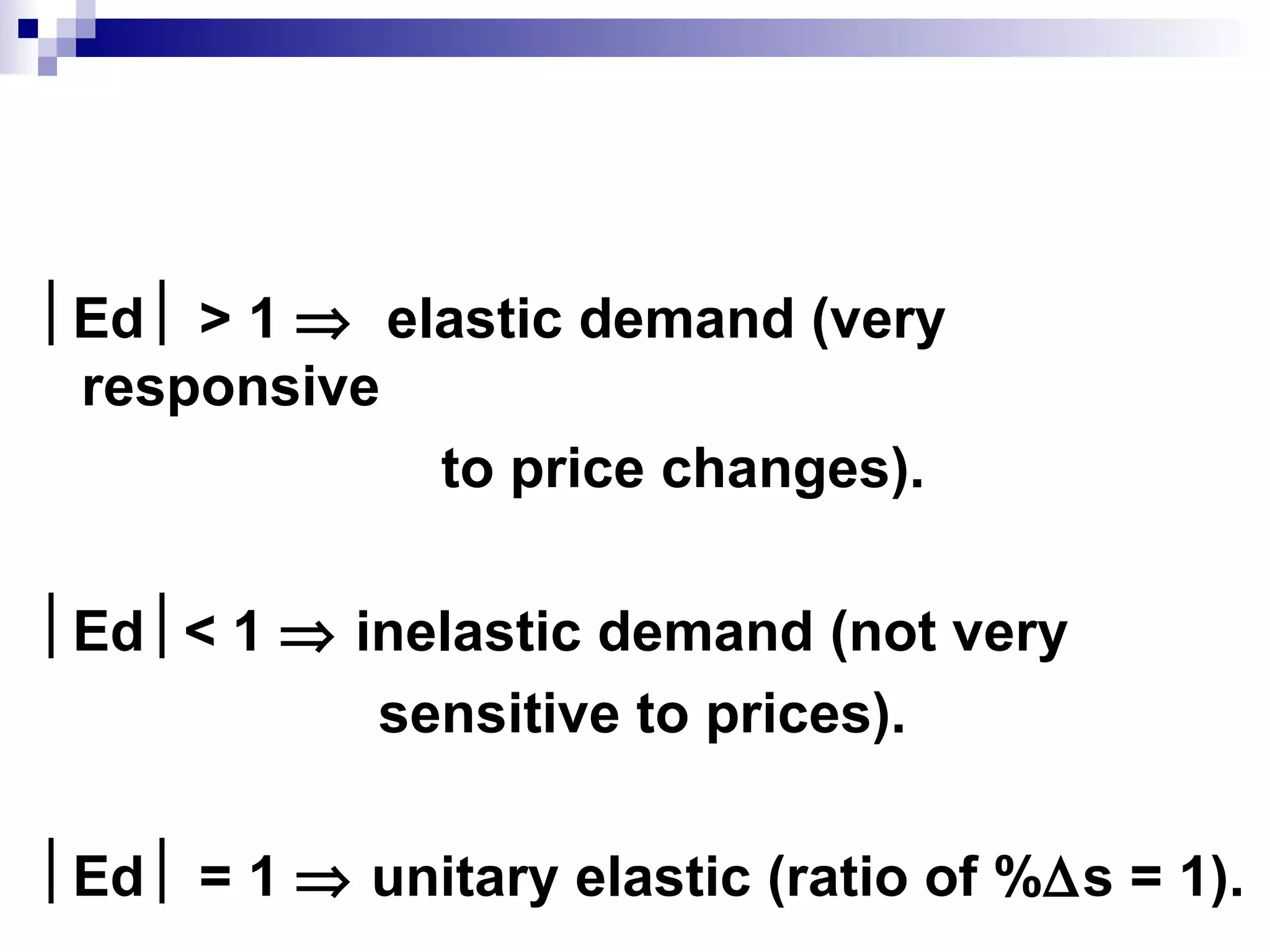
Ed > 1 ⇒ elastic demand (very
 responsive
             to price changes).

Ed< 1 ⇒ inelastic demand (not very
           sensitive to prices).

Ed = 1 ⇒ unitary elastic (ratio of %∆s = 1).
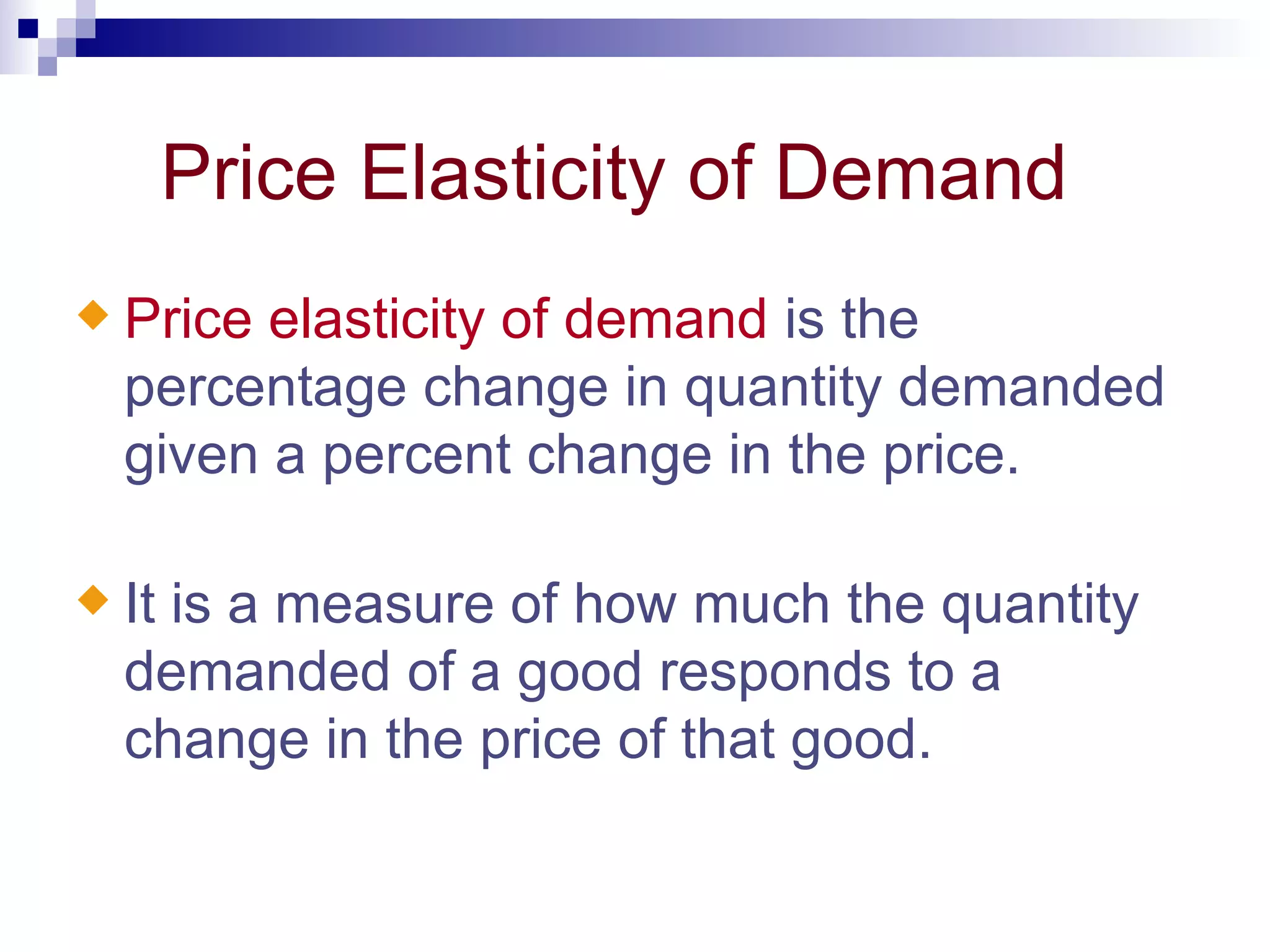
Price Elasticity of Demand
x   Price elasticity of demand is the
    percentage change in quantity demanded
    given a percent change in the price.

x   It is a measure of how much the quantity
    demanded of a good responds to a
    change in the price of that good.
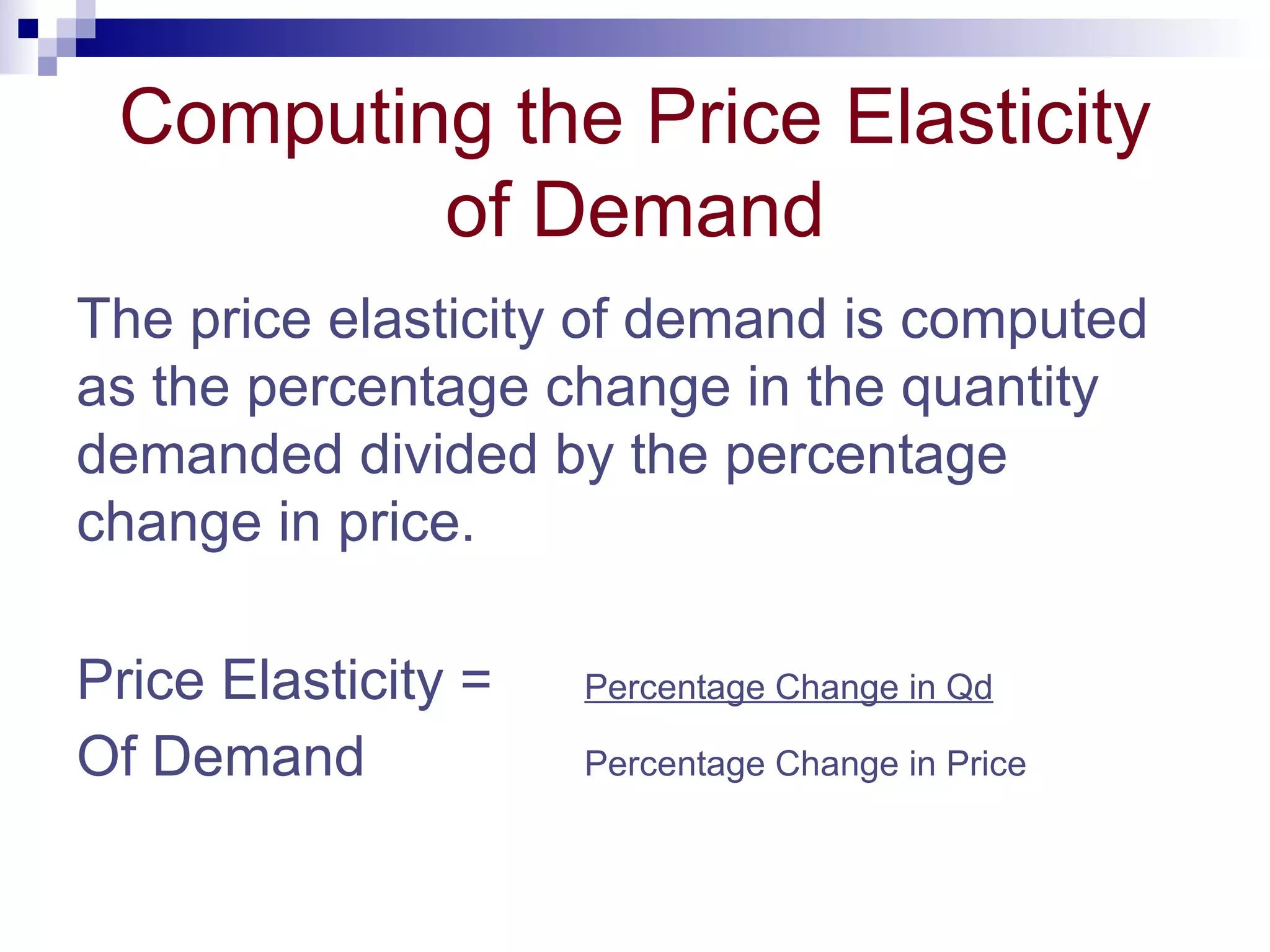
Computing the Price Elasticity
         of Demand
The price elasticity of demand is computed
as the percentage change in the quantity
demanded divided by the percentage
change in price.

Price Elasticity =   Percentage Change in Qd

Of Demand            Percentage Change in Price
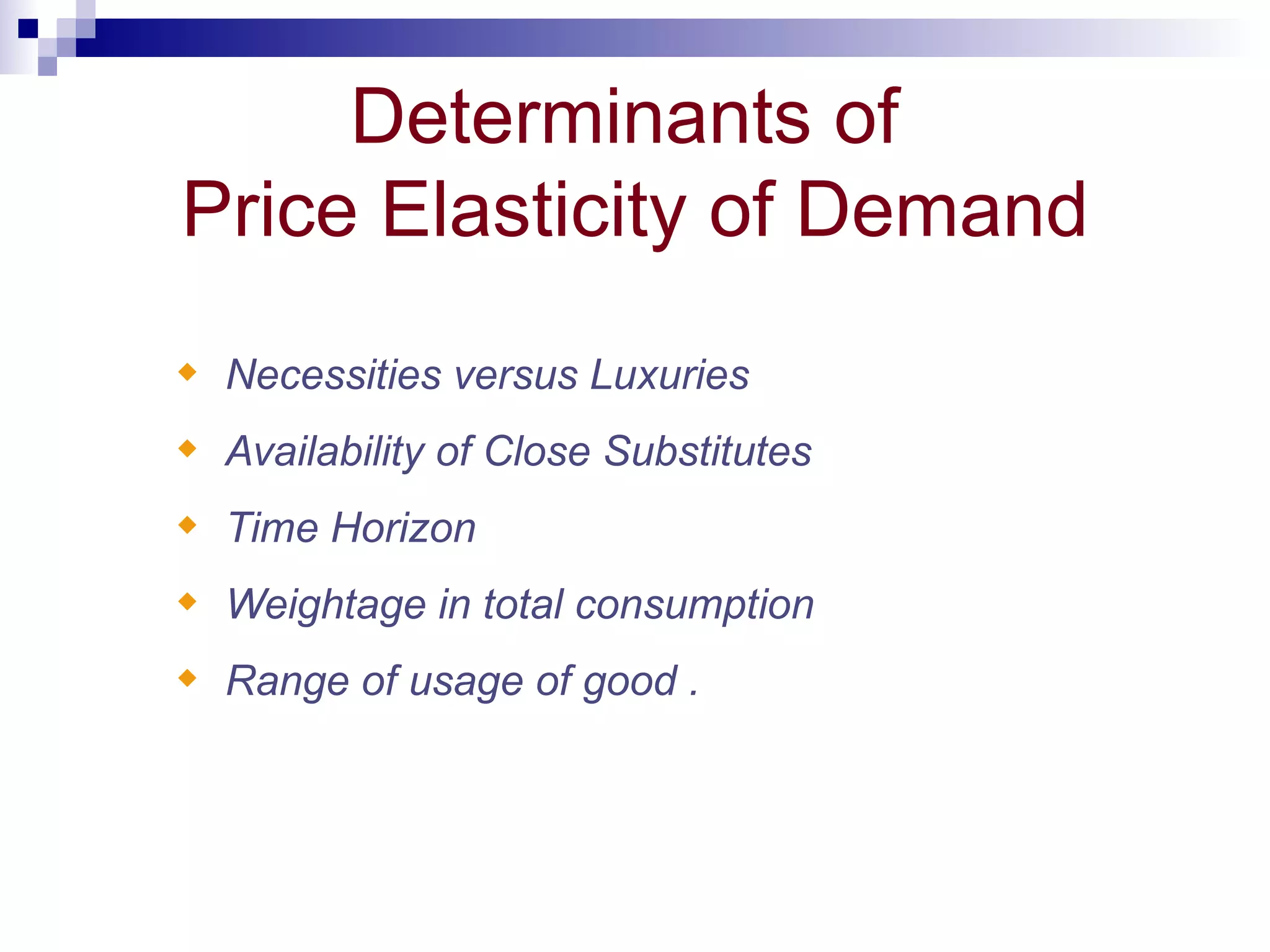
Determinants of
Price Elasticity of Demand
x   Necessities versus Luxuries
x   Availability of Close Substitutes
x   Time Horizon
x   Weightage in total consumption
x   Range of usage of good .
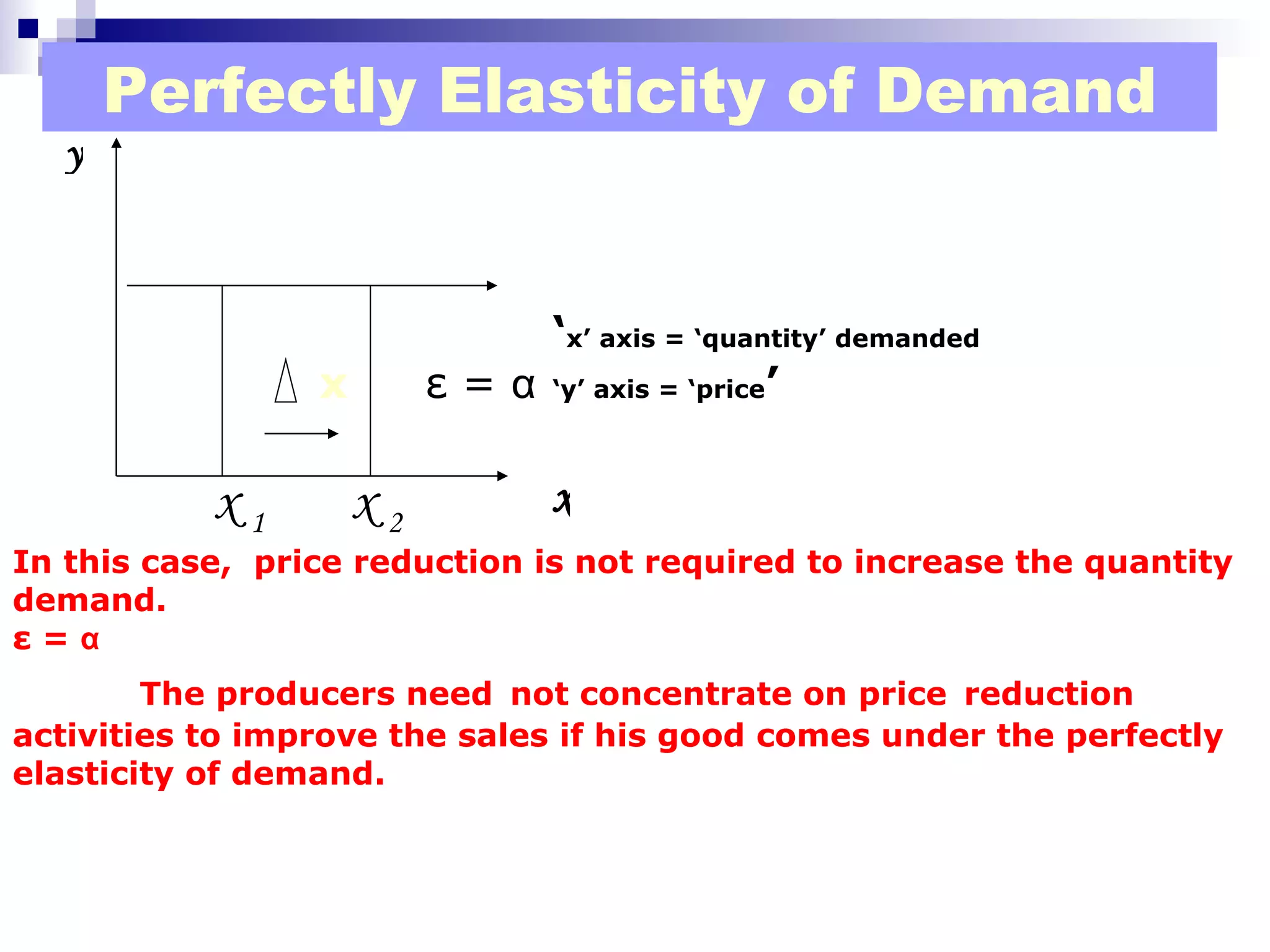
Perfectly Elasticity of Demand
   y


                                ‘x’ axis = ‘quantity’ demanded
                 x        ε = α ‘y’ axis = ‘price’

           x1        x2           x
In this case, price reduction is not required to increase the quantity
demand.
ε=α
        The producers need not concentrate on price reduction
activities to improve the sales if his good comes under the perfectly
elasticity of demand.
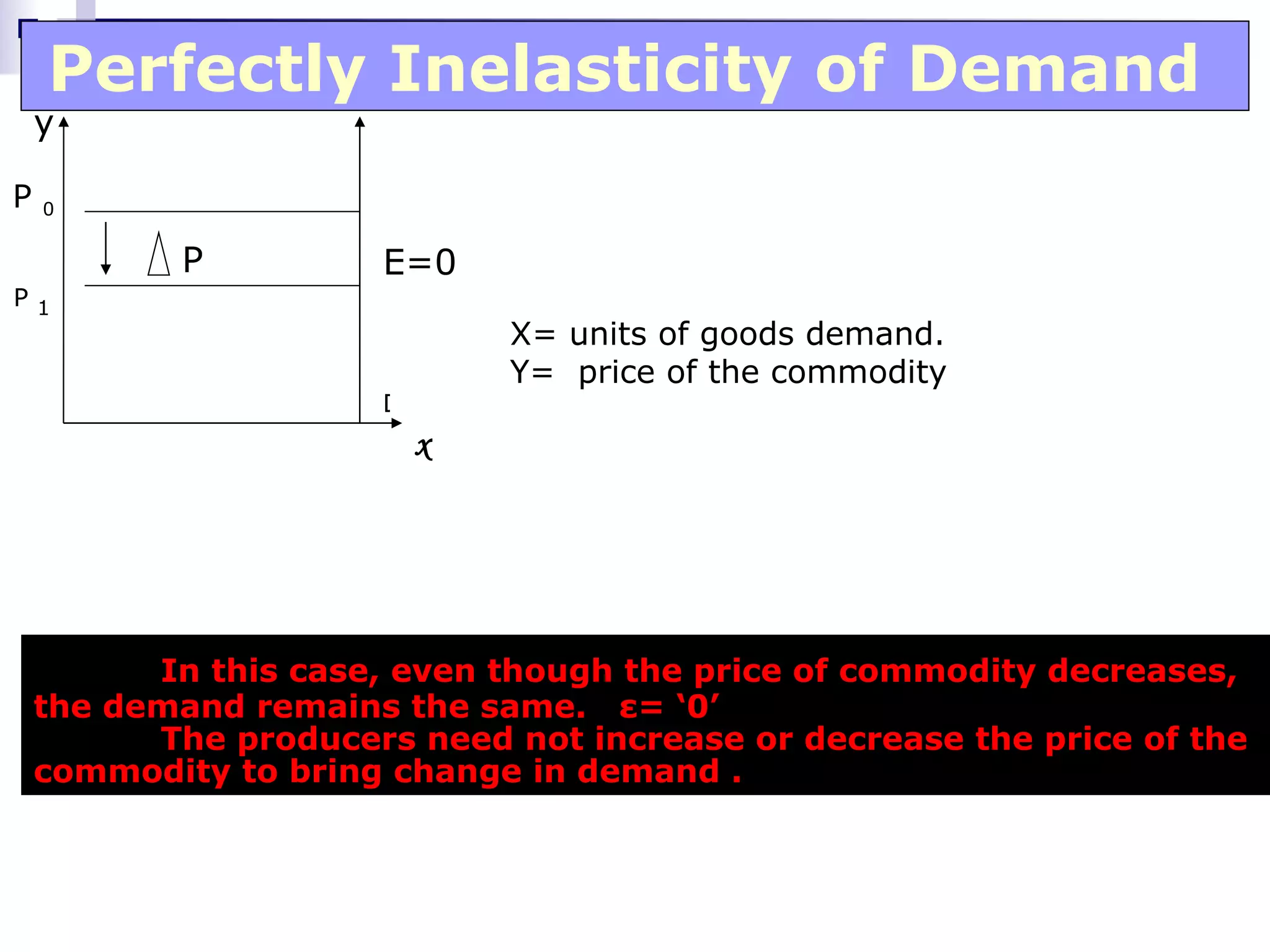
Perfectly Inelasticity of Demand
    y

P   0


            P         E=0
P1
                              X= units of goods demand.
                              Y= price of the commodity
                      D
                          x


          In this case, even though the price of commodity decreases,
    the demand remains the same. ε= ‘0’
          The producers need not increase or decrease the price of the
    commodity to bring change in demand .
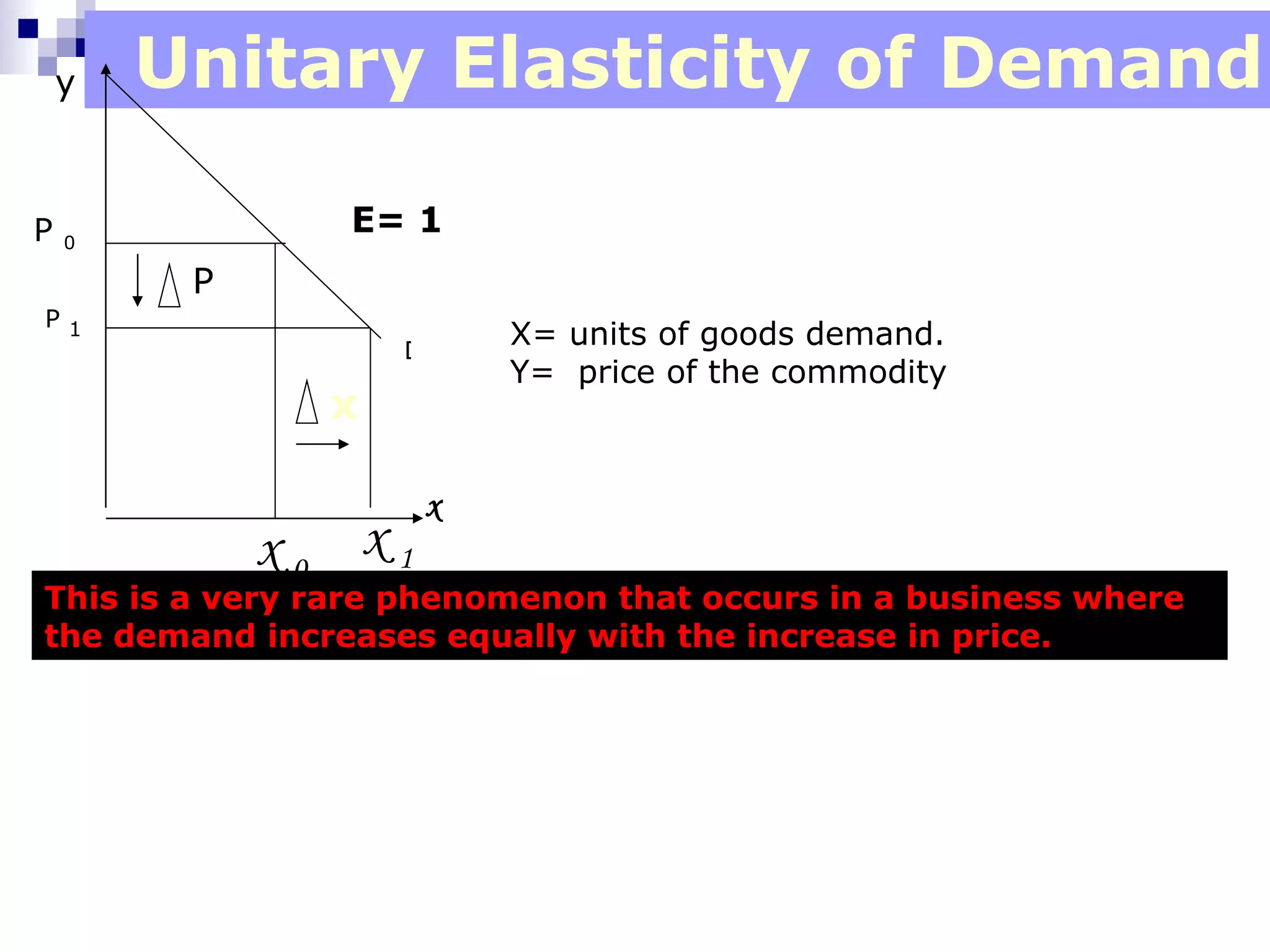
y   Unitary Elasticity of Demand

P   0
                E= 1
         P
P1
                   D
                           X= units of goods demand.
                           Y= price of the commodity
               x

                       x
             x0 x1
This is a very rare phenomenon that occurs in a business where
the demand increases equally with the increase in price.
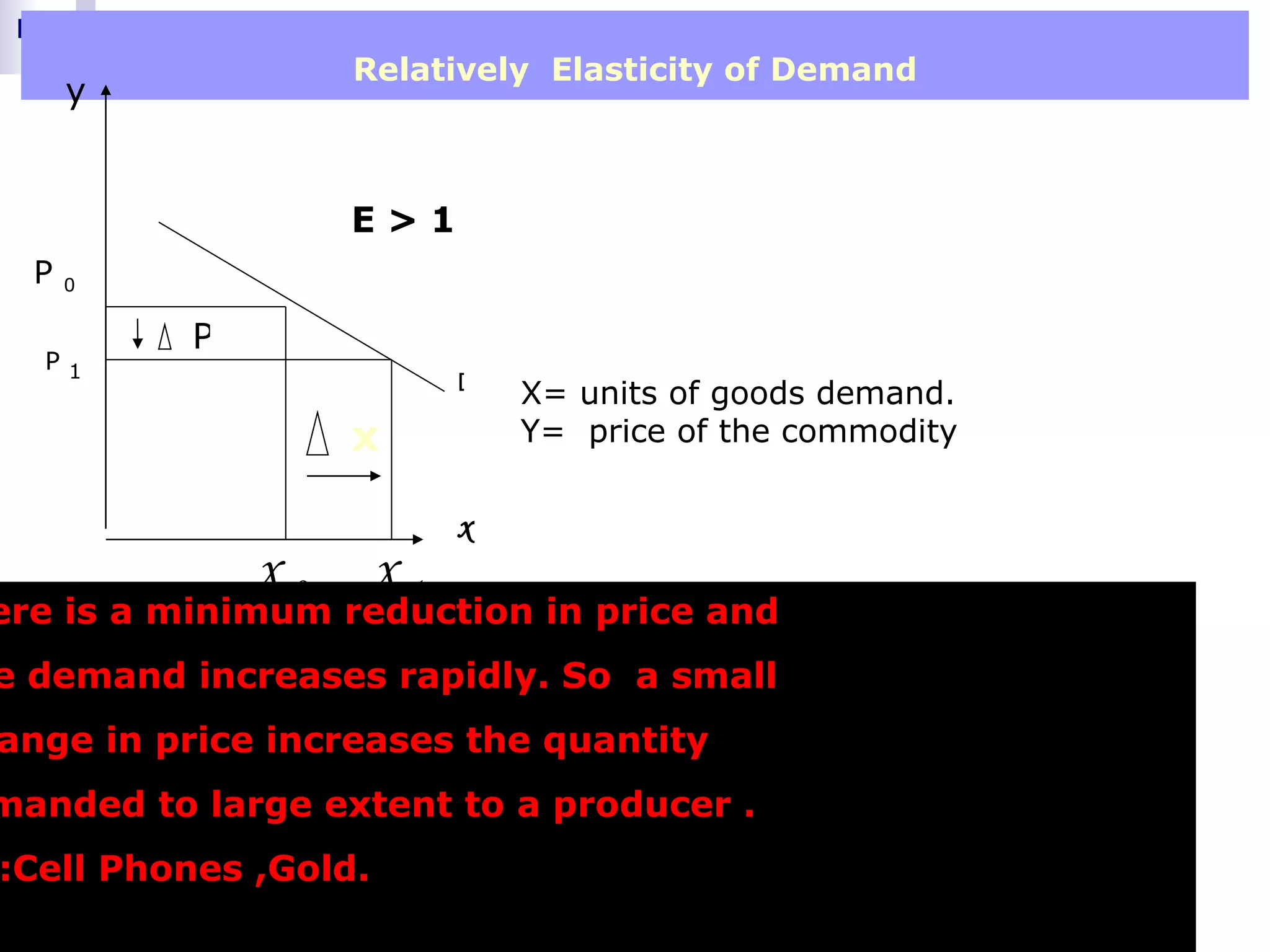
Relatively Elasticity of Demand
      y


                   E>1
  P   0


          P
  P1
                           D
                               X= units of goods demand.
                   x           Y= price of the commodity

                           x
              x0      x1
ere is a minimum reduction in price and
e demand increases rapidly. So a small
ange in price increases the quantity
manded to large extent to a producer .
:Cell Phones ,Gold.
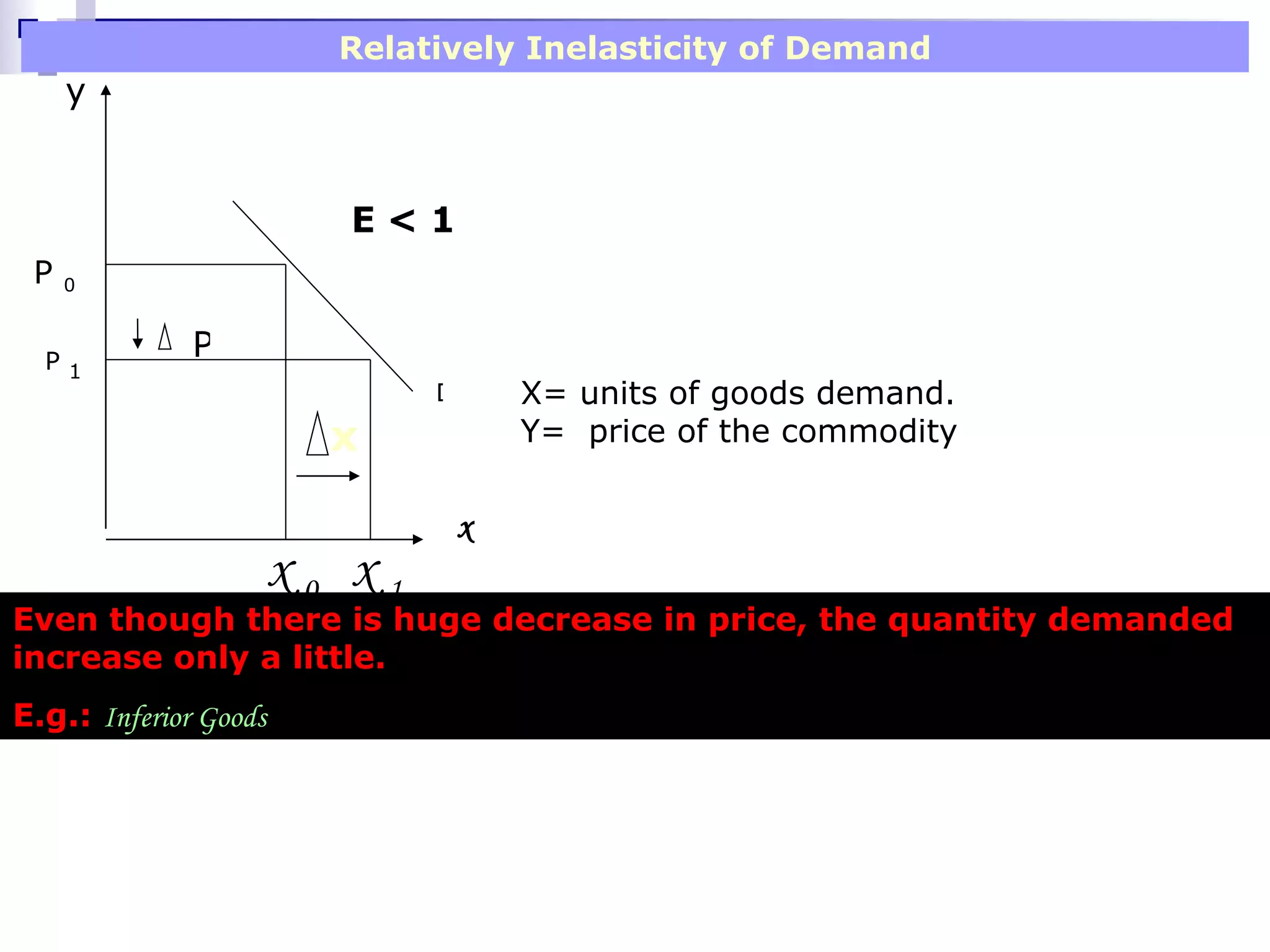
Relatively Inelasticity of Demand
     y


                          E<1
 P   0


  P1
              P
                               D       X= units of goods demand.
                         x             Y= price of the commodity

                                   x
                       x0 x1
Even though there is huge decrease in price, the quantity demanded
increase only a little.
E.g.: Inferior Goods
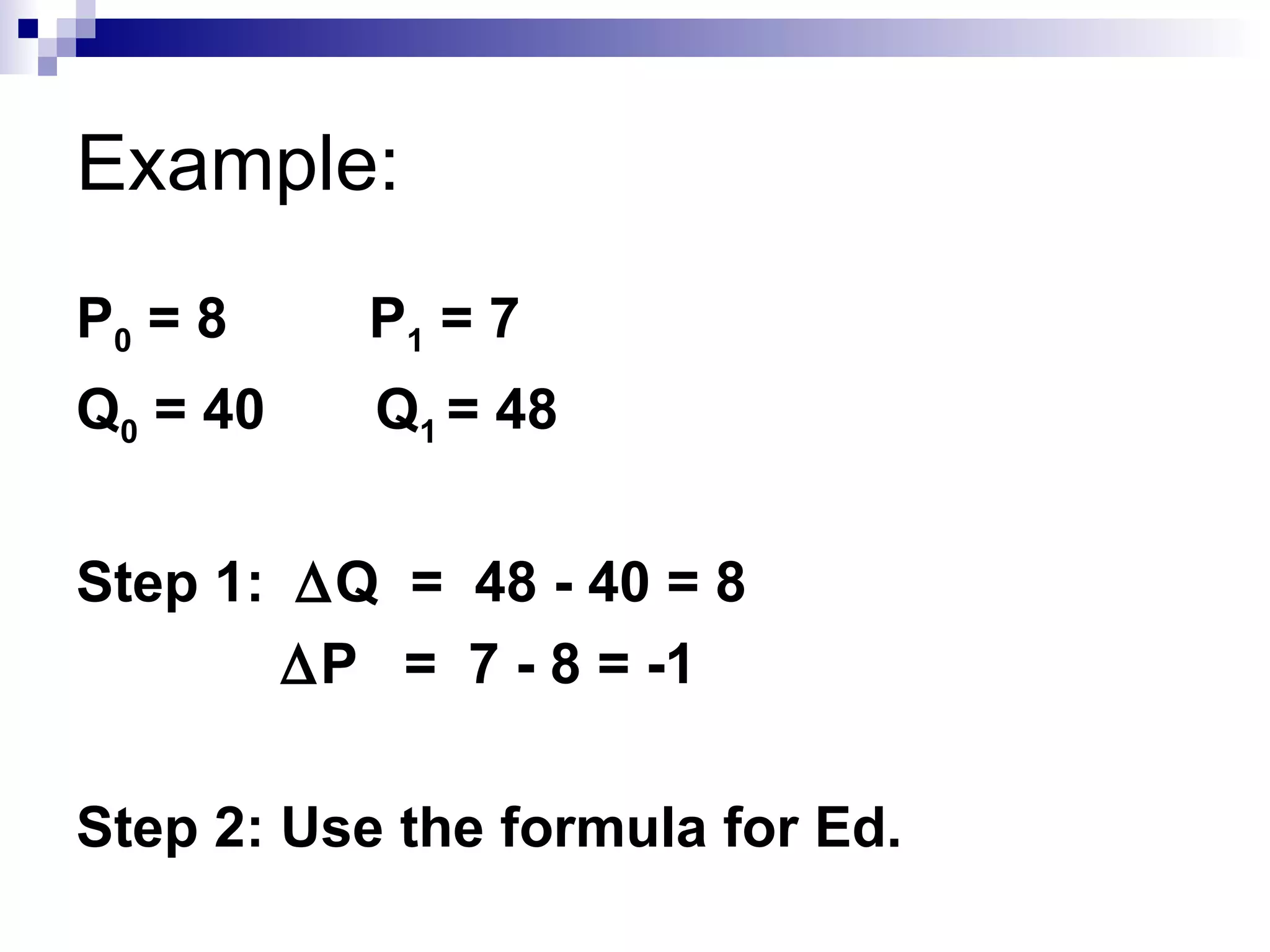
Example:
P0 = 8    P1 = 7
Q0 = 40    Q1 = 48


Step 1: ∆Q = 48 - 40 = 8
        ∆P = 7 - 8 = -1

Step 2: Use the formula for Ed.
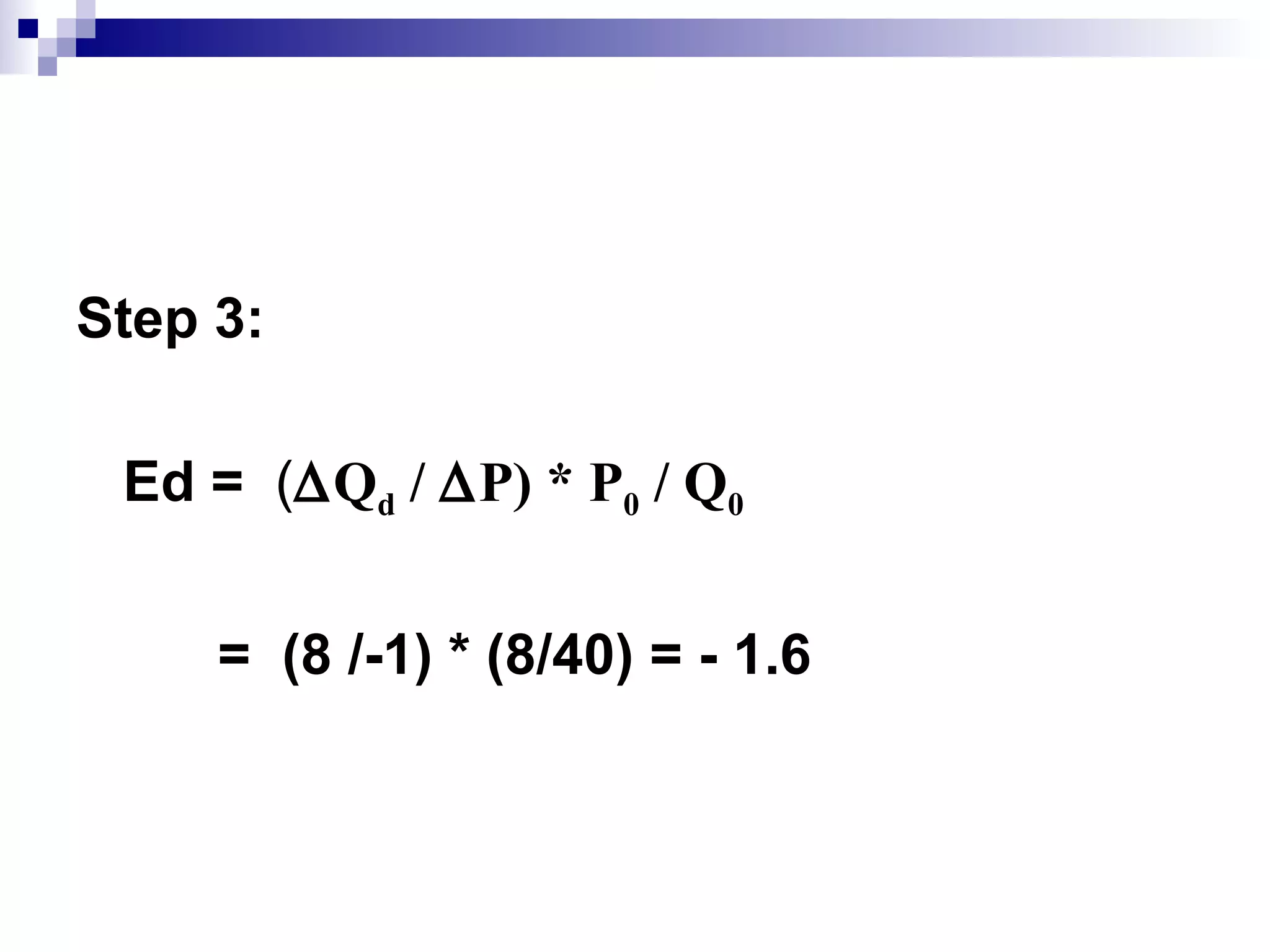
Step 3:

 Ed = (∆Qd / ∆P) * P0 / Q0


     = (8 /-1) * (8/40) = - 1.6
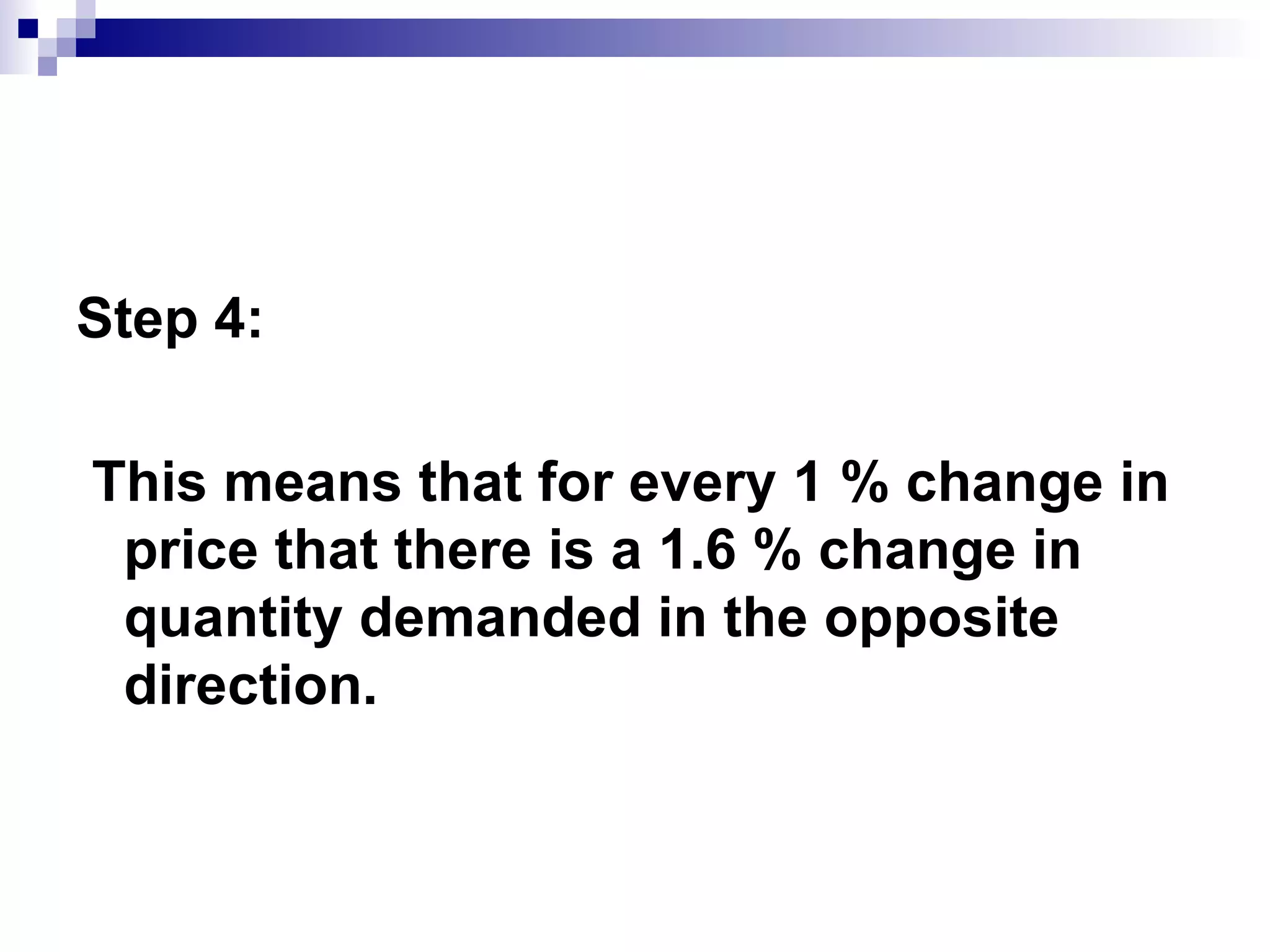
Step 4:

This means that for every 1 % change in
 price that there is a 1.6 % change in
 quantity demanded in the opposite
 direction.
Income Elasticity
      • Income Elasticity of Demand
x Income elasticity of demand
  measures how much the quantity
  demanded of a good responds to a
  change in consumers’ income.
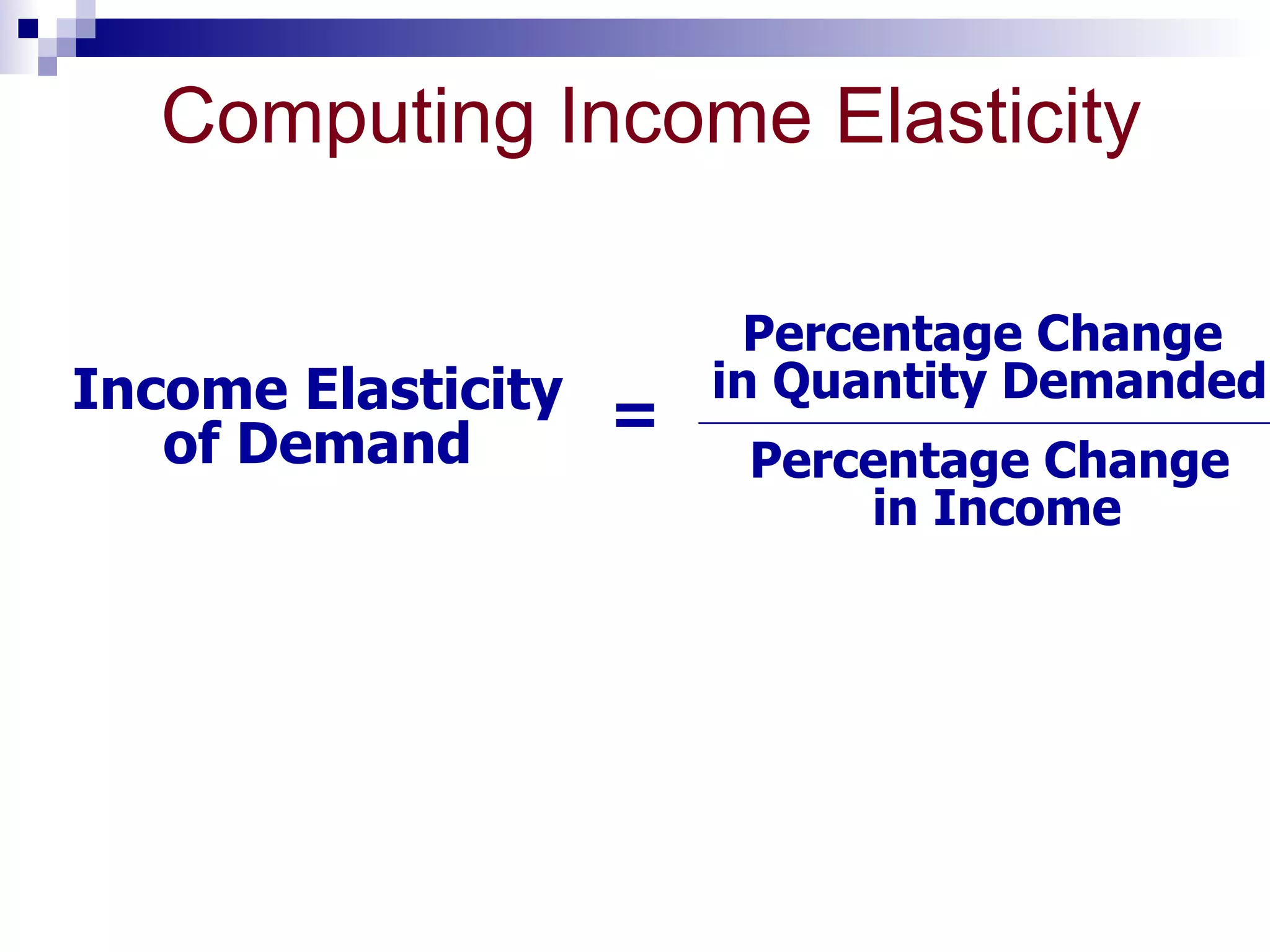
x It is computed as the percentage
  change in the quantity demanded
  divided by the percentage change in
  income.
Computing Income Elasticity

                       Percentage Change
Income Elasticity =   in Quantity Demanded
   of Demand           Percentage Change
                           in Income
Income Elasticity
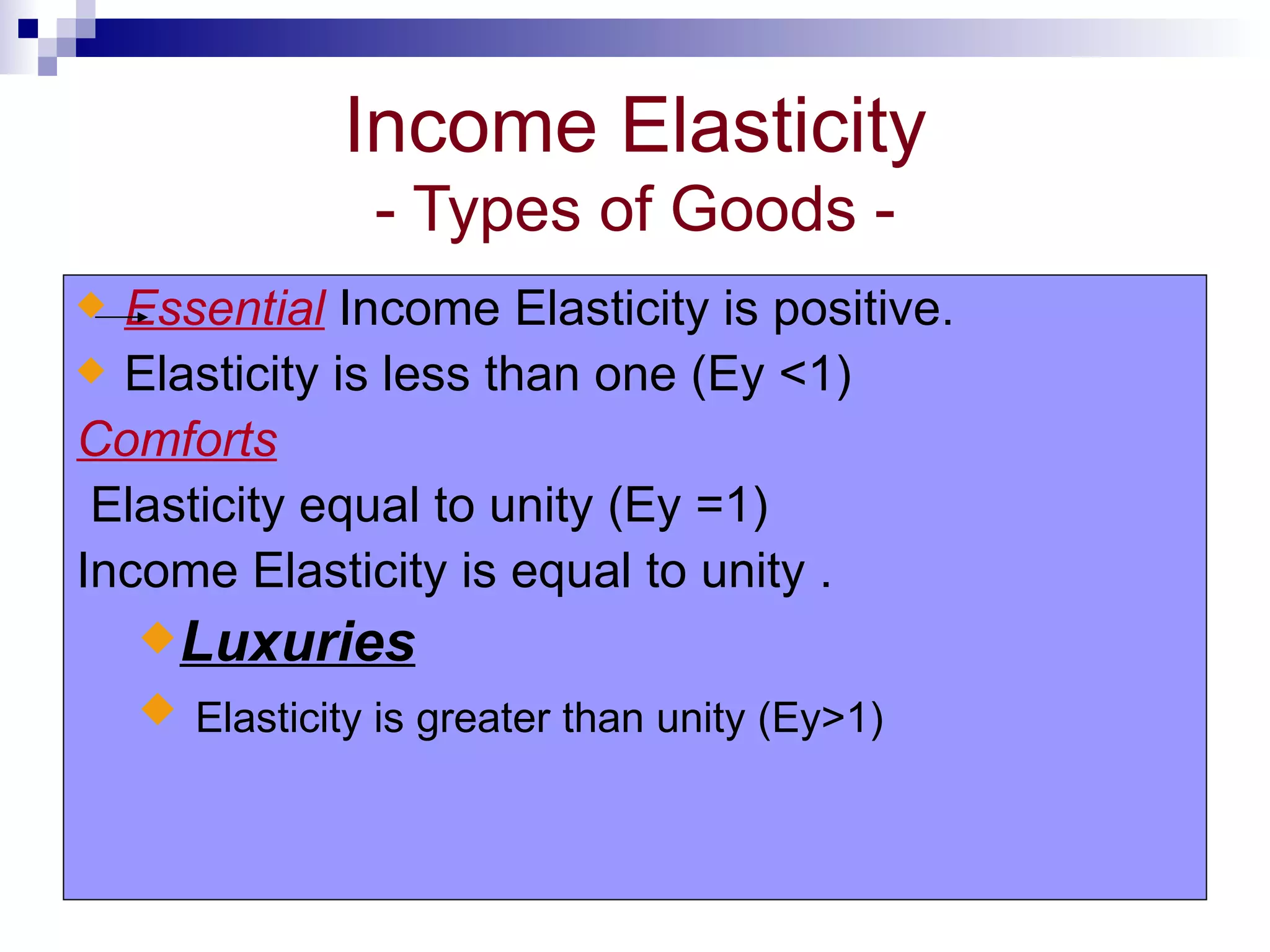
                - Types of Goods -
x Essential Income Elasticity is positive.
x Elasticity is less than one (Ey <1)
Comforts
 Elasticity equal to unity (Ey =1)
Income Elasticity is equal to unity .
    x Luxuries
    x Elasticity is greater than unity (Ey>1)
Income Elasticity of Demand
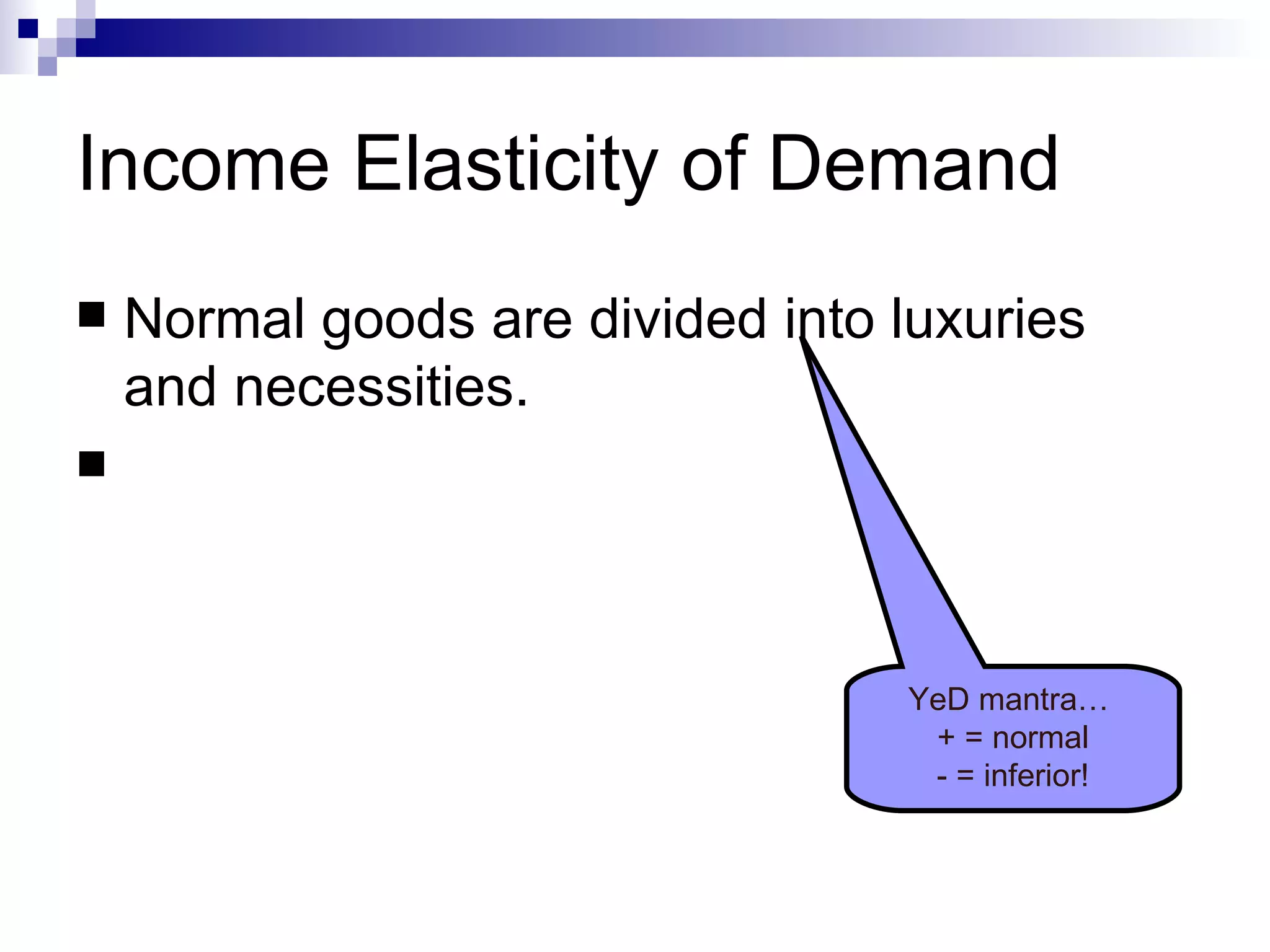
 Normal goods are divided into luxuries
  and necessities.

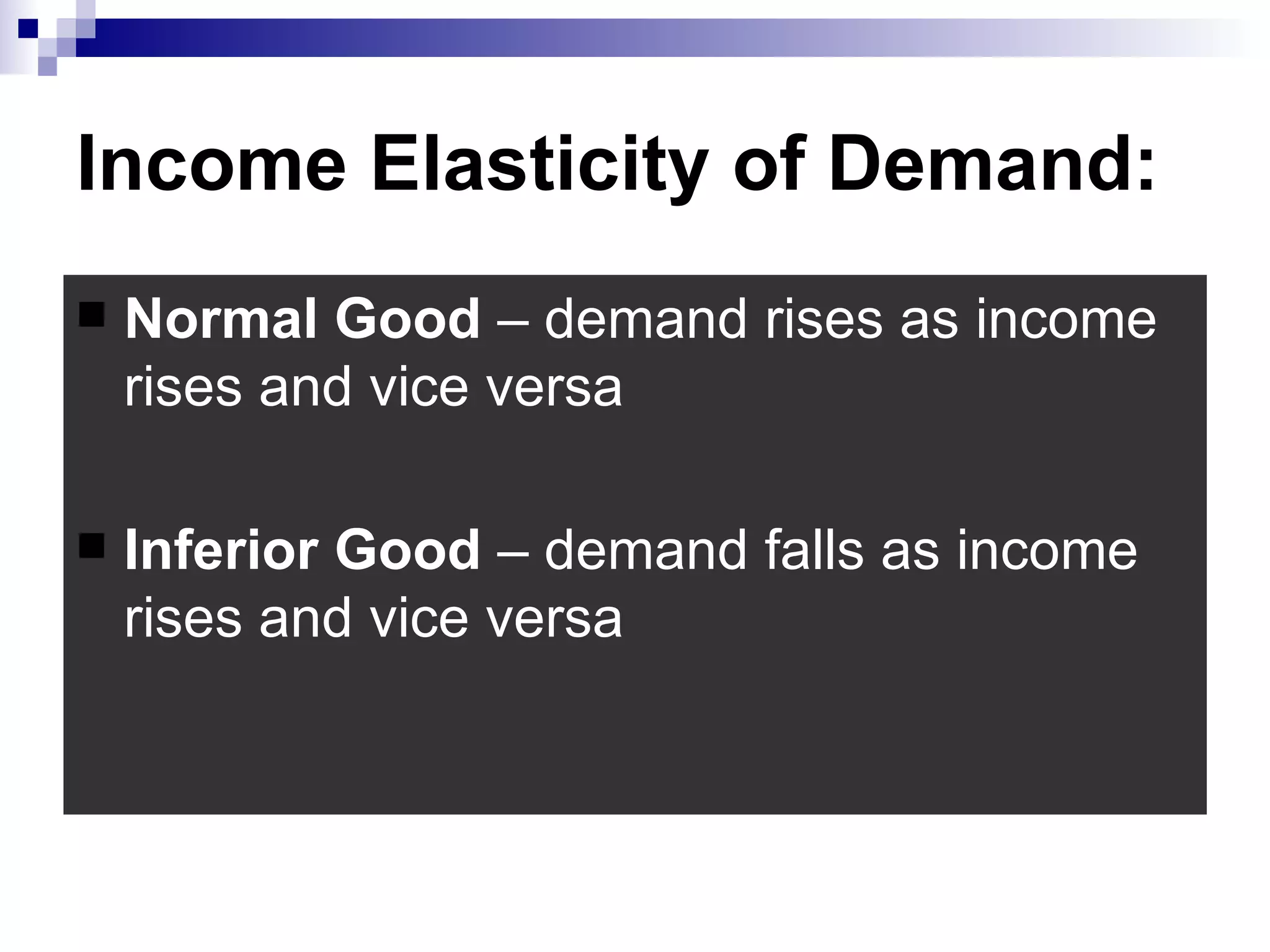
 Normal Good – demand rises as income
  rises and vice versa

                              YeD mantra…
                               + = normal
                               - = inferior!
Income Elasticity of Demand
   Luxuries are goods that have an income
    elasticity greater than one.

   Their percentage increase in demand is
    greater than the percentage increase in
    income.
Income Elasticity of Demand
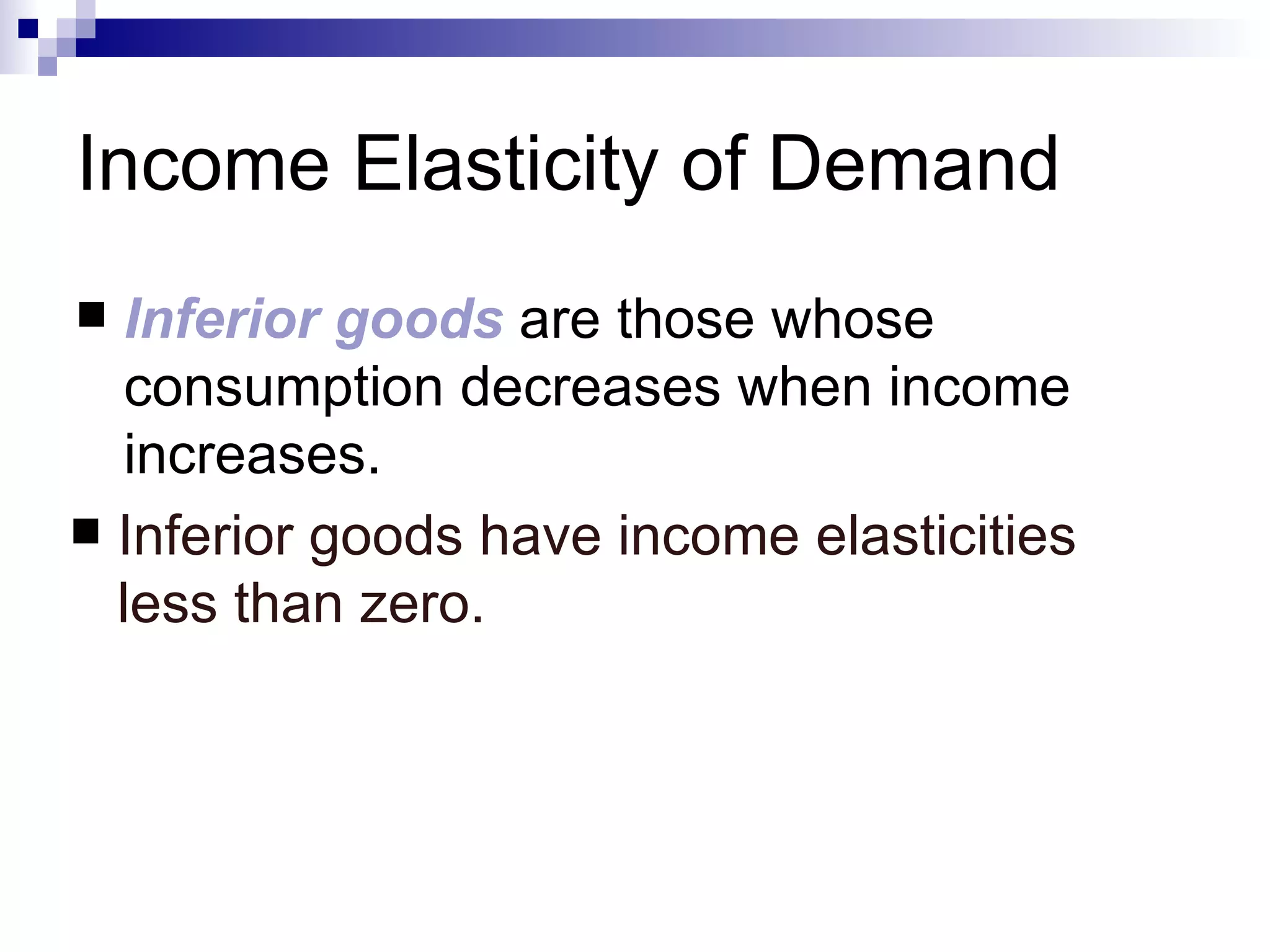
 Inferior goods are those whose
  consumption decreases when income
  increases.
 Inferior goods have income elasticities
  less than zero.
Income Elasticity of Demand:
   Normal Good – demand rises as income
    rises and vice versa

   Inferior Good – demand falls as income
    rises and vice versa
Look out for the sign…!
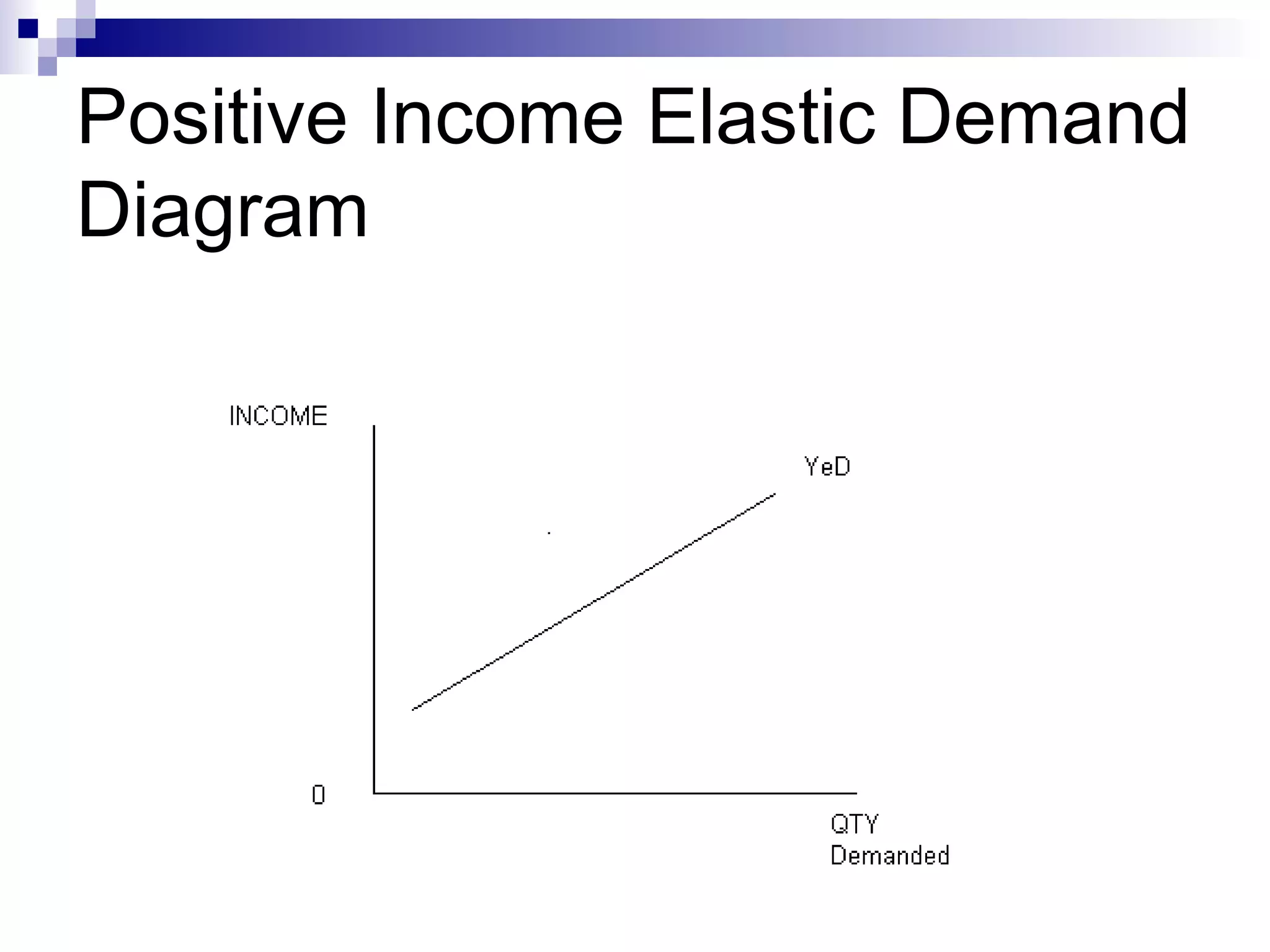
   A positive sign (+) denotes a normal good

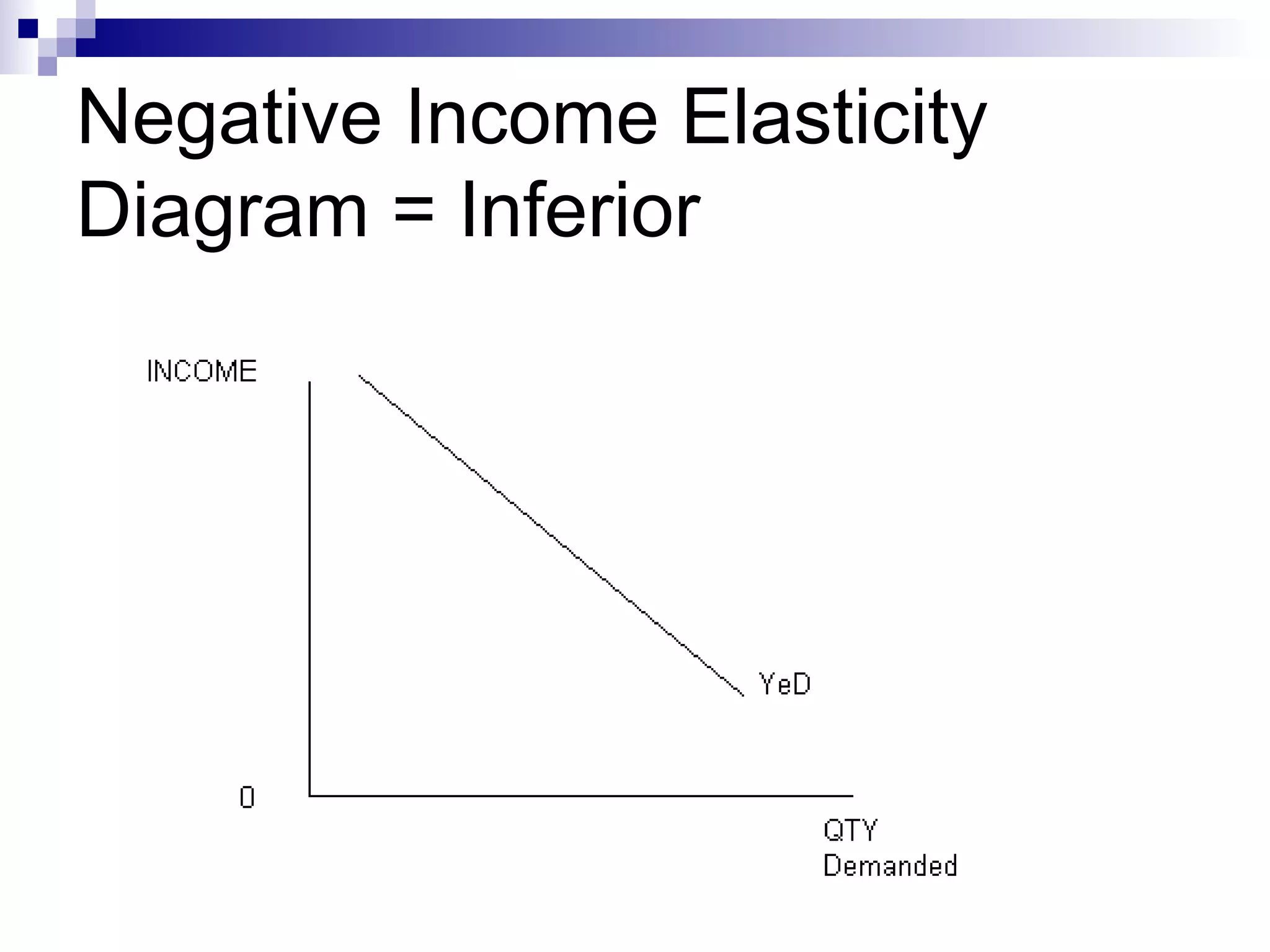
   A negative sign (-) denotes an inferior
    good
Positive Income Elastic Demand
Diagram
Negative Income Elasticity
Diagram = Inferior
Zero Income Elasticity
   This occurs when a
    change in income
    has NO effect on
    the demand for
    goods.

   A rise of 5%
    income in a rich
    country will leave
    the Demand for
    toothpaste
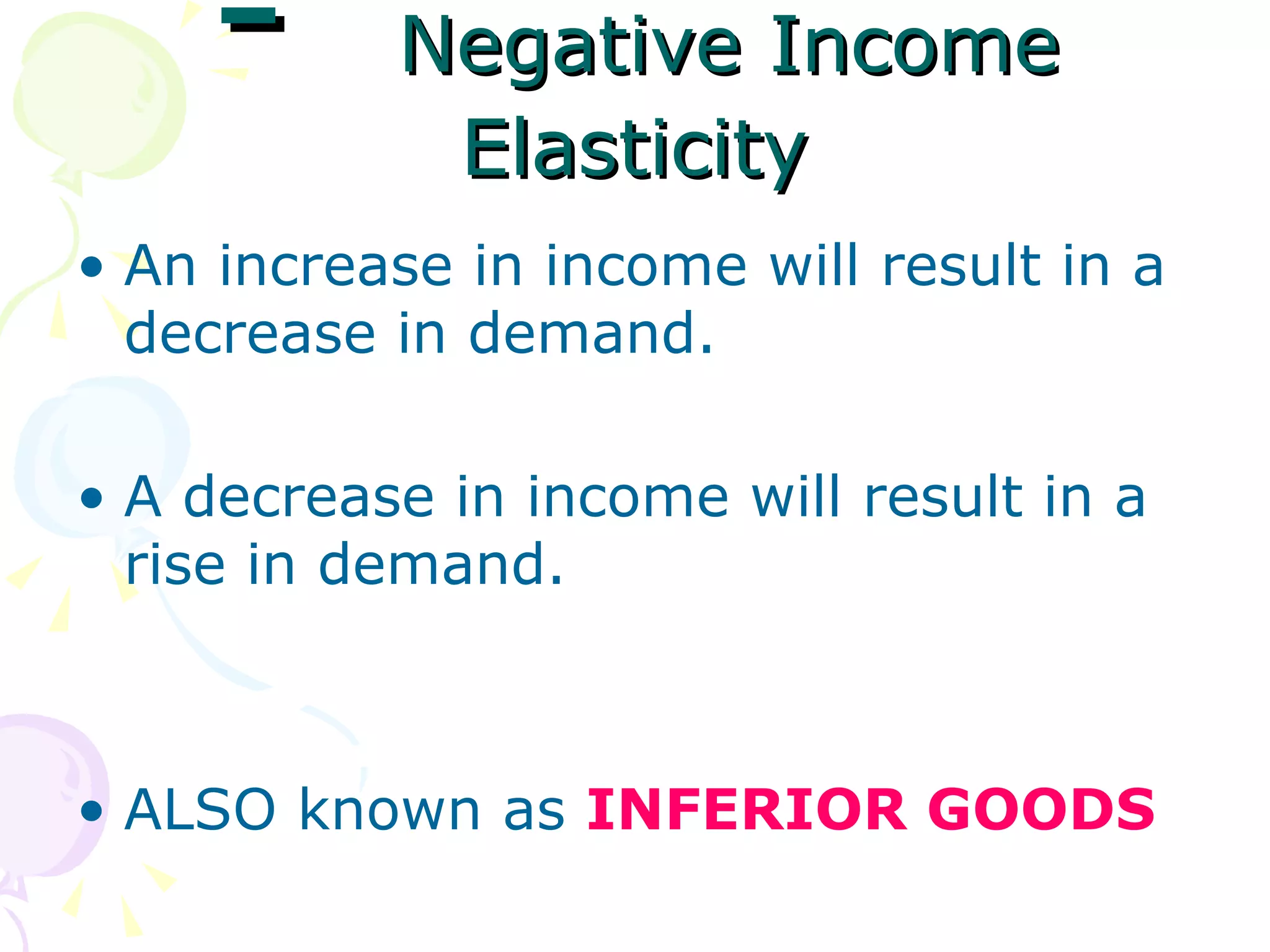
-      Negative Income
            Elasticity
• An increase in income will result in a
  decrease in demand.

• A decrease in income will result in a
  rise in demand.


• ALSO known as INFERIOR GOODS
Look for the signs!
NORMAL     GOODS            • LUXURY GOODS


+   BETWEEN 0 & 1
    +0.5 +0.9 + 0.1               +    GREATER THAN 1
                                       +2 +5 +27


                INFERIOR     GOODS


                 -    CAN BE A DECIMAL OR A VALUE
                      GREATER THAN 1
Income Elasticity and the
Demand for Airline Travel
   Demand for air travel has a positive
    income elasticity of demand
   The industry is cyclical
       During an upturn, demand rises for
        business and leisure travel)
       During a recession, the demand tails
        away
Income elasticity will vary according to the
   type of air travel
       E.g. difference between low-cost “no-
        frills” and higher priced scheduled
        services on low-haul flights
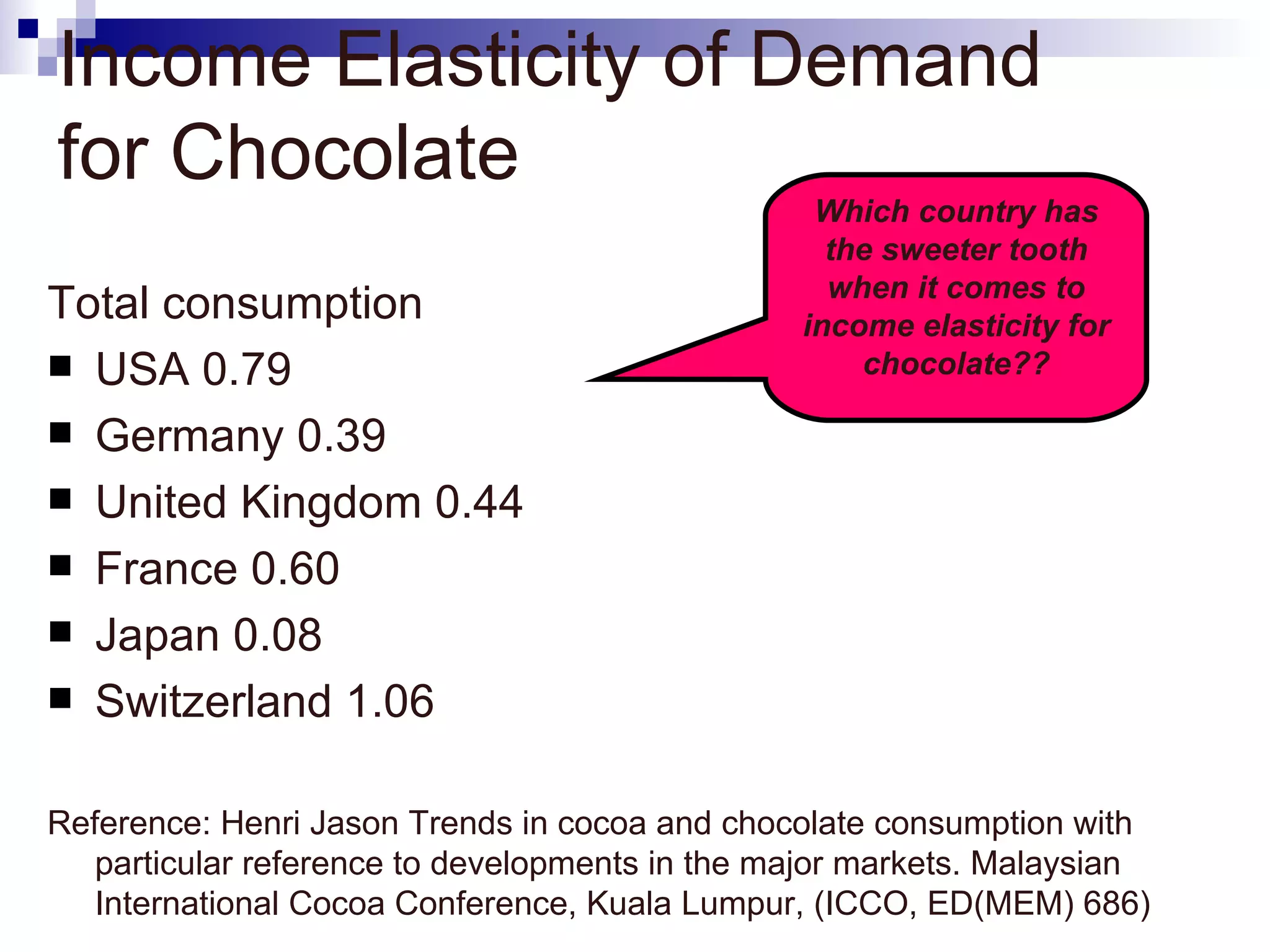
Income Elasticity of Demand
for Chocolate
                                                 Which country has
                                                  the sweeter tooth
                                                  when it comes to
Total consumption                               income elasticity for
 USA 0.79                                          chocolate??

 Germany 0.39
 United Kingdom 0.44
 France 0.60
 Japan 0.08
 Switzerland 1.06


Reference: Henri Jason Trends in cocoa and chocolate consumption with
   particular reference to developments in the major markets. Malaysian
   International Cocoa Conference, Kuala Lumpur, (ICCO, ED(MEM) 686)
USES OF INCOME ELASTICITY

   It is useful in demand forecasting ,When a change in personal
    income is expected     .

   It avoids over or under production.

   It helps to define the good as normal or inferior good
PROBLEMS


   A consumer demands 4kgs of sugar when his income is Rs 2,000.
    When his income went up to Rs 2,400 ,demand for sugar increased
    to 5 kgs . Calculate Ye of demand and state whether it is elastic or
    inelastic in nature ?

   2) If a consumer ‘s demand for a good increases from 100units to
      200 units per week when his income rises from Rs 2000 to Rs
    3000,Find income elasticity of demand ?

1.2 , 2
Cross-Price Elasticity
Measures how sensitive DEMAND
 for a commodity is to changes in
 the price of a substitute or
 compliment commodity
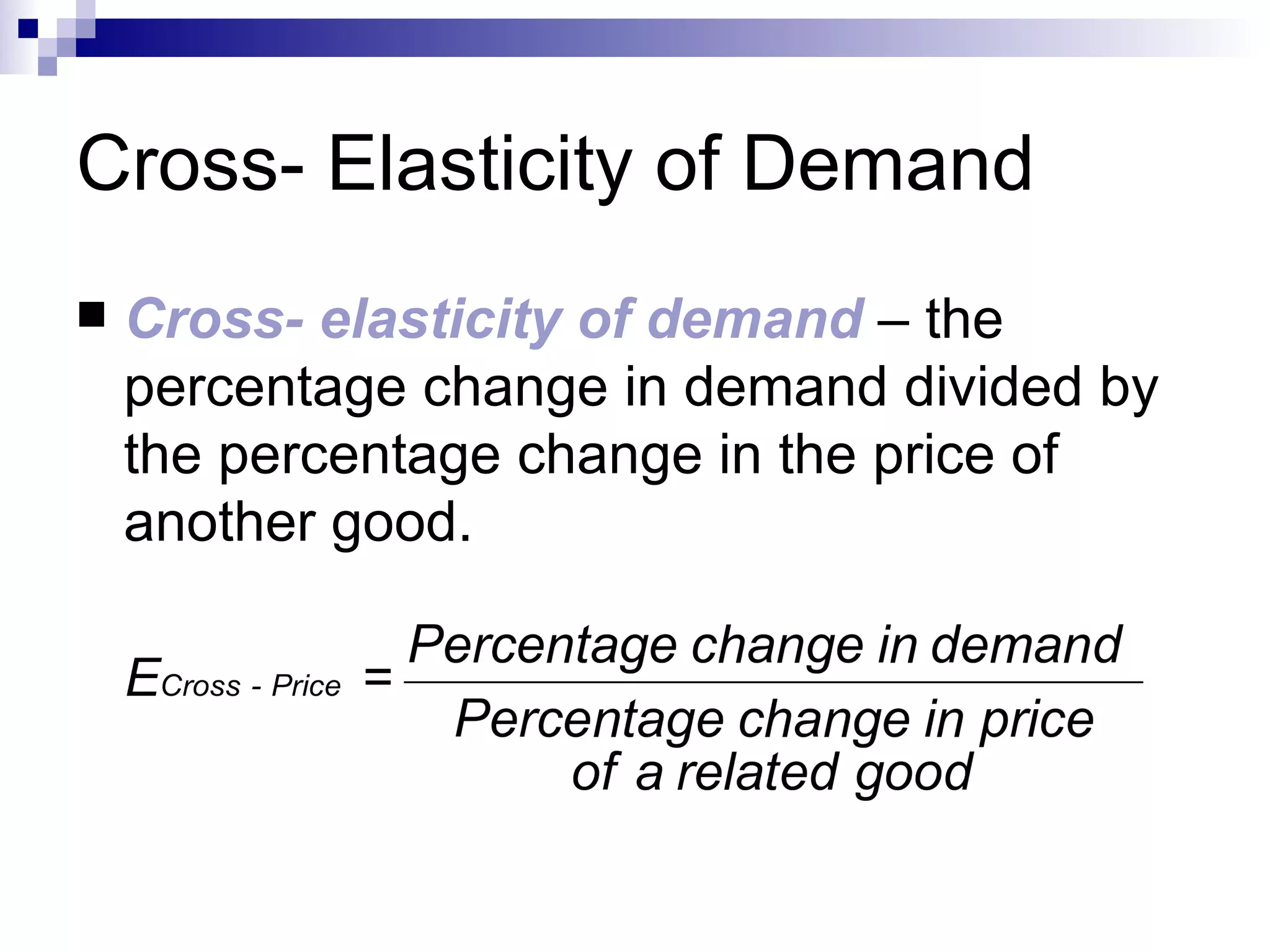
Cross- Elasticity of Demand
   Cross- elasticity of demand – the
    percentage change in demand divided by
    the percentage change in the price of
    another good.
Complements and
         Substitutes
• Substitutes are goods that can be
  used in place of another.
• Substitutes have positive cross-price
  elasticities.
Complements and Substitutes
 Complements are goods that are used in
  conjunction with other goods.
 Complements have negative cross-price
  elasticities.
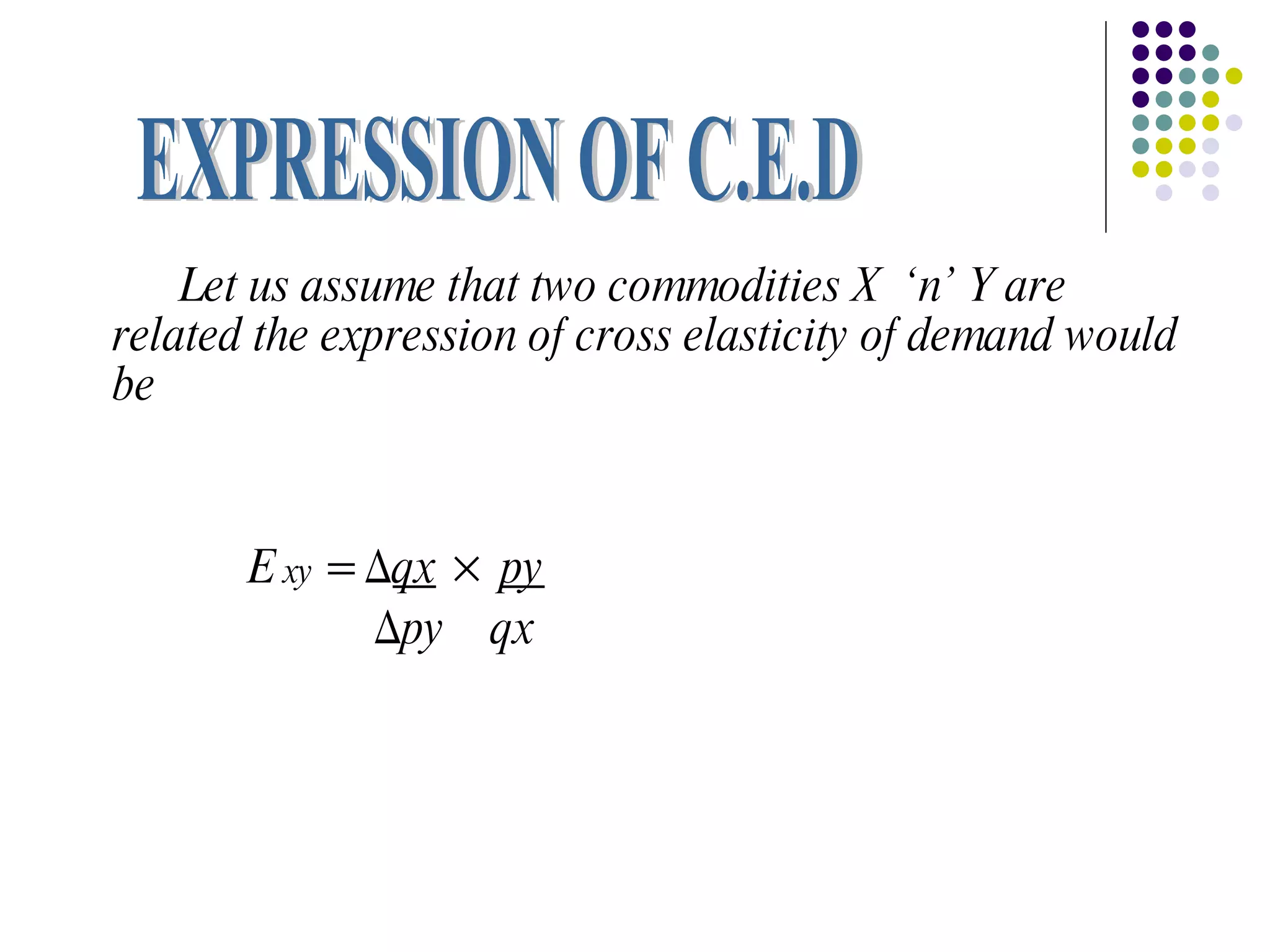
Let us assume that two commodities X ‘n’ Y are
related the expression of cross elasticity of demand would
be


       E xy = ∆qx × py
              ∆py qx
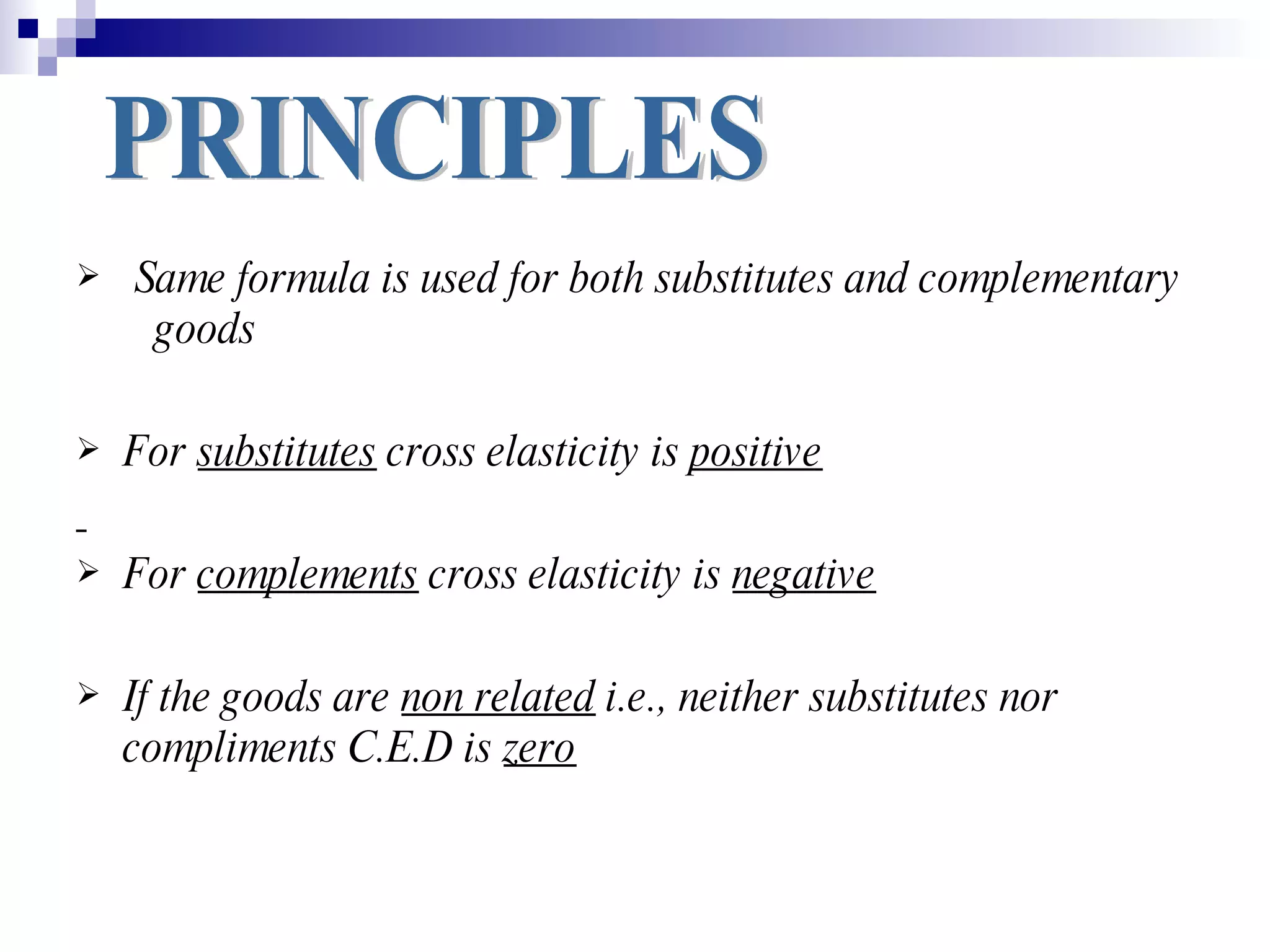
   Same formula is used for both substitutes and complementary
     goods

   For substitutes cross elasticity is positive

   For complements cross elasticity is negative

   If the goods are non related i.e., neither substitutes nor
    compliments C.E.D is zero
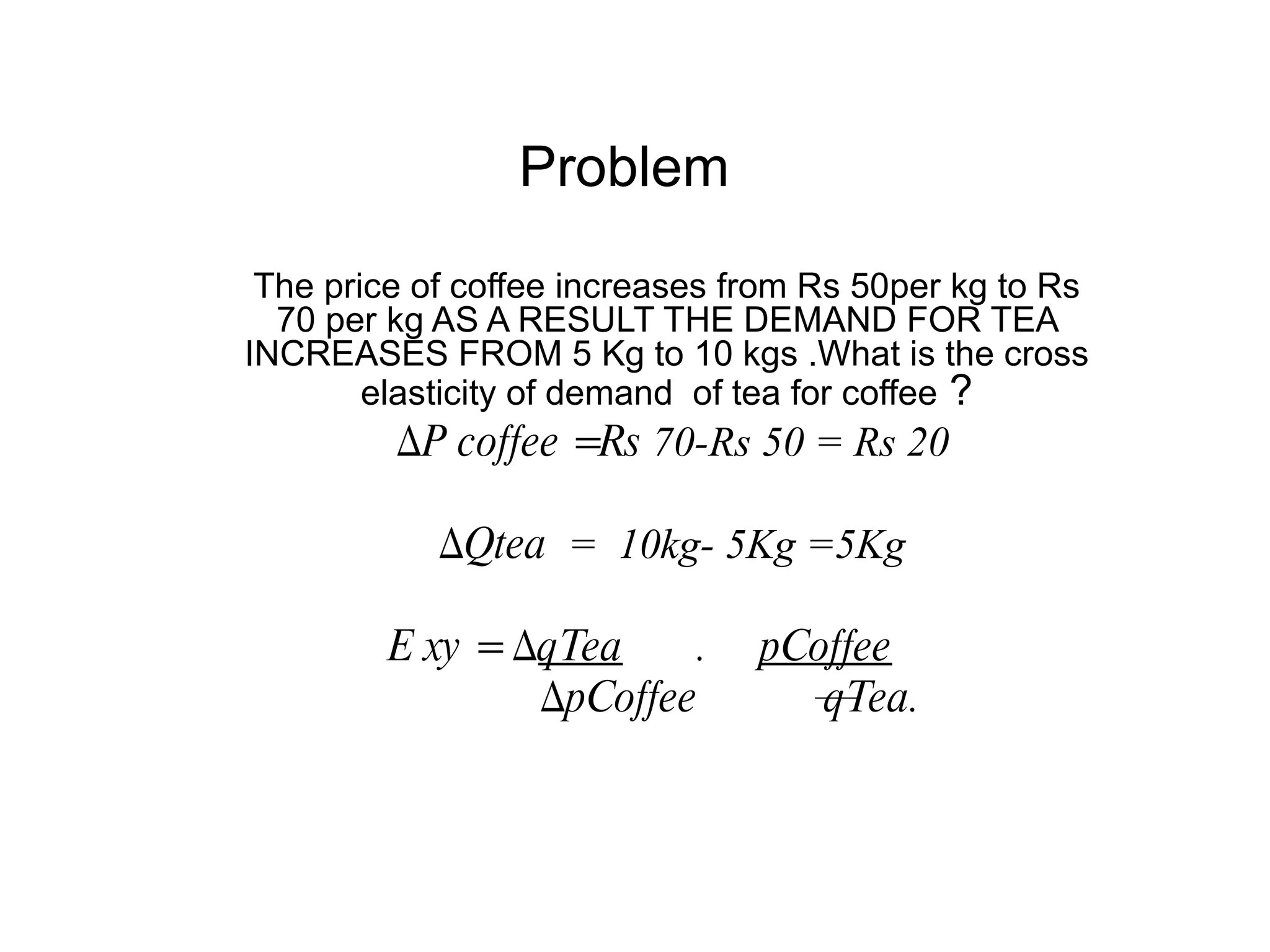
Problem
 The price of coffee increases from Rs 50per kg to Rs
  70 per kg AS A RESULT THE DEMAND FOR TEA
INCREASES FROM 5 Kg to 10 kgs .What is the cross
        elasticity of demand of tea for coffee ?
         ∆P coffee =Rs 70-Rs 50 = Rs 20

            ∆Qtea = 10kg- 5Kg =5Kg

         E xy = ∆qTea     .     pCoffee
                 ∆pCoffee          qTea.
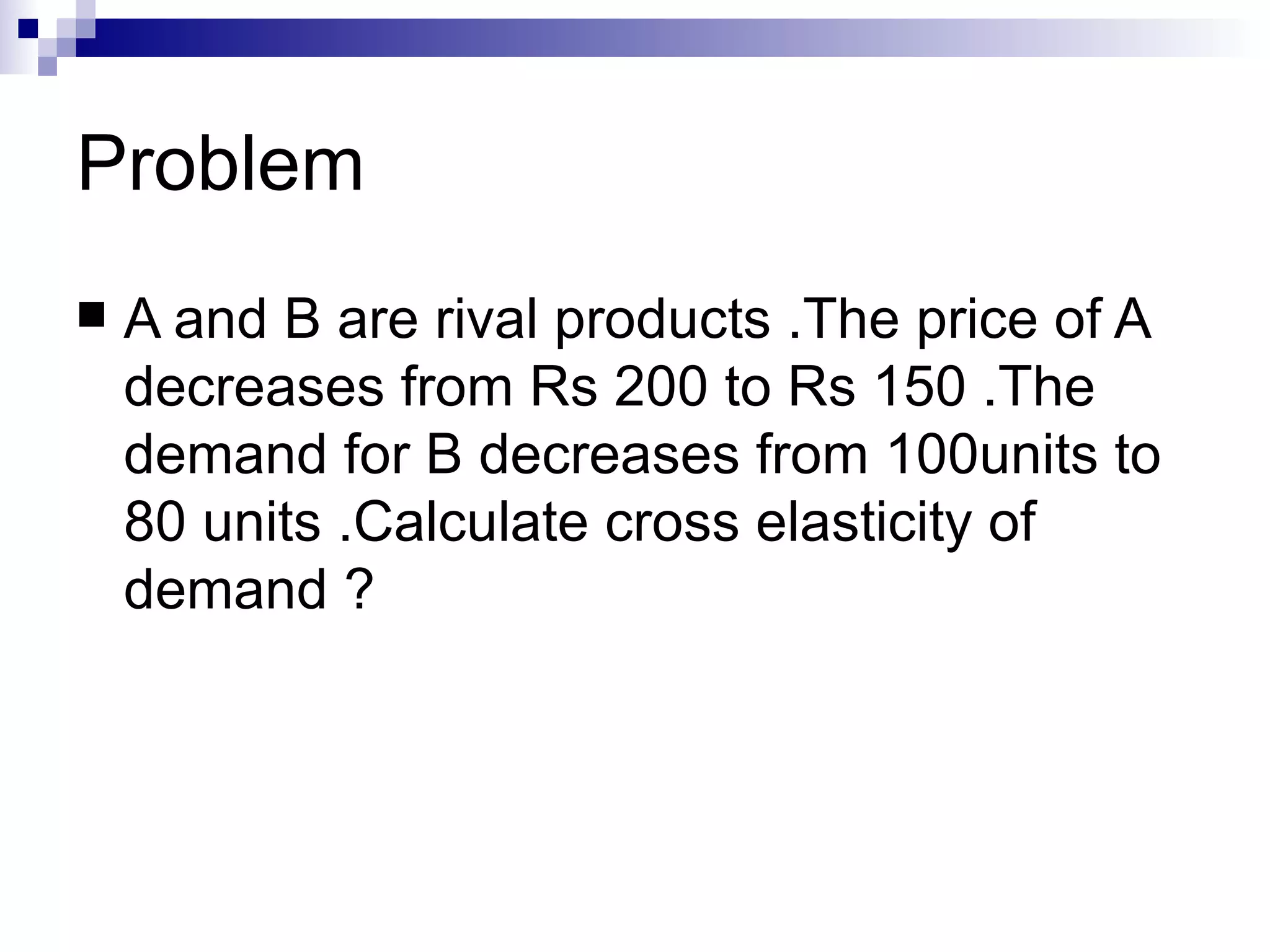
Problem
   A and B are rival products .The price of A
    decreases from Rs 200 to Rs 150 .The
    demand for B decreases from 100units to
    80 units .Calculate cross elasticity of
    demand ?
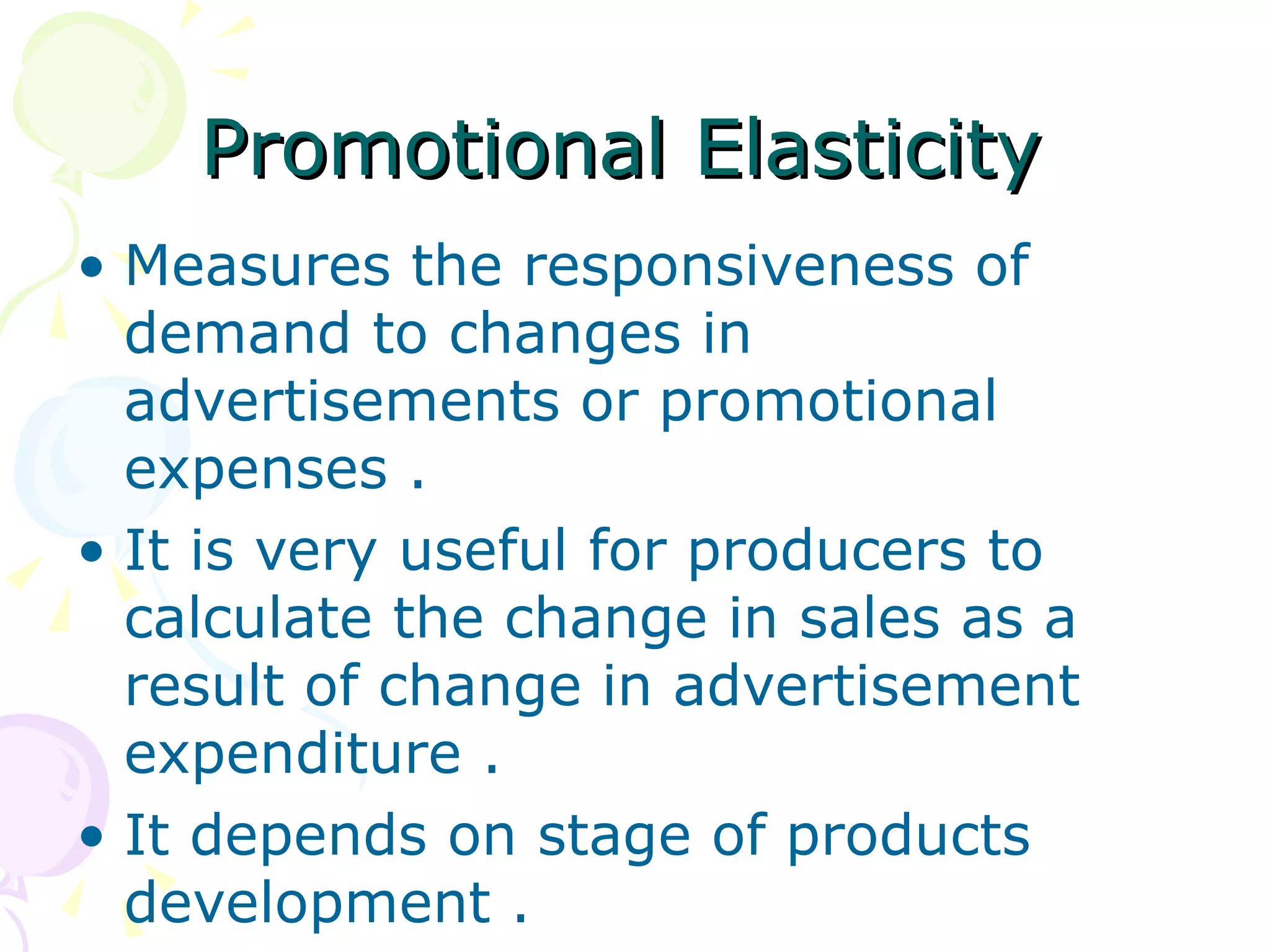
Promotional Elasticity
• Measures the responsiveness of
  demand to changes in
  advertisements or promotional
  expenses .
• It is very useful for producers to
  calculate the change in sales as a
  result of change in advertisement
  expenditure .
• It depends on stage of products
  development .
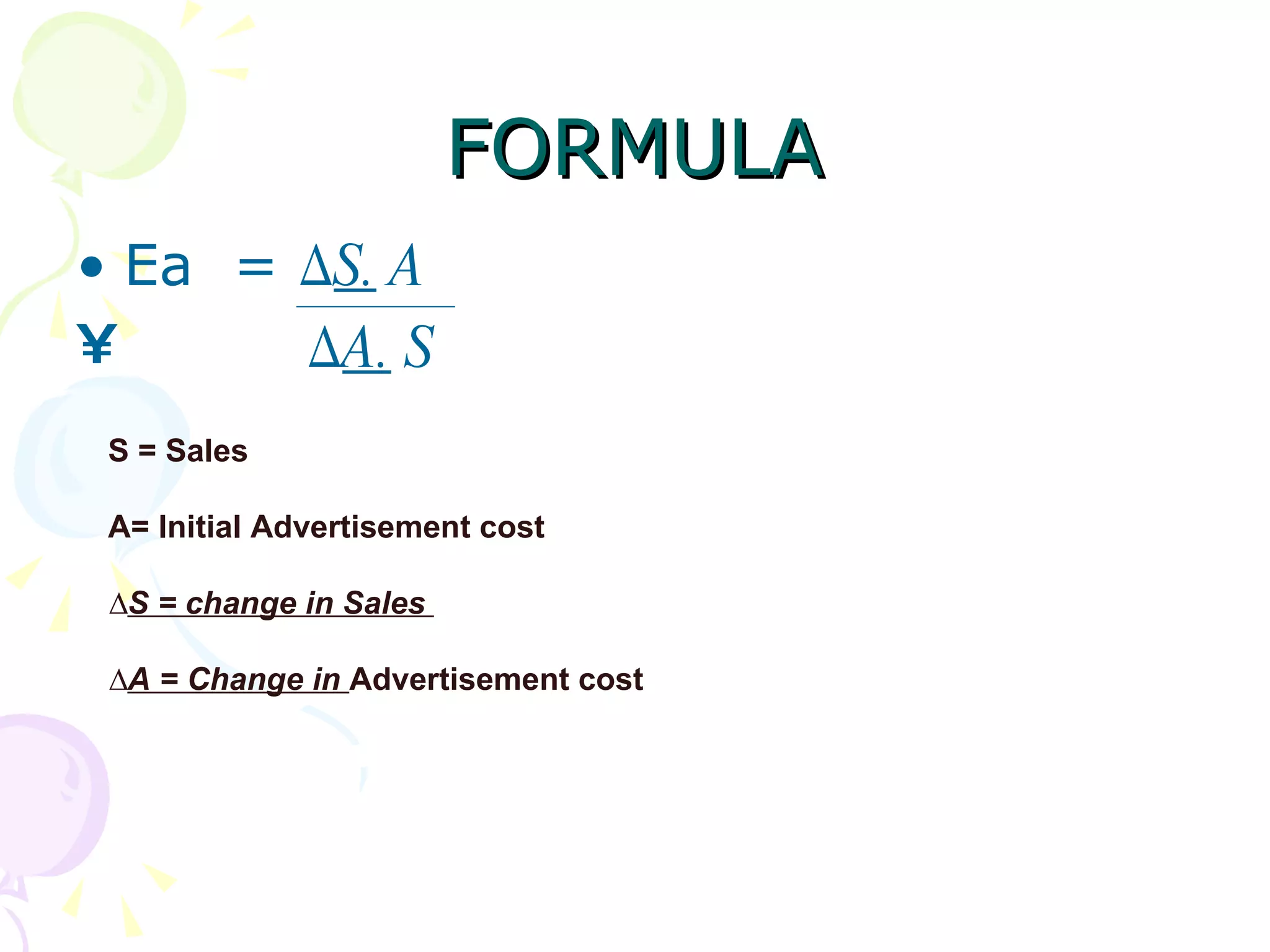
FORMULA
• Ea = ∆S. A
•      ∆A. S
 S = Sales

 A= Initial Advertisement cost

 ∆S = change in Sales

 ∆A = Change in Advertisement cost
Importance of Elasticity
 Relationship between changes
  in price and total revenue
 Importance in determining
  what goods to tax (tax revenue)
 Importance in analysing time lags in
  production
 Influences the behaviour of a firm

Elasticity Ppt

  • 1.
    SUPPLY Supply isthe willingness and ability of producers to make a specific quantity of output available to consumers at a particular price over a given period of time.
  • 2.
    Law of supply A decrease in the price of a good, all other things held constant, will cause a decrease in the quantity supplied of the good.  An increase in the price of a good, all other things held constant, will cause an increase in the quantity supplied of the good.
  • 3.
    Supply Determinants Sx = F( Px , Py, Pz,……;P,O,T) Sx = Amount of good x supplied Px = Price of good x Py,Pz = Prices of other goods in the market P = Prices of factors of production o = Objective of the producer T = State of technology
  • 4.
    Factors on whichsupply depends  Important shift factors of supply are  Changes in the prices of inputs used in production of a good  Changes in technology  Changes in suppliers expectations  Changes in taxes and subsidies  Each of these shift factors will cause a shift in supply, whereas a change in price causes a movement along the supply curve.  The major variables other than price are  Nature of the commodity  Limited supply of inputs  Events beyond human control like good/bad harvest, weather conditions and natural disasters like floods.  Government restriction on quantity to be produced .
  • 5.
    Elasticity of supply  It is defined as the ratio of percentage change in quantity demanded and the percentage change change in the price of the commodity.  Change in price Es = change in quantity Quantity Price
  • 6.
    Elasticity  The responsivenessof one variable to changes in another  When price rises, what happens to demand?  Demand falls  BUT!  How much does demand fall?
  • 7.
    Elasticity  If pricerises by 10% - what happens to demand?  We know demand will fall  By more than 10%?  By less than 10%?  Elasticity measures the extent to which demand will change
  • 8.
    Elasticity . .. x … is a measure of how much buyers and sellers respond to changes in market conditions x … allows us to analyze supply and demand with greater precision. xJournal Question-Name 3 necessities and 3 luxuries that you would buy.
  • 9.
    Determinants of Elasticity  Time period – the longer the time under consideration the more elastic a good is likely to be  Number and closeness of substitutes – the greater the number of substitutes, the more elastic  The proportion of income taken up by the product – the smaller the proportion the more inelastic  Luxury or Necessity - for example, addictive drugs
  • 10.
    Types of Elasticity  Price elasticity of demand  Income elasticity of demand  Cross elasticity  Promotional or Advertisemsent  Measurement of Elasticity :  POINT METHOD  ARC METHOD
  • 11.
    Point Method Pointelasticity: Elasticity measured at a given point of a linear demand (or a supply) curve. dQ P εP = x 1 dP Q1
  • 12.
    Arc Method Arcelasticity: Elasticity which is measured over a discrete interval of a demand (or a supply) curve. Q2 − Q1 P2 − P Ep = ÷ 1 (Q1 + Q2 ) / 2 ( P + P2 ) / 2 1 Mid Point Formula
  • 13.
    Question 2. A firmincreases the price of product A, from 50p to 60p, demand falls from 1000 units a week, to 900 units a week. What is the Price elasticity of demand of the product? A. 2 B. 1.5 C. 0.5
  • 14.
    Ed > 1⇒ elastic demand (very responsive to price changes). Ed< 1 ⇒ inelastic demand (not very sensitive to prices). Ed = 1 ⇒ unitary elastic (ratio of %∆s = 1).
  • 15.
    Price Elasticity ofDemand x Price elasticity of demand is the percentage change in quantity demanded given a percent change in the price. x It is a measure of how much the quantity demanded of a good responds to a change in the price of that good.
  • 16.
    Computing the PriceElasticity of Demand The price elasticity of demand is computed as the percentage change in the quantity demanded divided by the percentage change in price. Price Elasticity = Percentage Change in Qd Of Demand Percentage Change in Price
  • 17.
    Determinants of Price Elasticityof Demand x Necessities versus Luxuries x Availability of Close Substitutes x Time Horizon x Weightage in total consumption x Range of usage of good .
  • 18.
    Perfectly Elasticity ofDemand y ‘x’ axis = ‘quantity’ demanded x ε = α ‘y’ axis = ‘price’ x1 x2 x In this case, price reduction is not required to increase the quantity demand. ε=α The producers need not concentrate on price reduction activities to improve the sales if his good comes under the perfectly elasticity of demand.
  • 19.
    Perfectly Inelasticity ofDemand y P 0 P E=0 P1 X= units of goods demand. Y= price of the commodity D x In this case, even though the price of commodity decreases, the demand remains the same. ε= ‘0’ The producers need not increase or decrease the price of the commodity to bring change in demand .
  • 20.
    y Unitary Elasticity of Demand P 0 E= 1 P P1 D X= units of goods demand. Y= price of the commodity x x x0 x1 This is a very rare phenomenon that occurs in a business where the demand increases equally with the increase in price.
  • 21.
    Relatively Elasticity ofDemand y E>1 P 0 P P1 D X= units of goods demand. x Y= price of the commodity x x0 x1 ere is a minimum reduction in price and e demand increases rapidly. So a small ange in price increases the quantity manded to large extent to a producer . :Cell Phones ,Gold.
  • 22.
    Relatively Inelasticity ofDemand y E<1 P 0 P1 P D X= units of goods demand. x Y= price of the commodity x x0 x1 Even though there is huge decrease in price, the quantity demanded increase only a little. E.g.: Inferior Goods
  • 23.
    Example: P0 = 8 P1 = 7 Q0 = 40 Q1 = 48 Step 1: ∆Q = 48 - 40 = 8 ∆P = 7 - 8 = -1 Step 2: Use the formula for Ed.
  • 24.
    Step 3: Ed= (∆Qd / ∆P) * P0 / Q0 = (8 /-1) * (8/40) = - 1.6
  • 25.
    Step 4: This meansthat for every 1 % change in price that there is a 1.6 % change in quantity demanded in the opposite direction.
  • 26.
    Income Elasticity • Income Elasticity of Demand x Income elasticity of demand measures how much the quantity demanded of a good responds to a change in consumers’ income. x It is computed as the percentage change in the quantity demanded divided by the percentage change in income.
  • 27.
    Computing Income Elasticity Percentage Change Income Elasticity = in Quantity Demanded of Demand Percentage Change in Income
  • 28.
    Income Elasticity - Types of Goods - x Essential Income Elasticity is positive. x Elasticity is less than one (Ey <1) Comforts Elasticity equal to unity (Ey =1) Income Elasticity is equal to unity . x Luxuries x Elasticity is greater than unity (Ey>1)
  • 29.
    Income Elasticity ofDemand  Normal goods are divided into luxuries and necessities.  Normal Good – demand rises as income rises and vice versa YeD mantra… + = normal - = inferior!
  • 30.
    Income Elasticity ofDemand  Luxuries are goods that have an income elasticity greater than one.  Their percentage increase in demand is greater than the percentage increase in income.
  • 31.
    Income Elasticity ofDemand  Inferior goods are those whose consumption decreases when income increases.  Inferior goods have income elasticities less than zero.
  • 32.
    Income Elasticity ofDemand:  Normal Good – demand rises as income rises and vice versa  Inferior Good – demand falls as income rises and vice versa
  • 33.
    Look out forthe sign…!  A positive sign (+) denotes a normal good  A negative sign (-) denotes an inferior good
  • 34.
  • 35.
  • 36.
    Zero Income Elasticity  This occurs when a change in income has NO effect on the demand for goods.  A rise of 5% income in a rich country will leave the Demand for toothpaste
  • 37.
    - Negative Income Elasticity • An increase in income will result in a decrease in demand. • A decrease in income will result in a rise in demand. • ALSO known as INFERIOR GOODS
  • 38.
    Look for thesigns! NORMAL GOODS • LUXURY GOODS + BETWEEN 0 & 1 +0.5 +0.9 + 0.1 + GREATER THAN 1 +2 +5 +27 INFERIOR GOODS - CAN BE A DECIMAL OR A VALUE GREATER THAN 1
  • 39.
    Income Elasticity andthe Demand for Airline Travel  Demand for air travel has a positive income elasticity of demand  The industry is cyclical  During an upturn, demand rises for business and leisure travel)  During a recession, the demand tails away Income elasticity will vary according to the type of air travel  E.g. difference between low-cost “no- frills” and higher priced scheduled services on low-haul flights
  • 40.
    Income Elasticity ofDemand for Chocolate Which country has the sweeter tooth when it comes to Total consumption income elasticity for  USA 0.79 chocolate??  Germany 0.39  United Kingdom 0.44  France 0.60  Japan 0.08  Switzerland 1.06 Reference: Henri Jason Trends in cocoa and chocolate consumption with particular reference to developments in the major markets. Malaysian International Cocoa Conference, Kuala Lumpur, (ICCO, ED(MEM) 686)
  • 41.
    USES OF INCOMEELASTICITY  It is useful in demand forecasting ,When a change in personal income is expected .  It avoids over or under production.  It helps to define the good as normal or inferior good
  • 42.
    PROBLEMS  A consumer demands 4kgs of sugar when his income is Rs 2,000. When his income went up to Rs 2,400 ,demand for sugar increased to 5 kgs . Calculate Ye of demand and state whether it is elastic or inelastic in nature ?  2) If a consumer ‘s demand for a good increases from 100units to 200 units per week when his income rises from Rs 2000 to Rs 3000,Find income elasticity of demand ? 1.2 , 2
  • 43.
    Cross-Price Elasticity Measures howsensitive DEMAND for a commodity is to changes in the price of a substitute or compliment commodity
  • 44.
    Cross- Elasticity ofDemand  Cross- elasticity of demand – the percentage change in demand divided by the percentage change in the price of another good.
  • 45.
    Complements and Substitutes • Substitutes are goods that can be used in place of another. • Substitutes have positive cross-price elasticities.
  • 46.
    Complements and Substitutes Complements are goods that are used in conjunction with other goods.  Complements have negative cross-price elasticities.
  • 47.
    Let us assumethat two commodities X ‘n’ Y are related the expression of cross elasticity of demand would be E xy = ∆qx × py ∆py qx
  • 48.
    Same formula is used for both substitutes and complementary goods  For substitutes cross elasticity is positive  For complements cross elasticity is negative  If the goods are non related i.e., neither substitutes nor compliments C.E.D is zero
  • 49.
    Problem The priceof coffee increases from Rs 50per kg to Rs 70 per kg AS A RESULT THE DEMAND FOR TEA INCREASES FROM 5 Kg to 10 kgs .What is the cross elasticity of demand of tea for coffee ? ∆P coffee =Rs 70-Rs 50 = Rs 20 ∆Qtea = 10kg- 5Kg =5Kg E xy = ∆qTea . pCoffee ∆pCoffee qTea.
  • 50.
    Problem  A and B are rival products .The price of A decreases from Rs 200 to Rs 150 .The demand for B decreases from 100units to 80 units .Calculate cross elasticity of demand ?
  • 51.
    Promotional Elasticity • Measuresthe responsiveness of demand to changes in advertisements or promotional expenses . • It is very useful for producers to calculate the change in sales as a result of change in advertisement expenditure . • It depends on stage of products development .
  • 52.
    FORMULA • Ea =∆S. A • ∆A. S S = Sales A= Initial Advertisement cost ∆S = change in Sales ∆A = Change in Advertisement cost
  • 53.
    Importance of Elasticity Relationship between changes in price and total revenue  Importance in determining what goods to tax (tax revenue)  Importance in analysing time lags in production  Influences the behaviour of a firm