CONCEPTS OF
ELASTICITY
MERCADO, RICH-ANNE M.
ORIGENES, MIA CHERISE P.
ELASTICITY
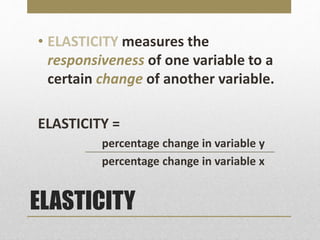
• ELASTICITY measures the
responsiveness of one variable to a
certain change of another variable.
ELASTICITY =
percentage change in variable y
percentage change in variable x
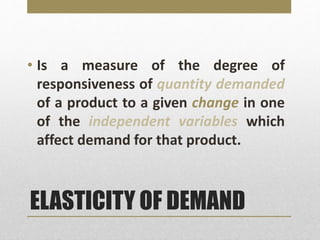
ELASTICITY OF DEMAND
• Is a measure of the degree of
responsiveness of quantity demanded
of a product to a given change in one
of the independent variables which
affect demand for that product.
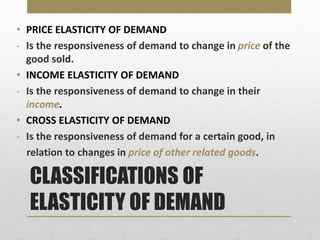
CLASSIFICATIONS OF
ELASTICITY OF DEMAND
• PRICE ELASTICITY OF DEMAND
- Is the responsiveness of demand to change in price of the
good sold.
• INCOME ELASTICITY OF DEMAND
- Is the responsiveness of demand to change in their
income.
• CROSS ELASTICITY OF DEMAND
- Is the responsiveness of demand for a certain good, in
relation to changes in price of other related goods.
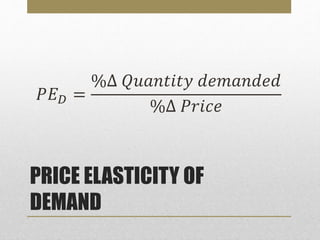
PRICE ELASTICITY OF
DEMAND
𝑃𝐸 𝐷 =
%∆ 𝑄𝑢𝑎𝑛𝑡𝑖𝑡𝑦 𝑑𝑒𝑚𝑎𝑛𝑑𝑒𝑑
%∆ 𝑃𝑟𝑖𝑐𝑒
PRICE ELASTICITY OF
DEMAND
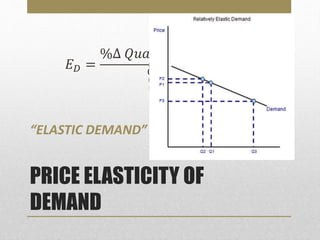
𝐸 𝐷 =
%∆ 𝑄𝑢𝑎𝑛𝑡𝑖𝑡𝑦 𝑑𝑒𝑚𝑎𝑛𝑑𝑒𝑑
%∆ 𝑃𝑟𝑖𝑐𝑒
“ELASTIC DEMAND”
EXAMPLE
DEGREE OF PRICE
ELASTICITY OF DEMAND
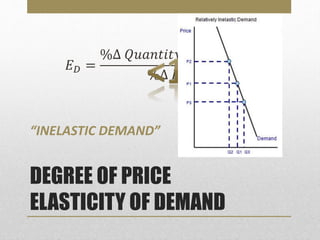
𝐸 𝐷 =
%∆ 𝑄𝑢𝑎𝑛𝑡𝑖𝑡𝑦 𝑑𝑒𝑚𝑎𝑛𝑑𝑒𝑑
%∆ 𝑃𝑟𝑖𝑐𝑒
“INELASTIC DEMAND”
EXAMPLE
DEGREE OF PRICE
ELASTICITY OF DEMAND
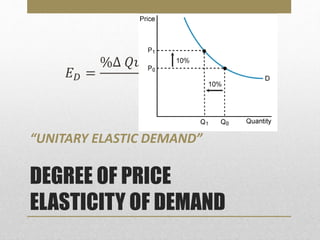
𝐸 𝐷 =
%∆ 𝑄𝑢𝑎𝑛𝑡𝑖𝑡𝑦 𝑑𝑒𝑚𝑎𝑛𝑑𝑒𝑑
%∆ 𝑃𝑟𝑖𝑐𝑒
“UNITARY ELASTIC DEMAND”
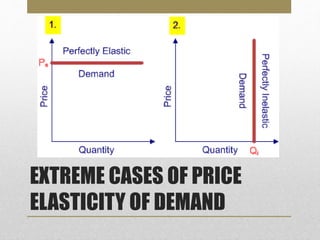
EXTREME CASES OF PRICE
ELASTICITY OF DEMAND
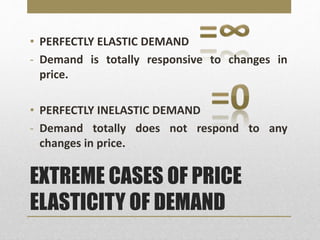
• PERFECTLY ELASTIC DEMAND
- Demand is totally responsive to changes in
price.
• PERFECTLY INELASTIC DEMAND
- Demand totally does not respond to any
changes in price.
EXTREME CASES OF PRICE
ELASTICITY OF DEMAND
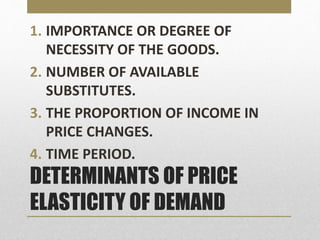
DETERMINANTS OF PRICE
ELASTICITY OF DEMAND
1. IMPORTANCE OR DEGREE OF
NECESSITY OF THE GOODS.
2. NUMBER OF AVAILABLE
SUBSTITUTES.
3. THE PROPORTION OF INCOME IN
PRICE CHANGES.
4. TIME PERIOD.
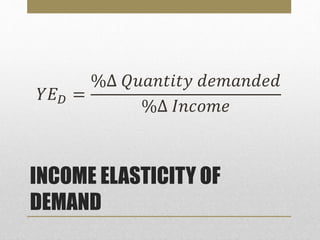
INCOME ELASTICITY OF
DEMAND
𝑌𝐸 𝐷 =
%∆ 𝑄𝑢𝑎𝑛𝑡𝑖𝑡𝑦 𝑑𝑒𝑚𝑎𝑛𝑑𝑒𝑑
%∆ 𝐼𝑛𝑐𝑜𝑚𝑒
NORMAL & INFERIOR GOODS
• NORMAL GOOD
- Means that as income increases, more goods
and services will be demanded.
• INFERIOR GOOD
- Means that as income rises, quantity demand
for such good declines.
LUXURY & NECESSITY
GOODS
• LUXURY GOOD
- Are normal goods with an elasticity coefficient
greater than 1.
• NECESSITY GOOD
- Are normal goods with an income elasticity of
less than 1 yet still manifest positive result.
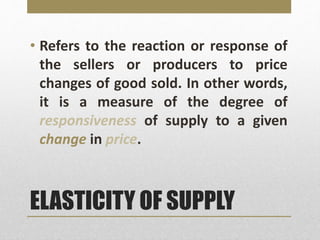
ELASTICITY OF SUPPLY
• Refers to the reaction or response of
the sellers or producers to price
changes of good sold. In other words,
it is a measure of the degree of
responsiveness of supply to a given
change in price.
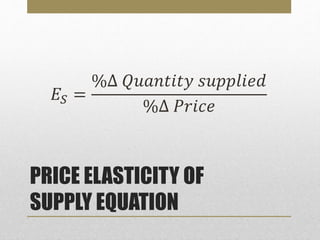
PRICE ELASTICITY OF
SUPPLY EQUATION
𝐸𝑆 =
%∆ 𝑄𝑢𝑎𝑛𝑡𝑖𝑡𝑦 𝑠𝑢𝑝𝑝𝑙𝑖𝑒𝑑
%∆ 𝑃𝑟𝑖𝑐𝑒
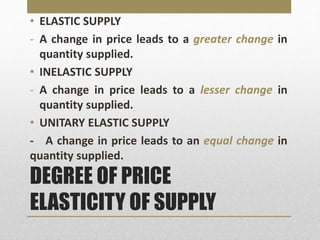
DEGREE OF PRICE
ELASTICITY OF SUPPLY
• ELASTIC SUPPLY
- A change in price leads to a greater change in
quantity supplied.
• INELASTIC SUPPLY
- A change in price leads to a lesser change in
quantity supplied.
• UNITARY ELASTIC SUPPLY
- A change in price leads to an equal change in
quantity supplied.
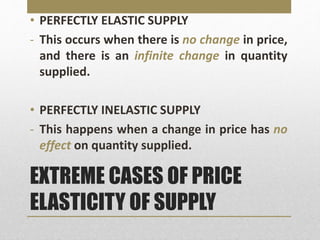
EXTREME CASES OF PRICE
ELASTICITY OF SUPPLY
• PERFECTLY ELASTIC SUPPLY
- This occurs when there is no change in price,
and there is an infinite change in quantity
supplied.
• PERFECTLY INELASTIC SUPPLY
- This happens when a change in price has no
effect on quantity supplied.
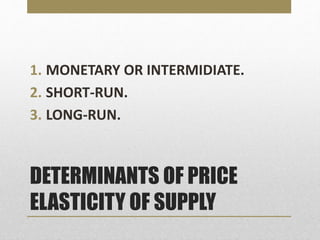
DETERMINANTS OF PRICE
ELASTICITY OF SUPPLY
1. MONETARY OR INTERMIDIATE.
2. SHORT-RUN.
3. LONG-RUN.
END OF PRESENTATION 

Concepts of elasticity

  • 1.
    CONCEPTS OF ELASTICITY MERCADO, RICH-ANNEM. ORIGENES, MIA CHERISE P.
  • 2.
    ELASTICITY • ELASTICITY measuresthe responsiveness of one variable to a certain change of another variable. ELASTICITY = percentage change in variable y percentage change in variable x
  • 3.
    ELASTICITY OF DEMAND •Is a measure of the degree of responsiveness of quantity demanded of a product to a given change in one of the independent variables which affect demand for that product.
  • 4.
    CLASSIFICATIONS OF ELASTICITY OFDEMAND • PRICE ELASTICITY OF DEMAND - Is the responsiveness of demand to change in price of the good sold. • INCOME ELASTICITY OF DEMAND - Is the responsiveness of demand to change in their income. • CROSS ELASTICITY OF DEMAND - Is the responsiveness of demand for a certain good, in relation to changes in price of other related goods.
  • 5.
    PRICE ELASTICITY OF DEMAND 𝑃𝐸𝐷 = %∆ 𝑄𝑢𝑎𝑛𝑡𝑖𝑡𝑦 𝑑𝑒𝑚𝑎𝑛𝑑𝑒𝑑 %∆ 𝑃𝑟𝑖𝑐𝑒
  • 6.
    PRICE ELASTICITY OF DEMAND 𝐸𝐷 = %∆ 𝑄𝑢𝑎𝑛𝑡𝑖𝑡𝑦 𝑑𝑒𝑚𝑎𝑛𝑑𝑒𝑑 %∆ 𝑃𝑟𝑖𝑐𝑒 “ELASTIC DEMAND”
  • 7.
  • 8.
    DEGREE OF PRICE ELASTICITYOF DEMAND 𝐸 𝐷 = %∆ 𝑄𝑢𝑎𝑛𝑡𝑖𝑡𝑦 𝑑𝑒𝑚𝑎𝑛𝑑𝑒𝑑 %∆ 𝑃𝑟𝑖𝑐𝑒 “INELASTIC DEMAND”
  • 9.
  • 10.
    DEGREE OF PRICE ELASTICITYOF DEMAND 𝐸 𝐷 = %∆ 𝑄𝑢𝑎𝑛𝑡𝑖𝑡𝑦 𝑑𝑒𝑚𝑎𝑛𝑑𝑒𝑑 %∆ 𝑃𝑟𝑖𝑐𝑒 “UNITARY ELASTIC DEMAND”
  • 11.
    EXTREME CASES OFPRICE ELASTICITY OF DEMAND • PERFECTLY ELASTIC DEMAND - Demand is totally responsive to changes in price. • PERFECTLY INELASTIC DEMAND - Demand totally does not respond to any changes in price.
  • 12.
    EXTREME CASES OFPRICE ELASTICITY OF DEMAND
  • 13.
    DETERMINANTS OF PRICE ELASTICITYOF DEMAND 1. IMPORTANCE OR DEGREE OF NECESSITY OF THE GOODS. 2. NUMBER OF AVAILABLE SUBSTITUTES. 3. THE PROPORTION OF INCOME IN PRICE CHANGES. 4. TIME PERIOD.
  • 14.
    INCOME ELASTICITY OF DEMAND 𝑌𝐸𝐷 = %∆ 𝑄𝑢𝑎𝑛𝑡𝑖𝑡𝑦 𝑑𝑒𝑚𝑎𝑛𝑑𝑒𝑑 %∆ 𝐼𝑛𝑐𝑜𝑚𝑒
  • 15.
    NORMAL & INFERIORGOODS • NORMAL GOOD - Means that as income increases, more goods and services will be demanded. • INFERIOR GOOD - Means that as income rises, quantity demand for such good declines.
  • 16.
    LUXURY & NECESSITY GOODS •LUXURY GOOD - Are normal goods with an elasticity coefficient greater than 1. • NECESSITY GOOD - Are normal goods with an income elasticity of less than 1 yet still manifest positive result.
  • 17.
    ELASTICITY OF SUPPLY •Refers to the reaction or response of the sellers or producers to price changes of good sold. In other words, it is a measure of the degree of responsiveness of supply to a given change in price.
  • 18.
    PRICE ELASTICITY OF SUPPLYEQUATION 𝐸𝑆 = %∆ 𝑄𝑢𝑎𝑛𝑡𝑖𝑡𝑦 𝑠𝑢𝑝𝑝𝑙𝑖𝑒𝑑 %∆ 𝑃𝑟𝑖𝑐𝑒
  • 19.
    DEGREE OF PRICE ELASTICITYOF SUPPLY • ELASTIC SUPPLY - A change in price leads to a greater change in quantity supplied. • INELASTIC SUPPLY - A change in price leads to a lesser change in quantity supplied. • UNITARY ELASTIC SUPPLY - A change in price leads to an equal change in quantity supplied.
  • 20.
    EXTREME CASES OFPRICE ELASTICITY OF SUPPLY • PERFECTLY ELASTIC SUPPLY - This occurs when there is no change in price, and there is an infinite change in quantity supplied. • PERFECTLY INELASTIC SUPPLY - This happens when a change in price has no effect on quantity supplied.
  • 21.
    DETERMINANTS OF PRICE ELASTICITYOF SUPPLY 1. MONETARY OR INTERMIDIATE. 2. SHORT-RUN. 3. LONG-RUN.
  • 22.