Conducting an Interview An Introduction Part 1
The Interview: an Introduction Technique to collect information  Interactive, verbal, real time contact First step in collecting information for needs analysis  Research method for making personal contacts
The Interview: an Introduction The interview is a way to: Share ideas, engage in dialogue, solve problems Obtain peripheral information that may be associated with an analysis goal
The Interview: an Introduction Two types of interview techniques:  Face to face Telephone
Provides in-depth narrative information Encourages respondents to talk about:  feelings, attitudes, and opinions Purposes of Conducting Interviews
Interviews in a systematic needs analysis: Provides information to develop questions for a written questionnaire Produces information for analysis Validates  information that we may already have Purposes of Conducting Interviews
Structured Semi-structured Unstructured   The extent of information and feedback required for a particular needs analysis will determine which type you use.  Three Types of Interviews
Structured interviews  = written questionnaires  Fixed questions with fixed response categories covering a specific area or topic – responses (Yes, no, sometimes, always) Work well with clear needs analysis goals. Needs analyst needs to have some information about the performance problem before constructing the questions. Types of Interviews
Concise questions/to the point Interview time usually takes no more than 15 to 20 minutes Types of Interviews –  Structured Interviews cont’d
Interview Advantages/ Limitations Useful before developing a questionnaire Useful to validate information obtained from other methods Seldom used as the only method to gather needs analysis information.
Interview Advantages/Limitations The best way to use an interview: To find the optimals:   what they think ought to be going on how the organization should work  what they know based on personal experience
Interview Advantages/Limitations Best questions to ask: Finding Actuals:  how employees are/are not performing way the organization is operating  whether they perceive problem/opportunity
Interviews Advantages/Limitations Best questions to ask: Finding Feelings:  how respondents feel how they think others feel confidence with the interview topic  whether they like/dislike the topic
Interviews Advantages/ Limitations Best questions to ask: Finding Cause(s):  what is causing the problem Finding Solution(s):  ideas on how to solve a problem or initiate a business opportunity
Five Steps in Conducting an Interview Determine the objectives  Prepare for the interview Carry out the interview Conclude the interviewing process Compile and analyze results
Determine the Objectives of the Interview Are you looking for information about:  Optimal performance? Actual performance problems? Feelings about performance? Solutions to performance problems? Business opportunities and barriers to implementing them?
Determine the Objectives of the Interview Draft objectives for the interview using standard terms, keeping them clear, direct, and short. Share the objectives with the champions of the needs analysis initiative for their review and comments. Finalize the objectives.
Prepare for the Interview Clarify and make decisions:  The specific purposes of the interview The population or sample or respondents Develop protocol/ script to help in carrying out the interviews.
Prepare for the Interview Draft an opening statement explaining the purposes of the interview Indicate the estimated time that will be needed Provide an explanation concerning issues of confidentiality
Conduct the Interview Don’t dominate the conversation  Encourage the respondent to talk Avoid interrupting Avoid stating your own opinions
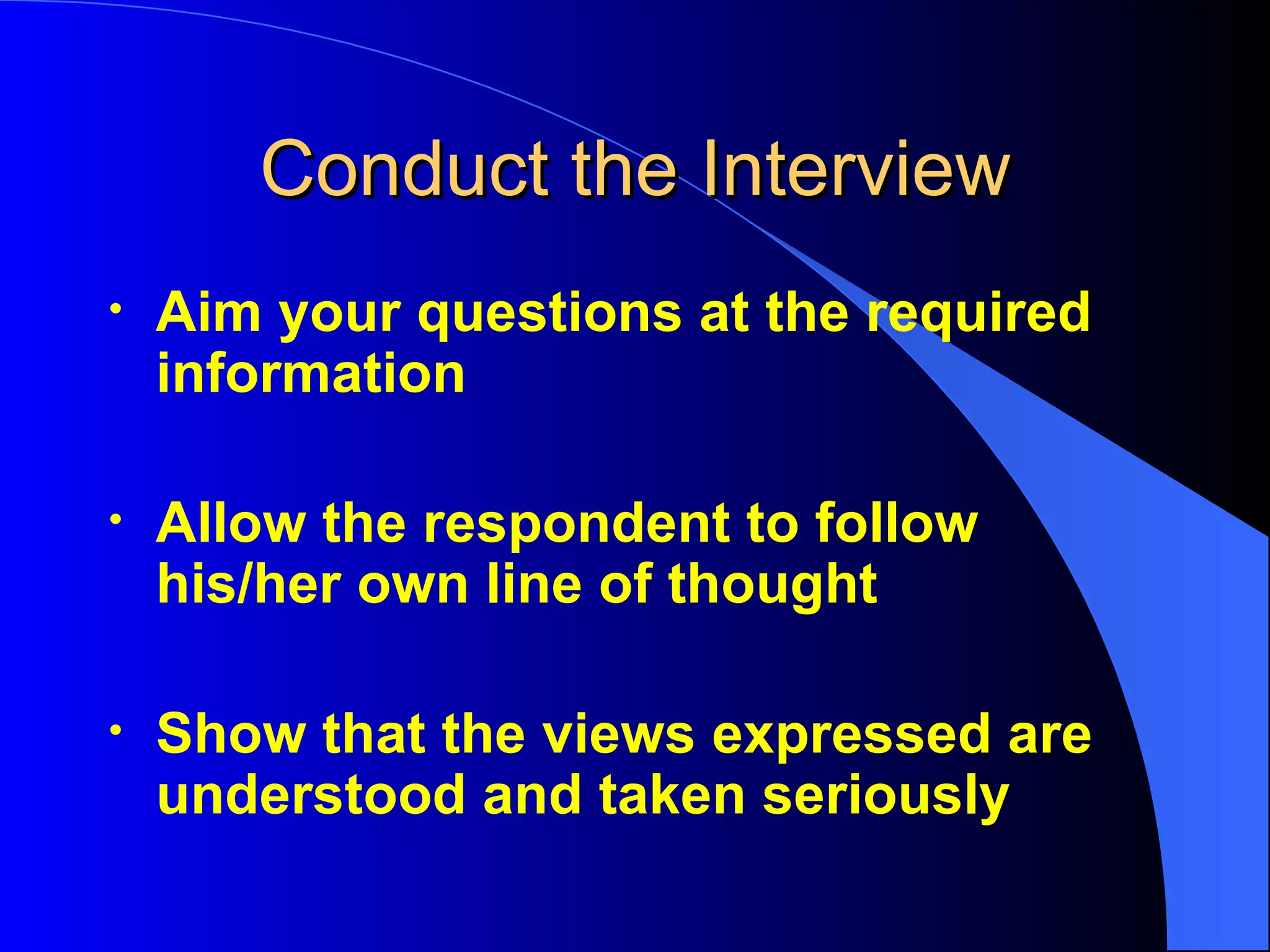
Conduct the Interview Aim your questions at the required information Allow the respondent to follow his/her own line of thought Show that the views expressed are understood and taken seriously
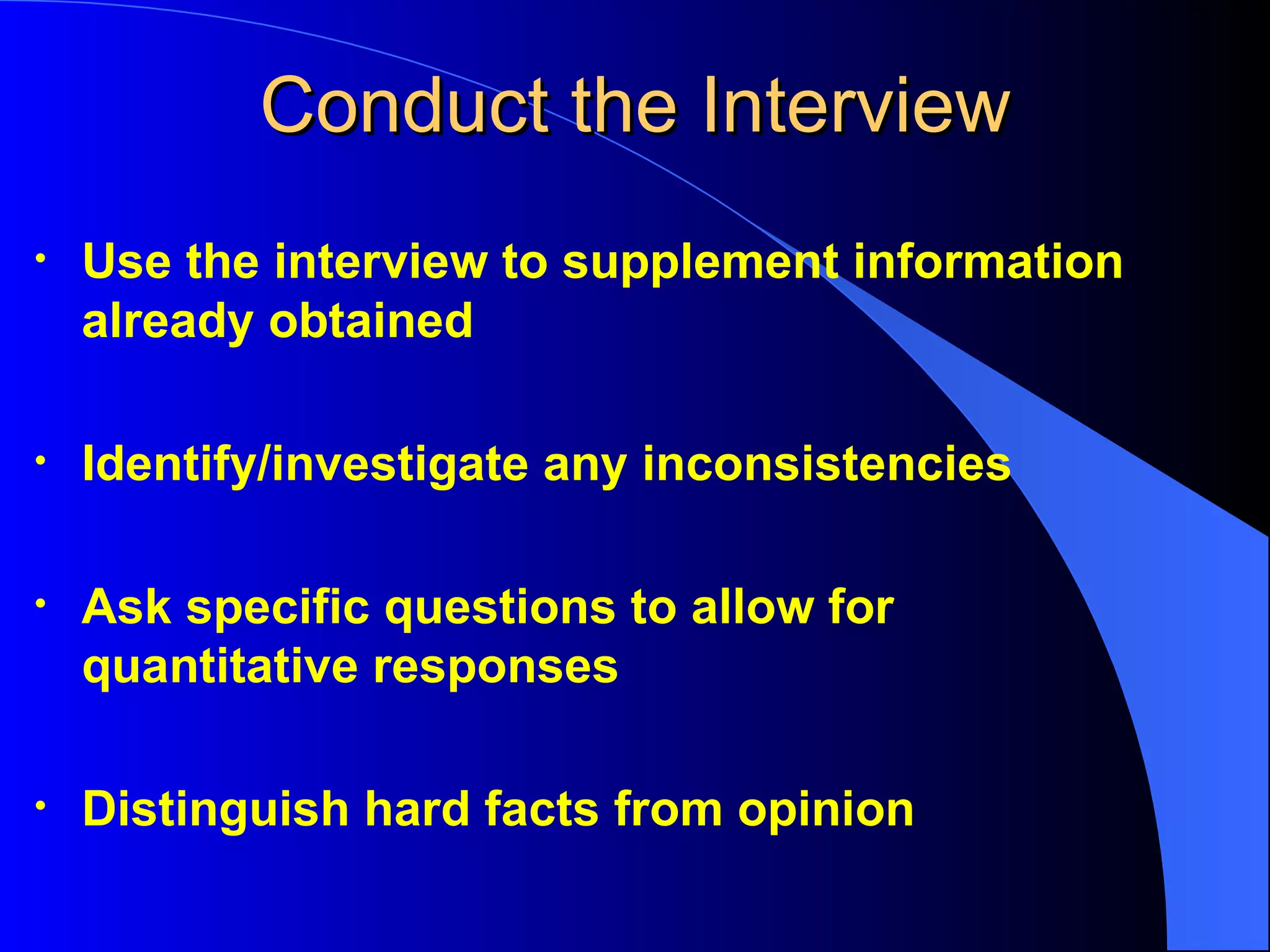
Conduct the Interview Use the interview to supplement information already obtained Identify/investigate any inconsistencies Ask specific questions to allow for quantitative responses Distinguish hard facts from opinion
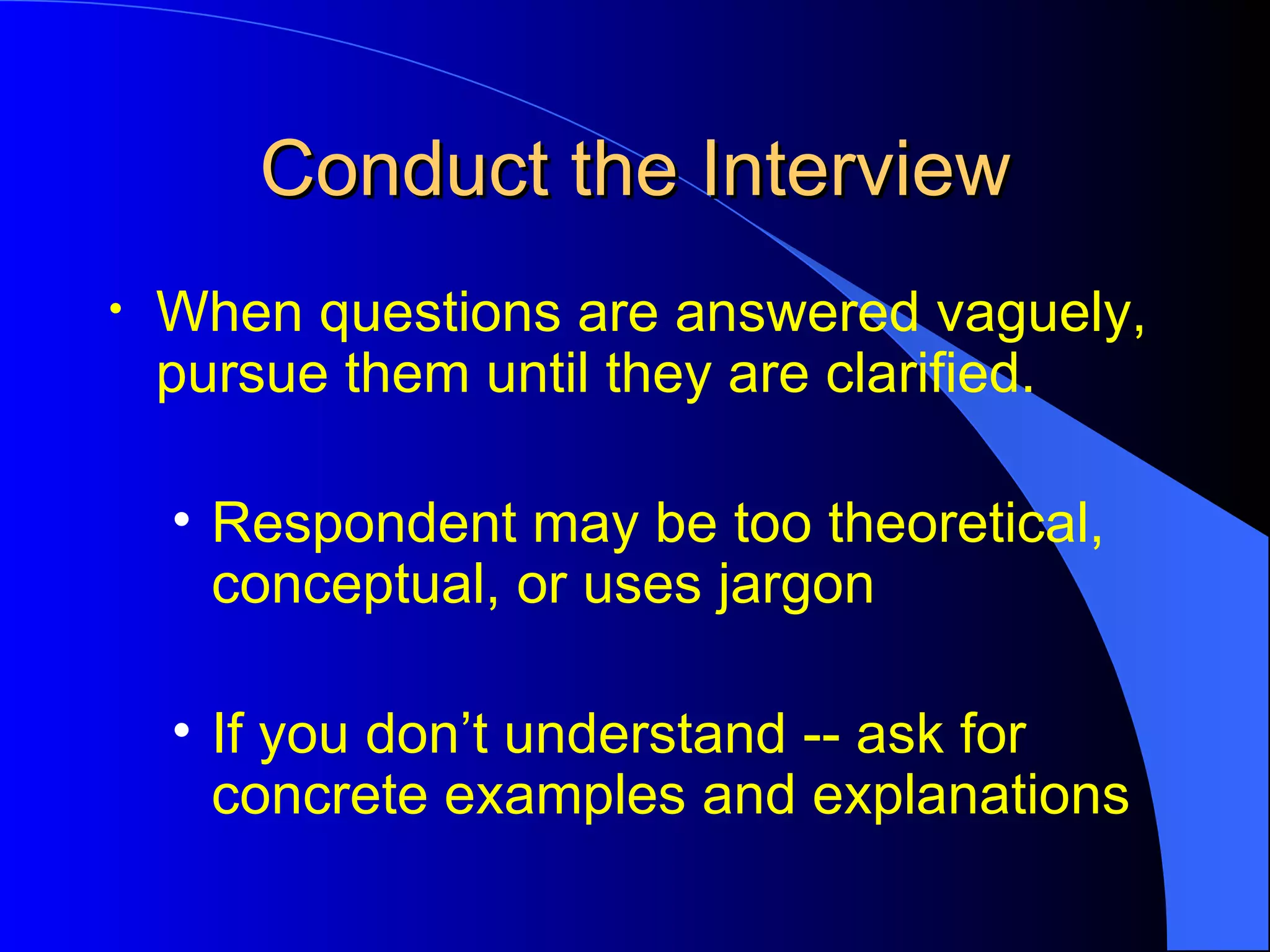
Conduct the Interview When questions are answered vaguely, pursue them until they are clarified. Respondent may be too theoretical, conceptual, or uses jargon  If you don’t understand -- ask for concrete examples and explanations
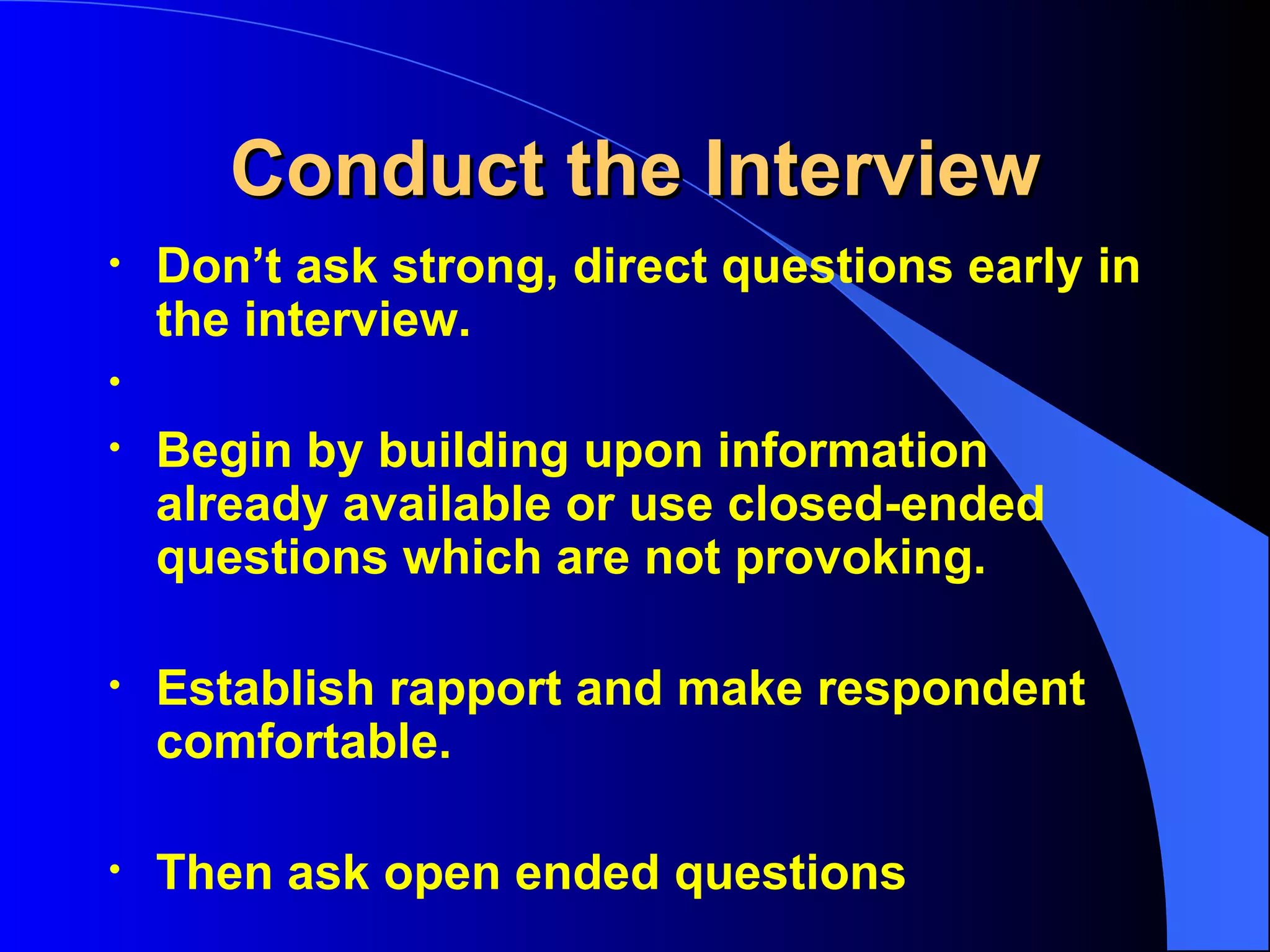
Conduct the Interview Don’t ask strong, direct questions early in the interview. Begin by building upon information already available or use closed-ended questions which are not provoking. Establish rapport and make respondent comfortable. Then ask open ended questions
Conclude the Interview Process Stop the interviewing process when you begin to hear the same information from several respondents. After 4 to 6 interviews, you could notice much redundancy If you hear similar responses with 2 or 3 stop the interviewing process
Conclude the Interview Process Follow-up with any respondents to get further clarification or needed data. Don’t betray trust/ confidence of those you interviewed. Remove information that could  identify a particular respondent.

Conducting an Interview - Part 1

  • 1.
    Conducting an InterviewAn Introduction Part 1
  • 2.
    The Interview: anIntroduction Technique to collect information Interactive, verbal, real time contact First step in collecting information for needs analysis Research method for making personal contacts
  • 3.
    The Interview: anIntroduction The interview is a way to: Share ideas, engage in dialogue, solve problems Obtain peripheral information that may be associated with an analysis goal
  • 4.
    The Interview: anIntroduction Two types of interview techniques: Face to face Telephone
  • 5.
    Provides in-depth narrativeinformation Encourages respondents to talk about: feelings, attitudes, and opinions Purposes of Conducting Interviews
  • 6.
    Interviews in asystematic needs analysis: Provides information to develop questions for a written questionnaire Produces information for analysis Validates information that we may already have Purposes of Conducting Interviews
  • 7.
    Structured Semi-structured Unstructured The extent of information and feedback required for a particular needs analysis will determine which type you use. Three Types of Interviews
  • 8.
    Structured interviews = written questionnaires Fixed questions with fixed response categories covering a specific area or topic – responses (Yes, no, sometimes, always) Work well with clear needs analysis goals. Needs analyst needs to have some information about the performance problem before constructing the questions. Types of Interviews
  • 9.
    Concise questions/to thepoint Interview time usually takes no more than 15 to 20 minutes Types of Interviews – Structured Interviews cont’d
  • 10.
    Interview Advantages/ LimitationsUseful before developing a questionnaire Useful to validate information obtained from other methods Seldom used as the only method to gather needs analysis information.
  • 11.
    Interview Advantages/Limitations Thebest way to use an interview: To find the optimals: what they think ought to be going on how the organization should work what they know based on personal experience
  • 12.
    Interview Advantages/Limitations Bestquestions to ask: Finding Actuals: how employees are/are not performing way the organization is operating whether they perceive problem/opportunity
  • 13.
    Interviews Advantages/Limitations Bestquestions to ask: Finding Feelings: how respondents feel how they think others feel confidence with the interview topic whether they like/dislike the topic
  • 14.
    Interviews Advantages/ LimitationsBest questions to ask: Finding Cause(s): what is causing the problem Finding Solution(s): ideas on how to solve a problem or initiate a business opportunity
  • 15.
    Five Steps inConducting an Interview Determine the objectives Prepare for the interview Carry out the interview Conclude the interviewing process Compile and analyze results
  • 16.
    Determine the Objectivesof the Interview Are you looking for information about: Optimal performance? Actual performance problems? Feelings about performance? Solutions to performance problems? Business opportunities and barriers to implementing them?
  • 17.
    Determine the Objectivesof the Interview Draft objectives for the interview using standard terms, keeping them clear, direct, and short. Share the objectives with the champions of the needs analysis initiative for their review and comments. Finalize the objectives.
  • 18.
    Prepare for theInterview Clarify and make decisions: The specific purposes of the interview The population or sample or respondents Develop protocol/ script to help in carrying out the interviews.
  • 19.
    Prepare for theInterview Draft an opening statement explaining the purposes of the interview Indicate the estimated time that will be needed Provide an explanation concerning issues of confidentiality
  • 20.
    Conduct the InterviewDon’t dominate the conversation Encourage the respondent to talk Avoid interrupting Avoid stating your own opinions
  • 21.
    Conduct the InterviewAim your questions at the required information Allow the respondent to follow his/her own line of thought Show that the views expressed are understood and taken seriously
  • 22.
    Conduct the InterviewUse the interview to supplement information already obtained Identify/investigate any inconsistencies Ask specific questions to allow for quantitative responses Distinguish hard facts from opinion
  • 23.
    Conduct the InterviewWhen questions are answered vaguely, pursue them until they are clarified. Respondent may be too theoretical, conceptual, or uses jargon If you don’t understand -- ask for concrete examples and explanations
  • 24.
    Conduct the InterviewDon’t ask strong, direct questions early in the interview. Begin by building upon information already available or use closed-ended questions which are not provoking. Establish rapport and make respondent comfortable. Then ask open ended questions
  • 25.
    Conclude the InterviewProcess Stop the interviewing process when you begin to hear the same information from several respondents. After 4 to 6 interviews, you could notice much redundancy If you hear similar responses with 2 or 3 stop the interviewing process
  • 26.
    Conclude the InterviewProcess Follow-up with any respondents to get further clarification or needed data. Don’t betray trust/ confidence of those you interviewed. Remove information that could identify a particular respondent.