Interviewing Skills
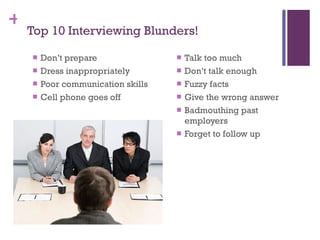
Top 10 Interviewing Blunders! Don’t prepare Dress inappropriately Poor communication skills Cell phone goes off Talk too much  Don’t talk enough Fuzzy facts Give the wrong answer Badmouthing past employers Forget to follow up
Prepare for the Interview Research the company Check the website and ask around Update your paperwork Most recent employment and education Bring several copies to the interview Anticipate and practice interview questions
Commonly Asked Job Interview Questions Why do you want to work for our company? What are your future career plans? Tell me something about yourself. Why did you choose this particular field of work? Describe a past work situation where you encountered a problem and describe how you solved it.
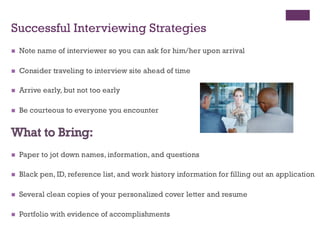
Successful Interviewing Strategies
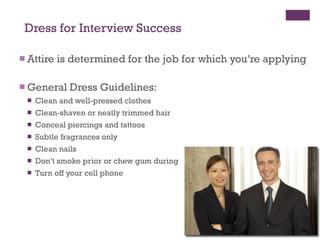
Dress for Interview Success Attire is determined for the job for which you’re applying General Dress Guidelines: Clean and well-pressed clothes Clean-shaven or neatly trimmed hair Conceal piercings and tattoos Subtle fragrances only Clean nails Don’t smoke prior or chew gum during Turn off your cell phone
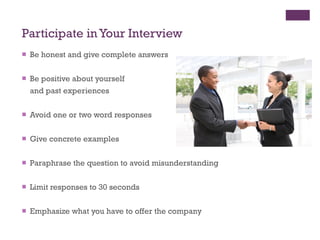
Participate in Your Interview Be honest and give complete answers Be positive about yourself  and past experiences Avoid one or two word responses Give concrete examples Paraphrase the question to avoid misunderstanding Limit responses to 30 seconds  Emphasize what you have to offer the company
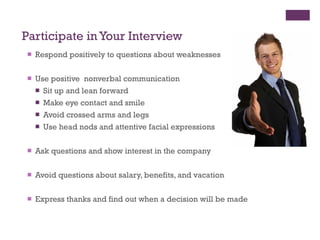
Participate in Your Interview Respond positively to questions about weaknesses Use positive  nonverbal communication Sit up and lean forward Make eye contact and smile Avoid crossed arms and legs Use head nods and attentive facial expressions Ask questions and show interest in the company Avoid questions about salary, benefits, and vacation  Express thanks and find out when a decision will be made
Follow-Up After Your Interview Fewer than 10% of applicants send a thank you letter May be the most important letter you write Provides another contact with the employer Sets you apart from those who didn’t send one Should take place within 24 hours after the interview Follow-Up Letter Should: State your appreciation Explain what you liked about the position Sound enthusiastic about working for the company

Interviewing Skills PowerPoint

  • 1.
  • 2.
    Top 10 InterviewingBlunders! Don’t prepare Dress inappropriately Poor communication skills Cell phone goes off Talk too much Don’t talk enough Fuzzy facts Give the wrong answer Badmouthing past employers Forget to follow up
  • 3.
    Prepare for theInterview Research the company Check the website and ask around Update your paperwork Most recent employment and education Bring several copies to the interview Anticipate and practice interview questions
  • 4.
    Commonly Asked JobInterview Questions Why do you want to work for our company? What are your future career plans? Tell me something about yourself. Why did you choose this particular field of work? Describe a past work situation where you encountered a problem and describe how you solved it.
  • 5.
  • 6.
    Dress for InterviewSuccess Attire is determined for the job for which you’re applying General Dress Guidelines: Clean and well-pressed clothes Clean-shaven or neatly trimmed hair Conceal piercings and tattoos Subtle fragrances only Clean nails Don’t smoke prior or chew gum during Turn off your cell phone
  • 7.
    Participate in YourInterview Be honest and give complete answers Be positive about yourself and past experiences Avoid one or two word responses Give concrete examples Paraphrase the question to avoid misunderstanding Limit responses to 30 seconds Emphasize what you have to offer the company
  • 8.
    Participate in YourInterview Respond positively to questions about weaknesses Use positive nonverbal communication Sit up and lean forward Make eye contact and smile Avoid crossed arms and legs Use head nods and attentive facial expressions Ask questions and show interest in the company Avoid questions about salary, benefits, and vacation Express thanks and find out when a decision will be made
  • 9.
    Follow-Up After YourInterview Fewer than 10% of applicants send a thank you letter May be the most important letter you write Provides another contact with the employer Sets you apart from those who didn’t send one Should take place within 24 hours after the interview Follow-Up Letter Should: State your appreciation Explain what you liked about the position Sound enthusiastic about working for the company