RESUME WRITING


Open the Door to Opportunity!
Primary Purpose

A resume will get you ……………an interview!
A resume is a marketing piece that presents you in
 the best possible light.
It’s not an application
A well-designed resume does a
    number of things:

Paints a positive and factual picture of YOU.
Sets a positive tone for the interview.
Guides the interviewer in what to ask.
Influences others who approve the hiring.
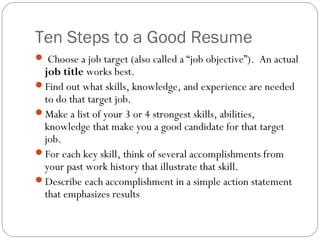
Ten Steps to a Good Resume
 Choose a job target (also called a “job objective”). An actual
 job title works best.
Find out what skills, knowledge, and experience are needed
 to do that target job.
Make a list of your 3 or 4 strongest skills, abilities,
 knowledge that make you a good candidate for that target
 job.
For each key skill, think of several accomplishments from
 your past work history that illustrate that skill.
Describe each accomplishment in a simple action statement
 that emphasizes results
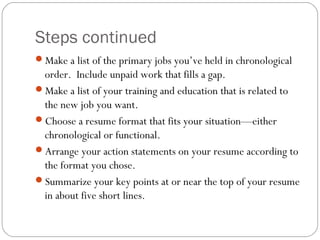
Steps continued
Make a list of the primary jobs you’ve held in chronological
 order. Include unpaid work that fills a gap.
Make a list of your training and education that is related to
 the new job you want.
Choose a resume format that fits your situation—either
 chronological or functional.
Arrange your action statements on your resume according to
 the format you chose.
Summarize your key points at or near the top of your resume
 in about five short lines.
Step 1: Choose a job target

FOCUS: The people who have the hardest
 time finding a job are often the ones who
 insist on writing a “generic” resume that
 lists everything they ever did. They HOPE
 some employer will figure out what job will
 fit them….but employers won’t do that;
 they’re looking for people who know what
 they want.
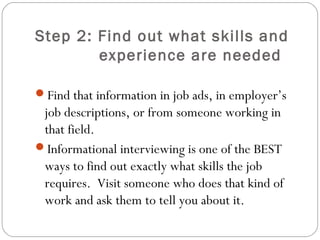
Step 2: Find out what skills and
        experience are needed

Find that information in job ads, in employer’s
 job descriptions, or from someone working in
 that field.
Informational interviewing is one of the BEST
 ways to find out exactly what skills the job
 requires. Visit someone who does that kind of
 work and ask them to tell you about it.
Step 3: List your strongest skills
Examples taken from resumes:
Target job: Customer Service representative
Relevant skills: verbal skills
                  problem solving skills
                  computer skills
                  customer care skills
Target job: Department Manager
Relevant Skills: Personnel Management
                 Budgeting/Financial Planning
                 Supervision and Training
Step 4: Accomplishments
Examples taken from resumes:
Job Objective: Electronic Sales Representative
Direct Sales and Product Demonstration
Set sales record for 3 consecutive months.
Exceeded quotas and increased sales in largest territory

Job Objective: Merchandising display
Display
Set up effective retail displays of beverages in supermarkets
  and package stores
Inventoried and reordered display materials
Step 5: Write action statements

Think about what problem existed in your
 workplace.
What action did you take to resolve the
 problem?
What were the beneficial results of your
 action?
Examples of accomplishments
written as action statements
Increased account base by 50% at two locations.
Developed friendly, supportive relationships with coffee
 shop customers, building a loyal base of repeat customers.
Advised callers on how to make connections.
Designed and presented hour-long weekly orientation
 program; doubled membership
Assembled materials and reports.
Developed greatly improved filing system saving time.
Transformed a disorganized warehouse into a smooth-
 running organization; saved $250,000 in recovered stock.
Step 6: List past jobs
 • List your most recent job first, then your earlier jobs.
 • Include ALL jobs IF you are young and have very little
     work experience
 •   Include ALL jobs that show experience related to your job
     objective
 •   Include unpaid work if it helps to prove you have skills and
     experience or it fills in a gap.
 •   Omit jobs that were very brief UNLESS they are needed
     to show how you developed your skills—or to fill in a
     skimpy work history.
 •   Round all employment dates to years.
Step 6 continued
 • Eliminate the earliest jobs; go back only 10-15 years
 • If you did roughly the same kind of odd job repeatedly, you
   could create your own job title and call yourself self-employed.
 • Examples:
  Household Repairman (self-employed) Atlanta, 1994-present
   Customer references available.
  Child Care (self-employed) Dallas, 1991-present.
  Customer references available on request.
Step 6 continued:
 If you’ve worked with a lot of staffing services, here’s how to handle that
   gracefully. List the agency as the employer and pick one job title that covers
   most of the temporary work. Then list the specific assignments,
   accomplishments, and the experience gained.

Administrative Assistant/Secretary, Staffing Solutions, Marietta, 1995-2000
 Typed business correspondence and routed calls for 6 busy offices
 Cleaned up a backlog of past due accounts receivable for Martinson Dry
  Cleaning.
 Conducted accurate year-end inventory for Design Studio
Step 6 continued

If you are CURRENTLY unemployed, it would
 help a LOT to find an immediate short-term
 opportunity to get some unpaid volunteer work
 experience, preferably in your line of work, and
 put that on your resume now. This will look
 better than being unemployed. Don’t use the
 word “volunteer”. Rename the category “Work
 History”.
Step 6 continued

If you have gaps in your work experience, tell
 what you WERE doing as gracefully as possible
 rather than leave a gap.
Examples:
 1993-95 Full-time parent
 1992-94 Maternity leave and family management
 1995-97 Full time student
Step 7 List training and education
Omit high school if you have academic
 credentials from college.
Mention your college work even if you don’t
 plan to get a degree.
Examples:
     Accounting Major, Chattahoochee Technical
 College, 1998-99
     Business classes, 1997, Chattahoochee
 Technical College
Step 7 continued
Omit this section IF you have no training, no college
 experience, and no courses to list that are in any way related
 to your new job goal.
If you completed a training class, list the certificate you
 earned.
If you only completed part of the training, list every course
 you took that is directly related to your current job target.
Step 8: Choose a format

Choose chronological if you’re staying in the
 same field and you have an unbroken
 employment history
Chronological means your work experience is
 arrange in order by dates of the jobs you’ve held
 with the most recent first. This one places more
 emphasis on your JOB TITLES
Step 8 continued
 Functional means your work experience is described by emphasizing the
   SKILLS involved. Put the descriptive details into
   skill-group paragraphs.
Example:
RELEVANT SKILL #1
-something I did using that skill
RELEVANT SKILL #2
-something I did using that skill
Job Title, Company, City, State, dates
Step 9: Arrange your action
statements


If you chose a chronological format, place
 each action statement under the appropriate
 job title where the action happened.
If you chose a functional format, place each
 action statement under a skill category.
Step 10: Summarize your key
points at the top
Keep each summary statement to one line. Include key
  points that a new employer will need to know and those
  that will make you look attractive and qualified for the
  new job.
Examples:
  - How much experience in this line of work
  - Training or education in this line of work
 - A special accomplishment or recognition
  -Your key skills, talents, special knowledge
  -Something about your attitude or work ethics
Reminders

Proofread for grammar and punctuation.
Check the spelling.
Get feedback from someone in-the-
 know.
References


Parker, Yana Damn Good Resume Guide,
 Ten Speed Press, Berkeley, CA
Parker, Yana The Resume Catalog:
 200 Damn Good Examples, Ten Speed Press,
 Berkeley, CA

Resume writing ppt presentation

  • 1.
    RESUME WRITING Open theDoor to Opportunity!
  • 2.
    Primary Purpose A resumewill get you ……………an interview! A resume is a marketing piece that presents you in the best possible light. It’s not an application
  • 3.
    A well-designed resumedoes a number of things: Paints a positive and factual picture of YOU. Sets a positive tone for the interview. Guides the interviewer in what to ask. Influences others who approve the hiring.
  • 4.
    Ten Steps toa Good Resume  Choose a job target (also called a “job objective”). An actual job title works best. Find out what skills, knowledge, and experience are needed to do that target job. Make a list of your 3 or 4 strongest skills, abilities, knowledge that make you a good candidate for that target job. For each key skill, think of several accomplishments from your past work history that illustrate that skill. Describe each accomplishment in a simple action statement that emphasizes results
  • 5.
    Steps continued Make alist of the primary jobs you’ve held in chronological order. Include unpaid work that fills a gap. Make a list of your training and education that is related to the new job you want. Choose a resume format that fits your situation—either chronological or functional. Arrange your action statements on your resume according to the format you chose. Summarize your key points at or near the top of your resume in about five short lines.
  • 6.
    Step 1: Choosea job target FOCUS: The people who have the hardest time finding a job are often the ones who insist on writing a “generic” resume that lists everything they ever did. They HOPE some employer will figure out what job will fit them….but employers won’t do that; they’re looking for people who know what they want.
  • 7.
    Step 2: Findout what skills and experience are needed Find that information in job ads, in employer’s job descriptions, or from someone working in that field. Informational interviewing is one of the BEST ways to find out exactly what skills the job requires. Visit someone who does that kind of work and ask them to tell you about it.
  • 8.
    Step 3: Listyour strongest skills Examples taken from resumes: Target job: Customer Service representative Relevant skills: verbal skills problem solving skills computer skills customer care skills Target job: Department Manager Relevant Skills: Personnel Management Budgeting/Financial Planning Supervision and Training
  • 9.
    Step 4: Accomplishments Examplestaken from resumes: Job Objective: Electronic Sales Representative Direct Sales and Product Demonstration Set sales record for 3 consecutive months. Exceeded quotas and increased sales in largest territory Job Objective: Merchandising display Display Set up effective retail displays of beverages in supermarkets and package stores Inventoried and reordered display materials
  • 10.
    Step 5: Writeaction statements Think about what problem existed in your workplace. What action did you take to resolve the problem? What were the beneficial results of your action?
  • 11.
    Examples of accomplishments writtenas action statements Increased account base by 50% at two locations. Developed friendly, supportive relationships with coffee shop customers, building a loyal base of repeat customers. Advised callers on how to make connections. Designed and presented hour-long weekly orientation program; doubled membership Assembled materials and reports. Developed greatly improved filing system saving time. Transformed a disorganized warehouse into a smooth- running organization; saved $250,000 in recovered stock.
  • 12.
    Step 6: Listpast jobs • List your most recent job first, then your earlier jobs. • Include ALL jobs IF you are young and have very little work experience • Include ALL jobs that show experience related to your job objective • Include unpaid work if it helps to prove you have skills and experience or it fills in a gap. • Omit jobs that were very brief UNLESS they are needed to show how you developed your skills—or to fill in a skimpy work history. • Round all employment dates to years.
  • 13.
    Step 6 continued • Eliminate the earliest jobs; go back only 10-15 years • If you did roughly the same kind of odd job repeatedly, you could create your own job title and call yourself self-employed. • Examples: Household Repairman (self-employed) Atlanta, 1994-present Customer references available. Child Care (self-employed) Dallas, 1991-present. Customer references available on request.
  • 14.
    Step 6 continued: If you’ve worked with a lot of staffing services, here’s how to handle that gracefully. List the agency as the employer and pick one job title that covers most of the temporary work. Then list the specific assignments, accomplishments, and the experience gained. Administrative Assistant/Secretary, Staffing Solutions, Marietta, 1995-2000  Typed business correspondence and routed calls for 6 busy offices  Cleaned up a backlog of past due accounts receivable for Martinson Dry Cleaning.  Conducted accurate year-end inventory for Design Studio
  • 15.
    Step 6 continued Ifyou are CURRENTLY unemployed, it would help a LOT to find an immediate short-term opportunity to get some unpaid volunteer work experience, preferably in your line of work, and put that on your resume now. This will look better than being unemployed. Don’t use the word “volunteer”. Rename the category “Work History”.
  • 16.
    Step 6 continued Ifyou have gaps in your work experience, tell what you WERE doing as gracefully as possible rather than leave a gap. Examples: 1993-95 Full-time parent 1992-94 Maternity leave and family management 1995-97 Full time student
  • 17.
    Step 7 Listtraining and education Omit high school if you have academic credentials from college. Mention your college work even if you don’t plan to get a degree. Examples: Accounting Major, Chattahoochee Technical College, 1998-99 Business classes, 1997, Chattahoochee Technical College
  • 18.
    Step 7 continued Omitthis section IF you have no training, no college experience, and no courses to list that are in any way related to your new job goal. If you completed a training class, list the certificate you earned. If you only completed part of the training, list every course you took that is directly related to your current job target.
  • 19.
    Step 8: Choosea format Choose chronological if you’re staying in the same field and you have an unbroken employment history Chronological means your work experience is arrange in order by dates of the jobs you’ve held with the most recent first. This one places more emphasis on your JOB TITLES
  • 20.
    Step 8 continued Functional means your work experience is described by emphasizing the SKILLS involved. Put the descriptive details into skill-group paragraphs. Example: RELEVANT SKILL #1 -something I did using that skill -something I did using that skill RELEVANT SKILL #2 -something I did using that skill -something I did using that skill Job Title, Company, City, State, dates Job Title, Company, City, State, dates
  • 21.
    Step 9: Arrangeyour action statements If you chose a chronological format, place each action statement under the appropriate job title where the action happened. If you chose a functional format, place each action statement under a skill category.
  • 22.
    Step 10: Summarizeyour key points at the top Keep each summary statement to one line. Include key points that a new employer will need to know and those that will make you look attractive and qualified for the new job. Examples: - How much experience in this line of work - Training or education in this line of work - A special accomplishment or recognition -Your key skills, talents, special knowledge -Something about your attitude or work ethics
  • 23.
    Reminders Proofread for grammarand punctuation. Check the spelling. Get feedback from someone in-the- know.
  • 24.
    References Parker, Yana DamnGood Resume Guide, Ten Speed Press, Berkeley, CA Parker, Yana The Resume Catalog: 200 Damn Good Examples, Ten Speed Press, Berkeley, CA