Instructional Design Unit 4
Client  Surveys Contains: List of objectives Identification of who you will interview A list of topics for the interview A list of questions A checklist for recording answers
Your Client Surveys Must be completed today Examples on pages 44 and 45 of your text book An example on the blog
Unit 4 Learning Theories
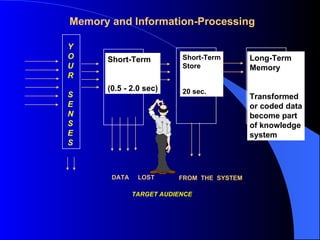
Y O U R S E N S E S Short-Term (0.5 - 2.0 sec) Short-Term Store 20 sec. Long-Term Memory Transformed  or coded data become part of knowledge system Memory and Information-Processing DATA  LOST FROM  THE  SYSTEM TARGET AUDIENCE
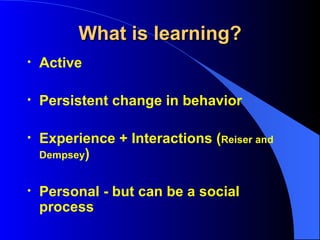
What is learning? Active Persistent change in behavior Experience + Interactions ( Reiser and Dempsey ) Personal - but can be a social process
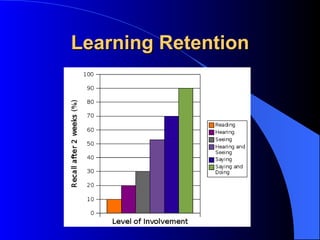
Learning Retention
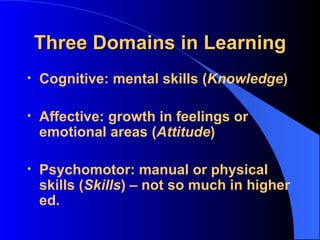
Three Domains in Learning Cognitive: mental skills ( Knowledge )  Affective: growth in feelings or emotional areas ( Attitude )  Psychomotor: manual or physical skills ( Skills ) – not so much in higher ed.
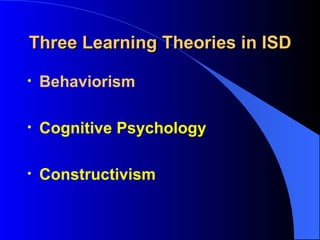
Three Learning Theories in ISD Behaviorism Cognitive Psychology Constructivism
Behaviorism Mental processes are vague Mental processes can only be inferred Behaviors can be understood
Behaviorism Effective in training Uses immediate feedback Textbooks, computers, audio-visual devices Connections between input and output Can’t explain complex human performances
Cognitive Psychology how  learners acquire knowledge and skills Problem-solving processes The mind = information processing system ISD has adopted strategies from cognitive psychology
Constructivism Knowledge is  constructed Learning based upon own experiences Learning cannot be pre-determined Involves the learner in goal-setting and learning experiences Difficulties in assessment procedures
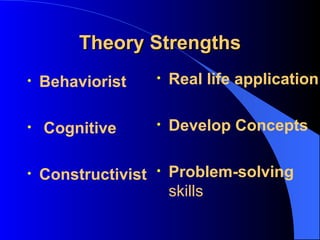
Theory Strengths Behaviorist Cognitive  Constructivist Real life application Develop Concepts Problem-solving  skills
Implications of Theories for ISD Behaviorist  - easily applied Cognitive Psychology  - helps identify the processes of learning Constructivist  - used in the design An IS Designer must apply theories to  practice.
Problem-Based Learning (PBL) Begins with a problem situation Uses a problem-based tutorial Students work in small groups Compatible with a constructivist approach Follows systematic design principles
The ISD Paradigm Must we start with new assumptions? ADDIE model based on cognitive science? Is the Core Process “Behaviorist?” ISD “Constructivist?” How can we tell? What do these terms mean?

Unit 4

  • 1.
  • 2.
    Client SurveysContains: List of objectives Identification of who you will interview A list of topics for the interview A list of questions A checklist for recording answers
  • 3.
    Your Client SurveysMust be completed today Examples on pages 44 and 45 of your text book An example on the blog
  • 4.
  • 5.
    Y O UR S E N S E S Short-Term (0.5 - 2.0 sec) Short-Term Store 20 sec. Long-Term Memory Transformed or coded data become part of knowledge system Memory and Information-Processing DATA LOST FROM THE SYSTEM TARGET AUDIENCE
  • 6.
    What is learning?Active Persistent change in behavior Experience + Interactions ( Reiser and Dempsey ) Personal - but can be a social process
  • 7.
  • 8.
    Three Domains inLearning Cognitive: mental skills ( Knowledge ) Affective: growth in feelings or emotional areas ( Attitude ) Psychomotor: manual or physical skills ( Skills ) – not so much in higher ed.
  • 9.
    Three Learning Theoriesin ISD Behaviorism Cognitive Psychology Constructivism
  • 10.
    Behaviorism Mental processesare vague Mental processes can only be inferred Behaviors can be understood
  • 11.
    Behaviorism Effective intraining Uses immediate feedback Textbooks, computers, audio-visual devices Connections between input and output Can’t explain complex human performances
  • 12.
    Cognitive Psychology how learners acquire knowledge and skills Problem-solving processes The mind = information processing system ISD has adopted strategies from cognitive psychology
  • 13.
    Constructivism Knowledge is constructed Learning based upon own experiences Learning cannot be pre-determined Involves the learner in goal-setting and learning experiences Difficulties in assessment procedures
  • 14.
    Theory Strengths BehavioristCognitive Constructivist Real life application Develop Concepts Problem-solving skills
  • 15.
    Implications of Theoriesfor ISD Behaviorist - easily applied Cognitive Psychology - helps identify the processes of learning Constructivist - used in the design An IS Designer must apply theories to practice.
  • 16.
    Problem-Based Learning (PBL)Begins with a problem situation Uses a problem-based tutorial Students work in small groups Compatible with a constructivist approach Follows systematic design principles
  • 17.
    The ISD ParadigmMust we start with new assumptions? ADDIE model based on cognitive science? Is the Core Process “Behaviorist?” ISD “Constructivist?” How can we tell? What do these terms mean?