Professional Development Job Search Interviewing
Objectives State the key steps in conducting a job search Identify interview process activities: pre-interview, during the interview, post-interview Demonstrate the proper way to respond in an interview situation
“ Winning is accomplished in the preparation phase, not the execution phase.” Anonymous
Job Leads Job leads can be found by any of several means: Directly from target company Internet search Message boards and job-search sites  Newspaper advertisements Industry journals Industry associations Current employees of target industry/company Posted job positions Your professional network Sending an unsolicited cover letter and resume
Targeting a Desired Position Carefully review job announcement If possible, secure a copy of the job description Identify key job skills, and highlight company needs Include your key qualifications for the position in both your cover letter and your resume Your cover letter and resume must include a daytime telephone number Ensure that your telephone voice mail and/or message machine is professional
Preparing for the Interview Company Research Find out with whom you will be interviewing Find out how much time is allotted Research the company via company-produced brochures/literature, industry journals or the internet Interviews with current employees and leaders Practice selling your skills Be sure to adapt your speech to relate your skills to each company's specific needs
Preparing for the Interview Practice day Drive to the interview location Park car, walk to interview location Do not go into the specific office Note nearest public restroom Other Considerations Ensure your interview attire is clean and professional Purchase thank-you notes
Preparing for the Interview Your interview portfolio should contain: Resume Notepad and pen Reference list Copies of pertinent documents
Day of the Interview Look in the mirror Ensure professional appearance Practice handshake and introduction Arrive no later than15 minutes early Go to the restroom and freshen up Enter meeting location no later than 5 minutes early
During the Interview Practice good verbal communication Speak clearly, slowly and with confidence Listen carefully to the interviewer’s name Listen carefully and ensure that you fully comprehend the question before you formulate an answer Your answers should relate back to the job qualifications and/or job duties The goal is to convey to interviewer how your knowledge, skills, and abilities will assist the company  Keep your answers brief, but complete
During the Interview Practice good non-verbal communication Stand, smile and extend your hand for a firm handshake Be aware of your own body language, as well as the interviewer’s Sit up straight, sit back in chair, and relax Make eye contact, but don’t stare down the interviewer
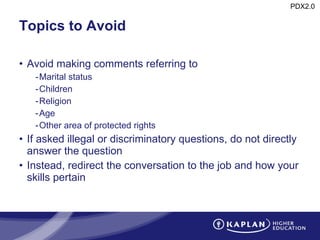
Topics to Avoid Avoid making comments referring to Marital status Children Religion Age Other area of protected rights If asked illegal or discriminatory questions, do not directly answer the question Instead, redirect the conversation to the job and how your skills pertain
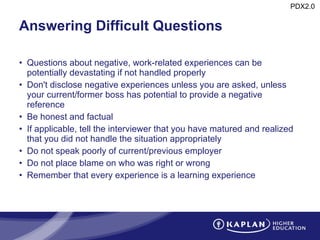
Answering Difficult Questions Questions about negative, work-related experiences can be potentially devastating if not handled properly Don't disclose negative experiences unless you are asked, unless your current/former boss has potential to provide a negative reference Be honest and factual If applicable, tell the interviewer that you have matured and realized that you did not handle the situation appropriately Do not speak poorly of current/previous employer Do not place blame on who was right or wrong Remember that every experience is a learning experience
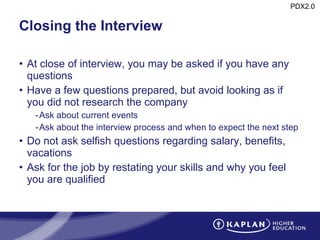
Closing the Interview At close of interview, you may be asked if you have any questions Have a few questions prepared, but avoid looking as if you did not research the company Ask about current events Ask about the interview process and when to expect the next step Do not ask selfish questions regarding salary, benefits, vacations Ask for the job by restating your skills and why you feel you are qualified

Job search

  • 1.
    Professional Development JobSearch Interviewing
  • 2.
    Objectives State thekey steps in conducting a job search Identify interview process activities: pre-interview, during the interview, post-interview Demonstrate the proper way to respond in an interview situation
  • 3.
    “ Winning isaccomplished in the preparation phase, not the execution phase.” Anonymous
  • 4.
    Job Leads Jobleads can be found by any of several means: Directly from target company Internet search Message boards and job-search sites Newspaper advertisements Industry journals Industry associations Current employees of target industry/company Posted job positions Your professional network Sending an unsolicited cover letter and resume
  • 5.
    Targeting a DesiredPosition Carefully review job announcement If possible, secure a copy of the job description Identify key job skills, and highlight company needs Include your key qualifications for the position in both your cover letter and your resume Your cover letter and resume must include a daytime telephone number Ensure that your telephone voice mail and/or message machine is professional
  • 6.
    Preparing for theInterview Company Research Find out with whom you will be interviewing Find out how much time is allotted Research the company via company-produced brochures/literature, industry journals or the internet Interviews with current employees and leaders Practice selling your skills Be sure to adapt your speech to relate your skills to each company's specific needs
  • 7.
    Preparing for theInterview Practice day Drive to the interview location Park car, walk to interview location Do not go into the specific office Note nearest public restroom Other Considerations Ensure your interview attire is clean and professional Purchase thank-you notes
  • 8.
    Preparing for theInterview Your interview portfolio should contain: Resume Notepad and pen Reference list Copies of pertinent documents
  • 9.
    Day of theInterview Look in the mirror Ensure professional appearance Practice handshake and introduction Arrive no later than15 minutes early Go to the restroom and freshen up Enter meeting location no later than 5 minutes early
  • 10.
    During the InterviewPractice good verbal communication Speak clearly, slowly and with confidence Listen carefully to the interviewer’s name Listen carefully and ensure that you fully comprehend the question before you formulate an answer Your answers should relate back to the job qualifications and/or job duties The goal is to convey to interviewer how your knowledge, skills, and abilities will assist the company Keep your answers brief, but complete
  • 11.
    During the InterviewPractice good non-verbal communication Stand, smile and extend your hand for a firm handshake Be aware of your own body language, as well as the interviewer’s Sit up straight, sit back in chair, and relax Make eye contact, but don’t stare down the interviewer
  • 12.
    Topics to AvoidAvoid making comments referring to Marital status Children Religion Age Other area of protected rights If asked illegal or discriminatory questions, do not directly answer the question Instead, redirect the conversation to the job and how your skills pertain
  • 13.
    Answering Difficult QuestionsQuestions about negative, work-related experiences can be potentially devastating if not handled properly Don't disclose negative experiences unless you are asked, unless your current/former boss has potential to provide a negative reference Be honest and factual If applicable, tell the interviewer that you have matured and realized that you did not handle the situation appropriately Do not speak poorly of current/previous employer Do not place blame on who was right or wrong Remember that every experience is a learning experience
  • 14.
    Closing the InterviewAt close of interview, you may be asked if you have any questions Have a few questions prepared, but avoid looking as if you did not research the company Ask about current events Ask about the interview process and when to expect the next step Do not ask selfish questions regarding salary, benefits, vacations Ask for the job by restating your skills and why you feel you are qualified