


INTERVIEW
MAIN  TOPICS  FOR DISCUSSION What is meant by interview Types of interview Characteristics of A focus group Techniques of interviewing Reliability and validity of interview Do and don'ts of interviewing Advantages and limitations of interview
WHAT IS MEANT BY INTERVIEW The interview is a process of communication or interaction in which the subject or interviewee gives the needed information verbally in a face-to-face situation.  Although the interview is generally associated with counseling or psychotherapy. It can be used effectively to collect useful information about individuals in many research situations.
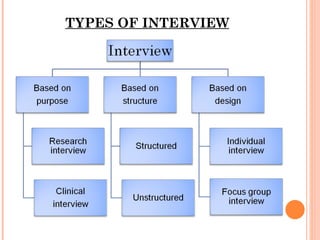
TYPES OF INTERVIEW
RESEARCH INTERVIEW Interview may be used as a tool for gathering data required by the researcher to test hypothesis or solve his problem of historical, experimental, survey or clinical type of research. This type of interview is called research interview.
CLINICAL INTERVIEW In clinical work, social workers and psychiatrist use interview to secure information about an individual’s problem his past history, job or family adjustment. In such situations, the major purpose of interview are diagnosis and treatment. This type of interview is designed as clinical interview.
STRUCTURED INTERVIEW The procedure to be followed is standardized and is determined in advance of the interview.  The same type of questions are presented in the same order to each interviewee. The interviewer has no freedom to rephrase the questions, add extra ones, and change the order in which the questions have to be presented.  Structured interviews impose a degree of formality.
UNSTRUCTURED INTERVIEW Unstructured interviews provide greater flexibility.  The interviewer is largely free to arrange the form and timing of the questions.  He can thus rephrase the questions, modify them and add some new questions to his list.
INDIVIDUAL INTERVIEW In some situations, an interviewer may interview one individual at one time. It is called an individual interview.
FOCUS GROUP INTERVIEW  Sometimes because of limited time and recourses it is preferable to collect information by interviewing collectively individuals. Such a group is called focus group . In a focus group interview, a group of individuals are interviewed by an interviewer. The size of the group should neither be too small nor too large.
NATURE AND NUMBER OF INDIVIDUALS  CONSTITUTING THE FOCUS GROUP Include those individuals in the group who have the characteristics, experience, or knowledge needed to provide rich information on the topic. Limit the size of the group to 6-8 individuals so that almost all the participants have a chance to share the information. All participants in the group should feel comfortable while talking with one another
CHARECTERISTICS OF A FOCUS  GROUP  Nature and number of individuals constituting the focus group Comfortable environment Sampling and number of focus group Developing questions Training of interviewer for holding focus group interviews
COMFORTABLE   ENVIRONMENT Hold focus group in familiar or neutral settings such as office buildings, libraries, and schools etc. Seat participants so that they can see easily one another. Interview participants in their language.
SAMPLING AND NUMBER OF FOCUS GROUP Use purposive sampling for constituting focus groups. Frame three to four focus groups for each audience category that is of interest. If after the third or fourth group the team is still receiving new information, the team might continue conducting focus groups until no new information is elicited.
DEVELOPING QUESTIONS The questions must be conversational and easy for the participants. The questions should focus on getting information that directly relates to the objectives of the research study. Use questions that get participants involved.
While developing questions , the researcher should keep in mind several guidelines :  (a) use open-ended questions  (b) avoid questions that can be answered with a “yes” or “no”  (c) avoid “why” questions and  (d) use “think back “ questions
TRAINING OF INTERVIEWER FOR HOLDING FOCUS GROUP INTERVIEWS Make sure that every participant speaks the same amount in a group Control dominant talker by thanking them for their input and asking for others to share. Remind the group that it is important to hear from every one.
Call on quiet participants. They are often reflective thinkers and have creative things to offer. For starting the focus group discussion, the moderator must create a thoughtful, receptive atmosphere; provide ground rules; and set the tone of discussion in an open environment. Use field notes, tape recording, video cameras, laptop computers for recording focus group discussion.
TECHNIQUES OF INTERVIEWING PREPARATION FOR THE INTERVIEW CONDUCTING THE INTERVIEW RECORDING OF THE INTERVIEW
PREPARATION FOR THE INTERVIEW The interviewer must decide exactly what kind of data the interview should yield ,  whether the structured or unstructured procedure will be more useful , and how the result of the interview should be recorded.
It is advisable to try out the interview on another person before using it for actual investigation. This may reveal the deficiencies that should be corrected before the actual execution of the interview. The interviewer must have a clear idea of the sort of information he needs ,and accordingly he may prepare an interview schedule with list of questions which will extract that information.
CONDUCTING THE INTERVIEW Ask only one question at a time. Repeat a question if necessary. Try to make sure that the subject understands the question. Listen carefully for the interviewee’s answer. Observe the subject’s facial expressions, gestures, and tone of voice. Allow the subject sufficient time to answer the question, but do not let the interview drag.
Avoid suggesting answers to the questions. Do not show sign of surprise, shock, anger, or other emotions if unexpected answers are given. Maintain a neutral attitude with respect to controversial issues during the interview. In the unstructured interview, ask additional questions to follow up clues or obtain additional information. Use tact and skill in getting the subject back to an area of inquiry when he has strayed too far from the original question.
RECORDING OF THE INTERVIEW   The interviewer may make use of a schedule, a structured format, rating scale or a tape recorder to record the responses of the interviewee. The use of a tape recorder provides an objective basis. The use of tape recorder also permits the interviewer to devote full attention to the interviewee and save much time of the interviewer which he may have to utilize in recording the responses during or after the interview. If a tape recorder is not available , the interviewer may take notes of the responses.
RELIABILITY AND VALIDITY OF INTERVIEW According to good the reliability of data obtained through the interview is affected by the following factors, The desire of many interviewees to make good impressions, particularly in answers to questions relating to generally accepted standards of behavior. The reluctance of many subjects  to reveal highly personal information. Content and form of questions ,procedures established for the interview ,physical setting ,mode of recording ,accidental distractions ,and temporary state of the parties involved in the interview. For validity of the interview, it is advisable to compare the interviewee’s responses with other sources of data.
DOS AND DON'TS OF INTERVIEWING Do not assume anything. Do not form pre-judgments. Do ask both open and closed questions. Do verify understanding through probing and confirming questions. Do avoid confrontation. Do act in a friendly but professional manner. Do not interrupt.
Do listen actively. Do take notes, but do not be obtrusive about it. Do let the interviewee do most of the talking Do establish rapport early and maintain it. Do maintain control over the subject matter. Do establish a time frame for the interview and stick to it. Do conclude positively. Do be polite and courteous.
ADVANTAGES OF THE INTERVIEW It provides an opportunity to the interviewer to question thoroughly certain areas of inquiry. The interview permits greater depth of response which is not possible through any other means. It also enables an interviewer to get information concerning feelings, attitudes or emotions in relation to certain questions
LIMITATIONS OF THE INTERVIEW It is a time consuming technique. The effectiveness of the interview depends greatly upon the skill of the interviewer not ordinarily possessed by inexperienced researchers. There is a constant danger of subjectivity on the part of the interviewer. Even in the presence of a skilled interviewer ,some interviewees will not respond freely ,frankly and accurately.
THANK YOU

Interview

  • 1.
  • 2.
    MAIN TOPICS FOR DISCUSSION What is meant by interview Types of interview Characteristics of A focus group Techniques of interviewing Reliability and validity of interview Do and don'ts of interviewing Advantages and limitations of interview
  • 3.
    WHAT IS MEANTBY INTERVIEW The interview is a process of communication or interaction in which the subject or interviewee gives the needed information verbally in a face-to-face situation. Although the interview is generally associated with counseling or psychotherapy. It can be used effectively to collect useful information about individuals in many research situations.
  • 4.
  • 5.
    RESEARCH INTERVIEW Interviewmay be used as a tool for gathering data required by the researcher to test hypothesis or solve his problem of historical, experimental, survey or clinical type of research. This type of interview is called research interview.
  • 6.
    CLINICAL INTERVIEW Inclinical work, social workers and psychiatrist use interview to secure information about an individual’s problem his past history, job or family adjustment. In such situations, the major purpose of interview are diagnosis and treatment. This type of interview is designed as clinical interview.
  • 7.
    STRUCTURED INTERVIEW Theprocedure to be followed is standardized and is determined in advance of the interview. The same type of questions are presented in the same order to each interviewee. The interviewer has no freedom to rephrase the questions, add extra ones, and change the order in which the questions have to be presented. Structured interviews impose a degree of formality.
  • 8.
    UNSTRUCTURED INTERVIEW Unstructuredinterviews provide greater flexibility. The interviewer is largely free to arrange the form and timing of the questions. He can thus rephrase the questions, modify them and add some new questions to his list.
  • 9.
    INDIVIDUAL INTERVIEW Insome situations, an interviewer may interview one individual at one time. It is called an individual interview.
  • 10.
    FOCUS GROUP INTERVIEW Sometimes because of limited time and recourses it is preferable to collect information by interviewing collectively individuals. Such a group is called focus group . In a focus group interview, a group of individuals are interviewed by an interviewer. The size of the group should neither be too small nor too large.
  • 11.
    NATURE AND NUMBEROF INDIVIDUALS CONSTITUTING THE FOCUS GROUP Include those individuals in the group who have the characteristics, experience, or knowledge needed to provide rich information on the topic. Limit the size of the group to 6-8 individuals so that almost all the participants have a chance to share the information. All participants in the group should feel comfortable while talking with one another
  • 12.
    CHARECTERISTICS OF AFOCUS GROUP Nature and number of individuals constituting the focus group Comfortable environment Sampling and number of focus group Developing questions Training of interviewer for holding focus group interviews
  • 13.
    COMFORTABLE ENVIRONMENT Hold focus group in familiar or neutral settings such as office buildings, libraries, and schools etc. Seat participants so that they can see easily one another. Interview participants in their language.
  • 14.
    SAMPLING AND NUMBEROF FOCUS GROUP Use purposive sampling for constituting focus groups. Frame three to four focus groups for each audience category that is of interest. If after the third or fourth group the team is still receiving new information, the team might continue conducting focus groups until no new information is elicited.
  • 15.
    DEVELOPING QUESTIONS Thequestions must be conversational and easy for the participants. The questions should focus on getting information that directly relates to the objectives of the research study. Use questions that get participants involved.
  • 16.
    While developing questions, the researcher should keep in mind several guidelines : (a) use open-ended questions (b) avoid questions that can be answered with a “yes” or “no” (c) avoid “why” questions and (d) use “think back “ questions
  • 17.
    TRAINING OF INTERVIEWERFOR HOLDING FOCUS GROUP INTERVIEWS Make sure that every participant speaks the same amount in a group Control dominant talker by thanking them for their input and asking for others to share. Remind the group that it is important to hear from every one.
  • 18.
    Call on quietparticipants. They are often reflective thinkers and have creative things to offer. For starting the focus group discussion, the moderator must create a thoughtful, receptive atmosphere; provide ground rules; and set the tone of discussion in an open environment. Use field notes, tape recording, video cameras, laptop computers for recording focus group discussion.
  • 19.
    TECHNIQUES OF INTERVIEWINGPREPARATION FOR THE INTERVIEW CONDUCTING THE INTERVIEW RECORDING OF THE INTERVIEW
  • 20.
    PREPARATION FOR THEINTERVIEW The interviewer must decide exactly what kind of data the interview should yield , whether the structured or unstructured procedure will be more useful , and how the result of the interview should be recorded.
  • 21.
    It is advisableto try out the interview on another person before using it for actual investigation. This may reveal the deficiencies that should be corrected before the actual execution of the interview. The interviewer must have a clear idea of the sort of information he needs ,and accordingly he may prepare an interview schedule with list of questions which will extract that information.
  • 22.
    CONDUCTING THE INTERVIEWAsk only one question at a time. Repeat a question if necessary. Try to make sure that the subject understands the question. Listen carefully for the interviewee’s answer. Observe the subject’s facial expressions, gestures, and tone of voice. Allow the subject sufficient time to answer the question, but do not let the interview drag.
  • 23.
    Avoid suggesting answersto the questions. Do not show sign of surprise, shock, anger, or other emotions if unexpected answers are given. Maintain a neutral attitude with respect to controversial issues during the interview. In the unstructured interview, ask additional questions to follow up clues or obtain additional information. Use tact and skill in getting the subject back to an area of inquiry when he has strayed too far from the original question.
  • 24.
    RECORDING OF THEINTERVIEW The interviewer may make use of a schedule, a structured format, rating scale or a tape recorder to record the responses of the interviewee. The use of a tape recorder provides an objective basis. The use of tape recorder also permits the interviewer to devote full attention to the interviewee and save much time of the interviewer which he may have to utilize in recording the responses during or after the interview. If a tape recorder is not available , the interviewer may take notes of the responses.
  • 25.
    RELIABILITY AND VALIDITYOF INTERVIEW According to good the reliability of data obtained through the interview is affected by the following factors, The desire of many interviewees to make good impressions, particularly in answers to questions relating to generally accepted standards of behavior. The reluctance of many subjects to reveal highly personal information. Content and form of questions ,procedures established for the interview ,physical setting ,mode of recording ,accidental distractions ,and temporary state of the parties involved in the interview. For validity of the interview, it is advisable to compare the interviewee’s responses with other sources of data.
  • 26.
    DOS AND DON'TSOF INTERVIEWING Do not assume anything. Do not form pre-judgments. Do ask both open and closed questions. Do verify understanding through probing and confirming questions. Do avoid confrontation. Do act in a friendly but professional manner. Do not interrupt.
  • 27.
    Do listen actively.Do take notes, but do not be obtrusive about it. Do let the interviewee do most of the talking Do establish rapport early and maintain it. Do maintain control over the subject matter. Do establish a time frame for the interview and stick to it. Do conclude positively. Do be polite and courteous.
  • 28.
    ADVANTAGES OF THEINTERVIEW It provides an opportunity to the interviewer to question thoroughly certain areas of inquiry. The interview permits greater depth of response which is not possible through any other means. It also enables an interviewer to get information concerning feelings, attitudes or emotions in relation to certain questions
  • 29.
    LIMITATIONS OF THEINTERVIEW It is a time consuming technique. The effectiveness of the interview depends greatly upon the skill of the interviewer not ordinarily possessed by inexperienced researchers. There is a constant danger of subjectivity on the part of the interviewer. Even in the presence of a skilled interviewer ,some interviewees will not respond freely ,frankly and accurately.
  • 30.