Land Classification Systems

Loading...

Flash Player 9 (or above) is needed to view presentations.
We have detected that you do not have it on your computer. To install it, go here.

0 comments

Post a comment

    Post a comment
    Embed Video
    Edit your comment Cancel

    Favorites, Groups & Events

    Land Classification Systems - Presentation Transcript

    1. Land Classification Systems and Agricultural Land Use Planning in Hawaii Mele Chillingworth Masters Candidate, UH Manoa Department of Urban and Regional Planning Department of Natural Resources and Environmental Management Presentation to HIGICC Luncheon Friday, October 30, 2009
    2. Outline • Introduction • State Agricultural Land Use District U Di t i t • Land Classification Systems – LSB – ALISH – LESA • Comparison and Analysis of Systems
    3. Introduction • “Problem Definition of Problem Hawaii’s Agricultural Lands: An Evolutionary History” • How a problem is defined determines how it can be solved
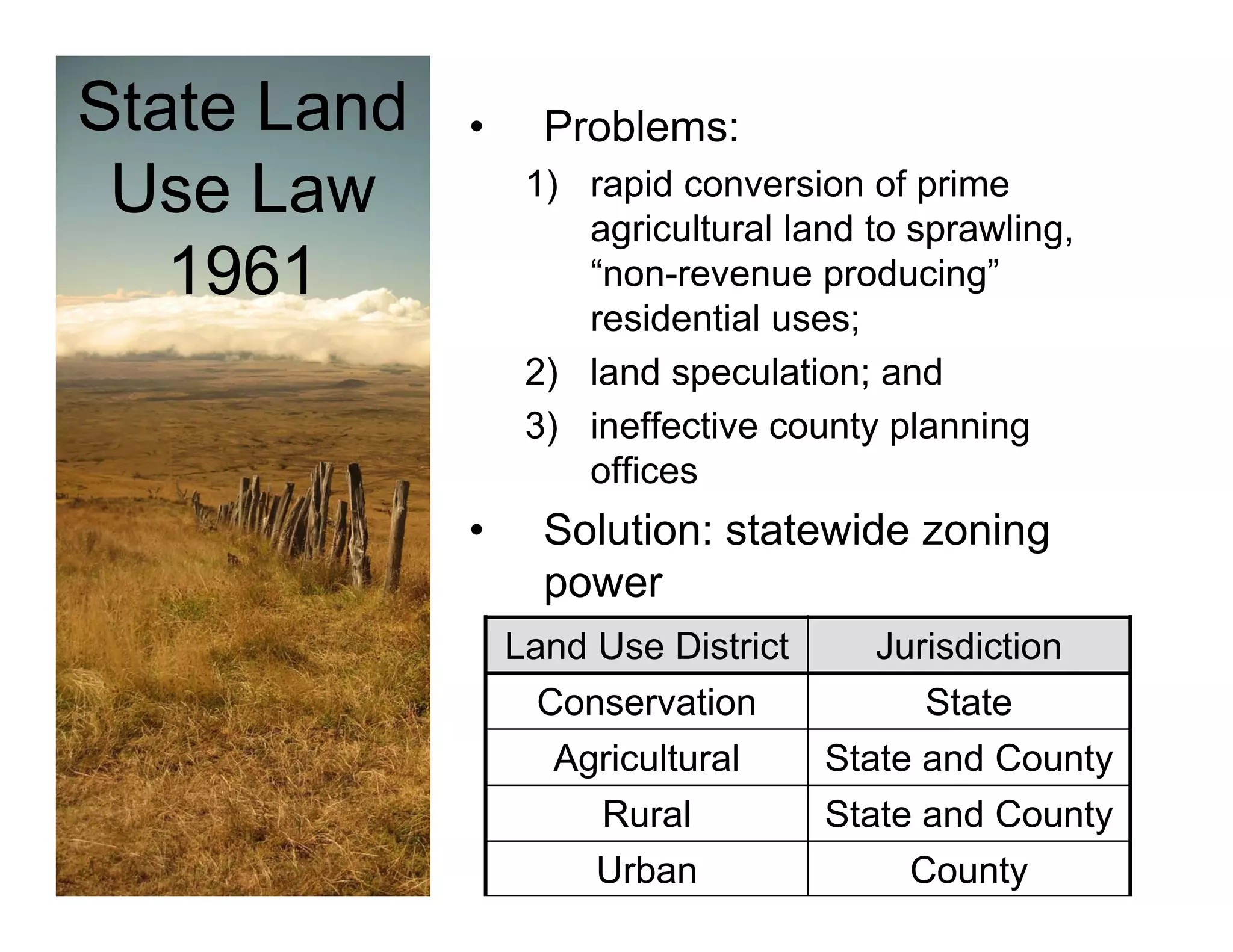
    4. State Land • Problems: Use La Law 1) rapid conversion of prime id i f i agricultural land to sprawling, 1961 “non-revenue producing” residential uses; 2) land speculation; and 3) i ff ti county planning ineffective t l i offices • Solution: statewide zoning power Land Use District Jurisdiction Conservation State Agricultural g State and Countyy Rural State and County Urban County
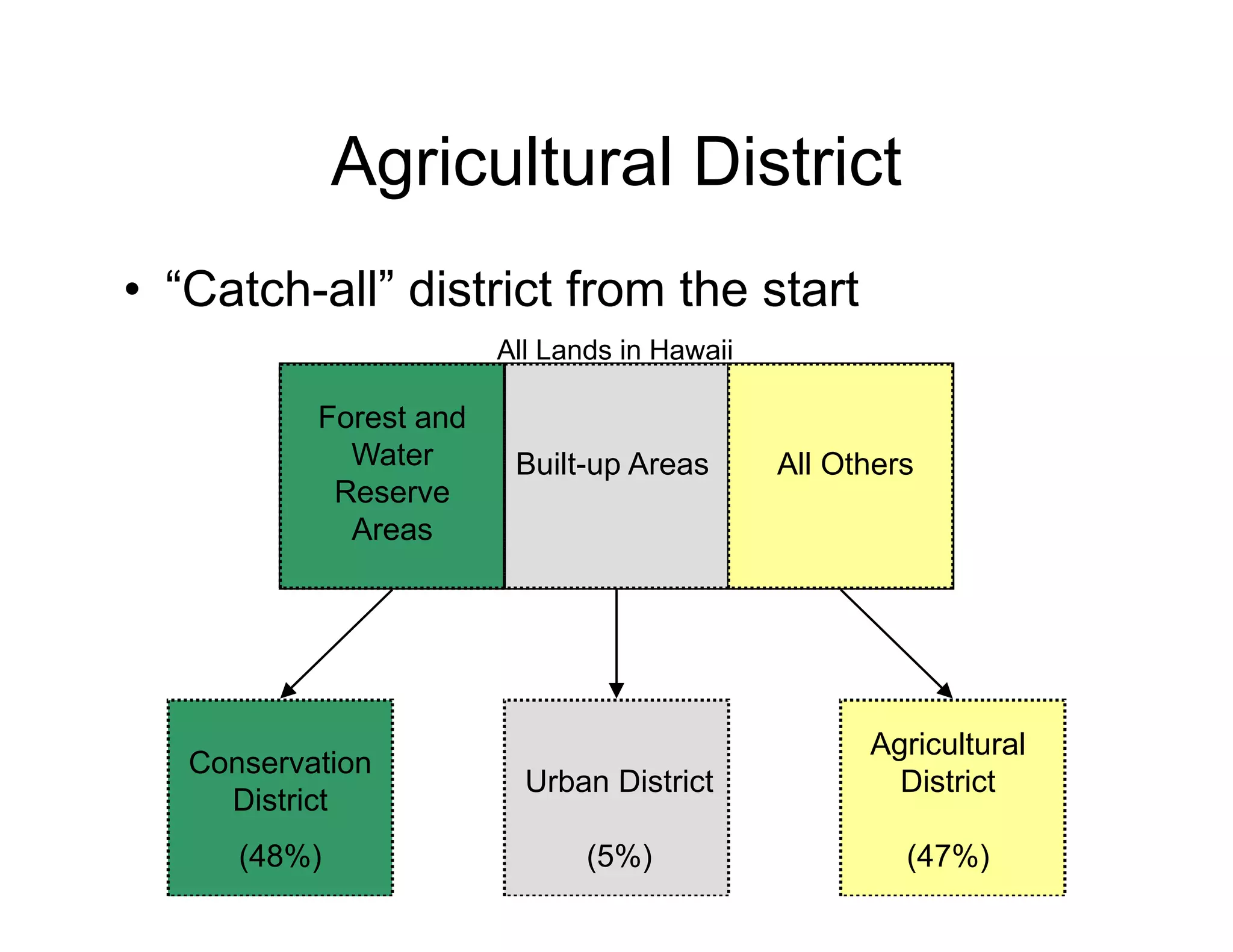
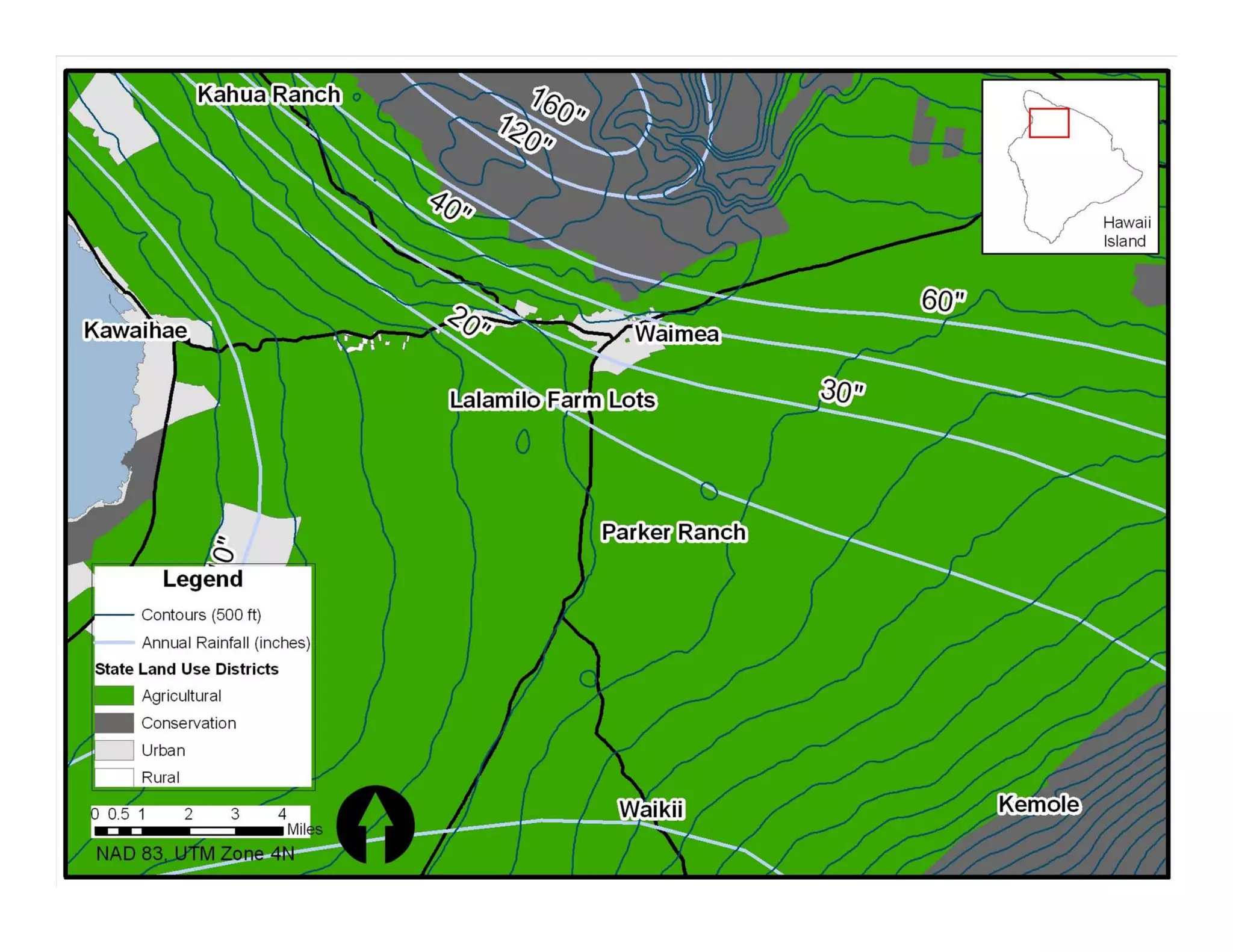
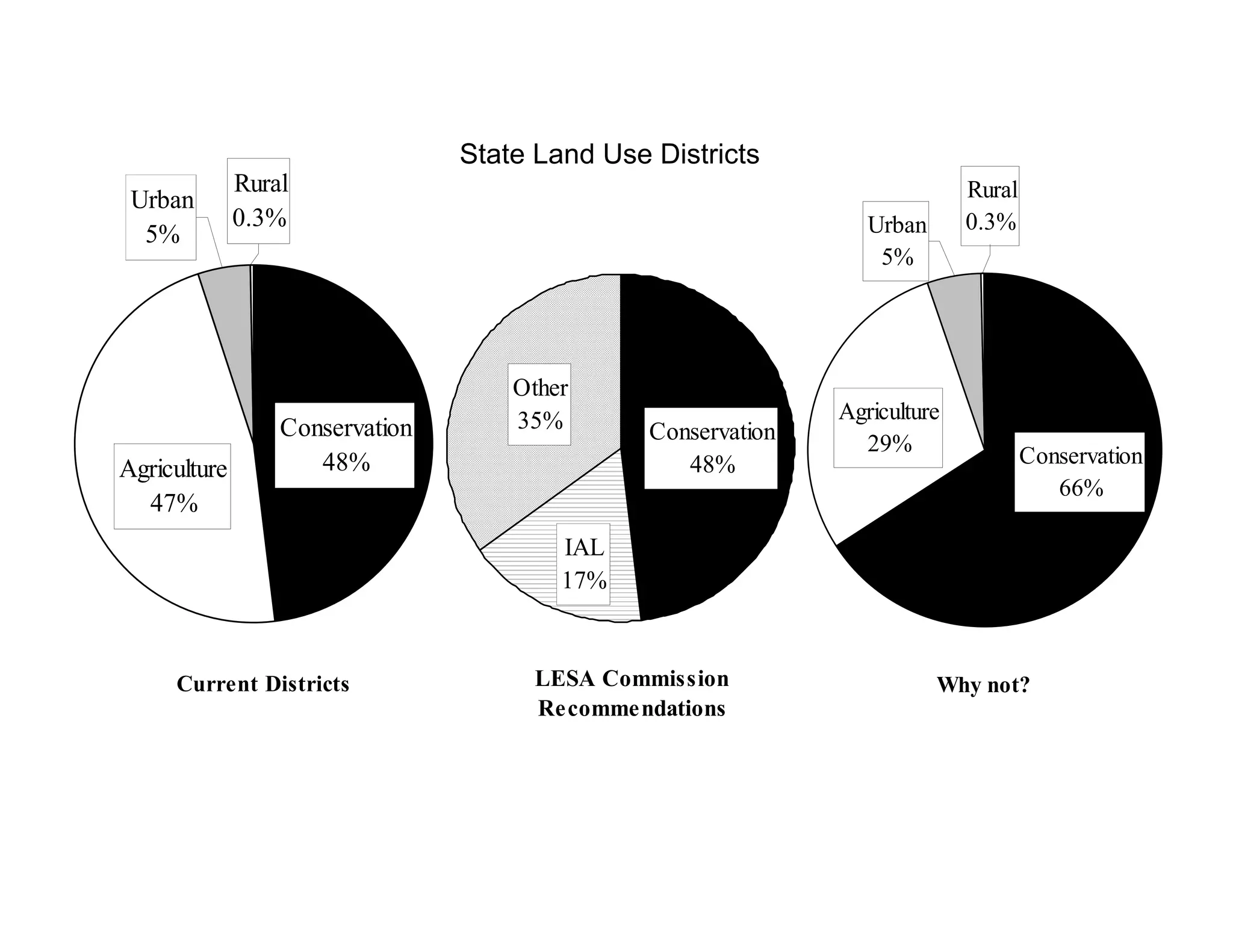
    5. Agricultural District • “Catch-all” district from the start Catch all All Lands in Hawaii Forest and Water Built-up Areas All Others Reserve Areas Agricultural Conservation Urban District District District (48%) (5%) (47%)
    6. Land Classification • 1960s-80s 1960s 80s Systems • Ag District too large • Part of broader national efforts • LUC boundary change y g process • S i tifi b i f l d use Scientific basis for land decisions • 1978: State to preserve IAL
    7. What are • Are capable of producing Important sustained high agricultural yields when treated and managed Agricultural according to accepted farming Lands? methods and technology; • C t ib t t the St t ’ economic Contribute to th State’s i base and produce agricultural commodities for export or local consumption; ti • Are needed to promote the expansion of agricultural activities and income for the future, even if currently not in production. Act 183, Important Agricultural Lands
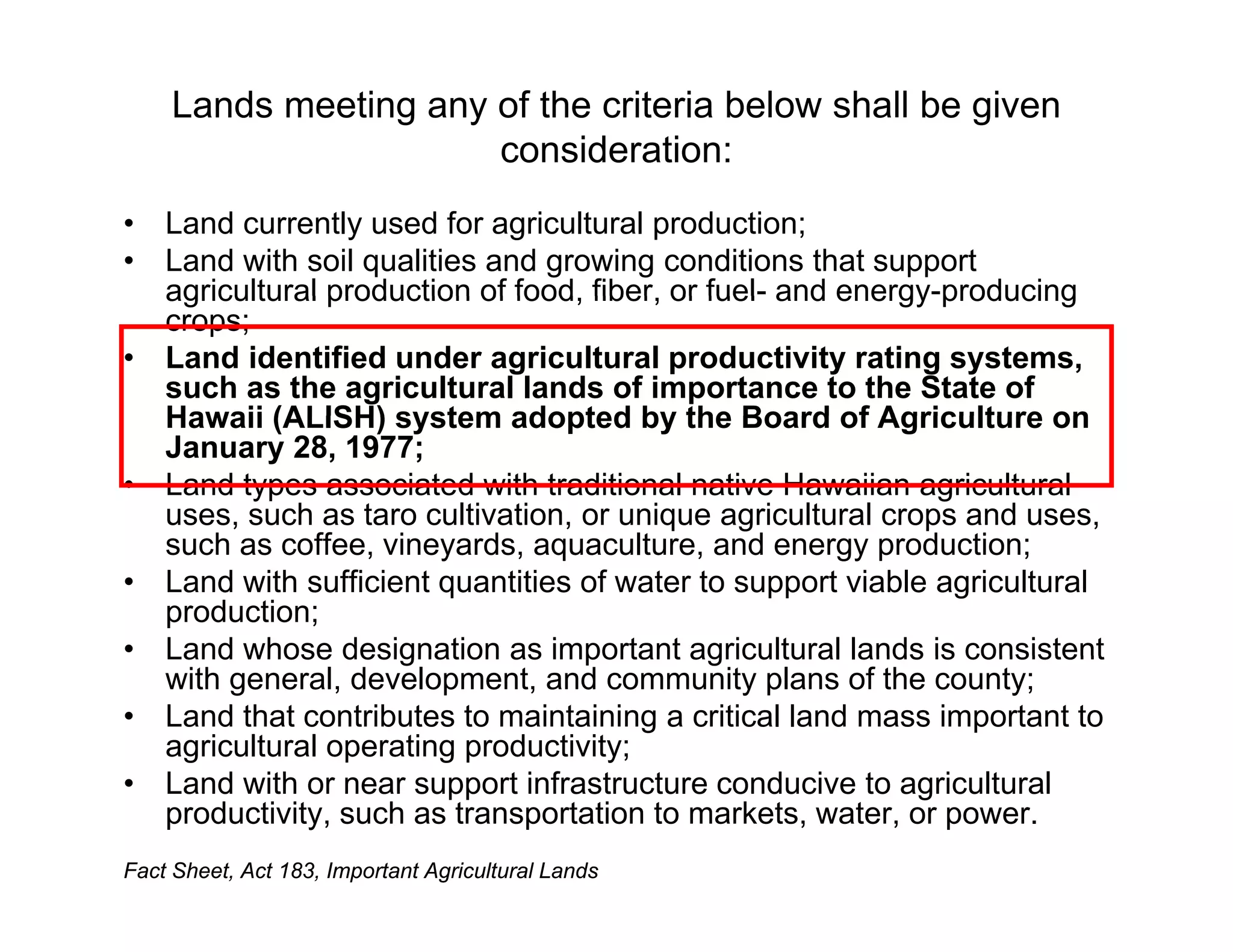
    8. Lands meeting any of the criteria below shall be given consideration: • Land currently used for agricultural production; • Land with soil qualities and growing conditions that support agricultural production of food fiber or fuel- and energy-producing food, fiber, fuel energy producing crops; • Land identified under agricultural productivity rating systems, such as the agricultural lands of importance to the State of Hawaii (ALISH) system adopted by the Board of Agriculture on January 28, 1977; • Land types associated with traditional native Hawaiian agricultural uses, such as taro cultivation, or unique agricultural crops and uses, such as coffee, vineyards, aquaculture, and energy production; h ff i d lt d d ti • Land with sufficient quantities of water to support viable agricultural production; • Land whose designation as important agricultural lands is consistent with general, development, and community plans of the county; • Land that contributes to maintaining a critical land mass important to agricultural operating productivity; • Land ith L d with or near support i f t t t infrastructure conducive t agricultural d i to i lt l productivity, such as transportation to markets, water, or power. Fact Sheet, Act 183, Important Agricultural Lands
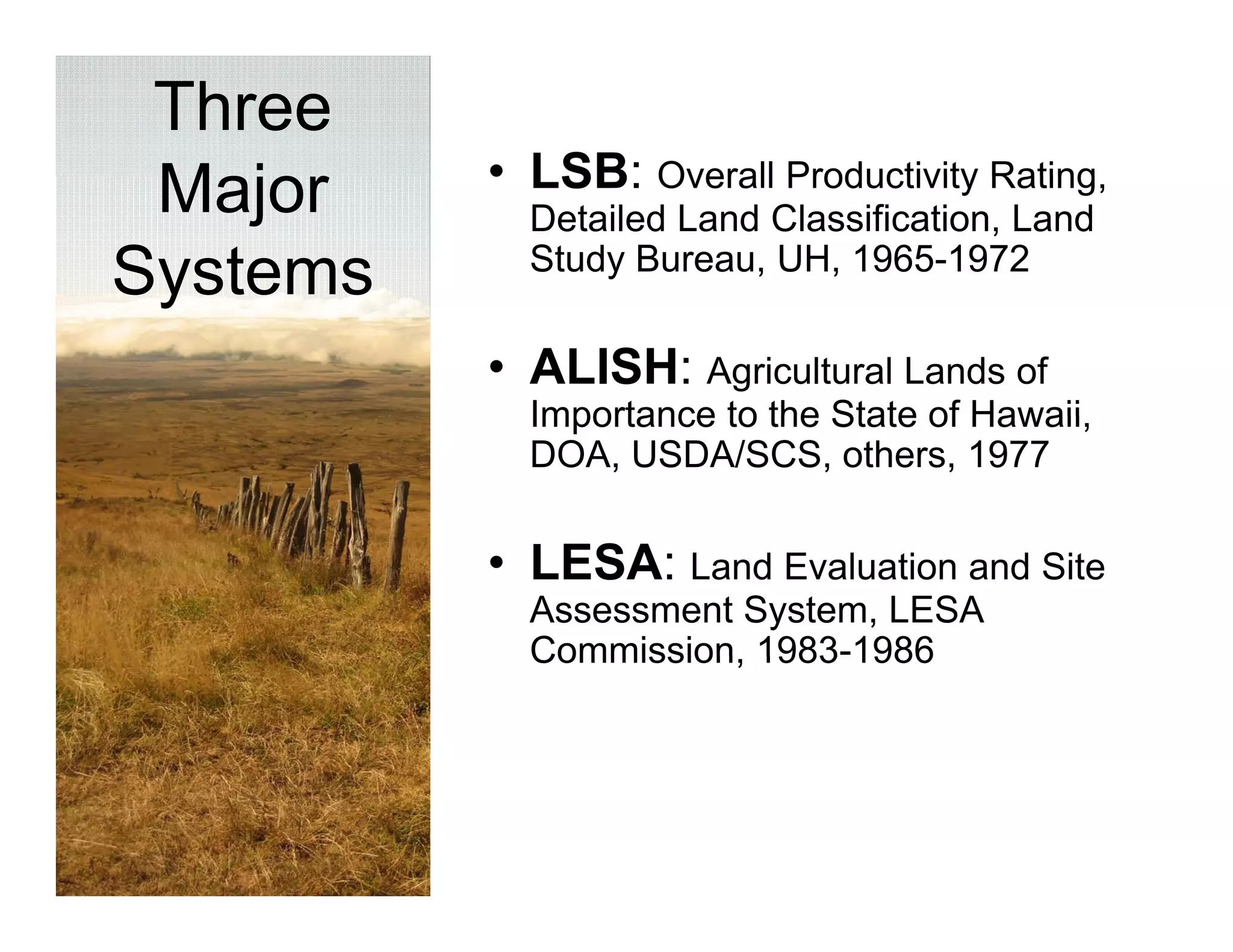
    9. Three Major • LSB: Overall Productivity Rating Rating, Detailed Land Classification, Land Study Bureau, UH, 1965-1972 Systems y • ALISH: Agricultural Lands of Importance to the State of Hawaii, Hawaii DOA, USDA/SCS, others, 1977 • LESA: Land Evaluation and Site Assessment System, LESA Commission, 1983 1986 Commission 1983-1986
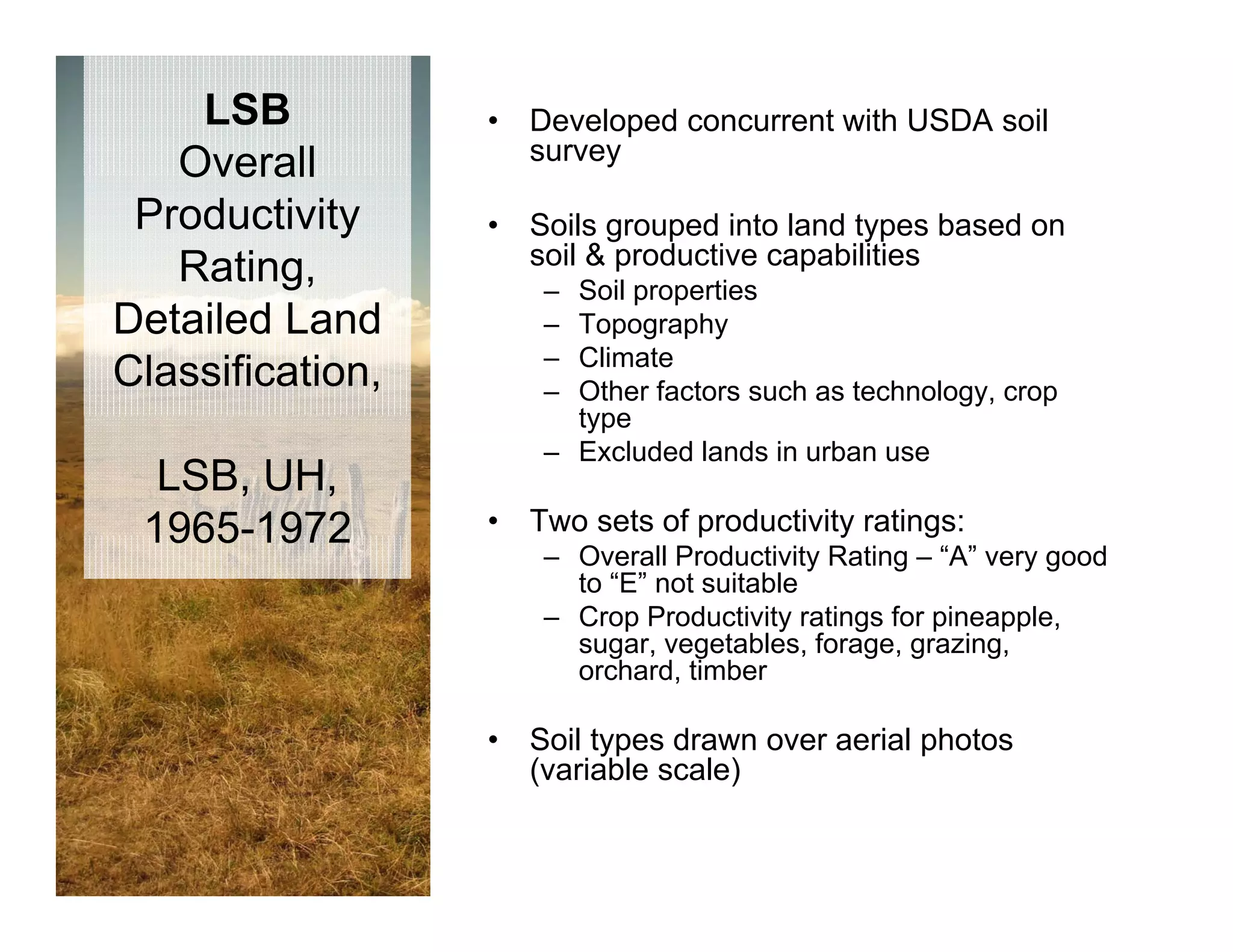
    10. LSB • Developed concurrent with USDA soil survey Overall Productivity • Soils grouped into land types based on soil & productive capabilities Rating, – Soil properties Detailed Land – Topography – Climate Classification, – Other factors such as technology, crop type – Excluded lands in urban use LSB, UH, 1965 1972 1965-1972 • Two sets of productivity ratings: p y g – Overall Productivity Rating – “A” very good to “E” not suitable – Crop Productivity ratings for pineapple, sugar, vegetables, forage, grazing, g , g , g ,g g, orchard, timber • Soil types drawn over aerial photos (variable scale)
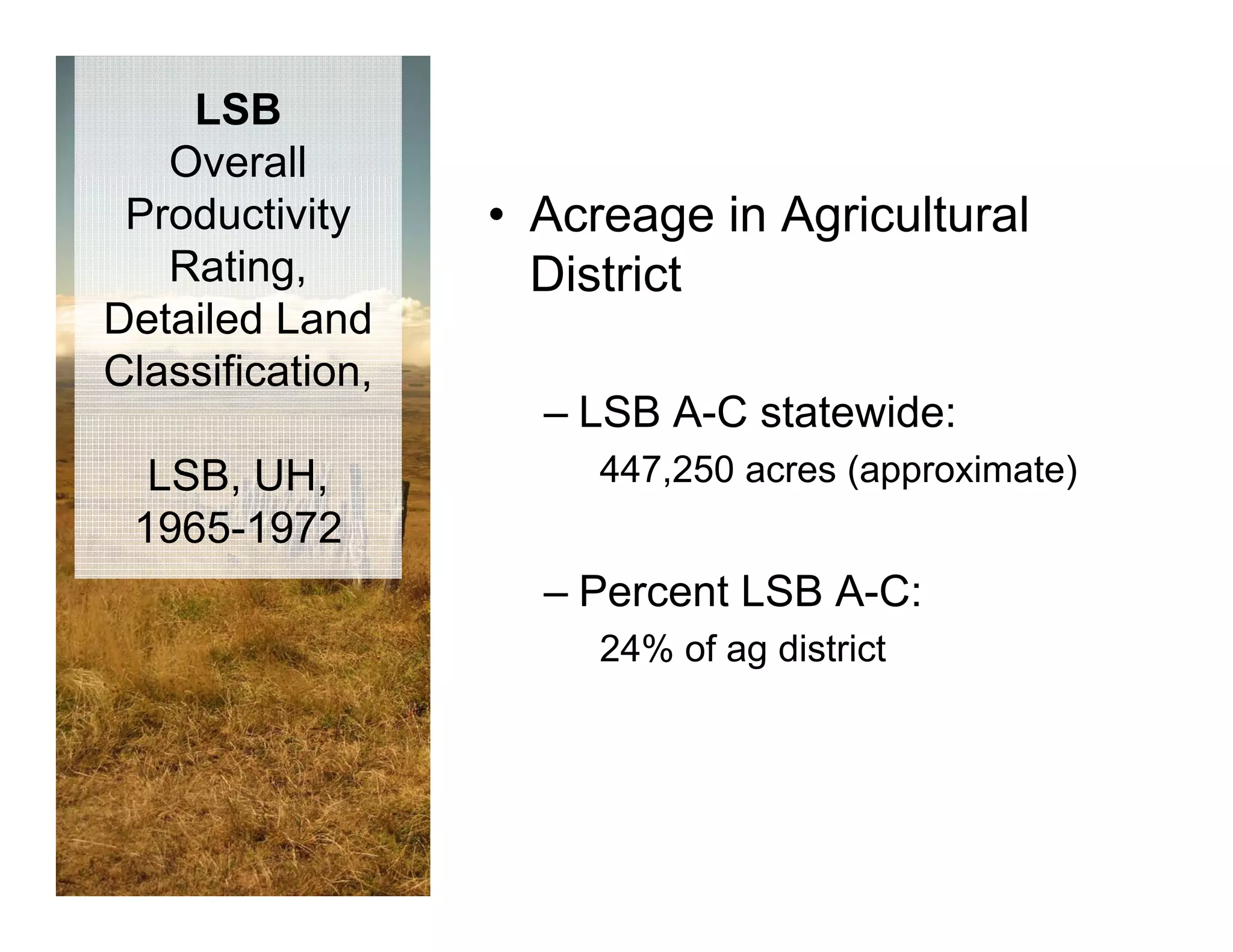
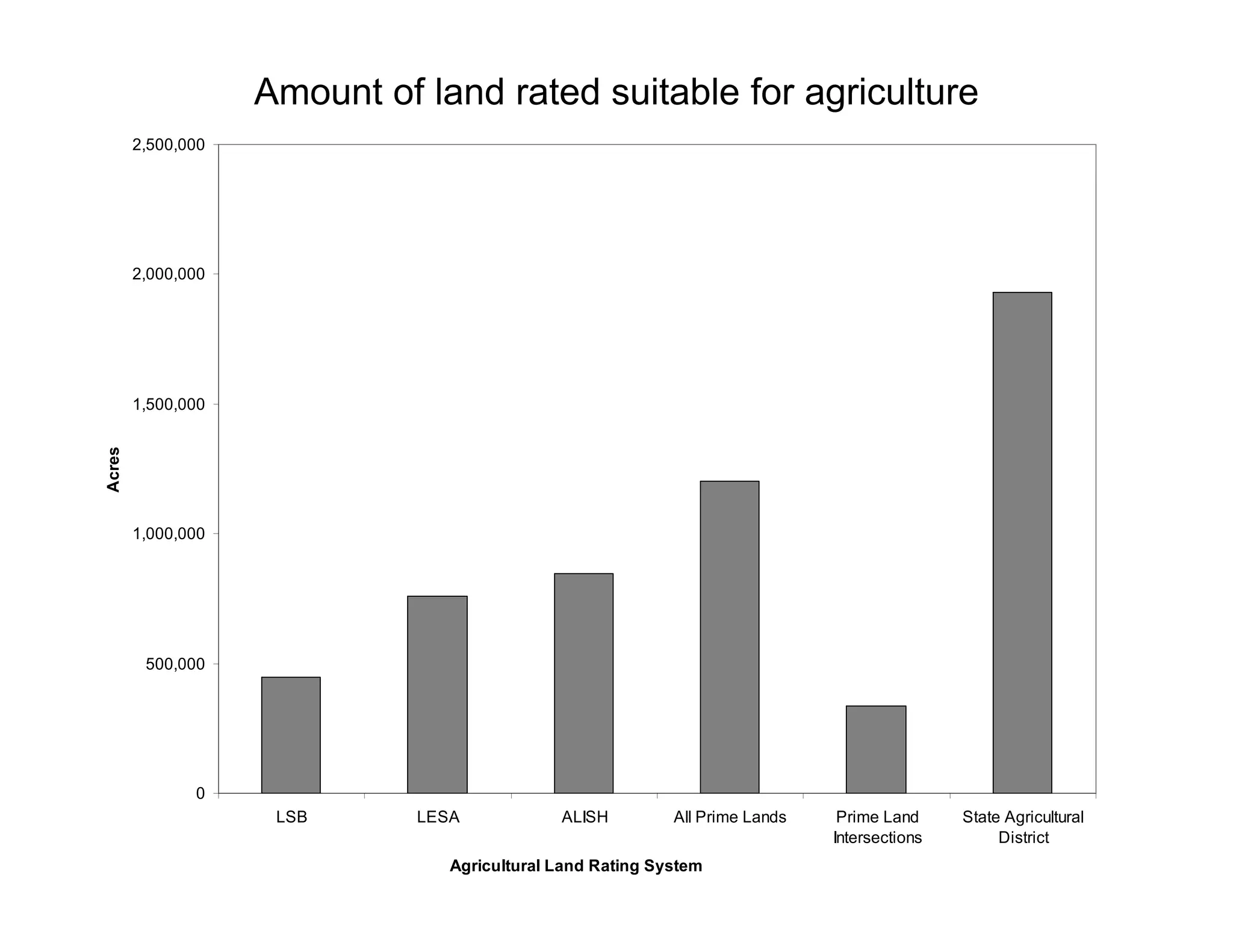
    11. LSB Overall Productivity • Acreage in Agricultural Rating, District Detailed Land Classification, – LSB A-C statewide: LSB, UH, 447,250 acres (approximate) 1965 1972 1965-1972 – Percent LSB A-C: 24% of ag district
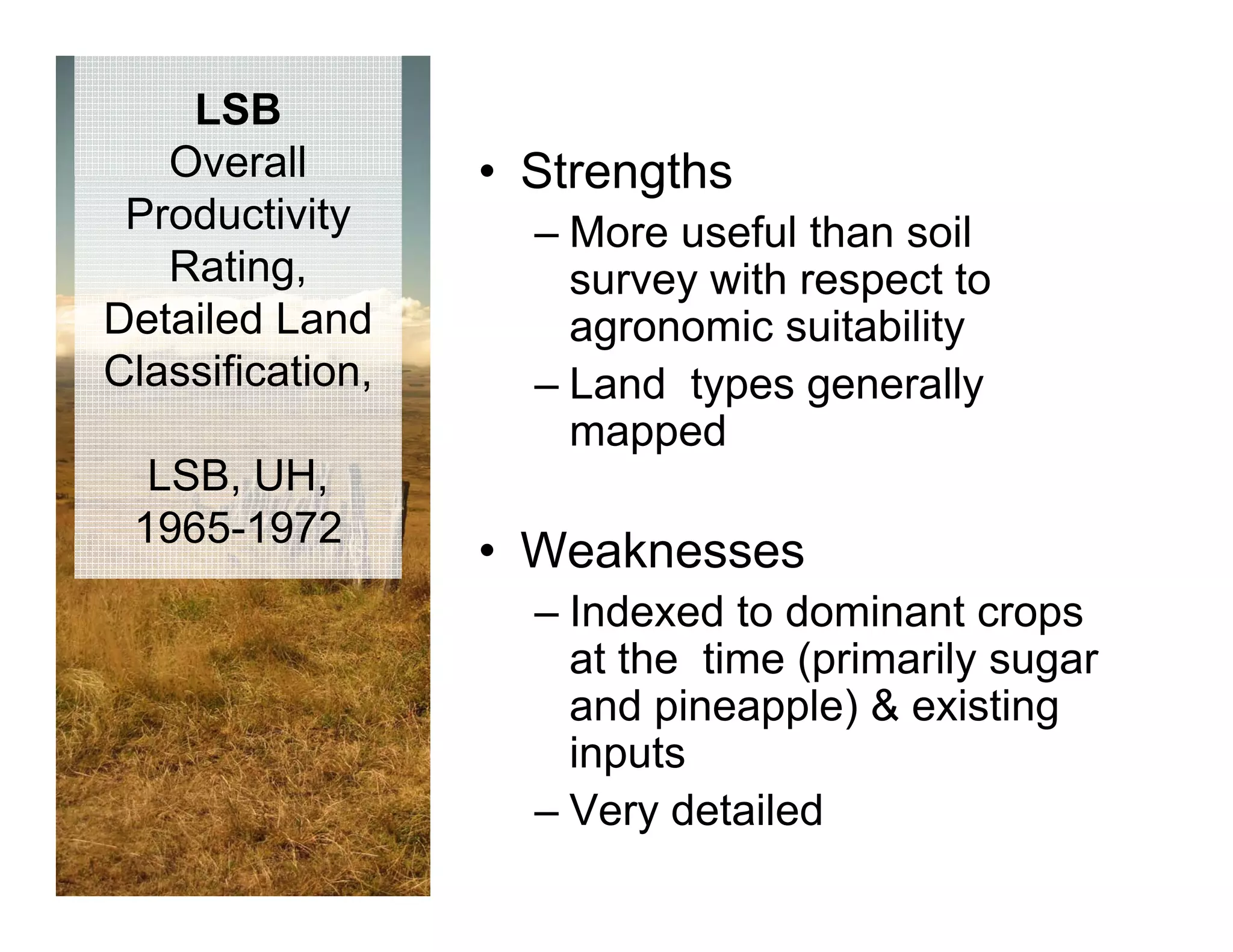
    12. LSB Overall • Strengths Productivity – More useful than soil Rating, survey with respect to y p Detailed Land agronomic suitability Classification, – Land types generally mapped d LSB, UH, 1965 1972 1965-1972 • W k Weaknesses – Indexed to dominant crops at the time (primarily sugar and pineapple) & existing inputs p – Very detailed
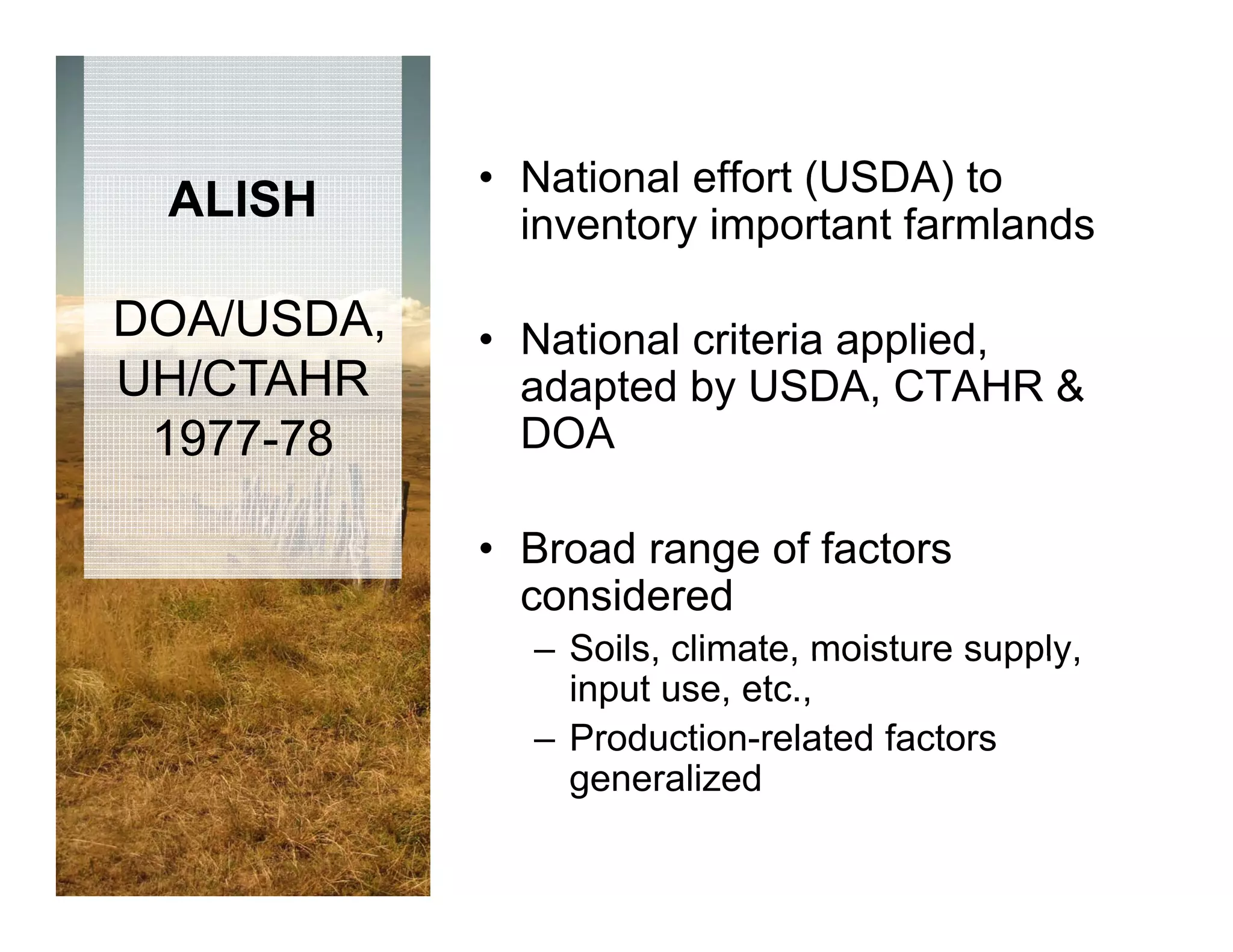
    13. • National effort (USDA) to ALISH inventory important farmlands DOA/USDA, • National criteria applied, UH/CTAHR adapted by USDA, CTAHR & 1977-78 DOA • B d range of factors Broad ff t considered – Soils climate moisture supply Soils, climate, supply, input use, etc., – Production-related factors generalized
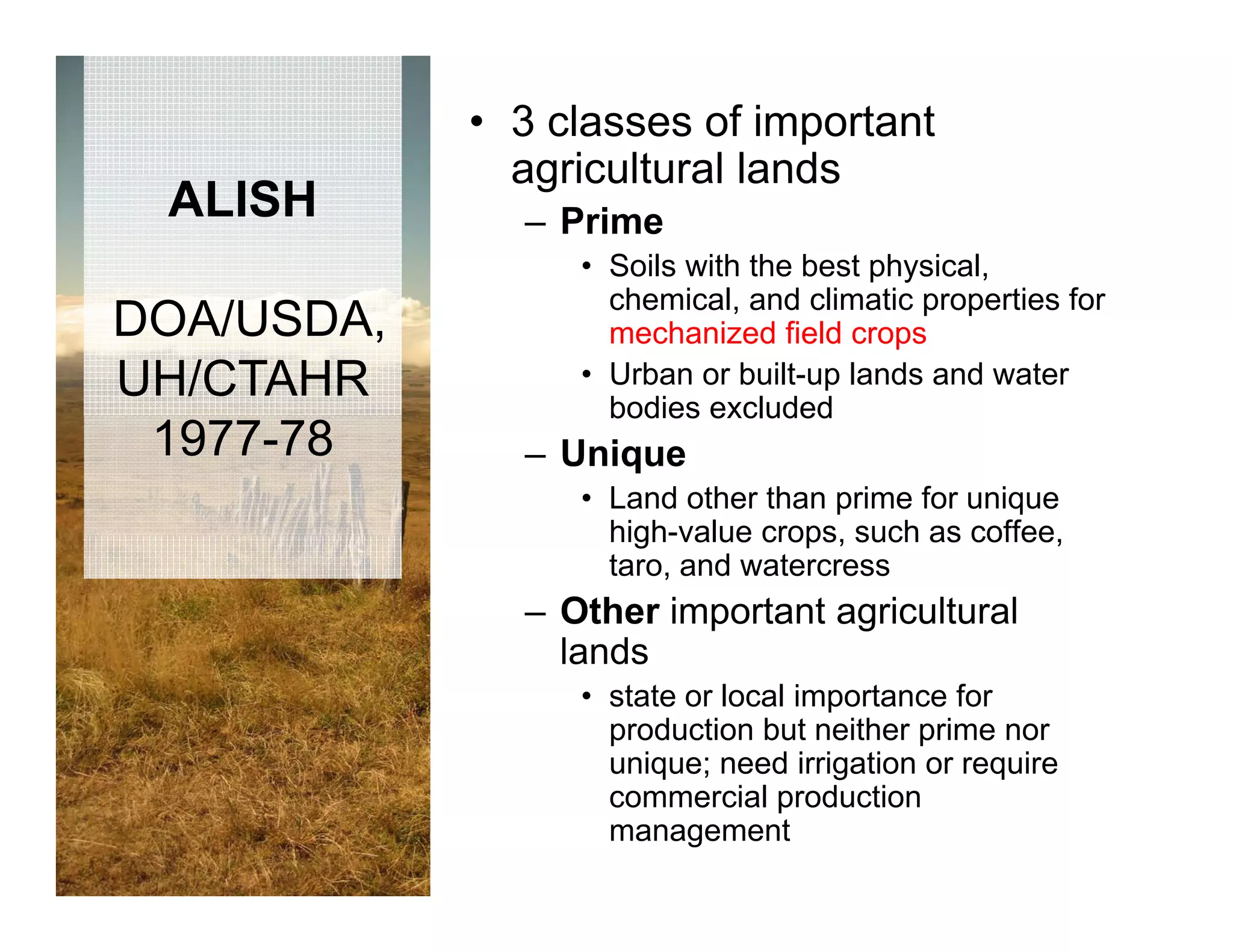
    14. • 3 classes of important agricultural lands ALISH – Prime • Soils with the best physical, chemical, chemical and climatic properties for DOA/USDA, mechanized field crops UH/CTAHR • Urban or built-up lands and water bodies excluded 1977-78 – Unique • Land other than prime for unique high value crops, high-value crops such as coffee coffee, taro, and watercress – Other important agricultural lands • state or local importance for production but neither prime nor unique; need irrigation or require q ; g q commercial production management
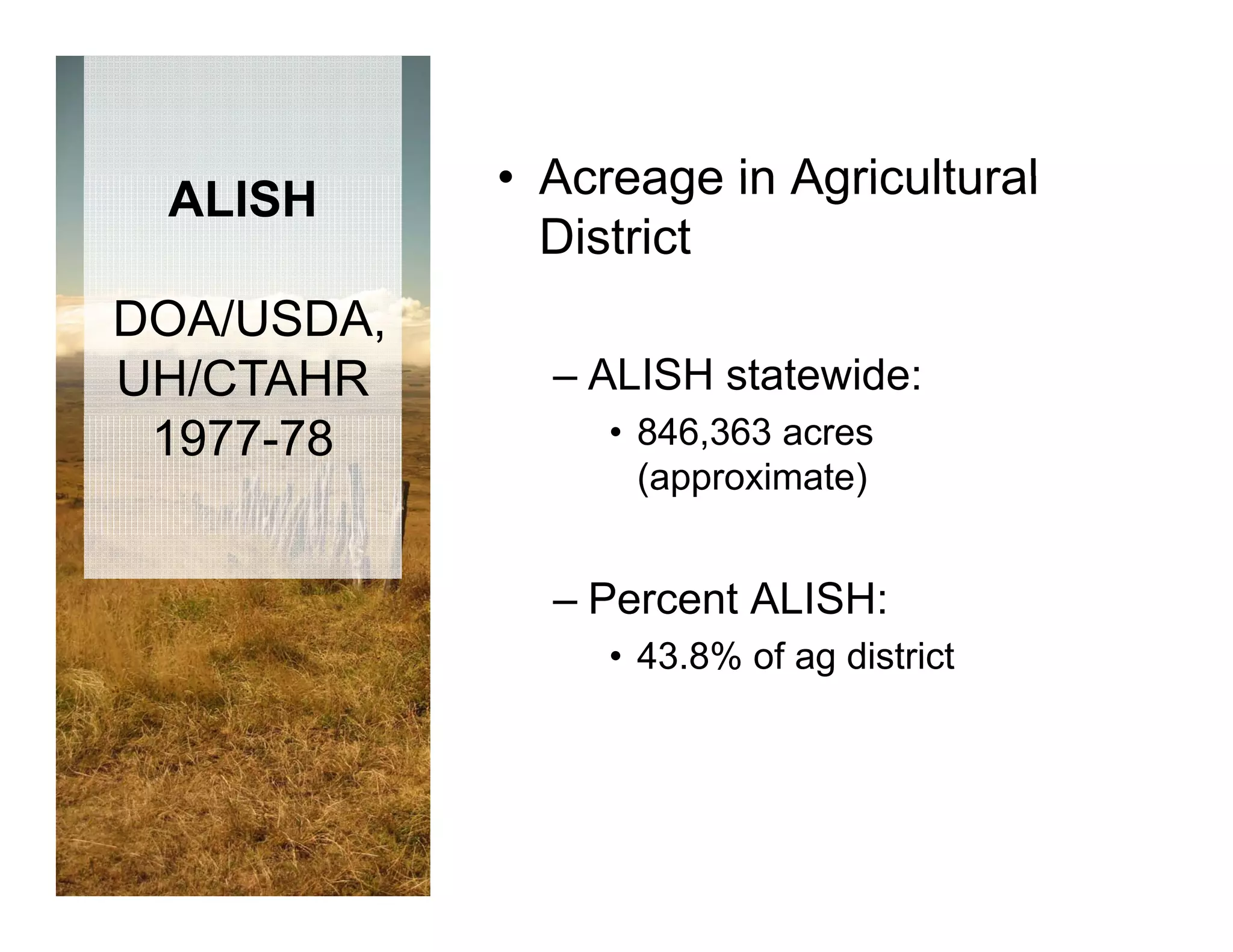
    15. ALISH • Acreage in Agricultural District DOA/USDA, UH/CTAHR – ALISH statewide: 1977-78 • 846,363 acres (approximate) – Percent ALISH: • 43 8% of ag district 43.8%
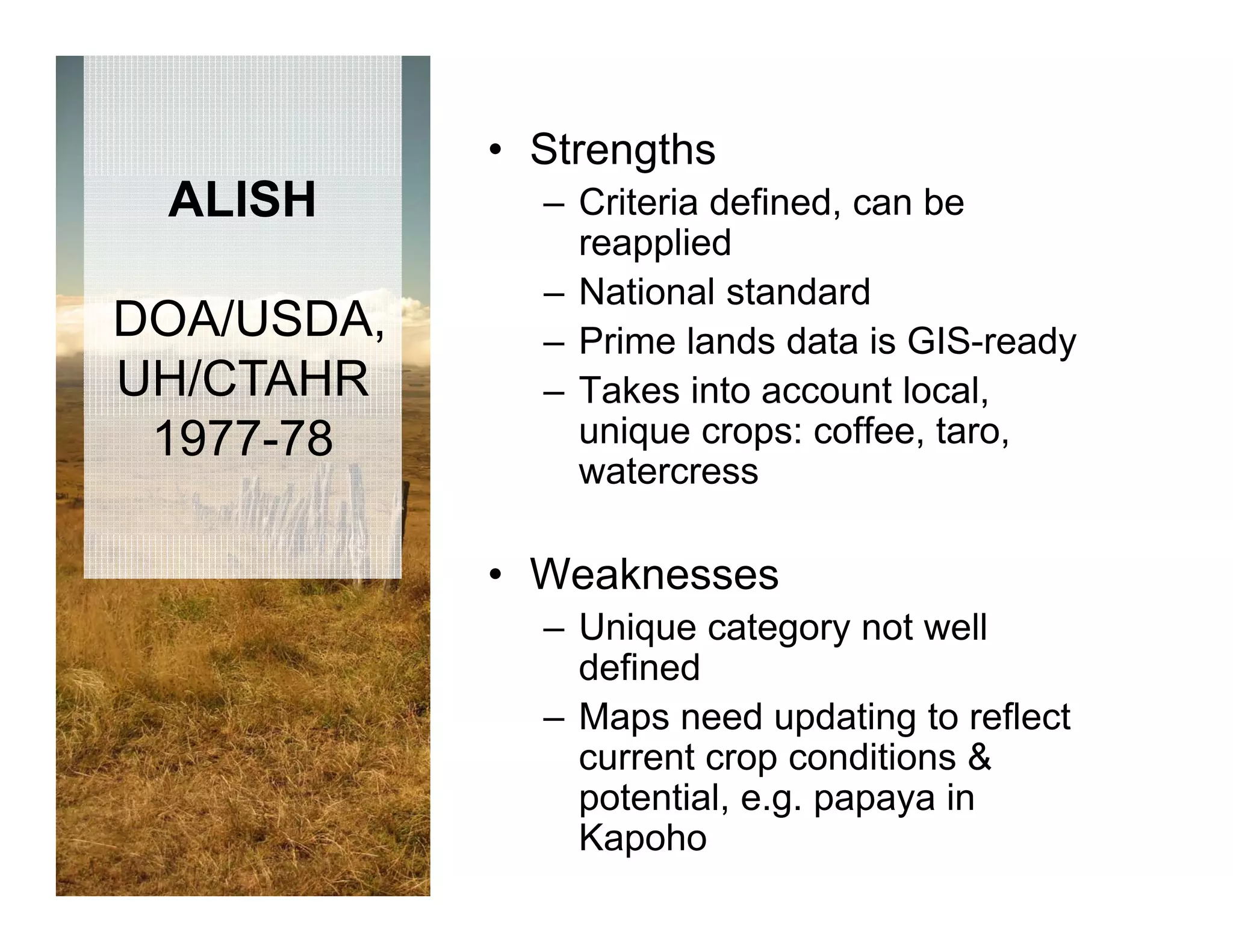
    16. • Strengths ALISH – Criteria defined, can be reapplied – National standard DOA/USDA, – Prime lands data is GIS-ready UH/CTAHR – Takes into account local, 1977-78 unique crops: coffee, taro, watercress • Weaknesses – Unique category not well defined d fi d – Maps need updating to reflect current crop conditions & p potential, e.g. papaya in Kapoho
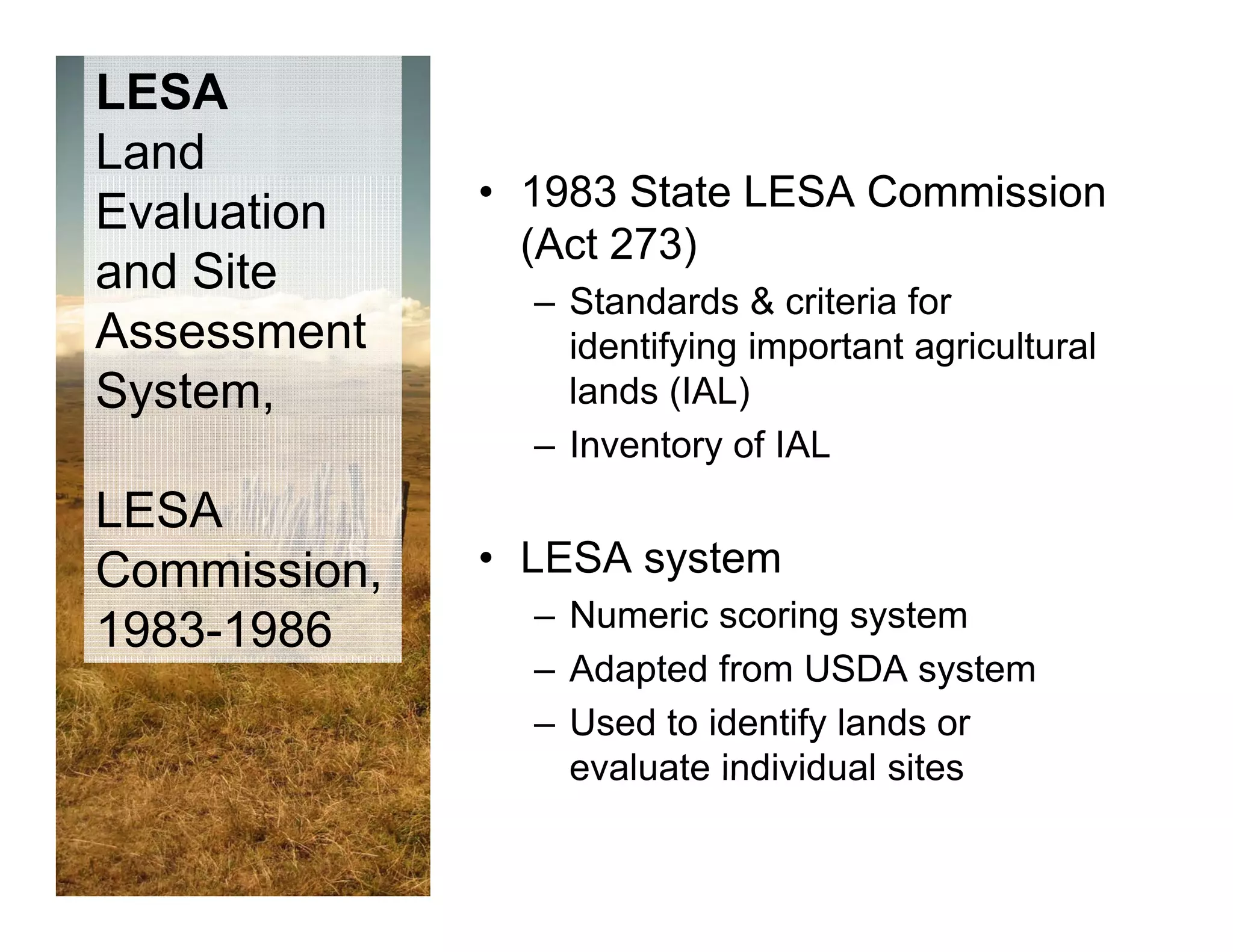
    17. LESA Land • 1983 SState LESA C Commission i i Evaluation (Act 273) and Site – Standards & criteria for Assessment identifying important agricultural System, y lands (IAL) – Inventory of IAL LESA Commission, • LESA system – Numeric scoring system 1983-1986 – Ad t d f Adapted from USDA system t – Used to identify lands or evaluate individual sites
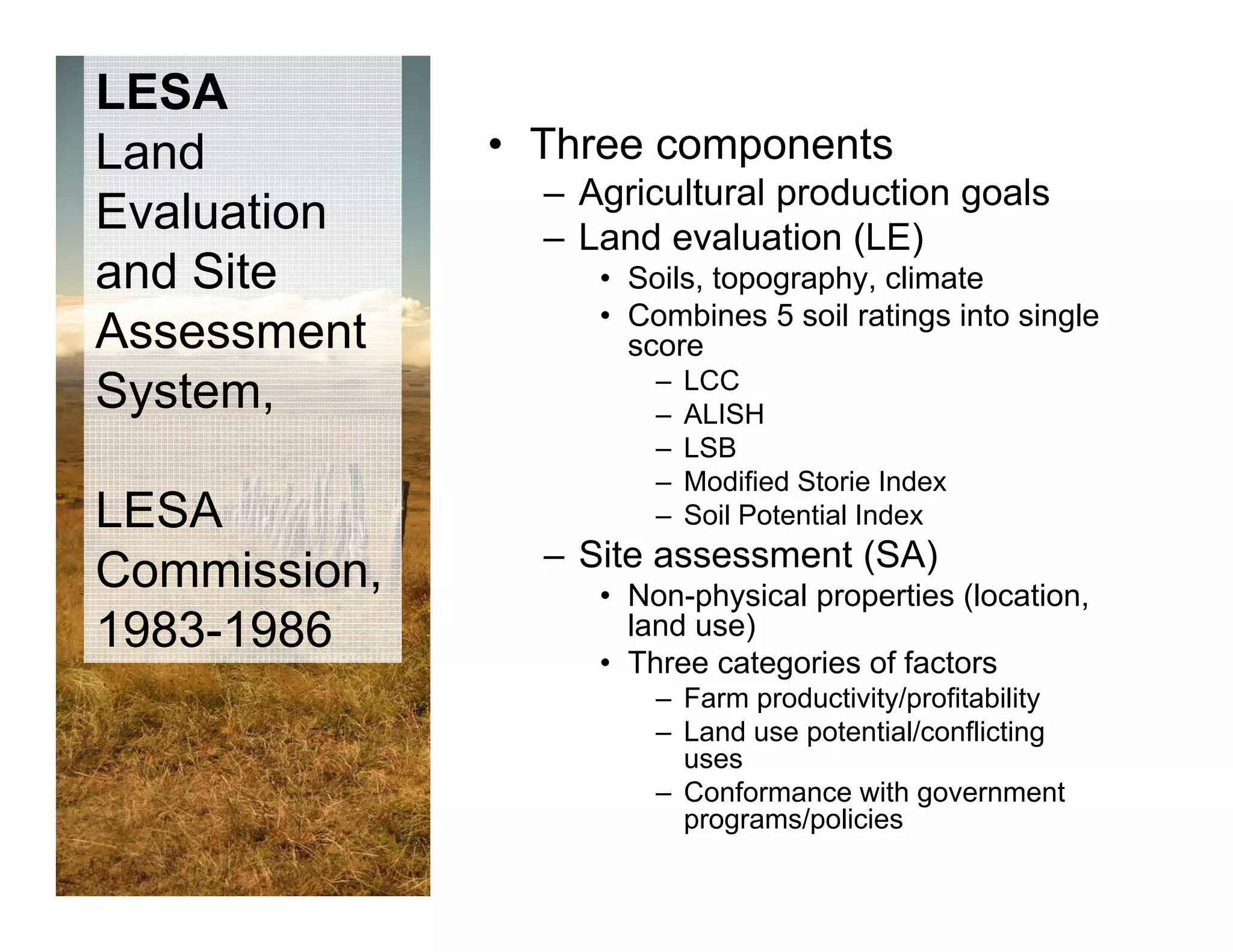
    18. LESA Land • Three components – Agricultural production goals Evaluation – Land evaluation (LE) and Site • Soils, topography, climate • Combines 5 soil ratings into single Assessment score – LCC System, y – ALISH – LSB – Modified Storie Index LESA – Soil Potential Index – Site assessment (SA) Commission, • Non-physical properties (location, 1983-1986 land use) • Th Three categories of factors t i ff t – Farm productivity/profitability – Land use potential/conflicting uses – Conformance with government programs/policies
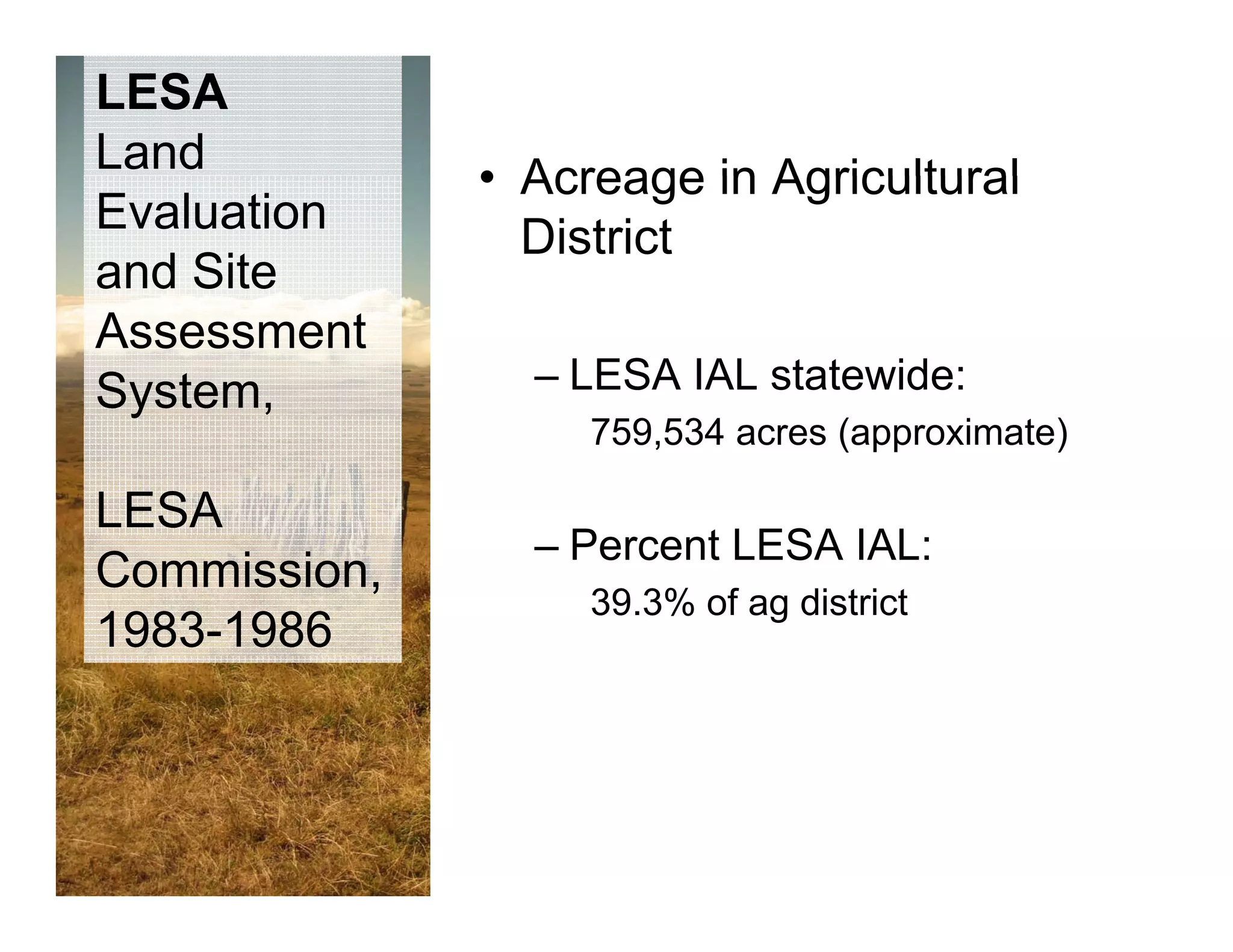
    19. LESA Land • Acreage in Agricultural Evaluation District and Site Assessment y System, – LESA IAL statewide: 759,534 acres (approximate) LESA –P Percent LESA IAL t IAL: Commission, 39.3% of ag district 1983-1986
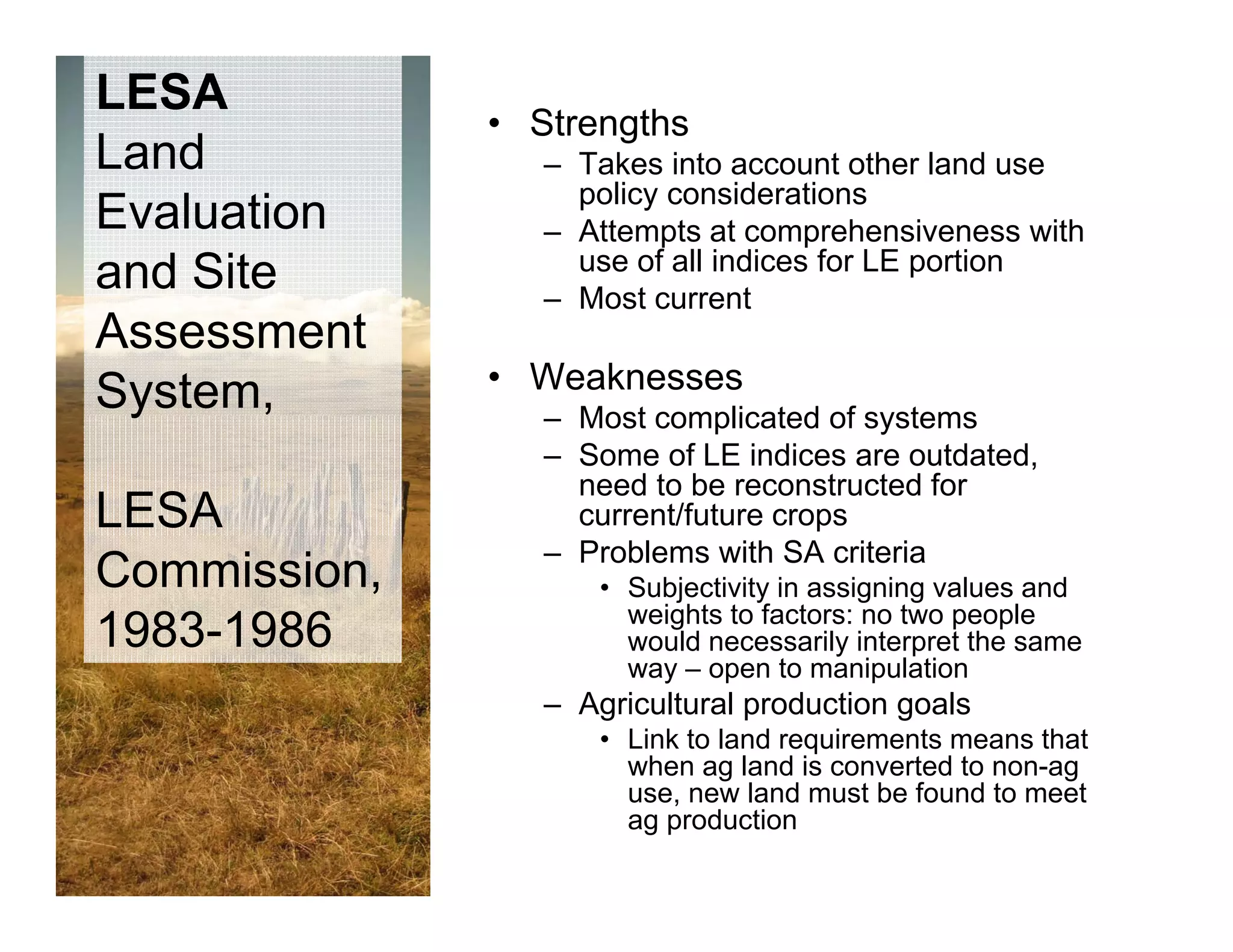
    20. LESA • Strengths Land – Takes into account other land use policy considerations Evaluation – Attempts at comprehensiveness with use of all indices for LE portion and Site – Most current Assessment y System, • Weaknesses – Most complicated of systems – Some of LE indices are outdated, need to be reconstructed for LESA current/future crops – Problems with SA criteria Commission, • Subjectivity in assigning values and weights to factors: no two people 1983-1986 would necessarily interpret the same y p way – open to manipulation – Agricultural production goals • Link to land requirements means that when ag land is co e ted to non-ag e a d s converted o ag use, new land must be found to meet ag production
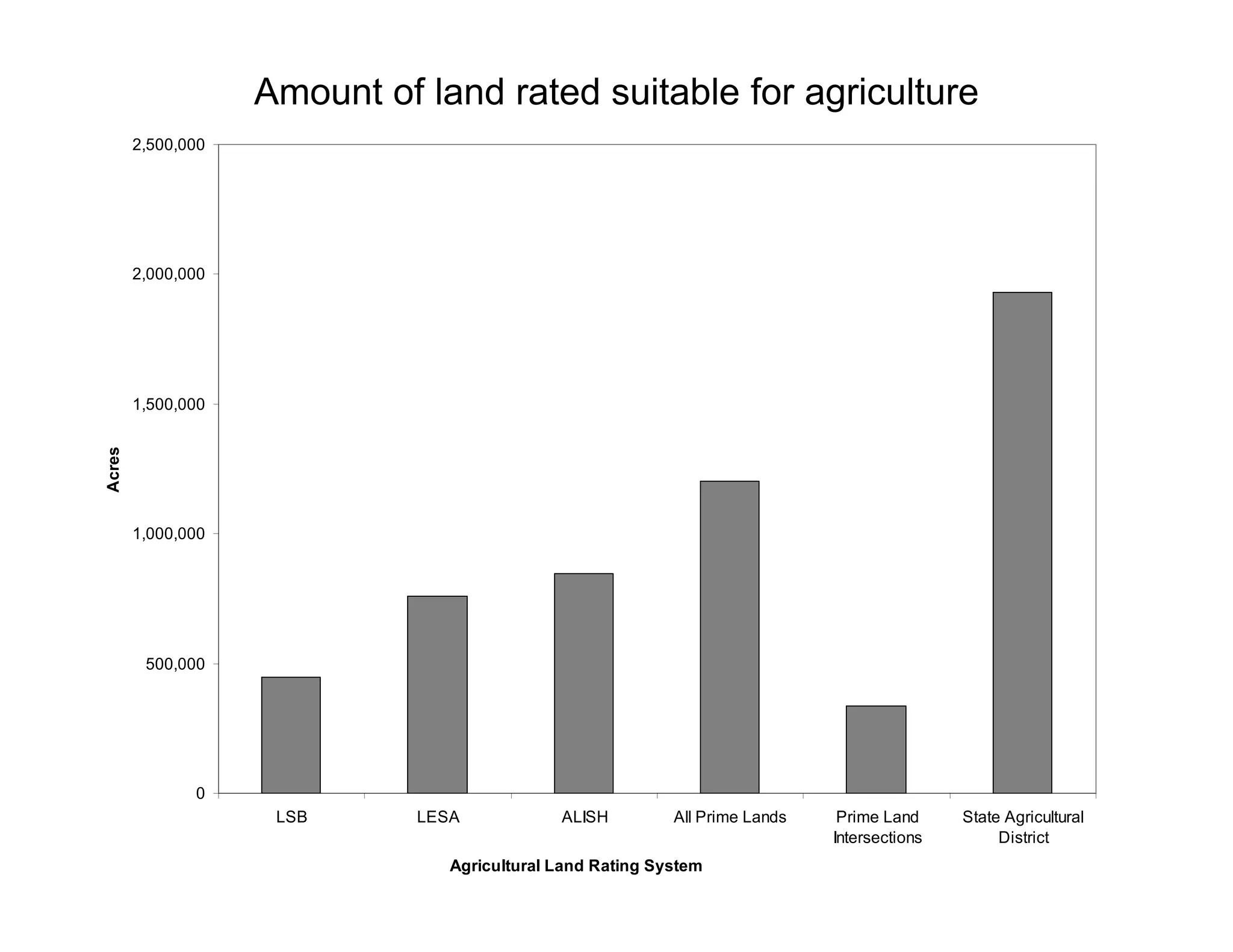
    21. Amount of land ratedsuitable for agriculture Amount of land rated suitable for agriculture 2,500,000 2,000,000 1,500,000 Acres 1,000,000 1 000 000 500,000 0 LSB LESA ALISH All Prime Lands Prime Land State Agricultural Intersections District Agricultural Land Rating System
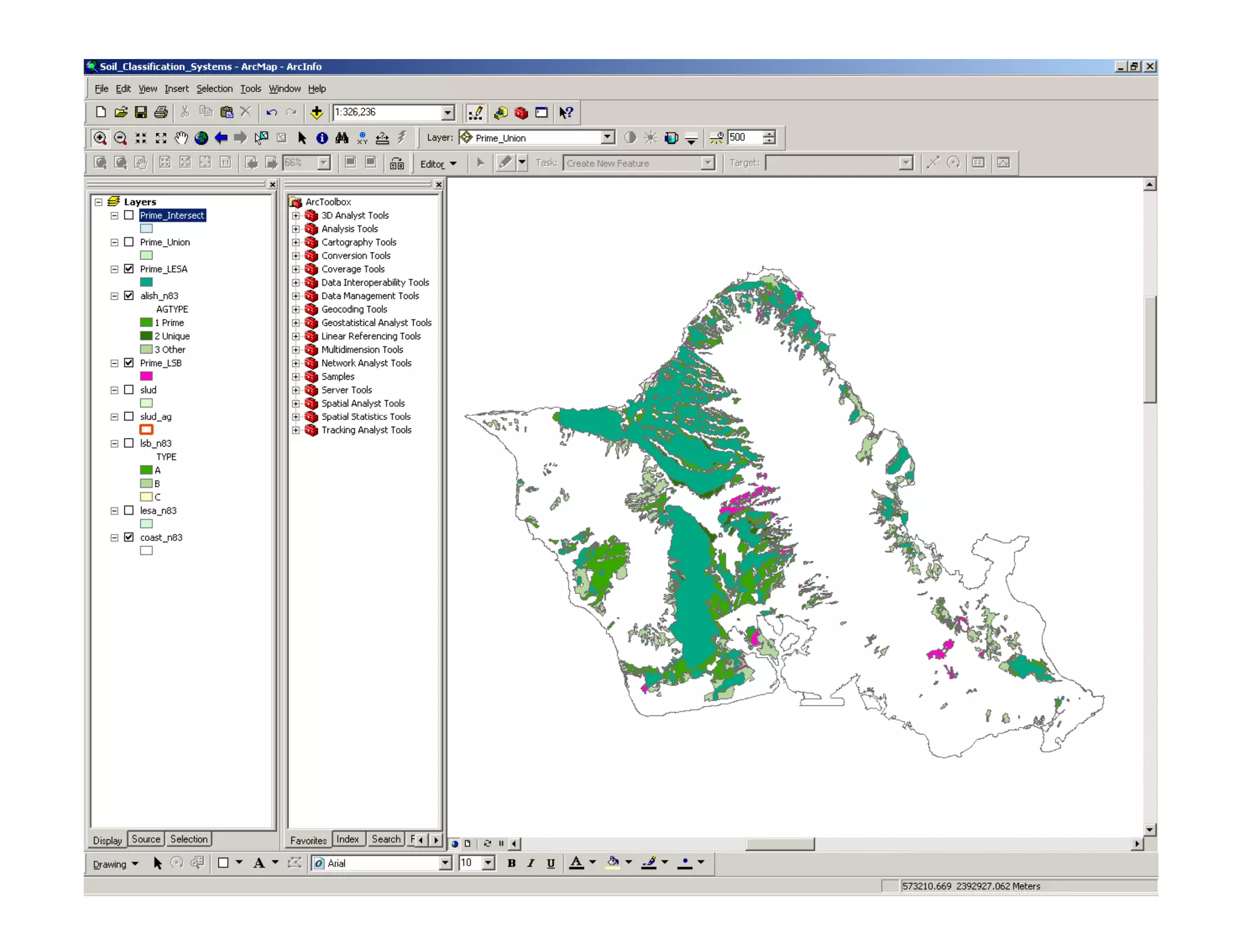
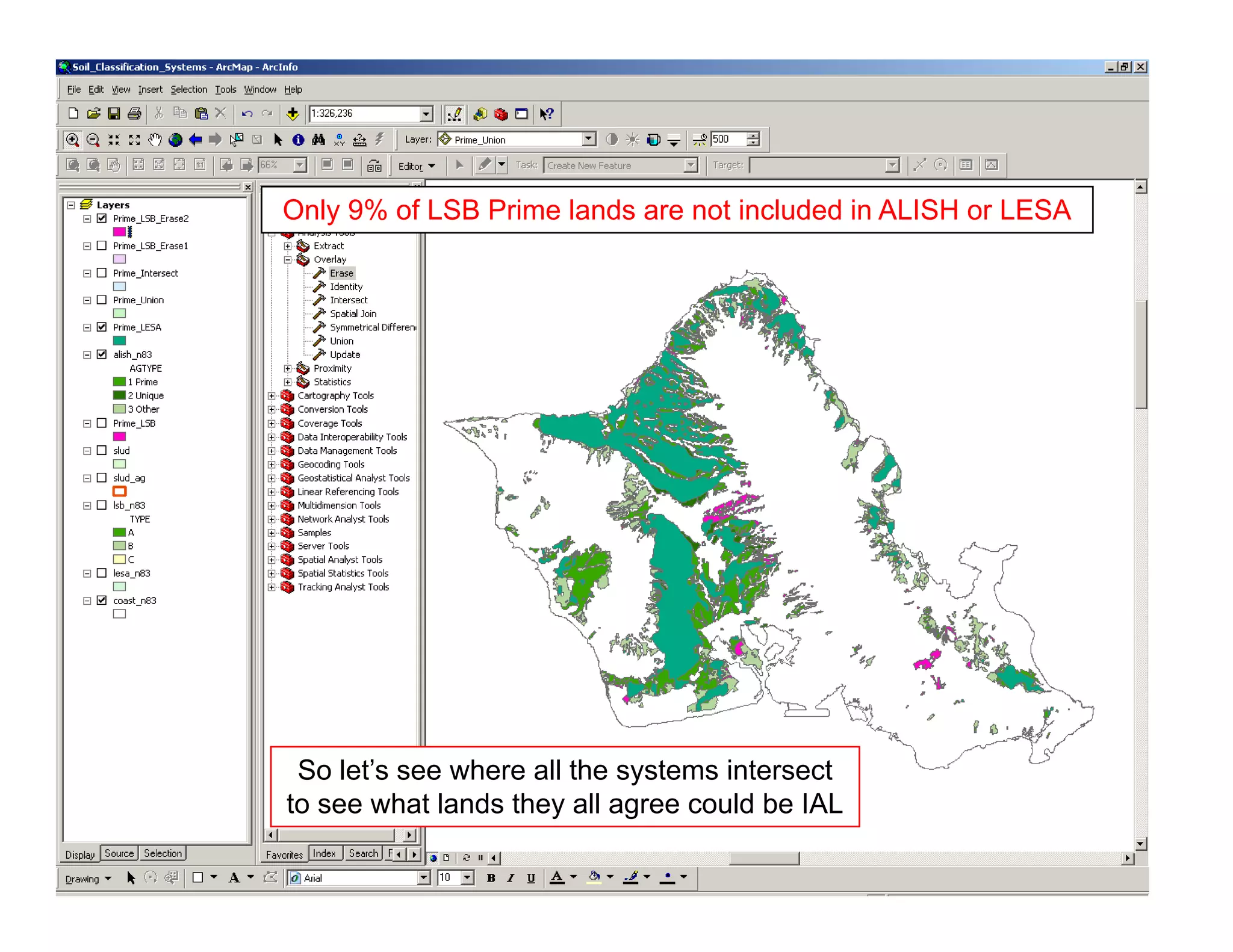
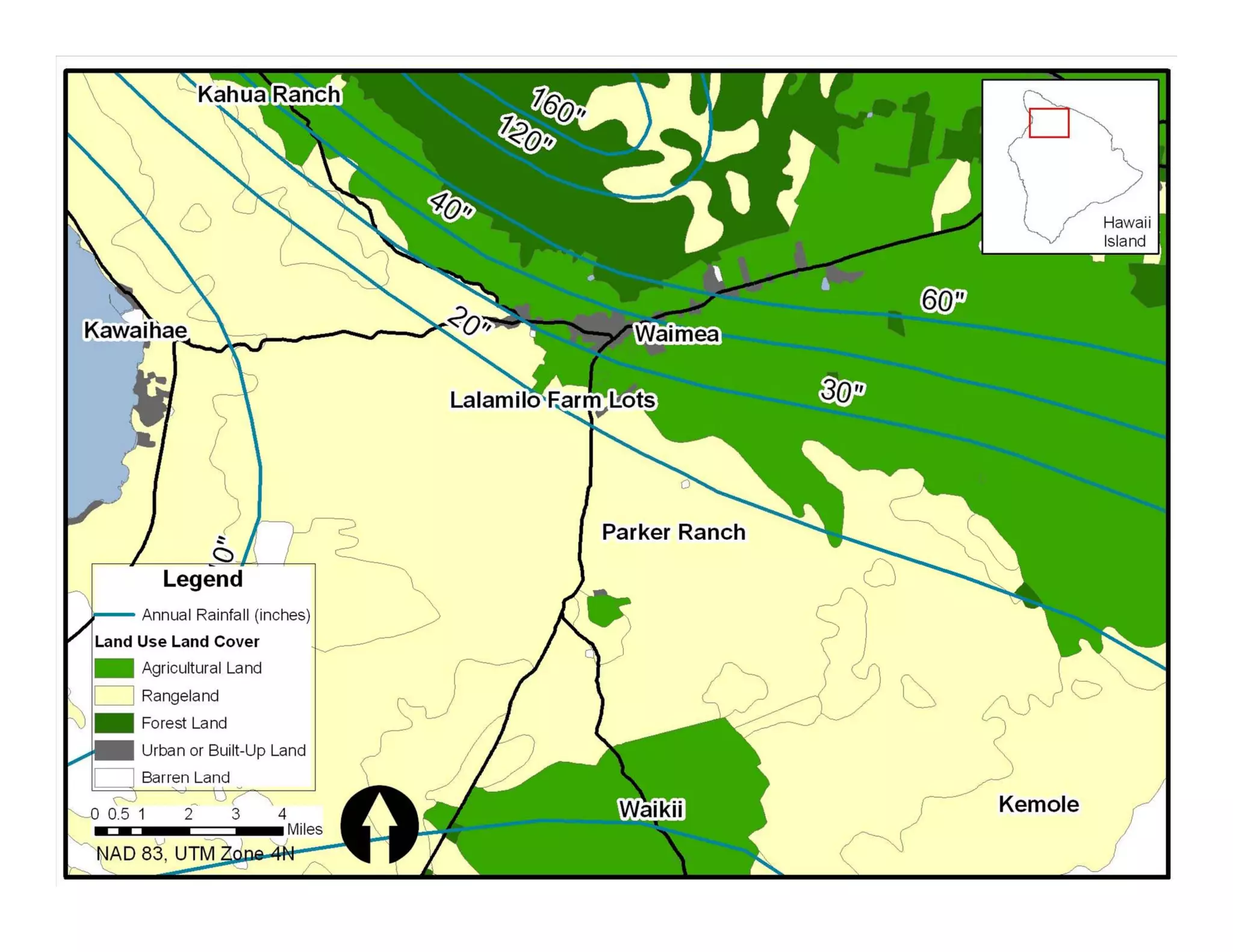
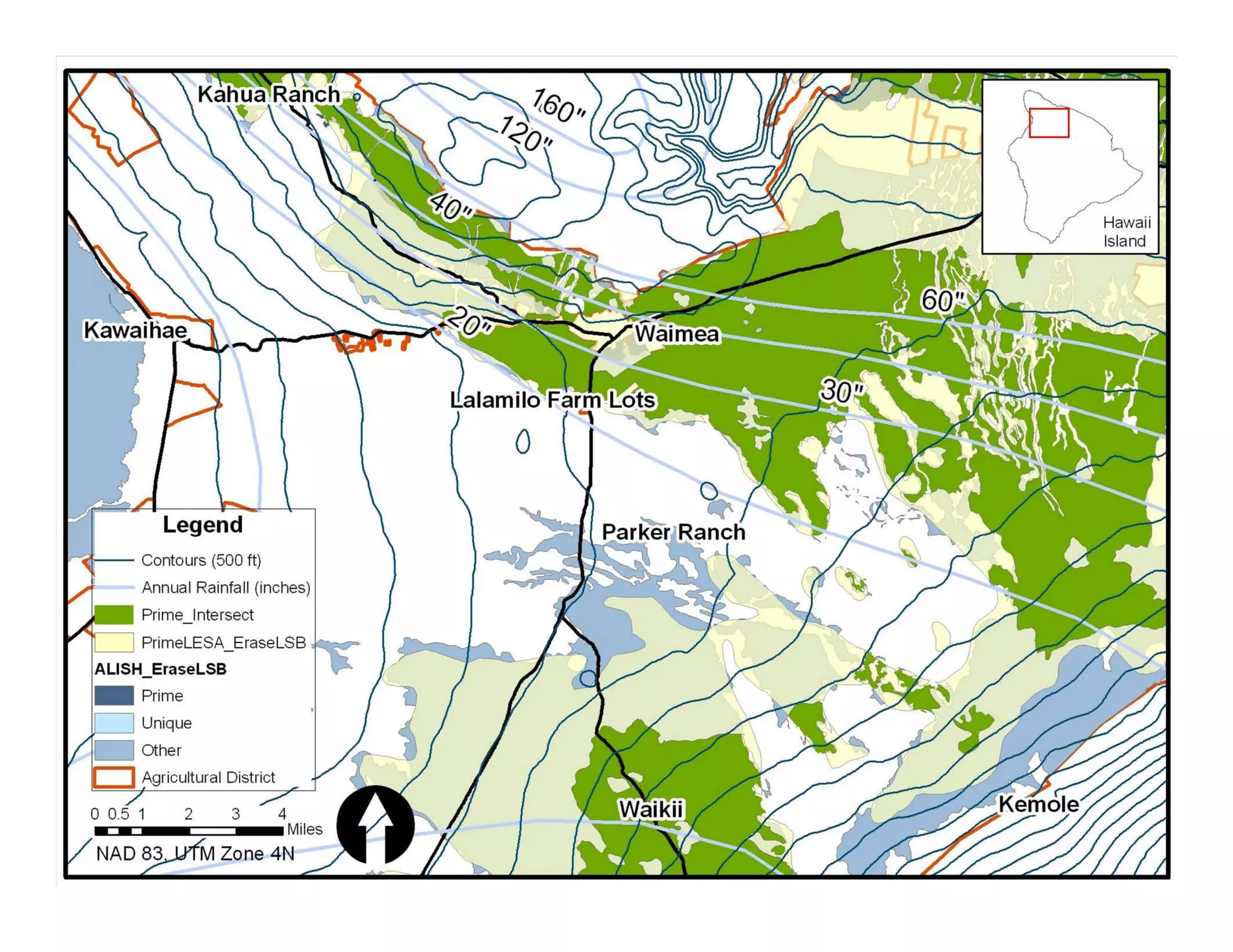
    22. Only 9% of LSB Prime lands are not included in ALISH or LESA So let s see where all the systems intersect let’s to see what lands they all agree could be IAL
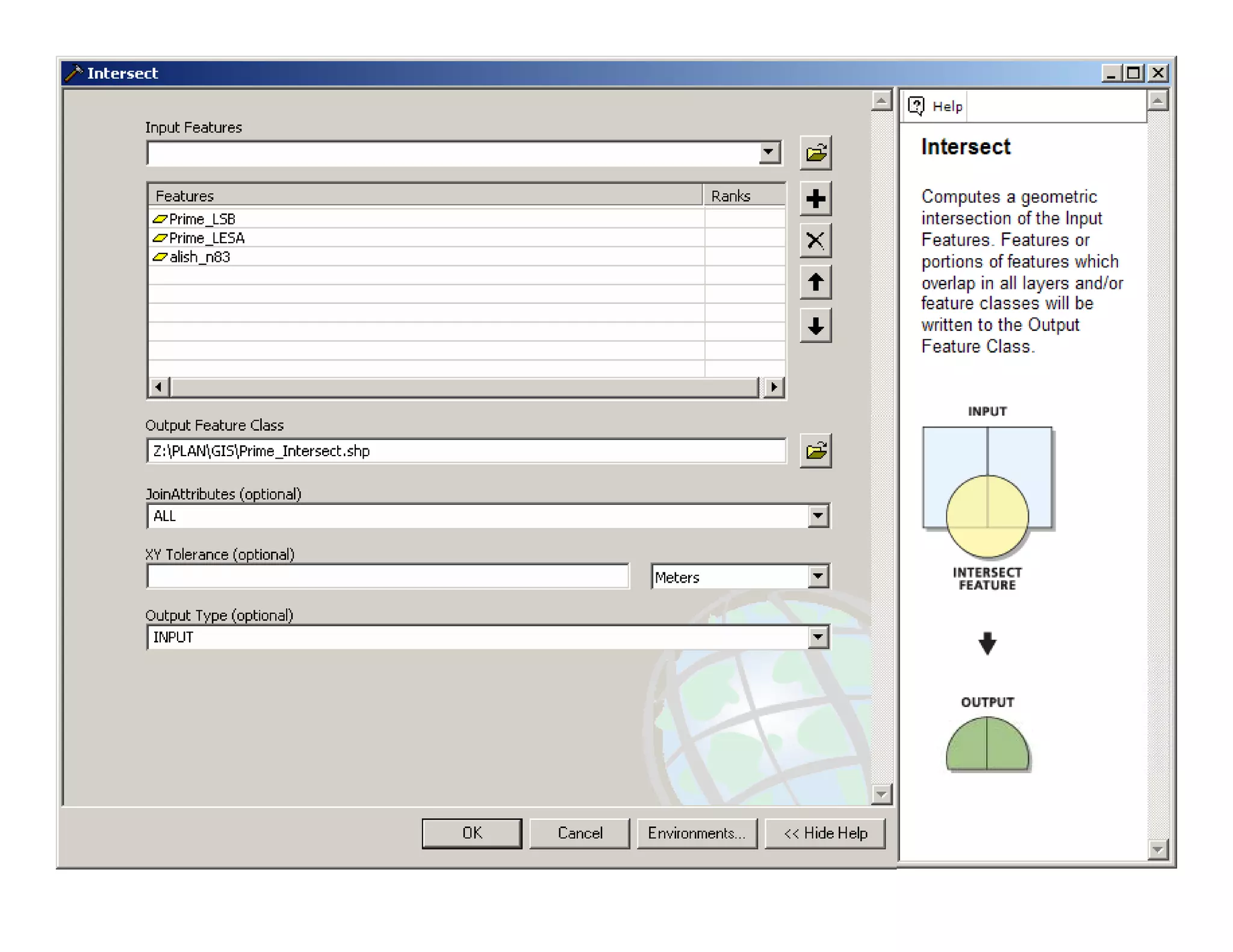
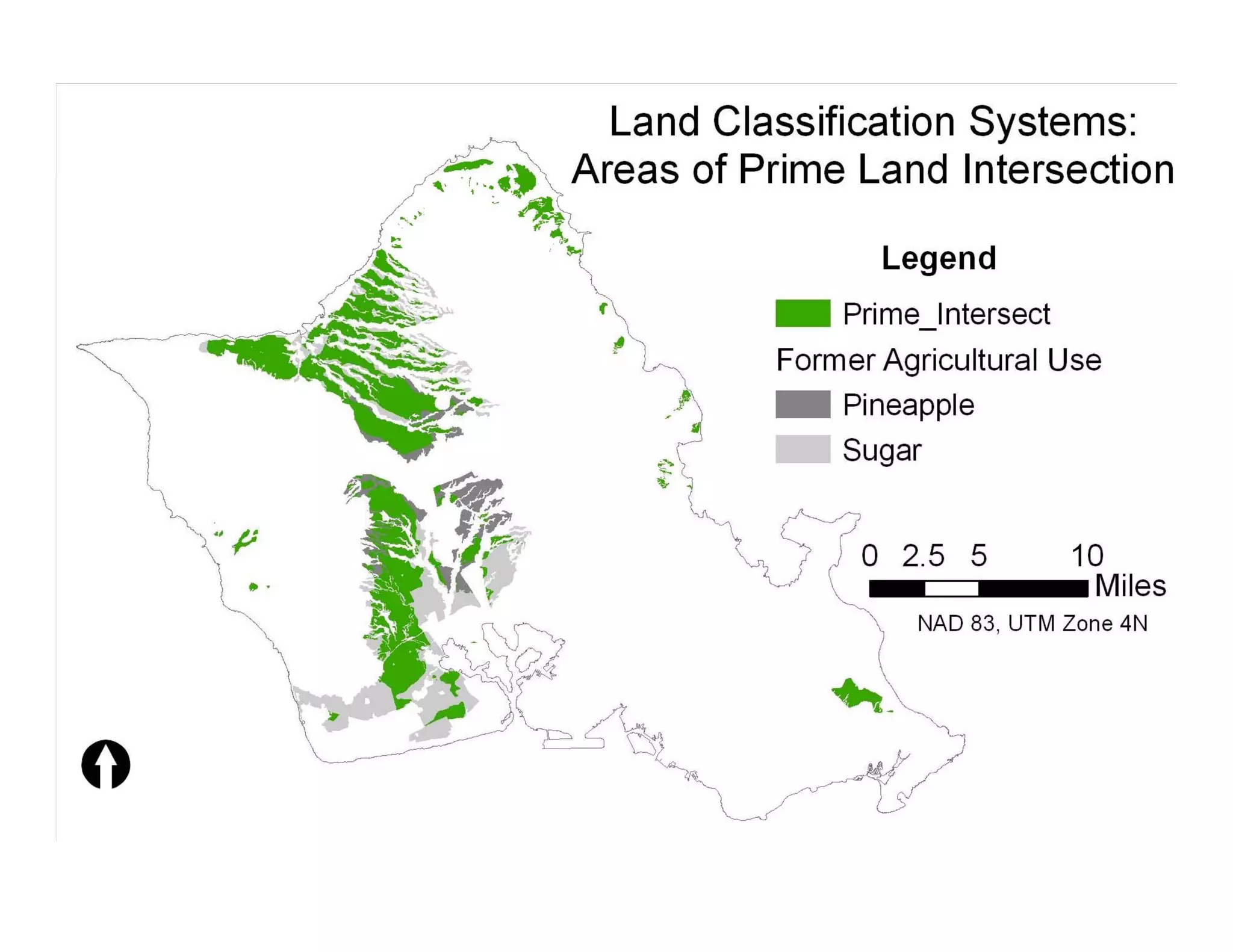
    23. Intersections
    24. Areas of Intersection
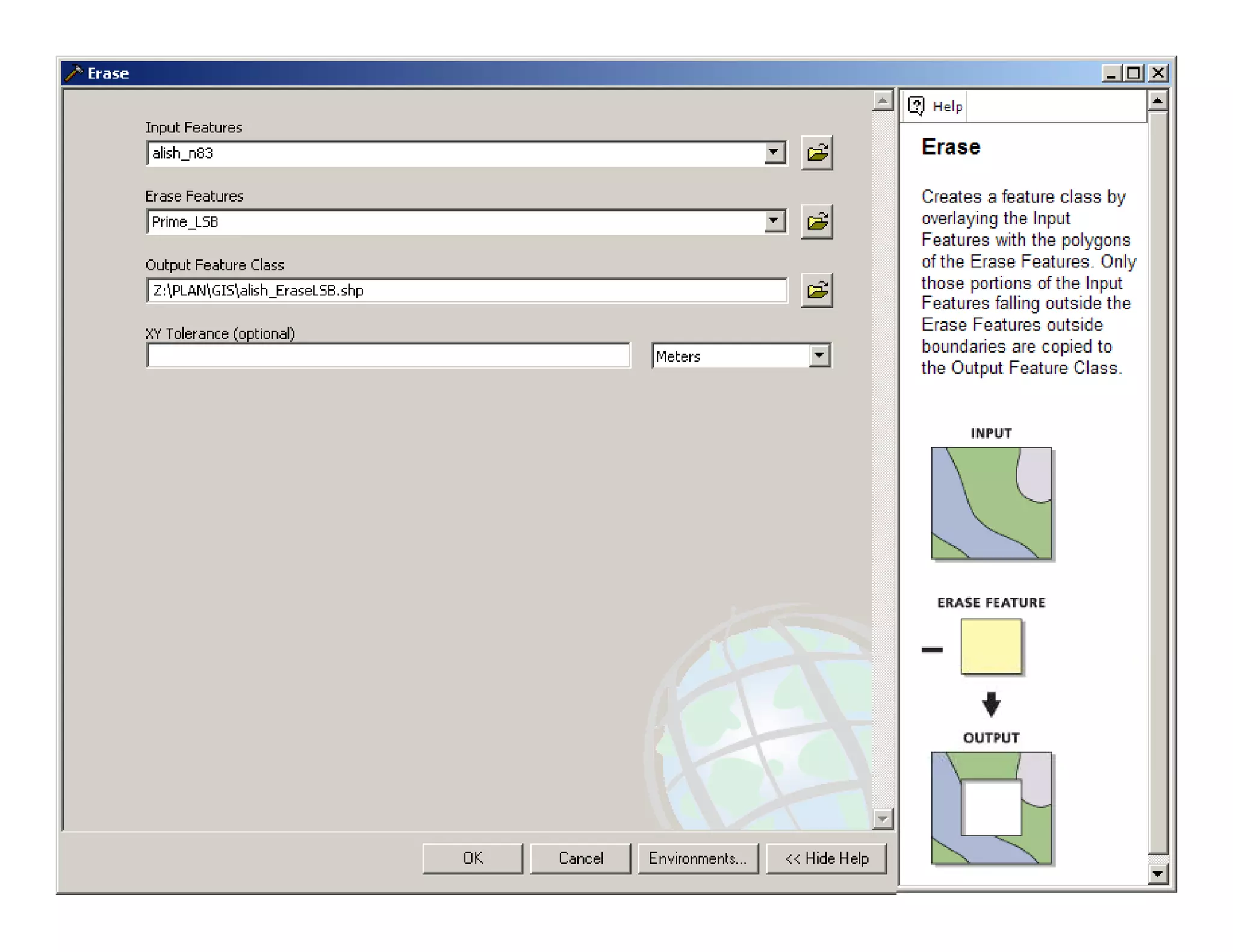
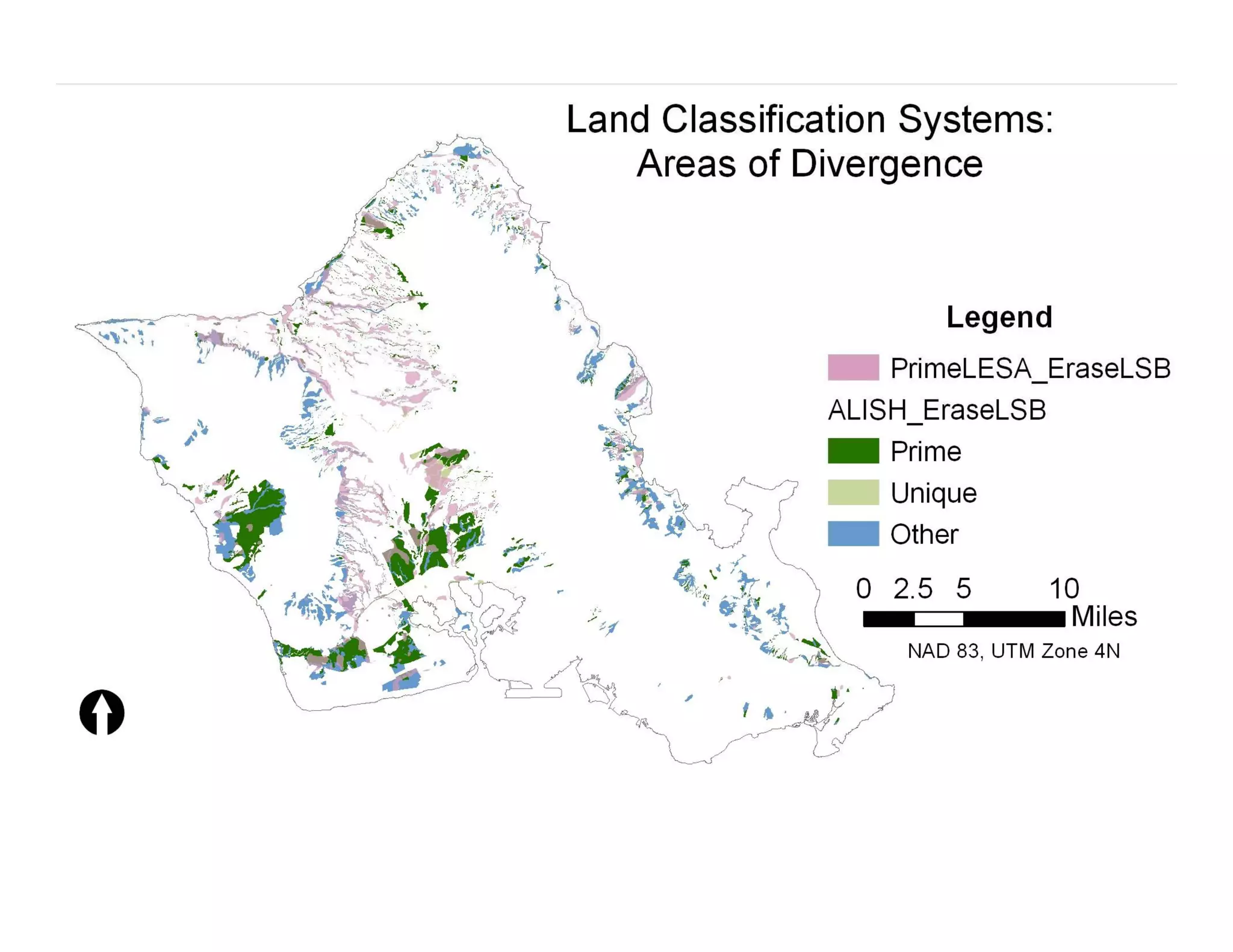
    25. Divergence
    26. Areas of Divergence
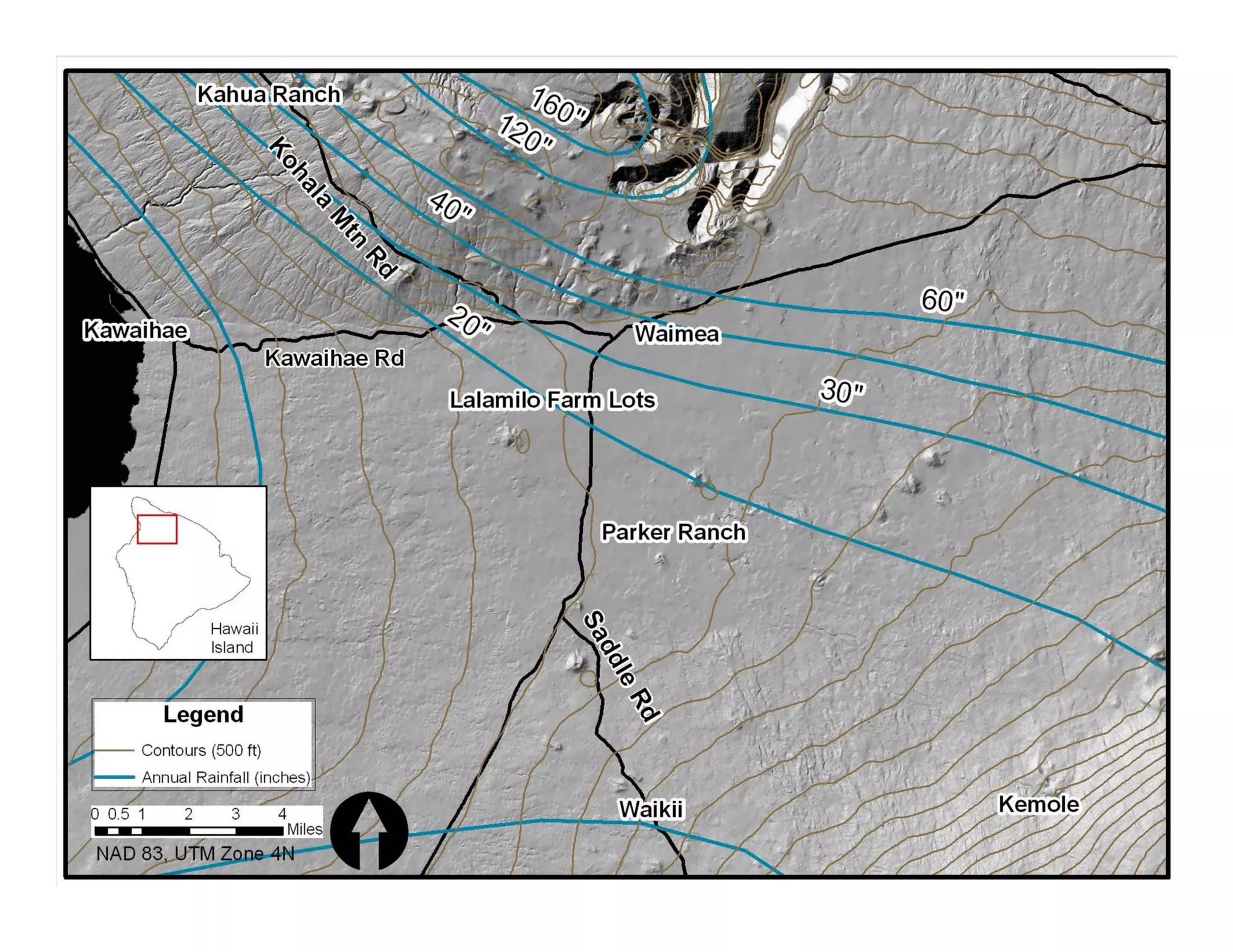
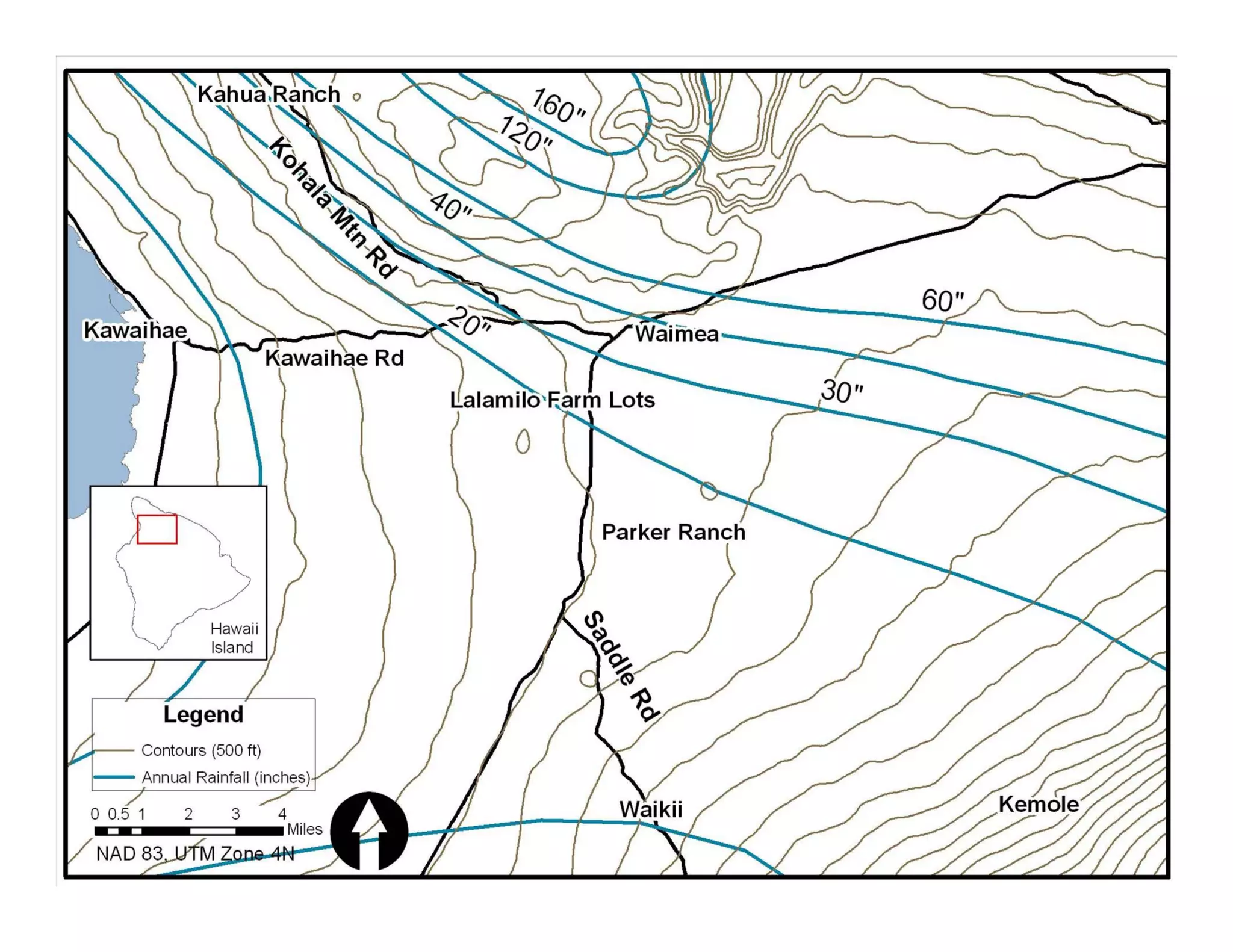
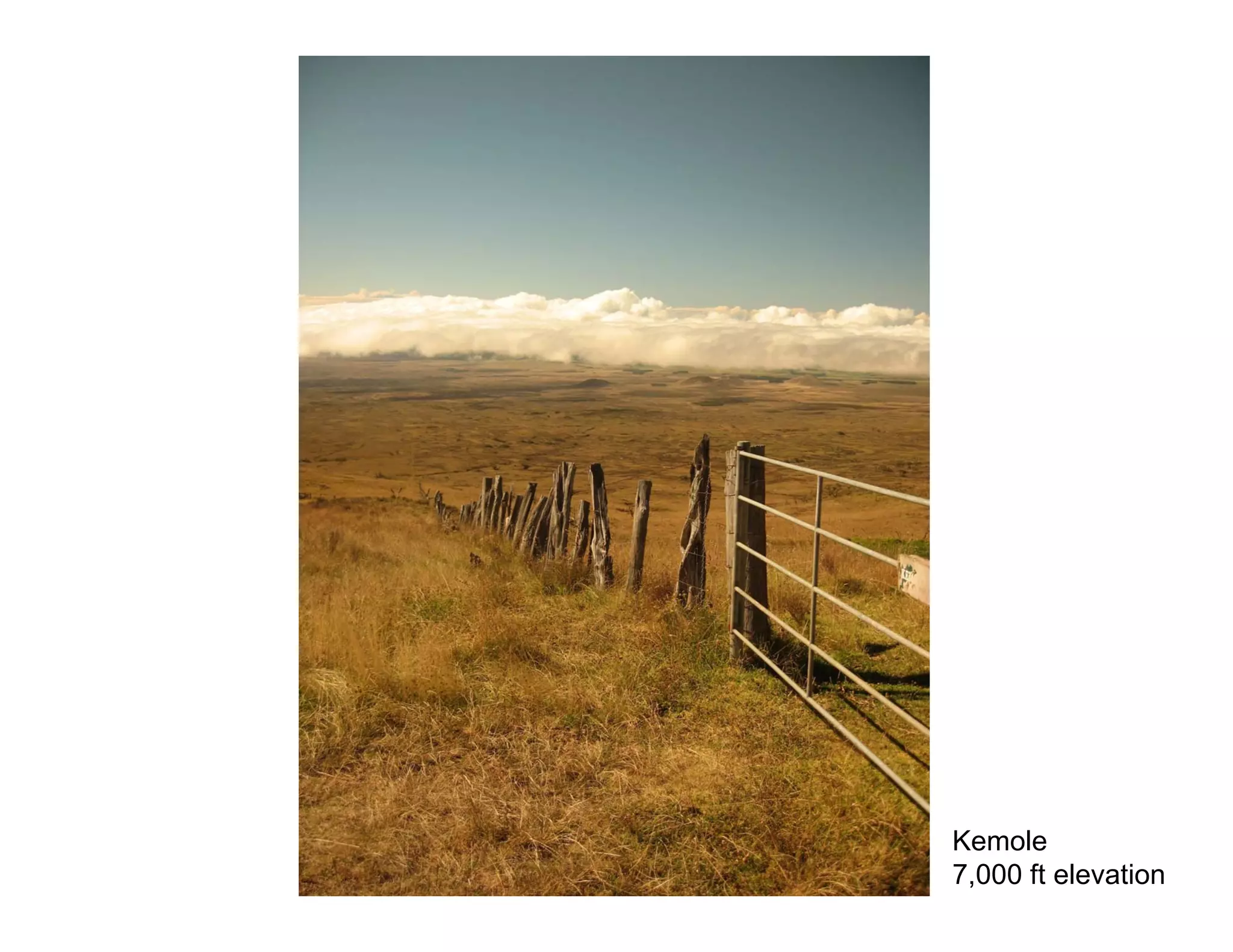
    27. Kemole 7,000 ft elevation
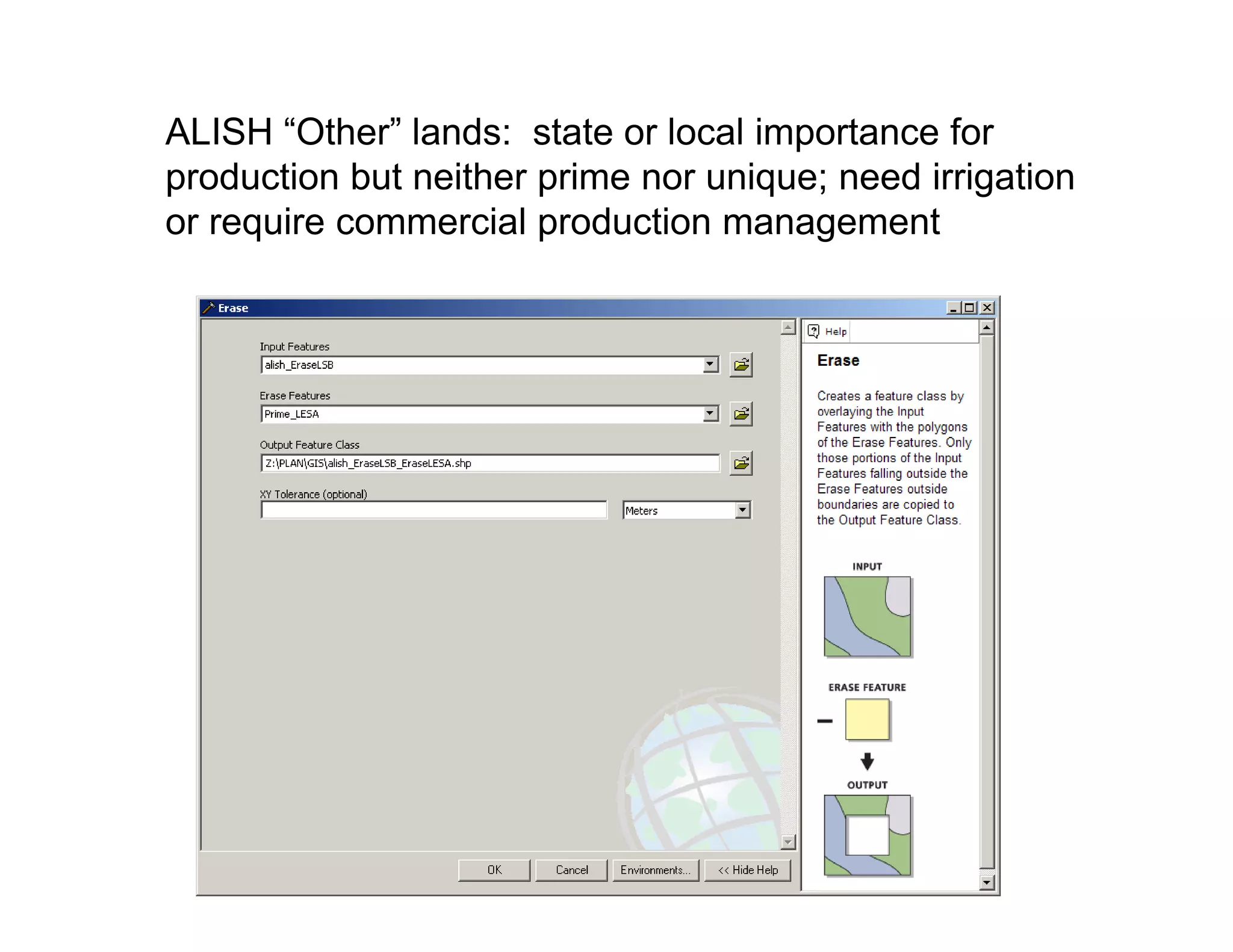
    28. ALISH “Other” lands: state or local importance for production but neither prime nor unique; need irrigation or require commercial production management
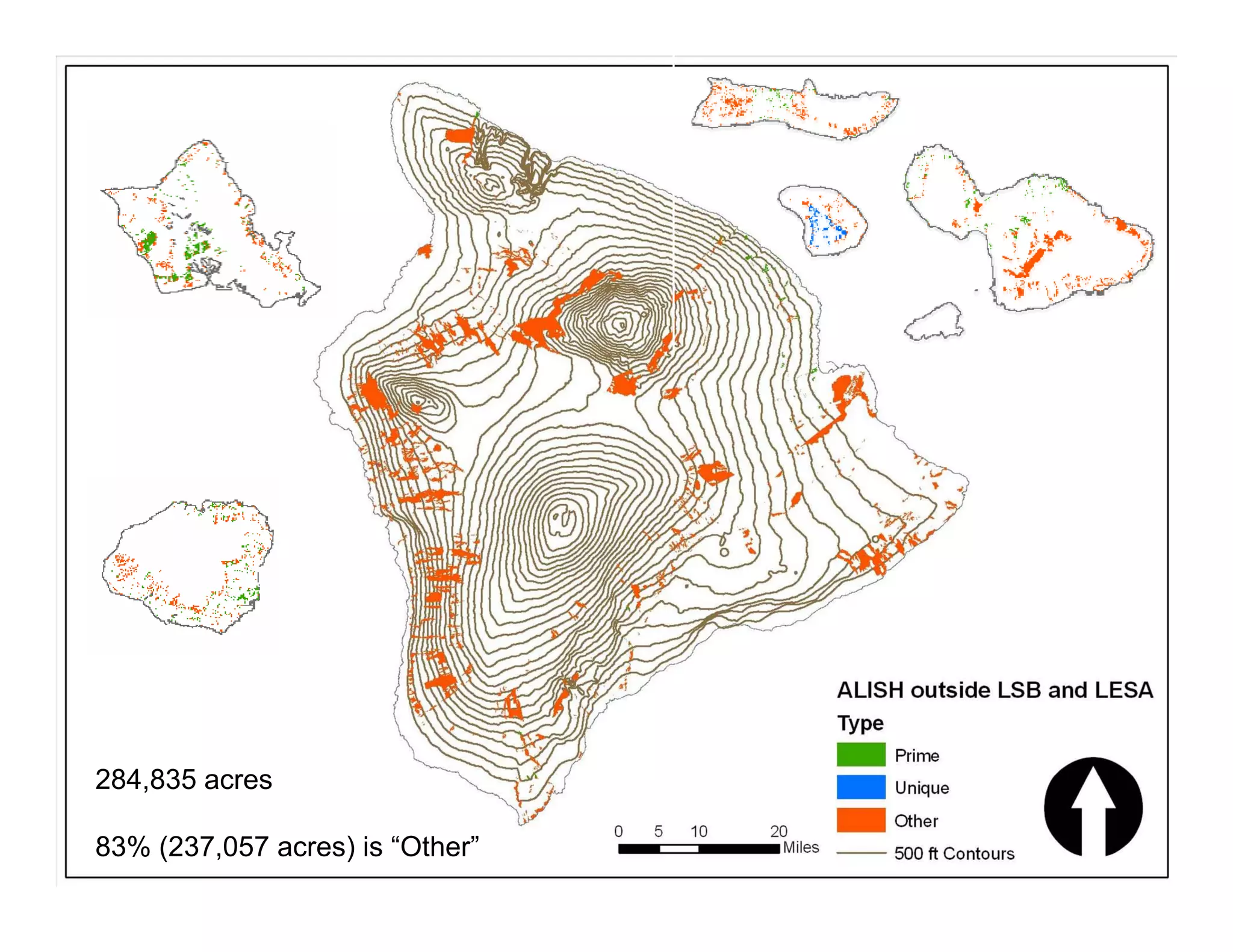
    29. 284,835 284 835 acres 83% (237,057 acres) is “Other”
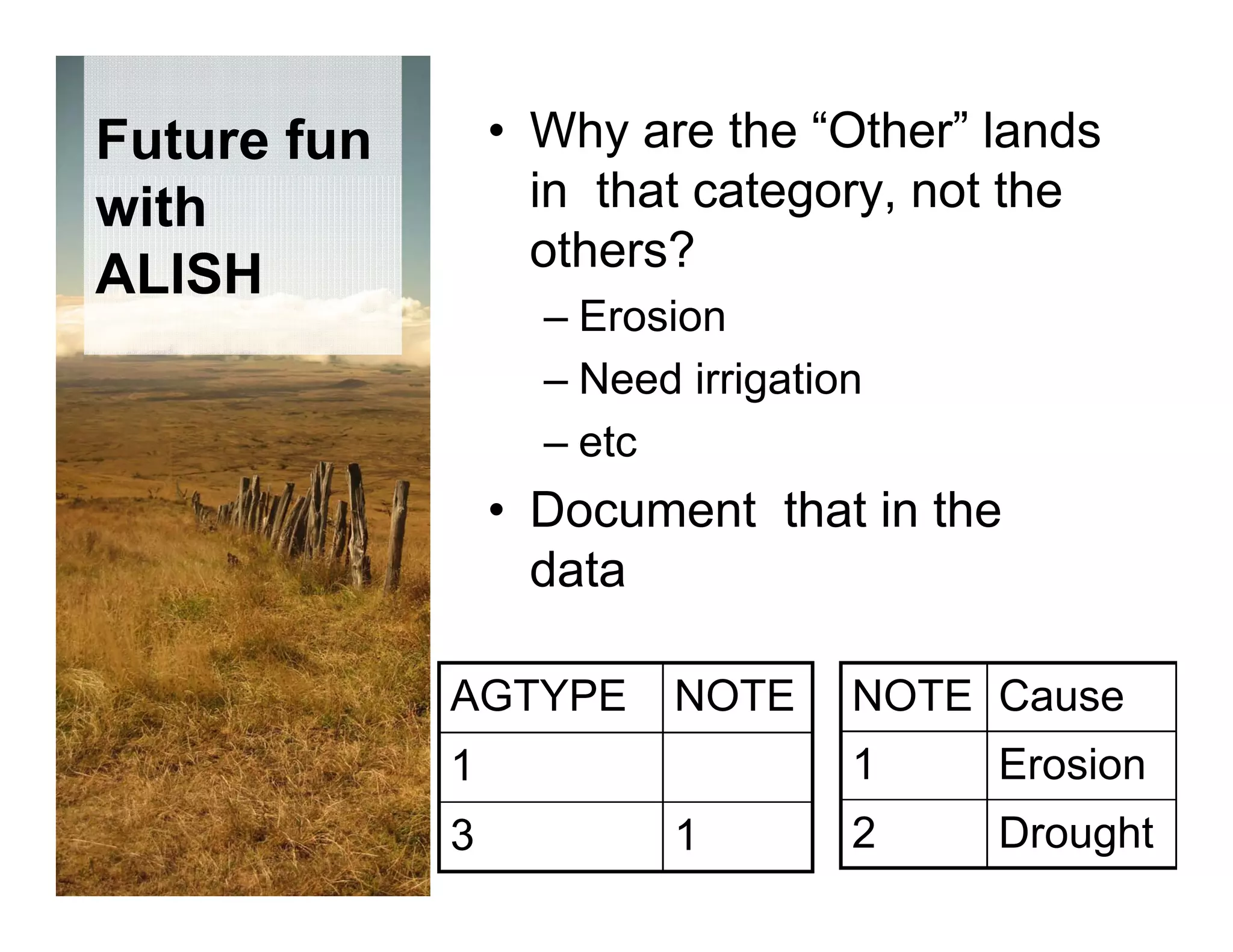
    30. Future fun • Why are the “Other” lands with in that t i th t category, not the t th others? ALISH – Erosion – Need irrigation – etc • Document that in the data AGTYPE NOTE NOTE Cause 1 1 Erosion 3 1 2 Drought
    31. What s What’s the point?
    32. Amount of land rated suitable for agriculture 2,500,000 2,000,000 1,500,000 Acres 1,000,000 1 000 000 500,000 0 LSB LESA ALISH All Prime Lands Prime Land State Agricultural Intersections District Agricultural Land Rating System
    33. State Land Use Districts Rural R l Rural Urban 0.3% Urban 0.3% 5% 5% Other 35% Agriculture Conservation Conservation 29% Conservation Agriculture 48% 48% 66% 47% IAL 17% Current Districts LESA Commission Why not? Recommendations
    34. Questions Q ti Comments Discussion Thank you

    custom

    285 views, 0 favs, 2 embeds more stats

    Agricultural land classification systems in Hawaii

    More info about this document

    © All Rights Reserved

    Go to text version

    • Total Views 285
      • 282 on SlideShare
      • 3 from embeds
    • Comments 0
    • Favorites 0
    • Downloads 8
    Most viewed embeds
    • 2 views on http://higicc.camp8.org
    • 1 views on https://www.mturk.com

    more

    All embeds
    • 2 views on http://higicc.camp8.org
    • 1 views on https://www.mturk.com

    less

    Flagged as inappropriate Flag as inappropriate
    Flag as inappropriate

    Select your reason for flagging this presentation as inappropriate. If needed, use the feedback form to let us know more details.

    Cancel
    File a copyright complaint
    Having problems? Go to our helpdesk?

    Categories