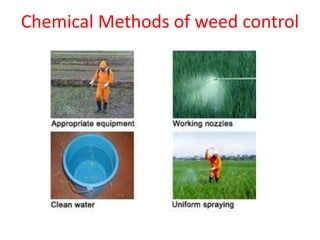
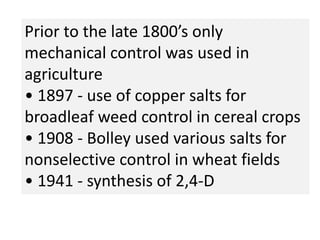
Chemical Methods of weed control
In chemical weed control, chemicals called
herbicides are used to kill certain plants or inhibit their
growth.
Chemical weed control is an option in integrated
weed management that refers to the integrated use of
cultural, manual, mechanical and/or chemical control
methods.
Herbicide selectivity and its dose, time and method
of application are of paramount
importance/consideration before applying to a crop.
What is Chemical or Herbicide Weed Control?
Prior to the late 1800’s only
mechanical control was used in
agriculture
• 1897 - use of copper salts for
broadleaf weed control in cereal crops
• 1908 - Bolley used various salts for
nonselective control in wheat fields
• 1941 - synthesis of 2,4-D
Time marches on
• 1944 - selective nature of 2,4-D discovered on
dandelion
• 1945 - value of pre-emergent weed control
established
• 1945 until today dramatic proliferation of
orgnanic pesticide (over 2500 active ingredients
labeled and marketed) formulations (lost count)
i) Herbicide is the most potent single tool towards weed management if
used judiciously on the prescribed guidelines. It on global basis has the
highest consumption, production and market share among all pesticides.
ii) Herbicides particularly pre-emergence ones control weeds right from the
beginning of their germination and thus prove to be more efficient than
many other methods of weed control.
iii) Herbicides can control weeds having morphology similar to crop plants,
e.g. Phalaris minor, Avena fatua/ludoviciana, Lolium temulentum etc in
winter cereals like wheat, barley and cultivated oat easily and efficiently
than other methods.
This is revealed when they come to flower by means of the difference in their
inflorescence.
iv) Most herbicides prove to be more economical than mechanical & manual
methods particularly where manual labourer costs higher.
Usefulness of chemical method/Herbicides
V) They can substitute mechanical control of weeds in many
situations and hence reduce mechanical damage (stalk
breakage, lodging, up-rooting, root damage, etc) to crops.
vi) They control weeds where other methods is difficult to
execute, e.g. in wet & marshy soils under humid conditions,
within or between narrow-rows of crops.
vii) Herbicides prove to be the most important tool for weed
management under minimum and zero tillage. Similarly under
tilled conditions, the number of tillage could be reduced by
applying herbicides, and thus they save labour and energy.
viii) They offer greater flexibility/resilience on the choice of crop
management system. For example, using herbicide one needs
not to depend much on crop rotation, intercropping etc towards
weed management.
Usefulness of chemical method/Herbicides
Limitations of chemical method/herbicides
i) Herbicides may cause inadvertent/unintentional injury to crop and other non-
target vegetation in an area by faulty application techniques (using inappropriate
herbicide, its dose & spray volume, spraying in windy days, etc).
It is even true for a good selective herbicide since selectivity is crop-specific, climate-
and soil-specific, dose-dependent and dependent on time and method of
application, etc.
ii) Most herbicides are narrow-window ones (i.e. window of application is narrow).
This dictates that they, except their requisite time of application, cannot be applied
at any time or at any growth stages of crop like insecticides or fungicides seeing
incidence of the pests.
Once that time of application elapses or is over, their selectivity margin goes down
and prove risky for application in that crop. On the contrary, wider window herbicides,
which could be applied all through the growth stages of a crop, are rarely available in
the world.
iii) Many herbicides are narrow-spectrum ones (i.e. the spectrum of weed kill is
narrow).
In fact, no herbicide gives 100% control not because of herbicide per se but for
other factors, e.g. weed species variation and tolerance, spray techniques
(volume rates, sprayer type, degree of spray overlapping, etc.), soil condition
(moisture, organic matter content, temperature, etc.) and climatic condition
(temperature, relative humidity, sunshine, etc.), which readily interact with
herbicide.
iv) Chemical method may be less economic under small and fragmented
holdings of the farmers.
v) It poses high risk towards adoption in crops particularly by illiterate farmers.
Proper technical know-how of the herbicide is the pre-requisite for its
application to crop to ensure crop safety..
Limitations of chemical method/herbicides
vi) Herbicide residues left in soil may cause soil and water pollution concurrently or
in the long run. Residues of atrazine has been detected in the well water long back in
USA, in ground water at IARI, New Delhi (personal communication) and long
continued use of paraquat, a non-residual herbicide caused havoc phytotoxicity in
Thailand (Fryer et. al., 1975).
vii) Herbicides may pose toxicity to other non-target organisms such as soil micro-
flora and micro-fauna, vertebrate animals and crops grown in succession. Atrazine
applied to maize has been found phytotoxic to wheat grown in rotation and similarly
metribuzin at 0.5 kg/ha in sandy loam soil caused phytotoxicity to wheat (personal
communication).
viii) They may be the cause for concern and threat on their long and continued use to
human health and safety.
ix) Continuous use of herbicides particularly narrow-spectrum ones may cause weed
flora shift. For example, continuous use of benthiocarb in rice-field has resulted in
spontaneous increase in the population of broad-leaved weeds like Monochoria
vaginalis (Burm) and Sphenoclea zeylanica Gaertn. (Mukhopadhyay, 1992; Raju,
1998).
Speedy proliferation of Ischaemum rugosum in rice has happened mainly due to
uninterrupted use of butachlor..
Limitations of chemical method/herbicides
The broad-leaved weed domination in wheat has changed to grass weed (Avena
ludoviciana and Phalaris minor) domination due to continuous use of 2,4-D or other
phenoxyalkanoic acids in the world (Crafts, 1975). Several broad-leaved weeds and
sedges have, of late, become very important in the crop fields due to continuous use of
predominantly grass killer herbicides (ISWS, 2000).
x) Continuous use of the same herbicides or group of herbicides having similar mode of
action may cause insurgence of herbicide-resistant weeds (Urech et. al., 1997). The same
reason applies to Phalaris minor developed resistance to isoproturon in India (Malik and
Malik, 1994; Malik et. al., 1995; Yaduraju and Singh, 1997).
xi) Continuous use of broad-spectrum herbicides in crop-fields may cause preponderance
of perennial weeds in the long run.
Cyperus rotundus and Cynodon dactylon problem under high herbicide-used zero tillage;
Cynodon dactylon, Cyperus rotundus, Sorghum halepense, Sacchurum spontaneum L.
infesting large areas of field crops (Mukhopadhyay, 1992); and Cirsium arvense and
Convolvulus arvensis preponderance in wheat in parts of Punjab and 35
Haryana (Singh et. al., 1992) are good examples.
NEARLY 400 HERBICIDES HAVE BEEN
DEVELOPED UNDER DIFFERENT
CHEMICAL FAMILIES/CLASSES. THEY
DIFFER WIDELY IN THEIR PHYSICAL,
CHEMICAL AND BIOLOGICAL
PROPERTIES.
HERBICIDE CLASSIFICATION
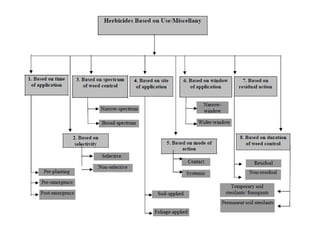
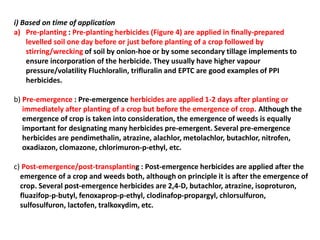
i) Based on time of application
a) Pre-planting : Pre-planting herbicides (Figure 4) are applied in finally-prepared
levelled soil one day before or just before planting of a crop followed by
stirring/wrecking of soil by onion-hoe or by some secondary tillage implements to
ensure incorporation of the herbicide. They usually have higher vapour
pressure/volatility Fluchloralin, trifluralin and EPTC are good examples of PPI
herbicides.
b) Pre-emergence : Pre-emergence herbicides are applied 1-2 days after planting or
immediately after planting of a crop but before the emergence of crop. Although the
emergence of crop is taken into consideration, the emergence of weeds is equally
important for designating many herbicides pre-emergent. Several pre-emergence
herbicides are pendimethalin, atrazine, alachlor, metolachlor, butachlor, nitrofen,
oxadiazon, clomazone, chlorimuron-p-ethyl, etc.
c) Post-emergence/post-transplanting : Post-emergence herbicides are applied after the
emergence of a crop and weeds both, although on principle it is after the emergence of
crop. Several post-emergence herbicides are 2,4-D, butachlor, atrazine, isoproturon,
fluazifop-p-butyl, fenoxaprop-p-ethyl, clodinafop-propargyl, chlorsulfuron,
sulfosulfuron, lactofen, tralkoxydim, etc.
ii) Based on selectivity
a) Selective : The herbicide which kills selectively a particular
species/group of plants (weeds) in a mixed stand/population
of plants (crop and weeds) is called a selective one
All pre-planting, pre-emergence and post-emergence herbicides
meant for application in crops are selective ones.
b) Non-selective :The herbicide which kills indiscriminately
species/group of plants irrespective of weeds and crop is called
a non-selective one.
Paraquat, glyphosate, glufosinate-ammonium, acrolein,
picloram, amitrole, chlorfenac/fenac, metham, sodium chlorate
(NaClO3) are examples of non-selective herbicides
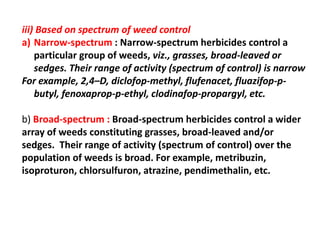
iii) Based on spectrum of weed control
a) Narrow-spectrum : Narrow-spectrum herbicides control a
particular group of weeds, viz., grasses, broad-leaved or
sedges. Their range of activity (spectrum of control) is narrow
For example, 2,4–D, diclofop-methyl, flufenacet, fluazifop-p-
butyl, fenoxaprop-p-ethyl, clodinafop-propargyl, etc.
b) Broad-spectrum : Broad-spectrum herbicides control a wider
array of weeds constituting grasses, broad-leaved and/or
sedges. Their range of activity (spectrum of control) over the
population of weeds is broad. For example, metribuzin,
isoproturon, chlorsulfuron, atrazine, pendimethalin, etc.
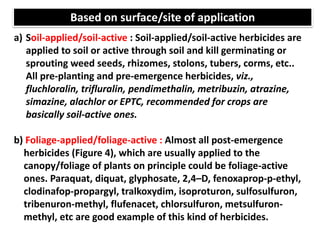
a) Soil-applied/soil-active : Soil-applied/soil-active herbicides are
applied to soil or active through soil and kill germinating or
sprouting weed seeds, rhizomes, stolons, tubers, corms, etc..
All pre-planting and pre-emergence herbicides, viz.,
fluchloralin, trifluralin, pendimethalin, metribuzin, atrazine,
simazine, alachlor or EPTC, recommended for crops are
basically soil-active ones.
b) Foliage-applied/foliage-active : Almost all post-emergence
herbicides (Figure 4), which are usually applied to the
canopy/foliage of plants on principle could be foliage-active
ones. Paraquat, diquat, glyphosate, 2,4–D, fenoxaprop-p-ethyl,
clodinafop-propargyl, tralkoxydim, isoproturon, sulfosulfuron,
tribenuron-methyl, flufenacet, chlorsulfuron, metsulfuron-
methyl, etc are good example of this kind of herbicides.
Based on surface/site of application
Based on mode of action
Contact (but limited/restricted mobility) : Contact herbicides on
principle should control weeds by means of contact with
germinating seeds, radicles/roots and/or plumules/shoots
/foliages. However, contact herbicides are not purely contact in
nature. They have at least some degree of mobility, may be
restricted within a leaf, a petiole etc. Bromoxynil, ioxynil,
paraquat, diquat, propanil are ideal examples of contact
herbicides.
b) Translocated/systemic : Translocated herbicides move from
the site of application (soil, plant foliage) to site of action, where
they inhibit/jeopardize a particular or a number of bio-chemical
reactions and bring about the ultimate herbicidal effect. For
example, pendimethalin, trifluralin, fluchloralin, 2,4–D,
isoproturon, glyphosate, glufosinate-ammonium, atrazine,
metribuzin, nitrofen, etc.
a) Narrow-window herbicide : Narrow-window herbicides have length/range of
time of application highly reduced/limited to just before sowing or from sowing
to before emergence of crop or at a specific time after crop emergence as post-
emergence. They are, therefore, pre-planting, pre-emergence or post-emergence
herbicides, e.g. trifluralin, fluchloralin, pendimethalin, fenoxaprop-p-ethyl,
clodinafop-propargyl, sulfosulfuron, tralkoxydim etc. Once a crop is left untreated
at the specified period, almost all these herbicides cannot be used again in other
growth stages of that crop.
b) Wider-window herbicide : Wider-window herbicides as desired should have
length/range of time span of application wider, for example, from before sowing
or after sowing to longer period of crop growth may be up to 40 days after
emergence of crop in certain cases. They, therefore, are herbicides with extended
period of activity along the crop growth cycle. In fact, there is hardly any
herbicide in the world today, which is wider-window in true sense. Atrazine and
butachlor because of their pre- and post-emergence activities may loosely be
held as wider-window herbicides. Chlorimuron-p-ethyl can be used as PPI, pre-
emergence or post-emergence in a few crops particularly soybean and may be
assumed to be a wider-window herbicide for soybean.
vi) Based on window of application
Based on residual action in soil
a) Non-residual : Non-residual herbicides usually leave no or less
residue in soil and get quickly inactivated or metabolized upon
falling in soil. They do not have extended period of activity in soil.
Paraquat, diquat, glyphosate, clodinafop-propargyl, DSMA and
amitrole are non-residual herbicides. Amitrole has both symplastic
and apoplastic movement.
b) Residual : Residual herbicides after application usually maintain
their phytotoxic effect in soil for a considerable period of time but
not the whole crop growing season. Therefore, they offer good
control of weeds in crops for sufficient period at least for the
critical period of weed competition. Atrazine, pendimethalin,
isoproturon, fluchloralin, trifluralin, 2,4-D, metribuzin, simazine,
alachlor, EPTC – all are residual ones.
a) Temporary soil sterilant/fumigant : Temporary soil sterilants
sterilize the soil for relatively short period of time usually for
15-16 weeks. They are basically fumigants. High volatility is
always preferred for fumigant’s action. Methyl bromide (MB),
metham (vapum®), carbon disulfide (CS2), chlorfenac,
chloropicrin/tear gas (CCl3NO2), methyl isothiocyanate,
dazomet (DMTT) are good examples of temporary soil
sterilant or fumigant.
b) Permanent soil sterilant : Permanent soil sterilants remain
active in soil for relatively long period of time, sometimes for
two or more seasons/years. Triazines, phenylureas (e.g. linuron)
or sodium chlorate (NaClO3) at very high dose act as permanent
soil sterilant. They are recommended mainly for industrial and
non-crop areas.
Based on duration of weed control (mainly under non-crop situation)
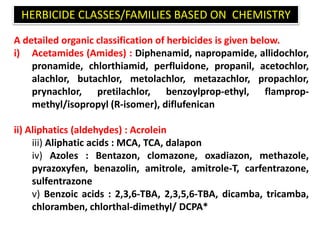
A detailed organic classification of herbicides is given below.
i) Acetamides (Amides) : Diphenamid, napropamide, allidochlor,
pronamide, chlorthiamid, perfluidone, propanil, acetochlor,
alachlor, butachlor, metolachlor, metazachlor, propachlor,
prynachlor, pretilachlor, benzoylprop-ethyl, flamprop-
methyl/isopropyl (R-isomer), diflufenican
ii) Aliphatics (aldehydes) : Acrolein
iii) Aliphatic acids : MCA, TCA, dalapon
iv) Azoles : Bentazon, clomazone, oxadiazon, methazole,
pyrazoxyfen, benazolin, amitrole, amitrole-T, carfentrazone,
sulfentrazone
v) Benzoic acids : 2,3,6-TBA, 2,3,5,6-TBA, dicamba, tricamba,
chloramben, chlorthal-dimethyl/ DCPA*
HERBICIDE CLASSES/FAMILIES BASED ON CHEMISTRY
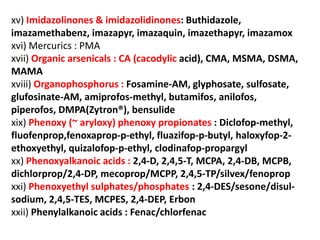
xv) Imidazolinones & imidazolidinones: Buthidazole,
imazamethabenz, imazapyr, imazaquin, imazethapyr, imazamox
xvi) Mercurics : PMA
xvii) Organic arsenicals : CA (cacodylic acid), CMA, MSMA, DSMA,
MAMA
xviii) Organophosphorus : Fosamine-AM, glyphosate, sulfosate,
glufosinate-AM, amiprofos-methyl, butamifos, anilofos,
piperofos, DMPA(Zytron®), bensulide
xix) Phenoxy (~ aryloxy) phenoxy propionates : Diclofop-methyl,
fluofenprop,fenoxaprop-p-ethyl, fluazifop-p-butyl, haloxyfop-2-
ethoxyethyl, quizalofop-p-ethyl, clodinafop-propargyl
xx) Phenoxyalkanoic acids : 2,4-D, 2,4,5-T, MCPA, 2,4-DB, MCPB,
dichlorprop/2,4-DP, mecoprop/MCPP, 2,4,5-TP/silvex/fenoprop
xxi) Phenoxyethyl sulphates/phosphates : 2,4-DES/sesone/disul-
sodium, 2,4,5-TES, MCPES, 2,4-DEP, Erbon
xxii) Phenylalkanoic acids : Fenac/chlorfenac
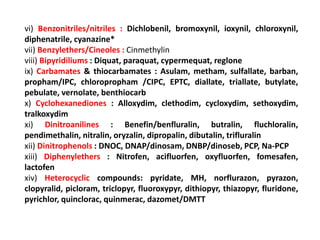
vi) Benzonitriles/nitriles : Dichlobenil, bromoxynil, ioxynil, chloroxynil,
diphenatrile, cyanazine*
vii) Benzylethers/Cineoles : Cinmethylin
viii) Bipyridiliums : Diquat, paraquat, cypermequat, reglone
ix) Carbamates & thiocarbamates : Asulam, metham, sulfallate, barban,
propham/IPC, chloropropham /CIPC, EPTC, diallate, triallate, butylate,
pebulate, vernolate, benthiocarb
x) Cyclohexanediones : Alloxydim, clethodim, cycloxydim, sethoxydim,
tralkoxydim
xi) Dinitroanilines : Benefin/benfluralin, butralin, fluchloralin,
pendimethalin, nitralin, oryzalin, dipropalin, dibutalin, trifluralin
xii) Dinitrophenols : DNOC, DNAP/dinosam, DNBP/dinoseb, PCP, Na-PCP
xiii) Diphenylethers : Nitrofen, acifluorfen, oxyfluorfen, fomesafen,
lactofen
xiv) Heterocyclic compounds: pyridate, MH, norflurazon, pyrazon,
clopyralid, picloram, triclopyr, fluoroxypyr, dithiopyr, thiazopyr, fluridone,
pyrichlor, quinclorac, quinmerac, dazomet/DMTT
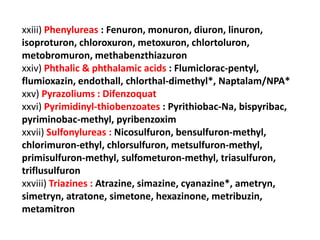
xxiii) Phenylureas : Fenuron, monuron, diuron, linuron,
isoproturon, chloroxuron, metoxuron, chlortoluron,
metobromuron, methabenzthiazuron
xxiv) Phthalic & phthalamic acids : Flumiclorac-pentyl,
flumioxazin, endothall, chlorthal-dimethyl*, Naptalam/NPA*
xxv) Pyrazoliums : Difenzoquat
xxvi) Pyrimidinyl-thiobenzoates : Pyrithiobac-Na, bispyribac,
pyriminobac-methyl, pyribenzoxim
xxvii) Sulfonylureas : Nicosulfuron, bensulfuron-methyl,
chlorimuron-ethyl, chlorsulfuron, metsulfuron-methyl,
primisulfuron-methyl, sulfometuron-methyl, triasulfuron,
triflusulfuron
xxviii) Triazines : Atrazine, simazine, cyanazine*, ametryn,
simetryn, atratone, simetone, hexazinone, metribuzin,
metamitron
xxix) Triazolopyrimidine sulfonanilides :
Flumetsulam/DE 498, cloransulam-methyl,
dicosulam, metosulam
xxx) Uracils : Bromacil, isocil, lenacil, terbacil
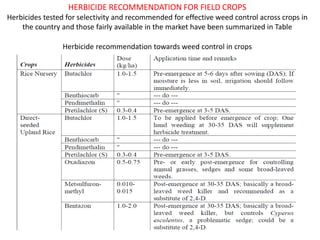
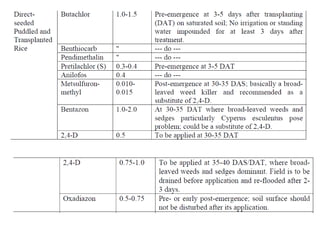
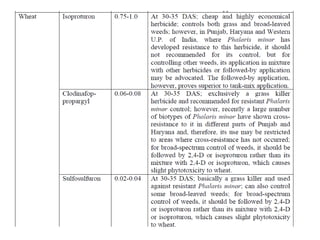
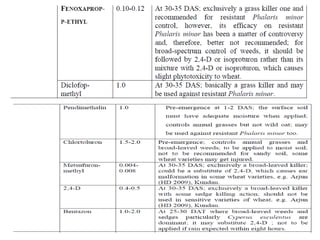
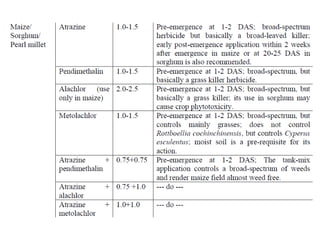
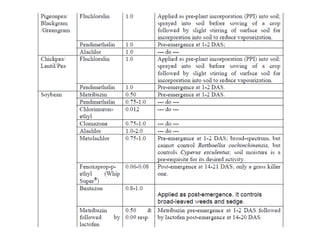
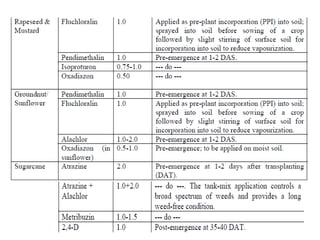
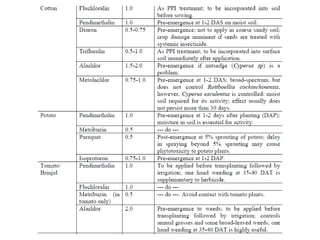
HERBICIDE RECOMMENDATION FOR FIELD CROPS
Herbicides tested for selectivity and recommended for effective weed control across crops in
the country and those fairly available in the market have been summarized in Table
Herbicide recommendation towards weed control in crops
The chemical method albeit proved more promising, has led to
many problems such as weed flora shift, insurgence of herbicide-
resistant weeds,
Gradual population built-up/preponderance of perennial weeds
and inhibition in growth of non-target micro-flora besides residue
problem in environment and marked reduction in tillage practice.
 Even the spectrum of weeds killed by herbicides, in most cases, is
narrow.
Herbicide, therefore, cannot be a sole and fool-proof strategy.
Problems associated with chemical weed management
Thus, no single method, e.g. manual & mechanical,
biological or chemical, could reach to the desired
level of weed control efficiency in certain location or
across locations mainly because of the vast diversity
of weeds in crop fields.
IWM is a method whereby all economically,
ecologically and toxicologically justifiable methods
are employed to keep the harmful organisms below
the threshold level of economic damage, keeping in
the foreground the conscious employment of
natural limiting factors (Jaya Kumar and
Jagannathan, 2003).
Integrated weed management
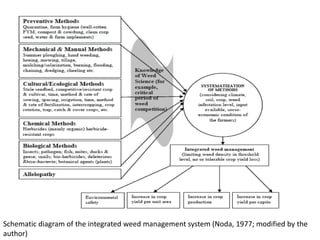
The concept is that it uses a variety of technologies in a single weed
management with the objective to produce optimum crop yield at a
minimum cost taking into consideration ecological and socio-
economic constraints under a given eco-system.
It is thus a more holistic approach for weed management in crops
or cropping system combining two or more control methods (Noda,
1977).
Weed biologists’ contributions could be of immense value towards
evaluation of the ecological factors that govern weed abundance,
describe conditions and times when weeds are most vulnerable to
management tactics, providing information to predict accurately the
response of weeds to various controls, and elucidating the
functional links between environment, weeds, crops, and other
species.
Integrated weed management
Schematic diagram of the integrated weed management system (Noda, 1977; modified by the
author)
Weeds need to be controlled from planting until the crop canopy
closes.
ALWAYS READ and FOLLOW the instructions on the product label.
Ensure the product is suited for the type and stage of crop and
weeds to be controlled.
Ensure field conditions are suitable (e.g., some products only work
when the soil is moist, or when there is standing water or no
standing water).
Products are designed for early application when weed control is
most important. Some products are designed to control the weeds
before they emerge (pre-emergence), while others are only
effective after the weeds have emerged (post-emergence).
How to Use Herbicides to Effectively Control Weeds?
Use clean water and fresh water
Uniformly apply product across the field: maintain steady
pressure, a steady walking speed and uniform spray application
action.
Ensure nozzles are functioning and providing uniform output.
Spray products from a height of around 50 cm above the target.
Minimize movement of the product to non-target areas by using
low pressures (< 2 bars), by avoiding applications in very strong
winds and by limiting water run-off from fields.
Spray perpendicular to the wind, so that product is blown away
from the applicator.
Be sure to rotate the use of herbicides so weeds do not develop
resistance
Use the recommended rate of water/method
Thank you

Chemical weed control

  • 1.
    Chemical Methods ofweed control
  • 2.
    In chemical weedcontrol, chemicals called herbicides are used to kill certain plants or inhibit their growth. Chemical weed control is an option in integrated weed management that refers to the integrated use of cultural, manual, mechanical and/or chemical control methods. Herbicide selectivity and its dose, time and method of application are of paramount importance/consideration before applying to a crop. What is Chemical or Herbicide Weed Control?
  • 3.
    Prior to thelate 1800’s only mechanical control was used in agriculture • 1897 - use of copper salts for broadleaf weed control in cereal crops • 1908 - Bolley used various salts for nonselective control in wheat fields • 1941 - synthesis of 2,4-D
  • 4.
    Time marches on •1944 - selective nature of 2,4-D discovered on dandelion • 1945 - value of pre-emergent weed control established • 1945 until today dramatic proliferation of orgnanic pesticide (over 2500 active ingredients labeled and marketed) formulations (lost count)
  • 5.
    i) Herbicide isthe most potent single tool towards weed management if used judiciously on the prescribed guidelines. It on global basis has the highest consumption, production and market share among all pesticides. ii) Herbicides particularly pre-emergence ones control weeds right from the beginning of their germination and thus prove to be more efficient than many other methods of weed control. iii) Herbicides can control weeds having morphology similar to crop plants, e.g. Phalaris minor, Avena fatua/ludoviciana, Lolium temulentum etc in winter cereals like wheat, barley and cultivated oat easily and efficiently than other methods. This is revealed when they come to flower by means of the difference in their inflorescence. iv) Most herbicides prove to be more economical than mechanical & manual methods particularly where manual labourer costs higher. Usefulness of chemical method/Herbicides
  • 6.
    V) They cansubstitute mechanical control of weeds in many situations and hence reduce mechanical damage (stalk breakage, lodging, up-rooting, root damage, etc) to crops. vi) They control weeds where other methods is difficult to execute, e.g. in wet & marshy soils under humid conditions, within or between narrow-rows of crops. vii) Herbicides prove to be the most important tool for weed management under minimum and zero tillage. Similarly under tilled conditions, the number of tillage could be reduced by applying herbicides, and thus they save labour and energy. viii) They offer greater flexibility/resilience on the choice of crop management system. For example, using herbicide one needs not to depend much on crop rotation, intercropping etc towards weed management. Usefulness of chemical method/Herbicides
  • 7.
    Limitations of chemicalmethod/herbicides i) Herbicides may cause inadvertent/unintentional injury to crop and other non- target vegetation in an area by faulty application techniques (using inappropriate herbicide, its dose & spray volume, spraying in windy days, etc). It is even true for a good selective herbicide since selectivity is crop-specific, climate- and soil-specific, dose-dependent and dependent on time and method of application, etc. ii) Most herbicides are narrow-window ones (i.e. window of application is narrow). This dictates that they, except their requisite time of application, cannot be applied at any time or at any growth stages of crop like insecticides or fungicides seeing incidence of the pests. Once that time of application elapses or is over, their selectivity margin goes down and prove risky for application in that crop. On the contrary, wider window herbicides, which could be applied all through the growth stages of a crop, are rarely available in the world.
  • 8.
    iii) Many herbicidesare narrow-spectrum ones (i.e. the spectrum of weed kill is narrow). In fact, no herbicide gives 100% control not because of herbicide per se but for other factors, e.g. weed species variation and tolerance, spray techniques (volume rates, sprayer type, degree of spray overlapping, etc.), soil condition (moisture, organic matter content, temperature, etc.) and climatic condition (temperature, relative humidity, sunshine, etc.), which readily interact with herbicide. iv) Chemical method may be less economic under small and fragmented holdings of the farmers. v) It poses high risk towards adoption in crops particularly by illiterate farmers. Proper technical know-how of the herbicide is the pre-requisite for its application to crop to ensure crop safety.. Limitations of chemical method/herbicides
  • 9.
    vi) Herbicide residuesleft in soil may cause soil and water pollution concurrently or in the long run. Residues of atrazine has been detected in the well water long back in USA, in ground water at IARI, New Delhi (personal communication) and long continued use of paraquat, a non-residual herbicide caused havoc phytotoxicity in Thailand (Fryer et. al., 1975). vii) Herbicides may pose toxicity to other non-target organisms such as soil micro- flora and micro-fauna, vertebrate animals and crops grown in succession. Atrazine applied to maize has been found phytotoxic to wheat grown in rotation and similarly metribuzin at 0.5 kg/ha in sandy loam soil caused phytotoxicity to wheat (personal communication). viii) They may be the cause for concern and threat on their long and continued use to human health and safety. ix) Continuous use of herbicides particularly narrow-spectrum ones may cause weed flora shift. For example, continuous use of benthiocarb in rice-field has resulted in spontaneous increase in the population of broad-leaved weeds like Monochoria vaginalis (Burm) and Sphenoclea zeylanica Gaertn. (Mukhopadhyay, 1992; Raju, 1998). Speedy proliferation of Ischaemum rugosum in rice has happened mainly due to uninterrupted use of butachlor.. Limitations of chemical method/herbicides
  • 10.
    The broad-leaved weeddomination in wheat has changed to grass weed (Avena ludoviciana and Phalaris minor) domination due to continuous use of 2,4-D or other phenoxyalkanoic acids in the world (Crafts, 1975). Several broad-leaved weeds and sedges have, of late, become very important in the crop fields due to continuous use of predominantly grass killer herbicides (ISWS, 2000). x) Continuous use of the same herbicides or group of herbicides having similar mode of action may cause insurgence of herbicide-resistant weeds (Urech et. al., 1997). The same reason applies to Phalaris minor developed resistance to isoproturon in India (Malik and Malik, 1994; Malik et. al., 1995; Yaduraju and Singh, 1997). xi) Continuous use of broad-spectrum herbicides in crop-fields may cause preponderance of perennial weeds in the long run. Cyperus rotundus and Cynodon dactylon problem under high herbicide-used zero tillage; Cynodon dactylon, Cyperus rotundus, Sorghum halepense, Sacchurum spontaneum L. infesting large areas of field crops (Mukhopadhyay, 1992); and Cirsium arvense and Convolvulus arvensis preponderance in wheat in parts of Punjab and 35 Haryana (Singh et. al., 1992) are good examples.
  • 11.
    NEARLY 400 HERBICIDESHAVE BEEN DEVELOPED UNDER DIFFERENT CHEMICAL FAMILIES/CLASSES. THEY DIFFER WIDELY IN THEIR PHYSICAL, CHEMICAL AND BIOLOGICAL PROPERTIES. HERBICIDE CLASSIFICATION
  • 13.
    i) Based ontime of application a) Pre-planting : Pre-planting herbicides (Figure 4) are applied in finally-prepared levelled soil one day before or just before planting of a crop followed by stirring/wrecking of soil by onion-hoe or by some secondary tillage implements to ensure incorporation of the herbicide. They usually have higher vapour pressure/volatility Fluchloralin, trifluralin and EPTC are good examples of PPI herbicides. b) Pre-emergence : Pre-emergence herbicides are applied 1-2 days after planting or immediately after planting of a crop but before the emergence of crop. Although the emergence of crop is taken into consideration, the emergence of weeds is equally important for designating many herbicides pre-emergent. Several pre-emergence herbicides are pendimethalin, atrazine, alachlor, metolachlor, butachlor, nitrofen, oxadiazon, clomazone, chlorimuron-p-ethyl, etc. c) Post-emergence/post-transplanting : Post-emergence herbicides are applied after the emergence of a crop and weeds both, although on principle it is after the emergence of crop. Several post-emergence herbicides are 2,4-D, butachlor, atrazine, isoproturon, fluazifop-p-butyl, fenoxaprop-p-ethyl, clodinafop-propargyl, chlorsulfuron, sulfosulfuron, lactofen, tralkoxydim, etc.
  • 14.
    ii) Based onselectivity a) Selective : The herbicide which kills selectively a particular species/group of plants (weeds) in a mixed stand/population of plants (crop and weeds) is called a selective one All pre-planting, pre-emergence and post-emergence herbicides meant for application in crops are selective ones. b) Non-selective :The herbicide which kills indiscriminately species/group of plants irrespective of weeds and crop is called a non-selective one. Paraquat, glyphosate, glufosinate-ammonium, acrolein, picloram, amitrole, chlorfenac/fenac, metham, sodium chlorate (NaClO3) are examples of non-selective herbicides
  • 15.
    iii) Based onspectrum of weed control a) Narrow-spectrum : Narrow-spectrum herbicides control a particular group of weeds, viz., grasses, broad-leaved or sedges. Their range of activity (spectrum of control) is narrow For example, 2,4–D, diclofop-methyl, flufenacet, fluazifop-p- butyl, fenoxaprop-p-ethyl, clodinafop-propargyl, etc. b) Broad-spectrum : Broad-spectrum herbicides control a wider array of weeds constituting grasses, broad-leaved and/or sedges. Their range of activity (spectrum of control) over the population of weeds is broad. For example, metribuzin, isoproturon, chlorsulfuron, atrazine, pendimethalin, etc.
  • 16.
    a) Soil-applied/soil-active :Soil-applied/soil-active herbicides are applied to soil or active through soil and kill germinating or sprouting weed seeds, rhizomes, stolons, tubers, corms, etc.. All pre-planting and pre-emergence herbicides, viz., fluchloralin, trifluralin, pendimethalin, metribuzin, atrazine, simazine, alachlor or EPTC, recommended for crops are basically soil-active ones. b) Foliage-applied/foliage-active : Almost all post-emergence herbicides (Figure 4), which are usually applied to the canopy/foliage of plants on principle could be foliage-active ones. Paraquat, diquat, glyphosate, 2,4–D, fenoxaprop-p-ethyl, clodinafop-propargyl, tralkoxydim, isoproturon, sulfosulfuron, tribenuron-methyl, flufenacet, chlorsulfuron, metsulfuron- methyl, etc are good example of this kind of herbicides. Based on surface/site of application
  • 17.
    Based on modeof action Contact (but limited/restricted mobility) : Contact herbicides on principle should control weeds by means of contact with germinating seeds, radicles/roots and/or plumules/shoots /foliages. However, contact herbicides are not purely contact in nature. They have at least some degree of mobility, may be restricted within a leaf, a petiole etc. Bromoxynil, ioxynil, paraquat, diquat, propanil are ideal examples of contact herbicides. b) Translocated/systemic : Translocated herbicides move from the site of application (soil, plant foliage) to site of action, where they inhibit/jeopardize a particular or a number of bio-chemical reactions and bring about the ultimate herbicidal effect. For example, pendimethalin, trifluralin, fluchloralin, 2,4–D, isoproturon, glyphosate, glufosinate-ammonium, atrazine, metribuzin, nitrofen, etc.
  • 18.
    a) Narrow-window herbicide: Narrow-window herbicides have length/range of time of application highly reduced/limited to just before sowing or from sowing to before emergence of crop or at a specific time after crop emergence as post- emergence. They are, therefore, pre-planting, pre-emergence or post-emergence herbicides, e.g. trifluralin, fluchloralin, pendimethalin, fenoxaprop-p-ethyl, clodinafop-propargyl, sulfosulfuron, tralkoxydim etc. Once a crop is left untreated at the specified period, almost all these herbicides cannot be used again in other growth stages of that crop. b) Wider-window herbicide : Wider-window herbicides as desired should have length/range of time span of application wider, for example, from before sowing or after sowing to longer period of crop growth may be up to 40 days after emergence of crop in certain cases. They, therefore, are herbicides with extended period of activity along the crop growth cycle. In fact, there is hardly any herbicide in the world today, which is wider-window in true sense. Atrazine and butachlor because of their pre- and post-emergence activities may loosely be held as wider-window herbicides. Chlorimuron-p-ethyl can be used as PPI, pre- emergence or post-emergence in a few crops particularly soybean and may be assumed to be a wider-window herbicide for soybean. vi) Based on window of application
  • 19.
    Based on residualaction in soil a) Non-residual : Non-residual herbicides usually leave no or less residue in soil and get quickly inactivated or metabolized upon falling in soil. They do not have extended period of activity in soil. Paraquat, diquat, glyphosate, clodinafop-propargyl, DSMA and amitrole are non-residual herbicides. Amitrole has both symplastic and apoplastic movement. b) Residual : Residual herbicides after application usually maintain their phytotoxic effect in soil for a considerable period of time but not the whole crop growing season. Therefore, they offer good control of weeds in crops for sufficient period at least for the critical period of weed competition. Atrazine, pendimethalin, isoproturon, fluchloralin, trifluralin, 2,4-D, metribuzin, simazine, alachlor, EPTC – all are residual ones.
  • 20.
    a) Temporary soilsterilant/fumigant : Temporary soil sterilants sterilize the soil for relatively short period of time usually for 15-16 weeks. They are basically fumigants. High volatility is always preferred for fumigant’s action. Methyl bromide (MB), metham (vapum®), carbon disulfide (CS2), chlorfenac, chloropicrin/tear gas (CCl3NO2), methyl isothiocyanate, dazomet (DMTT) are good examples of temporary soil sterilant or fumigant. b) Permanent soil sterilant : Permanent soil sterilants remain active in soil for relatively long period of time, sometimes for two or more seasons/years. Triazines, phenylureas (e.g. linuron) or sodium chlorate (NaClO3) at very high dose act as permanent soil sterilant. They are recommended mainly for industrial and non-crop areas. Based on duration of weed control (mainly under non-crop situation)
  • 21.
    A detailed organicclassification of herbicides is given below. i) Acetamides (Amides) : Diphenamid, napropamide, allidochlor, pronamide, chlorthiamid, perfluidone, propanil, acetochlor, alachlor, butachlor, metolachlor, metazachlor, propachlor, prynachlor, pretilachlor, benzoylprop-ethyl, flamprop- methyl/isopropyl (R-isomer), diflufenican ii) Aliphatics (aldehydes) : Acrolein iii) Aliphatic acids : MCA, TCA, dalapon iv) Azoles : Bentazon, clomazone, oxadiazon, methazole, pyrazoxyfen, benazolin, amitrole, amitrole-T, carfentrazone, sulfentrazone v) Benzoic acids : 2,3,6-TBA, 2,3,5,6-TBA, dicamba, tricamba, chloramben, chlorthal-dimethyl/ DCPA* HERBICIDE CLASSES/FAMILIES BASED ON CHEMISTRY
  • 22.
    xv) Imidazolinones &imidazolidinones: Buthidazole, imazamethabenz, imazapyr, imazaquin, imazethapyr, imazamox xvi) Mercurics : PMA xvii) Organic arsenicals : CA (cacodylic acid), CMA, MSMA, DSMA, MAMA xviii) Organophosphorus : Fosamine-AM, glyphosate, sulfosate, glufosinate-AM, amiprofos-methyl, butamifos, anilofos, piperofos, DMPA(Zytron®), bensulide xix) Phenoxy (~ aryloxy) phenoxy propionates : Diclofop-methyl, fluofenprop,fenoxaprop-p-ethyl, fluazifop-p-butyl, haloxyfop-2- ethoxyethyl, quizalofop-p-ethyl, clodinafop-propargyl xx) Phenoxyalkanoic acids : 2,4-D, 2,4,5-T, MCPA, 2,4-DB, MCPB, dichlorprop/2,4-DP, mecoprop/MCPP, 2,4,5-TP/silvex/fenoprop xxi) Phenoxyethyl sulphates/phosphates : 2,4-DES/sesone/disul- sodium, 2,4,5-TES, MCPES, 2,4-DEP, Erbon xxii) Phenylalkanoic acids : Fenac/chlorfenac
  • 23.
    vi) Benzonitriles/nitriles :Dichlobenil, bromoxynil, ioxynil, chloroxynil, diphenatrile, cyanazine* vii) Benzylethers/Cineoles : Cinmethylin viii) Bipyridiliums : Diquat, paraquat, cypermequat, reglone ix) Carbamates & thiocarbamates : Asulam, metham, sulfallate, barban, propham/IPC, chloropropham /CIPC, EPTC, diallate, triallate, butylate, pebulate, vernolate, benthiocarb x) Cyclohexanediones : Alloxydim, clethodim, cycloxydim, sethoxydim, tralkoxydim xi) Dinitroanilines : Benefin/benfluralin, butralin, fluchloralin, pendimethalin, nitralin, oryzalin, dipropalin, dibutalin, trifluralin xii) Dinitrophenols : DNOC, DNAP/dinosam, DNBP/dinoseb, PCP, Na-PCP xiii) Diphenylethers : Nitrofen, acifluorfen, oxyfluorfen, fomesafen, lactofen xiv) Heterocyclic compounds: pyridate, MH, norflurazon, pyrazon, clopyralid, picloram, triclopyr, fluoroxypyr, dithiopyr, thiazopyr, fluridone, pyrichlor, quinclorac, quinmerac, dazomet/DMTT
  • 24.
    xxiii) Phenylureas :Fenuron, monuron, diuron, linuron, isoproturon, chloroxuron, metoxuron, chlortoluron, metobromuron, methabenzthiazuron xxiv) Phthalic & phthalamic acids : Flumiclorac-pentyl, flumioxazin, endothall, chlorthal-dimethyl*, Naptalam/NPA* xxv) Pyrazoliums : Difenzoquat xxvi) Pyrimidinyl-thiobenzoates : Pyrithiobac-Na, bispyribac, pyriminobac-methyl, pyribenzoxim xxvii) Sulfonylureas : Nicosulfuron, bensulfuron-methyl, chlorimuron-ethyl, chlorsulfuron, metsulfuron-methyl, primisulfuron-methyl, sulfometuron-methyl, triasulfuron, triflusulfuron xxviii) Triazines : Atrazine, simazine, cyanazine*, ametryn, simetryn, atratone, simetone, hexazinone, metribuzin, metamitron
  • 25.
    xxix) Triazolopyrimidine sulfonanilides: Flumetsulam/DE 498, cloransulam-methyl, dicosulam, metosulam xxx) Uracils : Bromacil, isocil, lenacil, terbacil
  • 26.
    HERBICIDE RECOMMENDATION FORFIELD CROPS Herbicides tested for selectivity and recommended for effective weed control across crops in the country and those fairly available in the market have been summarized in Table Herbicide recommendation towards weed control in crops
  • 34.
    The chemical methodalbeit proved more promising, has led to many problems such as weed flora shift, insurgence of herbicide- resistant weeds, Gradual population built-up/preponderance of perennial weeds and inhibition in growth of non-target micro-flora besides residue problem in environment and marked reduction in tillage practice.  Even the spectrum of weeds killed by herbicides, in most cases, is narrow. Herbicide, therefore, cannot be a sole and fool-proof strategy. Problems associated with chemical weed management
  • 35.
    Thus, no singlemethod, e.g. manual & mechanical, biological or chemical, could reach to the desired level of weed control efficiency in certain location or across locations mainly because of the vast diversity of weeds in crop fields. IWM is a method whereby all economically, ecologically and toxicologically justifiable methods are employed to keep the harmful organisms below the threshold level of economic damage, keeping in the foreground the conscious employment of natural limiting factors (Jaya Kumar and Jagannathan, 2003). Integrated weed management
  • 36.
    The concept isthat it uses a variety of technologies in a single weed management with the objective to produce optimum crop yield at a minimum cost taking into consideration ecological and socio- economic constraints under a given eco-system. It is thus a more holistic approach for weed management in crops or cropping system combining two or more control methods (Noda, 1977). Weed biologists’ contributions could be of immense value towards evaluation of the ecological factors that govern weed abundance, describe conditions and times when weeds are most vulnerable to management tactics, providing information to predict accurately the response of weeds to various controls, and elucidating the functional links between environment, weeds, crops, and other species. Integrated weed management
  • 37.
    Schematic diagram ofthe integrated weed management system (Noda, 1977; modified by the author)
  • 38.
    Weeds need tobe controlled from planting until the crop canopy closes. ALWAYS READ and FOLLOW the instructions on the product label. Ensure the product is suited for the type and stage of crop and weeds to be controlled. Ensure field conditions are suitable (e.g., some products only work when the soil is moist, or when there is standing water or no standing water). Products are designed for early application when weed control is most important. Some products are designed to control the weeds before they emerge (pre-emergence), while others are only effective after the weeds have emerged (post-emergence). How to Use Herbicides to Effectively Control Weeds?
  • 39.
    Use clean waterand fresh water Uniformly apply product across the field: maintain steady pressure, a steady walking speed and uniform spray application action. Ensure nozzles are functioning and providing uniform output. Spray products from a height of around 50 cm above the target. Minimize movement of the product to non-target areas by using low pressures (< 2 bars), by avoiding applications in very strong winds and by limiting water run-off from fields. Spray perpendicular to the wind, so that product is blown away from the applicator. Be sure to rotate the use of herbicides so weeds do not develop resistance Use the recommended rate of water/method
  • 40.