
C A ANITHA
SOIL CONSERVATION OFFICER
IWDM-K CHADAYAMANGALAM
Deposition of solid
waste
Accumulation of non-
biodegradable
materials
Toxification of
chemicals into
poisons
Unhealthy soil
management methods
Improper irrigation
practices
 Improper tillage
 Non-maintenance of a proper supply of
organic matter in the soil
 Irregular maintenance of a proper nutrient
supply of trace elements
 Improper maintenance of the correct soil
acidity
 Heavy metal pollution
 Cr, Pb,Cd,Cs, As
 Chemical pesticides,fungicides,weedicides
 Excessive lime application
 Poorly drained soil result in salt deposits
leading to high soil salinity
 Unirrigated land giving rise to stagnation of
agriculture waste products
 Irregular irrigation leads to decreasing
moisturization of land
 May alter plant metabolism and reduce crop
yields
 Trees and plants may absorb soil
contaminants and pass them up the food
chain
1. Use of pesticides should be minimized.
2. Use of fertilizers should be judicious.
3. Cropping techniques should be improved to
prevent growth of weeds.
4. Special pits should be selected for dumping
wastes.
5. Controlled grazing and forest management.
6. Wind breaks and wind shield in areas exposed to
wind erosion
7. Planning of soil binding grasses along banks and
slopes prone to rapid erosion.
8. Afforestation and reforestation.
the capacity of a specific kind of soil to function with its
surroundings, sustain plant and animal productivity,
maintain or enhance soil, water and air quality and
support human health and habitation
 Electrical Conductivity
 Soil Nitrate
 Soil Reaction (pH)
 more...
 Aggregate Stability
 Available Water Capcity
 Bulk Density
 Infiltration
 Slaking
 Soil Crusts
 Soil Structure and Macropores
 more...
 Earthworms
 Organic Matter
 Potentially Mineralizable Nitrogen
 Respiration
 Soil Enzymes
 Total Organic Carbon
 more...
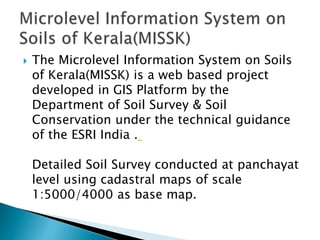
 The Microlevel Information System on Soils
of Kerala(MISSK) is a web based project
developed in GIS Platform by the
Department of Soil Survey & Soil
Conservation under the technical guidance
of the ESRI India .
Detailed Soil Survey conducted at panchayat
level using cadastral maps of scale
1:5000/4000 as base map.
 Generation of soil information system
 Generation of soil and other thematic maps in
GIS platform
 enable the users to access all information on
soils on survey number basis through
internet
 To help the farmers to manage their land
 Enabling the planners, administrators and
researchers to formulate micro level plans
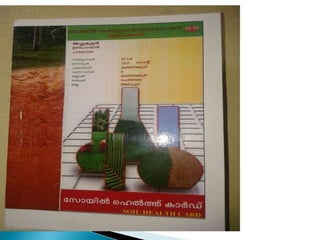
The Department of Soil Survey & Soil Conservation provides Soil
Health Management Support Service to farmers by providing
Soil Health Cards to individual farmers on per plot basis.
Soil Health Cards evaluate the health or quality of a soil as a
function of its various physico-chemical characteristics like
available macro and micro nutrients, water holding capacity,
CEC, soil texture, content of exchangeable bases,
exchangeable acidity, soil pH, EC and organic carbon content.
 The soil health card evaluates the health or
quality of a soil as a function of its
characteristics, water, plant and other
biological properties. The card is a tool to
help the farmer to monitor and improve soil
health based on their own field experience
and working knowledge of their soils.
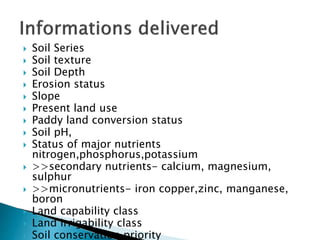
 Soil Series
 Soil texture
 Soil Depth
 Erosion status
 Slope
 Present land use
 Paddy land conversion status
 Soil pH,
 Status of major nutrients
nitrogen,phosphorus,potassium
 >>secondary nutrients- calcium, magnesium,
sulphur
 >>micronutrients- iron copper,zinc, manganese,
boron
 Land capability class
 Land irrigability class
 Soil conservation priority
 Samples are collected on per plot basis
 Collection of information on land
characteristics
 The results of the soil analysis is
communicated to the farmers in the form of
soil health cards.
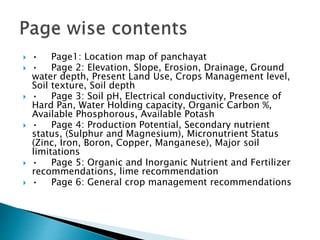
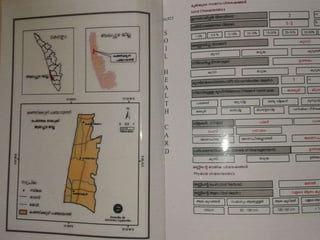
 • Page1: Location map of panchayat
 • Page 2: Elevation, Slope, Erosion, Drainage, Ground
water depth, Present Land Use, Crops Management level,
Soil texture, Soil depth
 • Page 3: Soil pH, Electrical conductivity, Presence of
Hard Pan, Water Holding capacity, Organic Carbon %,
Available Phosphorous, Available Potash
 • Page 4: Production Potential, Secondary nutrient
status, (Sulphur and Magnesium), Micronutrient Status
(Zinc, Iron, Boron, Copper, Manganese), Major soil
limitations
 • Page 5: Organic and Inorganic Nutrient and Fertilizer
recommendations, lime recommendation
 • Page 6: General crop management recommendations
It is a multi institutional project initiated by the Department of Agriculture, Govt. of Kerala. The
soil nutrient management information system has been conceptualized, designed, developed and
implemented by Indian Institute of Information Technology and Management- Kerala (IIITM-K) for
the Government of Kerala.
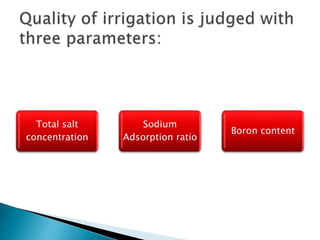
Total salt
concentration
Sodium
Adsorption ratio
Boron content
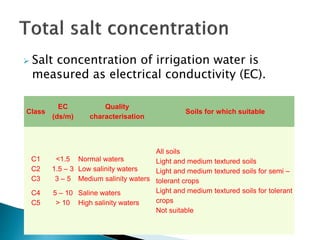
 Salt concentration of irrigation water is
measured as electrical conductivity (EC).
Class
EC
(ds/m)
Quality
characterisation
Soils for which suitable
C1
C2
C3
C4
C5
<1.5
1.5 – 3
3 – 5
5 – 10
> 10
Normal waters
Low salinity waters
Medium salinity waters
Saline waters
High salinity waters
All soils
Light and medium textured soils
Light and medium textured soils for semi –
tolerant crops
Light and medium textured soils for tolerant
crops
Not suitable
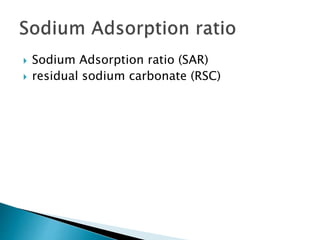
 Sodium Adsorption ratio (SAR)
 residual sodium carbonate (RSC)
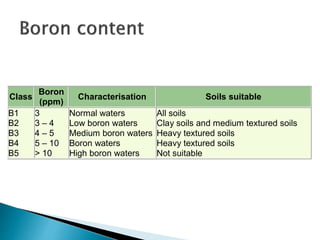
Class
Boron
(ppm)
Characterisation Soils suitable
B1
B2
B3
B4
B5
3
3 – 4
4 – 5
5 – 10
> 10
Normal waters
Low boron waters
Medium boron waters
Boron waters
High boron waters
All soils
Clay soils and medium textured soils
Heavy textured soils
Not suitable
Soil science

Soil science

  • 1.
    C A ANITHA SOILCONSERVATION OFFICER IWDM-K CHADAYAMANGALAM
  • 2.
    Deposition of solid waste Accumulationof non- biodegradable materials Toxification of chemicals into poisons
  • 3.
  • 4.
     Improper tillage Non-maintenance of a proper supply of organic matter in the soil  Irregular maintenance of a proper nutrient supply of trace elements  Improper maintenance of the correct soil acidity
  • 5.
     Heavy metalpollution  Cr, Pb,Cd,Cs, As  Chemical pesticides,fungicides,weedicides  Excessive lime application
  • 6.
     Poorly drainedsoil result in salt deposits leading to high soil salinity  Unirrigated land giving rise to stagnation of agriculture waste products  Irregular irrigation leads to decreasing moisturization of land
  • 7.
     May alterplant metabolism and reduce crop yields  Trees and plants may absorb soil contaminants and pass them up the food chain
  • 8.
    1. Use ofpesticides should be minimized. 2. Use of fertilizers should be judicious. 3. Cropping techniques should be improved to prevent growth of weeds. 4. Special pits should be selected for dumping wastes. 5. Controlled grazing and forest management. 6. Wind breaks and wind shield in areas exposed to wind erosion 7. Planning of soil binding grasses along banks and slopes prone to rapid erosion. 8. Afforestation and reforestation.
  • 9.
    the capacity ofa specific kind of soil to function with its surroundings, sustain plant and animal productivity, maintain or enhance soil, water and air quality and support human health and habitation
  • 10.
     Electrical Conductivity Soil Nitrate  Soil Reaction (pH)  more...
  • 11.
     Aggregate Stability Available Water Capcity  Bulk Density  Infiltration  Slaking  Soil Crusts  Soil Structure and Macropores  more...
  • 12.
     Earthworms  OrganicMatter  Potentially Mineralizable Nitrogen  Respiration  Soil Enzymes  Total Organic Carbon  more...
  • 14.
     The MicrolevelInformation System on Soils of Kerala(MISSK) is a web based project developed in GIS Platform by the Department of Soil Survey & Soil Conservation under the technical guidance of the ESRI India . Detailed Soil Survey conducted at panchayat level using cadastral maps of scale 1:5000/4000 as base map.
  • 15.
     Generation ofsoil information system  Generation of soil and other thematic maps in GIS platform  enable the users to access all information on soils on survey number basis through internet  To help the farmers to manage their land  Enabling the planners, administrators and researchers to formulate micro level plans
  • 16.
    The Department ofSoil Survey & Soil Conservation provides Soil Health Management Support Service to farmers by providing Soil Health Cards to individual farmers on per plot basis. Soil Health Cards evaluate the health or quality of a soil as a function of its various physico-chemical characteristics like available macro and micro nutrients, water holding capacity, CEC, soil texture, content of exchangeable bases, exchangeable acidity, soil pH, EC and organic carbon content.
  • 17.
     The soilhealth card evaluates the health or quality of a soil as a function of its characteristics, water, plant and other biological properties. The card is a tool to help the farmer to monitor and improve soil health based on their own field experience and working knowledge of their soils.
  • 18.
     Soil Series Soil texture  Soil Depth  Erosion status  Slope  Present land use  Paddy land conversion status  Soil pH,  Status of major nutrients nitrogen,phosphorus,potassium  >>secondary nutrients- calcium, magnesium, sulphur  >>micronutrients- iron copper,zinc, manganese, boron  Land capability class  Land irrigability class  Soil conservation priority
  • 19.
     Samples arecollected on per plot basis  Collection of information on land characteristics  The results of the soil analysis is communicated to the farmers in the form of soil health cards.
  • 20.
     • Page1:Location map of panchayat  • Page 2: Elevation, Slope, Erosion, Drainage, Ground water depth, Present Land Use, Crops Management level, Soil texture, Soil depth  • Page 3: Soil pH, Electrical conductivity, Presence of Hard Pan, Water Holding capacity, Organic Carbon %, Available Phosphorous, Available Potash  • Page 4: Production Potential, Secondary nutrient status, (Sulphur and Magnesium), Micronutrient Status (Zinc, Iron, Boron, Copper, Manganese), Major soil limitations  • Page 5: Organic and Inorganic Nutrient and Fertilizer recommendations, lime recommendation  • Page 6: General crop management recommendations
  • 23.
    It is amulti institutional project initiated by the Department of Agriculture, Govt. of Kerala. The soil nutrient management information system has been conceptualized, designed, developed and implemented by Indian Institute of Information Technology and Management- Kerala (IIITM-K) for the Government of Kerala.
  • 25.
  • 26.
     Salt concentrationof irrigation water is measured as electrical conductivity (EC). Class EC (ds/m) Quality characterisation Soils for which suitable C1 C2 C3 C4 C5 <1.5 1.5 – 3 3 – 5 5 – 10 > 10 Normal waters Low salinity waters Medium salinity waters Saline waters High salinity waters All soils Light and medium textured soils Light and medium textured soils for semi – tolerant crops Light and medium textured soils for tolerant crops Not suitable
  • 27.
     Sodium Adsorptionratio (SAR)  residual sodium carbonate (RSC)
  • 28.
    Class Boron (ppm) Characterisation Soils suitable B1 B2 B3 B4 B5 3 3– 4 4 – 5 5 – 10 > 10 Normal waters Low boron waters Medium boron waters Boron waters High boron waters All soils Clay soils and medium textured soils Heavy textured soils Heavy textured soils Not suitable