Agronomy is derived from a Greek word ‘agros’ meaning
‘field’ and ‘nomos’ meaning ‘management’.
Definition of Agronomy
1. It is defined as an agricultural science deals with principles
and practices of crop production and field management.
2. Agronomy is branch of agricultural science, which deals with
principles, & practices of soil, water & crop management.
3. It is branch of agricultural science that deals with methods
which provide favorable environment to the crop for higher
productivity.
Scope of Agronomy
 Identification of proper season for cultivation
Proper methods of cultivation
Availability and application of chemical fertilizers
Availability of herbicides for control of weeds
Water management practices
Intensive cropping
New technology to overcome the effect of moisture
stress
Packages of practices to explore full potential
Keeping farm implements
Maintaining the ecological balance
Care and disposal of farm and animal products
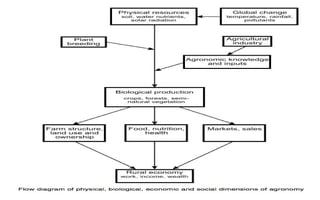
Relation of agronomy to other sciences
Soil Science
Agricultural Chemistry
Crop physiology
Plant ecology
Biochemistry
Economics
Crops and major soils - Classification –
Economic and agricultural importance in India
Classification of crops
Classification is done to generalize similar crop plants
as a class for better understanding of them.
Classification types used in crops
1. Based on ontogeny (Life cycle)
2. Based on economic use (Agronomic)
3. Based on Botany (Scientific)
4. Based on seasons 5. Based on climate
1. Based on Ontogeny (Life cycle)
a)Annual crops:
Ex. Wheat, rice, maize, mustard etc.
b) Biennial crops:
Ex. Sugar beet, beet root, etc.
c) Perennial crops:
Ex. Napier fodder grass, coconut, etc.
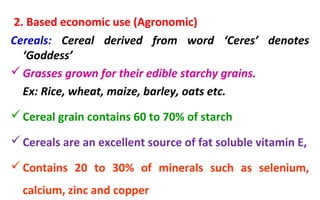
2. Based economic use (Agronomic)
Cereals: Cereal derived from word ‘Ceres’ denotes
‘Goddess’
Grasses grown for their edible starchy grains.
Ex: Rice, wheat, maize, barley, oats etc.
Cereal grain contains 60 to 70% of starch
Cereals are an excellent source of fat soluble vitamin E,
Contains 20 to 30% of minerals such as selenium,
calcium, zinc and copper
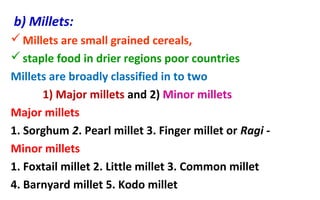
b) Millets:
Millets are small grained cereals,
staple food in drier regions poor countries
Millets are broadly classified in to two
1) Major millets and 2) Minor millets
Major millets
1. Sorghum 2. Pearl millet 3. Finger millet or Ragi -
Minor millets
1. Foxtail millet 2. Little millet 3. Common millet
4. Barnyard millet 5. Kodo millet
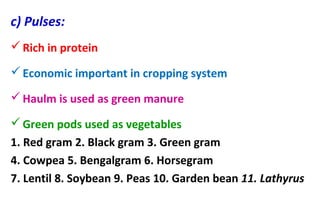
c) Pulses:
Rich in protein
Economic important in cropping system
Haulm is used as green manure
Green pods used as vegetables
1. Red gram 2. Black gram 3. Green gram
4. Cowpea 5. Bengalgram 6. Horsegram
7. Lentil 8. Soybean 9. Peas 10. Garden bean 11. Lathyrus
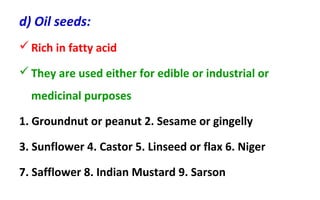
d) Oil seeds:
Rich in fatty acid
They are used either for edible or industrial or
medicinal purposes
1. Groundnut or peanut 2. Sesame or gingelly
3. Sunflower 4. Castor 5. Linseed or flax 6. Niger
7. Safflower 8. Indian Mustard 9. Sarson
Groundnut: 1) cooking oil & soap 2) haulm & oil cake is
a used as cattle feed 3)shell has fuel value 4) soil
amendment 5) It is a bed material in the poultry
forms
Sesame: 1) Cooking oil 2) Gingelly cake is used as a
cattle feed 3) Capsule & stalk for composting /
burning purpose
Castor: 1) Oil used as medicinal and industrial oil 2)
Aviation lubricant purpose 3) Castor cake is
concentrated organic manure 4) The shell and stalk is
used for fuel purpose
Mustard: 1) Edible oil 2) Oil cake cattle feed.
Safflower and sunflower: 1) Oil for cooking purpose
2) Unsaturated fatty acids 3) Cake is used as cattle feed
Niger: 1) Seed used in soap making 2) Paint & varnish
3) light lubricant 4) Crop is generally an industrial crop
Linseed: 1) Oil used in preparation of paints 2)
varnishes
e) Sugar crops
1)Sugar cane juice used for jaggery or sugar. 2) molasses,
bagasse, pressmud 3) Molasses used for alcohol and
yeast formation 4) bagasse for paper making & fuel. 5)
Press mud used for soil amendment 6) Green leaf & dry
foliage is used for cattle feed.
1) Sugar beet tubers are mainly used for extraction of
sugar 2) Tubers & tops used as a fodder for cattle feed.
f) Fibre crops: i) seed fibre – cotton; ii) Stem/ bast fibre –
Jute, mesta; iii) leaf fibre – Agave, pineapple.
Cotton: Epidermal hairs of seed coats is the economic
portion. Lint (Kapas-seed) has industrial value (fibre)
Jute, Sunnhemp, mesta: The fibre obtained from stems is
used for gunny bags, ropes. Stem itself is used as fuel.
Sunnhemp is used for both stem fibre and green
manure crop
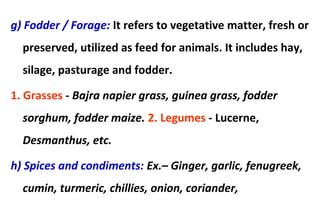
g) Fodder / Forage: It refers to vegetative matter, fresh or
preserved, utilized as feed for animals. It includes hay,
silage, pasturage and fodder.
1. Grasses - Bajra napier grass, guinea grass, fodder
sorghum, fodder maize. 2. Legumes - Lucerne,
Desmanthus, etc.
h) Spices and condiments: Ex.– Ginger, garlic, fenugreek,
cumin, turmeric, chillies, onion, coriander,
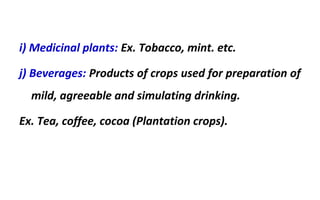
i) Medicinal plants: Ex. Tobacco, mint. etc.
j) Beverages: Products of crops used for preparation of
mild, agreeable and simulating drinking.
Ex. Tea, coffee, cocoa (Plantation crops).
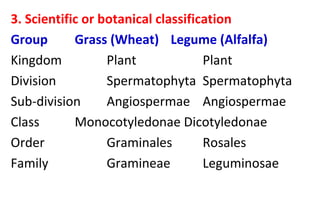
3. Scientific or botanical classification
Group Grass (Wheat) Legume (Alfalfa)
Kingdom Plant Plant
Division Spermatophyta Spermatophyta
Sub-division Angiospermae Angiospermae
Class Monocotyledonae Dicotyledonae
Order Graminales Rosales
Family Gramineae Leguminosae
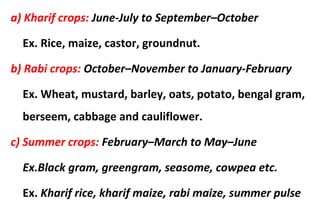
a) Kharif crops: June-July to September–October
Ex. Rice, maize, castor, groundnut.
b) Rabi crops: October–November to January-February
Ex. Wheat, mustard, barley, oats, potato, bengal gram,
berseem, cabbage and cauliflower.
c) Summer crops: February–March to May–June
Ex.Black gram, greengram, seasome, cowpea etc.
Ex. Kharif rice, kharif maize, rabi maize, summer pulse
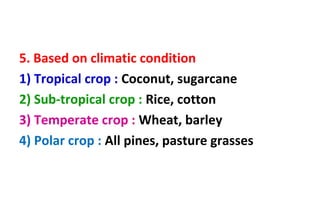
5. Based on climatic condition
1) Tropical crop : Coconut, sugarcane
2) Sub-tropical crop : Rice, cotton
3) Temperate crop : Wheat, barley
4) Polar crop : All pines, pasture grasses

Agronomy introduction

  • 1.
    Agronomy is derivedfrom a Greek word ‘agros’ meaning ‘field’ and ‘nomos’ meaning ‘management’. Definition of Agronomy 1. It is defined as an agricultural science deals with principles and practices of crop production and field management. 2. Agronomy is branch of agricultural science, which deals with principles, & practices of soil, water & crop management. 3. It is branch of agricultural science that deals with methods which provide favorable environment to the crop for higher productivity.
  • 3.
    Scope of Agronomy Identification of proper season for cultivation Proper methods of cultivation Availability and application of chemical fertilizers Availability of herbicides for control of weeds Water management practices
  • 4.
    Intensive cropping New technologyto overcome the effect of moisture stress Packages of practices to explore full potential Keeping farm implements Maintaining the ecological balance Care and disposal of farm and animal products
  • 5.
    Relation of agronomyto other sciences Soil Science Agricultural Chemistry Crop physiology Plant ecology Biochemistry Economics
  • 6.
    Crops and majorsoils - Classification – Economic and agricultural importance in India Classification of crops Classification is done to generalize similar crop plants as a class for better understanding of them. Classification types used in crops 1. Based on ontogeny (Life cycle) 2. Based on economic use (Agronomic) 3. Based on Botany (Scientific) 4. Based on seasons 5. Based on climate
  • 7.
    1. Based onOntogeny (Life cycle) a)Annual crops: Ex. Wheat, rice, maize, mustard etc. b) Biennial crops: Ex. Sugar beet, beet root, etc. c) Perennial crops: Ex. Napier fodder grass, coconut, etc.
  • 8.
    2. Based economicuse (Agronomic) Cereals: Cereal derived from word ‘Ceres’ denotes ‘Goddess’ Grasses grown for their edible starchy grains. Ex: Rice, wheat, maize, barley, oats etc. Cereal grain contains 60 to 70% of starch Cereals are an excellent source of fat soluble vitamin E, Contains 20 to 30% of minerals such as selenium, calcium, zinc and copper
  • 9.
    b) Millets: Millets aresmall grained cereals, staple food in drier regions poor countries Millets are broadly classified in to two 1) Major millets and 2) Minor millets Major millets 1. Sorghum 2. Pearl millet 3. Finger millet or Ragi - Minor millets 1. Foxtail millet 2. Little millet 3. Common millet 4. Barnyard millet 5. Kodo millet
  • 10.
    c) Pulses: Rich inprotein Economic important in cropping system Haulm is used as green manure Green pods used as vegetables 1. Red gram 2. Black gram 3. Green gram 4. Cowpea 5. Bengalgram 6. Horsegram 7. Lentil 8. Soybean 9. Peas 10. Garden bean 11. Lathyrus
  • 11.
    d) Oil seeds: Richin fatty acid They are used either for edible or industrial or medicinal purposes 1. Groundnut or peanut 2. Sesame or gingelly 3. Sunflower 4. Castor 5. Linseed or flax 6. Niger 7. Safflower 8. Indian Mustard 9. Sarson
  • 12.
    Groundnut: 1) cookingoil & soap 2) haulm & oil cake is a used as cattle feed 3)shell has fuel value 4) soil amendment 5) It is a bed material in the poultry forms Sesame: 1) Cooking oil 2) Gingelly cake is used as a cattle feed 3) Capsule & stalk for composting / burning purpose Castor: 1) Oil used as medicinal and industrial oil 2) Aviation lubricant purpose 3) Castor cake is concentrated organic manure 4) The shell and stalk is used for fuel purpose
  • 13.
    Mustard: 1) Edibleoil 2) Oil cake cattle feed. Safflower and sunflower: 1) Oil for cooking purpose 2) Unsaturated fatty acids 3) Cake is used as cattle feed Niger: 1) Seed used in soap making 2) Paint & varnish 3) light lubricant 4) Crop is generally an industrial crop Linseed: 1) Oil used in preparation of paints 2) varnishes
  • 14.
    e) Sugar crops 1)Sugarcane juice used for jaggery or sugar. 2) molasses, bagasse, pressmud 3) Molasses used for alcohol and yeast formation 4) bagasse for paper making & fuel. 5) Press mud used for soil amendment 6) Green leaf & dry foliage is used for cattle feed. 1) Sugar beet tubers are mainly used for extraction of sugar 2) Tubers & tops used as a fodder for cattle feed.
  • 15.
    f) Fibre crops:i) seed fibre – cotton; ii) Stem/ bast fibre – Jute, mesta; iii) leaf fibre – Agave, pineapple. Cotton: Epidermal hairs of seed coats is the economic portion. Lint (Kapas-seed) has industrial value (fibre) Jute, Sunnhemp, mesta: The fibre obtained from stems is used for gunny bags, ropes. Stem itself is used as fuel. Sunnhemp is used for both stem fibre and green manure crop
  • 16.
    g) Fodder /Forage: It refers to vegetative matter, fresh or preserved, utilized as feed for animals. It includes hay, silage, pasturage and fodder. 1. Grasses - Bajra napier grass, guinea grass, fodder sorghum, fodder maize. 2. Legumes - Lucerne, Desmanthus, etc. h) Spices and condiments: Ex.– Ginger, garlic, fenugreek, cumin, turmeric, chillies, onion, coriander,
  • 17.
    i) Medicinal plants:Ex. Tobacco, mint. etc. j) Beverages: Products of crops used for preparation of mild, agreeable and simulating drinking. Ex. Tea, coffee, cocoa (Plantation crops).
  • 18.
    3. Scientific orbotanical classification Group Grass (Wheat) Legume (Alfalfa) Kingdom Plant Plant Division Spermatophyta Spermatophyta Sub-division Angiospermae Angiospermae Class Monocotyledonae Dicotyledonae Order Graminales Rosales Family Gramineae Leguminosae
  • 19.
    a) Kharif crops:June-July to September–October Ex. Rice, maize, castor, groundnut. b) Rabi crops: October–November to January-February Ex. Wheat, mustard, barley, oats, potato, bengal gram, berseem, cabbage and cauliflower. c) Summer crops: February–March to May–June Ex.Black gram, greengram, seasome, cowpea etc. Ex. Kharif rice, kharif maize, rabi maize, summer pulse
  • 20.
    5. Based onclimatic condition 1) Tropical crop : Coconut, sugarcane 2) Sub-tropical crop : Rice, cotton 3) Temperate crop : Wheat, barley 4) Polar crop : All pines, pasture grasses