LAND USE
WHAT IS LAND USE?
- it is the function or functions that humans apply to
the land available to them. The study of land use is
the study of how the land is managed, including how
the natural world is adapted to human needs.
Zoning is related to land use but is
how governments regulate and
control it.
IMPORTANCE OF LAND USE
It tells us a great deal about the governments making
the decisions for land use and the priorities they hold.
The better we understand the way the world has been
adapted to human needs, and in what patterns, the
more we can predict future trends.
The better we can predict the future of land use, the
more we can prepare for negative impacts.
TYPES OF LAND USE
Residential
Transportation
Institutional
Open Space
Industrial
Commercial
Agricultural
ACTIVITY
Count from 1 – 4
Instruction:
Draw your own city plan that
consist of different types of
land use.
RESIDENTIAL
•Residential land is used for housing.
The type of housing in an area is based on
residential density, defined by:
• Number of housing units in a hectare (unit of land)
• A hectare is about 100 x 100 meters (or roughly the
size of two football fields)
Types of Residential
Density
Low Density
• Single-family homes,
semi-detached homes,
and duplexes
• Have less than 30
homes per hectare
Types of Residential
Density
Medium Density
Town houses, low-rise
apartments
Have between 30 to 100
homes per hectare
Types of Residential
Density
High Density
• High-rise
apartments
• Have more than
100 units per
hectare
TRANSPORTATION
Transport land is used for roads,
railways, subways, or airports.
Includes: sidewalks, roads,
highways, subways, streetcars,
railroad tracks, freight yards,
airports, marinas and any other
land that is used for transportation
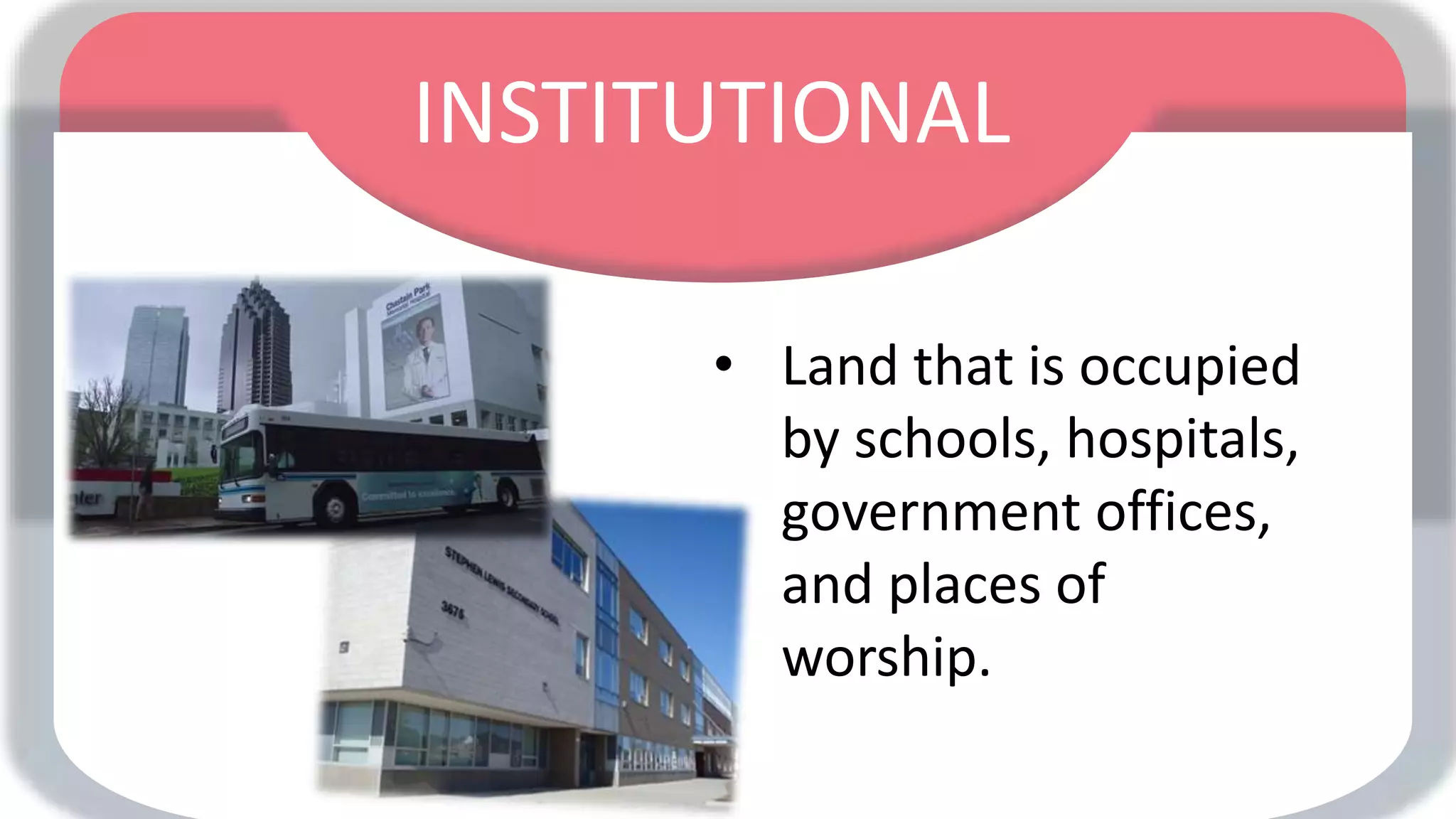
INSTITUTIONAL
• Land that is occupied
by schools, hospitals,
government offices,
and places of
worship.
OPEN SPACE
• Land that is now vacant,
or left in a natural state
(like a woodlot), or land
that is for recreational
use (parks, playgrounds,
community centers)
INDUSTRIAL
Land that is used for
industry.
Some examples: Factories,
warehouses, power plants,
or places of resource
extraction (like mines).
COMMERCIAL
• Land that is set aside
for commercial
activities. This includes
any land use that is
used for buying, selling,
or trading goods and
services.
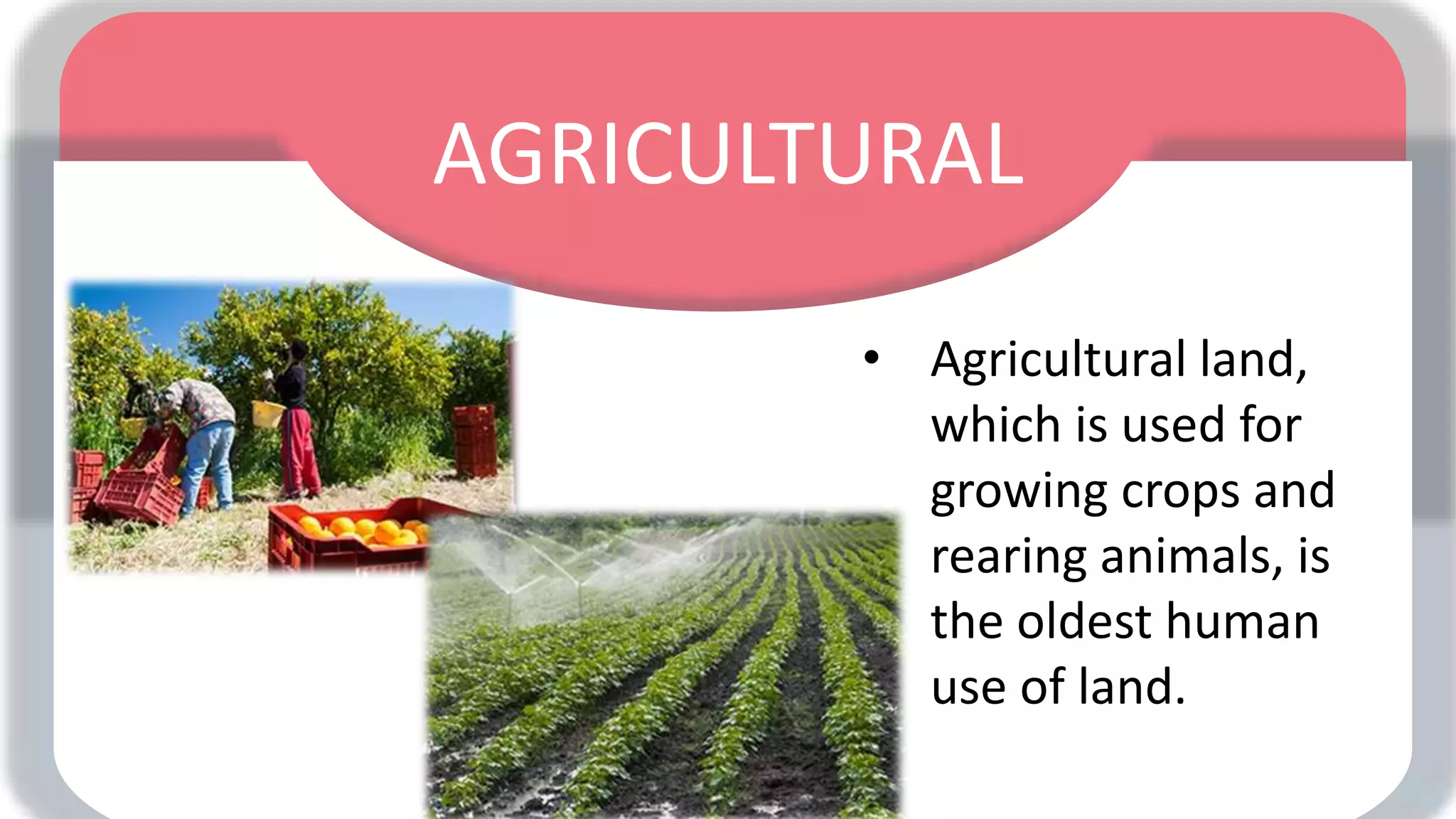
AGRICULTURAL
• Agricultural land,
which is used for
growing crops and
rearing animals, is
the oldest human
use of land.
PHYSICAL FACTORS, ECONOMIC
FACTORS & HUMAN FACTORS
PHYSICAL FACTORS
• Relief - influences the extent to which farm machinery can
be used and the rate of erosion of the soil. On very steep
slopes it is difficult to use modern farm machinery, and such
slopes are also very subject to erosion. Relief can also affect
land use through its influence upon the climate (temperature
falls with an increase in altitude).
• Soils - the mineral content, the mineral texture and the
depth of soil affect the land use.
• Climate - the amount of rainfall (too little or too much), wind
and sunshine.
ECONOMIC FACTORS
•Capital - this is the money needed to buy land.
animals, seeds, fertilizers, tools, machinery etc.
•Markets - (In this case market refers to the
demand of a particular thing) Distance from
markets affect land use because very perishable
crops need to arrive in fresh condition.
HUMAN FACTORS
• Land Tenure - this is the rights a person has to the
land. If the land is not owned by the farmer, there is
no guarantee of continued land use, therefore he/she
only plant short-terms crops such as corn and peas
and have no incentive to improve the land and/or put
up farm buildings.
• Inheritance Practices - this is where there is not one a
single continuous piece of land, and are made up of
several scattered plots (known as land fragmentation).
• Tradition - farmers are accustomed to doing things as they
know it and therefore they are less productive because the
methods are outdated.
• Labor - On modern farms what now used to be done by hand
are now done by machines however, on small peasant farms
they use hand tools and generally there is a shortage of labor
during harvest time.
• The Role of Government - governments can influence
farmers towards the form of land use they feel are most
suited to the country's needs.
Let’s play a game …

Land Use

  • 1.
  • 2.
    WHAT IS LANDUSE? - it is the function or functions that humans apply to the land available to them. The study of land use is the study of how the land is managed, including how the natural world is adapted to human needs. Zoning is related to land use but is how governments regulate and control it.
  • 3.
    IMPORTANCE OF LANDUSE It tells us a great deal about the governments making the decisions for land use and the priorities they hold. The better we understand the way the world has been adapted to human needs, and in what patterns, the more we can predict future trends. The better we can predict the future of land use, the more we can prepare for negative impacts.
  • 4.
    TYPES OF LANDUSE Residential Transportation Institutional Open Space Industrial Commercial Agricultural
  • 5.
    ACTIVITY Count from 1– 4 Instruction: Draw your own city plan that consist of different types of land use.
  • 6.
    RESIDENTIAL •Residential land isused for housing. The type of housing in an area is based on residential density, defined by: • Number of housing units in a hectare (unit of land) • A hectare is about 100 x 100 meters (or roughly the size of two football fields)
  • 7.
    Types of Residential Density LowDensity • Single-family homes, semi-detached homes, and duplexes • Have less than 30 homes per hectare
  • 8.
    Types of Residential Density MediumDensity Town houses, low-rise apartments Have between 30 to 100 homes per hectare
  • 9.
    Types of Residential Density HighDensity • High-rise apartments • Have more than 100 units per hectare
  • 10.
    TRANSPORTATION Transport land isused for roads, railways, subways, or airports. Includes: sidewalks, roads, highways, subways, streetcars, railroad tracks, freight yards, airports, marinas and any other land that is used for transportation
  • 11.
    INSTITUTIONAL • Land thatis occupied by schools, hospitals, government offices, and places of worship.
  • 12.
    OPEN SPACE • Landthat is now vacant, or left in a natural state (like a woodlot), or land that is for recreational use (parks, playgrounds, community centers)
  • 13.
    INDUSTRIAL Land that isused for industry. Some examples: Factories, warehouses, power plants, or places of resource extraction (like mines).
  • 14.
    COMMERCIAL • Land thatis set aside for commercial activities. This includes any land use that is used for buying, selling, or trading goods and services.
  • 15.
    AGRICULTURAL • Agricultural land, whichis used for growing crops and rearing animals, is the oldest human use of land.
  • 16.
  • 17.
    PHYSICAL FACTORS • Relief- influences the extent to which farm machinery can be used and the rate of erosion of the soil. On very steep slopes it is difficult to use modern farm machinery, and such slopes are also very subject to erosion. Relief can also affect land use through its influence upon the climate (temperature falls with an increase in altitude). • Soils - the mineral content, the mineral texture and the depth of soil affect the land use. • Climate - the amount of rainfall (too little or too much), wind and sunshine.
  • 18.
    ECONOMIC FACTORS •Capital -this is the money needed to buy land. animals, seeds, fertilizers, tools, machinery etc. •Markets - (In this case market refers to the demand of a particular thing) Distance from markets affect land use because very perishable crops need to arrive in fresh condition.
  • 19.
    HUMAN FACTORS • LandTenure - this is the rights a person has to the land. If the land is not owned by the farmer, there is no guarantee of continued land use, therefore he/she only plant short-terms crops such as corn and peas and have no incentive to improve the land and/or put up farm buildings. • Inheritance Practices - this is where there is not one a single continuous piece of land, and are made up of several scattered plots (known as land fragmentation).
  • 20.
    • Tradition -farmers are accustomed to doing things as they know it and therefore they are less productive because the methods are outdated. • Labor - On modern farms what now used to be done by hand are now done by machines however, on small peasant farms they use hand tools and generally there is a shortage of labor during harvest time. • The Role of Government - governments can influence farmers towards the form of land use they feel are most suited to the country's needs.
  • 21.

Editor's Notes

  • #2 Humans use land for lots of di×erent things. Today you'll learn about the types of land use, why it's important. If you've ever played a settlement building game like SimCity, you'll know all about land use.
  • #3 Zoning is what you do when you create a particular area in a SimCity game; you give permission for people to build houses, businesses or factories, but you don't build them yourself. Cities take control of this kind of thing to make their cities more pleasant to live in, to control pollution, protect the environment, and create efficient transport links.
  • #11 anything that transports people or goods.
  • #20 It is difficult to borrow money. If the land is owned by the farmer, he/she has a greater freedom of choice because the farmer can make long-term investments such as the growing of tree crops like cocoa and coconuts, the putting up of farm buildings and the making of farm roads. It is easier to borrow money for improvements.