
Land Capability Classification
Presented By :
Dr. R.K. Thakur
Assistant Professor (Soil Science)
College of Agriculture, Balaghat
Jawaharlal Nehru Krishi Vishwa Vidyalaya, Jabalpur (M.P.)
◼ The system of land capability classification requires that every
acre of land be used in accordance with its capability and
limitations.
◼ The land capability classification is a broad grouping of soils
bases on their limitations and also serves as a guide to assess
suitability of the land for cultivation, grazing and forest
plantation.
◼ Land capability classification is the system of grouping soils
primarily on the basis of their capability to produce common
cultivated crops and pasture without deteriorating over a long
period of time.
◼ It is strongly biased towards consideration of soil conservation;
and it is based on negative land features, the limitations.
◼ The structure of LCC is capability class, capability subclass and
capability unit.
Introduction :-
Land Capability Groupings :-
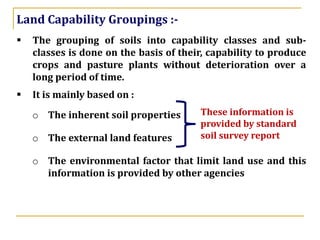
▪ The grouping of soils into capability classes and sub-
classes is done on the basis of their, capability to produce
crops and pasture plants without deterioration over a
long period of time.
▪ It is mainly based on :
o The inherent soil properties
o The external land features
o The environmental factor that limit land use and this
information is provided by other agencies
These information is
provided by standard
soil survey report
▪ The LCC scheme is developed by the soil conservation
service of the United States Department of Agriculture
(USDA).
▪ The classification scheme has three categories namely
(i) Capability units
(ii) Capability classes and
(iii)Capability sub-class
▪ Land capability classification may be defined as a system
of grouping land in to various classes based on inherent
limitations imposed on sustained use by soil attributes,
topography, drainage and climate.
Land Capability Classification (LCC) :-
▪ Depth of soil
▪ Drainage condition of soil
▪ Texture and Structure of soil
▪ Relief (slope)
▪ Intensity of soil erosion
▪ Susceptibility to overflow and flooding and degree of
saturation
▪ Problematic soils (Salt affected, acidity and other
unfavourable chemical properties)
▪ Climatic variation etc.
Factors for determining the capability of a soil :-
▪ It is a grouping of one or more individual soil-mapping
units having similar potentials and continuing
limitations or hazards.
▪ The capability unit condenses and simplifies soils
information for planning individual tracts of land, field
by field.
▪ Capability units with the class and sub-class furnish
information about the degree of limitation kind of
conservation problems and the management practices
needed.
Land Capability Unit :-
▪ The capability classes are useful as a means of
introducing the map user to the more detailed
information on the soil map which is indicated by
different colours.
▪ It is the broadest category in the land capability
classification system.
▪ Thus, land is classified in to eight land capability classes
are used to represent both irrigated and non-irrigated
land capability classes.
▪ Class codes I (1), II (2), III (3), IV (4), V (5), VI (6), VII (7)
and VIII (8).
▪ Land suitable for agriculture and other uses which
include class I to class IV lands. While, land not suitable
for agriculture but very well suited for forestry, grass land
and wild life which include class V to class VIII lands.
Land Capability Classes :-
▪ The subclasses are further divides in to unit based on a
specific management practice.
▪ The symbol given for each sub-classes is used as suffix
to the concerned land capability class.
▪ These are applied only to classes II, III and IV and
shown by the addition of small alphabets, namely :
‘e’ – Erosion and runoff
‘w’ – Excess of water is the main problem
‘s’ – Soil limitations
‘c’ – Climatic limitations
Land Capability Sub-Classes :-
Thanks
Best PDF Encryption Reviews

Land Capability Classification

  • 1.
    Land Capability Classification PresentedBy : Dr. R.K. Thakur Assistant Professor (Soil Science) College of Agriculture, Balaghat Jawaharlal Nehru Krishi Vishwa Vidyalaya, Jabalpur (M.P.)
  • 2.
    ◼ The systemof land capability classification requires that every acre of land be used in accordance with its capability and limitations. ◼ The land capability classification is a broad grouping of soils bases on their limitations and also serves as a guide to assess suitability of the land for cultivation, grazing and forest plantation. ◼ Land capability classification is the system of grouping soils primarily on the basis of their capability to produce common cultivated crops and pasture without deteriorating over a long period of time. ◼ It is strongly biased towards consideration of soil conservation; and it is based on negative land features, the limitations. ◼ The structure of LCC is capability class, capability subclass and capability unit. Introduction :-
  • 3.
    Land Capability Groupings:- ▪ The grouping of soils into capability classes and sub- classes is done on the basis of their, capability to produce crops and pasture plants without deterioration over a long period of time. ▪ It is mainly based on : o The inherent soil properties o The external land features o The environmental factor that limit land use and this information is provided by other agencies These information is provided by standard soil survey report
  • 4.
    ▪ The LCCscheme is developed by the soil conservation service of the United States Department of Agriculture (USDA). ▪ The classification scheme has three categories namely (i) Capability units (ii) Capability classes and (iii)Capability sub-class ▪ Land capability classification may be defined as a system of grouping land in to various classes based on inherent limitations imposed on sustained use by soil attributes, topography, drainage and climate. Land Capability Classification (LCC) :-
  • 5.
    ▪ Depth ofsoil ▪ Drainage condition of soil ▪ Texture and Structure of soil ▪ Relief (slope) ▪ Intensity of soil erosion ▪ Susceptibility to overflow and flooding and degree of saturation ▪ Problematic soils (Salt affected, acidity and other unfavourable chemical properties) ▪ Climatic variation etc. Factors for determining the capability of a soil :-
  • 6.
    ▪ It isa grouping of one or more individual soil-mapping units having similar potentials and continuing limitations or hazards. ▪ The capability unit condenses and simplifies soils information for planning individual tracts of land, field by field. ▪ Capability units with the class and sub-class furnish information about the degree of limitation kind of conservation problems and the management practices needed. Land Capability Unit :-
  • 7.
    ▪ The capabilityclasses are useful as a means of introducing the map user to the more detailed information on the soil map which is indicated by different colours. ▪ It is the broadest category in the land capability classification system. ▪ Thus, land is classified in to eight land capability classes are used to represent both irrigated and non-irrigated land capability classes. ▪ Class codes I (1), II (2), III (3), IV (4), V (5), VI (6), VII (7) and VIII (8). ▪ Land suitable for agriculture and other uses which include class I to class IV lands. While, land not suitable for agriculture but very well suited for forestry, grass land and wild life which include class V to class VIII lands. Land Capability Classes :-
  • 8.
  • 9.
    ▪ The subclassesare further divides in to unit based on a specific management practice. ▪ The symbol given for each sub-classes is used as suffix to the concerned land capability class. ▪ These are applied only to classes II, III and IV and shown by the addition of small alphabets, namely : ‘e’ – Erosion and runoff ‘w’ – Excess of water is the main problem ‘s’ – Soil limitations ‘c’ – Climatic limitations Land Capability Sub-Classes :-
  • 10.