
Conservation Agriculture in semi arid tropics

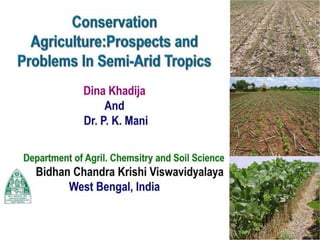
Conservation agriculture involves minimal soil disturbance through no-till or reduced tillage practices, maximum soil cover through crop residues, and crop rotations. When used together, these practices can reduce and sometimes reverse soil and water degradation over time. The goals of conservation agriculture include conserving and improving natural resources through integrated management of soil, water, and biological resources combined with external inputs in a way that contributes to environmental conservation and sustained agricultural production. Some key benefits include improved soil quality, water use efficiency, and climate change mitigation and adaptation. Adoption can be difficult due to mindset changes and lack of suitable equipment, but obstacles can be overcome through farmer collaboration and support.

Recommended
Recommended
More Related Content
What's hot
What's hot (20)
Viewers also liked
Viewers also liked (20)
Similar to Conservation Agriculture in semi arid tropics
Similar to Conservation Agriculture in semi arid tropics (20)
More from P.K. Mani
More from P.K. Mani (20)
Recently uploaded
Recently uploaded (20)
Conservation Agriculture in semi arid tropics
- 2. What is Conservation Agriculture? An array of technologies such as residue retention, zero- and reduced tillage, crop rotations, green manure cover crops, controlled traffic and raised beds. When used in combination these, over time, reduce, and often revert, the degradation of soil and water resources. Residue retention distinguishes conservation agriculture from conventional agriculture, and all conservation systems include at least a certain level of surface residue cover.
- 3. Goals of CA FAO defined goals of CA as follows: “CA aims to conserve, improve, and make more efficient use of natural resources through integrated management of available soil, water, and biological resources combined with external inputs. It contributes to the environmental conservation as well as to the enhanced and sustained agricultural production. Therefore, it can also be referred to as resource efficient or resource effective agriculture”.
- 5. WORLD SCENARIO In India it is being practiced about 2-3 mha (WCCA Report 2009).
- 6. BASIC PRINCIPLES OF CA Minimal Soil disturbances enable through No-till/reduced tillage Maximum soil cover/ residues Appropriate crop sequences/ rotations (Spatial and temporal crop sequencing).
- 7. Conservation Agriculture Means Dramatic Tillage Reductions Combined with Adequate Surface Retention of Crop Residues Conventional Till Systems CA Zero Till Systems
- 8. Zero Till (ZT) –Wheat Seeding • Reduced costs (Rs 2000-2500/ha) due to savings in fuel and labor • Timely planting of kharif and winter season crops, resulting in higher yields • Lower density of herbicide resistance in comparison to traditional tillage. • Significant irrigation water savings (up to 15-20%) • Improved input use efficiency because of the right placement of seed and fertilizer nutrients • Better plant stands • Less burning of crop resides Advantages of Zero Tillage
- 9. Resource Conserving Technologies (RCTs) 1. No-tillage 2. Laser land leveling 3. Direct seeding of rice 4. Leaf colour chart for N 5. Crop diversification Conventional RCTs
- 10. CA based RCTs options for System sustainability Zero tillage Paired row ZT Control traffic ZT Direct seeding Unpuddled transplanting Reduced tillage Bed planting Surface seeding
- 11. SEMI-ARID TROPICS Characterized by: • variable and unpredictable rainfall • structurally unstable soils • low overall productivity
- 12. CONSERVATION AGRICULTURE IN SEMI –ARID TROPICS protects the soil from the heating effect of the sun protect soil against raindrop impact allow improvement in soil aggregation practices of minimum/ zero tillage and direct sowing techniques lead to minimum disturbance of soil.
- 13. Properly Managed CA Encourages Sustainable Soil Management Physical Soil Quality Chemical Soil Quality Biological Soil Quality Soil Organic Matter
- 14. Soil Chemical Quality: Higher soil cation exchange capacity (CEC) due to increased organic matter content. Systems with pigeon peas (Cajanus cajan) resulted in a 70% increase in CEC compared to a fallow-maize system (FAO, 2001). Combination of ZT with sufficient crop residue retention reduces evaporation from the topsoil and salt accumulation (Hobbs and Govaerts, 2010).
- 15. Contd. Table : Organic Carbon in Conventional & Minimum tilled fields Tillage Treatments Organic C (g/kg) 0 – 5 cm 5-20 cm Conventional Tillage 5.42 5.26 Minimum Tillage 6.16 6.00 Improves soil organic Carbon
- 16. Soil Physical Quality Table:Tillage and Nitrogen level effect on infiltrability (cm/hr) Reduce soil compaction due to reduced traffic and application of crop residues. Increase infiltration rate of water Tillage N50% N100 % N150% Averag e CT-CT 3.02 2.84 1.08 2.31 MB-RT 2.96 7.53 8.61 6.37 RT-RT 2.85 8.88 6.24 5.99 NT-NT 3.04 10.91 11.05 8.33 Average 2.97 7.54 6.74
- 17. Contd.. Increase soil moisture percentage
- 19. Effect of Tillage on Soil Rhizobium Populations 0 10 20 30 40 50 60 Zero Tillage Conventional Tillage Rhizobiumcells Voss and Sidiras, 1985
- 20. Conservation Agriculture and C sequestration Differences in soil organic carbon content (%) due to adoption of zero-tillage over conventional tillage.
- 21. Conservation and Water Use Efficiency CA improve rain water infiltration (Shaxson et al., 2008) Improve water holding capacity (Govaerts et al., 2009) Reduce evaporative loss of water(Scopel et al., 2004)
- 22. Conservation Agriculture and Climate Change- Mitigation and Adaptation: Adaptation to climate change mainly due to enhanced water balance Climate change mitigation through possible C sequestration and reduced emission of CO2 to the atmosphere
- 23. Conservation Agriculture and Climate Change- Mitigation and Adaptation Figure : Mitigation and adaptation to climate change and variabilities through CA (Lal,2010)
- 24. Why CA is difficult to adopt? Mindset/ attitudinal change Strategies different from those we have adopted over past decades Non-availability suitable farm equipment/ Farmers’ choice.
- 25. Constraints in Scaling Up Conservation Agriculture in SAT Competitive Uses of Crop Residues Weed Preponderance New Implements and Operating Skills Required Nutrient Immobilization Carryover of Insect-Pests and Disease Pathogens
- 26. Monoculture leads to a build-up of pests and diseases. This is far more marked in zero tillage than in conventional tillage The key to controlling pests and diseases in zero tillage agriculture is crop rotation. One should avoid seeding a crop into it’s own residues before these are decomposed.
- 27. Up Scaling Conservation Agriculture in SAT The obstacles in up scaling CA can be overcome through: Interaction among associations of interested people organization of promotional events such as field days By providing credit to farmers to buy the equipment, machinery, and inputs through banks and credit agencies at reasonable interest rates.
- 28. Concluding Remarks: The SAT is characterized by highly variable and low rainfall, poorly developed infrastructure, degraded soils, and low socio-economic condition of the farmers. CA has been reported as sustainable and eco-friendly crop production technique in the fragile eco-systems of SAT. In the long-term CA has been found to render several benefits including soil conservation with improved soil health higher rain water use efficiency climate change mitigation and adaptation improved biodiversity higher economic returns