PHOTOPERIODISM
The biological measurement of the
relative lengths of day and night
Photoperiodism
 Photoperiodism the response by an organism to
synchronise its body with changes in day length
 At high latitudes this is important because the
change in length of the day indicates the season
 Days getting shorter indicate winter is
approaching
 Days getting longer indicate summer is
approaching
 Some plants regulate their flowering this way
© 2010 Paul Billiet ODWS
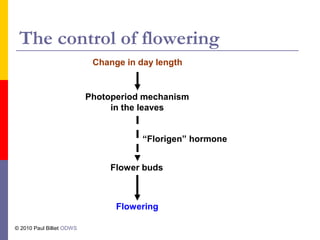
The control of flowering
Flowering
“Florigen” hormone
Flower buds
Photoperiod mechanism
in the leaves
Change in day length
© 2010 Paul Billiet ODWS
Response to day length
 Response varies according to the age of
the plant and varies in its intensity
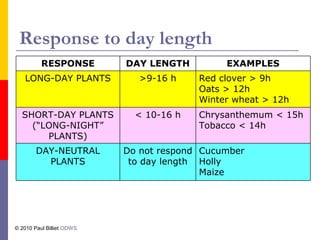
 Broadly they can be grouped into three
categories
© 2010 Paul Billiet ODWS
Response to day length
Cucumber
Holly
Maize
Do not respond
to day length
DAY-NEUTRAL
PLANTS
Chrysanthemum < 15h
Tobacco < 14h
< 10-16 hSHORT-DAY PLANTS
(“LONG-NIGHT”
PLANTS)
Red clover > 9h
Oats > 12h
Winter wheat > 12h
>9-16 hLONG-DAY PLANTS
EXAMPLESDAY LENGTHRESPONSE
© 2010 Paul Billiet ODWS
Response to day length
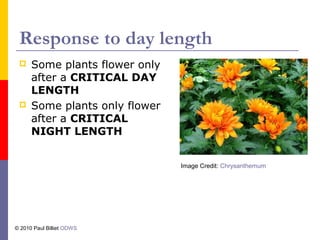
 Some plants flower only
after a CRITICAL DAY
LENGTH
 Some plants only flower
after a CRITICAL
NIGHT LENGTH
Image Credit: Chrysanthemum
© 2010 Paul Billiet ODWS
The night break phenomenon
For plants with a critical night length, a
short flash of light in the middle of the night
would make the plant behave as if it had
been exposed to a long day
© 2010 Paul Billiet ODWS
The quality of the light
 The wavelength of the light used is important
StimulatesInhibits670 – 680nmRed light
ReversesStimulates>700nmFar red
light
LONG-DAYSHORT-DAYWavelengthColour
© 2010 Paul Billiet ODWS
The pigment
 This indicated that there should be a
pigment that absorbs red light
(in other words this pigment should be
blue-green)
 This pigment is the mechanism capable of
recognising changes in day length
PHYTOCHROME
© 2010 Paul Billiet ODWS
The photoperiod mechanism
 Phytochrome exists in two versions which
are inter-convertible
 PR that absorbs red light
 PFR that absorbs far red light
PR
RED
LIGHT
FAR RED
LIGHT
PFR
© 2010 Paul Billiet ODWS
In the short-day plant
PFR
PR builds up
Darkness (slow)
Far red light (fast)
Short-day
plants
FLORIGEN
Activated
FLOWERING
© 2010 Paul Billiet ODWS
In the long-day plant
PFR builds up PR
Sunlight
Red light
Long-day
plants
FLOWERING
FLORIGEN
Activated
© 2010 Paul Billiet ODWS
Summary
Sunlight
Red light
Darkness (slow)
Far red light (fast)
PFR builds up
Long-day
plants
FLOWERING
FLORIGEN
Activated
PR builds up
Short-day
plants
FLORIGEN
Activated
FLOWERING
© 2010 Paul Billiet ODWS

Photoperiodism

  • 1.
    PHOTOPERIODISM The biological measurementof the relative lengths of day and night
  • 2.
    Photoperiodism  Photoperiodism theresponse by an organism to synchronise its body with changes in day length  At high latitudes this is important because the change in length of the day indicates the season  Days getting shorter indicate winter is approaching  Days getting longer indicate summer is approaching  Some plants regulate their flowering this way © 2010 Paul Billiet ODWS
  • 3.
    The control offlowering Flowering “Florigen” hormone Flower buds Photoperiod mechanism in the leaves Change in day length © 2010 Paul Billiet ODWS
  • 4.
    Response to daylength  Response varies according to the age of the plant and varies in its intensity  Broadly they can be grouped into three categories © 2010 Paul Billiet ODWS
  • 5.
    Response to daylength Cucumber Holly Maize Do not respond to day length DAY-NEUTRAL PLANTS Chrysanthemum < 15h Tobacco < 14h < 10-16 hSHORT-DAY PLANTS (“LONG-NIGHT” PLANTS) Red clover > 9h Oats > 12h Winter wheat > 12h >9-16 hLONG-DAY PLANTS EXAMPLESDAY LENGTHRESPONSE © 2010 Paul Billiet ODWS
  • 6.
    Response to daylength  Some plants flower only after a CRITICAL DAY LENGTH  Some plants only flower after a CRITICAL NIGHT LENGTH Image Credit: Chrysanthemum © 2010 Paul Billiet ODWS
  • 7.
    The night breakphenomenon For plants with a critical night length, a short flash of light in the middle of the night would make the plant behave as if it had been exposed to a long day © 2010 Paul Billiet ODWS
  • 8.
    The quality ofthe light  The wavelength of the light used is important StimulatesInhibits670 – 680nmRed light ReversesStimulates>700nmFar red light LONG-DAYSHORT-DAYWavelengthColour © 2010 Paul Billiet ODWS
  • 9.
    The pigment  Thisindicated that there should be a pigment that absorbs red light (in other words this pigment should be blue-green)  This pigment is the mechanism capable of recognising changes in day length PHYTOCHROME © 2010 Paul Billiet ODWS
  • 10.
    The photoperiod mechanism Phytochrome exists in two versions which are inter-convertible  PR that absorbs red light  PFR that absorbs far red light PR RED LIGHT FAR RED LIGHT PFR © 2010 Paul Billiet ODWS
  • 11.
    In the short-dayplant PFR PR builds up Darkness (slow) Far red light (fast) Short-day plants FLORIGEN Activated FLOWERING © 2010 Paul Billiet ODWS
  • 12.
    In the long-dayplant PFR builds up PR Sunlight Red light Long-day plants FLOWERING FLORIGEN Activated © 2010 Paul Billiet ODWS
  • 13.
    Summary Sunlight Red light Darkness (slow) Farred light (fast) PFR builds up Long-day plants FLOWERING FLORIGEN Activated PR builds up Short-day plants FLORIGEN Activated FLOWERING © 2010 Paul Billiet ODWS