Trees
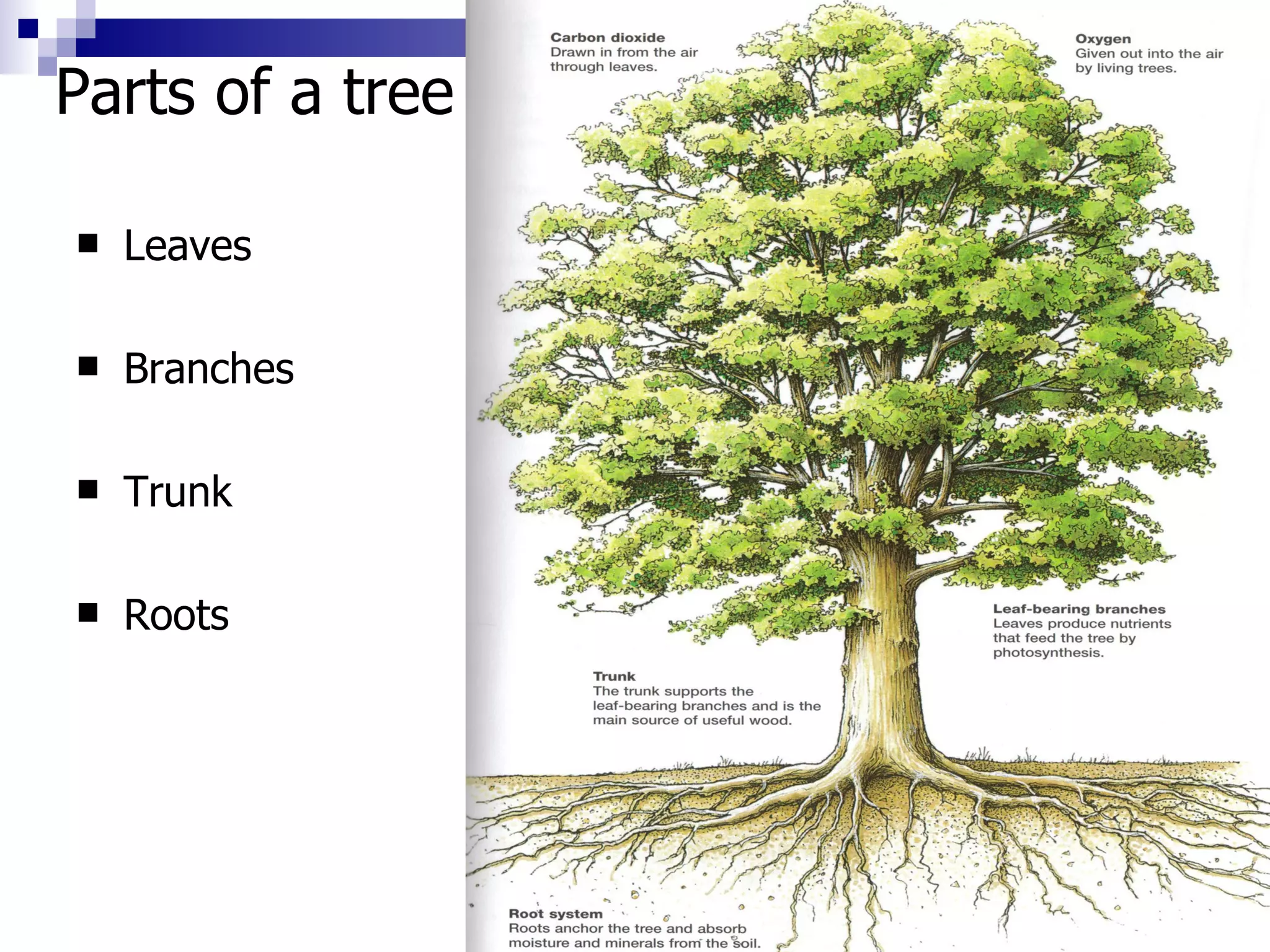
Parts of a tree Leaves Branches Trunk Roots
Function of various parts Roots - anchor the tree and absorb moisture and  minerals from the soil Trunk - supports the branches and is the main  source of wood we use Bark - protects the wood on the inside from attack Leaves - used to produce food for the tree to grow
How trees grow Trees grow from either 1) seeds 2) cutting Seeds can be scattered by main means Some simply drop from the tree and land on the ground Some are dispersed by the wind Others are carried away by animals and birds A cutting (stem or branch) is taken from an existing tree and is replanted in a warm humid environment. It should eventually develop roots and survive as a growing tree
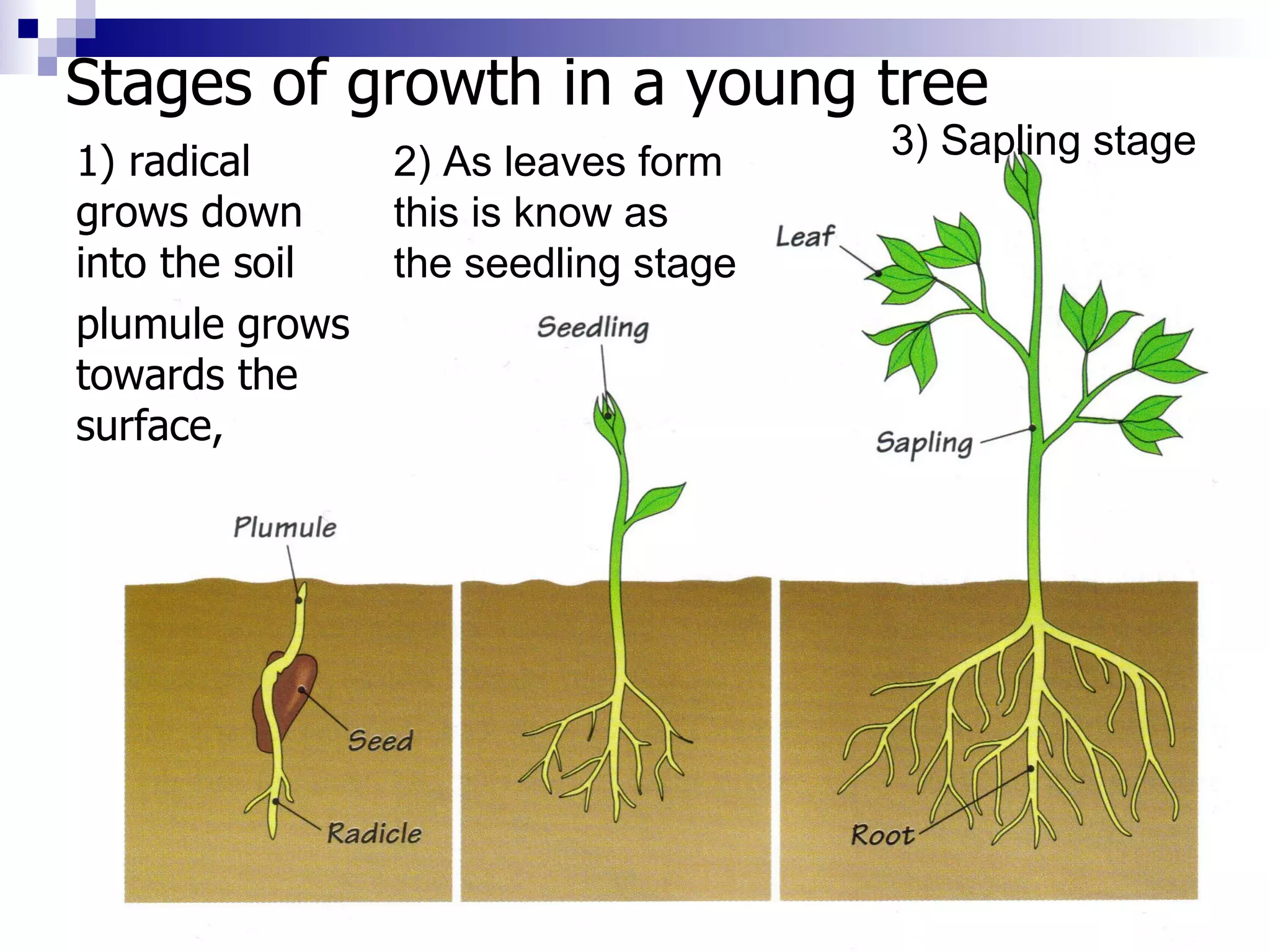
How a tree grows from a Seed Seed is dispersed from the tree After some time the seed germinates. It requires moisture and warmth. The seed itself contains the food necessary for germination. After germination the RADICAL (root) grows down into the soil Then the PLUMULE (shoot) grows towards the surface, as the first leaves form, plant is now called a seedling Seedling grows into a sapling as the tree begins to get strength
Stages of growth in a young tree 1) radical grows down into the soil plumule grows towards the surface,  2) As leaves form this is know as the seedling stage 3) Sapling stage
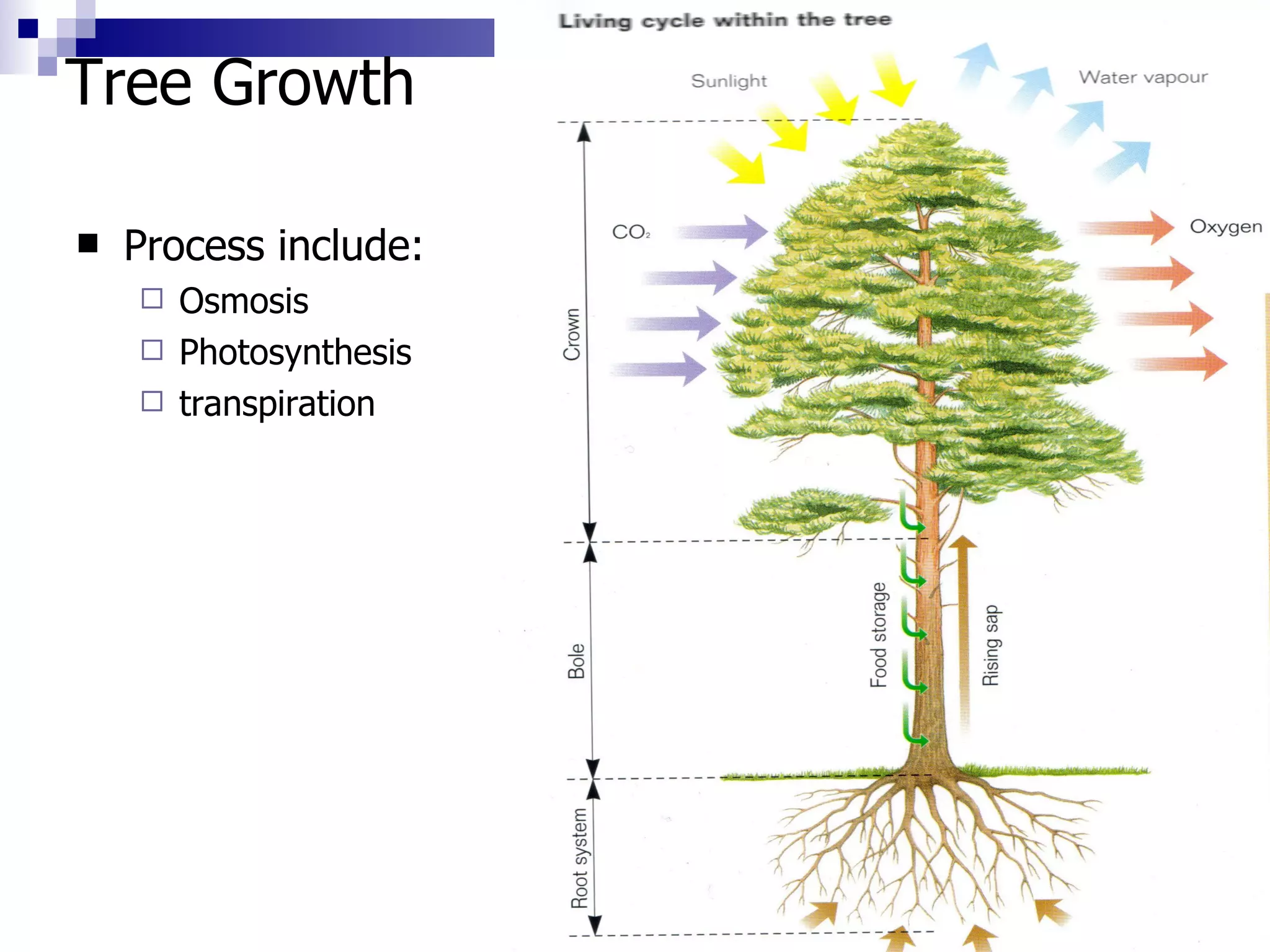
Tree Growth Process include: Osmosis Photosynthesis transpiration
Osmosis The roots of a tree absorb water and minerals from the soil The water and minerals travel up through the roots, trunk and branches through  xylem cells  to the leaves Xylem cells are narrow and thin which allows moisture to travel up them through capillary action
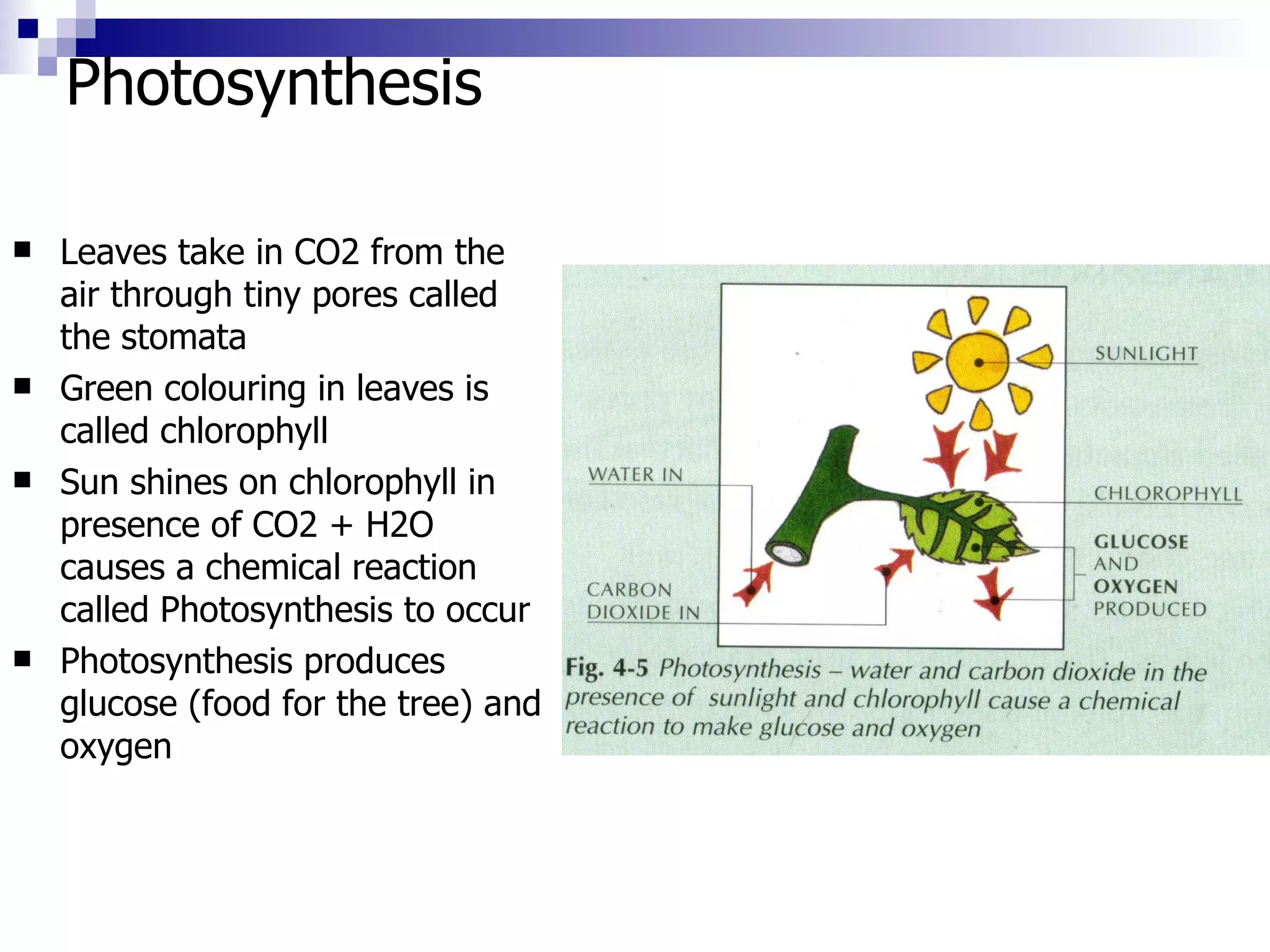
Photosynthesis  Leaves take in CO2 from the air through tiny pores called the stomata Green colouring in leaves is called chlorophyll Sun shines on chlorophyll in presence of CO2 + H2O causes a chemical reaction called Photosynthesis to occur Photosynthesis produces glucose (food for the tree) and oxygen
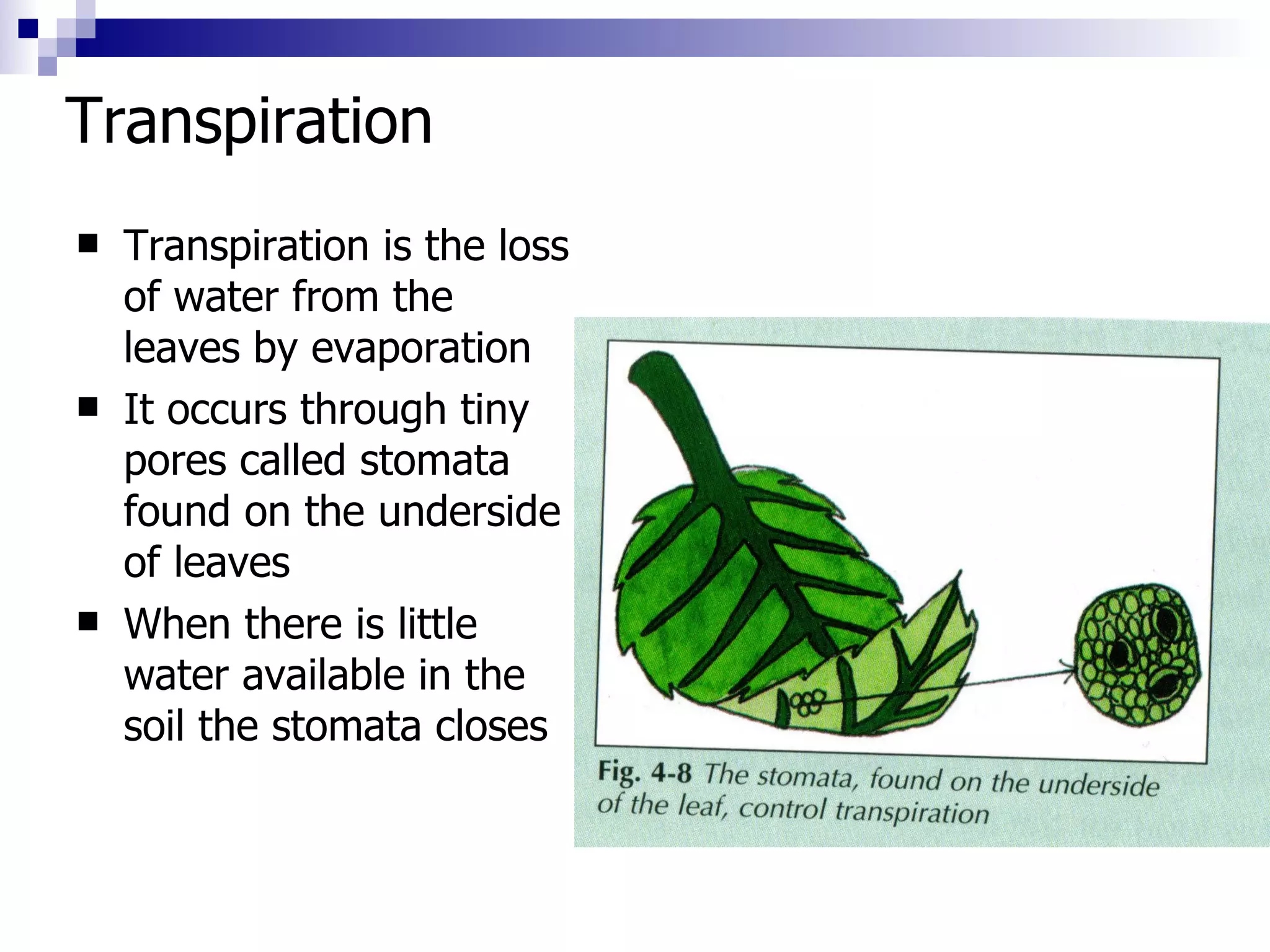
Transpiration  Transpiration is the loss of water from the leaves by evaporation It occurs through tiny pores called stomata found on the underside of leaves When there is little water available in the soil the stomata closes
Tree  Structure
Tree Structure
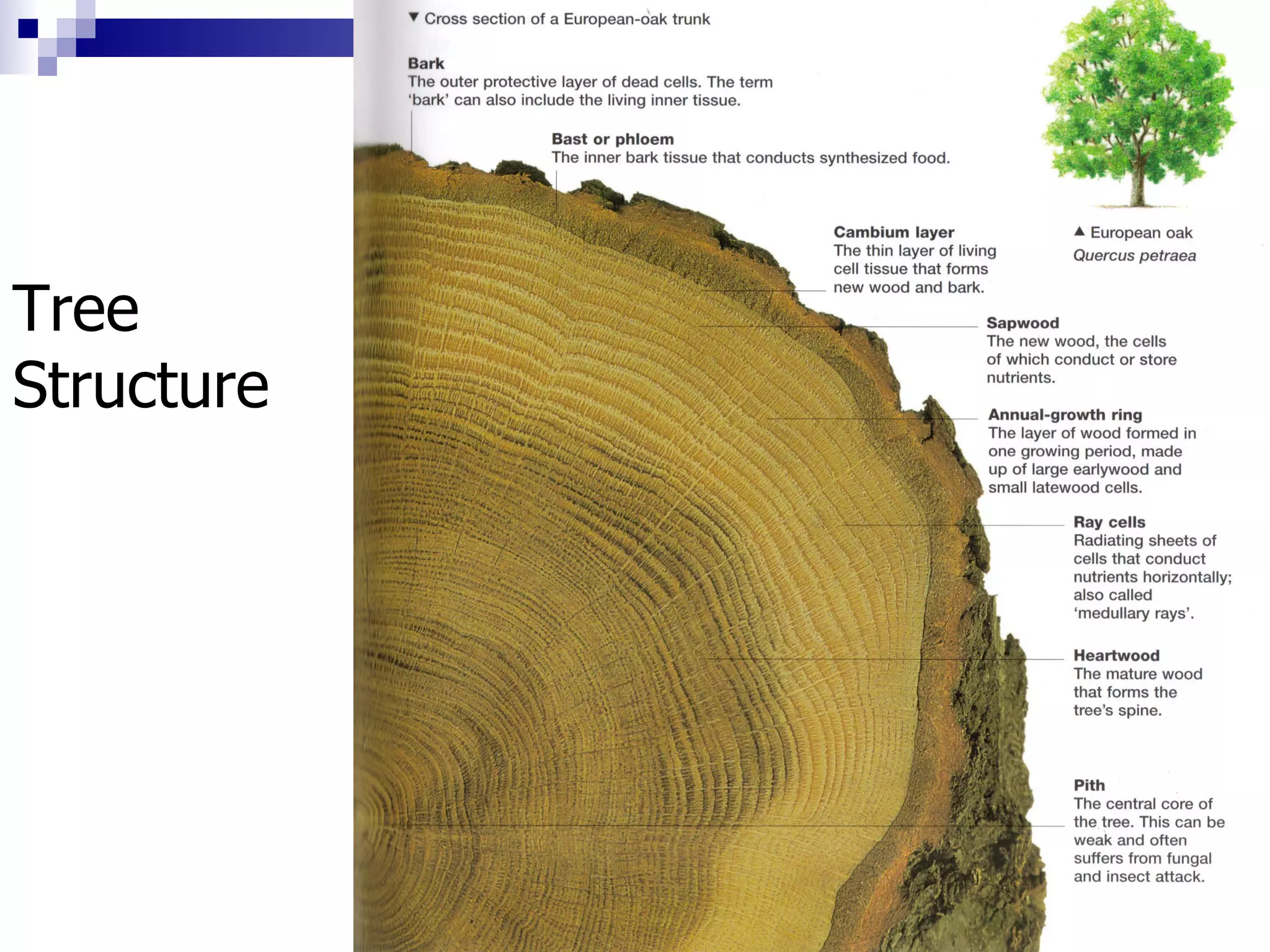
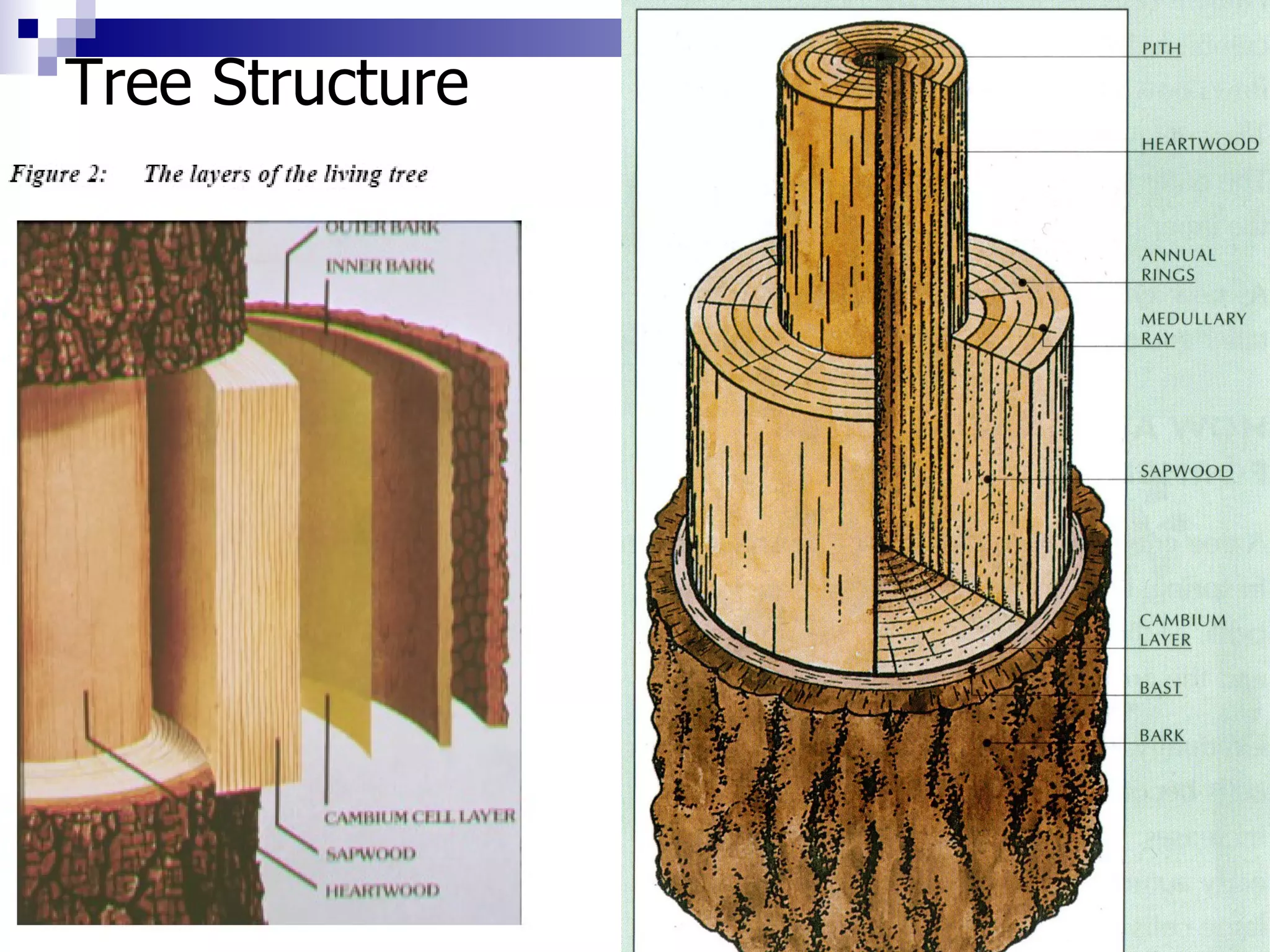
Bark  A thick layer of cork which surrounds the trunk and the branches Function is to: Protect against damage from weather, animals, insect and fungus Prevent evaporation of moisture and minerals from the tree Bast A thin moist layer of inner bark New bark cells are produced as the old cells die off Food is carried down the tree from the leaves
Cambium Layer This is a layer of cells under the bark. This is where the growth of the tree occurs Xylem cells are found on the inside of the cambium layer next to the sapwood and this is where water and minerals are transported to the leaves from the roots.  Phloem cells are found on the outside of the cambium layer next to the bark. This is where food from the leaves is transported to the tree This energy causes the phloem cells to split. The outer half become new phloem cells and the inner half become the new xylem cells (forms an annual ring) As new xylem cells are formed the tree grows taller and thicker
Sapwood  As the tree grows layers of cells are added to the sapwood It is light coloured wood in the trunk As the sapwood carries nutrients and moisture to the leaves from the roots it is moist, therefore it is prone to attack from fungi and insects
Heartwood  Darker colour than sapwood Found beside the pith close to the centre of the tree Made up from dead mature cells which no longer transport water or nutrients Provides support for the tree Heartwood is more durable and resistant to fungal and insect attack than sapwood Pith Pith is found in the centre of the trunk and is made up of original sapling cells
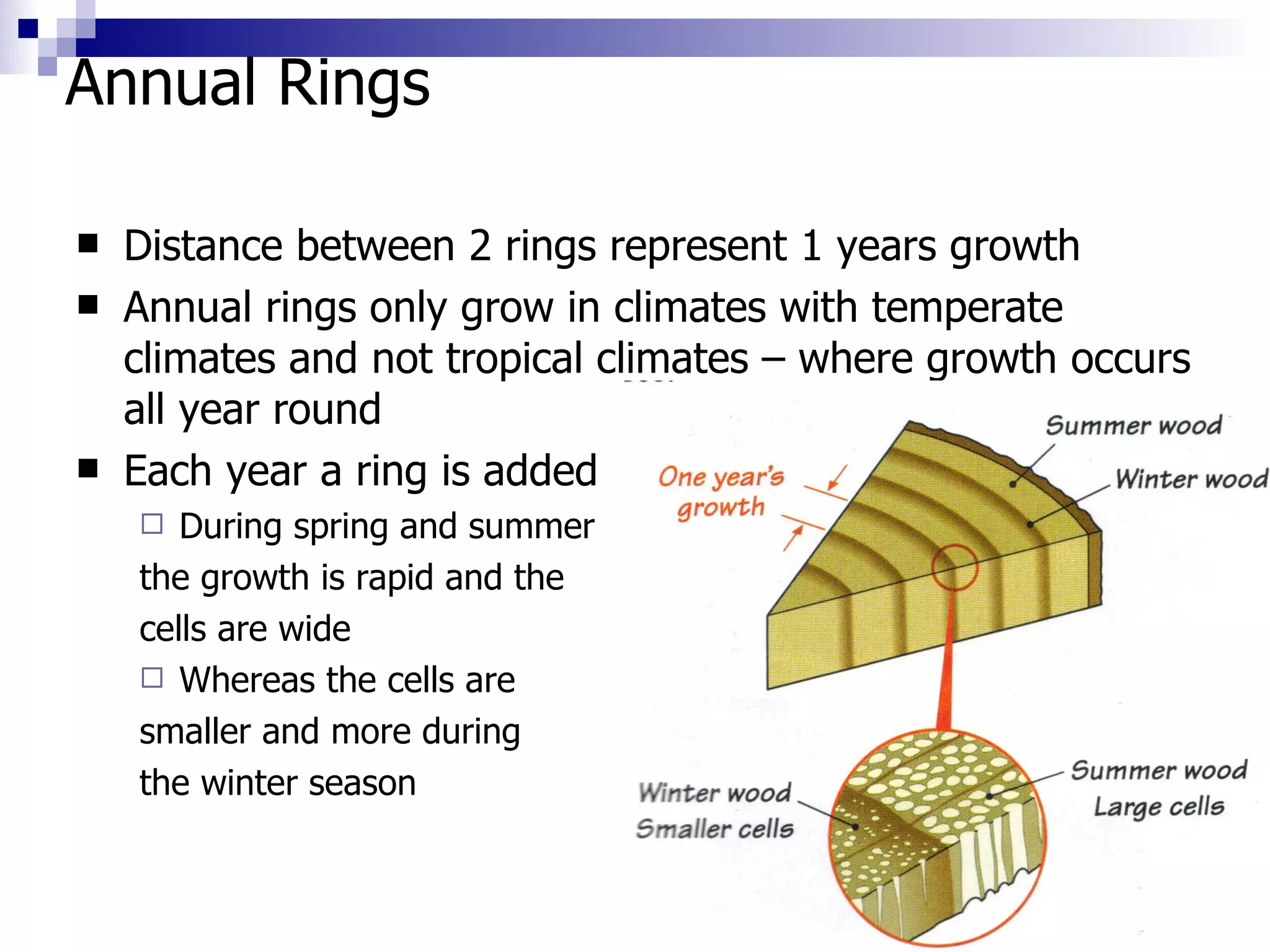
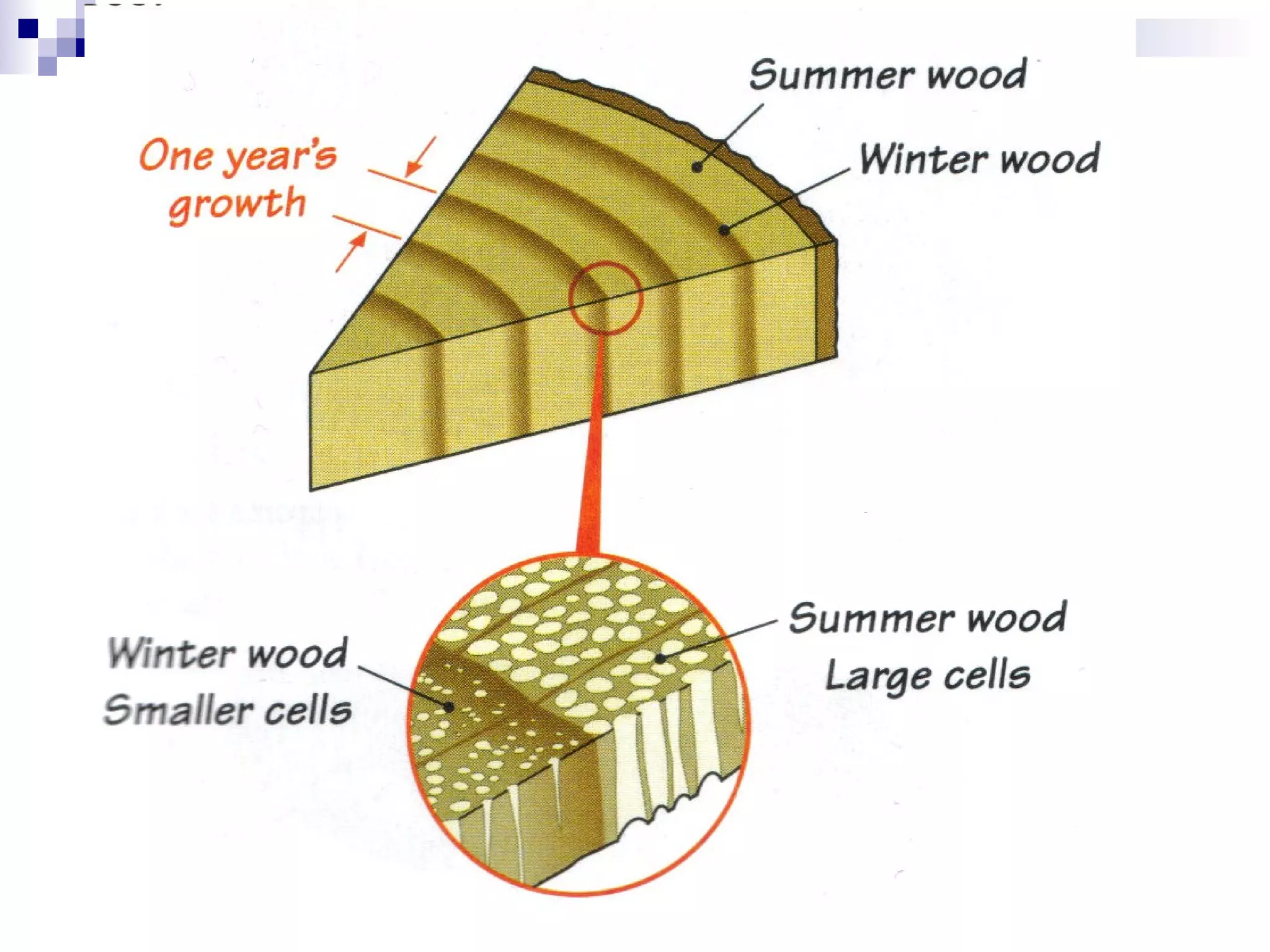
Annual Rings Distance between 2 rings represent 1 years growth Annual rings only grow in climates with temperate climates and not tropical climates – where growth occurs all year round Each year a ring is added During spring and summer  the growth is rapid and the  cells are wide Whereas the cells are  smaller and more during  the winter season
 

2. tree growth & structure

  • 1.
  • 2.
    Parts of atree Leaves Branches Trunk Roots
  • 3.
    Function of variousparts Roots - anchor the tree and absorb moisture and minerals from the soil Trunk - supports the branches and is the main source of wood we use Bark - protects the wood on the inside from attack Leaves - used to produce food for the tree to grow
  • 4.
    How trees growTrees grow from either 1) seeds 2) cutting Seeds can be scattered by main means Some simply drop from the tree and land on the ground Some are dispersed by the wind Others are carried away by animals and birds A cutting (stem or branch) is taken from an existing tree and is replanted in a warm humid environment. It should eventually develop roots and survive as a growing tree
  • 5.
    How a treegrows from a Seed Seed is dispersed from the tree After some time the seed germinates. It requires moisture and warmth. The seed itself contains the food necessary for germination. After germination the RADICAL (root) grows down into the soil Then the PLUMULE (shoot) grows towards the surface, as the first leaves form, plant is now called a seedling Seedling grows into a sapling as the tree begins to get strength
  • 6.
    Stages of growthin a young tree 1) radical grows down into the soil plumule grows towards the surface, 2) As leaves form this is know as the seedling stage 3) Sapling stage
  • 7.
    Tree Growth Processinclude: Osmosis Photosynthesis transpiration
  • 8.
    Osmosis The rootsof a tree absorb water and minerals from the soil The water and minerals travel up through the roots, trunk and branches through xylem cells to the leaves Xylem cells are narrow and thin which allows moisture to travel up them through capillary action
  • 9.
    Photosynthesis Leavestake in CO2 from the air through tiny pores called the stomata Green colouring in leaves is called chlorophyll Sun shines on chlorophyll in presence of CO2 + H2O causes a chemical reaction called Photosynthesis to occur Photosynthesis produces glucose (food for the tree) and oxygen
  • 10.
    Transpiration Transpirationis the loss of water from the leaves by evaporation It occurs through tiny pores called stomata found on the underside of leaves When there is little water available in the soil the stomata closes
  • 11.
  • 12.
  • 13.
    Bark Athick layer of cork which surrounds the trunk and the branches Function is to: Protect against damage from weather, animals, insect and fungus Prevent evaporation of moisture and minerals from the tree Bast A thin moist layer of inner bark New bark cells are produced as the old cells die off Food is carried down the tree from the leaves
  • 14.
    Cambium Layer Thisis a layer of cells under the bark. This is where the growth of the tree occurs Xylem cells are found on the inside of the cambium layer next to the sapwood and this is where water and minerals are transported to the leaves from the roots. Phloem cells are found on the outside of the cambium layer next to the bark. This is where food from the leaves is transported to the tree This energy causes the phloem cells to split. The outer half become new phloem cells and the inner half become the new xylem cells (forms an annual ring) As new xylem cells are formed the tree grows taller and thicker
  • 15.
    Sapwood Asthe tree grows layers of cells are added to the sapwood It is light coloured wood in the trunk As the sapwood carries nutrients and moisture to the leaves from the roots it is moist, therefore it is prone to attack from fungi and insects
  • 16.
    Heartwood Darkercolour than sapwood Found beside the pith close to the centre of the tree Made up from dead mature cells which no longer transport water or nutrients Provides support for the tree Heartwood is more durable and resistant to fungal and insect attack than sapwood Pith Pith is found in the centre of the trunk and is made up of original sapling cells
  • 17.
    Annual Rings Distancebetween 2 rings represent 1 years growth Annual rings only grow in climates with temperate climates and not tropical climates – where growth occurs all year round Each year a ring is added During spring and summer the growth is rapid and the cells are wide Whereas the cells are smaller and more during the winter season
  • 18.