Visit www.readinga-z.com
for thousands of books and materials.
About Trees
A Reading A–Z Level P Leveled Reader
Word Count: 769
www.readinga-z.com
About TreesAbout Trees
Written by Sherry SterlingWritten by Sherry Sterling
LEVELED READER • P
About Trees
Written by Sherry Sterling
www.readinga-z.com
About Trees
Level P Leveled Reader
© 2007 Learning A–Z
Written by Sherry Sterling
All rights reserved.
www.readinga-z.com
Photo Credits:
Cover, back cover, title page, 3, 5, 6, 7, 8, 12 (bottom left), 14, 15: © ArtToday;
page 4: © Getty Images; page 9 (main): © Robert Estall/CORBIS; page 9 (inset):
© Royalty-Free/Getty Images; page 10: Royalty-Free/Getty Images; page 11
(main): Royalty-Free/Getty Images; page 11 (bottom left), 12 (all except bottom
left): © Hemera Technologies; page 13: © David Aubrey/CORBIS
Correlation
LEVEL P
N
21
30
Fountas & Pinnell
Reading Recovery
DRA
Leveled Books
Lesson Plans
Worksheets
Benchmark Books
& Running Records
Systematic Phonics Lessons
Decodable Books
Sound/Symbol Books
High-Frequency Word Books
Alphabet Books
Poetry
Read-Alouds
Vocabulary Books
Reader’s Theater
Comprehension Quizzes
Fluency Passages
Retelling Rubrics
VISIT
www.readinga-z.com
The Online Reading Program
English * Spanish * French
All for one LOW yearly fee
See all the Reading A-Z materials
Table of Contents
Introduction . . . . . . . . . . . . . . . . . . . . . . . 4
Leaves . . . . . . . . . . . . . . . . . . . . . . . . . . . . 5
Branches . . . . . . . . . . . . . . . . . . . . . . . . . . 7
Trunk . . . . . . . . . . . . . . . . . . . . . . . . . . . . . 8
Roots . . . . . . . . . . . . . . . . . . . . . . . . . . . . 10
Sap . . . . . . . . . . . . . . . . . . . . . . . . . . . . . . 11
Seeds . . . . . . . . . . . . . . . . . . . . . . . . . . . . 12
Growing. . . . . . . . . . . . . . . . . . . . . . . . . . 13
Conclusion . . . . . . . . . . . . . . . . . . . . . . . 14
Glossary/Index . . . . . . . . . . . . . . . . . . . 16
3
Introduction
Trees are the tallest living plants.
Redwood trees can grow as tall as a
30-story building. Giant sequoias can
weigh as much as 3,000 large pickup
trucks, making them one of the heaviest
living things. Trees also live a long time.
Many trees alive today were full grown
long before the United States became a
country. But these massive trees share
something with all plants—they make
their own food.
4
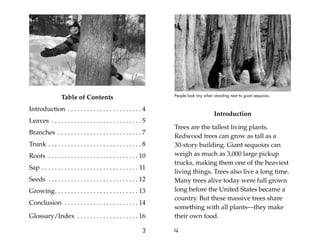
People look tiny when standing next to giant sequoias.
Leaves
Imagine being able to make
your own food without
cooking or even going to
a restaurant! Leaves make
food for trees by changing
energy from sunlight into
food. This important work
is done by chlorophyll
(KLOR-uh-fill), the green
coloring in leaves.
Leaves come in all shapes
and sizes. Most deciduous
(dee-SIJ-oo-us) trees have
wide, thin leaves, while
most conifers have needle-
like leaves. Conifers keep
their needles through all
seasons. Only the oldest
needles fall to the ground.
Deciduous trees lose their
leaves every fall.
5
In the fall, the leaves of deciduous trees
show their true colors. These true colors
are yellows, oranges, and browns, which
hide under green chlorophyll all spring
and summer. We see these colors in the
fall after leaves stop making chlorophyll.
6
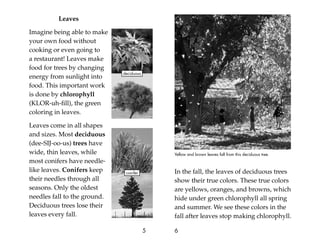
Yellow and brown leaves fall from this deciduous tree.
conifer
deciduous
Branches
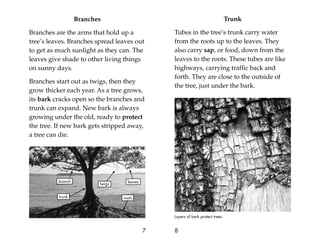
Branches are the arms that hold up a
tree’s leaves. Branches spread leaves out
to get as much sunlight as they can. The
leaves give shade to other living things
on sunny days.
Branches start out as twigs, then they
grow thicker each year. As a tree grows,
its bark cracks open so the branches and
trunk can expand. New bark is always
growing under the old, ready to protect
the tree. If new bark gets stripped away,
a tree can die.
7
Trunk
Tubes in the tree’s trunk carry water
from the roots up to the leaves. They
also carry sap, or food, down from the
leaves to the roots. These tubes are like
highways, carrying traffic back and
forth. They are close to the outside of
the tree, just under the bark.
8
Layers of bark protect trees.
twigs
branch
trunk
leaves
roots
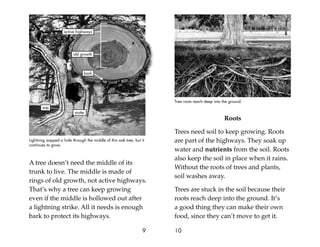
A tree doesn’t need the middle of its
trunk to live. The middle is made of
rings of old growth, not active highways.
That’s why a tree can keep growing
even if the middle is hollowed out after
a lightning strike. All it needs is enough
bark to protect its highways.
9
Roots
Trees need soil to keep growing. Roots
are part of the highways. They soak up
water and nutrients from the soil. Roots
also keep the soil in place when it rains.
Without the roots of trees and plants,
soil washes away.
Trees are stuck in the soil because their
roots reach deep into the ground. It’s
a good thing they can make their own
food, since they can’t move to get it.
10
Tree roots reach deep into the ground.
Lightning zapped a hole through the middle of this oak tree, but it
continues to grow.
bark
old growth
active highways
water
sap
Sap
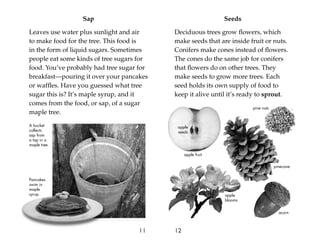
Leaves use water plus sunlight and air
to make food for the tree. This food is
in the form of liquid sugars. Sometimes
people eat some kinds of tree sugars for
food. You’ve probably had tree sugar for
breakfast—pouring it over your pancakes
or waffles. Have you guessed what tree
sugar this is? It’s maple syrup, and it
comes from the food, or sap, of a sugar
maple tree.
11
Seeds
Deciduous trees grow flowers, which
make seeds that are inside fruit or nuts.
Conifers make cones instead of flowers.
The cones do the same job for conifers
that flowers do on other trees. They
make seeds to grow more trees. Each
seed holds its own supply of food to
keep it alive until it’s ready to sprout.
12
A bucket
collects
sap from
a tap in a
maple tree.
Pancakes
swim in
maple
syrup.
acorn
apple
blooms
apple
seeds
pinecone
apple fruit
pine nuts
Growing
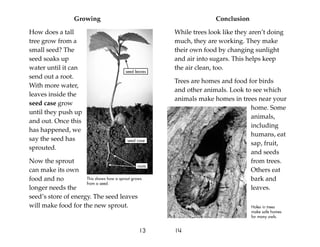
How does a tall
tree grow from a
small seed? The
seed soaks up
water until it can
send out a root.
With more water,
leaves inside the
seed case grow
until they push up
and out. Once this
has happened, we
say the seed has
sprouted.
Now the sprout
can make its own
food and no
longer needs the
seed’s store of energy. The seed leaves
will make food for the new sprout.
13
Conclusion
While trees look like they aren’t doing
much, they are working. They make
their own food by changing sunlight
and air into sugars. This helps keep
the air clean, too.
Trees are homes and food for birds
and other animals. Look to see which
animals make homes in trees near your
home. Some
animals,
including
humans, eat
sap, fruit,
and seeds
from trees.
Others eat
bark and
leaves.
14
Holes in trees
make safe homes
for many owls.
This shows how a sprout grows
from a seed.
seed case
roots
seed leaves
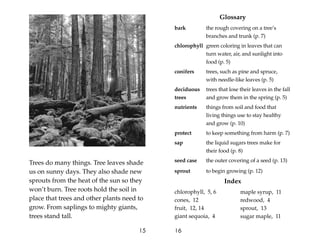
Trees do many things. Tree leaves shade
us on sunny days. They also shade new
sprouts from the heat of the sun so they
won’t burn. Tree roots hold the soil in
place that trees and other plants need to
grow. From saplings to mighty giants,
trees stand tall.
15
Glossary
bark the rough covering on a tree’s
branches and trunk (p. 7)
chlorophyll green coloring in leaves that can
turn water, air, and sunlight into
food (p. 5)
conifers trees, such as pine and spruce,
with needle-like leaves (p. 5)
deciduous trees that lose their leaves in the fall
trees and grow them in the spring (p. 5)
nutrients things from soil and food that
living things use to stay healthy
and grow (p. 10)
protect to keep something from harm (p. 7)
sap the liquid sugars trees make for
their food (p. 8)
seed case the outer covering of a seed (p. 13)
sprout to begin growing (p. 12)
Index
chlorophyll, 5, 6
cones, 12
fruit, 12, 14
giant sequoia, 4
16
maple syrup, 11
redwood, 4
sprout, 13
sugar maple, 11
SendQualityBooksHome
WithAllYourStudents
www.readinga-z.com
TheOnlineReadingProgram
LeveledBooks
LessonPlans
Worksheets
Assessments
Comprehension&FluencyResources
PhonicsMaterials
AlphabetBooks
More
InstantaccesstoThousandsofDownloadable
Books&ReadingResources
(IncludingEnglish,Spanish,andFrench)
LowAnnualSubscriptions

Raz lp17 abouttrees_samp

  • 1.
    Visit www.readinga-z.com for thousandsof books and materials. About Trees A Reading A–Z Level P Leveled Reader Word Count: 769 www.readinga-z.com About TreesAbout Trees Written by Sherry SterlingWritten by Sherry Sterling LEVELED READER • P
  • 2.
    About Trees Written bySherry Sterling www.readinga-z.com About Trees Level P Leveled Reader © 2007 Learning A–Z Written by Sherry Sterling All rights reserved. www.readinga-z.com Photo Credits: Cover, back cover, title page, 3, 5, 6, 7, 8, 12 (bottom left), 14, 15: © ArtToday; page 4: © Getty Images; page 9 (main): © Robert Estall/CORBIS; page 9 (inset): © Royalty-Free/Getty Images; page 10: Royalty-Free/Getty Images; page 11 (main): Royalty-Free/Getty Images; page 11 (bottom left), 12 (all except bottom left): © Hemera Technologies; page 13: © David Aubrey/CORBIS Correlation LEVEL P N 21 30 Fountas & Pinnell Reading Recovery DRA Leveled Books Lesson Plans Worksheets Benchmark Books & Running Records Systematic Phonics Lessons Decodable Books Sound/Symbol Books High-Frequency Word Books Alphabet Books Poetry Read-Alouds Vocabulary Books Reader’s Theater Comprehension Quizzes Fluency Passages Retelling Rubrics VISIT www.readinga-z.com The Online Reading Program English * Spanish * French All for one LOW yearly fee See all the Reading A-Z materials
  • 3.
    Table of Contents Introduction. . . . . . . . . . . . . . . . . . . . . . . 4 Leaves . . . . . . . . . . . . . . . . . . . . . . . . . . . . 5 Branches . . . . . . . . . . . . . . . . . . . . . . . . . . 7 Trunk . . . . . . . . . . . . . . . . . . . . . . . . . . . . . 8 Roots . . . . . . . . . . . . . . . . . . . . . . . . . . . . 10 Sap . . . . . . . . . . . . . . . . . . . . . . . . . . . . . . 11 Seeds . . . . . . . . . . . . . . . . . . . . . . . . . . . . 12 Growing. . . . . . . . . . . . . . . . . . . . . . . . . . 13 Conclusion . . . . . . . . . . . . . . . . . . . . . . . 14 Glossary/Index . . . . . . . . . . . . . . . . . . . 16 3 Introduction Trees are the tallest living plants. Redwood trees can grow as tall as a 30-story building. Giant sequoias can weigh as much as 3,000 large pickup trucks, making them one of the heaviest living things. Trees also live a long time. Many trees alive today were full grown long before the United States became a country. But these massive trees share something with all plants—they make their own food. 4 People look tiny when standing next to giant sequoias.
  • 4.
    Leaves Imagine being ableto make your own food without cooking or even going to a restaurant! Leaves make food for trees by changing energy from sunlight into food. This important work is done by chlorophyll (KLOR-uh-fill), the green coloring in leaves. Leaves come in all shapes and sizes. Most deciduous (dee-SIJ-oo-us) trees have wide, thin leaves, while most conifers have needle- like leaves. Conifers keep their needles through all seasons. Only the oldest needles fall to the ground. Deciduous trees lose their leaves every fall. 5 In the fall, the leaves of deciduous trees show their true colors. These true colors are yellows, oranges, and browns, which hide under green chlorophyll all spring and summer. We see these colors in the fall after leaves stop making chlorophyll. 6 Yellow and brown leaves fall from this deciduous tree. conifer deciduous
  • 5.
    Branches Branches are thearms that hold up a tree’s leaves. Branches spread leaves out to get as much sunlight as they can. The leaves give shade to other living things on sunny days. Branches start out as twigs, then they grow thicker each year. As a tree grows, its bark cracks open so the branches and trunk can expand. New bark is always growing under the old, ready to protect the tree. If new bark gets stripped away, a tree can die. 7 Trunk Tubes in the tree’s trunk carry water from the roots up to the leaves. They also carry sap, or food, down from the leaves to the roots. These tubes are like highways, carrying traffic back and forth. They are close to the outside of the tree, just under the bark. 8 Layers of bark protect trees. twigs branch trunk leaves roots
  • 6.
    A tree doesn’tneed the middle of its trunk to live. The middle is made of rings of old growth, not active highways. That’s why a tree can keep growing even if the middle is hollowed out after a lightning strike. All it needs is enough bark to protect its highways. 9 Roots Trees need soil to keep growing. Roots are part of the highways. They soak up water and nutrients from the soil. Roots also keep the soil in place when it rains. Without the roots of trees and plants, soil washes away. Trees are stuck in the soil because their roots reach deep into the ground. It’s a good thing they can make their own food, since they can’t move to get it. 10 Tree roots reach deep into the ground. Lightning zapped a hole through the middle of this oak tree, but it continues to grow. bark old growth active highways water sap
  • 7.
    Sap Leaves use waterplus sunlight and air to make food for the tree. This food is in the form of liquid sugars. Sometimes people eat some kinds of tree sugars for food. You’ve probably had tree sugar for breakfast—pouring it over your pancakes or waffles. Have you guessed what tree sugar this is? It’s maple syrup, and it comes from the food, or sap, of a sugar maple tree. 11 Seeds Deciduous trees grow flowers, which make seeds that are inside fruit or nuts. Conifers make cones instead of flowers. The cones do the same job for conifers that flowers do on other trees. They make seeds to grow more trees. Each seed holds its own supply of food to keep it alive until it’s ready to sprout. 12 A bucket collects sap from a tap in a maple tree. Pancakes swim in maple syrup. acorn apple blooms apple seeds pinecone apple fruit pine nuts
  • 8.
    Growing How does atall tree grow from a small seed? The seed soaks up water until it can send out a root. With more water, leaves inside the seed case grow until they push up and out. Once this has happened, we say the seed has sprouted. Now the sprout can make its own food and no longer needs the seed’s store of energy. The seed leaves will make food for the new sprout. 13 Conclusion While trees look like they aren’t doing much, they are working. They make their own food by changing sunlight and air into sugars. This helps keep the air clean, too. Trees are homes and food for birds and other animals. Look to see which animals make homes in trees near your home. Some animals, including humans, eat sap, fruit, and seeds from trees. Others eat bark and leaves. 14 Holes in trees make safe homes for many owls. This shows how a sprout grows from a seed. seed case roots seed leaves
  • 9.
    Trees do manythings. Tree leaves shade us on sunny days. They also shade new sprouts from the heat of the sun so they won’t burn. Tree roots hold the soil in place that trees and other plants need to grow. From saplings to mighty giants, trees stand tall. 15 Glossary bark the rough covering on a tree’s branches and trunk (p. 7) chlorophyll green coloring in leaves that can turn water, air, and sunlight into food (p. 5) conifers trees, such as pine and spruce, with needle-like leaves (p. 5) deciduous trees that lose their leaves in the fall trees and grow them in the spring (p. 5) nutrients things from soil and food that living things use to stay healthy and grow (p. 10) protect to keep something from harm (p. 7) sap the liquid sugars trees make for their food (p. 8) seed case the outer covering of a seed (p. 13) sprout to begin growing (p. 12) Index chlorophyll, 5, 6 cones, 12 fruit, 12, 14 giant sequoia, 4 16 maple syrup, 11 redwood, 4 sprout, 13 sugar maple, 11
  • 10.