Professional Forestry Education
Fundamentals of Forest Stand Dynamics:
An approach to experiential learning for forestry students
Edward Wilson
Silviculturist
Scottish School of Forestry
Inverness College UHI, Inverness, Scotland
18 July 2014
First presented: 18 07 2014
This version: v1.1, 18 07 2014
RESEARCH
I N T E R N A T I O N A L
Outline
• Definition and relevance of Forest Stand Dynamics to forestry
education
• Organisation and approach to a learning session/activity
– Experiential
– Integrative
– Active
• Learning outcomes from completion of the session
• Questions and Discussion
Forest Stand Dynamics (1)
• What is Forest Stand Dynamics?
– The study of change in forest stand structure with time, including stand
behaviour during and after disturbance (human-caused or natural)
– Oliver and Larson 1996
• What are the Foundations of the Discipline of Forest Stand Dynamics?
– Observation
– Ecology, physiology, morphology, anatomy, environmental factors
– Facilitates study of Interactions – i.e., tree-tree, species-species, tree-site
– Enables understanding of Stand Growth and Succession
• Where does Forest Stand Dynamics fit in the undergraduate forestry
curriculum?
– Forest science
– Silvicultural systems
– Woodland ecology
– (Re-enforces learning in Forest mensuration and thinning control, and other
modules)
Forest Stand Dynamics (2)
• Why is Forest Stand Dynamics important for foresters?
– Aids understanding of forest development and responses to natural disturbance
– Basis for understanding the interactions and responses to planned interventions
• Predicting productivity and future yield
• Predicting future structure and composition
• Controlling silvicultural costs
• Habitat and conservation values
• Enhancing landscape-scale values
– Forests are complex systems and need to be managed to be both resilient (to
minimise effects of climate change, pests and diseases) and sustainable (social,
economic, ecological and environmental factors)
– Principles of forest stand dynamics apply to all forest types and forest biomes.
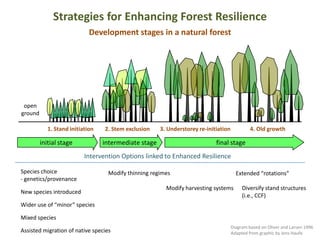
Development stages in a natural forest
initial stage intermediate stage final stage
Strategies for Enhancing Forest Resilience
Modify thinning regimes Extended “rotations”
Diversify stand structures
(i.e., CCF)
Species choice
- genetics/provenance
Mixed species
Assisted migration of native species
New species introduced
Wider use of “minor” species
Diagram based on Oliver and Larsen 1996
Adapted from graphic by Jens Haufe
open
ground
1. Stand initiation 2. Stem exclusion 3. Understorey re-initiation 4. Old growth
Intervention Options linked to Enhanced Resilience
Modify harvesting systems
Facilitating Learning in Forest Stand Dynamics
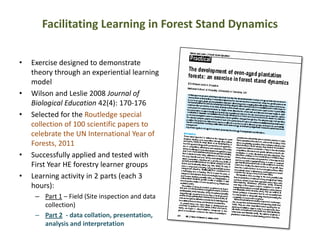
• Exercise designed to demonstrate
theory through an experiential learning
model
• Wilson and Leslie 2008 Journal of
Biological Education 42(4): 170-176
• Selected for the Routledge special
collection of 100 scientific papers to
celebrate the UN International Year of
Forests, 2011
• Successfully applied and tested with
First Year HE forestry learner groups
• Learning activity in 2 parts (each 3
hours):
– Part 1 – Field (Site inspection and data
collection)
– Part 2 - data collation, presentation,
analysis and interpretation
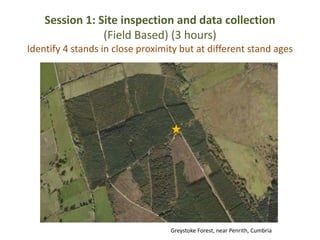
Session 1: Site inspection and data collection
(Field Based) (3 hours)
Identify 4 stands in close proximity but at different stand ages
Greystoke Forest, near Penrith, Cumbria
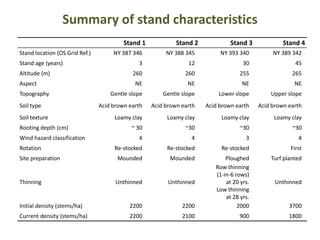
Stand 1 Stand 2 Stand 3 Stand 4
Stand location (OS Grid Ref.) NY 387 346 NY 388 345 NY 393 340 NY 389 342
Stand age (years) 3 12 30 45
Altitude (m) 260 260 255 265
Aspect NE NE NE NE
Topography Gentle slope Gentle slope Lower slope Upper slope
Soil type Acid brown earth Acid brown earth Acid brown earth Acid brown earth
Soil texture Loamy clay Loamy clay Loamy clay Loamy clay
Rooting depth (cm) ~ 30 ~30 ~30 ~30
Wind hazard classification 4 4 3 4
Rotation Re-stocked Re-stocked Re-stocked First
Site preparation Mounded Mounded Ploughed Turf planted
Thinning Unthinned Unthinned
Row thinning
(1-in-6 rows)
at 20 yrs.
Low thinning
at 28 yrs.
Unthinned
Initial density (stems/ha) 2200 2200 2000 3700
Current density (stems/ha) 2200 2100 900 1800
Summary of stand characteristics
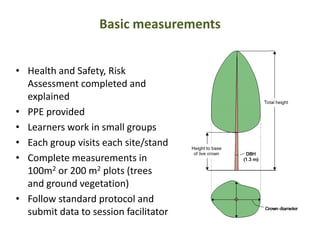
Basic measurements
• Health and Safety, Risk
Assessment completed and
explained
• PPE provided
• Learners work in small groups
• Each group visits each site/stand
• Complete measurements in
100m2 or 200 m2 plots (trees
and ground vegetation)
• Follow standard protocol and
submit data to session facilitator
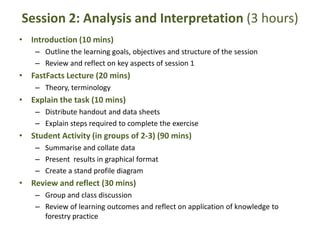
Session 2: Analysis and Interpretation (3 hours)
• Introduction (10 mins)
– Outline the learning goals, objectives and structure of the session
– Review and reflect on key aspects of session 1
• FastFacts Lecture (20 mins)
– Theory, terminology
• Explain the task (10 mins)
– Distribute handout and data sheets
– Explain steps required to complete the exercise
• Student Activity (in groups of 2-3) (90 mins)
– Summarise and collate data
– Present results in graphical format
– Create a stand profile diagram
• Review and reflect (30 mins)
– Group and class discussion
– Review of learning outcomes and reflect on application of knowledge to
forestry practice
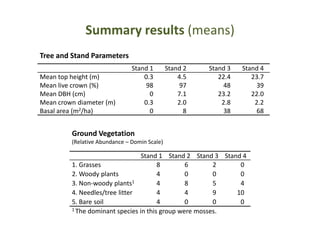
Summary results (means)
Tree and Stand Parameters
Stand 1 Stand 2 Stand 3 Stand 4
Mean top height (m) 0.3 4.5 22.4 23.7
Mean live crown (%) 98 97 48 39
Mean DBH (cm) 0 7.1 23.2 22.0
Mean crown diameter (m) 0.3 2.0 2.8 2.2
Basal area (m2/ha) 0 8 38 68
Ground Vegetation
(Relative Abundance – Domin Scale)
Stand 1 Stand 2 Stand 3 Stand 4
1. Grasses 8 6 2 0
2. Woody plants 4 0 0 0
3. Non-woody plants1 4 8 5 4
4. Needles/tree litter 4 4 9 10
5. Bare soil 4 0 0 0
1 The dominant species in this group were mosses.
0
20
40
60
80
100
0 10 20 30 40 50
Meanlivecrown(%)
0
5
10
15
20
25
0 10 20 30 40 50
Meantopheight(m)
0
5
10
15
20
25
30
0 10 20 30 40 50
Stand Age (years)
MeanDBH(cm)
Grand
period
a.
b.
c.
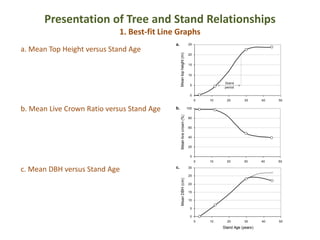
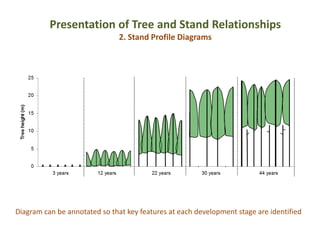
Presentation of Tree and Stand Relationships
1. Best-fit Line Graphs
a. Mean Top Height versus Stand Age
b. Mean Live Crown Ratio versus Stand Age
c. Mean DBH versus Stand Age
Presentation of Tree and Stand Relationships
2. Stand Profile Diagrams
Diagram can be annotated so that key features at each development stage are identified
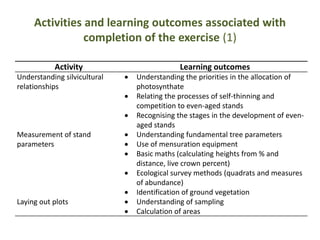
Activities and learning outcomes associated with
completion of the exercise (1)
Activity Learning outcomes
Understanding silvicultural
relationships
 Understanding the priorities in the allocation of
photosynthate
 Relating the processes of self-thinning and
competition to even-aged stands
 Recognising the stages in the development of even-
aged stands
Measurement of stand
parameters
 Understanding fundamental tree parameters
 Use of mensuration equipment
 Basic maths (calculating heights from % and
distance, live crown percent)
 Ecological survey methods (quadrats and measures
of abundance)
 Identification of ground vegetation
Laying out plots  Understanding of sampling
 Calculation of areas
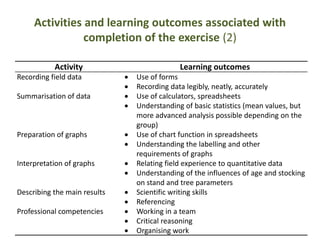
Activities and learning outcomes associated with
completion of the exercise (2)
Activity Learning outcomes
Recording field data  Use of forms
 Recording data legibly, neatly, accurately
Summarisation of data  Use of calculators, spreadsheets
 Understanding of basic statistics (mean values, but
more advanced analysis possible depending on the
group)
Preparation of graphs  Use of chart function in spreadsheets
 Understanding the labelling and other
requirements of graphs
Interpretation of graphs  Relating field experience to quantitative data
 Understanding of the influences of age and stocking
on stand and tree parameters
Describing the main results  Scientific writing skills
 Referencing
Professional competencies  Working in a team
 Critical reasoning
 Organising work
Professional Forestry Education
Reference
Wilson, E. R., and A. D. Leslie. 2008. The development of even-aged plantation
forests: a field-based practical exercise in forest stand dynamics. Journal of Biological
Education 42(4): 170-176
URL: http://silviculture.org.uk/publications/
Download: http://www.researchgate.net/profile/Edward_Wilson5
First presented: 18 07 2014
This version: v1.1, 18 07 2014
Contact Information
Edward Wilson
Email: ted.wilson@silviculture.org.uk
Web: www.silviculture.org.uk
RESEARCH
I N T E R N A T I O N A L

Teaching Forest Stand Dynamics

  • 1.
    Professional Forestry Education Fundamentalsof Forest Stand Dynamics: An approach to experiential learning for forestry students Edward Wilson Silviculturist Scottish School of Forestry Inverness College UHI, Inverness, Scotland 18 July 2014 First presented: 18 07 2014 This version: v1.1, 18 07 2014 RESEARCH I N T E R N A T I O N A L
  • 2.
    Outline • Definition andrelevance of Forest Stand Dynamics to forestry education • Organisation and approach to a learning session/activity – Experiential – Integrative – Active • Learning outcomes from completion of the session • Questions and Discussion
  • 3.
    Forest Stand Dynamics(1) • What is Forest Stand Dynamics? – The study of change in forest stand structure with time, including stand behaviour during and after disturbance (human-caused or natural) – Oliver and Larson 1996 • What are the Foundations of the Discipline of Forest Stand Dynamics? – Observation – Ecology, physiology, morphology, anatomy, environmental factors – Facilitates study of Interactions – i.e., tree-tree, species-species, tree-site – Enables understanding of Stand Growth and Succession • Where does Forest Stand Dynamics fit in the undergraduate forestry curriculum? – Forest science – Silvicultural systems – Woodland ecology – (Re-enforces learning in Forest mensuration and thinning control, and other modules)
  • 4.
    Forest Stand Dynamics(2) • Why is Forest Stand Dynamics important for foresters? – Aids understanding of forest development and responses to natural disturbance – Basis for understanding the interactions and responses to planned interventions • Predicting productivity and future yield • Predicting future structure and composition • Controlling silvicultural costs • Habitat and conservation values • Enhancing landscape-scale values – Forests are complex systems and need to be managed to be both resilient (to minimise effects of climate change, pests and diseases) and sustainable (social, economic, ecological and environmental factors) – Principles of forest stand dynamics apply to all forest types and forest biomes.
  • 5.
    Development stages ina natural forest initial stage intermediate stage final stage Strategies for Enhancing Forest Resilience Modify thinning regimes Extended “rotations” Diversify stand structures (i.e., CCF) Species choice - genetics/provenance Mixed species Assisted migration of native species New species introduced Wider use of “minor” species Diagram based on Oliver and Larsen 1996 Adapted from graphic by Jens Haufe open ground 1. Stand initiation 2. Stem exclusion 3. Understorey re-initiation 4. Old growth Intervention Options linked to Enhanced Resilience Modify harvesting systems
  • 6.
    Facilitating Learning inForest Stand Dynamics • Exercise designed to demonstrate theory through an experiential learning model • Wilson and Leslie 2008 Journal of Biological Education 42(4): 170-176 • Selected for the Routledge special collection of 100 scientific papers to celebrate the UN International Year of Forests, 2011 • Successfully applied and tested with First Year HE forestry learner groups • Learning activity in 2 parts (each 3 hours): – Part 1 – Field (Site inspection and data collection) – Part 2 - data collation, presentation, analysis and interpretation
  • 7.
    Session 1: Siteinspection and data collection (Field Based) (3 hours) Identify 4 stands in close proximity but at different stand ages Greystoke Forest, near Penrith, Cumbria
  • 8.
    Stand 1 Stand2 Stand 3 Stand 4 Stand location (OS Grid Ref.) NY 387 346 NY 388 345 NY 393 340 NY 389 342 Stand age (years) 3 12 30 45 Altitude (m) 260 260 255 265 Aspect NE NE NE NE Topography Gentle slope Gentle slope Lower slope Upper slope Soil type Acid brown earth Acid brown earth Acid brown earth Acid brown earth Soil texture Loamy clay Loamy clay Loamy clay Loamy clay Rooting depth (cm) ~ 30 ~30 ~30 ~30 Wind hazard classification 4 4 3 4 Rotation Re-stocked Re-stocked Re-stocked First Site preparation Mounded Mounded Ploughed Turf planted Thinning Unthinned Unthinned Row thinning (1-in-6 rows) at 20 yrs. Low thinning at 28 yrs. Unthinned Initial density (stems/ha) 2200 2200 2000 3700 Current density (stems/ha) 2200 2100 900 1800 Summary of stand characteristics
  • 9.
    Basic measurements • Healthand Safety, Risk Assessment completed and explained • PPE provided • Learners work in small groups • Each group visits each site/stand • Complete measurements in 100m2 or 200 m2 plots (trees and ground vegetation) • Follow standard protocol and submit data to session facilitator
  • 10.
    Session 2: Analysisand Interpretation (3 hours) • Introduction (10 mins) – Outline the learning goals, objectives and structure of the session – Review and reflect on key aspects of session 1 • FastFacts Lecture (20 mins) – Theory, terminology • Explain the task (10 mins) – Distribute handout and data sheets – Explain steps required to complete the exercise • Student Activity (in groups of 2-3) (90 mins) – Summarise and collate data – Present results in graphical format – Create a stand profile diagram • Review and reflect (30 mins) – Group and class discussion – Review of learning outcomes and reflect on application of knowledge to forestry practice
  • 11.
    Summary results (means) Treeand Stand Parameters Stand 1 Stand 2 Stand 3 Stand 4 Mean top height (m) 0.3 4.5 22.4 23.7 Mean live crown (%) 98 97 48 39 Mean DBH (cm) 0 7.1 23.2 22.0 Mean crown diameter (m) 0.3 2.0 2.8 2.2 Basal area (m2/ha) 0 8 38 68 Ground Vegetation (Relative Abundance – Domin Scale) Stand 1 Stand 2 Stand 3 Stand 4 1. Grasses 8 6 2 0 2. Woody plants 4 0 0 0 3. Non-woody plants1 4 8 5 4 4. Needles/tree litter 4 4 9 10 5. Bare soil 4 0 0 0 1 The dominant species in this group were mosses.
  • 12.
    0 20 40 60 80 100 0 10 2030 40 50 Meanlivecrown(%) 0 5 10 15 20 25 0 10 20 30 40 50 Meantopheight(m) 0 5 10 15 20 25 30 0 10 20 30 40 50 Stand Age (years) MeanDBH(cm) Grand period a. b. c. Presentation of Tree and Stand Relationships 1. Best-fit Line Graphs a. Mean Top Height versus Stand Age b. Mean Live Crown Ratio versus Stand Age c. Mean DBH versus Stand Age
  • 13.
    Presentation of Treeand Stand Relationships 2. Stand Profile Diagrams Diagram can be annotated so that key features at each development stage are identified
  • 14.
    Activities and learningoutcomes associated with completion of the exercise (1) Activity Learning outcomes Understanding silvicultural relationships  Understanding the priorities in the allocation of photosynthate  Relating the processes of self-thinning and competition to even-aged stands  Recognising the stages in the development of even- aged stands Measurement of stand parameters  Understanding fundamental tree parameters  Use of mensuration equipment  Basic maths (calculating heights from % and distance, live crown percent)  Ecological survey methods (quadrats and measures of abundance)  Identification of ground vegetation Laying out plots  Understanding of sampling  Calculation of areas
  • 15.
    Activities and learningoutcomes associated with completion of the exercise (2) Activity Learning outcomes Recording field data  Use of forms  Recording data legibly, neatly, accurately Summarisation of data  Use of calculators, spreadsheets  Understanding of basic statistics (mean values, but more advanced analysis possible depending on the group) Preparation of graphs  Use of chart function in spreadsheets  Understanding the labelling and other requirements of graphs Interpretation of graphs  Relating field experience to quantitative data  Understanding of the influences of age and stocking on stand and tree parameters Describing the main results  Scientific writing skills  Referencing Professional competencies  Working in a team  Critical reasoning  Organising work
  • 16.
    Professional Forestry Education Reference Wilson,E. R., and A. D. Leslie. 2008. The development of even-aged plantation forests: a field-based practical exercise in forest stand dynamics. Journal of Biological Education 42(4): 170-176 URL: http://silviculture.org.uk/publications/ Download: http://www.researchgate.net/profile/Edward_Wilson5 First presented: 18 07 2014 This version: v1.1, 18 07 2014 Contact Information Edward Wilson Email: ted.wilson@silviculture.org.uk Web: www.silviculture.org.uk RESEARCH I N T E R N A T I O N A L