
Introduction to Forestry
(According to 5th Dean Syllabus)
Dr. Shailendra Bhalawe
Assistant Professor
Department of Agro-forestry
College of Agriculture, Balaghat
Jawaharlal Nehru Agriculture University, Jabalpur
(M.P.)
Introduction:
Forest: The word ”Forest” is derived from Latin word “Foris”
meaning outside the village boundary or away from inhabited land.
It is a large tract covered with trees and under growth sometimes
mixed with pasture.
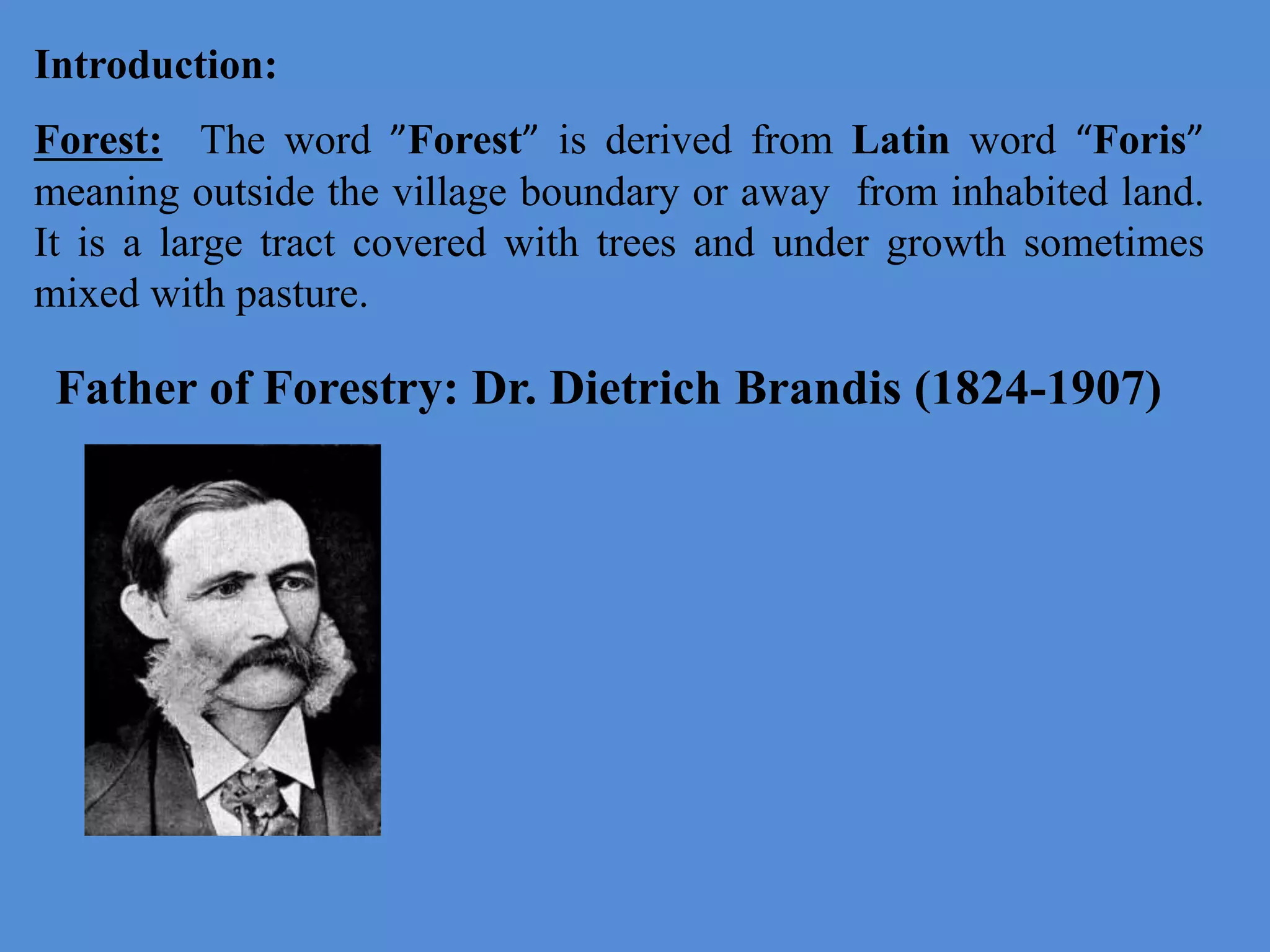
Father of Forestry: Dr. Dietrich Brandis (1824-1907)
Generally-: Forest is referred to an area occupied by different kinds
of trees, shrubs, herbs and grasses and maintained as such. In a
general sense forest is a large uncultivated tract of land covered with
trees and Underwood, woody ground and rude pasture; a preserve for
big game.
Technically-: Forest is an area set aside for the production of timber
and other forest produce or maintained under woody vegetation for
certain indirect benefits which it provides e.g. climatic or protective.
(Anon., 1966).
Ecologically-: It is defined as a plant community, predominantly of
trees and other woody vegetation usually with a closed canopy.
Legally-: Forest is an area of land proclaimed to be a forest under a
forest law.
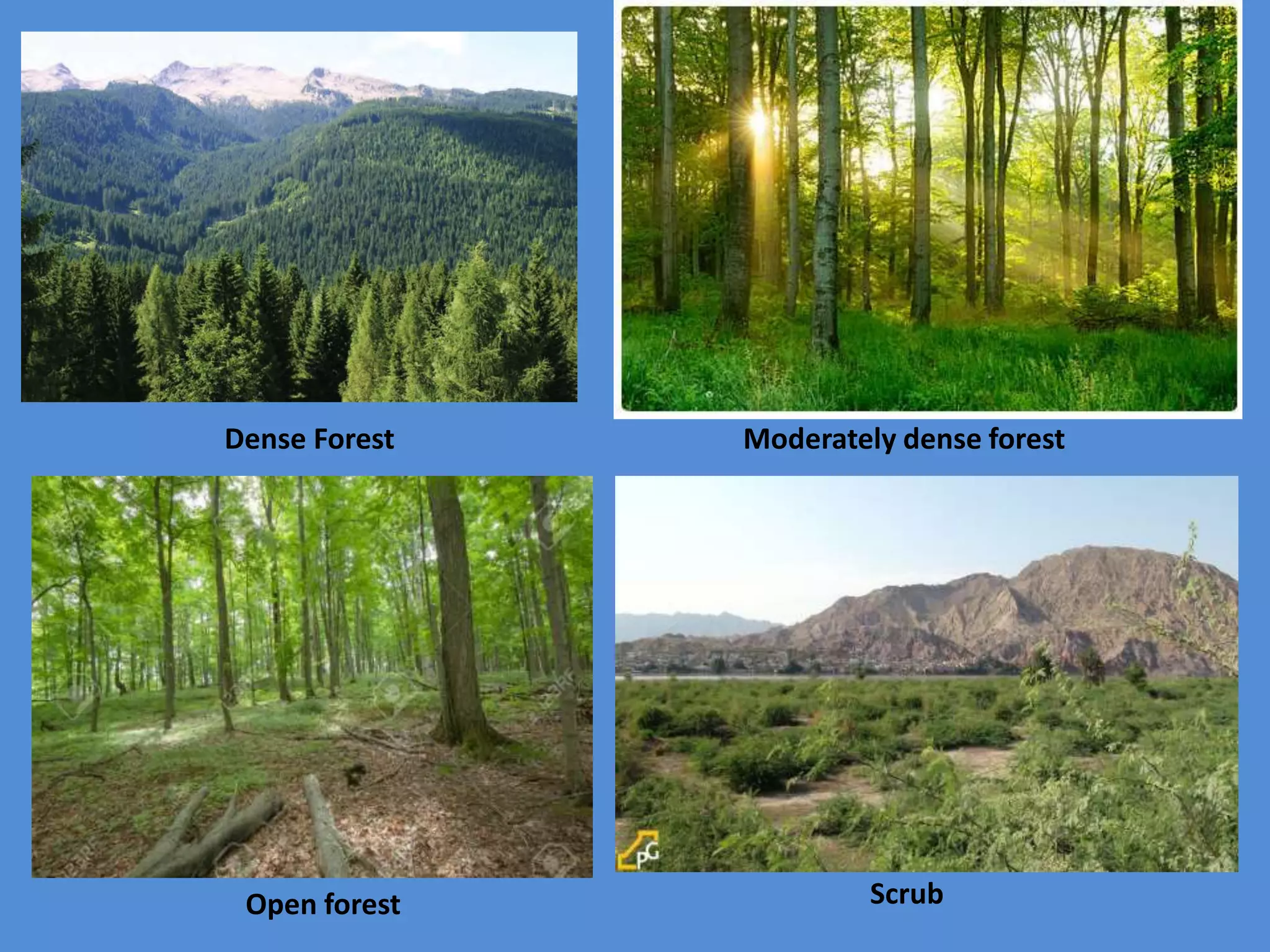
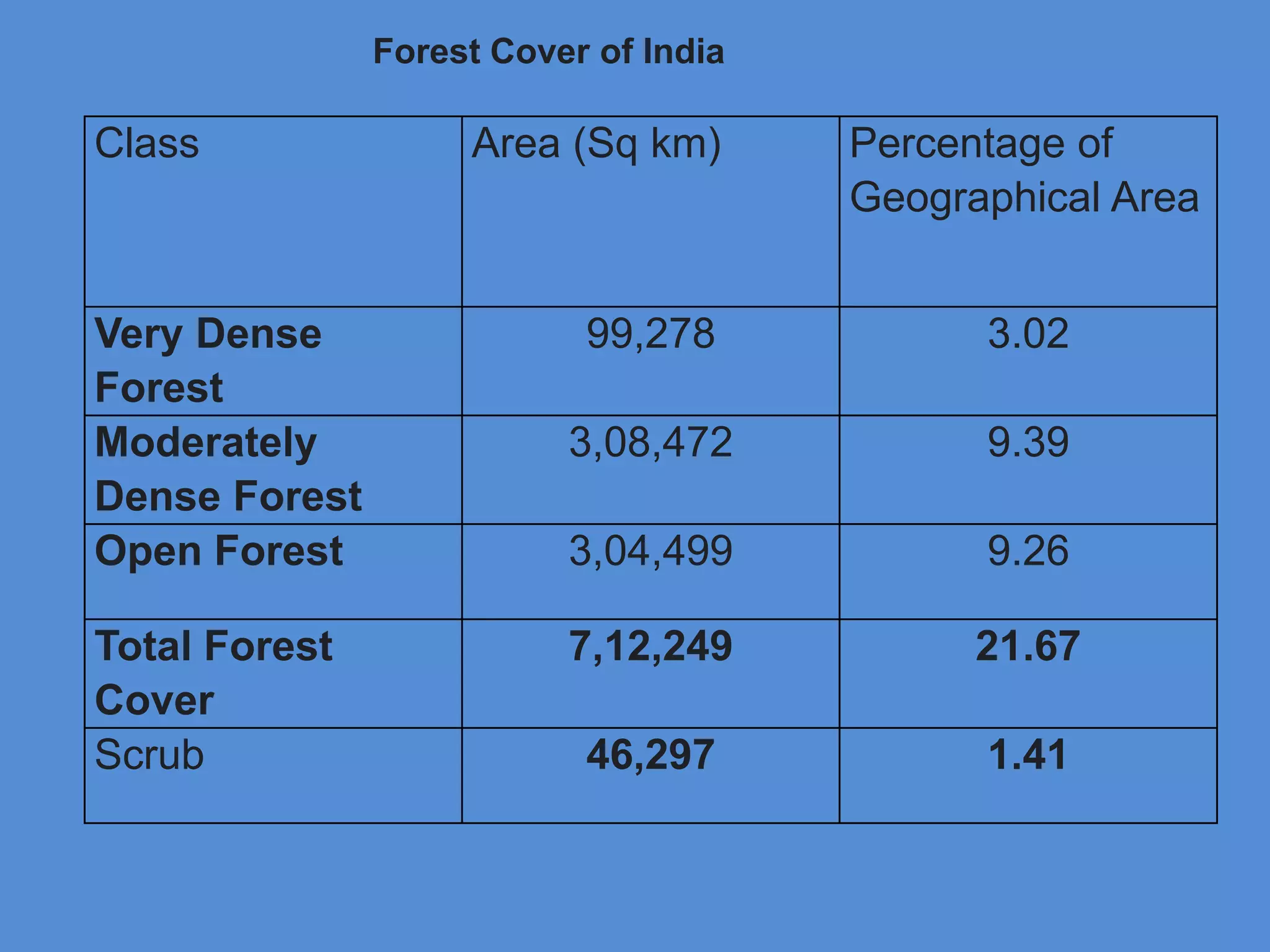
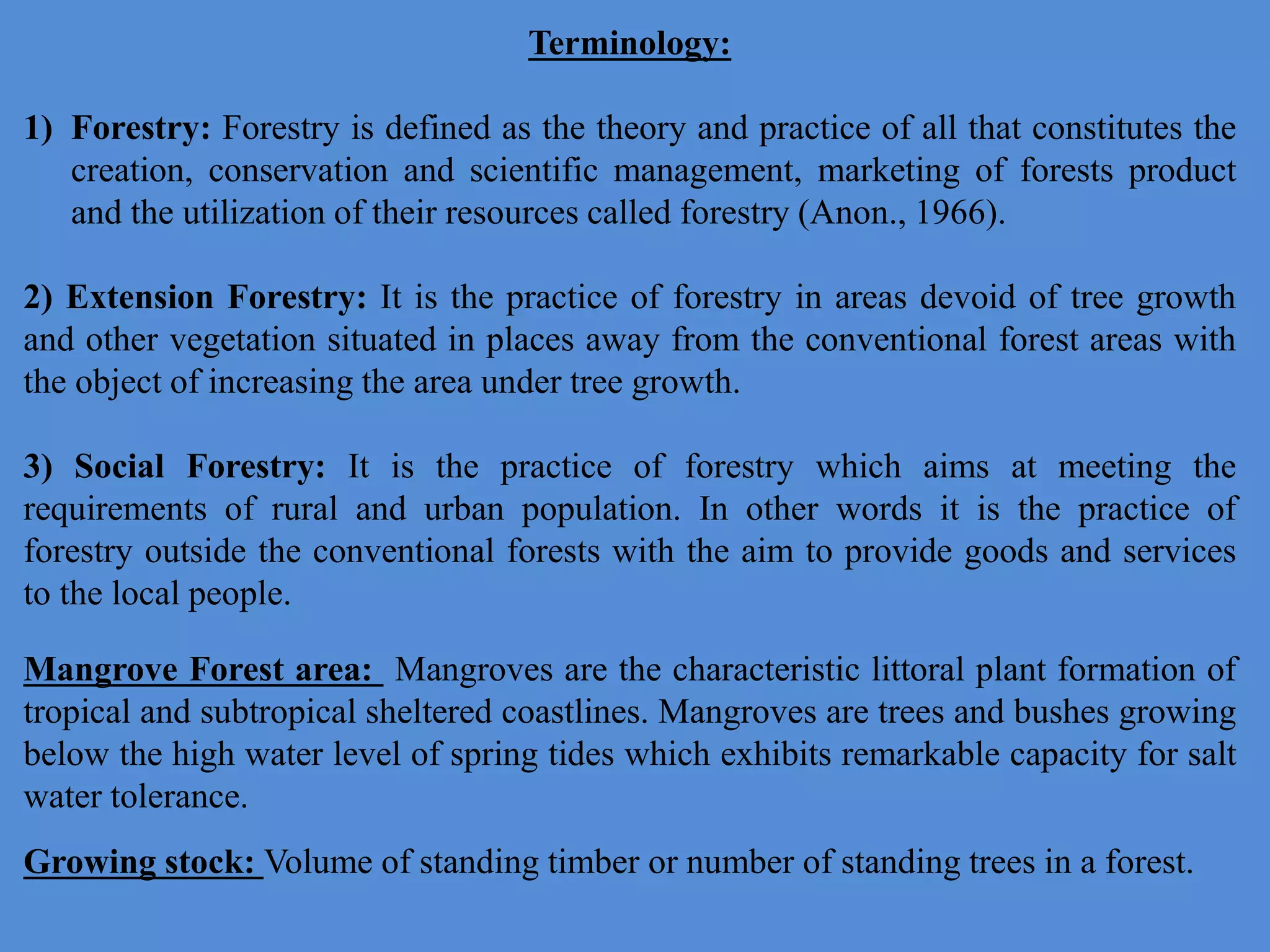
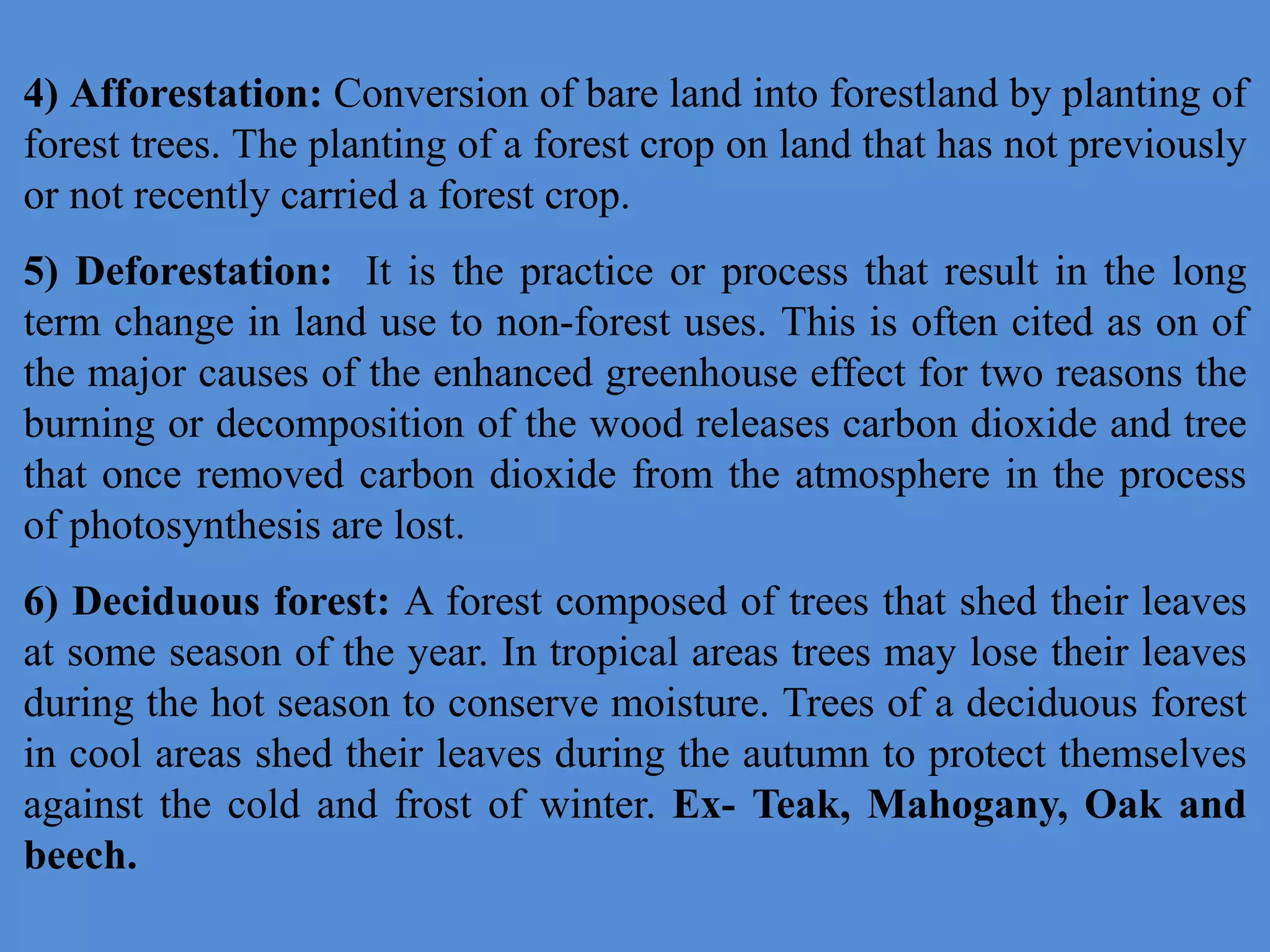
Dense Forest Moderately dense forest
Open forest Scrub
Class Area (Sq km) Percentage of
Geographical Area
Very Dense
Forest
99,278 3.02
Moderately
Dense Forest
3,08,472 9.39
Open Forest 3,04,499 9.26
Total Forest
Cover
7,12,249 21.67
Scrub 46,297 1.41
Forest Cover of India
Mangrove Forest area: Mangroves are the characteristic littoral plant formation of
tropical and subtropical sheltered coastlines. Mangroves are trees and bushes growing
below the high water level of spring tides which exhibits remarkable capacity for salt
water tolerance.
Growing stock: Volume of standing timber or number of standing trees in a forest.
Terminology:
1) Forestry: Forestry is defined as the theory and practice of all that constitutes the
creation, conservation and scientific management, marketing of forests product
and the utilization of their resources called forestry (Anon., 1966).
2) Extension Forestry: It is the practice of forestry in areas devoid of tree growth
and other vegetation situated in places away from the conventional forest areas with
the object of increasing the area under tree growth.
3) Social Forestry: It is the practice of forestry which aims at meeting the
requirements of rural and urban population. In other words it is the practice of
forestry outside the conventional forests with the aim to provide goods and services
to the local people.
4) Afforestation: Conversion of bare land into forestland by planting of
forest trees. The planting of a forest crop on land that has not previously
or not recently carried a forest crop.
5) Deforestation: It is the practice or process that result in the long
term change in land use to non-forest uses. This is often cited as on of
the major causes of the enhanced greenhouse effect for two reasons the
burning or decomposition of the wood releases carbon dioxide and tree
that once removed carbon dioxide from the atmosphere in the process
of photosynthesis are lost.
6) Deciduous forest: A forest composed of trees that shed their leaves
at some season of the year. In tropical areas trees may lose their leaves
during the hot season to conserve moisture. Trees of a deciduous forest
in cool areas shed their leaves during the autumn to protect themselves
against the cold and frost of winter. Ex- Teak, Mahogany, Oak and
beech.
7) Dendrology: The study of trees that is knowledge of the taxonomy, systematic
relationships and field recognitions of tree species.
8) Fast growing trees: Trees having the height growth minimum of 60 cm per year
and the mean annual increment of 10 m3/ha is called as fast growing trees.
9) Farm Forestry: Farm forestry is the name given to programmes which promote
commercial tree growing by farmers on their own land. Farm forestry was defined by
NCA (1976) as the practice of forestry in all its aspects in and the around the farms or
village lands integrated with other farm operations.
10) Breast Height: A standard height from ground level for recording diameter, girth
or basal area of a tree, generally 1.37 m. called breast height of tree.
11) Canopy: The foliar cover in a forest stand consisting of one or several layers.
12) Crown: The part of a tree or woody plant bearing live branches and foliage.
List of National Forest related Institute:
1.(ICFRE) Indian Council of Forestry Research & Education: Dehradun
(Uttarakhand)
2. (IIFM) Indian Institute of Forest Management: Bhopal (Madhya Pradesh)
3. (TFRI) Tropical Forest Research Institute: Jabalpur (Madhya Pradesh)
4. (IGFRI) Indian Grassland Forest Research Institute: Jhasi (Uttar Pradesh)
5. (NRCA) National Research Centre for Agro-forestry: Jhasi (Uttar Pradesh)
INSTRUMENTS USED IN MEASUREMENT OF TREES:
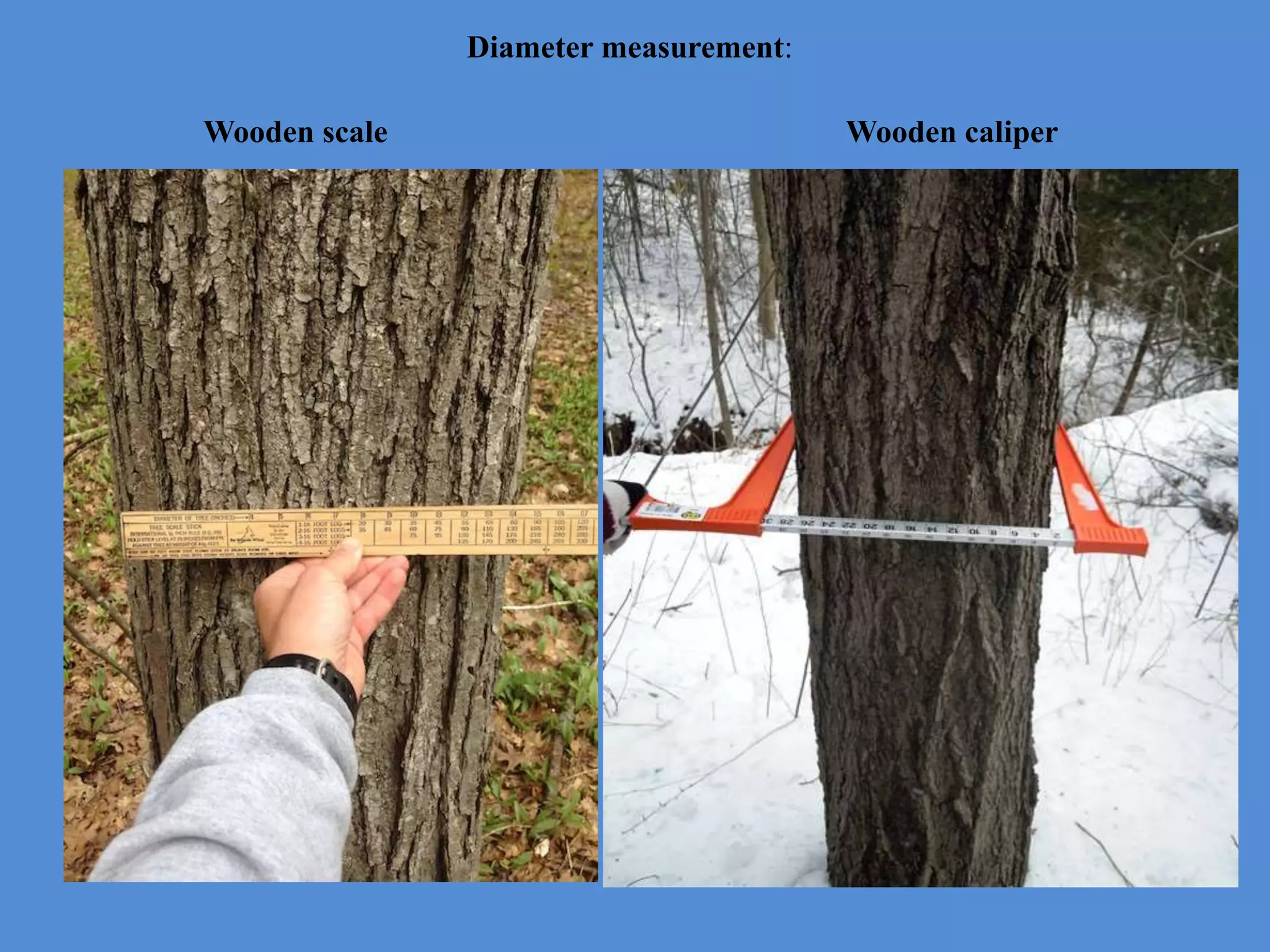
1. Diameter measurement: Wooden scale, Wooden caliper.
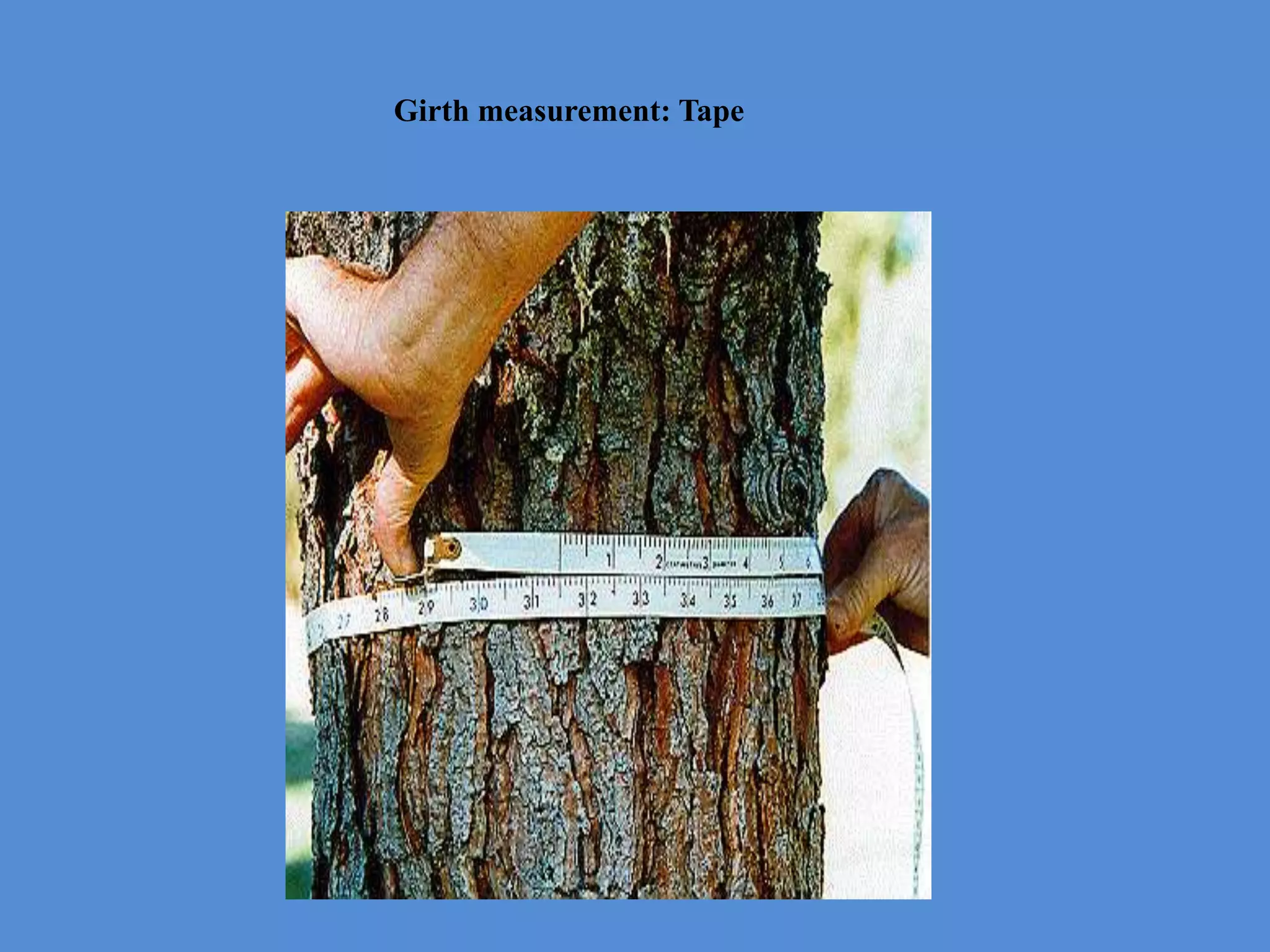
2. Girth measurement: Tape
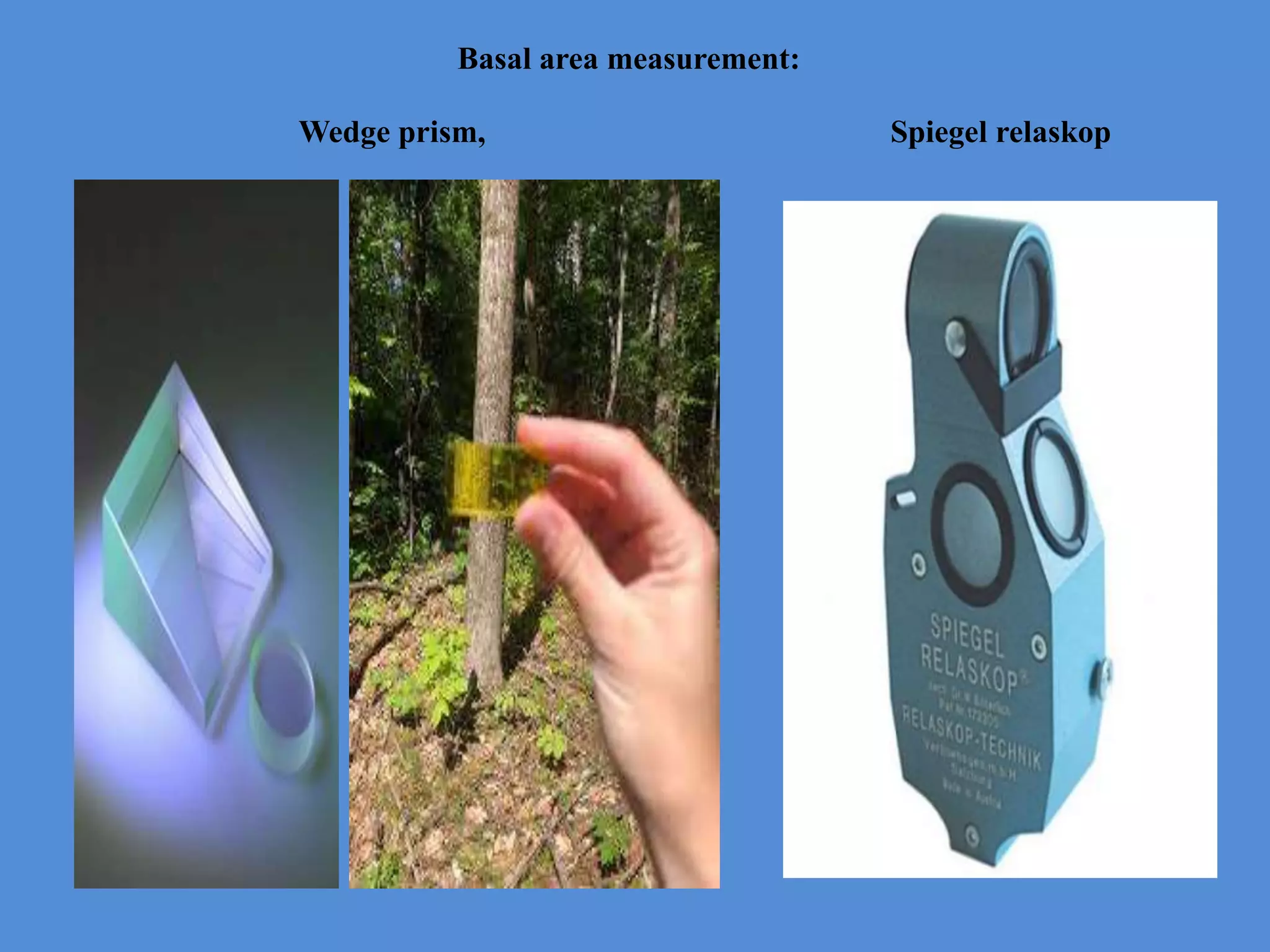
3.Basal area measurement: Wedge prism, Spiegel relaskop
4. Height measurement:
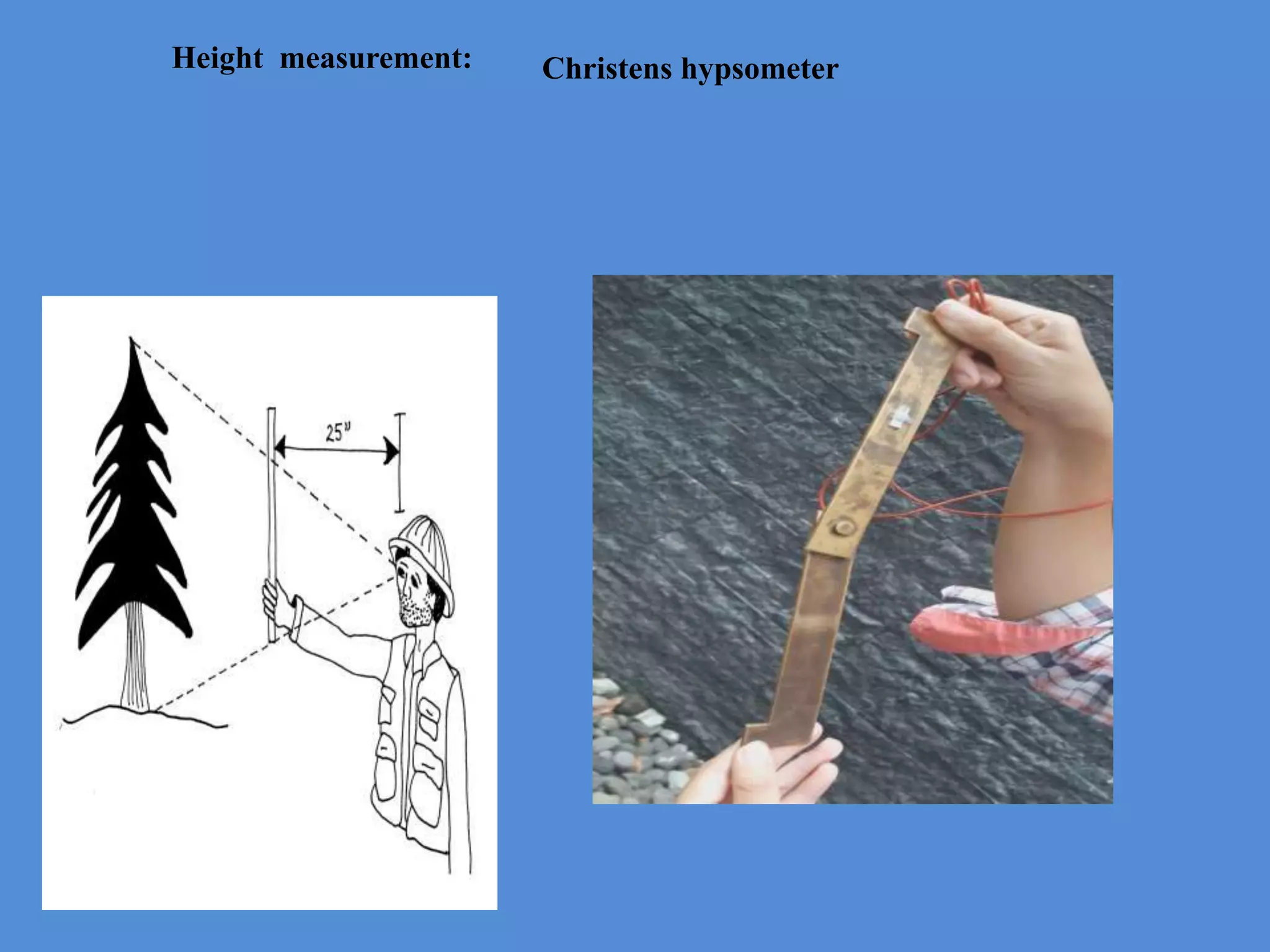
a. Instruments based on principles of similar triangle: Christens hypsometer,
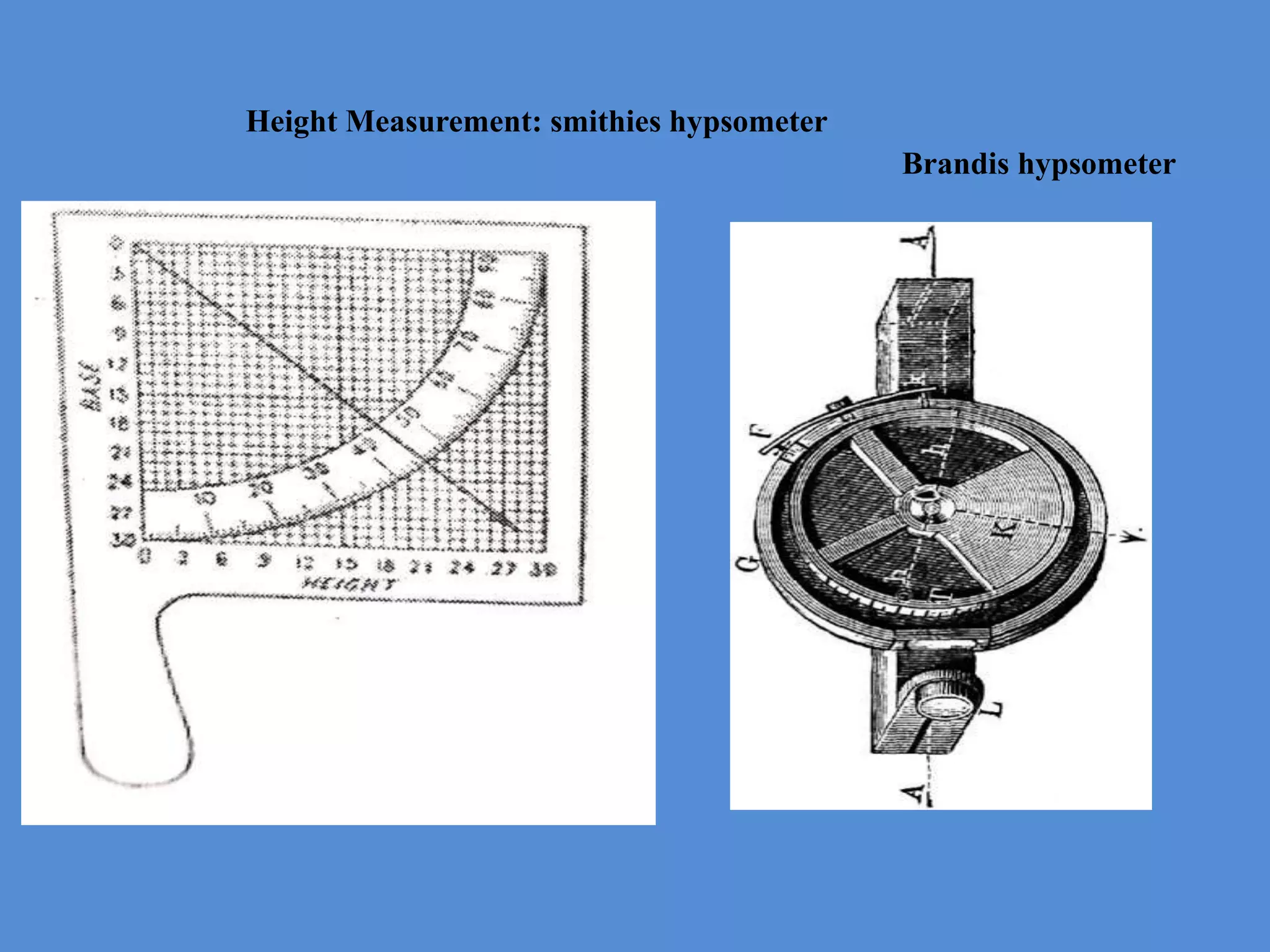
smithies hypsometer, improvised caliper.
b. Instruments based on trigonometrically principles: Brandis hypsometer, Abneys
level, Topographical Abneys levels, Haga altimeter, Blume-leiss hypsometer,
Relaskop.
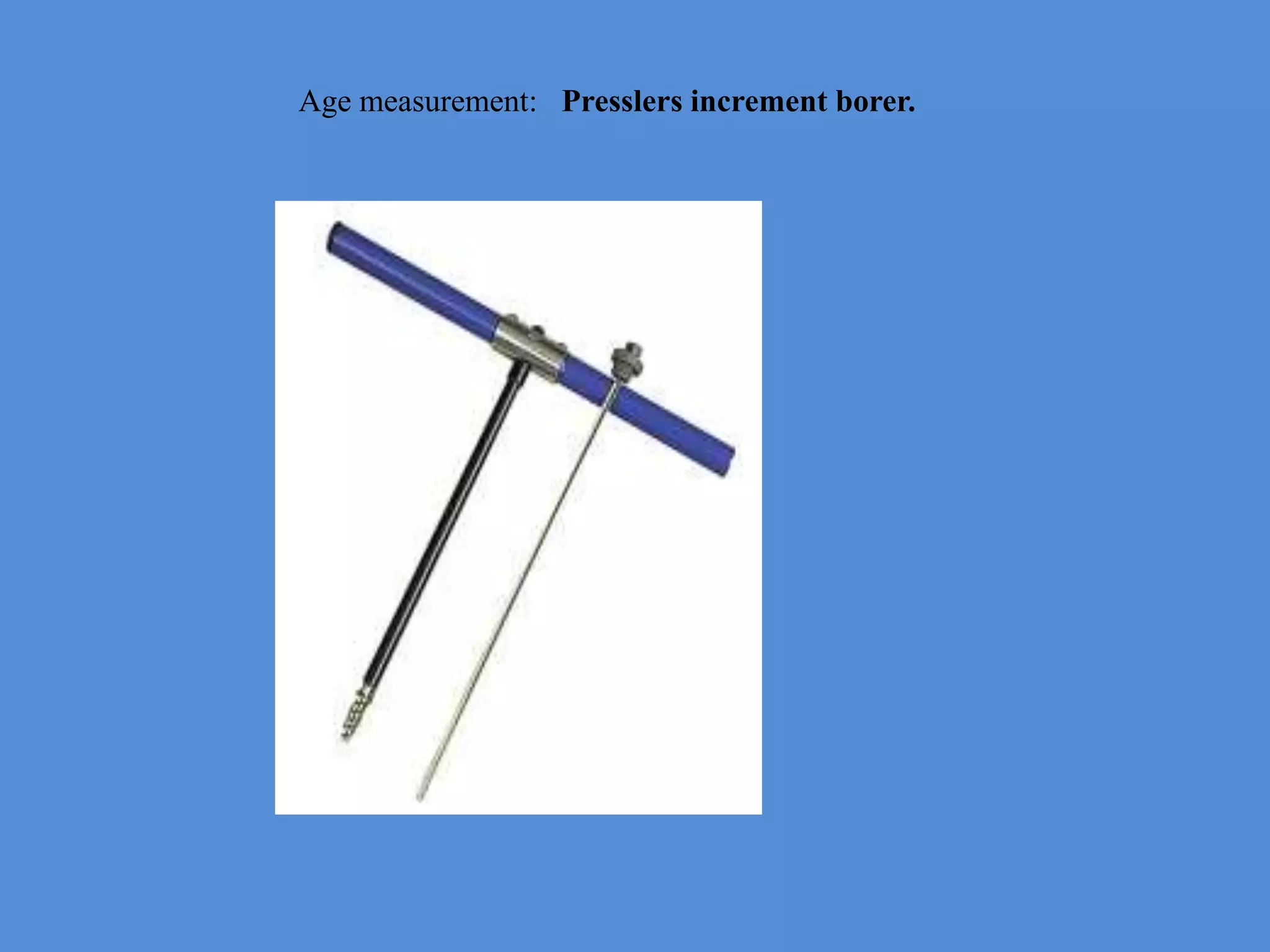
5. Age measurement: Presslers increment borer.
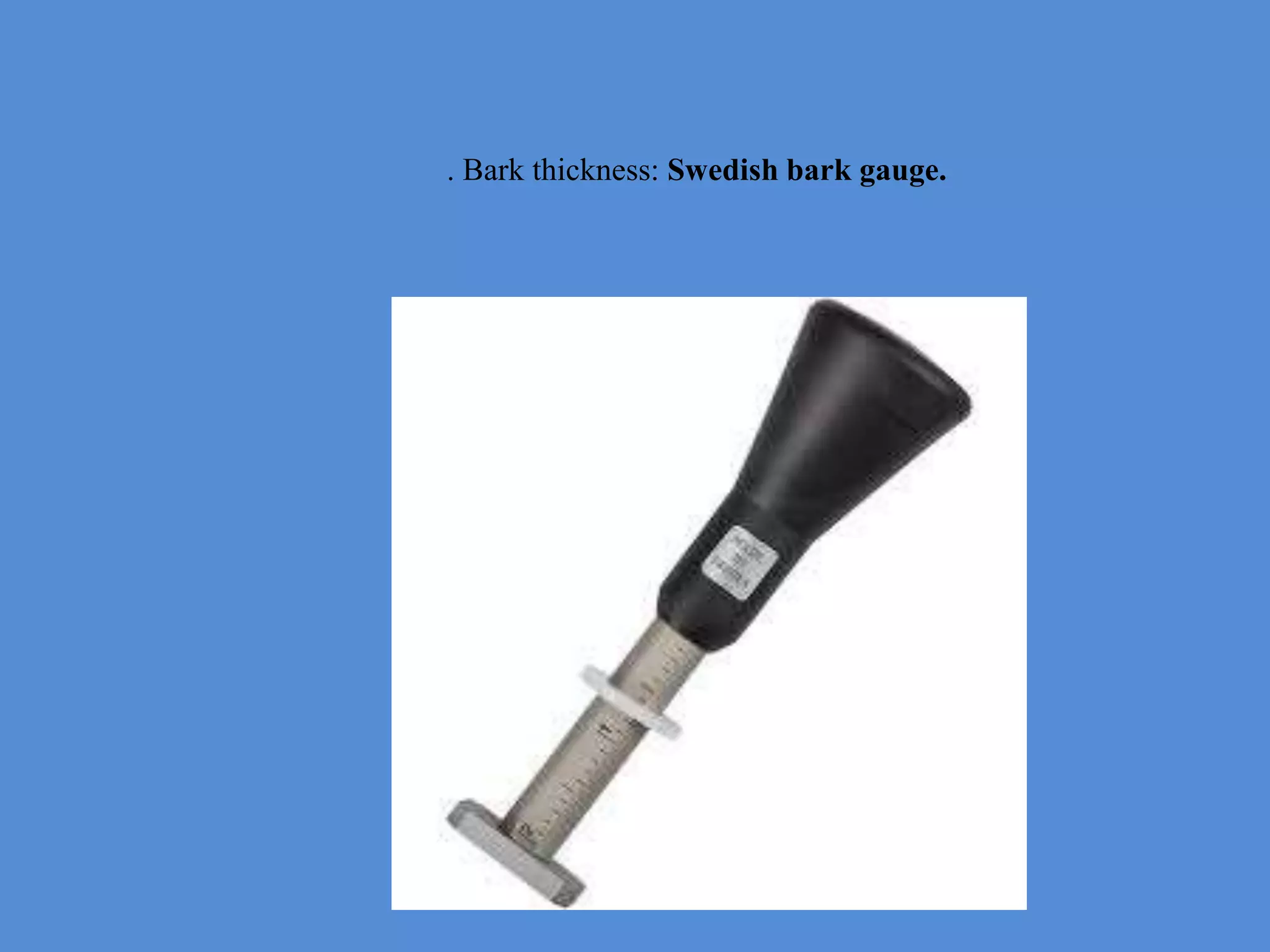
6. Bark thickness: Swedish bark gauge.
Diameter measurement:
Wooden scale Wooden caliper
Girth measurement: Tape
Basal area measurement:
Wedge prism, Spiegel relaskop
Height measurement: Christens hypsometer
Height Measurement: smithies hypsometer
Brandis hypsometer
Age measurement: Presslers increment borer.
. Bark thickness: Swedish bark gauge.
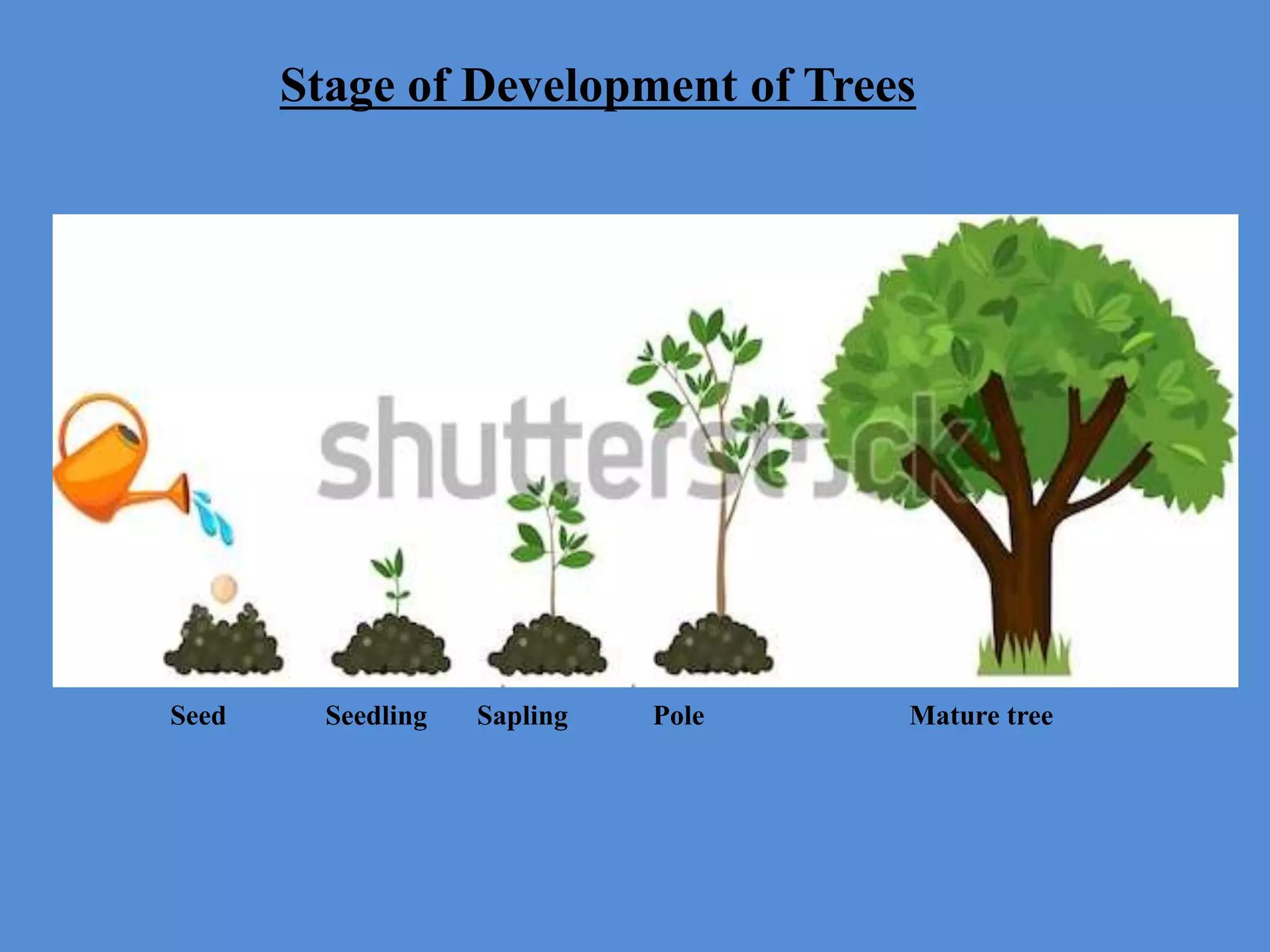
Seed Seedling Sapling Pole Mature tree
Stage of Development of Trees
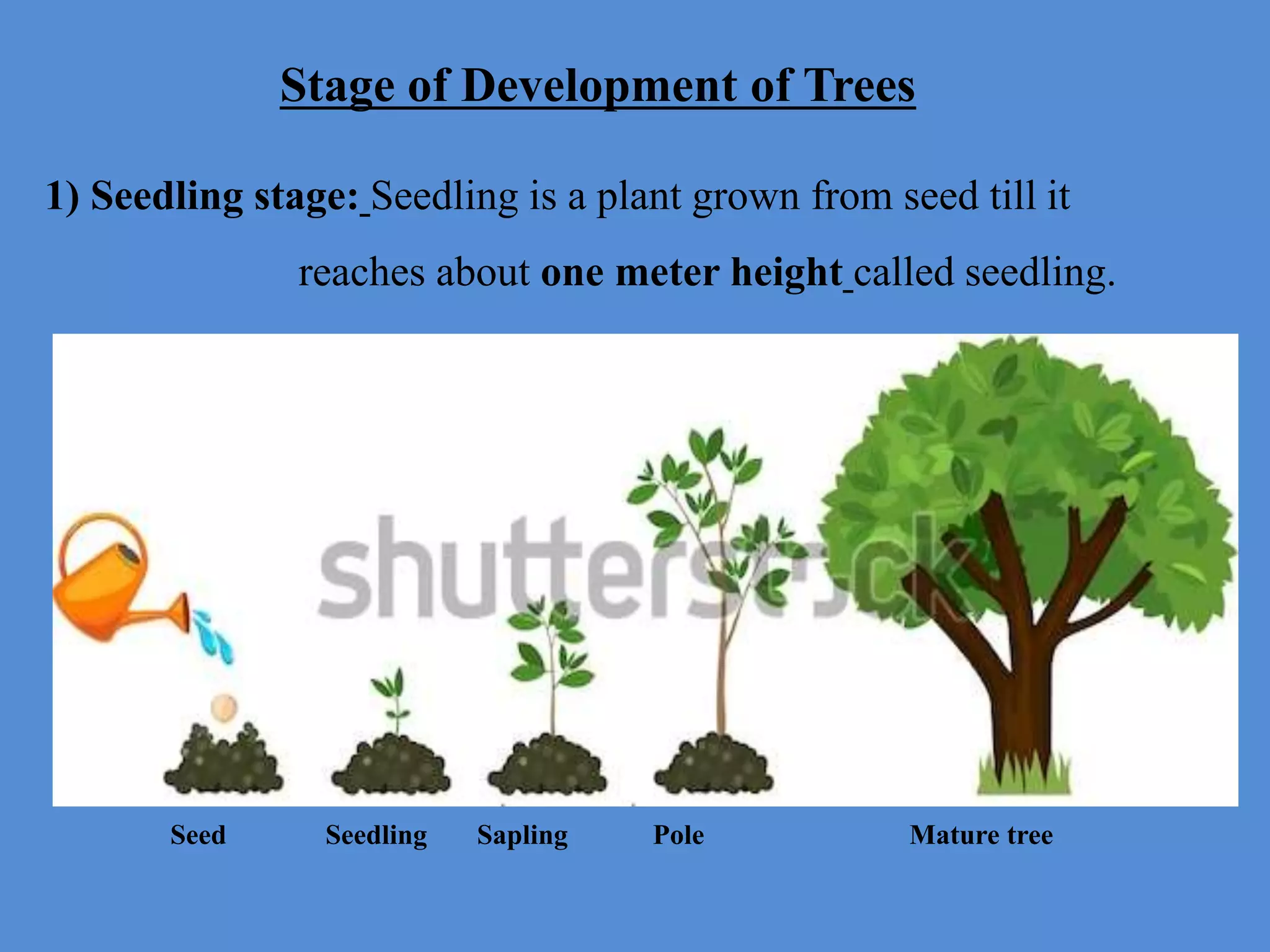
1) Seedling stage: Seedling is a plant grown from seed till it
reaches about one meter height called seedling.
Stage of Development of Trees
Seed Seedling Sapling Pole Mature tree
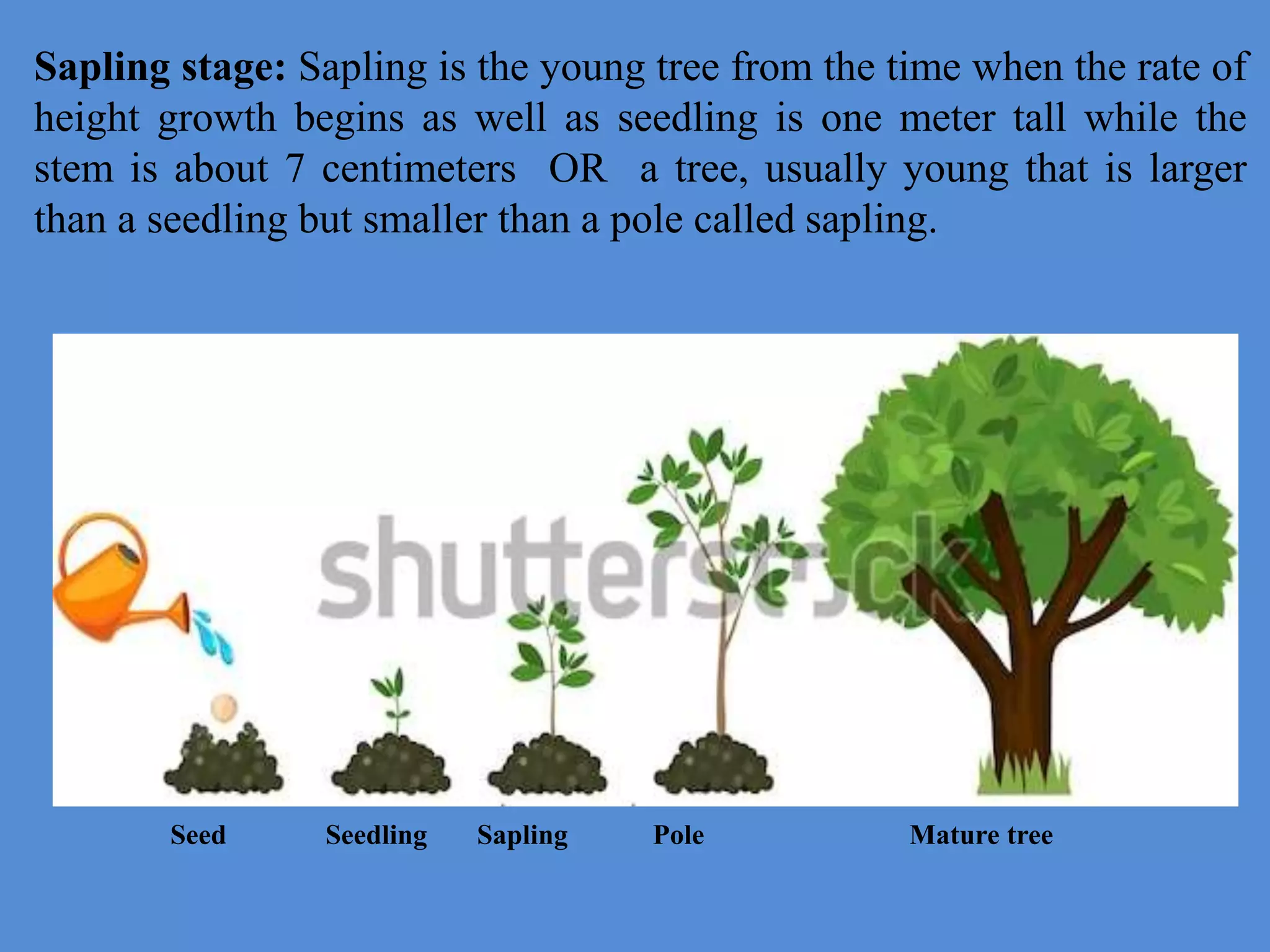
Sapling stage: Sapling is the young tree from the time when the rate of
height growth begins as well as seedling is one meter tall while the
stem is about 7 centimeters OR a tree, usually young that is larger
than a seedling but smaller than a pole called sapling.
Seed Seedling Sapling Pole Mature tree
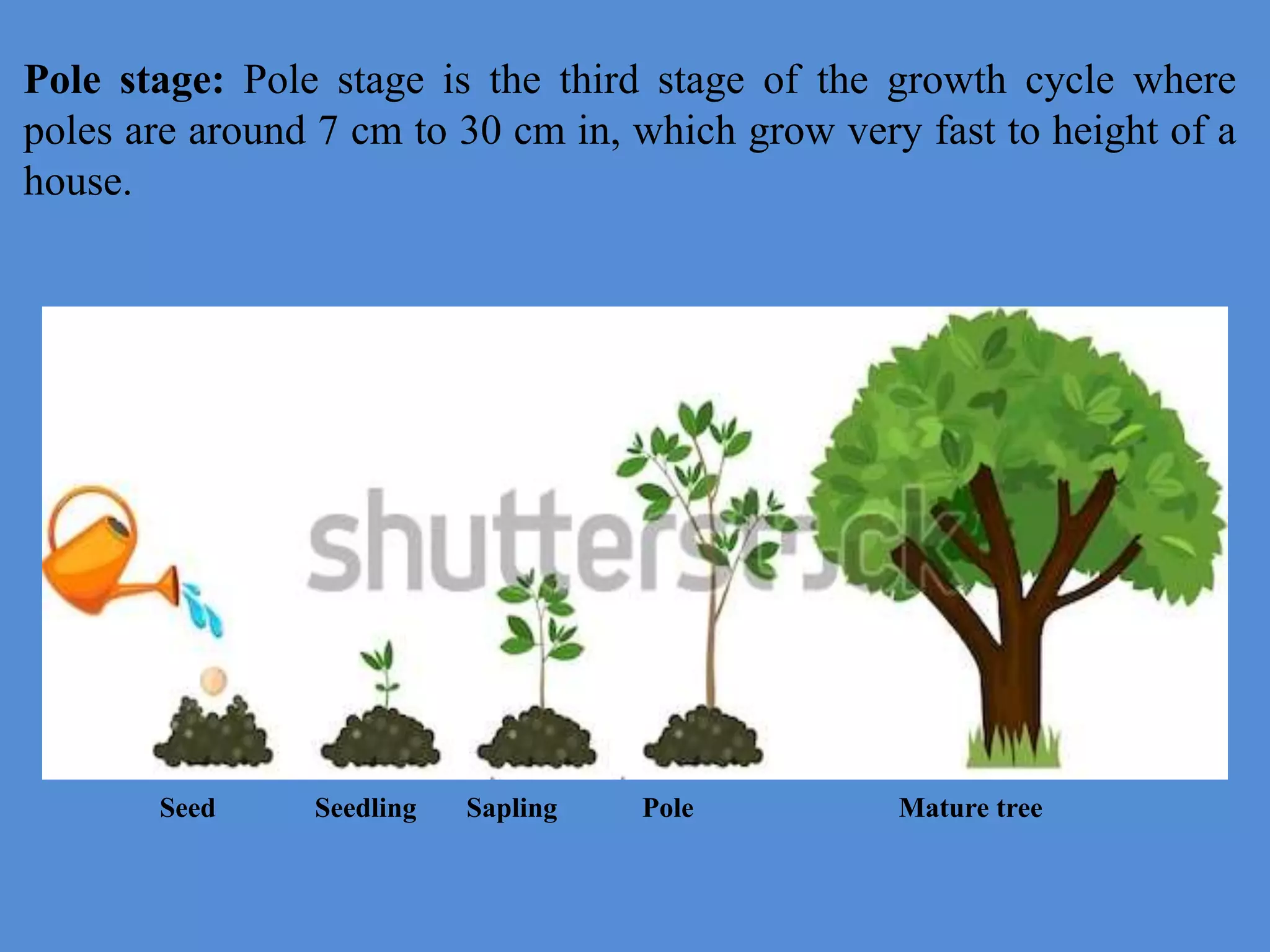
Pole stage: Pole stage is the third stage of the growth cycle where
poles are around 7 cm to 30 cm in, which grow very fast to height of a
house.
Seed Seedling Sapling Pole Mature tree
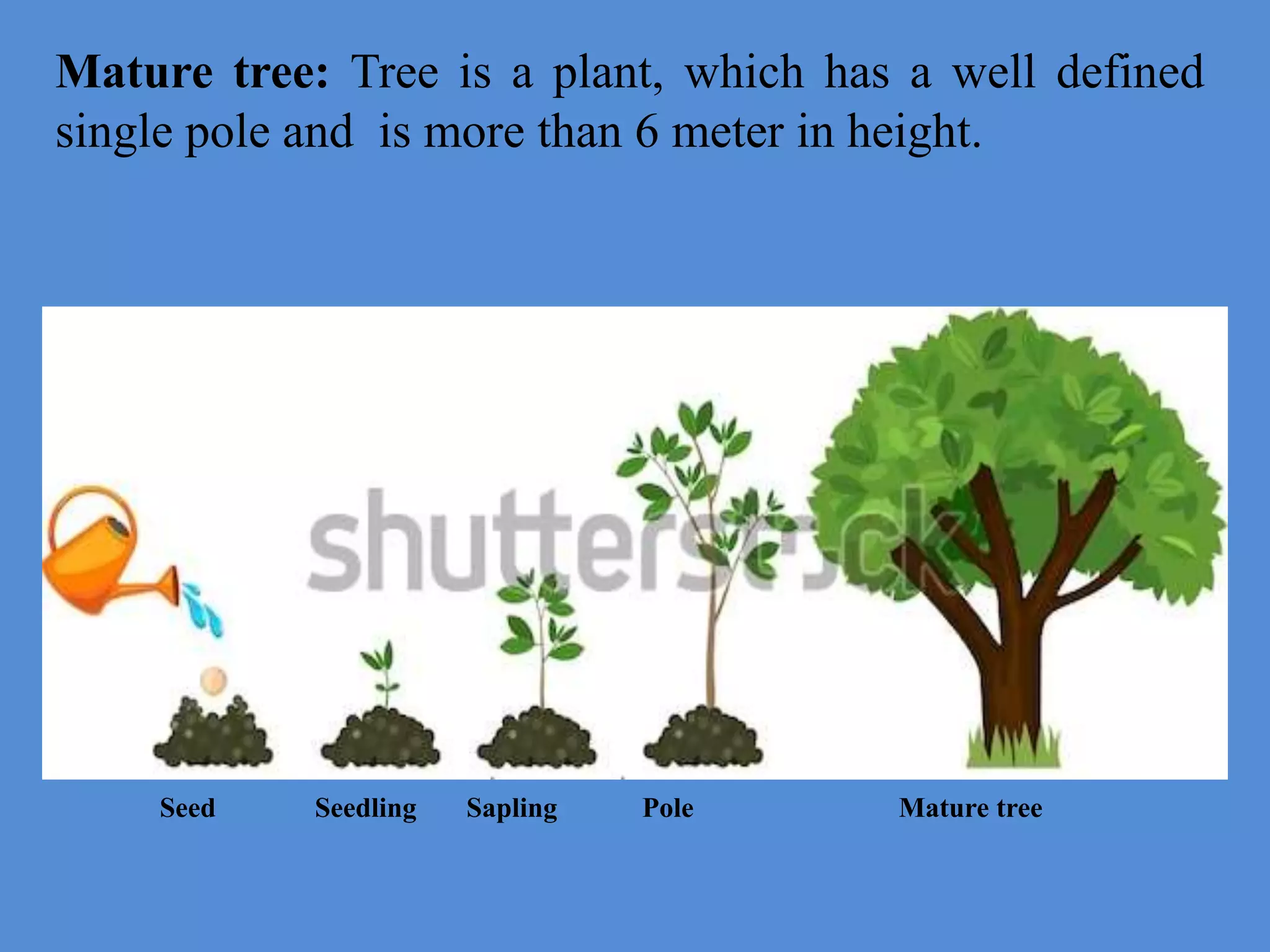
Mature tree: Tree is a plant, which has a well defined
single pole and is more than 6 meter in height.
Seed Seedling Sapling Pole Mature tree
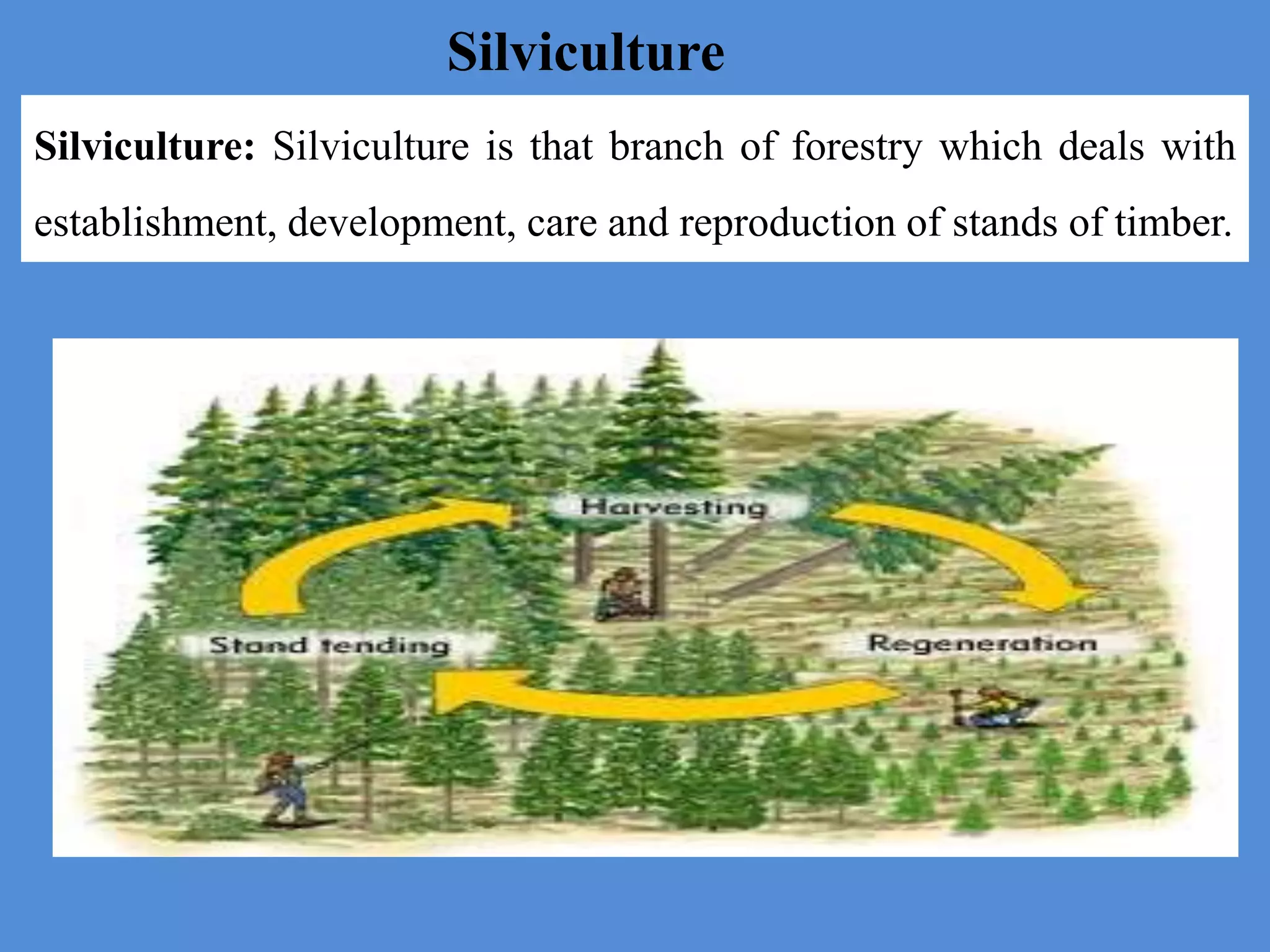
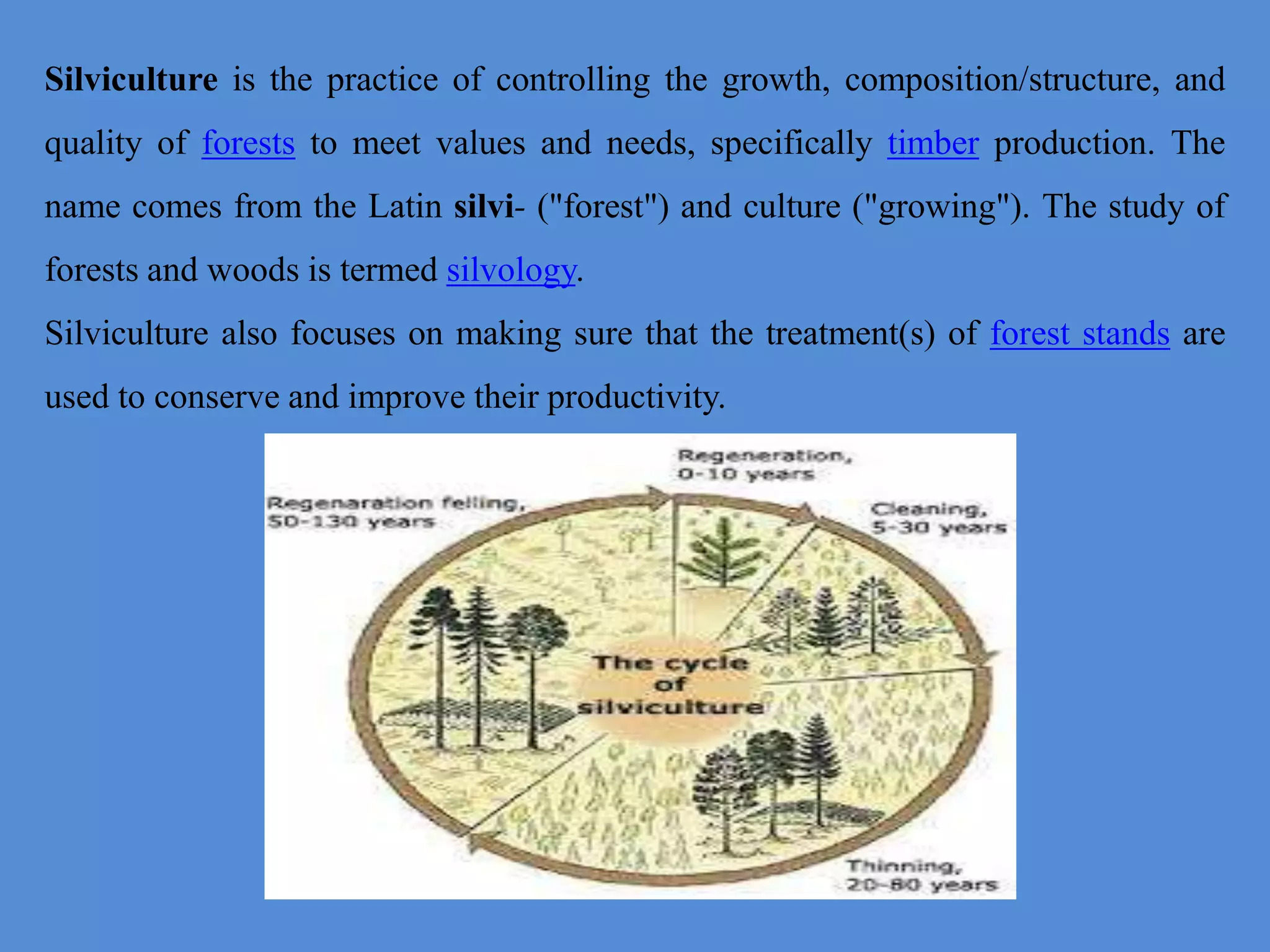
Silviculture: Silviculture is that branch of forestry which deals with
establishment, development, care and reproduction of stands of timber.
Silviculture
Silviculture is the practice of controlling the growth, composition/structure, and
quality of forests to meet values and needs, specifically timber production. The
name comes from the Latin silvi- ("forest") and culture ("growing"). The study of
forests and woods is termed silvology.
Silviculture also focuses on making sure that the treatment(s) of forest stands are
used to conserve and improve their productivity.
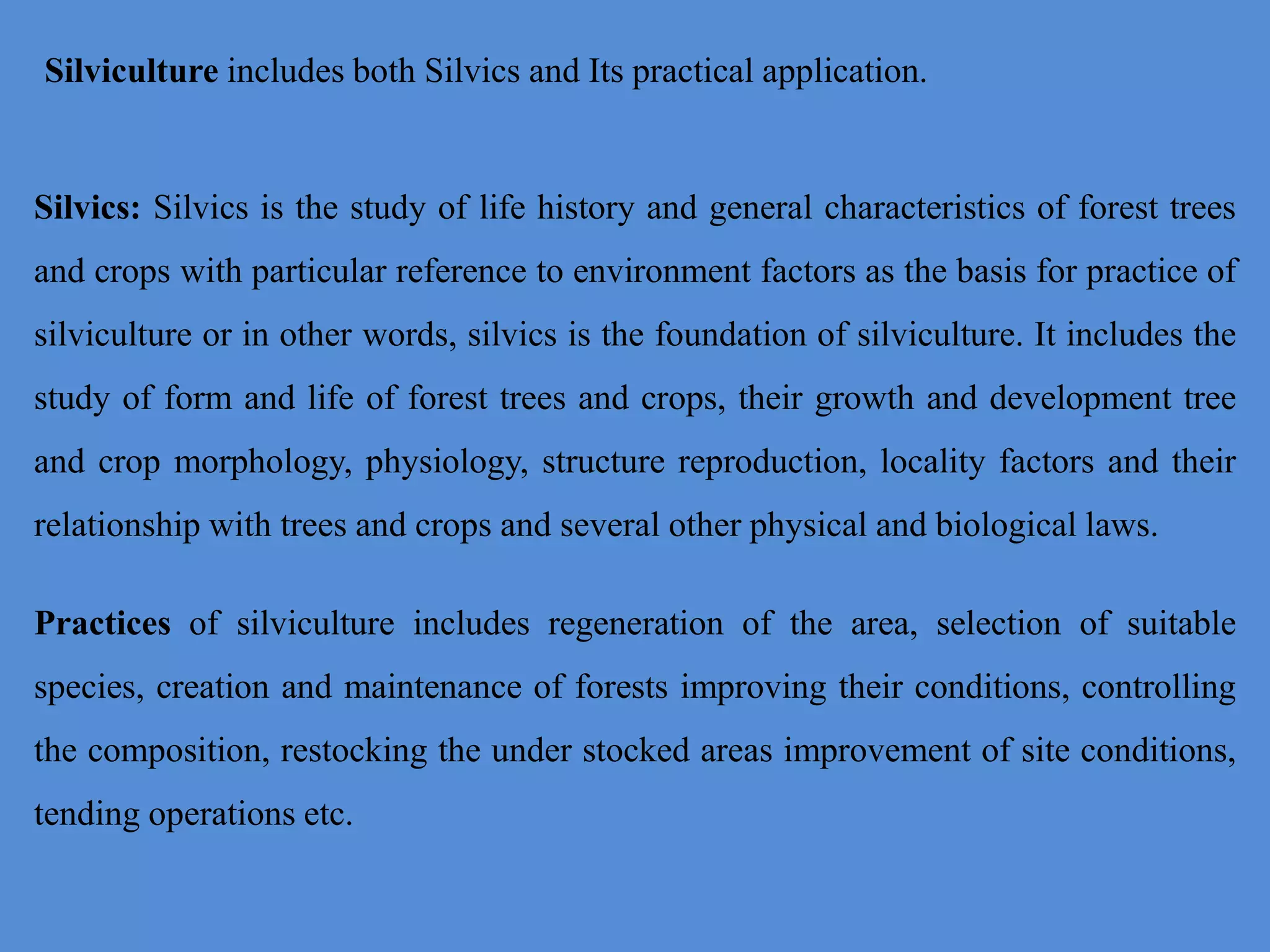
Silvics: Silvics is the study of life history and general characteristics of forest trees
and crops with particular reference to environment factors as the basis for practice of
silviculture or in other words, silvics is the foundation of silviculture. It includes the
study of form and life of forest trees and crops, their growth and development tree
and crop morphology, physiology, structure reproduction, locality factors and their
relationship with trees and crops and several other physical and biological laws.
Practices of silviculture includes regeneration of the area, selection of suitable
species, creation and maintenance of forests improving their conditions, controlling
the composition, restocking the under stocked areas improvement of site conditions,
tending operations etc.
Silviculture includes both Silvics and Its practical application.
Objective of Silviculture:
1. Production of higher volume per unit area.
2. Production of superior quality timber
3.Production of economically valuable species
4. Reducing the rotation of species
5. Afforestation
6. Reforestation
7. Introduction of exotics
8. Facilitate management and use of forests
9. Protection of site and intangible returns.
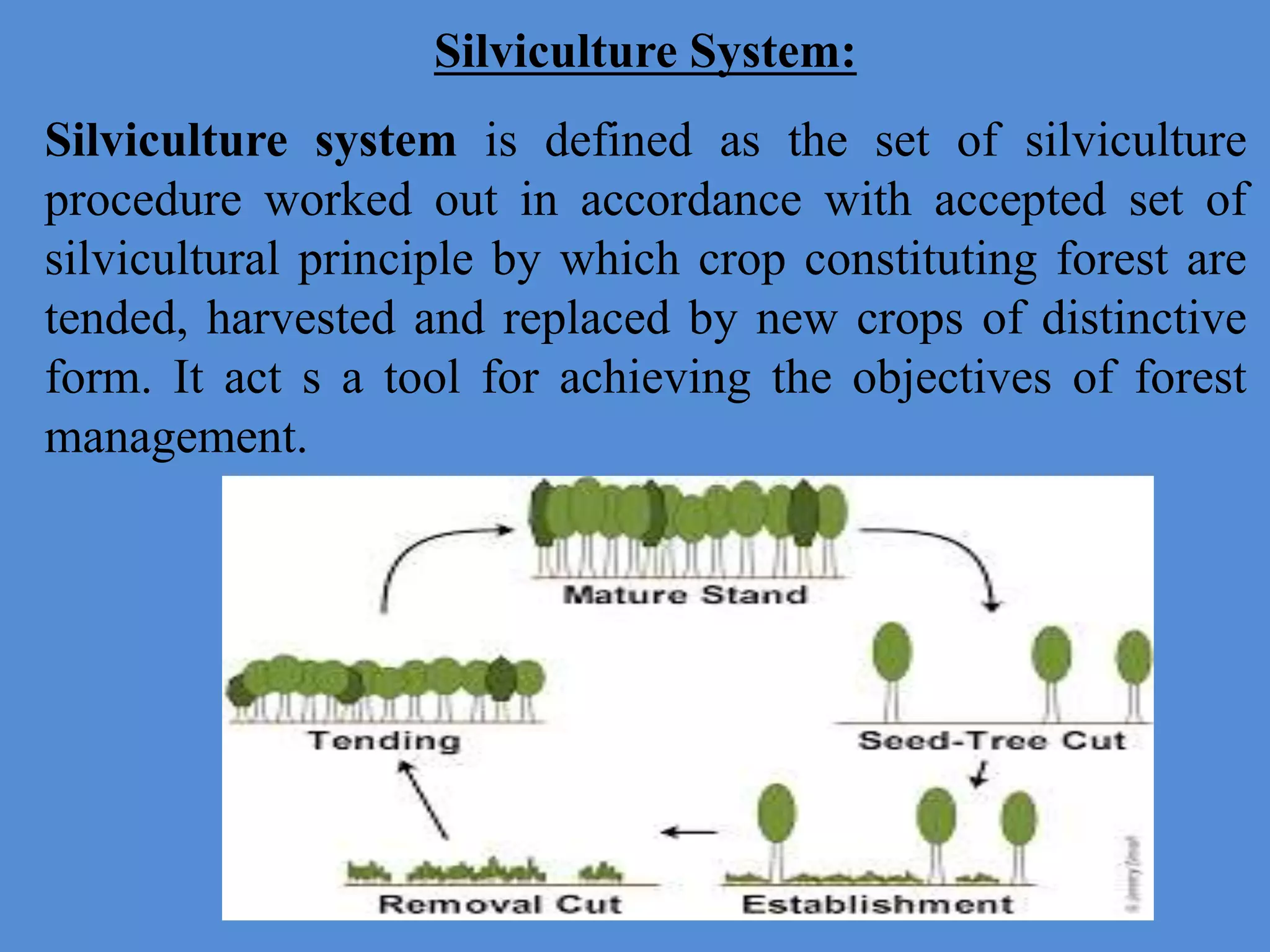
Silviculture System:
Silviculture system is defined as the set of silviculture
procedure worked out in accordance with accepted set of
silvicultural principle by which crop constituting forest are
tended, harvested and replaced by new crops of distinctive
form. It act s a tool for achieving the objectives of forest
management.
Scope and objectives of Silviculture system:
1. The pattern of felling to be adopted for
harvesting.
2. The method of regeneration to be adopted.
3. The tending of the new crop.
4. The form or character of the crop to be
produced.
Classification of Silvicultural System
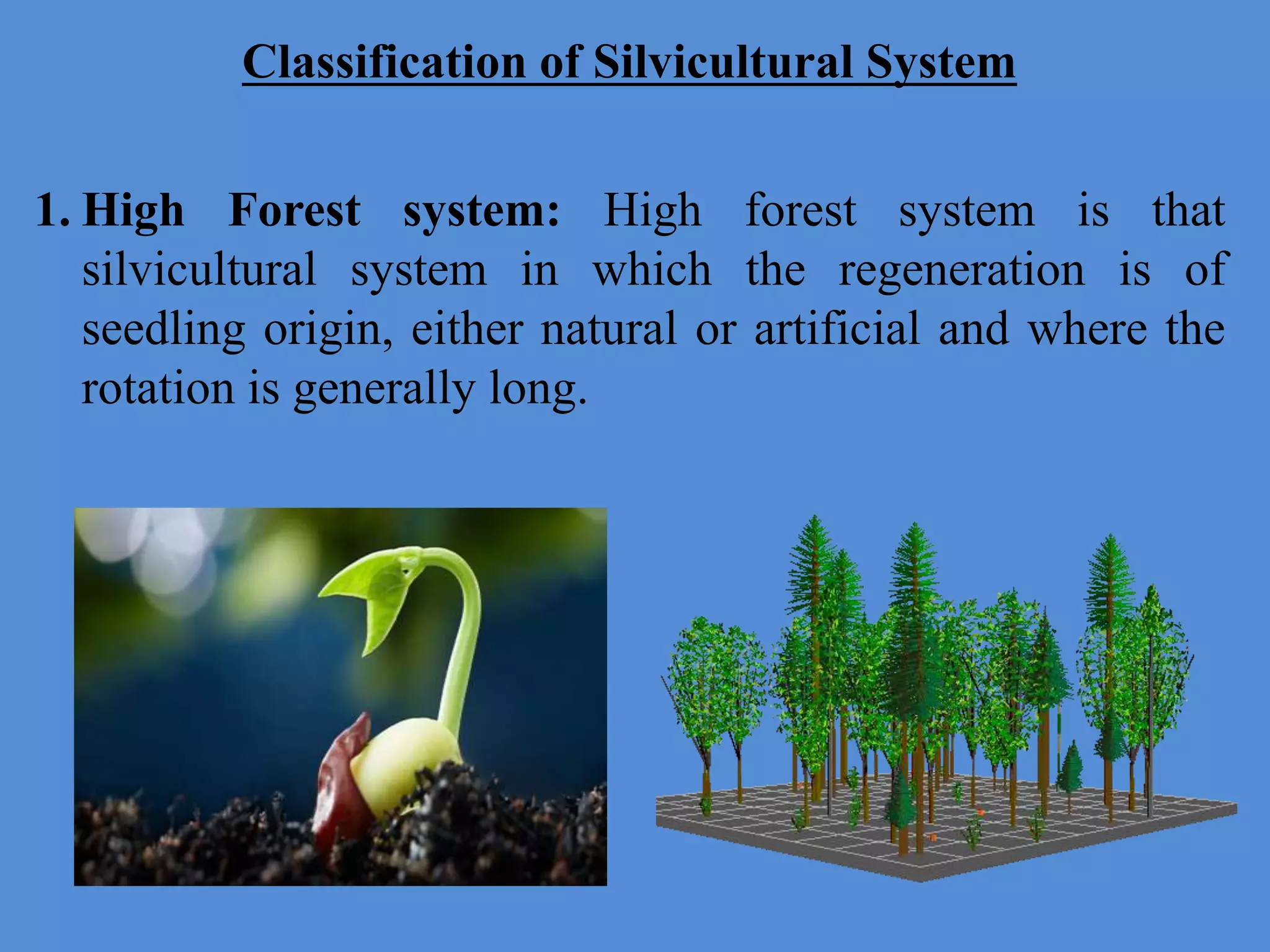
1. High Forest system: High forest system is that
silvicultural system in which the regeneration is of
seedling origin, either natural or artificial and where the
rotation is generally long.
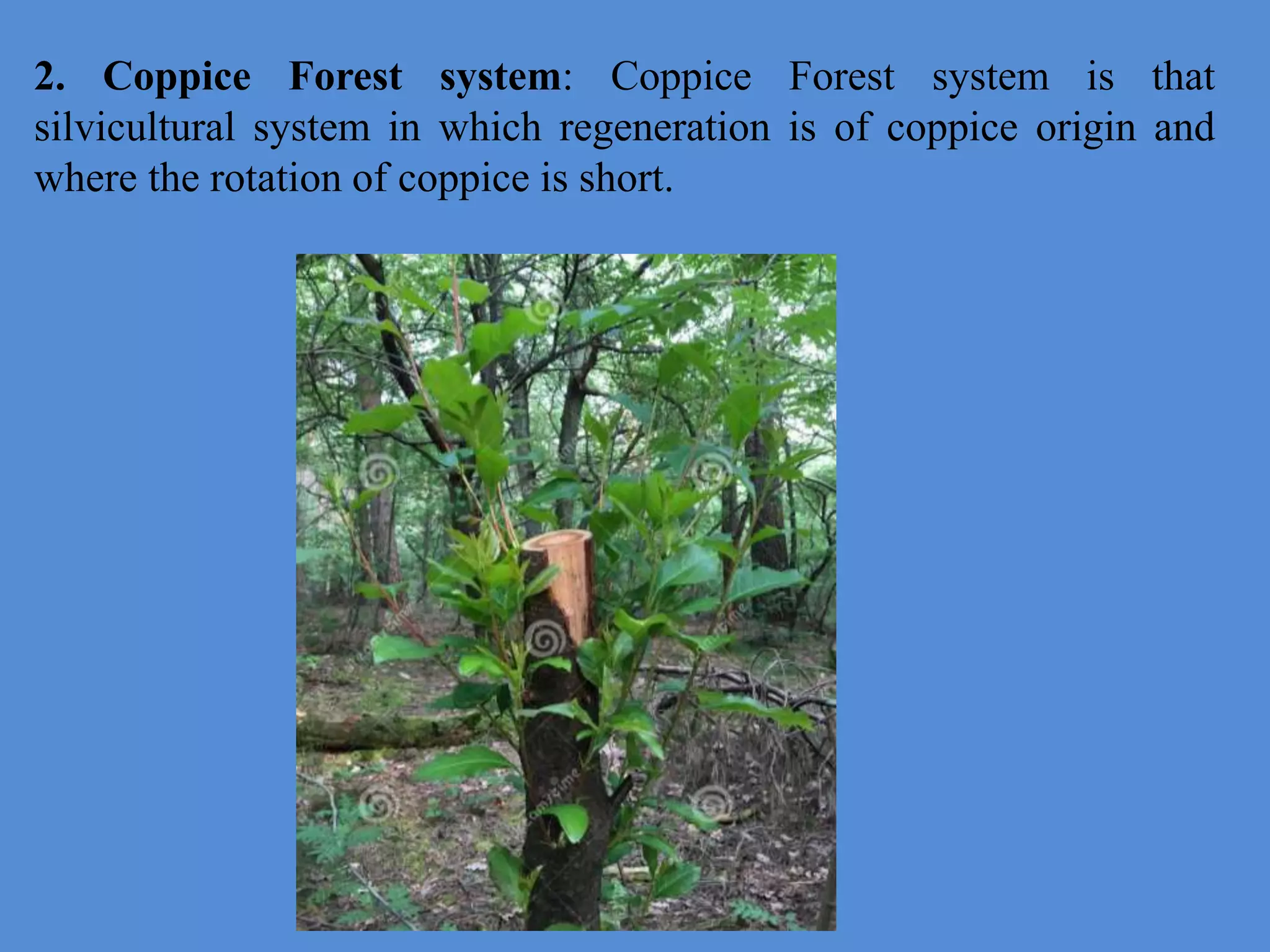
2. Coppice Forest system: Coppice Forest system is that
silvicultural system in which regeneration is of coppice origin and
where the rotation of coppice is short.
Thank You

Introduction to forestry some terminology

  • 1.
    Introduction to Forestry (Accordingto 5th Dean Syllabus) Dr. Shailendra Bhalawe Assistant Professor Department of Agro-forestry College of Agriculture, Balaghat Jawaharlal Nehru Agriculture University, Jabalpur (M.P.)
  • 3.
    Introduction: Forest: The word”Forest” is derived from Latin word “Foris” meaning outside the village boundary or away from inhabited land. It is a large tract covered with trees and under growth sometimes mixed with pasture. Father of Forestry: Dr. Dietrich Brandis (1824-1907)
  • 4.
    Generally-: Forest isreferred to an area occupied by different kinds of trees, shrubs, herbs and grasses and maintained as such. In a general sense forest is a large uncultivated tract of land covered with trees and Underwood, woody ground and rude pasture; a preserve for big game. Technically-: Forest is an area set aside for the production of timber and other forest produce or maintained under woody vegetation for certain indirect benefits which it provides e.g. climatic or protective. (Anon., 1966). Ecologically-: It is defined as a plant community, predominantly of trees and other woody vegetation usually with a closed canopy. Legally-: Forest is an area of land proclaimed to be a forest under a forest law.
  • 5.
    Dense Forest Moderatelydense forest Open forest Scrub
  • 6.
    Class Area (Sqkm) Percentage of Geographical Area Very Dense Forest 99,278 3.02 Moderately Dense Forest 3,08,472 9.39 Open Forest 3,04,499 9.26 Total Forest Cover 7,12,249 21.67 Scrub 46,297 1.41 Forest Cover of India
  • 7.
    Mangrove Forest area:Mangroves are the characteristic littoral plant formation of tropical and subtropical sheltered coastlines. Mangroves are trees and bushes growing below the high water level of spring tides which exhibits remarkable capacity for salt water tolerance. Growing stock: Volume of standing timber or number of standing trees in a forest. Terminology: 1) Forestry: Forestry is defined as the theory and practice of all that constitutes the creation, conservation and scientific management, marketing of forests product and the utilization of their resources called forestry (Anon., 1966). 2) Extension Forestry: It is the practice of forestry in areas devoid of tree growth and other vegetation situated in places away from the conventional forest areas with the object of increasing the area under tree growth. 3) Social Forestry: It is the practice of forestry which aims at meeting the requirements of rural and urban population. In other words it is the practice of forestry outside the conventional forests with the aim to provide goods and services to the local people.
  • 8.
    4) Afforestation: Conversionof bare land into forestland by planting of forest trees. The planting of a forest crop on land that has not previously or not recently carried a forest crop. 5) Deforestation: It is the practice or process that result in the long term change in land use to non-forest uses. This is often cited as on of the major causes of the enhanced greenhouse effect for two reasons the burning or decomposition of the wood releases carbon dioxide and tree that once removed carbon dioxide from the atmosphere in the process of photosynthesis are lost. 6) Deciduous forest: A forest composed of trees that shed their leaves at some season of the year. In tropical areas trees may lose their leaves during the hot season to conserve moisture. Trees of a deciduous forest in cool areas shed their leaves during the autumn to protect themselves against the cold and frost of winter. Ex- Teak, Mahogany, Oak and beech.
  • 9.
    7) Dendrology: Thestudy of trees that is knowledge of the taxonomy, systematic relationships and field recognitions of tree species. 8) Fast growing trees: Trees having the height growth minimum of 60 cm per year and the mean annual increment of 10 m3/ha is called as fast growing trees. 9) Farm Forestry: Farm forestry is the name given to programmes which promote commercial tree growing by farmers on their own land. Farm forestry was defined by NCA (1976) as the practice of forestry in all its aspects in and the around the farms or village lands integrated with other farm operations. 10) Breast Height: A standard height from ground level for recording diameter, girth or basal area of a tree, generally 1.37 m. called breast height of tree. 11) Canopy: The foliar cover in a forest stand consisting of one or several layers. 12) Crown: The part of a tree or woody plant bearing live branches and foliage.
  • 10.
    List of NationalForest related Institute: 1.(ICFRE) Indian Council of Forestry Research & Education: Dehradun (Uttarakhand) 2. (IIFM) Indian Institute of Forest Management: Bhopal (Madhya Pradesh) 3. (TFRI) Tropical Forest Research Institute: Jabalpur (Madhya Pradesh) 4. (IGFRI) Indian Grassland Forest Research Institute: Jhasi (Uttar Pradesh) 5. (NRCA) National Research Centre for Agro-forestry: Jhasi (Uttar Pradesh)
  • 11.
    INSTRUMENTS USED INMEASUREMENT OF TREES: 1. Diameter measurement: Wooden scale, Wooden caliper. 2. Girth measurement: Tape 3.Basal area measurement: Wedge prism, Spiegel relaskop 4. Height measurement: a. Instruments based on principles of similar triangle: Christens hypsometer, smithies hypsometer, improvised caliper. b. Instruments based on trigonometrically principles: Brandis hypsometer, Abneys level, Topographical Abneys levels, Haga altimeter, Blume-leiss hypsometer, Relaskop. 5. Age measurement: Presslers increment borer. 6. Bark thickness: Swedish bark gauge.
  • 12.
  • 13.
  • 14.
    Basal area measurement: Wedgeprism, Spiegel relaskop
  • 15.
  • 16.
    Height Measurement: smithieshypsometer Brandis hypsometer
  • 17.
  • 18.
    . Bark thickness:Swedish bark gauge.
  • 19.
    Seed Seedling SaplingPole Mature tree Stage of Development of Trees
  • 20.
    1) Seedling stage:Seedling is a plant grown from seed till it reaches about one meter height called seedling. Stage of Development of Trees Seed Seedling Sapling Pole Mature tree
  • 21.
    Sapling stage: Saplingis the young tree from the time when the rate of height growth begins as well as seedling is one meter tall while the stem is about 7 centimeters OR a tree, usually young that is larger than a seedling but smaller than a pole called sapling. Seed Seedling Sapling Pole Mature tree
  • 22.
    Pole stage: Polestage is the third stage of the growth cycle where poles are around 7 cm to 30 cm in, which grow very fast to height of a house. Seed Seedling Sapling Pole Mature tree
  • 23.
    Mature tree: Treeis a plant, which has a well defined single pole and is more than 6 meter in height. Seed Seedling Sapling Pole Mature tree
  • 24.
    Silviculture: Silviculture isthat branch of forestry which deals with establishment, development, care and reproduction of stands of timber. Silviculture
  • 25.
    Silviculture is thepractice of controlling the growth, composition/structure, and quality of forests to meet values and needs, specifically timber production. The name comes from the Latin silvi- ("forest") and culture ("growing"). The study of forests and woods is termed silvology. Silviculture also focuses on making sure that the treatment(s) of forest stands are used to conserve and improve their productivity.
  • 26.
    Silvics: Silvics isthe study of life history and general characteristics of forest trees and crops with particular reference to environment factors as the basis for practice of silviculture or in other words, silvics is the foundation of silviculture. It includes the study of form and life of forest trees and crops, their growth and development tree and crop morphology, physiology, structure reproduction, locality factors and their relationship with trees and crops and several other physical and biological laws. Practices of silviculture includes regeneration of the area, selection of suitable species, creation and maintenance of forests improving their conditions, controlling the composition, restocking the under stocked areas improvement of site conditions, tending operations etc. Silviculture includes both Silvics and Its practical application.
  • 27.
    Objective of Silviculture: 1.Production of higher volume per unit area. 2. Production of superior quality timber 3.Production of economically valuable species 4. Reducing the rotation of species 5. Afforestation 6. Reforestation 7. Introduction of exotics 8. Facilitate management and use of forests 9. Protection of site and intangible returns.
  • 28.
    Silviculture System: Silviculture systemis defined as the set of silviculture procedure worked out in accordance with accepted set of silvicultural principle by which crop constituting forest are tended, harvested and replaced by new crops of distinctive form. It act s a tool for achieving the objectives of forest management.
  • 29.
    Scope and objectivesof Silviculture system: 1. The pattern of felling to be adopted for harvesting. 2. The method of regeneration to be adopted. 3. The tending of the new crop. 4. The form or character of the crop to be produced.
  • 30.
    Classification of SilviculturalSystem 1. High Forest system: High forest system is that silvicultural system in which the regeneration is of seedling origin, either natural or artificial and where the rotation is generally long.
  • 31.
    2. Coppice Forestsystem: Coppice Forest system is that silvicultural system in which regeneration is of coppice origin and where the rotation of coppice is short.
  • 32.