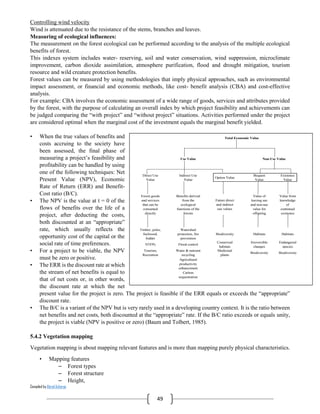
ADVANCE FOREST
ECOLOGY
SFB702
Materials from lecture slides and old notes
COMPILED BY:
January 2020
Compiled by Abiral Acharya
1
CONTENTS
UNIT 1: FOREST ECOLOGY (4)........................................................................................................2
UNIT 2: COMMUNITY ECOLOGY (4) .............................................................................................9
UNIT 3: VARIABILITY AND DIVERSITY (5) ...............................................................................19
UNIT 4: FOREST AND ENVIRONMENTAL INTERACTIONS (4) ............................................29
UNIT 5: FOREST INFLUENCES (5).................................................................................................40
UNIT 6: THE ECOSYSTEM PERSPECTIVE (6)............................................................................51
UNIT 7: ECOLOGY AS FOUNDATION FOR SFM (6)..................................................................59
UNIT 8: DISTURBANCE AND STAND DEVELOPMENT (4)......................................................65
UNIT: 9 APPLICATION OF SIMULATION MODELS IN FOREST ECOLOGY (6) ...............72
UNIT 10: APPLICATION OF ECOLOGICAL PRINCIPLES IN NATURAL AND FOREST
MANAGEMENT (4) ............................................................................................................................79
Compiled by Abiral Acharya
2
UNIT 1: FOREST ECOLOGY (4)
1.1 Fundamental Concept of Forest Ecology
Forest ecology is the study of forest ecosystem. Forest ecosystem is the basic fundamental unit of organisms and
their environment, interacting with each other and with their own components (Odum, 1971). Ecology deals with
the organism and its place to live, its environment.
The word ‘ecology’ was first used by German zoologist, Ernst Haeckel (1866). He derived it from the Greek words
oikos (home) and logos (study). Thus, the study of the house or habitat of an organism is the ‘ecology’. The term
ecology was defined by Haeckel as the study of the reciprocal relations between organisms and their environments.
Ecology has been defined differently by various authors (Clements, 1916; Elton, 1927; Odum, 1972; Krebs, 1978).
Clements (1916), “The science of community”.
Elton (1927), “The study of animals and plants in relation to their habit and habitats”.
Odum (1972), “Scientific study of the structure and nature”.
Krebs (1978),” Scientific study of interactions that determine the distribution and abundance of organisms”.
The word ‘Forest’ is derived from the Latin ‘Foris’, which means out of doors. The definition adopted by the
society of American Foresters is “a forest is a biological community dominated by trees and other woody
vegetation”. In the British Commonwealth Forest Terminology, Forest is “a plant community predominantly of
trees and other woody vegetation usually with close canopy”.
From ecological standards forest may be defined as “an ecological system dominated by tree population”.
According to Spur and Barnes (1973),’forest ecology is concerned with forest as a biological community with the
interrelationships between the various trees and other organisms constituting the community and with the
interrelationships between these organisms and the physical environment in which they exist’.
 The scientific study of the interactions that determine the distribution and abundance of organisms.” (Kreb
1985”)
 The study of the relationships between organisms and the totality of the physical and biological factors
affecting them or influenced by them.” (Pianka 1988)
 The study of organisms and their environment - and the interrelationships between the two.”- (Putman and
Wrattern 1984)
Some terminologies in Ecology
Autecology: It is concerned with the study of the interrelations of individual organisms with the environment. It is
inductive (method of reasoning).
Synecology: Synecology is concerned with the study of groups of organisms – the community. It is deductive and
philosophical
An organism is any form of life with cells as basic unit.
A population is a group of interacting individuals of the same species living in a specific physical place, the
habitat.
A community consists of all the populations of different species of plants, animals and microorganisms living
together in an area.
Branches of Forest ecology
Compiled by Abiral Acharya
3
Autecology: Autecology deals at the individual level.
Population ecology: Population ecology study at the population level.
Synecology/Community ecology: Community ecology study at the community level.
Ecosystem ecology: it deals at the both a biotic and biotic level.
Environmental Ecology: It deals at the only a biotic level.
Radio ecology: It deals Interaction of radioisotopes with population.
Genecology: It deals with gene frequency variation within species in relation to environment variation.
Ecologist approach the study of ecosystems
• Levels(organisms, populations, communities)
• Interactions (predation, parasitism, competition)
• Processes (Photosynthesis, respiration, transpiration)
• Pathways (food chains, biochemical cycles, succession)
• Locations (aquatic, marine and terrestrial ecosystems; Biomes (The complex of several communities in
any area represented by an assemblage of different kinds of plants, animals etc. sharing a common climate)
Trends in current ecological research
• Characterization of biodiversity in the world’s ecosystems
• Studying the impacts of “exotic” species that “invade” local environments
• Assessing the ecological sustainability of human activities (e.g. The great warming)
• Linking evolution and ecology
• Movement of toxics through environmental pathways
• Impact of toxic substances on human health
• Analysis of ecosystem
1.2 Forest ecosystem- The function, structure and major components of Forest Ecosystem
Whittaker (1962) suggested that "an ecosystem is a functional system that includes an assemblage of interacting
organisms (plants, animals, and saprobes) and their environment, which acts on them and on which they act".
Woodbury proposed in 1954 “an ecosystem is a complex in which habitat, plants and animals are considered as
one unit, the materials and energy of one passing in and out of the other”.
Turk (1988) defined, as “an ecosystem is a system formed by the interactions of variety of individual organisms
with each other and with their physical environment.
The well accepted definition of ecosystem is “an interaction between the living organisms (biotic components)
with the non-living matters (abiotic components) at which exchange of materials in the form of energy takes place.
What is a Healthy Ecosystem?
Utilitarian Concept: If the ecosystem supplies a sustainable level of goods and services.
Ecological Concept: If the structure, function, complexity, interactions and pattern of change are not altered.
The term ecosystem was suggested by an English ecologist Tansley (1935): and defined as "not only the
organism-complex, but the whole complex of physical factors forming what we called environment".
F.E. Clements (1916) recognized three types of interactions within ecosystem.
i. The effects of physical environment on organisms.
ii. The effect of organisms on their physical environment
iii. The effect of organisms on organisms.
Compiled by Abiral Acharya
4
He termed type (i), (ii), and (iii) interactions as ‘action’, ‘reaction’ and ‘co-action’ respectively. There is a
complex relationship between structure and function of an ecosystem. Ecosystems are not static. They change over
time, structurally and functionally.
Ecosystem Characteristics (attributes)
1. Structure:
a. Vertical: Trees, sapling, shrubs, herbaceous
b. Horizontal: Uniform, patchy, random
2. Function:
Constant exchange of matter and energy between the physical environment and living community
3. Complexity:
i. All events and conditions are determined by multiple factors.
ii. Prediction of an event requires detailed knowledge of these factors and how they interact?
4. Interdependency:
a. Behavior of the whole ecosystem is not predictable by the behavior of any one part of the system
considered separately.
5. Temporal change:
a. Ecosystem are "not static"
b. Changes are made within certain bounds, key process and potentials are maintained.
6. Diffuse boundaries:
i. Clear boundaries between ecosystems are rare.
ii. Ecosystems transition from one type to another
Structure of an Ecosystem (Explain yourself)
An ecosystem has two components. They are biotic and biotic components
Abiotic Component
The physical environment is the biotic component. It comprises climatic conditions and elements and compounds
of soil and atmosphere. The physical environment influences not only the ‘biotic structure’ but also the ‘function’
of the ecosystem. It controls structure by limiting the range of organisms that will be represented in the community
of the ecosystem. The kind and degree of interaction between population of various organisms and physical
environment determine the function of an ecosystem.
Biotic Components
Living components of the ecosystem is the biotic components. It comprises autotrophic organisms, heterotrophic
organisms and decomposers.
Function of an Ecosystem
The three functional characteristics of an ecosystem are energy flow, nutrients cycling and ecosystem regulation.
i. Energy flow
To sustain the life processes all organisms need energy. The initial source of energy is sun. Green plants directly
use solar radiation to convert carbon dioxide from atmosphere and water from soil into glucose. This process
known as photosynthesis in which light energy converts into chemical energy. This energy is transfer to herbivores
who consume plant biomass as a food and in turn herbivores to carnivores. The micro-organisms obtain energy
from dead plants and animals.
These transfers of energy are not cent percent effective. According to second law of thermodynamics, in any
transfer of energy from one form to another some energy escapes from the system, usually as a heat. These series
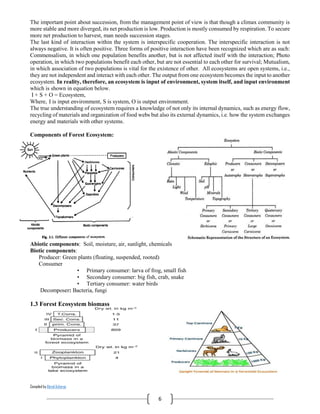
of energy transfers are regarded as the food chain or energy flow as they form a series of links which are shown
in Figure 1 and Figure 2.
Compiled by Abiral Acharya
5
ii. Nutrient Cycling
The ecosystem draws nutrients from atmosphere and soil. Simple inorganic elements converted into complex
organic substances during biological processes, which are taking place in green plants. These complex organic
substances form plant and animal tissues. When plants and animals die, tissues undergo bacterial decay and
decomposition. Bacterial decay and decomposition of complex organic matter release inorganic nutrient
elements to physical environment and interns from physical environment to plants. These continuous cycling of
nutrients between plants to physical environment and physical environment to plants are known as nutrient
cycling.
Fig: nutrient recycling
iii. Ecosystem Regulation
The third functional characteristic is eco-regulation, i.e. the manner in which an ecosystem regulates itself. There
are two ways in which an ecosystem can regulates itself: Bye interactions within the system, and interactions with
other systems.
Interactions within the system are four kinds: Competition between the individuals of one population, inter
specific competition, inter specific cooperation and interaction of leaving components with abiotic environment
The competition between the individuals of one population does not change the composition of an ecosystem. The
competition only controls the number of individuals in any one kind of organisms. The inter specific, however,
eliminates weaker species and change the composition of the ecosystem which is known as succession. Succession
takes place between plants communities over time as result of their interaction with environment. Climax is the
last stage of succession, it is more stable than pioneer stage because of its greater diversity, larger organic structure
and more balanced flow of energy.
Compiled by Abiral Acharya
6
The important point about succession, from the management point of view is that though a climax community is
more stable and more diverged, its net production is low. Production is mostly consumed by respiration. To secure
more net production to harvest, man needs succession stages.
The last kind of interaction within the system is interspecific cooperation. The interspecific interaction is not
always negative. It is often positive. Three forms of positive interaction have been recognized which are as such:
Commensalism, in which one population benefits another, but is not affected itself with the interaction; Photo
operation, in which two populations benefit each other, but are not essential to each other for survival; Mutualism,
in which association of two populations is vital for the existence of other. All ecosystems are open systems, i.e.,
they are not independent and interact with each other. The output from one ecosystem becomes the input to another
ecosystem. In reality, therefore, an ecosystem is input of environment, system itself, and input environment
which is shown in equation below.
I + S + O = Ecosystem,
Where, I is input environment, S is system, O is output environment.
The true understanding of ecosystem requires a knowledge of not only its internal dynamics, such as energy flow,
recycling of materials and organization of food webs but also its external dynamics, i.e. how the system exchanges
energy and materials with other systems.
Components of Forest Ecosystem:
Abiotic components: Soil, moisture, air, sunlight, chemicals
Biotic components:
Producer: Green plants (floating, suspended, rooted)
Consumer
• Primary consumer: larva of frog, small fish
• Secondary consumer: big fish, crab, snake
• Tertiary consumer: water birds
Decomposer: Bacteria, fungi
1.3 Forest Ecosystem biomass
Compiled by Abiral Acharya
7
The biomass of any ecosystem is assessed in terms of production or Ecosystem productivity. The increase in total
weight (biomass) or quantity of organic material on a given area over a defined period. It is usually use to a specific
population or trophic level, but it can refer to the whole ecosystem. Production is equal to the crop plus the non-
harvested and non-harvestable organic material produced over the period, plus loss to other populations, trophic
levels or ecosystems as appropriate.
Productivity:
All the energy that the plant fixes results formulation of sugar in the plants leaves. Sugar produced in the leaves
of green plants is derived from CO2 and H2O combined with solar energy. Thus the energy incorporated into living
tissue of plants is either in terms of the light energy utilized or in terms of the sugar produced. All the energy used
by plants is converted into chemical energy. So the entire energy uptake of plants can be measured by measuring
the total amount of sugar produced.
This amount of entire energy uptake by plants or sugar produced is known as gross primary production. This is
the total amount of organic matter that plant produces through photosynthesis. It is a total weight in all the parts
of root, steam, leaves, fruits etc. It is not easy to measure gross primary productivity (organic matter) because
some of the sugar produced by photosynthesis will be lost immediately through plant respiration one can measure
the total organic matter actually present in the plant (biomass) by deducting the sugar or energy lost through
respiration from the gross primary production, which is called Net primary production.
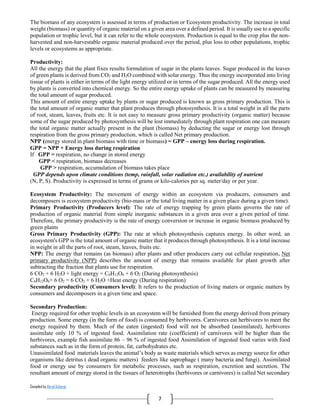
NPP (energy stored in plant biomass with time or biomass) = GPP – energy loss during respiration.
GPP = NPP + Energy loss during respiration
If GPP = respiration, no change in stored energy
GPP < respiration, biomass decreases
GPP > respiration, accumulation of biomass takes place
GPP depends upon climate conditions (temp, rainfall, solar radiation etc.) availability of nutrient
(N, P, S). Productivity is expressed in terms of grams or kilo-calories per sq. meter/day or per year.
Ecosystem Productivity: The movement of energy within an ecosystem via producers, consumers and
decomposers is ecosystem productivity (bio-mass or the total living matter in a given place during a given time).
Primary Productivity (Producers level): The rate of energy trapping by green plants governs the rate of
production of organic material from simple inorganic substances in a given area over a given period of time.
Therefore, the primary productivity is the rate of energy conversion or increase in organic biomass produced by
green plants
Gross Primary Productivity (GPP): The rate at which photosynthesis captures energy. In other word, an
ecosystem's GPP is the total amount of organic matter that it produces through photosynthesis. It is a total increase
in weight in all the parts of root, steam, leaves, fruits etc.
NPP: The energy that remains (as biomass) after plants and other producers carry out cellular respiration. Net
primary productivity (NPP) describes the amount of energy that remains available for plant growth after
subtracting the fraction that plants use for respiration.
6 CO2 + 6 H2O + light energy = C6H12O6 + 6 O2 (During photosynthesis)
C6H12O6+ 6 O2 = 6 CO2 + 6 H2O +Heat energy (During respiration)
Secondary productivity (Consumers level): It refers to the production of living maters or organic matters by
consumers and decomposers in a given time and space.
Secondary Production:
Energy required for other trophic levels in an ecosystem will be furnished from the energy derived from primary
production. Some energy (in the form of food) is consumed by herbivores. Carnivores eat herbivores to meet the
energy required by them. Much of the eaten (ingested) food will not be absorbed (assimilated), herbivores
assimilate only 10 % of ingested food. Assimilation rate (coefficient) of carnivores will be higher than the
herbivores, example fish assimilate 86 – 96 % of ingested food Assimilation of ingested food varies with food
substances such as in the form of protein, fat, carbohydrates etc.
Unassimilated food materials leaves the animal’s body as waste materials which serves as energy source for other
organisms like detritus ( dead organic matters) feeders like saprophage ( many bacteria and fungi). Assimilated
food or energy use by consumers for metabolic processes, such as respiration, excretion and secretion. The
resultant amount of energy stored in the tissues of heterotrophs (herbivores or carnivores) is called Net secondary
Compiled by Abiral Acharya
8
production. Gross secondary production = total food material (energy) ingested by the heterotrophs - materials
lost as waste or faeces or material defecated.
Gross secondary production can be measured directly by measuring the amount of food ingested minus material
defecated.
Factors affecting the primary productivity:
 Solar radiation
 Temperature
 Moisture: Leaf water potential, soil moisture and precipitation fluctuation and transpiration.
 Mineral nutrition: Uptake of minerals from soil, fire effect, salinity, heavy metals, nitrogen metabolism.
 Biotic activities: Grazing above ground herbivores, below ground herbivores, predators and parasites, disease of
primary producers.
 Impact of human population: Pollutions of different sorts, ionizing radiation like atomic explosion etc.
Methods of measuring Primary Production
 Harvest method: It involves removal of vegetation periodically and weighing the material.
 Oxygen Measurement: In aquatic vegetation CO2 gas analysis method is not used but oxygen evolution method
is generally used since there is a definite equivalence between oxygen and food produced; Oxygen production
can be a basis for determining productivity.
 PH
Method: In aquatic ecosystems PH
of the water is a function of the dissolved carbon dioxide content, which
in turn, is decreased by photosynthesis and increased by respiration.
 Disappearance of Raw Material: Productivity can be measured not only by the rate of formation of materials
(food, protoplasm, minerals) and by measuring gaseous exchanges but also by the rate of the disappearance of
raw minerals.
 Productivity Determinations with Radioactive Materials: The use of radioactive tracers in ecology opens new
possibilities in determining productivity. With a known amount of "marked materials",
 The Chlorophyll Method: There is direct correlation between the amount of chlorophyll and dry matter
production in different types of communities with varying light conditions.
 Other Methods:
 Diameter of trees in sample quadrates in measured at breast height and the height is determined
for each tree.
 A set of sample trees is cut and subjected to a detailed analysis for dry weight of stems, twigs,
leaves and roots.
 Regression values are computed for the sets of trees belonging to each girth class, relating the
biomass of each fraction to the diameter at breast height.
Compiled by Abiral Acharya
9
UNIT 2: COMMUNITY ECOLOGY (4)
2.1 Community and its characteristics
Community is a group of organisms sharing same habitat growing in a uniform environment. A forest, a grassland,
a desert or a pond are natural communities. Community ecology deals with the groups of different kinds of
population in the area. In the nature different kinds of organisms grow in association with each other. A group of
several species (plants and /or animals) living together with mutual tolerance (adjustment) and beneficial
interactions in a natural area is known as community or biotic community.
A community must include only living entities of the area. If non-living (abiotic) factors together with the living
(biotic) entities are also considered, then we would be dealing with an ecosystem rather than a community.
Within community some species may interact more strongly among themselves than with others, utilizing habitat
and food resources in the similar manner these groups are called guilds. Botanist use the term association for the
plant community possessing a definite species composition. Ecologist also recognize community as heterotrophic
and autotrophic.
Community has two sorts of characteristics. One, which are not shown by its individual component species. These
characteristics which have meaning only with reference to community level of organisms, are:
– Species diversity
– Regional diversity
– Local diversity
– Growth form and structures
– Vertical structure
– Horizontal structure
– Succession
– Dominance
– Trophic structure
Species Diversity:
It refers to the variety and number of different species in a given time and space. Ecologically, species diversity
is measured by species richness (number of different species in an area), species composition (listing of species
or species assemblage) and relative abundance of species. Each community is made up of much different
organisms-plant, animals, microbes, which differ taxonomically from each other. The number of species and
population abundance in community also vary greatly.
There are two levels of species diversity;
(i) Regional diversity of whole nations or parts of continents within which many different communities exist, and
(ii) Local diversity in a given nation where different communities exist at different latitudes.
Growth form and Structure:
Community is described in terms of major growth forms as trees, shrubs, herbs, mosses etc. In each growth form
as in trees, there may be different kind of plants as broad leaved trees, evergreen trees etc. These different growth
forms determines the structural pattern of a community.
According to the mode of arrangement of the various growth forms, the community exhibit:
(i) zonation-horizontal layering
(ii) stratification vertical layering.
Compiled by Abiral Acharya
10
Dominance: In each community all the species are not equally important. There are relatively only a few of these,
which determine the nature of the community. These few species exert a major controlling influence on the
community. Such species are known as dominants.
Fig: Dominance in different community
Succession: Each community has its own development history. It develops as a result of a directional change in
it with time.
Trophic structure (self-sufficiency): Nutritionally, each community, a group of autotrophic plants as well as
heterotrophic animals, exists as a self-sufficient, perfectly balanced assemblage of organisms. Each community
has its own composition structure and developmental history.
Compiled by Abiral Acharya
11
The other community characteristics are synthetic characters. These are determined after computing the data on
the quantitative and qualitative characters of the community. These are actually computed from analytical
characters.
Presence and Constance: It expresses the extent of occurrence of the individuals of a particular species in the
community.
a) Rare Present in (1-20%) of the sampling unit
b) Seldom present (21-41%)
c) Often present (41-60%)
d) Mostly present (61-80%)
e) Constantly present (81-100%)
Fidelity: This is the degree with which a species is restricted in distribution to one kind of community. Such
species are sometimes known as indicators. The species have been grouped into five fidelity classes:
a) Fidelity 1 (Strangers): Plants appearing accidently.
b) Fidelity 2 (Indifferents): indifferent plants, may occur in any community.
c) Fidelity 3 (Preferents): Occur in many communities but predominant in one.
d) Fidelity 4 (Selectives): specially present in one community but may occasionally occur in other
communities as well.
e) Fidelity 5 (Exclusives): occur only in one particular community.
Dominance: Thus the restriction of the abundance of one species by a more efficient competitor is known as
dominance. Of the various species present in a community, relatively few exert the major controlling influence by
virtue of their number, size, production and other activities over the composition, growth performance etc. of the
other species of the community. Species exerting such an important control on the community are called
dominants.
Dominants modify the environment within the community by tempering light, space, moisture and other
conditions etc. and thus only those species, which are able to tolerate these modified physical conditions can exist
within the community.
On the basis of density, frequency and dominance values there has been proposed the idea of importance value
index (IVI). For IVI relative density, relative frequency and relative dominance are calculated as:
2.2 Raunkiaer’s life form:
In the past, ecologist used the general appearance of plant communities as determined by the stature of the plant
species, their spread and character of life form as the basis of the study of communities. These methods are known
as physiognomic methods.
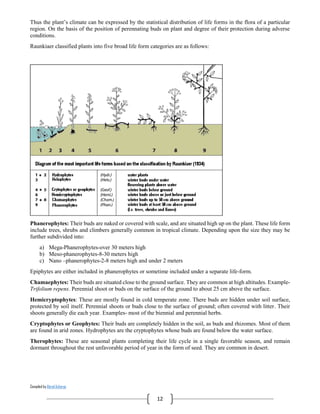
Of these Raunkiaer’s (1934) life form method has been commonly employed. According to him: A life form is
“the sum of the adaptation of the plant to climate”
He considered that the way in which different species overcome the adverse environmental conditions determines
their limit of distribution.
Compiled by Abiral Acharya
12
Thus the plant’s climate can be expressed by the statistical distribution of life forms in the flora of a particular
region. On the basis of the position of perennating buds on plant and degree of their protection during adverse
conditions.
Raunkiaer classified plants into five broad life form categories are as follows:
Phanerophytes: Their buds are naked or covered with scale, and are situated high up on the plant. These life form
include trees, shrubs and climbers generally common in tropical climate. Depending upon the size they may be
further subdivided into:
a) Mega-Phanerophytes-over 30 meters high
b) Meso-phanerophytes-8-30 meters high
c) Nano –phanerophytes-2-8 meters high and under 2 meters
Epiphytes are either included in phanerophytes or sometime included under a separate life-form.
Chamaephytes: Their buds are situated close to the ground surface. They are common at high altitudes. Example-
Trifolium repens. Perennial shoot or buds on the surface of the ground to about 25 cm above the surface.
Hemicryptophytes: These are mostly found in cold temperate zone. There buds are hidden under soil surface,
protected by soil itself. Perennial shoots or buds close to the surface of ground; often covered with litter. Their
shoots generally die each year. Examples- most of the biennial and perennial herbs.
Cryptophytes or Geophytes: Their buds are completely hidden in the soil, as buds and rhizomes. Most of them
are found in arid zones. Hydrophytes are the cryptophytes whose buds are found below the water surface.
Therophytes: These are seasonal plants completing their life cycle in a single favorable season, and remain
dormant throughout the rest unfavorable period of year in the form of seed. They are common in desert.
Compiled by Abiral Acharya
13
2.3 Composition, structure, origin and development:
Community Composition: Communities may be large or small. Larger one extend over areas of several
thousands of square kilometers as forest, others such as deserts etc. are comparatively smaller with dimensions in
hundreds of kilometers and still others such as meadows, rivers, ponds, rocky plateaus etc. occupying the more
restricted area. Very small sized communities are the groups of micro-organisms in such microhabitats as leaf
surface, fallen log, litter, soil etc. In each community there are diverse species.
All these species are not equally important but these are only few overlapping species which by their bulk and
growth modify the habitat and control the growth of other species of the community, thus forming a sort of
characteristics nucleus in the community. These species are called the dominants.
Generally in forest communities, one of the species is dominant and in such case community is called by the name
of dominant species as for example, Sal forest community spruce forest community. In other communities, there
may be more than one dominants as in oak-hickory forest community.
Composition is the proportion of plant species relative to total in a given area. It can be expressed as:
 Relative cover
 Relative density
 Relative weight, etc.
Expressed as %.
Uses of Composition
a) To describe ecological sites
b) To evaluate forest or rangeland condition and
trend
c) Used to determine carrying capacity
d) Assessing wildlife habitat and forage
Advantages of Composition
a) Easy to calculate from existing measures
b) Easy to understand and visualize
c) Allows community comparisons at different
locations with same ecological site
d) Indicates dominance and diversity
There is no direct methods for the calculation of the composition. The other indirect methods are:
Frequency: not appropriate as frequency is discrete variable and it doesn’t give absolute amount.
Density: % composition of Species A =
𝑇𝑜𝑡𝑎𝑙 𝑛𝑜.𝑜𝑓 𝑖𝑛𝑑𝑖𝑣𝑖𝑑𝑢𝑎𝑙𝑠 𝑜𝑓 𝑡ℎ𝑒 𝑠𝑝𝑒𝑐𝑖𝑒𝑠 𝑖𝑛 𝑎𝑙𝑙 𝑡ℎ𝑒 𝑠𝑎𝑚𝑝𝑙𝑖𝑛𝑔 𝑢𝑛𝑖𝑡𝑠
𝑇𝑜𝑡𝑎𝑙 𝑛𝑜. 𝑜𝑓 𝑠𝑎𝑚𝑝𝑙𝑖𝑛𝑔 𝑢𝑛𝑖𝑡𝑠 𝑠𝑡𝑢𝑑𝑖𝑒𝑑
𝑥 100
Biomass: % composition of species A =
Total wt.species A
Total wt.all species
𝑥 100
Cover: % composition of species A =
% cover species A
Σ cover all species
𝑥 100
Dry Weight Rank Method:
Compiled by Abiral Acharya
14
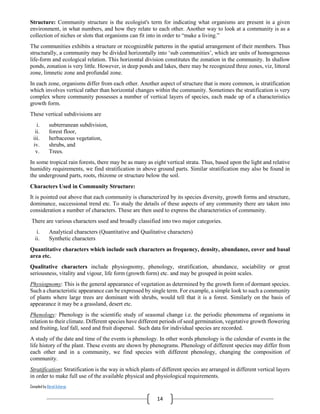
Structure: Community structure is the ecologist's term for indicating what organisms are present in a given
environment, in what numbers, and how they relate to each other. Another way to look at a community is as a
collection of niches or slots that organisms can fit into in order to “make a living.”
The communities exhibits a structure or recognizable patterns in the spatial arrangement of their members. Thus
structurally, a community may be divided horizontally into ‘sub communities’, which are units of homogeneous
life-form and ecological relation. This horizontal division constitutes the zonation in the community. In shallow
ponds, zonation is very little. However, in deep ponds and lakes, there may be recognized three zones, viz, littoral
zone, limnetic zone and profundal zone.
In each zone, organisms differ from each other. Another aspect of structure that is more common, is stratification
which involves vertical rather than horizontal changes within the community. Sometimes the stratification is very
complex where community possesses a number of vertical layers of species, each made up of a characteristics
growth form.
These vertical subdivisions are
i. subterranean subdivision,
ii. forest floor,
iii. herbaceous vegetation,
iv. shrubs, and
v. Trees.
In some tropical rain forests, there may be as many as eight vertical strata. Thus, based upon the light and relative
humidity requirements, we find stratification in above ground parts. Similar stratification may also be found in
the underground parts, roots, rhizome or structure below the soil.
Characters Used in Community Structure:
It is pointed out above that each community is characterized by its species diversity, growth forms and structure,
dominance, successional trend etc. To study the details of these aspects of any community there are taken into
consideration a number of characters. These are then used to express the characteristics of community.
There are various characters used and broadly classified into two major categories.
i. Analytical characters (Quantitative and Qualitative characters)
ii. Synthetic characters
Quantitative characters which include such characters as frequency, density, abundance, cover and basal
area etc.
Qualitative characters include physiognomy, phenology, stratification, abundance, sociability or great
seriousness, vitality and vigour, life form (growth form) etc. and may be grouped in point scales.
Physiognomy: This is the general appearance of vegetation as determined by the growth form of dormant species.
Such a characteristic appearance can be expressed by single term. For example, a simple look to such a community
of plants where large trees are dominant with shrubs, would tell that it is a forest. Similarly on the basis of
appearance it may be a grassland, desert etc.
Phenology: Phenology is the scientific study of seasonal change i.e. the periodic phenomena of organisms in
relation to their climate. Different species have different periods of seed germination, vegetative growth flowering
and fruiting, leaf fall, seed and fruit dispersal. Such data for individual species are recorded.
A study of the date and time of the events is phenology. In other words phenology is the calendar of events in the
life history of the plant. These events are shown by phenograms. Phenology of different species may differ from
each other and in a community, we find species with different phenology, changing the composition of
community.
Stratification: Stratification is the way in which plants of different species are arranged in different vertical layers
in order to make full use of the available physical and physiological requirements.
Compiled by Abiral Acharya
15
Abundance: Although related with density, abundance may not expressed generally in quantitative terms.
Organisms particularly plants are not found uniformly distributed in an area they are found in smaller patches or
groups, differing in number at each place. Abundance is divided in five arbitrary groups, depending upon the
number of plants. The groups are very rare, rare, common, frequent and very much frequent.
Sociability: It denotes the proximity of plants to one another. Plants generally grow as isolated individuals, in
patches, colonies or groups. Plants of some species grows better when nearer to each other and produce thick
population. Other become weak or die in such an association Fruit and seed dispersal etc. and nature of
reproduction are affected by the way in which they are aggregated. Species with same density may differ in
sociability values. Thus sociability express the degree of association between species. Some divide the sociability
into as many as ten classes, but Braun- Blanquet (1932) used only five sociability groups.
S1- Plants (stems) found quite separately from each other, thus growing singly.
S2-A group of 4-5 plants at one place
S3- Many smaller scattered groups at one place
S4- several bigger groups of many plants at one place
S5-A large group occupying larger area
Vitality: This is the capacity of normal growth and reproduction, which are important for successful survival of a
species. The vitality depends upon weight of species. In plants, stem height, root length, leaf area, leaf number,
number and weight of flower, fruit seeds determine the vitality. On this basis plants are grouped into different
vitality groups. R. Mishra and G.S. Puri (1954) gave three groups are as follows
1. Well-developed plants completing their life cycles regularly, producing viable seeds.
2. Plants reproducing vegetatively and
3. Ephemerals short lived
Origin and Development:
A community with its particular environment constitutes an entity which has its origin and development. In a
barren area there reach the seeds and propagules of the species. This is known as migration. The process of
seedling establishment and success growth is called as ecesis. As a result of migration and subsequent ecesis,
species colonies the new areas-colonization. By this time with the changing environment due to plants’ growth,
several other species of both plants and animals colonising the area and sooner or later the area is colonised by a
defined community.
Sometimes species live together in a community under a particular set of environment conditions, as a result of
which there are chiefly two major types of relationships between the organisms of a community and their
environment. These are as follows:
Interrelations between organisms themselves: Such relations are chiefly in respect of food and space. These
include:
(a) Competition: In the process of rapid colonization, individuals become aggregated at a place. As a result of
these actions and interactions on the habitat, the pioneer species modify their own environment. Those, which are
unable to adapt themselves to the changing environmental conditions, disappear from the area. This orderly
change, which leads to the development of vegetation, is called succession. Sooner or later this change comes to
a stop, when a particular community comes to stay and both, community and the habitat have reached a
stabilization. This final community is called the climax community.
(b) Stratification: Various plants in each stratum are adapted to that particular set of local conditions and
moreover, the plants of one layer modify the environment, which is suitable for species in another layer of the
community. Stratification thus is the results of interdependencies of species, as for example, lianas and epiphytes
grow on other plants.
Compiled by Abiral Acharya
16
(c) Cohabitation: There are reports of a number of chemicals secreted by vegetative organs of plants of a
community which modify the edaphic conditions.
Similarly, chemicals secreted by fungi, bacteria and actinomycetes in soil affect the root system as well as shoots
of higher plants.
2.4 Units of vegetation classification:
Vegetation is continuous, sum total of various form of plant population growing in the region. Communities are
the units of vegetation.
There are number of approaches to community classification but the most commonly used commonly used
classification can be studied under following categories
• Classification based on habitat, growth form i.e. Physiognomy
• Classification based on species dominance, succession etc. i.e. Phytosociology.
Physiognomic Classification: Physiognomic classification are based on the physiognomy (i.e. the set of functional
and morphological attributes) of the dominant plants in the community. In order to follow this approach, it is
necessary to choose which morphological or functional plant attributes are relevant. Physiognomic classifications
are useful to describe the vegetation of large areas. The abstract units in physiognomic classifications are called
formations, which can be arranged in a hierarchical system. In order to characterize formations it is sometimes
important the vertical (i.e. stratification) and horizontal (i.e. open- or closed-canopy) structure of the plant
community.
Humboldt (1808) divided communities in 19 groups and Griesbach(1875) in seven groups on the basis of type of
vegetation the main group were ligniden (woody), herbaceous (herbiden), grasses and so on.
Warming (1909-1923), on the basis of growth forms and habitat divided communities into two main classes
Autotrophs, and Heterotrophs. The former included Hydrophytes-7 classes, and land plants (terrestrial) many
classes. Raunkiaer’s classification is one of the physiognomic classification.
Phytosociological classification: Phytosociology is the branch of science which deals with plant communities,
their composition and development, and the relationships between the species within them. A phytosociological
system is a system for classifying these communities.
Since ecologists differed widely from each other in respect of their views on successional trends in vegetation and
final stabilized state (climax community). There developed as many as five continental schools of thought on
community classification. Due to such different views there has been much controversy in the boundary limits of
a community.
S.
Europe
Strong support from phytosociolgy school, Zurich-Montepillar characteristic species approach in
terms of fidelity. Attempts to define community units of floristic basis units comparable to genera
and species in taxonomy various associations compared in tabulated form as abstract associations
N.
Europe
Strongly influenced by Uppsala school of phytosociology use of quadrat vegetational units based on
stratification and concept of constancy. formation classified by physiognomic methods associations
uniform in both, physiognomy and stratified species structure attention to minimal area for
determining constancy
Russia Genralisation difficult. Attempts made to correlate vegetation to environmental gradients. Bio-
coenosis (complexes of organism in critical relationship to environment) idea given
USA Development of cause-effect philosophy and adoption of Clements ideas.
Formation –an organic entity based on climatic climax which grows matures and dies subdivided
into Associations -defined by dominance, subdivided into
Consociation-defined by single dominants further divide into societies-defined by subordinate
species development of vegetation continuum and ordination concepts in late 1940 and to present
mainly by Gleson.
Britain Extensively influenced by Tansley formation defined like Clements subdivided into:- Associations,
Consociation and society, but included all mature major communities (depending on factors other
Compiled by Abiral Acharya
17
than climate ) and not just the climatic climax communities of Clements. Definition by dominants
Statistical approach leading to association’s analysis and ordination in the 1960.
Clementsian unit of vegetation:
According to Clements (1916) on the basis of different units if vegetation the communities may be classified as
follows.
Formation: Whenever the vegetation reaches highest development becoming more or less stable for more or less
definite period, under the existing climate it is called a plant formation. Some plant formation of the world are
rain forest, temperate forest grassland, desert and mangroves.
Plant formation is geographically wide spread climax vegetation unit growing in uniform climatic condition. The
dominant member of plant form have similar growth- forms. For example in a deciduous forest formation, all the
dominant species are broad leaved trees.
In desert formation the dominant species are usually shrubs. In a plant formation there are several dominant
species. Thus a plant formation is composed of several communities with a dominant and co-dominant species.
The principal formations of the world are rain forests, deciduous forests, coniferous forests, grasslands, deserts,
mangroves, scrubs etc.
Associations: In a plant formation there may be present several associations. Plant formation occupying a wide
extensive area there may be present several dominant species. Thus a plant formation may be divided into several
associations. In each association community is present which has two or more dominant species. Each smaller
community of a plant formation with two or more dominant species is known as Association.
The number of association in the community is determined by sub-climates within the general climate of the
formation. Thus the association is more uniform and similar than the formation in its physiognomy structure and
floristic composition. The development or seral communities of an association are known as Associes. In presence
of local variation and other factor but in similar climatic condition there may develop two subdivisions of
associations.
Faciation – It is actually a local variant of an association which is related within a general climate to small
differences in moisture relations and temperature. It is not very much distinct from an association, within a
formation. Similar to association, in faciation too, there are present two or more dominant species. It varies from
the association in terms of having specific precipitation, evaporation and temperature, seral communities are
accordingly known as Facies.
Lociation- This is also a localized variant of an association, differing from it in having different types of some
main sub- dominant and chief secondary species. Seral community are accordingly known as locies.
Thus in a formation besides several associations, there may also exist faciation and lociations which are simply
local variants of association differing from it in minor respects.
Consociation: Due to local variations in edaphic factors, temperature, precipitation, they may develop several
plant communities within a plant association. Each community in the association is dominated by an only a single
species. Each such community, with a single dominant species is known as consociation.
In one association there may be present many consociations, each with a single dominant species. The
developmental or seral communities of a climax consociation are known as consocies. In a consociation, consocies
are controlled by facies.
Society: Society is a community characterized by one or more subdominant species. In area with dominance of
consociation or faciation other species are found growing in abundance. It can be said that society is dominance
within dominance. The seral communities are known as socies. Societies are of two types: Layer Society and
Aspect society.
Compiled by Abiral Acharya
18
2.5 Main Concepts in classification of the community:
Different ecologist gave different treatment to community level of organisation. The opinion of ecologist can be
summarized under two heads:
1. Community is an organised basic units and can be classified.
2. Community is simple assemblage of population of different species having similar environmental
requirement and thus cannot be classified as discrete unit.
This gave rise to two concepts for classification of community.
Individualistic concept (Gleason 1926): According to all classification tradition of community, basic unit of
community may be recognised at one or other level of organisation and can be classified.
In all these theories community have been recognized as equivalent to a species or an organism, and the existence
of a particular species in each community is recognized. Thus each community is characterised with particular
species, dominant, constant. Each individual is distributed independent to other where it disperse and survive.
Condition favouring each species differ of individuals finding it in there tolerance.
In this tradition of community classification were called association unit theory or community unit theory by
Whittaker1955.
Thus according to H.A. Gleason (1926) each individual species tends to be distributed independently of other
occurring where it can disperse and survive within its total range of tolerance of environmental conditions i.e.
ecological niche of the species.
Vegetation continuum concept: Individualistic concept was criticised by the people who believed in interrelation
of population in community. The concept of vegetational continuum was developed by Whittaker (1948, 1951)
and Curtis (1959) and their associates.
The continuum concept has been supported on the basis of environmental gradient. Through gradient analysis or
ordination communities are supposed to vary continuously in space with each point of continuum being equally
probable.
Under natural condition there exist no clear cut lines of separation between vegetation and environmental
conditions. Parallel to environmental gradient there is found vegetational gradient called Ecocline.
Compiled by Abiral Acharya
19
UNIT 3: VARIABILITY AND DIVERSITY (5)
3.1 Variation and diversity due to genotype, phenotype and environment interactions:
Variation and Diversity due to genetics:
Genetic variation describes naturally occurring genetic differences among individuals of the same species. This
variation permits flexibility and survival of a population in the face of changing environmental circumstances.
Consequently, genetic variation is often considered an advantage, as it is a form of preparation for the unexpected.
Genetic variation in a population is derived from a wide assortment of genes and alleles. The persistence of
populations over time through changing environments depends on their capacity to adapt to shifting external
conditions. The variation can be seen in growth, crown, branches, phenology, defense, root structure within same
species. Plant genetic diversity changes in time and space (Ecological or evolutionary Process).
Genetic diversity is the foundation for all higher levels of biodiversity. Genetic diversity provides the recipe for
populations and species, which in turn form communities and ecosystems. Genetic variation enables evolutionary
change and artificial selection.
Each genotype in the population usually has a different fitness for that particular environment. In other words,
some genotypes will be favoured, and individuals with those genotypes will continue to reproduce. Other
genotypes will not be favoured: individuals with those genotypes will be less likely to reproduce. Unfavourable
genotypes take many forms, such as increased risk of predation, decreased access to mates, or decreased access
to resources that maintain health. Overall, the forces that cause relative allele frequencies to change at the
population level can also influence the selection forces that shape them over successive generations.
Genetic diversity may have direct economic value (genes for disease resistance, biologically active compounds).
But effective conservation for whatever purpose depends upon accurate, thoughtful assessment of genetic
diversity. Preservation of genetic diversity is usually a high priority in conservation programs.
Evolution takes place for these genotypes that are the fittest and the best adapted in the existing environmental
condition and produce much more off-spring than those of others. Evolutions results from natural selection and
adaptation.
Natural Selection: Differential reproduction of genotypes in preserving favourable variants and eliminating less
favourable variants always leads to more” fitness”.
Adaptation: Genotype changes in an individual or population so that any living organism survives or grows better
to the existing environment.
The change in genetics make up of a species over time is evolution; it takes place because all the individuals of a
population are not cent percent alike. They differ each other in their genetic constitution (genotype). Different
individuals have different capabilities to survive and reproduce in a given set of environmental conditions. This
difference in survival and reproduction capabilities results from the genotypic variation in individuals. The
genotypes that have the best survival and reproduction capabilities are best adapted to their environment and will
make the largest contribution to the next generation.
Gene–environment interaction (or genotype–environment interaction or G×E) is when two different genotypes
respond to environmental variation in different ways. A norm of reaction is a graph that shows the relationship
between genes and environmental factors when phenotypic differences are continuous.
There are two different concepts of gene–environment interaction. Tabery has labeled them biometric and
developmental interaction, while Sesardic uses the terms statistical and common-sense interaction.
The biometric (or statistical) conception has its origins in research programs that seek to measure the relative
proportions of genetic and environmental contributions to phenotypic variation within populations. Biometric
gene–environment interaction has in population genetics and behavioral genetics. Any interaction results in the
breakdown of the additivity of the main effects of heredity and environment, but whether such interaction is
Compiled by Abiral Acharya
20
present in particular settings is an empirical (experimental) question. Biometric interaction is relevant in the
context of research on individual differences rather than in the context of the development of a particular organism.
Developmental gene–environment interaction is a concept more commonly used by developmental genetic and
developmental psychobiologists. Developmental interaction is not seen merely as a statistical phenomenon.
Whether statistical interaction is present or not, developmental interaction is in any case manifested in the causal
interaction of genes and environments in producing an individual's phenotype.
Phenotypic Variation
To consider the adaptedness of forest tree and their ability to adapt with changing environmental condition is
important for forest ecologist. The ability to survive and reproduce in a given range of environment is adaptedness.
The observable properties of an individual are the result of the combined effects of its genetics constitution
(genotypes) and its abiotic environment. Genotypes are never visible, because, from the moments of fertilization
the environment influences it.
The visible organism is the phenotype, the result of the effect of external environment on the genotype. We may
express this relationship by the following relationship: Phenotype = Genotype + external environment. Relative
effect of genetic variation and environmental variation may be find out by following equation; VP=Vg +Ve
Where, VP= Total phenotypic variation
Vg= genetic variation
Ve= environmental variance
The degree of genetic control of a phenotypic character is termed as heritability which is the ratio of Vg/Vp. If
the ratio of this factor is more than 75% it means the high heritability which indicate a strong Genetic control for
the trait characters like branchiness, bole form, bark structure, stem wood density and susceptibility to insect and
diseases are genetically controlled. Low heritability indicates a strong environmental control for the trait
characters like heights (strongly influenced by soil fertilizer and moisture) and diameter (influenced by density of
the stand) of trees are environmentally influenced or weak genetic control, which have usually low heritability.
Environmental Variation and diversity occurs as a result of:
– Climatic Factors
– Abiotic factors
– Edaphic Factors
– Locality factors
– Topographic Factors
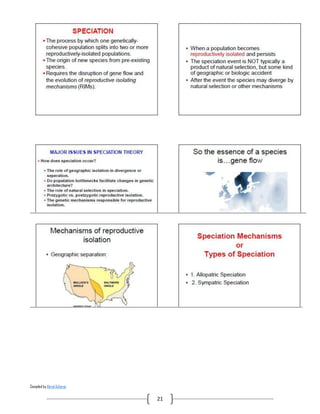
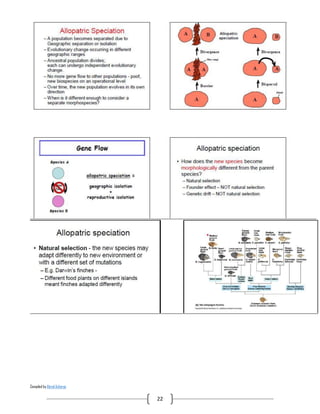
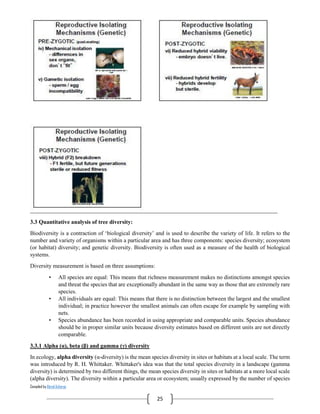
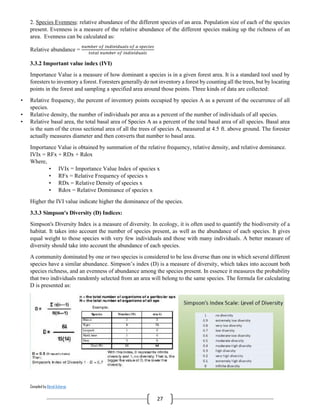
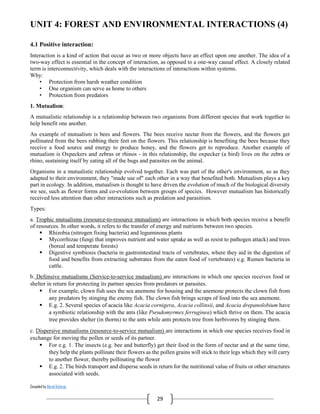
3.2 Speciation:
Compiled by Abiral Acharya
21
Compiled by Abiral Acharya
22
Compiled by Abiral Acharya
23
Compiled by Abiral Acharya
24
Compiled by Abiral Acharya
25
3.3 Quantitative analysis of tree diversity:
Biodiversity is a contraction of ‘biological diversity’ and is used to describe the variety of life. It refers to the
number and variety of organisms within a particular area and has three components: species diversity; ecosystem
(or habitat) diversity; and genetic diversity. Biodiversity is often used as a measure of the health of biological
systems.
Diversity measurement is based on three assumptions:
• All species are equal: This means that richness measurement makes no distinctions amongst species
and threat the species that are exceptionally abundant in the same way as those that are extremely rare
species.
• All individuals are equal: This means that there is no distinction between the largest and the smallest
individual; in practice however the smallest animals can often escape for example by sampling with
nets.
• Species abundance has been recorded in using appropriate and comparable units. Species abundance
should be in proper similar units because diversity estimates based on different units are not directly
comparable.
3.3.1 Alpha (α), beta (β) and gamma (γ) diversity
In ecology, alpha diversity (α-diversity) is the mean species diversity in sites or habitats at a local scale. The term
was introduced by R. H. Whittaker. Whittaker's idea was that the total species diversity in a landscape (gamma
diversity) is determined by two different things, the mean species diversity in sites or habitats at a more local scale
(alpha diversity). The diversity within a particular area or ecosystem; usually expressed by the number of species
Compiled by Abiral Acharya
26
(i.e., species richness) in that ecosystem. Beta diversity is a comparison of diversity between ecosystems, usually
measured as the amount of species change between the ecosystems. Beta diversity allows us to compare diversity
between ecosystems. Gamma diversity is a measure of the overall diversity within a large region. Geographic-
scale species diversity according to Hunter (2002). It is also known as geographic-scale species diversity.
Species Diversity
Species diversity relates to the number of the different species and the number of individuals of each species
within any one community. The measurement of Species diversity is important in assessing the biological value,
natural richness and uniqueness of an area. The most basic and objective measure of species diversity is simply
the number of species within a particular group (birds, for example) found per sample. But used alone, this
measurement, called species richness, can be misleading. So, any serious diversity measurement needs to account
for both species richness and species evenness. Because, the greater the number of species and the more even the
distribution, the higher the diversity value. Also, the species evenness differs sharply between the two areas.
Level of Species diversity:
Alpha diversity: diversity within specific communities or habitat types. It is the number of species found in a
particular area or ecosystem. For example: Habitat X has 5 species of ants - Therefore, the alpha diversity for ants
in this place is 5.
Beta diversity: diversity between two habitat types. It is the variation of the species composition between two
habitats or regions. It takes into account the alpha diversity of the habitats and the number of unique species on
each habitat. For example: Habitat 1 has 4 species: a, b, c, and d (alpha diversity = 4). Habitat 2 has 3 species:
c, d, and e (alpha diversity = 3). To calculate the beta diversity, we subtract the number of overlapping species of
each habitat’s alpha diversity and sum the results: (4 species on habitat 1 - 2 overlapping species) + (3 species on
habitat 2 - 2 overlapping species) = (4–2) + (3–2) = 2+1 = 3. The beta diversity between habitats 1 and 2 is 3.
Gamma diversity: diversity over large regions. It is a measure of the overall number of species (the diversity)
within a region. It is basically the sum of all the species of all habitats within the region of interest. The gamma
diversity of the region with habitats 1 and 2 from the last question would be 5, since that there were 5 species on
habitats 1 and 2: a, b, c, d, and e.
Measuring Biodiversity: Biodiversity can be quantified in many different ways. Two main factors taken into
account by ecologists are Species richness and Species evenness.
1. Species Richness: The number of species per sample is a measure of richness. The more species present in a
sample, the 'richer' the sample. It is a measure of the number of different kinds of organisms present in a particular
area. This is a simple count of the species in a community. Each species contributes one count to the total
regardless of whether the species population is 1 or 1 million.
Compiled by Abiral Acharya
27
2. Species Evenness: relative abundance of the different species of an area. Population size of each of the species
present. Evenness is a measure of the relative abundance of the different species making up the richness of an
area. Evenness can be calculated as:
Relative abundance =
𝑛𝑢𝑚𝑏𝑒𝑟 𝑜𝑓 𝑖𝑛𝑑𝑖𝑣𝑖𝑑𝑢𝑎𝑙𝑠 𝑜𝑓 𝑎 𝑠𝑝𝑒𝑐𝑖𝑒𝑠
𝑡𝑜𝑡𝑎𝑙 𝑛𝑢𝑚𝑏𝑒𝑟 𝑜𝑓 𝑖𝑛𝑑𝑖𝑣𝑖𝑑𝑢𝑎𝑙𝑠
3.3.2 Important value index (IVI)
Importance Value is a measure of how dominant a species is in a given forest area. It is a standard tool used by
foresters to inventory a forest. Foresters generally do not inventory a forest by counting all the trees, but by locating
points in the forest and sampling a specified area around those points. Three kinds of data are collected:
• Relative frequency, the percent of inventory points occupied by species A as a percent of the occurrence of all
species.
• Relative density, the number of individuals per area as a percent of the number of individuals of all species.
• Relative basal area, the total basal area of Species A as a percent of the total basal area of all species. Basal area
is the sum of the cross sectional area of all the trees of species A, measured at 4.5 ft. above ground. The forester
actually measures diameter and then converts that number to basal area.
Importance Value is obtained by summation of the relative frequency, relative density, and relative dominance.
IVIx = RFx + RDx + Rdox
Where,
• IVIx = Importance Value Index of species x
• RFx = Relative Frequency of species x
• RDx = Relative Density of species x
• Rdox = Relative Dominance of species x
Higher the IVI value indicate higher the dominance of the species.
3.3.3 Simpson's Diversity (D) Indices:
Simpson's Diversity Index is a measure of diversity. In ecology, it is often used to quantify the biodiversity of a
habitat. It takes into account the number of species present, as well as the abundance of each species. It gives
equal weight to those species with very few individuals and those with many individuals. A better measure of
diversity should take into account the abundance of each species.
A community dominated by one or two species is considered to be less diverse than one in which several different
species have a similar abundance. Simpson’s index (D) is a measure of diversity, which takes into account both
species richness, and an evenness of abundance among the species present. In essence it measures the probability
that two individuals randomly selected from an area will belong to the same species. The formula for calculating
D is presented as:
Compiled by Abiral Acharya
28
3.3.4 Shannon diversity index (H’)
Shannon and Wiener independently derived the function which has become known as Shannon index of diversity. This
indeed assumes that individuals are randomly sampled from an independently large population and all the species are
represented in the sample.
The Shannon diversity index (H) is another index that is commonly used to characterize species diversity in a
community. Like Simpson's index, Shannon's index accounts for both abundance and evenness of the species present.
The proportion of species i relative to the total number of species (pi) is calculated, and then multiplied by the natural
logarithm of this proportion (lnpi). The resulting product is summed across species, and multiplied by -1.
The value of Shannon diversity is usually found to fall between 1.5 and 3.5 and only rarely it surpasses 4.5.
Compiled by Abiral Acharya
29
UNIT 4: FOREST AND ENVIRONMENTAL INTERACTIONS (4)
4.1 Positive interaction:
Interaction is a kind of action that occur as two or more objects have an effect upon one another. The idea of a
two-way effect is essential in the concept of interaction, as opposed to a one-way causal effect. A closely related
term is interconnectivity, which deals with the interactions of interactions within systems.
Why:
• Protection from harsh weather condition
• One organism can serve as home to others
• Protection from predators
1. Mutualism:
A mutualistic relationship is a relationship between two organisms from different species that work together to
help benefit one another.
An example of mutualism is bees and flowers. The bees receive nectar from the flowers, and the flowers get
pollinated from the bees rubbing their feet on the flowers. This relationship is benefiting the bees because they
receive a food source and energy to produce honey, and the flowers get to reproduce. Another example of
mutualism is Oxpeckers and zebras or rhinos - in this relationship, the oxpecker (a bird) lives on the zebra or
rhino, sustaining itself by eating all of the bugs and parasites on the animal.
Organisms in a mutualistic relationship evolved together. Each was part of the other's environment, so as they
adapted to their environment, they "made use of" each other in a way that benefited both. Mutualism plays a key
part in ecology. In addition, mutualism is thought to have driven the evolution of much of the biological diversity
we see, such as flower forms and co-evolution between groups of species. However mutualism has historically
received less attention than other interactions such as predation and parasitism.
Types:
a. Trophic mutualisms (resource-to-resource mutualism) are interactions in which both species receive a benefit
of resources. In other words, it refers to the transfer of energy and nutrients between two species.
 Rhizobia (nitrogen fixing bacteria) and leguminous plants
 Mycorrhizae (fungi that improves nutrient and water uptake as well as resist to pathogen attack) and trees
(boreal and temperate forests)
 Digestive symbiosis (bacteria in gastrointestinal tracts of vertebrates, where they aid in the digestion of
food and benefits from extracting substrates from the eaten food of vertebrates) e.g. Rumen bacteria in
cattle.
b. Defensive mutualisms (Service-to-service mutualism) are interactions in which one species receives food or
shelter in return for protecting its partner species from predators or parasites.
 For example, clown fish uses the sea anemone for housing and the anemone protects the clown fish from
any predators by stinging the enemy fish. The clown fish brings scraps of food into the sea anemone.
 E.g. 2. Several species of acacia like Acacia cornigera, Acacia collinsii, and Acacia drepanolobium have
a symbiotic relationship with the ants (like Pseudomyrmex ferruginea) which thrive on them. The acacia
tree provides shelter (in thorns) to the ants while ants protects tree from herbivores by stinging them.
c. Dispersive mutualisms (resource-to-service mutualism) are interactions in which one species receives food in
exchange for moving the pollen or seeds of its partner.
 For e.g. 1. The insects (e.g. bee and butterfly) get their food in the form of nectar and at the same time,
they help the plants pollinate their flowers as the pollen grains will stick to their legs which they will carry
to another flower, thereby pollinating the flower
 E.g. 2. The birds transport and disperse seeds in return for the nutritional value of fruits or other structures
associated with seeds.
Compiled by Abiral Acharya
30
Obligate or facultative Mutualism: Mutualism can be considered obligate or facultative. Species involved in
obligate mutualism cannot survive without the relationship, while facultative mutualistic species can survive
individually when separated but often not as well. For example, leafcutter ants and certain fungi have an obligate
mutualistic relationship. The ant larvae eat only one kind of fungi, and the fungi cannot survive without the
constant care of the ants. As a result, the colonies activities revolve around cultivating the fungi. They provide it
with digested leaf material, can sense if a leaf species is harmful to the fungi, and keep it free from pests.
A good example of a facultative mutualistic relationship is found between mycorrhizal fungi and plant roots. It
has been suggested that 80% of vascular plants form relationships with mycorrhizal fungi (Deacon 2006). Yet the
relationship can turn parasitic when the environment of the fungi is nutrient rich, because the plant no longer
provides a benefit (Johnson et al. 1997). Thus, the nature of the interactions between two species is often relative
to the abiotic conditions and not always easily identified in nature.
2. Commensalism:
In ecology, commensalism is a class of relationship between two organisms where one organism benefits without
affecting the other.
For example, Cattle egrets foraging in fields among cattle or other livestock is an example of commensalism. As
cattle, horses and other livestock graze on the field, they cause movements that stir up various insects. As the
insects are stirred up, the cattle egrets following the livestock catch and feed upon them. The egrets benefit from
this relationship because the livestock have helped them find their meals, while the livestock are typically
unaffected by it.
Orchids and mosses are plants that can exhibit commensalism with trees. The plants grow on the trunks or
branches of trees, getting the light they need as well as nutrients that run down along the tree. As long as these
plants do not grow too heavy, the tree is not affected.
Types:
a. Chemical commensalism is most often observed between two species of bacteria. It involves one species of
bacteria feeding on the chemicals produced or the waste products that are not used by the other bacteria.
b. Inquilinism involves one species using the body or a body cavity of another organism as a platform or a living
space (sometimes food) while the host organism neither benefits nor is harmed. For example, epiphytic plants that
grow on trees, or birds that live in holes in trees.
c. Metabiosis is a form of commensalism that occurs when one species unintentionally creates a home for another
species through one of its normal life activities. Example include hermit crabs, which use gastropod shells (after
death of gastropod) to protect their bodies.
d. Phoresy takes place when one organism attaches to another organism specifically for the purpose of gaining
transportation. This concerns mainly arthropods (mites on insect).
3. Protocooperation:
Protocooperation is type of positive interaction where two species interact with each other beneficially; they have
no need to interact with each other. They interact purely for the gain that they receive from doing this. It is not at
all necessary for protocooperation to occur; growth and survival is possible in the absence of the interaction. The
interaction that occurs can be between different kingdoms.
The term, initially used for intraspecific interactions, was popularized by Eugene Odum (1953), although other
authors prefer to use the terms “cooperation”" or “mutualism”.
Thus, Protocooperation is a positive interaction in which both the species will be benefited but they can live
equally well without this association. Example: Sea anemone and Hermit crab. The sea anemone (Adamsia) gets
attached to the molluscan shell of the hermit crab (Eupagurus). Sea anemone gives protect to the crab and the crab
in turn carries the anemone to new feeding grounds.
Protocooperation is a form of mutualism, but the cooperating species do not depend on each other for survival.
An example of protocooperation happens between soil bacteria or fungi, and the plants that occur growing in the
Compiled by Abiral Acharya
31
soil. None of the species rely on the relationship for survival, but all of the fungi, bacteria and higher plants take
part in shaping soil composition and fertility. Soil bacteria and fungi interrelate with each other, forming nutrients
essential to the plants survival. The plants obtain nutrients from root nodules and decomposing organic substance.
Plants benefit by getting essential mineral nutrients and carbon dioxide. The plants do not need these mineral
nutrients but do help the plant grow even further.
Examples:
a. Ants and aphids: The ant searches for food on trees and shrubs that are hosts to honeydew-secreting species
such as aphids, mealy bugs. The ant gathers the sugary substance and takes it to its nest as food for its offspring.
It has been known for the ant to stimulate the aphid to secrete honeydew straight into its mouth. Some ant species
even look after the honeydew producers from natural predators.
In areas where the ant inhabits the same ecosystem as the aphid, the plants they inhabit normally suffer from a
higher presence of aphids which is detrimental to the plant but not to the two species protocooperating.
b. Flowers and insects: The flower of plants that are pollinated by insects and birds benefit from protocooperation.
The plants, particularly those with large bright colourful flowers bearing nectar glands, experience cross
pollination because of the insects activities. This is beneficial to the insect that has got the food supply of pollen
and nectar required for its survival.
c. Birds: Protocooperation can occur in birds. The Egyptian plover removes insect pests from the backs of buffalo,
antelope, giraffes and rhinos. The cattle egret in America as well does the same task of removing the unwanted
insects and parasites.
d. Fish: Certain fish perform the task of cleaning other fish, by removing ectoparasites, cleaning wounded flesh,
and getting rid of dead flesh. Even predatory fish rely on cleansing symbionts, and adopt a placid state while they
are cleansed. The fish that do the cleansing are often concentrated around specific sites where the other fish come
to be cleansed these are known as cleansing stations.
4.2 Negative interactions:
1. Competition:
This is known as negative interaction. Both species are harmed. There are three types of competition:
• Interference competition (Real and direct competition )
• Exploitation competition (Real and indirect competition)
• Apparent competition
Compiled by Abiral Acharya
32
It occurs when species compete for a resource in short supply. This resource may be prey, water, light, nutrients,
nest sites; etc. Individuals experience both types of competition, but the relative importance of the two types of
competition varies from population to population and species to species.
Intraspecific competition: Rivalry often occurs between members of the same species within an ecological
community. These individuals compete for limited resources like food, shelter and mates. Intraspecific
competition helps nature keep the population under control. When food is limited, the environment can only feed
so many individuals of the same species. This results in the survival of the fittest, only those capable of winning
against their counterparts survive. Similar regulation occurs when individuals compete over shelter for raising
young. This is often occurs with young male lions; Animals that lose are driven from the group and from the area.
Interspecific competition: It occurs when members of more than one species compete for the same resource.
Woodpeckers and squirrels often compete for nesting rights in the same holes and spaces in trees, while the lions
and cheetahs of the African savannah compete for the same antelope and gazelle prey. Even though individual
animals are competing for the same shelter or food, interspecific competition is usually less critical than
intraspecific competition. The antelope, for example, is not the lion's only prey. Because of this, the lion can
choose to compete for antelope or to look elsewhere. Animals of different species typically compete with each
other only for food, water and shelter. But they often compete with members of their own species for mates and
territory as well.
Plants also compete for space, nutrients and resources such as water and sunlight. This competition can shape how
the ecosystem looks. Taller trees shield a forest's understory -- the ground beneath the forest's tree-top canopy
from sunlight, making it hard for anything to grow but the most shade-tolerant plants. The life cycles of some
plants are also impacted because many shorter plants flower and bear seeds before the leaves of the taller trees are
fully developed, which makes it possible for shorter plants to receive sunlight. Desert plants have developed
shallow, far-reaching roots systems to successfully compete for valuable water resources, which is an example of
how competition can affect the evolution of a species.
Speciation as a result of competition: Scientists posit that competitive relationships may at least be partially
responsible for the evolutionary process. In natural selection, the individuals of a species best adapted to the
environment around them survive to reproduce and pass on the genetics that make them well adapted. Take the
giraffe for example, whose evolution of its long neck makes it possible to eat foods with little to no competition.
As an herbivore, it completes with other grazing herbivores such as zebras and antelope for food. Giraffes with
longer necks are able to reach the leaves of high tree branches, giving them access to more food and a better
chance of passing their genetics on to their offspring.
Types of competition
Exploitation competition: Exploitation competition occurs when individuals interact indirectly as they compete
for common resources, like territory, prey or food. A form of competition wherein organisms indirectly compete
with other organisms for resources by exploiting resources to limit the resources availability to other organisms
Interference competition: When an individual directly alters the resource-attaining behaviour of other individuals,
the interaction is considered interference competition. In interference competition, the competition between
organisms is direct. An example is the aggression display between competing organisms. This applies to both
intraspecific and interspecific competition. In intraspecific competition, the competing organisms are of the same
species. They vie for same resources such as territory, mate, food, etc. The male deer for instance lock horns when
competing for a potential mate. Direct competition is also exhibited in interspecific competition. In interspecific
competition; the opposing organisms are of different species. An example of direct competition between
different species is the rivalry between a lion and a tiger competing for the same prey.
Apparent competition: occurs when two individuals that do not directly compete for resources affect each other
indirectly by being prey for the same predator (Hatcher et al. 2006). Consider a hawk (predator) that preys both
on squirrels and mice. In this relationship, if the squirrel population increases, then the mouse population may be
positively affected since more squirrels will be available as prey for the hawks. However, an increased squirrel
population may eventually lead to a higher population of hawks requiring more prey, thus, negatively affecting
the mice through increased predation pressure as the squirrel population declines.
Compiled by Abiral Acharya
33
Whether by interference or exploitation, over time a superior competitor can eliminate an inferior one from the
area, resulting in competitive exclusion. The outcomes of competition between two species can be predicted using
equations, and one of the most well-known is the Lotka-Volterra model. This model relates the population density
and carrying capacity of two species to each other and includes their overall effect on each other. The four
outcomes of this model are: 1) species A competitively excludes species B; 2) species B competitively excludes
species A; 3) either species wins based on population densities; or 4) coexistence occurs.
Species can survive together if intra-specific is stronger than inter-specific competition. This means that each
species will inhibit their own population growth before they inhibit that of the competitor, leading to coexistence.
Another mechanism for avoiding competitive exclusion is to adopt alternative life history and dispersal strategies,
which are usually reinforced through natural selection. This mechanism reduces competitive interactions and
increases opportunities for new colonization and nutrient acquisition. The success of this is often dependent upon
events (such as tide, flood, or fire disturbances) that create opportunities for dispersal and nutrient acquisition.
Consider that Plant Species A is more efficient than Plant Species B at nutrient uptake, but Plant B is a better
disperser. In this example, the resource under competition is nutrients, but nutrient acquisition is related to
availability. If a disturbance opens up new space for colonization, Plant B is expected to arrive first and maintain
its presence in the community until Plant A arrives and begins competing with Plant B. Eventually Plant A will
outcompete Plant B, perhaps by growing faster because Plant A is more efficient at nutrient acquisition. With an
increasing Plant A population, the Plant B population will decline, and given enough time, can be excluded from
that area. The exclusion of Plant B can be avoided if a local disturbance (for example, prairie fires) consistently
opens new opportunities (space) for colonization. This often happens in nature, and thus disturbance can balance
competitive interactions and prevent competitive exclusion by creating patches that will be readily colonized by
species with better dispersal strategies.
The success of the dispersal versus nutrient acquisition trade-off depends, however, on the frequency and spatial
proximity (or how close they are) of disturbance events relative to the dispersal rates of individuals of the
competing species. Coexistence can be achieved when disturbances occur at a frequency or distance that allows
the weaker, but often better dispersing, competitor to be maintained in a habitat. If the disturbance is too frequent
the inferior competitor (better disperser) wins, but if the disturbance is rare then the superior competitor slowly
outcompetes the inferior competitor, resulting in competitive exclusion. This is known as the intermediate
disturbance hypothesis.
Competition may result:
• Extinction of competing species
• Resource portioning
• Character displacement
2. Predation and Herbivory
Predation requires one individual, the predator, to kill and eat another individual, the prey. Predation influences
organisms at two ecological levels. At the level of the individual, the prey organism has a sudden decline in fitness,
as measured by its lifetime reproductive success, because it will never reproduce again. At the level of the
community, predation reduces the number of individuals in the prey population.
Compiled by Abiral Acharya
34
In most examples of this relationship, the predator and prey are both animals. However, protozoans are known to
prey on bacteria and other protozoans. Under ideal circumstances, seeds grow to become plants. However,
consumption of a seed kills the plant before it can grow, making seed consumption an example of predation. Some
plants are known to trap and digest insects (for example, pitcher plant).
Typically, this interaction occurs between species (inter-specific); but when it occurs within a species (intra-
specific) it is cannibalism. Cannibalism is actually quite common in both aquatic and terrestrial food webs (Huss et
al. 2010; Greenwood et al. 2010). It often occurs when food resources are scarce, forcing organisms of the same
species to feed on each other. This can actually benefit the species as a whole by sustaining the population through
times of limited resources while simultaneously allowing the scarce resources to rebound through reduced feeding
pressure (Huss et al. 2010).
The predator-prey relationship can be complex through sophisticated adaptations by both predators and prey, in
what has been called an "evolutionary arms race." Typical predatory adaptations are sharp teeth and claws, stingers
or poison, quick and agile bodies, camouflage coloration and excellent olfactory, visual or aural acuity. Prey
species have evolved a variety of defences including behavioural, morphological, physiological, mechanical, and
chemical defences to avoid being preyed upon (Aaron, Farnsworth et al. 1996, 2008).
Prey display various defensive adaptations. Behavioural defenses include hiding, fleeing, forming herds or
schools, self-defence, and alarm calls. Animals also have morphological and physiological defense adaptations.
Cryptic coloration, or camouflage, makes prey difficult to spot. Many, such as leaf insects, moths, a variety of
frogs and small lizards, and herbivorous mammals, are cryptically coloured to make them more difficult to see.
Behaviourally, they freeze after detecting the presence of a predator. This lack of movement helps them better
blend in with their background and inhibits the ability of the predator to find them. But when predators venture
too close, prey will take flight, running or flying to escape.
Some species give extra time by distracting the predator. Examples include moths that flash brightly coloured
hindwings, lizards that drop their tails, and insect larvae that discharge slime. Such actions surprise the predator
and give the prey time a few extra moments to escape.
Animals with effective chemical defense often exhibit bright warning coloration, called aposematic coloration.
Predators are particularly cautious in dealing with prey that display such coloration. In some cases, a prey species
may gain significant protection by mimicking the appearance of another species. In Batesian mimicry, a palatable
or harmless species mimics an unpalatable or harmful model. In Mullerian mimicry, two or more unpalatable
species resemble each other.
Herbivory (+/– interaction) refers to an interaction in which an herbivore eats parts of a plant or alga. It has led
to evolution of plant mechanical and chemical defenses and adaptations by herbivores.
In this, an individual feeds on all or part of a photosynthetic organism (plant or algae), possibly killing it
(Gurevitch et al. 2006). An important difference between herbivory and predation is that herbivory does not always
lead to the death of the individual. Herbivory is often the foundation of food webs since it involves the
consumption of primary producers (organisms that convert light energy to chemical energy through
photosynthesis).
Herbivores are classified based on the part of the plant consumed. Granivores eat seeds; grazers eat grasses and
low shrubs; browsers eat leaves from trees or shrubs; and frugivores eat fruits. Plants, like prey, also have evolved
adaptations to herbivory. Tolerance is the ability to minimize negative effects resulting from herbivory, while
resistance means that plants use defenses to avoid being consumed. Physical (for example, thorns, tough material,
sticky substances) and chemical adaptations (for example, irritating toxins on piercing structures, and bad-tasting
chemicals in leaves) are two common types of plant defenses (Gurevitch et al. 2006).
3. Antagonism:
Antagonism, in ecology, an association between organisms in which one benefits at the expense of the other. It
includes Predation, Parasitism, Grazing and Browsing and Competition.
Compiled by Abiral Acharya
35
4. Ammensalism:
Ammensalism, association between organisms of two different species in which one is inhibited or destroyed and
the other is unaffected. There are two basic modes: competition, in which a larger or stronger organism excludes
a smaller or weaker one from living space or deprives it of food, and antibiosis, in which one organism is
unaffected but the other is damaged or killed by a chemical secretion.
Some higher plants secrete substances that inhibit the growth of, or kill outright, nearby competing plants. An
example is the black walnut (Juglans nigra), which secretes juglone, a substance that destroys many herbaceous
plants within its root zone. Algal bloom (in the second figure) is another example of Ammensalism.
5. Parasitism:
Parasitism is a relationship between species, where one organism, the parasite, lives on or in another organism,
the host, causing it some harm, and is adapted structurally to this way of life.
Parasites include protozoans such as the agents of malaria, sleeping sickness, and amoebic dysentery; animals
such as hookworms, lice, mosquitoes, and vampire bats; fungi such as honey fungus and the agents of ringworm;
and plants such as mistletoe, dodder, and the broomrapes.
There are six major parasitic strategies of exploitation of animal hosts, namely parasitic castration, directly
transmitted parasitism (by contact), trophically transmitted parasitism (by being eaten), vector-transmitted
parasitism, parasitoidism, and micro predation.
Like predation, parasitism is a type of consumer-resource interaction, but unlike predators, parasites, with the
exception of parasitoids, are typically much smaller than their hosts, do not kill them, and often live in or on their
hosts for an extended period. Parasites of animals are highly specialised, and reproduce at a faster rate than their
hosts.
Classic examples include interactions between vertebrate hosts and tapeworms, flukes, the malaria-causing
Plasmodium species, and fleas.
Parasites reduce host fitness by general or specialised pathology, from parasitic castration to modification of host
behaviour. Parasites increase their own fitness by exploiting hosts for resources necessary for their survival, in
particular by feeding on them and by using intermediate (secondary) hosts to assist in their transmission from one
definitive (primary) host to another.
Taxonomists classify parasites in a variety of overlapping schemes, based on their interactions with their hosts
and on their life-cycles, which are sometimes very complex. An obligate parasite depends completely on the host
to complete its life cycle, while a facultative parasite does not. Parasite life-cycles involving only one host are
called "direct"; those with a definitive host (where the parasite reproduces sexually) and at least one intermediate
host are called "indirect”. An endoparasite lives inside the host's body; an ectoparasite lives outside, on the host's
surface. Mesoparasites - like some copepods, for example - enter an opening in the host's body and remain partly
embedded there.
Compiled by Abiral Acharya
36
Some parasites can be generalists, feeding on a wide range of hosts, but many parasites, and the majority of
protozoans and helminths that parasitise animals, are specialists and extremely host-specific. An early basic,
functional division of parasites distinguished micro parasites and macro parasites. The microorganisms and
viruses that can reproduce and complete their life cycle within the host are known as micro parasites. Macro
parasites are the multicellular organisms that reproduce and complete their life cycle outside of the host or on the
host's body
4.3 Plant microbe-animal’s interrelationship:
Plants and animals evolved together, so it is not surprising that there are many complex plant/animal relationships.
This process of interdependent evolution of two or more species is called coevolution. Some relationships are
beneficial to both parties, while others have a clear benefit for one at the expense, or even death, of the other. Four
important plant/microbe-animal interactions are explored here: plant/herbivore, plant/pollinator, plant/disperser,
and other examples of mutualism such as plant and nutrient provider. The interaction can be both positive and
negative.
Compiled by Abiral Acharya
37
Plants are non-motile but they constantly encounter both the biotic and abiotic stress. There is a constant war
between the pathogenic microbes and the host plant – the outcome of which determines resistance or disease.
Plants secrete various organic compounds resulting in a nutritionally enriched environment favourable for
microbial growth. As a result, plants are heavily colonized with a diversity of microbes whose reservoir is primary
the soil.
Microbes that colonize plants are called either epiphytes (colonize plant surface) or endophytes (colonize plants
interior). The relationship may be positive or negative. Plants and microbes can have variety of interactions
including pathogenic, symbiotic and associative. The relationship with Mycorrhizae is beneficial to plants.
The relationship with ruminant bacteria beneficial animals. Similarly, many of such microbes creates the disease
to both plants and animals and has the negative relationship with pathogens. Types of pathogen based on effects:
• Necrotrophy: plant cells are killed
• Biotrophy: plant cells remain alive
• Hemibiotrophy: plant cells initially alive later killed.
Compiled by Abiral Acharya
38
4.4 Synecology (Community ecology) and its types:
Community is the biotic component of an ecosystem. The study
of community properties and the interaction among organism that
composed it is termed synecology. Each community is
characterized by a particular species composition, vertical
structure (life form) and patterns of change over space and time. Plant and animal cannot live as isolated
individual. Generally, they prefer to live in groups or colonies. A group of individuals of the same species is
known as population. Population is a part of community. Therefore, forest community may be defined as “the
sum of populations of different species having mutual relationship among them and to the environment within
a given area”.
Trees dominate Forest community. The nature of forest community is governed by the interaction of three groups
of factors. They are: the site or habitat available for plant growth, the plants and animals available to colonize
and occupy that site or habitat and the history of the site or habitat. The changes in the site and biota over a period
of time due to the influence of changing seasons, climates, soils, vegetation, animals etc. i.e., the history
of that habitat. The forest ecosystem is the complex of trees, shrubs, herbs, bacteria, fungi, protozoa, arthropods
(invertebrates), vertebrates, oxygen, carbon - dioxide, water, minerals, dead organic matter etc. It is constantly
changing both in time and in space.
The following points characterize the
community as well as:-
i. Species diversity
ii. Co-existence
iii. Interdependency
iv. Species dominance
v. Stratification
vi. Succession
Forest is the major part of the plant
community. Forest types differ with climate,
physiography, and association. Different
plant communities and their association help
determine the forest types. The forest of
Nepal are classified into 35 types as per the
plant communities in the different regions of
the country. Tropical Sal forest shows the
association of the predominant sal forest
with species like Botdhainro, Karma and Asna. They also vary as per the different region. The forest community
of western floor is different from that of eastern.
Compiled by Abiral Acharya
39
4.5 Succession and its types:
The change in the species composition and community structure over time is called succession or ecological
succession. Succession continues until a more or less stable condition is attained (constant turnover of materials)
called climax. Different transitional stages through which plant communities passes on the way to reach climax
are called seral stage.
Types of succession
Primary succession: starts in an area that
is previously totally un-vegetated or
barren or unoccupied by biotic
communities
Secondary succession: starts in an area
where other organisms were already
present (from where previous vegetation
were disturbed). This succession takes
place much rapidly than primary
succession. The time requires to reach
climax also depend on the types, extent
and magnitude of disturbances and site
quality.
As plant community changes with time, so does the animal community because each species is best adapted to a
specific succession stage.
Compiled by Abiral Acharya
40
UNIT 5: FOREST INFLUENCES (5)
5.1 Effects of forest on soil, vegetation, physiography, local and micro-climate.
All effects resulting from the presence of forest upon climate, soil water, productivity is termed under forest
influences. Conservation of water and soil is to designate some of the applied aspects of forest influences. The
important forest influences concerned with are precipitation, soil, temperature, wind, micro-climate, etc. It has
additional value in climate change.
On soil:
Biota, mostly forest vegetation contribute towards:
• Organic matter accumulation
• Biochemical weathering
• Profile mixing
• Nutrient cycling
• Aggregate stability
Effect of Forest on soil &water conservation:
• Reduce soil erosion
• Provide permeable barriers
• Increase infiltration
• Soil formation
• Maintain soil fertility
• Stabilize Mechanical structures
• Influence on soil temperature
• Flood control
Influence of forest on soil fertility:
• Maintain fertility through litter but effect is very slow except nitrogen-fixing species
• Tree species influence soil differently, based on differences in nutrient uptake, litter quality, and growth
• Add organic matter
Influence on soil temperature:
• Forest cover makes temperature of soil, more equable than it is in open.
• This is due to the fact that forest cover act as a screen and prevents sun’s ray from heating the soil inside
the forest to the same extent as it does in open
• Studies made on the effect of forest on temperature shows 3-4 degree difference in temperature
• During the night, this screen prevents the loss of heat by radiation. The result of this is mean maximum
temperature of air and soil inside the forest is lower and mean minimum temperature higher.
• As forest cover influence is not only air temperature but also on soil temperature.
• The influences of forest vegetation on freezing of soil are of great importance.
• Soil under a forest usually remains soft when that in the open is frozen to considerable depth.
Influence on Infiltration and Water Retention
• Forest vegetation, by reducing surface runoff, increases the amount of water that percolates into a soil.
• The effect of forest in preventing freezing of forest soil of vast importance in increasing the amount of
water that percolates into it, particularly during the spring months (Auten, 1933).
• Forest cover in increasing the volume of soil in mountainous region over the solid rock foundation,
increase seepage.
Compiled by Abiral Acharya
41
• The humus layers, characteristic of every well-managed forest, absorb from two to four times their weight
of water.
• Forest soil, with its overlaying organic layers is in a real sense a vast sponge capable of absorbing much
more water per unit area than soil in the open.
• Therefore water-holding capacity of humus rich soils is highly increased.
.Influence on Wind Erosion
• Forests, by checking the velocity of wind and by reducing surface runoff have a great influence on the
stability of soil.
• Sands subject to wind erosion should be covered with forest growth or their soil binding plants because
permanent, stability can be attained only where sands liable to shift are so covered (Kellogg, 1915).
Influence on springs
• A forest through its influence in increasing seepage and decreasing, surfaces runoff provides a large
supply of ground water, particularly in mountainous and hilly region, for the feeding of springs.
• In level countries where the general effect of a forest is to drain the soil and lower the ground water,
springs seldom cover and the effect of the forest upon them is of minor importance.
Influence on Floods
• Forests, in reducing surface runoff and increasing seepage, extend the time over which precipitation
reaches as streams.
• The most striking influence of forest vegetation on stream flow is shown where thick forest is there.
Influence on soil formation
• In general the influence of forest vegetation on soil related to -the producing of a new substratum of soil
and the changing of soil structure.
• Forest vegetation assists in the formation of soil by the accumulation of plant remains by stimulating
weathering through the action of acids formed by vegetation, and by the resistance which forest vegetation
offers to moving air and water.
Influence on nutrient recycling
• Nutrient input through nitrogen fixation
• Nutrient uptake from deeper layers
• Recycling through decomposition
• Improvement of soil fauna
• Soil amelioration
On vegetation:
1. Neighbourhood effects: Plants growing in dense stands interact with their neighbours in multiple ways with
either positive or negative consequences for the partners.
• Positive effects facilitate the existence of a target individual by increasing its fitness, for example by
improving the nutrient and water supply in the direct proximity of this plant
• Negative interactions reduce the fitness of partners of the interaction, primarily through the consumption
of a growth-limiting resource, or through direct chemical or mechanical interactions with a negative
outcome for the fitness.
2. Competition: Growth reduction in individuals of inferior species as a consequence of long-term asymmetric
competition. The competition with neighbours generally leads to negative effects on one or all neighbours in terms
of vitality and/or productivity. Consequences of competition can be assessed with a negative or positive outcome
when a target tree is compared in its growth in either all specific or conspecific neighbourhood.
Compiled by Abiral Acharya
42
On physiography:
• Principal role of plant root system is the provision of stability for the plant itself, implying resistance
against wind, water and gravitational forces, and for the soil containing the roots. Plant roots are believed
to play an essential role in slope stabilization and erosion control.
• Since the erosion and landslides are controlled through forest and greenery, it helps to maintain the natural
physiography of the landscape.
• Forests and plantation also controls stream bank erosion, gully erosion and other natural disasters
On microclimate:
Microclimate can be defined as the climate at small scale.
These variables which, together characterise the microclimate:
• sunlight exposure,
• wind exposure (magnitude and direction),
• precipitation,
• temperature (of air and soil),
• Moisture content (of air and soil).
Microclimate conditions strongly influence ecosystem processes, and changes in microclimate of the magnitude
that can occur near forest edges may dramatically alter ecosystem structure and function.
Formation of local and micro climate by Forest:
Amelioration of climate: Forest influence in amelioration of local and micro climate by their influence on
temperature, rainfall, humidity, wind etc.
Influence in temperature: Forest act as an umbrella for forest environment. Forest cover makes temperature, both
air and soil, more equable than it is in open. This is due to the fact that forest cover act as a screen and prevents
sun’s ray from heating the air and soil inside the forest to the same extent as it does in open. Studies made on the
effect of forest on temperature shows 3-4 degree difference in temperature. During the night, this screen prevents
the loss of heat by radiation. The result of this is mean maximum temperature of air and soil inside the forest is
lower and mean minimum temperature higher.
As forest cover influence is not only air temperature but also on soil temperature. The moderating influence on
air temperature is not only confined to forest area but is carried far beyond it. The influences of forest vegetation
on freezing of soil are of great importance. Soil under a forest usually remains soft when that in the open is frozen
to considerable depth.
Influence on wind: A strip of trees and shrub reduce wind velocity considerably. The reduction in wind velocity,
the height and distance to which it is affected, is dependent upon the height of the tree and their density. That is
why wind breaks are established around orchards, and shelterbelts are raising in areas experiencing wind erosion
or desiccating effect of cold winds. In case of a forest, the influence of height of trees and their density on wind
velocity is further affected by the length and breadth of the forest. It is estimated that the wind velocity inside the
forest are less than 20% to 60% of that in the open.
Influence on humidity: Forest keep on drawing water from inside the earth and transpiring it in the atmosphere
they have favourable effect on humidity. Champion and Seth estimated that a Sal forest of 37 years age and
containing 778 trees per hectare transpires about 1200 mm of water annually. Thus forest increase atmospheric
humidity of the adjoining areas.
5.2 Litter production, accumulation, decomposition and nutrient cycling:
Forest litter is characterized as fresh, undecomposed, and easily recognizable plant debris that have fallen to the
ground. This can be leaves, cones, needles, twigs, bark, seeds/nuts, logs, reproductive organs of a plant.
Compiled by Abiral Acharya
43
In general, leaf litter accounts for about 70% of total litter fall in forests. Variation in amount of litter depends
upon species.
Role of Litter
• transfer of organic matter
• nutrient cycling
• forest productivity,
Litter fall
Litter fall is characterized as fresh, unrecompensed, and easily recognizable plant debris. This can be anything
from leaves, cones, needles, twigs, bark, seeds/nuts, logs, reproductive organs. Items larger than 2 cm diameter
are referred to as coarse litter, while anything smaller is referred to as fine litter. Litter fall is most directly affected
by ecosystem type. Leaf litter account for about 70 percentage of litter fall in forests, but woody litter tends to
increase with forest age (Lonsdale, W.M. 1988).
Nutrient inputs through litter:
1. Understory vegetation
• Plays an important role in the circulation of nutrients that often has been ignored.
• Under relatively open conditions understory vegetation may contribute up to 28% of total litter.
• The shrubs and herbs contain higher percentage of many nutrients in comparison to foliage leaf.
2. Large woody debris:
• Decaying tree trunk and stumps constitute a major component of organic matter of the forest floor.
• Decayed wood is an important substrate for the establishment of seedlings because of high moisture
content.
3. Belowground litter:
• The root material that dies each year and decays in the soil. Because the amount of root mortality is
difficult to determine, especially the abundant fine roots.
• It occurs primarily in the upper 30 cm of soil, acts as a substrate for soil organisms, aerates the soil, hold
moisture and may contribute significant amounts of nutrients to the ecosystem.
• Annual root mortality also varies according to the species
Annual litter fall varies wildly in same stand in different years, to such a degree that the maximum in one year
may be as much as three ties to the minimum in another. Differences between species and types, between
deciduous and coniferous, or between light and heavy crowned species. Annual fall is smaller on poor than on
good site qualities. The heaviest annual fall in well stocked stands occurs about the age of peak of the current
annual increment and is less at older and at younger ages.
Nutrient Accumulation (Forest Floor)
The forest floor is a key component in the ecosystem. Leaf litter and other litter gradually accumulate on the forest
floor until decomposition begins. Initial litter fall may exceed decomposition, but sooner or later, an equilibrium
is reached between the yearly addition and yearly rate of decomposition. Forest floor litter furnishes food for
insects, earthworms and numerous microorganisms, which create favorable soil structure and constitute to soil
fertility.
The amount of forest floor tends to be greatest in the forests of cool climates of high altitudes and lower as climate
become warmer. The amount of forest floor in a given region and type increases with age 30 to 80 years and
thereafter varies with age, site and density, but often without systematic relation to any one of these factors. The
chemical role of litter and forest floor in maintaining or changing soil productivity depends chiefly upon their
content of N, Ca, P and K. The removal of forest floor results in reduction of degree of aggregation.
Compiled by Abiral Acharya
44
Nutrient Return (Decomposition)
Decomposition of litter and the release of nutrients is often the critical link in the forest biogeochemical cycle.
The variation in rate of decomposition based on:
• The activity of soil fauna
• Soil microbes
• Environment
• Litter quality (physical and chemical)
Decomposition involves a variety of organisms:
• Microfauna & microflora [<100 μm]– bacteria and fungi; nematodes, protozoa
• Mesafauna [100 μm – 2mm] – mites, tapeworms
• Macrofauna [2-20 mm] - millipedes
• Megafauna [> 20 mm]- earthworms, snails
 Decomposition of plant litter involves the physical, biological and chemical processes that reduce litter to carbon
dioxide, ammonia, water and mineral nutrients. It is a key process and major determinant in nutrient cycling of
terrestrial ecosystem.
 Leaf litter of fast growing species, which is also more palatable to generalist herbivores; decompose more readily
than those produced by slow growing species (which is less palatable to generalist herbivores with high C/N ratio).
 Litter decomposition is positively related with the turnover of fungal species in litter over the period.
 In addition to microorganisms, termites also have important roles in decomposition of woody debris, particularly
in Sal forests.
 Entire process of decomposition can be divided into two stages: physical breakdown of litter to smaller pieces by
detritivore; and mineralization by saprophytic microorganism into inorganic molecules.
In terms of nutrient dynamics, decomposition of litter involves following three sequential phases:
1. Initial release phase: by leaching
2. Net immobilization phase: nutrients are imported into the residual materials through microbial activities.
3. Net release phase: absolute decline in the nutrient mass of decomposing litter.
If decomposition is too low
• Most nutrients removed from active circulation for a long time
• Nutrient cycling , forest productivity are reduced
• Excessive accumulation of litter leads to undesirable properties in the forest floor, eg may be excessively
wet, acidic, remain cold through the growing season
• Leads to poor root development
• Poor tree nutrition
• Slow tree growth
If decomposition is too high
• May release nutrients before soils and plants can retain them
o May be leached out of rooting zone
• Nitrogen may be lost by denitrification.
• Causes loss of Soil Organic Matter (SOM) which leads to development of undesirable physical and
chemical soil conditions. Can cause changes in
o Fertility
o Soil moisture status
o Resistance to erosion and other soil damage
Rate of litter decomposition varies enormously:
Compiled by Abiral Acharya
45
• Tropical forests
o In humid tropical forests it is 6 to 10 times faster than the temperate forests. Leaf may decompose
within few week of falling on forest floor
o Tropical decomposition rates will be slow in
o weathered tropical white sands
o Variable in seasonal dry periods
o Moderate in drier tropical forest
• Temperate
o Temperate hardwood forests – rapid
o Slow or very slow in Coniferous (4 to 30 yrs. for needle decomposition)
• Arctic, alpine and dry land forests have slowest rates (needle decomposition requires 40 yr. or more.
• Litter decomposition is accomplished by
– Soil animals of various sizes ( worms , mites , beetles, insect larvae)
– Soil microorganisms ( bacteria and fungi)
• The rate of decomposition is also dependent on
– Activity of soil fauna
– Tree species producing the litter
• Chemical characteristics of the litter will influence the pH, nutritional value of litter to decomposer
• Relative proportion of different organic components is very important.
Nutrient Cycling:
Nutrient cycling is an essential process in an ecosystem. In the nutrient cycle, the usage of the nutrients in the
environment, their movement and the processes their cycling are described. Nutrients cycles involve not only
living organisms, but non-living components as well.
3 types of Nutrient cycling
– Geochemical
– Biogeochemical
– Biochemical
In ecology and earth science, a biogeochemical cycle of substances is a pathway by which a chemical
substance moves through biotic (biosphere) and abiotic (lithosphere, atmosphere, and hydrosphere) compartments
of Earth.
Geochemical cycle is the pathway that chemical elements take in the surface and crust of the Earth. The term
“geochemical” tells us that geological and chemical factors are all included. The migration of heated and
compressed chemical elements and compounds such as silicon, aluminium, and general alkali metals through the
means of subduction and volcanism is known in the geological world as geochemical cycles.
The geochemical cycle encompasses the natural separation and concentration of elements and heat-assisted
recombination processes. Changes may not be apparent over a short term, such as with biogeochemical cycles,
but over a long term changes of great magnitude occur, including the evolution of continents and oceans.
5.3 Carbon sequestration and greenhouse effect, carbon footprint, carbon pool
All climate researchers agree that global climate is changing. Fossil fuel plays a major role in driving climate
change. In order to understand how fossil fuel is causing climate change, one must understand:
• Greenhouse gases
• The Greenhouse Effect
• Disruption of the Carbon Cycle
Compiled by Abiral Acharya
46
The water vapour, carbon dioxide, nitrous oxide and methane form a blanket of gases that does not allow the solar
radiation to escape back into the space. This blanket function like the glass panels of a greenhouse, which allows
the sunlight to pass through but prevents the heat from being re-radiation in outer space. It result in the warming
of the earth surface. This is so called greenhouse effect. This natural greenhouse effect is essential to maintain the
temperature of earth at a normal habitable level.
Greenhouse effect is the process by which carbon dioxide and other gases in the atmosphere absorb infrared
radiation from the sun, forming a “heat blanket” around the Earth. Some rays is reflected and other is trapped as
heat to warm the Earth.
Enhanced greenhouse effect: caused from an increase of CO2, methane, and nitrous oxides from human activities
into the air which traps more heat and raises the temperatures of the Earth’s surface. The natural greenhouse effect
is the absorption of a part of the sun's rays by naturally abundant greenhouse gases in the atmosphere such as
carbon dioxide (CO2), water vapour (H2O) and methane (CH4).
Carbon dioxide contributes about 60% of total warming, Methane – 20%, CFCs -14%, N2O - 6%. Beside these
major greenhouse gases Hydrochloroflurocarbons (HCFCs), hydroflurocarbons (HFCs), halons, carbon
tetrachloride and ozone also cause greenhouse effect. The relative contribution of different sources to GHGs is as
follows:
• Burning of fossil fuels – 49%
• Agriculture - 13%
• Deforestation - 14%
• Industrial processes - 24%
Greenhouse gas concentrations are measured in parts per million, parts per billion, and even parts per trillion. One
part per million is equivalent to one drop of water diluted into about 13 gallons of liquid (roughly the fuel tank of
a compact car).
Carbon sequestration is the process of Capture and long-term storage of atmospheric Carbon Dioxide (CO2)
and may refer specifically to: "The process of removing carbon dioxide from the atmosphere and depositing it in
a reservoir.” The process of carbon capture and storage, where carbon dioxide is removed from fuel gases , such
as on power stations, before being stored in underground reservoirs. Natural biochemical cycling of
carbon between the atmosphere and reservoirs, such as by chemical weathering of rocks.
• Carbon sequestration describes long-term storage of carbon dioxide or other forms of carbon to either mitigate
or defer global warming and avoid dangerous climate change.
• Carbon dioxide is naturally captured from the atmosphere through biological, chemical or physical processes.
Compiled by Abiral Acharya
47
• Some anthropogenic sequestration techniques exploit these natural processes, while some use entirely
artificial processes.
• Carbon dioxide may be captured as a pure by-product in processes related to petroleum refining or from fuel
gases from power generation CO2 sequestration includes the storage part of carbon capture and storage, which
refers to large-scale, permanent artificial capture and sequestration of industrially produced CO2 using
subsurface reservoirs, ocean water, aging oil fields, or other carbon sinks .
Major types of CO2 sequestration
1. Terrestrial Sequestration
2. Geologic Sequestration
3. Ocean sequestration
1. Terrestrial Sequestration
Terrestrial (or biologic) sequestration means using plants to capture CO2 from the atmosphere and then storing
it as carbon in the stems and roots of the plants as well as in the soil. In photosynthesis, plants take in CO2 and
give off the oxygen (O2) to the atmosphere as a waste gas. The plants retain and use the carbon to live and grow.
When the plant dies, part of the carbon from the plant is preserved (stored) in the soil. Terrestrial sequestration
is a set of land management practices that maximizes the amount of carbon that remains stored in the soil and
plant material for the long term.
No-till farming, wetland management, rangeland management, and reforestation are examples of terrestrial
sequestration practices that are already in use. It is important to remember that terrestrial sequestration does not
store CO2 as a gas but stores the carbon portion of the CO2 (the C in the CO2). If the soil is disturbed and the
soil carbon comes in contact with oxygen in the air, the exposed soil carbon can combine with O2 to form
CO2 gas and return the atmosphere, reducing the amount of carbon in storage.
Forests are capable of effective sequestration and storage of atmospheric carbon in biomass by way of processes
of photosynthesis and tree growth. Carbon is absorbed and assimilated by tree foliage and is stored as carbon-
rich organic compounds such as cellulose and hemicelluloses, lignin, starch, lipid and waxes, mostly in tissues
in tree. During photosynthesis, plants absorb CO2 and hence forests have an important ecological function in
fixing and storing carbon from the atmosphere.
2. Geologic Sequestration
Geologic sequestration is putting CO2 into long-term storage in
geologic zones deep underground. Geologic sequestration is the
method of storage that is generally considered for carbon capture
and storage (CCS) projects. CCS is the practice of capturing
CO2 at anthropogenic sources before it is released to the
atmosphere and then transporting the CO2 gas to a site where it
can be put into long-term storage. Before geologic sequestration
can be widely used, two issues need to be addressed:
1. Only a handful of specialized facilities like natural gas-
processing plants, coal gasification plants, and ethanol
plants currently have processes that separate CO2 and
make it available for geologic sequestration.
2. Actions are under way now to develop economical
methods of separating and capturing CO2 at other large-scale systems like power plants that produce
relatively large quantities of anthropogenic CO2.
3. Ocean sequestration
One of the most promising places to sequester carbon is in the oceans, which currently take up a third of the carbon
emitted by human activity, roughly two billion metric tons each year. The amount of carbon that would double
the load in the atmosphere would increase the concentration in the deep ocean by only two percent.
Compiled by Abiral Acharya
48
Two sequestration strategies are under intense study. One is direct injection, which would pump liquefied carbon
dioxide a thousand meters deep or deeper, either directly from shore stations or from tankers trailing long pipes
at sea. At great depths, CO2 is denser than sea water, and it may be possible to store it on the bottom as liquid or
deposits of icy hydrates, "At depths easy to reach with pipes, CO2 is buoyant; it has to be diluted and dispersed
so it will dissolve."
Carbon footprint:
The amount of carbon dioxide released into the atmosphere as a result of the activities of a particular individual,
organization, or community.
Carbon emissions and other greenhouse gases are used by the burning of fossil fuels in the environment. In fact,
any activity to fulfil a human need requires energy that emits carbon dioxide. The electricity we use is mostly
made from fossil fuels (such as coal, natural gas and oil).
Carbon pools:
Carbon pools are reservoirs of carbon that have the capacity to both take in and release carbon. There are four
very broad global carbon pools which encompass many complex systems. Each of these pools exchange carbon
with one another, known as carbon fluxes, comprising what is known as the global carbon cycle.
Earth's carbon pools
• The ocean (~37,000 GtC)
• Terrestrial ecosystems (~3,000 GtC)
• Earth's crust (sedimentary rocks ~75,000,000 GtC)
• The atmosphere (~830 GtC)
The amount of carbon in these carbon pools is measured in gigatonnes (GtC): 1 gigatonne, or 1 trillion kilograms
of carbon, is equal to the weight of around 200 million elephants! Another interesting way to think about a GtC:
Consider the world population (~7.3 billion humans) at an average mass of 60 kg. Assuming an 18% carbon
composition of the body all of the humans on Earth would only make about 0.07 gigatonnes of carbon.
5.4 Measuring forest influences
5.4.1 Environmental and physical parameter to measure forest influences
Forest dynamics can be studied in three main ways:
– By inferring dynamics assessment of the stand structure
– By monitoring forests over time, for example through repeated surveys of permanent sample plots
(PSP)
– Through the use of models
• Life on Earth is possible primarily because light, water, and a comfortable temperature allow it to flourish.
• A very important component of the physical environment that makes life on Earth possible is consistent
temperature, maintained through the natural greenhouse effect, which keeps the Earth at 20o
C on average.
• The natural greenhouse effect is the absorption of a part of the sun's rays by naturally abundant greenhouse
gases in the atmosphere such as carbon dioxide (CO2), water vapour (H2O) and methane (CH4).
Measuring water regulation by the forest
Forest canopies intercept some precipitation, and thus only 50-80% of rainfall reaches the forest floor, of which
some of that evaporates before entering the soil. Of the precipitation that reaches the soil, approximately 50-80%
will be transpired back into the atmosphere by the vegetation. Thus, forests serve as large water pumps between
the soil and the atmosphere.
Measuring properties of the soil and nutrients
The availability of nutrients and water are dependent on soil texture (sand, silt, loam, clay content), pH, cation
exchange capacity, and water holding capacity, that are determined not only by soil texture but also by organic
matter content, and porosity. Nutrients are cycled between the biosphere and the pedosphere (soil) through tree
uptake, litter fall, and decomposition. Most nutrients are recycled into the soil via decomposition through microbes
and fungi. More importantly, trees are the primary pathway by which water moves between the soil and the
atmosphere.
Compiled by Abiral Acharya
49
Controlling wind velocity
Wind is attenuated due to the resistance of the stems, branches and leaves.
Measuring of ecological influences:
The measurement on the forest ecological can be performed according to the analysis of the multiple ecological
benefits of forest.
This indexes system includes water- reserving, soil and water conservation, wind suppression, microclimate
improvement, carbon dioxide assimilation, atmosphere purification, flood and drought mitigation, tourism
resource and wild creature protection benefits.
Forest values can be measured by using methodologies that imply physical approaches, such as environmental
impact assessment, or financial and economic methods, like cost- benefit analysis (CBA) and cost-effective
analysis.
For example: CBA involves the economic assessment of a wide range of goods, services and attributes provided
by the forest, with the purpose of calculating an overall index by which project feasibility and achievements can
be judged comparing the “with project” and “without project” situations. Activities performed under the project
are considered optimal when the marginal cost of the investment equals the marginal benefit yielded.
• When the true values of benefits and
costs accruing to the society have
been assessed, the final phase of
measuring a project’s feasibility and
profitability can be handled by using
one of the following techniques: Net
Present Value (NPV), Economic
Rate of Return (ERR) and Benefit-
Cost ratio (B/C).
• The NPV is the value at t = 0 of the
flows of benefits over the life of a
project, after deducting the costs,
both discounted at an “appropriate”
rate, which usually reflects the
opportunity cost of the capital or the
social rate of time preferences.
• For a project to be viable, the NPV
must be zero or positive.
• The ERR is the discount rate at which
the stream of net benefits is equal to
that of net costs or, in other words,
the discount rate at which the net
present value for the project is zero. The project is feasible if the ERR equals or exceeds the “appropriate”
discount rate.
• The B/C is a variant of the NPV but is very rarely used in a developing country context. It is the ratio between
net benefits and net costs, both discounted at the “appropriate” rate. If the B/C ratio exceeds or equals unity,
the project is viable (NPV is positive or zero) (Baum and Tolbert, 1985).
5.4.2 Vegetation mapping
Vegetation mapping is about mapping relevant features and is more than mapping purely physical characteristics.
• Mapping features
– Forest types
– Forest structure
– Height,
9
Figure 1
Adapted from: Munasinghe, 1995
Total Economic Value
Use Value Non-Use Value
Direct Use
Value
Indirect Use
Value
Option Value
Bequest
Value
Existence
Value
Forest goods
and services
that can be
consumed
directly
Benefits derived
from the
ecological
functions of the
forests
Future direct
and indirect
use values
Value of
leaving use
and non-use
value for
offspring
Value from
knowledge
of
continued
existence
Timber, poles,
fuelwood,
fodder
Watershed
protection, fire
prevention
Biodiversity Habitats Habitats
NTFPs Flood control
Conserved
habitats
Irreversible
changes
Endangered
species
Tourism,
Recreation
Water & nutrient
recycling
Medicinal
plants
Biodiversity Biodiversity
Agricultural
productivity
enhancement
Carbon
sequestration
Decreasing "tangibility" of value to individuals
Compiled by Abiral Acharya
50
– biomass,
– volume and structures
– Threats to the forest
Vegetation mapping- mapping the distribution and extent of vegetation to create a map with complete coverage
of the types of vegetation showing distinct boundaries separating adjacent features.
Vegetation maps show the distribution of vegetation by interpreting physical data layers, often derived from
remote sensing and GIS, using biological information about vegetation obtained from direct sampling of the
habitat variables.
A small proportion of the vegetation can be sampled and the complete coverage is inferred from the association
between the physical habitat data and the samples so the final maps predict the distribution of vegetation.
Why do We Need vegetation Maps?
– Visualize the spatial distribution of ecosystems or vegetation components
– Manage human activities to deliver effective sustainable development and maintain ecosystem function.
– A wide range of applications in management, planning, policy and research
– Vegetation maps show the inferred geographical extent and boundaries of vegetation classes.
– Homogeneity, patchiness and connections between habitats are important ecological considerations that
can be assessed from vegetation maps.
– Provide a fundamental information layer for spatial and strategic planning;
– Support sustainable use of resources;
– Help implement an ecosystem-based approach to the management of human activities to protect the
environment;
– Help focus monitoring effort
Vegetation classification is a prerequisite to structuring knowledge and developing our understanding of the
vegetation types. Vegetation classification schemes are devised to define forests in a consistent way, such that
similar data can be consistently assigned to particular vegetation types so these data may be compared between
geographic areas and over time.
Classification schemes are designed so that vegetation types can be consistently applied by different workers and
across different geographical regions based on requirements. Different vegetation classification schemes are often
hierarchical such that broadly-defined vegetation are subdivided into finer and finer units to suit end-user needs
for differing levels of detail. For instance, a Forest can first be divided into Dense forest (Trees are densely packed)
and Open forest (sparsely distributed trees) and then further sub-divided based on different kinds of species and
their associated plants. Habitat or vegetation mapping is a complex process that requires considerable expertise
and resources to produce maps that meet the requirements of end users.
– Before embarking on a mapping, it is important to understand the scientific and policy drivers that
establish our need for vegetation maps.
– Vegetation mapping combines habitat information from sample data with full coverage of physical
factors.
Mapping Procedures/methods
• The physical information can be obtained either directly from Remote Sensing or derived from physical
models.
• Only a small proportion of the area can be directly sampled and the complete coverage is inferred (predicted)
from the association between the full coverage physical habitat data and samples.
• In some cases this may be a simple process of using expert judgment, whilst in others modelling might take
the form of a multi-step process of transforming and combining many data sets.
Compiled by Abiral Acharya
51
UNIT 6: THE ECOSYSTEM PERSPECTIVE (6)
6.1 The ecosystem approach to problem solving
What are the Problems of Ecosystem?
 Sustainable Ecosystem Management
 Enhancement of Livelihood Security
The Ecosystem Approach (EA) stands at the meeting point
of sustainable ecosystem management and enhanced
livelihood security for the poor. Ecosystem are not
isolated. They overlap, interlock and interact with one
another.
EA requires the recognition of ecosystems which is heavily
influenced by surrounding systems both local, regional and
global. Ecosystem are not island of excellence, they are not isolated landscape.
Ecosystem means- All the communities/living organisms/ biotic factors and environmental / abiotic factors in a
particular area. These factors are interacting and interdependent. The factors make up a self-contained system
which is self-supporting in terms of energy flow.
The ecosystem Management Requires:
1. An integrated approach to all ecosystem
components (e.g. human activities, habitats
and species, including physical processes).
2. The Consideration of ecosystem functions
and resulting ecosystem services
3. Strong participation of stakeholders
Ecosystem approach is promoted by the CBD. CBD
Enlisted 12 guiding principles for implementations.
The principles often looks complex, but overall
message is simple and can be summed up in a few
points.
 The ecosystem approach is a way of making
decisions in order to manage resources as well as activities sustainably.
 It recognizes that humans are part of the ecosystem and that our activities both affect the ecosystem and
depend on it.
CBD Defined Ecosystem Approach
The Convention on Biological Diversity (CBD) defines the ecosystem approach as a strategy for the integrated
management of land, water and living resources that promotes Conservation and Sustainable use in an equitable
way.
The approach is “the comprehensive integrated management of human activities based on best available scientific
knowledge about the ecosystem and its dynamics, in order to identify and take action on influences which are
critical to the health of the ecosystems, thereby achieving sustainable use of ecosystem goods and services and
maintenance of ecosystem integrity”.
Compiled by Abiral Acharya
52
12 Principles of Ecosystem Approaches (Based on CBD Guidelines on Ecosystem Approach):
1. Recognise objectives as society’s choice
• Economic, cultural and social perception of ecosystems varies amongst different elements of human
society.
• Human rights, interests and cultural diversity must be taken into account and ecosystems should be
equitably managed for their intrinsic, tangible and intangible benefits.
2. Aim for decentralised management (i.e. subsidiarity)
• Management should involve all stakeholders, balance local interests and wider public interests, ensure
management is close to the ecosystem, and encourage ownership and accountability.
3. Consider the extended impacts, or externalities.
• Managers should take into account and analyse effects (actual or potential) that activities have on other
ecosystems.
4. Understand the economic context and aim to reduce market distortion
• Market distortions that adversely affect biodiversity must be avoided.
• Incentives should support conservation and sustainable use and costs and benefits ought to be internalised
within the focal ecosystem.
5. Prioritise ecosystem services: Ecosystem functions and structures that supply services must be conserved.
6. Recognise and respect ecosystem limits: Management strategies must consider environmental conditions that
limit productivity, ecosystem structure, functioning and diversity.
7. Operate at an appropriate scale, spatially and temporally.
• Operational boundaries are defined by users, managers, scientists and local peoples.
• Cross-boundary connectivity should be promoted where necessary.
• Management options must consider the interaction and integration of genes, species and ecosystems.
8. Manage for the long-term, considering lagged effects.
• Characteristic temporal scales and lag-effects within ecosystems must be taken into consideration.
• Preference of favouring immediate benefits over future ones should be avoided
9. Accept change as inherent and inevitable.
• Adaptive management must recognise the dynamic and complex nature of ecosystem properties and
anticipate change.
• Managers need to avoid decisions that limit future options and actions should consider long-term
protracted global change.
10. Balance use and preservation.
• It is important to adopt a flexible management approach that takes conservation and use into context and
apply a continuum of measures from fully protected to sustainably managed ecosystems.
11. Bring all knowledge
• Relevant information should be shared with all stakeholders.
• All assumptions should be made explicit and checked against available knowledge and stakeholder views.
12. Involve all relevant stakeholders
• To address management complexities decision making should draw upon necessary expertise and involve
relevant stakeholders at all levels.
The 12 Principles are simplified by IUCN’s Commission on Ecosystem Management (CEM) in 5 steps summary:
1. Step A. Key stakeholders and area
Compiled by Abiral Acharya
53
2. Step B. Ecosystem Structure, Function and Management
3. Step C. Economic Issues
4. Step D. Adaptive Management over Space
5. Step E. Adaptive Management over Time
Operational Guideline of EA
• Focus on the relationships and processes within ecosystem.
• Enhance benefit-sharing
• Use adaptive management practices
• Carry out management actions at the scale appropriate for the issue being addressed, with decentralization
to lowest level, as appropriate
• Ensure intersectoral cooperation
Ecosystem Approaches to Problem Solving
Ecosystem Approaches is the way of observing ecological phenomena in their interconnected and multi-layered
structures. Ecosystem approach helps to develop conceptual framework for resolving ecosystem issues. The idea
of ecosystem approaches is to protect and manage the environment through the use of scientific reasoning.
A. Good Ecological Knowledge
• Population Ecology – Natality, mortality, survivorship, Migration etc.
• Ecological Interaction – negative, positive, Intra/Interspecies
• Community Ecology
• Landscape Ecology
• Food Chains
• Trophic Levels and Energy Flow
• Population Dynamics
• Ecological Laws
B. Understanding on Ecosystem Services
• Ecosystem services are the means by which ecosystems provide benefits to people.
• Ecosystem services can be separated into four main types:
 provisioning services (e.g. harvesting resources);
 regulating services (e.g. regulation of climate);
 cultural services (e.g. cultural and spiritual benefits); and
 supporting services (e.g. nutrient cycling)
• Ecosystem services are the foundation for our
economic prosperity and well-being.
C. Identification of Stakeholders
• Who are potential stakeholders of Forest?
(Government, Local Government, Local Communities
(age group, profession, gender etc.), NGOs, INGOs,
Global, Network, Businessman/Investors)
• Behaviour, Interest and Understanding level of the
Stakeholders, Local community is Most Crucial.
• The ecosystem approach calls for strong stakeholder
participation in decision-making process of resource
management.
Fig: Nepal’s position in Ecosystem Approach
Compiled by Abiral Acharya
54
Indicators of EA:
1. Measurable
2. Cost-effective
3. Concrete
4. Interpretable
5. Grounded in Theory
6. Sensitive
7. Responsive
6.2 Concept of system analysis and simulations
Ecological Modelling is essential for the management of
ecological systems. Ecological models are implemented
as mathematical models of real ecosystems.
Jeffers 1988 defined ecological or ecosystem models as
abstraction of real systems. While modelling about the
system we should able to conserve the appropriate and
emergent properties of the system. Since model is an
abstraction, some details of the description can be
omitted. The model is developed as the result of system
Analysis.
Model is equivalent to reducing the dimensionality of
observed reality (data). Two approaches for reducing
dimensionality of systems are:-
• Statistics – Dependent and Independent variables
• System Analysis – Functionality of the system
System Analysis includes testing of and
experimentation with models. In Ecology, System
cannot be subjected to experimental research are modeled. Magnitude, complexity and slow change of the
ecosystem are major motivation of ecological modeling. Construction of simulation model requires describing the
components of a system and their interrelationships. Conceptual Model is a definition of boundaries of the
resulting simulation model.
Ecological model has two domains –
1. The domain of the theoretical model
2. The domain of the implemented mathematical model
Ecosystems are generally too complex to be amenable to models having an analytical solution with computing
devices. Therefore the most common representation of an ecosystem is a simulation model. As Mathematical
models are the abstraction of the ecosystem, it contains subset of observables of the ecosystem and their
relationships.
What is simulation, or a model?
Simulation is a model of a set of problems or events that can be used to teach someone how to do something, or
the process of making such a model. Simulation is process to create virtual scene how the system is functioning.
Model is produce that represent the system. Simulation is the process of using a model to study the particular
model. E.g. Wildlife Population Models are the means to communicate with the partners, managers, local experts
and biologists. Modeling helps to inform decision makers on how to best manage wildlife for the future.
Compiled by Abiral Acharya
55
Computer Models and Modeling
1. It can be used to explain and share our understanding of population dynamics.
2. Our understanding of population dynamics forms the basis for wildlife management.
3. Models inputs should be informed by data (science and local knowledge) about outputs interpreted with
help of expert knowledge and local expertise.
System Dynamics: System dynamic is a computer aided approach to policy analysis and design. It applies to
dynamics problems arising in complex social, managerial, economic, or ecological systems. Dynamic system is
characterized by interdependent mutual interaction, information feedback and circular causality.
6.3 Method of System Analysis:
There are four phases of system analysis
1: Conceptual model formulation 2: Quantitative model specification
3: Model evaluation 4: Model application
6.3.1 Concept of model formulation
Mathematical Models are an abstraction of the system and they are based on our understanding of the principles
that govern the system. The purpose of mathematical modeling is to simulate the behaviour of the environmental
system being modeled.
We can Observe, Analyse, Synthesize and Rationalize the Behaviour of these system under controlled conditions,
and also we may evaluate the performance of the proposed solutions to an environment problems.
Conceptual model formulation takes following steps –
1. Define the problems,
2. Setting the model Objectives,
3. Determine system boundary,
4. Categories the components within the system of
interest,
5. Identify the relationship among the components and
construct causal diagrams,
6. Sketch the expected patterns of model behavior.
1. Define the problem
• What is the problem to be solved?
• What is the phenomenon to be understood?
• What are the questions to be addressed?
2. Setting the model objectives
• What are specific expected accomplishment of a
model?
• Objectives provide:
i. the framework for model
development
ii. the standard for model evaluation
iii. the context for interpretation of model results
3. Determine the system boundary
• Determine inputs of model
• Identify set of components that must be included in the model
Classification of Mathematical Modelling
Compiled by Abiral Acharya
56
4. Categorize the components within the system-of-interest
• Define distinctive classes of system components
• Classify components into categories of variables:
– State variables (accumulations, levels, or stocks)
– Rate variables (flows)
– Auxiliary variables (neither accumulations nor flows; intermediate variables for calculating rates
and other variables )
– Driving variables (that affect but are not affected by the rest of the system)
– Sources and sinks (origination and termination points)
5. Identify the relationships among the components and construct causal diagrams
• The system components are related through material flow and through information flow
• Feedback, causal-Loop diagramming, and System Structure
o Influence of one variable to another may be positive or negative
• Graphical representation of causal links (arrows, signs, and conventions)
6. Sketch the expected patterns of model behavior
• Sketch general patterns of the dynamics of the system based on:
o the feedback loop structure of the system
o your knowledge of the system (or phenomenon)
o information from other sources
• Consider them as preliminary hypotheses or speculations
Types of conceptual models
• Descriptive
• Tables
• Box and Arrows
• Pictorial Conceptual Models
6.3.2 Quantitative Model Specification:
i. Select the General Quantitative Structure for Model
ii. Identify functional form of model equations
iii. Dimensional analysis code
iv. The model for equations for the computer
v. Chose the basic time unit for simulation
vi. Execute the baseline simulations
Compiled by Abiral Acharya
57
vii. Present the model equations
1. Select the General Quantitative Structure for Model: Different Types of Mathematical Formats/equations
(Difference equations, Differential equations, Matrix algebra & Partial differential equations)
The mathematical models are simple in the beginning.
Complex models can be built only after simpler ones
have been assembled and tested. The size of the model
increased when the models contain more inputs. Every
models has some amount of waste which is independent
to the size of the model.
2. Identify functional form of model equations: All the equations together should completely describe the
relationships among all variables, and thus govern the dynamics of the model.
3. Dimensional analysis:
• For any mathematical equations with dimensional quantities (units) to be correct
• Functions of Dimensional Analysis (checking validity of model equations)
• Example, A population model - dN/dt= rN (K-N)/K
4. Code the model for equations for the computer: In order to conduct simulations, model equations must be
translated into some sort of computer languages (or computer codes) i.e. Flow diagram
5. Chose the basic time unit for simulation
6. Execute the baseline simulations: The baseline (or normal) simulation is the model simulation based on a
particular set of data to be used as a benchmark or reference against which subsequent simulations are compared.
7. Present the model equations
• Present mathematical expressions whenever possible to represent relationships among variables
• Present conceptual models and flow diagrams with equations make the model easier to be understood
6.3.3 Model evaluation (or validation)
Model evaluation involves several aspects:
Compiled by Abiral Acharya
58
• Assess the reasonableness of the model structure and the interpretability of functional relationships
within the model
• Evaluate the correspondence between model behavior and the expected patterns of model behavior
• Examine the correspondence between model predictions and the data from the real system
• Determine the sensitivity of model predictions to changes in the values of important parameters
Application or use of Model
• Develop and execute the experimental design for the simulations
Deterministic vs stochastic
Follow the same general principles of experimental design (e.g., factorial design)
• Analyze and interpret the simulation results
Deterministic vs stochastic
# of replicate simulations for stochastic models
Single-value predictions vs. time-series predictions
Statistical analysis for stochastic models
• Examine additional types of management policies or environmental situations
• Communicate the simulation results.
Fig. 1: a) Modelling cycle and b) Model evaluation
Compiled by Abiral Acharya
59
UNIT 7: ECOLOGY AS FOUNDATION FOR SFM (6)
7.1 Sustainable forest management and social-ecological systems
Sustainable Forest Management
Sustainable forest management (SFM) is defined as a “dynamic and evolving concept, which aims to maintain
and enhance the economic, social and environmental values of all types of forests, for the benefit of present and
future generations”. Forests and trees, when sustainably managed, make vital contributions both to people and the
planet, bolstering livelihoods, providing clean air and water, conserving biodiversity and responding to climate
change.
International Tropical Timber Organization (ITTO) defines sustainable forest management (SFM) as ―the
process of managing forest to achieve one or more clearly specified objectives of management with regard to the
production of a continuous flow of desired forest products and services without undue reduction of its inherent
values and future productivity and without undue undesirable effects of social and physical environment.
This definition implies the following objectives of SFM:
• Continuously satisfying needs for goods and environmental services from forests
• Ensuring the conservation of forest soils, water and carbon stocks and conserving biodiversity
• Maintaining the resilience and renewal capacity of forests, including for carbon storage
• Supporting the food-security, cultural and livelihood needs of forest-dependent communities
• Ensuring the equitable sharing of responsibilities in forest management and of the benefits arising from
forest use.
ITTO Criteria & Indicators
Sustainable Forest Management (SFM) has globally gained support as a strategy to use and manage forest
resources while maintaining forest ecosystem services. However, type, relevance, and utilisation of forest
ecosystem services vary across eco-regions, countries, and policy implementation pathways. As such, the concept
of SFM is subject to a series of translations within the social-ecological context in which it is implemented.
Social-ecological systems are complex, integrated systems in which humans are part of nature (Berkes & Folke
1998). SFM is likely to be shaped by the social-ecological context in which it is implemented. This brings
challenges to the implementation of SFM on the ground, including how to align domestic governance regimes
with the needs and specificities of local social-ecological systems.
Compiled by Abiral Acharya
60
A social-ecological system consists of 'a bio-geo-physical' unit and its associated social actors and institutions.
Social-ecological systems are complex and adaptive and delimited by spatial or functional boundaries surrounding
particular ecosystems and their context problems.
A social-ecological system can be defined as:
• A coherent system of biophysical and social factors that regularly interact in a resilient, sustained manner;
• A system that is defined at several spatial, temporal, and organisational scales, which may be
hierarchically linked;
• A set of critical resources (natural, socio-economic, and cultural) whose flow and use is regulated by a
combination of ecological and social systems; and
• A perpetually dynamic, complex system with continuous adaptation.
The theory of Socio-ecological system
Social-ecological systems are linked systems of people and nature, emphasising that humans must be seen as a
part of, not apart from, nature (Berkes and Folke, 1998).
• A coherent system of biophysical and social factors that regularly interact in a resilient, sustained manner;
• A system that is defined at several spatial, temporal, and organisational scales, which may be hierarchically
linked;
• A set of critical resources (natural, socioeconomic, and cultural) whose flow and use is regulated by a
combination of ecological and social systems; and
• A perpetually dynamic, complex system with continuous adaptation
Compiled by Abiral Acharya
61
Components of socio-ecological system:
7.2 Ecological and silvicultural strategies for sustainable forest management
The development and use of a variety of silvicultural systems can provide ways to achieve sustainable forest
management through the retention of forest structure in old-growth ecosystems and the diversification of forest
structure in managed forests. The idea that forest structure is the key to sustainable forest management can be
described as a sustainability chain (Burgess et al. 2001).
Compiled by Abiral Acharya
62
By using Silviculture to diversify forest structure, diverse habitats are created. These diverse habitats then support
a variety of biota that underpin healthy ecosystem processes. In turn, the existence of healthy ecosystem processes
provides a basis for concluding that forest-management practices are ecologically sound and sustainable.
The effects of forestry practices on the links in the sustainability chain have seldom, if ever, been tested (Spence
2001). For example, although the bark of a single tree in a large opening retains the structure required to support
a community of micro-arthropods, the habitat may not be suitable as a result of extremes in temperature and
moisture, and the community would perish.
In that instance, forest structure would not beget habitat and the sustainability chain would be broken. Similarly,
the link between biodiversity and ecosystem processes is poorly understood. This is partly because of the long
temporal and large spatial scales that must be considered. In addition, quantitative data about how species diversity
and abundance are affected by different silvicultural systems are rarely available. This clearly defines a role for
using research that is linked closely with forestry operations in finding the route toward the goal of sustainability
through science-based forest management.
The issue of managing forests for multiple values can place timber harvesting and managing forests for other uses
in conflict. Timber values tend to increase with the level of harvesting while forest values (non-timber values)
tend to decrease with increasing levels of cutting.
This has led to the perception that the trade-off between timber and forests is an all-or-nothing proposition.
However, for particular values, the picture may not be so simple. For example, trade-offs between wildlife (forest)
and financial (timber) values were shown to have a classical convex production possibility curve (Calkin et al.
2002). Similarly, aesthetic (forest) values may reach near-maximum when less than 100% of the basal area is
retained. In a test of alternative silvicultural systems (Arnott and Beese 1997), the retention of 25% of the basal
area led viewers to conclude that they were not looking at an aesthetically unacceptable (clearcut) harvesting
treatment. By considering how the balance of various values such as biodiversity, wildlife, and water would be
described along a continuum of harvesting intensity, perhaps the balance between timber and forest values can be
more clearly rationalized.
7.2.1 Stand level sustainability: The concept of ―ecological rotation
The rotation period in forestry is the time from planting to harvesting of forest trees. This period varies depending
on species as different trees have different growth patterns. There are 6 main types of rotation. Physical Rotation/
Ecological rotation: It is the rotation which coincides with the natural lease of life of a species on a given site. The
natural life-span of trees varies greatly with species and the site factors. This rotation is applicable only in case of
protection and amenity forests, park lands and in some cases roadside avenues.
It is very variable, fairly long and also indefinite. Another interpretation of physical rotation is the age up to which
the trees remain sound, or produce viable seed in high forests and, in coppice crops, can put forth reliable coppice
shoots. This rotation is not of any relevance to economic forestry.
As society begins to recognize the urgency of managing the world's remaining forests sustainably for a variety of
values and services, pressure has increased for a more ecologically and socially based form of forestry. Of
particular concern are the ecological values associated with older forest. The abundance and quality of these
elements, and also the stand species composition, are correlated with age. Thus, forest age structure is an indicator
of forest-dependent species distributions and, consequently, of biodiversity (Franklin, 1993; Gauthier et al., 1996),
ecosystem function (Bergeron et al., 1999) and recreation value (Bettinger et al., 2009). Structural elements of
forest are correlated with the compositions of avian and insect communities
Thus, empirical relations between forest age and habitat values are used in models (e.g., Armstrong et al., 2001)
to link management actions to ecological indicators. Over large spatial extents, forest age-class structure is
therefore itself an indicator of economic, social and ecological sustainability (Didion et al., 2007).
Compiled by Abiral Acharya
63
Long-term forest planning requires choosing and implementing a management strategy that simultaneously
satisfies economic, social and ecological objectives (Davis et al., 2001). In almost all management models, forest
age structure is the most important state variable from which indicators for all these objectives are derived. For
example, economic objectives are a function of harvestable volume flows over time, which are in turn predicted
from stand yield curves relating merchantable volume to stand age.
7.2.2 Landscape level sustainability: The concept of the shifting mosaic
Landscape ecology is the science of studying and improving
relationships between ecological processes in the environment
and particular ecosystems. This is done within a variety of
landscape scales, development spatial patterns, and
organizational levels of research and policy.
Landscapes are defined in terms of uniformity in land use.
Landscape ecology explores the landscape's natural potential in
terms of functional utility for human societies. To analyse this
potential, it is necessary to draw on several natural sciences.
Spatial patterns influence ecological processes. The landscape scale offers meaningful level of sustainability
analysis and visibility into issues that brands care most about such as high conservation value forests, the vitality
of local communities. The Shifting Habitat Mosaic refers to temporal changes in the spatial pattern of habitats,
through the flood and drought.
Considered environments of high productivity and ecological value, flood plains are areas flooded by the lateral
overflow of rivers or lakes, by the rainwater or ground water. The flood plains can be called the Aquatic/Terrestrial
Transition Zone. This alternation between aquatic and terrestrial increases the decomposition of organic matter
and the nutrient cycling, in addition to reducing the periods of stagnation in comparison with the conditions in
permanently flooded habitats.
Landscape equilibrium: With most concepts, equilibrium has been defined relative to some ―undisturbed‖ state.
A landscape has been considered as being in equilibrium if it remains in the neighbourhood of some undisturbed
state or remains balanced in the recovery stages leading to this undisturbed state. Temporal and spatial scales of
confounded (annoid) disturbance and recovery are often in discussions of landscape equilibrium. Habitat
intrinsically is not static, owing to constantly changing successional (or gradient) states as landscape is mediated
by interactive physical (e.g. flood, drought, fire) and biological (e.g. disease, predation, and invasion) drivers.
Thus, physical and biological attributes vary in time and space and interact to determine quantity and quality of
specific habitat per life stage. Sufficient quality habitat is required to permit a positive life history energy balance
to sustain a population over the long term, otherwise extinction occurs (HALL et al. 1992).
Compiled by Abiral Acharya
64
Patch dynamics is an ecological perspective that the structure, function, and dynamics of ecological systems can
be understood through studying their interactive patches. Patch dynamics, as a term, may also refer to the
spatiotemporal changes within and among patches that make up a landscape. "Shifting Habitat Mosaic" (SHM)
that change seasonally, determining an important spatiotemporal variability, characterized by the presence of
habitats that interrelate in different degrees. The Shifting Habitat Mosaic refers to temporal changes in landscape
fragments, which are presented sometimes dry, sometimes flooded, with exposed vegetation or soil.
Shifting Mosaic Steady-State (SMSS) describes an entire landscape in which patches of that landscape are at
different successional stages. SMSS describes how a forested landscape's plant composition might change after a
disturbance and given a sufficiently long period of time (this could be on the order of hundreds of years).
This concept describes the stages of how an ecosystem might develop post disturbance and suggests that the final
stage of development is a steady-state. After a disturbance event, with time and a constant environment (no major
disturbance, such as a hurricane), an ecosystem will reach a steady-state where gross primary production
(production of living organic material) equals respiration (respiration of living plants and respiration of
heterotrophs).
These changes seasonally create a mosaic of landscapes by natural processes such as floods, mass movements,
fluvial deposits, defrosting, etc., but also by human activities such as burnings, deforestation and dams.
Compiled by Abiral Acharya
65
UNIT 8: DISTURBANCE AND STAND DEVELOPMENT (4)
8.1 Conceptual stages of stand development:
Trees over time
• Trees alter their environment and demand for resources as they grow
• As forests age increases, they become more vulnerable to agents of disturbance such as high winds, fire,
fungi, and bark beetles.
• Intense competition occurs when single species is present in the stand
• Though number of individual changes, LAI** remains fairly stable over the years
• In Nepal, long-term monitoring of species composition and growth in permanent plots is available at a
few places only.
**Leaf area index (LAI) is a dimensionless quantity that characterizes plant canopies. It is defined as the one-
sided green leaf area per unit ground surface area (LAI = leaf area / ground area, m2 / m2) in broadleaf canopies.
8.1.1 Stand Initiation Stage:
The beginning of primary and secondary succession which depends on the kind and intensity of various kinds of
disturbances
Disturbance:
• Increased light availability
• Rise in soil temperature
• Increase in nutrient return to soil through litter production
• Reduced competition to seedlings in terms of moisture and nutrients
Role of animal activity more important in this stage
o Dispersal of seed and other propagates
Compiled by Abiral Acharya
66
o Partial digestion of seed coats when ingested – induce germination of seeds with physical
dormancy [e.g. seeds of tree species Banayan (Ficus benghalensis) are more likely to
germinate naturally and sprout earlier only when it passes through the gut of birds
Birds – long distance dispersal of seeds; some new islands were colonized first by plants dispersed by birds than
those dispersed by wind.
o Large animals change micro habitats of forest by trampling, burrowing, etc.
Species to colonize first
o R selected species/early successional species
8.1.2 Stem exclusion
• Canopy is too dense to allow new saplings to grow into the canopy
• Canopy continues to have one cohort or age group
• Competition is intense and density dependent “self-thinning’’ occurs
• Intense competition
• Number of individuals reduced up to 90% - self thinning rule
• Maximum stem biomass of individual tree declines linearly with increasing stem density.
• The slope of the log-log plot between stem biomass per individual and stem density is -3/2 (Yoda et
al. 1963).
• W = KD−3/2
, where, w = average biomass per individual, D = density, and K = constant
• Leaf area, rather than stem biomass, is the underlining principle of self-thinning.
• Growth efficiency (-stem wood production per unit of leaf area) declined from initiation stage to stem
exclusion stage by up to 90%).
• Generally individuals reaching to uppermost canopy have high growth efficiency than others
remaining in sub canopy or under canopy layer.
8.1.3 Understorey initiation stage
• Creation of forest/canopy gap – death of trees, felling of trees; large gaps cannot be filled by branch
extension.
• Adequate light penetration from the canopy; initiation of growth of understory vegetation; increase
habitat diversity; an important feature for supporting host of controlling agents that reduce the
intensity of herbivore.
• Mortality at this stage leads to accumulation of large woody debris which remained there in the next
stage of stand development; perceptions of forester vs. ecologists:
Forester – potential fuel hazard; breeding site for bark beetle; habitat for other potentially damaging insects and
pathogens.
Forest ecologists – potentially important contributor to species diversity and nutrient cycling; long term carbon
storage.
Tree crowns are now large enough so that when one tree dies, the surrounding trees cannot fill the gap --- density
independent mortality. Thus, new cohorts can eventually enter the canopy, diameter distribution becomes bimodal
- large and small peaks.
Factors that influence species composition
 Light ---- Degree of Shade Tolerance
 Soil Moisture
This is also the stage where stands usually reach their economic maturity
Compiled by Abiral Acharya
67
Characteristics ---- larger trees, fewer trees, seed is produced, large crowns, larger canopy gaps, less aggressive
crown expansion --- thus more light reaching the forest floor
8.1.4 Old growth stage
• Little or no height growth of dominant trees, but diameter growth continues.
• Live biomass reaches to maximum in early old growth stage
• Natural mortality of large over story trees produces irregular canopy gaps and accelerates the
recruitment of reproduction and sub- canopy trees into the over storey and main canopy.
• Tree species richness and structural diversity reaches to maximum but total number of species of
plants and animal may be low.
• Species adapted to grow under shade condition require less amount of sap wood to support given area
of leaf than that required by species adapted to exposed habitats.
• Lower growth efficiency of trees than in earlier stage of stand development.
• High micro habitat diversity leading to more complex food web – high resilience to disturbance.
• At landscape level, mosaic of forest patches at different stages of stand development can be found.
Functional response of stand development
a. Biomass production
• Above ground net primary productivity (NPP) increases initially, reaches to peak during early stem
exclusion stage, and then decline rapidly.
• Decline in NPP may be due to decline in LAI, decline in stand hydraulic conductance, increase in
maintenance respiration, and decline in nutrient availability in soil.
b. Accumulation of nutrient and soil organic matter (SOM)
• Above ground nutrient accumulation pattern roughly follow the biomass Accumulation of C and N in
soil depends on temperature (and hence rate of decomposition), stand development stage, and litter
type and production.
• Generally soil organic C and N increases rapidly during early stage (particularly in primary
succession) to maximum and then decline to equilibrium at later stage.
• Nutrient loss from the forest stand is less likely in old growth stage where nearly 1/5th
of the total
nutrient may be immobilized in the form of persistent litter (woody debris).
1.2 Disturbance and effects on forest development
Disturbance: “A relatively discrete event in time that disrupts ecosystem, community or population structure and
changes resources, substrate availability, or the physical environment.” (Pickett and White 1985)
Or, any event that ̳bring about a significant reduction in the overstorey LAI for a period of >1 year (Warring and
Running 1998)
Ecological Importance of Disturbance
• Mixes ages, composition, structure at multiple spatio-temporal scales
• Provides diverse habitat and PATHCES – important to biodiversity
• Ecosystems are dynamic – growth, death, replacement. Disturbance is a major change factor
Types of disturbance
• Many different types, operating at many spatio-temporal scales
• Different types produce divers results (over space and time)
• Interactions can occur across scales
Compiled by Abiral Acharya
68
Agents of disturbance
• Insects
• Bark defoliation
• Diseases and
pathogen
• Browsing
• Fires
• Wind
• Volcanoes
• Climate change
• Drought
• Floods
• Glaciers
• Mass wasting
• Humans
Kinds of major disturbances
a. Biotic
I. Insect defoliation:
• Decline in LAI, NPP and gross primary productivity (GPP)
• Defoliation by native insect may have positive impact on stand development – a case of Canadian
boreal forest (Coyea and Margulis, 1994)
• Insect outbreak occurs as the stand reaches to its lowest mean growth efficiency and mortality
concentrate on trees with growth efficiency significantly lower than the mean
• Following the death of many less resistant trees, growth efficiency increased and NPP reaches to near
maximum.
• Generally in nutrient rich stands (or upon fertilization) intensity of defoliation is low due to high
availability of nutrients per unit mass of leaf consumed
• Where nutrient and water is limiting, defoliating insect cause more damage
• Forest managers may be tempted to use pesticides/insecticides, but this may not control population
outburst; rather it may harm natural buildup of pathogen of insect.
II. Bark beetle
• More common in pine, e.g. Dendroctonus ponderosae in pine;
• Attacks on dead and dying trees, but some aggressive species attack and kill living and healthy trees
• Beetles deposits eggs in galleries excavated in phloem, cambium and sap wood
• Strategies of beetle attacks
• First attacking beetle producing chemical attractants (e.g. pheromones) to bring other beetles of
the same species
• Tolerating resin secretion
• Inoculating trees with pathogenic fungi ( that kills trees by halting water transport through sap
wood
 Tree defence to beetle depends on the amount of resin produced and carbohydrate mobilized to wall off
the spread of fungus that the beetle introduced to phloem and sap wood
Disturbance may lead to:
• Loss of standing biomass (e.g. fire, logging)
• Loss of photosynthetic area (e.g. herbivory)
• Loss of species diversity
• Temporary loss of ecosystem function (e.g. biological N fixation)
• Change in stand level biomass allocation (e.g. live to dead due to fire)
• Nutrient flush to soil (through increased litter production)
• Concentration of nutrient in the form of insect and animal defecation at population
outbreak
• Enhanced nutrient leaching from the stand
• Every disturbance is followed by recovery; course and duration of recovery vary with
intensity and type of disturbance (e.g. ground fire vs. crown fire).
• Climate change can affect forests by altering the frequency, intensity, duration, and
timing of fire, drought, introduced species, insect and pathogen outbreaks, hurricanes,
windstorms, ice storms, or landslides (Dale et al 2001).
Compiled by Abiral Acharya
69
 If water, nutrient and CO2 uptake are not limiting, thinning can improve resistance of residual trees to
beetle attack.
III. Pathogen
• Many different diseases affect ecosystems
• Often synergistic with other disturbance (weakened/stressed/dead organisms)
• Fungi, bacteria, viruses
• Spread (dispersal) related to distribution of “subjects” and related behaviors, ability to move.
• For example: Fusarium solani is one of the several causes of mortality of Dalbergia sissoo
Susceptibility to pathogen increases when:
– N is limiting
– Low photosynthesis due to shade
– Accumulation of amino acid in leaves
– Low phenolic to sugar ratio
– Low lignin to sugar ratio
– Lack of balanced nutrition (e.g. relatively high N and low P)
IV. Animal browsing
• Vertebrate animals are less selective in their diet than are invertebrates
• Where browsing animals are native, the vegetation is well adapted to herbivory
• Introduction of mammals to New Zealand (where bat is the only native mammals) lead to extensive
damage to forests
• Selective browsing of young individuals of the trees species may significantly modify the species
composition in long term
• Treeline position in subalpine forest lowered by herbivory
V. Alien invasion (Invasive species)
• Alien: The taxa which is not native to the region and owe their presence to direct or indirect activities of
humans.
• Aliens may be casual, naturalized and invasive
• Introduced species that frequently have enormous impacts on natives
• Lack predators, other controls
• Alien invasion – the most important cause of biodiversity loss next to land use change and habitat
alteration.
• Alien invasive species (AIS) reduce forage supply to wildlife, reduce diversity of understory vegetation,
reduce tree regeneration, change biochemical environment of soil;
• Invasiveness of a community/forest will increase following disturbances, disease and pest outbreaks that
increase resource availability by increasing resource supply (e.g. direct leakage from damaged tissues)
and/or reducing the rate of resource capture by the resident vegetation. Example: Mikania micrantha,
Lantana camera etc.
b. Abiotic factors
I. Fire:
• Important ecological factor; a tool in rangeland management (controlled firing in grassland) and
nomadic agriculture (shifting cultivation)
• In average, 300 to 400 ha. of forest worldwide has been burned annually
• Spread and intensity depends on climate and available fuel
• Fire effects on soil fertility differed with climatic regions
Compiled by Abiral Acharya
70
• Fire is particularly important for regenerating short lived species (early successional) and conifers;
pine forest native to southeastern US is maintained by periodic fire; if fire is controlled pine will be
replaced by hardwood species
• Soil heating leads to accumulation of ammonium nitrogen by oxidizing organic matter
• Ground fire removes volatile organic compounds that inhibit decomposition
• Ground fire increases seed dispersal of conifers and subsequent germination. Species composition
and nutrient cycling in Eucalyptus forests of Australia is shaped by periodic fire.
II. Atmospheric factors: Gases, and wet and dry fall
• Gases: Atmospheric components captured more by forests than by any other vegetation
• Over the past century, concentration of O3, SO2, NH3, CO2 and CH4 increased substantially over the
natural level
• Humid atmospheric condition increases sensitivity to atmospheric pollutants;
• Deciduous species are more sensitive to pollutants than are evergreens. Green house gasses: CO2, O3,
CH4; rising CO2 may induce stomata closure
• Rise in SO2, NO are the causes of acid deposition
• O3 has direct toxic effect to photosynthesis.
• Wet and dry falls: Atmospheric deposition of cations (Ca+2
, Mg+2
, K+
), N and S are important,
sometimes more important than mineral weathering, source for forests and other vegetation.
• Air borne deposition of heavy metal is important locally; heavy metals – lethal to moss, lichens;
inhibit microbial activities in soil
• Some species (particularly belonging to Brassicaceae) are hyper accumulators of heavy metals;
III. Forest Harvesting
• Removal of nutrients; 0.1-7.0% of nutrient pools of N, P, K and Ca; up to 31% S of the pool
• In traditional harvesting, the period required for recovery of nutrient loss is shorter than the harvest
cycle.
• Removal of whole trees for biomass energy and pulpwood removes more nutrients than timber harvest
• Since foliage and small twigs are left behind in timber logging, the loss of nutrient is low
• Following removal of canopy trees, soil warms up, more water remained available, favor
decomposition, mineralization, and nitrification
• Any attempts to reduce herbaceous and shrubby vegetation in such stands may increase nutrient
leaching
• Harvesting may reduce slope stability due to loss of root system holding soil, soil compaction leading
to low water percolation and high surface run off, and construction of road for access.
IV. Mechanical forces: wind, snow and ice, mass movement
• Wind: Fast moving air; alters thermal environment and hydraulic balance of the individual plants as
well as stand, in addition to mechanical stress
• Shallow rooted plants (e.g. Populus) more vulnerable to wind damage than deep rooted plants (e.g.
Eucalyptus)
• Many forests depend on winds for diversity and productivity
• Mangrove forests of coastal regions are relatively resistant to wind, and also protect surrounding land
uses from hurricanes.
• Snow and Ice: Accumulation of snow and ice exerted mechanical stress on tree branches and stem;
sometime sufficient to cause breakage
• On slopes, slow downhill movement of snow can cause uprooting of young trees
• In some temperate regions, upper elevational limits of species of Abies, Picea and Pinus determined
by their susceptibility to snow damage
• Mass movement: Mass movements of soil and snow avalanches are common in hills and mountains
Compiled by Abiral Acharya
71
• Partly or completely damage the existing vegetation and initiate the new process of stand development
• Lowland riparian forests may be subjected to flooding which involves deposition of sediments and
water logging creating hypoxic or anoxic condition to root.
• Some species are adapted to flooding (e.g. Acacia catechu), while others are killed if flooding is
prolonged/of high intensity (e.g. Shorea robusta).
Tree response to disturbance
Commons responses to disturbances
• Decline in growth efficiency and NPP
• Greater investment in defense system
• Increase in susceptibility to other disturbance factors
• Increased mortality, reduced regeneration
• High litter production and nutrient return to soil
• Alters speed and stage of stand development
Response to biotic disturbances
• Synthesis of defense chemicals to repel biotic agents and to make tissue less palatable (e.g. synthesis of
secondary metabolites such as alkaloides, cyanogenic glycosides, phytoalexins)
• Increased mobilization of reserved carbohydrates
Response to abiotic disturbances
• Development of reaction wood in stem and branches in response to mechanical stresses from wind,
snowfall, etc.
• Development of aerenchyma tissue and hypertrophied lenticels in stem and roots in response to flooding
• Closure of stomata (and hence decline in photosynthesis) in response to increase in concentration of SO2,
O3, etc.
• Forest ecosystem response to pollutants
8.3 Application to management
 Insect herbivory: Insect herbivory is low in forests with high tree diversity; composition of tree species
is more important than species richness. Therefore, monodominant stands are more likely to be affected
by insect herbivory than the diverse stands. More complex forests have inherently high tolerance to insect
herbivory. A probable case of defoliation of Sal in Gorkha by red ant.
 Pathogen: Commencement of thinning early in the stand development may increase resistance to
pathogens; low density and mixed plantation reduces the mortality due to pathogen.
 Animal herbivory: A proper combination of palatable and non-palatable plant species is needed to
ensure sustainable forestry. Exceptionally high proportion of palatable species may increase population
of certain herbivore to the level that it becomes damaging to biodiversity and long term productivity.
 Management option to delay N saturation: fast growing trees harvested in short rotation; slash and
burn; and grinding of large woody debris and mixing into the soil which immobilize N and made available
the cat ions.
 Wind: Thinning should be restricted to allow sufficient time for plant to add wood to their lower boles
and roots; forest edge should be managed in such a way that wind sweeps up over the canopy and does
not penetrate into the stand.
Compiled by Abiral Acharya
72
UNIT: 9 APPLICATION OF SIMULATION MODELS IN
FOREST ECOLOGY (6)
9.1 Population Dynamics; Effects of Density independent and density Dependent Factors
Population dynamics: Population is the total number of the collective group or the species living within the
particular area with the various characteristics. It is dynamic and changes with the time. Ecology is the wide
subject that deals with the population and the surrounding. Similarly, the population ecology is the branch of the
ecology that deals with the variation in the population size and structure and also the population dynamics. It is
also known as the population biology.
Population size and growth are limited by many factors. Some are density-dependent, while others are density-
independent.
 Density-dependent limiting factors cause a population's per capita growth rate to change—typically, to
drop—with increasing population density. One example is competition for limited food among members
of a population.
 Density-independent factors affect per capita growth rate independent of population density. Examples
include natural disasters like forest fires.
Limiting factors of different kinds can interact in complex ways to produce various patterns of population growth.
Some populations show cyclical oscillations, in which population size changes predictably in a cycle.
A. Density-dependent limiting factors
Imagine a population of organisms—let's say, deer—
with access to a fixed, constant amount of food.
When the population is small, the available amount
of food will be plenty for everyone. But, when the
population gets large enough, the available food
becomes limited and may no longer be sufficient,
leading to competition among the deer. Because of
the competition, some deer may die of starvation or
fail to have offspring, decreasing the per capita—per
individual—growth rate and causing population size
to decline.
Density-dependent limiting factors tend to be biotic—as opposed to physical features of the environment. Some
common examples of density-dependent limiting factors include:
Competition within the population- When a population reaches a high density, there are more individuals trying
to use the same quantity of resources. This can lead to competition for food, water, shelter, mates, light, and other
resources needed for survival and reproduction.
Predation- Higher-density populations may attract predators who wouldn’t bother with a sparser population. When
these predators eat individuals from the population, they decrease its numbers but may increase their own.
Disease and parasites- Disease is more likely to break out and result in deaths when more individuals are living
together in the same place. Parasites are also more likely to spread under these conditions.
Waste accumulation- High population densities can lead to the accumulation of harmful waste products that kill
individuals or impair reproduction, reducing the population’s growth.
Compiled by Abiral Acharya
73
Density-dependent regulation can also take the form of behavioural or physiological changes in the organisms
that make up the population. For example, rodents called lemmings respond to high population density by
emigrating in groups in search of a new, less crowded place to live. This process has been misinterpreted as a
mass suicide of sorts in popular culture because the lemmings sometimes die while trying to cross bodies of water.
B. Density-independent limiting factors
The second group of limiting factors consists of density-independent limiting factors that affect per capita growth
rate independent of how dense the population is.
As an example, let's consider a wildfire that breaks out in a forest where deer live. The fire will kill any unlucky
deer that are present, regardless of population size. An individual deer's chance of dying doesn't depend at all on
how many other deer are around. Density-independent limiting factors often take the form of natural disasters,
severe weather, and pollution and so on.
Unlike density-dependent limiting factors, density-independent limiting factors alone can’t keep a population at
constant levels. That’s because their strength doesn’t depend on the size of the population, so they don’t make a
"correction" when the population size gets too large. Instead, they may lead to erratic, abrupt shifts in population
size. Small populations may be at risk of getting wiped out by sporadic, density-independent events.
Population fluctuations
In the real world, many density-dependent and density-independent limiting factors can usually do—interact to
produce the patterns of change. For example, a population may be kept near carrying capacity by density-
dependent factors for a period then experience an abrupt drop in numbers due to a density-independent event, such
as a storm or fire. However, even in the absence of catastrophes, populations are not always stable at carrying
capacity. In fact, populations can fluctuate, or vary, in density in many different patterns. Some undergo irregular
spikes and crashes in numbers.
9.2 Effects of age specific natality and mortality
Population Dynamics is concerned with changes in the density or numbers of organisms and the processes that
cause these changes. The study of population dynamics focuses on these changes: how, when, and why they occur.
Change in Population Density = (Births + Immigration) - (Deaths + Emigration)
Populations vary widely in the relative numbers of young and old and thus they show different natality and
mortality. Usually three age groups are recognized in a population, viz pre-reproductive, reproductive and post
reproductive Natality and mortality rate changes with age.
a. Natality
Number of new individual born, hatched or otherwise produced per unit time. It is expressed as number of live
births per female over a given period of time, usually one year. When food is abundant and growing conditions
are favorable, a population has the potential to increase in number from generation to generation.
Fertility vs. Fecundity: Fertility is the natural capacity to produce offspring, whereas fecundity is the potential
capacity for reproduction. A lack of fertility is infertility while a lack of fecundity would be called sterility.
Fecundity is under both genetic and environmental control, and is the major measure of fitness. Fecundity is
important and well-studied in the field of population ecology. Fecundity can increase or decrease in
a population according to current conditions and certain regulating factors.
For instance, in times of hardship for a population, such as a lack of food, juvenile and eventually adult fecundity
has been shown to decrease (i.e. due to a lack of resources the juvenile individuals are unable to reproduce,
eventually the adults will run out of resources and reproduction will cease).
Natality is influenced by:
Compiled by Abiral Acharya
74
i. Clutch size and litter produced: Number of young produced by female. This influences the population of the
animal
• Elephant litter size: 1
• Wild boar( average litter size): 4-6
ii. Length of breeding season or number of breeding cycle per year: Some animals like meadow vow have short
gestation period of 21 days and they have capacity to breed immediately after giving birth while some species
such as elephant has a gestation period of 2 years and produce only one young at a time.
• Gangetic dolphin: 240-270 days (gestation period)
• Black stork (kalo bhudiphor):30-35 days (gestation period)
iii. Breeding age: Some animals breed earlier whiles for some animals it years several years to breed. A small
antelope breed at an age of one year while a elephant does not breed until it is 13-14 years. Hence, the populations
of antelope increases rapidly while the population of elephant increase very slowly.
iv. Density of population: Density refers to the number of animals per unit area. In sparse population, the species
find difficult to get mates and thus the natality is low. While in case of dense population also the natality is low.
In dense population, there is inverse relationship between density and natality.
N 1/D
Ecological birth rate or natality rate of a population is expressed by B=Nn/t, where “B” is natality rate per unit of
time, “Nn” number of new individuals that are added to the population by natality and “t” is the unit of time.
b. Mortality
The number of individuals that die per unit of
time due to various physiological changes
pertaining to old age. Also depends on the
composition, density and size of the population.
Factors affecting mortality (decimating factors)
• Predation, Disease and Parasites,
Poisoning, Accidents, Weather,
Starvation, Stress or shock disease,
Hunting
• Incidence of death in a population can
be expressed by a survivorship curve,
where the number of survivors in a
given population are plotted against
time
• A survivorship curve is a graph
showing the number or proportion of
individuals surviving at each age for a
given species or group (e.g. males or females)
There are three generalized types of survivorship curves:
• Type I survivorship curves are characterized by high survival in early and middle life, followed by a rapid
decline in survivorship in later life
• Type II curves are an intermediate between Types I and III, where roughly constant mortality rate is
experienced regardless
• Type III curves, the greatest mortality is experienced early in life, with relatively low rates of death for
those surviving this bottleneck of age.
Compiled by Abiral Acharya
75
The effect of mortality on population structures is to reduce the component of the population in which the mortality
occurs. Historically, the most dangerous ages were infant and old age. In addition, some epidemics of infectious
diseases (e.g. Spanish 'flu) had their highest mortality among young adults, whose immune systems were
presumably insufficiently primed. It is expected that the forecast bird 'flu epidemic will behave similarly.
However, in human the majority of infectious diseases of early younger hood have been conquered by
immunization, and improved nutrition and hygiene that have rendered childhood safer. The effect of this is to raise
the population in the upper age groups substantially. Environmental fluctuation basically represents climatic and
weather ups and downs (e.g. temperature, wind velocity, rain, snow, ocean currents, humidity etc. and interactions
among these).
Such fluctuations influences or effects variety of ecological processes and have been shown to affect terrestrial
vegetation, herbivores and carnivores, marine biology and fish stocks through both direct and indirect pathways.
So, environmental change has negatively affected most biological systems on our planet and is becoming of
increasing concern for the well-being and survival of many species.
Climate impact on individuals and populations may operate either directly through physiology (metabolic and
reproductive processes) or indirectly through the ecosystem, including prey, predators, and competitors.
Individuals born in a specific year may be larger or smaller than the average, depending on the climatic conditions
in the year of birth. For example, severe winter delayed the height of organisms. Such cohort effects have been
reported in both ungulates and cod populations.
Climate has differential influences on sexes and age-classes. Survival of young and old individuals of organisms
are affected by variations, more survival of prime-aged individuals, and male survival is affected more than female
survival. Another example is the effect of frost formation, including plant death, or damage of sensitive parts of
plants (e.g., flower buds, ovaries, and leaves).
At an organism level, environmental fluctuations effects encompass not only endocrine disruptions, sex-ratio
changes and decreased reproductive parameters, but also include teratogenic and genotoxic effects,
immunosuppression and other immune-system impairments that can lead directly to disease or increase the risk
of acquiring disease. Living organisms will strive to maintain health by recognizing and resolving abnormal
situations, such as the presence of invading microorganisms or harmful peptides, abnormal cell replication and
deleterious mutations. However, fast-paced environmental changes may pose additional pressure on
immunocompetence and health maintenance, which may seriously impact population viability and persistence.
Thus, predicting the consequences of global environmental change on biodiversity is a complex task mainly
because the effects encompass multiple and complex dynamic processes that rarely have single and clear-cut
actions. Rather, the effects appear to interact and can even have additive costs, and these can manifest at several
levels.
For instance, habitat degradation and fragmentation not only may decrease food availability and restrict the
movement of animals, thus impairing nutritional status and limiting gene flow, but also may increase the
opportunity for contact among humans, domestic livestock and wildlife (Deem et al. 2001), potentially enhancing
disease transmission rates (Smith et al. 2009).
Furthermore, pollutants can alter habitat quality, reduce nutrient availability and encourage toxic algae blooms
along coastlines (Smith 2003; Havens 2008; Paul 2008), all of which can indirectly affect the survival of sensitive
species. Besides, pollutants can directly impact reproductive parameters (Sonne et al. 2006, 2007), sex ratios
(Reusch & Wood 2007) and immunocompetence (Selgrade 2007). Because of this very complexity, environmental
change is likely to seriously impair the viability of wildlife.
Compiled by Abiral Acharya
76
9.3 Effects of Fluctuating Environmental conditions
Population growth rate is fundamental to understanding the relationship between populations and environmental
conditions. It is determined not just by the well-documented effects of average environmental conditions, but also
by more complex effects of environmental variability.
This may include the well-known effects of variability on extinction risk, with fluctuations reducing populations
to the critically low numbers where they become vulnerable, but in theory environmental variability can also
impact the long-term growth rates of wildlife populations more directly (e.g. endangered Black-faced Spoonbills
(Platalea minor); Pickett et al., 2015).
9.4 Effects of competition and frequency of Ecological disturbance
Competition: It is a negative interaction that occurs among organisms whenever two or more organisms require
the same limited resource. All organisms require resources to grow, reproduce, and survive. For example, animals
require food (such as other organisms) and water, whereas plants require soil nutrients (for example, nitrogen),
light, and water. The large tree blocks the sun for the small trees under it, therefore they don't get the sunlight they
need. Organisms, however, cannot acquire a resource when other organisms consume or defend that resource.
Therefore, competitors reduce each other's growth, reproduction and survival.
Compiled by Abiral Acharya
77
Competition can occur between individuals of the same species, called intraspecific competition, or between
different species, called interspecific competition. Intraspecific competition can regulate population dynamics
(changes in population size over time). This occurs because individuals become crowded as a population grows.
Since individuals within a population require the same resources, crowding causes resources to become more
limited. Some individuals (typically small juveniles) eventually do not acquire enough resources and die or do not
reproduce. Thus, this reduces population size and slows population growth.
On the other hand, Interspecific competition can alter the sizes of many species' populations at the same time.
Experiments demonstrate that when species compete for a limited resource, one species eventually drives the
populations of other species to become extinct. These experiments suggest that competing species cannot coexist
(they cannot live together in the same area) because the best competitor will exclude all other competing species.
This is also called “Competitive Exclusion Principle”.
Biologists typically recognize two types of competition: interference and exploitative competition. During
interference competition, organisms interact directly by fighting for scarce resources. For example, large aphids
(insects) defend feeding sites on cottonwood leaves by kicking and shoving smaller aphids from better sites. In
contrast, during exploitative competition, organisms interact indirectly by consuming scarce resources. For
example, plants consume nitrogen by absorbing it into their roots, making nitrogen unavailable to nearby plants.
Plants that produce many roots typically reduce soil nitrogen to very low levels, eventually killing neighboring
plants.
Character displacement
Competition can cause species to evolve differences in traits. This occurs because the individuals of a species with
traits similar to competing species always experience strong interspecific competition. The studies provides
information, that competing species' traits are more different when they live in the same area than when competing
species live in different areas is called character displacement.
Studies showed that when Geospiza fortis and G. fuliginosa were present on the same land, G. fuliginosa tends to
evolve a small beak and G. fortis tends to evolve a large beak. For the two finch species (seed eating birds), beak
size was displaced, beaks became smaller in one species and larger in the other species. Hence, character
displacement is important because they provide evidence that competition plays a very important role in
determining ecological and evolutionary patterns in nature.
Ecological disturbance, an event or force, of non-biological or biological origin, that brings about mortality to
organisms and changes in their spatial patterning in the ecosystems they inhabit. In other words, it is an event that
results in a sustained disruption of an ecosystem’s structure and function. Disturbance plays a significant role in
shaping the structure of individual populations and the character of whole ecosystems. Minor disturbances include
localized wind events, droughts, floods, small wild land fires, and disease outbreaks in plant and animal
populations.
In contrast, major disturbances include large-scale wind events (such as tropical cyclones), volcanic
eruptions, tsunamis, intense forest fires, epidemics, ocean temperature changes events or
other climate phenomena, and pollution and land-use conversion caused by humans. The notion of ecological
disturbance has ecological succession, an idea emphasizing the progressive changes in ecosystem structure that
follow a disturbance.
Characteristics of disturbance: The ecological impact of a disturbance is dependent on its intensity and frequency,
on the spatial distribution (or the spatial pattern) and size of the disturbed patches, and on the scale (the spatial
extent) of the disturbance. These characteristics are further influenced by the season in which the disturbance
occurs, the history of the disturbed site, and the site’s topography.
Sometimes disturbance may be beneficial: A disturbance may change a forest significantly. After severe wind,
the forest floor is often littered with dead material. The decaying matter and abundant sunlight promote an
Compiled by Abiral Acharya
78
abundance of new growth. In the case of forest fires, a portion of the nutrients previously held in plant biomass is
returned quickly to the soil as biomass burns. Many plants and animals benefit from disturbance conditions. Some
species are particularly suited for exploiting recently disturbed sites (E.g. Rhinos were found feeding on area
where the old grasslands were burned and new grasses were present in CNP). Spatial and biological disturbances
can create a mosaic of habitat patches separated by varying distances.
9.5 Effects of Foraging and Thermoregulation
Foraging-Foraging means relying on food provided by nature through the gathering of plants and small animals,
birds, and insects; scavenging animals killed by other predators; and hunting. The word foraging can be used
interchangeably with “hunting” and “gathering”. “A lot of the wild foods that are in high demand grow in
undisturbed areas and have a special connection to the soil; picking them disturbs a fragile ecosystem.”
Foraging is the latest foodie trend, and the demand for wild edibles has led an increasing number of foragers into
forests and parks to collect ingredients like ramps, mushrooms and blue berries without regard for their impact on
the environment.
Fungi play a vital role in the ecology of all natural habitats. They are nature's recyclers, as they break down organic
matter from plants and animals. Many creatures feed on fungi, and they are host to some rare invertebrates that
are unique to these ancient woodlands. Commercial collection or over exploitation of such important fungi
(mushroom) is damaging the food chain of the forest ecosystem.
Thermoregulation
Many animals regulate their body temperature through behavior, such as seeking sun or shade or huddling together
for warmth. Endotherms can alter metabolic heat production to maintain body temperature using both shivering
and non-shivering thermogenesis. Such as birds and mammals, use metabolic heat to maintain a stable internal
temperature, often one different from the environment.
While in Ectotherms, like lizards and snakes, do not use metabolic heat to maintain their body temperature but
take on the temperature of the environment. Vasoconstriction—shrinking—and vasodilation—expansion—of
blood vessels to the skin can alter an organism's exchange of heat with the environment. A countercurrent heat
exchanger is an arrangement of blood vessels in which heat flows from warmer to cooler blood, usually reducing
heat loss. Some animals use body insulation and evaporative mechanisms, such as sweating and panting, in body
temperature regulation.
Controlling the loss and gain of heat:
Animals also have body structures and physiological responses that control how much heat they exchange with
the environment:
• Circulatory mechanisms, such as altering blood flow patterns
• Insulation, such as fur, fat, or feathers
• Evaporative mechanisms, such as panting and sweating
Circulatory mechanisms
• The body's surface is the main site for heat exchange with the environment.
• Controlling the flow of blood to the skin is an important way to control the rate of heat loss to—or gain
from—the surroundings.
Vasoconstriction and vasodilation
• In endotherms, warm blood from the body’s core typically loses heat to the environment as it passes near
the skin.
• Shrinking the diameter of blood vessels that supply the skin, a process known as vasoconstriction, reduces
blood flow and helps retain heat.
Compiled by Abiral Acharya
79
UNIT 10: APPLICATION OF ECOLOGICAL PRINCIPLES
IN NATURAL AND FOREST MANAGEMENT (4)
10.1 Wildlife management: Effects of Habitat Fragmentation on the management of Endangered
Animal species
• Rare and endangered (highly threatened) species
• Species with large home range
• Species with limited power of dispersal
• Species with low reproductive potential
• Species dependent on resources that are unpredictable in time or space
• Ground-nesting species
• Species of habitat interiors
• Species exploited or persecuted by people
Solutions:
• Conservation managers around the world have been using a range of techniques to help increase
connectivity in fragmented landscapes.
• These include creating corridors, buffers and stepping stones to aid the movement of different
organisms.
• A corridor could be anything from a hedgerow to a restored riparian (river edge) zone, to the huge
landscape-scale links with the basic idea being to create a direct link between separate patches.
• Stepping stones are patches of habitat which ease movement through the landscape without
necessarily creating direct links.
• Buffer zones around a woodland may help to reduce the edge effect, and protect the interior of the
woods from disturbance caused by activities such as agrochemical use on adjacent land.
Compiled by Abiral Acharya
80
• Additional solutions include creating a matrix of other semi-natural habitat such as scrubland, which
may still be favorable to some woodland fauna.
• Species-specific links, such as badger tunnels and aerial runways for squirrels, are also used to help
these animals to negotiate roads.
10.2 Stocking density and brush control
The major options that a producer has for brush control includes chemical, fire, mowing and biological control.
Biological control is the use of animals, insects, plants or pathogens to control brush. Grazing animals can be used
to either promote or reduce brush and weed abundance. Goats and sheep are two common examples of livestock
that will eat brush. For e.g. Sheep and more often, goats are known to forage on multiflora rose and autumn olive.
The key to control is repeated heavy defoliation in spring and early summer without overgrazing the grasses and
legumes.
Stocking density (head/ha) refers to the number of stock per hectare on a grazing area or unit at any one time
and is usually used to describe the number of stock per unit area in a high-density grazing situation.
Also, sustainable Agriculture or rangeland management is a management system which reduces costs of purchased
inputs, minimizes the impact on the immediate and off-farm environment/rangeland, and provides a sustained
level of production and profit from farming (Francis et al., 1987). Therefore, sustainable brush management
requires a minimum of purchased inputs, minimal environmental pollution, and yet achieves the objectives of
brush management in a cost-effective manner. Cattle, if managed right, are the most sustainable option that we
have for brush control. They require the least inputs-investment in animals, result in little pollution, control most
brush species and actually turn a profit while converting brush to a saleable product.
Research suggests that the grazing of sheep or goats for two seasons at a rate of eight to twelve goats/sheep per
acre may be required in the early season. This stocking rate may be reduced later when pasture growth slows. A
rotation system works best. Multi-species grazing can be effective at clearing and subsequent killing of brush in
pastures. Goats will defoliate and debark bushes, saplings, and small trees. By standing on their hind legs, they
can defoliate stems to a height of 5 feet. Spring and early summer are critical times for goat and sheep control of
brush. Depending on the objective, grazing animals may be used to reduce or sustain brush in the pasture.
Grazing #7 1 NRCS, Michigan
TGN 231 10/10 October 2010
Subject: Grazing Management for Biological Control
of Brush and Herbaceous Weeds
Date: October, 2010
Biological control is the use of animals, insects, plants or pathogens to control
brush. Grazing animals can be used to either promote or reduce brush and
weed abundance. Goats and sheep are two examples of livestock that will eat
brush. Sheep and more often, goats are known to forage on multiflora rose and
autumn olive. The key to control is repeated heavy defoliation in spring and early
summer without overgrazing the grasses and legumes.
Research suggests that the grazing of sheep or goats for two seasons at a rate
of eight to twelve goats/sheep per acre may be required in the early season.
This stocking rate may be reduced later when pasture growth slows. A rotation
system works best. Multi-species grazing (Table 1.) can be effective at clearing
and subsequent killing of brush in pastures.
Goats will defoliate and debark bushes, saplings, and small trees. By standing
on their hind legs, they can defoliate stems to a height of 5 feet. Spring and early
summer are critical times for goat and sheep control of brush.
Depending on the objective, grazing animals may be used to reduce or sustain
brush in the pasture.
Table 1. Stocking rate guide for brush control.
Pasture Type Brush
Canopy
Cows Goat or
Sheep
Alone
Cows +
Goat/Sheep
Brushy Pasture 10-40% 1 9-11 1+(2 to4)
Brush
Eradication
>40% 8-12 0.5+ (6 to 8 per
acre)
Sustainable
Browse
Management
10-40% 1 to 3
per acre
0.25 + (1 to 2
per acre)
On brushy pasture, 9-11 goats could run on the same amount of land required to run a single
head of cattle. The number of goats to add to an existing cattle stocking rate on brushy pasture
would be 2 to 4 per existing cow. Data from NRCS Missouri.
Compiled by Abiral Acharya
81
10.3 Effect of Timber Harvest on the Relative Abundance of Wildlife species
Clear cut method:
• Clearcutting removes all the trees in a given area, much like a wildfire, hurricane or other natural
disturbance would do.
• Clearcuts are an efficient way to convert unhealthy stands to healthy, productive forests because they
allow forest managers to control the tree species that grow on the site through natural or artificial
regeneration.
• While a clearcut removes all canopy cover and is unattractive for a short period of time, it is an effective
method for creating habitat for a variety of wildlife species.
• Animals that eat insects, such as turkeys and quails, and those that eat annual and perennial plants, such
as bears and deer, thrive in recently clearcut areas.
• Many creatures also find shelter from weather and predators in the low growing grasses, bushes and briar
thickets that follow this type of harvest.
• In addition, clearcutting is an important forest management tool because it can be used to create edges -
areas where two habitat types or two ages of the same habitat meet.
• Because edges provide easy access to more than one habitat, they usually have more diverse wildlife
communities than large blocks of a single habitat.
Shelter wood
• In a shelter wood cut, mature trees are removed in two or three harvests over a period of 10 to 15 years.
• This method allows regeneration of medium to low shade-tolerant species because a "shelter" is left to
protect them.
• Many hardwoods, such as oak, hickory and cherry, can produce and maintain seedlings or sprouts in light
shade under a partially cut stand.
• However, the young trees will not grow and develop fully until the remaining overstory trees are removed.
• One benefit to shelter wood harvests is that they provide cover and early successional food sources for
wildlife.
• However, this method of harvest is not recommended for trees with shallow root systems because the
remaining trees are more susceptible to wind damage after neighboring trees are removed.
• Another disadvantage to shelter wood cuts is that they require more roads to be built through the forest,
and increase the risk of soil disturbance and damage to the remaining trees during harvesting.
Seed tree
• In a seed tree harvest, five or more scattered trees per acre are left in the harvested area to provide seeds
for a new forest stand.
• These trees are selected based on their growth rate, form, seeding ability, wind resistance and future
marketability.
• Wildlife benefit from seed tree harvests in much the same way as they do from a clearcut harvest, except
that they also reap the benefits of the seed trees themselves.
• If left on site indefinitely, seed trees eventually may become snags or downed logs, which are important
habitat components for woodpeckers and many other species.
• Seed trees are also excellent food sources and nesting sites for hawks and other birds.
• One disadvantage to seed tree harvests is that the remaining trees are at increased risk of damage from
wind, lightening, insect attack and logging of nearby trees.
• This type harvest may also require the landowner to make future investments in thinning and competition
control because of uncontrolled reseeding.
Group selection
• Group selection is essentially a small-scale clearcut where groups of trees in a given area are harvested
over many years so that the entire stand has been cut within 40 to 50 years.
• This method is used primarily on bottomland hardwood stands to harvest high-quality, top dollar logs.
Compiled by Abiral Acharya
82
• The size of the group cut determines the tree species that are likely to return after the harvest.
• Openings that are less than one-fourth acre favor shade-tolerant species, and larger openings favor sun-
loving species.
• Group selection provides ideal pockets of young vegetation for grouse, deer and songbirds.
• But because it requires intensive management and frequent access to all areas of the property, it can be an
expensive forest regeneration method.
Single tree selection
• Single-tree selection, the most intensive harvesting method, removes individual trees that are ready for
harvest, of low value or in competition with other trees.
• With single-tree selection, the forest continuously produces timber and constantly has new seedlings
emerging to take the place of harvested trees.
• Single-tree selection maintains a late succession forest that benefits many wildlife species such as squirrels
and turkey.
• Single-tree selection harvesting is best in small or confined areas for a variety of reasons.
• One is that this harvesting method requires more roads. In addition, surrounding trees can be damaged
during harvests, and frequent use of logging equipment in a given area may compact the soil.
• Sun-loving trees, which are an important source of food for wildlife, do not regenerate well with single-
tree selection, so forest managers must use mechanical or chemical controls to prevent shade-tolerant
species from taking over the site.
THAT’S IT HAI GUYS!!
ENJOY HAI GUYS!!

Advance Forest ecology

  • 1.
    ADVANCE FOREST ECOLOGY SFB702 Materials fromlecture slides and old notes COMPILED BY: January 2020
  • 2.
    Compiled by AbiralAcharya 1 CONTENTS UNIT 1: FOREST ECOLOGY (4)........................................................................................................2 UNIT 2: COMMUNITY ECOLOGY (4) .............................................................................................9 UNIT 3: VARIABILITY AND DIVERSITY (5) ...............................................................................19 UNIT 4: FOREST AND ENVIRONMENTAL INTERACTIONS (4) ............................................29 UNIT 5: FOREST INFLUENCES (5).................................................................................................40 UNIT 6: THE ECOSYSTEM PERSPECTIVE (6)............................................................................51 UNIT 7: ECOLOGY AS FOUNDATION FOR SFM (6)..................................................................59 UNIT 8: DISTURBANCE AND STAND DEVELOPMENT (4)......................................................65 UNIT: 9 APPLICATION OF SIMULATION MODELS IN FOREST ECOLOGY (6) ...............72 UNIT 10: APPLICATION OF ECOLOGICAL PRINCIPLES IN NATURAL AND FOREST MANAGEMENT (4) ............................................................................................................................79
  • 3.
    Compiled by AbiralAcharya 2 UNIT 1: FOREST ECOLOGY (4) 1.1 Fundamental Concept of Forest Ecology Forest ecology is the study of forest ecosystem. Forest ecosystem is the basic fundamental unit of organisms and their environment, interacting with each other and with their own components (Odum, 1971). Ecology deals with the organism and its place to live, its environment. The word ‘ecology’ was first used by German zoologist, Ernst Haeckel (1866). He derived it from the Greek words oikos (home) and logos (study). Thus, the study of the house or habitat of an organism is the ‘ecology’. The term ecology was defined by Haeckel as the study of the reciprocal relations between organisms and their environments. Ecology has been defined differently by various authors (Clements, 1916; Elton, 1927; Odum, 1972; Krebs, 1978). Clements (1916), “The science of community”. Elton (1927), “The study of animals and plants in relation to their habit and habitats”. Odum (1972), “Scientific study of the structure and nature”. Krebs (1978),” Scientific study of interactions that determine the distribution and abundance of organisms”. The word ‘Forest’ is derived from the Latin ‘Foris’, which means out of doors. The definition adopted by the society of American Foresters is “a forest is a biological community dominated by trees and other woody vegetation”. In the British Commonwealth Forest Terminology, Forest is “a plant community predominantly of trees and other woody vegetation usually with close canopy”. From ecological standards forest may be defined as “an ecological system dominated by tree population”. According to Spur and Barnes (1973),’forest ecology is concerned with forest as a biological community with the interrelationships between the various trees and other organisms constituting the community and with the interrelationships between these organisms and the physical environment in which they exist’.  The scientific study of the interactions that determine the distribution and abundance of organisms.” (Kreb 1985”)  The study of the relationships between organisms and the totality of the physical and biological factors affecting them or influenced by them.” (Pianka 1988)  The study of organisms and their environment - and the interrelationships between the two.”- (Putman and Wrattern 1984) Some terminologies in Ecology Autecology: It is concerned with the study of the interrelations of individual organisms with the environment. It is inductive (method of reasoning). Synecology: Synecology is concerned with the study of groups of organisms – the community. It is deductive and philosophical An organism is any form of life with cells as basic unit. A population is a group of interacting individuals of the same species living in a specific physical place, the habitat. A community consists of all the populations of different species of plants, animals and microorganisms living together in an area. Branches of Forest ecology
  • 4.
    Compiled by AbiralAcharya 3 Autecology: Autecology deals at the individual level. Population ecology: Population ecology study at the population level. Synecology/Community ecology: Community ecology study at the community level. Ecosystem ecology: it deals at the both a biotic and biotic level. Environmental Ecology: It deals at the only a biotic level. Radio ecology: It deals Interaction of radioisotopes with population. Genecology: It deals with gene frequency variation within species in relation to environment variation. Ecologist approach the study of ecosystems • Levels(organisms, populations, communities) • Interactions (predation, parasitism, competition) • Processes (Photosynthesis, respiration, transpiration) • Pathways (food chains, biochemical cycles, succession) • Locations (aquatic, marine and terrestrial ecosystems; Biomes (The complex of several communities in any area represented by an assemblage of different kinds of plants, animals etc. sharing a common climate) Trends in current ecological research • Characterization of biodiversity in the world’s ecosystems • Studying the impacts of “exotic” species that “invade” local environments • Assessing the ecological sustainability of human activities (e.g. The great warming) • Linking evolution and ecology • Movement of toxics through environmental pathways • Impact of toxic substances on human health • Analysis of ecosystem 1.2 Forest ecosystem- The function, structure and major components of Forest Ecosystem Whittaker (1962) suggested that "an ecosystem is a functional system that includes an assemblage of interacting organisms (plants, animals, and saprobes) and their environment, which acts on them and on which they act". Woodbury proposed in 1954 “an ecosystem is a complex in which habitat, plants and animals are considered as one unit, the materials and energy of one passing in and out of the other”. Turk (1988) defined, as “an ecosystem is a system formed by the interactions of variety of individual organisms with each other and with their physical environment. The well accepted definition of ecosystem is “an interaction between the living organisms (biotic components) with the non-living matters (abiotic components) at which exchange of materials in the form of energy takes place. What is a Healthy Ecosystem? Utilitarian Concept: If the ecosystem supplies a sustainable level of goods and services. Ecological Concept: If the structure, function, complexity, interactions and pattern of change are not altered. The term ecosystem was suggested by an English ecologist Tansley (1935): and defined as "not only the organism-complex, but the whole complex of physical factors forming what we called environment". F.E. Clements (1916) recognized three types of interactions within ecosystem. i. The effects of physical environment on organisms. ii. The effect of organisms on their physical environment iii. The effect of organisms on organisms.
  • 5.
    Compiled by AbiralAcharya 4 He termed type (i), (ii), and (iii) interactions as ‘action’, ‘reaction’ and ‘co-action’ respectively. There is a complex relationship between structure and function of an ecosystem. Ecosystems are not static. They change over time, structurally and functionally. Ecosystem Characteristics (attributes) 1. Structure: a. Vertical: Trees, sapling, shrubs, herbaceous b. Horizontal: Uniform, patchy, random 2. Function: Constant exchange of matter and energy between the physical environment and living community 3. Complexity: i. All events and conditions are determined by multiple factors. ii. Prediction of an event requires detailed knowledge of these factors and how they interact? 4. Interdependency: a. Behavior of the whole ecosystem is not predictable by the behavior of any one part of the system considered separately. 5. Temporal change: a. Ecosystem are "not static" b. Changes are made within certain bounds, key process and potentials are maintained. 6. Diffuse boundaries: i. Clear boundaries between ecosystems are rare. ii. Ecosystems transition from one type to another Structure of an Ecosystem (Explain yourself) An ecosystem has two components. They are biotic and biotic components Abiotic Component The physical environment is the biotic component. It comprises climatic conditions and elements and compounds of soil and atmosphere. The physical environment influences not only the ‘biotic structure’ but also the ‘function’ of the ecosystem. It controls structure by limiting the range of organisms that will be represented in the community of the ecosystem. The kind and degree of interaction between population of various organisms and physical environment determine the function of an ecosystem. Biotic Components Living components of the ecosystem is the biotic components. It comprises autotrophic organisms, heterotrophic organisms and decomposers. Function of an Ecosystem The three functional characteristics of an ecosystem are energy flow, nutrients cycling and ecosystem regulation. i. Energy flow To sustain the life processes all organisms need energy. The initial source of energy is sun. Green plants directly use solar radiation to convert carbon dioxide from atmosphere and water from soil into glucose. This process known as photosynthesis in which light energy converts into chemical energy. This energy is transfer to herbivores who consume plant biomass as a food and in turn herbivores to carnivores. The micro-organisms obtain energy from dead plants and animals. These transfers of energy are not cent percent effective. According to second law of thermodynamics, in any transfer of energy from one form to another some energy escapes from the system, usually as a heat. These series of energy transfers are regarded as the food chain or energy flow as they form a series of links which are shown in Figure 1 and Figure 2.
  • 6.
    Compiled by AbiralAcharya 5 ii. Nutrient Cycling The ecosystem draws nutrients from atmosphere and soil. Simple inorganic elements converted into complex organic substances during biological processes, which are taking place in green plants. These complex organic substances form plant and animal tissues. When plants and animals die, tissues undergo bacterial decay and decomposition. Bacterial decay and decomposition of complex organic matter release inorganic nutrient elements to physical environment and interns from physical environment to plants. These continuous cycling of nutrients between plants to physical environment and physical environment to plants are known as nutrient cycling. Fig: nutrient recycling iii. Ecosystem Regulation The third functional characteristic is eco-regulation, i.e. the manner in which an ecosystem regulates itself. There are two ways in which an ecosystem can regulates itself: Bye interactions within the system, and interactions with other systems. Interactions within the system are four kinds: Competition between the individuals of one population, inter specific competition, inter specific cooperation and interaction of leaving components with abiotic environment The competition between the individuals of one population does not change the composition of an ecosystem. The competition only controls the number of individuals in any one kind of organisms. The inter specific, however, eliminates weaker species and change the composition of the ecosystem which is known as succession. Succession takes place between plants communities over time as result of their interaction with environment. Climax is the last stage of succession, it is more stable than pioneer stage because of its greater diversity, larger organic structure and more balanced flow of energy.
  • 7.
    Compiled by AbiralAcharya 6 The important point about succession, from the management point of view is that though a climax community is more stable and more diverged, its net production is low. Production is mostly consumed by respiration. To secure more net production to harvest, man needs succession stages. The last kind of interaction within the system is interspecific cooperation. The interspecific interaction is not always negative. It is often positive. Three forms of positive interaction have been recognized which are as such: Commensalism, in which one population benefits another, but is not affected itself with the interaction; Photo operation, in which two populations benefit each other, but are not essential to each other for survival; Mutualism, in which association of two populations is vital for the existence of other. All ecosystems are open systems, i.e., they are not independent and interact with each other. The output from one ecosystem becomes the input to another ecosystem. In reality, therefore, an ecosystem is input of environment, system itself, and input environment which is shown in equation below. I + S + O = Ecosystem, Where, I is input environment, S is system, O is output environment. The true understanding of ecosystem requires a knowledge of not only its internal dynamics, such as energy flow, recycling of materials and organization of food webs but also its external dynamics, i.e. how the system exchanges energy and materials with other systems. Components of Forest Ecosystem: Abiotic components: Soil, moisture, air, sunlight, chemicals Biotic components: Producer: Green plants (floating, suspended, rooted) Consumer • Primary consumer: larva of frog, small fish • Secondary consumer: big fish, crab, snake • Tertiary consumer: water birds Decomposer: Bacteria, fungi 1.3 Forest Ecosystem biomass
  • 8.
    Compiled by AbiralAcharya 7 The biomass of any ecosystem is assessed in terms of production or Ecosystem productivity. The increase in total weight (biomass) or quantity of organic material on a given area over a defined period. It is usually use to a specific population or trophic level, but it can refer to the whole ecosystem. Production is equal to the crop plus the non- harvested and non-harvestable organic material produced over the period, plus loss to other populations, trophic levels or ecosystems as appropriate. Productivity: All the energy that the plant fixes results formulation of sugar in the plants leaves. Sugar produced in the leaves of green plants is derived from CO2 and H2O combined with solar energy. Thus the energy incorporated into living tissue of plants is either in terms of the light energy utilized or in terms of the sugar produced. All the energy used by plants is converted into chemical energy. So the entire energy uptake of plants can be measured by measuring the total amount of sugar produced. This amount of entire energy uptake by plants or sugar produced is known as gross primary production. This is the total amount of organic matter that plant produces through photosynthesis. It is a total weight in all the parts of root, steam, leaves, fruits etc. It is not easy to measure gross primary productivity (organic matter) because some of the sugar produced by photosynthesis will be lost immediately through plant respiration one can measure the total organic matter actually present in the plant (biomass) by deducting the sugar or energy lost through respiration from the gross primary production, which is called Net primary production. NPP (energy stored in plant biomass with time or biomass) = GPP – energy loss during respiration. GPP = NPP + Energy loss during respiration If GPP = respiration, no change in stored energy GPP < respiration, biomass decreases GPP > respiration, accumulation of biomass takes place GPP depends upon climate conditions (temp, rainfall, solar radiation etc.) availability of nutrient (N, P, S). Productivity is expressed in terms of grams or kilo-calories per sq. meter/day or per year. Ecosystem Productivity: The movement of energy within an ecosystem via producers, consumers and decomposers is ecosystem productivity (bio-mass or the total living matter in a given place during a given time). Primary Productivity (Producers level): The rate of energy trapping by green plants governs the rate of production of organic material from simple inorganic substances in a given area over a given period of time. Therefore, the primary productivity is the rate of energy conversion or increase in organic biomass produced by green plants Gross Primary Productivity (GPP): The rate at which photosynthesis captures energy. In other word, an ecosystem's GPP is the total amount of organic matter that it produces through photosynthesis. It is a total increase in weight in all the parts of root, steam, leaves, fruits etc. NPP: The energy that remains (as biomass) after plants and other producers carry out cellular respiration. Net primary productivity (NPP) describes the amount of energy that remains available for plant growth after subtracting the fraction that plants use for respiration. 6 CO2 + 6 H2O + light energy = C6H12O6 + 6 O2 (During photosynthesis) C6H12O6+ 6 O2 = 6 CO2 + 6 H2O +Heat energy (During respiration) Secondary productivity (Consumers level): It refers to the production of living maters or organic matters by consumers and decomposers in a given time and space. Secondary Production: Energy required for other trophic levels in an ecosystem will be furnished from the energy derived from primary production. Some energy (in the form of food) is consumed by herbivores. Carnivores eat herbivores to meet the energy required by them. Much of the eaten (ingested) food will not be absorbed (assimilated), herbivores assimilate only 10 % of ingested food. Assimilation rate (coefficient) of carnivores will be higher than the herbivores, example fish assimilate 86 – 96 % of ingested food Assimilation of ingested food varies with food substances such as in the form of protein, fat, carbohydrates etc. Unassimilated food materials leaves the animal’s body as waste materials which serves as energy source for other organisms like detritus ( dead organic matters) feeders like saprophage ( many bacteria and fungi). Assimilated food or energy use by consumers for metabolic processes, such as respiration, excretion and secretion. The resultant amount of energy stored in the tissues of heterotrophs (herbivores or carnivores) is called Net secondary
  • 9.
    Compiled by AbiralAcharya 8 production. Gross secondary production = total food material (energy) ingested by the heterotrophs - materials lost as waste or faeces or material defecated. Gross secondary production can be measured directly by measuring the amount of food ingested minus material defecated. Factors affecting the primary productivity:  Solar radiation  Temperature  Moisture: Leaf water potential, soil moisture and precipitation fluctuation and transpiration.  Mineral nutrition: Uptake of minerals from soil, fire effect, salinity, heavy metals, nitrogen metabolism.  Biotic activities: Grazing above ground herbivores, below ground herbivores, predators and parasites, disease of primary producers.  Impact of human population: Pollutions of different sorts, ionizing radiation like atomic explosion etc. Methods of measuring Primary Production  Harvest method: It involves removal of vegetation periodically and weighing the material.  Oxygen Measurement: In aquatic vegetation CO2 gas analysis method is not used but oxygen evolution method is generally used since there is a definite equivalence between oxygen and food produced; Oxygen production can be a basis for determining productivity.  PH Method: In aquatic ecosystems PH of the water is a function of the dissolved carbon dioxide content, which in turn, is decreased by photosynthesis and increased by respiration.  Disappearance of Raw Material: Productivity can be measured not only by the rate of formation of materials (food, protoplasm, minerals) and by measuring gaseous exchanges but also by the rate of the disappearance of raw minerals.  Productivity Determinations with Radioactive Materials: The use of radioactive tracers in ecology opens new possibilities in determining productivity. With a known amount of "marked materials",  The Chlorophyll Method: There is direct correlation between the amount of chlorophyll and dry matter production in different types of communities with varying light conditions.  Other Methods:  Diameter of trees in sample quadrates in measured at breast height and the height is determined for each tree.  A set of sample trees is cut and subjected to a detailed analysis for dry weight of stems, twigs, leaves and roots.  Regression values are computed for the sets of trees belonging to each girth class, relating the biomass of each fraction to the diameter at breast height.
  • 10.
    Compiled by AbiralAcharya 9 UNIT 2: COMMUNITY ECOLOGY (4) 2.1 Community and its characteristics Community is a group of organisms sharing same habitat growing in a uniform environment. A forest, a grassland, a desert or a pond are natural communities. Community ecology deals with the groups of different kinds of population in the area. In the nature different kinds of organisms grow in association with each other. A group of several species (plants and /or animals) living together with mutual tolerance (adjustment) and beneficial interactions in a natural area is known as community or biotic community. A community must include only living entities of the area. If non-living (abiotic) factors together with the living (biotic) entities are also considered, then we would be dealing with an ecosystem rather than a community. Within community some species may interact more strongly among themselves than with others, utilizing habitat and food resources in the similar manner these groups are called guilds. Botanist use the term association for the plant community possessing a definite species composition. Ecologist also recognize community as heterotrophic and autotrophic. Community has two sorts of characteristics. One, which are not shown by its individual component species. These characteristics which have meaning only with reference to community level of organisms, are: – Species diversity – Regional diversity – Local diversity – Growth form and structures – Vertical structure – Horizontal structure – Succession – Dominance – Trophic structure Species Diversity: It refers to the variety and number of different species in a given time and space. Ecologically, species diversity is measured by species richness (number of different species in an area), species composition (listing of species or species assemblage) and relative abundance of species. Each community is made up of much different organisms-plant, animals, microbes, which differ taxonomically from each other. The number of species and population abundance in community also vary greatly. There are two levels of species diversity; (i) Regional diversity of whole nations or parts of continents within which many different communities exist, and (ii) Local diversity in a given nation where different communities exist at different latitudes. Growth form and Structure: Community is described in terms of major growth forms as trees, shrubs, herbs, mosses etc. In each growth form as in trees, there may be different kind of plants as broad leaved trees, evergreen trees etc. These different growth forms determines the structural pattern of a community. According to the mode of arrangement of the various growth forms, the community exhibit: (i) zonation-horizontal layering (ii) stratification vertical layering.
  • 11.
    Compiled by AbiralAcharya 10 Dominance: In each community all the species are not equally important. There are relatively only a few of these, which determine the nature of the community. These few species exert a major controlling influence on the community. Such species are known as dominants. Fig: Dominance in different community Succession: Each community has its own development history. It develops as a result of a directional change in it with time. Trophic structure (self-sufficiency): Nutritionally, each community, a group of autotrophic plants as well as heterotrophic animals, exists as a self-sufficient, perfectly balanced assemblage of organisms. Each community has its own composition structure and developmental history.
  • 12.
    Compiled by AbiralAcharya 11 The other community characteristics are synthetic characters. These are determined after computing the data on the quantitative and qualitative characters of the community. These are actually computed from analytical characters. Presence and Constance: It expresses the extent of occurrence of the individuals of a particular species in the community. a) Rare Present in (1-20%) of the sampling unit b) Seldom present (21-41%) c) Often present (41-60%) d) Mostly present (61-80%) e) Constantly present (81-100%) Fidelity: This is the degree with which a species is restricted in distribution to one kind of community. Such species are sometimes known as indicators. The species have been grouped into five fidelity classes: a) Fidelity 1 (Strangers): Plants appearing accidently. b) Fidelity 2 (Indifferents): indifferent plants, may occur in any community. c) Fidelity 3 (Preferents): Occur in many communities but predominant in one. d) Fidelity 4 (Selectives): specially present in one community but may occasionally occur in other communities as well. e) Fidelity 5 (Exclusives): occur only in one particular community. Dominance: Thus the restriction of the abundance of one species by a more efficient competitor is known as dominance. Of the various species present in a community, relatively few exert the major controlling influence by virtue of their number, size, production and other activities over the composition, growth performance etc. of the other species of the community. Species exerting such an important control on the community are called dominants. Dominants modify the environment within the community by tempering light, space, moisture and other conditions etc. and thus only those species, which are able to tolerate these modified physical conditions can exist within the community. On the basis of density, frequency and dominance values there has been proposed the idea of importance value index (IVI). For IVI relative density, relative frequency and relative dominance are calculated as: 2.2 Raunkiaer’s life form: In the past, ecologist used the general appearance of plant communities as determined by the stature of the plant species, their spread and character of life form as the basis of the study of communities. These methods are known as physiognomic methods. Of these Raunkiaer’s (1934) life form method has been commonly employed. According to him: A life form is “the sum of the adaptation of the plant to climate” He considered that the way in which different species overcome the adverse environmental conditions determines their limit of distribution.
  • 13.
    Compiled by AbiralAcharya 12 Thus the plant’s climate can be expressed by the statistical distribution of life forms in the flora of a particular region. On the basis of the position of perennating buds on plant and degree of their protection during adverse conditions. Raunkiaer classified plants into five broad life form categories are as follows: Phanerophytes: Their buds are naked or covered with scale, and are situated high up on the plant. These life form include trees, shrubs and climbers generally common in tropical climate. Depending upon the size they may be further subdivided into: a) Mega-Phanerophytes-over 30 meters high b) Meso-phanerophytes-8-30 meters high c) Nano –phanerophytes-2-8 meters high and under 2 meters Epiphytes are either included in phanerophytes or sometime included under a separate life-form. Chamaephytes: Their buds are situated close to the ground surface. They are common at high altitudes. Example- Trifolium repens. Perennial shoot or buds on the surface of the ground to about 25 cm above the surface. Hemicryptophytes: These are mostly found in cold temperate zone. There buds are hidden under soil surface, protected by soil itself. Perennial shoots or buds close to the surface of ground; often covered with litter. Their shoots generally die each year. Examples- most of the biennial and perennial herbs. Cryptophytes or Geophytes: Their buds are completely hidden in the soil, as buds and rhizomes. Most of them are found in arid zones. Hydrophytes are the cryptophytes whose buds are found below the water surface. Therophytes: These are seasonal plants completing their life cycle in a single favorable season, and remain dormant throughout the rest unfavorable period of year in the form of seed. They are common in desert.
  • 14.
    Compiled by AbiralAcharya 13 2.3 Composition, structure, origin and development: Community Composition: Communities may be large or small. Larger one extend over areas of several thousands of square kilometers as forest, others such as deserts etc. are comparatively smaller with dimensions in hundreds of kilometers and still others such as meadows, rivers, ponds, rocky plateaus etc. occupying the more restricted area. Very small sized communities are the groups of micro-organisms in such microhabitats as leaf surface, fallen log, litter, soil etc. In each community there are diverse species. All these species are not equally important but these are only few overlapping species which by their bulk and growth modify the habitat and control the growth of other species of the community, thus forming a sort of characteristics nucleus in the community. These species are called the dominants. Generally in forest communities, one of the species is dominant and in such case community is called by the name of dominant species as for example, Sal forest community spruce forest community. In other communities, there may be more than one dominants as in oak-hickory forest community. Composition is the proportion of plant species relative to total in a given area. It can be expressed as:  Relative cover  Relative density  Relative weight, etc. Expressed as %. Uses of Composition a) To describe ecological sites b) To evaluate forest or rangeland condition and trend c) Used to determine carrying capacity d) Assessing wildlife habitat and forage Advantages of Composition a) Easy to calculate from existing measures b) Easy to understand and visualize c) Allows community comparisons at different locations with same ecological site d) Indicates dominance and diversity There is no direct methods for the calculation of the composition. The other indirect methods are: Frequency: not appropriate as frequency is discrete variable and it doesn’t give absolute amount. Density: % composition of Species A = 𝑇𝑜𝑡𝑎𝑙 𝑛𝑜.𝑜𝑓 𝑖𝑛𝑑𝑖𝑣𝑖𝑑𝑢𝑎𝑙𝑠 𝑜𝑓 𝑡ℎ𝑒 𝑠𝑝𝑒𝑐𝑖𝑒𝑠 𝑖𝑛 𝑎𝑙𝑙 𝑡ℎ𝑒 𝑠𝑎𝑚𝑝𝑙𝑖𝑛𝑔 𝑢𝑛𝑖𝑡𝑠 𝑇𝑜𝑡𝑎𝑙 𝑛𝑜. 𝑜𝑓 𝑠𝑎𝑚𝑝𝑙𝑖𝑛𝑔 𝑢𝑛𝑖𝑡𝑠 𝑠𝑡𝑢𝑑𝑖𝑒𝑑 𝑥 100 Biomass: % composition of species A = Total wt.species A Total wt.all species 𝑥 100 Cover: % composition of species A = % cover species A Σ cover all species 𝑥 100 Dry Weight Rank Method:
  • 15.
    Compiled by AbiralAcharya 14 Structure: Community structure is the ecologist's term for indicating what organisms are present in a given environment, in what numbers, and how they relate to each other. Another way to look at a community is as a collection of niches or slots that organisms can fit into in order to “make a living.” The communities exhibits a structure or recognizable patterns in the spatial arrangement of their members. Thus structurally, a community may be divided horizontally into ‘sub communities’, which are units of homogeneous life-form and ecological relation. This horizontal division constitutes the zonation in the community. In shallow ponds, zonation is very little. However, in deep ponds and lakes, there may be recognized three zones, viz, littoral zone, limnetic zone and profundal zone. In each zone, organisms differ from each other. Another aspect of structure that is more common, is stratification which involves vertical rather than horizontal changes within the community. Sometimes the stratification is very complex where community possesses a number of vertical layers of species, each made up of a characteristics growth form. These vertical subdivisions are i. subterranean subdivision, ii. forest floor, iii. herbaceous vegetation, iv. shrubs, and v. Trees. In some tropical rain forests, there may be as many as eight vertical strata. Thus, based upon the light and relative humidity requirements, we find stratification in above ground parts. Similar stratification may also be found in the underground parts, roots, rhizome or structure below the soil. Characters Used in Community Structure: It is pointed out above that each community is characterized by its species diversity, growth forms and structure, dominance, successional trend etc. To study the details of these aspects of any community there are taken into consideration a number of characters. These are then used to express the characteristics of community. There are various characters used and broadly classified into two major categories. i. Analytical characters (Quantitative and Qualitative characters) ii. Synthetic characters Quantitative characters which include such characters as frequency, density, abundance, cover and basal area etc. Qualitative characters include physiognomy, phenology, stratification, abundance, sociability or great seriousness, vitality and vigour, life form (growth form) etc. and may be grouped in point scales. Physiognomy: This is the general appearance of vegetation as determined by the growth form of dormant species. Such a characteristic appearance can be expressed by single term. For example, a simple look to such a community of plants where large trees are dominant with shrubs, would tell that it is a forest. Similarly on the basis of appearance it may be a grassland, desert etc. Phenology: Phenology is the scientific study of seasonal change i.e. the periodic phenomena of organisms in relation to their climate. Different species have different periods of seed germination, vegetative growth flowering and fruiting, leaf fall, seed and fruit dispersal. Such data for individual species are recorded. A study of the date and time of the events is phenology. In other words phenology is the calendar of events in the life history of the plant. These events are shown by phenograms. Phenology of different species may differ from each other and in a community, we find species with different phenology, changing the composition of community. Stratification: Stratification is the way in which plants of different species are arranged in different vertical layers in order to make full use of the available physical and physiological requirements.
  • 16.
    Compiled by AbiralAcharya 15 Abundance: Although related with density, abundance may not expressed generally in quantitative terms. Organisms particularly plants are not found uniformly distributed in an area they are found in smaller patches or groups, differing in number at each place. Abundance is divided in five arbitrary groups, depending upon the number of plants. The groups are very rare, rare, common, frequent and very much frequent. Sociability: It denotes the proximity of plants to one another. Plants generally grow as isolated individuals, in patches, colonies or groups. Plants of some species grows better when nearer to each other and produce thick population. Other become weak or die in such an association Fruit and seed dispersal etc. and nature of reproduction are affected by the way in which they are aggregated. Species with same density may differ in sociability values. Thus sociability express the degree of association between species. Some divide the sociability into as many as ten classes, but Braun- Blanquet (1932) used only five sociability groups. S1- Plants (stems) found quite separately from each other, thus growing singly. S2-A group of 4-5 plants at one place S3- Many smaller scattered groups at one place S4- several bigger groups of many plants at one place S5-A large group occupying larger area Vitality: This is the capacity of normal growth and reproduction, which are important for successful survival of a species. The vitality depends upon weight of species. In plants, stem height, root length, leaf area, leaf number, number and weight of flower, fruit seeds determine the vitality. On this basis plants are grouped into different vitality groups. R. Mishra and G.S. Puri (1954) gave three groups are as follows 1. Well-developed plants completing their life cycles regularly, producing viable seeds. 2. Plants reproducing vegetatively and 3. Ephemerals short lived Origin and Development: A community with its particular environment constitutes an entity which has its origin and development. In a barren area there reach the seeds and propagules of the species. This is known as migration. The process of seedling establishment and success growth is called as ecesis. As a result of migration and subsequent ecesis, species colonies the new areas-colonization. By this time with the changing environment due to plants’ growth, several other species of both plants and animals colonising the area and sooner or later the area is colonised by a defined community. Sometimes species live together in a community under a particular set of environment conditions, as a result of which there are chiefly two major types of relationships between the organisms of a community and their environment. These are as follows: Interrelations between organisms themselves: Such relations are chiefly in respect of food and space. These include: (a) Competition: In the process of rapid colonization, individuals become aggregated at a place. As a result of these actions and interactions on the habitat, the pioneer species modify their own environment. Those, which are unable to adapt themselves to the changing environmental conditions, disappear from the area. This orderly change, which leads to the development of vegetation, is called succession. Sooner or later this change comes to a stop, when a particular community comes to stay and both, community and the habitat have reached a stabilization. This final community is called the climax community. (b) Stratification: Various plants in each stratum are adapted to that particular set of local conditions and moreover, the plants of one layer modify the environment, which is suitable for species in another layer of the community. Stratification thus is the results of interdependencies of species, as for example, lianas and epiphytes grow on other plants.
  • 17.
    Compiled by AbiralAcharya 16 (c) Cohabitation: There are reports of a number of chemicals secreted by vegetative organs of plants of a community which modify the edaphic conditions. Similarly, chemicals secreted by fungi, bacteria and actinomycetes in soil affect the root system as well as shoots of higher plants. 2.4 Units of vegetation classification: Vegetation is continuous, sum total of various form of plant population growing in the region. Communities are the units of vegetation. There are number of approaches to community classification but the most commonly used commonly used classification can be studied under following categories • Classification based on habitat, growth form i.e. Physiognomy • Classification based on species dominance, succession etc. i.e. Phytosociology. Physiognomic Classification: Physiognomic classification are based on the physiognomy (i.e. the set of functional and morphological attributes) of the dominant plants in the community. In order to follow this approach, it is necessary to choose which morphological or functional plant attributes are relevant. Physiognomic classifications are useful to describe the vegetation of large areas. The abstract units in physiognomic classifications are called formations, which can be arranged in a hierarchical system. In order to characterize formations it is sometimes important the vertical (i.e. stratification) and horizontal (i.e. open- or closed-canopy) structure of the plant community. Humboldt (1808) divided communities in 19 groups and Griesbach(1875) in seven groups on the basis of type of vegetation the main group were ligniden (woody), herbaceous (herbiden), grasses and so on. Warming (1909-1923), on the basis of growth forms and habitat divided communities into two main classes Autotrophs, and Heterotrophs. The former included Hydrophytes-7 classes, and land plants (terrestrial) many classes. Raunkiaer’s classification is one of the physiognomic classification. Phytosociological classification: Phytosociology is the branch of science which deals with plant communities, their composition and development, and the relationships between the species within them. A phytosociological system is a system for classifying these communities. Since ecologists differed widely from each other in respect of their views on successional trends in vegetation and final stabilized state (climax community). There developed as many as five continental schools of thought on community classification. Due to such different views there has been much controversy in the boundary limits of a community. S. Europe Strong support from phytosociolgy school, Zurich-Montepillar characteristic species approach in terms of fidelity. Attempts to define community units of floristic basis units comparable to genera and species in taxonomy various associations compared in tabulated form as abstract associations N. Europe Strongly influenced by Uppsala school of phytosociology use of quadrat vegetational units based on stratification and concept of constancy. formation classified by physiognomic methods associations uniform in both, physiognomy and stratified species structure attention to minimal area for determining constancy Russia Genralisation difficult. Attempts made to correlate vegetation to environmental gradients. Bio- coenosis (complexes of organism in critical relationship to environment) idea given USA Development of cause-effect philosophy and adoption of Clements ideas. Formation –an organic entity based on climatic climax which grows matures and dies subdivided into Associations -defined by dominance, subdivided into Consociation-defined by single dominants further divide into societies-defined by subordinate species development of vegetation continuum and ordination concepts in late 1940 and to present mainly by Gleson. Britain Extensively influenced by Tansley formation defined like Clements subdivided into:- Associations, Consociation and society, but included all mature major communities (depending on factors other
  • 18.
    Compiled by AbiralAcharya 17 than climate ) and not just the climatic climax communities of Clements. Definition by dominants Statistical approach leading to association’s analysis and ordination in the 1960. Clementsian unit of vegetation: According to Clements (1916) on the basis of different units if vegetation the communities may be classified as follows. Formation: Whenever the vegetation reaches highest development becoming more or less stable for more or less definite period, under the existing climate it is called a plant formation. Some plant formation of the world are rain forest, temperate forest grassland, desert and mangroves. Plant formation is geographically wide spread climax vegetation unit growing in uniform climatic condition. The dominant member of plant form have similar growth- forms. For example in a deciduous forest formation, all the dominant species are broad leaved trees. In desert formation the dominant species are usually shrubs. In a plant formation there are several dominant species. Thus a plant formation is composed of several communities with a dominant and co-dominant species. The principal formations of the world are rain forests, deciduous forests, coniferous forests, grasslands, deserts, mangroves, scrubs etc. Associations: In a plant formation there may be present several associations. Plant formation occupying a wide extensive area there may be present several dominant species. Thus a plant formation may be divided into several associations. In each association community is present which has two or more dominant species. Each smaller community of a plant formation with two or more dominant species is known as Association. The number of association in the community is determined by sub-climates within the general climate of the formation. Thus the association is more uniform and similar than the formation in its physiognomy structure and floristic composition. The development or seral communities of an association are known as Associes. In presence of local variation and other factor but in similar climatic condition there may develop two subdivisions of associations. Faciation – It is actually a local variant of an association which is related within a general climate to small differences in moisture relations and temperature. It is not very much distinct from an association, within a formation. Similar to association, in faciation too, there are present two or more dominant species. It varies from the association in terms of having specific precipitation, evaporation and temperature, seral communities are accordingly known as Facies. Lociation- This is also a localized variant of an association, differing from it in having different types of some main sub- dominant and chief secondary species. Seral community are accordingly known as locies. Thus in a formation besides several associations, there may also exist faciation and lociations which are simply local variants of association differing from it in minor respects. Consociation: Due to local variations in edaphic factors, temperature, precipitation, they may develop several plant communities within a plant association. Each community in the association is dominated by an only a single species. Each such community, with a single dominant species is known as consociation. In one association there may be present many consociations, each with a single dominant species. The developmental or seral communities of a climax consociation are known as consocies. In a consociation, consocies are controlled by facies. Society: Society is a community characterized by one or more subdominant species. In area with dominance of consociation or faciation other species are found growing in abundance. It can be said that society is dominance within dominance. The seral communities are known as socies. Societies are of two types: Layer Society and Aspect society.
  • 19.
    Compiled by AbiralAcharya 18 2.5 Main Concepts in classification of the community: Different ecologist gave different treatment to community level of organisation. The opinion of ecologist can be summarized under two heads: 1. Community is an organised basic units and can be classified. 2. Community is simple assemblage of population of different species having similar environmental requirement and thus cannot be classified as discrete unit. This gave rise to two concepts for classification of community. Individualistic concept (Gleason 1926): According to all classification tradition of community, basic unit of community may be recognised at one or other level of organisation and can be classified. In all these theories community have been recognized as equivalent to a species or an organism, and the existence of a particular species in each community is recognized. Thus each community is characterised with particular species, dominant, constant. Each individual is distributed independent to other where it disperse and survive. Condition favouring each species differ of individuals finding it in there tolerance. In this tradition of community classification were called association unit theory or community unit theory by Whittaker1955. Thus according to H.A. Gleason (1926) each individual species tends to be distributed independently of other occurring where it can disperse and survive within its total range of tolerance of environmental conditions i.e. ecological niche of the species. Vegetation continuum concept: Individualistic concept was criticised by the people who believed in interrelation of population in community. The concept of vegetational continuum was developed by Whittaker (1948, 1951) and Curtis (1959) and their associates. The continuum concept has been supported on the basis of environmental gradient. Through gradient analysis or ordination communities are supposed to vary continuously in space with each point of continuum being equally probable. Under natural condition there exist no clear cut lines of separation between vegetation and environmental conditions. Parallel to environmental gradient there is found vegetational gradient called Ecocline.
  • 20.
    Compiled by AbiralAcharya 19 UNIT 3: VARIABILITY AND DIVERSITY (5) 3.1 Variation and diversity due to genotype, phenotype and environment interactions: Variation and Diversity due to genetics: Genetic variation describes naturally occurring genetic differences among individuals of the same species. This variation permits flexibility and survival of a population in the face of changing environmental circumstances. Consequently, genetic variation is often considered an advantage, as it is a form of preparation for the unexpected. Genetic variation in a population is derived from a wide assortment of genes and alleles. The persistence of populations over time through changing environments depends on their capacity to adapt to shifting external conditions. The variation can be seen in growth, crown, branches, phenology, defense, root structure within same species. Plant genetic diversity changes in time and space (Ecological or evolutionary Process). Genetic diversity is the foundation for all higher levels of biodiversity. Genetic diversity provides the recipe for populations and species, which in turn form communities and ecosystems. Genetic variation enables evolutionary change and artificial selection. Each genotype in the population usually has a different fitness for that particular environment. In other words, some genotypes will be favoured, and individuals with those genotypes will continue to reproduce. Other genotypes will not be favoured: individuals with those genotypes will be less likely to reproduce. Unfavourable genotypes take many forms, such as increased risk of predation, decreased access to mates, or decreased access to resources that maintain health. Overall, the forces that cause relative allele frequencies to change at the population level can also influence the selection forces that shape them over successive generations. Genetic diversity may have direct economic value (genes for disease resistance, biologically active compounds). But effective conservation for whatever purpose depends upon accurate, thoughtful assessment of genetic diversity. Preservation of genetic diversity is usually a high priority in conservation programs. Evolution takes place for these genotypes that are the fittest and the best adapted in the existing environmental condition and produce much more off-spring than those of others. Evolutions results from natural selection and adaptation. Natural Selection: Differential reproduction of genotypes in preserving favourable variants and eliminating less favourable variants always leads to more” fitness”. Adaptation: Genotype changes in an individual or population so that any living organism survives or grows better to the existing environment. The change in genetics make up of a species over time is evolution; it takes place because all the individuals of a population are not cent percent alike. They differ each other in their genetic constitution (genotype). Different individuals have different capabilities to survive and reproduce in a given set of environmental conditions. This difference in survival and reproduction capabilities results from the genotypic variation in individuals. The genotypes that have the best survival and reproduction capabilities are best adapted to their environment and will make the largest contribution to the next generation. Gene–environment interaction (or genotype–environment interaction or G×E) is when two different genotypes respond to environmental variation in different ways. A norm of reaction is a graph that shows the relationship between genes and environmental factors when phenotypic differences are continuous. There are two different concepts of gene–environment interaction. Tabery has labeled them biometric and developmental interaction, while Sesardic uses the terms statistical and common-sense interaction. The biometric (or statistical) conception has its origins in research programs that seek to measure the relative proportions of genetic and environmental contributions to phenotypic variation within populations. Biometric gene–environment interaction has in population genetics and behavioral genetics. Any interaction results in the breakdown of the additivity of the main effects of heredity and environment, but whether such interaction is
  • 21.
    Compiled by AbiralAcharya 20 present in particular settings is an empirical (experimental) question. Biometric interaction is relevant in the context of research on individual differences rather than in the context of the development of a particular organism. Developmental gene–environment interaction is a concept more commonly used by developmental genetic and developmental psychobiologists. Developmental interaction is not seen merely as a statistical phenomenon. Whether statistical interaction is present or not, developmental interaction is in any case manifested in the causal interaction of genes and environments in producing an individual's phenotype. Phenotypic Variation To consider the adaptedness of forest tree and their ability to adapt with changing environmental condition is important for forest ecologist. The ability to survive and reproduce in a given range of environment is adaptedness. The observable properties of an individual are the result of the combined effects of its genetics constitution (genotypes) and its abiotic environment. Genotypes are never visible, because, from the moments of fertilization the environment influences it. The visible organism is the phenotype, the result of the effect of external environment on the genotype. We may express this relationship by the following relationship: Phenotype = Genotype + external environment. Relative effect of genetic variation and environmental variation may be find out by following equation; VP=Vg +Ve Where, VP= Total phenotypic variation Vg= genetic variation Ve= environmental variance The degree of genetic control of a phenotypic character is termed as heritability which is the ratio of Vg/Vp. If the ratio of this factor is more than 75% it means the high heritability which indicate a strong Genetic control for the trait characters like branchiness, bole form, bark structure, stem wood density and susceptibility to insect and diseases are genetically controlled. Low heritability indicates a strong environmental control for the trait characters like heights (strongly influenced by soil fertilizer and moisture) and diameter (influenced by density of the stand) of trees are environmentally influenced or weak genetic control, which have usually low heritability. Environmental Variation and diversity occurs as a result of: – Climatic Factors – Abiotic factors – Edaphic Factors – Locality factors – Topographic Factors 3.2 Speciation:
  • 22.
  • 23.
  • 24.
  • 25.
  • 26.
    Compiled by AbiralAcharya 25 3.3 Quantitative analysis of tree diversity: Biodiversity is a contraction of ‘biological diversity’ and is used to describe the variety of life. It refers to the number and variety of organisms within a particular area and has three components: species diversity; ecosystem (or habitat) diversity; and genetic diversity. Biodiversity is often used as a measure of the health of biological systems. Diversity measurement is based on three assumptions: • All species are equal: This means that richness measurement makes no distinctions amongst species and threat the species that are exceptionally abundant in the same way as those that are extremely rare species. • All individuals are equal: This means that there is no distinction between the largest and the smallest individual; in practice however the smallest animals can often escape for example by sampling with nets. • Species abundance has been recorded in using appropriate and comparable units. Species abundance should be in proper similar units because diversity estimates based on different units are not directly comparable. 3.3.1 Alpha (α), beta (β) and gamma (γ) diversity In ecology, alpha diversity (α-diversity) is the mean species diversity in sites or habitats at a local scale. The term was introduced by R. H. Whittaker. Whittaker's idea was that the total species diversity in a landscape (gamma diversity) is determined by two different things, the mean species diversity in sites or habitats at a more local scale (alpha diversity). The diversity within a particular area or ecosystem; usually expressed by the number of species
  • 27.
    Compiled by AbiralAcharya 26 (i.e., species richness) in that ecosystem. Beta diversity is a comparison of diversity between ecosystems, usually measured as the amount of species change between the ecosystems. Beta diversity allows us to compare diversity between ecosystems. Gamma diversity is a measure of the overall diversity within a large region. Geographic- scale species diversity according to Hunter (2002). It is also known as geographic-scale species diversity. Species Diversity Species diversity relates to the number of the different species and the number of individuals of each species within any one community. The measurement of Species diversity is important in assessing the biological value, natural richness and uniqueness of an area. The most basic and objective measure of species diversity is simply the number of species within a particular group (birds, for example) found per sample. But used alone, this measurement, called species richness, can be misleading. So, any serious diversity measurement needs to account for both species richness and species evenness. Because, the greater the number of species and the more even the distribution, the higher the diversity value. Also, the species evenness differs sharply between the two areas. Level of Species diversity: Alpha diversity: diversity within specific communities or habitat types. It is the number of species found in a particular area or ecosystem. For example: Habitat X has 5 species of ants - Therefore, the alpha diversity for ants in this place is 5. Beta diversity: diversity between two habitat types. It is the variation of the species composition between two habitats or regions. It takes into account the alpha diversity of the habitats and the number of unique species on each habitat. For example: Habitat 1 has 4 species: a, b, c, and d (alpha diversity = 4). Habitat 2 has 3 species: c, d, and e (alpha diversity = 3). To calculate the beta diversity, we subtract the number of overlapping species of each habitat’s alpha diversity and sum the results: (4 species on habitat 1 - 2 overlapping species) + (3 species on habitat 2 - 2 overlapping species) = (4–2) + (3–2) = 2+1 = 3. The beta diversity between habitats 1 and 2 is 3. Gamma diversity: diversity over large regions. It is a measure of the overall number of species (the diversity) within a region. It is basically the sum of all the species of all habitats within the region of interest. The gamma diversity of the region with habitats 1 and 2 from the last question would be 5, since that there were 5 species on habitats 1 and 2: a, b, c, d, and e. Measuring Biodiversity: Biodiversity can be quantified in many different ways. Two main factors taken into account by ecologists are Species richness and Species evenness. 1. Species Richness: The number of species per sample is a measure of richness. The more species present in a sample, the 'richer' the sample. It is a measure of the number of different kinds of organisms present in a particular area. This is a simple count of the species in a community. Each species contributes one count to the total regardless of whether the species population is 1 or 1 million.
  • 28.
    Compiled by AbiralAcharya 27 2. Species Evenness: relative abundance of the different species of an area. Population size of each of the species present. Evenness is a measure of the relative abundance of the different species making up the richness of an area. Evenness can be calculated as: Relative abundance = 𝑛𝑢𝑚𝑏𝑒𝑟 𝑜𝑓 𝑖𝑛𝑑𝑖𝑣𝑖𝑑𝑢𝑎𝑙𝑠 𝑜𝑓 𝑎 𝑠𝑝𝑒𝑐𝑖𝑒𝑠 𝑡𝑜𝑡𝑎𝑙 𝑛𝑢𝑚𝑏𝑒𝑟 𝑜𝑓 𝑖𝑛𝑑𝑖𝑣𝑖𝑑𝑢𝑎𝑙𝑠 3.3.2 Important value index (IVI) Importance Value is a measure of how dominant a species is in a given forest area. It is a standard tool used by foresters to inventory a forest. Foresters generally do not inventory a forest by counting all the trees, but by locating points in the forest and sampling a specified area around those points. Three kinds of data are collected: • Relative frequency, the percent of inventory points occupied by species A as a percent of the occurrence of all species. • Relative density, the number of individuals per area as a percent of the number of individuals of all species. • Relative basal area, the total basal area of Species A as a percent of the total basal area of all species. Basal area is the sum of the cross sectional area of all the trees of species A, measured at 4.5 ft. above ground. The forester actually measures diameter and then converts that number to basal area. Importance Value is obtained by summation of the relative frequency, relative density, and relative dominance. IVIx = RFx + RDx + Rdox Where, • IVIx = Importance Value Index of species x • RFx = Relative Frequency of species x • RDx = Relative Density of species x • Rdox = Relative Dominance of species x Higher the IVI value indicate higher the dominance of the species. 3.3.3 Simpson's Diversity (D) Indices: Simpson's Diversity Index is a measure of diversity. In ecology, it is often used to quantify the biodiversity of a habitat. It takes into account the number of species present, as well as the abundance of each species. It gives equal weight to those species with very few individuals and those with many individuals. A better measure of diversity should take into account the abundance of each species. A community dominated by one or two species is considered to be less diverse than one in which several different species have a similar abundance. Simpson’s index (D) is a measure of diversity, which takes into account both species richness, and an evenness of abundance among the species present. In essence it measures the probability that two individuals randomly selected from an area will belong to the same species. The formula for calculating D is presented as:
  • 29.
    Compiled by AbiralAcharya 28 3.3.4 Shannon diversity index (H’) Shannon and Wiener independently derived the function which has become known as Shannon index of diversity. This indeed assumes that individuals are randomly sampled from an independently large population and all the species are represented in the sample. The Shannon diversity index (H) is another index that is commonly used to characterize species diversity in a community. Like Simpson's index, Shannon's index accounts for both abundance and evenness of the species present. The proportion of species i relative to the total number of species (pi) is calculated, and then multiplied by the natural logarithm of this proportion (lnpi). The resulting product is summed across species, and multiplied by -1. The value of Shannon diversity is usually found to fall between 1.5 and 3.5 and only rarely it surpasses 4.5.
  • 30.
    Compiled by AbiralAcharya 29 UNIT 4: FOREST AND ENVIRONMENTAL INTERACTIONS (4) 4.1 Positive interaction: Interaction is a kind of action that occur as two or more objects have an effect upon one another. The idea of a two-way effect is essential in the concept of interaction, as opposed to a one-way causal effect. A closely related term is interconnectivity, which deals with the interactions of interactions within systems. Why: • Protection from harsh weather condition • One organism can serve as home to others • Protection from predators 1. Mutualism: A mutualistic relationship is a relationship between two organisms from different species that work together to help benefit one another. An example of mutualism is bees and flowers. The bees receive nectar from the flowers, and the flowers get pollinated from the bees rubbing their feet on the flowers. This relationship is benefiting the bees because they receive a food source and energy to produce honey, and the flowers get to reproduce. Another example of mutualism is Oxpeckers and zebras or rhinos - in this relationship, the oxpecker (a bird) lives on the zebra or rhino, sustaining itself by eating all of the bugs and parasites on the animal. Organisms in a mutualistic relationship evolved together. Each was part of the other's environment, so as they adapted to their environment, they "made use of" each other in a way that benefited both. Mutualism plays a key part in ecology. In addition, mutualism is thought to have driven the evolution of much of the biological diversity we see, such as flower forms and co-evolution between groups of species. However mutualism has historically received less attention than other interactions such as predation and parasitism. Types: a. Trophic mutualisms (resource-to-resource mutualism) are interactions in which both species receive a benefit of resources. In other words, it refers to the transfer of energy and nutrients between two species.  Rhizobia (nitrogen fixing bacteria) and leguminous plants  Mycorrhizae (fungi that improves nutrient and water uptake as well as resist to pathogen attack) and trees (boreal and temperate forests)  Digestive symbiosis (bacteria in gastrointestinal tracts of vertebrates, where they aid in the digestion of food and benefits from extracting substrates from the eaten food of vertebrates) e.g. Rumen bacteria in cattle. b. Defensive mutualisms (Service-to-service mutualism) are interactions in which one species receives food or shelter in return for protecting its partner species from predators or parasites.  For example, clown fish uses the sea anemone for housing and the anemone protects the clown fish from any predators by stinging the enemy fish. The clown fish brings scraps of food into the sea anemone.  E.g. 2. Several species of acacia like Acacia cornigera, Acacia collinsii, and Acacia drepanolobium have a symbiotic relationship with the ants (like Pseudomyrmex ferruginea) which thrive on them. The acacia tree provides shelter (in thorns) to the ants while ants protects tree from herbivores by stinging them. c. Dispersive mutualisms (resource-to-service mutualism) are interactions in which one species receives food in exchange for moving the pollen or seeds of its partner.  For e.g. 1. The insects (e.g. bee and butterfly) get their food in the form of nectar and at the same time, they help the plants pollinate their flowers as the pollen grains will stick to their legs which they will carry to another flower, thereby pollinating the flower  E.g. 2. The birds transport and disperse seeds in return for the nutritional value of fruits or other structures associated with seeds.
  • 31.
    Compiled by AbiralAcharya 30 Obligate or facultative Mutualism: Mutualism can be considered obligate or facultative. Species involved in obligate mutualism cannot survive without the relationship, while facultative mutualistic species can survive individually when separated but often not as well. For example, leafcutter ants and certain fungi have an obligate mutualistic relationship. The ant larvae eat only one kind of fungi, and the fungi cannot survive without the constant care of the ants. As a result, the colonies activities revolve around cultivating the fungi. They provide it with digested leaf material, can sense if a leaf species is harmful to the fungi, and keep it free from pests. A good example of a facultative mutualistic relationship is found between mycorrhizal fungi and plant roots. It has been suggested that 80% of vascular plants form relationships with mycorrhizal fungi (Deacon 2006). Yet the relationship can turn parasitic when the environment of the fungi is nutrient rich, because the plant no longer provides a benefit (Johnson et al. 1997). Thus, the nature of the interactions between two species is often relative to the abiotic conditions and not always easily identified in nature. 2. Commensalism: In ecology, commensalism is a class of relationship between two organisms where one organism benefits without affecting the other. For example, Cattle egrets foraging in fields among cattle or other livestock is an example of commensalism. As cattle, horses and other livestock graze on the field, they cause movements that stir up various insects. As the insects are stirred up, the cattle egrets following the livestock catch and feed upon them. The egrets benefit from this relationship because the livestock have helped them find their meals, while the livestock are typically unaffected by it. Orchids and mosses are plants that can exhibit commensalism with trees. The plants grow on the trunks or branches of trees, getting the light they need as well as nutrients that run down along the tree. As long as these plants do not grow too heavy, the tree is not affected. Types: a. Chemical commensalism is most often observed between two species of bacteria. It involves one species of bacteria feeding on the chemicals produced or the waste products that are not used by the other bacteria. b. Inquilinism involves one species using the body or a body cavity of another organism as a platform or a living space (sometimes food) while the host organism neither benefits nor is harmed. For example, epiphytic plants that grow on trees, or birds that live in holes in trees. c. Metabiosis is a form of commensalism that occurs when one species unintentionally creates a home for another species through one of its normal life activities. Example include hermit crabs, which use gastropod shells (after death of gastropod) to protect their bodies. d. Phoresy takes place when one organism attaches to another organism specifically for the purpose of gaining transportation. This concerns mainly arthropods (mites on insect). 3. Protocooperation: Protocooperation is type of positive interaction where two species interact with each other beneficially; they have no need to interact with each other. They interact purely for the gain that they receive from doing this. It is not at all necessary for protocooperation to occur; growth and survival is possible in the absence of the interaction. The interaction that occurs can be between different kingdoms. The term, initially used for intraspecific interactions, was popularized by Eugene Odum (1953), although other authors prefer to use the terms “cooperation”" or “mutualism”. Thus, Protocooperation is a positive interaction in which both the species will be benefited but they can live equally well without this association. Example: Sea anemone and Hermit crab. The sea anemone (Adamsia) gets attached to the molluscan shell of the hermit crab (Eupagurus). Sea anemone gives protect to the crab and the crab in turn carries the anemone to new feeding grounds. Protocooperation is a form of mutualism, but the cooperating species do not depend on each other for survival. An example of protocooperation happens between soil bacteria or fungi, and the plants that occur growing in the
  • 32.
    Compiled by AbiralAcharya 31 soil. None of the species rely on the relationship for survival, but all of the fungi, bacteria and higher plants take part in shaping soil composition and fertility. Soil bacteria and fungi interrelate with each other, forming nutrients essential to the plants survival. The plants obtain nutrients from root nodules and decomposing organic substance. Plants benefit by getting essential mineral nutrients and carbon dioxide. The plants do not need these mineral nutrients but do help the plant grow even further. Examples: a. Ants and aphids: The ant searches for food on trees and shrubs that are hosts to honeydew-secreting species such as aphids, mealy bugs. The ant gathers the sugary substance and takes it to its nest as food for its offspring. It has been known for the ant to stimulate the aphid to secrete honeydew straight into its mouth. Some ant species even look after the honeydew producers from natural predators. In areas where the ant inhabits the same ecosystem as the aphid, the plants they inhabit normally suffer from a higher presence of aphids which is detrimental to the plant but not to the two species protocooperating. b. Flowers and insects: The flower of plants that are pollinated by insects and birds benefit from protocooperation. The plants, particularly those with large bright colourful flowers bearing nectar glands, experience cross pollination because of the insects activities. This is beneficial to the insect that has got the food supply of pollen and nectar required for its survival. c. Birds: Protocooperation can occur in birds. The Egyptian plover removes insect pests from the backs of buffalo, antelope, giraffes and rhinos. The cattle egret in America as well does the same task of removing the unwanted insects and parasites. d. Fish: Certain fish perform the task of cleaning other fish, by removing ectoparasites, cleaning wounded flesh, and getting rid of dead flesh. Even predatory fish rely on cleansing symbionts, and adopt a placid state while they are cleansed. The fish that do the cleansing are often concentrated around specific sites where the other fish come to be cleansed these are known as cleansing stations. 4.2 Negative interactions: 1. Competition: This is known as negative interaction. Both species are harmed. There are three types of competition: • Interference competition (Real and direct competition ) • Exploitation competition (Real and indirect competition) • Apparent competition
  • 33.
    Compiled by AbiralAcharya 32 It occurs when species compete for a resource in short supply. This resource may be prey, water, light, nutrients, nest sites; etc. Individuals experience both types of competition, but the relative importance of the two types of competition varies from population to population and species to species. Intraspecific competition: Rivalry often occurs between members of the same species within an ecological community. These individuals compete for limited resources like food, shelter and mates. Intraspecific competition helps nature keep the population under control. When food is limited, the environment can only feed so many individuals of the same species. This results in the survival of the fittest, only those capable of winning against their counterparts survive. Similar regulation occurs when individuals compete over shelter for raising young. This is often occurs with young male lions; Animals that lose are driven from the group and from the area. Interspecific competition: It occurs when members of more than one species compete for the same resource. Woodpeckers and squirrels often compete for nesting rights in the same holes and spaces in trees, while the lions and cheetahs of the African savannah compete for the same antelope and gazelle prey. Even though individual animals are competing for the same shelter or food, interspecific competition is usually less critical than intraspecific competition. The antelope, for example, is not the lion's only prey. Because of this, the lion can choose to compete for antelope or to look elsewhere. Animals of different species typically compete with each other only for food, water and shelter. But they often compete with members of their own species for mates and territory as well. Plants also compete for space, nutrients and resources such as water and sunlight. This competition can shape how the ecosystem looks. Taller trees shield a forest's understory -- the ground beneath the forest's tree-top canopy from sunlight, making it hard for anything to grow but the most shade-tolerant plants. The life cycles of some plants are also impacted because many shorter plants flower and bear seeds before the leaves of the taller trees are fully developed, which makes it possible for shorter plants to receive sunlight. Desert plants have developed shallow, far-reaching roots systems to successfully compete for valuable water resources, which is an example of how competition can affect the evolution of a species. Speciation as a result of competition: Scientists posit that competitive relationships may at least be partially responsible for the evolutionary process. In natural selection, the individuals of a species best adapted to the environment around them survive to reproduce and pass on the genetics that make them well adapted. Take the giraffe for example, whose evolution of its long neck makes it possible to eat foods with little to no competition. As an herbivore, it completes with other grazing herbivores such as zebras and antelope for food. Giraffes with longer necks are able to reach the leaves of high tree branches, giving them access to more food and a better chance of passing their genetics on to their offspring. Types of competition Exploitation competition: Exploitation competition occurs when individuals interact indirectly as they compete for common resources, like territory, prey or food. A form of competition wherein organisms indirectly compete with other organisms for resources by exploiting resources to limit the resources availability to other organisms Interference competition: When an individual directly alters the resource-attaining behaviour of other individuals, the interaction is considered interference competition. In interference competition, the competition between organisms is direct. An example is the aggression display between competing organisms. This applies to both intraspecific and interspecific competition. In intraspecific competition, the competing organisms are of the same species. They vie for same resources such as territory, mate, food, etc. The male deer for instance lock horns when competing for a potential mate. Direct competition is also exhibited in interspecific competition. In interspecific competition; the opposing organisms are of different species. An example of direct competition between different species is the rivalry between a lion and a tiger competing for the same prey. Apparent competition: occurs when two individuals that do not directly compete for resources affect each other indirectly by being prey for the same predator (Hatcher et al. 2006). Consider a hawk (predator) that preys both on squirrels and mice. In this relationship, if the squirrel population increases, then the mouse population may be positively affected since more squirrels will be available as prey for the hawks. However, an increased squirrel population may eventually lead to a higher population of hawks requiring more prey, thus, negatively affecting the mice through increased predation pressure as the squirrel population declines.
  • 34.
    Compiled by AbiralAcharya 33 Whether by interference or exploitation, over time a superior competitor can eliminate an inferior one from the area, resulting in competitive exclusion. The outcomes of competition between two species can be predicted using equations, and one of the most well-known is the Lotka-Volterra model. This model relates the population density and carrying capacity of two species to each other and includes their overall effect on each other. The four outcomes of this model are: 1) species A competitively excludes species B; 2) species B competitively excludes species A; 3) either species wins based on population densities; or 4) coexistence occurs. Species can survive together if intra-specific is stronger than inter-specific competition. This means that each species will inhibit their own population growth before they inhibit that of the competitor, leading to coexistence. Another mechanism for avoiding competitive exclusion is to adopt alternative life history and dispersal strategies, which are usually reinforced through natural selection. This mechanism reduces competitive interactions and increases opportunities for new colonization and nutrient acquisition. The success of this is often dependent upon events (such as tide, flood, or fire disturbances) that create opportunities for dispersal and nutrient acquisition. Consider that Plant Species A is more efficient than Plant Species B at nutrient uptake, but Plant B is a better disperser. In this example, the resource under competition is nutrients, but nutrient acquisition is related to availability. If a disturbance opens up new space for colonization, Plant B is expected to arrive first and maintain its presence in the community until Plant A arrives and begins competing with Plant B. Eventually Plant A will outcompete Plant B, perhaps by growing faster because Plant A is more efficient at nutrient acquisition. With an increasing Plant A population, the Plant B population will decline, and given enough time, can be excluded from that area. The exclusion of Plant B can be avoided if a local disturbance (for example, prairie fires) consistently opens new opportunities (space) for colonization. This often happens in nature, and thus disturbance can balance competitive interactions and prevent competitive exclusion by creating patches that will be readily colonized by species with better dispersal strategies. The success of the dispersal versus nutrient acquisition trade-off depends, however, on the frequency and spatial proximity (or how close they are) of disturbance events relative to the dispersal rates of individuals of the competing species. Coexistence can be achieved when disturbances occur at a frequency or distance that allows the weaker, but often better dispersing, competitor to be maintained in a habitat. If the disturbance is too frequent the inferior competitor (better disperser) wins, but if the disturbance is rare then the superior competitor slowly outcompetes the inferior competitor, resulting in competitive exclusion. This is known as the intermediate disturbance hypothesis. Competition may result: • Extinction of competing species • Resource portioning • Character displacement 2. Predation and Herbivory Predation requires one individual, the predator, to kill and eat another individual, the prey. Predation influences organisms at two ecological levels. At the level of the individual, the prey organism has a sudden decline in fitness, as measured by its lifetime reproductive success, because it will never reproduce again. At the level of the community, predation reduces the number of individuals in the prey population.
  • 35.
    Compiled by AbiralAcharya 34 In most examples of this relationship, the predator and prey are both animals. However, protozoans are known to prey on bacteria and other protozoans. Under ideal circumstances, seeds grow to become plants. However, consumption of a seed kills the plant before it can grow, making seed consumption an example of predation. Some plants are known to trap and digest insects (for example, pitcher plant). Typically, this interaction occurs between species (inter-specific); but when it occurs within a species (intra- specific) it is cannibalism. Cannibalism is actually quite common in both aquatic and terrestrial food webs (Huss et al. 2010; Greenwood et al. 2010). It often occurs when food resources are scarce, forcing organisms of the same species to feed on each other. This can actually benefit the species as a whole by sustaining the population through times of limited resources while simultaneously allowing the scarce resources to rebound through reduced feeding pressure (Huss et al. 2010). The predator-prey relationship can be complex through sophisticated adaptations by both predators and prey, in what has been called an "evolutionary arms race." Typical predatory adaptations are sharp teeth and claws, stingers or poison, quick and agile bodies, camouflage coloration and excellent olfactory, visual or aural acuity. Prey species have evolved a variety of defences including behavioural, morphological, physiological, mechanical, and chemical defences to avoid being preyed upon (Aaron, Farnsworth et al. 1996, 2008). Prey display various defensive adaptations. Behavioural defenses include hiding, fleeing, forming herds or schools, self-defence, and alarm calls. Animals also have morphological and physiological defense adaptations. Cryptic coloration, or camouflage, makes prey difficult to spot. Many, such as leaf insects, moths, a variety of frogs and small lizards, and herbivorous mammals, are cryptically coloured to make them more difficult to see. Behaviourally, they freeze after detecting the presence of a predator. This lack of movement helps them better blend in with their background and inhibits the ability of the predator to find them. But when predators venture too close, prey will take flight, running or flying to escape. Some species give extra time by distracting the predator. Examples include moths that flash brightly coloured hindwings, lizards that drop their tails, and insect larvae that discharge slime. Such actions surprise the predator and give the prey time a few extra moments to escape. Animals with effective chemical defense often exhibit bright warning coloration, called aposematic coloration. Predators are particularly cautious in dealing with prey that display such coloration. In some cases, a prey species may gain significant protection by mimicking the appearance of another species. In Batesian mimicry, a palatable or harmless species mimics an unpalatable or harmful model. In Mullerian mimicry, two or more unpalatable species resemble each other. Herbivory (+/– interaction) refers to an interaction in which an herbivore eats parts of a plant or alga. It has led to evolution of plant mechanical and chemical defenses and adaptations by herbivores. In this, an individual feeds on all or part of a photosynthetic organism (plant or algae), possibly killing it (Gurevitch et al. 2006). An important difference between herbivory and predation is that herbivory does not always lead to the death of the individual. Herbivory is often the foundation of food webs since it involves the consumption of primary producers (organisms that convert light energy to chemical energy through photosynthesis). Herbivores are classified based on the part of the plant consumed. Granivores eat seeds; grazers eat grasses and low shrubs; browsers eat leaves from trees or shrubs; and frugivores eat fruits. Plants, like prey, also have evolved adaptations to herbivory. Tolerance is the ability to minimize negative effects resulting from herbivory, while resistance means that plants use defenses to avoid being consumed. Physical (for example, thorns, tough material, sticky substances) and chemical adaptations (for example, irritating toxins on piercing structures, and bad-tasting chemicals in leaves) are two common types of plant defenses (Gurevitch et al. 2006). 3. Antagonism: Antagonism, in ecology, an association between organisms in which one benefits at the expense of the other. It includes Predation, Parasitism, Grazing and Browsing and Competition.
  • 36.
    Compiled by AbiralAcharya 35 4. Ammensalism: Ammensalism, association between organisms of two different species in which one is inhibited or destroyed and the other is unaffected. There are two basic modes: competition, in which a larger or stronger organism excludes a smaller or weaker one from living space or deprives it of food, and antibiosis, in which one organism is unaffected but the other is damaged or killed by a chemical secretion. Some higher plants secrete substances that inhibit the growth of, or kill outright, nearby competing plants. An example is the black walnut (Juglans nigra), which secretes juglone, a substance that destroys many herbaceous plants within its root zone. Algal bloom (in the second figure) is another example of Ammensalism. 5. Parasitism: Parasitism is a relationship between species, where one organism, the parasite, lives on or in another organism, the host, causing it some harm, and is adapted structurally to this way of life. Parasites include protozoans such as the agents of malaria, sleeping sickness, and amoebic dysentery; animals such as hookworms, lice, mosquitoes, and vampire bats; fungi such as honey fungus and the agents of ringworm; and plants such as mistletoe, dodder, and the broomrapes. There are six major parasitic strategies of exploitation of animal hosts, namely parasitic castration, directly transmitted parasitism (by contact), trophically transmitted parasitism (by being eaten), vector-transmitted parasitism, parasitoidism, and micro predation. Like predation, parasitism is a type of consumer-resource interaction, but unlike predators, parasites, with the exception of parasitoids, are typically much smaller than their hosts, do not kill them, and often live in or on their hosts for an extended period. Parasites of animals are highly specialised, and reproduce at a faster rate than their hosts. Classic examples include interactions between vertebrate hosts and tapeworms, flukes, the malaria-causing Plasmodium species, and fleas. Parasites reduce host fitness by general or specialised pathology, from parasitic castration to modification of host behaviour. Parasites increase their own fitness by exploiting hosts for resources necessary for their survival, in particular by feeding on them and by using intermediate (secondary) hosts to assist in their transmission from one definitive (primary) host to another. Taxonomists classify parasites in a variety of overlapping schemes, based on their interactions with their hosts and on their life-cycles, which are sometimes very complex. An obligate parasite depends completely on the host to complete its life cycle, while a facultative parasite does not. Parasite life-cycles involving only one host are called "direct"; those with a definitive host (where the parasite reproduces sexually) and at least one intermediate host are called "indirect”. An endoparasite lives inside the host's body; an ectoparasite lives outside, on the host's surface. Mesoparasites - like some copepods, for example - enter an opening in the host's body and remain partly embedded there.
  • 37.
    Compiled by AbiralAcharya 36 Some parasites can be generalists, feeding on a wide range of hosts, but many parasites, and the majority of protozoans and helminths that parasitise animals, are specialists and extremely host-specific. An early basic, functional division of parasites distinguished micro parasites and macro parasites. The microorganisms and viruses that can reproduce and complete their life cycle within the host are known as micro parasites. Macro parasites are the multicellular organisms that reproduce and complete their life cycle outside of the host or on the host's body 4.3 Plant microbe-animal’s interrelationship: Plants and animals evolved together, so it is not surprising that there are many complex plant/animal relationships. This process of interdependent evolution of two or more species is called coevolution. Some relationships are beneficial to both parties, while others have a clear benefit for one at the expense, or even death, of the other. Four important plant/microbe-animal interactions are explored here: plant/herbivore, plant/pollinator, plant/disperser, and other examples of mutualism such as plant and nutrient provider. The interaction can be both positive and negative.
  • 38.
    Compiled by AbiralAcharya 37 Plants are non-motile but they constantly encounter both the biotic and abiotic stress. There is a constant war between the pathogenic microbes and the host plant – the outcome of which determines resistance or disease. Plants secrete various organic compounds resulting in a nutritionally enriched environment favourable for microbial growth. As a result, plants are heavily colonized with a diversity of microbes whose reservoir is primary the soil. Microbes that colonize plants are called either epiphytes (colonize plant surface) or endophytes (colonize plants interior). The relationship may be positive or negative. Plants and microbes can have variety of interactions including pathogenic, symbiotic and associative. The relationship with Mycorrhizae is beneficial to plants. The relationship with ruminant bacteria beneficial animals. Similarly, many of such microbes creates the disease to both plants and animals and has the negative relationship with pathogens. Types of pathogen based on effects: • Necrotrophy: plant cells are killed • Biotrophy: plant cells remain alive • Hemibiotrophy: plant cells initially alive later killed.
  • 39.
    Compiled by AbiralAcharya 38 4.4 Synecology (Community ecology) and its types: Community is the biotic component of an ecosystem. The study of community properties and the interaction among organism that composed it is termed synecology. Each community is characterized by a particular species composition, vertical structure (life form) and patterns of change over space and time. Plant and animal cannot live as isolated individual. Generally, they prefer to live in groups or colonies. A group of individuals of the same species is known as population. Population is a part of community. Therefore, forest community may be defined as “the sum of populations of different species having mutual relationship among them and to the environment within a given area”. Trees dominate Forest community. The nature of forest community is governed by the interaction of three groups of factors. They are: the site or habitat available for plant growth, the plants and animals available to colonize and occupy that site or habitat and the history of the site or habitat. The changes in the site and biota over a period of time due to the influence of changing seasons, climates, soils, vegetation, animals etc. i.e., the history of that habitat. The forest ecosystem is the complex of trees, shrubs, herbs, bacteria, fungi, protozoa, arthropods (invertebrates), vertebrates, oxygen, carbon - dioxide, water, minerals, dead organic matter etc. It is constantly changing both in time and in space. The following points characterize the community as well as:- i. Species diversity ii. Co-existence iii. Interdependency iv. Species dominance v. Stratification vi. Succession Forest is the major part of the plant community. Forest types differ with climate, physiography, and association. Different plant communities and their association help determine the forest types. The forest of Nepal are classified into 35 types as per the plant communities in the different regions of the country. Tropical Sal forest shows the association of the predominant sal forest with species like Botdhainro, Karma and Asna. They also vary as per the different region. The forest community of western floor is different from that of eastern.
  • 40.
    Compiled by AbiralAcharya 39 4.5 Succession and its types: The change in the species composition and community structure over time is called succession or ecological succession. Succession continues until a more or less stable condition is attained (constant turnover of materials) called climax. Different transitional stages through which plant communities passes on the way to reach climax are called seral stage. Types of succession Primary succession: starts in an area that is previously totally un-vegetated or barren or unoccupied by biotic communities Secondary succession: starts in an area where other organisms were already present (from where previous vegetation were disturbed). This succession takes place much rapidly than primary succession. The time requires to reach climax also depend on the types, extent and magnitude of disturbances and site quality. As plant community changes with time, so does the animal community because each species is best adapted to a specific succession stage.
  • 41.
    Compiled by AbiralAcharya 40 UNIT 5: FOREST INFLUENCES (5) 5.1 Effects of forest on soil, vegetation, physiography, local and micro-climate. All effects resulting from the presence of forest upon climate, soil water, productivity is termed under forest influences. Conservation of water and soil is to designate some of the applied aspects of forest influences. The important forest influences concerned with are precipitation, soil, temperature, wind, micro-climate, etc. It has additional value in climate change. On soil: Biota, mostly forest vegetation contribute towards: • Organic matter accumulation • Biochemical weathering • Profile mixing • Nutrient cycling • Aggregate stability Effect of Forest on soil &water conservation: • Reduce soil erosion • Provide permeable barriers • Increase infiltration • Soil formation • Maintain soil fertility • Stabilize Mechanical structures • Influence on soil temperature • Flood control Influence of forest on soil fertility: • Maintain fertility through litter but effect is very slow except nitrogen-fixing species • Tree species influence soil differently, based on differences in nutrient uptake, litter quality, and growth • Add organic matter Influence on soil temperature: • Forest cover makes temperature of soil, more equable than it is in open. • This is due to the fact that forest cover act as a screen and prevents sun’s ray from heating the soil inside the forest to the same extent as it does in open • Studies made on the effect of forest on temperature shows 3-4 degree difference in temperature • During the night, this screen prevents the loss of heat by radiation. The result of this is mean maximum temperature of air and soil inside the forest is lower and mean minimum temperature higher. • As forest cover influence is not only air temperature but also on soil temperature. • The influences of forest vegetation on freezing of soil are of great importance. • Soil under a forest usually remains soft when that in the open is frozen to considerable depth. Influence on Infiltration and Water Retention • Forest vegetation, by reducing surface runoff, increases the amount of water that percolates into a soil. • The effect of forest in preventing freezing of forest soil of vast importance in increasing the amount of water that percolates into it, particularly during the spring months (Auten, 1933). • Forest cover in increasing the volume of soil in mountainous region over the solid rock foundation, increase seepage.
  • 42.
    Compiled by AbiralAcharya 41 • The humus layers, characteristic of every well-managed forest, absorb from two to four times their weight of water. • Forest soil, with its overlaying organic layers is in a real sense a vast sponge capable of absorbing much more water per unit area than soil in the open. • Therefore water-holding capacity of humus rich soils is highly increased. .Influence on Wind Erosion • Forests, by checking the velocity of wind and by reducing surface runoff have a great influence on the stability of soil. • Sands subject to wind erosion should be covered with forest growth or their soil binding plants because permanent, stability can be attained only where sands liable to shift are so covered (Kellogg, 1915). Influence on springs • A forest through its influence in increasing seepage and decreasing, surfaces runoff provides a large supply of ground water, particularly in mountainous and hilly region, for the feeding of springs. • In level countries where the general effect of a forest is to drain the soil and lower the ground water, springs seldom cover and the effect of the forest upon them is of minor importance. Influence on Floods • Forests, in reducing surface runoff and increasing seepage, extend the time over which precipitation reaches as streams. • The most striking influence of forest vegetation on stream flow is shown where thick forest is there. Influence on soil formation • In general the influence of forest vegetation on soil related to -the producing of a new substratum of soil and the changing of soil structure. • Forest vegetation assists in the formation of soil by the accumulation of plant remains by stimulating weathering through the action of acids formed by vegetation, and by the resistance which forest vegetation offers to moving air and water. Influence on nutrient recycling • Nutrient input through nitrogen fixation • Nutrient uptake from deeper layers • Recycling through decomposition • Improvement of soil fauna • Soil amelioration On vegetation: 1. Neighbourhood effects: Plants growing in dense stands interact with their neighbours in multiple ways with either positive or negative consequences for the partners. • Positive effects facilitate the existence of a target individual by increasing its fitness, for example by improving the nutrient and water supply in the direct proximity of this plant • Negative interactions reduce the fitness of partners of the interaction, primarily through the consumption of a growth-limiting resource, or through direct chemical or mechanical interactions with a negative outcome for the fitness. 2. Competition: Growth reduction in individuals of inferior species as a consequence of long-term asymmetric competition. The competition with neighbours generally leads to negative effects on one or all neighbours in terms of vitality and/or productivity. Consequences of competition can be assessed with a negative or positive outcome when a target tree is compared in its growth in either all specific or conspecific neighbourhood.
  • 43.
    Compiled by AbiralAcharya 42 On physiography: • Principal role of plant root system is the provision of stability for the plant itself, implying resistance against wind, water and gravitational forces, and for the soil containing the roots. Plant roots are believed to play an essential role in slope stabilization and erosion control. • Since the erosion and landslides are controlled through forest and greenery, it helps to maintain the natural physiography of the landscape. • Forests and plantation also controls stream bank erosion, gully erosion and other natural disasters On microclimate: Microclimate can be defined as the climate at small scale. These variables which, together characterise the microclimate: • sunlight exposure, • wind exposure (magnitude and direction), • precipitation, • temperature (of air and soil), • Moisture content (of air and soil). Microclimate conditions strongly influence ecosystem processes, and changes in microclimate of the magnitude that can occur near forest edges may dramatically alter ecosystem structure and function. Formation of local and micro climate by Forest: Amelioration of climate: Forest influence in amelioration of local and micro climate by their influence on temperature, rainfall, humidity, wind etc. Influence in temperature: Forest act as an umbrella for forest environment. Forest cover makes temperature, both air and soil, more equable than it is in open. This is due to the fact that forest cover act as a screen and prevents sun’s ray from heating the air and soil inside the forest to the same extent as it does in open. Studies made on the effect of forest on temperature shows 3-4 degree difference in temperature. During the night, this screen prevents the loss of heat by radiation. The result of this is mean maximum temperature of air and soil inside the forest is lower and mean minimum temperature higher. As forest cover influence is not only air temperature but also on soil temperature. The moderating influence on air temperature is not only confined to forest area but is carried far beyond it. The influences of forest vegetation on freezing of soil are of great importance. Soil under a forest usually remains soft when that in the open is frozen to considerable depth. Influence on wind: A strip of trees and shrub reduce wind velocity considerably. The reduction in wind velocity, the height and distance to which it is affected, is dependent upon the height of the tree and their density. That is why wind breaks are established around orchards, and shelterbelts are raising in areas experiencing wind erosion or desiccating effect of cold winds. In case of a forest, the influence of height of trees and their density on wind velocity is further affected by the length and breadth of the forest. It is estimated that the wind velocity inside the forest are less than 20% to 60% of that in the open. Influence on humidity: Forest keep on drawing water from inside the earth and transpiring it in the atmosphere they have favourable effect on humidity. Champion and Seth estimated that a Sal forest of 37 years age and containing 778 trees per hectare transpires about 1200 mm of water annually. Thus forest increase atmospheric humidity of the adjoining areas. 5.2 Litter production, accumulation, decomposition and nutrient cycling: Forest litter is characterized as fresh, undecomposed, and easily recognizable plant debris that have fallen to the ground. This can be leaves, cones, needles, twigs, bark, seeds/nuts, logs, reproductive organs of a plant.
  • 44.
    Compiled by AbiralAcharya 43 In general, leaf litter accounts for about 70% of total litter fall in forests. Variation in amount of litter depends upon species. Role of Litter • transfer of organic matter • nutrient cycling • forest productivity, Litter fall Litter fall is characterized as fresh, unrecompensed, and easily recognizable plant debris. This can be anything from leaves, cones, needles, twigs, bark, seeds/nuts, logs, reproductive organs. Items larger than 2 cm diameter are referred to as coarse litter, while anything smaller is referred to as fine litter. Litter fall is most directly affected by ecosystem type. Leaf litter account for about 70 percentage of litter fall in forests, but woody litter tends to increase with forest age (Lonsdale, W.M. 1988). Nutrient inputs through litter: 1. Understory vegetation • Plays an important role in the circulation of nutrients that often has been ignored. • Under relatively open conditions understory vegetation may contribute up to 28% of total litter. • The shrubs and herbs contain higher percentage of many nutrients in comparison to foliage leaf. 2. Large woody debris: • Decaying tree trunk and stumps constitute a major component of organic matter of the forest floor. • Decayed wood is an important substrate for the establishment of seedlings because of high moisture content. 3. Belowground litter: • The root material that dies each year and decays in the soil. Because the amount of root mortality is difficult to determine, especially the abundant fine roots. • It occurs primarily in the upper 30 cm of soil, acts as a substrate for soil organisms, aerates the soil, hold moisture and may contribute significant amounts of nutrients to the ecosystem. • Annual root mortality also varies according to the species Annual litter fall varies wildly in same stand in different years, to such a degree that the maximum in one year may be as much as three ties to the minimum in another. Differences between species and types, between deciduous and coniferous, or between light and heavy crowned species. Annual fall is smaller on poor than on good site qualities. The heaviest annual fall in well stocked stands occurs about the age of peak of the current annual increment and is less at older and at younger ages. Nutrient Accumulation (Forest Floor) The forest floor is a key component in the ecosystem. Leaf litter and other litter gradually accumulate on the forest floor until decomposition begins. Initial litter fall may exceed decomposition, but sooner or later, an equilibrium is reached between the yearly addition and yearly rate of decomposition. Forest floor litter furnishes food for insects, earthworms and numerous microorganisms, which create favorable soil structure and constitute to soil fertility. The amount of forest floor tends to be greatest in the forests of cool climates of high altitudes and lower as climate become warmer. The amount of forest floor in a given region and type increases with age 30 to 80 years and thereafter varies with age, site and density, but often without systematic relation to any one of these factors. The chemical role of litter and forest floor in maintaining or changing soil productivity depends chiefly upon their content of N, Ca, P and K. The removal of forest floor results in reduction of degree of aggregation.
  • 45.
    Compiled by AbiralAcharya 44 Nutrient Return (Decomposition) Decomposition of litter and the release of nutrients is often the critical link in the forest biogeochemical cycle. The variation in rate of decomposition based on: • The activity of soil fauna • Soil microbes • Environment • Litter quality (physical and chemical) Decomposition involves a variety of organisms: • Microfauna & microflora [<100 μm]– bacteria and fungi; nematodes, protozoa • Mesafauna [100 μm – 2mm] – mites, tapeworms • Macrofauna [2-20 mm] - millipedes • Megafauna [> 20 mm]- earthworms, snails  Decomposition of plant litter involves the physical, biological and chemical processes that reduce litter to carbon dioxide, ammonia, water and mineral nutrients. It is a key process and major determinant in nutrient cycling of terrestrial ecosystem.  Leaf litter of fast growing species, which is also more palatable to generalist herbivores; decompose more readily than those produced by slow growing species (which is less palatable to generalist herbivores with high C/N ratio).  Litter decomposition is positively related with the turnover of fungal species in litter over the period.  In addition to microorganisms, termites also have important roles in decomposition of woody debris, particularly in Sal forests.  Entire process of decomposition can be divided into two stages: physical breakdown of litter to smaller pieces by detritivore; and mineralization by saprophytic microorganism into inorganic molecules. In terms of nutrient dynamics, decomposition of litter involves following three sequential phases: 1. Initial release phase: by leaching 2. Net immobilization phase: nutrients are imported into the residual materials through microbial activities. 3. Net release phase: absolute decline in the nutrient mass of decomposing litter. If decomposition is too low • Most nutrients removed from active circulation for a long time • Nutrient cycling , forest productivity are reduced • Excessive accumulation of litter leads to undesirable properties in the forest floor, eg may be excessively wet, acidic, remain cold through the growing season • Leads to poor root development • Poor tree nutrition • Slow tree growth If decomposition is too high • May release nutrients before soils and plants can retain them o May be leached out of rooting zone • Nitrogen may be lost by denitrification. • Causes loss of Soil Organic Matter (SOM) which leads to development of undesirable physical and chemical soil conditions. Can cause changes in o Fertility o Soil moisture status o Resistance to erosion and other soil damage Rate of litter decomposition varies enormously:
  • 46.
    Compiled by AbiralAcharya 45 • Tropical forests o In humid tropical forests it is 6 to 10 times faster than the temperate forests. Leaf may decompose within few week of falling on forest floor o Tropical decomposition rates will be slow in o weathered tropical white sands o Variable in seasonal dry periods o Moderate in drier tropical forest • Temperate o Temperate hardwood forests – rapid o Slow or very slow in Coniferous (4 to 30 yrs. for needle decomposition) • Arctic, alpine and dry land forests have slowest rates (needle decomposition requires 40 yr. or more. • Litter decomposition is accomplished by – Soil animals of various sizes ( worms , mites , beetles, insect larvae) – Soil microorganisms ( bacteria and fungi) • The rate of decomposition is also dependent on – Activity of soil fauna – Tree species producing the litter • Chemical characteristics of the litter will influence the pH, nutritional value of litter to decomposer • Relative proportion of different organic components is very important. Nutrient Cycling: Nutrient cycling is an essential process in an ecosystem. In the nutrient cycle, the usage of the nutrients in the environment, their movement and the processes their cycling are described. Nutrients cycles involve not only living organisms, but non-living components as well. 3 types of Nutrient cycling – Geochemical – Biogeochemical – Biochemical In ecology and earth science, a biogeochemical cycle of substances is a pathway by which a chemical substance moves through biotic (biosphere) and abiotic (lithosphere, atmosphere, and hydrosphere) compartments of Earth. Geochemical cycle is the pathway that chemical elements take in the surface and crust of the Earth. The term “geochemical” tells us that geological and chemical factors are all included. The migration of heated and compressed chemical elements and compounds such as silicon, aluminium, and general alkali metals through the means of subduction and volcanism is known in the geological world as geochemical cycles. The geochemical cycle encompasses the natural separation and concentration of elements and heat-assisted recombination processes. Changes may not be apparent over a short term, such as with biogeochemical cycles, but over a long term changes of great magnitude occur, including the evolution of continents and oceans. 5.3 Carbon sequestration and greenhouse effect, carbon footprint, carbon pool All climate researchers agree that global climate is changing. Fossil fuel plays a major role in driving climate change. In order to understand how fossil fuel is causing climate change, one must understand: • Greenhouse gases • The Greenhouse Effect • Disruption of the Carbon Cycle
  • 47.
    Compiled by AbiralAcharya 46 The water vapour, carbon dioxide, nitrous oxide and methane form a blanket of gases that does not allow the solar radiation to escape back into the space. This blanket function like the glass panels of a greenhouse, which allows the sunlight to pass through but prevents the heat from being re-radiation in outer space. It result in the warming of the earth surface. This is so called greenhouse effect. This natural greenhouse effect is essential to maintain the temperature of earth at a normal habitable level. Greenhouse effect is the process by which carbon dioxide and other gases in the atmosphere absorb infrared radiation from the sun, forming a “heat blanket” around the Earth. Some rays is reflected and other is trapped as heat to warm the Earth. Enhanced greenhouse effect: caused from an increase of CO2, methane, and nitrous oxides from human activities into the air which traps more heat and raises the temperatures of the Earth’s surface. The natural greenhouse effect is the absorption of a part of the sun's rays by naturally abundant greenhouse gases in the atmosphere such as carbon dioxide (CO2), water vapour (H2O) and methane (CH4). Carbon dioxide contributes about 60% of total warming, Methane – 20%, CFCs -14%, N2O - 6%. Beside these major greenhouse gases Hydrochloroflurocarbons (HCFCs), hydroflurocarbons (HFCs), halons, carbon tetrachloride and ozone also cause greenhouse effect. The relative contribution of different sources to GHGs is as follows: • Burning of fossil fuels – 49% • Agriculture - 13% • Deforestation - 14% • Industrial processes - 24% Greenhouse gas concentrations are measured in parts per million, parts per billion, and even parts per trillion. One part per million is equivalent to one drop of water diluted into about 13 gallons of liquid (roughly the fuel tank of a compact car). Carbon sequestration is the process of Capture and long-term storage of atmospheric Carbon Dioxide (CO2) and may refer specifically to: "The process of removing carbon dioxide from the atmosphere and depositing it in a reservoir.” The process of carbon capture and storage, where carbon dioxide is removed from fuel gases , such as on power stations, before being stored in underground reservoirs. Natural biochemical cycling of carbon between the atmosphere and reservoirs, such as by chemical weathering of rocks. • Carbon sequestration describes long-term storage of carbon dioxide or other forms of carbon to either mitigate or defer global warming and avoid dangerous climate change. • Carbon dioxide is naturally captured from the atmosphere through biological, chemical or physical processes.
  • 48.
    Compiled by AbiralAcharya 47 • Some anthropogenic sequestration techniques exploit these natural processes, while some use entirely artificial processes. • Carbon dioxide may be captured as a pure by-product in processes related to petroleum refining or from fuel gases from power generation CO2 sequestration includes the storage part of carbon capture and storage, which refers to large-scale, permanent artificial capture and sequestration of industrially produced CO2 using subsurface reservoirs, ocean water, aging oil fields, or other carbon sinks . Major types of CO2 sequestration 1. Terrestrial Sequestration 2. Geologic Sequestration 3. Ocean sequestration 1. Terrestrial Sequestration Terrestrial (or biologic) sequestration means using plants to capture CO2 from the atmosphere and then storing it as carbon in the stems and roots of the plants as well as in the soil. In photosynthesis, plants take in CO2 and give off the oxygen (O2) to the atmosphere as a waste gas. The plants retain and use the carbon to live and grow. When the plant dies, part of the carbon from the plant is preserved (stored) in the soil. Terrestrial sequestration is a set of land management practices that maximizes the amount of carbon that remains stored in the soil and plant material for the long term. No-till farming, wetland management, rangeland management, and reforestation are examples of terrestrial sequestration practices that are already in use. It is important to remember that terrestrial sequestration does not store CO2 as a gas but stores the carbon portion of the CO2 (the C in the CO2). If the soil is disturbed and the soil carbon comes in contact with oxygen in the air, the exposed soil carbon can combine with O2 to form CO2 gas and return the atmosphere, reducing the amount of carbon in storage. Forests are capable of effective sequestration and storage of atmospheric carbon in biomass by way of processes of photosynthesis and tree growth. Carbon is absorbed and assimilated by tree foliage and is stored as carbon- rich organic compounds such as cellulose and hemicelluloses, lignin, starch, lipid and waxes, mostly in tissues in tree. During photosynthesis, plants absorb CO2 and hence forests have an important ecological function in fixing and storing carbon from the atmosphere. 2. Geologic Sequestration Geologic sequestration is putting CO2 into long-term storage in geologic zones deep underground. Geologic sequestration is the method of storage that is generally considered for carbon capture and storage (CCS) projects. CCS is the practice of capturing CO2 at anthropogenic sources before it is released to the atmosphere and then transporting the CO2 gas to a site where it can be put into long-term storage. Before geologic sequestration can be widely used, two issues need to be addressed: 1. Only a handful of specialized facilities like natural gas- processing plants, coal gasification plants, and ethanol plants currently have processes that separate CO2 and make it available for geologic sequestration. 2. Actions are under way now to develop economical methods of separating and capturing CO2 at other large-scale systems like power plants that produce relatively large quantities of anthropogenic CO2. 3. Ocean sequestration One of the most promising places to sequester carbon is in the oceans, which currently take up a third of the carbon emitted by human activity, roughly two billion metric tons each year. The amount of carbon that would double the load in the atmosphere would increase the concentration in the deep ocean by only two percent.
  • 49.
    Compiled by AbiralAcharya 48 Two sequestration strategies are under intense study. One is direct injection, which would pump liquefied carbon dioxide a thousand meters deep or deeper, either directly from shore stations or from tankers trailing long pipes at sea. At great depths, CO2 is denser than sea water, and it may be possible to store it on the bottom as liquid or deposits of icy hydrates, "At depths easy to reach with pipes, CO2 is buoyant; it has to be diluted and dispersed so it will dissolve." Carbon footprint: The amount of carbon dioxide released into the atmosphere as a result of the activities of a particular individual, organization, or community. Carbon emissions and other greenhouse gases are used by the burning of fossil fuels in the environment. In fact, any activity to fulfil a human need requires energy that emits carbon dioxide. The electricity we use is mostly made from fossil fuels (such as coal, natural gas and oil). Carbon pools: Carbon pools are reservoirs of carbon that have the capacity to both take in and release carbon. There are four very broad global carbon pools which encompass many complex systems. Each of these pools exchange carbon with one another, known as carbon fluxes, comprising what is known as the global carbon cycle. Earth's carbon pools • The ocean (~37,000 GtC) • Terrestrial ecosystems (~3,000 GtC) • Earth's crust (sedimentary rocks ~75,000,000 GtC) • The atmosphere (~830 GtC) The amount of carbon in these carbon pools is measured in gigatonnes (GtC): 1 gigatonne, or 1 trillion kilograms of carbon, is equal to the weight of around 200 million elephants! Another interesting way to think about a GtC: Consider the world population (~7.3 billion humans) at an average mass of 60 kg. Assuming an 18% carbon composition of the body all of the humans on Earth would only make about 0.07 gigatonnes of carbon. 5.4 Measuring forest influences 5.4.1 Environmental and physical parameter to measure forest influences Forest dynamics can be studied in three main ways: – By inferring dynamics assessment of the stand structure – By monitoring forests over time, for example through repeated surveys of permanent sample plots (PSP) – Through the use of models • Life on Earth is possible primarily because light, water, and a comfortable temperature allow it to flourish. • A very important component of the physical environment that makes life on Earth possible is consistent temperature, maintained through the natural greenhouse effect, which keeps the Earth at 20o C on average. • The natural greenhouse effect is the absorption of a part of the sun's rays by naturally abundant greenhouse gases in the atmosphere such as carbon dioxide (CO2), water vapour (H2O) and methane (CH4). Measuring water regulation by the forest Forest canopies intercept some precipitation, and thus only 50-80% of rainfall reaches the forest floor, of which some of that evaporates before entering the soil. Of the precipitation that reaches the soil, approximately 50-80% will be transpired back into the atmosphere by the vegetation. Thus, forests serve as large water pumps between the soil and the atmosphere. Measuring properties of the soil and nutrients The availability of nutrients and water are dependent on soil texture (sand, silt, loam, clay content), pH, cation exchange capacity, and water holding capacity, that are determined not only by soil texture but also by organic matter content, and porosity. Nutrients are cycled between the biosphere and the pedosphere (soil) through tree uptake, litter fall, and decomposition. Most nutrients are recycled into the soil via decomposition through microbes and fungi. More importantly, trees are the primary pathway by which water moves between the soil and the atmosphere.
  • 50.
    Compiled by AbiralAcharya 49 Controlling wind velocity Wind is attenuated due to the resistance of the stems, branches and leaves. Measuring of ecological influences: The measurement on the forest ecological can be performed according to the analysis of the multiple ecological benefits of forest. This indexes system includes water- reserving, soil and water conservation, wind suppression, microclimate improvement, carbon dioxide assimilation, atmosphere purification, flood and drought mitigation, tourism resource and wild creature protection benefits. Forest values can be measured by using methodologies that imply physical approaches, such as environmental impact assessment, or financial and economic methods, like cost- benefit analysis (CBA) and cost-effective analysis. For example: CBA involves the economic assessment of a wide range of goods, services and attributes provided by the forest, with the purpose of calculating an overall index by which project feasibility and achievements can be judged comparing the “with project” and “without project” situations. Activities performed under the project are considered optimal when the marginal cost of the investment equals the marginal benefit yielded. • When the true values of benefits and costs accruing to the society have been assessed, the final phase of measuring a project’s feasibility and profitability can be handled by using one of the following techniques: Net Present Value (NPV), Economic Rate of Return (ERR) and Benefit- Cost ratio (B/C). • The NPV is the value at t = 0 of the flows of benefits over the life of a project, after deducting the costs, both discounted at an “appropriate” rate, which usually reflects the opportunity cost of the capital or the social rate of time preferences. • For a project to be viable, the NPV must be zero or positive. • The ERR is the discount rate at which the stream of net benefits is equal to that of net costs or, in other words, the discount rate at which the net present value for the project is zero. The project is feasible if the ERR equals or exceeds the “appropriate” discount rate. • The B/C is a variant of the NPV but is very rarely used in a developing country context. It is the ratio between net benefits and net costs, both discounted at the “appropriate” rate. If the B/C ratio exceeds or equals unity, the project is viable (NPV is positive or zero) (Baum and Tolbert, 1985). 5.4.2 Vegetation mapping Vegetation mapping is about mapping relevant features and is more than mapping purely physical characteristics. • Mapping features – Forest types – Forest structure – Height, 9 Figure 1 Adapted from: Munasinghe, 1995 Total Economic Value Use Value Non-Use Value Direct Use Value Indirect Use Value Option Value Bequest Value Existence Value Forest goods and services that can be consumed directly Benefits derived from the ecological functions of the forests Future direct and indirect use values Value of leaving use and non-use value for offspring Value from knowledge of continued existence Timber, poles, fuelwood, fodder Watershed protection, fire prevention Biodiversity Habitats Habitats NTFPs Flood control Conserved habitats Irreversible changes Endangered species Tourism, Recreation Water & nutrient recycling Medicinal plants Biodiversity Biodiversity Agricultural productivity enhancement Carbon sequestration Decreasing "tangibility" of value to individuals
  • 51.
    Compiled by AbiralAcharya 50 – biomass, – volume and structures – Threats to the forest Vegetation mapping- mapping the distribution and extent of vegetation to create a map with complete coverage of the types of vegetation showing distinct boundaries separating adjacent features. Vegetation maps show the distribution of vegetation by interpreting physical data layers, often derived from remote sensing and GIS, using biological information about vegetation obtained from direct sampling of the habitat variables. A small proportion of the vegetation can be sampled and the complete coverage is inferred from the association between the physical habitat data and the samples so the final maps predict the distribution of vegetation. Why do We Need vegetation Maps? – Visualize the spatial distribution of ecosystems or vegetation components – Manage human activities to deliver effective sustainable development and maintain ecosystem function. – A wide range of applications in management, planning, policy and research – Vegetation maps show the inferred geographical extent and boundaries of vegetation classes. – Homogeneity, patchiness and connections between habitats are important ecological considerations that can be assessed from vegetation maps. – Provide a fundamental information layer for spatial and strategic planning; – Support sustainable use of resources; – Help implement an ecosystem-based approach to the management of human activities to protect the environment; – Help focus monitoring effort Vegetation classification is a prerequisite to structuring knowledge and developing our understanding of the vegetation types. Vegetation classification schemes are devised to define forests in a consistent way, such that similar data can be consistently assigned to particular vegetation types so these data may be compared between geographic areas and over time. Classification schemes are designed so that vegetation types can be consistently applied by different workers and across different geographical regions based on requirements. Different vegetation classification schemes are often hierarchical such that broadly-defined vegetation are subdivided into finer and finer units to suit end-user needs for differing levels of detail. For instance, a Forest can first be divided into Dense forest (Trees are densely packed) and Open forest (sparsely distributed trees) and then further sub-divided based on different kinds of species and their associated plants. Habitat or vegetation mapping is a complex process that requires considerable expertise and resources to produce maps that meet the requirements of end users. – Before embarking on a mapping, it is important to understand the scientific and policy drivers that establish our need for vegetation maps. – Vegetation mapping combines habitat information from sample data with full coverage of physical factors. Mapping Procedures/methods • The physical information can be obtained either directly from Remote Sensing or derived from physical models. • Only a small proportion of the area can be directly sampled and the complete coverage is inferred (predicted) from the association between the full coverage physical habitat data and samples. • In some cases this may be a simple process of using expert judgment, whilst in others modelling might take the form of a multi-step process of transforming and combining many data sets.
  • 52.
    Compiled by AbiralAcharya 51 UNIT 6: THE ECOSYSTEM PERSPECTIVE (6) 6.1 The ecosystem approach to problem solving What are the Problems of Ecosystem?  Sustainable Ecosystem Management  Enhancement of Livelihood Security The Ecosystem Approach (EA) stands at the meeting point of sustainable ecosystem management and enhanced livelihood security for the poor. Ecosystem are not isolated. They overlap, interlock and interact with one another. EA requires the recognition of ecosystems which is heavily influenced by surrounding systems both local, regional and global. Ecosystem are not island of excellence, they are not isolated landscape. Ecosystem means- All the communities/living organisms/ biotic factors and environmental / abiotic factors in a particular area. These factors are interacting and interdependent. The factors make up a self-contained system which is self-supporting in terms of energy flow. The ecosystem Management Requires: 1. An integrated approach to all ecosystem components (e.g. human activities, habitats and species, including physical processes). 2. The Consideration of ecosystem functions and resulting ecosystem services 3. Strong participation of stakeholders Ecosystem approach is promoted by the CBD. CBD Enlisted 12 guiding principles for implementations. The principles often looks complex, but overall message is simple and can be summed up in a few points.  The ecosystem approach is a way of making decisions in order to manage resources as well as activities sustainably.  It recognizes that humans are part of the ecosystem and that our activities both affect the ecosystem and depend on it. CBD Defined Ecosystem Approach The Convention on Biological Diversity (CBD) defines the ecosystem approach as a strategy for the integrated management of land, water and living resources that promotes Conservation and Sustainable use in an equitable way. The approach is “the comprehensive integrated management of human activities based on best available scientific knowledge about the ecosystem and its dynamics, in order to identify and take action on influences which are critical to the health of the ecosystems, thereby achieving sustainable use of ecosystem goods and services and maintenance of ecosystem integrity”.
  • 53.
    Compiled by AbiralAcharya 52 12 Principles of Ecosystem Approaches (Based on CBD Guidelines on Ecosystem Approach): 1. Recognise objectives as society’s choice • Economic, cultural and social perception of ecosystems varies amongst different elements of human society. • Human rights, interests and cultural diversity must be taken into account and ecosystems should be equitably managed for their intrinsic, tangible and intangible benefits. 2. Aim for decentralised management (i.e. subsidiarity) • Management should involve all stakeholders, balance local interests and wider public interests, ensure management is close to the ecosystem, and encourage ownership and accountability. 3. Consider the extended impacts, or externalities. • Managers should take into account and analyse effects (actual or potential) that activities have on other ecosystems. 4. Understand the economic context and aim to reduce market distortion • Market distortions that adversely affect biodiversity must be avoided. • Incentives should support conservation and sustainable use and costs and benefits ought to be internalised within the focal ecosystem. 5. Prioritise ecosystem services: Ecosystem functions and structures that supply services must be conserved. 6. Recognise and respect ecosystem limits: Management strategies must consider environmental conditions that limit productivity, ecosystem structure, functioning and diversity. 7. Operate at an appropriate scale, spatially and temporally. • Operational boundaries are defined by users, managers, scientists and local peoples. • Cross-boundary connectivity should be promoted where necessary. • Management options must consider the interaction and integration of genes, species and ecosystems. 8. Manage for the long-term, considering lagged effects. • Characteristic temporal scales and lag-effects within ecosystems must be taken into consideration. • Preference of favouring immediate benefits over future ones should be avoided 9. Accept change as inherent and inevitable. • Adaptive management must recognise the dynamic and complex nature of ecosystem properties and anticipate change. • Managers need to avoid decisions that limit future options and actions should consider long-term protracted global change. 10. Balance use and preservation. • It is important to adopt a flexible management approach that takes conservation and use into context and apply a continuum of measures from fully protected to sustainably managed ecosystems. 11. Bring all knowledge • Relevant information should be shared with all stakeholders. • All assumptions should be made explicit and checked against available knowledge and stakeholder views. 12. Involve all relevant stakeholders • To address management complexities decision making should draw upon necessary expertise and involve relevant stakeholders at all levels. The 12 Principles are simplified by IUCN’s Commission on Ecosystem Management (CEM) in 5 steps summary: 1. Step A. Key stakeholders and area
  • 54.
    Compiled by AbiralAcharya 53 2. Step B. Ecosystem Structure, Function and Management 3. Step C. Economic Issues 4. Step D. Adaptive Management over Space 5. Step E. Adaptive Management over Time Operational Guideline of EA • Focus on the relationships and processes within ecosystem. • Enhance benefit-sharing • Use adaptive management practices • Carry out management actions at the scale appropriate for the issue being addressed, with decentralization to lowest level, as appropriate • Ensure intersectoral cooperation Ecosystem Approaches to Problem Solving Ecosystem Approaches is the way of observing ecological phenomena in their interconnected and multi-layered structures. Ecosystem approach helps to develop conceptual framework for resolving ecosystem issues. The idea of ecosystem approaches is to protect and manage the environment through the use of scientific reasoning. A. Good Ecological Knowledge • Population Ecology – Natality, mortality, survivorship, Migration etc. • Ecological Interaction – negative, positive, Intra/Interspecies • Community Ecology • Landscape Ecology • Food Chains • Trophic Levels and Energy Flow • Population Dynamics • Ecological Laws B. Understanding on Ecosystem Services • Ecosystem services are the means by which ecosystems provide benefits to people. • Ecosystem services can be separated into four main types:  provisioning services (e.g. harvesting resources);  regulating services (e.g. regulation of climate);  cultural services (e.g. cultural and spiritual benefits); and  supporting services (e.g. nutrient cycling) • Ecosystem services are the foundation for our economic prosperity and well-being. C. Identification of Stakeholders • Who are potential stakeholders of Forest? (Government, Local Government, Local Communities (age group, profession, gender etc.), NGOs, INGOs, Global, Network, Businessman/Investors) • Behaviour, Interest and Understanding level of the Stakeholders, Local community is Most Crucial. • The ecosystem approach calls for strong stakeholder participation in decision-making process of resource management. Fig: Nepal’s position in Ecosystem Approach
  • 55.
    Compiled by AbiralAcharya 54 Indicators of EA: 1. Measurable 2. Cost-effective 3. Concrete 4. Interpretable 5. Grounded in Theory 6. Sensitive 7. Responsive 6.2 Concept of system analysis and simulations Ecological Modelling is essential for the management of ecological systems. Ecological models are implemented as mathematical models of real ecosystems. Jeffers 1988 defined ecological or ecosystem models as abstraction of real systems. While modelling about the system we should able to conserve the appropriate and emergent properties of the system. Since model is an abstraction, some details of the description can be omitted. The model is developed as the result of system Analysis. Model is equivalent to reducing the dimensionality of observed reality (data). Two approaches for reducing dimensionality of systems are:- • Statistics – Dependent and Independent variables • System Analysis – Functionality of the system System Analysis includes testing of and experimentation with models. In Ecology, System cannot be subjected to experimental research are modeled. Magnitude, complexity and slow change of the ecosystem are major motivation of ecological modeling. Construction of simulation model requires describing the components of a system and their interrelationships. Conceptual Model is a definition of boundaries of the resulting simulation model. Ecological model has two domains – 1. The domain of the theoretical model 2. The domain of the implemented mathematical model Ecosystems are generally too complex to be amenable to models having an analytical solution with computing devices. Therefore the most common representation of an ecosystem is a simulation model. As Mathematical models are the abstraction of the ecosystem, it contains subset of observables of the ecosystem and their relationships. What is simulation, or a model? Simulation is a model of a set of problems or events that can be used to teach someone how to do something, or the process of making such a model. Simulation is process to create virtual scene how the system is functioning. Model is produce that represent the system. Simulation is the process of using a model to study the particular model. E.g. Wildlife Population Models are the means to communicate with the partners, managers, local experts and biologists. Modeling helps to inform decision makers on how to best manage wildlife for the future.
  • 56.
    Compiled by AbiralAcharya 55 Computer Models and Modeling 1. It can be used to explain and share our understanding of population dynamics. 2. Our understanding of population dynamics forms the basis for wildlife management. 3. Models inputs should be informed by data (science and local knowledge) about outputs interpreted with help of expert knowledge and local expertise. System Dynamics: System dynamic is a computer aided approach to policy analysis and design. It applies to dynamics problems arising in complex social, managerial, economic, or ecological systems. Dynamic system is characterized by interdependent mutual interaction, information feedback and circular causality. 6.3 Method of System Analysis: There are four phases of system analysis 1: Conceptual model formulation 2: Quantitative model specification 3: Model evaluation 4: Model application 6.3.1 Concept of model formulation Mathematical Models are an abstraction of the system and they are based on our understanding of the principles that govern the system. The purpose of mathematical modeling is to simulate the behaviour of the environmental system being modeled. We can Observe, Analyse, Synthesize and Rationalize the Behaviour of these system under controlled conditions, and also we may evaluate the performance of the proposed solutions to an environment problems. Conceptual model formulation takes following steps – 1. Define the problems, 2. Setting the model Objectives, 3. Determine system boundary, 4. Categories the components within the system of interest, 5. Identify the relationship among the components and construct causal diagrams, 6. Sketch the expected patterns of model behavior. 1. Define the problem • What is the problem to be solved? • What is the phenomenon to be understood? • What are the questions to be addressed? 2. Setting the model objectives • What are specific expected accomplishment of a model? • Objectives provide: i. the framework for model development ii. the standard for model evaluation iii. the context for interpretation of model results 3. Determine the system boundary • Determine inputs of model • Identify set of components that must be included in the model Classification of Mathematical Modelling
  • 57.
    Compiled by AbiralAcharya 56 4. Categorize the components within the system-of-interest • Define distinctive classes of system components • Classify components into categories of variables: – State variables (accumulations, levels, or stocks) – Rate variables (flows) – Auxiliary variables (neither accumulations nor flows; intermediate variables for calculating rates and other variables ) – Driving variables (that affect but are not affected by the rest of the system) – Sources and sinks (origination and termination points) 5. Identify the relationships among the components and construct causal diagrams • The system components are related through material flow and through information flow • Feedback, causal-Loop diagramming, and System Structure o Influence of one variable to another may be positive or negative • Graphical representation of causal links (arrows, signs, and conventions) 6. Sketch the expected patterns of model behavior • Sketch general patterns of the dynamics of the system based on: o the feedback loop structure of the system o your knowledge of the system (or phenomenon) o information from other sources • Consider them as preliminary hypotheses or speculations Types of conceptual models • Descriptive • Tables • Box and Arrows • Pictorial Conceptual Models 6.3.2 Quantitative Model Specification: i. Select the General Quantitative Structure for Model ii. Identify functional form of model equations iii. Dimensional analysis code iv. The model for equations for the computer v. Chose the basic time unit for simulation vi. Execute the baseline simulations
  • 58.
    Compiled by AbiralAcharya 57 vii. Present the model equations 1. Select the General Quantitative Structure for Model: Different Types of Mathematical Formats/equations (Difference equations, Differential equations, Matrix algebra & Partial differential equations) The mathematical models are simple in the beginning. Complex models can be built only after simpler ones have been assembled and tested. The size of the model increased when the models contain more inputs. Every models has some amount of waste which is independent to the size of the model. 2. Identify functional form of model equations: All the equations together should completely describe the relationships among all variables, and thus govern the dynamics of the model. 3. Dimensional analysis: • For any mathematical equations with dimensional quantities (units) to be correct • Functions of Dimensional Analysis (checking validity of model equations) • Example, A population model - dN/dt= rN (K-N)/K 4. Code the model for equations for the computer: In order to conduct simulations, model equations must be translated into some sort of computer languages (or computer codes) i.e. Flow diagram 5. Chose the basic time unit for simulation 6. Execute the baseline simulations: The baseline (or normal) simulation is the model simulation based on a particular set of data to be used as a benchmark or reference against which subsequent simulations are compared. 7. Present the model equations • Present mathematical expressions whenever possible to represent relationships among variables • Present conceptual models and flow diagrams with equations make the model easier to be understood 6.3.3 Model evaluation (or validation) Model evaluation involves several aspects:
  • 59.
    Compiled by AbiralAcharya 58 • Assess the reasonableness of the model structure and the interpretability of functional relationships within the model • Evaluate the correspondence between model behavior and the expected patterns of model behavior • Examine the correspondence between model predictions and the data from the real system • Determine the sensitivity of model predictions to changes in the values of important parameters Application or use of Model • Develop and execute the experimental design for the simulations Deterministic vs stochastic Follow the same general principles of experimental design (e.g., factorial design) • Analyze and interpret the simulation results Deterministic vs stochastic # of replicate simulations for stochastic models Single-value predictions vs. time-series predictions Statistical analysis for stochastic models • Examine additional types of management policies or environmental situations • Communicate the simulation results. Fig. 1: a) Modelling cycle and b) Model evaluation
  • 60.
    Compiled by AbiralAcharya 59 UNIT 7: ECOLOGY AS FOUNDATION FOR SFM (6) 7.1 Sustainable forest management and social-ecological systems Sustainable Forest Management Sustainable forest management (SFM) is defined as a “dynamic and evolving concept, which aims to maintain and enhance the economic, social and environmental values of all types of forests, for the benefit of present and future generations”. Forests and trees, when sustainably managed, make vital contributions both to people and the planet, bolstering livelihoods, providing clean air and water, conserving biodiversity and responding to climate change. International Tropical Timber Organization (ITTO) defines sustainable forest management (SFM) as ―the process of managing forest to achieve one or more clearly specified objectives of management with regard to the production of a continuous flow of desired forest products and services without undue reduction of its inherent values and future productivity and without undue undesirable effects of social and physical environment. This definition implies the following objectives of SFM: • Continuously satisfying needs for goods and environmental services from forests • Ensuring the conservation of forest soils, water and carbon stocks and conserving biodiversity • Maintaining the resilience and renewal capacity of forests, including for carbon storage • Supporting the food-security, cultural and livelihood needs of forest-dependent communities • Ensuring the equitable sharing of responsibilities in forest management and of the benefits arising from forest use. ITTO Criteria & Indicators Sustainable Forest Management (SFM) has globally gained support as a strategy to use and manage forest resources while maintaining forest ecosystem services. However, type, relevance, and utilisation of forest ecosystem services vary across eco-regions, countries, and policy implementation pathways. As such, the concept of SFM is subject to a series of translations within the social-ecological context in which it is implemented. Social-ecological systems are complex, integrated systems in which humans are part of nature (Berkes & Folke 1998). SFM is likely to be shaped by the social-ecological context in which it is implemented. This brings challenges to the implementation of SFM on the ground, including how to align domestic governance regimes with the needs and specificities of local social-ecological systems.
  • 61.
    Compiled by AbiralAcharya 60 A social-ecological system consists of 'a bio-geo-physical' unit and its associated social actors and institutions. Social-ecological systems are complex and adaptive and delimited by spatial or functional boundaries surrounding particular ecosystems and their context problems. A social-ecological system can be defined as: • A coherent system of biophysical and social factors that regularly interact in a resilient, sustained manner; • A system that is defined at several spatial, temporal, and organisational scales, which may be hierarchically linked; • A set of critical resources (natural, socio-economic, and cultural) whose flow and use is regulated by a combination of ecological and social systems; and • A perpetually dynamic, complex system with continuous adaptation. The theory of Socio-ecological system Social-ecological systems are linked systems of people and nature, emphasising that humans must be seen as a part of, not apart from, nature (Berkes and Folke, 1998). • A coherent system of biophysical and social factors that regularly interact in a resilient, sustained manner; • A system that is defined at several spatial, temporal, and organisational scales, which may be hierarchically linked; • A set of critical resources (natural, socioeconomic, and cultural) whose flow and use is regulated by a combination of ecological and social systems; and • A perpetually dynamic, complex system with continuous adaptation
  • 62.
    Compiled by AbiralAcharya 61 Components of socio-ecological system: 7.2 Ecological and silvicultural strategies for sustainable forest management The development and use of a variety of silvicultural systems can provide ways to achieve sustainable forest management through the retention of forest structure in old-growth ecosystems and the diversification of forest structure in managed forests. The idea that forest structure is the key to sustainable forest management can be described as a sustainability chain (Burgess et al. 2001).
  • 63.
    Compiled by AbiralAcharya 62 By using Silviculture to diversify forest structure, diverse habitats are created. These diverse habitats then support a variety of biota that underpin healthy ecosystem processes. In turn, the existence of healthy ecosystem processes provides a basis for concluding that forest-management practices are ecologically sound and sustainable. The effects of forestry practices on the links in the sustainability chain have seldom, if ever, been tested (Spence 2001). For example, although the bark of a single tree in a large opening retains the structure required to support a community of micro-arthropods, the habitat may not be suitable as a result of extremes in temperature and moisture, and the community would perish. In that instance, forest structure would not beget habitat and the sustainability chain would be broken. Similarly, the link between biodiversity and ecosystem processes is poorly understood. This is partly because of the long temporal and large spatial scales that must be considered. In addition, quantitative data about how species diversity and abundance are affected by different silvicultural systems are rarely available. This clearly defines a role for using research that is linked closely with forestry operations in finding the route toward the goal of sustainability through science-based forest management. The issue of managing forests for multiple values can place timber harvesting and managing forests for other uses in conflict. Timber values tend to increase with the level of harvesting while forest values (non-timber values) tend to decrease with increasing levels of cutting. This has led to the perception that the trade-off between timber and forests is an all-or-nothing proposition. However, for particular values, the picture may not be so simple. For example, trade-offs between wildlife (forest) and financial (timber) values were shown to have a classical convex production possibility curve (Calkin et al. 2002). Similarly, aesthetic (forest) values may reach near-maximum when less than 100% of the basal area is retained. In a test of alternative silvicultural systems (Arnott and Beese 1997), the retention of 25% of the basal area led viewers to conclude that they were not looking at an aesthetically unacceptable (clearcut) harvesting treatment. By considering how the balance of various values such as biodiversity, wildlife, and water would be described along a continuum of harvesting intensity, perhaps the balance between timber and forest values can be more clearly rationalized. 7.2.1 Stand level sustainability: The concept of ―ecological rotation The rotation period in forestry is the time from planting to harvesting of forest trees. This period varies depending on species as different trees have different growth patterns. There are 6 main types of rotation. Physical Rotation/ Ecological rotation: It is the rotation which coincides with the natural lease of life of a species on a given site. The natural life-span of trees varies greatly with species and the site factors. This rotation is applicable only in case of protection and amenity forests, park lands and in some cases roadside avenues. It is very variable, fairly long and also indefinite. Another interpretation of physical rotation is the age up to which the trees remain sound, or produce viable seed in high forests and, in coppice crops, can put forth reliable coppice shoots. This rotation is not of any relevance to economic forestry. As society begins to recognize the urgency of managing the world's remaining forests sustainably for a variety of values and services, pressure has increased for a more ecologically and socially based form of forestry. Of particular concern are the ecological values associated with older forest. The abundance and quality of these elements, and also the stand species composition, are correlated with age. Thus, forest age structure is an indicator of forest-dependent species distributions and, consequently, of biodiversity (Franklin, 1993; Gauthier et al., 1996), ecosystem function (Bergeron et al., 1999) and recreation value (Bettinger et al., 2009). Structural elements of forest are correlated with the compositions of avian and insect communities Thus, empirical relations between forest age and habitat values are used in models (e.g., Armstrong et al., 2001) to link management actions to ecological indicators. Over large spatial extents, forest age-class structure is therefore itself an indicator of economic, social and ecological sustainability (Didion et al., 2007).
  • 64.
    Compiled by AbiralAcharya 63 Long-term forest planning requires choosing and implementing a management strategy that simultaneously satisfies economic, social and ecological objectives (Davis et al., 2001). In almost all management models, forest age structure is the most important state variable from which indicators for all these objectives are derived. For example, economic objectives are a function of harvestable volume flows over time, which are in turn predicted from stand yield curves relating merchantable volume to stand age. 7.2.2 Landscape level sustainability: The concept of the shifting mosaic Landscape ecology is the science of studying and improving relationships between ecological processes in the environment and particular ecosystems. This is done within a variety of landscape scales, development spatial patterns, and organizational levels of research and policy. Landscapes are defined in terms of uniformity in land use. Landscape ecology explores the landscape's natural potential in terms of functional utility for human societies. To analyse this potential, it is necessary to draw on several natural sciences. Spatial patterns influence ecological processes. The landscape scale offers meaningful level of sustainability analysis and visibility into issues that brands care most about such as high conservation value forests, the vitality of local communities. The Shifting Habitat Mosaic refers to temporal changes in the spatial pattern of habitats, through the flood and drought. Considered environments of high productivity and ecological value, flood plains are areas flooded by the lateral overflow of rivers or lakes, by the rainwater or ground water. The flood plains can be called the Aquatic/Terrestrial Transition Zone. This alternation between aquatic and terrestrial increases the decomposition of organic matter and the nutrient cycling, in addition to reducing the periods of stagnation in comparison with the conditions in permanently flooded habitats. Landscape equilibrium: With most concepts, equilibrium has been defined relative to some ―undisturbed‖ state. A landscape has been considered as being in equilibrium if it remains in the neighbourhood of some undisturbed state or remains balanced in the recovery stages leading to this undisturbed state. Temporal and spatial scales of confounded (annoid) disturbance and recovery are often in discussions of landscape equilibrium. Habitat intrinsically is not static, owing to constantly changing successional (or gradient) states as landscape is mediated by interactive physical (e.g. flood, drought, fire) and biological (e.g. disease, predation, and invasion) drivers. Thus, physical and biological attributes vary in time and space and interact to determine quantity and quality of specific habitat per life stage. Sufficient quality habitat is required to permit a positive life history energy balance to sustain a population over the long term, otherwise extinction occurs (HALL et al. 1992).
  • 65.
    Compiled by AbiralAcharya 64 Patch dynamics is an ecological perspective that the structure, function, and dynamics of ecological systems can be understood through studying their interactive patches. Patch dynamics, as a term, may also refer to the spatiotemporal changes within and among patches that make up a landscape. "Shifting Habitat Mosaic" (SHM) that change seasonally, determining an important spatiotemporal variability, characterized by the presence of habitats that interrelate in different degrees. The Shifting Habitat Mosaic refers to temporal changes in landscape fragments, which are presented sometimes dry, sometimes flooded, with exposed vegetation or soil. Shifting Mosaic Steady-State (SMSS) describes an entire landscape in which patches of that landscape are at different successional stages. SMSS describes how a forested landscape's plant composition might change after a disturbance and given a sufficiently long period of time (this could be on the order of hundreds of years). This concept describes the stages of how an ecosystem might develop post disturbance and suggests that the final stage of development is a steady-state. After a disturbance event, with time and a constant environment (no major disturbance, such as a hurricane), an ecosystem will reach a steady-state where gross primary production (production of living organic material) equals respiration (respiration of living plants and respiration of heterotrophs). These changes seasonally create a mosaic of landscapes by natural processes such as floods, mass movements, fluvial deposits, defrosting, etc., but also by human activities such as burnings, deforestation and dams.
  • 66.
    Compiled by AbiralAcharya 65 UNIT 8: DISTURBANCE AND STAND DEVELOPMENT (4) 8.1 Conceptual stages of stand development: Trees over time • Trees alter their environment and demand for resources as they grow • As forests age increases, they become more vulnerable to agents of disturbance such as high winds, fire, fungi, and bark beetles. • Intense competition occurs when single species is present in the stand • Though number of individual changes, LAI** remains fairly stable over the years • In Nepal, long-term monitoring of species composition and growth in permanent plots is available at a few places only. **Leaf area index (LAI) is a dimensionless quantity that characterizes plant canopies. It is defined as the one- sided green leaf area per unit ground surface area (LAI = leaf area / ground area, m2 / m2) in broadleaf canopies. 8.1.1 Stand Initiation Stage: The beginning of primary and secondary succession which depends on the kind and intensity of various kinds of disturbances Disturbance: • Increased light availability • Rise in soil temperature • Increase in nutrient return to soil through litter production • Reduced competition to seedlings in terms of moisture and nutrients Role of animal activity more important in this stage o Dispersal of seed and other propagates
  • 67.
    Compiled by AbiralAcharya 66 o Partial digestion of seed coats when ingested – induce germination of seeds with physical dormancy [e.g. seeds of tree species Banayan (Ficus benghalensis) are more likely to germinate naturally and sprout earlier only when it passes through the gut of birds Birds – long distance dispersal of seeds; some new islands were colonized first by plants dispersed by birds than those dispersed by wind. o Large animals change micro habitats of forest by trampling, burrowing, etc. Species to colonize first o R selected species/early successional species 8.1.2 Stem exclusion • Canopy is too dense to allow new saplings to grow into the canopy • Canopy continues to have one cohort or age group • Competition is intense and density dependent “self-thinning’’ occurs • Intense competition • Number of individuals reduced up to 90% - self thinning rule • Maximum stem biomass of individual tree declines linearly with increasing stem density. • The slope of the log-log plot between stem biomass per individual and stem density is -3/2 (Yoda et al. 1963). • W = KD−3/2 , where, w = average biomass per individual, D = density, and K = constant • Leaf area, rather than stem biomass, is the underlining principle of self-thinning. • Growth efficiency (-stem wood production per unit of leaf area) declined from initiation stage to stem exclusion stage by up to 90%). • Generally individuals reaching to uppermost canopy have high growth efficiency than others remaining in sub canopy or under canopy layer. 8.1.3 Understorey initiation stage • Creation of forest/canopy gap – death of trees, felling of trees; large gaps cannot be filled by branch extension. • Adequate light penetration from the canopy; initiation of growth of understory vegetation; increase habitat diversity; an important feature for supporting host of controlling agents that reduce the intensity of herbivore. • Mortality at this stage leads to accumulation of large woody debris which remained there in the next stage of stand development; perceptions of forester vs. ecologists: Forester – potential fuel hazard; breeding site for bark beetle; habitat for other potentially damaging insects and pathogens. Forest ecologists – potentially important contributor to species diversity and nutrient cycling; long term carbon storage. Tree crowns are now large enough so that when one tree dies, the surrounding trees cannot fill the gap --- density independent mortality. Thus, new cohorts can eventually enter the canopy, diameter distribution becomes bimodal - large and small peaks. Factors that influence species composition  Light ---- Degree of Shade Tolerance  Soil Moisture This is also the stage where stands usually reach their economic maturity
  • 68.
    Compiled by AbiralAcharya 67 Characteristics ---- larger trees, fewer trees, seed is produced, large crowns, larger canopy gaps, less aggressive crown expansion --- thus more light reaching the forest floor 8.1.4 Old growth stage • Little or no height growth of dominant trees, but diameter growth continues. • Live biomass reaches to maximum in early old growth stage • Natural mortality of large over story trees produces irregular canopy gaps and accelerates the recruitment of reproduction and sub- canopy trees into the over storey and main canopy. • Tree species richness and structural diversity reaches to maximum but total number of species of plants and animal may be low. • Species adapted to grow under shade condition require less amount of sap wood to support given area of leaf than that required by species adapted to exposed habitats. • Lower growth efficiency of trees than in earlier stage of stand development. • High micro habitat diversity leading to more complex food web – high resilience to disturbance. • At landscape level, mosaic of forest patches at different stages of stand development can be found. Functional response of stand development a. Biomass production • Above ground net primary productivity (NPP) increases initially, reaches to peak during early stem exclusion stage, and then decline rapidly. • Decline in NPP may be due to decline in LAI, decline in stand hydraulic conductance, increase in maintenance respiration, and decline in nutrient availability in soil. b. Accumulation of nutrient and soil organic matter (SOM) • Above ground nutrient accumulation pattern roughly follow the biomass Accumulation of C and N in soil depends on temperature (and hence rate of decomposition), stand development stage, and litter type and production. • Generally soil organic C and N increases rapidly during early stage (particularly in primary succession) to maximum and then decline to equilibrium at later stage. • Nutrient loss from the forest stand is less likely in old growth stage where nearly 1/5th of the total nutrient may be immobilized in the form of persistent litter (woody debris). 1.2 Disturbance and effects on forest development Disturbance: “A relatively discrete event in time that disrupts ecosystem, community or population structure and changes resources, substrate availability, or the physical environment.” (Pickett and White 1985) Or, any event that ̳bring about a significant reduction in the overstorey LAI for a period of >1 year (Warring and Running 1998) Ecological Importance of Disturbance • Mixes ages, composition, structure at multiple spatio-temporal scales • Provides diverse habitat and PATHCES – important to biodiversity • Ecosystems are dynamic – growth, death, replacement. Disturbance is a major change factor Types of disturbance • Many different types, operating at many spatio-temporal scales • Different types produce divers results (over space and time) • Interactions can occur across scales
  • 69.
    Compiled by AbiralAcharya 68 Agents of disturbance • Insects • Bark defoliation • Diseases and pathogen • Browsing • Fires • Wind • Volcanoes • Climate change • Drought • Floods • Glaciers • Mass wasting • Humans Kinds of major disturbances a. Biotic I. Insect defoliation: • Decline in LAI, NPP and gross primary productivity (GPP) • Defoliation by native insect may have positive impact on stand development – a case of Canadian boreal forest (Coyea and Margulis, 1994) • Insect outbreak occurs as the stand reaches to its lowest mean growth efficiency and mortality concentrate on trees with growth efficiency significantly lower than the mean • Following the death of many less resistant trees, growth efficiency increased and NPP reaches to near maximum. • Generally in nutrient rich stands (or upon fertilization) intensity of defoliation is low due to high availability of nutrients per unit mass of leaf consumed • Where nutrient and water is limiting, defoliating insect cause more damage • Forest managers may be tempted to use pesticides/insecticides, but this may not control population outburst; rather it may harm natural buildup of pathogen of insect. II. Bark beetle • More common in pine, e.g. Dendroctonus ponderosae in pine; • Attacks on dead and dying trees, but some aggressive species attack and kill living and healthy trees • Beetles deposits eggs in galleries excavated in phloem, cambium and sap wood • Strategies of beetle attacks • First attacking beetle producing chemical attractants (e.g. pheromones) to bring other beetles of the same species • Tolerating resin secretion • Inoculating trees with pathogenic fungi ( that kills trees by halting water transport through sap wood  Tree defence to beetle depends on the amount of resin produced and carbohydrate mobilized to wall off the spread of fungus that the beetle introduced to phloem and sap wood Disturbance may lead to: • Loss of standing biomass (e.g. fire, logging) • Loss of photosynthetic area (e.g. herbivory) • Loss of species diversity • Temporary loss of ecosystem function (e.g. biological N fixation) • Change in stand level biomass allocation (e.g. live to dead due to fire) • Nutrient flush to soil (through increased litter production) • Concentration of nutrient in the form of insect and animal defecation at population outbreak • Enhanced nutrient leaching from the stand • Every disturbance is followed by recovery; course and duration of recovery vary with intensity and type of disturbance (e.g. ground fire vs. crown fire). • Climate change can affect forests by altering the frequency, intensity, duration, and timing of fire, drought, introduced species, insect and pathogen outbreaks, hurricanes, windstorms, ice storms, or landslides (Dale et al 2001).
  • 70.
    Compiled by AbiralAcharya 69  If water, nutrient and CO2 uptake are not limiting, thinning can improve resistance of residual trees to beetle attack. III. Pathogen • Many different diseases affect ecosystems • Often synergistic with other disturbance (weakened/stressed/dead organisms) • Fungi, bacteria, viruses • Spread (dispersal) related to distribution of “subjects” and related behaviors, ability to move. • For example: Fusarium solani is one of the several causes of mortality of Dalbergia sissoo Susceptibility to pathogen increases when: – N is limiting – Low photosynthesis due to shade – Accumulation of amino acid in leaves – Low phenolic to sugar ratio – Low lignin to sugar ratio – Lack of balanced nutrition (e.g. relatively high N and low P) IV. Animal browsing • Vertebrate animals are less selective in their diet than are invertebrates • Where browsing animals are native, the vegetation is well adapted to herbivory • Introduction of mammals to New Zealand (where bat is the only native mammals) lead to extensive damage to forests • Selective browsing of young individuals of the trees species may significantly modify the species composition in long term • Treeline position in subalpine forest lowered by herbivory V. Alien invasion (Invasive species) • Alien: The taxa which is not native to the region and owe their presence to direct or indirect activities of humans. • Aliens may be casual, naturalized and invasive • Introduced species that frequently have enormous impacts on natives • Lack predators, other controls • Alien invasion – the most important cause of biodiversity loss next to land use change and habitat alteration. • Alien invasive species (AIS) reduce forage supply to wildlife, reduce diversity of understory vegetation, reduce tree regeneration, change biochemical environment of soil; • Invasiveness of a community/forest will increase following disturbances, disease and pest outbreaks that increase resource availability by increasing resource supply (e.g. direct leakage from damaged tissues) and/or reducing the rate of resource capture by the resident vegetation. Example: Mikania micrantha, Lantana camera etc. b. Abiotic factors I. Fire: • Important ecological factor; a tool in rangeland management (controlled firing in grassland) and nomadic agriculture (shifting cultivation) • In average, 300 to 400 ha. of forest worldwide has been burned annually • Spread and intensity depends on climate and available fuel • Fire effects on soil fertility differed with climatic regions
  • 71.
    Compiled by AbiralAcharya 70 • Fire is particularly important for regenerating short lived species (early successional) and conifers; pine forest native to southeastern US is maintained by periodic fire; if fire is controlled pine will be replaced by hardwood species • Soil heating leads to accumulation of ammonium nitrogen by oxidizing organic matter • Ground fire removes volatile organic compounds that inhibit decomposition • Ground fire increases seed dispersal of conifers and subsequent germination. Species composition and nutrient cycling in Eucalyptus forests of Australia is shaped by periodic fire. II. Atmospheric factors: Gases, and wet and dry fall • Gases: Atmospheric components captured more by forests than by any other vegetation • Over the past century, concentration of O3, SO2, NH3, CO2 and CH4 increased substantially over the natural level • Humid atmospheric condition increases sensitivity to atmospheric pollutants; • Deciduous species are more sensitive to pollutants than are evergreens. Green house gasses: CO2, O3, CH4; rising CO2 may induce stomata closure • Rise in SO2, NO are the causes of acid deposition • O3 has direct toxic effect to photosynthesis. • Wet and dry falls: Atmospheric deposition of cations (Ca+2 , Mg+2 , K+ ), N and S are important, sometimes more important than mineral weathering, source for forests and other vegetation. • Air borne deposition of heavy metal is important locally; heavy metals – lethal to moss, lichens; inhibit microbial activities in soil • Some species (particularly belonging to Brassicaceae) are hyper accumulators of heavy metals; III. Forest Harvesting • Removal of nutrients; 0.1-7.0% of nutrient pools of N, P, K and Ca; up to 31% S of the pool • In traditional harvesting, the period required for recovery of nutrient loss is shorter than the harvest cycle. • Removal of whole trees for biomass energy and pulpwood removes more nutrients than timber harvest • Since foliage and small twigs are left behind in timber logging, the loss of nutrient is low • Following removal of canopy trees, soil warms up, more water remained available, favor decomposition, mineralization, and nitrification • Any attempts to reduce herbaceous and shrubby vegetation in such stands may increase nutrient leaching • Harvesting may reduce slope stability due to loss of root system holding soil, soil compaction leading to low water percolation and high surface run off, and construction of road for access. IV. Mechanical forces: wind, snow and ice, mass movement • Wind: Fast moving air; alters thermal environment and hydraulic balance of the individual plants as well as stand, in addition to mechanical stress • Shallow rooted plants (e.g. Populus) more vulnerable to wind damage than deep rooted plants (e.g. Eucalyptus) • Many forests depend on winds for diversity and productivity • Mangrove forests of coastal regions are relatively resistant to wind, and also protect surrounding land uses from hurricanes. • Snow and Ice: Accumulation of snow and ice exerted mechanical stress on tree branches and stem; sometime sufficient to cause breakage • On slopes, slow downhill movement of snow can cause uprooting of young trees • In some temperate regions, upper elevational limits of species of Abies, Picea and Pinus determined by their susceptibility to snow damage • Mass movement: Mass movements of soil and snow avalanches are common in hills and mountains
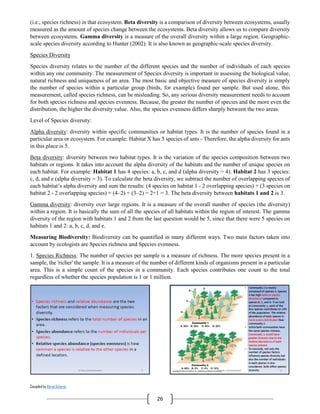
  • 72.
    Compiled by AbiralAcharya 71 • Partly or completely damage the existing vegetation and initiate the new process of stand development • Lowland riparian forests may be subjected to flooding which involves deposition of sediments and water logging creating hypoxic or anoxic condition to root. • Some species are adapted to flooding (e.g. Acacia catechu), while others are killed if flooding is prolonged/of high intensity (e.g. Shorea robusta). Tree response to disturbance Commons responses to disturbances • Decline in growth efficiency and NPP • Greater investment in defense system • Increase in susceptibility to other disturbance factors • Increased mortality, reduced regeneration • High litter production and nutrient return to soil • Alters speed and stage of stand development Response to biotic disturbances • Synthesis of defense chemicals to repel biotic agents and to make tissue less palatable (e.g. synthesis of secondary metabolites such as alkaloides, cyanogenic glycosides, phytoalexins) • Increased mobilization of reserved carbohydrates Response to abiotic disturbances • Development of reaction wood in stem and branches in response to mechanical stresses from wind, snowfall, etc. • Development of aerenchyma tissue and hypertrophied lenticels in stem and roots in response to flooding • Closure of stomata (and hence decline in photosynthesis) in response to increase in concentration of SO2, O3, etc. • Forest ecosystem response to pollutants 8.3 Application to management  Insect herbivory: Insect herbivory is low in forests with high tree diversity; composition of tree species is more important than species richness. Therefore, monodominant stands are more likely to be affected by insect herbivory than the diverse stands. More complex forests have inherently high tolerance to insect herbivory. A probable case of defoliation of Sal in Gorkha by red ant.  Pathogen: Commencement of thinning early in the stand development may increase resistance to pathogens; low density and mixed plantation reduces the mortality due to pathogen.  Animal herbivory: A proper combination of palatable and non-palatable plant species is needed to ensure sustainable forestry. Exceptionally high proportion of palatable species may increase population of certain herbivore to the level that it becomes damaging to biodiversity and long term productivity.  Management option to delay N saturation: fast growing trees harvested in short rotation; slash and burn; and grinding of large woody debris and mixing into the soil which immobilize N and made available the cat ions.  Wind: Thinning should be restricted to allow sufficient time for plant to add wood to their lower boles and roots; forest edge should be managed in such a way that wind sweeps up over the canopy and does not penetrate into the stand.
  • 73.
    Compiled by AbiralAcharya 72 UNIT: 9 APPLICATION OF SIMULATION MODELS IN FOREST ECOLOGY (6) 9.1 Population Dynamics; Effects of Density independent and density Dependent Factors Population dynamics: Population is the total number of the collective group or the species living within the particular area with the various characteristics. It is dynamic and changes with the time. Ecology is the wide subject that deals with the population and the surrounding. Similarly, the population ecology is the branch of the ecology that deals with the variation in the population size and structure and also the population dynamics. It is also known as the population biology. Population size and growth are limited by many factors. Some are density-dependent, while others are density- independent.  Density-dependent limiting factors cause a population's per capita growth rate to change—typically, to drop—with increasing population density. One example is competition for limited food among members of a population.  Density-independent factors affect per capita growth rate independent of population density. Examples include natural disasters like forest fires. Limiting factors of different kinds can interact in complex ways to produce various patterns of population growth. Some populations show cyclical oscillations, in which population size changes predictably in a cycle. A. Density-dependent limiting factors Imagine a population of organisms—let's say, deer— with access to a fixed, constant amount of food. When the population is small, the available amount of food will be plenty for everyone. But, when the population gets large enough, the available food becomes limited and may no longer be sufficient, leading to competition among the deer. Because of the competition, some deer may die of starvation or fail to have offspring, decreasing the per capita—per individual—growth rate and causing population size to decline. Density-dependent limiting factors tend to be biotic—as opposed to physical features of the environment. Some common examples of density-dependent limiting factors include: Competition within the population- When a population reaches a high density, there are more individuals trying to use the same quantity of resources. This can lead to competition for food, water, shelter, mates, light, and other resources needed for survival and reproduction. Predation- Higher-density populations may attract predators who wouldn’t bother with a sparser population. When these predators eat individuals from the population, they decrease its numbers but may increase their own. Disease and parasites- Disease is more likely to break out and result in deaths when more individuals are living together in the same place. Parasites are also more likely to spread under these conditions. Waste accumulation- High population densities can lead to the accumulation of harmful waste products that kill individuals or impair reproduction, reducing the population’s growth.
  • 74.
    Compiled by AbiralAcharya 73 Density-dependent regulation can also take the form of behavioural or physiological changes in the organisms that make up the population. For example, rodents called lemmings respond to high population density by emigrating in groups in search of a new, less crowded place to live. This process has been misinterpreted as a mass suicide of sorts in popular culture because the lemmings sometimes die while trying to cross bodies of water. B. Density-independent limiting factors The second group of limiting factors consists of density-independent limiting factors that affect per capita growth rate independent of how dense the population is. As an example, let's consider a wildfire that breaks out in a forest where deer live. The fire will kill any unlucky deer that are present, regardless of population size. An individual deer's chance of dying doesn't depend at all on how many other deer are around. Density-independent limiting factors often take the form of natural disasters, severe weather, and pollution and so on. Unlike density-dependent limiting factors, density-independent limiting factors alone can’t keep a population at constant levels. That’s because their strength doesn’t depend on the size of the population, so they don’t make a "correction" when the population size gets too large. Instead, they may lead to erratic, abrupt shifts in population size. Small populations may be at risk of getting wiped out by sporadic, density-independent events. Population fluctuations In the real world, many density-dependent and density-independent limiting factors can usually do—interact to produce the patterns of change. For example, a population may be kept near carrying capacity by density- dependent factors for a period then experience an abrupt drop in numbers due to a density-independent event, such as a storm or fire. However, even in the absence of catastrophes, populations are not always stable at carrying capacity. In fact, populations can fluctuate, or vary, in density in many different patterns. Some undergo irregular spikes and crashes in numbers. 9.2 Effects of age specific natality and mortality Population Dynamics is concerned with changes in the density or numbers of organisms and the processes that cause these changes. The study of population dynamics focuses on these changes: how, when, and why they occur. Change in Population Density = (Births + Immigration) - (Deaths + Emigration) Populations vary widely in the relative numbers of young and old and thus they show different natality and mortality. Usually three age groups are recognized in a population, viz pre-reproductive, reproductive and post reproductive Natality and mortality rate changes with age. a. Natality Number of new individual born, hatched or otherwise produced per unit time. It is expressed as number of live births per female over a given period of time, usually one year. When food is abundant and growing conditions are favorable, a population has the potential to increase in number from generation to generation. Fertility vs. Fecundity: Fertility is the natural capacity to produce offspring, whereas fecundity is the potential capacity for reproduction. A lack of fertility is infertility while a lack of fecundity would be called sterility. Fecundity is under both genetic and environmental control, and is the major measure of fitness. Fecundity is important and well-studied in the field of population ecology. Fecundity can increase or decrease in a population according to current conditions and certain regulating factors. For instance, in times of hardship for a population, such as a lack of food, juvenile and eventually adult fecundity has been shown to decrease (i.e. due to a lack of resources the juvenile individuals are unable to reproduce, eventually the adults will run out of resources and reproduction will cease). Natality is influenced by:
  • 75.
    Compiled by AbiralAcharya 74 i. Clutch size and litter produced: Number of young produced by female. This influences the population of the animal • Elephant litter size: 1 • Wild boar( average litter size): 4-6 ii. Length of breeding season or number of breeding cycle per year: Some animals like meadow vow have short gestation period of 21 days and they have capacity to breed immediately after giving birth while some species such as elephant has a gestation period of 2 years and produce only one young at a time. • Gangetic dolphin: 240-270 days (gestation period) • Black stork (kalo bhudiphor):30-35 days (gestation period) iii. Breeding age: Some animals breed earlier whiles for some animals it years several years to breed. A small antelope breed at an age of one year while a elephant does not breed until it is 13-14 years. Hence, the populations of antelope increases rapidly while the population of elephant increase very slowly. iv. Density of population: Density refers to the number of animals per unit area. In sparse population, the species find difficult to get mates and thus the natality is low. While in case of dense population also the natality is low. In dense population, there is inverse relationship between density and natality. N 1/D Ecological birth rate or natality rate of a population is expressed by B=Nn/t, where “B” is natality rate per unit of time, “Nn” number of new individuals that are added to the population by natality and “t” is the unit of time. b. Mortality The number of individuals that die per unit of time due to various physiological changes pertaining to old age. Also depends on the composition, density and size of the population. Factors affecting mortality (decimating factors) • Predation, Disease and Parasites, Poisoning, Accidents, Weather, Starvation, Stress or shock disease, Hunting • Incidence of death in a population can be expressed by a survivorship curve, where the number of survivors in a given population are plotted against time • A survivorship curve is a graph showing the number or proportion of individuals surviving at each age for a given species or group (e.g. males or females) There are three generalized types of survivorship curves: • Type I survivorship curves are characterized by high survival in early and middle life, followed by a rapid decline in survivorship in later life • Type II curves are an intermediate between Types I and III, where roughly constant mortality rate is experienced regardless • Type III curves, the greatest mortality is experienced early in life, with relatively low rates of death for those surviving this bottleneck of age.
  • 76.
    Compiled by AbiralAcharya 75 The effect of mortality on population structures is to reduce the component of the population in which the mortality occurs. Historically, the most dangerous ages were infant and old age. In addition, some epidemics of infectious diseases (e.g. Spanish 'flu) had their highest mortality among young adults, whose immune systems were presumably insufficiently primed. It is expected that the forecast bird 'flu epidemic will behave similarly. However, in human the majority of infectious diseases of early younger hood have been conquered by immunization, and improved nutrition and hygiene that have rendered childhood safer. The effect of this is to raise the population in the upper age groups substantially. Environmental fluctuation basically represents climatic and weather ups and downs (e.g. temperature, wind velocity, rain, snow, ocean currents, humidity etc. and interactions among these). Such fluctuations influences or effects variety of ecological processes and have been shown to affect terrestrial vegetation, herbivores and carnivores, marine biology and fish stocks through both direct and indirect pathways. So, environmental change has negatively affected most biological systems on our planet and is becoming of increasing concern for the well-being and survival of many species. Climate impact on individuals and populations may operate either directly through physiology (metabolic and reproductive processes) or indirectly through the ecosystem, including prey, predators, and competitors. Individuals born in a specific year may be larger or smaller than the average, depending on the climatic conditions in the year of birth. For example, severe winter delayed the height of organisms. Such cohort effects have been reported in both ungulates and cod populations. Climate has differential influences on sexes and age-classes. Survival of young and old individuals of organisms are affected by variations, more survival of prime-aged individuals, and male survival is affected more than female survival. Another example is the effect of frost formation, including plant death, or damage of sensitive parts of plants (e.g., flower buds, ovaries, and leaves). At an organism level, environmental fluctuations effects encompass not only endocrine disruptions, sex-ratio changes and decreased reproductive parameters, but also include teratogenic and genotoxic effects, immunosuppression and other immune-system impairments that can lead directly to disease or increase the risk of acquiring disease. Living organisms will strive to maintain health by recognizing and resolving abnormal situations, such as the presence of invading microorganisms or harmful peptides, abnormal cell replication and deleterious mutations. However, fast-paced environmental changes may pose additional pressure on immunocompetence and health maintenance, which may seriously impact population viability and persistence. Thus, predicting the consequences of global environmental change on biodiversity is a complex task mainly because the effects encompass multiple and complex dynamic processes that rarely have single and clear-cut actions. Rather, the effects appear to interact and can even have additive costs, and these can manifest at several levels. For instance, habitat degradation and fragmentation not only may decrease food availability and restrict the movement of animals, thus impairing nutritional status and limiting gene flow, but also may increase the opportunity for contact among humans, domestic livestock and wildlife (Deem et al. 2001), potentially enhancing disease transmission rates (Smith et al. 2009). Furthermore, pollutants can alter habitat quality, reduce nutrient availability and encourage toxic algae blooms along coastlines (Smith 2003; Havens 2008; Paul 2008), all of which can indirectly affect the survival of sensitive species. Besides, pollutants can directly impact reproductive parameters (Sonne et al. 2006, 2007), sex ratios (Reusch & Wood 2007) and immunocompetence (Selgrade 2007). Because of this very complexity, environmental change is likely to seriously impair the viability of wildlife.
  • 77.
    Compiled by AbiralAcharya 76 9.3 Effects of Fluctuating Environmental conditions Population growth rate is fundamental to understanding the relationship between populations and environmental conditions. It is determined not just by the well-documented effects of average environmental conditions, but also by more complex effects of environmental variability. This may include the well-known effects of variability on extinction risk, with fluctuations reducing populations to the critically low numbers where they become vulnerable, but in theory environmental variability can also impact the long-term growth rates of wildlife populations more directly (e.g. endangered Black-faced Spoonbills (Platalea minor); Pickett et al., 2015). 9.4 Effects of competition and frequency of Ecological disturbance Competition: It is a negative interaction that occurs among organisms whenever two or more organisms require the same limited resource. All organisms require resources to grow, reproduce, and survive. For example, animals require food (such as other organisms) and water, whereas plants require soil nutrients (for example, nitrogen), light, and water. The large tree blocks the sun for the small trees under it, therefore they don't get the sunlight they need. Organisms, however, cannot acquire a resource when other organisms consume or defend that resource. Therefore, competitors reduce each other's growth, reproduction and survival.
  • 78.
    Compiled by AbiralAcharya 77 Competition can occur between individuals of the same species, called intraspecific competition, or between different species, called interspecific competition. Intraspecific competition can regulate population dynamics (changes in population size over time). This occurs because individuals become crowded as a population grows. Since individuals within a population require the same resources, crowding causes resources to become more limited. Some individuals (typically small juveniles) eventually do not acquire enough resources and die or do not reproduce. Thus, this reduces population size and slows population growth. On the other hand, Interspecific competition can alter the sizes of many species' populations at the same time. Experiments demonstrate that when species compete for a limited resource, one species eventually drives the populations of other species to become extinct. These experiments suggest that competing species cannot coexist (they cannot live together in the same area) because the best competitor will exclude all other competing species. This is also called “Competitive Exclusion Principle”. Biologists typically recognize two types of competition: interference and exploitative competition. During interference competition, organisms interact directly by fighting for scarce resources. For example, large aphids (insects) defend feeding sites on cottonwood leaves by kicking and shoving smaller aphids from better sites. In contrast, during exploitative competition, organisms interact indirectly by consuming scarce resources. For example, plants consume nitrogen by absorbing it into their roots, making nitrogen unavailable to nearby plants. Plants that produce many roots typically reduce soil nitrogen to very low levels, eventually killing neighboring plants. Character displacement Competition can cause species to evolve differences in traits. This occurs because the individuals of a species with traits similar to competing species always experience strong interspecific competition. The studies provides information, that competing species' traits are more different when they live in the same area than when competing species live in different areas is called character displacement. Studies showed that when Geospiza fortis and G. fuliginosa were present on the same land, G. fuliginosa tends to evolve a small beak and G. fortis tends to evolve a large beak. For the two finch species (seed eating birds), beak size was displaced, beaks became smaller in one species and larger in the other species. Hence, character displacement is important because they provide evidence that competition plays a very important role in determining ecological and evolutionary patterns in nature. Ecological disturbance, an event or force, of non-biological or biological origin, that brings about mortality to organisms and changes in their spatial patterning in the ecosystems they inhabit. In other words, it is an event that results in a sustained disruption of an ecosystem’s structure and function. Disturbance plays a significant role in shaping the structure of individual populations and the character of whole ecosystems. Minor disturbances include localized wind events, droughts, floods, small wild land fires, and disease outbreaks in plant and animal populations. In contrast, major disturbances include large-scale wind events (such as tropical cyclones), volcanic eruptions, tsunamis, intense forest fires, epidemics, ocean temperature changes events or other climate phenomena, and pollution and land-use conversion caused by humans. The notion of ecological disturbance has ecological succession, an idea emphasizing the progressive changes in ecosystem structure that follow a disturbance. Characteristics of disturbance: The ecological impact of a disturbance is dependent on its intensity and frequency, on the spatial distribution (or the spatial pattern) and size of the disturbed patches, and on the scale (the spatial extent) of the disturbance. These characteristics are further influenced by the season in which the disturbance occurs, the history of the disturbed site, and the site’s topography. Sometimes disturbance may be beneficial: A disturbance may change a forest significantly. After severe wind, the forest floor is often littered with dead material. The decaying matter and abundant sunlight promote an
  • 79.
    Compiled by AbiralAcharya 78 abundance of new growth. In the case of forest fires, a portion of the nutrients previously held in plant biomass is returned quickly to the soil as biomass burns. Many plants and animals benefit from disturbance conditions. Some species are particularly suited for exploiting recently disturbed sites (E.g. Rhinos were found feeding on area where the old grasslands were burned and new grasses were present in CNP). Spatial and biological disturbances can create a mosaic of habitat patches separated by varying distances. 9.5 Effects of Foraging and Thermoregulation Foraging-Foraging means relying on food provided by nature through the gathering of plants and small animals, birds, and insects; scavenging animals killed by other predators; and hunting. The word foraging can be used interchangeably with “hunting” and “gathering”. “A lot of the wild foods that are in high demand grow in undisturbed areas and have a special connection to the soil; picking them disturbs a fragile ecosystem.” Foraging is the latest foodie trend, and the demand for wild edibles has led an increasing number of foragers into forests and parks to collect ingredients like ramps, mushrooms and blue berries without regard for their impact on the environment. Fungi play a vital role in the ecology of all natural habitats. They are nature's recyclers, as they break down organic matter from plants and animals. Many creatures feed on fungi, and they are host to some rare invertebrates that are unique to these ancient woodlands. Commercial collection or over exploitation of such important fungi (mushroom) is damaging the food chain of the forest ecosystem. Thermoregulation Many animals regulate their body temperature through behavior, such as seeking sun or shade or huddling together for warmth. Endotherms can alter metabolic heat production to maintain body temperature using both shivering and non-shivering thermogenesis. Such as birds and mammals, use metabolic heat to maintain a stable internal temperature, often one different from the environment. While in Ectotherms, like lizards and snakes, do not use metabolic heat to maintain their body temperature but take on the temperature of the environment. Vasoconstriction—shrinking—and vasodilation—expansion—of blood vessels to the skin can alter an organism's exchange of heat with the environment. A countercurrent heat exchanger is an arrangement of blood vessels in which heat flows from warmer to cooler blood, usually reducing heat loss. Some animals use body insulation and evaporative mechanisms, such as sweating and panting, in body temperature regulation. Controlling the loss and gain of heat: Animals also have body structures and physiological responses that control how much heat they exchange with the environment: • Circulatory mechanisms, such as altering blood flow patterns • Insulation, such as fur, fat, or feathers • Evaporative mechanisms, such as panting and sweating Circulatory mechanisms • The body's surface is the main site for heat exchange with the environment. • Controlling the flow of blood to the skin is an important way to control the rate of heat loss to—or gain from—the surroundings. Vasoconstriction and vasodilation • In endotherms, warm blood from the body’s core typically loses heat to the environment as it passes near the skin. • Shrinking the diameter of blood vessels that supply the skin, a process known as vasoconstriction, reduces blood flow and helps retain heat.
  • 80.
    Compiled by AbiralAcharya 79 UNIT 10: APPLICATION OF ECOLOGICAL PRINCIPLES IN NATURAL AND FOREST MANAGEMENT (4) 10.1 Wildlife management: Effects of Habitat Fragmentation on the management of Endangered Animal species • Rare and endangered (highly threatened) species • Species with large home range • Species with limited power of dispersal • Species with low reproductive potential • Species dependent on resources that are unpredictable in time or space • Ground-nesting species • Species of habitat interiors • Species exploited or persecuted by people Solutions: • Conservation managers around the world have been using a range of techniques to help increase connectivity in fragmented landscapes. • These include creating corridors, buffers and stepping stones to aid the movement of different organisms. • A corridor could be anything from a hedgerow to a restored riparian (river edge) zone, to the huge landscape-scale links with the basic idea being to create a direct link between separate patches. • Stepping stones are patches of habitat which ease movement through the landscape without necessarily creating direct links. • Buffer zones around a woodland may help to reduce the edge effect, and protect the interior of the woods from disturbance caused by activities such as agrochemical use on adjacent land.
  • 81.
    Compiled by AbiralAcharya 80 • Additional solutions include creating a matrix of other semi-natural habitat such as scrubland, which may still be favorable to some woodland fauna. • Species-specific links, such as badger tunnels and aerial runways for squirrels, are also used to help these animals to negotiate roads. 10.2 Stocking density and brush control The major options that a producer has for brush control includes chemical, fire, mowing and biological control. Biological control is the use of animals, insects, plants or pathogens to control brush. Grazing animals can be used to either promote or reduce brush and weed abundance. Goats and sheep are two common examples of livestock that will eat brush. For e.g. Sheep and more often, goats are known to forage on multiflora rose and autumn olive. The key to control is repeated heavy defoliation in spring and early summer without overgrazing the grasses and legumes. Stocking density (head/ha) refers to the number of stock per hectare on a grazing area or unit at any one time and is usually used to describe the number of stock per unit area in a high-density grazing situation. Also, sustainable Agriculture or rangeland management is a management system which reduces costs of purchased inputs, minimizes the impact on the immediate and off-farm environment/rangeland, and provides a sustained level of production and profit from farming (Francis et al., 1987). Therefore, sustainable brush management requires a minimum of purchased inputs, minimal environmental pollution, and yet achieves the objectives of brush management in a cost-effective manner. Cattle, if managed right, are the most sustainable option that we have for brush control. They require the least inputs-investment in animals, result in little pollution, control most brush species and actually turn a profit while converting brush to a saleable product. Research suggests that the grazing of sheep or goats for two seasons at a rate of eight to twelve goats/sheep per acre may be required in the early season. This stocking rate may be reduced later when pasture growth slows. A rotation system works best. Multi-species grazing can be effective at clearing and subsequent killing of brush in pastures. Goats will defoliate and debark bushes, saplings, and small trees. By standing on their hind legs, they can defoliate stems to a height of 5 feet. Spring and early summer are critical times for goat and sheep control of brush. Depending on the objective, grazing animals may be used to reduce or sustain brush in the pasture. Grazing #7 1 NRCS, Michigan TGN 231 10/10 October 2010 Subject: Grazing Management for Biological Control of Brush and Herbaceous Weeds Date: October, 2010 Biological control is the use of animals, insects, plants or pathogens to control brush. Grazing animals can be used to either promote or reduce brush and weed abundance. Goats and sheep are two examples of livestock that will eat brush. Sheep and more often, goats are known to forage on multiflora rose and autumn olive. The key to control is repeated heavy defoliation in spring and early summer without overgrazing the grasses and legumes. Research suggests that the grazing of sheep or goats for two seasons at a rate of eight to twelve goats/sheep per acre may be required in the early season. This stocking rate may be reduced later when pasture growth slows. A rotation system works best. Multi-species grazing (Table 1.) can be effective at clearing and subsequent killing of brush in pastures. Goats will defoliate and debark bushes, saplings, and small trees. By standing on their hind legs, they can defoliate stems to a height of 5 feet. Spring and early summer are critical times for goat and sheep control of brush. Depending on the objective, grazing animals may be used to reduce or sustain brush in the pasture. Table 1. Stocking rate guide for brush control. Pasture Type Brush Canopy Cows Goat or Sheep Alone Cows + Goat/Sheep Brushy Pasture 10-40% 1 9-11 1+(2 to4) Brush Eradication >40% 8-12 0.5+ (6 to 8 per acre) Sustainable Browse Management 10-40% 1 to 3 per acre 0.25 + (1 to 2 per acre) On brushy pasture, 9-11 goats could run on the same amount of land required to run a single head of cattle. The number of goats to add to an existing cattle stocking rate on brushy pasture would be 2 to 4 per existing cow. Data from NRCS Missouri.
  • 82.
    Compiled by AbiralAcharya 81 10.3 Effect of Timber Harvest on the Relative Abundance of Wildlife species Clear cut method: • Clearcutting removes all the trees in a given area, much like a wildfire, hurricane or other natural disturbance would do. • Clearcuts are an efficient way to convert unhealthy stands to healthy, productive forests because they allow forest managers to control the tree species that grow on the site through natural or artificial regeneration. • While a clearcut removes all canopy cover and is unattractive for a short period of time, it is an effective method for creating habitat for a variety of wildlife species. • Animals that eat insects, such as turkeys and quails, and those that eat annual and perennial plants, such as bears and deer, thrive in recently clearcut areas. • Many creatures also find shelter from weather and predators in the low growing grasses, bushes and briar thickets that follow this type of harvest. • In addition, clearcutting is an important forest management tool because it can be used to create edges - areas where two habitat types or two ages of the same habitat meet. • Because edges provide easy access to more than one habitat, they usually have more diverse wildlife communities than large blocks of a single habitat. Shelter wood • In a shelter wood cut, mature trees are removed in two or three harvests over a period of 10 to 15 years. • This method allows regeneration of medium to low shade-tolerant species because a "shelter" is left to protect them. • Many hardwoods, such as oak, hickory and cherry, can produce and maintain seedlings or sprouts in light shade under a partially cut stand. • However, the young trees will not grow and develop fully until the remaining overstory trees are removed. • One benefit to shelter wood harvests is that they provide cover and early successional food sources for wildlife. • However, this method of harvest is not recommended for trees with shallow root systems because the remaining trees are more susceptible to wind damage after neighboring trees are removed. • Another disadvantage to shelter wood cuts is that they require more roads to be built through the forest, and increase the risk of soil disturbance and damage to the remaining trees during harvesting. Seed tree • In a seed tree harvest, five or more scattered trees per acre are left in the harvested area to provide seeds for a new forest stand. • These trees are selected based on their growth rate, form, seeding ability, wind resistance and future marketability. • Wildlife benefit from seed tree harvests in much the same way as they do from a clearcut harvest, except that they also reap the benefits of the seed trees themselves. • If left on site indefinitely, seed trees eventually may become snags or downed logs, which are important habitat components for woodpeckers and many other species. • Seed trees are also excellent food sources and nesting sites for hawks and other birds. • One disadvantage to seed tree harvests is that the remaining trees are at increased risk of damage from wind, lightening, insect attack and logging of nearby trees. • This type harvest may also require the landowner to make future investments in thinning and competition control because of uncontrolled reseeding. Group selection • Group selection is essentially a small-scale clearcut where groups of trees in a given area are harvested over many years so that the entire stand has been cut within 40 to 50 years. • This method is used primarily on bottomland hardwood stands to harvest high-quality, top dollar logs.
  • 83.
    Compiled by AbiralAcharya 82 • The size of the group cut determines the tree species that are likely to return after the harvest. • Openings that are less than one-fourth acre favor shade-tolerant species, and larger openings favor sun- loving species. • Group selection provides ideal pockets of young vegetation for grouse, deer and songbirds. • But because it requires intensive management and frequent access to all areas of the property, it can be an expensive forest regeneration method. Single tree selection • Single-tree selection, the most intensive harvesting method, removes individual trees that are ready for harvest, of low value or in competition with other trees. • With single-tree selection, the forest continuously produces timber and constantly has new seedlings emerging to take the place of harvested trees. • Single-tree selection maintains a late succession forest that benefits many wildlife species such as squirrels and turkey. • Single-tree selection harvesting is best in small or confined areas for a variety of reasons. • One is that this harvesting method requires more roads. In addition, surrounding trees can be damaged during harvests, and frequent use of logging equipment in a given area may compact the soil. • Sun-loving trees, which are an important source of food for wildlife, do not regenerate well with single- tree selection, so forest managers must use mechanical or chemical controls to prevent shade-tolerant species from taking over the site. THAT’S IT HAI GUYS!! ENJOY HAI GUYS!!