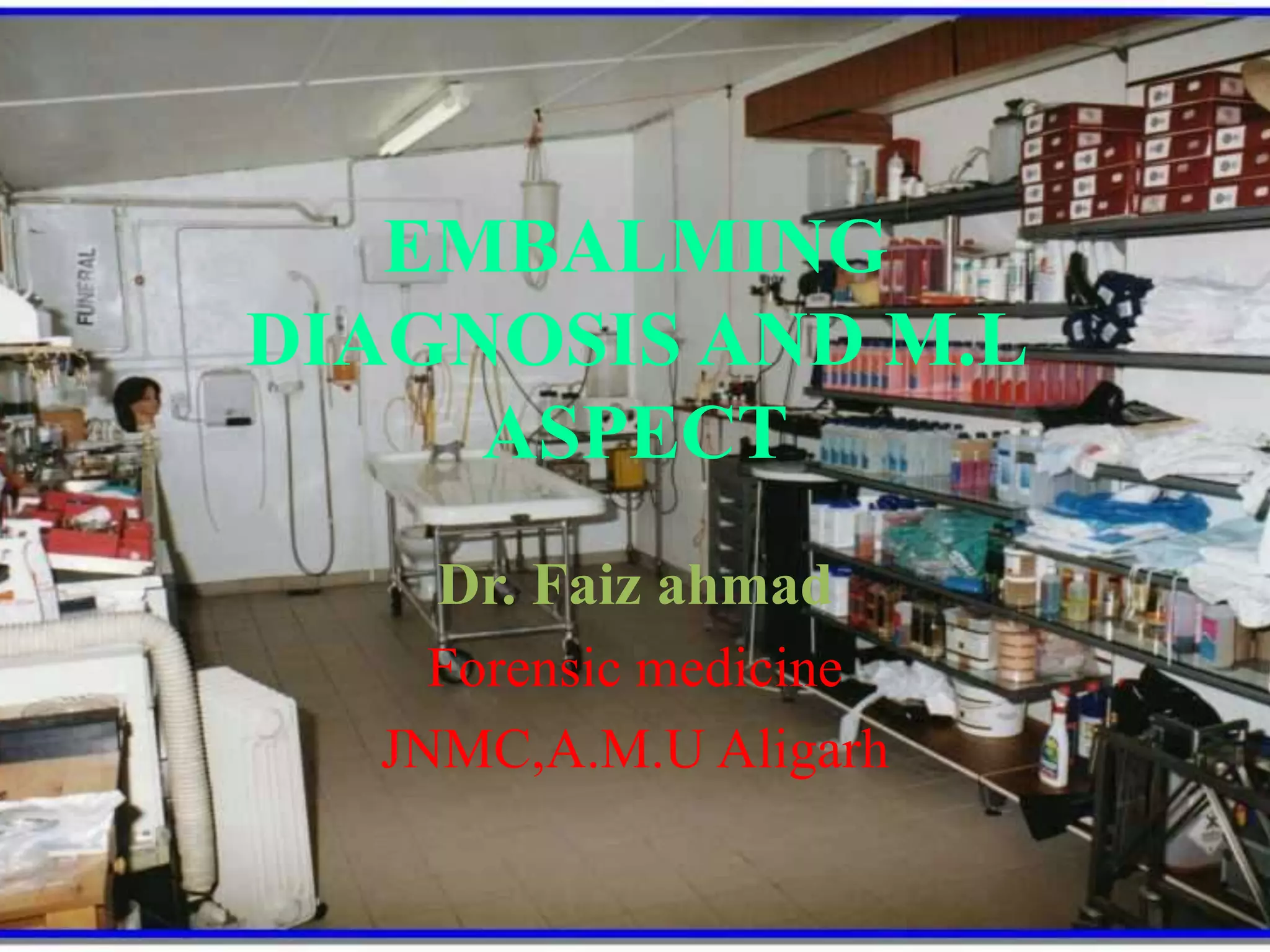
EMBALMING 
DIAGNOSIS AND M.L 
ASPECT 
Dr. Faiz ahmad 
Forensic medicine 
JNMC,A.M.U Aligarh
Preservation of Dead Body 
Artificially 
Freezing 
Embalming 
Texidermy 
Ancient egyptian 
method(mummification) 
Formalin preservation 
Paraffin impregnation 
Plastination 
Naturally 
• At very low temperature. 
• At very high temperature. 
• Shallow moist clay soiled 
grave,or submerged in water. 
• In water or soil containing 
antiseptic substance 
like,,arsenic,lime etc.
Definition: It is a process of preservation of 
dead body by treating it with antiseptic and 
preservatives to prevent putrifection. 

By this process, 
1. Protein are coagulated 
2. Tissues are fixed 
3. Organs are bleached and hardened 
4. Blood is coagulated and transformed into a pinkish brown 
mass 
EMBALMING
• Embalming produce a chemical stiffening similar to rigor mortis 
but normal rigor does not develop. 
• Rigidity in case of embalming is permanent. 
• To get desired effect- embalming to be done within 6 hrs of death. 
• If done several hrs of death,the body will show mixture of bacterial 
decomposition and mummification and will disintigrate in few 
months.
Embalming is done in: 
• Medical College to preserve dead body for the purpose of 
education and dissection. 
• When the dead body has to be taken from one country to 
other or in same state for last rituals. 
 Embalming is done by injecting embalming fluid in the 
body.
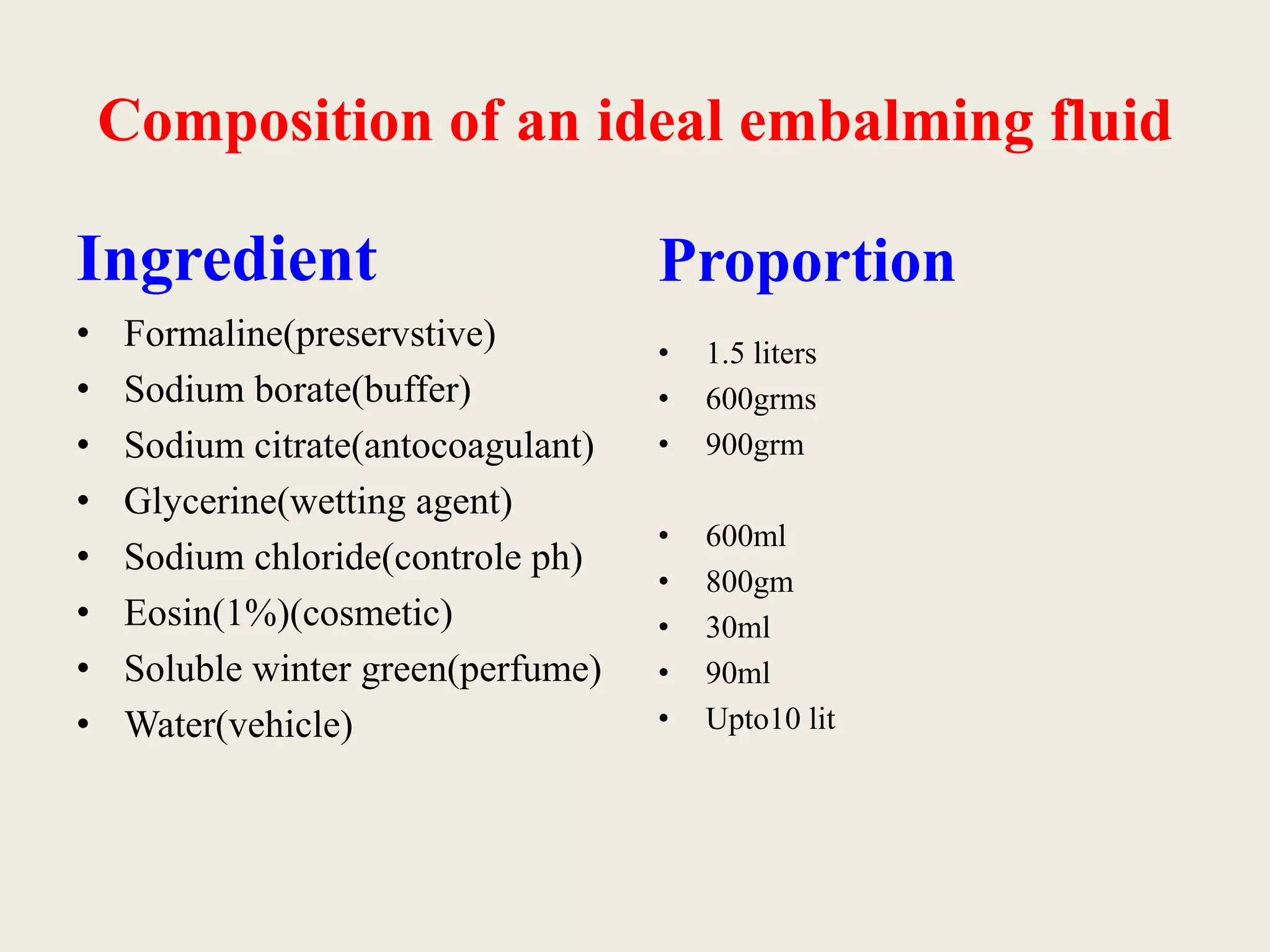
Composition of an ideal embalming fluid 
Proportion 
• 1.5 liters 
• 600grms 
• 900grm 
• 600ml 
• 800gm 
• 30ml 
• 90ml 
• Upto10 lit 
Ingredient 
• Formaline(preservstive) 
• Sodium borate(buffer) 
• Sodium citrate(antocoagulant) 
• Glycerine(wetting agent) 
• Sodium chloride(controle ph) 
• Eosin(1%)(cosmetic) 
• Soluble winter green(perfume) 
• Water(vehicle)
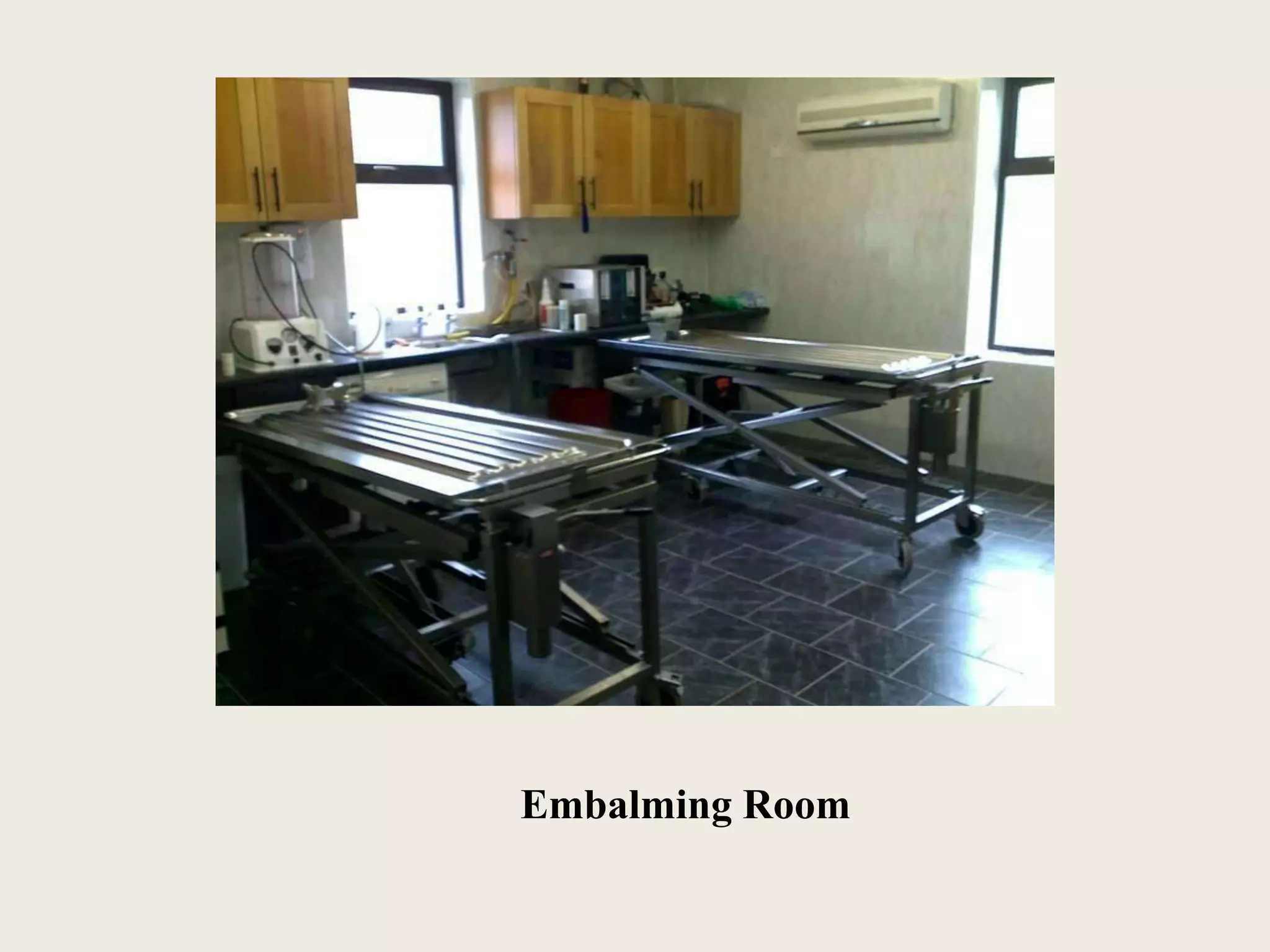
Embalming Room
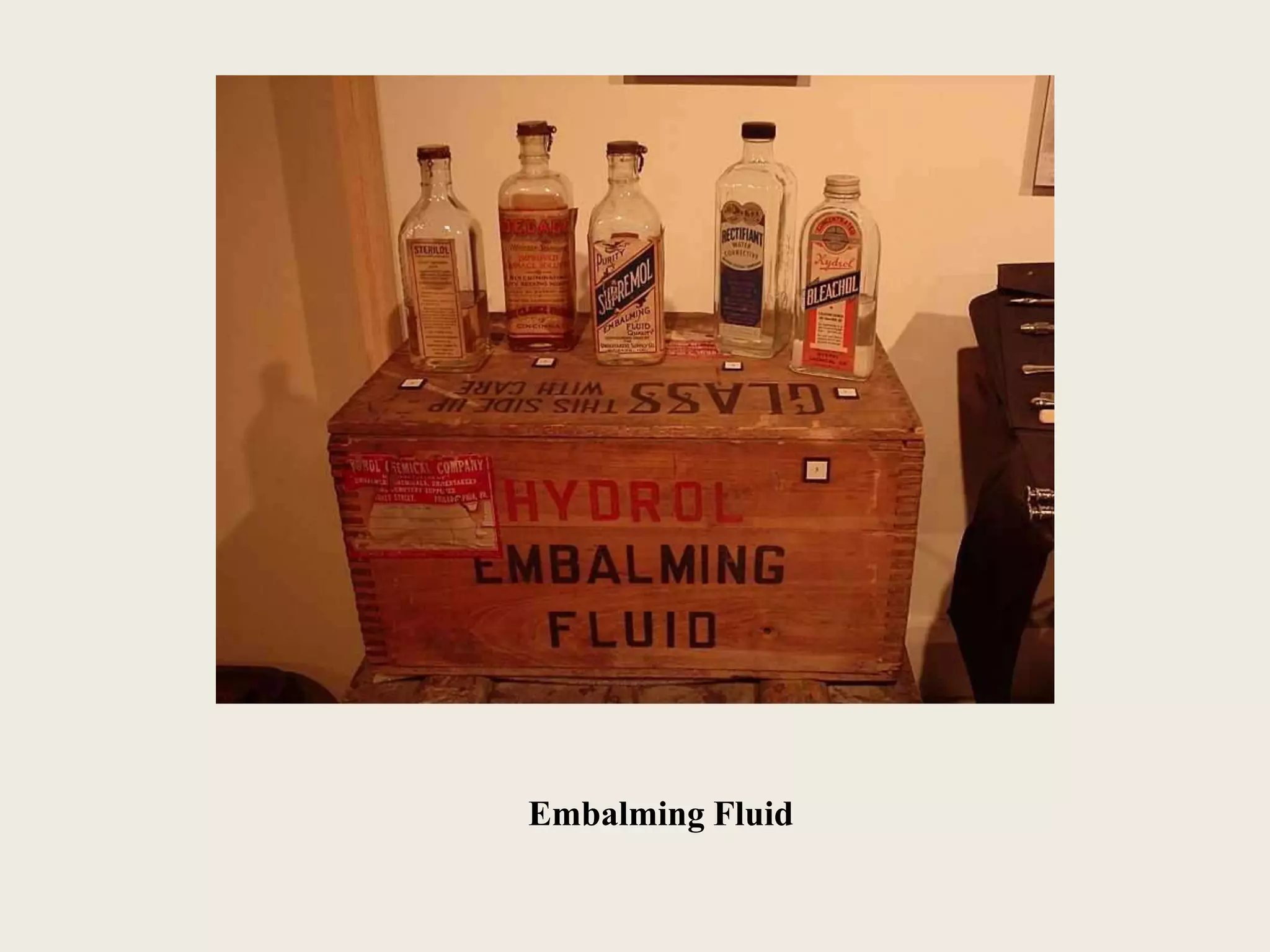
Embalming Fluid
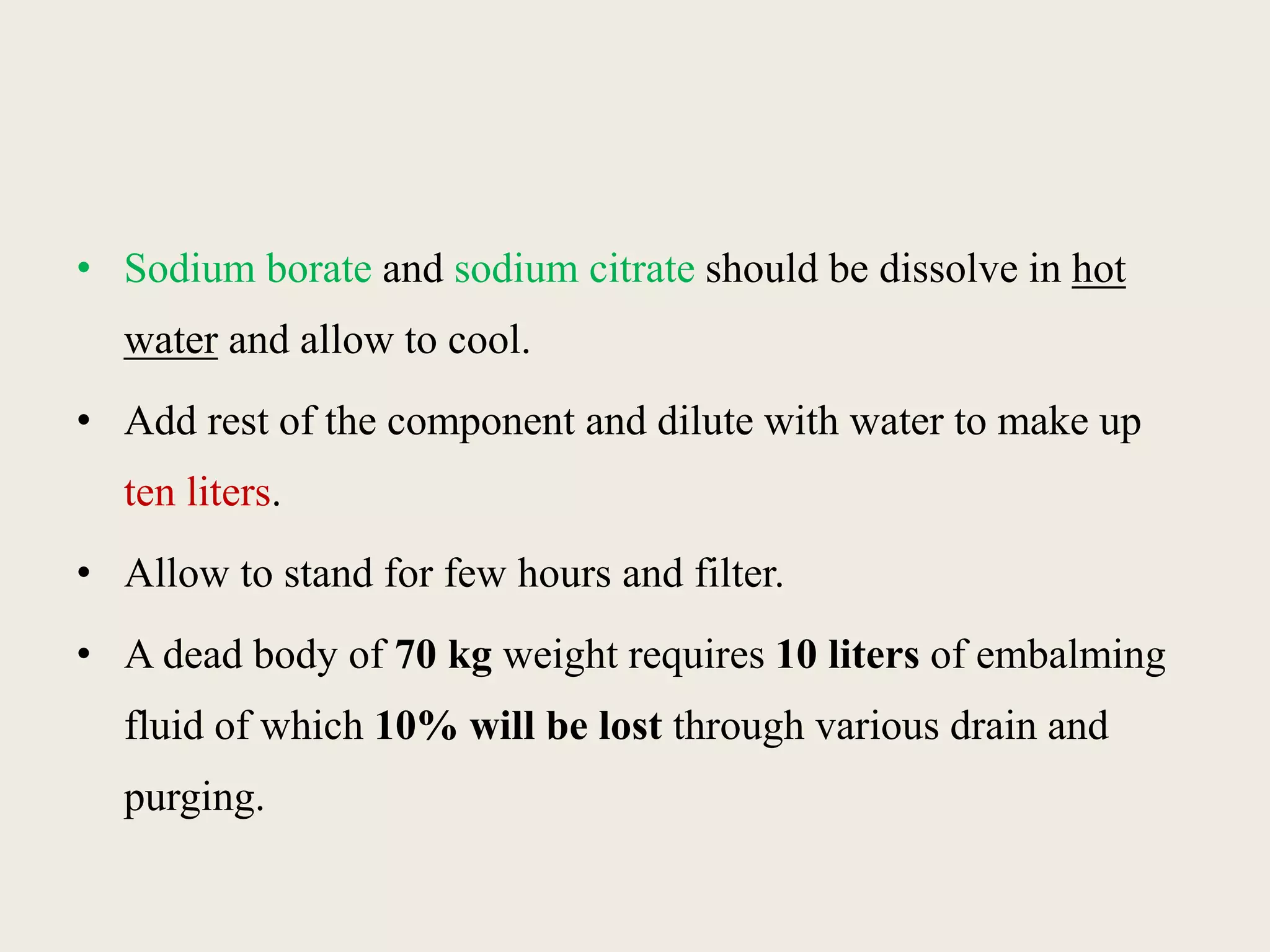
• Sodium borate and sodium citrate should be dissolve in hot 
water and allow to cool. 
• Add rest of the component and dilute with water to make up 
ten liters. 
• Allow to stand for few hours and filter. 
• A dead body of 70 kg weight requires 10 liters of embalming 
fluid of which 10% will be lost through various drain and 
purging.
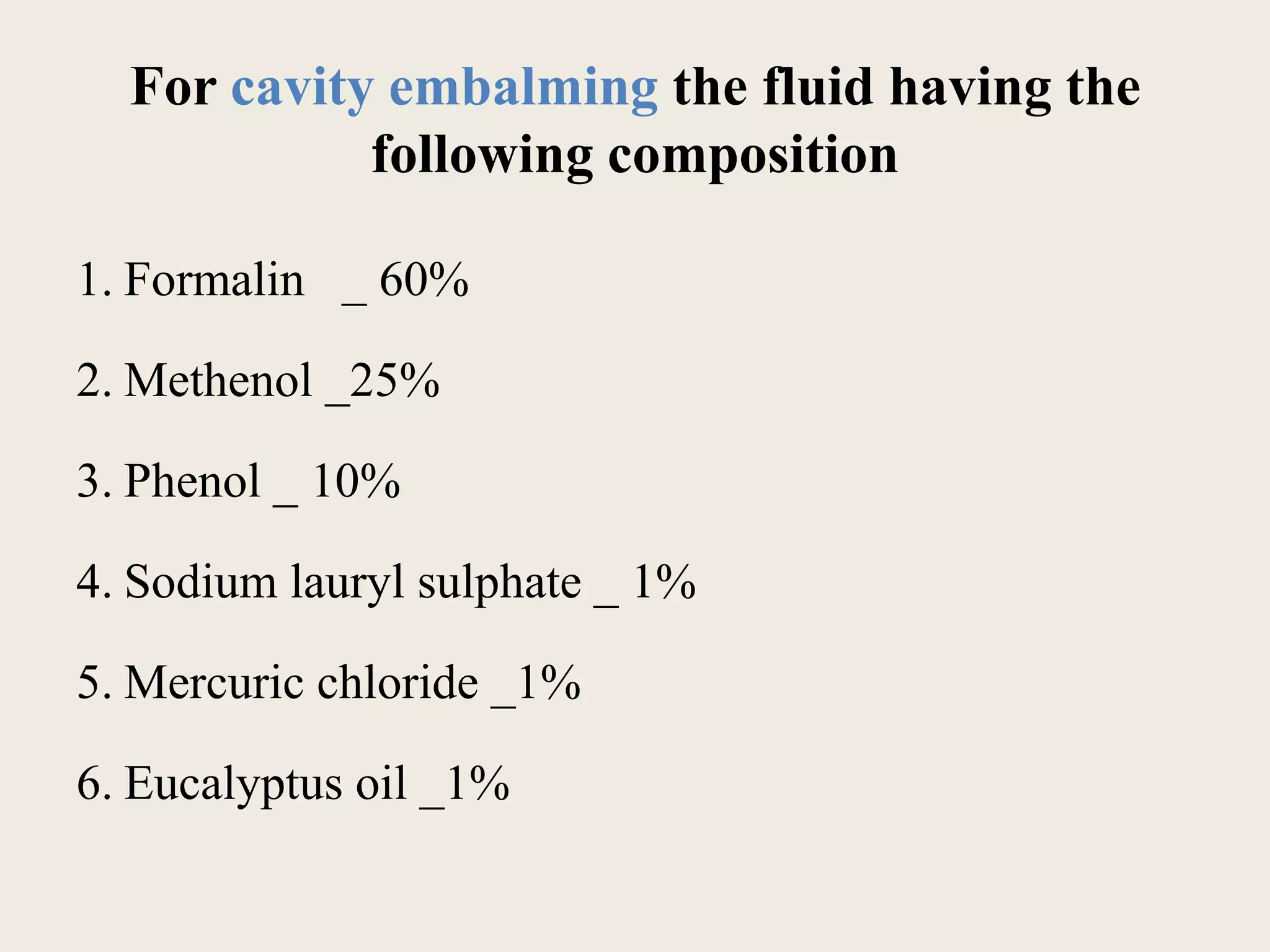
For cavity embalming the fluid having the 
following composition 
1. Formalin _ 60% 
2. Methenol _25% 
3. Phenol _ 10% 
4. Sodium lauryl sulphate _ 1% 
5. Mercuric chloride _1% 
6. Eucalyptus oil _1%
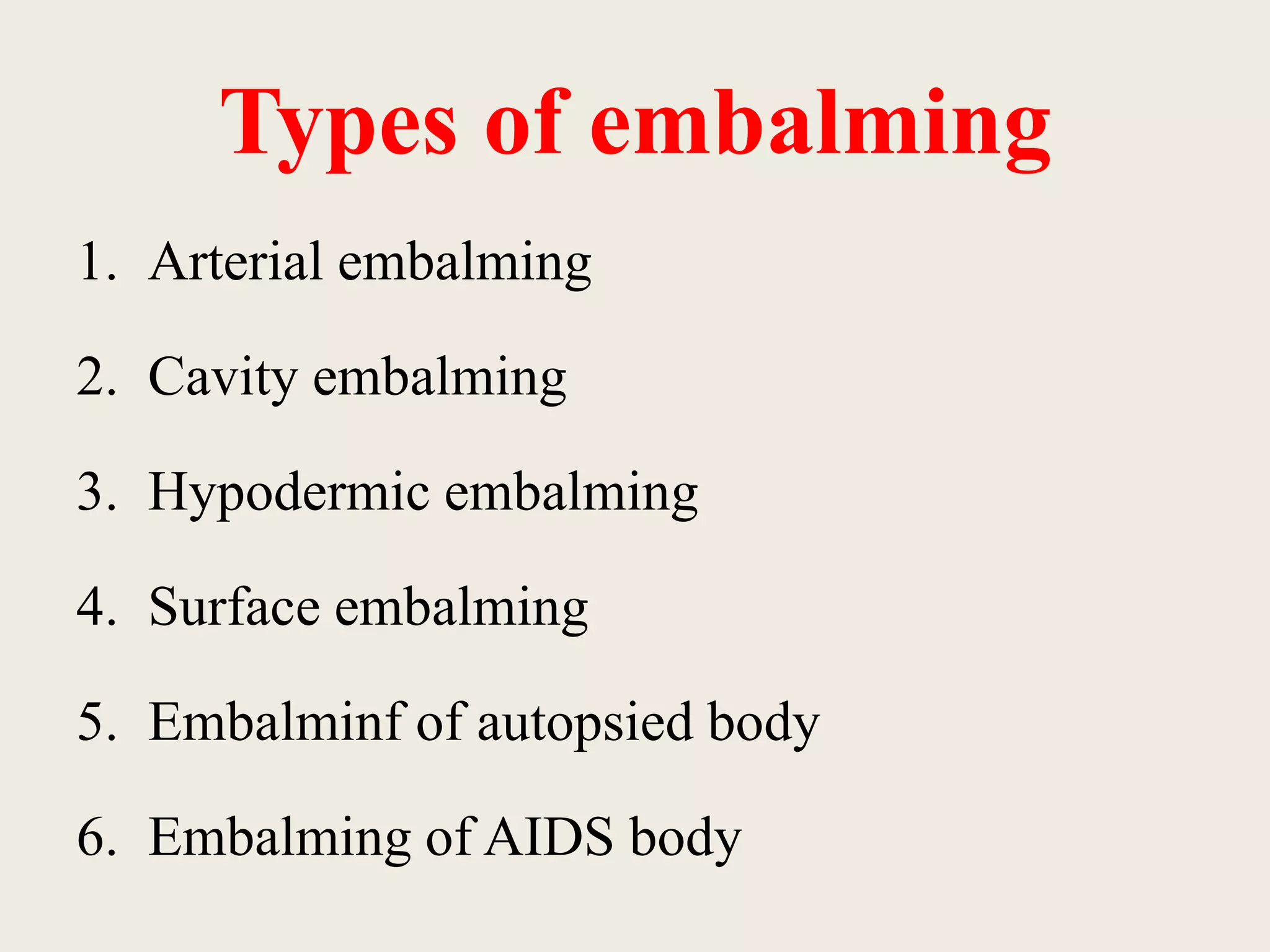
Types of embalming 
1. Arterial embalming 
2. Cavity embalming 
3. Hypodermic embalming 
4. Surface embalming 
5. Embalminf of autopsied body 
6. Embalming of AIDS body
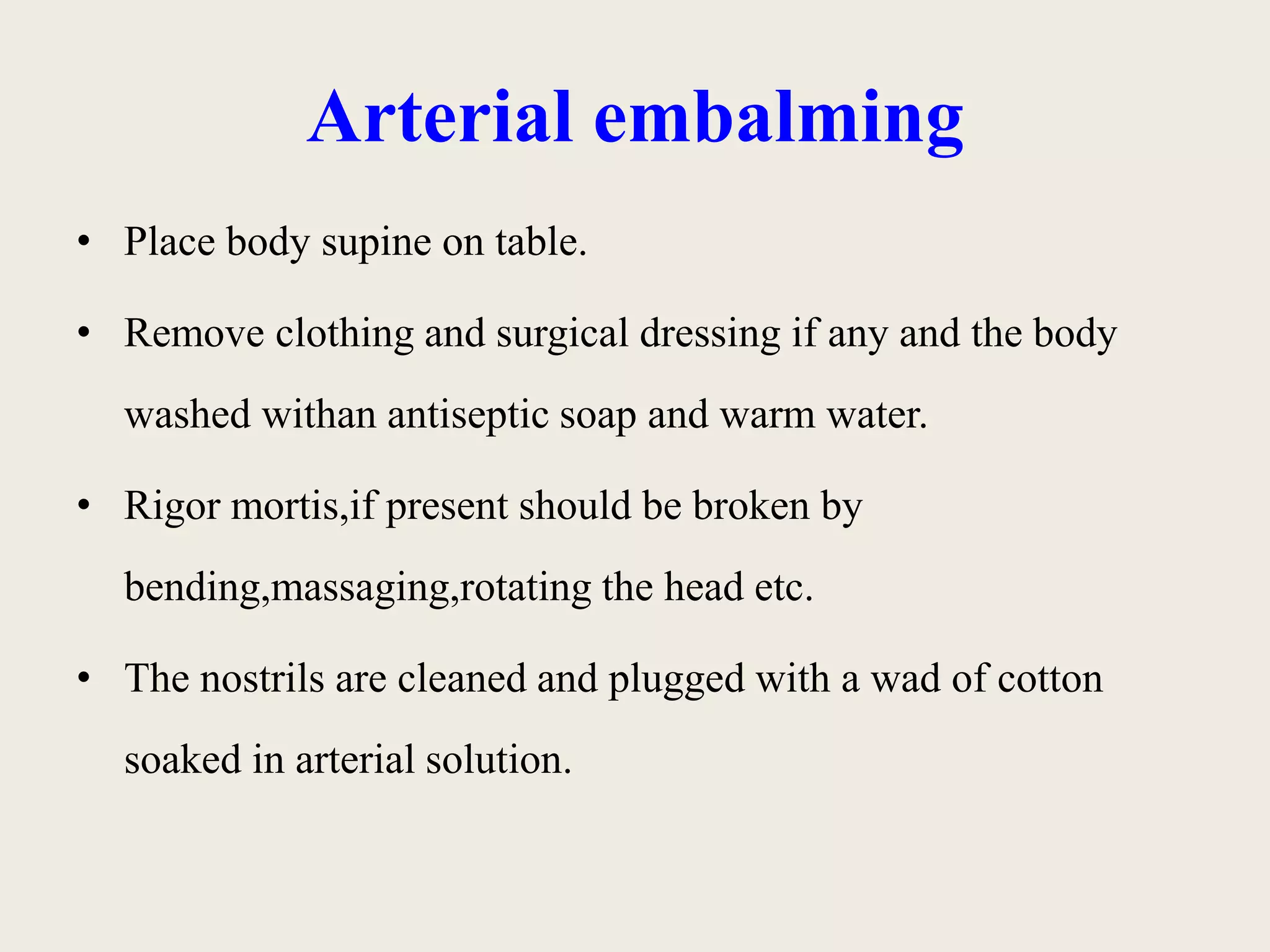
Arterial embalming 
• Place body supine on table. 
• Remove clothing and surgical dressing if any and the body 
washed withan antiseptic soap and warm water. 
• Rigor mortis,if present should be broken by 
bending,massaging,rotating the head etc. 
• The nostrils are cleaned and plugged with a wad of cotton 
soaked in arterial solution.
Arterial Embalming Conti.. 
• The cheek may be filled out with cotton soaked in arterial 
solution. 
• The mouth and eyelid shoud be closed. 
• If eyebal is sunken arterial solution should be injected into the 
orbit and eyeball. 
• The head should be elevated 8to10cm and placed on head rest 
and feet raised to facilitate drainage. 
• Anal orifice and vagina plugged similarly.
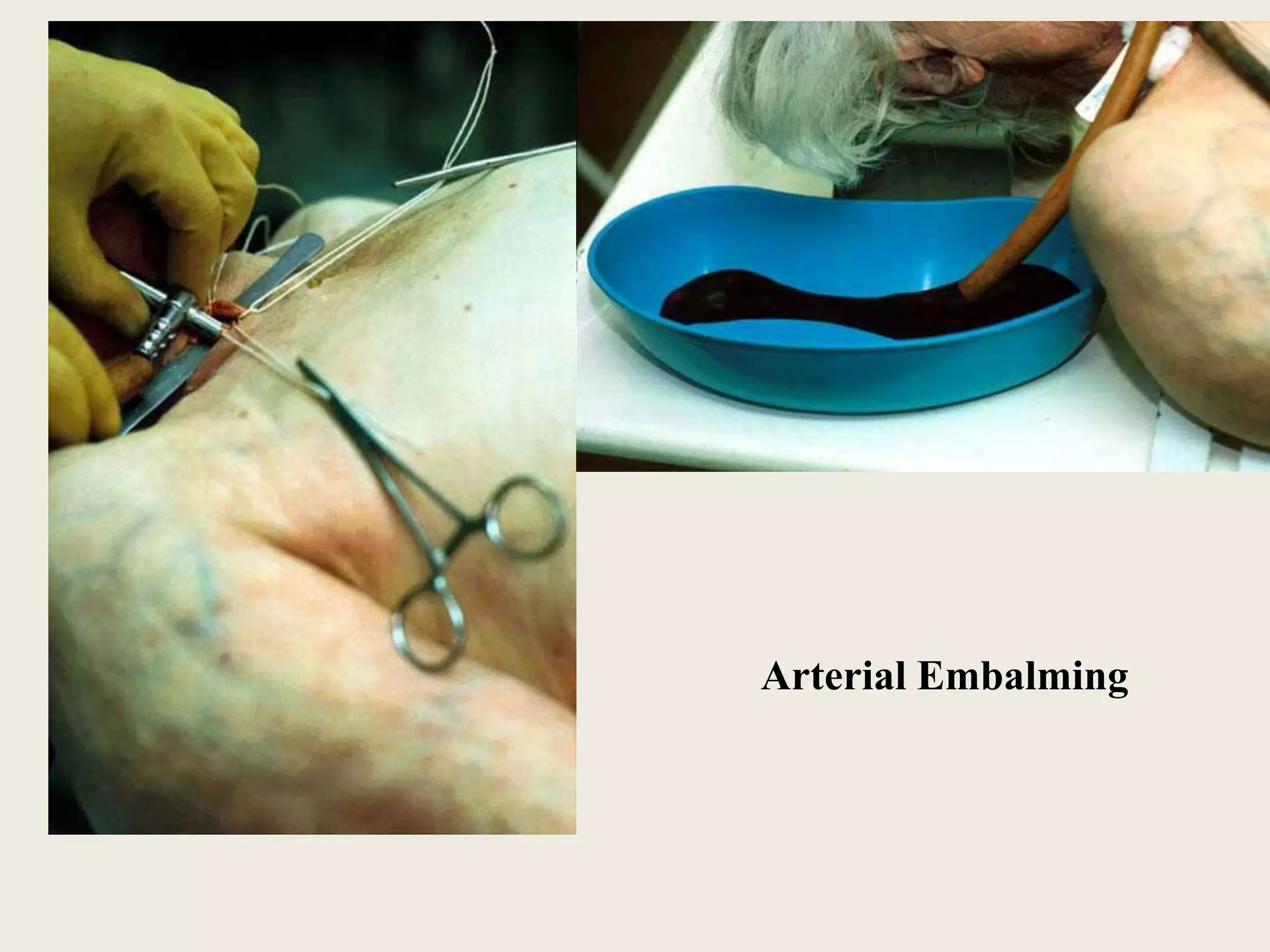
Arterial Embalming
Choice of vessels 
• The nearer the vessel to the heart ,the better the 
result specially for drainage. 
• Single point injection leave the patches of area 
unfixed by embalming fluid. 
• Multiple site injection used in,,traumatic 
death,autopsised case and postmortem mutilation.
• Six point injection involve , R/L common 
carotid A for head and neck, R/L axillary A for 
upper limb ,and R/L femoral A for lower limb. 
• On completion the vessel should be ligated to 
prevent leakage of embalming fluid.
• Each side of face injected separately to prevent 
distortion of face due to over injection 
• After injection of one artery it should be 
ligated before injecting to other artery, 
• All drainage point should be ligated after 
completion to prevent leak.
Instrument used for injecting the 
embalming fluid 
a) Hand/ foot pump 
b) Stirrup pump 
c) Bulb syringe: 
• This is a manual pump similar to Higginson's syringe. 
• Bulb type rubber syringe and rubber tubing at either end. 
• Valves,allow suction on one side and ejection on other side 
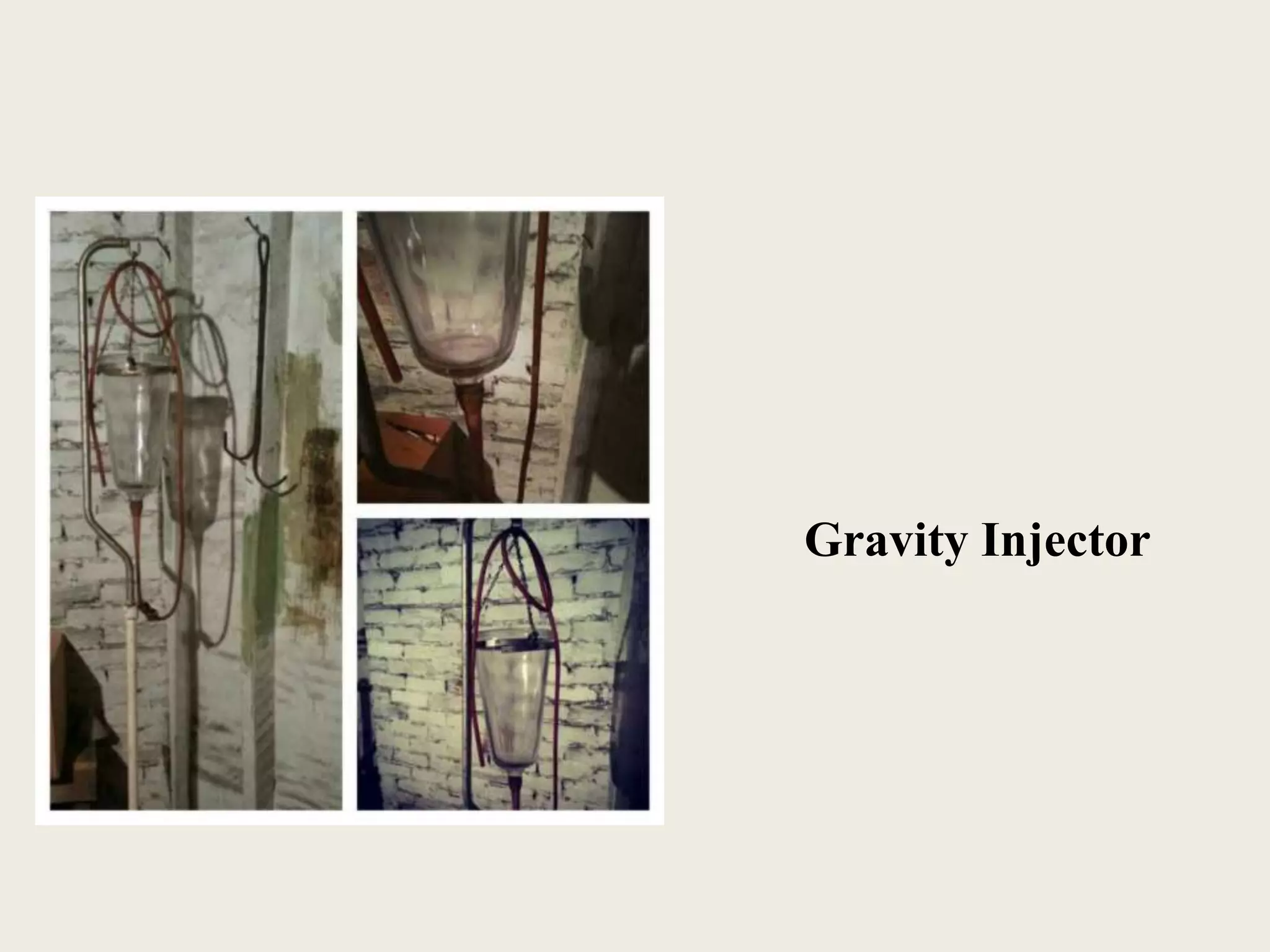
d. Gravity injector: 
• It is the simplest,safest,slowest of the injection method. 
• Gravity bottle or percolator should hold 10 lit of fluid and raised above body . 
• A rise of 1 m gives a fluid pressure of 0.6kg/sq.cm and 2m about 1kg/sq.cm 
• Take longer time and distribution of fluid is uneven.
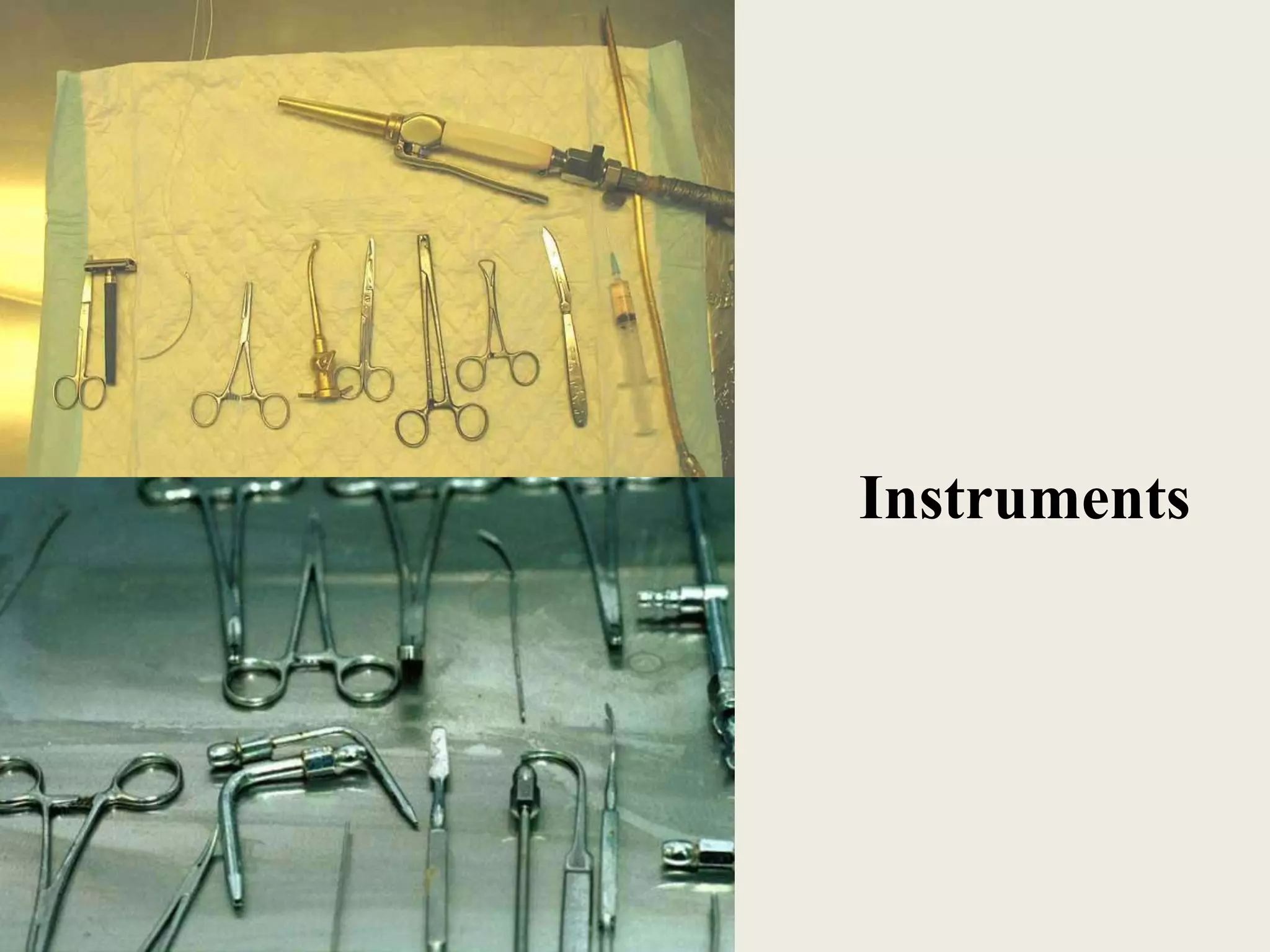
Instruments
Gravity Injector
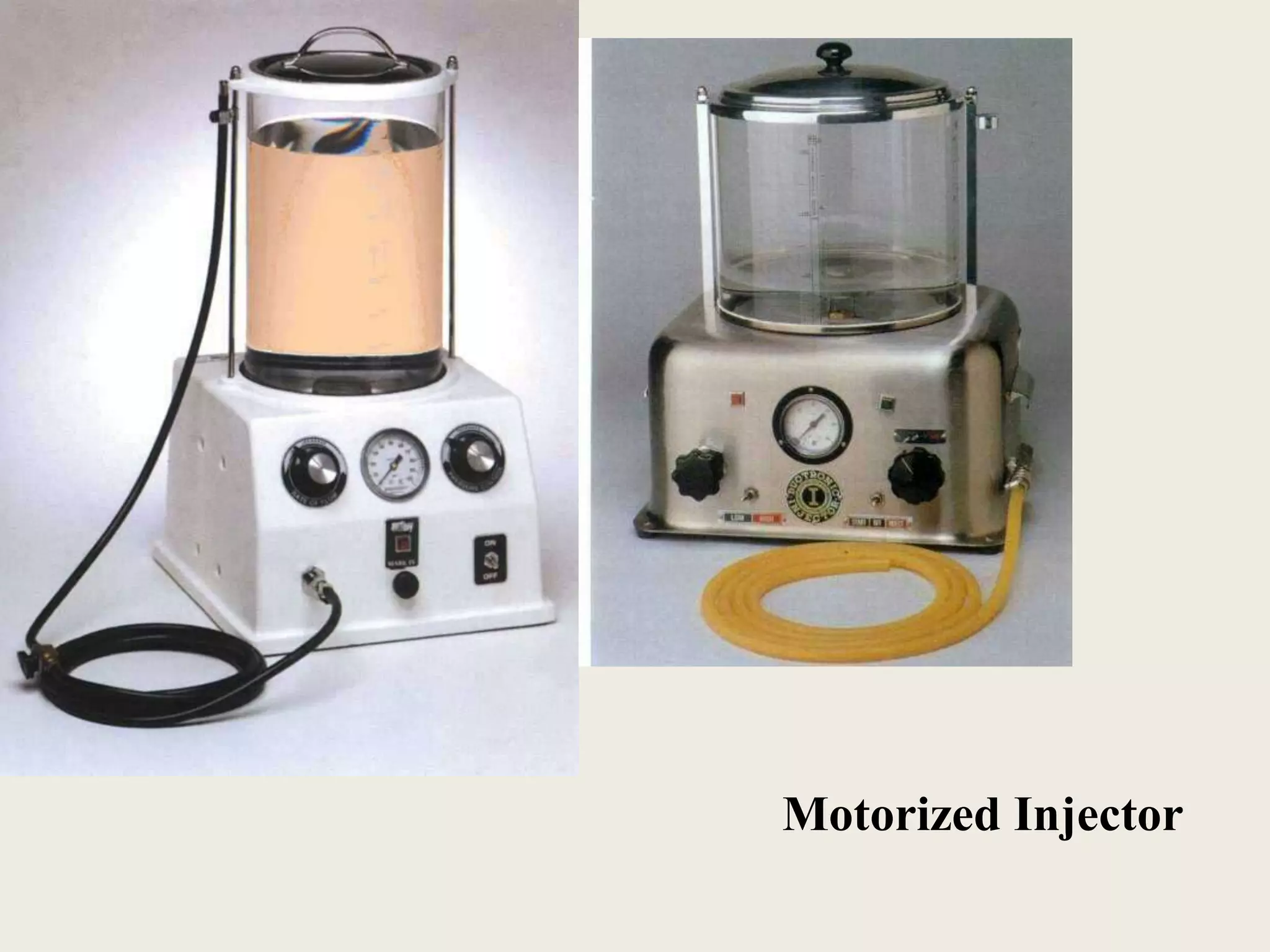
e)Motorised injectors: 
• Fluid from injection tank is forced into the vascular 
system using air from a compression tank. 
• Prassure and flow rate are controled by device 
• 10 litres of arterial solution injected within 30 min. 
• Injection prassure is about 2kg/sq.cm
Motorized Injector
Method of injection 
1.Continuous injection and drainage 
• The arterial injection is given continuously 
• Vein tube kept open throughout injection 
• Embalming time much shorter 
• Venous drainage and tissue saturation is poor 
• Least satisfactory
2. Continuous injection with disrupted drainage 
• The injection is continuous with vein tube closed. 
• The blood in the vein build up a resistance for 
arterial flow which help in better diffusion of fluid. 
• Thick blood is discharged when drain tube is 
opened. 
• Bettrer than continuous discharge and drainage.
3.Alternate injection and drainage 
• The arterial fluid is injected for some time with drain tube 
closed. 
• The injection is stopped when superficial veins swell, and 
drain is opened. 
• When the flow of blood from the drain tube stop, it is 
closed and injection started. 
• This process repeated several time.
4. Discontinuous injection and drainage: 
• This consist of repeated arterial injection of small quantities at 
two hrs interval. 
• The total quantiti of injection fluid is in exces of ordinary 
injection done at a time. 
• Injection is continued for three or four time. 
• The venous drain tube which is closed is opened a little before 
and open a little after starting another dose of injection. 
• This is the best method.
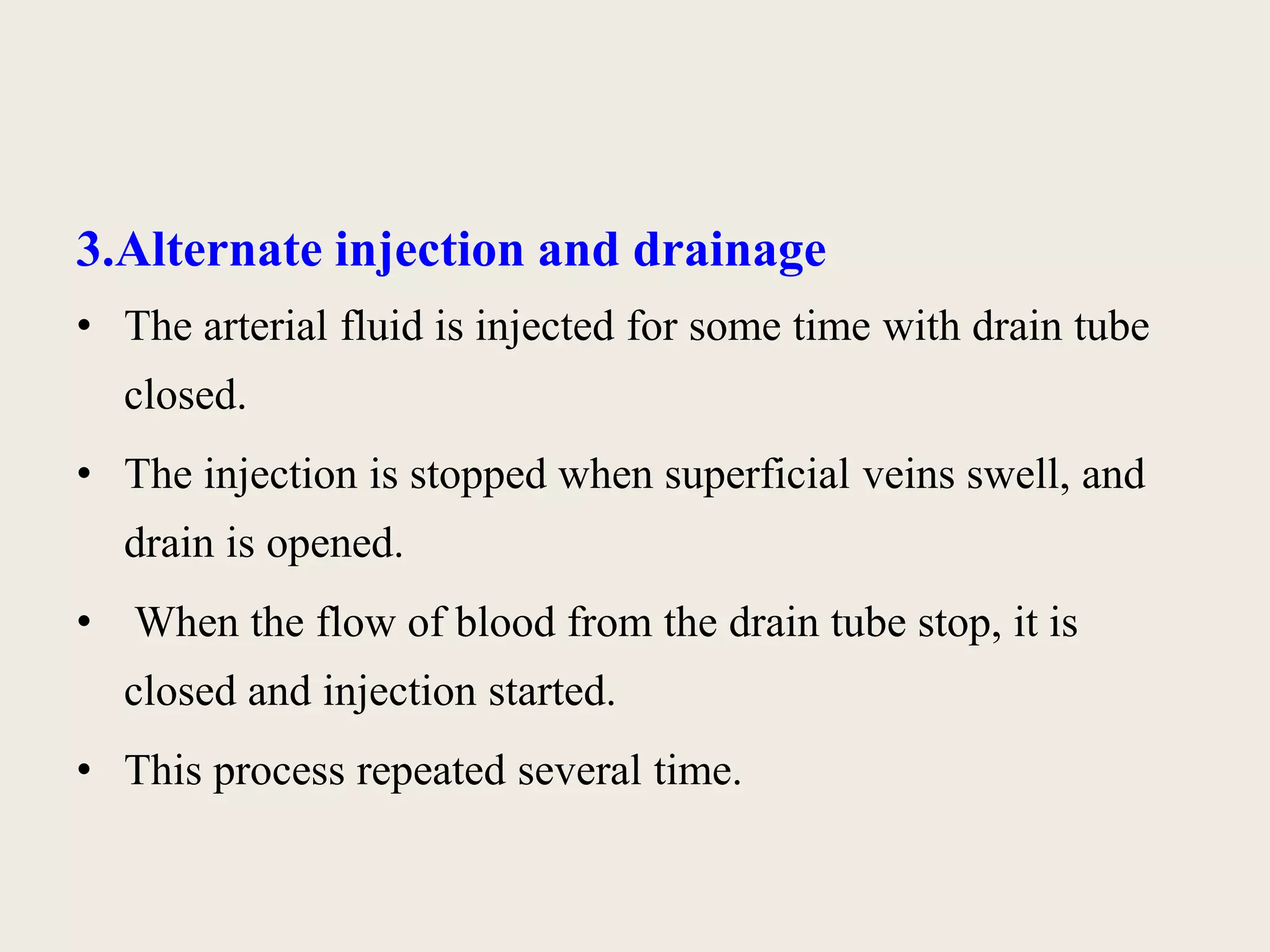
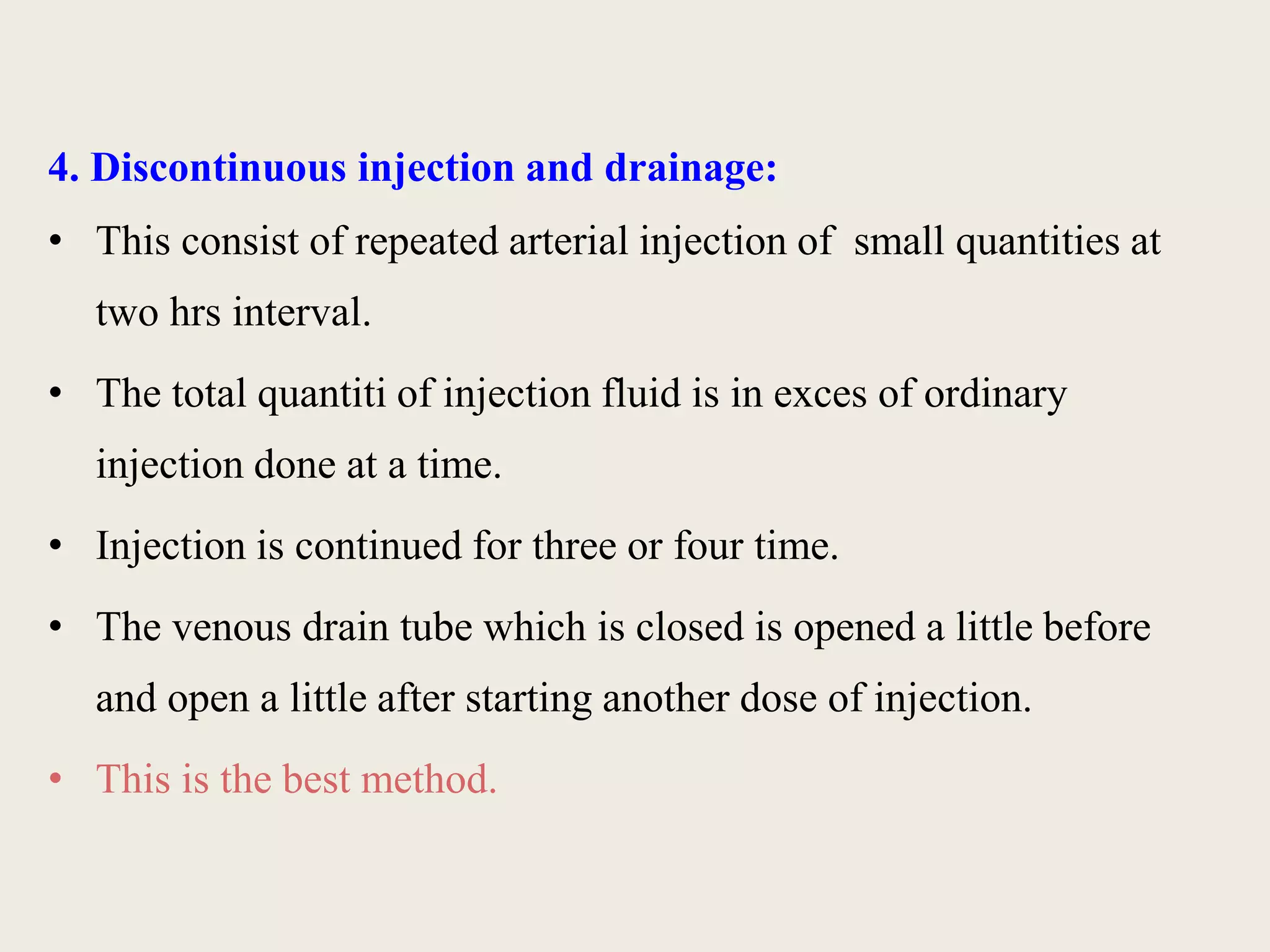
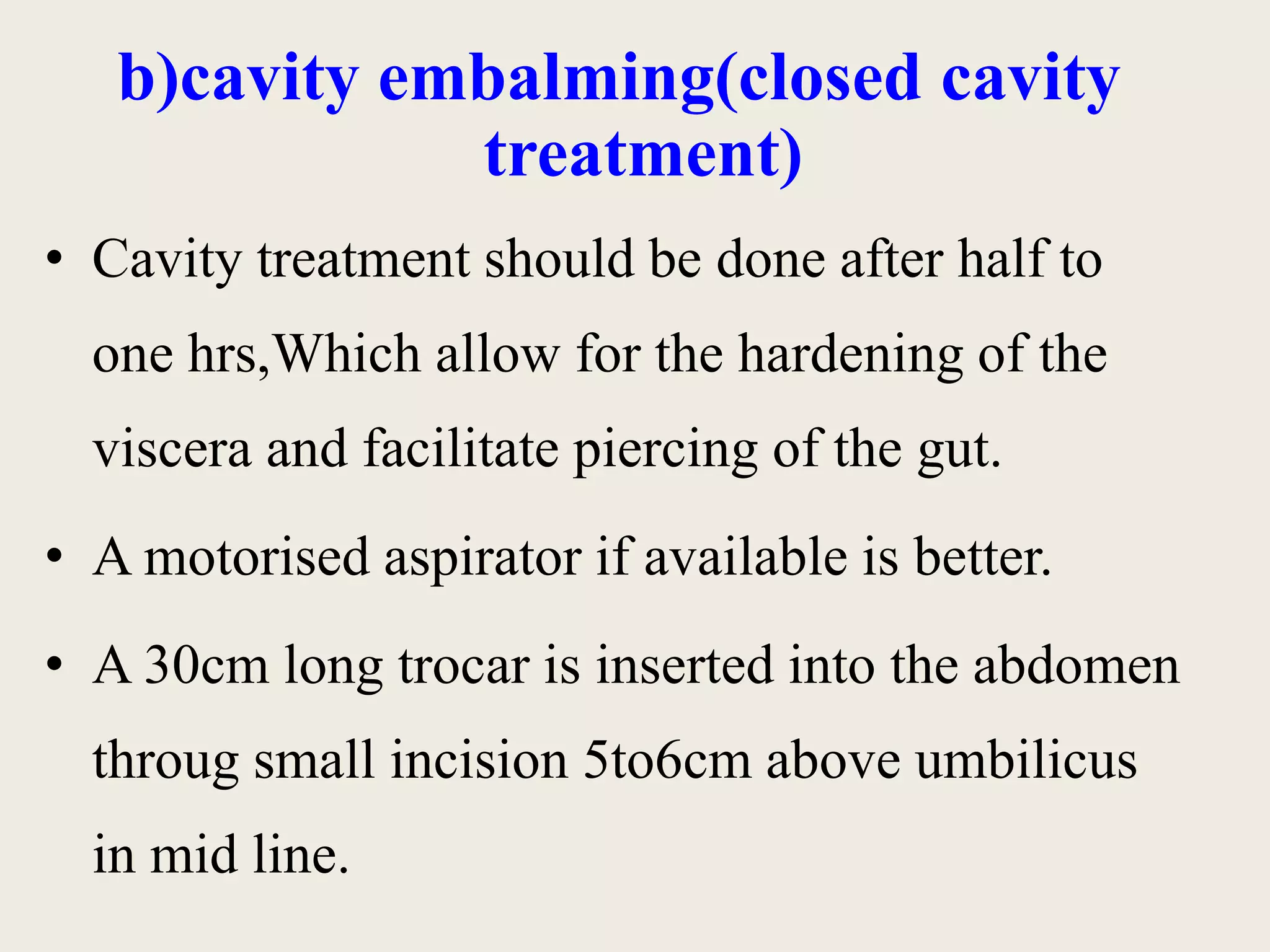
b)cavity embalming(closed cavity 
treatment) 
• Cavity treatment should be done after half to 
one hrs,Which allow for the hardening of the 
viscera and facilitate piercing of the gut. 
• A motorised aspirator if available is better. 
• A 30cm long trocar is inserted into the abdomen 
throug small incision 5to6cm above umbilicus 
in mid line.
Cavity Embalming
• The trocar is first directed upward, backward and 
to the left to pierce and aspirate the stomach. 
• Then trocar is slightly withdrawn and pushed up 
toward right to pierce right side of heart. 
• Next the right and left pleural sacs are reached 
by piercing diaphragm and aspirated.
• Next several puncture are made in small 
intestine , caecum , colon to suck out content. 
• The urinary bladder, sigmoid colon and rectum 
should be aspirated. 
• One liter of cavity fluid should be injected 
distributing it evenly throughout the cavity.
c)Hypodermic embalming 
• Suitable for embalming isolated limbs,body parts 
followimg bomb blast,air crush,railway injuries 
• Embalming fluid injected subcutaneously. 
d) Surface embalming: 
• Suitable for burn injury cases. 
• Whole body is packed with cotton soaked in 
embalming fluid.
e)Embalming of autopsied body: 
• Before stitching up ,thoraco-abdominal and cranial 
cavity is sponged with embalming fluid 
• Then viscera properly treated with embalming 
fluid,covering and packing with embalming fluid 
soaked cotton 
• Placed within the body cavity and stitched up. 
• If body is already stitched up,removed and re -stitched.
f)Embalming of AIDS bodies: 
• Concentration of arterial and cavity 
embalming fluid is increased. 
• Recomended precaution to be taken during 
handling the body.
Legal aspects of practice of 
embalming 
• Proper identification of body by near relative is done 
before procedure. 
• Concent for the procedure should be obtained. 
• No objection certificate from police should be obtained. 
• Death certificate should be referred before embalming. 
• In case of foreigner, Embassy clearance should be 
obtained in addition.
• In medicolegal cases, it should be done after autopsy. 
• Death certificate/P.M report should be accompanied 
with the dead body. 
• On completion of embalming,embalmer/competent 
authority should issue certificate(for local transport 
3copies ,and for international transport 5 copies. 
• In case of embalming of dead body who suffered from 
noticeable disease(cholera,rabis,plague,tetanus 
,HepB,AIDS,TB etc)concern authority is informed.
MEDICOLEGAL ASPECTS OF 
EMBALMING 
1. Embalming should never be allowed before 
autopsy, it may induce artifact and poses 
difficultu in interpreting the finding. 
2. Embalming provides chemical stiffening similar 
to rigor mortis, so difficulty arise in estimating 
time since death. 
3. Embalming alter the appearence of body so 
interpretation of injuries become difficult.
4.Embalming destroys cyanide,alcohol,opiates, carbon 
monoxide thus toxicological analysis become useless or 
difficult. 
5.Embalming kills bacteria so bacteriologic evaluation become 
useless. 
6. Due to embalming blood group cannot be made out. 
7.Detection of thrombus or embolism are not possible. 
8.The dimentions of wounds may be modified by the embalmer 
or new wounds may be produced due to use of trocher.
THANK YOU 
THANK YOU 
THANK YOU 
THANK YOU

Embalming diagnosis and m.l aspect

  • 1.
    EMBALMING DIAGNOSIS ANDM.L ASPECT Dr. Faiz ahmad Forensic medicine JNMC,A.M.U Aligarh
  • 2.
    Preservation of DeadBody Artificially Freezing Embalming Texidermy Ancient egyptian method(mummification) Formalin preservation Paraffin impregnation Plastination Naturally • At very low temperature. • At very high temperature. • Shallow moist clay soiled grave,or submerged in water. • In water or soil containing antiseptic substance like,,arsenic,lime etc.
  • 3.
    Definition: It isa process of preservation of dead body by treating it with antiseptic and preservatives to prevent putrifection. By this process, 1. Protein are coagulated 2. Tissues are fixed 3. Organs are bleached and hardened 4. Blood is coagulated and transformed into a pinkish brown mass EMBALMING
  • 4.
    • Embalming producea chemical stiffening similar to rigor mortis but normal rigor does not develop. • Rigidity in case of embalming is permanent. • To get desired effect- embalming to be done within 6 hrs of death. • If done several hrs of death,the body will show mixture of bacterial decomposition and mummification and will disintigrate in few months.
  • 5.
    Embalming is donein: • Medical College to preserve dead body for the purpose of education and dissection. • When the dead body has to be taken from one country to other or in same state for last rituals.  Embalming is done by injecting embalming fluid in the body.
  • 6.
    Composition of anideal embalming fluid Proportion • 1.5 liters • 600grms • 900grm • 600ml • 800gm • 30ml • 90ml • Upto10 lit Ingredient • Formaline(preservstive) • Sodium borate(buffer) • Sodium citrate(antocoagulant) • Glycerine(wetting agent) • Sodium chloride(controle ph) • Eosin(1%)(cosmetic) • Soluble winter green(perfume) • Water(vehicle)
  • 7.
  • 8.
  • 9.
    • Sodium borateand sodium citrate should be dissolve in hot water and allow to cool. • Add rest of the component and dilute with water to make up ten liters. • Allow to stand for few hours and filter. • A dead body of 70 kg weight requires 10 liters of embalming fluid of which 10% will be lost through various drain and purging.
  • 10.
    For cavity embalmingthe fluid having the following composition 1. Formalin _ 60% 2. Methenol _25% 3. Phenol _ 10% 4. Sodium lauryl sulphate _ 1% 5. Mercuric chloride _1% 6. Eucalyptus oil _1%
  • 11.
    Types of embalming 1. Arterial embalming 2. Cavity embalming 3. Hypodermic embalming 4. Surface embalming 5. Embalminf of autopsied body 6. Embalming of AIDS body
  • 12.
    Arterial embalming •Place body supine on table. • Remove clothing and surgical dressing if any and the body washed withan antiseptic soap and warm water. • Rigor mortis,if present should be broken by bending,massaging,rotating the head etc. • The nostrils are cleaned and plugged with a wad of cotton soaked in arterial solution.
  • 13.
    Arterial Embalming Conti.. • The cheek may be filled out with cotton soaked in arterial solution. • The mouth and eyelid shoud be closed. • If eyebal is sunken arterial solution should be injected into the orbit and eyeball. • The head should be elevated 8to10cm and placed on head rest and feet raised to facilitate drainage. • Anal orifice and vagina plugged similarly.
  • 14.
  • 15.
    Choice of vessels • The nearer the vessel to the heart ,the better the result specially for drainage. • Single point injection leave the patches of area unfixed by embalming fluid. • Multiple site injection used in,,traumatic death,autopsised case and postmortem mutilation.
  • 16.
    • Six pointinjection involve , R/L common carotid A for head and neck, R/L axillary A for upper limb ,and R/L femoral A for lower limb. • On completion the vessel should be ligated to prevent leakage of embalming fluid.
  • 17.
    • Each sideof face injected separately to prevent distortion of face due to over injection • After injection of one artery it should be ligated before injecting to other artery, • All drainage point should be ligated after completion to prevent leak.
  • 18.
    Instrument used forinjecting the embalming fluid a) Hand/ foot pump b) Stirrup pump c) Bulb syringe: • This is a manual pump similar to Higginson's syringe. • Bulb type rubber syringe and rubber tubing at either end. • Valves,allow suction on one side and ejection on other side d. Gravity injector: • It is the simplest,safest,slowest of the injection method. • Gravity bottle or percolator should hold 10 lit of fluid and raised above body . • A rise of 1 m gives a fluid pressure of 0.6kg/sq.cm and 2m about 1kg/sq.cm • Take longer time and distribution of fluid is uneven.
  • 19.
  • 20.
  • 21.
    e)Motorised injectors: •Fluid from injection tank is forced into the vascular system using air from a compression tank. • Prassure and flow rate are controled by device • 10 litres of arterial solution injected within 30 min. • Injection prassure is about 2kg/sq.cm
  • 22.
  • 23.
    Method of injection 1.Continuous injection and drainage • The arterial injection is given continuously • Vein tube kept open throughout injection • Embalming time much shorter • Venous drainage and tissue saturation is poor • Least satisfactory
  • 24.
    2. Continuous injectionwith disrupted drainage • The injection is continuous with vein tube closed. • The blood in the vein build up a resistance for arterial flow which help in better diffusion of fluid. • Thick blood is discharged when drain tube is opened. • Bettrer than continuous discharge and drainage.
  • 25.
    3.Alternate injection anddrainage • The arterial fluid is injected for some time with drain tube closed. • The injection is stopped when superficial veins swell, and drain is opened. • When the flow of blood from the drain tube stop, it is closed and injection started. • This process repeated several time.
  • 26.
    4. Discontinuous injectionand drainage: • This consist of repeated arterial injection of small quantities at two hrs interval. • The total quantiti of injection fluid is in exces of ordinary injection done at a time. • Injection is continued for three or four time. • The venous drain tube which is closed is opened a little before and open a little after starting another dose of injection. • This is the best method.
  • 27.
    b)cavity embalming(closed cavity treatment) • Cavity treatment should be done after half to one hrs,Which allow for the hardening of the viscera and facilitate piercing of the gut. • A motorised aspirator if available is better. • A 30cm long trocar is inserted into the abdomen throug small incision 5to6cm above umbilicus in mid line.
  • 28.
  • 29.
    • The trocaris first directed upward, backward and to the left to pierce and aspirate the stomach. • Then trocar is slightly withdrawn and pushed up toward right to pierce right side of heart. • Next the right and left pleural sacs are reached by piercing diaphragm and aspirated.
  • 30.
    • Next severalpuncture are made in small intestine , caecum , colon to suck out content. • The urinary bladder, sigmoid colon and rectum should be aspirated. • One liter of cavity fluid should be injected distributing it evenly throughout the cavity.
  • 31.
    c)Hypodermic embalming •Suitable for embalming isolated limbs,body parts followimg bomb blast,air crush,railway injuries • Embalming fluid injected subcutaneously. d) Surface embalming: • Suitable for burn injury cases. • Whole body is packed with cotton soaked in embalming fluid.
  • 32.
    e)Embalming of autopsiedbody: • Before stitching up ,thoraco-abdominal and cranial cavity is sponged with embalming fluid • Then viscera properly treated with embalming fluid,covering and packing with embalming fluid soaked cotton • Placed within the body cavity and stitched up. • If body is already stitched up,removed and re -stitched.
  • 33.
    f)Embalming of AIDSbodies: • Concentration of arterial and cavity embalming fluid is increased. • Recomended precaution to be taken during handling the body.
  • 34.
    Legal aspects ofpractice of embalming • Proper identification of body by near relative is done before procedure. • Concent for the procedure should be obtained. • No objection certificate from police should be obtained. • Death certificate should be referred before embalming. • In case of foreigner, Embassy clearance should be obtained in addition.
  • 35.
    • In medicolegalcases, it should be done after autopsy. • Death certificate/P.M report should be accompanied with the dead body. • On completion of embalming,embalmer/competent authority should issue certificate(for local transport 3copies ,and for international transport 5 copies. • In case of embalming of dead body who suffered from noticeable disease(cholera,rabis,plague,tetanus ,HepB,AIDS,TB etc)concern authority is informed.
  • 36.
    MEDICOLEGAL ASPECTS OF EMBALMING 1. Embalming should never be allowed before autopsy, it may induce artifact and poses difficultu in interpreting the finding. 2. Embalming provides chemical stiffening similar to rigor mortis, so difficulty arise in estimating time since death. 3. Embalming alter the appearence of body so interpretation of injuries become difficult.
  • 37.
    4.Embalming destroys cyanide,alcohol,opiates,carbon monoxide thus toxicological analysis become useless or difficult. 5.Embalming kills bacteria so bacteriologic evaluation become useless. 6. Due to embalming blood group cannot be made out. 7.Detection of thrombus or embolism are not possible. 8.The dimentions of wounds may be modified by the embalmer or new wounds may be produced due to use of trocher.
  • 38.
    THANK YOU THANKYOU THANK YOU THANK YOU

Editor's Notes