CONTENTS.
 INTRODUCTION
 HISTORY
 CHEMICAL FLUIDS
 TYPES
 REFERENCES
Definition:-
Embalming is one of humankind’s longest practiced arts,
is a means of artificially preserving the dead human
body.
Modern embalming is defined as the study & science of
treating a dead human body to achieve antiseptic
condition, a pre mortem appearance & preservation.
Introduction:-
Esmond R Long M.D., a Medical Historian
‘Nothing gives a better perspective of the subject than an
appreciation of the steps by which it has reached its
present state’
Types of preservation
 Natural means.
 Artificial means.
Natural means of preservation
 Freezing – ice, snow, glaciers.
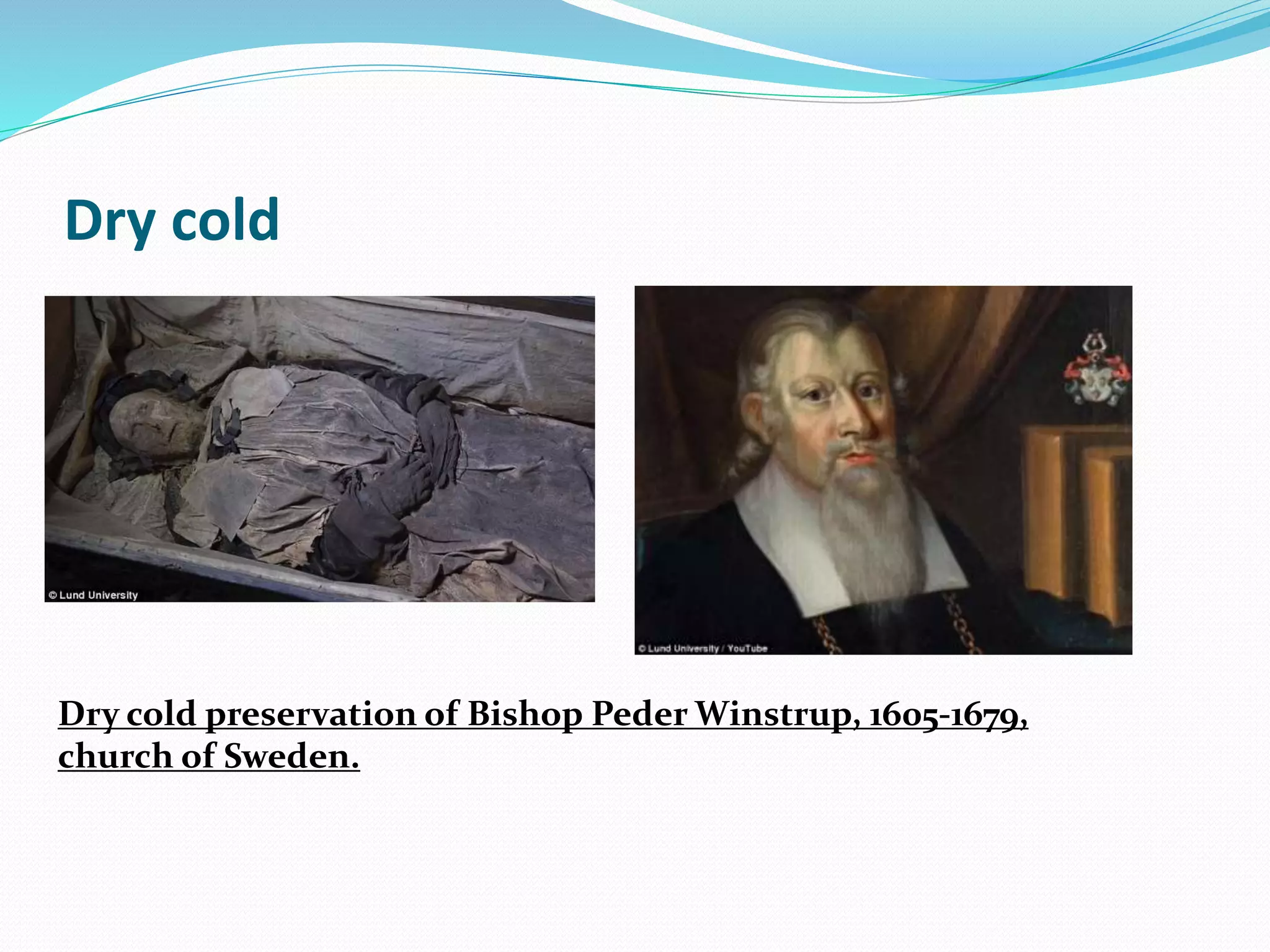
 Dry cold – cold dry air.
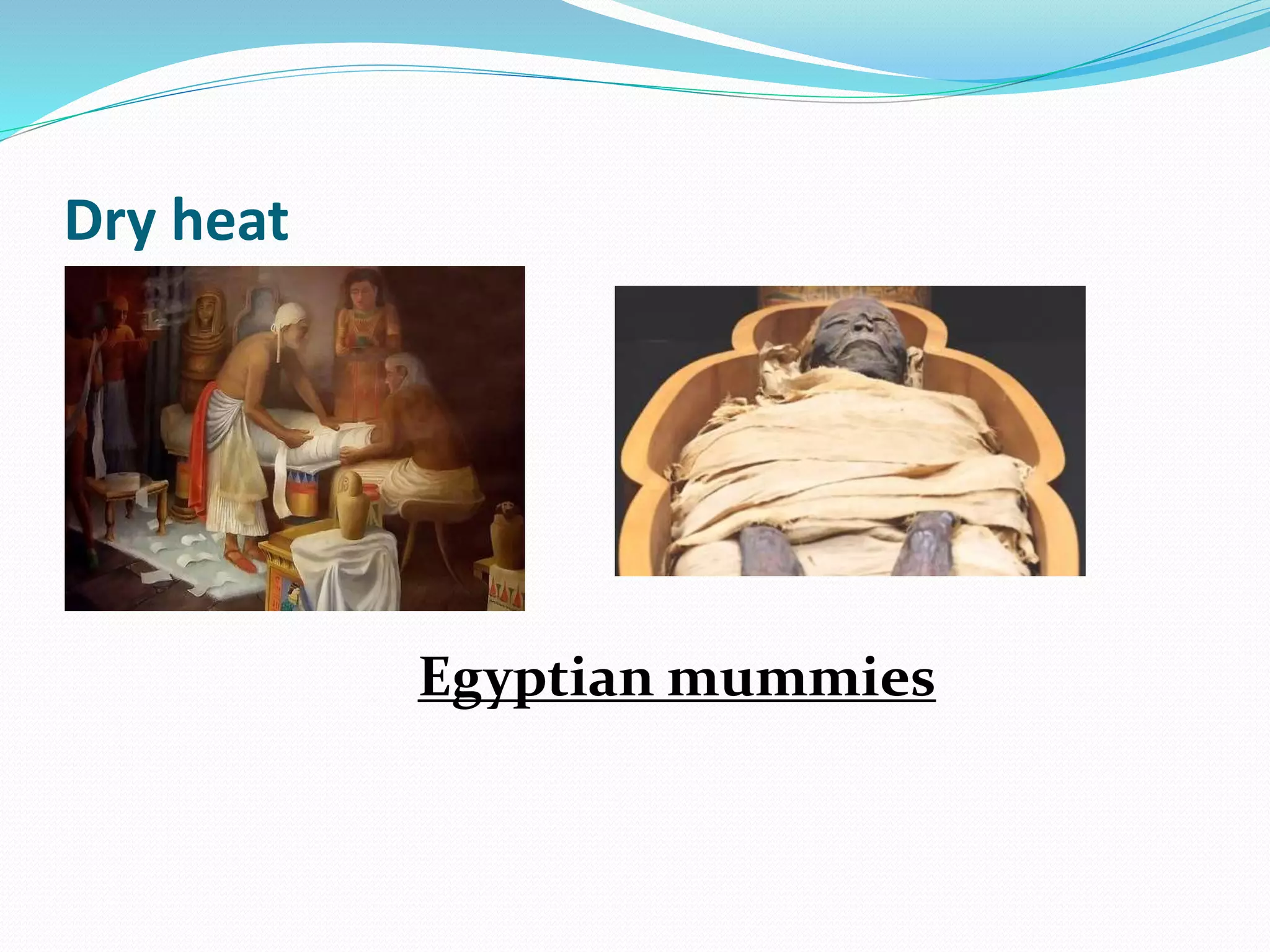
 Dry heat – dry warm air.
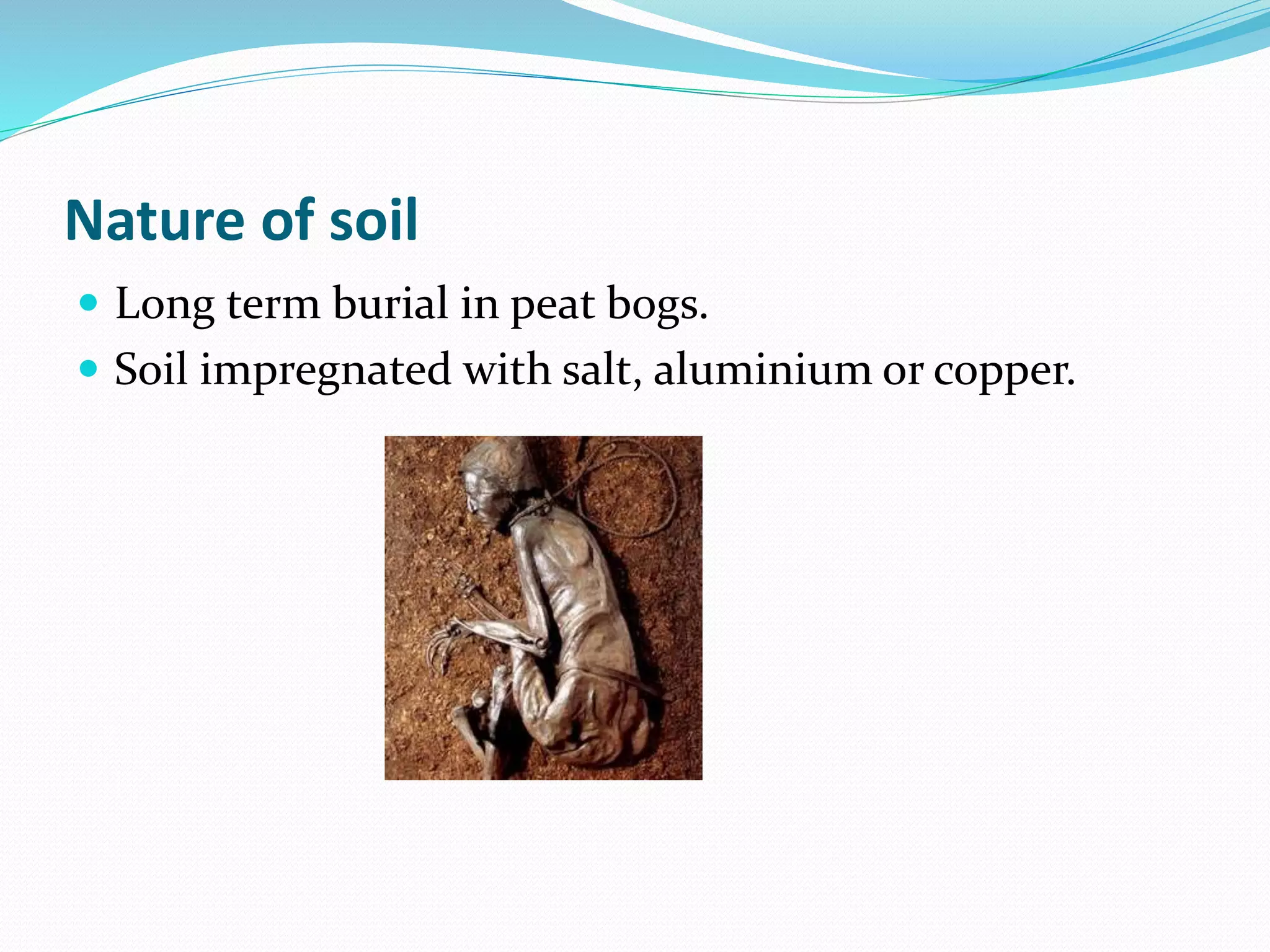
 Nature of the soil at the place of interment.
Freezing
Inca human sacrifice Snowcapping
Dry cold
Dry cold preservation of Bishop Peder Winstrup, 1605-1679,
church of Sweden.
Dry heat
Egyptian mummies
Nature of soil
 Long term burial in peat bogs.
 Soil impregnated with salt, aluminium or copper.
Artificial means of preservation
 Simple heat
 Powders
 Evisceration & immersion
 Evisceration, local incision & immersion
 Evisceration & drying
 Simple immersion
 Arterial injection
 Arterial injection & evisceration
 Cavity injection & immersion
 Arterial injection & cavity treatment
 Artificial cold
Simple heat
 Simple heat – slow drying in an oven that is heated
with mixture of slaked lime.
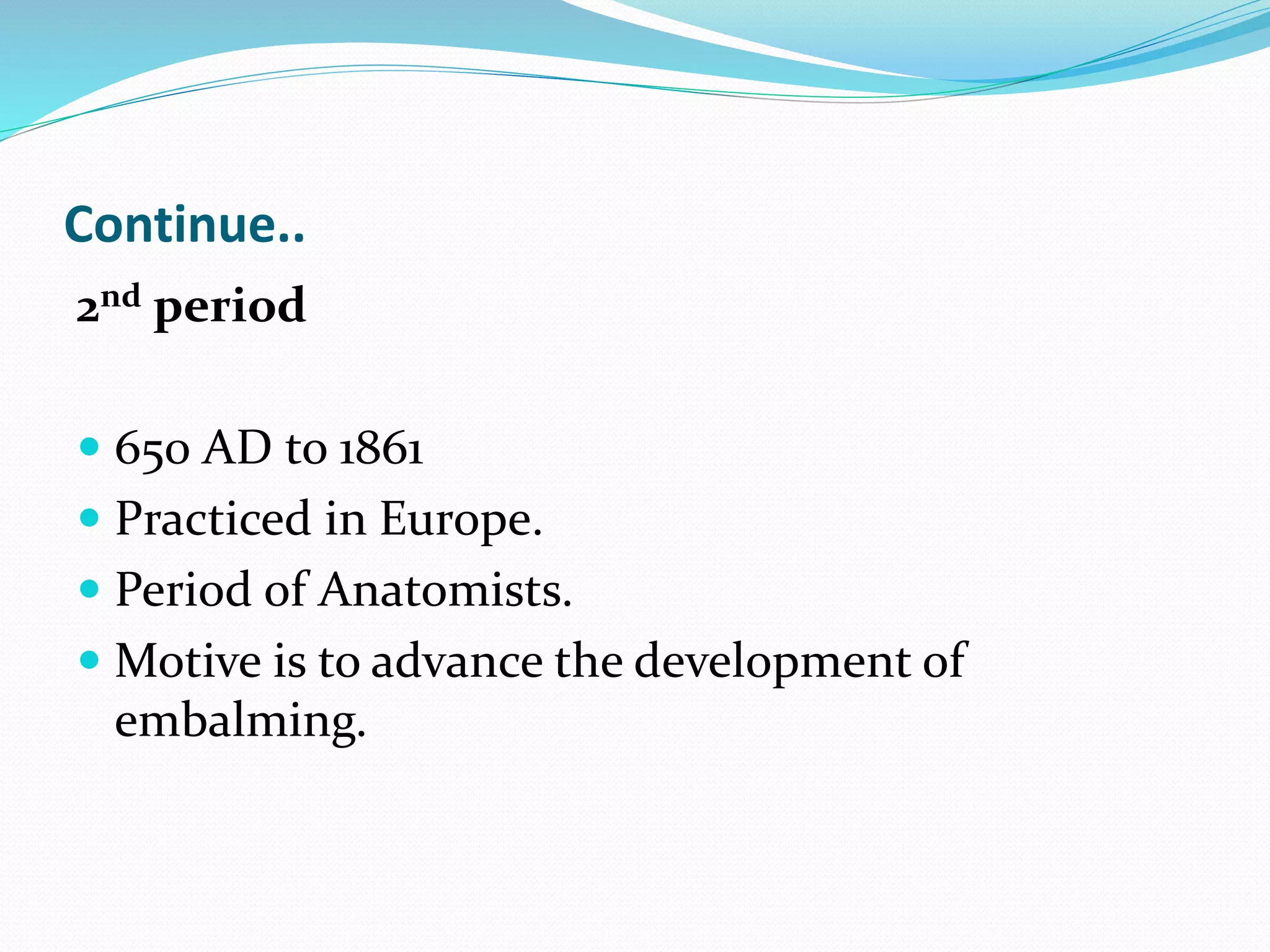
Powders
 Powders – sawdust + zinc sulphate or other
preservatives.
Evisceration & immersion
 Evisceration & immersion – used by Egyptians.
 Evisceration & drying – Guanche method.
 Evisceration, local incision & immersion – Europe
 Simple immersion – alcohol, brine or other liquid
preservatives.
 Arterial injection & evisceration – Hunter Brothers
 Cavity injection & immersion – Gabriel Clauderus
method.
 Arterial injection – mode of treatment of Gannal,
Sucquet.
 Arterial injection & cavity treatment – Modern
method.
 Artificial cold – refrigeration inhibits bacterial
activity.
Period of embalming history
1st period
 Originated in Egypt.
 3200 BC to 650 AC.
 Religious motive, believe in resurrection.
 Variation in techniques.
Continue..
2nd period
 650 AD to 1861
 Practiced in Europe.
 Period of Anatomists.
 Motive is to advance the development of
embalming.
Continue..
3rd period or modern period
 1861 till now.
 Europe to America.
 Funeral purpose, sentiments, public
transportations.
 Preserve for further study & research in anatomy.
Chemicals & fluids
 Preservatives
 Germicides
 Buffers
 Wetting agent
 Anticoagulants
 Dyes
 Vehicle
 Perfuming agent
Preservatives
 Formaldehyde
 Methanol
 Phenol
Formaldehyde
 Discovered in 1856, by british chemist, August
Wilheld Von Hofmann.
 Colourless
 Pungent odour
 Commercially available as formalin containing 37% of
formaldehyde in water.
 7% methyl alcohol, 37% formaldehyde remaining water.
Methanol
 Volatile, inflammable & poisonous.
 If consumed, causes blindness & death.
 Best preservative that precipitates proteins and kills
many organisms.
 Best useful dilution is 75% isopropyl alcohol.
 It is cheaper, toxic than ethanol.
 Stabilises formalin.
 Penetrates & diffuses easily.
Phenol
 Carbolic acid, Coal tar derivative, extremely
poisonous, colourless, Crystalline solid.
 Light exposure, turns dark(oxidation).
 Rapidly absorbed by protein contents of tissues.
 Non soluble in water, Soluble in ether, ethanol,
chloroform & glycerine.
 Powerful germicide & fungicide.
 Greying of tissues.
Germicides
 Surface disinfectants
 Kill microbes
 Eg: phenolic derivatives, zephiran chloride,
glutaraldehyde.
Buffers
 Weak acids or basic salts are used to stabilise the pH,
called buffers.
 Stability of the chemicals in embalming depends on
pH of the medium.
 Eg: sodium borate, sodium bicarbonate, magnesium
carbonate, sodium carbonate.
Wetting agent
 Lowers high surface tension of water & facilitates
penetration and distribution of embalming fluids.
 Eg: glycerine, glycol, sorbitol, sodium lauryl sulphate.
Anticoagulants
 Used to precipitate the calcium to non ionized state.
 They maintain blood in liquid state & facilitate
removal of blood and distribution of arterial fluids.
 Eg: sodium citrate, sodium oxalate
Dyes
 Produce an internal cosmetic effect that simulates
natural colouring of tissues.
 Eg: tetra bromo fluorescein(eosin), ponceau,
erythrosine, amaranth, acid fuchsin, toludine red &
rhodamine.
Vehicles
 Diluents or solvents or a mixture of solvents.
 Helps the ingredients in solution in a stable and
uniform state during transport through vascular
system to different parts of body.
 Eg: alcohols, glycerine, sorbitol, water
Perfumes
 Masking agents, water soluble or made water soluble
by surfactants.
 They are floral compounds.
 Eg: methyl salicylate(oil of winter green), clove oil,
cinnamon oil of peppermint(minthol) or lavender.
Muscle relaxants
 Relaxes smooth muscles in arterial wall & assist flow of
fluids in vascular system.
 Eg: magnesium chloride
Disinfection
Disinfectant - agent used to inanimate by destroying
microbial agent but not bacterial spores.
Germicide - agent used to inanimate by destroying
microbial agent but not bacterial spores.
Sterilization – effective decontaminates completely.
Embalming fluids
 Arterial fluids
 Cavity fluids
 Pre injection fluids
Arterial fluids
 Injected into vascular system.
 Dilution varies with types of bodies – dehydrated,
obese, oedematous.
 Also varies with special conditions like – refrigerated
bodies, burnt bodies, infants.
Arterial fluids for obese subject
1 Preservatives formalin
methanol
10 %
55%
2 Buffers Sodium borate 15 gm.
3 Anticoagulants Sodium citrate 15 gm.
4 Wetting agent Glycerine 15%
5 Germicide Phenol 5%
6 Vehicle Water 15%
7 Fungicide Thymol Few crystals
8 Dye 1% Eosin 5 ml.
9 Perfume Winter green oil 10 ml.
Arterial fluids for thin subjects
1 Preservatives formalin
methanol
10 %
55%
2 Buffers Sodium borate 15 gm.
3 Anticoagulants Sodium citrate 15 gm.
4 Wetting agent Glycerine 20%
5 Germicide Phenol 5%
6 Vehicle Water 10%
7 Fungicide Thymol Few crystals
8 Dye 1% Eosin 5 ml.
9 Perfume Winter green oil 10 ml.
Cavity fluids
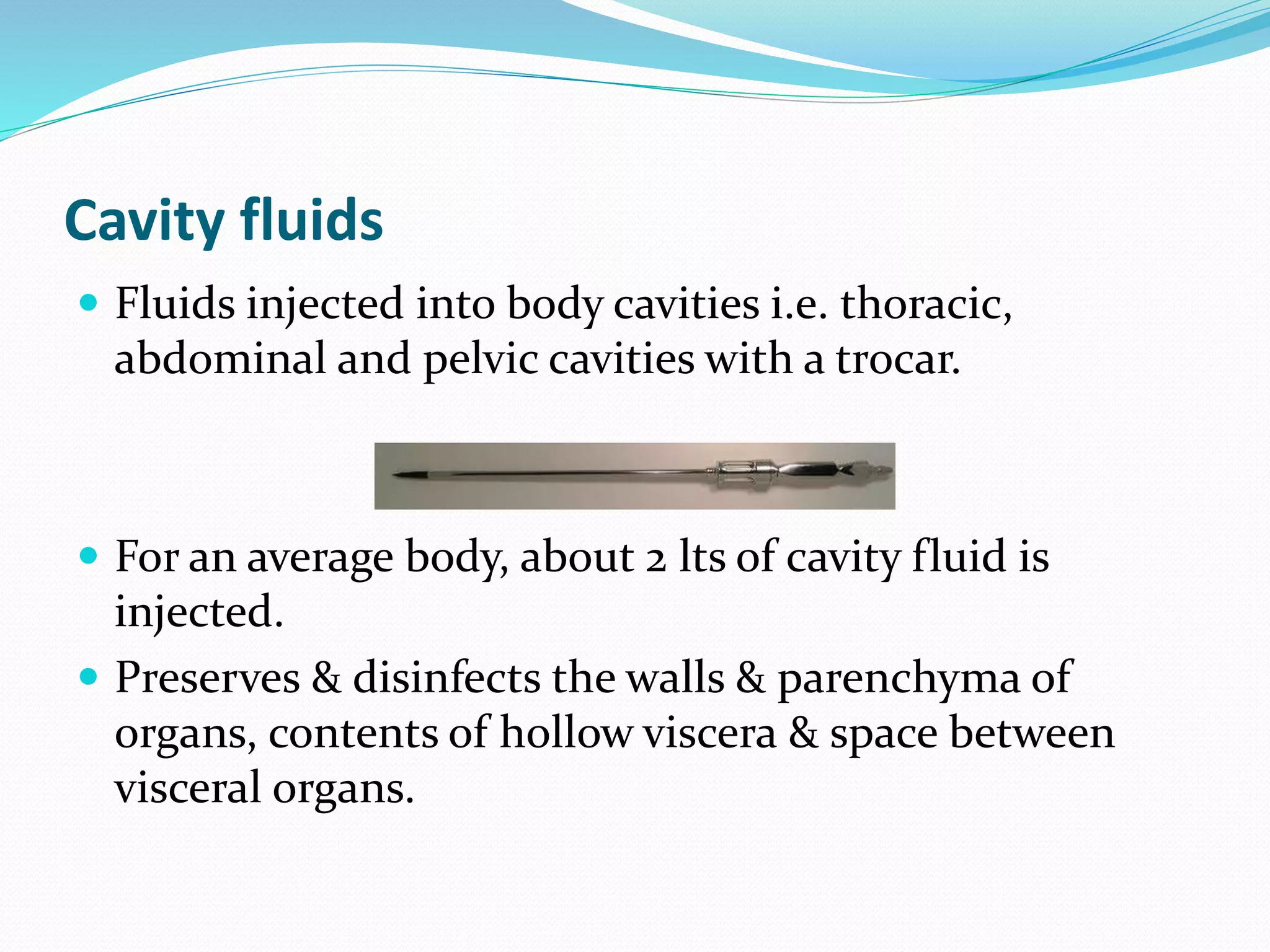
 Fluids injected into body cavities i.e. thoracic,
abdominal and pelvic cavities with a trocar.
 For an average body, about 2 lts of cavity fluid is
injected.
 Preserves & disinfects the walls & parenchyma of
organs, contents of hollow viscera & space between
visceral organs.
Cavity fluid compositions
1 Formalin 60%
2 Methanol 25%
3 Glycerine 2.5%
4 Phenol 10%
5 Mercuric chloride 1%
5 Lavender 1%
Pre injection fluids
Death
Forces greater
volume of blood
to capillary bed &
venous system
Continues..
 Pre injection fluid is injected before injecting arterial
fluids.
 It allows to drain the blood from vascular system.
 4 to 5 litters injected, wait for 30min before injecting
arterial fluids.
 Loosens clots, improves drainage.
 Contains anticoagulants & buffers.
Fluids used in dissection laboratories
Paint mixture – for keeping moist.
1 Glycerine 75%
2 Alcohol 10%
3 Phenol 5%
4 Water 10%
Tank (immersion) fluid – for immersing cadavers
1 Formalin 15%
2 Glycerine 20%
3 Phenol 5%
4 Water 60%
Cloth fluid – prevent drying of area under dissection &
isolated dissected part.
1 Formalin 5%
2 Glycerine 50%
3 Phenol 5%
4 Water 40%
Methods of embalming
 Arterial embalming
 Cavity embalming
Supplemental method
 Hypodermic embalming
 Surface embalming
Hypodermic embalming
 To preserve small or large local body areas by
subcutaneous injection.
 May be arterial fluid or cavity fluid.
 Hypodermic syringe, 8 to 19 gauge of varying length.
Surface embalming
 Local body areas are preserved by applying suitable
chemicals to surface of the body.
 May be arterial or cavity fluid.
 Packs of cotton or gauge are soaked, applied to eternal
skin.
 Eg: burned tissues, bed sores, surface lesions
Embalming procedure
Factors determining the flow of fluids into tissues
 capillary resistance,
 chemical composition,
 injection pressure,
 osmosis, diffusion & gravity.
Gravity injection
 Traditional, safest, simplest & least expensive.
 Graduated glass bottle, 10 litters with an outlet.
 Outlet is corked through which the nozzle is passed,
connected to transparent rubber tube with screw
clamp to regulate rate of flow.
 Other end is attached to injecting needle or cannula.
 Bottled filled with arterial fluid is kept 4 to 6 feet from
embalming table.
 Raise of 1 foot gives fluid pressure of 0.43 pound.
Electric pump
 Simple device generates pressure to force fluid from
tank to vascular system.
 Provides steady & high pressure.
 Delivers 8 to 10 litres within 30 to 45 min.
References
• Ajmani, M.L (1998) 'Embalming: principles & legal
aspects', , (), pp. .
Andrew, L. Hodges (2006) 'Embalming explained',
• Internet source
Thank you

Embalming

  • 2.
    CONTENTS.  INTRODUCTION  HISTORY CHEMICAL FLUIDS  TYPES  REFERENCES
  • 3.
    Definition:- Embalming is oneof humankind’s longest practiced arts, is a means of artificially preserving the dead human body. Modern embalming is defined as the study & science of treating a dead human body to achieve antiseptic condition, a pre mortem appearance & preservation.
  • 4.
    Introduction:- Esmond R LongM.D., a Medical Historian ‘Nothing gives a better perspective of the subject than an appreciation of the steps by which it has reached its present state’
  • 5.
    Types of preservation Natural means.  Artificial means.
  • 6.
    Natural means ofpreservation  Freezing – ice, snow, glaciers.  Dry cold – cold dry air.  Dry heat – dry warm air.  Nature of the soil at the place of interment.
  • 7.
  • 8.
    Dry cold Dry coldpreservation of Bishop Peder Winstrup, 1605-1679, church of Sweden.
  • 9.
  • 10.
    Nature of soil Long term burial in peat bogs.  Soil impregnated with salt, aluminium or copper.
  • 11.
    Artificial means ofpreservation  Simple heat  Powders  Evisceration & immersion  Evisceration, local incision & immersion  Evisceration & drying  Simple immersion  Arterial injection  Arterial injection & evisceration  Cavity injection & immersion  Arterial injection & cavity treatment  Artificial cold
  • 12.
    Simple heat  Simpleheat – slow drying in an oven that is heated with mixture of slaked lime.
  • 13.
    Powders  Powders –sawdust + zinc sulphate or other preservatives.
  • 14.
    Evisceration & immersion Evisceration & immersion – used by Egyptians.
  • 15.
     Evisceration &drying – Guanche method.  Evisceration, local incision & immersion – Europe  Simple immersion – alcohol, brine or other liquid preservatives.  Arterial injection & evisceration – Hunter Brothers  Cavity injection & immersion – Gabriel Clauderus method.
  • 16.
     Arterial injection– mode of treatment of Gannal, Sucquet.  Arterial injection & cavity treatment – Modern method.  Artificial cold – refrigeration inhibits bacterial activity.
  • 17.
    Period of embalminghistory 1st period  Originated in Egypt.  3200 BC to 650 AC.  Religious motive, believe in resurrection.  Variation in techniques.
  • 18.
    Continue.. 2nd period  650AD to 1861  Practiced in Europe.  Period of Anatomists.  Motive is to advance the development of embalming.
  • 19.
    Continue.. 3rd period ormodern period  1861 till now.  Europe to America.  Funeral purpose, sentiments, public transportations.  Preserve for further study & research in anatomy.
  • 20.
    Chemicals & fluids Preservatives  Germicides  Buffers  Wetting agent  Anticoagulants  Dyes  Vehicle  Perfuming agent
  • 21.
  • 22.
    Formaldehyde  Discovered in1856, by british chemist, August Wilheld Von Hofmann.  Colourless  Pungent odour  Commercially available as formalin containing 37% of formaldehyde in water.  7% methyl alcohol, 37% formaldehyde remaining water.
  • 23.
    Methanol  Volatile, inflammable& poisonous.  If consumed, causes blindness & death.  Best preservative that precipitates proteins and kills many organisms.  Best useful dilution is 75% isopropyl alcohol.  It is cheaper, toxic than ethanol.  Stabilises formalin.  Penetrates & diffuses easily.
  • 24.
    Phenol  Carbolic acid,Coal tar derivative, extremely poisonous, colourless, Crystalline solid.  Light exposure, turns dark(oxidation).  Rapidly absorbed by protein contents of tissues.  Non soluble in water, Soluble in ether, ethanol, chloroform & glycerine.  Powerful germicide & fungicide.  Greying of tissues.
  • 25.
    Germicides  Surface disinfectants Kill microbes  Eg: phenolic derivatives, zephiran chloride, glutaraldehyde.
  • 26.
    Buffers  Weak acidsor basic salts are used to stabilise the pH, called buffers.  Stability of the chemicals in embalming depends on pH of the medium.  Eg: sodium borate, sodium bicarbonate, magnesium carbonate, sodium carbonate.
  • 27.
    Wetting agent  Lowershigh surface tension of water & facilitates penetration and distribution of embalming fluids.  Eg: glycerine, glycol, sorbitol, sodium lauryl sulphate.
  • 28.
    Anticoagulants  Used toprecipitate the calcium to non ionized state.  They maintain blood in liquid state & facilitate removal of blood and distribution of arterial fluids.  Eg: sodium citrate, sodium oxalate
  • 29.
    Dyes  Produce aninternal cosmetic effect that simulates natural colouring of tissues.  Eg: tetra bromo fluorescein(eosin), ponceau, erythrosine, amaranth, acid fuchsin, toludine red & rhodamine.
  • 30.
    Vehicles  Diluents orsolvents or a mixture of solvents.  Helps the ingredients in solution in a stable and uniform state during transport through vascular system to different parts of body.  Eg: alcohols, glycerine, sorbitol, water
  • 31.
    Perfumes  Masking agents,water soluble or made water soluble by surfactants.  They are floral compounds.  Eg: methyl salicylate(oil of winter green), clove oil, cinnamon oil of peppermint(minthol) or lavender.
  • 32.
    Muscle relaxants  Relaxessmooth muscles in arterial wall & assist flow of fluids in vascular system.  Eg: magnesium chloride
  • 33.
    Disinfection Disinfectant - agentused to inanimate by destroying microbial agent but not bacterial spores. Germicide - agent used to inanimate by destroying microbial agent but not bacterial spores. Sterilization – effective decontaminates completely.
  • 34.
    Embalming fluids  Arterialfluids  Cavity fluids  Pre injection fluids
  • 35.
    Arterial fluids  Injectedinto vascular system.  Dilution varies with types of bodies – dehydrated, obese, oedematous.  Also varies with special conditions like – refrigerated bodies, burnt bodies, infants.
  • 36.
    Arterial fluids forobese subject 1 Preservatives formalin methanol 10 % 55% 2 Buffers Sodium borate 15 gm. 3 Anticoagulants Sodium citrate 15 gm. 4 Wetting agent Glycerine 15% 5 Germicide Phenol 5% 6 Vehicle Water 15% 7 Fungicide Thymol Few crystals 8 Dye 1% Eosin 5 ml. 9 Perfume Winter green oil 10 ml.
  • 37.
    Arterial fluids forthin subjects 1 Preservatives formalin methanol 10 % 55% 2 Buffers Sodium borate 15 gm. 3 Anticoagulants Sodium citrate 15 gm. 4 Wetting agent Glycerine 20% 5 Germicide Phenol 5% 6 Vehicle Water 10% 7 Fungicide Thymol Few crystals 8 Dye 1% Eosin 5 ml. 9 Perfume Winter green oil 10 ml.
  • 38.
    Cavity fluids  Fluidsinjected into body cavities i.e. thoracic, abdominal and pelvic cavities with a trocar.  For an average body, about 2 lts of cavity fluid is injected.  Preserves & disinfects the walls & parenchyma of organs, contents of hollow viscera & space between visceral organs.
  • 39.
    Cavity fluid compositions 1Formalin 60% 2 Methanol 25% 3 Glycerine 2.5% 4 Phenol 10% 5 Mercuric chloride 1% 5 Lavender 1%
  • 40.
    Pre injection fluids Death Forcesgreater volume of blood to capillary bed & venous system
  • 41.
    Continues..  Pre injectionfluid is injected before injecting arterial fluids.  It allows to drain the blood from vascular system.  4 to 5 litters injected, wait for 30min before injecting arterial fluids.  Loosens clots, improves drainage.  Contains anticoagulants & buffers.
  • 42.
    Fluids used indissection laboratories Paint mixture – for keeping moist. 1 Glycerine 75% 2 Alcohol 10% 3 Phenol 5% 4 Water 10%
  • 43.
    Tank (immersion) fluid– for immersing cadavers 1 Formalin 15% 2 Glycerine 20% 3 Phenol 5% 4 Water 60%
  • 44.
    Cloth fluid –prevent drying of area under dissection & isolated dissected part. 1 Formalin 5% 2 Glycerine 50% 3 Phenol 5% 4 Water 40%
  • 45.
    Methods of embalming Arterial embalming  Cavity embalming Supplemental method  Hypodermic embalming  Surface embalming
  • 46.
    Hypodermic embalming  Topreserve small or large local body areas by subcutaneous injection.  May be arterial fluid or cavity fluid.  Hypodermic syringe, 8 to 19 gauge of varying length.
  • 47.
    Surface embalming  Localbody areas are preserved by applying suitable chemicals to surface of the body.  May be arterial or cavity fluid.  Packs of cotton or gauge are soaked, applied to eternal skin.  Eg: burned tissues, bed sores, surface lesions
  • 48.
    Embalming procedure Factors determiningthe flow of fluids into tissues  capillary resistance,  chemical composition,  injection pressure,  osmosis, diffusion & gravity.
  • 49.
    Gravity injection  Traditional,safest, simplest & least expensive.  Graduated glass bottle, 10 litters with an outlet.  Outlet is corked through which the nozzle is passed, connected to transparent rubber tube with screw clamp to regulate rate of flow.  Other end is attached to injecting needle or cannula.  Bottled filled with arterial fluid is kept 4 to 6 feet from embalming table.  Raise of 1 foot gives fluid pressure of 0.43 pound.
  • 50.
    Electric pump  Simpledevice generates pressure to force fluid from tank to vascular system.  Provides steady & high pressure.  Delivers 8 to 10 litres within 30 to 45 min.
  • 51.
    References • Ajmani, M.L(1998) 'Embalming: principles & legal aspects', , (), pp. . Andrew, L. Hodges (2006) 'Embalming explained', • Internet source
  • 52.