VIDYAKIRANA GROUP OF
INSTITUTION BANGALORE
SUBJECT- NURSING FOUNDATION
TOPIC – CARE OF TERMINAL ILL PATIENT
PRESENTTED BY –MRS. SULEKHA DESHMUKH
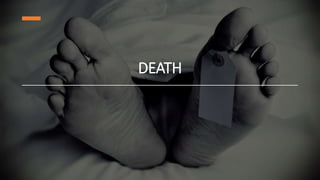
DEATH
• Death is a irreversible cessation of circulatory,
respiratory function or the irreversible cessation of
all functions of the entire brain including the
brainstem
•Sign of dying
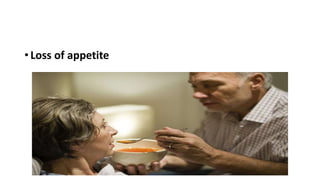
• Loss of appetite
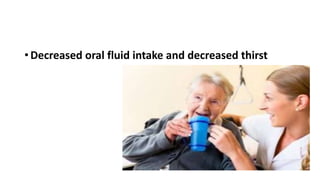
• Decreased oral fluid intake and decreased thirst
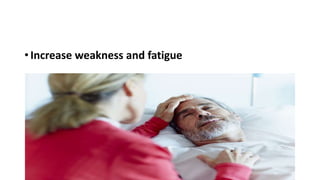
• Increase weakness and fatigue
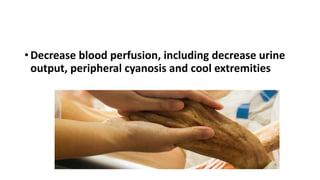
• Decrease blood perfusion, including decrease urine
output, peripheral cyanosis and cool extremities
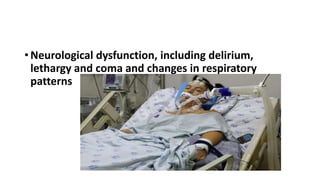
• Neurological dysfunction, including delirium,
lethargy and coma and changes in respiratory
patterns
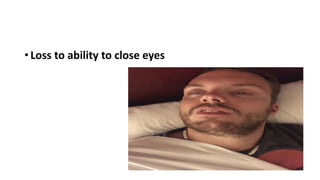
• Loss to ability to close eyes
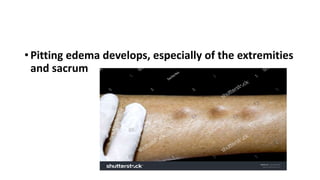
• Pitting edema develops, especially of the extremities
and sacrum
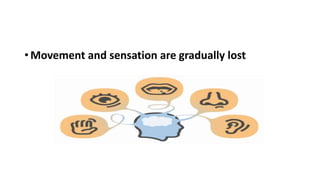
• Movement and sensation are gradually lost
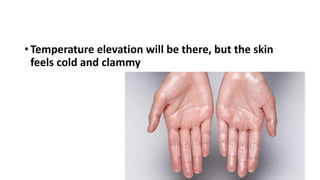
• Temperature elevation will be there, but the skin
feels cold and clammy
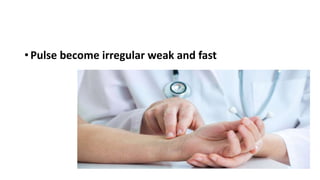
• Pulse become irregular weak and fast
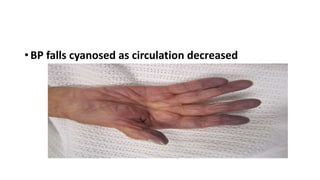
• BP falls cyanosed as circulation decreased
• Respiration become noisy and reflexes disappear
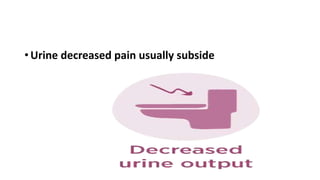
• Urine decreased pain usually subside
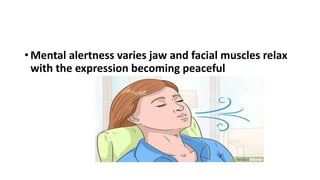
• Mental alertness varies jaw and facial muscles relax
with the expression becoming peaceful
SIGNS OF DEATH
Absence of heartbeat and respiration
Fixed pupil
Skin color turn to a waxen pallor and extremities
may darken
Body temperature drops
Muscle and sphincters mat relax
•PHYSIOLOGICAL CHANGES AFTER DEATH
• RIGOR MORTIS – stiffening of the body that occurs
about 2-4 hours after death, resulting from a lack of
ATP which cause the muscles to contract, which in
turn immobilize the joints
• It starts in the involuntary muscles [ heart and
bladder] then progress to head, neck, trunk and
extremities
• ALOGOR MORTIS - gradual decrease of the body
temperature after death, when blood circulation
terminates, and hypothalamus ceases to function,
body temperature falls down
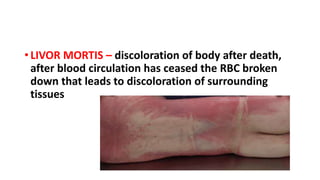
• LIVOR MORTIS – discoloration of body after death,
after blood circulation has ceased the RBC broken
down that leads to discoloration of surrounding
tissues
• DECOMSITION – TISSUES after death become soft
and eventually liquefied by bacterial fermentation,
the hotter the temperature, the more rapid the
change so body are store in cool places
TYPE OF DEATH
• There are main two type of death
• 1- HEART AND RESPIRATORY DEATH- Means an
irreversible stopping of heart and lung function
• 2- BRAIN DEATH – Means an irreversible stopping of
brain function
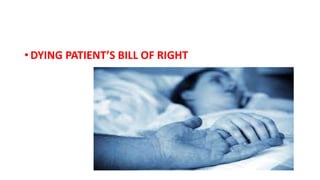
• DYING PATIENT’S BILL OF RIGHT
 patient have right to be treated as a living human
being until the day they die
 They have right to maintain a sense of hopefulness
however changing its focus may be
 the right to express feelings and emotions about
death in one’s own way
The right to participate in all decisions concerning
one’s care
 the right to be cared for by compassionate,
sensitive knowledgeable people who will attempt to
understand one’s need
 the right to have all questions answered honestly
and fully
 the right to seek spirituality
 the right to be free from physical pain
 the right to express feeling and emotions about
pain in one’s own way
 the right to understand the process of death
 the right to die
 the right to die in peace and dignity
 the right not to die alone
 the right to expect that the sanctity of the body will
be respected after death
• CARE OF THE DYING PATIENT
 psychological support – relief from loneliness, fear,
and depression.
 meeting the spiritual needs according to his/her
religious customs
 the dying person may be shifted to privet room or
privacy is maintained by putting the screen so that …
…. other patient may not be disturbed by the
unpleasant sight and other disturbance.
 O2 inhalation to remove his/her discomfort
 elevation of the patient’s head and shoulders may
make breathing easier
 keep the room well-ventilated and keep crowed
away
 periodic suctioning is necessary
 the patient is unable to swallow even the ship of
water, most of then require IV fluids
 if they can tolerate the oral fluids, shop of water is
given with teaspoon, that will help the patient to
keep the mouth moist
 give frequent oral hygiene
 the denture are removed and kept safely
 catheterization has to be done
 perineal area has to be done
 frequent skin care should be given with particular
attention to be pressure point
 patient should be comfortably placed and their
position.
 avoid whispering any think in patient room
 since the eye are opened, protect the eyes from
corneal ulceration with protective ointment
 patient should not be disturbed while sleeping
 the visitors should be instructed not to disturbed
the patient during his resting
 maintain calm and quit environment
 cleanliness and appearance are important until the
end
 cleanliness of the skin, hair, mouth and cloth has to
be maintained
 DEATH
DECLARATION
 CERTIFICATION
AND AUTOPSY
• DEATH DECLARATION- generally a physician must
make the determination that a person is dead the
physician then makes a formal declaration of the
death and the record of the time of the death in a
hospital setting
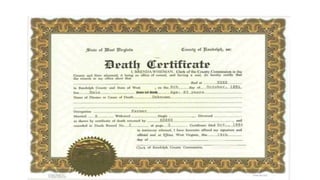
 DEATH CERTIFICATION –
 it is the official recording of a person’s death and
issued by the GOVT.
 It is usually including name ,age, date of death and
causes of death
 the first duty must be performed in all
circumstance, including deaths caused by disease,
old age, suicide, homicide and accident
• AUTOPSY – [post- mortem examination] an
examination of a dead body to find out the causes of
death, autopsy are usually performed by a
specialized medical doctor called pathologist
• the pathologist makes a cut on the body from the
collarbone to the lower abdomen to examine the
chest and abdomen organs .
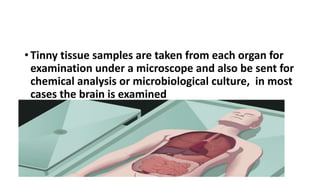
• Tinny tissue samples are taken from each organ for
examination under a microscope and also be sent for
chemical analysis or microbiological culture, in most
cases the brain is examined
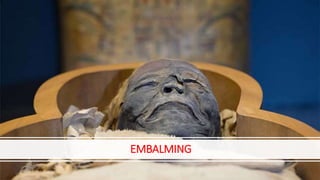
EMBALMING
CON…
• Embalming is the process of preserving a
body by delaying the natural effects of death.
This is done by introducing specialist
embalming solutions into the body after
someone has passed away, helping to give
them a more peaceful appearance.
The purpose of embalming
 to temporarily preserve human remains to prevent
decomposition and prepare them for funeral
presentation
 Embalming for anatomical study and research
TYPE OF PRESERVATION
•NATURAL PRESERVATION
•ARTIFICIAL PRESERVATION
•NATURAL PRESERVATION
•Freezing – ice, snow, glaciers
•Dry cold – cold dry air
•Dry heat – dry warm air
•Natura of the soil at the place of interment
• ARTIFICIAL PRESERVATION
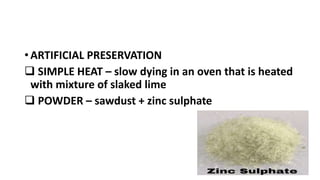
 SIMPLE HEAT – slow dying in an oven that is heated
with mixture of slaked lime
 POWDER – sawdust + zinc sulphate
• ARTERIAL EMBALMING- Is injecting embalming
chemical into blood arteries typically through the
right common carotid artery, the right jugular vein is
used to drain blood
• the embalming solution is injected into the corpse
using an embalming machine and the embalmer
massage the corpse to ensure that the fluid is evenly
distributed.
 in the event of inadequate circulation, alternative
injection sites are utilized
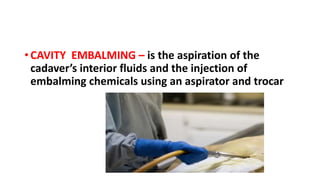
• CAVITY EMBALMING – is the aspiration of the
cadaver’s interior fluids and the injection of
embalming chemicals using an aspirator and trocar
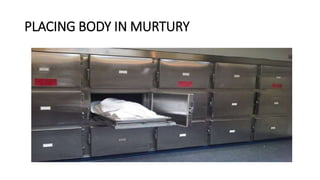
PLACING BODY IN MURTURY
THE DEAD BODY MUST BE DELIVERED TO THE MURTURY
FOR STORAGE UNDER THREE CIRCUMSTANCE
 if the body is unidentified the body should be stored in
the mortuary until police arrive
 if the deceased person’s family members are not available
and have been notified to collect the body
 if it is MLC CASE, the body should be kept in mortuary
until the arrival of the police and not given to the relatives
 before transporting the body to the mortuary the
technician must be notified
 the body should be transported to the mortuary on
a stretcher in a secure manner
 the ward boy shall take signature from the
mortuary technician to conformation of receipt of
the dead body
 tagging the dead body after the body packed
 the name age, sex, IP no, consultant name, time of
death, date of death is mentioned on the tags.
 three tags shall be put on the body – on head,
chest, and left leg .
 mortuary staff shall maintain full record of the
body brought to mortuary in the mortuary register.
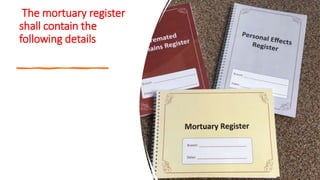
The mortuary register
shall contain the
following details
 identification number
 name, age, sex of deceased, date and time of death
 identification mark and finger impression
Details of near relative
 whether autopsy is done or not
If done, then date and time of autopsy
 name of autopsy surgeon
 date and time when body is placed in cold storage
 length of body
 list of valuables which have been removed from
body
 signature of technician
Name of relatives
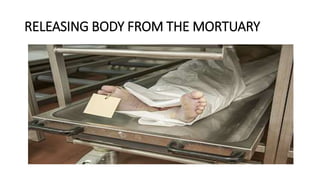
RELEASING BODY FROM THE MORTUARY
 prior to handing over the dead body, the relatives'
identities must be verified
 the details of the transfer of the deceased’s body
must be recorded in death register, and relative’s
signature must be obtained as acknowledgment
 before releasing the body, the local police
authorities must be notified by the family/physician
and receive their permission
MLC [ MEDICO LEGAL CASE ]
• A medico legal case is described as a case of injury or
illness, in which investigation by law-enforcement
agencies required to determine responsibility for the
cause of the damage or illness
• All cases of accidents, burns, assault, alleged suicide
or homicide, poisoning, road traffic accident, rape,
and drowning be recorded as medico-legal cases
[MLC]
EUTHANASIA
• The practice of killing somebody without pain who
wants to die because he/she is suffering from a
disease that can’t be cured
• Euthanasia is the voluntary act of a patient suffering
a terminal disease, of terminating their life
• Euthanasia is essentially divided into two type –
ACTIVE AND PASSIVE euthanasia
• TYPE OF EUTHANASIA
 1- ACTIVE – deliberate act usually through the intentional
administration of lethal drugs, to end an incurably or
terminally ill patient’s life
 2- PASSIVE – deliberate withholding or withdrawal of life-
prolonging medical treatment resulting in the patient’s
death
• Terminally ill cancer patients, AIDS, and other
terminally ill condition with no active treatment are
common causes of euthanasia
DNI/DNR
•DO NOT INTUBATE – incubation is a procedure that
can help save a life when someone can not breathe a
health care provider uses a laryngoscope to guide an
endotracheal tube into the mouth or nose, voice box
then trachea. The tube keeps the airway open so air
can get to the lungs
•DO NOT RESUSCITATE – resuscitation is a technique
of basic life support for the purpose of
• DO NOT RESUSCITATE – resuscitation is a technique
of basic life support for the purpose of oxygenation
to the heart, lungs, and brain until the appropriate
medical treatment can come and retore the normal
cardiopulmonary function
• WHO ARE THE DNI/DNR CANDIDATES
When a patient has prolonged unconsciousness
from which recovery is unlikely
When a patient has a terminal condition for which
no definitive treatment exists
When a patient has a chronic disorder and burden
of resuscitation
• When medical treatment seems ineffective.
WHEN DNI/DNR ACTIVATED WHAT HAPPENS– if DNI
AND DNR orders, a health professional will provide
basic support in the form of ..
PROVIDE OXYGEN
POSITION
APPLY SPLINT
PROVIDE EMOTIONAL SUPPORT
• A MEDICAL PROFESSIONAL IS NOT REQUIRED TO
Do not perform chest compressions
Do not insert superior airway
Do not administer drugs for cardiac resuscitation
Do not provide ventilator
Do not defibrillate
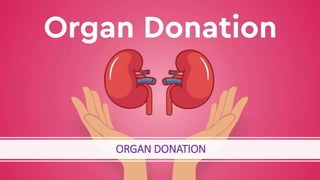
ORGAN DONATION
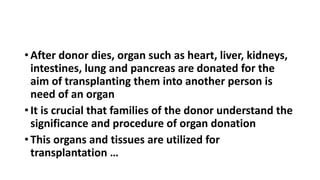
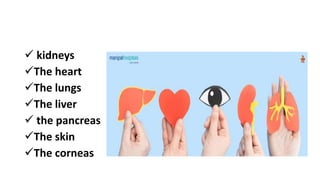
• After donor dies, organ such as heart, liver, kidneys,
intestines, lung and pancreas are donated for the
aim of transplanting them into another person is
need of an organ
• It is crucial that families of the donor understand the
significance and procedure of organ donation
• This organs and tissues are utilized for
transplantation …
 kidneys
The heart
The lungs
The liver
 the pancreas
The skin
The corneas
GRIEF
CONCEPTION OF LOSS
• A person experience loss in the absence of an
objective, person’s body part or function or emotion
that was formerly present
• Loss is an inevitable part of life and grief is a natural
part of the healing process.
• The reason of grief are many such as the loss of a
love one, the loss of heath or the letting go of a long
dream
TYPES OF LOSS
• There are various
type of loss
• ACTUAL LOSS
• PERCEIVED LOSS
• PSYSICAL LOSS
• PSYCHOLOGICAL
LOSS
ACTUAL LOSS – the death of love one or theft of
one’s property, loss of body part, death of family
members, or job loss, lost of valuable objective
PERCEIVED LOSS – rejection by friends and family
which lead to a loss of confidence or change an
individual’s social standing
PHYSICAL LOSS - amputation of an extremity,
scarring from burns or permanent injury
PSYCHOLOGICAL LOSS- a women experiencing
infertility as a result of menopause
GRIEF
Introduction
• Grief is a normal response to ant loss, grieving is the
emotional reaction to loss
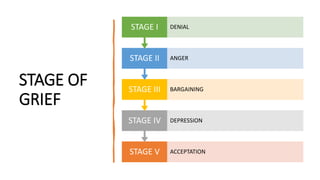
STAGE OF
GRIEF
STAGE V ACCEPTATION
STAGE IV DEPRESSION
STAGE III BARGAINING
STAGE II ANGER
STAGE I DENIAL
• STAGE I – DENIAL ---- this is a stage of shock and
disbelief, the response may be of “NO” it can not be
true
• STAGE II – ANGER ---- why me ? And it is not fair. Are
comments often expressed during the anger stage
anger may be directed to self or to loved one once,
care giver and even to god
• STAGE III- BARGANING ----- if god will help me
through this, I promise I will go to church every
Sunday and I will help to others, during this stage
which is generally not visible or evident to others, a
bargaining made with god to reverse or postpone the
loss
• STAGE IV – DEPRESSION – during this stage full
impact of the loss is experienced it shows symptoms
of social withdrawal and loneliness
• STAGE V - ACCEPTANCE – The final stage brings a
feeling of peace regarding the loss that has occurred,
focus is on the reality of the loss, and it is meaning
for the for the individuals affected by it
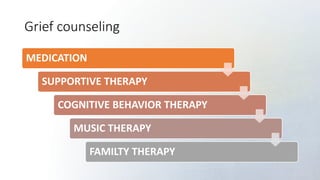
Grief counseling
MEDICATION
SUPPORTIVE THERAPY
COGNITIVE BEHAVIOR THERAPY
MUSIC THERAPY
FAMILTY THERAPY
Thank you
• Thank you