Communication Objectives & Budgeting
Communication Objectives Are important because they serves as a bench mark in  Communication  Communications in b/w agencies and organizational managers/sales promotion firms /media buying services etc. Planning and decision making   While in decision making process communication objectives plays an important role , i.e. how to develop a campaign/media mix selection /and allocating budget to diff. elements  Measuring results The success and failure are relative to the objectives u have defined. Good objective are those which are measurable.
How to determine objectives Diff. in between marketing and comm. Objectives  Marketing objectives are stated in firm’s overall mkting.plans. Are usually defined in terms of specific measurable outcomes such as sales volume /market share/profits/ROI.  or What the company wanted to accomplish by its overall marketing program.
Now by defining marketing objective managers must be able to translate these objectives into communication objectives. To do this  Situation analysis  provides some valuable information's. Like : The mkt.segment the firm wanted to target and TA. The product and its convincing attributes to the segment. Competitors brand analysis. positioning/promotional expenditure /creative and media strategies /tactics used in ads. Etc) How u are going to position ur brand and specific behavior responses. Primary  Vs  secondary objectives. e.g. primary may be to increase sales /mkt share  Secondary may be that u give a certain personality to the brand and start promoting the concept .
Let’s see what are comm. objectives Are statements of what various aspects of the IMC program will accomplish. Must translate general mkting goals into communications goals. Goals ? To get mkt share   or   to communicate the information or a selling message
Some times u don’t get the desired increase sales by certain ad. Campaign. Does it means that advertising fails .  Consider a football game . Same is the case of communication is just a quarterback of the team if team looses does not mean the quarterback should be shunted out from the team.  Poor performance may be due to  Quality / Packaging / Distribution  /Price / tech./competition or even the economy  Other important point in favor of advertising is that it has a carry over effect.
Sales based objectives  Some times only objective of the firm is to increase the sales. in such a situation the communication objectives may be: Direct response advertising. toll free numbers) Retail advertising  Some times when Ad. Plays a very dominant role in the marketing plan.e.g is of  Pepsi/coke , sales-oriented objective are used. Repositioning the product. When the promotional activities are related with sales-oriented objectives, measuring results depends upon the sales generated.
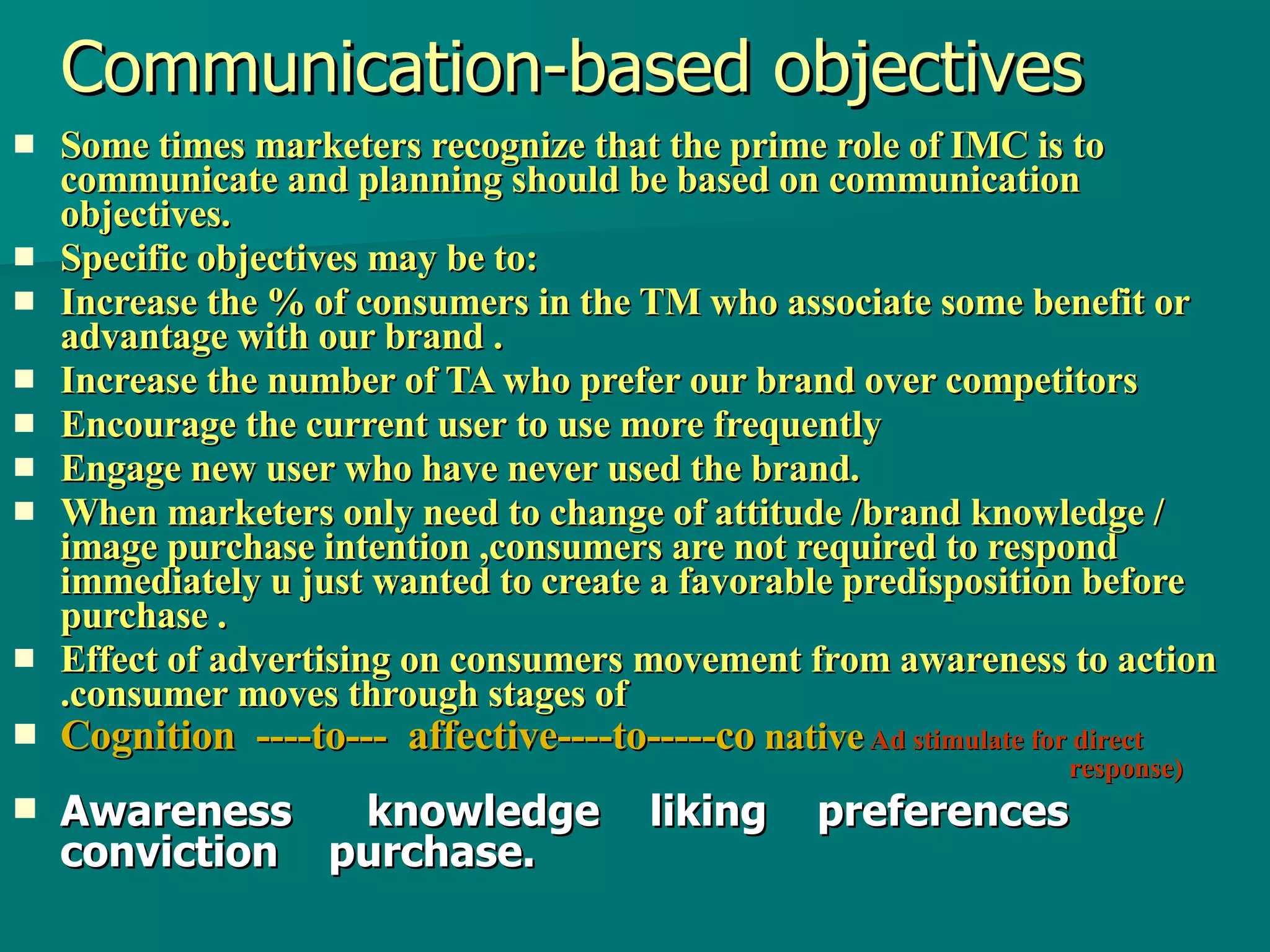
Communication-based objectives Some times marketers recognize that the prime role of IMC is to communicate and planning should be based on communication objectives. Specific objectives may be to: Increase the % of consumers in the TM who associate some benefit or advantage with our brand . Increase the number of TA who prefer our brand over competitors Encourage the current user to use more frequently Engage new user who have never used the brand. When marketers only need to change of attitude /brand knowledge / image purchase intention ,consumers are not required to respond immediately u just wanted to create a favorable predisposition before purchase . Effect of advertising on consumers movement from awareness to action .consumer moves through stages of  Cognition  ----to---  affective----to-----co  native   Ad stimulate for direct    response)   Awareness  knowledge  liking  preferences  conviction  purchase.
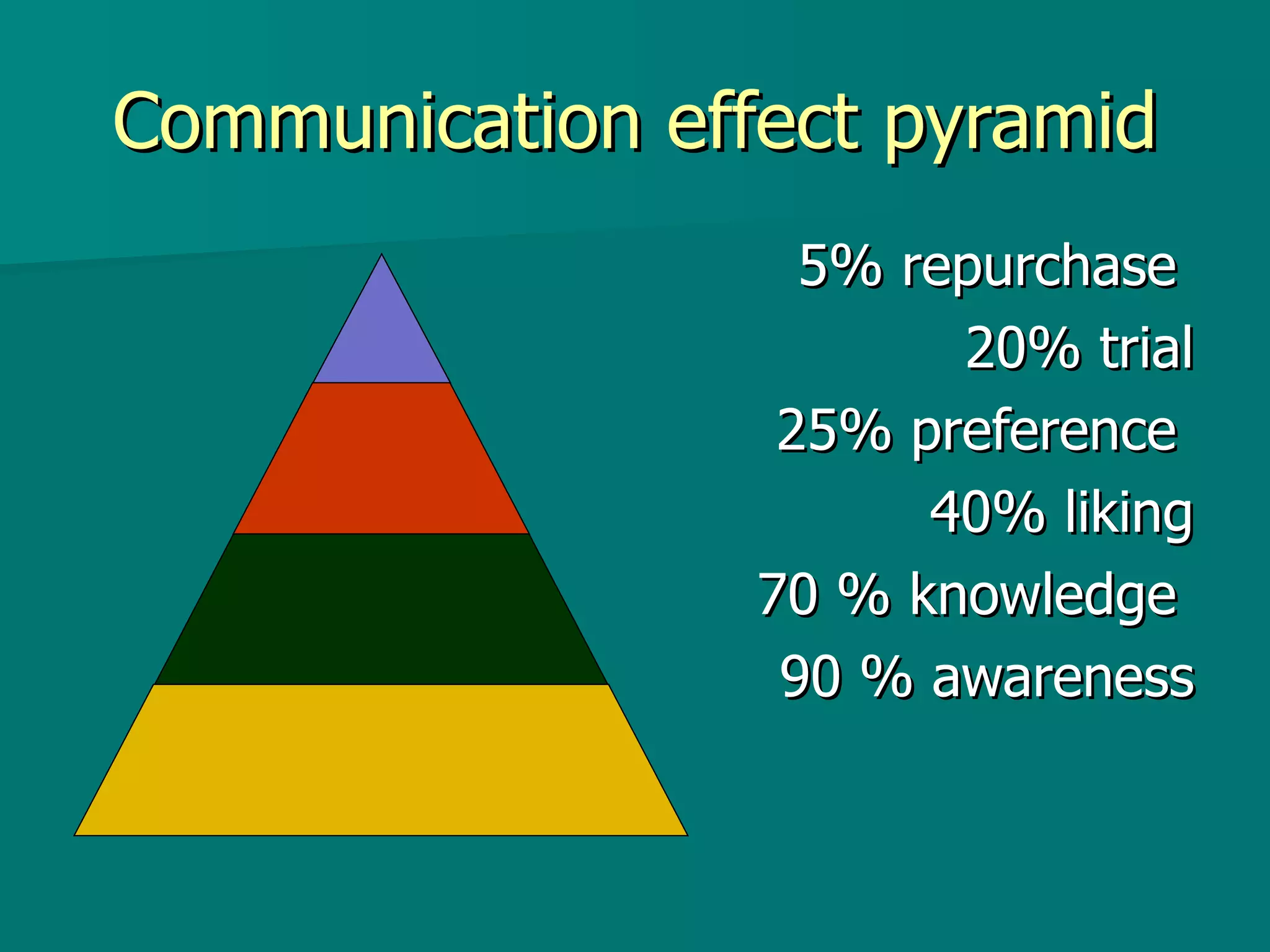
Communication effect pyramid 5% repurchase  20% trial 25% preference  40% liking 70 % knowledge  90 % awareness
Some problems with communication objectives U can not measure in quantitative terms that how much the consumers are in the phase of knowledge ,liking ,preferences etc.(no formula to provide the information)
DAGMAR an approach to setting objectives A report in the name of “Defining Advertising Goals for Measuring advertising Results”  by Russell Colley and said: Advertising’s job,purly and simply is to communicate to a defined audience information and a frame of mind that stimulates action. Advertising succeed or fails depends upon how well it has communicated the desired information and attitudes to the right people at the right time and at the right cost.
Communication task be based on (according to Colley) Awareness ( making the consumer aware of the existence of the brand or company ) Comprehension Developing a understanding of what the product is and what it will do for the consumer. Conviction Developing a mental disposition in consumers mind  Action Actual purchase or trial
Characteristics of objectives Concrete ,measurable tasks  What Appeal /message to communicate  Target audience  Well defined target audience ,based on demographics/psychographics etc. Benchmark and degree to change sought That is present position of audiences and after the communication is been done . Specified time period Time in which advertising objectives is accomplished.
Decisions that made diet Coke a success Previously diet drinks were Tab  Due to heavy promotion /a good new taste (new formula secret known to a very few people)  /brand name already known to world. Objectives of promotion were: To earn profit from the country’s increasing trends of weight consciousness Break the public’s perception that a soft drink has to lose its taste when it loses its calories. Wanted to expand its TM. Decision was made to sell it not on calories but on taste (Just for the taste of it)  26 % sales increases in first five yrs of introduction  Risks involved were :  If diet coke had flopped, it would have tarnished Coke’s image also.
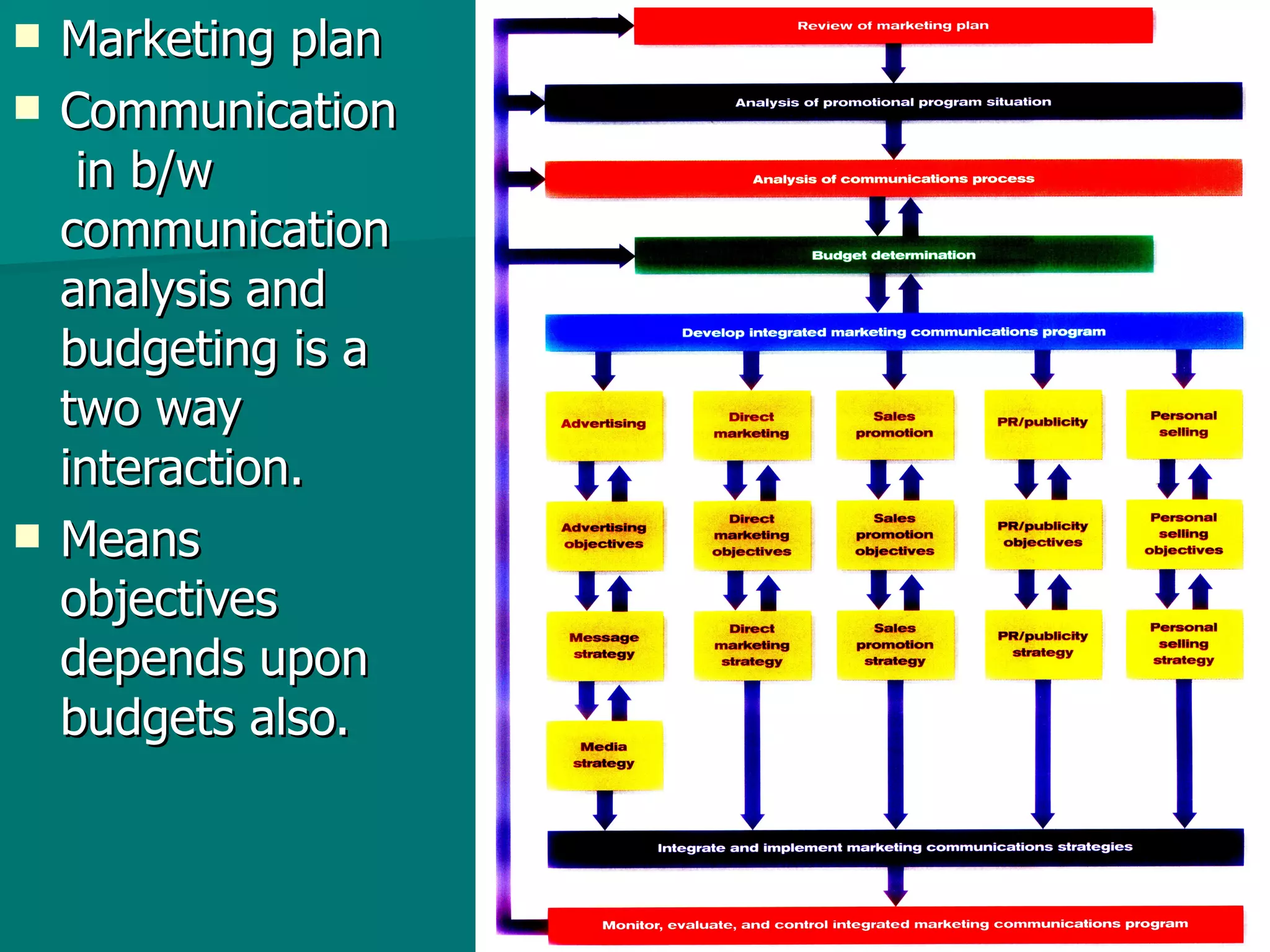
Marketing plan  Communication  in b/w communication analysis and budgeting is a two way interaction. Means objectives depends upon budgets also.
Q Weather the communication budget is an expense or investment ? Some theoretical approaches on the issue. Marginal analysis Sales response models Top-down approaches Affordable method Arbitrary allocation  Percentage of sales  Competitive parity  ROI
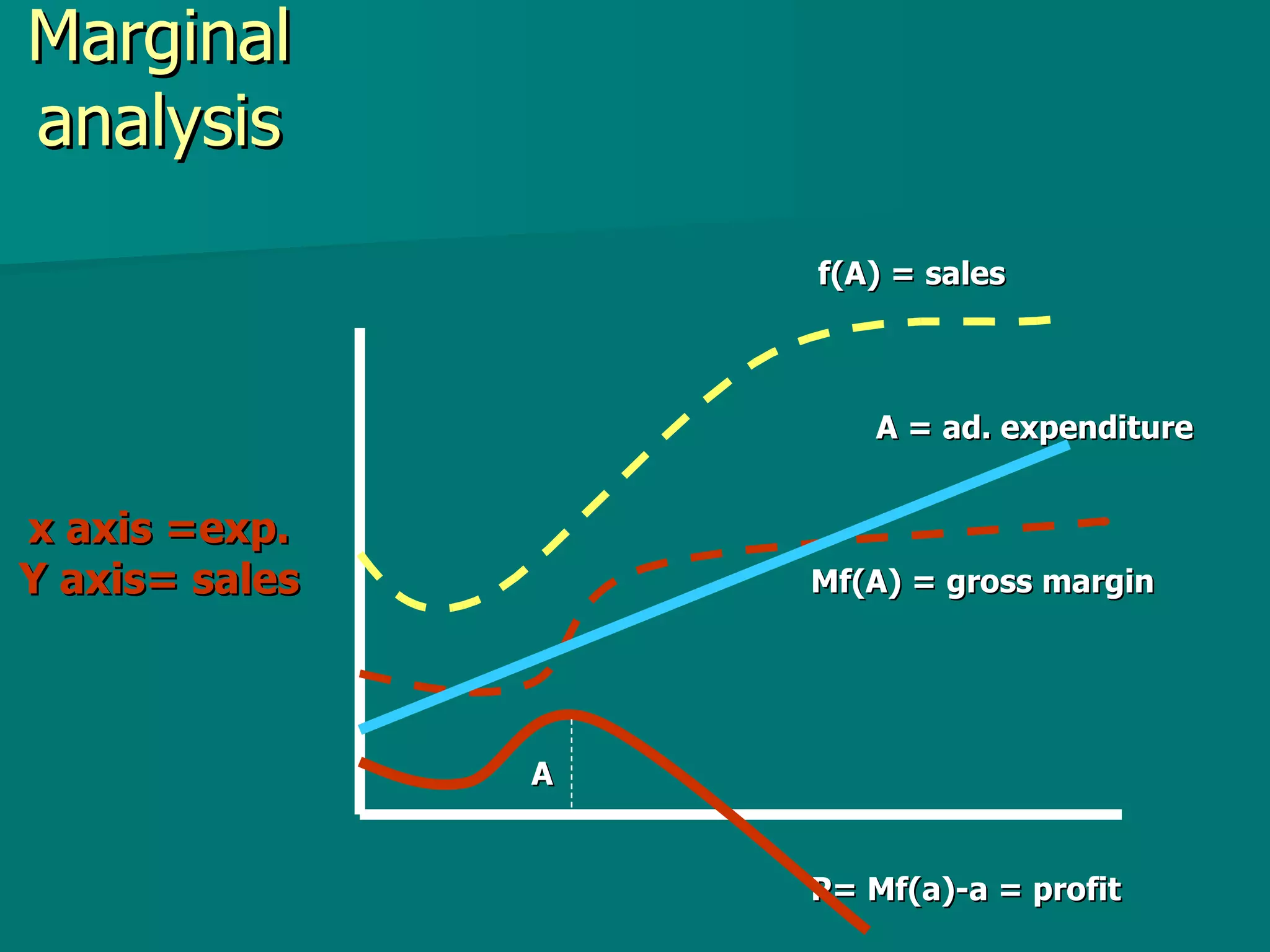
Marginal analysis x axis =exp. Y axis= sales   f(A) = sales A = ad. expenditure Mf(A) = gross margin A  P= Mf(a)-a = profit
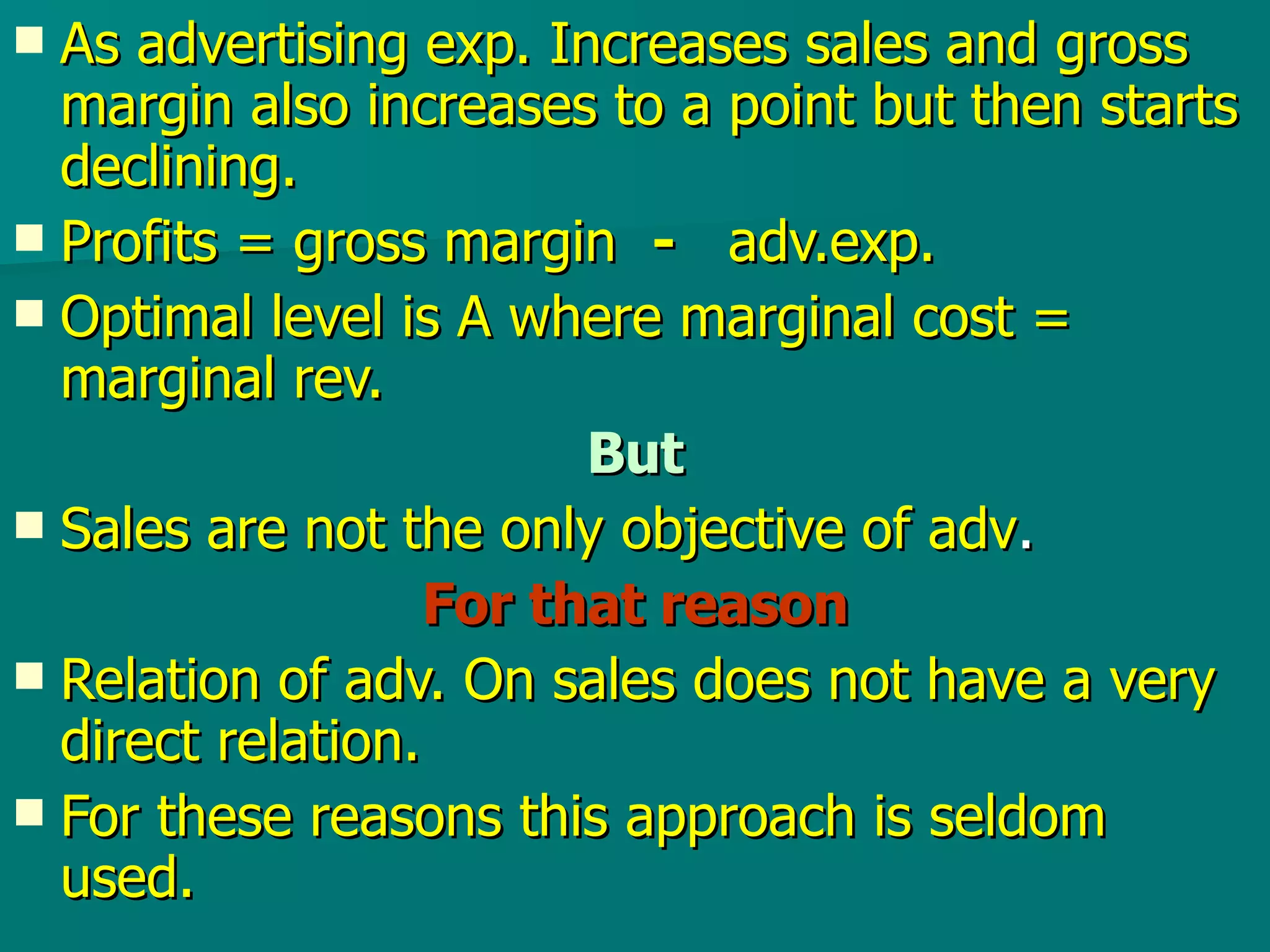
As advertising exp. Increases sales and gross margin also increases to a point but then starts declining. Profits = gross margin  -   adv.exp. Optimal level is A where marginal cost = marginal rev. But Sales are not the only objective of adv . For that reason Relation of adv. On sales does not have a very direct relation.  For these reasons this approach is seldom used.
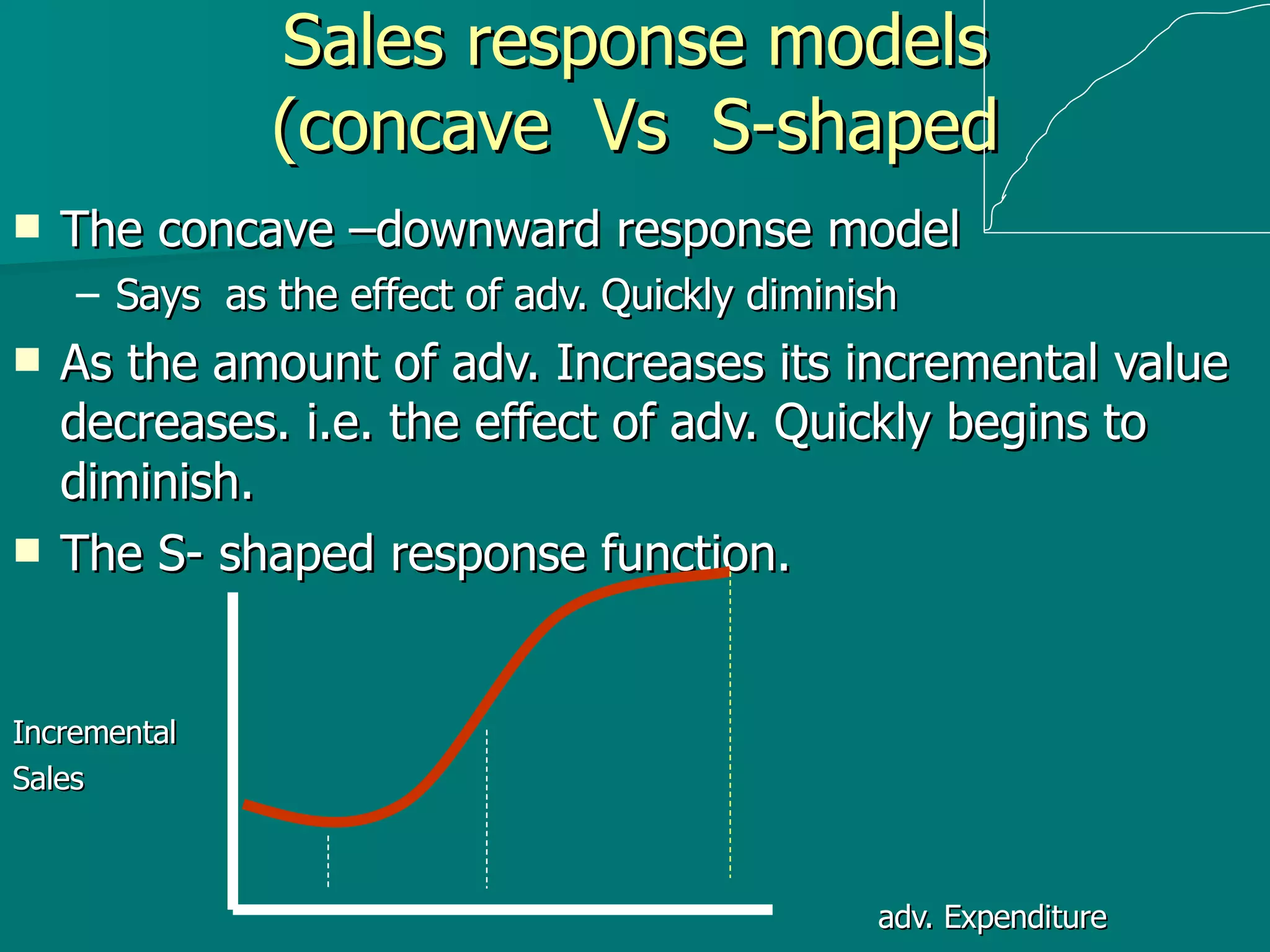
Sales response models (concave  Vs  S-shaped The concave –downward response model Says  as the effect of adv. Quickly diminish  As the amount of adv. Increases its incremental value decreases. i.e. the effect of adv. Quickly begins to diminish. The S- shaped response function. Incremental  Sales   adv. Expenditure
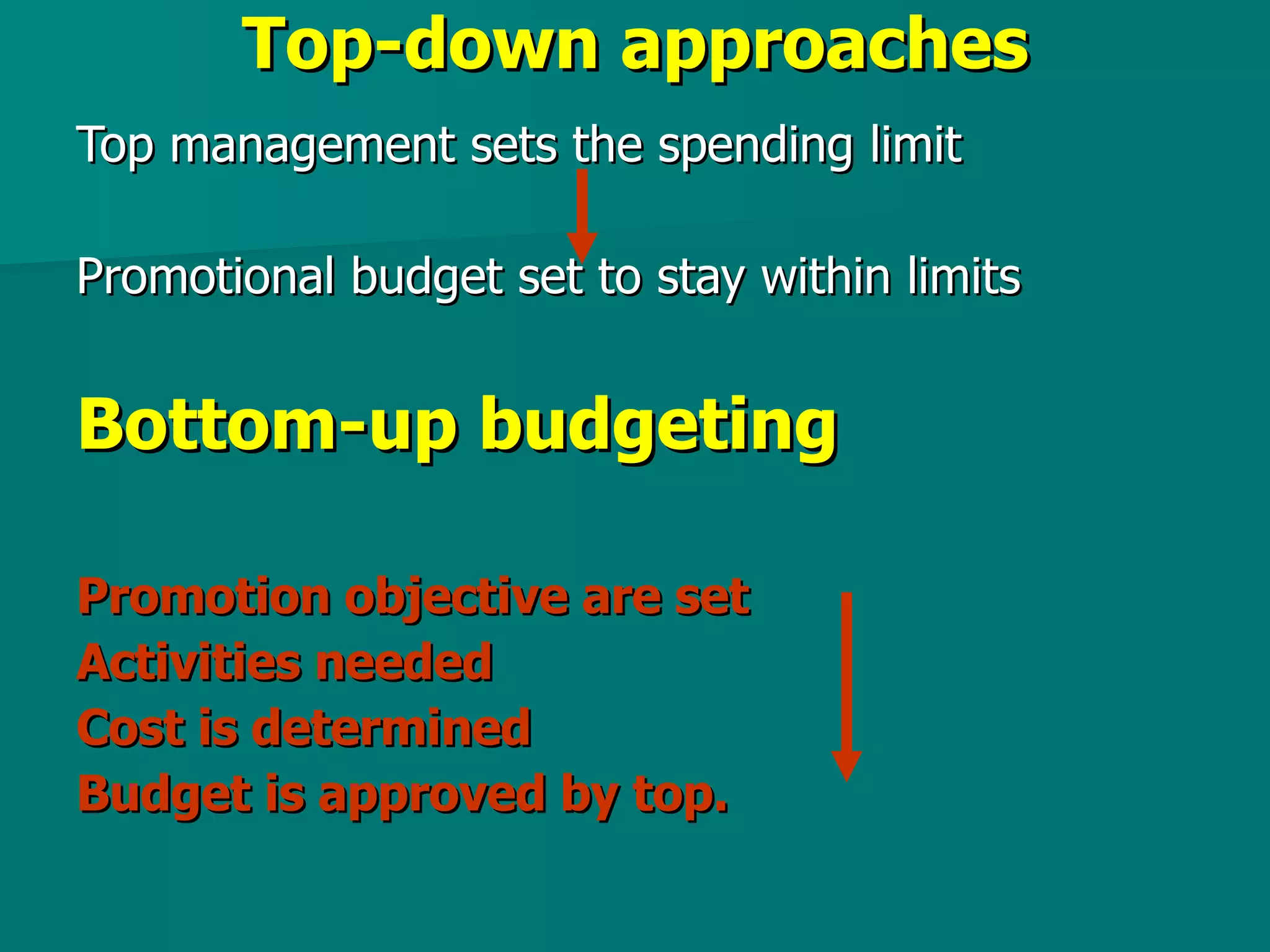
Top-down approaches Top management sets the spending limit Promotional budget set to stay within limits Bottom-up budgeting Promotion objective are set Activities needed Cost is determined  Budget is approved by top.
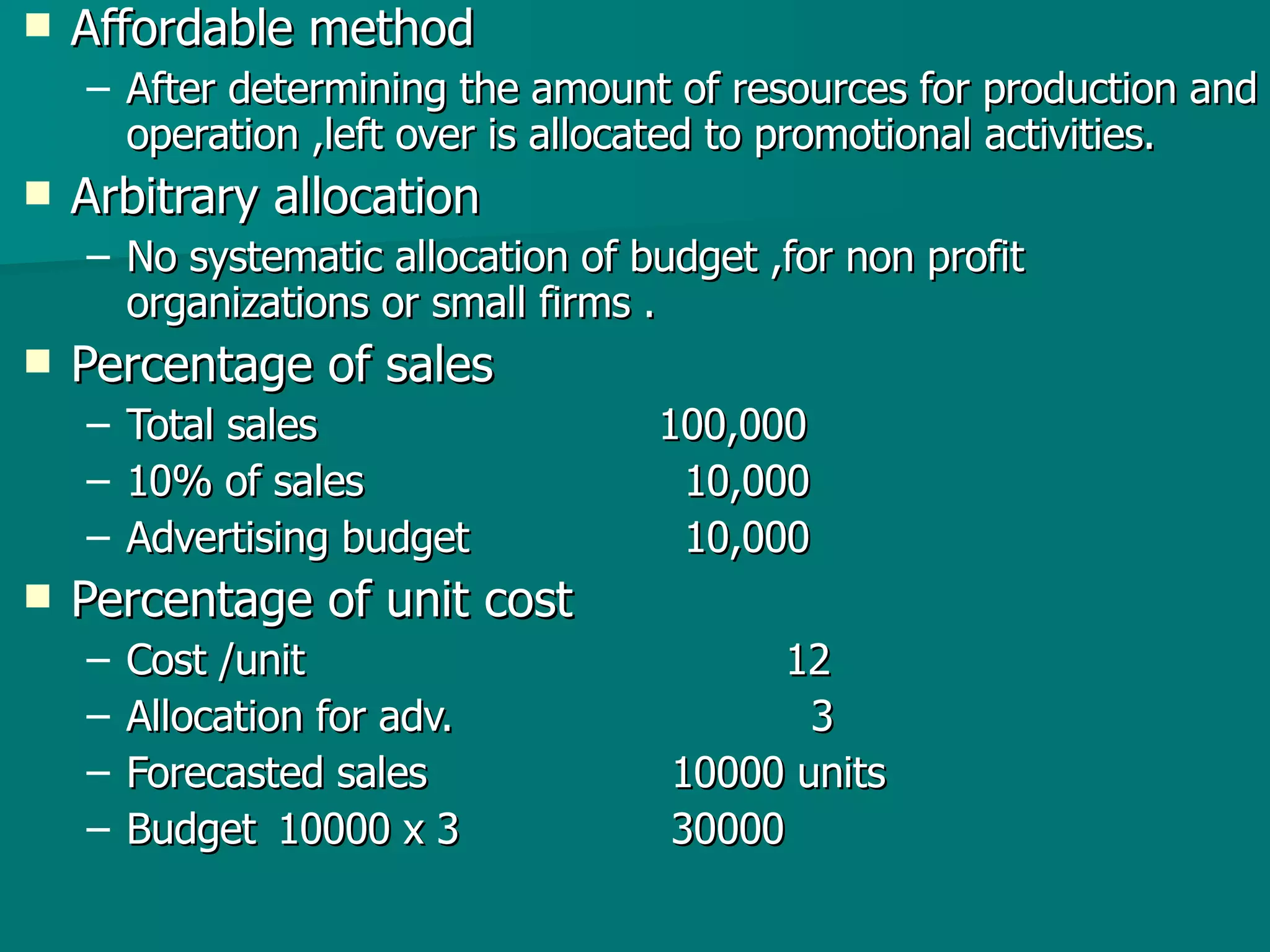
Affordable method  After determining the amount of resources for production and operation ,left over is allocated to promotional activities. Arbitrary allocation No systematic allocation of budget ,for non profit organizations or small firms . Percentage of sales  Total sales  100,000 10% of sales    10,000 Advertising budget     10,000 Percentage of unit cost Cost /unit 12 Allocation for adv.   3 Forecasted sales   10000 units  Budget  10000 x 3  30000
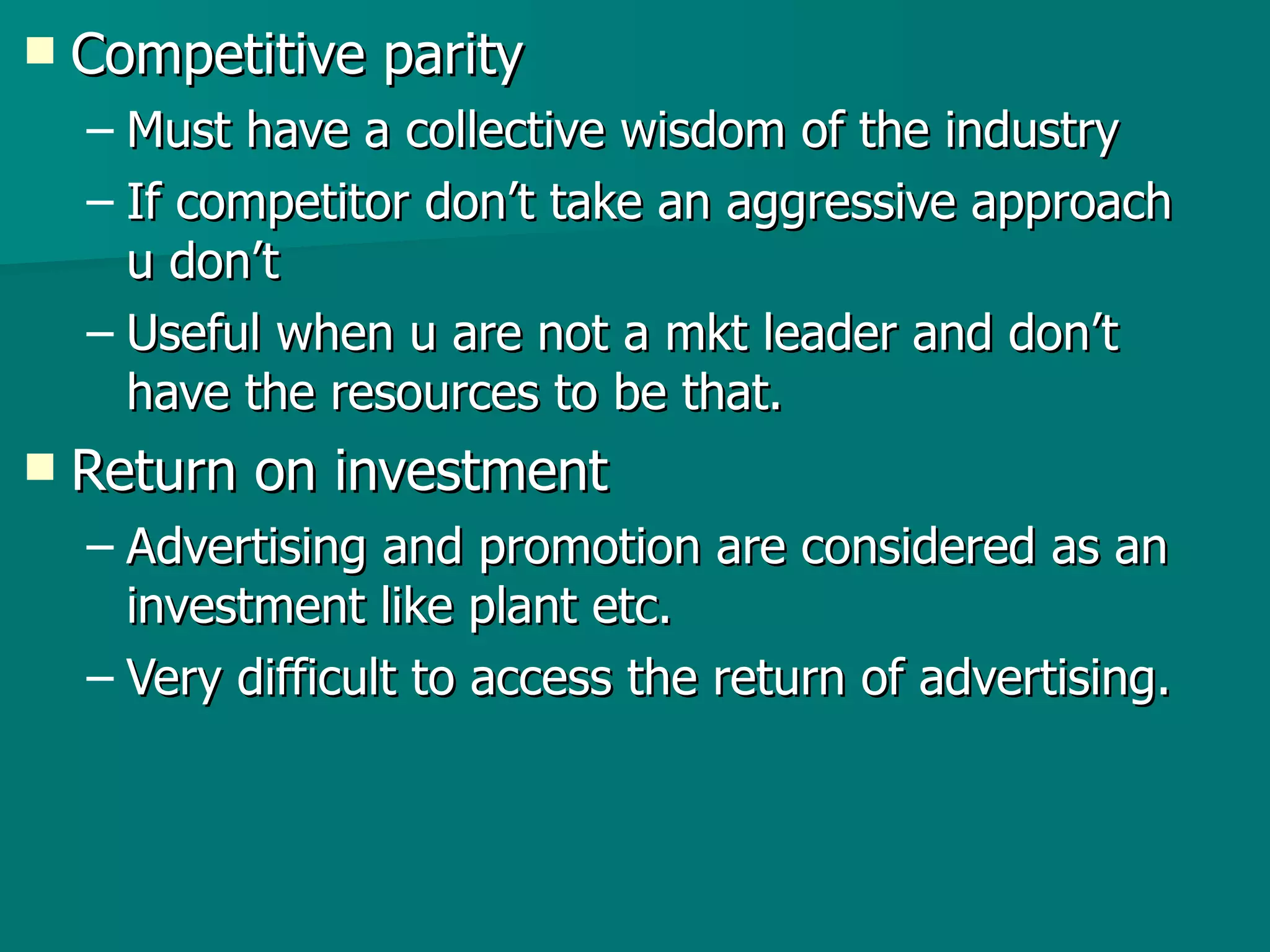
Competitive parity Must have a collective wisdom of the industry  If competitor don’t take an aggressive approach u don’t Useful when u are not a mkt leader and don’t have the resources to be that. Return on investment Advertising and promotion are considered as an investment like plant etc. Very difficult to access the return of advertising.

Communication Objectives

  • 1.
  • 2.
    Communication Objectives Areimportant because they serves as a bench mark in Communication Communications in b/w agencies and organizational managers/sales promotion firms /media buying services etc. Planning and decision making While in decision making process communication objectives plays an important role , i.e. how to develop a campaign/media mix selection /and allocating budget to diff. elements Measuring results The success and failure are relative to the objectives u have defined. Good objective are those which are measurable.
  • 3.
    How to determineobjectives Diff. in between marketing and comm. Objectives Marketing objectives are stated in firm’s overall mkting.plans. Are usually defined in terms of specific measurable outcomes such as sales volume /market share/profits/ROI. or What the company wanted to accomplish by its overall marketing program.
  • 4.
    Now by definingmarketing objective managers must be able to translate these objectives into communication objectives. To do this Situation analysis provides some valuable information's. Like : The mkt.segment the firm wanted to target and TA. The product and its convincing attributes to the segment. Competitors brand analysis. positioning/promotional expenditure /creative and media strategies /tactics used in ads. Etc) How u are going to position ur brand and specific behavior responses. Primary Vs secondary objectives. e.g. primary may be to increase sales /mkt share Secondary may be that u give a certain personality to the brand and start promoting the concept .
  • 5.
    Let’s see whatare comm. objectives Are statements of what various aspects of the IMC program will accomplish. Must translate general mkting goals into communications goals. Goals ? To get mkt share or to communicate the information or a selling message
  • 6.
    Some times udon’t get the desired increase sales by certain ad. Campaign. Does it means that advertising fails . Consider a football game . Same is the case of communication is just a quarterback of the team if team looses does not mean the quarterback should be shunted out from the team. Poor performance may be due to Quality / Packaging / Distribution /Price / tech./competition or even the economy Other important point in favor of advertising is that it has a carry over effect.
  • 7.
    Sales based objectives Some times only objective of the firm is to increase the sales. in such a situation the communication objectives may be: Direct response advertising. toll free numbers) Retail advertising Some times when Ad. Plays a very dominant role in the marketing plan.e.g is of Pepsi/coke , sales-oriented objective are used. Repositioning the product. When the promotional activities are related with sales-oriented objectives, measuring results depends upon the sales generated.
  • 8.
    Communication-based objectives Sometimes marketers recognize that the prime role of IMC is to communicate and planning should be based on communication objectives. Specific objectives may be to: Increase the % of consumers in the TM who associate some benefit or advantage with our brand . Increase the number of TA who prefer our brand over competitors Encourage the current user to use more frequently Engage new user who have never used the brand. When marketers only need to change of attitude /brand knowledge / image purchase intention ,consumers are not required to respond immediately u just wanted to create a favorable predisposition before purchase . Effect of advertising on consumers movement from awareness to action .consumer moves through stages of Cognition ----to--- affective----to-----co native Ad stimulate for direct response) Awareness knowledge liking preferences conviction purchase.
  • 9.
    Communication effect pyramid5% repurchase 20% trial 25% preference 40% liking 70 % knowledge 90 % awareness
  • 10.
    Some problems withcommunication objectives U can not measure in quantitative terms that how much the consumers are in the phase of knowledge ,liking ,preferences etc.(no formula to provide the information)
  • 11.
    DAGMAR an approachto setting objectives A report in the name of “Defining Advertising Goals for Measuring advertising Results” by Russell Colley and said: Advertising’s job,purly and simply is to communicate to a defined audience information and a frame of mind that stimulates action. Advertising succeed or fails depends upon how well it has communicated the desired information and attitudes to the right people at the right time and at the right cost.
  • 12.
    Communication task bebased on (according to Colley) Awareness ( making the consumer aware of the existence of the brand or company ) Comprehension Developing a understanding of what the product is and what it will do for the consumer. Conviction Developing a mental disposition in consumers mind Action Actual purchase or trial
  • 13.
    Characteristics of objectivesConcrete ,measurable tasks What Appeal /message to communicate Target audience Well defined target audience ,based on demographics/psychographics etc. Benchmark and degree to change sought That is present position of audiences and after the communication is been done . Specified time period Time in which advertising objectives is accomplished.
  • 14.
    Decisions that madediet Coke a success Previously diet drinks were Tab Due to heavy promotion /a good new taste (new formula secret known to a very few people) /brand name already known to world. Objectives of promotion were: To earn profit from the country’s increasing trends of weight consciousness Break the public’s perception that a soft drink has to lose its taste when it loses its calories. Wanted to expand its TM. Decision was made to sell it not on calories but on taste (Just for the taste of it) 26 % sales increases in first five yrs of introduction Risks involved were : If diet coke had flopped, it would have tarnished Coke’s image also.
  • 15.
    Marketing plan Communication in b/w communication analysis and budgeting is a two way interaction. Means objectives depends upon budgets also.
  • 16.
    Q Weather thecommunication budget is an expense or investment ? Some theoretical approaches on the issue. Marginal analysis Sales response models Top-down approaches Affordable method Arbitrary allocation Percentage of sales Competitive parity ROI
  • 17.
    Marginal analysis xaxis =exp. Y axis= sales f(A) = sales A = ad. expenditure Mf(A) = gross margin A P= Mf(a)-a = profit
  • 18.
    As advertising exp.Increases sales and gross margin also increases to a point but then starts declining. Profits = gross margin - adv.exp. Optimal level is A where marginal cost = marginal rev. But Sales are not the only objective of adv . For that reason Relation of adv. On sales does not have a very direct relation. For these reasons this approach is seldom used.
  • 19.
    Sales response models(concave Vs S-shaped The concave –downward response model Says as the effect of adv. Quickly diminish As the amount of adv. Increases its incremental value decreases. i.e. the effect of adv. Quickly begins to diminish. The S- shaped response function. Incremental Sales adv. Expenditure
  • 20.
    Top-down approaches Topmanagement sets the spending limit Promotional budget set to stay within limits Bottom-up budgeting Promotion objective are set Activities needed Cost is determined Budget is approved by top.
  • 21.
    Affordable method After determining the amount of resources for production and operation ,left over is allocated to promotional activities. Arbitrary allocation No systematic allocation of budget ,for non profit organizations or small firms . Percentage of sales Total sales 100,000 10% of sales 10,000 Advertising budget 10,000 Percentage of unit cost Cost /unit 12 Allocation for adv. 3 Forecasted sales 10000 units Budget 10000 x 3 30000
  • 22.
    Competitive parity Musthave a collective wisdom of the industry If competitor don’t take an aggressive approach u don’t Useful when u are not a mkt leader and don’t have the resources to be that. Return on investment Advertising and promotion are considered as an investment like plant etc. Very difficult to access the return of advertising.