Variations in consumer decision making   Depends upon the type of product  Low priced /routine /habitual  Reminder adv. Periodic promotion Prominent shelf position New products  High adv. Free sampling  Special price offer  High value coupons  Low knowledge about the product Ads with detail information  Sales personnel
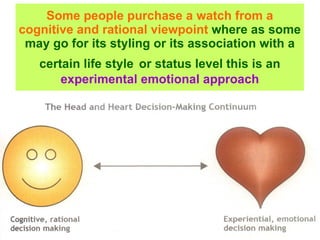
Some people purchase a watch from a cognitive and rational viewpoint  where as   some may go for its styling or its association with a certain life style   or status level this is an  experimental emotional approach
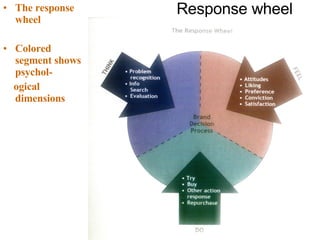
Response wheel The response wheel Colored segment shows psychol- ogical dimensions
Dec.process  Route    Products   Cognitive   think/feel/do cars, new products with high involvement Impulse do/feel/think    snacks, beverages, small house holds Experience feel/do/think restaurants, trade  shows, new products with sampling  demonstration Repeat/habit do/think/feel   Low priced
Consumer Learning Process Learning occurs intentionally (problem solving process) as well as un-intentionally. learning and memory theories are useful in understanding that how consumers wants and motives are acquired and how their tastes are developed, how frequently we are going to repeat our advertising , how visuals ,symbols ,sounds and other techniques can facilitates promotion.
Learning Can be defined as relatively permanent change on behavior occurring as a result of experience. (experience may be of purchase and consumption)
Types of learned behaviors Physical behavior We learn many physical behaviors to respond to a situation e.g. learn to walk , talk , interact with others, and also the method of responding to various purchase situations.  Consumers learn certain physical activity through the process of modeling, in which they mimic the behavior of other individual such as celebrities. Symbolic Learning and problem Solving  Traffic signs , McDonald's Golden arches, slogans etc. and also the cognitive process. One can also engage in problem-solving process of thinking and insight relations. Thinking involves the mental manipulation of symbols representing the real world to form meanings. This leads to insight that is relationships of products  with problems .e.g u may be interested in buying an alarm for car due to certain symbols or ads but after some insight knowledge that ur car is always in secured parking lots u decide not ot waste money and spend it for some thing else.
Affective Learning People learn to value certain elements of their environment and dislike others. This means that consumers learn many of their wants ,needs, motives as well as what products satisfy these needs. Learning also influence the consumers in developing a favorable or unfavorable attitudes towards some product.
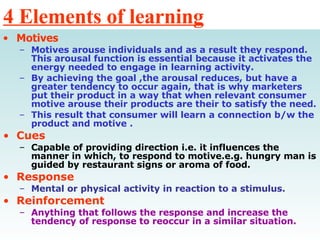
4 Elements of learning Motives Motives arouse individuals and as a result they respond. This arousal function is essential because it activates the energy needed to engage in learning activity. By achieving the goal ,the arousal reduces, but have a greater tendency to occur again, that is why marketers put their product in a way that when relevant consumer motive arouse their products are their to satisfy the need.  This result that consumer will learn a connection b/w the product and motive .  Cues Capable of providing direction i.e. it influences the manner in which, to respond to motive.e.g. hungry man is guided by restaurant signs or aroma of food.  Response Mental or physical activity in reaction to a stimulus. Reinforcement Anything that follows the response and increase the tendency of response to reoccur in a similar situation.
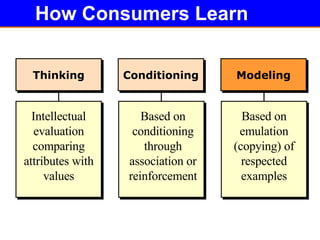
How Consumers Learn Conditioning Thinking Conditioning Based on conditioning through association or reinforcement Thinking Intellectual evaluation comparing attributes with values Modeling Based on emulation (copying) of respected examples
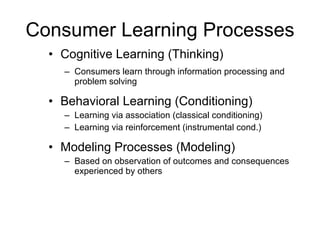
Consumer Learning Processes Cognitive Learning (Thinking) Consumers learn through information processing and problem solving Behavioral Learning (Conditioning) Learning via association (classical conditioning) Learning via reinforcement (instrumental cond.) Modeling Processes (Modeling) Based on observation of outcomes and consequences experienced by others
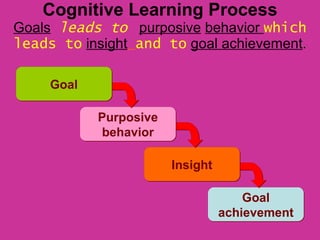
Cognitive Learning Process Goals   leads to   purposive   behavior  which leads to   insight   and to   goal achievement . Goal Goal achievement Insight Purposive behavior
Behavioral learning theory. Based on the fact that learning occurs through the connection b/w an external  stimuli and response (S-R).
Behavioral learning theory . Two approaches of the theory Classical conditioning Operant conditioning Classical conditioning Says that learning is an associative process with an already existing relationship b/w a stimuli and response. e.g. of  food and salivation  that is not taught rather it already exists. or we can say food is unconditional stimuli and so as unconditional response salivation.
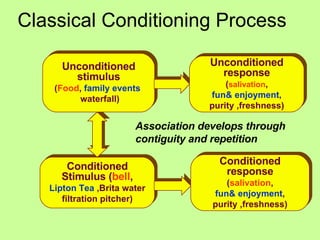
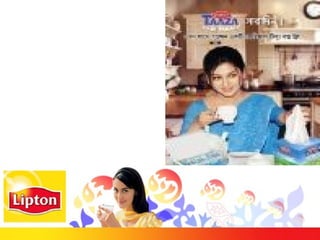
Classical Conditioning Process Association develops through contiguity and repetition Unconditioned stimulus ( Food ,  family events   waterfall) Conditioned Stimulus ( bell , Lipton Tea  ,Brita water filtration pitcher) Unconditioned response ( salivation , fun& enjoyment , purity ,freshness) Conditioned response ( salivation , fun& enjoyment , purity ,freshness)
 
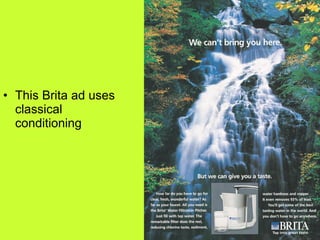
This Brita ad uses classical conditioning
Considerations while applying the theory Contiguity : unconditional and conditional stimuli must be close enough in time and space  Repetition: the more often the unconditional and conditional stumble occur together the stronger the association
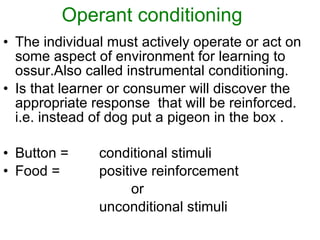
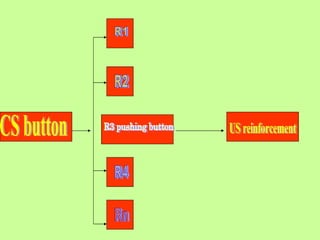
Operant conditioning The individual must actively operate or act on some aspect of environment for learning to ossur.Also called instrumental conditioning. Is that learner or consumer will discover the appropriate response  that will be reinforced. i.e. instead of dog put a pigeon in the box . Button = conditional stimuli Food = positive reinforcement  or  unconditional stimuli
R1 R2 R3 pushing button R4 Rn US reinforcement CS button
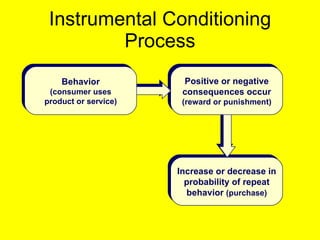
Instrumental Conditioning Process Behavior (consumer uses product or service) Increase or decrease in probability of repeat behavior  (purchase) Positive or negative consequences occur (reward or punishment)
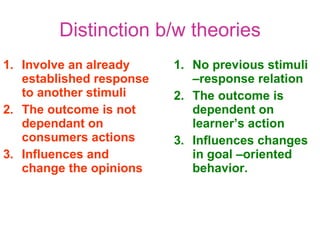
Distinction b/w theories Involve an already established response to another stimuli The outcome is not dependant on consumers actions Influences and change the opinions  No previous stimuli –response relation  The outcome is dependent on learner’s action Influences changes in goal –oriented behavior.
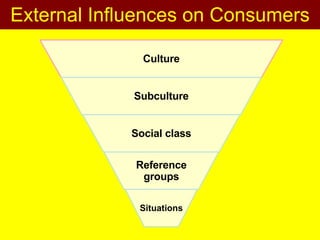
External Influences on Consumers Subculture Culture Social class Reference groups Situations
Environmental influences on consumer behavior Culture  That includes knowledge , belief, art,morals,law, customs, and any other capabilities and habits acquired by man as a member of society. every thing that is socially learned and shared by the members of society. Characteristics of culture   Culture is learned From one generation to an other
Culture is socially shared American culture in our society / TV programs etc. Culture are similar but diff . e.g. calendar / education/ family/ music/ gestures/ housing etc. Is persistent Cultural elements are handed down from generation to generations cant escape ur cultural heritage  Is adaptive But in spite of resistance culture is changing gradually rate of change varies. Organized as well as integrated. Tends to form a consistent and integrated as a whole.
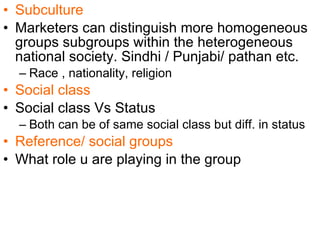
Subculture Marketers can distinguish more homogeneous groups subgroups within the heterogeneous national society. Sindhi / Punjabi/ pathan etc. Race , nationality, religion Social class Social class Vs Status Both can be of same social class but diff. in status   Reference/ social groups What role u are playing in the group
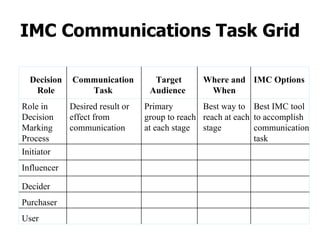
IMC Communications Task Grid Decision Role Communication Task Target Audience   Where and When IMC Options Desired result or effect from communication Primary  group to reach at each stage Best way to reach at each stage  Best IMC tool to accomplish communication task Role in  Decision Marking Process Initiator Influencer Decider Purchaser User
And the Chapter is finished…! THANK YOU!!

Consumer Behavior (Learning)

  • 1.
    Variations in consumerdecision making Depends upon the type of product Low priced /routine /habitual Reminder adv. Periodic promotion Prominent shelf position New products High adv. Free sampling Special price offer High value coupons Low knowledge about the product Ads with detail information Sales personnel
  • 2.
    Some people purchasea watch from a cognitive and rational viewpoint where as some may go for its styling or its association with a certain life style or status level this is an experimental emotional approach
  • 3.
    Response wheel Theresponse wheel Colored segment shows psychol- ogical dimensions
  • 4.
    Dec.process Route Products Cognitive think/feel/do cars, new products with high involvement Impulse do/feel/think snacks, beverages, small house holds Experience feel/do/think restaurants, trade shows, new products with sampling demonstration Repeat/habit do/think/feel Low priced
  • 5.
    Consumer Learning ProcessLearning occurs intentionally (problem solving process) as well as un-intentionally. learning and memory theories are useful in understanding that how consumers wants and motives are acquired and how their tastes are developed, how frequently we are going to repeat our advertising , how visuals ,symbols ,sounds and other techniques can facilitates promotion.
  • 6.
    Learning Can bedefined as relatively permanent change on behavior occurring as a result of experience. (experience may be of purchase and consumption)
  • 7.
    Types of learnedbehaviors Physical behavior We learn many physical behaviors to respond to a situation e.g. learn to walk , talk , interact with others, and also the method of responding to various purchase situations. Consumers learn certain physical activity through the process of modeling, in which they mimic the behavior of other individual such as celebrities. Symbolic Learning and problem Solving Traffic signs , McDonald's Golden arches, slogans etc. and also the cognitive process. One can also engage in problem-solving process of thinking and insight relations. Thinking involves the mental manipulation of symbols representing the real world to form meanings. This leads to insight that is relationships of products with problems .e.g u may be interested in buying an alarm for car due to certain symbols or ads but after some insight knowledge that ur car is always in secured parking lots u decide not ot waste money and spend it for some thing else.
  • 8.
    Affective Learning Peoplelearn to value certain elements of their environment and dislike others. This means that consumers learn many of their wants ,needs, motives as well as what products satisfy these needs. Learning also influence the consumers in developing a favorable or unfavorable attitudes towards some product.
  • 9.
    4 Elements oflearning Motives Motives arouse individuals and as a result they respond. This arousal function is essential because it activates the energy needed to engage in learning activity. By achieving the goal ,the arousal reduces, but have a greater tendency to occur again, that is why marketers put their product in a way that when relevant consumer motive arouse their products are their to satisfy the need. This result that consumer will learn a connection b/w the product and motive . Cues Capable of providing direction i.e. it influences the manner in which, to respond to motive.e.g. hungry man is guided by restaurant signs or aroma of food. Response Mental or physical activity in reaction to a stimulus. Reinforcement Anything that follows the response and increase the tendency of response to reoccur in a similar situation.
  • 10.
    How Consumers LearnConditioning Thinking Conditioning Based on conditioning through association or reinforcement Thinking Intellectual evaluation comparing attributes with values Modeling Based on emulation (copying) of respected examples
  • 11.
    Consumer Learning ProcessesCognitive Learning (Thinking) Consumers learn through information processing and problem solving Behavioral Learning (Conditioning) Learning via association (classical conditioning) Learning via reinforcement (instrumental cond.) Modeling Processes (Modeling) Based on observation of outcomes and consequences experienced by others
  • 12.
    Cognitive Learning ProcessGoals leads to purposive behavior which leads to insight and to goal achievement . Goal Goal achievement Insight Purposive behavior
  • 13.
    Behavioral learning theory.Based on the fact that learning occurs through the connection b/w an external stimuli and response (S-R).
  • 14.
    Behavioral learning theory. Two approaches of the theory Classical conditioning Operant conditioning Classical conditioning Says that learning is an associative process with an already existing relationship b/w a stimuli and response. e.g. of food and salivation that is not taught rather it already exists. or we can say food is unconditional stimuli and so as unconditional response salivation.
  • 15.
    Classical Conditioning ProcessAssociation develops through contiguity and repetition Unconditioned stimulus ( Food , family events waterfall) Conditioned Stimulus ( bell , Lipton Tea ,Brita water filtration pitcher) Unconditioned response ( salivation , fun& enjoyment , purity ,freshness) Conditioned response ( salivation , fun& enjoyment , purity ,freshness)
  • 16.
  • 17.
    This Brita aduses classical conditioning
  • 18.
    Considerations while applyingthe theory Contiguity : unconditional and conditional stimuli must be close enough in time and space Repetition: the more often the unconditional and conditional stumble occur together the stronger the association
  • 19.
    Operant conditioning Theindividual must actively operate or act on some aspect of environment for learning to ossur.Also called instrumental conditioning. Is that learner or consumer will discover the appropriate response that will be reinforced. i.e. instead of dog put a pigeon in the box . Button = conditional stimuli Food = positive reinforcement or unconditional stimuli
  • 20.
    R1 R2 R3pushing button R4 Rn US reinforcement CS button
  • 21.
    Instrumental Conditioning ProcessBehavior (consumer uses product or service) Increase or decrease in probability of repeat behavior (purchase) Positive or negative consequences occur (reward or punishment)
  • 22.
    Distinction b/w theoriesInvolve an already established response to another stimuli The outcome is not dependant on consumers actions Influences and change the opinions No previous stimuli –response relation The outcome is dependent on learner’s action Influences changes in goal –oriented behavior.
  • 23.
    External Influences onConsumers Subculture Culture Social class Reference groups Situations
  • 24.
    Environmental influences onconsumer behavior Culture That includes knowledge , belief, art,morals,law, customs, and any other capabilities and habits acquired by man as a member of society. every thing that is socially learned and shared by the members of society. Characteristics of culture Culture is learned From one generation to an other
  • 25.
    Culture is sociallyshared American culture in our society / TV programs etc. Culture are similar but diff . e.g. calendar / education/ family/ music/ gestures/ housing etc. Is persistent Cultural elements are handed down from generation to generations cant escape ur cultural heritage Is adaptive But in spite of resistance culture is changing gradually rate of change varies. Organized as well as integrated. Tends to form a consistent and integrated as a whole.
  • 26.
    Subculture Marketers candistinguish more homogeneous groups subgroups within the heterogeneous national society. Sindhi / Punjabi/ pathan etc. Race , nationality, religion Social class Social class Vs Status Both can be of same social class but diff. in status Reference/ social groups What role u are playing in the group
  • 27.
    IMC Communications TaskGrid Decision Role Communication Task Target Audience Where and When IMC Options Desired result or effect from communication Primary group to reach at each stage Best way to reach at each stage Best IMC tool to accomplish communication task Role in Decision Marking Process Initiator Influencer Decider Purchaser User
  • 28.
    And the Chapteris finished…! THANK YOU!!