MARKETING
COMMUNICATIONS
ADVERTISING, PUBLICITY
& BRAND MANAGEMENT
By
Himansu S M / 20-Jul-2013
THEORETICAL UNDERSTANDING
OF MARKETING
COMMUNICATIONS
• WHAT IS MARKETING
• The shortest definition of Marketing
Management is “Meeting Needs Profitably”.
WHAT IS MARKETED-1
Marketing people are involved in marketing 10
types of entities –
• Goods – physical products, consumer
products, consumer durables
• Services – transport, repair & maintenance,
legal, financial, consultancy, hotel, specialised
skills
• Experiences – theaters, opera, Disney-world,
ocean cruise, cinema, music concerts
WHAT IS MARKETED-2
• Events – trade shows, sports, world cups,
vintage car rally, fashion shows, artistic
performance shows
• Persons – celebrity marketing, film stars,
politicians, artists, performers, advertisers
• Places – cities, states, countries for tourism,
leisure & place for industrialisation & business
WHAT IS MARKETED-3
• Properties – ownership of tangible properties
like real estate, house, apartment, farm house,
precious metals and intangible properties like
financial portfolio of various securities
• Organisations – building up identity, image,
reputation, and value in the minds of
consumers
WHAT IS MARKETED-4
• Informations – can be packaged & marketed
as a product – text books, encyclopaedias,
magazines & journals on literature, science,
technology, medicine space, now available
thru internet
• Ideas – concept regarding a utility, business
opportunity, advertising / marketing ideas,
scientific & technical, social, financial,
psychological etc.
MARKETING
COMMUNICATIONS
• The “Communications” in the marketing
context is in the 4th “P” - “PROMOTION” of the
4Ps of Marketing. The 4Ps are :
• PRODUCT,
• PRICE,
• PLACE &
• PROMOTION
INTRODUCTION
• Modern marketing process involves
something more than just developing a good
product, pricing it attractively & making it
accessible. It calls for communication with the
present & potential stakeholders & the
general public. For most companies today, the
question is not whether to communicate, but
rather what to say, to whom, & how often.
INTRODUCTION
• In a simple marketing system there is a two-
way flow of entities between
• the “Industry” (a collection of marketers) and
• the “Market” (a collection of buyers)
• They are given in the following matrix, and we
clearly see that it’s a two-way process:
FLOW OF ENTITIES
Entities that flow from
Industry to Market are
• Goods / Services,
• Communications.
Entities that flow from
Market to Industry are
• Money,
• Information /
Feedback.
COMMUNICATIONS
• Communication and information have attained so
much of refinement and popularity, that the
world has become a global village.
• Despite the incidents of hatred and distrust, the
world has shown that it is united by the instant &
relentless communications.
• In addition to being a global force communication
is the unique tool that marketers use to persuade
the consumers to act as in a desired way, say to
vote, to buy, to donate, to patronise, etc.
COMMUNICATIONS
• Communications take many forms, like verbal,
visual or symbolic, and convey special meaning
that the marketers want to impart to the
consumers.
• Communications can evoke emotions that put
consumers in more receptive frames of mind, and
it can encourage purchases that help consumers
solve problems or avoid negative outcomes.
• In short, Communications is the bridge between
marketers & consumers, and between consumers
& their socio-cultural environments.
THE MARKETING
COMMUNICATIONS MIX
• This is a way of looking at the whole
marketing process from the viewpoint of the
customer (-Kotler).
• The modern marketing communications mix
(also called the Promotional mix) consists of
Six major tools or models of communications
(which may be further sub-divided), they are:
THE MC MIX – 1 & 2
–Advertising: Any paid form of nonpersonal
presentation & promotion of ideas, goods,
or services by an identified sponsor.
–Sales Promotion: A variety of short term
incentives to encourage trial or purchase of
a product or service.
THE MC MIX – 3 & 4
–Public Relations & Publicity: A variety of
programmes designed to promote or
protect a company’s image or its individual
products.
–Personal Selling: Face-to-Face interactions
with one or more prospective purchasers
for the purpose of making presentations,
answering questions, and procuring orders.
THE MC MIX – 5 & 6
–Direct & Interactive Marketing: Use of mail,
telephone, fax, e-mail, or internet to
communicate directly with or solicit
response or dialogue from specific
customers and prospects.
–Events & Experiences: Company sponsored
activities and programmes designed to
create daily or special brand related
interactions.
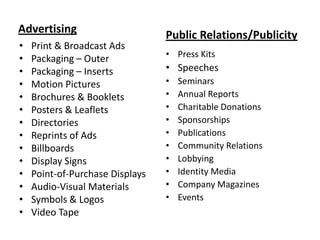
Advertising
• Print & Broadcast Ads
• Packaging – Outer
• Packaging – Inserts
• Motion Pictures
• Brochures & Booklets
• Posters & Leaflets
• Directories
• Reprints of Ads
• Billboards
• Display Signs
• Point-of-Purchase Displays
• Audio-Visual Materials
• Symbols & Logos
• Video Tape
Public Relations/Publicity
• Press Kits
• Speeches
• Seminars
• Annual Reports
• Charitable Donations
• Sponsorships
• Publications
• Community Relations
• Lobbying
• Identity Media
• Company Magazines
• Events
HIMANSU S M / 10-JUL-2013
THANK YOU

Marketing Communications - 1 Introduction

  • 1.
    MARKETING COMMUNICATIONS ADVERTISING, PUBLICITY & BRANDMANAGEMENT By Himansu S M / 20-Jul-2013
  • 2.
    THEORETICAL UNDERSTANDING OF MARKETING COMMUNICATIONS •WHAT IS MARKETING • The shortest definition of Marketing Management is “Meeting Needs Profitably”.
  • 3.
    WHAT IS MARKETED-1 Marketingpeople are involved in marketing 10 types of entities – • Goods – physical products, consumer products, consumer durables • Services – transport, repair & maintenance, legal, financial, consultancy, hotel, specialised skills • Experiences – theaters, opera, Disney-world, ocean cruise, cinema, music concerts
  • 4.
    WHAT IS MARKETED-2 •Events – trade shows, sports, world cups, vintage car rally, fashion shows, artistic performance shows • Persons – celebrity marketing, film stars, politicians, artists, performers, advertisers • Places – cities, states, countries for tourism, leisure & place for industrialisation & business
  • 5.
    WHAT IS MARKETED-3 •Properties – ownership of tangible properties like real estate, house, apartment, farm house, precious metals and intangible properties like financial portfolio of various securities • Organisations – building up identity, image, reputation, and value in the minds of consumers
  • 6.
    WHAT IS MARKETED-4 •Informations – can be packaged & marketed as a product – text books, encyclopaedias, magazines & journals on literature, science, technology, medicine space, now available thru internet • Ideas – concept regarding a utility, business opportunity, advertising / marketing ideas, scientific & technical, social, financial, psychological etc.
  • 7.
    MARKETING COMMUNICATIONS • The “Communications”in the marketing context is in the 4th “P” - “PROMOTION” of the 4Ps of Marketing. The 4Ps are : • PRODUCT, • PRICE, • PLACE & • PROMOTION
  • 8.
    INTRODUCTION • Modern marketingprocess involves something more than just developing a good product, pricing it attractively & making it accessible. It calls for communication with the present & potential stakeholders & the general public. For most companies today, the question is not whether to communicate, but rather what to say, to whom, & how often.
  • 9.
    INTRODUCTION • In asimple marketing system there is a two- way flow of entities between • the “Industry” (a collection of marketers) and • the “Market” (a collection of buyers) • They are given in the following matrix, and we clearly see that it’s a two-way process:
  • 10.
    FLOW OF ENTITIES Entitiesthat flow from Industry to Market are • Goods / Services, • Communications. Entities that flow from Market to Industry are • Money, • Information / Feedback.
  • 11.
    COMMUNICATIONS • Communication andinformation have attained so much of refinement and popularity, that the world has become a global village. • Despite the incidents of hatred and distrust, the world has shown that it is united by the instant & relentless communications. • In addition to being a global force communication is the unique tool that marketers use to persuade the consumers to act as in a desired way, say to vote, to buy, to donate, to patronise, etc.
  • 12.
    COMMUNICATIONS • Communications takemany forms, like verbal, visual or symbolic, and convey special meaning that the marketers want to impart to the consumers. • Communications can evoke emotions that put consumers in more receptive frames of mind, and it can encourage purchases that help consumers solve problems or avoid negative outcomes. • In short, Communications is the bridge between marketers & consumers, and between consumers & their socio-cultural environments.
  • 13.
    THE MARKETING COMMUNICATIONS MIX •This is a way of looking at the whole marketing process from the viewpoint of the customer (-Kotler). • The modern marketing communications mix (also called the Promotional mix) consists of Six major tools or models of communications (which may be further sub-divided), they are:
  • 14.
    THE MC MIX– 1 & 2 –Advertising: Any paid form of nonpersonal presentation & promotion of ideas, goods, or services by an identified sponsor. –Sales Promotion: A variety of short term incentives to encourage trial or purchase of a product or service.
  • 15.
    THE MC MIX– 3 & 4 –Public Relations & Publicity: A variety of programmes designed to promote or protect a company’s image or its individual products. –Personal Selling: Face-to-Face interactions with one or more prospective purchasers for the purpose of making presentations, answering questions, and procuring orders.
  • 16.
    THE MC MIX– 5 & 6 –Direct & Interactive Marketing: Use of mail, telephone, fax, e-mail, or internet to communicate directly with or solicit response or dialogue from specific customers and prospects. –Events & Experiences: Company sponsored activities and programmes designed to create daily or special brand related interactions.
  • 17.
    Advertising • Print &Broadcast Ads • Packaging – Outer • Packaging – Inserts • Motion Pictures • Brochures & Booklets • Posters & Leaflets • Directories • Reprints of Ads • Billboards • Display Signs • Point-of-Purchase Displays • Audio-Visual Materials • Symbols & Logos • Video Tape Public Relations/Publicity • Press Kits • Speeches • Seminars • Annual Reports • Charitable Donations • Sponsorships • Publications • Community Relations • Lobbying • Identity Media • Company Magazines • Events
  • 18.
    HIMANSU S M/ 10-JUL-2013 THANK YOU