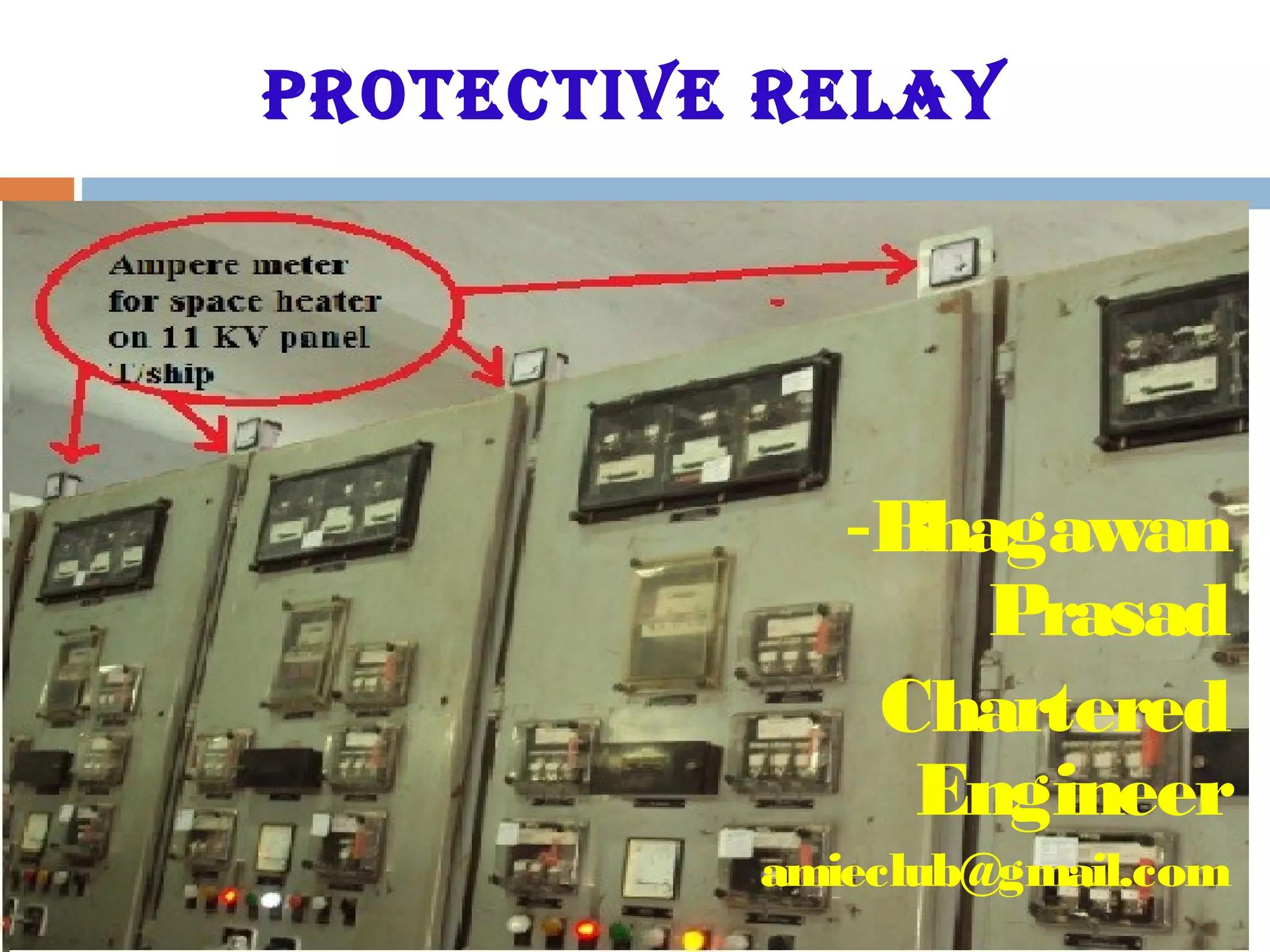
Protective relay
-Bhagawan
Prasad
Chartered
Engineer
amieclub@gmail.com
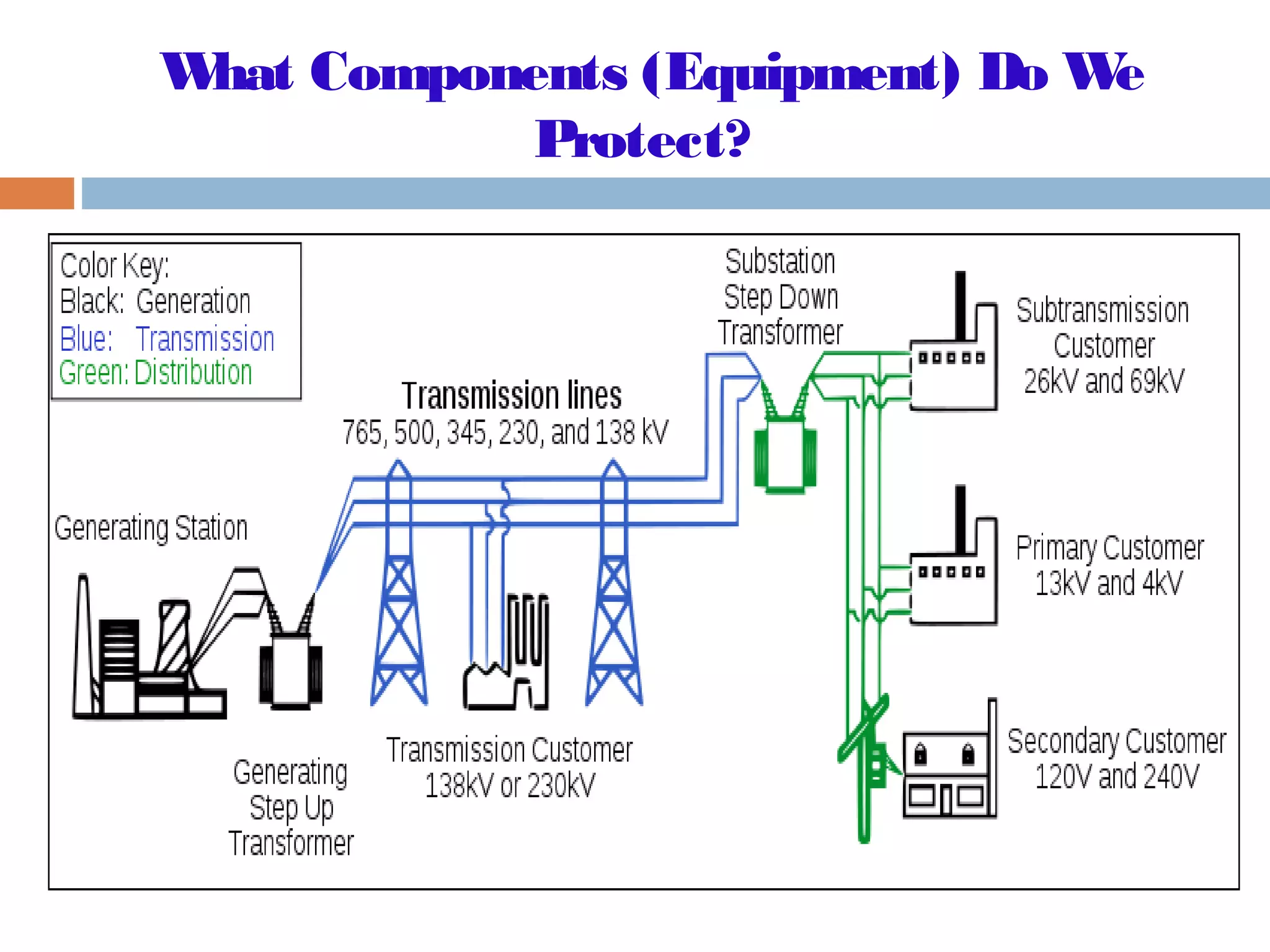
What Components (Equipment) Do We
Protect?
content
1. Introduction to Protective Relay
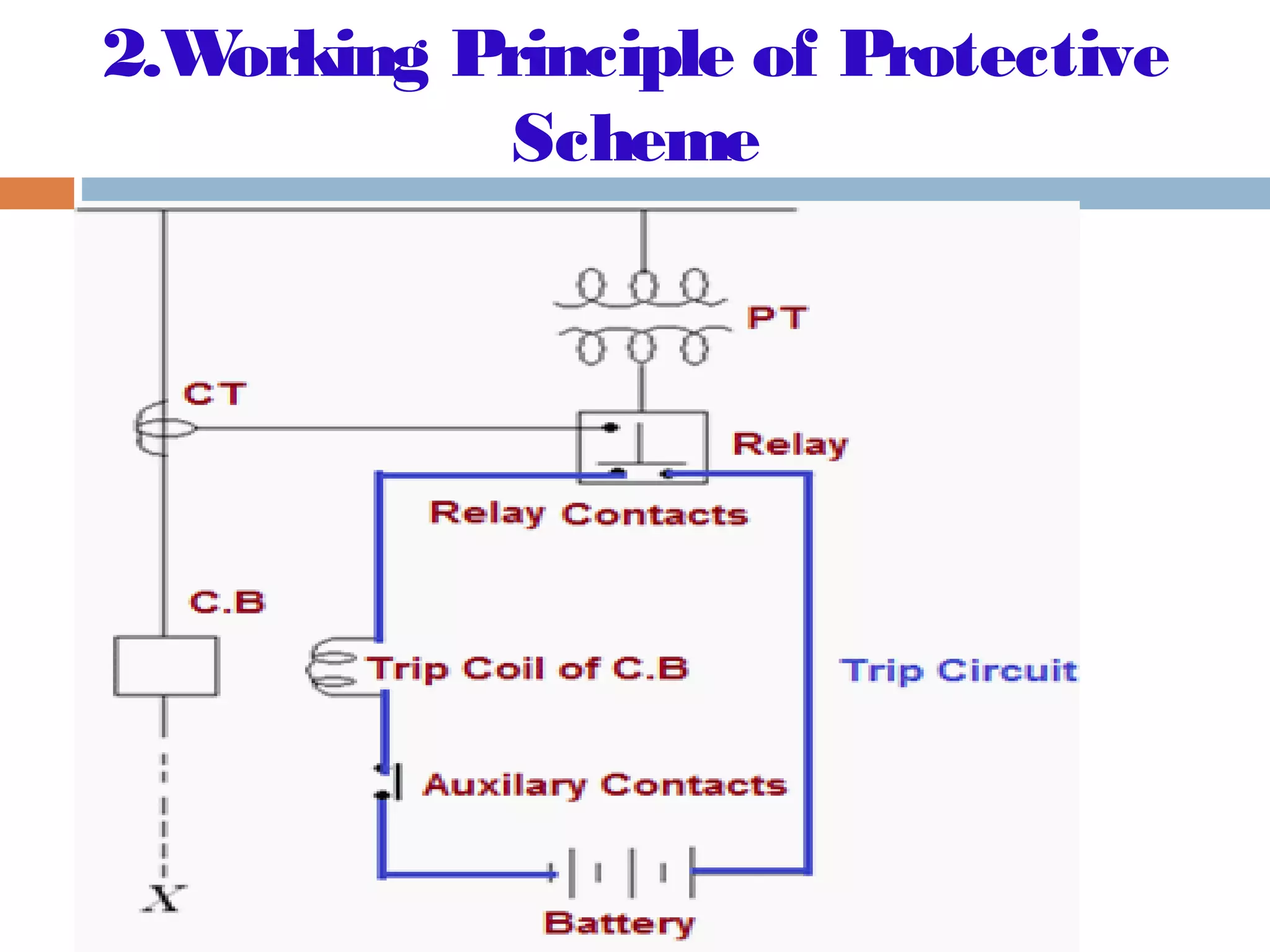
2. Working Principle of Protective Scheme
3. What is Relay?
4. Functions of Protective Relay
5. Desirable qualities of protective relaying
6. Terminology of protective relay
7. History of Protective Relay
8. Types of Relays
9. Types of Relay based on Relay Operation
Mechanism
10. Protective relay testing: Test relays of all
1.introduction to Protective relay
 Protectiverelay works in the way of sensing
and control devices to accomplish its
function. Under normal power system
operation, a protective relay remains idleand
serves no active function.
 whe n fault o r unde sirable co nditio n arrive s
Pro te ctive Re lay m ust be o pe rate d and
functio n co rre ctly.
 Failure o f a pro te ctive re lay can re sult in
de vastating e q uipm e nt dam ag e and
pro lo ng e d do wntim e .
2.Working Principle of Protective
Scheme
3.What is Relay?
A relay is automatic device
which senses an abnormal
condition of electrical circuit
and closes its contacts.
Thus the fault is se nse d and
the trip circuit is actuate d by
the re lay and the faulty part is
iso late d.
4.Functions oF Protective relay
 To sound an alarm or to close the trip circuit
 To disconnect the abnormally operating part
so as to prevent subsequent faults
 To isolateor disconnect faulted circuits or
equipment
 To localizetheeffect of fault to improve
system stability, service continuity and
system performance.
 To minimize hazards to personnel.
5. Desirable Qualities of Protective
Relaying
 Selectivity,
 Discrimination
 Stability
 Sensitivity,
 Power consumption
 System Security
 Reliability
 Adequateness
 Speed & Time
6.Terminology of protective
relay
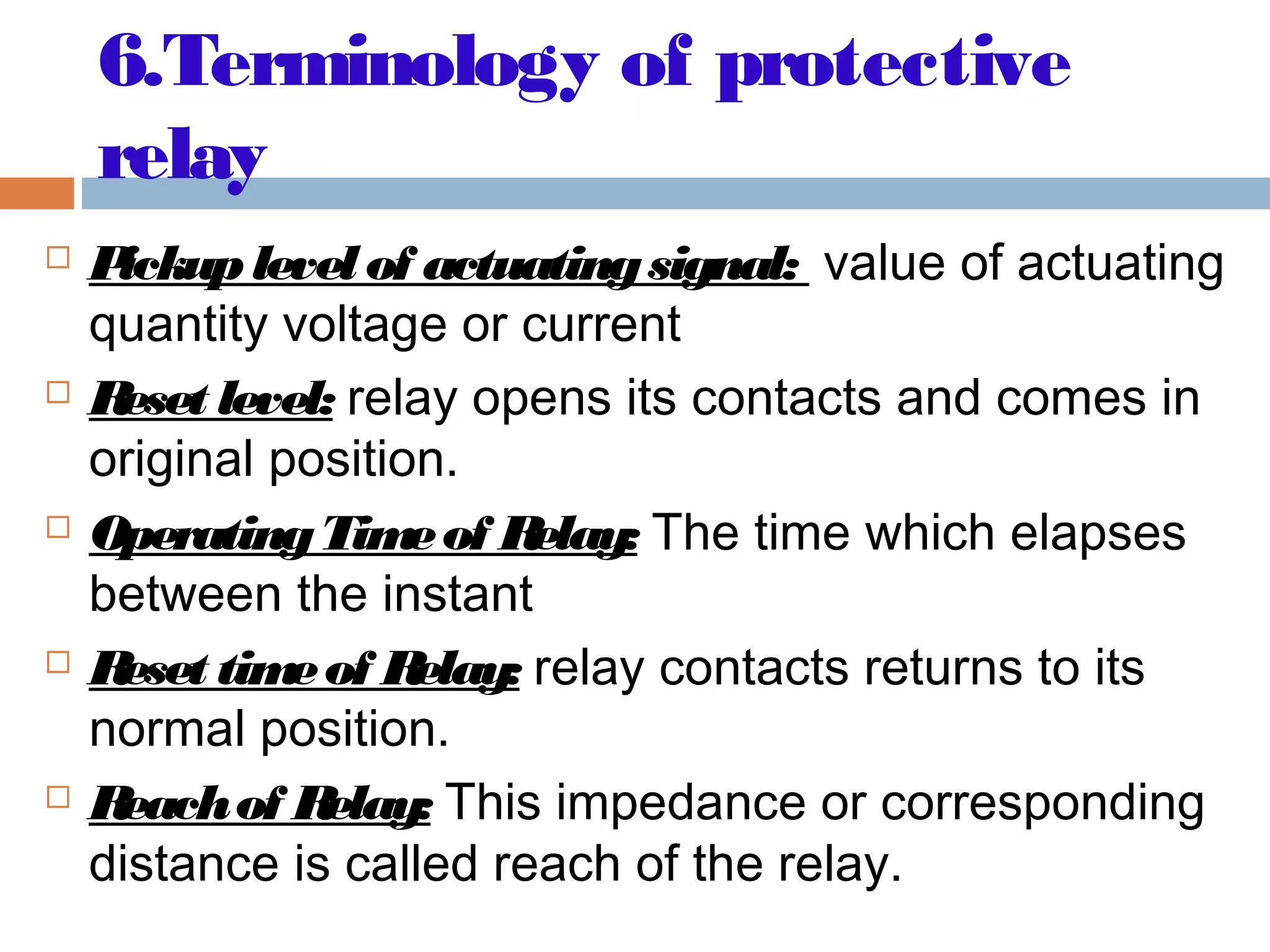
 Pickuplevel of actuatingsignal: value of actuating
quantity voltage or current
 Reset level: relay opens its contacts and comes in
original position.
 OperatingTimeof Relay: The time which elapses
between the instant
 Reset timeof Relay: relay contacts returns to its
normal position.
 Reachof Relay: This impedance or corresponding
distance is called reach of the relay.
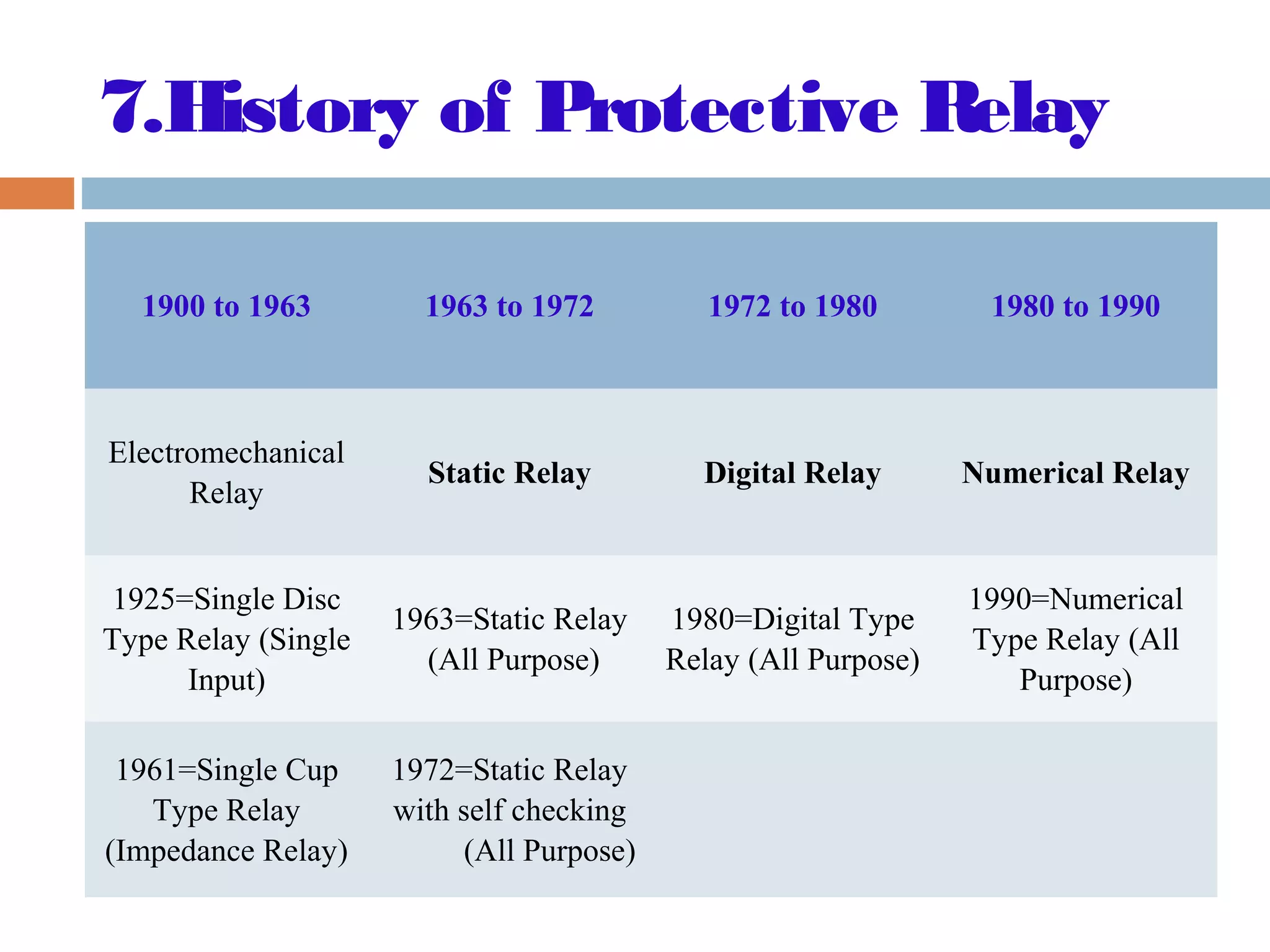
7.History of Protective Relay
1900 to 1963 1963 to 1972 1972 to 1980 1980 to 1990
Electromechanical
Relay
Static Relay Digital Relay Numerical Relay
1925=Single Disc
Type Relay (Single
Input)
1963=Static Relay
(All Purpose)
1980=Digital Type
Relay (All Purpose)
1990=Numerical
Type Relay (All
Purpose)
1961=Single Cup
Type Relay
(Impedance Relay)
1972=Static Relay
with self checking
(All Purpose)
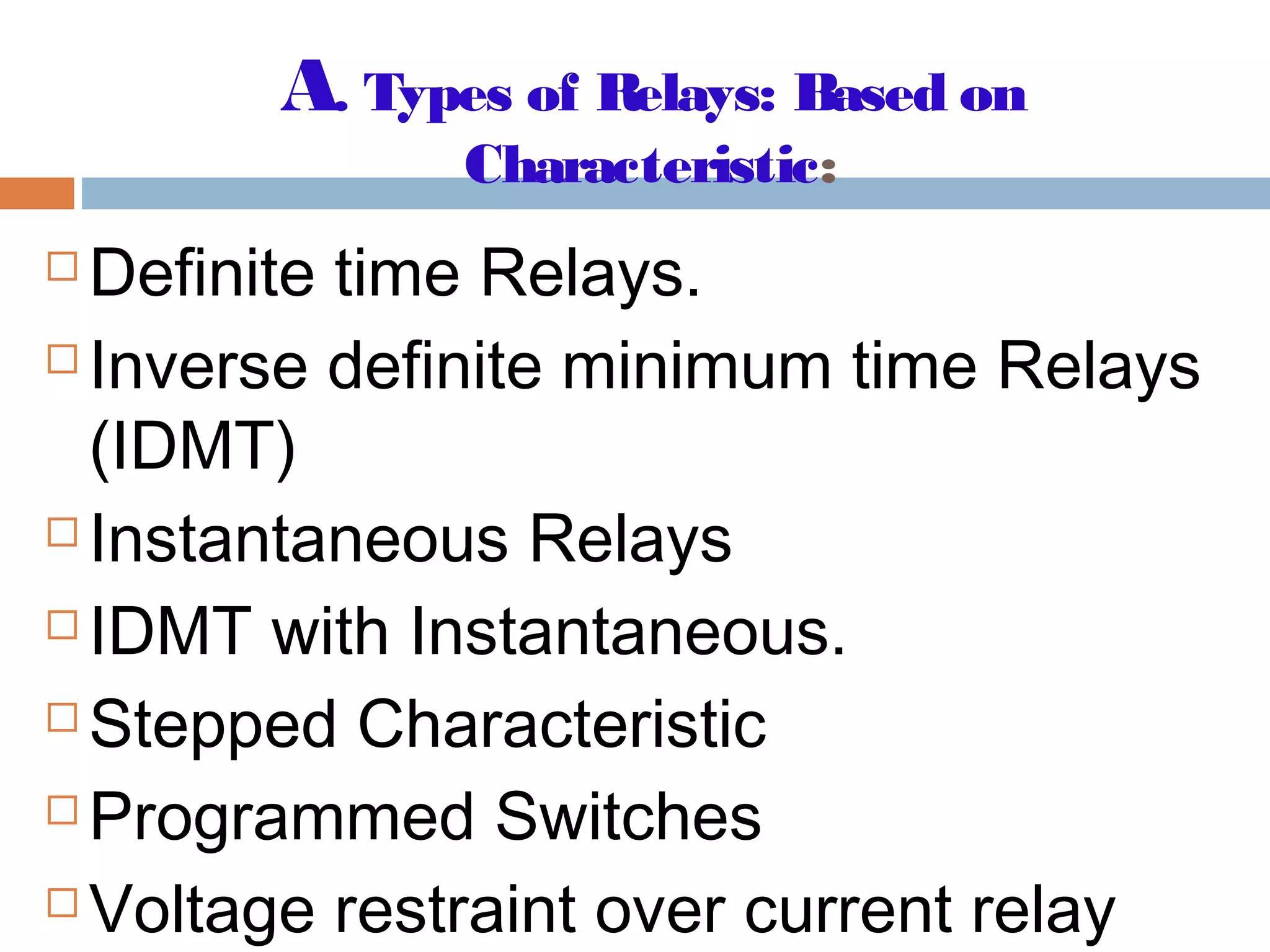
A. Types of Relays: Based on
Characteristic:
 Definite time Relays.
 Inverse definite minimum time Relays
(IDMT)
 Instantaneous Relays
 IDMT with Instantaneous.
 Stepped Characteristic
 Programmed Switches
 Voltage restraint over current relay
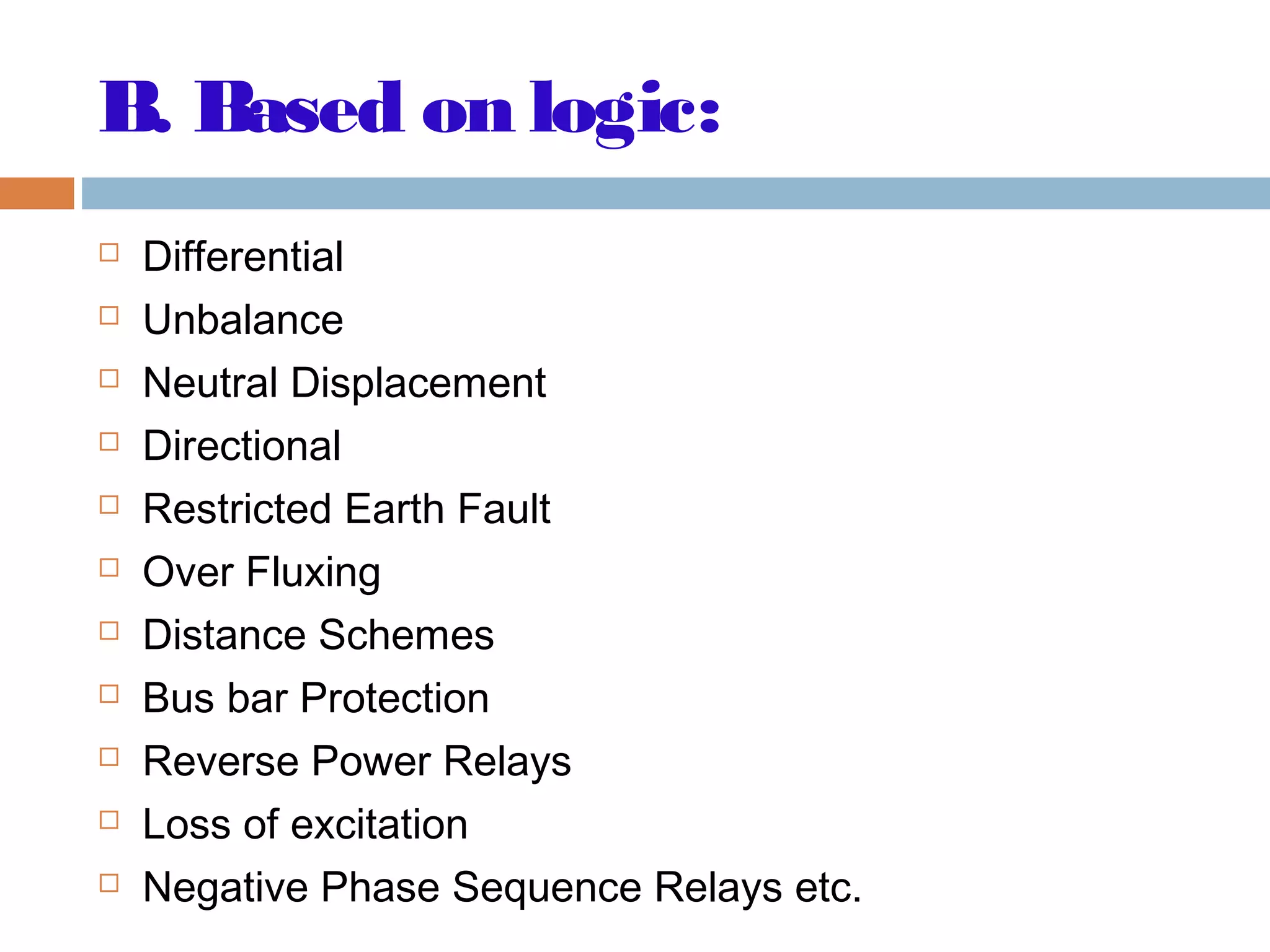
B. Based on logic:
 Differential
 Unbalance
 Neutral Displacement
 Directional
 Restricted Earth Fault
 Over Fluxing
 Distance Schemes
 Bus bar Protection
 Reverse Power Relays
 Loss of excitation
 Negative Phase Sequence Relays etc.
C. Based on Actuating parameter:
Current Relays
Voltage Relays
Frequency Relays
Power Relays etc.
D. Based on Operation Mechanism:
 1. Electro Magnetic Relay
2. Static Relay
……• Analog Relay
……• Digital Relay
……• Numerical /Microprocessor Relay
3. Mechanical relay
 Thermal
• OT Trip (O ilTe m pe rature Trip )
• WT Trip (Winding Te m pe rature Trip )
• Bearing Temp Trip etc.
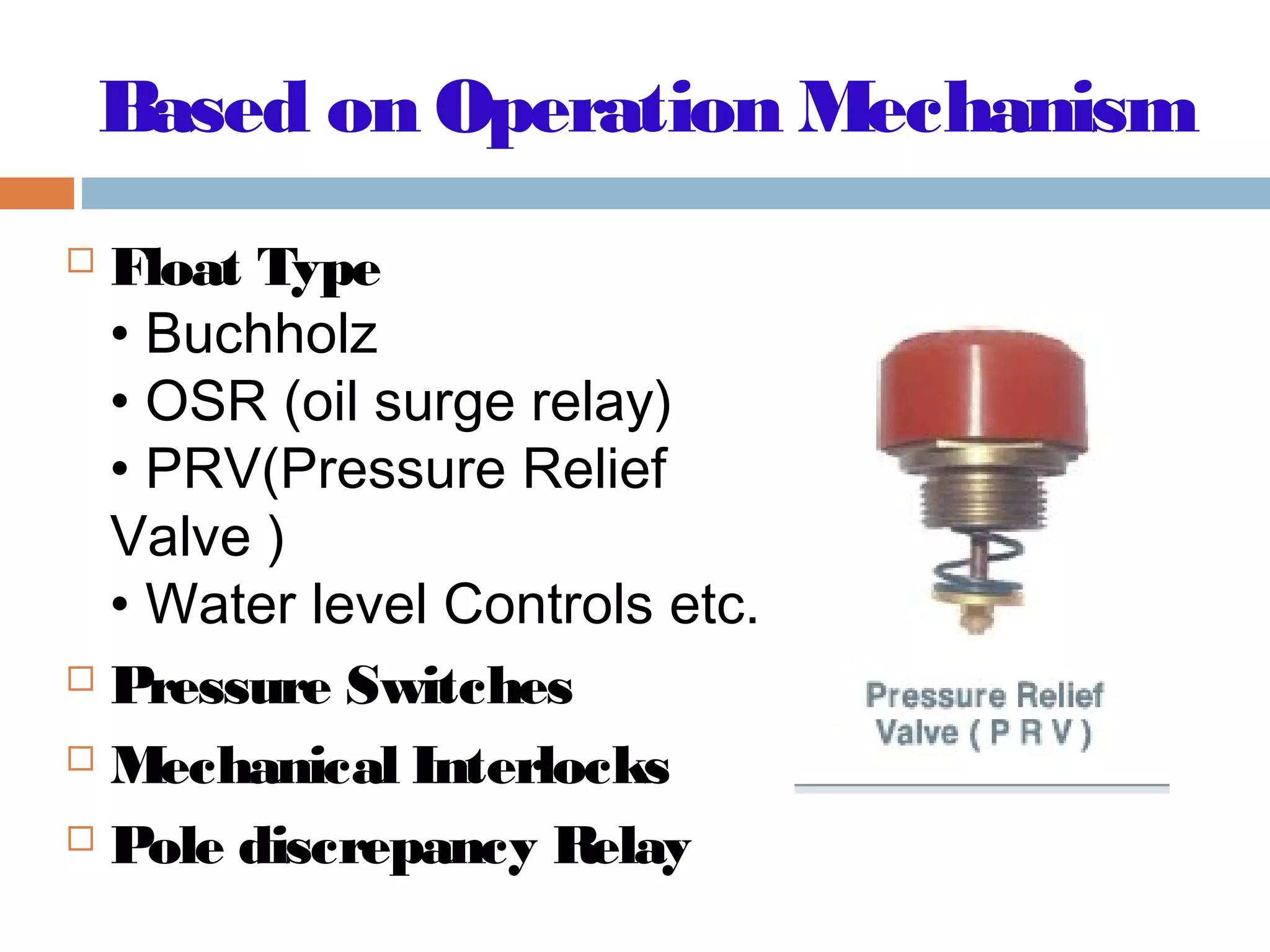
Based on Operation Mechanism
 Float Type
• Buchholz
• OSR (oil surge relay)
• PRV(Pressure Relief
Valve )
• Water level Controls etc.
 Pressure Switches
 Mechanical Interlocks
 Pole discrepancy Relay
E. Based on Applications
Primary Relays
Backup Relays
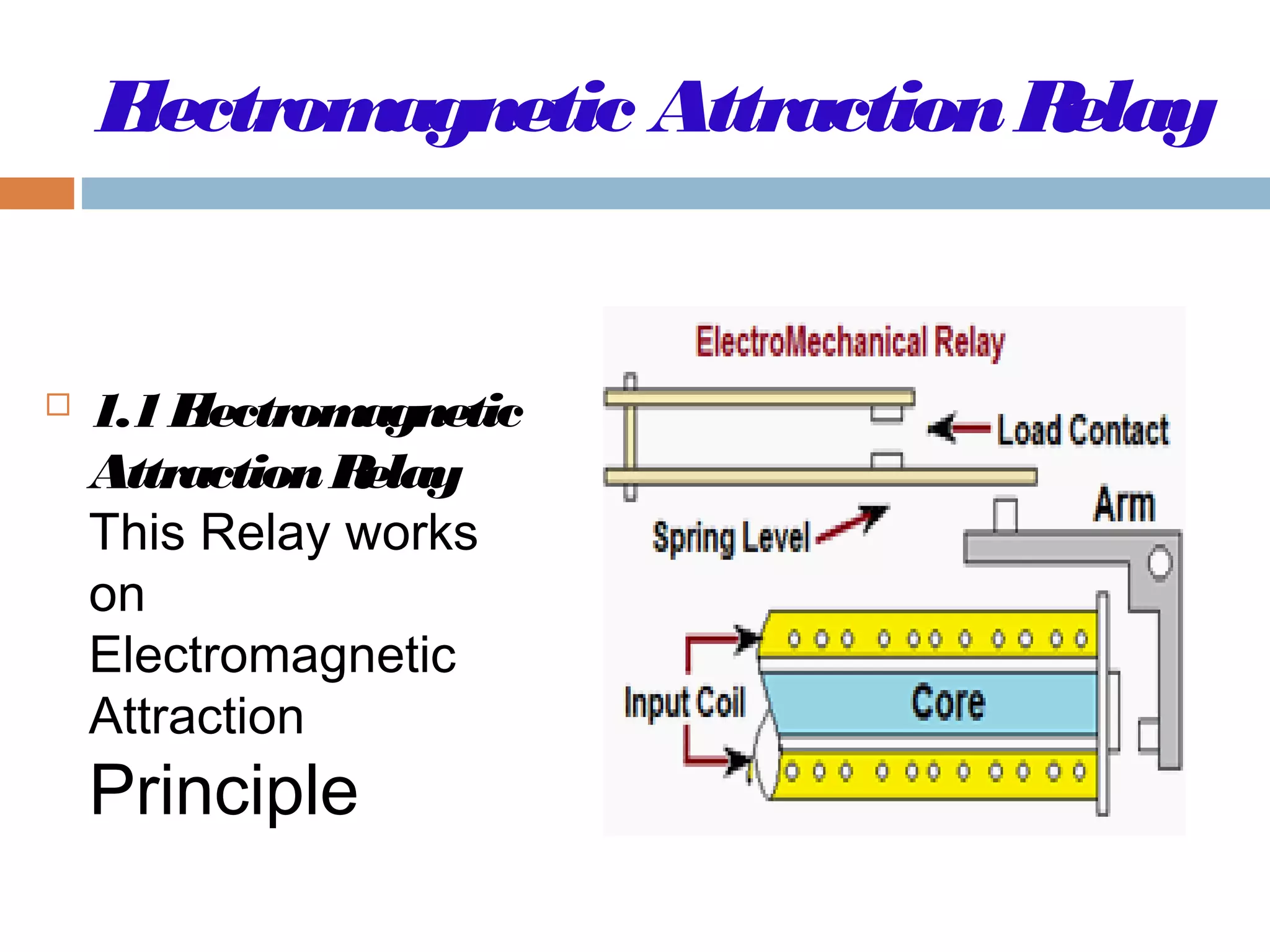
Electromagnetic AttractionRelay
 1.1Electromagnetic
AttractionRelay
This Relay works
on
Electromagnetic
Attraction
Principle
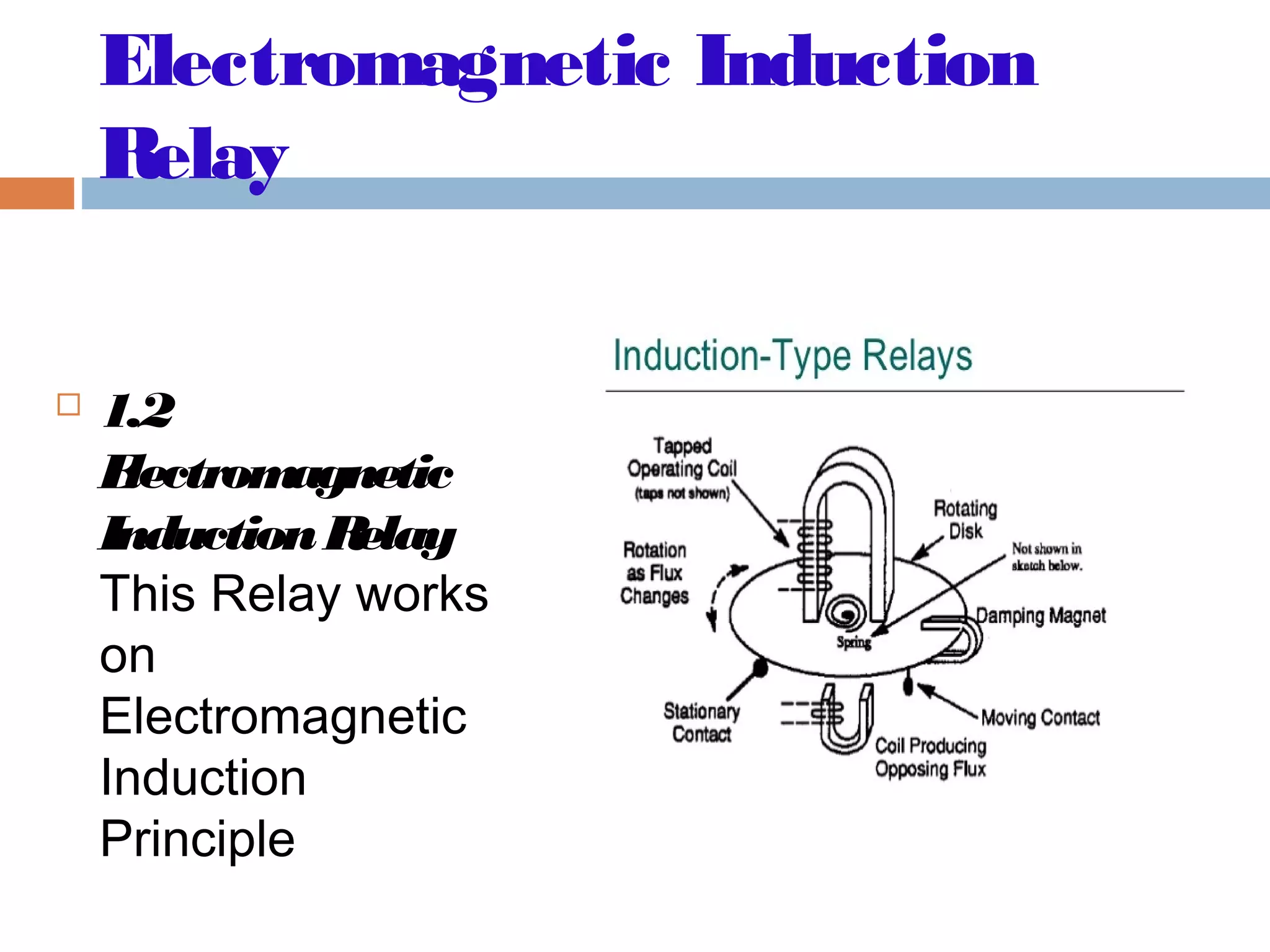
Electromagnetic Induction
Relay
 1.2
Electromagnetic
InductionRelay
This Relay works
on
Electromagnetic
Induction
Principle
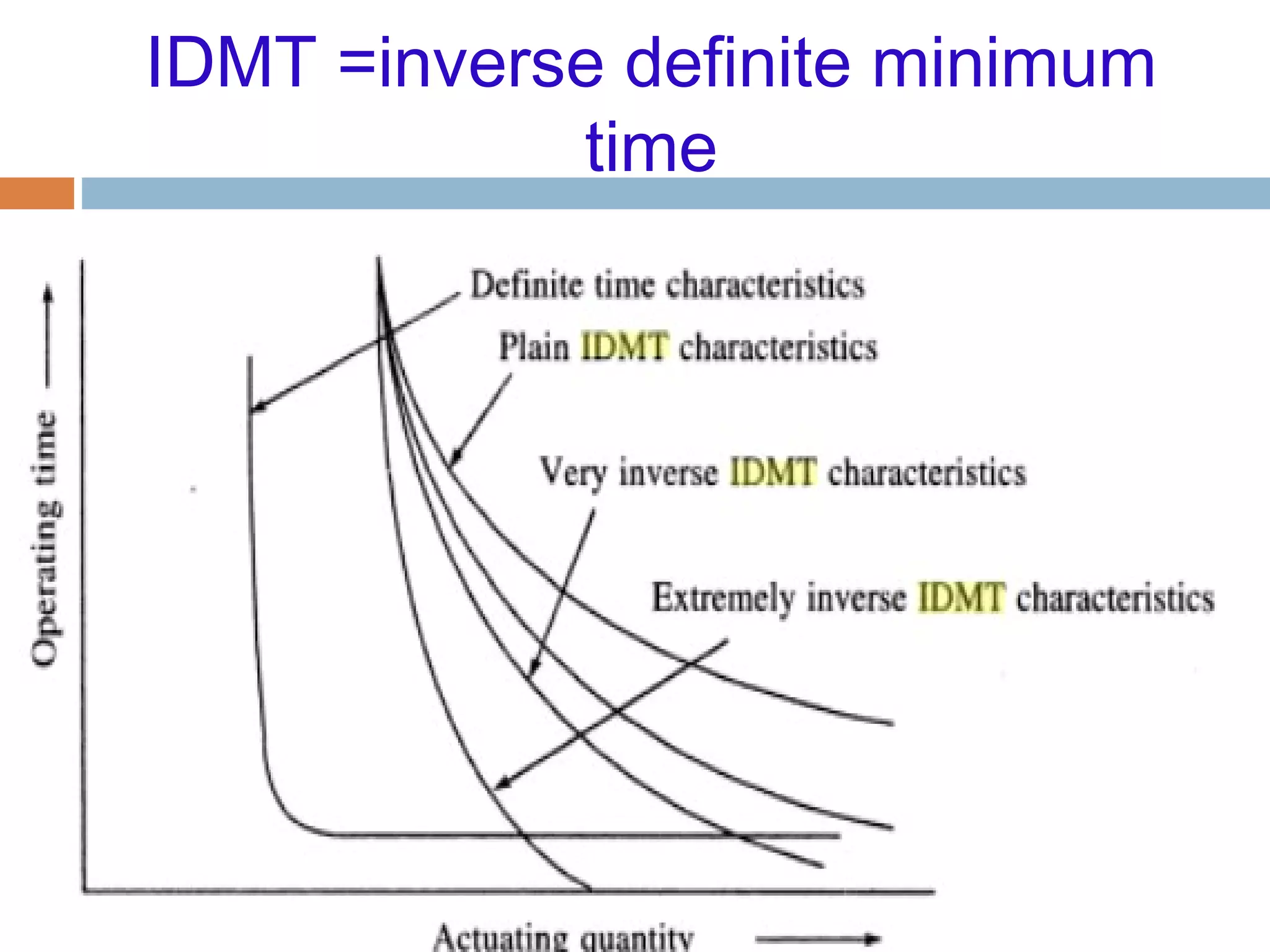
IDMT =inverse definite minimum
time
Limitations of Electromagnetic relays
 Low speedof operation.
 Change in characteristics over a period due to
ageing effect.
 Component failure leading to relay failure.
 Relay is Bulky
 Imposes high burden on CT
 No fault data available except phase indication.
 Inherent in its design,
 When an electromechanical Relay is activated,
bounce occurs at the contact site.
2.Solid State (Static) Relay
 2.1 Analog Relay: measured quantities are
converted into lower voltage but similar signals,
which are then combined or compared directly to
reference values
 2.2 Digital Relay: measured ac quantities are
manipulated in analogue form and subsequently
converted into square-wave (binary) voltages.
 2.3 Numerical Relay: measured ac quantities are
sequentially sampled and converted into numeric
data form. A microprocessor performs
mathematical and/or logical operations on the
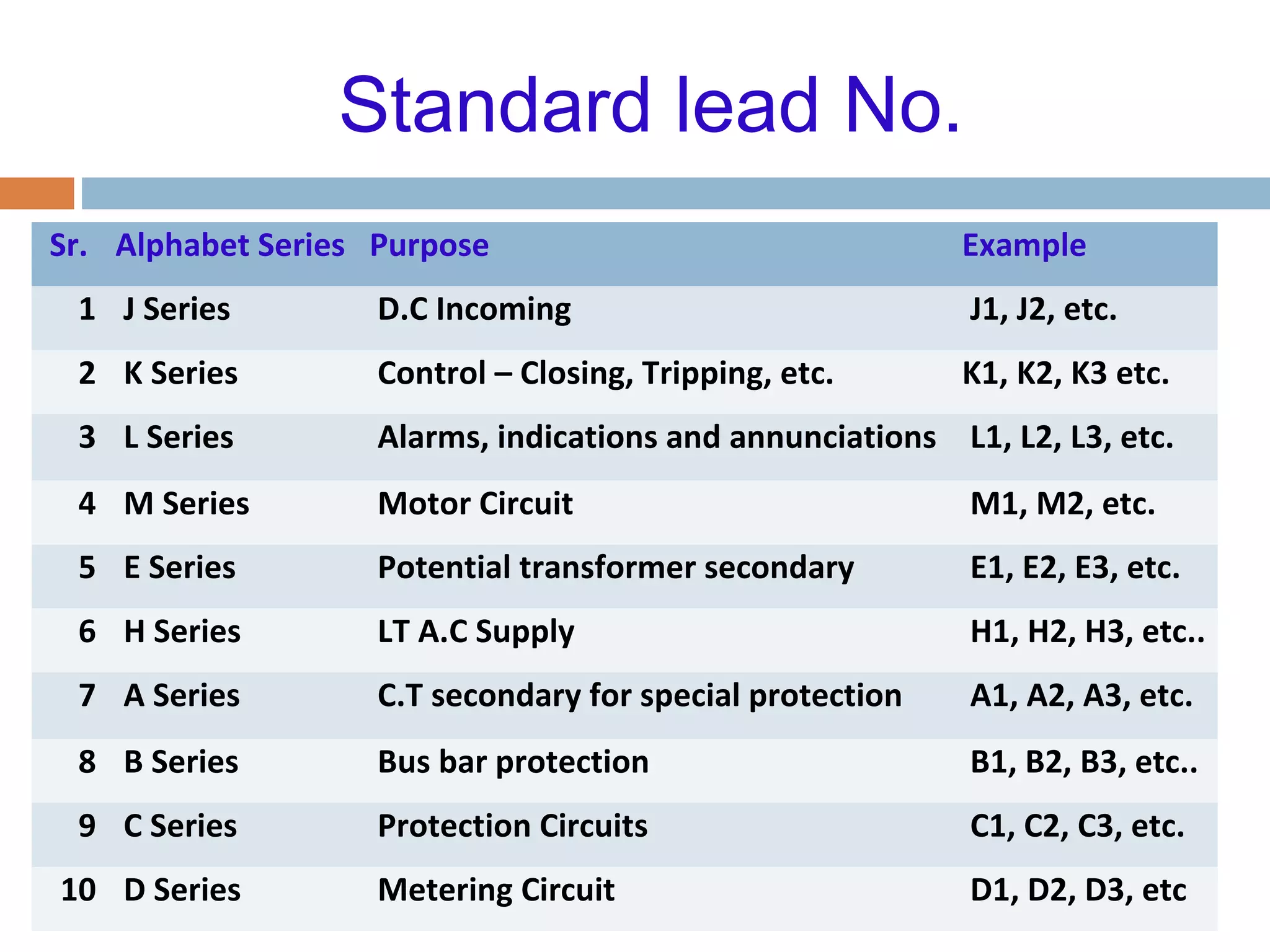
Standard lead No.
Sr. Alphabet Series Purpose Example
1 J Series D.C Incoming J1, J2, etc.
2 K Series Control – Closing, Tripping, etc. K1, K2, K3 etc.
3 L Series Alarms, indications and annunciations L1, L2, L3, etc.
4 M Series Motor Circuit M1, M2, etc.
5 E Series Potential transformer secondary E1, E2, E3, etc.
6 H Series LT A.C Supply H1, H2, H3, etc..
7 A Series C.T secondary for special protection A1, A2, A3, etc.
8 B Series Bus bar protection B1, B2, B3, etc..
9 C Series Protection Circuits C1, C2, C3, etc.
10 D Series Metering Circuit D1, D2, D3, etc
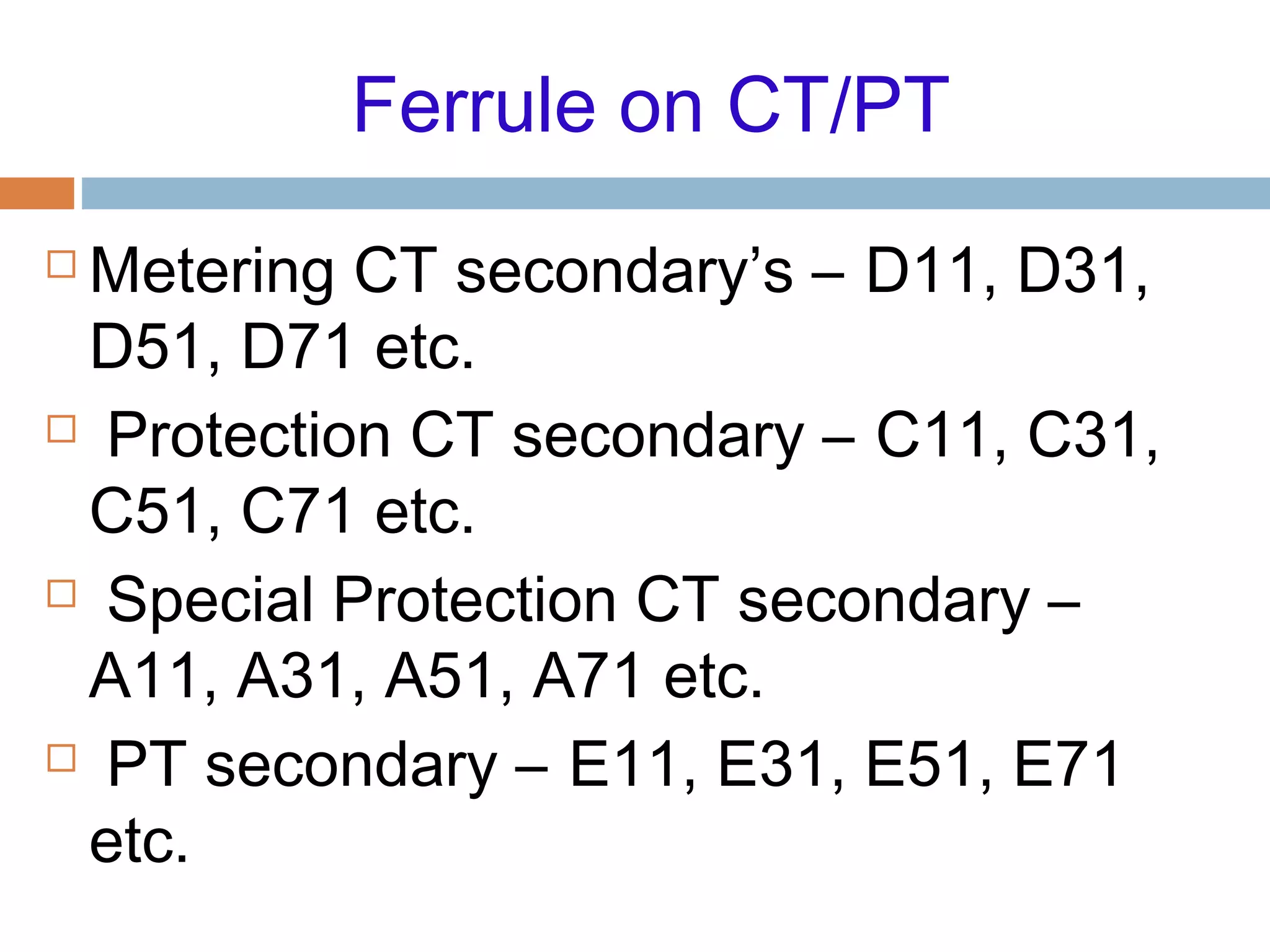
Ferrule on CT/PT
 Metering CT secondary’s – D11, D31,
D51, D71 etc.
 Protection CT secondary – C11, C31,
C51, C71 etc.
 Special Protection CT secondary –
A11, A31, A51, A71 etc.
 PT secondary – E11, E31, E51, E71
etc.
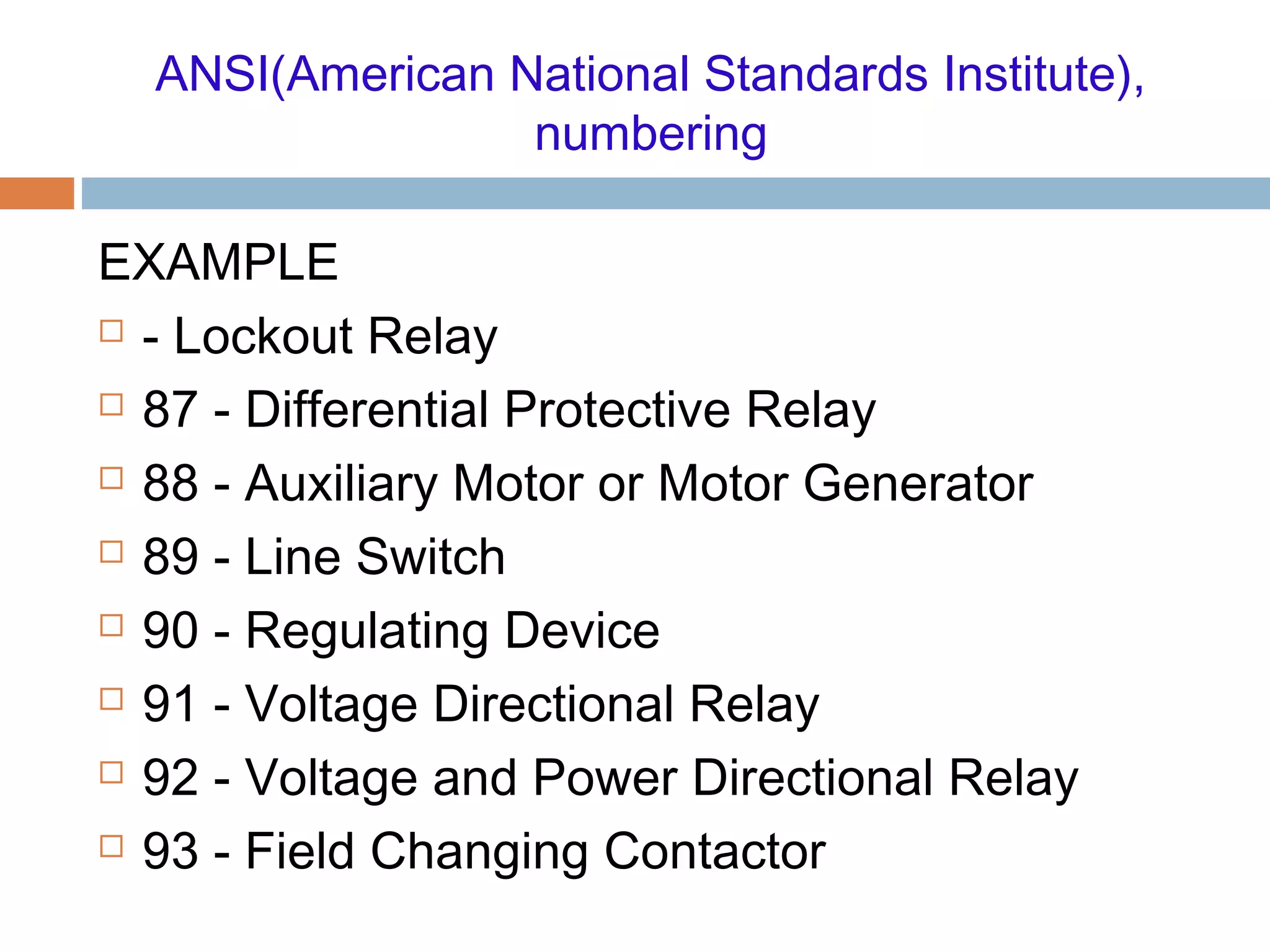
ANSI(American National Standards Institute),
numbering
EXAMPLE
 - Lockout Relay
 87 - Differential Protective Relay
 88 - Auxiliary Motor or Motor Generator
 89 - Line Switch
 90 - Regulating Device
 91 - Voltage Directional Relay
 92 - Voltage and Power Directional Relay
 93 - Field Changing Contactor
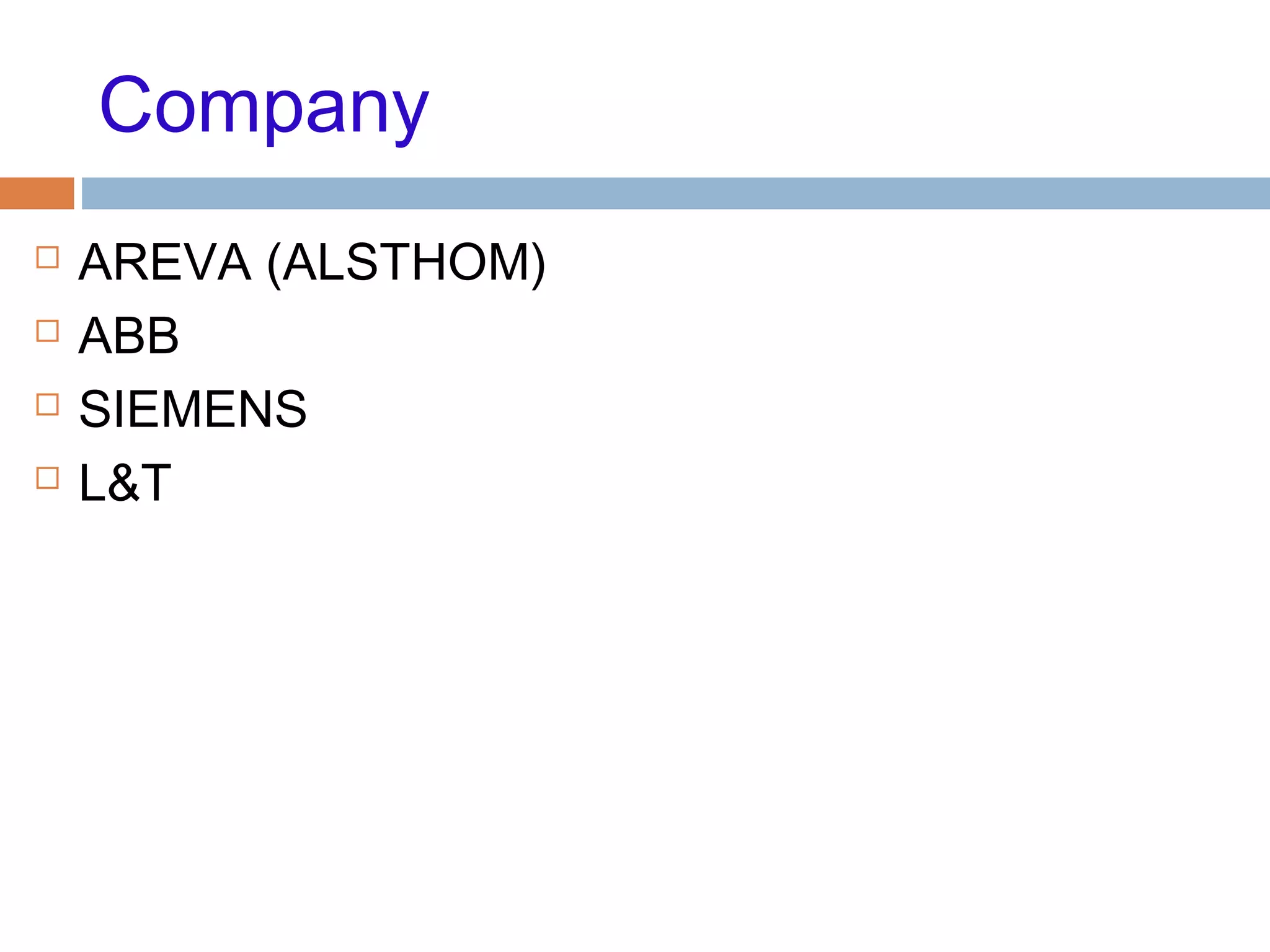
Company
 AREVA (ALSTHOM)
 ABB
 SIEMENS
 L&T
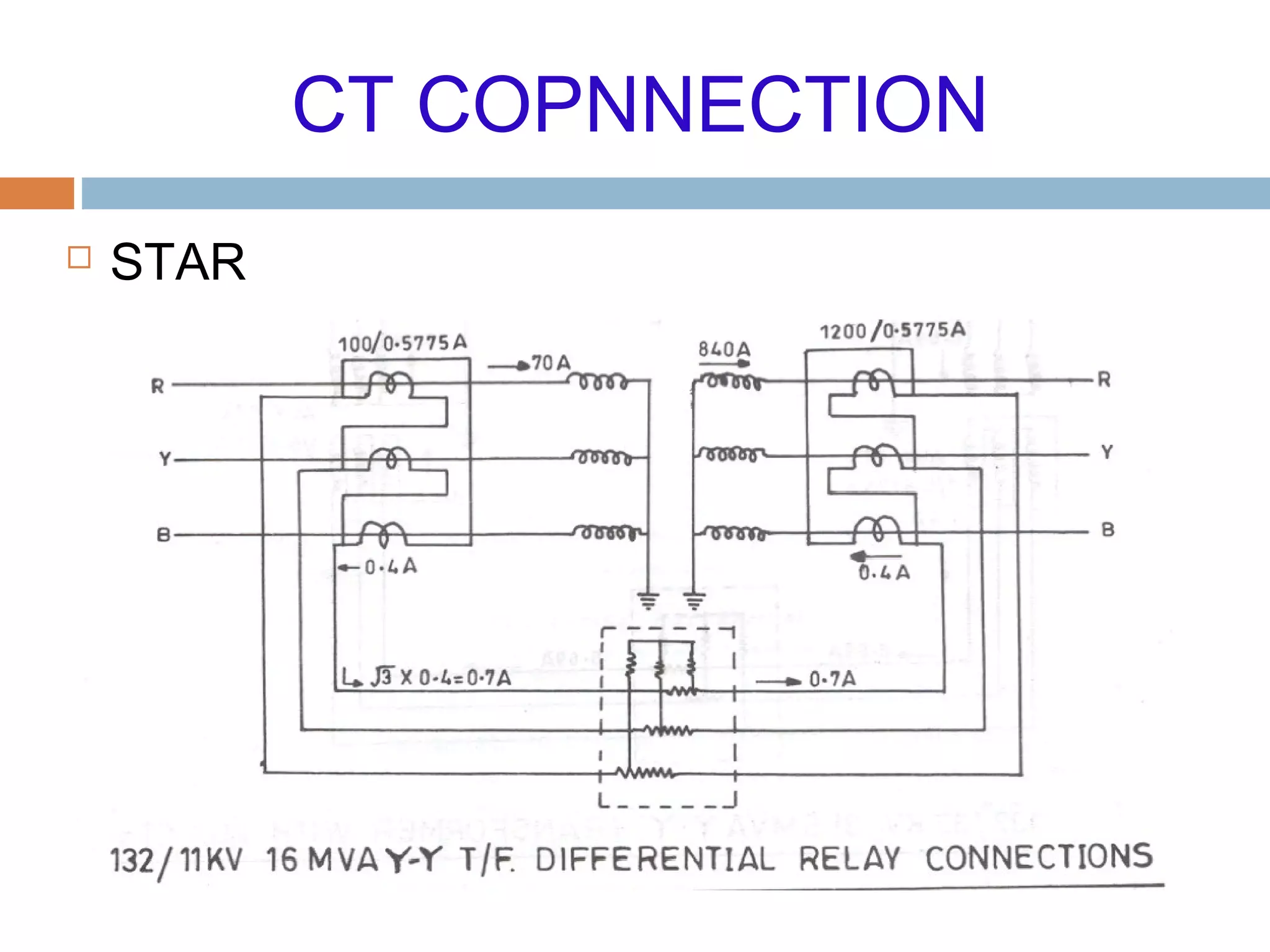
CT COPNNECTION
 STAR
-STAR
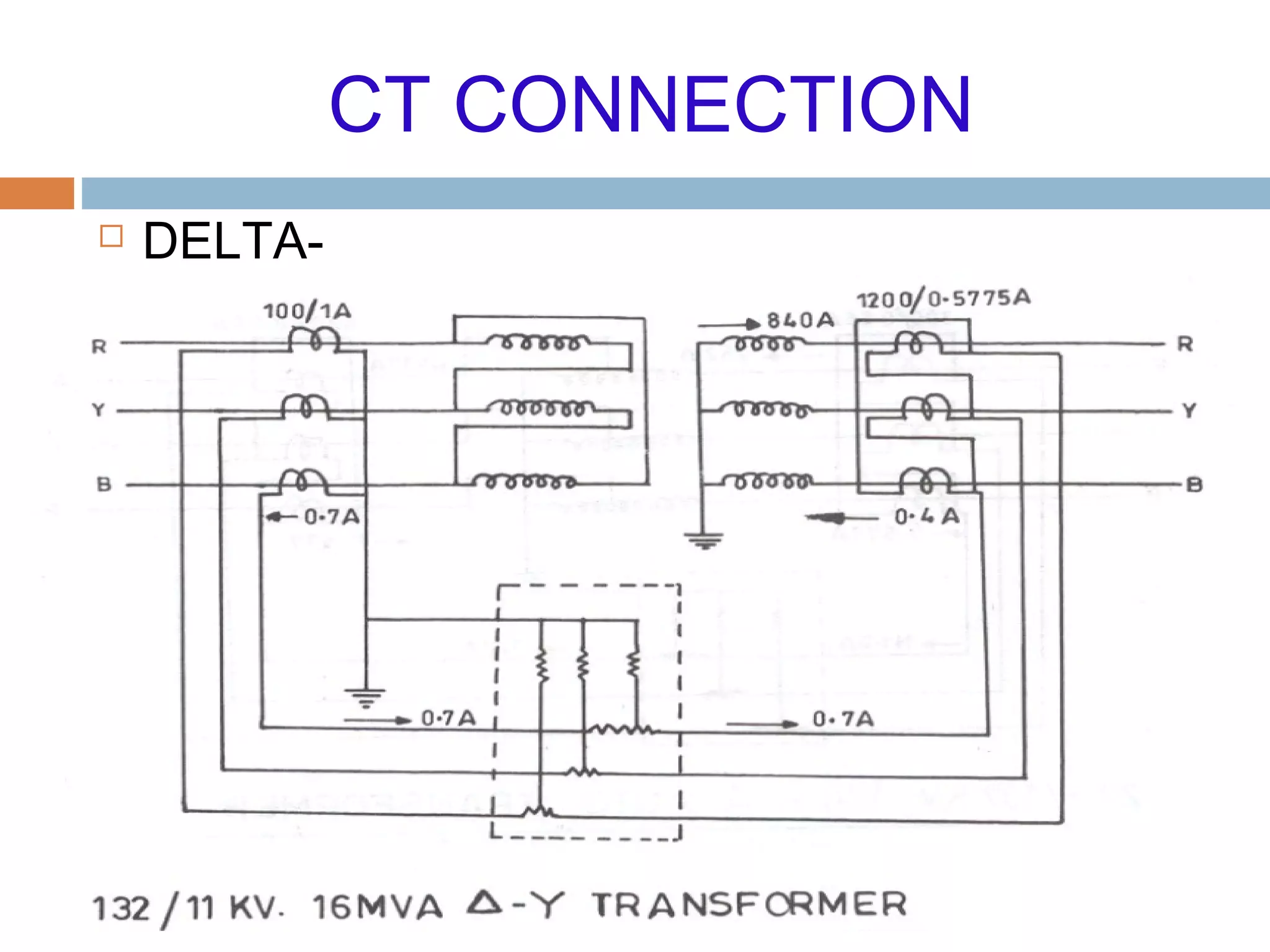
CT CONNECTION
 DELTA-
STAR
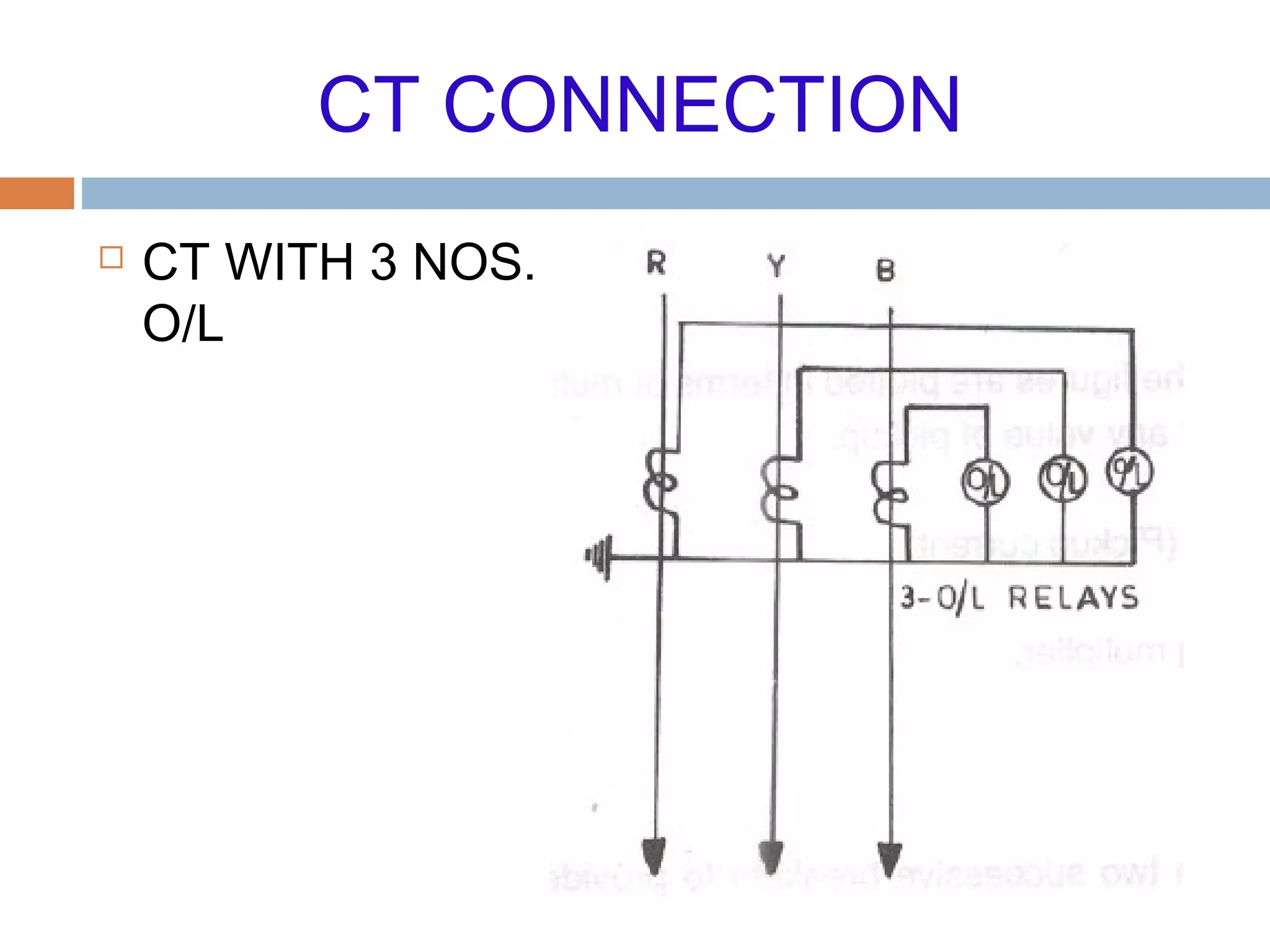
CT CONNECTION
 CT WITH 3 NOS.
O/L
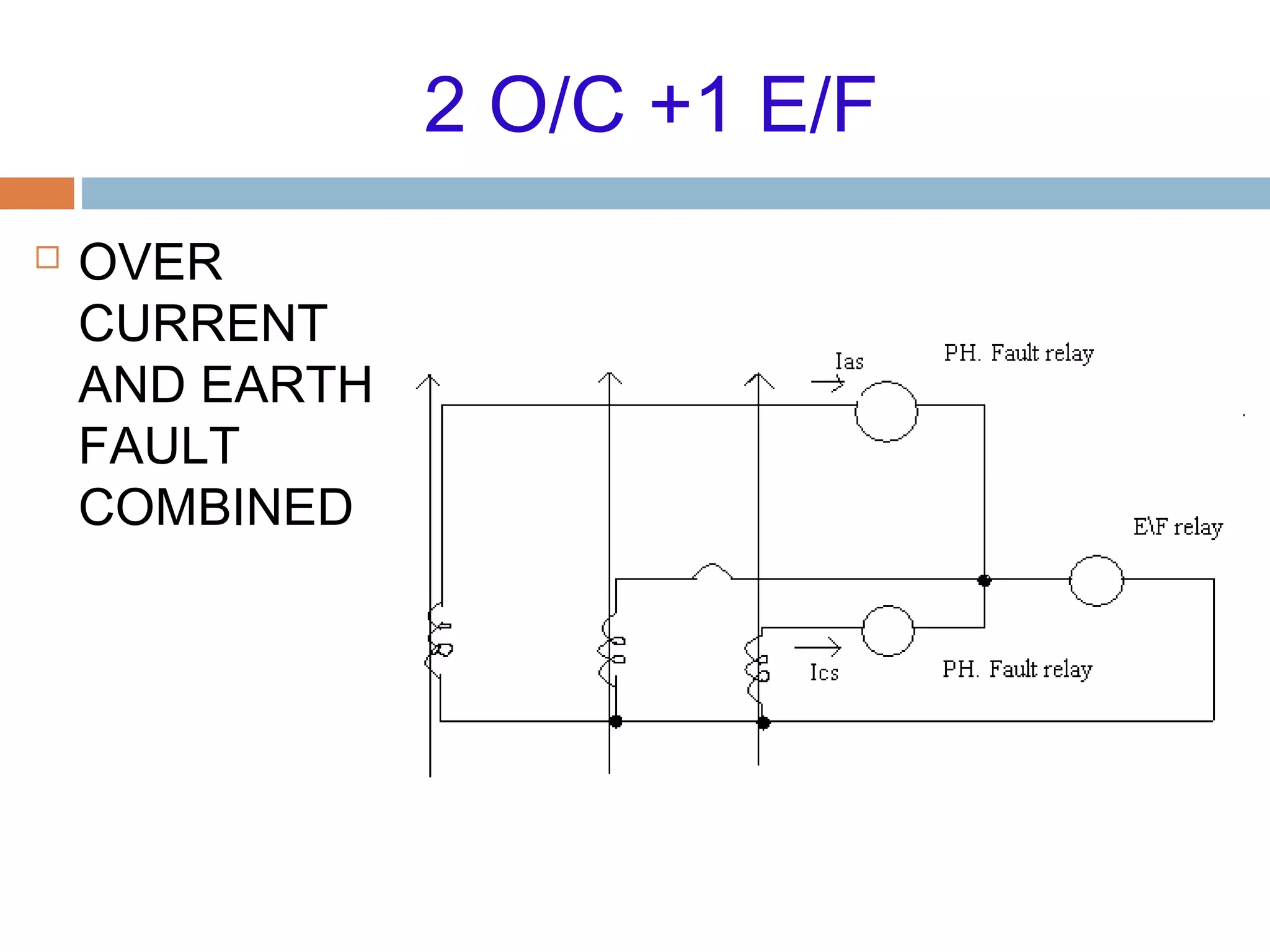
2 O/C +1 E/F
 OVER
CURRENT
AND EARTH
FAULT
COMBINED
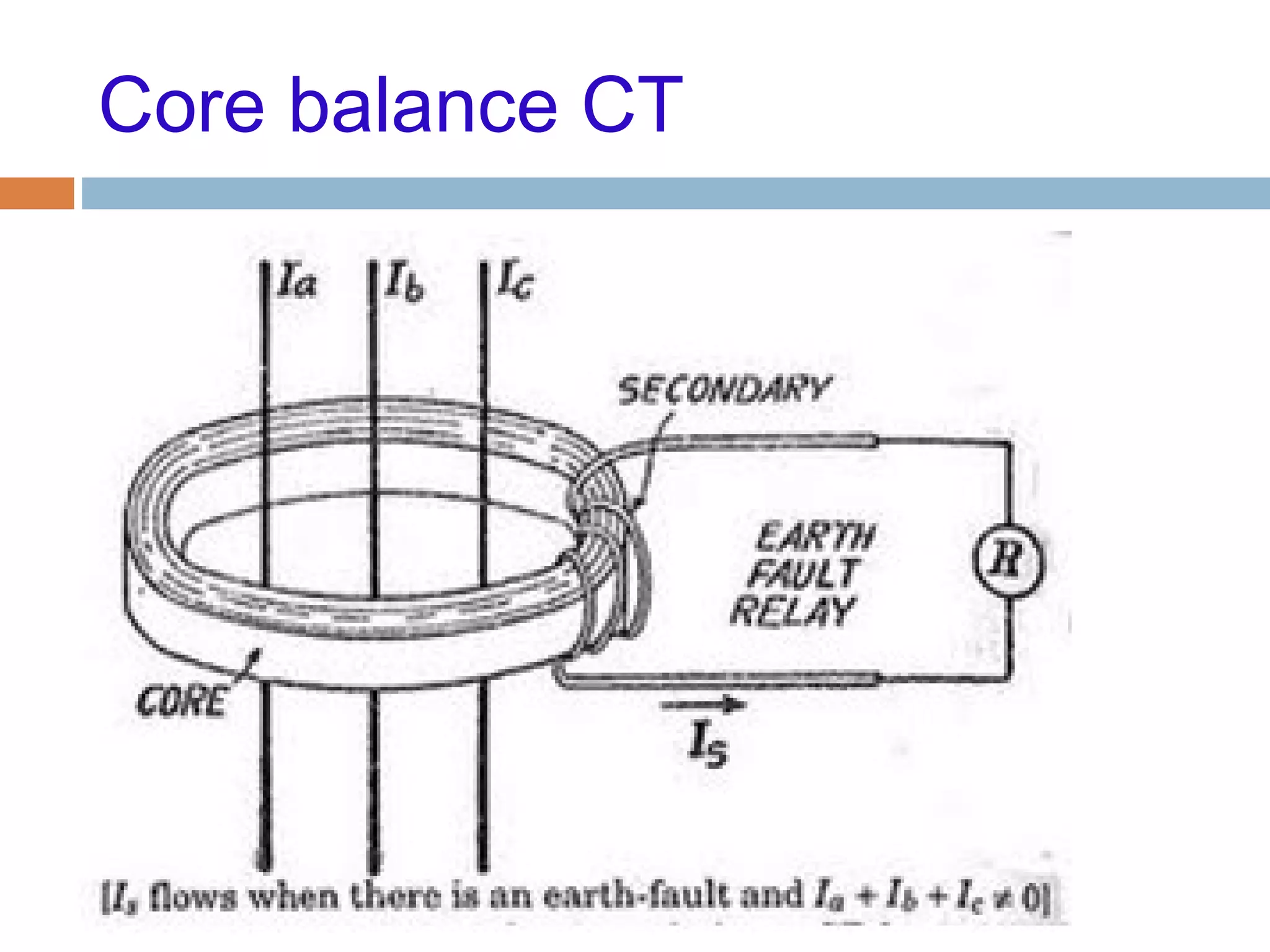
Core balance CT
THANK YOU

Protection basic

  • 1.
  • 2.
  • 3.
    content 1. Introduction toProtective Relay 2. Working Principle of Protective Scheme 3. What is Relay? 4. Functions of Protective Relay 5. Desirable qualities of protective relaying 6. Terminology of protective relay 7. History of Protective Relay 8. Types of Relays 9. Types of Relay based on Relay Operation Mechanism 10. Protective relay testing: Test relays of all
  • 4.
    1.introduction to Protectiverelay  Protectiverelay works in the way of sensing and control devices to accomplish its function. Under normal power system operation, a protective relay remains idleand serves no active function.  whe n fault o r unde sirable co nditio n arrive s Pro te ctive Re lay m ust be o pe rate d and functio n co rre ctly.  Failure o f a pro te ctive re lay can re sult in de vastating e q uipm e nt dam ag e and pro lo ng e d do wntim e .
  • 5.
    2.Working Principle ofProtective Scheme
  • 6.
    3.What is Relay? Arelay is automatic device which senses an abnormal condition of electrical circuit and closes its contacts. Thus the fault is se nse d and the trip circuit is actuate d by the re lay and the faulty part is iso late d.
  • 7.
    4.Functions oF Protectiverelay  To sound an alarm or to close the trip circuit  To disconnect the abnormally operating part so as to prevent subsequent faults  To isolateor disconnect faulted circuits or equipment  To localizetheeffect of fault to improve system stability, service continuity and system performance.  To minimize hazards to personnel.
  • 8.
    5. Desirable Qualitiesof Protective Relaying  Selectivity,  Discrimination  Stability  Sensitivity,  Power consumption  System Security  Reliability  Adequateness  Speed & Time
  • 9.
    6.Terminology of protective relay Pickuplevel of actuatingsignal: value of actuating quantity voltage or current  Reset level: relay opens its contacts and comes in original position.  OperatingTimeof Relay: The time which elapses between the instant  Reset timeof Relay: relay contacts returns to its normal position.  Reachof Relay: This impedance or corresponding distance is called reach of the relay.
  • 10.
    7.History of ProtectiveRelay 1900 to 1963 1963 to 1972 1972 to 1980 1980 to 1990 Electromechanical Relay Static Relay Digital Relay Numerical Relay 1925=Single Disc Type Relay (Single Input) 1963=Static Relay (All Purpose) 1980=Digital Type Relay (All Purpose) 1990=Numerical Type Relay (All Purpose) 1961=Single Cup Type Relay (Impedance Relay) 1972=Static Relay with self checking (All Purpose)
  • 11.
    A. Types ofRelays: Based on Characteristic:  Definite time Relays.  Inverse definite minimum time Relays (IDMT)  Instantaneous Relays  IDMT with Instantaneous.  Stepped Characteristic  Programmed Switches  Voltage restraint over current relay
  • 12.
    B. Based onlogic:  Differential  Unbalance  Neutral Displacement  Directional  Restricted Earth Fault  Over Fluxing  Distance Schemes  Bus bar Protection  Reverse Power Relays  Loss of excitation  Negative Phase Sequence Relays etc.
  • 13.
    C. Based onActuating parameter: Current Relays Voltage Relays Frequency Relays Power Relays etc.
  • 14.
    D. Based onOperation Mechanism:  1. Electro Magnetic Relay 2. Static Relay ……• Analog Relay ……• Digital Relay ……• Numerical /Microprocessor Relay 3. Mechanical relay  Thermal • OT Trip (O ilTe m pe rature Trip ) • WT Trip (Winding Te m pe rature Trip ) • Bearing Temp Trip etc.
  • 15.
    Based on OperationMechanism  Float Type • Buchholz • OSR (oil surge relay) • PRV(Pressure Relief Valve ) • Water level Controls etc.  Pressure Switches  Mechanical Interlocks  Pole discrepancy Relay
  • 16.
    E. Based onApplications Primary Relays Backup Relays
  • 17.
    Electromagnetic AttractionRelay  1.1Electromagnetic AttractionRelay ThisRelay works on Electromagnetic Attraction Principle
  • 18.
    Electromagnetic Induction Relay  1.2 Electromagnetic InductionRelay ThisRelay works on Electromagnetic Induction Principle
  • 19.
  • 20.
    Limitations of Electromagneticrelays  Low speedof operation.  Change in characteristics over a period due to ageing effect.  Component failure leading to relay failure.  Relay is Bulky  Imposes high burden on CT  No fault data available except phase indication.  Inherent in its design,  When an electromechanical Relay is activated, bounce occurs at the contact site.
  • 21.
    2.Solid State (Static)Relay  2.1 Analog Relay: measured quantities are converted into lower voltage but similar signals, which are then combined or compared directly to reference values  2.2 Digital Relay: measured ac quantities are manipulated in analogue form and subsequently converted into square-wave (binary) voltages.  2.3 Numerical Relay: measured ac quantities are sequentially sampled and converted into numeric data form. A microprocessor performs mathematical and/or logical operations on the
  • 22.
    Standard lead No. Sr.Alphabet Series Purpose Example 1 J Series D.C Incoming J1, J2, etc. 2 K Series Control – Closing, Tripping, etc. K1, K2, K3 etc. 3 L Series Alarms, indications and annunciations L1, L2, L3, etc. 4 M Series Motor Circuit M1, M2, etc. 5 E Series Potential transformer secondary E1, E2, E3, etc. 6 H Series LT A.C Supply H1, H2, H3, etc.. 7 A Series C.T secondary for special protection A1, A2, A3, etc. 8 B Series Bus bar protection B1, B2, B3, etc.. 9 C Series Protection Circuits C1, C2, C3, etc. 10 D Series Metering Circuit D1, D2, D3, etc
  • 23.
    Ferrule on CT/PT Metering CT secondary’s – D11, D31, D51, D71 etc.  Protection CT secondary – C11, C31, C51, C71 etc.  Special Protection CT secondary – A11, A31, A51, A71 etc.  PT secondary – E11, E31, E51, E71 etc.
  • 24.
    ANSI(American National StandardsInstitute), numbering EXAMPLE  - Lockout Relay  87 - Differential Protective Relay  88 - Auxiliary Motor or Motor Generator  89 - Line Switch  90 - Regulating Device  91 - Voltage Directional Relay  92 - Voltage and Power Directional Relay  93 - Field Changing Contactor
  • 25.
    Company  AREVA (ALSTHOM) ABB  SIEMENS  L&T
  • 26.
  • 27.
  • 28.
    CT CONNECTION  CTWITH 3 NOS. O/L
  • 29.
    2 O/C +1E/F  OVER CURRENT AND EARTH FAULT COMBINED
  • 30.
  • 31.