By: Dr. Sweta
Shah
Introduction
 In utility and industrial electric power
transmission and distribution systems, a digital
protective relay is a computer-based system
with
software-based protection algorithms for the
detection of electrical faults.
 They are functional replacements for electro-
mechanical protective relays and may include many
protection functions in one unit, as well as
providing metering, communication, and self-test
functions.
Advantages of Numerical Relay
 Numerical relay consists of many functions in one relay thus replace
many traditional relays with one.
 One relay can be used in many ways. Users can configure relay according
to their system requirement.
 Consists of no mechanical moving parts hence accurate operation.
 No maintenance is needed like electromechanical relays.
 Relays are compact in size and appearance is good.
 Many complicated functions can be achieved with developed logics
using various Gates.
 Gives entire details of fault record including with the graphs.
 Some relays have different Setting groups. The advantage of setting groups is
that user can change the entire settings of the relay by simply changing
Group setting. Frequent configuration is not needed.
 The main advantage of Numerical relays is communication between relays and
other equipment in the network is possible for doing automation of the
system.
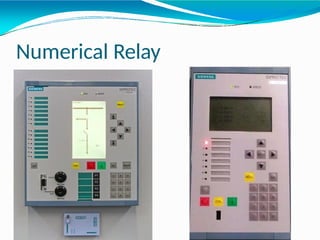
Numerical Relay
Input processing
 Low voltage and low current signals (i.e., at the secondary of
a voltage transformers and current transformers) are
brought
into a low pass filter that removes frequency content above
about
1/3of the sampling frequency
 The AC signal is then sampled by the relay's
analog-to-digital converter
 As a minimum, magnitude of the incoming quantity, commonly
using Fourier transform would be used in a simple relay
function.
 More advanced analysis can be used to determine phase
angles, power, reactive power, impedance, waveform distortion
, and other complex quantities.
Logic processing
 The relay analyzes the resultant A/D converter outputs
to determine if action is required under its protection
algorithm(s).
 Protection algorithms are a set of logic equations in
part designed by the protection engineer, and in
part designed by the relay manufacturer. The relay
is capable of applying advanced logic.
 If a fault condition is detected, output contacts operate
to trip the associated circuit breaker(s).
Parameter setting
 The logic is user-configurable and can vary from simply
changing front panel switches or moving of circuit
board jumpers to accessing the relay's internal parameter
setting webpage via communications link on another
computer hundreds of kilometers away.
 The relay may have an extensive collection of settings,
beyond what can be entered via front panel knobs and
dials, and these settings are transferred to the relay via an
interface with a PC (personal computer), and this same
PC interface may be used to collect event reports from the
relay.
Event recording
In some relays, a short history of the entire sampled
data is kept for oscillographic records. The event
recording would include some means for the user
to see the timing of key logic decisions, relay I/O
(input/output) changes, and see, in
an oscillographic fashion, at least the
fundamental component of the incoming
analogue parameters.
Data Display
 Digital/numerical relays provide a front panel display,
or display on a terminal through a communication
interface. This is used to display relay settings and
real- time current/voltage values, etc.
 More complex digital relays will have metering and
communication protocol ports, allowing the relay
to become an element in a SCADA system.
Communication ports may
include RS232/RS485 or Ethernet (copper or
fibre- optic). Communication languages may
include Modbus, DNP3 or IEC61850 protocols.
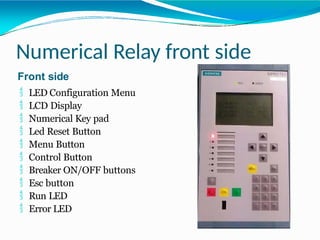
Numerical Relay front side
Front side
 LED Configuration Menu
 LCD Display
 Numerical Key pad
 Led Reset Button
 Menu Button
 Control Button
 Breaker ON/OFF buttons
 Esc button
 Run LED
 Error LED
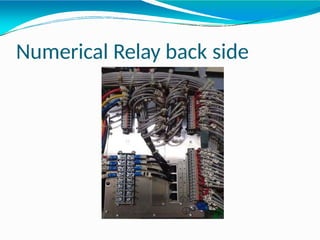
Numerical Relay Back Side:
Relay back side usually consist of different Terminal
Blocks [TB] for giving the Digital and Analog inputs,
outputs .
 TB for Current Transformer inputs
 TB for Potential Transformer inputs
 TB for Binary Inputs
 TB for Binary Outputs
 TB for Relay Power Supply
 TB for Live status contact
 Slots for Communication Ports
Numerical Relay back side
Input/Output
 Binary/Digital Inputs:
 Binary Inputs gives the status of the various
equipment to the relay in the form of 1’s and 0’s,
for
e.g. the Circuit breaker status is given by BI is
either ON/OFF
 Binary/Digital Outputs:
 Binary Outputs are the Commands generated by the
relay in the form of 1’s and 0’s, for e.g. trip
command given by the relay to breaker in the case
of fault.
LED Configuration:
 Any LED can be configured in two ways either Latch or
Unlatch.
 Latch LEDs:
 The Latch configured LED picks up as soon as the
indication exists and remains picked up until the relay
is reset at the device.
 The reset has been done by either pressing Reset button
manually or via the system interface (SCADA or DCS).
 Unlatch LEDs:
 The Unlatch configured LED picks up as soon as the
indication exists and drops as soon as the indication
no longer applied. It means the LED reset itself and no
manual reset required
Communication Protocols:
 Relay communication is provided with the following protocols.
These protocols helps to communicate relays among them
and also with HMI through modem.
 Following are the various protocols used.
 Modbus RS485:
 This uncomplicated, serial protocol is mainly used in industry
and by power supply corporations.
 DNP3.0,RS485:
 DNP 3.0 (Distributed Network Protocol, version 3) is a
messaging-based communication protocol.
 IEC61850 with RJ45 interface or Fibre interface:
 The Ethernet-based IEC 61850 protocol is the worldwide
standard for protection and control systems used by
power supply corporations.
Types of Numerical Relays
 Based on Logic
 These classifications are made on the basis of logical
operation of the relay
 Over Current/ Earth Fault: When excessive
current flows through a system it will trip the circuit
breaker. Used for transformer and feeder protection.
 Directional overcurrent: It is operated when the
fault drives the power to flow in a particular
direction (Opposite to the specified direction). Used
in the protection of Bus bar, Generator, and
Transformers.
 Differential: The differential relay is set to trip
when the phase difference of two or more identical
electrical quantities exceeds the specified value. It
can Protect Transformers and Generators from
localized faults.
 Under/ Over Voltage: The voltage in an electric
network might drop or rise below or above a fixed
value, the circuit is tripped under such
conditions.
 Distance: This type of relay is operated based on the
distance between the impedance of the fault and
the position of the relay. They are mostly used in
the protection of transmission lines.
Based On Characteristics
 Instantaneous relay: Activate the tripping
immediately after the occurrence of a fault, there will be
no time delay.
 Definite time relay: Activated only if the fault remains until
a specific time.
 Inverse time relays with definite minimum time (IDMT):
These Relays are mostly used in transmission lines. If
the line current exceeds the safe value, circuit breaker
gets triggered.
 Voltage restraint over current relay: The relay is activated
only if both the under-voltage and overcurrent conditions
occur at the same time.
Based on actuating parameters
 Current relays
 Voltage relays
 Frequency relays
 Power relays Etc.
Based on Application
 Primary relay
 Backup relay
 If the protection system fails the whole network might
get collapsed so they use the backup relay. Doing this
will help us protect the system even if the primary
relay goes faulty.
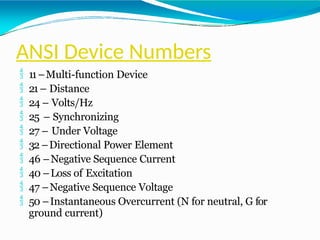
ANSI Device Numbers
 11–Multi-function Device
 21– Distance
 24 – Volts/Hz
 25 – Synchronizing
 27 – Under Voltage
 32 –Directional Power Element
 46 –Negative Sequence Current
 40 –Loss of Excitation
 47 –Negative Sequence Voltage
 50 –Instantaneous Overcurrent (N for neutral, G for
ground current)
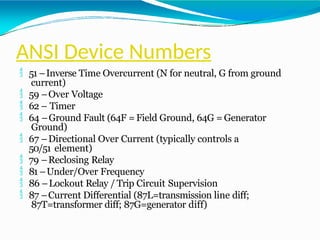
ANSI Device Numbers
 51 –Inverse Time Overcurrent (N for neutral, G from ground
current)
 59 –Over Voltage
 62 – Timer
 64 –Ground Fault (64F =Field Ground, 64G =Generator
Ground)
 67 –Directional Over Current (typically controls a
50/51 element)
 79 –Reclosing Relay
 81 –Under/Over Frequency
 86 –Lockout Relay / Trip Circuit Supervision
 87 –Current Differential (87L=transmission line diff;
87T=transformer diff; 87G=generator diff)

Numerical-Relay-PPT-1-convvffverted.pptx

  • 1.
  • 2.
    Introduction  In utilityand industrial electric power transmission and distribution systems, a digital protective relay is a computer-based system with software-based protection algorithms for the detection of electrical faults.  They are functional replacements for electro- mechanical protective relays and may include many protection functions in one unit, as well as providing metering, communication, and self-test functions.
  • 3.
    Advantages of NumericalRelay  Numerical relay consists of many functions in one relay thus replace many traditional relays with one.  One relay can be used in many ways. Users can configure relay according to their system requirement.  Consists of no mechanical moving parts hence accurate operation.  No maintenance is needed like electromechanical relays.  Relays are compact in size and appearance is good.  Many complicated functions can be achieved with developed logics using various Gates.  Gives entire details of fault record including with the graphs.  Some relays have different Setting groups. The advantage of setting groups is that user can change the entire settings of the relay by simply changing Group setting. Frequent configuration is not needed.  The main advantage of Numerical relays is communication between relays and other equipment in the network is possible for doing automation of the system.
  • 4.
  • 5.
    Input processing  Lowvoltage and low current signals (i.e., at the secondary of a voltage transformers and current transformers) are brought into a low pass filter that removes frequency content above about 1/3of the sampling frequency  The AC signal is then sampled by the relay's analog-to-digital converter  As a minimum, magnitude of the incoming quantity, commonly using Fourier transform would be used in a simple relay function.  More advanced analysis can be used to determine phase angles, power, reactive power, impedance, waveform distortion , and other complex quantities.
  • 6.
    Logic processing  Therelay analyzes the resultant A/D converter outputs to determine if action is required under its protection algorithm(s).  Protection algorithms are a set of logic equations in part designed by the protection engineer, and in part designed by the relay manufacturer. The relay is capable of applying advanced logic.  If a fault condition is detected, output contacts operate to trip the associated circuit breaker(s).
  • 7.
    Parameter setting  Thelogic is user-configurable and can vary from simply changing front panel switches or moving of circuit board jumpers to accessing the relay's internal parameter setting webpage via communications link on another computer hundreds of kilometers away.  The relay may have an extensive collection of settings, beyond what can be entered via front panel knobs and dials, and these settings are transferred to the relay via an interface with a PC (personal computer), and this same PC interface may be used to collect event reports from the relay.
  • 8.
    Event recording In somerelays, a short history of the entire sampled data is kept for oscillographic records. The event recording would include some means for the user to see the timing of key logic decisions, relay I/O (input/output) changes, and see, in an oscillographic fashion, at least the fundamental component of the incoming analogue parameters.
  • 9.
    Data Display  Digital/numericalrelays provide a front panel display, or display on a terminal through a communication interface. This is used to display relay settings and real- time current/voltage values, etc.  More complex digital relays will have metering and communication protocol ports, allowing the relay to become an element in a SCADA system. Communication ports may include RS232/RS485 or Ethernet (copper or fibre- optic). Communication languages may include Modbus, DNP3 or IEC61850 protocols.
  • 10.
    Numerical Relay frontside Front side  LED Configuration Menu  LCD Display  Numerical Key pad  Led Reset Button  Menu Button  Control Button  Breaker ON/OFF buttons  Esc button  Run LED  Error LED
  • 11.
    Numerical Relay BackSide: Relay back side usually consist of different Terminal Blocks [TB] for giving the Digital and Analog inputs, outputs .  TB for Current Transformer inputs  TB for Potential Transformer inputs  TB for Binary Inputs  TB for Binary Outputs  TB for Relay Power Supply  TB for Live status contact  Slots for Communication Ports
  • 12.
  • 13.
    Input/Output  Binary/Digital Inputs: Binary Inputs gives the status of the various equipment to the relay in the form of 1’s and 0’s, for e.g. the Circuit breaker status is given by BI is either ON/OFF  Binary/Digital Outputs:  Binary Outputs are the Commands generated by the relay in the form of 1’s and 0’s, for e.g. trip command given by the relay to breaker in the case of fault.
  • 14.
    LED Configuration:  AnyLED can be configured in two ways either Latch or Unlatch.  Latch LEDs:  The Latch configured LED picks up as soon as the indication exists and remains picked up until the relay is reset at the device.  The reset has been done by either pressing Reset button manually or via the system interface (SCADA or DCS).  Unlatch LEDs:  The Unlatch configured LED picks up as soon as the indication exists and drops as soon as the indication no longer applied. It means the LED reset itself and no manual reset required
  • 15.
    Communication Protocols:  Relaycommunication is provided with the following protocols. These protocols helps to communicate relays among them and also with HMI through modem.  Following are the various protocols used.  Modbus RS485:  This uncomplicated, serial protocol is mainly used in industry and by power supply corporations.  DNP3.0,RS485:  DNP 3.0 (Distributed Network Protocol, version 3) is a messaging-based communication protocol.  IEC61850 with RJ45 interface or Fibre interface:  The Ethernet-based IEC 61850 protocol is the worldwide standard for protection and control systems used by power supply corporations.
  • 16.
    Types of NumericalRelays  Based on Logic  These classifications are made on the basis of logical operation of the relay  Over Current/ Earth Fault: When excessive current flows through a system it will trip the circuit breaker. Used for transformer and feeder protection.  Directional overcurrent: It is operated when the fault drives the power to flow in a particular direction (Opposite to the specified direction). Used in the protection of Bus bar, Generator, and Transformers.
  • 17.
     Differential: Thedifferential relay is set to trip when the phase difference of two or more identical electrical quantities exceeds the specified value. It can Protect Transformers and Generators from localized faults.  Under/ Over Voltage: The voltage in an electric network might drop or rise below or above a fixed value, the circuit is tripped under such conditions.  Distance: This type of relay is operated based on the distance between the impedance of the fault and the position of the relay. They are mostly used in the protection of transmission lines.
  • 18.
    Based On Characteristics Instantaneous relay: Activate the tripping immediately after the occurrence of a fault, there will be no time delay.  Definite time relay: Activated only if the fault remains until a specific time.  Inverse time relays with definite minimum time (IDMT): These Relays are mostly used in transmission lines. If the line current exceeds the safe value, circuit breaker gets triggered.  Voltage restraint over current relay: The relay is activated only if both the under-voltage and overcurrent conditions occur at the same time.
  • 19.
    Based on actuatingparameters  Current relays  Voltage relays  Frequency relays  Power relays Etc.
  • 20.
    Based on Application Primary relay  Backup relay  If the protection system fails the whole network might get collapsed so they use the backup relay. Doing this will help us protect the system even if the primary relay goes faulty.
  • 21.
    ANSI Device Numbers 11–Multi-function Device  21– Distance  24 – Volts/Hz  25 – Synchronizing  27 – Under Voltage  32 –Directional Power Element  46 –Negative Sequence Current  40 –Loss of Excitation  47 –Negative Sequence Voltage  50 –Instantaneous Overcurrent (N for neutral, G for ground current)
  • 22.
    ANSI Device Numbers 51 –Inverse Time Overcurrent (N for neutral, G from ground current)  59 –Over Voltage  62 – Timer  64 –Ground Fault (64F =Field Ground, 64G =Generator Ground)  67 –Directional Over Current (typically controls a 50/51 element)  79 –Reclosing Relay  81 –Under/Over Frequency  86 –Lockout Relay / Trip Circuit Supervision  87 –Current Differential (87L=transmission line diff; 87T=transformer diff; 87G=generator diff)