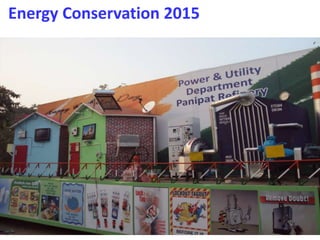
Energy Conservation 2015
Today’s Speaker
• Mr. Prasad is an Electrical Engineer by
profession,
• A Teacher by vocation,
• A Creative anchor by inclination
• He has written Blog on Electrical
Maintenance Engineering,
Renewable Energy, SAP PM & MM
application:
• Authored :a practical guide to cable
installation and tool box talk
• www.bralpowerassociate.blogspot.in
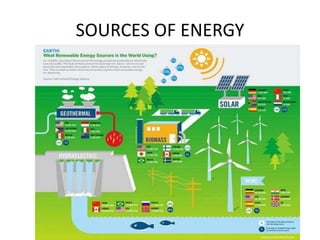
SOURCES OF ENERGY
POWER DISTRIBUTION TYPICAL
Major Sources and capacity of energy
2008
NON RENEWABLE
• COAL
• LPG
• NATURAL GAS
• NUCLEAR
• FUEL CELL
RENEWABLE
• WIND
• HYDRO
• SOLAR
• BIOMASS
• BIOGAS
• PHOTOVOLTAIC
Power generation root Capacity MW %
Thermal 103449 64.7
Hydro 36913 24.7
Nuclear 4560 2.9
Solar/wind/Biomass 16429 7.7
Total 1,61,351 100
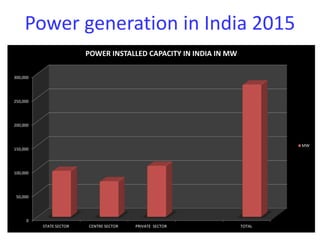
Power generation in India 2015
0
50,000
100,000
150,000
200,000
250,000
300,000
STATE SECTOR CENTRE SECTOR PRIVATE SECTOR TOTAL
POWER INSTALLED CAPACITY IN INDIA IN MW
MW
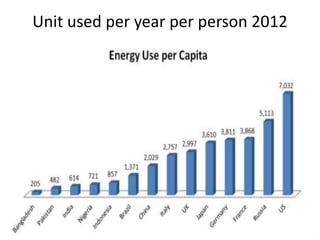
Unit used per year per person 2012
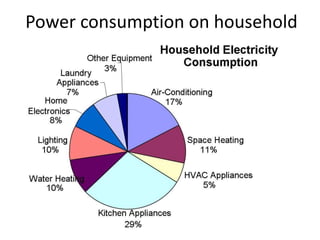
Power consumption on household
FILAMENT V/S CFL V/S LED
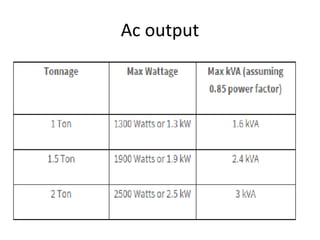
Power consumption in AC
• An AC with 2,000 Watt power input if
operated for about 12 hours per day will
consume:
2,000 watt x 12 hours = 24 kilowatt hour = 24
units
• BILL monthly (30 DAYS) =24X30X8 =Rs. 5760/-
Ac output
Ac tonnage
Carbon emission from household
= 1190 kg Per Annum per family
What is Energy Conservation?
• Conservation is the process of
reducing demand on a limited supply
and enabling that supply to begin to
rebuild itself.
• Many times the best way of doing
this is to replace the energy used
with an alternate.
Practical Methods of Energy Conservation
1. Install LED Lights
2. Lower the Room Temperature
3. Fix Air Leaks
4. Use Maximum Daylight
5. Get Energy Audit Done
6. Use Energy Efficient Appliances
7. Drive Less, Walk More and Car pooling
8. Switch Off Appliances when Not in Use
9. Plant Shady Landscaping
10. Install Energy Efficient Windows
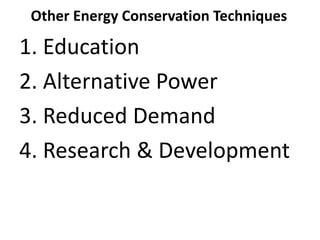
Other Energy Conservation Techniques
1. Education
2. Alternative Power
3. Reduced Demand
4. Research & Development
Energy saving tips
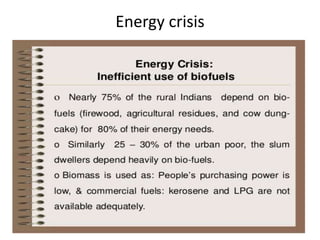
Energy crisis
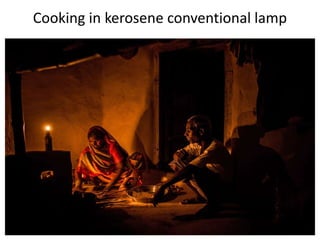
Cooking in kerosene conventional lamp
study in kerosene conventional lamp
study in kerosene conventional lamp 2
study under street light
study in candle
Energy  conservation 2015

Energy conservation 2015

  • 1.
  • 2.
    Today’s Speaker • Mr.Prasad is an Electrical Engineer by profession, • A Teacher by vocation, • A Creative anchor by inclination • He has written Blog on Electrical Maintenance Engineering, Renewable Energy, SAP PM & MM application: • Authored :a practical guide to cable installation and tool box talk • www.bralpowerassociate.blogspot.in
  • 3.
  • 4.
  • 5.
    Major Sources andcapacity of energy 2008 NON RENEWABLE • COAL • LPG • NATURAL GAS • NUCLEAR • FUEL CELL RENEWABLE • WIND • HYDRO • SOLAR • BIOMASS • BIOGAS • PHOTOVOLTAIC Power generation root Capacity MW % Thermal 103449 64.7 Hydro 36913 24.7 Nuclear 4560 2.9 Solar/wind/Biomass 16429 7.7 Total 1,61,351 100
  • 6.
    Power generation inIndia 2015 0 50,000 100,000 150,000 200,000 250,000 300,000 STATE SECTOR CENTRE SECTOR PRIVATE SECTOR TOTAL POWER INSTALLED CAPACITY IN INDIA IN MW MW
  • 7.
    Unit used peryear per person 2012
  • 9.
  • 10.
  • 11.
    Power consumption inAC • An AC with 2,000 Watt power input if operated for about 12 hours per day will consume: 2,000 watt x 12 hours = 24 kilowatt hour = 24 units • BILL monthly (30 DAYS) =24X30X8 =Rs. 5760/-
  • 12.
  • 13.
  • 14.
    Carbon emission fromhousehold = 1190 kg Per Annum per family
  • 15.
    What is EnergyConservation? • Conservation is the process of reducing demand on a limited supply and enabling that supply to begin to rebuild itself. • Many times the best way of doing this is to replace the energy used with an alternate.
  • 16.
    Practical Methods ofEnergy Conservation 1. Install LED Lights 2. Lower the Room Temperature 3. Fix Air Leaks 4. Use Maximum Daylight 5. Get Energy Audit Done 6. Use Energy Efficient Appliances 7. Drive Less, Walk More and Car pooling 8. Switch Off Appliances when Not in Use 9. Plant Shady Landscaping 10. Install Energy Efficient Windows
  • 17.
    Other Energy ConservationTechniques 1. Education 2. Alternative Power 3. Reduced Demand 4. Research & Development
  • 18.
  • 19.
  • 20.
    Cooking in keroseneconventional lamp
  • 21.
    study in keroseneconventional lamp
  • 22.
    study in keroseneconventional lamp 2
  • 23.
  • 24.