OISD 180 lightning , IS 2309 : 1989,
B.Prasad
Chartered Engineer
amieclub@gmail.co
m
20.05.2018
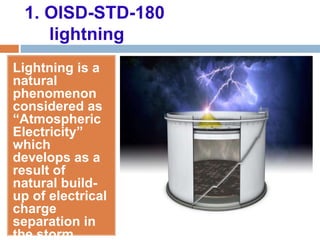
1. OISD-STD-180
lightning
Lightning is a
natural
phenomenon
considered as
“Atmospheric
Electricity”
which
develops as a
result of
natural build-
up of electrical
charge
separation in
the storm
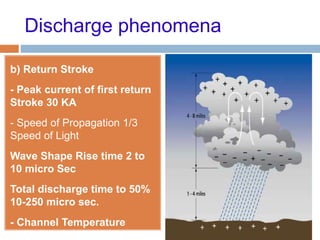
Discharge phenomena
b) Return Stroke
- Peak current of first return
Stroke 30 KA
- Speed of Propagation 1/3
Speed of Light
Wave Shape Rise time 2 to
10 micro Sec
Total discharge time to 50%
10-250 micro sec.
- Channel Temperature
30,000o K
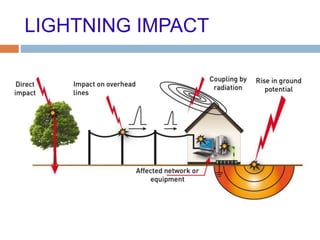
LIGHTNING IMPACT
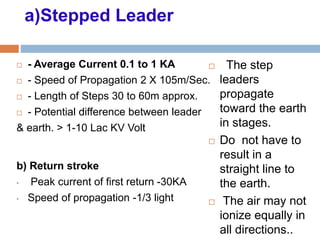
a)Stepped Leader
 - Average Current 0.1 to 1 KA
 - Speed of Propagation 2 X 10⁵m/Sec.
 - Length of Steps 30 to 60m approx.
 - Potential difference between leader
& earth. > 1-10 Lac KV Volt
 The step
leaders
propagate
toward the earth
in stages.
 Do not have to
result in a
straight line to
the earth.
 The air may not
ionize equally in
all directions..
b) Return stroke
• Peak current of first return -30KA
• Speed of propagation -1/3 light
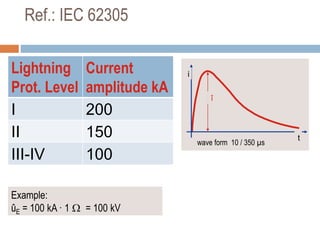
Ref.: IEC 62305
Lightning
Prot. Level
Current
amplitude kA
I 200
II 150
III-IV 100
i
t
î
wave form 10 / 350 µs
Example:
ûE = 100 kA · 1  = 100 kV
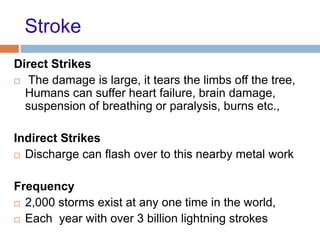
Stroke
Direct Strikes
 The damage is large, it tears the limbs off the tree,
Humans can suffer heart failure, brain damage,
suspension of breathing or paralysis, burns etc.,
Indirect Strikes
 Discharge can flash over to this nearby metal work
Frequency
 2,000 storms exist at any one time in the world,
 Each year with over 3 billion lightning strokes
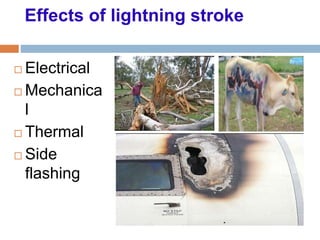
Effects of lightning stroke
 Electrical
 Mechanica
l
 Thermal
 Side
flashing
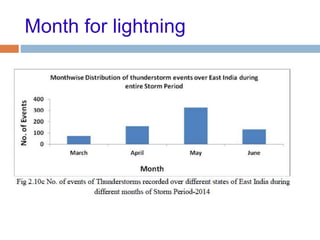
Month for lightning
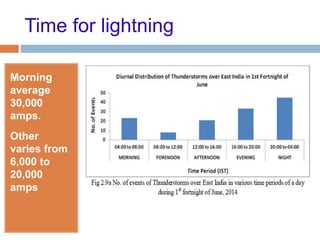
Time for lightning
Morning
average
30,000
amps.
Other
varies from
6,000 to
20,000
amps
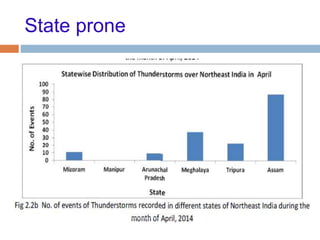
State prone
LIGHTNING PROTECTION
CONCEPTS
 To convey the lightning
energy to earth via a
defined route.
 To ensure low impedance
connection to the earth
mass.
 To eliminate the secondary
effects.
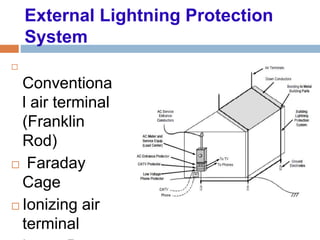
External Lightning Protection
System

Conventiona
l air terminal
(Franklin
Rod)
 Faraday
Cage
 Ionizing air
terminal
The remedial
approach
 Franklin
Rod
 Faraday
Cage
 Laser
Beam
 Ionizing
air
terminal
Indian Standard IS:2309
a. Type of Construction.
b. Contents of the
building and
consequential effects
due to lightning
stroke.
c. Degree of isolation.
d. Type of terrain where
the structure is
located.
e. Height of the
Structure.
f. Lightning prevalence.
 risk factor is less
than 10--5 – NO
USE .
 risk factor is
greater than 10—5
-MAY BE
PROVIDED
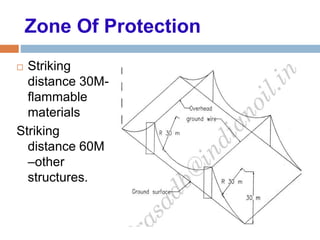
Zone Of Protection
 Striking
distance 30M-
flammable
materials
Striking
distance 60M
–other
structures.
M&I guide line: Protection of
storage tanks:
 Potential spark-gaps between
metallic conductors shall be
avoided at points where flammable
vapours may escape or
accumulate.
 Sheet steel of thickness less than
4.8 mm shall not be used.
 A properly designed / constructed
gas tight storage tanks considered
to be self-protected against
lightning provided it is
properly earthed and
bonded.
 Such a structure may not require
any additional means of lightning
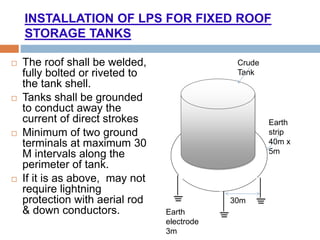
30m
Crude
Tank
Earth
strip
40m x
5m
Earth
electrode
3m
INSTALLATION OF LPS FOR FIXED ROOF
STORAGE TANKS
 The roof shall be welded,
fully bolted or riveted to
the tank shell.
 Tanks shall be grounded
to conduct away the
current of direct strokes
 Minimum of two ground
terminals at maximum 30
M intervals along the
perimeter of tank.
 If it is as above, may not
require lightning
protection with aerial rod
& down conductors.
Size and Material of
Conductors
Vertical Air Termination - 25mm dia., 1000mm
long GI Pipe
Horizontal air termination - 25mm X 3mm GI
Strip (or) 40mm X 5mm GI Strip
Down conductors - Same as horizontal air
termination.
Earth terminations - 65 mm dia., 3000mm long
G.I pipe in Test pit.
Bonding of conductive parts
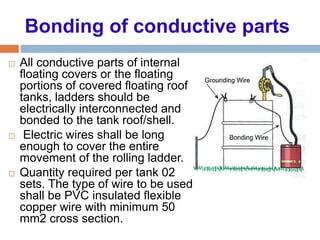
 All conductive parts of internal
floating covers or the floating
portions of covered floating roof
tanks, ladders should be
electrically interconnected and
bonded to the tank roof/shell.
 Electric wires shall be long
enough to cover the entire
movement of the rolling ladder.
 Quantity required per tank 02
sets. The type of wire to be used
shall be PVC insulated flexible
copper wire with minimum 50
mm2 cross section.
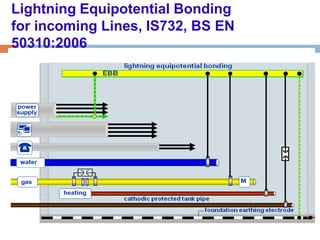
Lightning Equipotential Bonding
for incoming Lines, IS732, BS EN
50310:2006
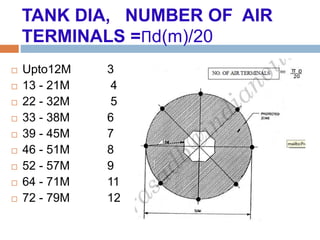
TANK DIA, NUMBER OF AIR
TERMINALS =Πd(m)/20
 Upto12M 3
 13 - 21M 4
 22 - 32M 5
 33 - 38M 6
 39 - 45M 7
 46 - 51M 8
 52 - 57M 9
 64 - 71M 11
 72 - 79M 12
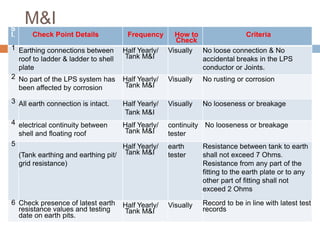
M&IS
l. Check Point Details Frequency How to
Check
Criteria
1 Earthing connections between
roof to ladder & ladder to shell
plate
Half Yearly/
Tank M&I
Visually No loose connection & No
accidental breaks in the LPS
conductor or Joints.
2 No part of the LPS system has
been affected by corrosion
Half Yearly/
Tank M&I
Visually No rusting or corrosion
3 All earth connection is intact. Half Yearly/
Tank M&I
Visually No looseness or breakage
4 electrical continuity between
shell and floating roof
Half Yearly/
Tank M&I
continuity
tester
No looseness or breakage
5
(Tank earthing and earthing pit/
grid resistance)
Half Yearly/
Tank M&I
earth
tester
Resistance between tank to earth
shall not exceed 7 Ohms.
Resistance from any part of the
fitting to the earth plate or to any
other part of fitting shall not
exceed 2 Ohms
6 Check presence of latest earth
resistance values and testing
date on earth pits.
Half Yearly/
Tank M&I
Visually Record to be in line with latest test
records
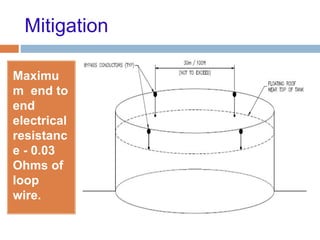
Mitigation
Maximu
m end to
end
electrical
resistanc
e - 0.03
Ohms of
loop
wire.
Control of fugitive(run away)
emission
 Measure initiative for vent, leak, smell control
Protection against lightning of
building , plant structure, chimney
General Design
Requirements.
 A lightning
protection system
(Conventional Air
Terminal System)
consists of the
following
 three basic
components:
 a) Air terminal
 b) Down
conductor
 c) Earth
Air Termination System, down conductor
, earth termination, contd..2
 Minimum 2 nos. vertical terminations shall be
provided for chimneys.
 Vertical air terminations shall project at least 300
mm above the protected structure
 All the vertical air terminations provided on the
same structure shall be interconnected.
 Where a structure has two elevations, either will
be given separate network.
 All the metal piping, railing etc., on the roof shall
be bonded to the protective network
Air Termination System, down
conductor , earth termination
 The recommended spacing of down conductors
is every 20 M of Perimeter for structures upto 20
M in height and every 10 M of perimeter for
structured above 20 M height.
 Each down conductor shall be provided with an
earth electrode and all earth electrodes shall be
interconnected through underground strip.
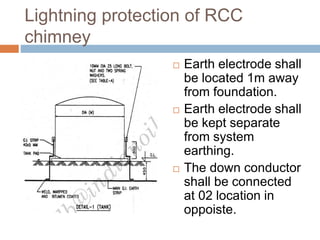
Lightning protection of RCC
chimney
 Earth electrode shall
be located 1m away
from foundation.
 Earth electrode shall
be kept separate
from system
earthing.
 The down conductor
shall be connected
at 02 location in
oppoiste.
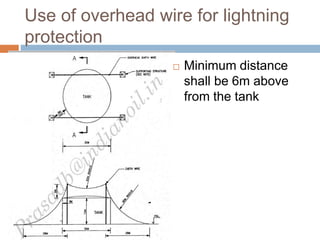
Use of overhead wire for lightning
protection
 Minimum distance
shall be 6m above
from the tank
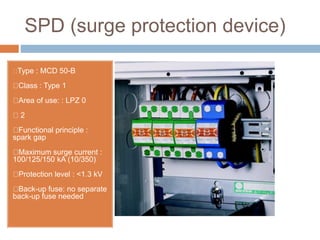
SPD (surge protection device)
Type : MCD 50-B
Class : Type 1
Area of use: : LPZ 0
2
Functional principle :
spark gap
Maximum surge current :
100/125/150 kA (10/350)
Protection level : <1.3 kV
Back-up fuse: no separate
back-up fuse needed
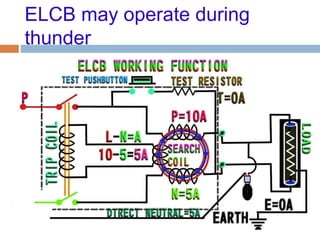
ELCB may operate during
thunder
Thanks

Lightning protection oisd 180

  • 1.
    OISD 180 lightning, IS 2309 : 1989, B.Prasad Chartered Engineer amieclub@gmail.co m 20.05.2018
  • 3.
    1. OISD-STD-180 lightning Lightning isa natural phenomenon considered as “Atmospheric Electricity” which develops as a result of natural build- up of electrical charge separation in the storm
  • 4.
    Discharge phenomena b) ReturnStroke - Peak current of first return Stroke 30 KA - Speed of Propagation 1/3 Speed of Light Wave Shape Rise time 2 to 10 micro Sec Total discharge time to 50% 10-250 micro sec. - Channel Temperature 30,000o K
  • 5.
  • 6.
    a)Stepped Leader  -Average Current 0.1 to 1 KA  - Speed of Propagation 2 X 10⁵m/Sec.  - Length of Steps 30 to 60m approx.  - Potential difference between leader & earth. > 1-10 Lac KV Volt  The step leaders propagate toward the earth in stages.  Do not have to result in a straight line to the earth.  The air may not ionize equally in all directions.. b) Return stroke • Peak current of first return -30KA • Speed of propagation -1/3 light
  • 7.
    Ref.: IEC 62305 Lightning Prot.Level Current amplitude kA I 200 II 150 III-IV 100 i t î wave form 10 / 350 µs Example: ûE = 100 kA · 1  = 100 kV
  • 8.
    Stroke Direct Strikes  Thedamage is large, it tears the limbs off the tree, Humans can suffer heart failure, brain damage, suspension of breathing or paralysis, burns etc., Indirect Strikes  Discharge can flash over to this nearby metal work Frequency  2,000 storms exist at any one time in the world,  Each year with over 3 billion lightning strokes
  • 9.
    Effects of lightningstroke  Electrical  Mechanica l  Thermal  Side flashing
  • 10.
  • 11.
  • 12.
  • 13.
    LIGHTNING PROTECTION CONCEPTS  Toconvey the lightning energy to earth via a defined route.  To ensure low impedance connection to the earth mass.  To eliminate the secondary effects.
  • 14.
    External Lightning Protection System  Conventiona lair terminal (Franklin Rod)  Faraday Cage  Ionizing air terminal
  • 15.
    The remedial approach  Franklin Rod Faraday Cage  Laser Beam  Ionizing air terminal
  • 16.
    Indian Standard IS:2309 a.Type of Construction. b. Contents of the building and consequential effects due to lightning stroke. c. Degree of isolation. d. Type of terrain where the structure is located. e. Height of the Structure. f. Lightning prevalence.  risk factor is less than 10--5 – NO USE .  risk factor is greater than 10—5 -MAY BE PROVIDED
  • 17.
    Zone Of Protection Striking distance 30M- flammable materials Striking distance 60M –other structures.
  • 18.
    M&I guide line:Protection of storage tanks:  Potential spark-gaps between metallic conductors shall be avoided at points where flammable vapours may escape or accumulate.  Sheet steel of thickness less than 4.8 mm shall not be used.  A properly designed / constructed gas tight storage tanks considered to be self-protected against lightning provided it is properly earthed and bonded.  Such a structure may not require any additional means of lightning
  • 19.
    30m Crude Tank Earth strip 40m x 5m Earth electrode 3m INSTALLATION OFLPS FOR FIXED ROOF STORAGE TANKS  The roof shall be welded, fully bolted or riveted to the tank shell.  Tanks shall be grounded to conduct away the current of direct strokes  Minimum of two ground terminals at maximum 30 M intervals along the perimeter of tank.  If it is as above, may not require lightning protection with aerial rod & down conductors.
  • 20.
    Size and Materialof Conductors Vertical Air Termination - 25mm dia., 1000mm long GI Pipe Horizontal air termination - 25mm X 3mm GI Strip (or) 40mm X 5mm GI Strip Down conductors - Same as horizontal air termination. Earth terminations - 65 mm dia., 3000mm long G.I pipe in Test pit.
  • 21.
    Bonding of conductiveparts  All conductive parts of internal floating covers or the floating portions of covered floating roof tanks, ladders should be electrically interconnected and bonded to the tank roof/shell.  Electric wires shall be long enough to cover the entire movement of the rolling ladder.  Quantity required per tank 02 sets. The type of wire to be used shall be PVC insulated flexible copper wire with minimum 50 mm2 cross section.
  • 22.
    Lightning Equipotential Bonding forincoming Lines, IS732, BS EN 50310:2006
  • 23.
    TANK DIA, NUMBEROF AIR TERMINALS =Πd(m)/20  Upto12M 3  13 - 21M 4  22 - 32M 5  33 - 38M 6  39 - 45M 7  46 - 51M 8  52 - 57M 9  64 - 71M 11  72 - 79M 12
  • 24.
    M&IS l. Check PointDetails Frequency How to Check Criteria 1 Earthing connections between roof to ladder & ladder to shell plate Half Yearly/ Tank M&I Visually No loose connection & No accidental breaks in the LPS conductor or Joints. 2 No part of the LPS system has been affected by corrosion Half Yearly/ Tank M&I Visually No rusting or corrosion 3 All earth connection is intact. Half Yearly/ Tank M&I Visually No looseness or breakage 4 electrical continuity between shell and floating roof Half Yearly/ Tank M&I continuity tester No looseness or breakage 5 (Tank earthing and earthing pit/ grid resistance) Half Yearly/ Tank M&I earth tester Resistance between tank to earth shall not exceed 7 Ohms. Resistance from any part of the fitting to the earth plate or to any other part of fitting shall not exceed 2 Ohms 6 Check presence of latest earth resistance values and testing date on earth pits. Half Yearly/ Tank M&I Visually Record to be in line with latest test records
  • 25.
  • 26.
    Control of fugitive(runaway) emission  Measure initiative for vent, leak, smell control
  • 27.
    Protection against lightningof building , plant structure, chimney General Design Requirements.  A lightning protection system (Conventional Air Terminal System) consists of the following  three basic components:  a) Air terminal  b) Down conductor  c) Earth
  • 28.
    Air Termination System,down conductor , earth termination, contd..2  Minimum 2 nos. vertical terminations shall be provided for chimneys.  Vertical air terminations shall project at least 300 mm above the protected structure  All the vertical air terminations provided on the same structure shall be interconnected.  Where a structure has two elevations, either will be given separate network.  All the metal piping, railing etc., on the roof shall be bonded to the protective network
  • 29.
    Air Termination System,down conductor , earth termination  The recommended spacing of down conductors is every 20 M of Perimeter for structures upto 20 M in height and every 10 M of perimeter for structured above 20 M height.  Each down conductor shall be provided with an earth electrode and all earth electrodes shall be interconnected through underground strip.
  • 30.
    Lightning protection ofRCC chimney  Earth electrode shall be located 1m away from foundation.  Earth electrode shall be kept separate from system earthing.  The down conductor shall be connected at 02 location in oppoiste.
  • 31.
    Use of overheadwire for lightning protection  Minimum distance shall be 6m above from the tank
  • 32.
    SPD (surge protectiondevice) Type : MCD 50-B Class : Type 1 Area of use: : LPZ 0 2 Functional principle : spark gap Maximum surge current : 100/125/150 kA (10/350) Protection level : <1.3 kV Back-up fuse: no separate back-up fuse needed
  • 33.
    ELCB may operateduring thunder
  • 35.