AN INTRODUCTION TO 
CREATIVE PROBLEM 
SOLVING
WHAT IS 
CREATIVE PROBLEM SOLVING? 
Creative Problem Solving (CPS) is a framework 
to apply creative-thinking processes to solve 
problems. Embedded in the model are tools 
and strategies that, when placed in the hands 
of students, allow them to be engaged in a 
process for thinking both creatively and 
critically. 
The Creative Problem Solving method is not 
just for school use. It should develop habits of 
mind in students that benefit them for a 
lifetime.
WHO DEVELOPED 
CREATIVE PROBLEM SOLVING? 
There are several (similar) models of creative 
problem solving that have been heavily 
researched and used in both business and 
education settings. 
The model discussed here was developed by 
Alex Osborn and Sidney Parnes.
THE 6 STEPS OF 
CREATIVE PROBLEM SOLVING 
1. Object ive (Mess) Finding: 
Select a problem. 
2. Fact Finding: 
List what you know. 
3. Problem Finding: 
What is the real problem? 
4. Idea Finding: 
Brainstorm ideas. 
5. Solut ion Finding: 
How wi l l you evaluate your ideas? 
Which is best? 
6. Acceptance Finding: 
Find ways to put ideas into act ion. 
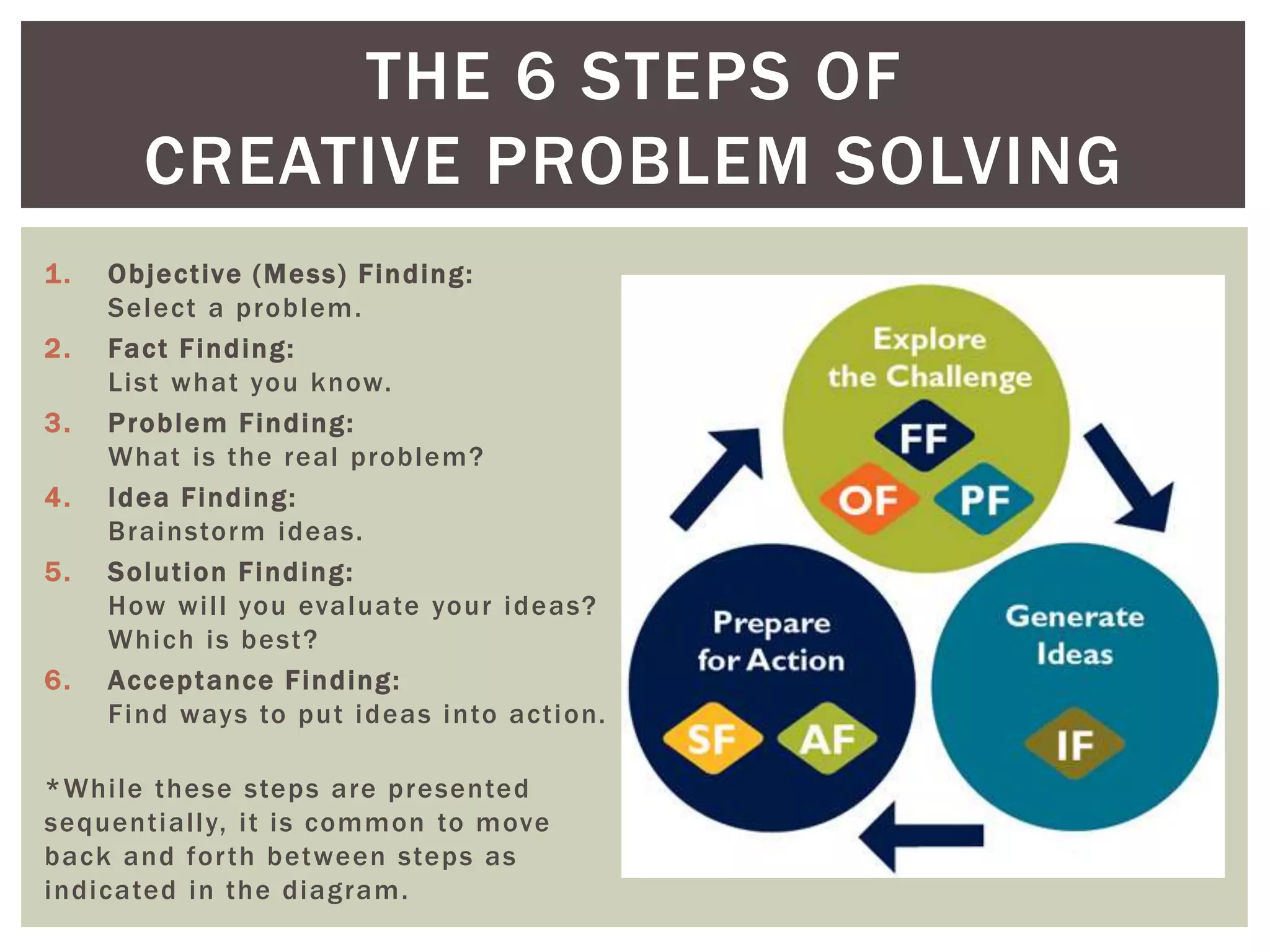
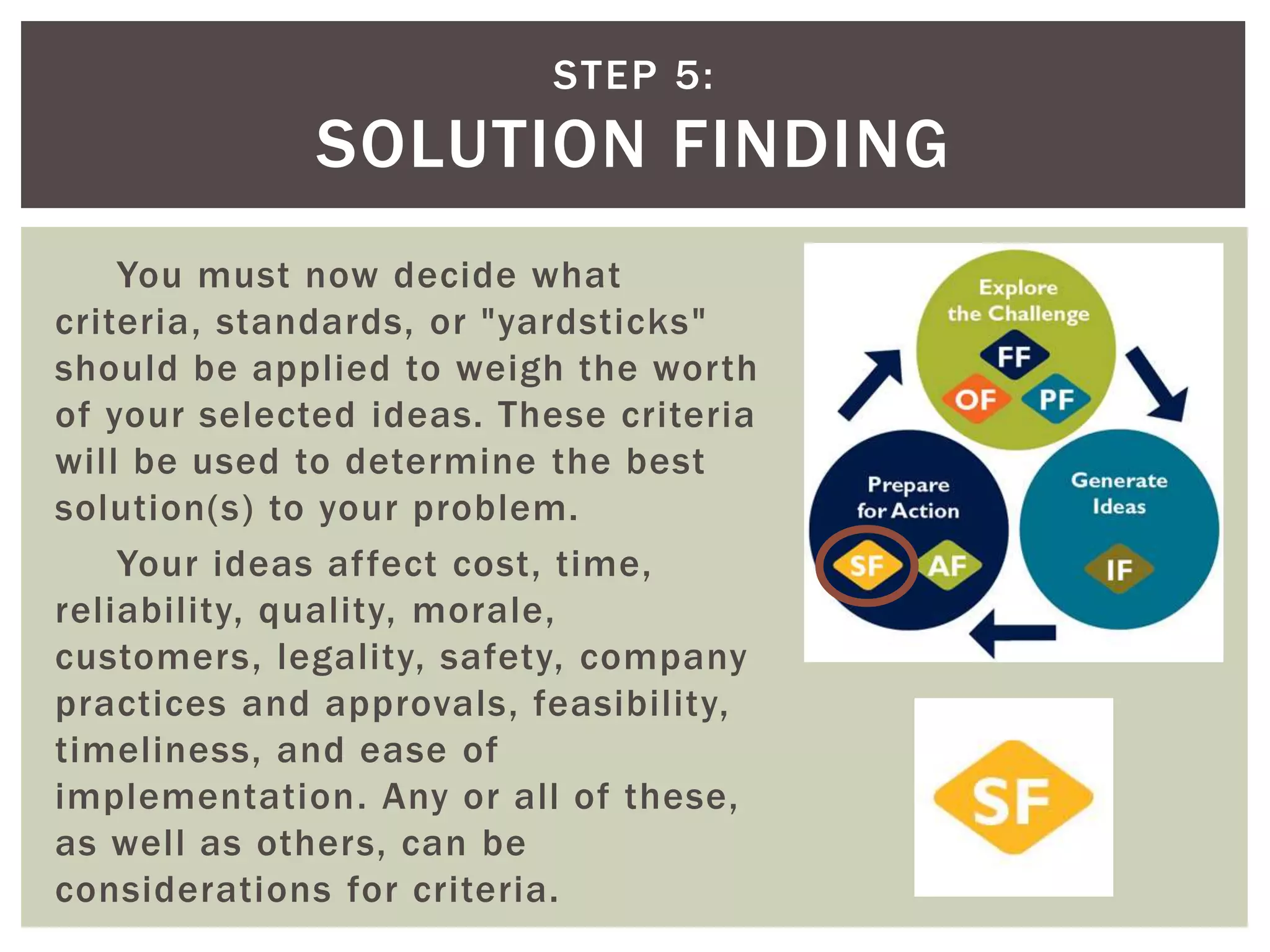
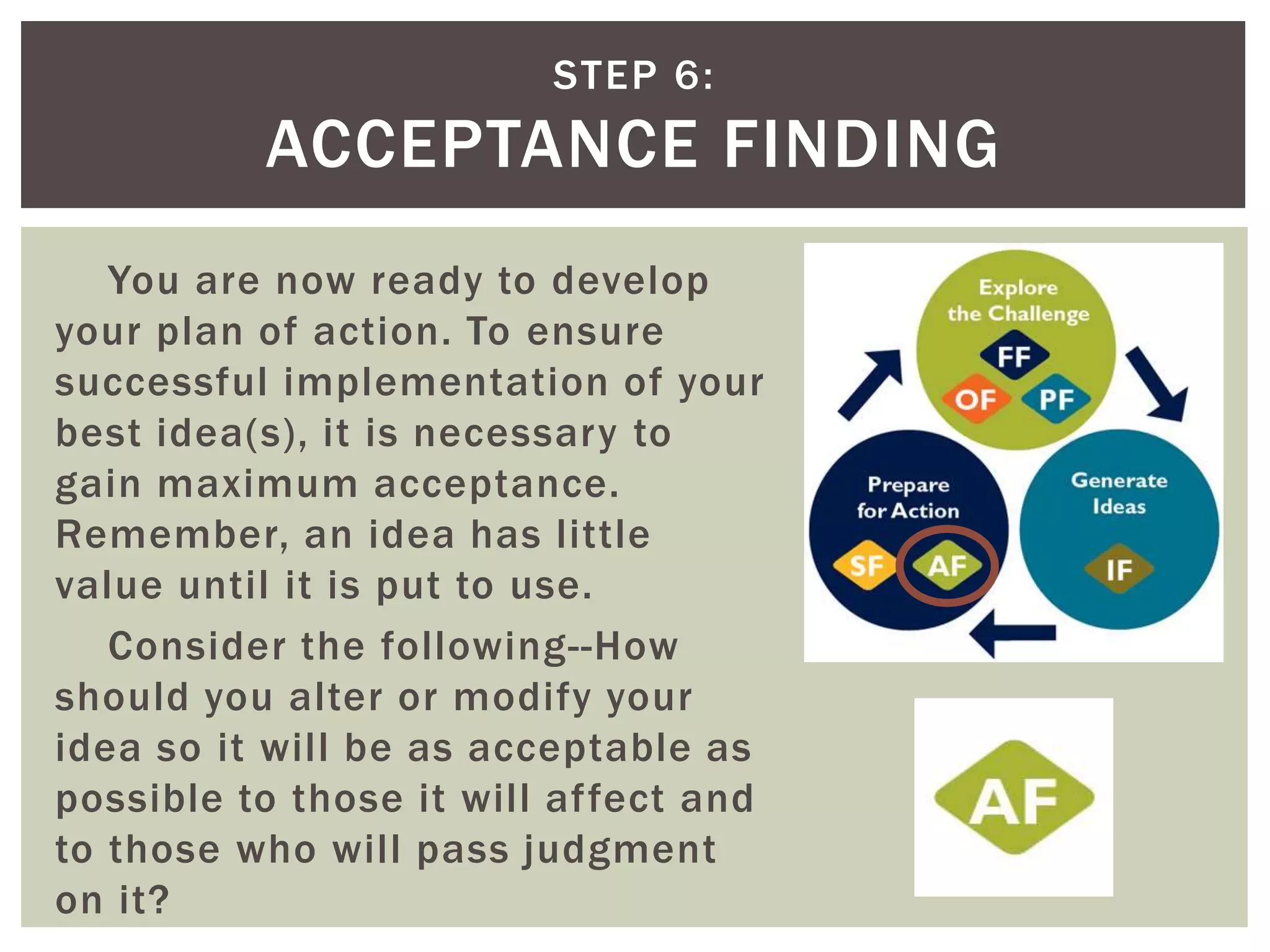
*Whi le these steps are presented 
sequent ial ly, i t is common to move 
back and for th between steps as 
indicated in the diagram.
STEP 1: 
OBJECTIVE (MESS) FINDING 
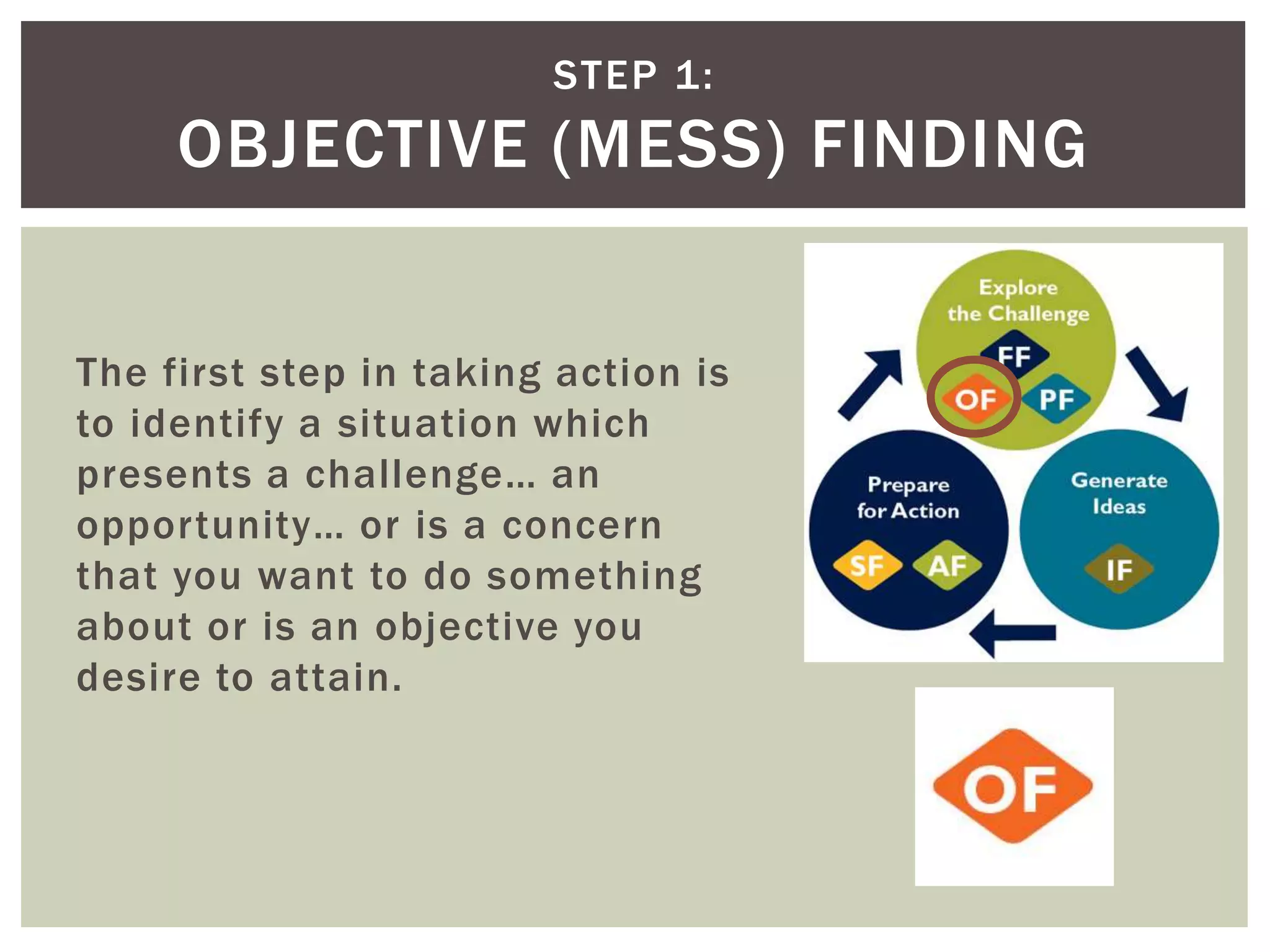
The first step in taking action is 
to identify a situation which 
presents a challenge… an 
oppor tunity… or is a concern 
that you want to do something 
about or is an objective you 
desire to attain.
STEP 2: 
FACT FINDING 
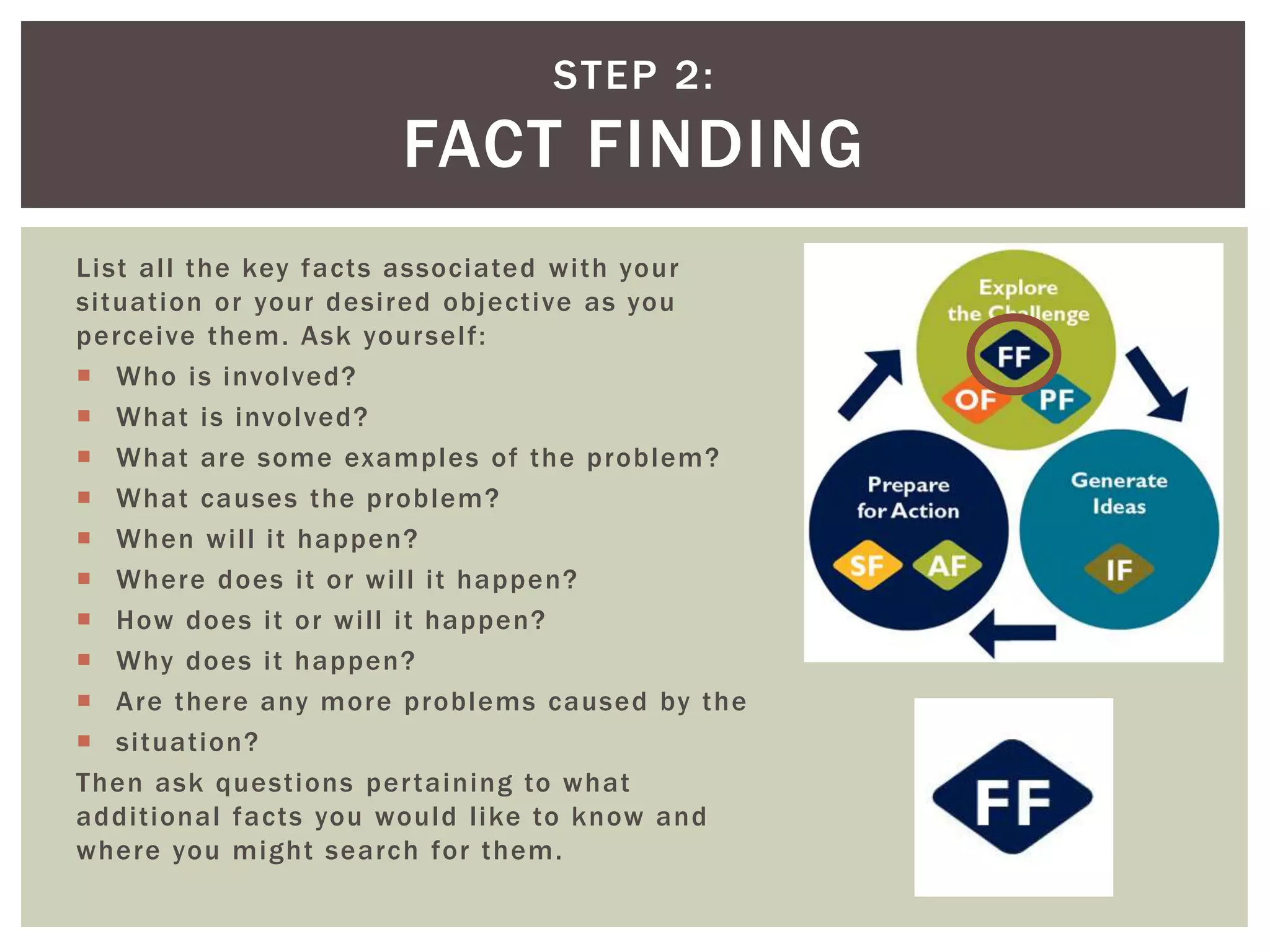
List al l the key facts associated wi th your 
si tuat ion or your desi red object ive as you 
perceive them. Ask yoursel f : 
 Who is involved? 
 What is involved? 
 What are some examples of the problem? 
 What causes the problem? 
 When wi l l i t happen? 
 Where does i t or wi l l i t happen? 
 How does i t or wi l l i t happen? 
 Why does i t happen? 
 Are there any more problems caused by the 
 si tuat ion? 
Then ask quest ions per taining to what 
addi t ional facts you would l ike to know and 
where you might search for them.
STEP 3: 
PROBLEM FINDING 
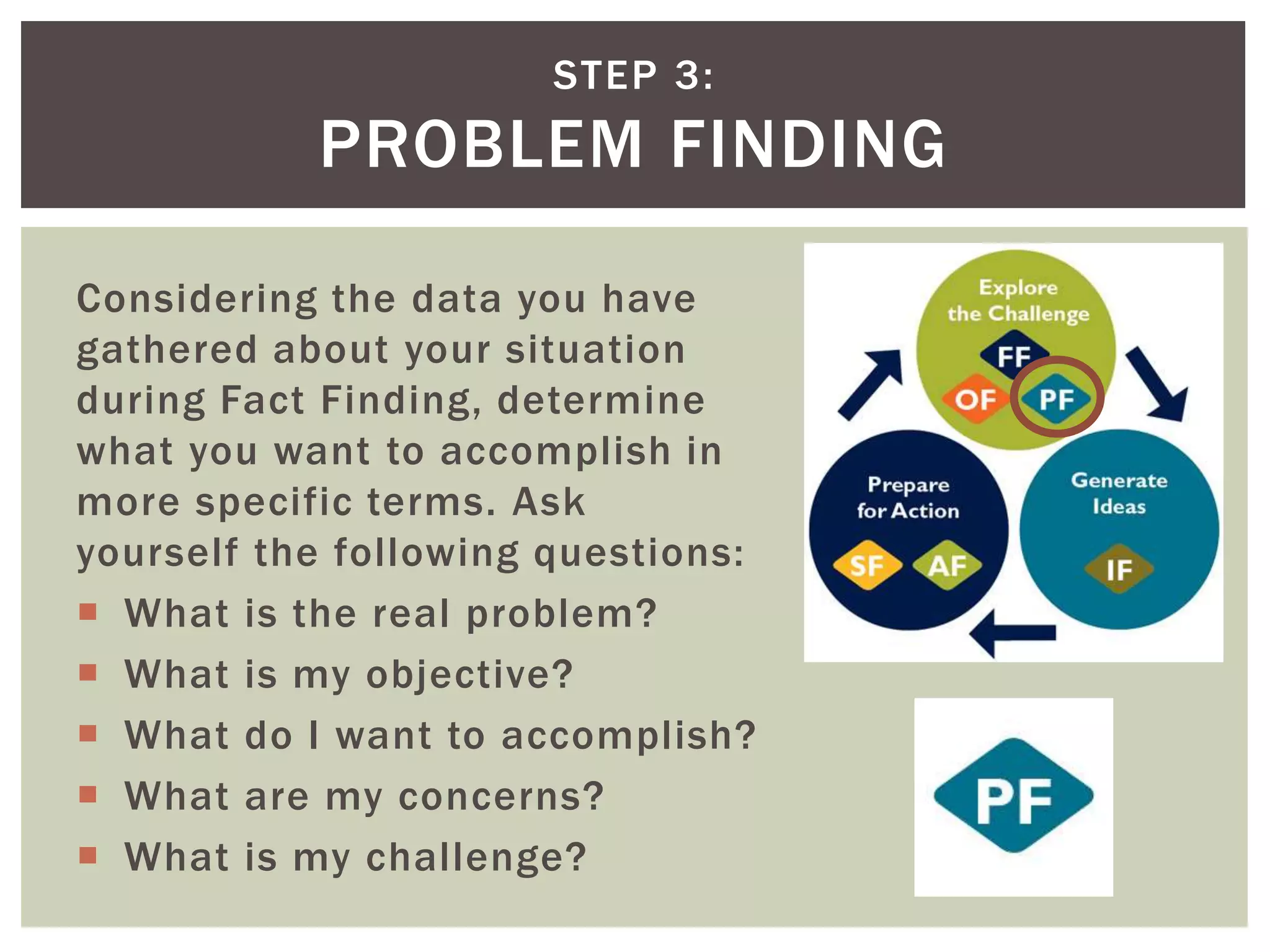
Considering the data you have 
gathered about your situation 
during Fact Finding, determine 
what you want to accomplish in 
more specific terms. Ask 
yourself the following questions: 
 What is the real problem? 
 What is my objective? 
 What do I want to accomplish? 
 What are my concerns? 
 What is my challenge?
STEP 4: 
IDEA FINDING 
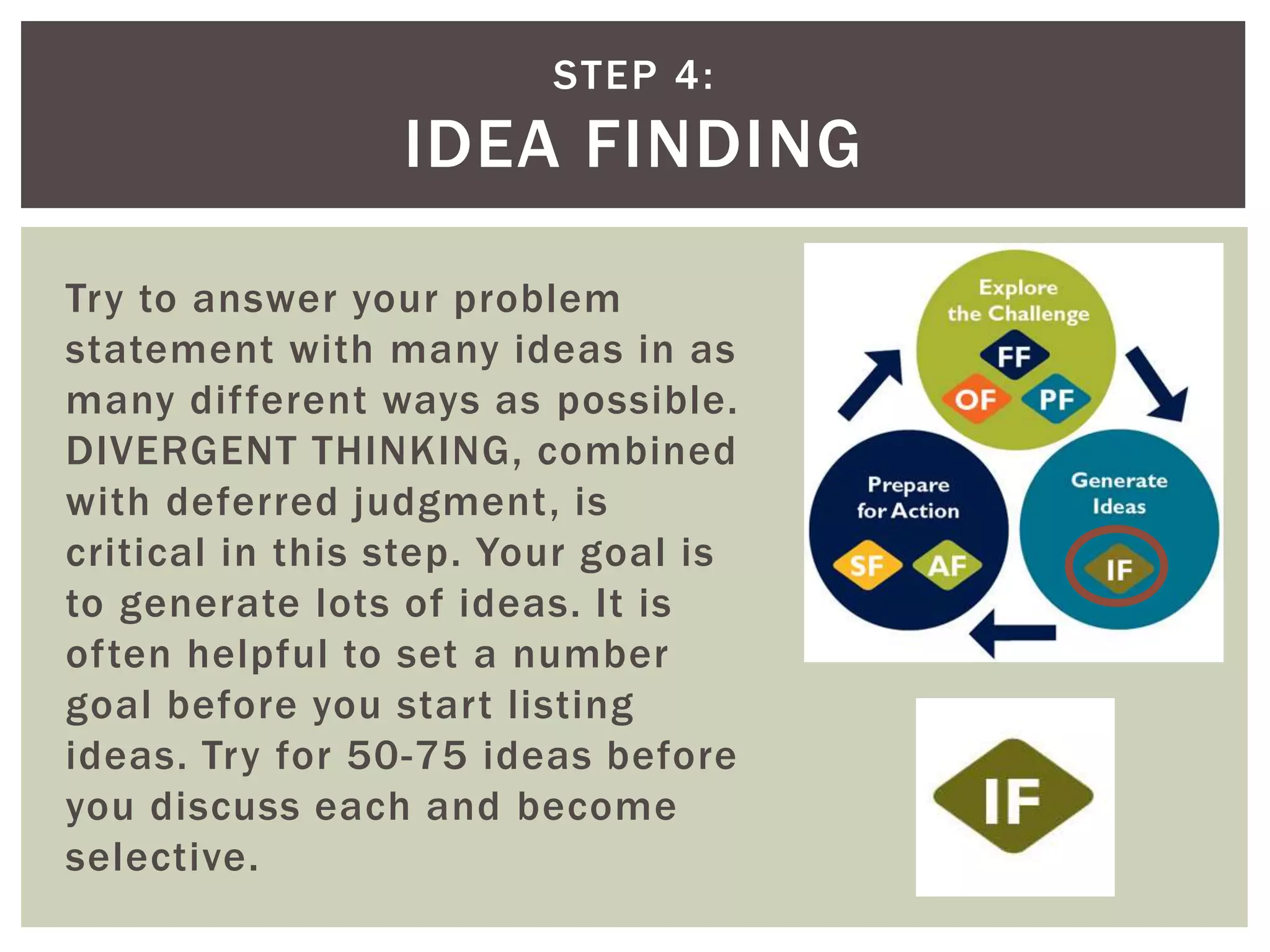
Try to answer your problem 
statement with many ideas in as 
many dif ferent ways as possible. 
DIVERGENT THINKING, combined 
with deferred judgment, is 
critical in this step. Your goal is 
to generate lots of ideas. It is 
of ten helpful to set a number 
goal before you start listing 
ideas. Try for 50-75 ideas before 
you discuss each and become 
selective.
STEP 5: 
SOLUTION FINDING 
You must now decide what 
criteria, standards, or "yardsticks" 
should be applied to weigh the wor th 
of your selected ideas. These criteria 
will be used to determine the best 
solution(s) to your problem. 
Your ideas af fect cost, time, 
reliability, quality, morale, 
customers, legality, safety, company 
practices and approvals, feasibility, 
timeliness, and ease of 
implementation. Any or all of these, 
as well as others, can be 
considerations for criteria.
STEP 6: 
ACCEPTANCE FINDING 
You are now ready to develop 
your plan of action. To ensure 
successful implementation of your 
best idea(s), it is necessary to 
gain maximum acceptance. 
Remember, an idea has little 
value until it is put to use. 
Consider the following--How 
should you alter or modify your 
idea so it will be as acceptable as 
possible to those it will af fect and 
to those who will pass judgment 
on it?
DIVERGENT AND CONVERGENT 
THINKING 
Each of the 6 steps of Creative Problem Solving involve 
divergent and convergent thinking: 
 Problem solvers are encouraged to think divergently 
at the star t of each step to develop as many ideas as 
possible. 
 Following divergent thinking, convergent thinking is 
encouraged to select the best ideas.
SAMPLE 
CREATIVE PROBLEM SOLVING TASKS 
Consider how the tasks on the following slides 
could be used in a classroom to teach the 
thinking skills associated with Creative Problem 
Solving while also allowing students to explore 
and master content standards.
SAMPLE 
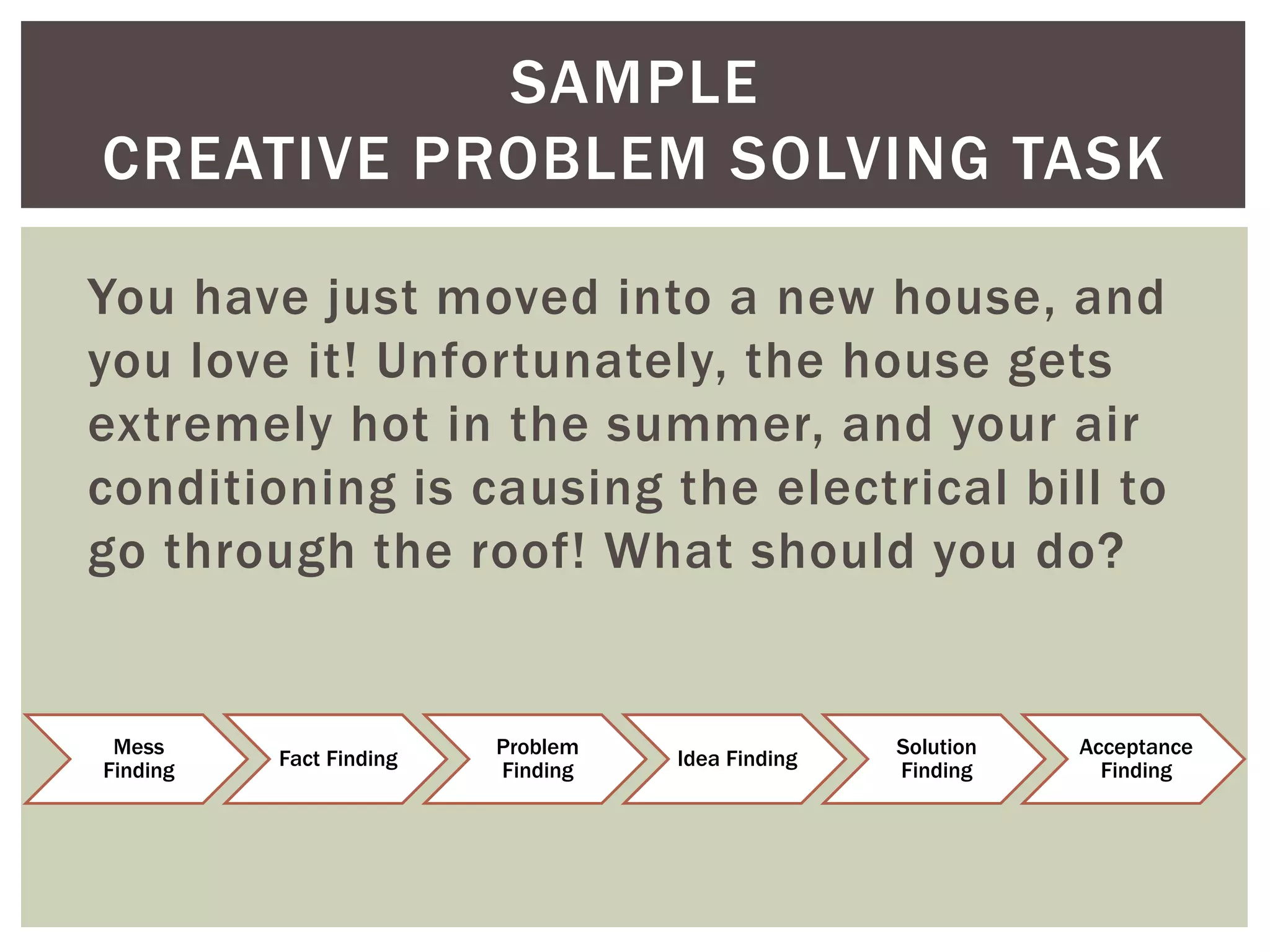
CREATIVE PROBLEM SOLVING TASK 
You have just moved into a new house, and 
you love it! Unfortunately, the house gets 
extremely hot in the summer, and your air 
conditioning is causing the electrical bill to 
go through the roof! What should you do? 
Mess 
Finding 
Fact Finding 
Problem 
Finding 
Idea Finding 
Solution 
Finding 
Acceptance 
Finding
SAMPLE 
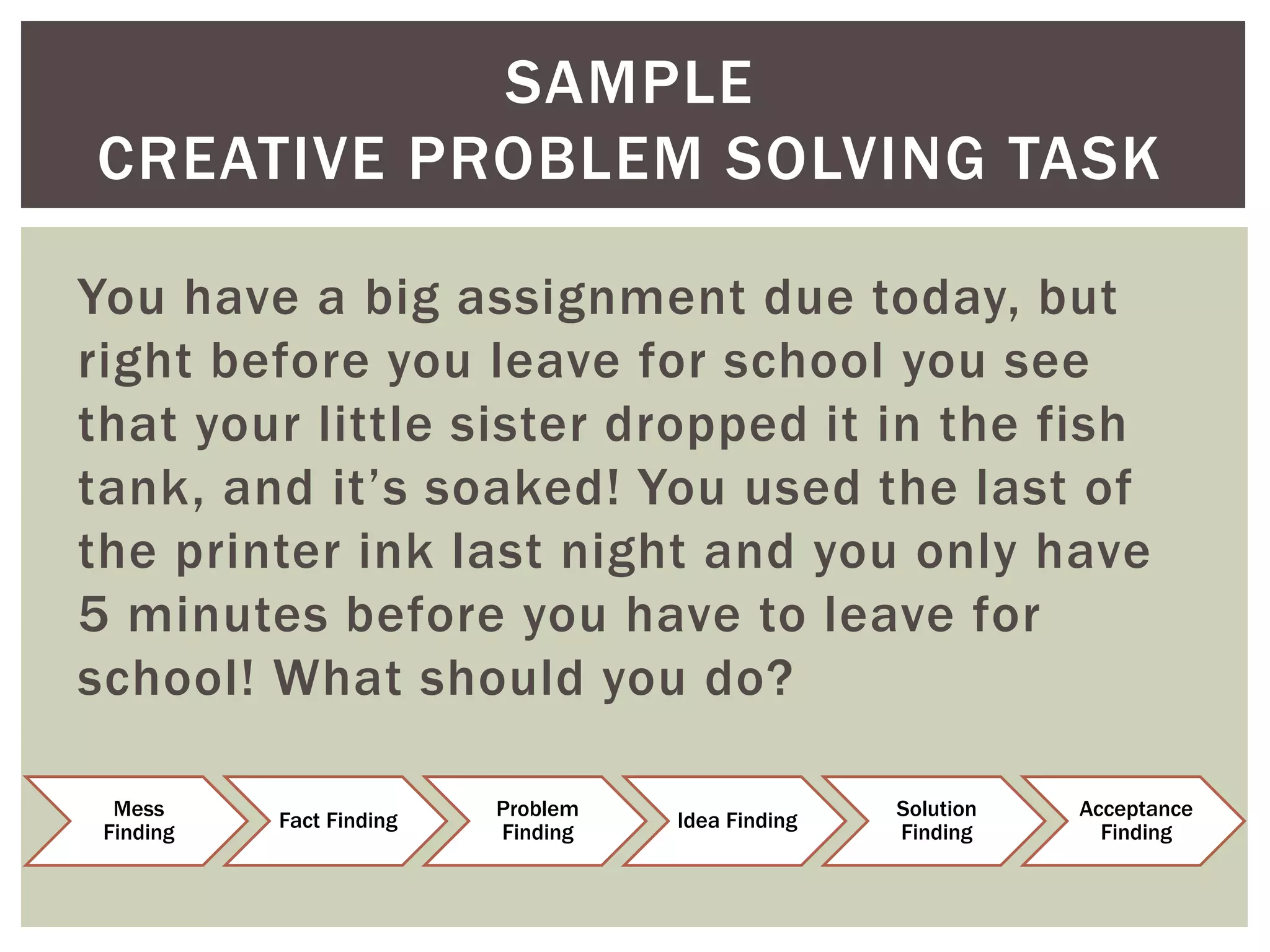
CREATIVE PROBLEM SOLVING TASK 
You have a big assignment due today, but 
right before you leave for school you see 
that your little sister dropped it in the fish 
tank, and it’s soaked! You used the last of 
the printer ink last night and you only have 
5 minutes before you have to leave for 
school! What should you do? 
Mess 
Finding 
Fact Finding 
Problem 
Finding 
Idea Finding 
Solution 
Finding 
Acceptance 
Finding
SAMPLE 
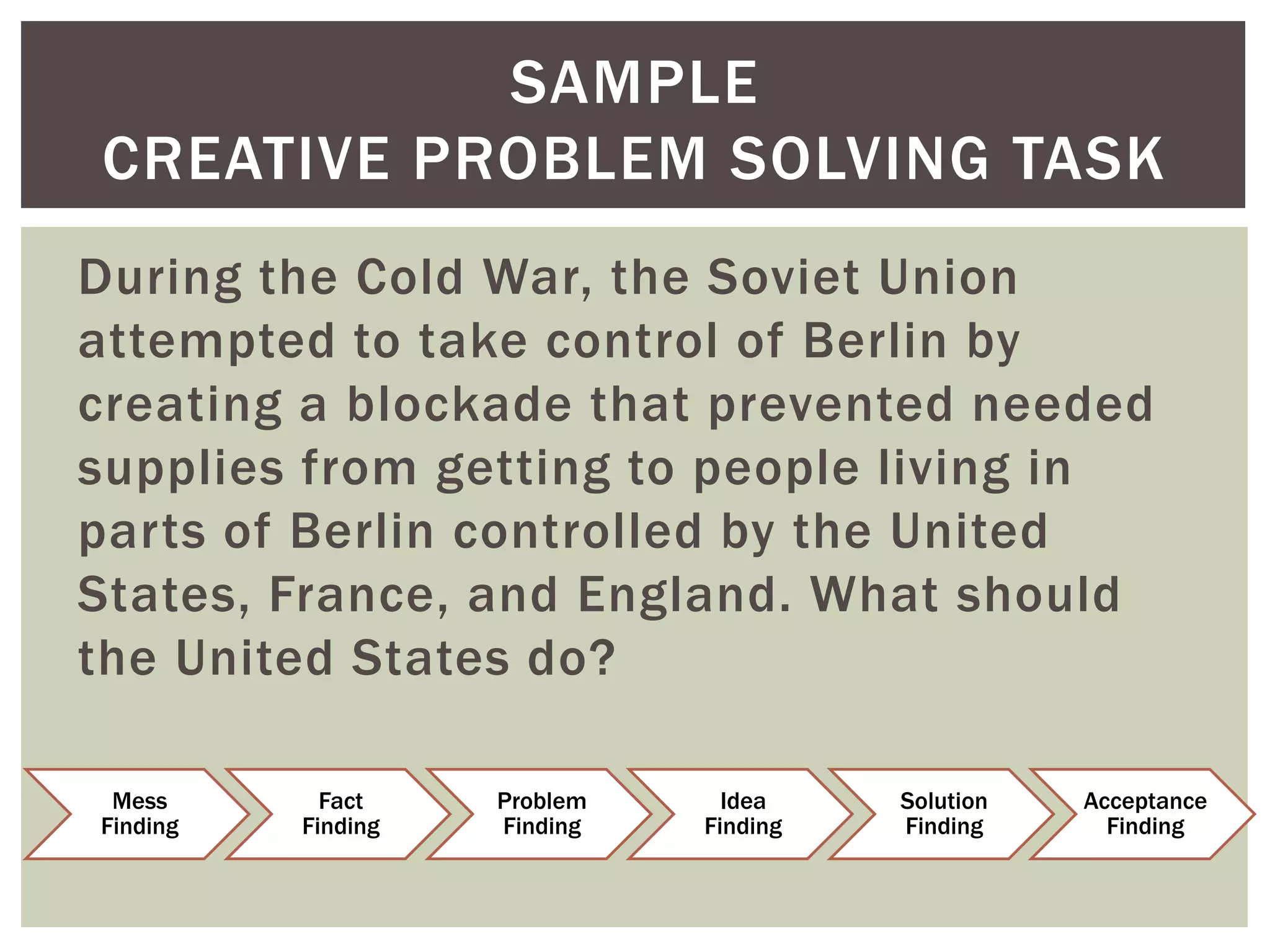
CREATIVE PROBLEM SOLVING TASK 
During the Cold War, the Soviet Union 
attempted to take control of Berlin by 
creating a blockade that prevented needed 
supplies from getting to people living in 
parts of Berlin controlled by the United 
States, France, and England. What should 
the United States do? 
Mess 
Finding 
Fact 
Finding 
Problem 
Finding 
Idea 
Finding 
Solution 
Finding 
Acceptance 
Finding
TOOLKIT FOR USING CREATIVE 
PROBLEM SOLVING IN A CLASSROOM 
http://www.roe11.k12.il.us/GES%20Stuff/Day 
%204/Process/Creative%20Problem%20Solvin 
g/CPS-Mitchell%20&%20Kowalik.pdf

An introduction to creative problem solving

  • 1.
    AN INTRODUCTION TO CREATIVE PROBLEM SOLVING
  • 2.
    WHAT IS CREATIVEPROBLEM SOLVING? Creative Problem Solving (CPS) is a framework to apply creative-thinking processes to solve problems. Embedded in the model are tools and strategies that, when placed in the hands of students, allow them to be engaged in a process for thinking both creatively and critically. The Creative Problem Solving method is not just for school use. It should develop habits of mind in students that benefit them for a lifetime.
  • 3.
    WHO DEVELOPED CREATIVEPROBLEM SOLVING? There are several (similar) models of creative problem solving that have been heavily researched and used in both business and education settings. The model discussed here was developed by Alex Osborn and Sidney Parnes.
  • 4.
    THE 6 STEPSOF CREATIVE PROBLEM SOLVING 1. Object ive (Mess) Finding: Select a problem. 2. Fact Finding: List what you know. 3. Problem Finding: What is the real problem? 4. Idea Finding: Brainstorm ideas. 5. Solut ion Finding: How wi l l you evaluate your ideas? Which is best? 6. Acceptance Finding: Find ways to put ideas into act ion. *Whi le these steps are presented sequent ial ly, i t is common to move back and for th between steps as indicated in the diagram.
  • 5.
    STEP 1: OBJECTIVE(MESS) FINDING The first step in taking action is to identify a situation which presents a challenge… an oppor tunity… or is a concern that you want to do something about or is an objective you desire to attain.
  • 6.
    STEP 2: FACTFINDING List al l the key facts associated wi th your si tuat ion or your desi red object ive as you perceive them. Ask yoursel f :  Who is involved?  What is involved?  What are some examples of the problem?  What causes the problem?  When wi l l i t happen?  Where does i t or wi l l i t happen?  How does i t or wi l l i t happen?  Why does i t happen?  Are there any more problems caused by the  si tuat ion? Then ask quest ions per taining to what addi t ional facts you would l ike to know and where you might search for them.
  • 7.
    STEP 3: PROBLEMFINDING Considering the data you have gathered about your situation during Fact Finding, determine what you want to accomplish in more specific terms. Ask yourself the following questions:  What is the real problem?  What is my objective?  What do I want to accomplish?  What are my concerns?  What is my challenge?
  • 8.
    STEP 4: IDEAFINDING Try to answer your problem statement with many ideas in as many dif ferent ways as possible. DIVERGENT THINKING, combined with deferred judgment, is critical in this step. Your goal is to generate lots of ideas. It is of ten helpful to set a number goal before you start listing ideas. Try for 50-75 ideas before you discuss each and become selective.
  • 9.
    STEP 5: SOLUTIONFINDING You must now decide what criteria, standards, or "yardsticks" should be applied to weigh the wor th of your selected ideas. These criteria will be used to determine the best solution(s) to your problem. Your ideas af fect cost, time, reliability, quality, morale, customers, legality, safety, company practices and approvals, feasibility, timeliness, and ease of implementation. Any or all of these, as well as others, can be considerations for criteria.
  • 10.
    STEP 6: ACCEPTANCEFINDING You are now ready to develop your plan of action. To ensure successful implementation of your best idea(s), it is necessary to gain maximum acceptance. Remember, an idea has little value until it is put to use. Consider the following--How should you alter or modify your idea so it will be as acceptable as possible to those it will af fect and to those who will pass judgment on it?
  • 11.
    DIVERGENT AND CONVERGENT THINKING Each of the 6 steps of Creative Problem Solving involve divergent and convergent thinking:  Problem solvers are encouraged to think divergently at the star t of each step to develop as many ideas as possible.  Following divergent thinking, convergent thinking is encouraged to select the best ideas.
  • 12.
    SAMPLE CREATIVE PROBLEMSOLVING TASKS Consider how the tasks on the following slides could be used in a classroom to teach the thinking skills associated with Creative Problem Solving while also allowing students to explore and master content standards.
  • 13.
    SAMPLE CREATIVE PROBLEMSOLVING TASK You have just moved into a new house, and you love it! Unfortunately, the house gets extremely hot in the summer, and your air conditioning is causing the electrical bill to go through the roof! What should you do? Mess Finding Fact Finding Problem Finding Idea Finding Solution Finding Acceptance Finding
  • 14.
    SAMPLE CREATIVE PROBLEMSOLVING TASK You have a big assignment due today, but right before you leave for school you see that your little sister dropped it in the fish tank, and it’s soaked! You used the last of the printer ink last night and you only have 5 minutes before you have to leave for school! What should you do? Mess Finding Fact Finding Problem Finding Idea Finding Solution Finding Acceptance Finding
  • 15.
    SAMPLE CREATIVE PROBLEMSOLVING TASK During the Cold War, the Soviet Union attempted to take control of Berlin by creating a blockade that prevented needed supplies from getting to people living in parts of Berlin controlled by the United States, France, and England. What should the United States do? Mess Finding Fact Finding Problem Finding Idea Finding Solution Finding Acceptance Finding
  • 16.
    TOOLKIT FOR USINGCREATIVE PROBLEM SOLVING IN A CLASSROOM http://www.roe11.k12.il.us/GES%20Stuff/Day %204/Process/Creative%20Problem%20Solvin g/CPS-Mitchell%20&%20Kowalik.pdf