PROBLEM
SOLVING AND
CREATIVITY
Module 18
WHO IS
EDWARD PAUL
TORRANCE?
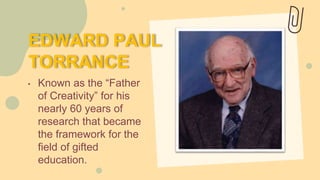
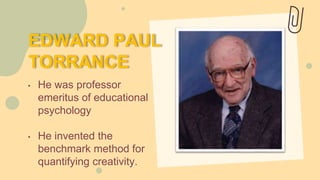
EDWARD PAUL
TORRANCE
• Known as the “Father
of Creativity” for his
nearly 60 years of
research that became
the framework for the
field of gifted
education.
EDWARD PAUL
TORRANCE
• He was professor
emeritus of educational
psychology
• He invented the
benchmark method for
quantifying creativity.
The “Torrance Tests of
Creativity Thinking”
helped shatter the
theory that IQ tests
alone were sufficient
to gauge real
intelligence.
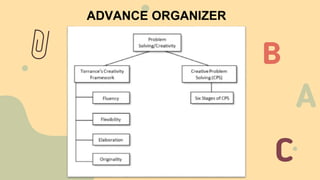
ADVANCE ORGANIZER
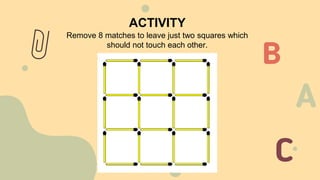
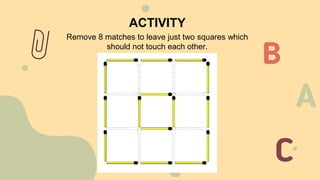
ACTIVITY
Remove 8 matches to leave just two squares which
should not touch each other.
ACTIVITY
Remove 8 matches to leave just two squares which
should not touch each other.
Torrance’s
Creativity
Framework
01
Fluency
• Refers to the production of a great number of ideas
or alternate solutions to a problem. It implies
understanding, not just remembering information
that is learned.
Key Words:
Compare, convert, count, define, describe, explain,
identify, label, list, match, name, outline, paraphrase,
predict, summarize.
Flexibility
• Refers to the production of ideas that show a variety
of possibilities or realm of thought. It involves the
ability to see things from different points of view, to
use different approaches and strategies.
Key Words:
Change, demonstrate, employ, extrapolate, predict,
interpret.
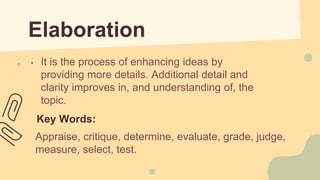
Elaboration
• It is the process of enhancing ideas by
providing more details. Additional detail and
clarity improves in, and understanding of, the
topic.
Key Words:
Appraise, critique, determine, evaluate, grade, judge,
measure, select, test.
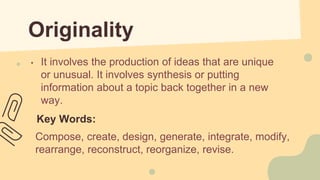
Originality
• It involves the production of ideas that are unique
or unusual. It involves synthesis or putting
information about a topic back together in a new
way.
Key Words:
Compose, create, design, generate, integrate, modify,
rearrange, reconstruct, reorganize, revise.
Creative Problem
Solving (CPS)
02
CREATIVE PROBLEM
SOLVING
• It is an intentional process for solving and problems
and discussing opportunities.
• It espouses the use of creativity in the 1950’s Alex
Osborn described this process in his book, Applied
Imagination.
• Osborn opened the process in the public domain
which mean anyone can use it.
6 Stages of
CPS
• The following, based on Van Gundy
(1988) description, is a very brief
skeleton of a very rich process, showing
it in its ‘6 x 2’ stages’ form:
Stage 1: Mess Finding
• Sensitise yourself (scan, search) for
issues (concerns, challenges,
opportunities, etc.) that need to be
tackled.
Stage 2: Data Finding
• Gather information about the problem.
Stage 3: Problem
Finding
• Convert a fuzzy statement of the
problem into a broad statement
more suitable for idea finding.
Stage 4: Idea Finding
• Generate as many idea as possible.
Stage 5: Solution
Finding
• Generate and select obvious evaluation
criteria and develop the short-listed ideas
from Idea Finding as much as you can in
the light of these criteria. Then opt for the
best of these improved ideas. ( e.g. using
comparison table)
Stage 6: Acceptance
Finding
• Develop a plan of action to implement
the solution you’ve settled on as the
best choice.
CREDITS: This presentation template was
created by Slidesgo, including icons by
Flaticon and infographics & images by
Freepik.
Thank
You!

Module-18-Problem-Solving-and-Creativity.pptx

  • 1.
  • 2.
  • 3.
    EDWARD PAUL TORRANCE • Knownas the “Father of Creativity” for his nearly 60 years of research that became the framework for the field of gifted education.
  • 4.
    EDWARD PAUL TORRANCE • Hewas professor emeritus of educational psychology • He invented the benchmark method for quantifying creativity.
  • 5.
    The “Torrance Testsof Creativity Thinking” helped shatter the theory that IQ tests alone were sufficient to gauge real intelligence.
  • 6.
  • 7.
    ACTIVITY Remove 8 matchesto leave just two squares which should not touch each other.
  • 8.
    ACTIVITY Remove 8 matchesto leave just two squares which should not touch each other.
  • 9.
  • 10.
    Fluency • Refers tothe production of a great number of ideas or alternate solutions to a problem. It implies understanding, not just remembering information that is learned. Key Words: Compare, convert, count, define, describe, explain, identify, label, list, match, name, outline, paraphrase, predict, summarize.
  • 11.
    Flexibility • Refers tothe production of ideas that show a variety of possibilities or realm of thought. It involves the ability to see things from different points of view, to use different approaches and strategies. Key Words: Change, demonstrate, employ, extrapolate, predict, interpret.
  • 12.
    Elaboration • It isthe process of enhancing ideas by providing more details. Additional detail and clarity improves in, and understanding of, the topic. Key Words: Appraise, critique, determine, evaluate, grade, judge, measure, select, test.
  • 13.
    Originality • It involvesthe production of ideas that are unique or unusual. It involves synthesis or putting information about a topic back together in a new way. Key Words: Compose, create, design, generate, integrate, modify, rearrange, reconstruct, reorganize, revise.
  • 14.
  • 15.
    CREATIVE PROBLEM SOLVING • Itis an intentional process for solving and problems and discussing opportunities. • It espouses the use of creativity in the 1950’s Alex Osborn described this process in his book, Applied Imagination. • Osborn opened the process in the public domain which mean anyone can use it.
  • 16.
  • 17.
    • The following,based on Van Gundy (1988) description, is a very brief skeleton of a very rich process, showing it in its ‘6 x 2’ stages’ form:
  • 18.
    Stage 1: MessFinding • Sensitise yourself (scan, search) for issues (concerns, challenges, opportunities, etc.) that need to be tackled.
  • 19.
    Stage 2: DataFinding • Gather information about the problem.
  • 20.
    Stage 3: Problem Finding •Convert a fuzzy statement of the problem into a broad statement more suitable for idea finding.
  • 21.
    Stage 4: IdeaFinding • Generate as many idea as possible.
  • 22.
    Stage 5: Solution Finding •Generate and select obvious evaluation criteria and develop the short-listed ideas from Idea Finding as much as you can in the light of these criteria. Then opt for the best of these improved ideas. ( e.g. using comparison table)
  • 23.
    Stage 6: Acceptance Finding •Develop a plan of action to implement the solution you’ve settled on as the best choice.
  • 24.
    CREDITS: This presentationtemplate was created by Slidesgo, including icons by Flaticon and infographics & images by Freepik. Thank You!