UMC1022 CREATIVITY & INNOVATION
    Creative Problem Solving (CPS)
          Zainal Abidin Sayadi
 Faculty of Science, Technology & Human Development
Identify the Goal, Wish or Challenge
Gather Data
Clarify the Problem


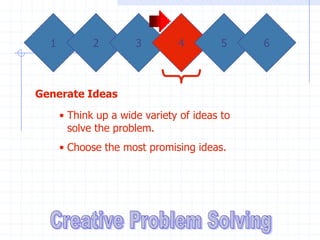
Generate Ideas


Select & Strengthen Solutions
Plan for Action
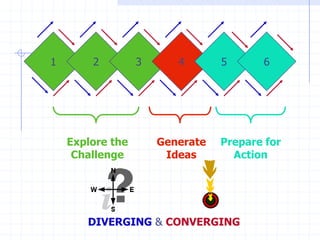
1       2         3      4       5      6


    Explore the       Generate   Prepare for
     Challenge         Ideas       Action


       DIVERGING & CONVERGING
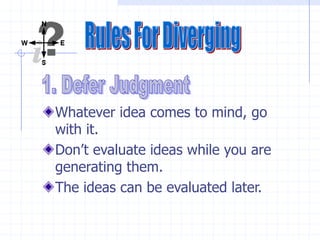
Whatever idea comes to mind, go
with it.
Don’t evaluate ideas while you are
generating them.
The ideas can be evaluated later.
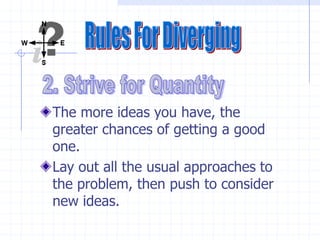
The more ideas you have, the
greater chances of getting a good
one.
Lay out all the usual approaches to
the problem, then push to consider
new ideas.
Freewheel - the wilder the ideas the
     better.
     It’s easier to tame a wild idea than to
     invigorate a weak one. (Osborn)
     Stretch your thinking to create some
     wild ideas.
“If at the first the idea is not absurd, there is no hope for it”
                         Albert Einstein
Let one idea spur other ideas.
Build, combine and improve ideas.
1st Stage
                   Divergent
 What if?
 Why not?
 What associations can we find
 What rules can we break?
 What assumptions are at work?
 What is this like?
 What analogy could we use?
 What metaphor suggests itself?
 Suppose the problem were a solution?
2nd Stage
                   Convergent
Will it work?
Can we do it?
Has it been tried before?
Does it fit in?
Have we got the resources?
Is the timing right?
Who can help?
How much will it cost?
Suppose it fails?
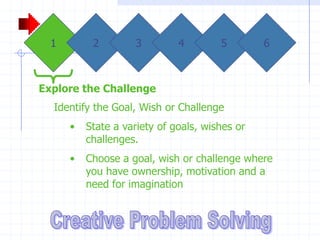
1        2        3         4        5        6


Explore the Challenge
  Identify the Goal, Wish or Challenge
      •   State a variety of goals, wishes or
          challenges.
      •   Choose a goal, wish or challenge where
          you have ownership, motivation and a
          need for imagination
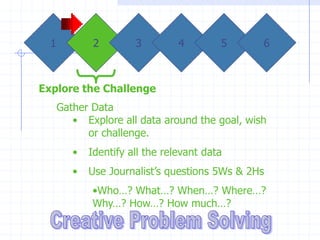
1           2        3         4        5     6


Explore the Challenge
      Gather Data
         • Explore all data around the goal, wish
            or challenge.
         •   Identify all the relevant data
         •   Use Journalist’s questions 5Ws & 2Hs
             •Who…? What…? When…? Where…?
             Why…? How…? How much…?
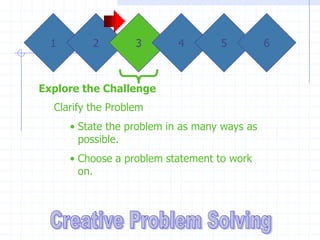
1       2        3        4       5          6


Explore the Challenge
  Clarify the Problem
      • State the problem in as many ways as
        possible.
      • Choose a problem statement to work
        on.
1          2        3        4         5    6


Generate Ideas

      • Think up a wide variety of ideas to
        solve the problem.
      • Choose the most promising ideas.
1          2          3         4           5   6


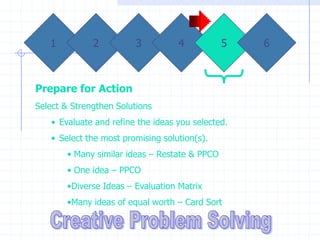
Prepare for Action
Select & Strengthen Solutions
   • Evaluate and refine the ideas you selected.
   • Select the most promising solution(s).
       • Many similar ideas – Restate & PPCO
       • One idea – PPCO
       •Diverse Ideas – Evaluation Matrix
       •Many ideas of equal worth – Card Sort
1              2        3          4       5      6


Prepare for Action
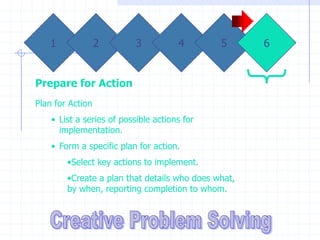
Plan for Action
    • List a series of possible actions for
      implementation.
    • Form a specific plan for action.
        •Select key actions to implement.
        •Create a plan that details who does what,
        by when, reporting completion to whom.
1         2        3         4        5          6


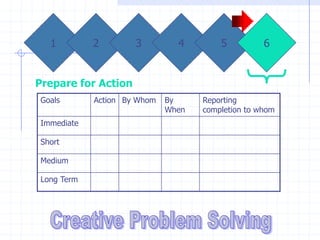
Prepare for Action
Goals       Action By Whom   By     Reporting
                             When   completion to whom
Immediate

Short

Medium

Long Term
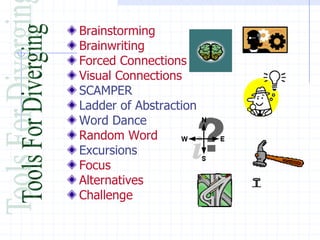
Brainstorming
Brainwriting
Forced Connections
Visual Connections
SCAMPER
Ladder of Abstraction
Word Dance
Random Word
Excursions
Focus
Alternatives
Challenge
Highlighting
Praise First (PPCO)
Card Sort
Evaluation Matrix
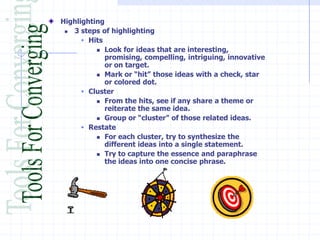
Highlighting
  3 steps of highlighting
       Hits
           Look for ideas that are interesting,
             promising, compelling, intriguing, innovative
             or on target.
           Mark or “hit” those ideas with a check, star
             or colored dot.
       Cluster
           From the hits, see if any share a theme or
             reiterate the same idea.
           Group or “cluster” of those related ideas.

       Restate
           For each cluster, try to synthesize the
             different ideas into a single statement.
           Try to capture the essence and paraphrase
             the ideas into one concise phrase.
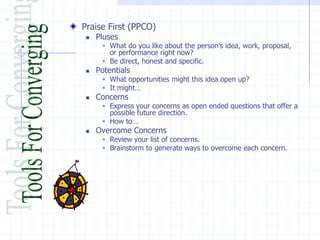
Praise First (PPCO)
    Pluses
       What do you like about the person’s idea, work, proposal,
        or performance right now?
       Be direct, honest and specific.
    Potentials
       What opportunities might this idea open up?
       It might…
    Concerns
       Express your concerns as open ended questions that offer a
        possible future direction.
       How to…
    Overcome Concerns
       Review your list of concerns.
       Brainstorm to generate ways to overcome each concern.
Card Sort
   Helps to compare, rank and
    prioritize promising ideas.
   It can be used to rank ideas,
    solutions, problem statements or
    criteria.


                           Continued…..
Card Sort… directions
1.   Write each idea on a separate card (3” x 5”)
     and arrange the cards in a row.
2.   Count how many cards (ideas) you have.
3.   Identify the option you like the least. Write
     the number that equals the total number of
     cards you have. Put the card off to the side.
4.   Of the cards remaining, identify the option
     you like the best and write “1” on it. Put it off
     to the side.
5.   ……
Evaluation Matrix
   A systematic way to analyze ideas.
   Directions:
      Generate Criteria
      Select Criteria
      Create a rating scale
      Set up the matrix
      Fill in the blank boxes
      Compare their strengths & weaknesses
      Overcome low criteria ratings
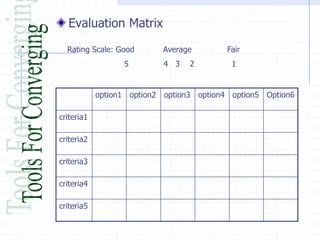
Evaluation Matrix

  Rating Scale: Good        Average        Fair
                  5         4 3   2         1


            option1 option2 option3 option4 option5 Option6

criteria1

criteria2

criteria3

criteria4

criteria5
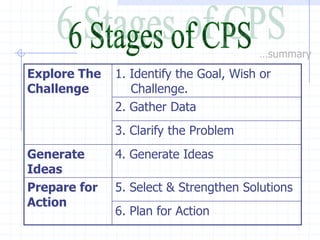
…summary
Explore The   1. Identify the Goal, Wish or
Challenge        Challenge.
              2. Gather Data
              3. Clarify the Problem
Generate      4. Generate Ideas
Ideas
Prepare for   5. Select & Strengthen Solutions
Action
              6. Plan for Action
NEXT…
 Some youtube videos to inspire you…

Creative Problem Solving

  • 1.
    UMC1022 CREATIVITY &INNOVATION Creative Problem Solving (CPS) Zainal Abidin Sayadi Faculty of Science, Technology & Human Development
  • 3.
    Identify the Goal,Wish or Challenge Gather Data Clarify the Problem Generate Ideas Select & Strengthen Solutions Plan for Action
  • 4.
    1 2 3 4 5 6 Explore the Generate Prepare for Challenge Ideas Action DIVERGING & CONVERGING
  • 6.
    Whatever idea comesto mind, go with it. Don’t evaluate ideas while you are generating them. The ideas can be evaluated later.
  • 7.
    The more ideasyou have, the greater chances of getting a good one. Lay out all the usual approaches to the problem, then push to consider new ideas.
  • 8.
    Freewheel - thewilder the ideas the better. It’s easier to tame a wild idea than to invigorate a weak one. (Osborn) Stretch your thinking to create some wild ideas. “If at the first the idea is not absurd, there is no hope for it” Albert Einstein
  • 9.
    Let one ideaspur other ideas. Build, combine and improve ideas.
  • 10.
    1st Stage Divergent What if? Why not? What associations can we find What rules can we break? What assumptions are at work? What is this like? What analogy could we use? What metaphor suggests itself? Suppose the problem were a solution?
  • 12.
    2nd Stage Convergent Will it work? Can we do it? Has it been tried before? Does it fit in? Have we got the resources? Is the timing right? Who can help? How much will it cost? Suppose it fails?
  • 13.
    1 2 3 4 5 6 Explore the Challenge Identify the Goal, Wish or Challenge • State a variety of goals, wishes or challenges. • Choose a goal, wish or challenge where you have ownership, motivation and a need for imagination
  • 14.
    1 2 3 4 5 6 Explore the Challenge Gather Data • Explore all data around the goal, wish or challenge. • Identify all the relevant data • Use Journalist’s questions 5Ws & 2Hs •Who…? What…? When…? Where…? Why…? How…? How much…?
  • 15.
    1 2 3 4 5 6 Explore the Challenge Clarify the Problem • State the problem in as many ways as possible. • Choose a problem statement to work on.
  • 16.
    1 2 3 4 5 6 Generate Ideas • Think up a wide variety of ideas to solve the problem. • Choose the most promising ideas.
  • 17.
    1 2 3 4 5 6 Prepare for Action Select & Strengthen Solutions • Evaluate and refine the ideas you selected. • Select the most promising solution(s). • Many similar ideas – Restate & PPCO • One idea – PPCO •Diverse Ideas – Evaluation Matrix •Many ideas of equal worth – Card Sort
  • 18.
    1 2 3 4 5 6 Prepare for Action Plan for Action • List a series of possible actions for implementation. • Form a specific plan for action. •Select key actions to implement. •Create a plan that details who does what, by when, reporting completion to whom.
  • 19.
    1 2 3 4 5 6 Prepare for Action Goals Action By Whom By Reporting When completion to whom Immediate Short Medium Long Term
  • 20.
    Brainstorming Brainwriting Forced Connections Visual Connections SCAMPER Ladderof Abstraction Word Dance Random Word Excursions Focus Alternatives Challenge
  • 21.
  • 22.
    Highlighting  3steps of highlighting  Hits  Look for ideas that are interesting, promising, compelling, intriguing, innovative or on target.  Mark or “hit” those ideas with a check, star or colored dot.  Cluster  From the hits, see if any share a theme or reiterate the same idea.  Group or “cluster” of those related ideas.  Restate  For each cluster, try to synthesize the different ideas into a single statement.  Try to capture the essence and paraphrase the ideas into one concise phrase.
  • 23.
    Praise First (PPCO)  Pluses  What do you like about the person’s idea, work, proposal, or performance right now?  Be direct, honest and specific.  Potentials  What opportunities might this idea open up?  It might…  Concerns  Express your concerns as open ended questions that offer a possible future direction.  How to…  Overcome Concerns  Review your list of concerns.  Brainstorm to generate ways to overcome each concern.
  • 24.
    Card Sort  Helps to compare, rank and prioritize promising ideas.  It can be used to rank ideas, solutions, problem statements or criteria. Continued…..
  • 25.
    Card Sort… directions 1. Write each idea on a separate card (3” x 5”) and arrange the cards in a row. 2. Count how many cards (ideas) you have. 3. Identify the option you like the least. Write the number that equals the total number of cards you have. Put the card off to the side. 4. Of the cards remaining, identify the option you like the best and write “1” on it. Put it off to the side. 5. ……
  • 26.
    Evaluation Matrix  A systematic way to analyze ideas.  Directions:  Generate Criteria  Select Criteria  Create a rating scale  Set up the matrix  Fill in the blank boxes  Compare their strengths & weaknesses  Overcome low criteria ratings
  • 27.
    Evaluation Matrix Rating Scale: Good Average Fair 5 4 3 2 1 option1 option2 option3 option4 option5 Option6 criteria1 criteria2 criteria3 criteria4 criteria5
  • 28.
    …summary Explore The 1. Identify the Goal, Wish or Challenge Challenge. 2. Gather Data 3. Clarify the Problem Generate 4. Generate Ideas Ideas Prepare for 5. Select & Strengthen Solutions Action 6. Plan for Action
  • 29.
    NEXT… Some youtubevideos to inspire you…