CREATIVE PROBLEM SOLVING
Trisha Anne S. Pasaba
3rd Yr. - BLIS
Definition
•CPS is an intentional process for
solving problems and discovering
opportunities.
•It espouses the use of creativity in
coming up with solutions which are not
only novel but practical as well.
Osborn’s Checklist
• The origin of Classical Brainstorming is the root of CPS.
GENERAL STRUCTURES
• Define problem
• Generate possible solutions
• Select & implement the best
• Found extensively in several different academic
traditions
Van Gundy (1998's) description
•is a very brief skeleton of a very rich
processes, showing it in its full '6x2 stages
form
STAGE 1: Mess Finding:
•Sensitize yourself(scan, search) for issues
(concerns, challenges, opportunities, etc)
that need to be tackled.
• Divergent techniques include: 'Wouldn't It be Nice If...' and
Wouldn't It be Awful If...'- Brainstorming to identify desirable
outcomes and obstacles to be overcome
• Convergent techniques include: the identification of
hotspots (Highlighting), expressed as a list of ('In What Way
Might...') and selection in terms of ownership criteria (e.g.
problem owner's motivation and ability to influence it) and
outlook criteria (e.g. urgency, familiarity, stability)
STAGE 2: Data Finding
•Gather information about the
problem
• Divergent techniques include: Five Ws and H (Who, Why, What,
Where, When and How) and listing of wants, sources and data: List all
your information 'wants' as a series of question; for each, list possible
sources of answers; then follow these up and for each source, list
possible sources of answers; then follow these up and for each source,
list what you found.
• Convergent techniques include: again the identification of hotspots
(Highlighting); Mind-mapping to sort and classify the information
gathered; and also restating the problem in the light of your richer
understanding of it.
STAGE 3: Problem Finding
•Convert a fuzzy statement of the
problem into a broad statement more
suitable for idea finding.
• Divergent techniques include: asking 'Why?' etc. - the
repeatable questions and Five Ws and H.
• Convergent techniques include: highlighting again,
reformulation of problem-statements to meet the criteria
that they contain only one problem and no criteria, and
selection of the most promising statement (but NB that the
mentel 'stretching' that th activity gives to the participants
can be as important as the actual statement chosen.)
STAGE 4: Idea Finding
•generate as many idea as possible
•Divergence using any of a very wide range of idea-
generating techniques. The general rules of Classic
Brainstorming (such as deferring judgement) are
likely to underpin all of these.
•Convergence can again involve hotspots o mind-
mapping, the combining of different ideas, and the
shortlisting of the most promising handful, perhaps
with some thought for the more obvious evaluation
criteria, but not over-restrictively.
STAGE 5: Solution Finding
•generate and select obvious evaluation
criteria (using an expansion/contraction
cycle) and develop (which may include
combining) the short-listed ideas from
Stage 4 as much as you can in the light of
these criteria. Then opt for the best of
these improved ideas (e.g. using
comparison tables)
STAGE 6: Acceptance Finding
• How can the suggestion you have just selected be made up to
standard and put into practice? Shun negativity, and continue to
apply deferred judgement-problems are exposed to be solved,
not to dishearten progress. Action plans are better developed in
small groups of 2-3 rather than in a large group (unless you
particularly want commitment by the whole group). Particularly
for 'people' problems it is often worth developing several
alternative action plans. Possible techniques include - Five Ws
and H, Implementation Checklist, Consensus Mapping, Potential
Problem Analysis (PPA).
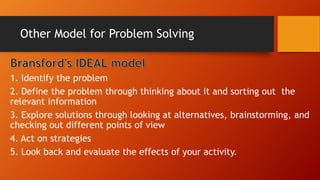
Other Model for Problem Solving
1. Identify the problem
2. Define the problem through thinking about it and sorting out the
relevant information
3. Explore solutions through looking at alternatives, brainstorming, and
checking out different points of view
4. Act on strategies
5. Look back and evaluate the effects of your activity.

Creative Problem Solving

  • 1.
    CREATIVE PROBLEM SOLVING TrishaAnne S. Pasaba 3rd Yr. - BLIS
  • 2.
    Definition •CPS is anintentional process for solving problems and discovering opportunities. •It espouses the use of creativity in coming up with solutions which are not only novel but practical as well.
  • 3.
    Osborn’s Checklist • Theorigin of Classical Brainstorming is the root of CPS. GENERAL STRUCTURES • Define problem • Generate possible solutions • Select & implement the best • Found extensively in several different academic traditions
  • 4.
    Van Gundy (1998's)description •is a very brief skeleton of a very rich processes, showing it in its full '6x2 stages form
  • 5.
    STAGE 1: MessFinding: •Sensitize yourself(scan, search) for issues (concerns, challenges, opportunities, etc) that need to be tackled.
  • 6.
    • Divergent techniquesinclude: 'Wouldn't It be Nice If...' and Wouldn't It be Awful If...'- Brainstorming to identify desirable outcomes and obstacles to be overcome • Convergent techniques include: the identification of hotspots (Highlighting), expressed as a list of ('In What Way Might...') and selection in terms of ownership criteria (e.g. problem owner's motivation and ability to influence it) and outlook criteria (e.g. urgency, familiarity, stability)
  • 7.
    STAGE 2: DataFinding •Gather information about the problem
  • 8.
    • Divergent techniquesinclude: Five Ws and H (Who, Why, What, Where, When and How) and listing of wants, sources and data: List all your information 'wants' as a series of question; for each, list possible sources of answers; then follow these up and for each source, list possible sources of answers; then follow these up and for each source, list what you found. • Convergent techniques include: again the identification of hotspots (Highlighting); Mind-mapping to sort and classify the information gathered; and also restating the problem in the light of your richer understanding of it.
  • 9.
    STAGE 3: ProblemFinding •Convert a fuzzy statement of the problem into a broad statement more suitable for idea finding.
  • 10.
    • Divergent techniquesinclude: asking 'Why?' etc. - the repeatable questions and Five Ws and H. • Convergent techniques include: highlighting again, reformulation of problem-statements to meet the criteria that they contain only one problem and no criteria, and selection of the most promising statement (but NB that the mentel 'stretching' that th activity gives to the participants can be as important as the actual statement chosen.)
  • 11.
    STAGE 4: IdeaFinding •generate as many idea as possible
  • 12.
    •Divergence using anyof a very wide range of idea- generating techniques. The general rules of Classic Brainstorming (such as deferring judgement) are likely to underpin all of these. •Convergence can again involve hotspots o mind- mapping, the combining of different ideas, and the shortlisting of the most promising handful, perhaps with some thought for the more obvious evaluation criteria, but not over-restrictively.
  • 13.
    STAGE 5: SolutionFinding •generate and select obvious evaluation criteria (using an expansion/contraction cycle) and develop (which may include combining) the short-listed ideas from Stage 4 as much as you can in the light of these criteria. Then opt for the best of these improved ideas (e.g. using comparison tables)
  • 14.
    STAGE 6: AcceptanceFinding • How can the suggestion you have just selected be made up to standard and put into practice? Shun negativity, and continue to apply deferred judgement-problems are exposed to be solved, not to dishearten progress. Action plans are better developed in small groups of 2-3 rather than in a large group (unless you particularly want commitment by the whole group). Particularly for 'people' problems it is often worth developing several alternative action plans. Possible techniques include - Five Ws and H, Implementation Checklist, Consensus Mapping, Potential Problem Analysis (PPA).
  • 15.
    Other Model forProblem Solving 1. Identify the problem 2. Define the problem through thinking about it and sorting out the relevant information 3. Explore solutions through looking at alternatives, brainstorming, and checking out different points of view 4. Act on strategies 5. Look back and evaluate the effects of your activity.