DYNAMIC VISCOSITY MEASUREMENT
USING OSTWALD VISCOMETER
Presented by
Tenison Basumatary, PhD student
Department of Electronics & communication
Technology,
Gauhati University, Guwahati, Assam-781014
e. mail:- tenibasu143@gauhati.ac.in
1
WHAT IS VISCOSITY……………?
Viscosity describes the liquid’s resistance to flow.
Mathematically, viscosity is the ratio of the shearing
stress to the velocity gradient in a fluid.
Viscosity measurement for different fluids is very
much important in
a) food processing industries,
b) pharmaceutical,
c) cosmetic and
d) petrochemical industries.
e) It is also extremely needed during design of
aerodynamic and hydrodynamic systems.
2
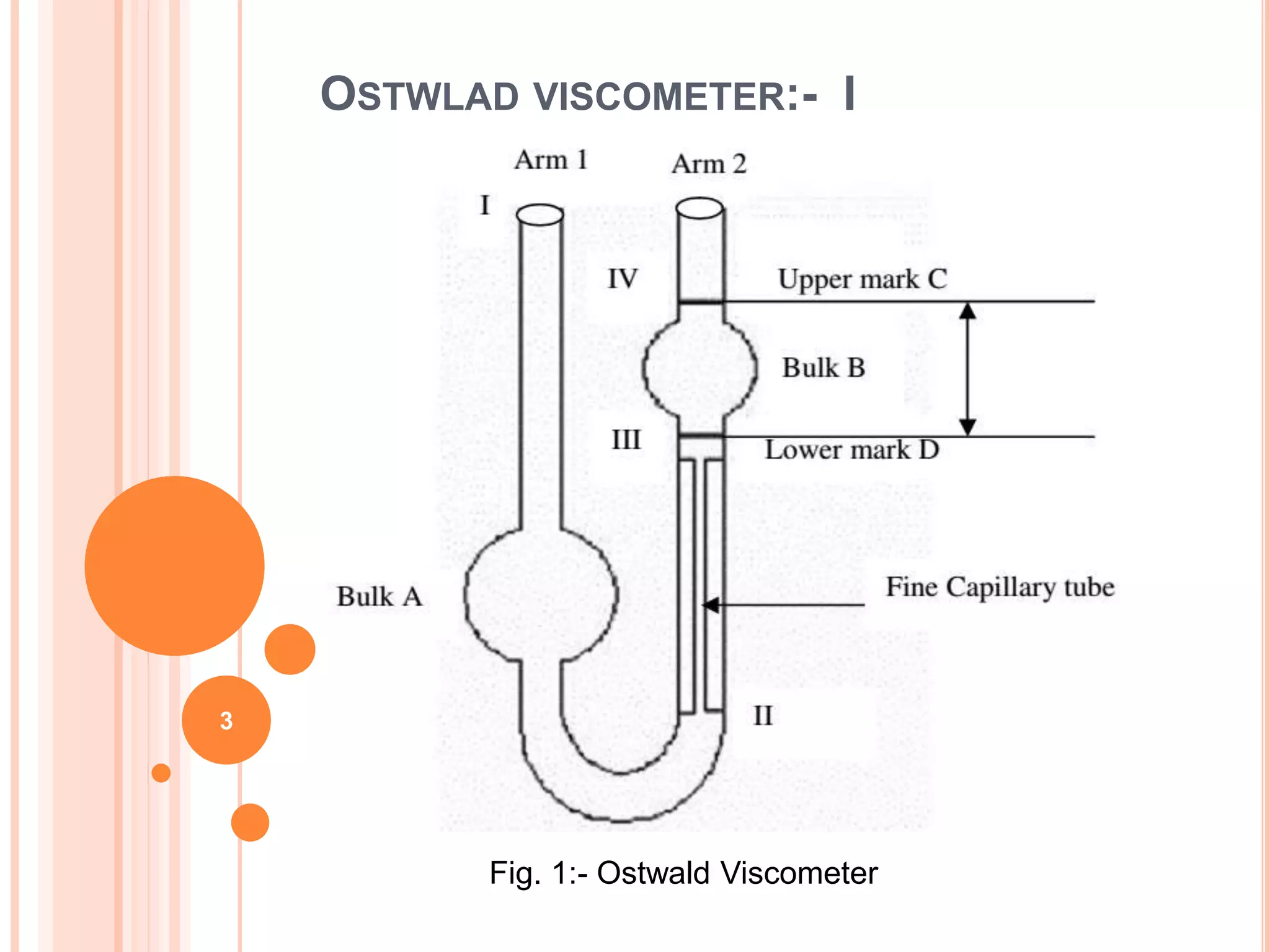
OSTWLAD VISCOMETER:- I
Fig. 1:- Ostwald Viscometer
3
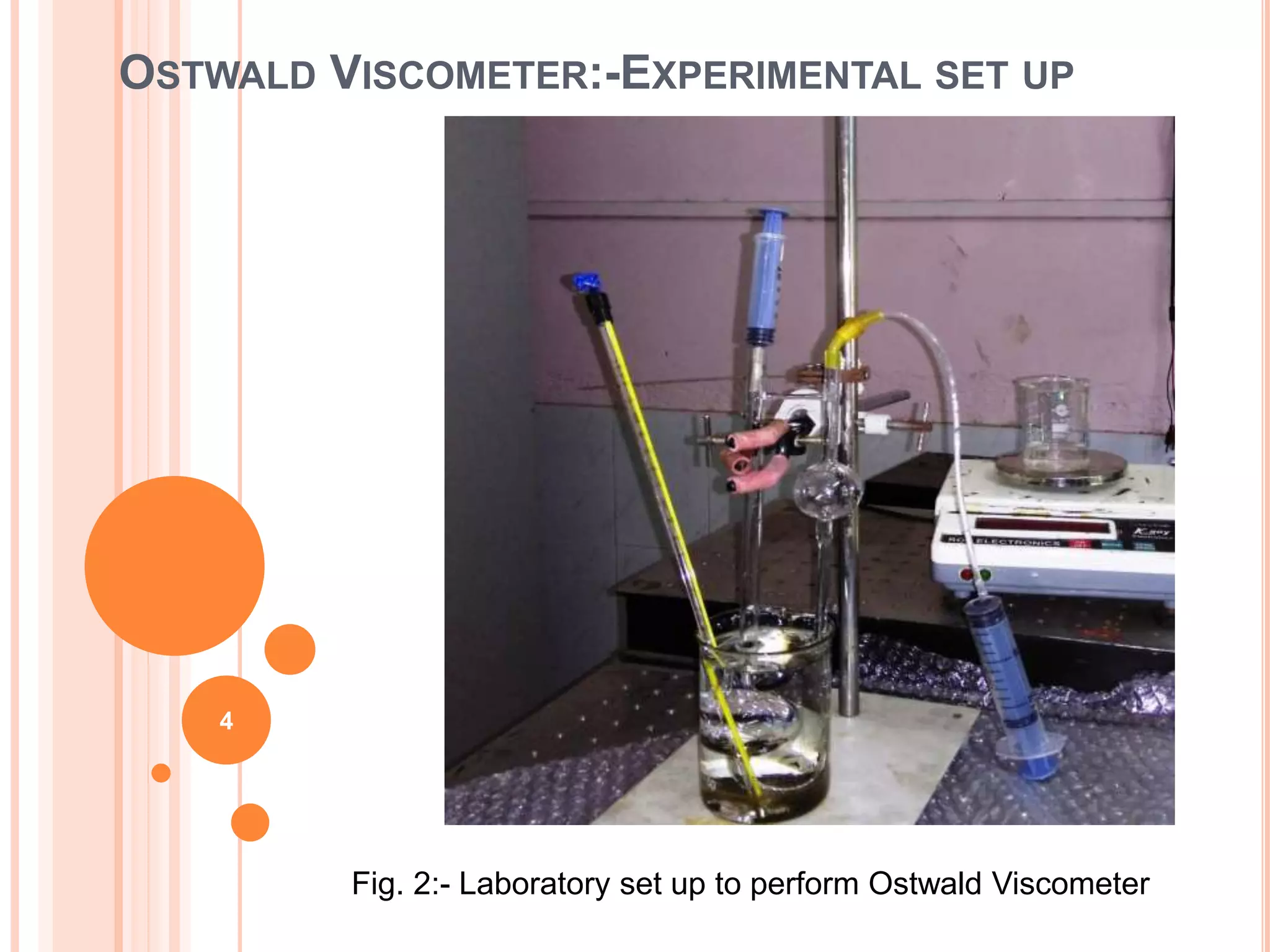
OSTWALD VISCOMETER:-EXPERIMENTAL SET UP
Fig. 2:- Laboratory set up to perform Ostwald Viscometer
4
PRINCIPLE OF OSTWALD VISCOMETER
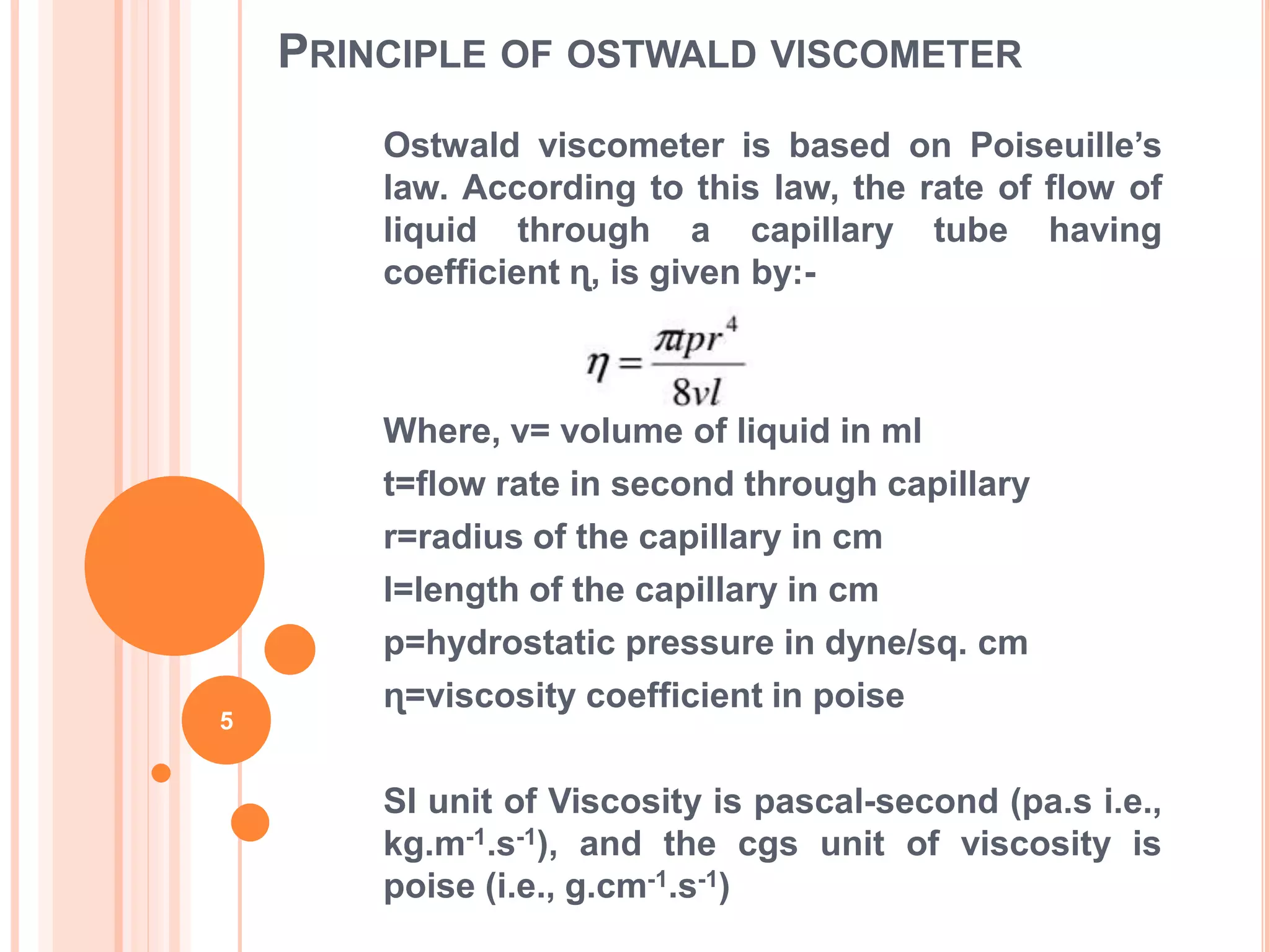
Ostwald viscometer is based on Poiseuille’s
law. According to this law, the rate of flow of
liquid through a capillary tube having
coefficient ɳ, is given by:-
Where, v= volume of liquid in ml
t=flow rate in second through capillary
r=radius of the capillary in cm
l=length of the capillary in cm
p=hydrostatic pressure in dyne/sq. cm
ɳ=viscosity coefficient in poise
SI unit of Viscosity is pascal-second (pa.s i.e.,
kg.m-1.s-1), and the cgs unit of viscosity is
poise (i.e., g.cm-1.s-1)
5
DETERMINATION OF DYNAMIC VISCOSITY OF THE GLYCERIN
AT DIFFERENT TEMPERATURES
Apparatus:-
Ostwald Viscometer,
Beaker,
20-25 mL syringe,
Thermostat,
Stand,
 Liquid samples and
Digital balance6
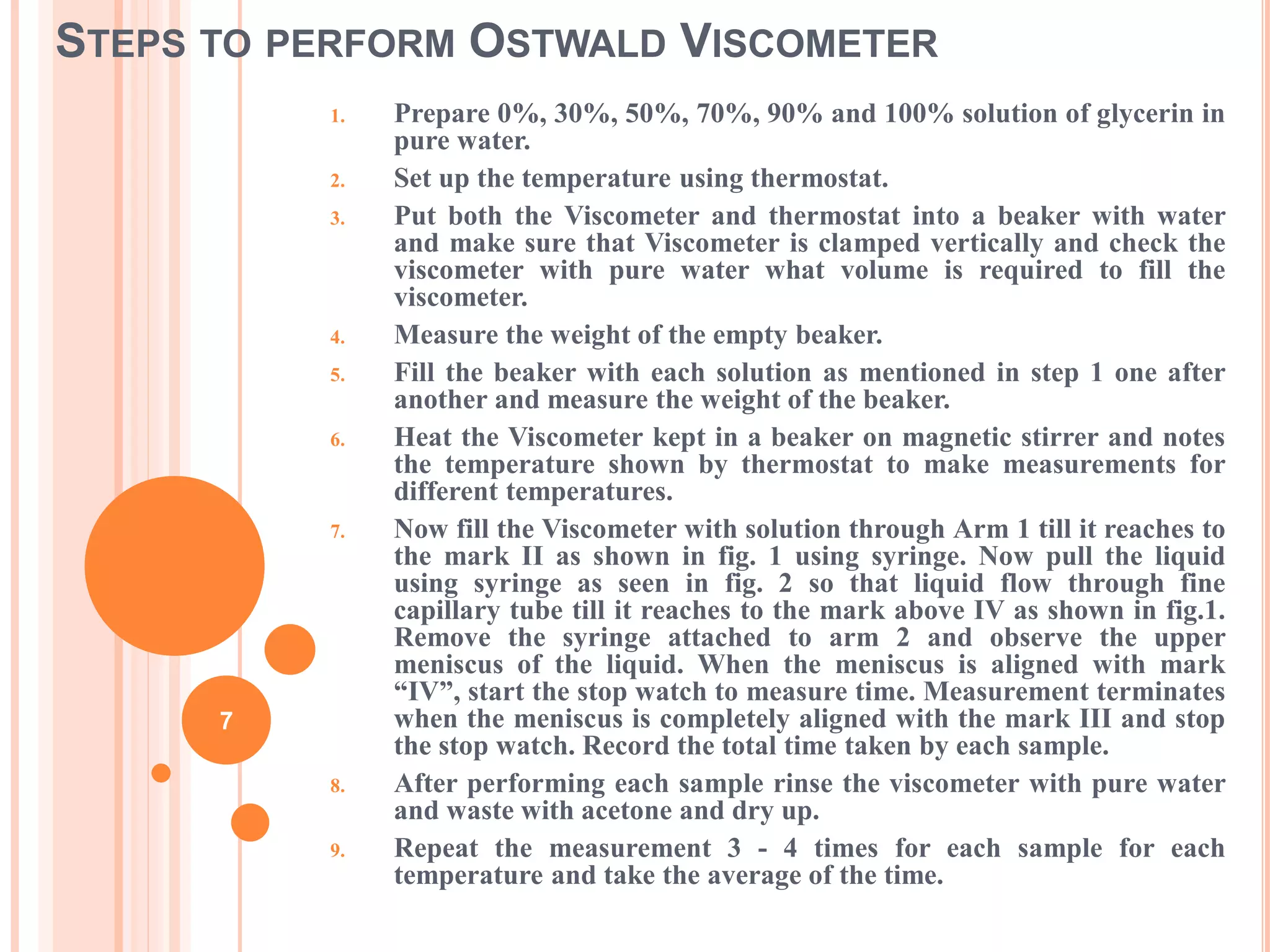
STEPS TO PERFORM OSTWALD VISCOMETER
1. Prepare 0%, 30%, 50%, 70%, 90% and 100% solution of glycerin in
pure water.
2. Set up the temperature using thermostat.
3. Put both the Viscometer and thermostat into a beaker with water
and make sure that Viscometer is clamped vertically and check the
viscometer with pure water what volume is required to fill the
viscometer.
4. Measure the weight of the empty beaker.
5. Fill the beaker with each solution as mentioned in step 1 one after
another and measure the weight of the beaker.
6. Heat the Viscometer kept in a beaker on magnetic stirrer and notes
the temperature shown by thermostat to make measurements for
different temperatures.
7. Now fill the Viscometer with solution through Arm 1 till it reaches to
the mark II as shown in fig. 1 using syringe. Now pull the liquid
using syringe as seen in fig. 2 so that liquid flow through fine
capillary tube till it reaches to the mark above IV as shown in fig.1.
Remove the syringe attached to arm 2 and observe the upper
meniscus of the liquid. When the meniscus is aligned with mark
“IV”, start the stop watch to measure time. Measurement terminates
when the meniscus is completely aligned with the mark III and stop
the stop watch. Record the total time taken by each sample.
8. After performing each sample rinse the viscometer with pure water
and waste with acetone and dry up.
9. Repeat the measurement 3 - 4 times for each sample for each
temperature and take the average of the time.
7
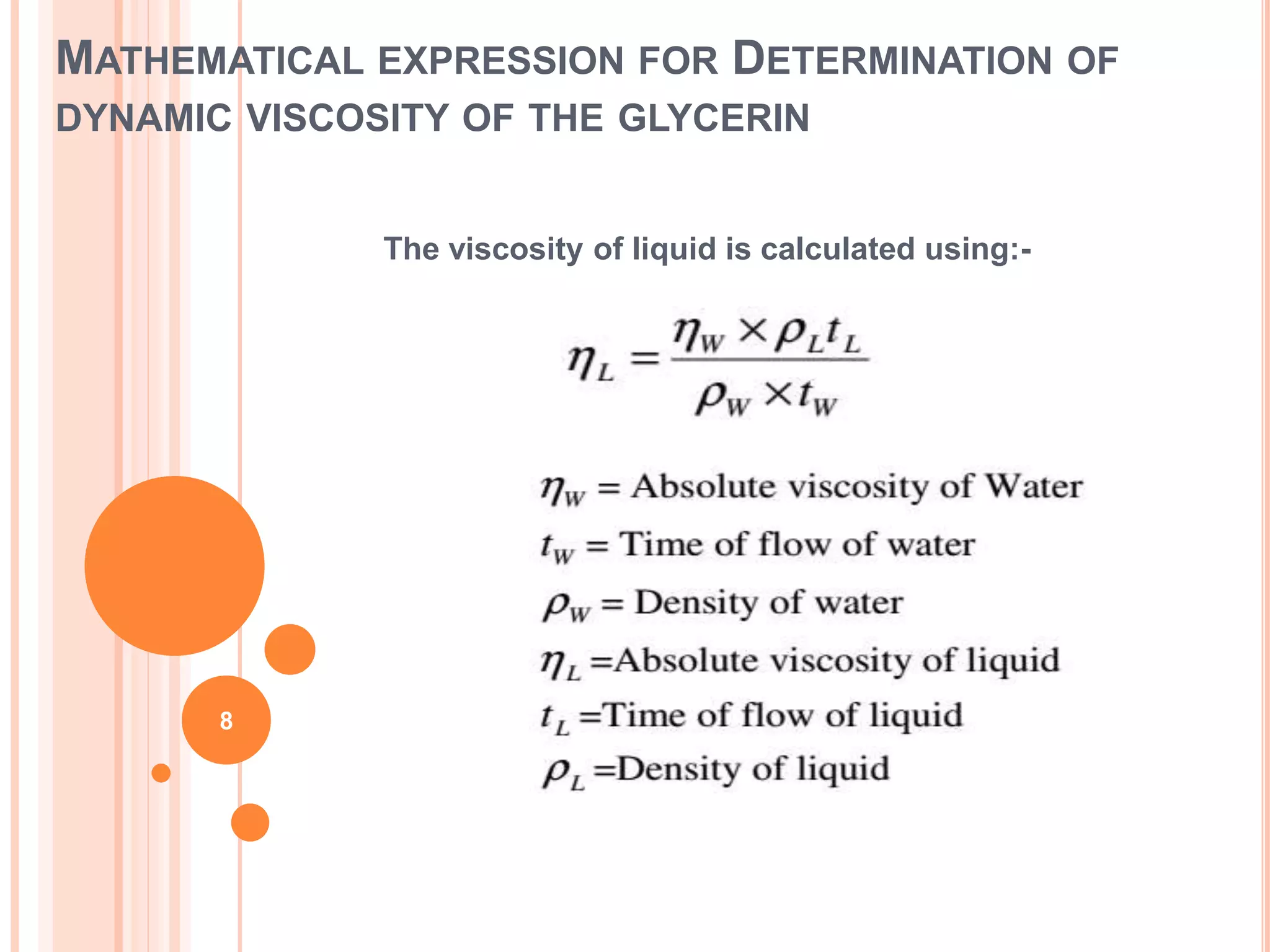
MATHEMATICAL EXPRESSION FOR DETERMINATION OF
DYNAMIC VISCOSITY OF THE GLYCERIN
The viscosity of liquid is calculated using:-
8

Viscosity measurement using ostwald viscometer

  • 1.
    DYNAMIC VISCOSITY MEASUREMENT USINGOSTWALD VISCOMETER Presented by Tenison Basumatary, PhD student Department of Electronics & communication Technology, Gauhati University, Guwahati, Assam-781014 e. mail:- tenibasu143@gauhati.ac.in 1
  • 2.
    WHAT IS VISCOSITY……………? Viscositydescribes the liquid’s resistance to flow. Mathematically, viscosity is the ratio of the shearing stress to the velocity gradient in a fluid. Viscosity measurement for different fluids is very much important in a) food processing industries, b) pharmaceutical, c) cosmetic and d) petrochemical industries. e) It is also extremely needed during design of aerodynamic and hydrodynamic systems. 2
  • 3.
    OSTWLAD VISCOMETER:- I Fig.1:- Ostwald Viscometer 3
  • 4.
    OSTWALD VISCOMETER:-EXPERIMENTAL SETUP Fig. 2:- Laboratory set up to perform Ostwald Viscometer 4
  • 5.
    PRINCIPLE OF OSTWALDVISCOMETER Ostwald viscometer is based on Poiseuille’s law. According to this law, the rate of flow of liquid through a capillary tube having coefficient ɳ, is given by:- Where, v= volume of liquid in ml t=flow rate in second through capillary r=radius of the capillary in cm l=length of the capillary in cm p=hydrostatic pressure in dyne/sq. cm ɳ=viscosity coefficient in poise SI unit of Viscosity is pascal-second (pa.s i.e., kg.m-1.s-1), and the cgs unit of viscosity is poise (i.e., g.cm-1.s-1) 5
  • 6.
    DETERMINATION OF DYNAMICVISCOSITY OF THE GLYCERIN AT DIFFERENT TEMPERATURES Apparatus:- Ostwald Viscometer, Beaker, 20-25 mL syringe, Thermostat, Stand,  Liquid samples and Digital balance6
  • 7.
    STEPS TO PERFORMOSTWALD VISCOMETER 1. Prepare 0%, 30%, 50%, 70%, 90% and 100% solution of glycerin in pure water. 2. Set up the temperature using thermostat. 3. Put both the Viscometer and thermostat into a beaker with water and make sure that Viscometer is clamped vertically and check the viscometer with pure water what volume is required to fill the viscometer. 4. Measure the weight of the empty beaker. 5. Fill the beaker with each solution as mentioned in step 1 one after another and measure the weight of the beaker. 6. Heat the Viscometer kept in a beaker on magnetic stirrer and notes the temperature shown by thermostat to make measurements for different temperatures. 7. Now fill the Viscometer with solution through Arm 1 till it reaches to the mark II as shown in fig. 1 using syringe. Now pull the liquid using syringe as seen in fig. 2 so that liquid flow through fine capillary tube till it reaches to the mark above IV as shown in fig.1. Remove the syringe attached to arm 2 and observe the upper meniscus of the liquid. When the meniscus is aligned with mark “IV”, start the stop watch to measure time. Measurement terminates when the meniscus is completely aligned with the mark III and stop the stop watch. Record the total time taken by each sample. 8. After performing each sample rinse the viscometer with pure water and waste with acetone and dry up. 9. Repeat the measurement 3 - 4 times for each sample for each temperature and take the average of the time. 7
  • 8.
    MATHEMATICAL EXPRESSION FORDETERMINATION OF DYNAMIC VISCOSITY OF THE GLYCERIN The viscosity of liquid is calculated using:- 8