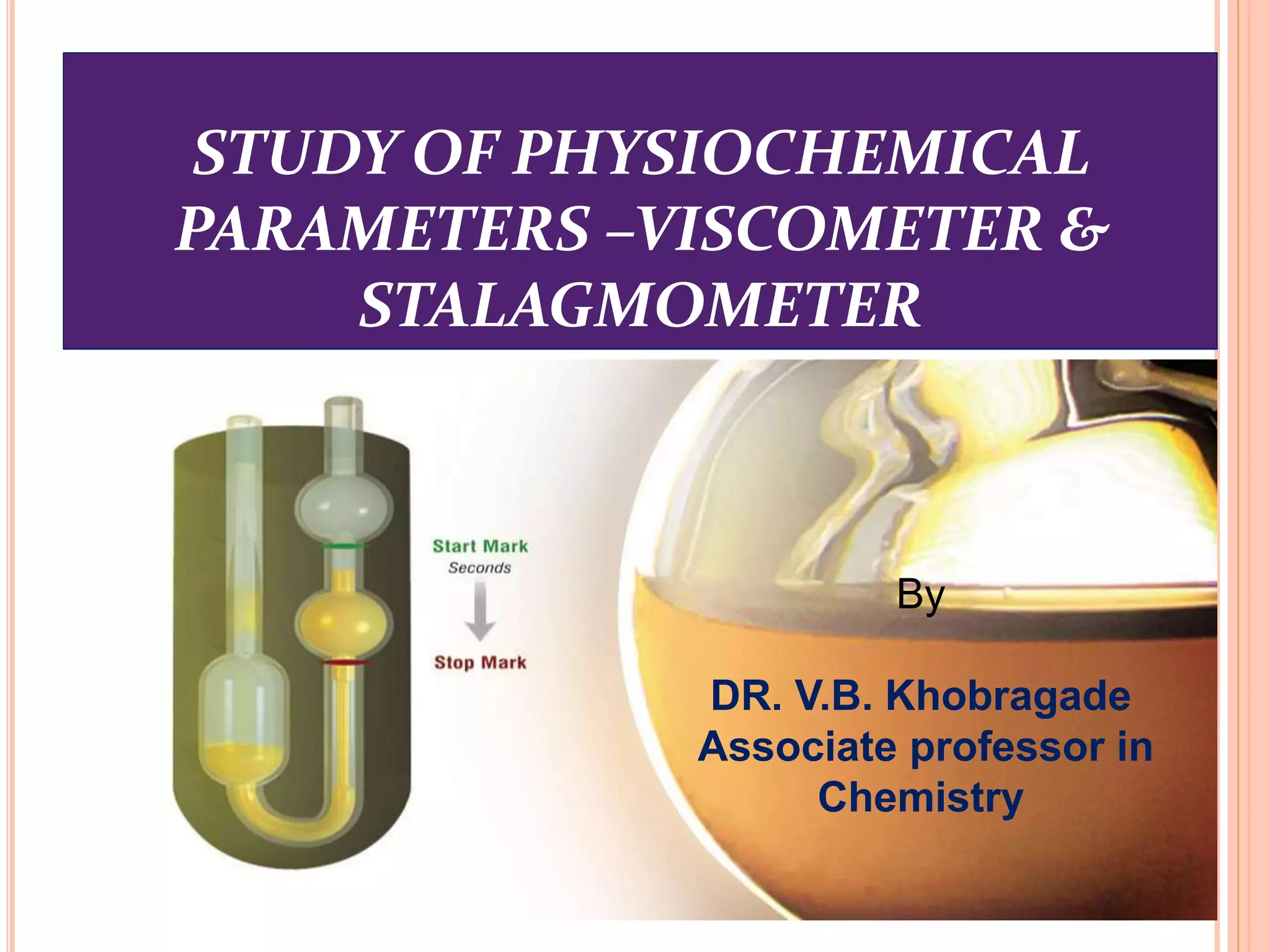
STUDY OF PHYSIOCHEMICAL
PARAMETERS –VISCOMETER &
STALAGMOMETER
By
DR. V.B. Khobragade
Associate professor in
Chemistry
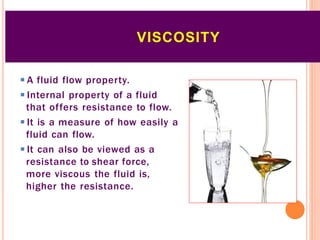
◾A fluid flow property.
◾Internal property of a fluid
that offers resistance to flow.
◾It is a measure of how easily a
fluid can flow.
◾It can also be viewed as a
resistance to shear force,
more viscous the fluid is,
higher the resistance.
VISCOSITY
2
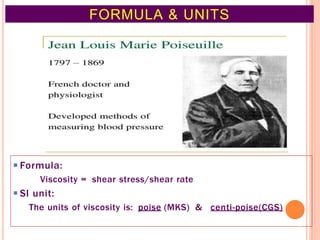
◾Formula:
Viscosity = shear stress/shear rate
◾SI unit:
The units of viscosity is: poise (MKS) & centi-poise(CGS)
FORMULA & UNITS
3
◾Definition:
“A viscometer is an instrument used to measure
the viscosity of a fluid.”
◾It is also known as “Viscosimeter.”
◾Viscometer only measures under one flow
condition
◾The measure of the resistance is taken by
measuring the drag resistance during relative
motion through the fluid.
VISCOMETER
4
◾Measuring viscosity is important when
considering process conditions for materials
that need to be pumped or piped . It effects
dipping and coating performance , which is
particularly relevant to syrups and lotions.
◾Viscometer can be used to monitor
batch consistency and quality control.
◾They are also used to characterize plastics.
IMPORTANCE
5
TYPES OF VISCOMETER
6
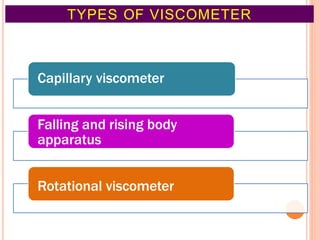
Capillary viscometer
Falling and rising body
apparatus
Rotational viscometer
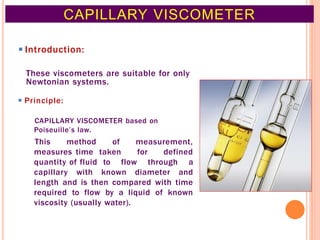
◾Introduction:
These viscometers are suitable for only
Newtonian systems.
◾Principle:
CAPILLARY VISCOMETER based on
Poiseuille’s law.
This method of measurement,
measures time taken for defined
quantity of fluid to flow through a
capillary with known diameter and
length and is then compared with time
required to flow by a liquid of known
viscosity (usually water).
CAPILLARY VISCOMETER
7
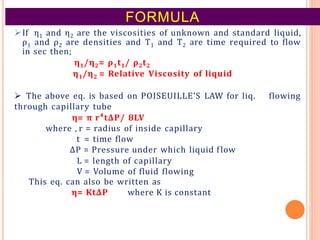
FORMULA
If η1 and η2 are the viscosities of unknown and standard liquid,
ρ1 and ρ2 are densities and T1 and T2 are time required to flow
in sec then;
η1/η2= ρ1t1/ ρ2t2
η1/η2 = Relative Viscosity of liquid
 The above eq. is based on POISEUILLE’S LAW for liq. flowing
through capillary tube
η= π r⁴tΔP/ 8LV
where , r = radius of inside capillary
t = time flow
ΔP = Pressure under which liquid flow
L = length of capillary
V = Volume of fluid flowing
This eq. can also be written as
η= KtΔP where K is constant
OSTWALD’S VISCOMETER
9
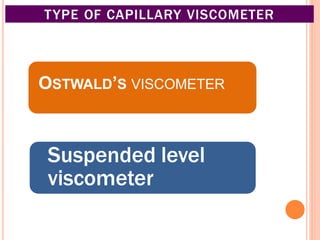
Suspended level
viscometer
TYPE OF CAPILLARY VISCOMETER
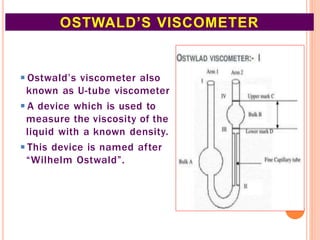
◾Ostwald’s viscometer also
known as U-tube viscometer
◾A device which is used to
measure the viscosity of the
liquid with a known density.
◾This device is named after
“Wilhelm Ostwald”.
OSTWALD’S VISCOMETER
10
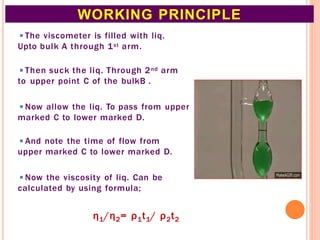
◾The viscometer is filled with liq.
Upto bulk A through 1st arm.
◾Then suck the liq. Through 2nd arm
to upper point C of the bulkB .
◾Now allow the liq. To pass from upper
marked C to lower marked D.
◾And note the time of flow from
upper marked C to lower marked D.
◾Now the viscosity of liq. Can be
calculated by using formula;
η1/η2= ρ1t1/ ρ2t2
WORKING PRINCIPLE
11
◾It is a modified form of
Ostwald’s viscometer.
◾In it ,there is third
vertical arm attached to
the bulb below the
capillary part of the right
arm.
◾Liquid is introduced into
the viscometer through the
left arm In quantity
sufficient to fill the bulb in
the left arm. 12
UBBELOHDE SUSPENDED LEVEL
VISCOMETER
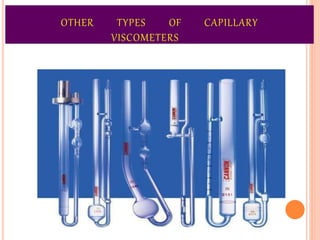
OTHER TYPES OF CAPILLARY
VISCOMETERS
13
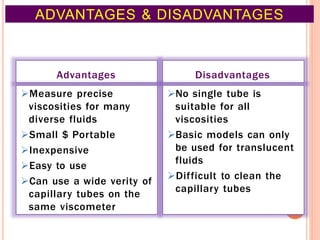
Advantages Disadvantages
No single tube is
suitable for all
viscosities
Basic models can only
be used for translucent
fluids
Difficult to clean the
capillary tubes
ADVANTAGES & DISADVANTAGES
14
Measure precise
viscosities for many
diverse fluids
Small $ Portable
Inexpensive
Easy to use
Can use a wide verity of
capillary tubes on the
same viscometer
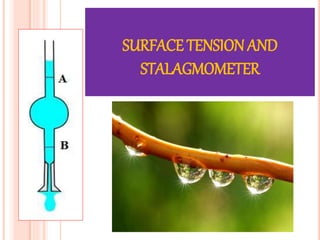
SURFACE TENSIONAND
STALAGMOMETER
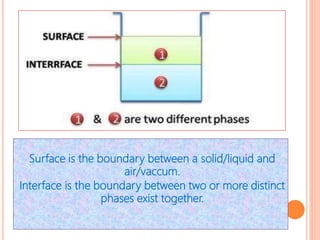
Surface is the boundary between a solid/liquid and
air/vaccum.
Interface is the boundary between two or more distinct
phases exist together.
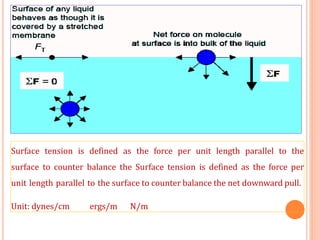
Surface tension is defined as the force per unit length parallel to the
surface to counter balance the Surface tension is defined as the force per
unit length parallel to the surface to counter balance the net downward pull.
Unit: dynes/cm ergs/m N/m
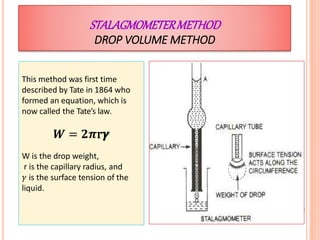
STALAGMOMETERMETHOD
DROP VOLUME METHOD
This method was first time
described by Tate in 1864 who
formed an equation, which is
now called the Tate’s law.
𝑾 = 𝟐𝝅r𝜸
W is the drop weight,
r is the capillary radius, and
𝛾 is the surface tension of the
liquid.
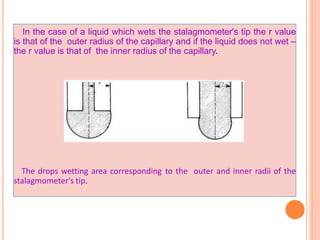
In the case of a liquid which wets the stalagmometer's tip the r value
is that of the outer radius of the capillary and if the liquid does not wet –
the r value is that of the inner radius of the capillary.
The drops wetting area corresponding to the outer and inner radii of the
stalagmometer's tip.
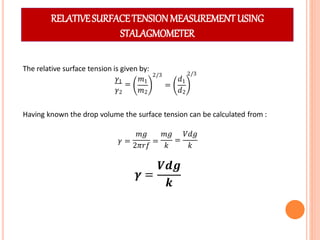
The relative surface tension is given by:
𝛾 𝑚
2/3
=
𝑑1
1
= 1
𝛾2 𝑚2 𝑑2
2/3
Having known the drop volume the surface tension can be calculated from :
=
𝑚𝑔 𝑚𝑔 𝑉𝑑𝑔
𝛾 =
2𝜋𝑟𝑓
=
𝑘 𝑘
𝜸 =
𝑽𝒅𝒈
𝒌
RELATIVESURFACETENSIONMEASUREMENTUSING
STALAGMOMETER
PRECAUTIONS TO BE TAKEN
 Tip of pipette should have no
imperfection in the outer circumference.
 Drops should be formed slowly
 About 20 – 30 drops should be collected
to find the average weight
 Temperature should be maintained
constant
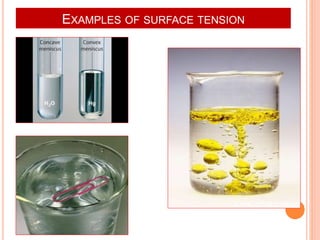
EXAMPLES OF SURFACE TENSION

Physicochemical parameters of Viscometer & Stagalmometer

  • 1.
    STUDY OF PHYSIOCHEMICAL PARAMETERS–VISCOMETER & STALAGMOMETER By DR. V.B. Khobragade Associate professor in Chemistry
  • 2.
    ◾A fluid flowproperty. ◾Internal property of a fluid that offers resistance to flow. ◾It is a measure of how easily a fluid can flow. ◾It can also be viewed as a resistance to shear force, more viscous the fluid is, higher the resistance. VISCOSITY 2
  • 3.
    ◾Formula: Viscosity = shearstress/shear rate ◾SI unit: The units of viscosity is: poise (MKS) & centi-poise(CGS) FORMULA & UNITS 3
  • 4.
    ◾Definition: “A viscometer isan instrument used to measure the viscosity of a fluid.” ◾It is also known as “Viscosimeter.” ◾Viscometer only measures under one flow condition ◾The measure of the resistance is taken by measuring the drag resistance during relative motion through the fluid. VISCOMETER 4
  • 5.
    ◾Measuring viscosity isimportant when considering process conditions for materials that need to be pumped or piped . It effects dipping and coating performance , which is particularly relevant to syrups and lotions. ◾Viscometer can be used to monitor batch consistency and quality control. ◾They are also used to characterize plastics. IMPORTANCE 5
  • 6.
    TYPES OF VISCOMETER 6 Capillaryviscometer Falling and rising body apparatus Rotational viscometer
  • 7.
    ◾Introduction: These viscometers aresuitable for only Newtonian systems. ◾Principle: CAPILLARY VISCOMETER based on Poiseuille’s law. This method of measurement, measures time taken for defined quantity of fluid to flow through a capillary with known diameter and length and is then compared with time required to flow by a liquid of known viscosity (usually water). CAPILLARY VISCOMETER 7
  • 8.
    FORMULA If η1 andη2 are the viscosities of unknown and standard liquid, ρ1 and ρ2 are densities and T1 and T2 are time required to flow in sec then; η1/η2= ρ1t1/ ρ2t2 η1/η2 = Relative Viscosity of liquid  The above eq. is based on POISEUILLE’S LAW for liq. flowing through capillary tube η= π r⁴tΔP/ 8LV where , r = radius of inside capillary t = time flow ΔP = Pressure under which liquid flow L = length of capillary V = Volume of fluid flowing This eq. can also be written as η= KtΔP where K is constant
  • 9.
  • 10.
    ◾Ostwald’s viscometer also knownas U-tube viscometer ◾A device which is used to measure the viscosity of the liquid with a known density. ◾This device is named after “Wilhelm Ostwald”. OSTWALD’S VISCOMETER 10
  • 11.
    ◾The viscometer isfilled with liq. Upto bulk A through 1st arm. ◾Then suck the liq. Through 2nd arm to upper point C of the bulkB . ◾Now allow the liq. To pass from upper marked C to lower marked D. ◾And note the time of flow from upper marked C to lower marked D. ◾Now the viscosity of liq. Can be calculated by using formula; η1/η2= ρ1t1/ ρ2t2 WORKING PRINCIPLE 11
  • 12.
    ◾It is amodified form of Ostwald’s viscometer. ◾In it ,there is third vertical arm attached to the bulb below the capillary part of the right arm. ◾Liquid is introduced into the viscometer through the left arm In quantity sufficient to fill the bulb in the left arm. 12 UBBELOHDE SUSPENDED LEVEL VISCOMETER
  • 13.
    OTHER TYPES OFCAPILLARY VISCOMETERS 13
  • 14.
    Advantages Disadvantages No singletube is suitable for all viscosities Basic models can only be used for translucent fluids Difficult to clean the capillary tubes ADVANTAGES & DISADVANTAGES 14 Measure precise viscosities for many diverse fluids Small $ Portable Inexpensive Easy to use Can use a wide verity of capillary tubes on the same viscometer
  • 15.
  • 16.
    Surface is theboundary between a solid/liquid and air/vaccum. Interface is the boundary between two or more distinct phases exist together.
  • 17.
    Surface tension isdefined as the force per unit length parallel to the surface to counter balance the Surface tension is defined as the force per unit length parallel to the surface to counter balance the net downward pull. Unit: dynes/cm ergs/m N/m
  • 18.
    STALAGMOMETERMETHOD DROP VOLUME METHOD Thismethod was first time described by Tate in 1864 who formed an equation, which is now called the Tate’s law. 𝑾 = 𝟐𝝅r𝜸 W is the drop weight, r is the capillary radius, and 𝛾 is the surface tension of the liquid.
  • 19.
    In the caseof a liquid which wets the stalagmometer's tip the r value is that of the outer radius of the capillary and if the liquid does not wet – the r value is that of the inner radius of the capillary. The drops wetting area corresponding to the outer and inner radii of the stalagmometer's tip.
  • 20.
    The relative surfacetension is given by: 𝛾 𝑚 2/3 = 𝑑1 1 = 1 𝛾2 𝑚2 𝑑2 2/3 Having known the drop volume the surface tension can be calculated from : = 𝑚𝑔 𝑚𝑔 𝑉𝑑𝑔 𝛾 = 2𝜋𝑟𝑓 = 𝑘 𝑘 𝜸 = 𝑽𝒅𝒈 𝒌 RELATIVESURFACETENSIONMEASUREMENTUSING STALAGMOMETER
  • 21.
    PRECAUTIONS TO BETAKEN  Tip of pipette should have no imperfection in the outer circumference.  Drops should be formed slowly  About 20 – 30 drops should be collected to find the average weight  Temperature should be maintained constant
  • 22.