PRIMARY & SECONDARY
DATA COLLECTION
Supervised by:
Dr. Navneet Agarwal
H.O.D.
P`ceutical Chemistry
Submitted by:
Sunil Saini
M.Pharm
(P`ceutics) Sem-1st
LACHOO MEMORIAL COLLEGE OF SCIENCE AND
TECHNOLOGY (PHARMACY WING)
JODHPUR
JAI NARAYAN VYAS UNIVERSITY, JODHPUR
INTRODUCTION
 Data collection is a term used to describe
a process of preparing and collecting data
 Systematic gathering of data for
a particular purpose from various
sources, that has been systematically
observed, recorded, organized.
 Data are the basic inputs to any decision
making process in business
 The purpose of data collection is-
 to obtain information
 to keep on record
 to make decisions
about important issues,
 to pass information on
to others
PURPOSE OF DATA
COLLECTION
CLASSIFICATION OF DATA
TYPES
PRIMARY
DATA
SECONDARY
DATA
PRIMARY DATA
 The data which are collected from the field under
the control and supervision of an investigator
 Primary data means original data that has been
collected specially for the purpose in mind
 This type of data are generally afresh and collected
for the first time
 It is useful for current studies as well as for future
studies
 For example: your own questionnaire.
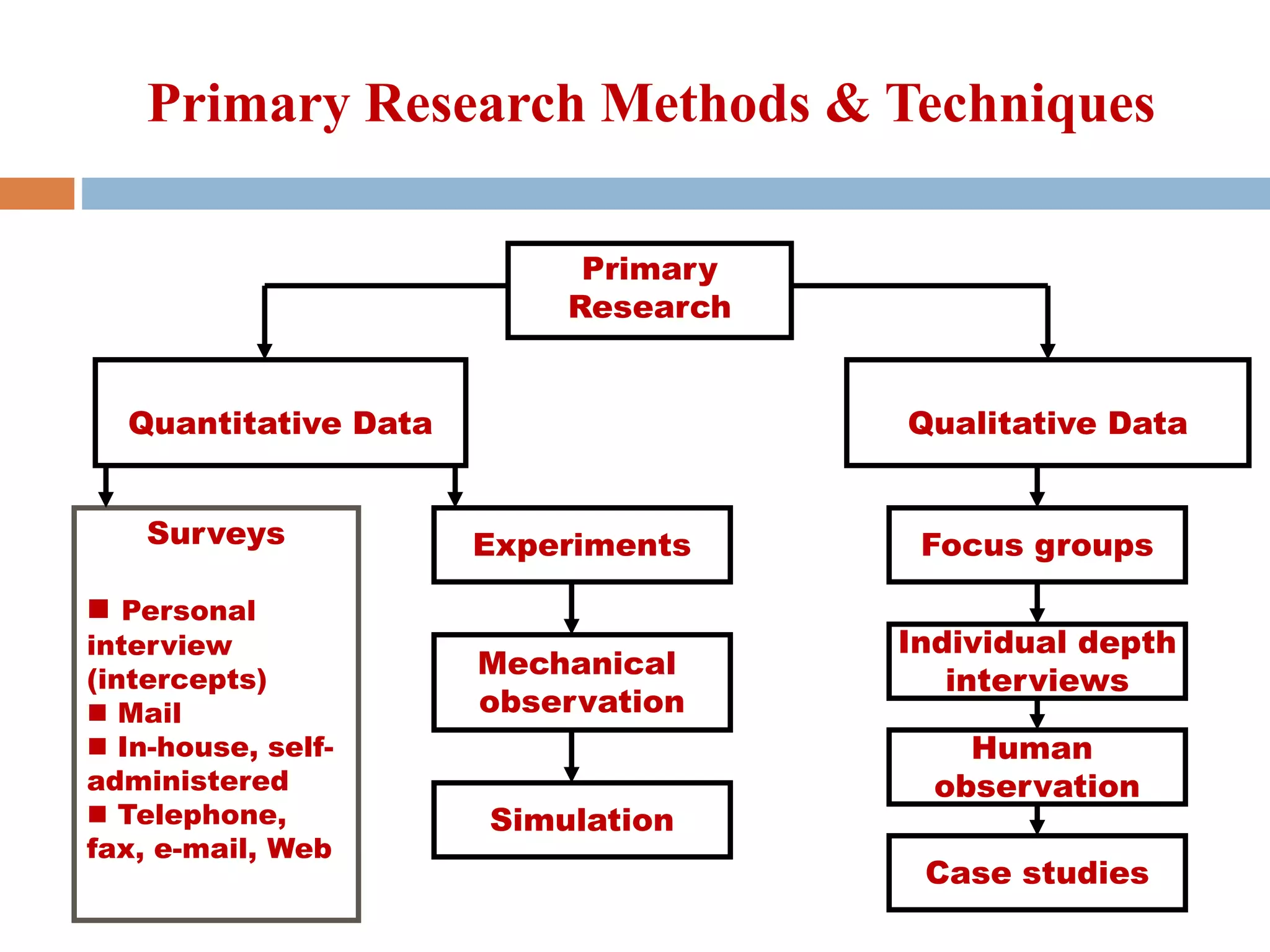
Primary Research Methods & Techniques
Surveys
 Personal
interview
(intercepts)
 Mail
 In-house, self-
administered
 Telephone,
fax, e-mail, Web
Quantitative Data
Primary
Research
Experiments
Mechanical
observation
Simulation
Qualitative Data
Case studies
Human
observation
Individual depth
interviews
Focus groups
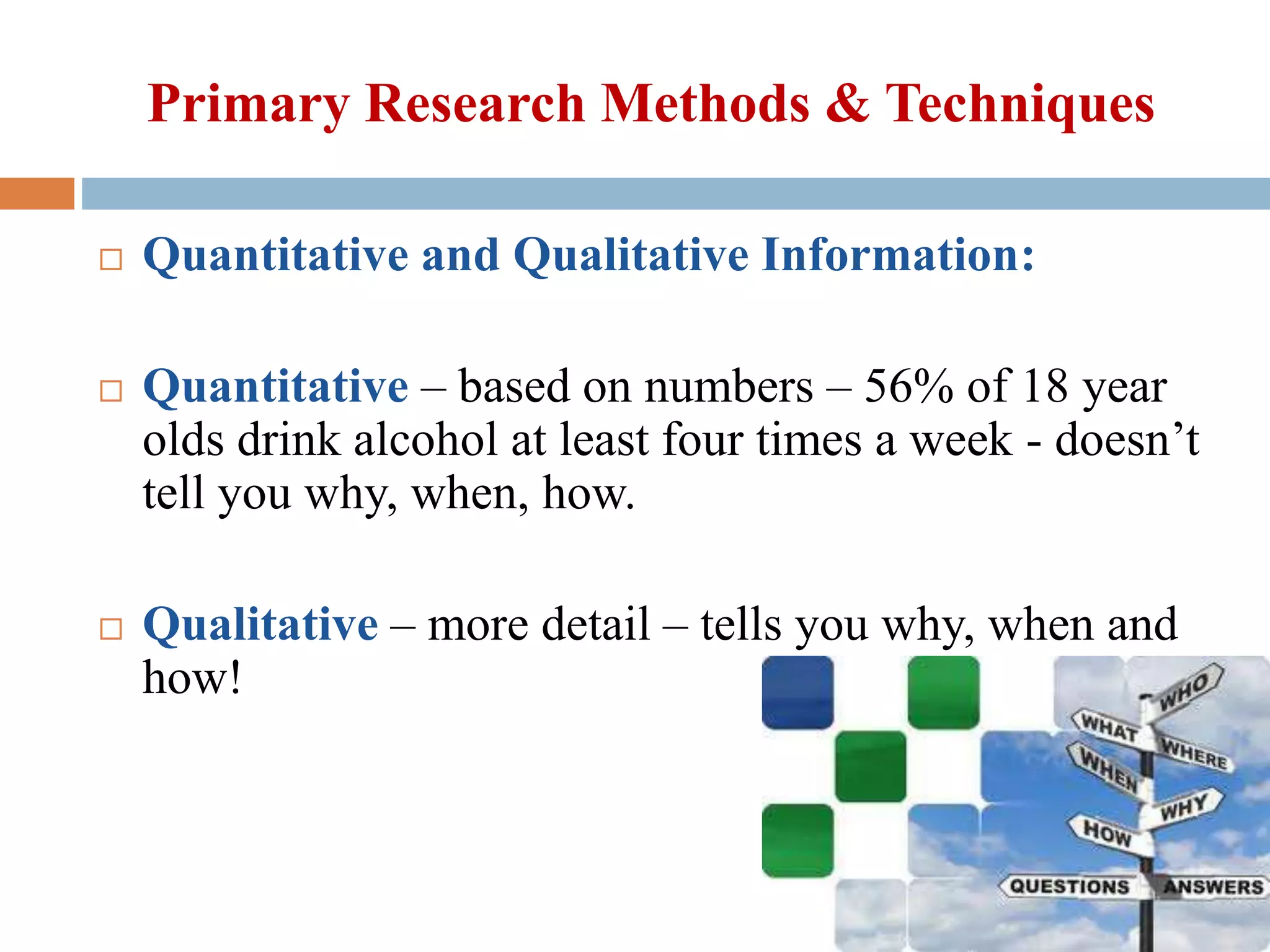
 Quantitative and Qualitative Information:
 Quantitative – based on numbers – 56% of 18 year
olds drink alcohol at least four times a week - doesn’t
tell you why, when, how.
 Qualitative – more detail – tells you why, when and
how!
Primary Research Methods & Techniques
Primary Research Categories
 Quantitative Research
Numerical
Statistically reliable
Projectable to a broader population
 Sampling Methods:
 Random Samples – equal chance of anyone
being picked
 May select those not in the target group –
indiscriminate
 Sample sizes may need to be
Large to be representative
 Can be very expensive
Quantitative Research Categories
 Stratified or Segment Random
Sampling
Samples on the basis of a
representative strata or segment
Still random but more focussed
May give more relevant information
May be more cost effective
Quantitative Research Categories
 Quota Sampling
 Again – by segment
 Not randomly selected
 Specific number on each segment are
interviewed, etc.
 May not be fully representative
 Cheaper method
Quantitative Research Categories
 Qualitative Research
In-depth, insight generating
Non-numerical
‘Directional’
 Common Techniques
Personal interviews (depth, one-on-one)
Focus groups (8-12) and mini-groups (3-
6)
Qualitative Research Categories
METHODS
 OBSERVATION METHOD
Through personal
observation
 PERSONAL INTERVIEW
Through Questionnaire
 TELEPHONE INTERVIEW
Through Call outcomes,
Call timings
 MAIL SURVEY
Through Mailed
Questionnaire
SECONDARY DATA
 Data gathered and recorded by someone else prior
to and for a purpose other than the current project
 Secondary data is data that has been collected for
another purpose.
 It involves less cost, time and effort
 Secondary data is data that is being reused. Usually
in a different context.
 For example: data from a book.
SOURCES
 INTERNAL SOURCES
Internal sources of secondary data are usually
for marketing application-
 Sales Records
 Marketing Activity
 Cost Information
 Distributor reports and feedback
 Customer feedback
 EXTERNAL SOURCES
External sources of secondary data are usually
for Financial application-
 Journals
 Books
 Magazines
 Newspaper
 Libraries
 The Internet
SOURCES
Advantages & Disadvantages of
Primary Data
 Advantages
 Targeted Issues are addressed
 Data interpretation is better
 Efficient Spending for Information
 Decency of Data
 Proprietary Issues
 Addresses Specific Research Issues
 Greater Control
 Disadvantages
 High Cost
 Time Consuming
 Inaccurate Feed-backs
 More number of resources is required
Advantages & Disadvantages of
Primary Data
Advantages & Disadvantages of
Secondary Data
 Advantages
 Ease of Access
 Low Cost to Acquire
 Clarification of Research Question
 May Answer Research Question
Disadvantages & Disadvantages of
Secondary Data
 Disadvantages
 Quality of Research
 Not Specific to Researcher’s Needs
 Incomplete Information
 Not Timely
Data Collection Flow
PRIMARY & SECONDARY DATA  COLLECTION

PRIMARY & SECONDARY DATA COLLECTION

  • 1.
    PRIMARY & SECONDARY DATACOLLECTION Supervised by: Dr. Navneet Agarwal H.O.D. P`ceutical Chemistry Submitted by: Sunil Saini M.Pharm (P`ceutics) Sem-1st LACHOO MEMORIAL COLLEGE OF SCIENCE AND TECHNOLOGY (PHARMACY WING) JODHPUR JAI NARAYAN VYAS UNIVERSITY, JODHPUR
  • 2.
    INTRODUCTION  Data collectionis a term used to describe a process of preparing and collecting data  Systematic gathering of data for a particular purpose from various sources, that has been systematically observed, recorded, organized.  Data are the basic inputs to any decision making process in business
  • 3.
     The purposeof data collection is-  to obtain information  to keep on record  to make decisions about important issues,  to pass information on to others PURPOSE OF DATA COLLECTION
  • 4.
  • 5.
    PRIMARY DATA  Thedata which are collected from the field under the control and supervision of an investigator  Primary data means original data that has been collected specially for the purpose in mind  This type of data are generally afresh and collected for the first time  It is useful for current studies as well as for future studies  For example: your own questionnaire.
  • 6.
    Primary Research Methods& Techniques Surveys  Personal interview (intercepts)  Mail  In-house, self- administered  Telephone, fax, e-mail, Web Quantitative Data Primary Research Experiments Mechanical observation Simulation Qualitative Data Case studies Human observation Individual depth interviews Focus groups
  • 7.
     Quantitative andQualitative Information:  Quantitative – based on numbers – 56% of 18 year olds drink alcohol at least four times a week - doesn’t tell you why, when, how.  Qualitative – more detail – tells you why, when and how! Primary Research Methods & Techniques
  • 8.
    Primary Research Categories Quantitative Research Numerical Statistically reliable Projectable to a broader population
  • 9.
     Sampling Methods: Random Samples – equal chance of anyone being picked  May select those not in the target group – indiscriminate  Sample sizes may need to be Large to be representative  Can be very expensive Quantitative Research Categories
  • 10.
     Stratified orSegment Random Sampling Samples on the basis of a representative strata or segment Still random but more focussed May give more relevant information May be more cost effective Quantitative Research Categories
  • 11.
     Quota Sampling Again – by segment  Not randomly selected  Specific number on each segment are interviewed, etc.  May not be fully representative  Cheaper method Quantitative Research Categories
  • 12.
     Qualitative Research In-depth,insight generating Non-numerical ‘Directional’  Common Techniques Personal interviews (depth, one-on-one) Focus groups (8-12) and mini-groups (3- 6) Qualitative Research Categories
  • 13.
    METHODS  OBSERVATION METHOD Throughpersonal observation  PERSONAL INTERVIEW Through Questionnaire  TELEPHONE INTERVIEW Through Call outcomes, Call timings  MAIL SURVEY Through Mailed Questionnaire
  • 14.
    SECONDARY DATA  Datagathered and recorded by someone else prior to and for a purpose other than the current project  Secondary data is data that has been collected for another purpose.  It involves less cost, time and effort  Secondary data is data that is being reused. Usually in a different context.  For example: data from a book.
  • 15.
    SOURCES  INTERNAL SOURCES Internalsources of secondary data are usually for marketing application-  Sales Records  Marketing Activity  Cost Information  Distributor reports and feedback  Customer feedback
  • 16.
     EXTERNAL SOURCES Externalsources of secondary data are usually for Financial application-  Journals  Books  Magazines  Newspaper  Libraries  The Internet SOURCES
  • 17.
    Advantages & Disadvantagesof Primary Data  Advantages  Targeted Issues are addressed  Data interpretation is better  Efficient Spending for Information  Decency of Data  Proprietary Issues  Addresses Specific Research Issues  Greater Control
  • 18.
     Disadvantages  HighCost  Time Consuming  Inaccurate Feed-backs  More number of resources is required Advantages & Disadvantages of Primary Data
  • 19.
    Advantages & Disadvantagesof Secondary Data  Advantages  Ease of Access  Low Cost to Acquire  Clarification of Research Question  May Answer Research Question
  • 20.
    Disadvantages & Disadvantagesof Secondary Data  Disadvantages  Quality of Research  Not Specific to Researcher’s Needs  Incomplete Information  Not Timely
  • 21.