Collection of data
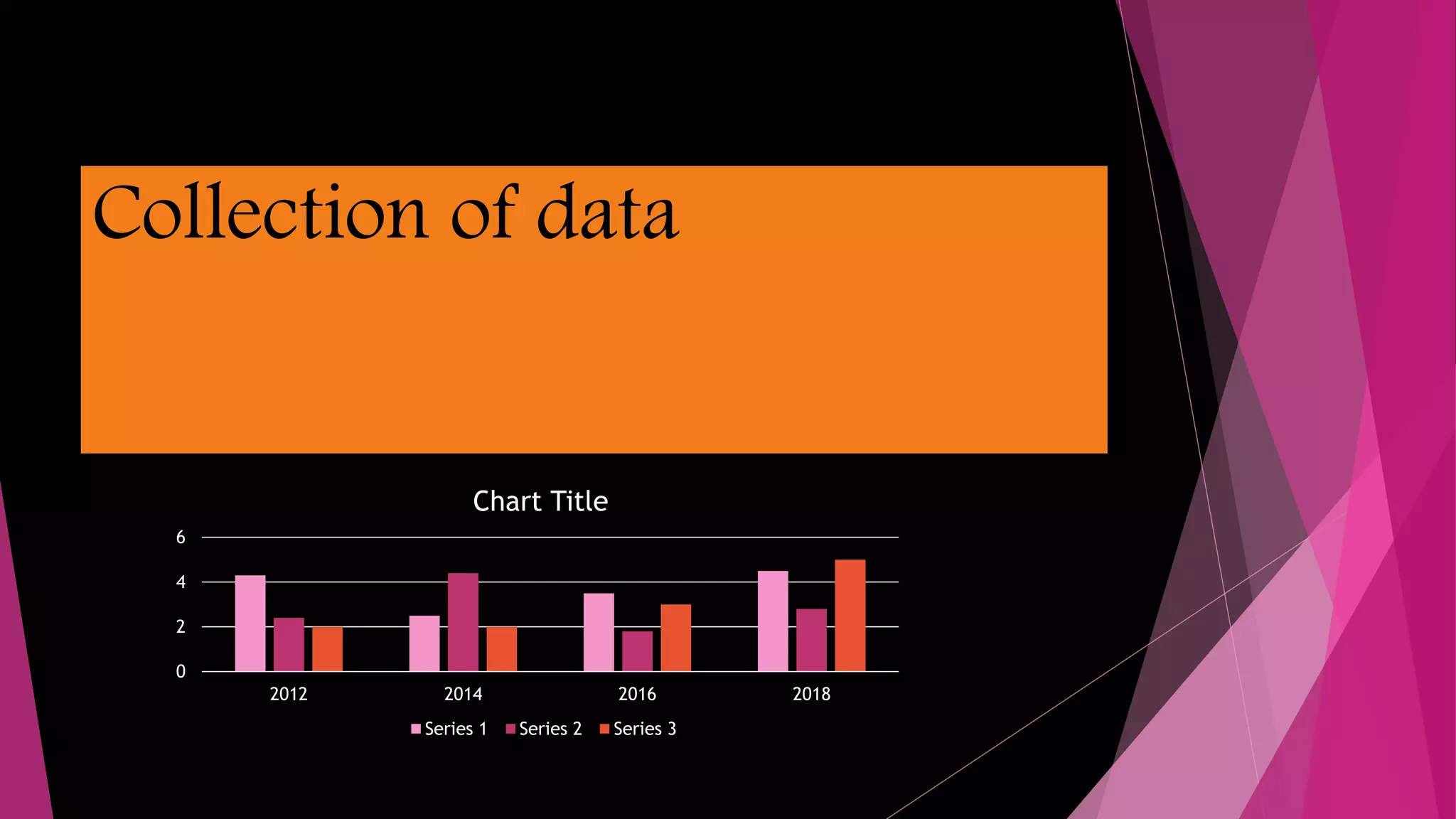
0
2
4
6
2012 2014 2016 2018
Chart Title
Series 1 Series 2 Series 3
introduction
 Data collection is a term used to describe a
process of preparing and collecting data.
 Systematic gathering of data for particular
purpose from various sources,that has been
systematically observed,recorded,organized.
 Data are the basis inputs to any decisions making
process in business.
PURPOSE OF DATA COLLECTION
 The purpose of data collection is:-
To keep on record.
To make decisions about important issue.
To pass information on to others.
:-
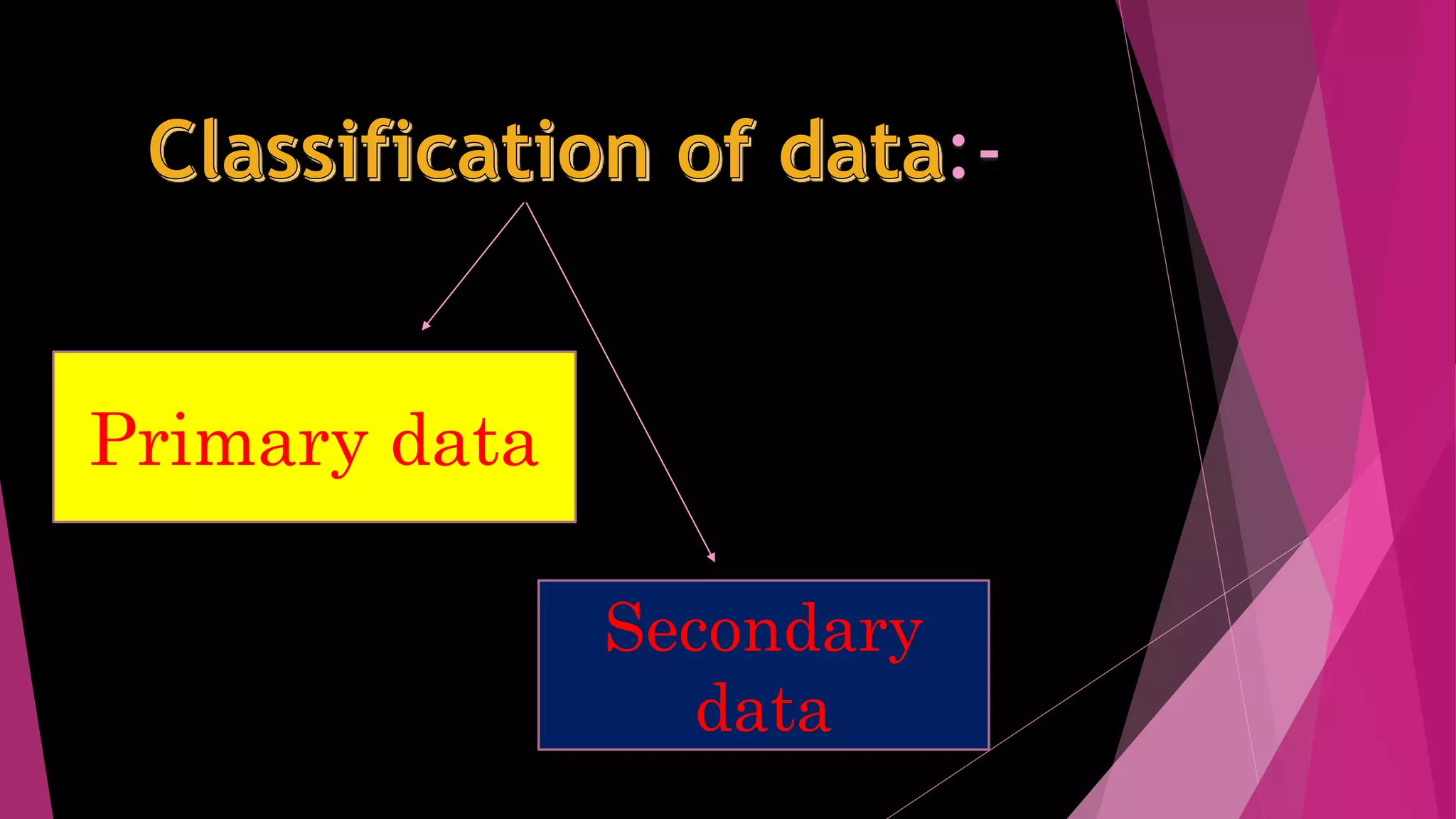
Primary data
Secondary
data
Primary data :-
 If the data being collected for the first time for statistical
treatment, they are known as primary data.
 In other word data collected by personal investigation
from the original source, by performing some experiments
is called primary data
 They are in the form of raw material.
 It is useful for current studies as well as future studies.
 For eg:- your own questionnaire.
Primary research methods:-
Quantitaive:- according to the magnituted or
number is called quantitative.
Eg:- chickens of poultary farm may be
classified on the basis of their growth rate.
Qualitative:- according to quality or attribute
the data is called qualitive.
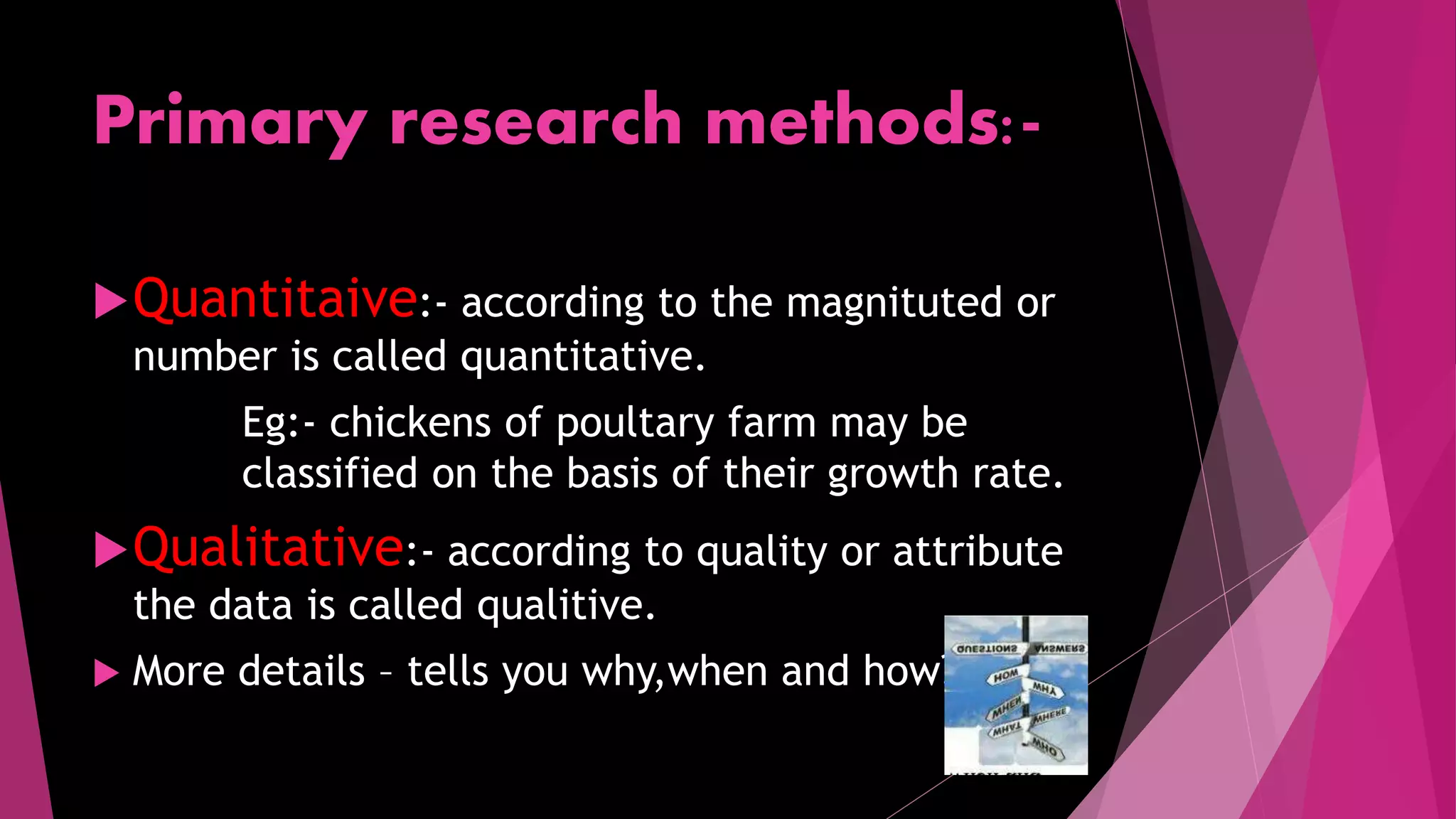
 More details – tells you why,when and how?
Advantageof primary data:-
 Degree of accurarcy is quite high.
 It does not require extra cautions
 It depicts the data in great detail.
 For some investigation, secondary data are
not available.
Disadvantage of primary data:
 Collection of data requires a lot of time.
 Requires lot of finance.
 Requires a lot of labour.
 Requires lot of skill.
 In some enquiries it is not possible to
collect primary data.
Secondary data :-
 When the primary data are used for any other
purpose they are termed as secondary data.
 It involves less cost, time and effort
 This type of data that is being reused. Usually in a
different context.
 For eg:- data form the book.
Sources:-
 Journals
 Books
 Magazines
 Newspaper
 Libraries
 The internet
Advantages of secondary data:-
Low cost to acquire.
Use is very conveninent.
Clarification of research
question.
May answer research question.
Disadvantage of secondary
data :-
Quality of research
Not spececific to researcher’s needs.
Incomplete information.
Not available for all types of enquiries.
Thank you 

Collection of data

  • 1.
    Collection of data 0 2 4 6 20122014 2016 2018 Chart Title Series 1 Series 2 Series 3
  • 2.
    introduction  Data collectionis a term used to describe a process of preparing and collecting data.  Systematic gathering of data for particular purpose from various sources,that has been systematically observed,recorded,organized.  Data are the basis inputs to any decisions making process in business.
  • 3.
    PURPOSE OF DATACOLLECTION  The purpose of data collection is:- To keep on record. To make decisions about important issue. To pass information on to others.
  • 4.
  • 5.
    Primary data :- If the data being collected for the first time for statistical treatment, they are known as primary data.  In other word data collected by personal investigation from the original source, by performing some experiments is called primary data  They are in the form of raw material.  It is useful for current studies as well as future studies.  For eg:- your own questionnaire.
  • 6.
    Primary research methods:- Quantitaive:-according to the magnituted or number is called quantitative. Eg:- chickens of poultary farm may be classified on the basis of their growth rate. Qualitative:- according to quality or attribute the data is called qualitive.  More details – tells you why,when and how?
  • 7.
    Advantageof primary data:- Degree of accurarcy is quite high.  It does not require extra cautions  It depicts the data in great detail.  For some investigation, secondary data are not available.
  • 8.
    Disadvantage of primarydata:  Collection of data requires a lot of time.  Requires lot of finance.  Requires a lot of labour.  Requires lot of skill.  In some enquiries it is not possible to collect primary data.
  • 9.
    Secondary data :- When the primary data are used for any other purpose they are termed as secondary data.  It involves less cost, time and effort  This type of data that is being reused. Usually in a different context.  For eg:- data form the book.
  • 10.
    Sources:-  Journals  Books Magazines  Newspaper  Libraries  The internet
  • 11.
    Advantages of secondarydata:- Low cost to acquire. Use is very conveninent. Clarification of research question. May answer research question.
  • 12.
    Disadvantage of secondary data:- Quality of research Not spececific to researcher’s needs. Incomplete information. Not available for all types of enquiries.
  • 13.