1Marek.Piatkowski@Rogers.com
Standardized
Work
Introduction
Thinkingwin, Win, WIN
Standardized Work
Introduction
Marek Piatkowski – January 2017
Thinkingwin, Win, WIN
2Marek.Piatkowski@Rogers.com
Standardized
Work
Introduction
Thinkingwin, Win, WIN
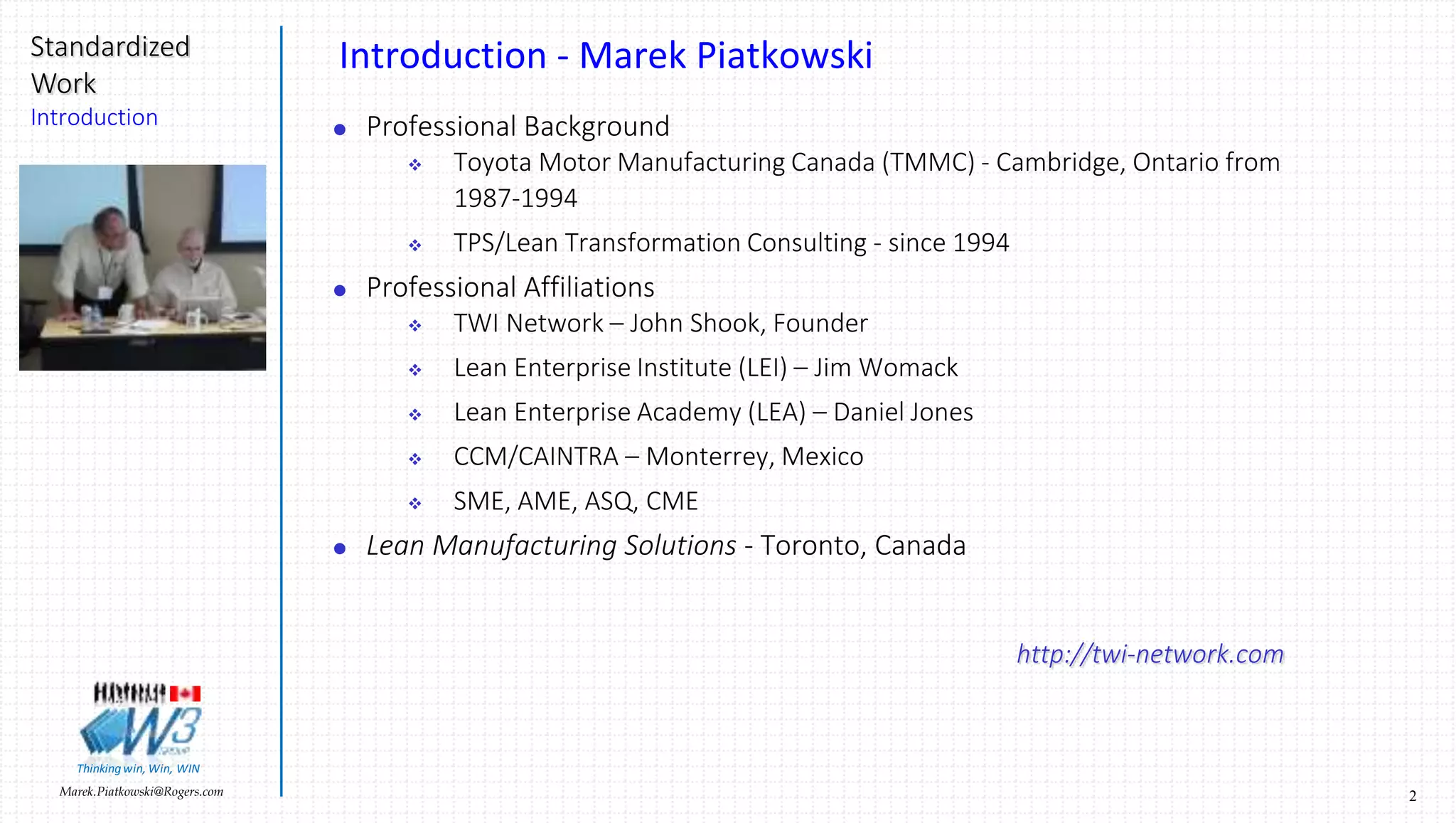
Introduction - Marek Piatkowski
 Professional Background
 Toyota Motor Manufacturing Canada (TMMC) - Cambridge, Ontario from
1987-1994
 TPS/Lean Transformation Consulting - since 1994
 Professional Affiliations
 TWI Network – John Shook, Founder
 Lean Enterprise Institute (LEI) – Jim Womack
 Lean Enterprise Academy (LEA) – Daniel Jones
 CCM/CAINTRA – Monterrey, Mexico
 SME, AME, ASQ, CME
 Lean Manufacturing Solutions - Toronto, Canada
http://twi-network.com
3Marek.Piatkowski@Rogers.com
Standardized
Work
Introduction
Thinkingwin, Win, WIN
4Marek.Piatkowski@Rogers.com
Standardized
Work
Introduction
Thinkingwin, Win, WIN
What is Standardized Work?
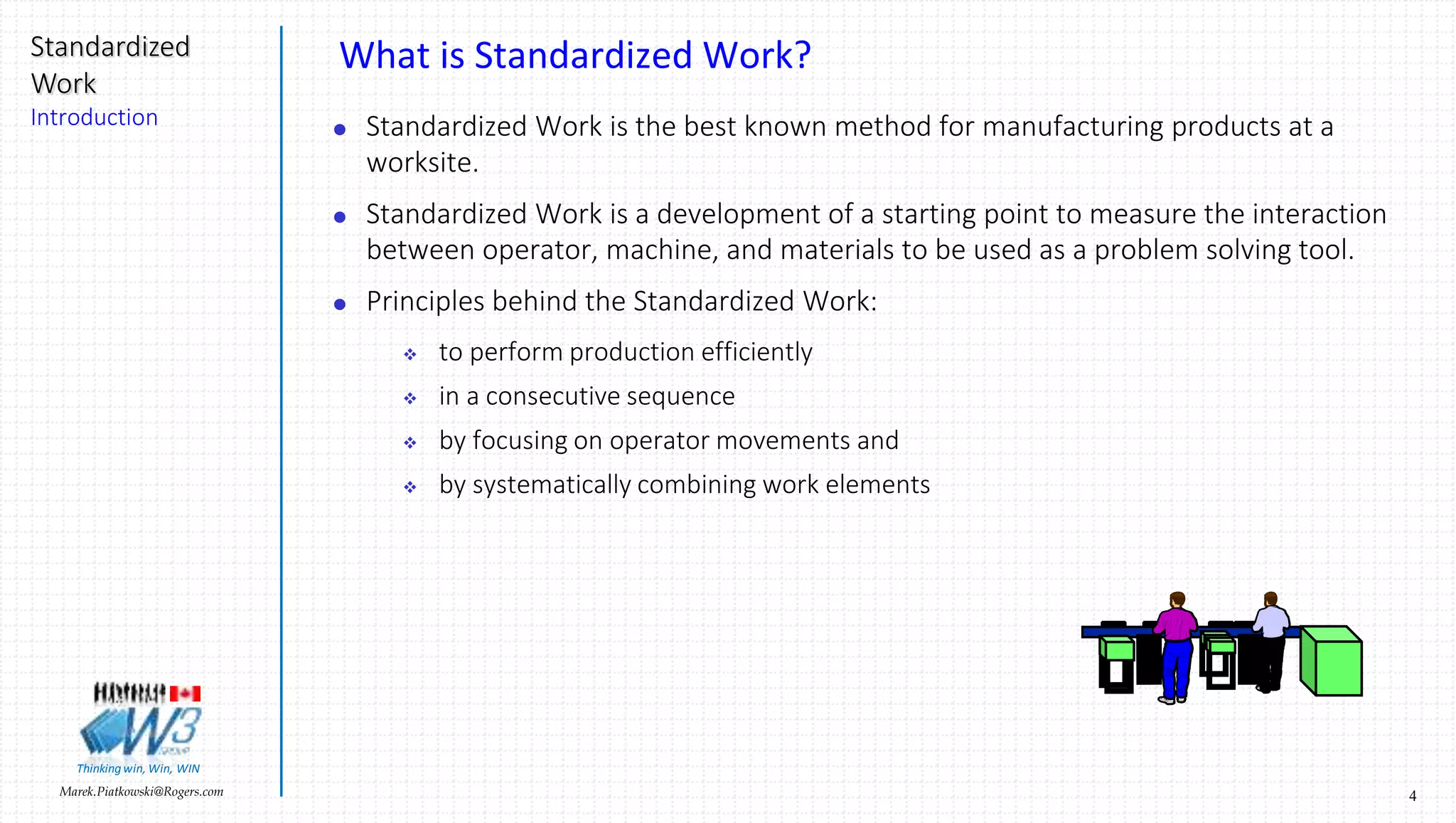
 Standardized Work is the best known method for manufacturing products at a
worksite.
 Standardized Work is a development of a starting point to measure the interaction
between operator, machine, and materials to be used as a problem solving tool.
 Principles behind the Standardized Work:
 to perform production efficiently
 in a consecutive sequence
 by focusing on operator movements and
 by systematically combining work elements
5Marek.Piatkowski@Rogers.com
Standardized
Work
Introduction
Thinkingwin, Win, WIN
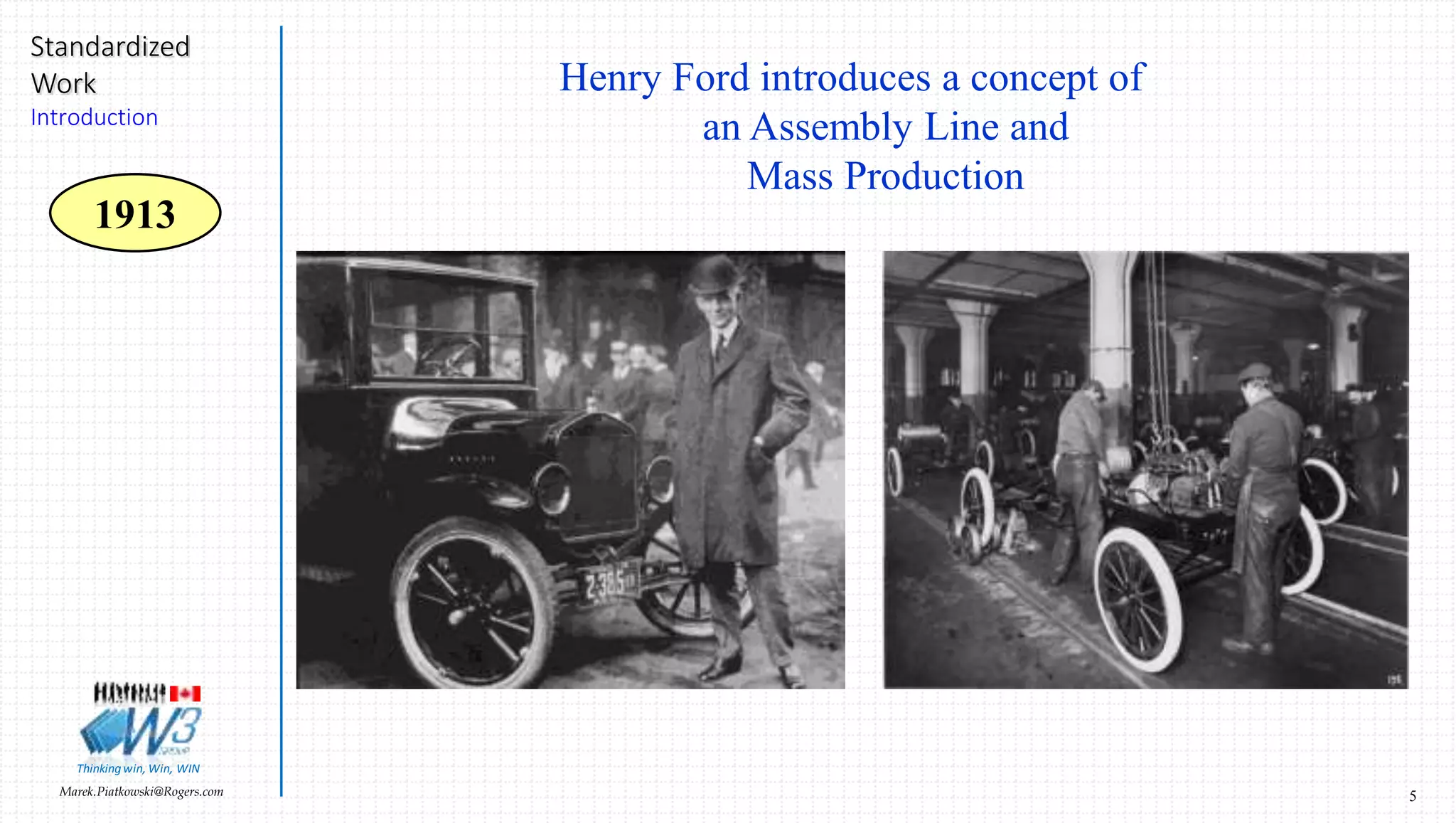
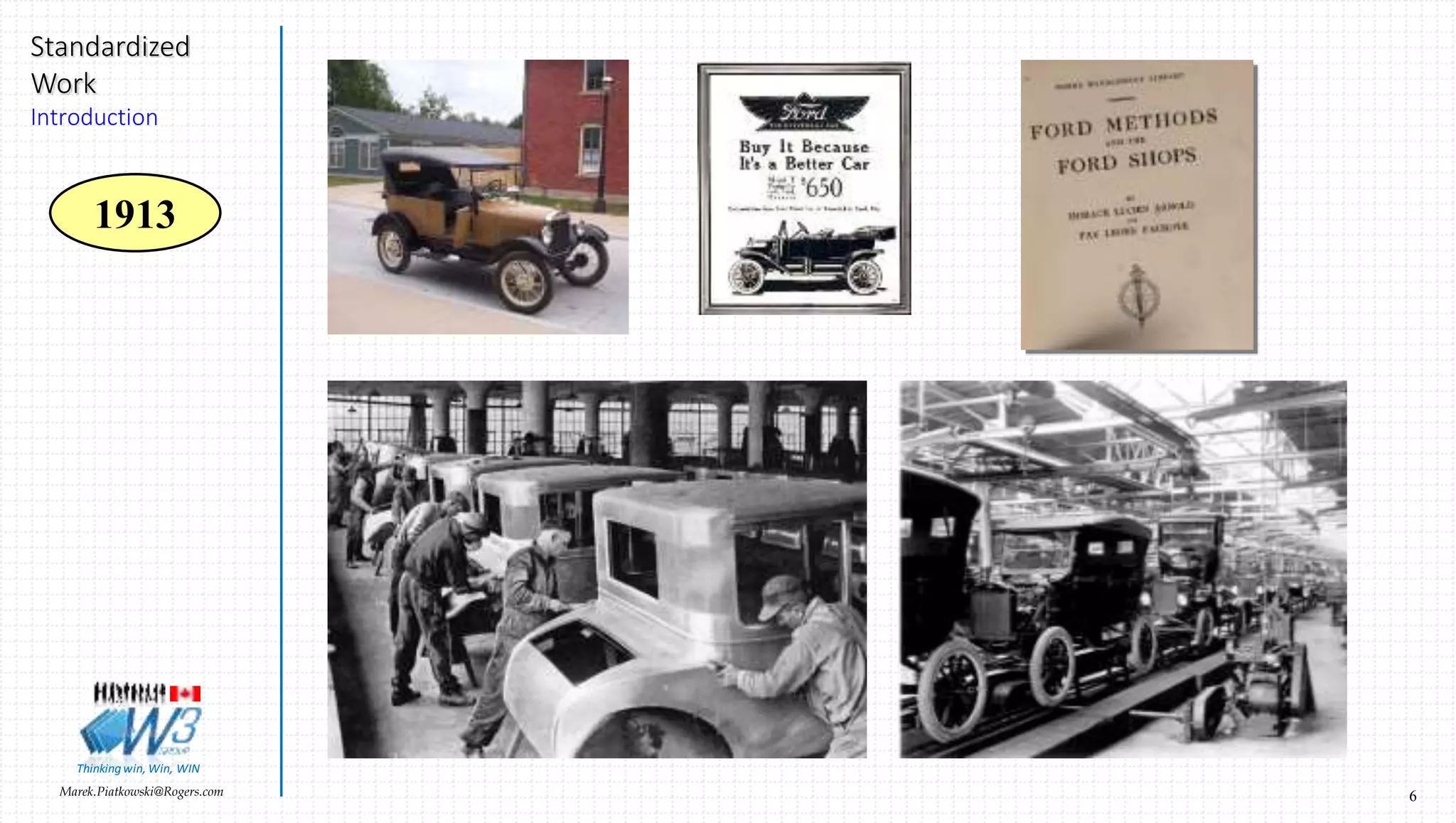
Henry Ford introduces a concept of
an Assembly Line and
Mass Production
1913
6Marek.Piatkowski@Rogers.com
Standardized
Work
Introduction
Thinkingwin, Win, WIN
1913
7Marek.Piatkowski@Rogers.com
Standardized
Work
Introduction
Thinkingwin, Win, WIN
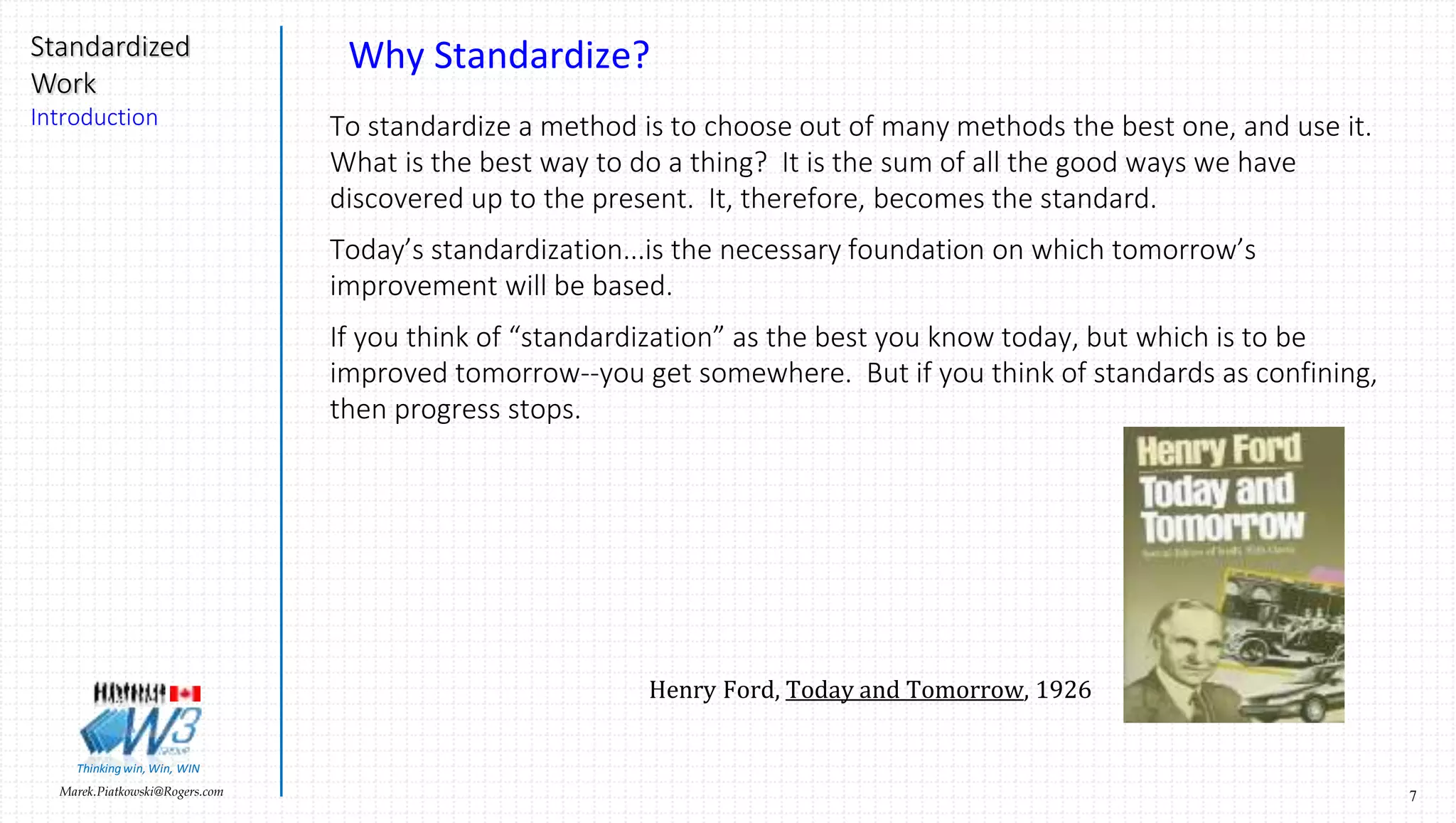
Why Standardize?
To standardize a method is to choose out of many methods the best one, and use it.
What is the best way to do a thing? It is the sum of all the good ways we have
discovered up to the present. It, therefore, becomes the standard.
Today’s standardization...is the necessary foundation on which tomorrow’s
improvement will be based.
If you think of “standardization” as the best you know today, but which is to be
improved tomorrow--you get somewhere. But if you think of standards as confining,
then progress stops.
Henry Ford, Today and Tomorrow, 1926
8Marek.Piatkowski@Rogers.com
Standardized
Work
Introduction
Thinkingwin, Win, WIN
History of Toyota Production System - TPS
1951
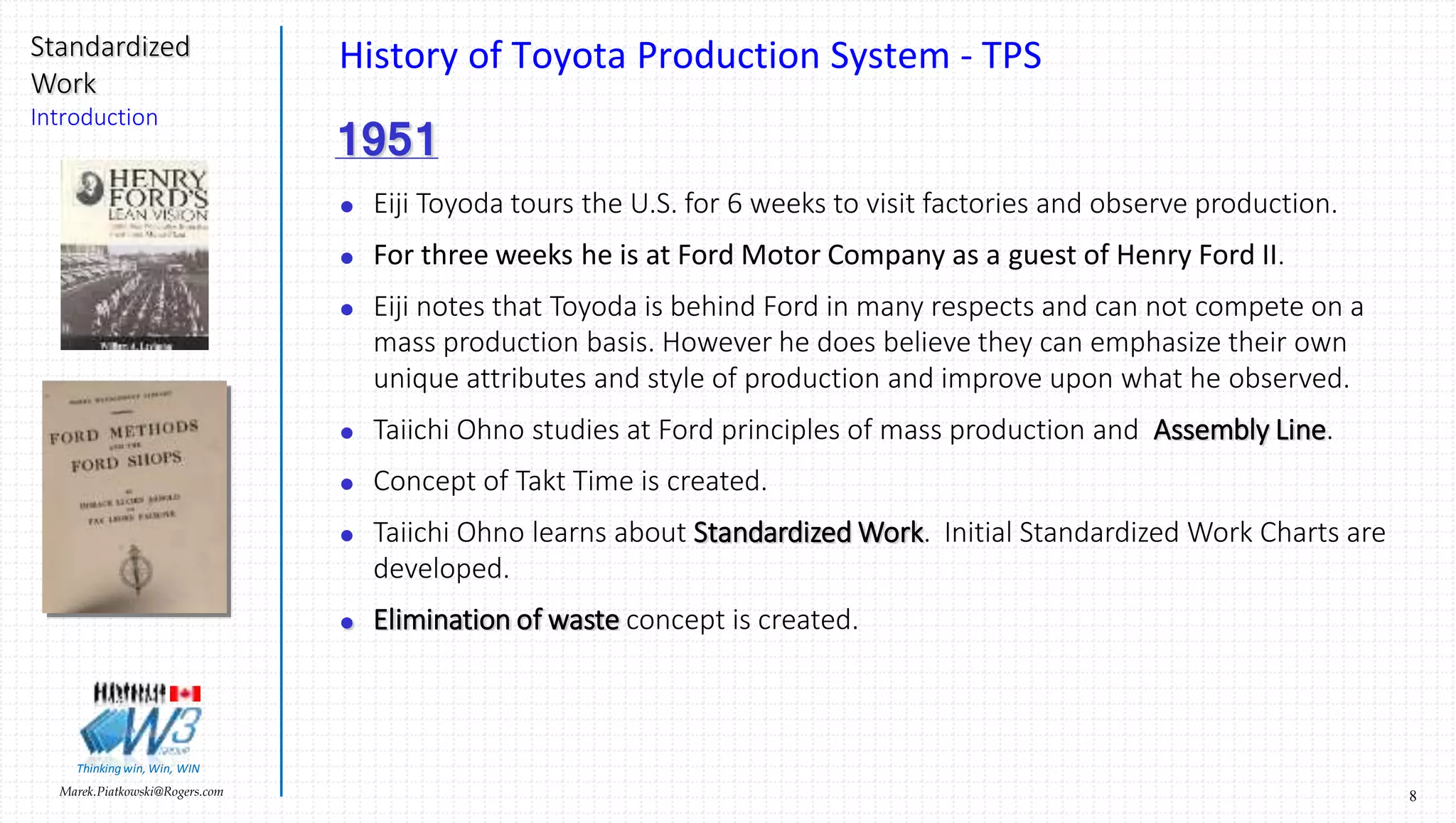
 Eiji Toyoda tours the U.S. for 6 weeks to visit factories and observe production.
 For three weeks he is at Ford Motor Company as a guest of Henry Ford II.
 Eiji notes that Toyoda is behind Ford in many respects and can not compete on a
mass production basis. However he does believe they can emphasize their own
unique attributes and style of production and improve upon what he observed.
 Taiichi Ohno studies at Ford principles of mass production and Assembly Line.
 Concept of Takt Time is created.
 Taiichi Ohno learns about Standardized Work. Initial Standardized Work Charts are
developed.
 Elimination of waste concept is created.
9Marek.Piatkowski@Rogers.com
Standardized
Work
Introduction
Thinkingwin, Win, WIN
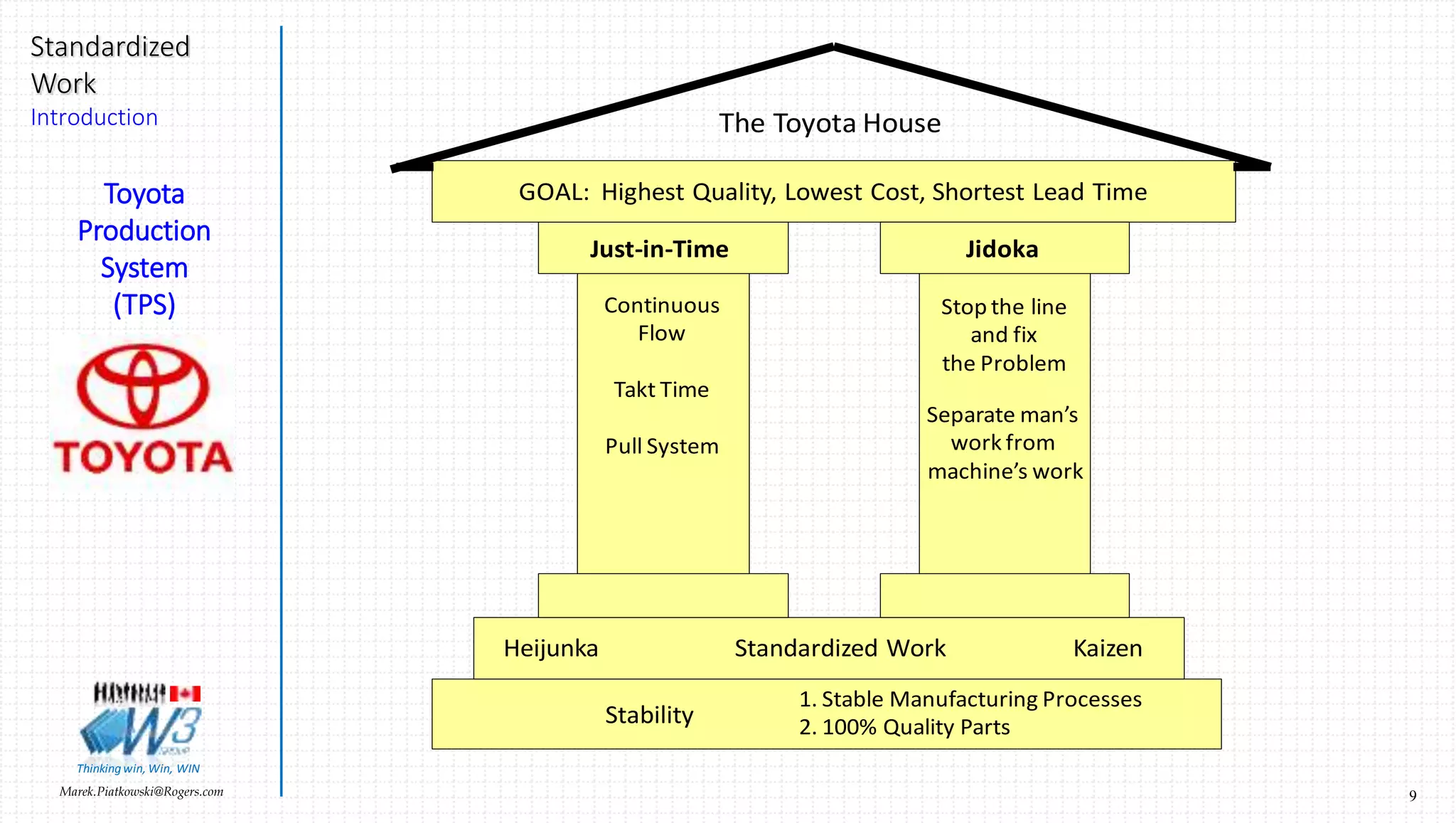
Stability
GOAL: Highest Quality, Lowest Cost, Shortest Lead Time
1. Stable Manufacturing Processes
2. 100% Quality Parts
Heijunka Standardized Work Kaizen
Just-in-Time Jidoka
Stop the line
and fix
the Problem
Separate man’s
work from
machine’s work
Continuous
Flow
Takt Time
Pull System
The Toyota House
Toyota
Production
System
(TPS)
10Marek.Piatkowski@Rogers.com
Standardized
Work
Introduction
Thinkingwin, Win, WIN
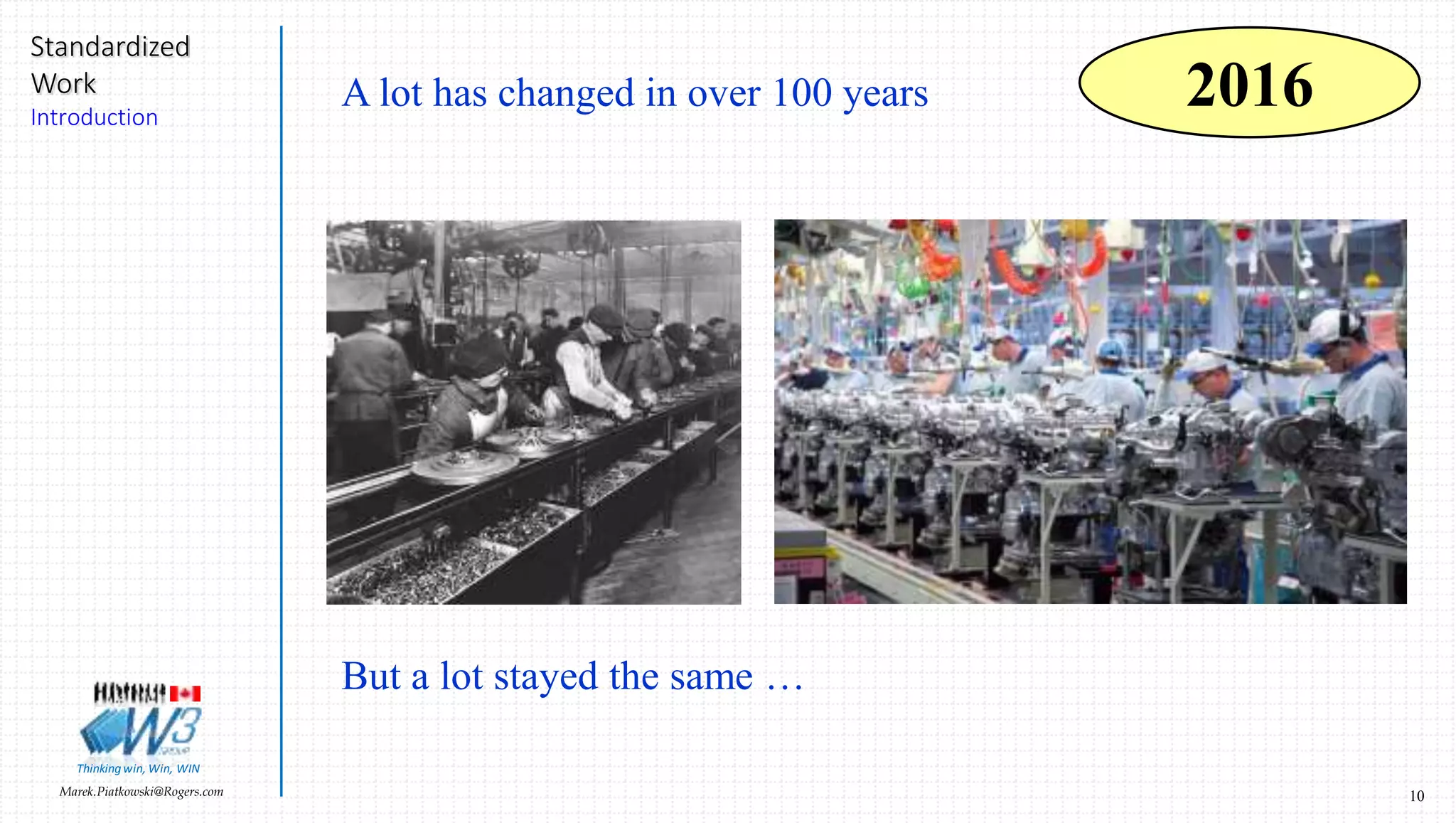
2016A lot has changed in over 100 years
But a lot stayed the same …
11Marek.Piatkowski@Rogers.com
Standardized
Work
Introduction
Thinkingwin, Win, WIN
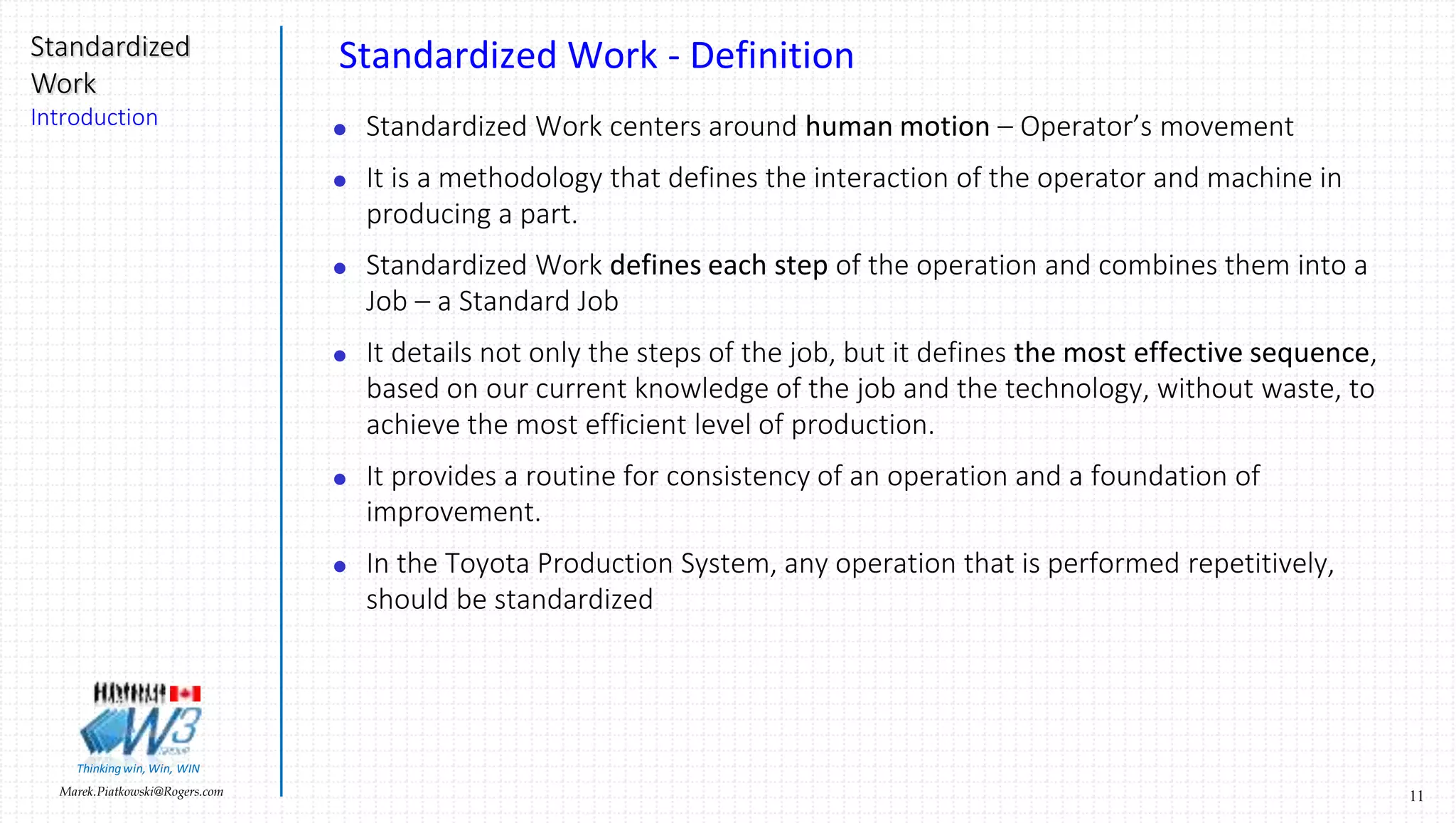
Standardized Work - Definition
 Standardized Work centers around human motion – Operator’s movement
 It is a methodology that defines the interaction of the operator and machine in
producing a part.
 Standardized Work defines each step of the operation and combines them into a
Job – a Standard Job
 It details not only the steps of the job, but it defines the most effective sequence,
based on our current knowledge of the job and the technology, without waste, to
achieve the most efficient level of production.
 It provides a routine for consistency of an operation and a foundation of
improvement.
 In the Toyota Production System, any operation that is performed repetitively,
should be standardized
12Marek.Piatkowski@Rogers.com
Standardized
Work
Introduction
Thinkingwin, Win, WIN
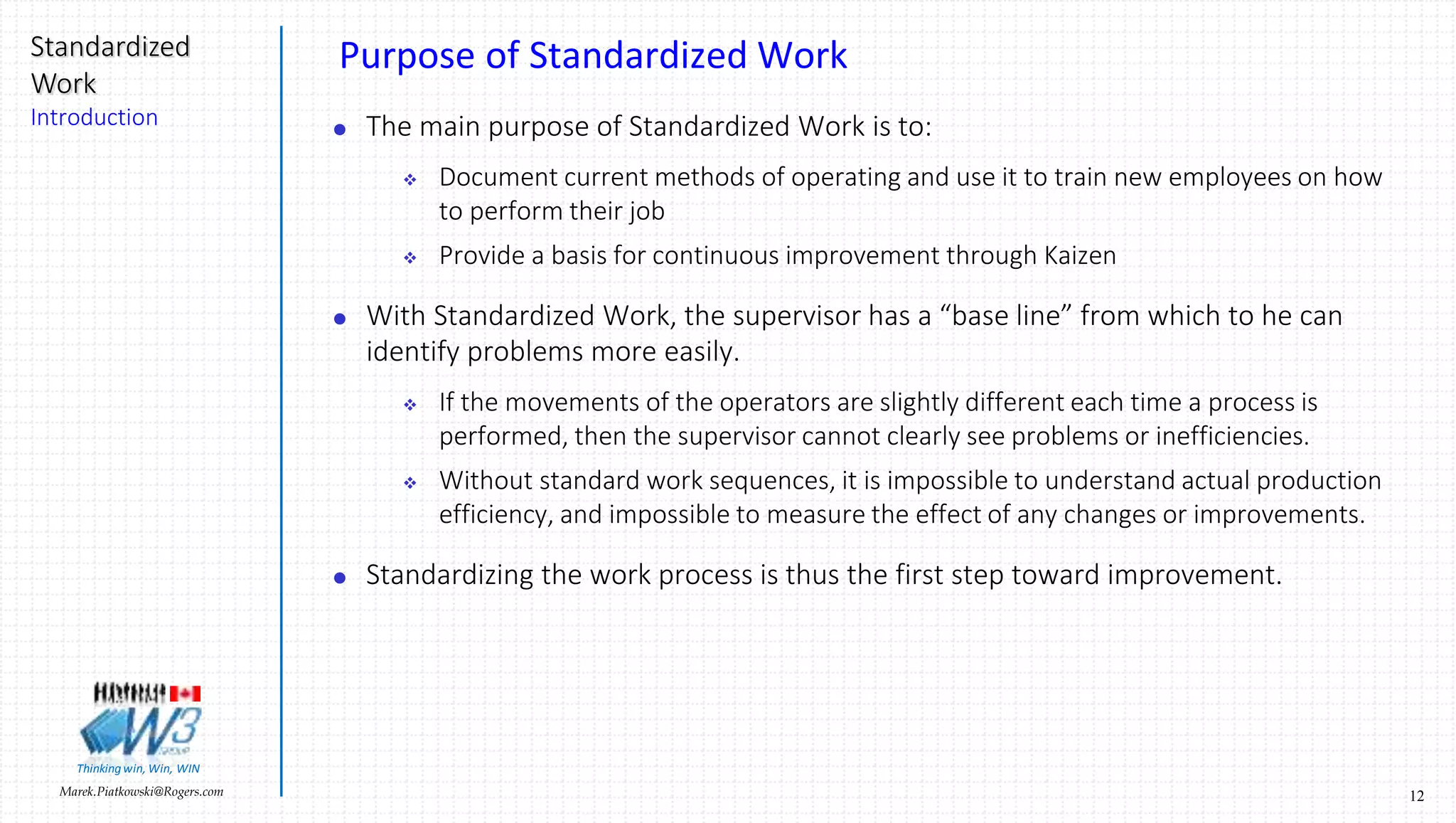
Purpose of Standardized Work
 The main purpose of Standardized Work is to:
 Document current methods of operating and use it to train new employees on how
to perform their job
 Provide a basis for continuous improvement through Kaizen
 With Standardized Work, the supervisor has a “base line” from which to he can
identify problems more easily.
 If the movements of the operators are slightly different each time a process is
performed, then the supervisor cannot clearly see problems or inefficiencies.
 Without standard work sequences, it is impossible to understand actual production
efficiency, and impossible to measure the effect of any changes or improvements.
 Standardizing the work process is thus the first step toward improvement.
13Marek.Piatkowski@Rogers.com
Standardized
Work
Introduction
Thinkingwin, Win, WIN
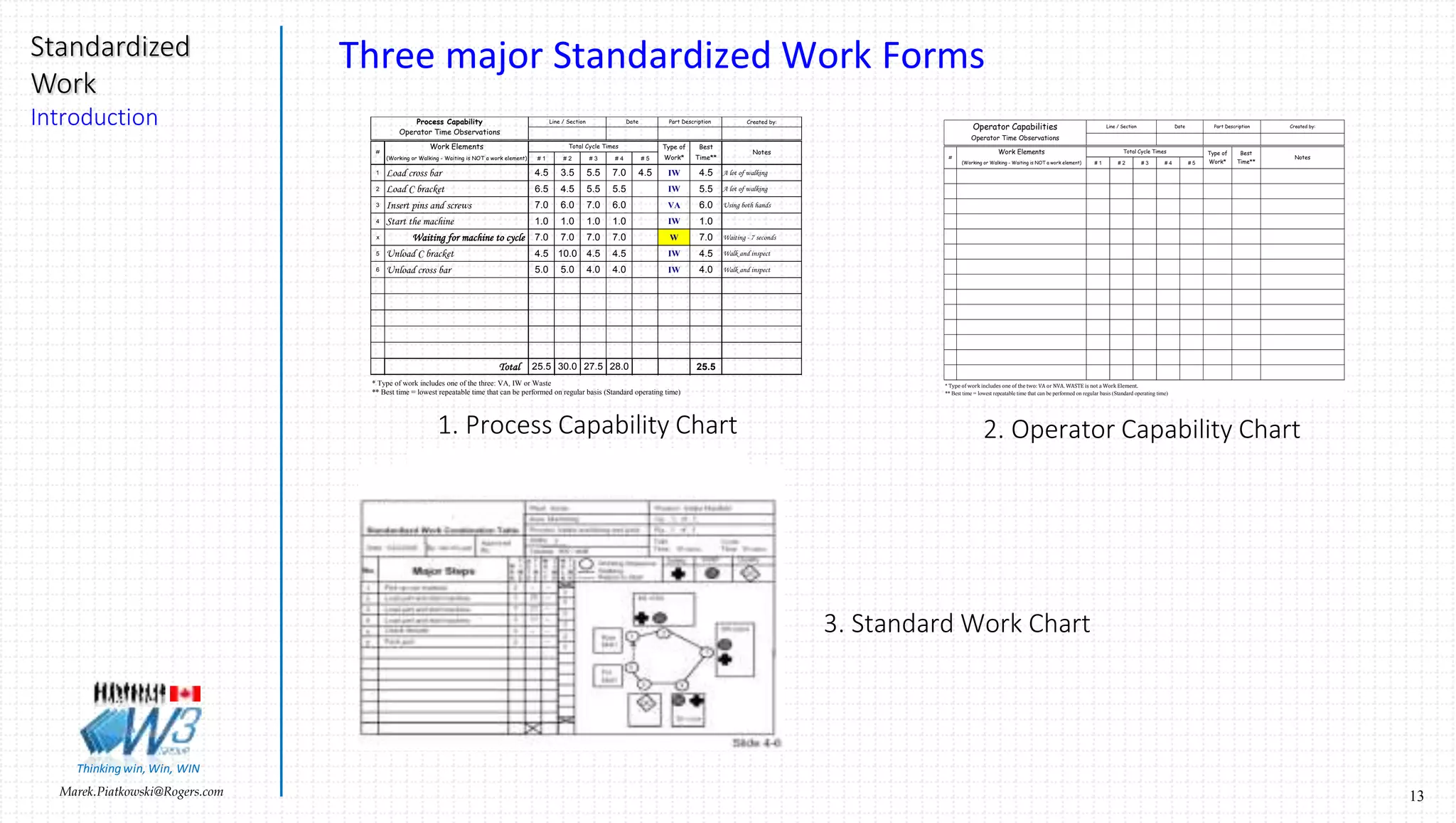
Three major Standardized Work Forms
3. Standard Work Chart
1. Process Capability Chart
Created by:
Work Elements
(Working or Walking - Waiting is NOT a work element) # 1 # 2 # 3 # 4 # 5
1 Load cross bar 4.5 3.5 5.5 7.0 4.5 IW 4.5 A lot of walking
2 Load C bracket 6.5 4.5 5.5 5.5 IW 5.5 A lot of walking
3 Insert pins and screws 7.0 6.0 7.0 6.0 VA 6.0 Using both hands
4 Start the machine 1.0 1.0 1.0 1.0 IW 1.0
x Waiting for machine to cycle 7.0 7.0 7.0 7.0 W 7.0 Waiting - 7 seconds
5 Unload C bracket 4.5 10.0 4.5 4.5 IW 4.5 Walk and inspect
6 Unload cross bar 5.0 5.0 4.0 4.0 IW 4.0 Walk and inspect
Total 25.5 30.0 27.5 28.0 25.5
* Type of work includes one of the three: VA, IW or Waste
** Best time = lowest repeatable time that can be performed on regular basis (Standard operating time)
Notes#
Best
Time**
Process Capability
Operator Time Observations
Total Cycle Times Type of
Work*
Line / Section Date Part Description
Created by:
Work Elements
(Working or Walking - Waiting is NOT a work element) # 1 # 2 # 3 # 4 # 5
* Type of work includes one of the two: VA or NVA. WASTE is not a Work Element.
** Best time = lowest repeatable time that can be performed on regular basis (Standard operating time)
Notes#
Best
Time**
Operator Capabilities
Operator Time Observations
Total Cycle Times Type of
Work*
Line / Section Date Part Description
2. Operator Capability Chart
14Marek.Piatkowski@Rogers.com
Standardized
Work
Introduction
Thinkingwin, Win, WIN
15Marek.Piatkowski@Rogers.com
Standardized
Work
Introduction
Thinkingwin, Win, WIN
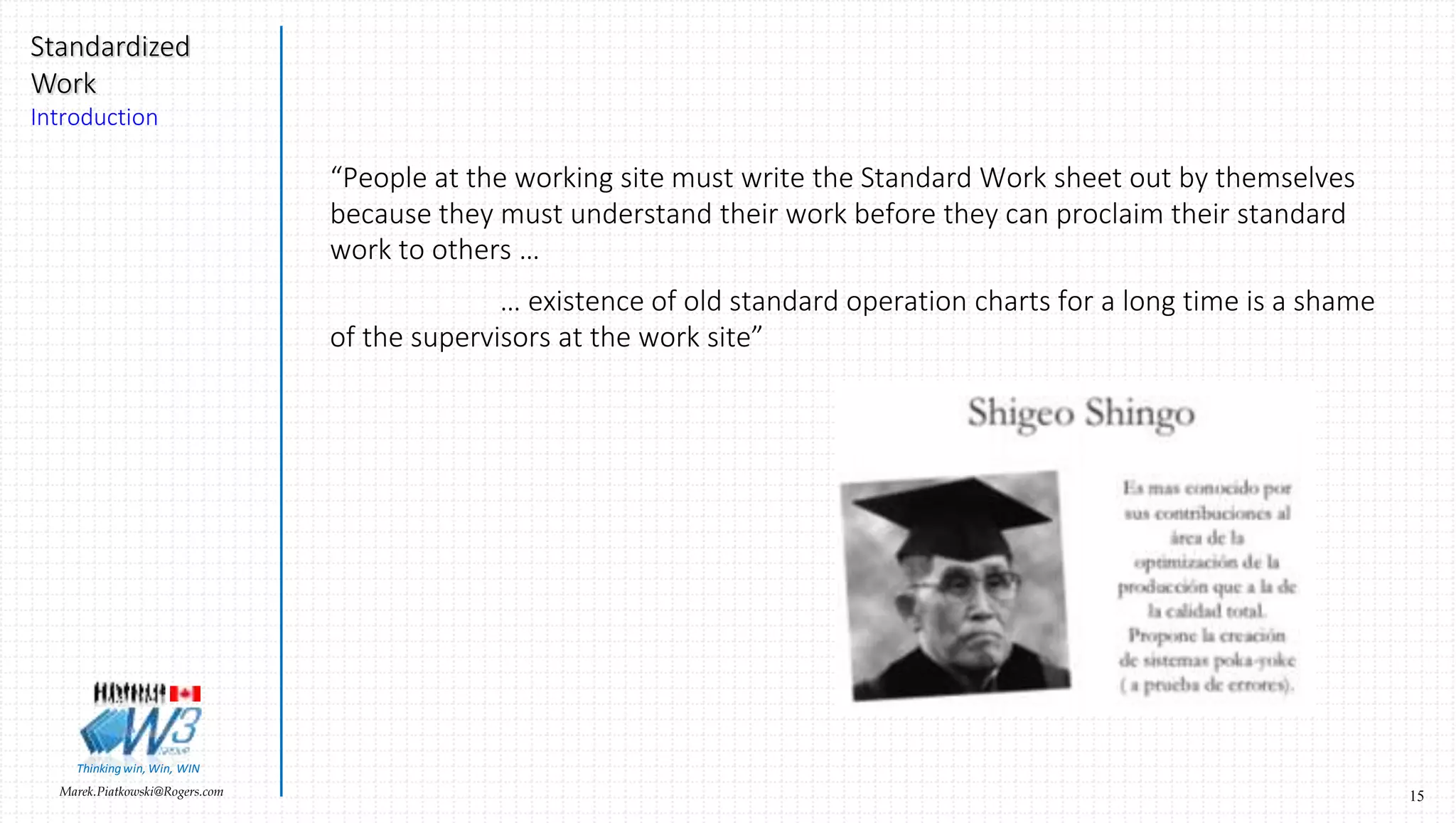
“People at the working site must write the Standard Work sheet out by themselves
because they must understand their work before they can proclaim their standard
work to others …
… existence of old standard operation charts for a long time is a shame
of the supervisors at the work site”
16Marek.Piatkowski@Rogers.com
Standardized
Work
Introduction
Thinkingwin, Win, WIN
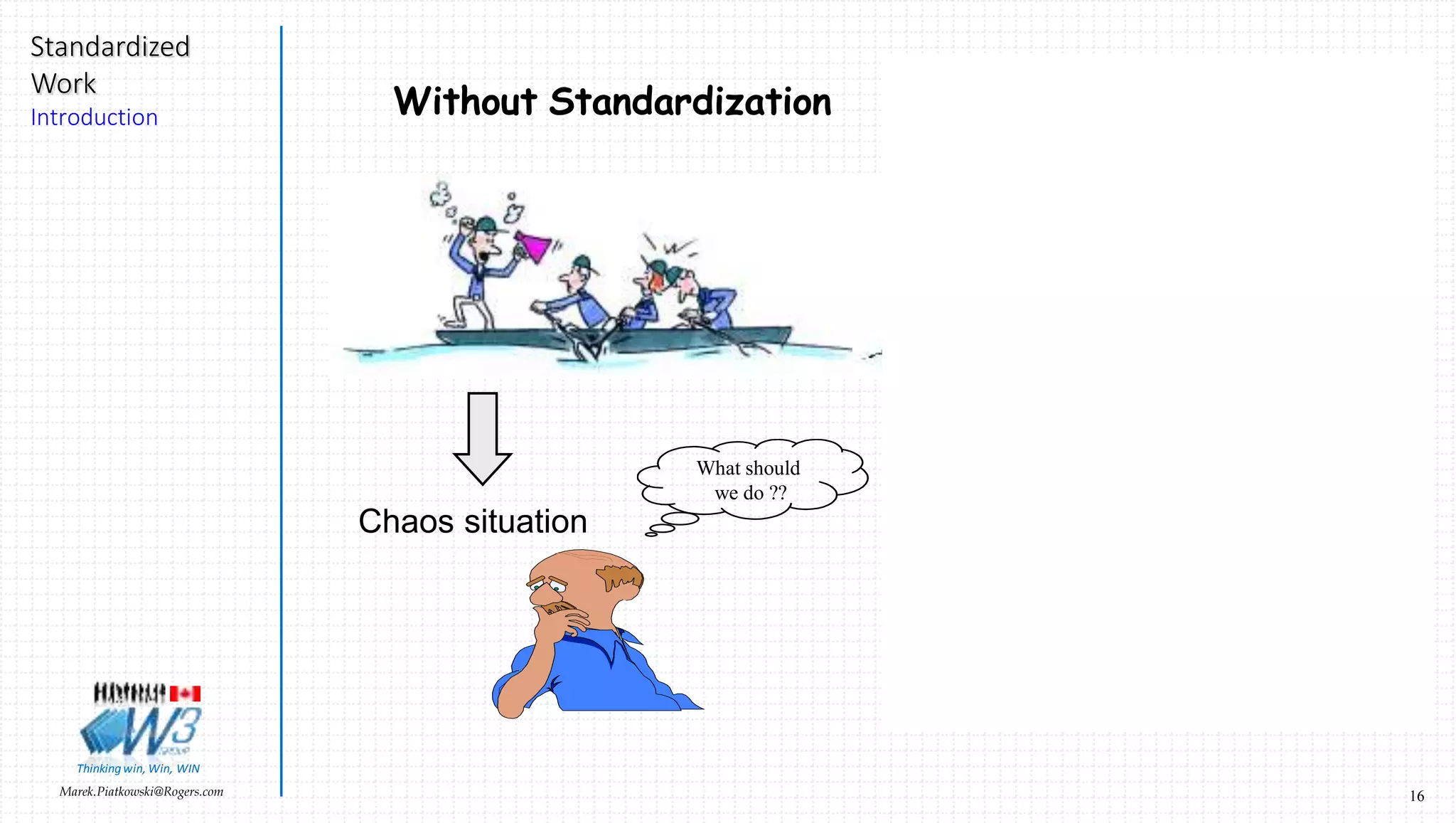
Without Standardization With Standardization
Chaos situation You can see where the problem is
What should
we do ??
17Marek.Piatkowski@Rogers.com
Standardized
Work
Introduction
Thinkingwin, Win, WIN
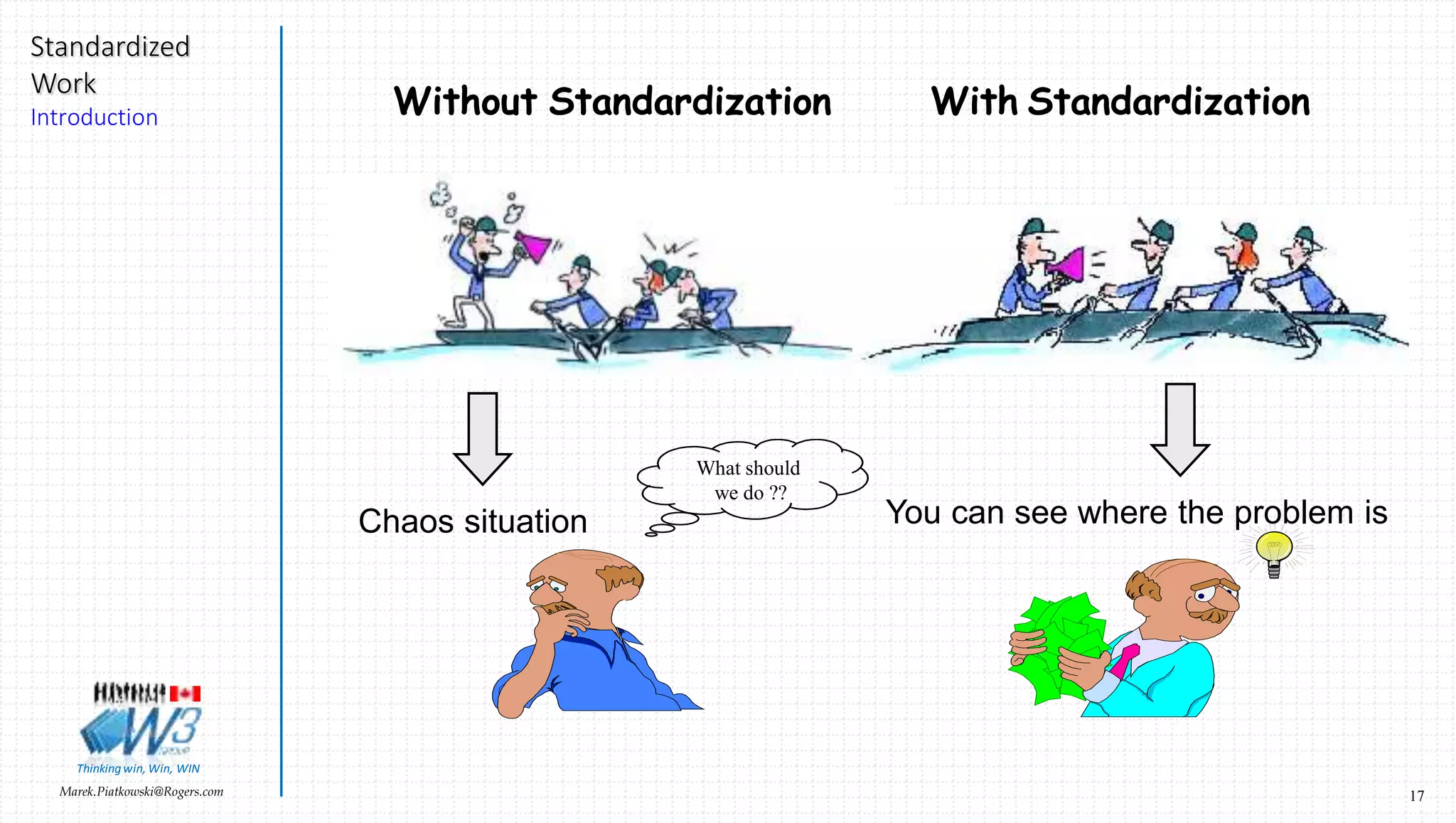
Without Standardization With Standardization
Chaos situation You can see where the problem is
What should
we do ??
18Marek.Piatkowski@Rogers.com
Standardized
Work
Introduction
Thinkingwin, Win, WIN
Benefits of Standardization
 Defines the most efficient sequence of production
 Minimizes Non-Value Added activities and eliminates Waste from the process
 Identifies manpower requirements based on Takt Time
 Defines and reinforces quality standards
 Prevents overproduction
 Allow for easier judgment regarding “normal” versus “abnormal” situations
 Establishing a manufacturing system flexible to accommodate any future changes
or improvements.
 Others …
19Marek.Piatkowski@Rogers.com
Standardized
Work
Introduction
Thinkingwin, Win, WIN
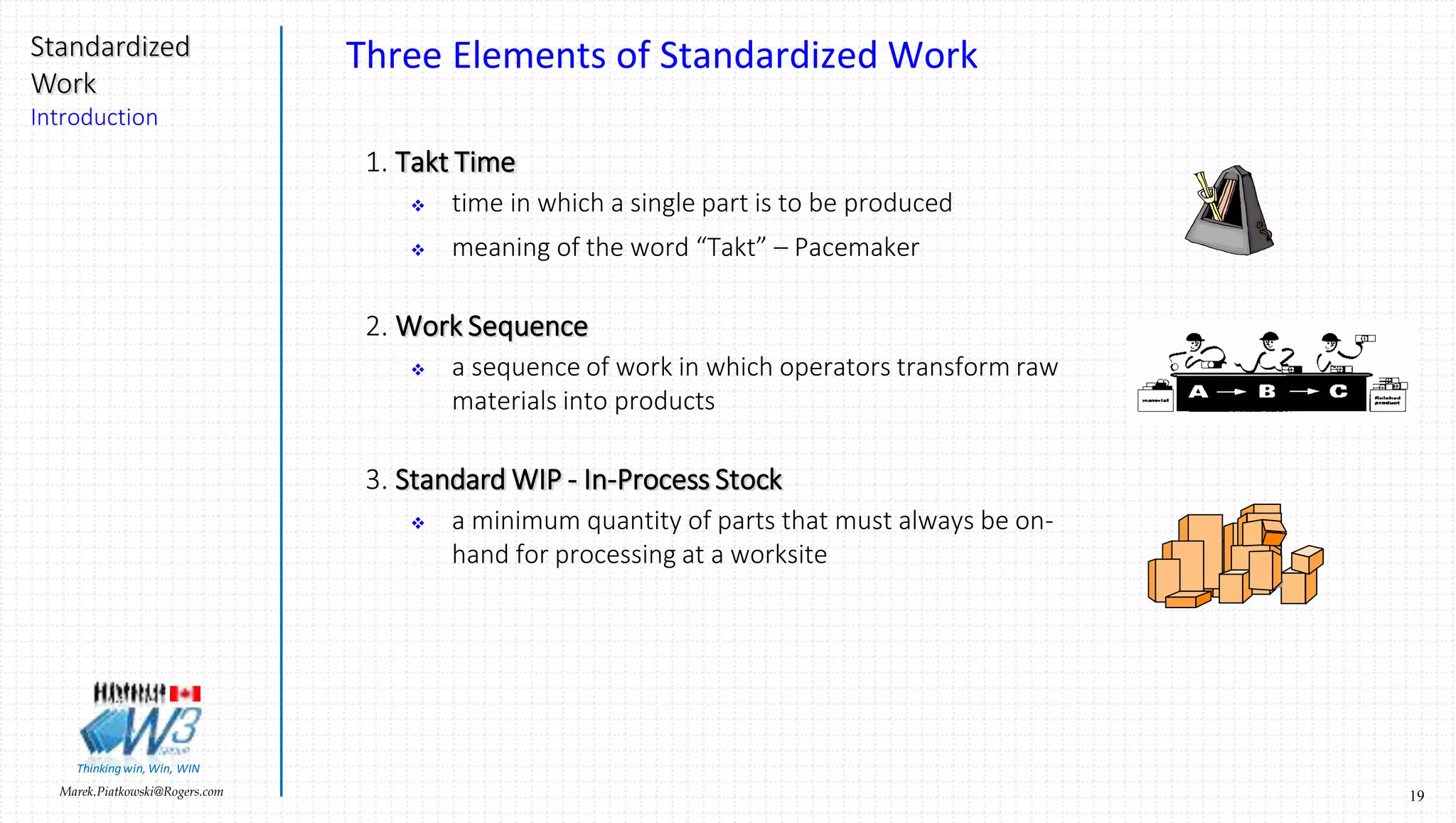
Three Elements of Standardized Work
1. Takt Time
 time in which a single part is to be produced
 meaning of the word “Takt” – Pacemaker
2. Work Sequence
 a sequence of work in which operators transform raw
materials into products
3. Standard WIP - In-Process Stock
 a minimum quantity of parts that must always be on-
hand for processing at a worksite
20Marek.Piatkowski@Rogers.com
Standardized
Work
Introduction
Thinkingwin, Win, WIN
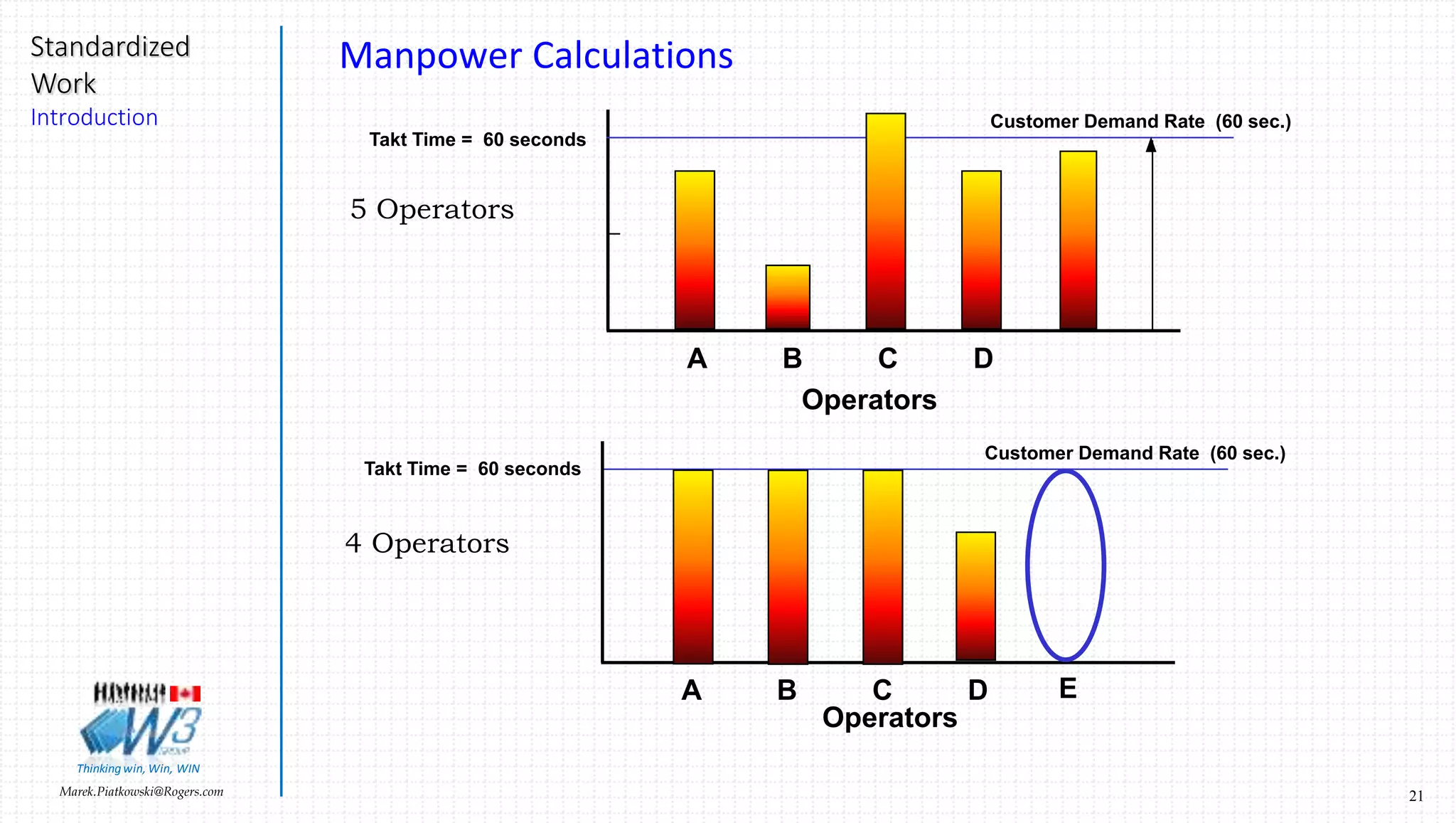
Manpower Calculations
Operators
A B C D
Customer Demand Rate (60 sec.)
Takt Time = 60 seconds
5 Operators
EA B C D
Operators
Customer Demand Rate (60 sec.)
4 Operators
Takt Time = 60 seconds
21Marek.Piatkowski@Rogers.com
Standardized
Work
Introduction
Thinkingwin, Win, WIN
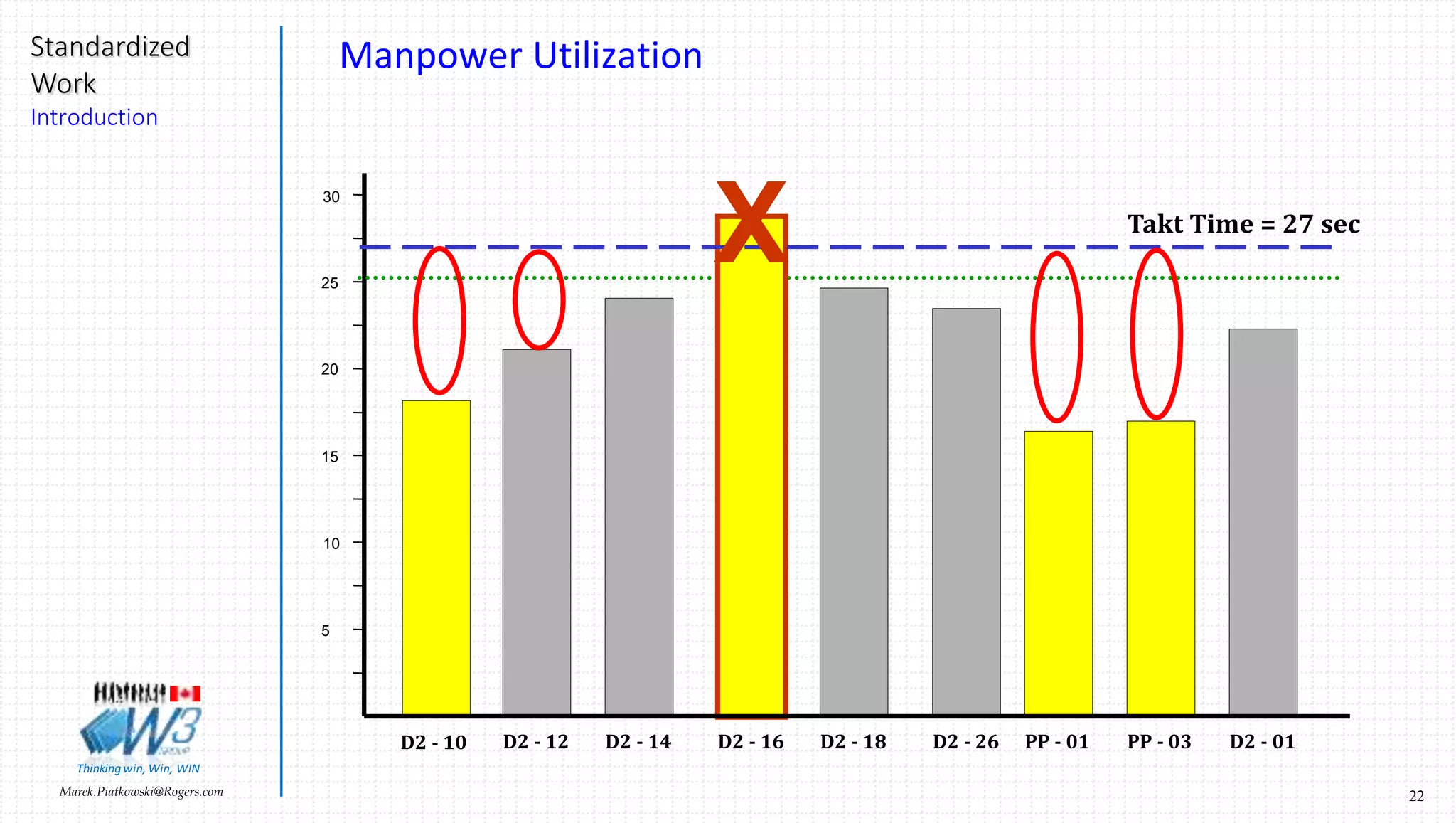
Manpower Utilization
5
10
15
20
25
30
D2 - 26
Takt Time = 27 sec
D2 - 10 D2 - 12 D2 - 14 D2 - 16 D2 - 18 PP - 01 D2 - 01PP - 03
X
22Marek.Piatkowski@Rogers.com
Standardized
Work
Introduction
Thinkingwin, Win, WIN
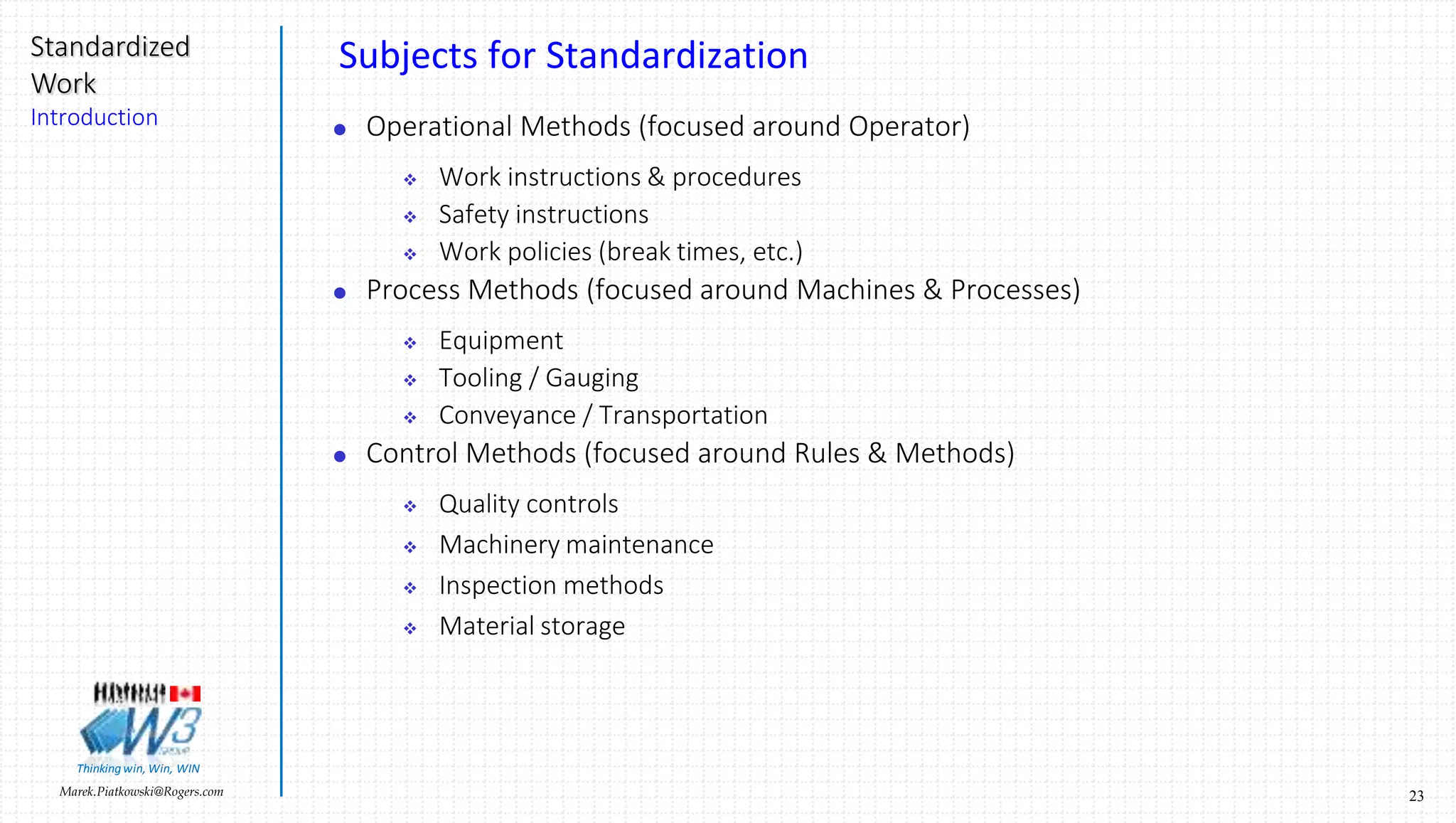
Subjects for Standardization
 Operational Methods (focused around Operator)
 Work instructions & procedures
 Safety instructions
 Work policies (break times, etc.)
 Process Methods (focused around Machines & Processes)
 Equipment
 Tooling / Gauging
 Conveyance / Transportation
 Control Methods (focused around Rules & Methods)
 Quality controls
 Machinery maintenance
 Inspection methods
 Material storage
23Marek.Piatkowski@Rogers.com
Standardized
Work
Introduction
Thinkingwin, Win, WIN
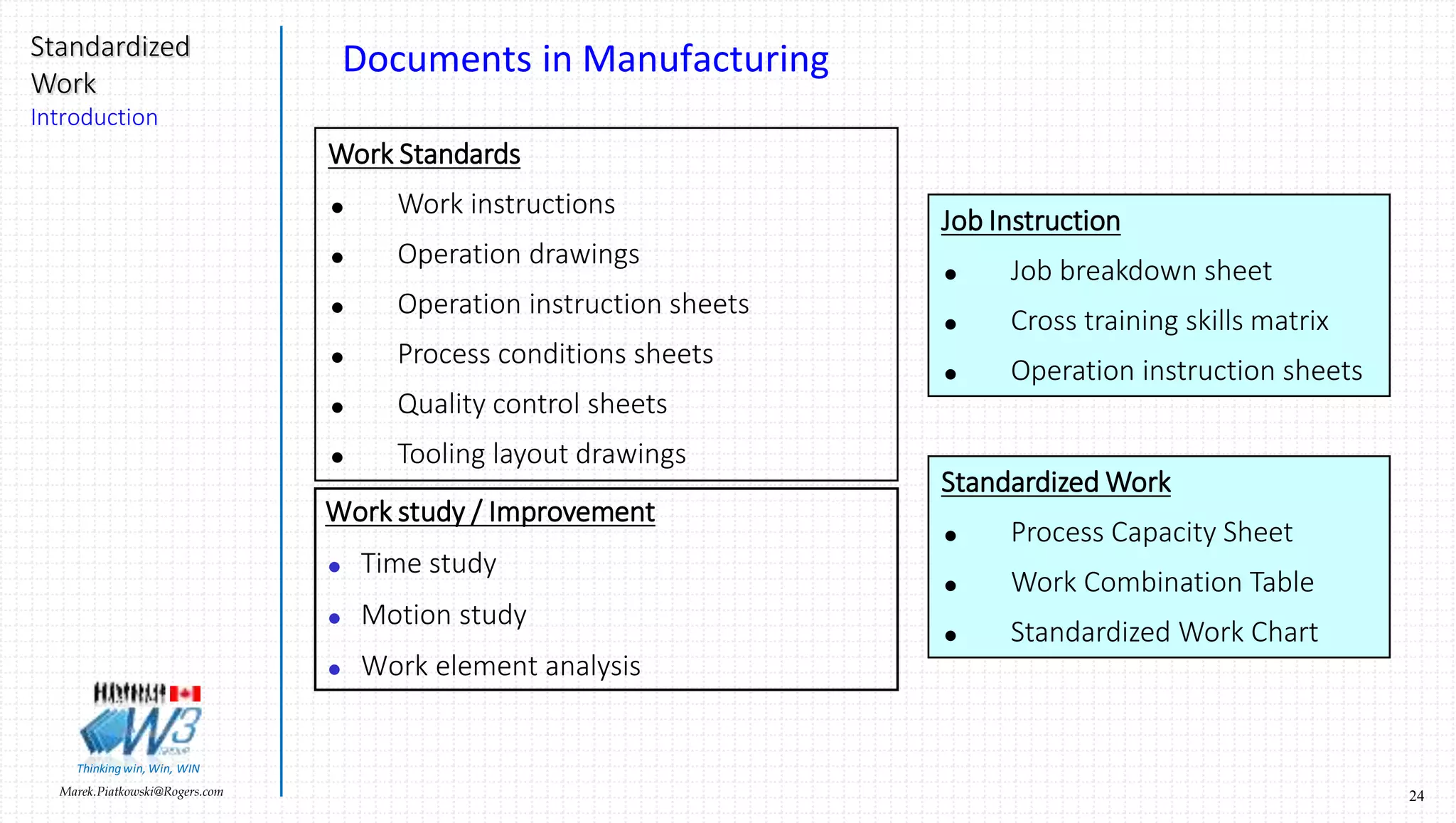
Documents in Manufacturing
Work study / Improvement
 Time study
 Motion study
 Work element analysis
Standardized Work
 Process Capacity Sheet
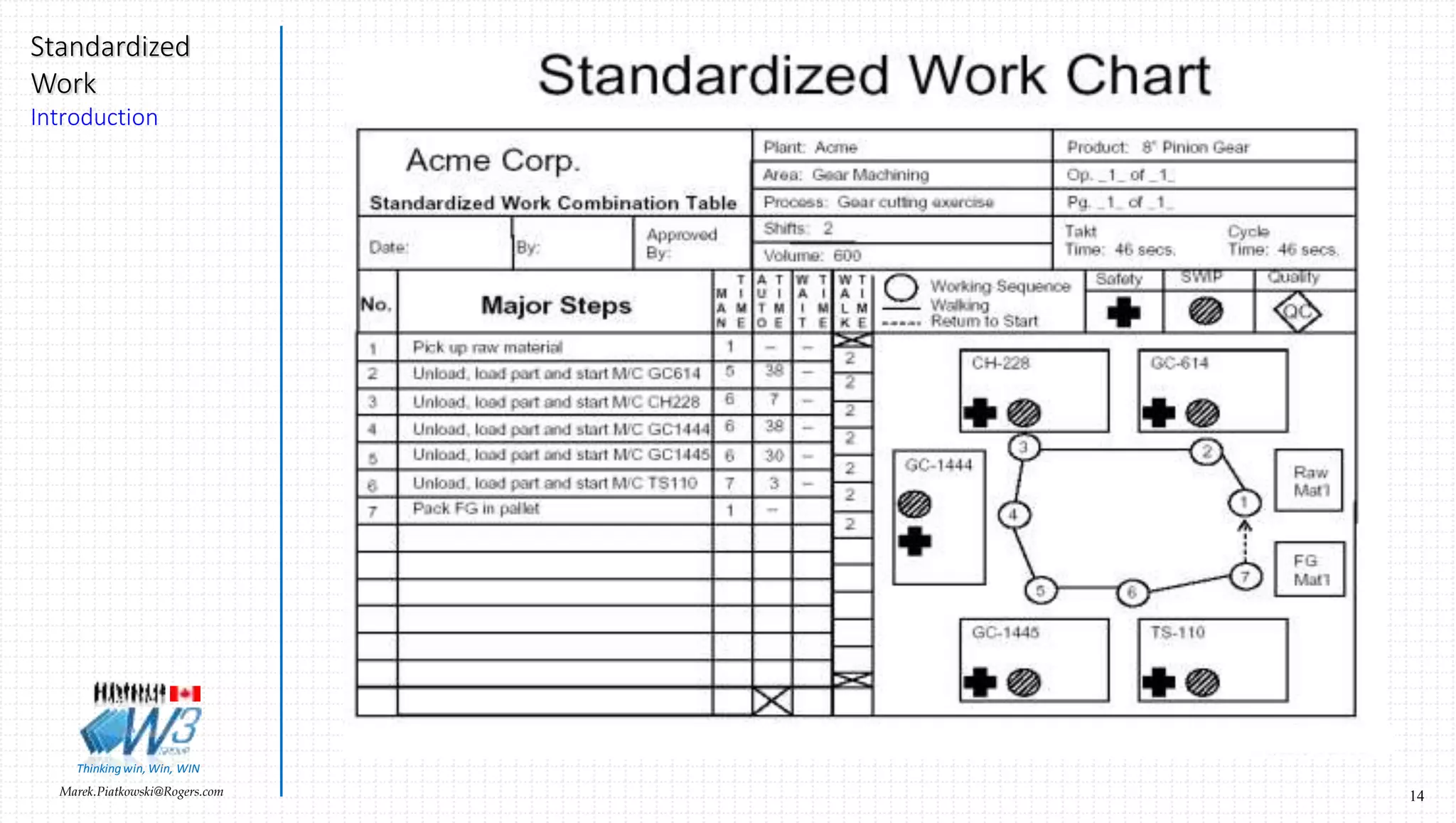
 Work Combination Table
 Standardized Work Chart
Job Instruction
 Job breakdown sheet
 Cross training skills matrix
 Operation instruction sheets
Work Standards
 Work instructions
 Operation drawings
 Operation instruction sheets
 Process conditions sheets
 Quality control sheets
 Tooling layout drawings
24Marek.Piatkowski@Rogers.com
Standardized
Work
Introduction
Thinkingwin, Win, WIN
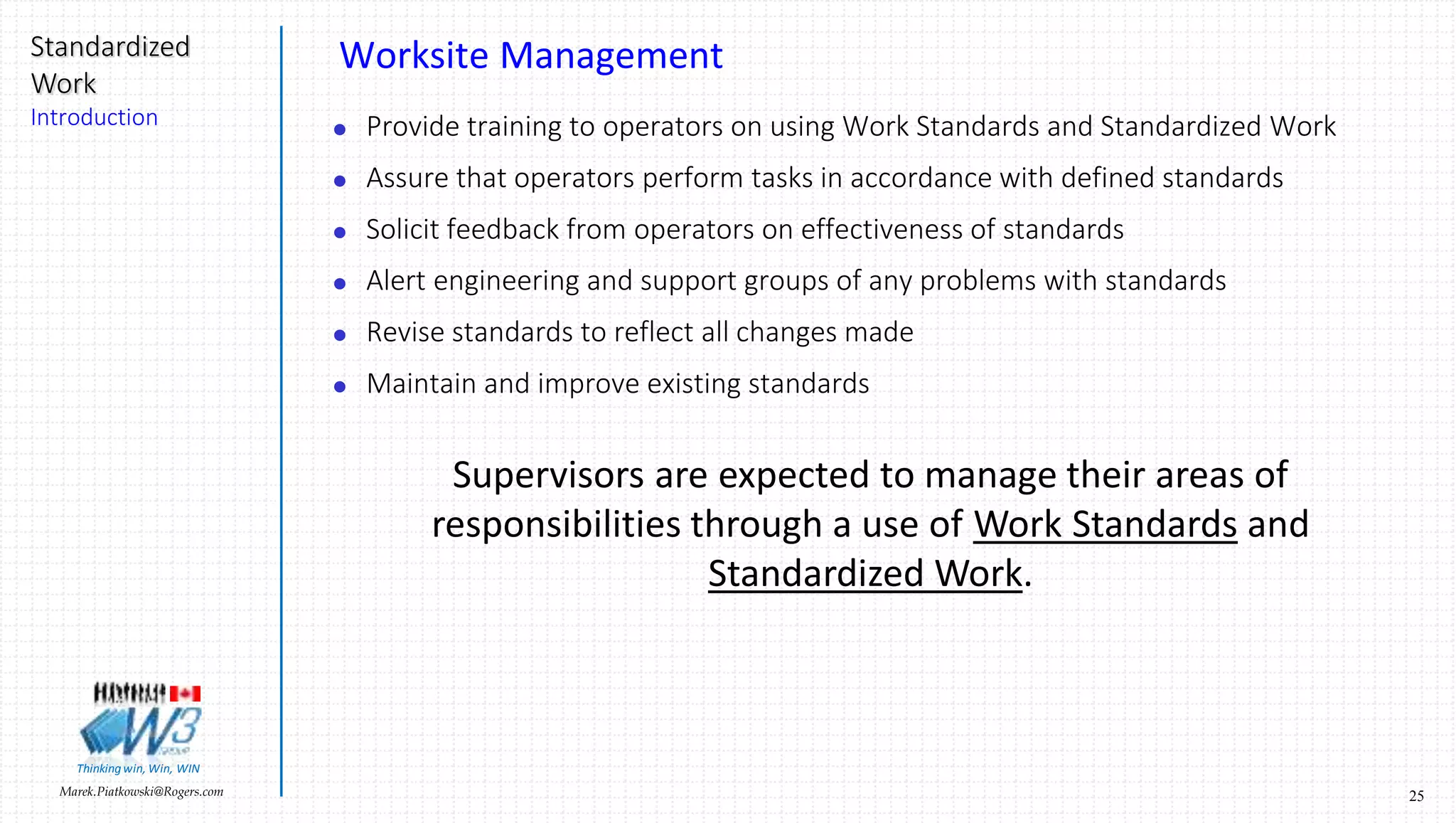
Worksite Management
 Provide training to operators on using Work Standards and Standardized Work
 Assure that operators perform tasks in accordance with defined standards
 Solicit feedback from operators on effectiveness of standards
 Alert engineering and support groups of any problems with standards
 Revise standards to reflect all changes made
 Maintain and improve existing standards
Supervisors are expected to manage their areas of
responsibilities through a use of Work Standards and
Standardized Work.
25Marek.Piatkowski@Rogers.com
Standardized
Work
Introduction
Thinkingwin, Win, WIN
Changing the World. One Kaizen at a time
This presentation is an intellectual property of W3 Group Canada Inc.
No parts of this document can be copied or reproduced
without written permission from:
Marek Piatkowski
W3 Group Canada Inc.
iPhone: 416-235-2631
Cell: 248-207-0416
Marek.Piatkowski@rogers.com
http://twi-network.com
26Marek.Piatkowski@Rogers.com
Standardized
Work
Introduction
Thinkingwin, Win, WIN
Presentations in this
Workshop
1. Log in to:
www.slideshare.net
2. Type in my name in
search area:
Marek Piatkowski
3. Select a presentation you
want to see
4. Learn and Enjoy

Introduction to Standardized Work