1
Lean Thinking Thru Daily Work
Management
M Hariharan
Director
Savoir faire
Management Services Pvt Ltd
Two days Workshop on QUALITY MANAGEMENT STANDARDS & QUALITY
TECHNOLOGY TOOLS (QMS/QTT)
Dt. : 11 December 2015 Venue : MCCIA Pune
22
Agenda
 Lean Thinking - Alignment
 Integration with QMS
 Customer Value
 Process Alignment
 People Alignment
 Lean Leadership
33
Agenda
 Lean Thinking - Alignment
 Integration with QMS
 Customer Value
 Process Alignment
 People Alignment
 Lean Leadership
44
Lean Thinking
 Changing Cost Perspective
 Sustaining “Inequality”
 Lean Thinking - Alignment
55
Lean Thinking
 Changing Cost Perspective
 Sustaining “Inequality”
 Lean Thinking - Alignment
66
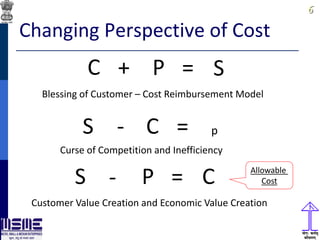
Changing Perspective of Cost
C + P = S
Blessing of Customer – Cost Reimbursement Model
S - C = p
Curse of Competition and Inefficiency
S - P = C
Customer Value Creation and Economic Value Creation
Allowable
Cost
77
Lean Thinking
 Changing Cost Perspective
 Sustaining “Inequality”
 Lean Thinking - Alignment
88
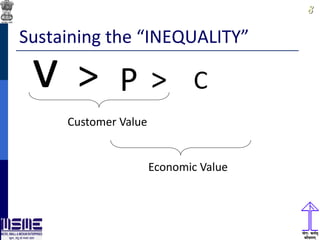
Sustaining the “INEQUALITY”
Customer Value
Economic Value
v > P > C
99
Lean Thinking
 Changing Cost Perspective
 Sustaining “Inequality”
 Lean Thinking - Alignment
1010
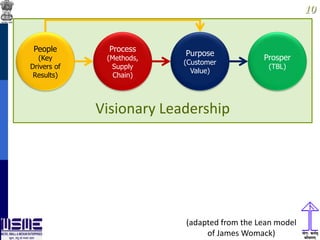
Visionary Leadership
Purpose
(Customer
Value)
Process
(Methods,
Supply
Chain)
People
(Key
Drivers of
Results)
Prosper
(TBL)
(adapted from the Lean model
of James Womack)
1111
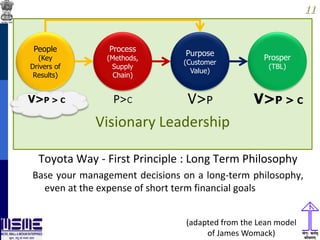
Visionary Leadership
Purpose
(Customer
Value)
Process
(Methods,
Supply
Chain)
People
(Key
Drivers of
Results)
Prosper
(TBL)
V>PP>C
(adapted from the Lean model
of James Womack)
V>P > CV>P > C
Toyota Way - First Principle : Long Term Philosophy
Base your management decisions on a long-term philosophy,
even at the expense of short term financial goals
1212
Agenda
 Lean Thinking - Alignment
 Integration with QMS
 Customer Value
 Process Alignment
 People Alignment
 Lean Leadership
1313
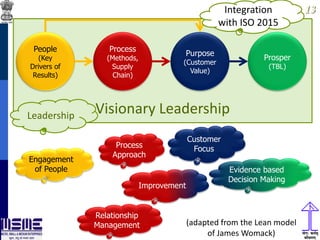
Visionary Leadership
Purpose
(Customer
Value)
Process
(Methods,
Supply
Chain)
People
(Key
Drivers of
Results)
Prosper
(TBL)
(adapted from the Lean model
of James Womack)
Customer
Focus
Leadership
Engagement
of People
Process
Approach
Improvement
Evidence based
Decision Making
Relationship
Management
Integration
with ISO 2015
1414
Agenda
 Lean Thinking - Alignment
 Integration with QMS
 Customer Value
 Process Alignment
 People Alignment
 Lean Leadership
1515
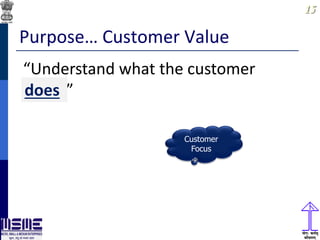
Purpose… Customer Value
“Understand what the customer
wants”does
Customer
Focus
1616
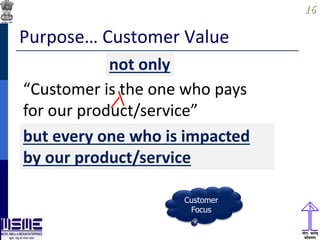
Purpose… Customer Value
“Customer is the one who pays
for our product/service”
not only
but every one who is impacted
by our product/service
Customer
Focus
17
7 Wastes
Customer
Focus
1818
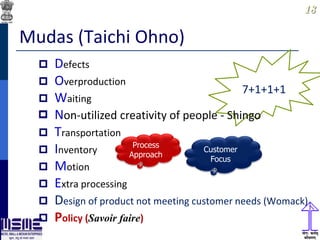
7+1+1+1
Non-utilized creativity of people - Shingo
Mudas (Taichi Ohno)
 Defects
 Overproduction
 Waiting

 Transportation
 Inventory
 Motion
 Extra processing
 Design of product not meeting customer needs (Womack)
 Policy (Savoir faire)
Customer
Focus
Process
Approach
1919
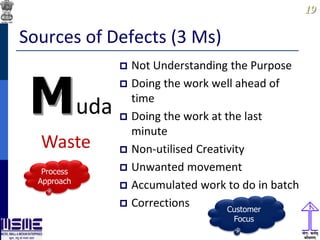
Sources of Defects (3 Ms)
 Not Understanding the Purpose
 Doing the work well ahead of
time
 Doing the work at the last
minute
 Non-utilised Creativity
 Unwanted movement
 Accumulated work to do in batch
 Corrections
uda
Waste
Process
Approach
Customer
Focus
2020
Agenda
 Lean Thinking - Alignment
 Integration with QMS
 Customer Value
 Process Alignment
 People Alignment
 Lean Leadership
2121
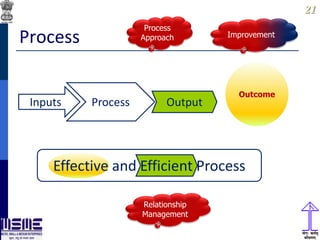
Process
ProcessInputs Output
Outcome
Effective and Efficient Process
Process
Approach Improvement
Relationship
Management
2222
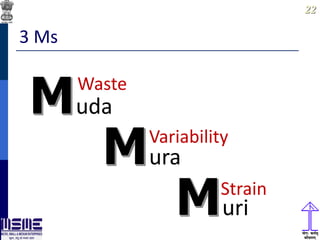
3 Ms
uda
ura
uri
Waste
Variability
Strain
2323
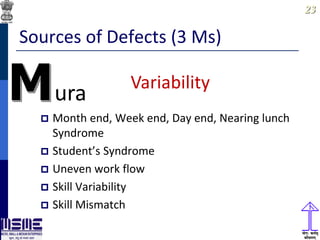
Sources of Defects (3 Ms)
 Month end, Week end, Day end, Nearing lunch
Syndrome
 Student’s Syndrome
 Uneven work flow
 Skill Variability
 Skill Mismatch
ura
Variability
2424
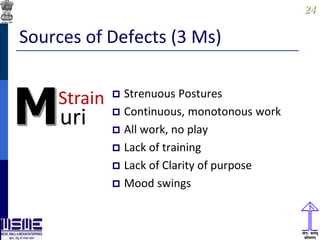
Sources of Defects (3 Ms)
 Strenuous Postures
 Continuous, monotonous work
 All work, no play
 Lack of training
 Lack of Clarity of purpose
 Mood swings
uri
Strain
25
Three eyes of Buddha
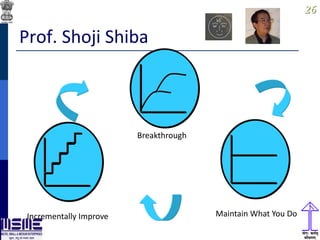
2626
Prof. Shoji Shiba
Maintain What You DoIncrementally Improve
Breakthrough
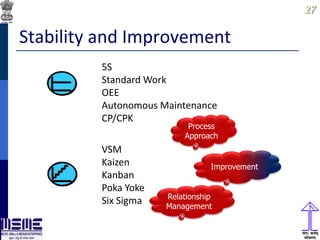
2727
Stability and Improvement
5S
Standard Work
OEE
Autonomous Maintenance
CP/CPK
VSM
Kaizen
Kanban
Poka Yoke
Six Sigma
Process
Approach
Improvement
Relationship
Management
2828
Agenda
 Lean Thinking - Alignment
 Integration with QMS
 Customer Value
 Process Alignment
 People Alignment
 Lean Leadership
2929
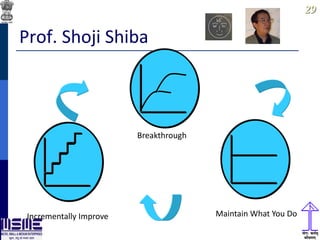
Prof. Shoji Shiba
Maintain What You DoIncrementally Improve
Breakthrough
3030
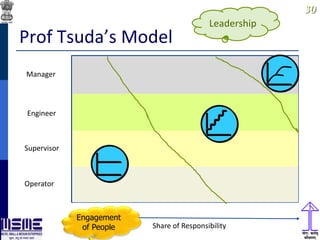
Prof Tsuda’s Model
Share of Responsibility
Operator
Supervisor
Engineer
Manager
Leadership
Engagement
of People
3131
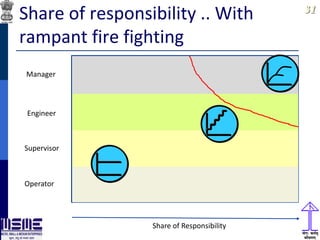
Share of responsibility .. With
rampant fire fighting
Share of Responsibility
Operator
Supervisor
Engineer
Manager
3232
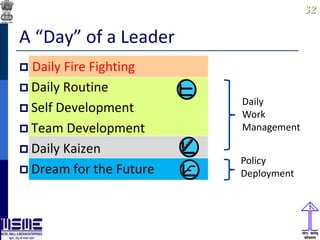
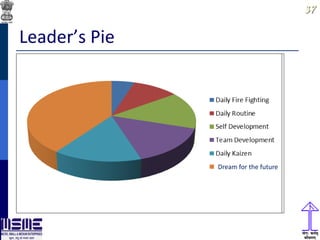
A “Day” of a Leader
 Daily Fire Fighting
 Daily Routine
 Self Development
 Team Development
 Daily Kaizen
 Dream for the Future
Daily Fire Fighting
Daily
Work
Management
Policy
Deployment
3333
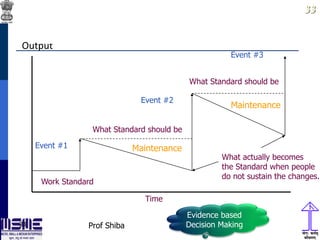
33
OutputThe Reality of Kaizen Events
Time
Event #1
Event #2
What Standard should be
What actually becomes
the Standard when people
do not sustain the changes.
Maintenance
Maintenance
Event #3
Work Standard
What Standard should be
Evidence based
Decision MakingProf Shiba
3434
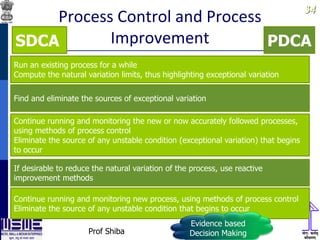
Process Control and Process
Improvement
Run an existing process for a while
Compute the natural variation limits, thus highlighting exceptional variation
Find and eliminate the sources of exceptional variation
Continue running and monitoring the new or now accurately followed processes,
using methods of process control
Eliminate the source of any unstable condition (exceptional variation) that begins
to occur
If desirable to reduce the natural variation of the process, use reactive
improvement methods
Continue running and monitoring new process, using methods of process control
Eliminate the source of any unstable condition that begins to occur
SDCA PDCA
Evidence based
Decision MakingProf Shiba
3535
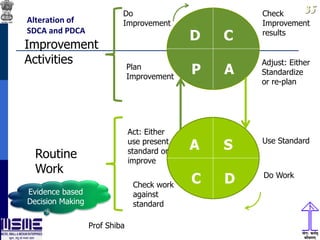
Alteration of
SDCA and PDCA
P
D C
A
C
A S
D
Use Standard
Do Work
Check work
against
standard
Act: Either
use present
standard or
improve
Routine
Work
Plan
Improvement
Do
Improvement
Check
Improvement
results
Adjust: Either
Standardize
or re-plan
Improvement
Activities
Evidence based
Decision Making
Prof Shiba
3636Building
Blocks of
DWM™
Standard Work
Visual
Manage-
ment
SDCA/
PDCA
Cycle
Daily
Kaizen
Defined Zonal Ownership
MP/CP Aligned with KPIs
Communication
KPIs Aligned with Policy Deployment
DWM aligned to
Customer Value
[ Control ] [ Improvement ]
Evidence based
Decision Making
Customer
Focus
Leadership Engagement
of People
Process
Approach
Improvement
Relationship
Management
3737
Leader’s Pie
Dream for the future
3838
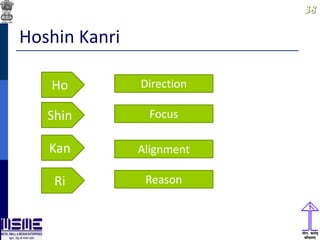
Hoshin Kanri
Ho
Shin
Kan
Ri
Direction
Focus
Alignment
Reason
3939
Hoshin Kanri
 Hoshin Kanri is the first attempt at business
break thru’ rather than process break thru’
 Deals systematically with process
improvement across company to produce
desired business results
 MBO was not connected to processes
4040
Hoshin Kanri for Alignment
 Aims to align all towards key company goals
 Using indirect enforcement
 Creating a sense of urgency
 Even hourly employees are influenced to choose activities with
strategically important objectives
 Aims to align all jobs and tasks, (routine and improvement)
focusing and coordinating efforts and resources to key
company goals in order to create breakthroughs
 Aims to bring company’s goals and activities quickly and
effectively into alignment with rapid societal and
environmental changes
4141
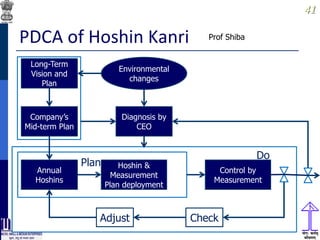
Plan
Plan
PDCA of Hoshin Kanri
Long-Term
Vision and
Plan
Company’s
Mid-term Plan
Environmental
changes
Diagnosis by
CEO
Annual
Hoshins
Hoshin &
Measurement
Plan deployment
Control by
Measurement
Do
CheckAdjust
Prof Shiba
4242
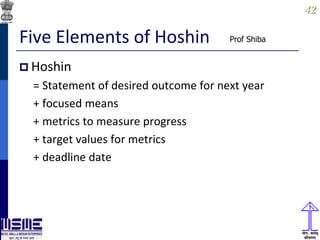
Five Elements of Hoshin
 Hoshin
= Statement of desired outcome for next year
+ focused means
+ metrics to measure progress
+ target values for metrics
+ deadline date
Prof Shiba
4343
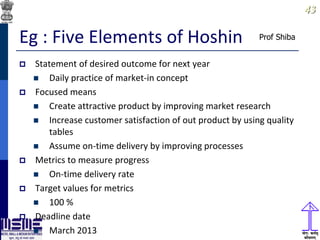
Eg : Five Elements of Hoshin
 Statement of desired outcome for next year
 Daily practice of market-in concept
 Focused means
 Create attractive product by improving market research
 Increase customer satisfaction of out product by using quality
tables
 Assume on-time delivery by improving processes
 Metrics to measure progress
 On-time delivery rate
 Target values for metrics
 100 %
 Deadline date
 March 2013
Prof Shiba
4444
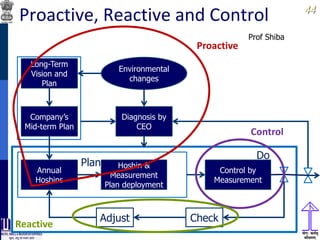
Plan
Plan
Proactive, Reactive and Control
Long-Term
Vision and
Plan
Company’s
Mid-term Plan
Environmental
changes
Diagnosis by
CEO
Annual
Hoshins
Hoshin &
Measurement
Plan deployment
Control by
Measurement
Do
CheckAdjust
Proactive
Reactive
Control
Prof Shiba
4545
Agenda
 Lean Thinking - Alignment
 Integration with QMS
 Customer Value
 Process Alignment
 People Alignment
 Lean Leadership
4646
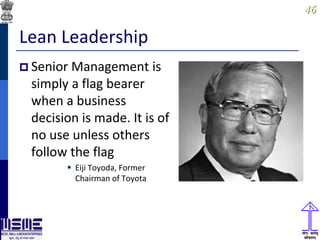
Lean Leadership
 Senior Management is
simply a flag bearer
when a business
decision is made. It is of
no use unless others
follow the flag
 Eiji Toyoda, Former
Chairman of Toyota
4747
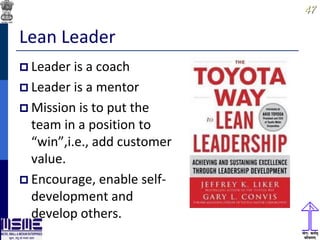
Lean Leader
 Leader is a coach
 Leader is a mentor
 Mission is to put the
team in a position to
“win”,i.e., add customer
value.
 Encourage, enable self-
development and
develop others.
48
Thank you
M Hariharan
hari@sfalignment.com

Lean Thinking and Daily Work Management

  • 1.
    1 Lean Thinking ThruDaily Work Management M Hariharan Director Savoir faire Management Services Pvt Ltd Two days Workshop on QUALITY MANAGEMENT STANDARDS & QUALITY TECHNOLOGY TOOLS (QMS/QTT) Dt. : 11 December 2015 Venue : MCCIA Pune
  • 2.
    22 Agenda  Lean Thinking- Alignment  Integration with QMS  Customer Value  Process Alignment  People Alignment  Lean Leadership
  • 3.
    33 Agenda  Lean Thinking- Alignment  Integration with QMS  Customer Value  Process Alignment  People Alignment  Lean Leadership
  • 4.
    44 Lean Thinking  ChangingCost Perspective  Sustaining “Inequality”  Lean Thinking - Alignment
  • 5.
    55 Lean Thinking  ChangingCost Perspective  Sustaining “Inequality”  Lean Thinking - Alignment
  • 6.
    66 Changing Perspective ofCost C + P = S Blessing of Customer – Cost Reimbursement Model S - C = p Curse of Competition and Inefficiency S - P = C Customer Value Creation and Economic Value Creation Allowable Cost
  • 7.
    77 Lean Thinking  ChangingCost Perspective  Sustaining “Inequality”  Lean Thinking - Alignment
  • 8.
    88 Sustaining the “INEQUALITY” CustomerValue Economic Value v > P > C
  • 9.
    99 Lean Thinking  ChangingCost Perspective  Sustaining “Inequality”  Lean Thinking - Alignment
  • 10.
  • 11.
    1111 Visionary Leadership Purpose (Customer Value) Process (Methods, Supply Chain) People (Key Drivers of Results) Prosper (TBL) V>PP>C (adaptedfrom the Lean model of James Womack) V>P > CV>P > C Toyota Way - First Principle : Long Term Philosophy Base your management decisions on a long-term philosophy, even at the expense of short term financial goals
  • 12.
    1212 Agenda  Lean Thinking- Alignment  Integration with QMS  Customer Value  Process Alignment  People Alignment  Lean Leadership
  • 13.
    1313 Visionary Leadership Purpose (Customer Value) Process (Methods, Supply Chain) People (Key Drivers of Results) Prosper (TBL) (adaptedfrom the Lean model of James Womack) Customer Focus Leadership Engagement of People Process Approach Improvement Evidence based Decision Making Relationship Management Integration with ISO 2015
  • 14.
    1414 Agenda  Lean Thinking- Alignment  Integration with QMS  Customer Value  Process Alignment  People Alignment  Lean Leadership
  • 15.
    1515 Purpose… Customer Value “Understandwhat the customer wants”does Customer Focus
  • 16.
    1616 Purpose… Customer Value “Customeris the one who pays for our product/service” not only but every one who is impacted by our product/service Customer Focus
  • 17.
  • 18.
    1818 7+1+1+1 Non-utilized creativity ofpeople - Shingo Mudas (Taichi Ohno)  Defects  Overproduction  Waiting   Transportation  Inventory  Motion  Extra processing  Design of product not meeting customer needs (Womack)  Policy (Savoir faire) Customer Focus Process Approach
  • 19.
    1919 Sources of Defects(3 Ms)  Not Understanding the Purpose  Doing the work well ahead of time  Doing the work at the last minute  Non-utilised Creativity  Unwanted movement  Accumulated work to do in batch  Corrections uda Waste Process Approach Customer Focus
  • 20.
    2020 Agenda  Lean Thinking- Alignment  Integration with QMS  Customer Value  Process Alignment  People Alignment  Lean Leadership
  • 21.
    2121 Process ProcessInputs Output Outcome Effective andEfficient Process Process Approach Improvement Relationship Management
  • 22.
  • 23.
    2323 Sources of Defects(3 Ms)  Month end, Week end, Day end, Nearing lunch Syndrome  Student’s Syndrome  Uneven work flow  Skill Variability  Skill Mismatch ura Variability
  • 24.
    2424 Sources of Defects(3 Ms)  Strenuous Postures  Continuous, monotonous work  All work, no play  Lack of training  Lack of Clarity of purpose  Mood swings uri Strain
  • 25.
  • 26.
    2626 Prof. Shoji Shiba MaintainWhat You DoIncrementally Improve Breakthrough
  • 27.
    2727 Stability and Improvement 5S StandardWork OEE Autonomous Maintenance CP/CPK VSM Kaizen Kanban Poka Yoke Six Sigma Process Approach Improvement Relationship Management
  • 28.
    2828 Agenda  Lean Thinking- Alignment  Integration with QMS  Customer Value  Process Alignment  People Alignment  Lean Leadership
  • 29.
    2929 Prof. Shoji Shiba MaintainWhat You DoIncrementally Improve Breakthrough
  • 30.
    3030 Prof Tsuda’s Model Shareof Responsibility Operator Supervisor Engineer Manager Leadership Engagement of People
  • 31.
    3131 Share of responsibility.. With rampant fire fighting Share of Responsibility Operator Supervisor Engineer Manager
  • 32.
    3232 A “Day” ofa Leader  Daily Fire Fighting  Daily Routine  Self Development  Team Development  Daily Kaizen  Dream for the Future Daily Fire Fighting Daily Work Management Policy Deployment
  • 33.
    3333 33 OutputThe Reality ofKaizen Events Time Event #1 Event #2 What Standard should be What actually becomes the Standard when people do not sustain the changes. Maintenance Maintenance Event #3 Work Standard What Standard should be Evidence based Decision MakingProf Shiba
  • 34.
    3434 Process Control andProcess Improvement Run an existing process for a while Compute the natural variation limits, thus highlighting exceptional variation Find and eliminate the sources of exceptional variation Continue running and monitoring the new or now accurately followed processes, using methods of process control Eliminate the source of any unstable condition (exceptional variation) that begins to occur If desirable to reduce the natural variation of the process, use reactive improvement methods Continue running and monitoring new process, using methods of process control Eliminate the source of any unstable condition that begins to occur SDCA PDCA Evidence based Decision MakingProf Shiba
  • 35.
    3535 Alteration of SDCA andPDCA P D C A C A S D Use Standard Do Work Check work against standard Act: Either use present standard or improve Routine Work Plan Improvement Do Improvement Check Improvement results Adjust: Either Standardize or re-plan Improvement Activities Evidence based Decision Making Prof Shiba
  • 36.
    3636Building Blocks of DWM™ Standard Work Visual Manage- ment SDCA/ PDCA Cycle Daily Kaizen DefinedZonal Ownership MP/CP Aligned with KPIs Communication KPIs Aligned with Policy Deployment DWM aligned to Customer Value [ Control ] [ Improvement ] Evidence based Decision Making Customer Focus Leadership Engagement of People Process Approach Improvement Relationship Management
  • 37.
  • 38.
  • 39.
    3939 Hoshin Kanri  HoshinKanri is the first attempt at business break thru’ rather than process break thru’  Deals systematically with process improvement across company to produce desired business results  MBO was not connected to processes
  • 40.
    4040 Hoshin Kanri forAlignment  Aims to align all towards key company goals  Using indirect enforcement  Creating a sense of urgency  Even hourly employees are influenced to choose activities with strategically important objectives  Aims to align all jobs and tasks, (routine and improvement) focusing and coordinating efforts and resources to key company goals in order to create breakthroughs  Aims to bring company’s goals and activities quickly and effectively into alignment with rapid societal and environmental changes
  • 41.
    4141 Plan Plan PDCA of HoshinKanri Long-Term Vision and Plan Company’s Mid-term Plan Environmental changes Diagnosis by CEO Annual Hoshins Hoshin & Measurement Plan deployment Control by Measurement Do CheckAdjust Prof Shiba
  • 42.
    4242 Five Elements ofHoshin  Hoshin = Statement of desired outcome for next year + focused means + metrics to measure progress + target values for metrics + deadline date Prof Shiba
  • 43.
    4343 Eg : FiveElements of Hoshin  Statement of desired outcome for next year  Daily practice of market-in concept  Focused means  Create attractive product by improving market research  Increase customer satisfaction of out product by using quality tables  Assume on-time delivery by improving processes  Metrics to measure progress  On-time delivery rate  Target values for metrics  100 %  Deadline date  March 2013 Prof Shiba
  • 44.
    4444 Plan Plan Proactive, Reactive andControl Long-Term Vision and Plan Company’s Mid-term Plan Environmental changes Diagnosis by CEO Annual Hoshins Hoshin & Measurement Plan deployment Control by Measurement Do CheckAdjust Proactive Reactive Control Prof Shiba
  • 45.
    4545 Agenda  Lean Thinking- Alignment  Integration with QMS  Customer Value  Process Alignment  People Alignment  Lean Leadership
  • 46.
    4646 Lean Leadership  SeniorManagement is simply a flag bearer when a business decision is made. It is of no use unless others follow the flag  Eiji Toyoda, Former Chairman of Toyota
  • 47.
    4747 Lean Leader  Leaderis a coach  Leader is a mentor  Mission is to put the team in a position to “win”,i.e., add customer value.  Encourage, enable self- development and develop others.
  • 48.