BTM509 Digital Data Communication Systems
KOCAELI UNIVERSITY
Graduate School of
Natural and Applied Sciences
Prepared By: Mohammed ABUIBAID
Email: m.a.abuibaid@gmail.com
Submitted to: Dr. Halil YİĞİT
Electronic and Communication Engineering
Carrier Sense Multiple Access
AcademicYear
2015/2016
Presentation Outline
1. Introduction to CSMA
2. CSMA access modes
3. CSMA Protocol Modifications
4. MATLAB code of CSMA/CD
Introduction video
CSMA Access Modes
- 1-Persistent
- Non-Persistent
- P-Persistent
- O-Persistent
CSMA Protocol Modifications
- CSMA with collision detection
- CSMA with collision avoidance
- Virtual time CSMA
CSMA/CD & CSMA/CA made simple – Youtube
CSMA access modes
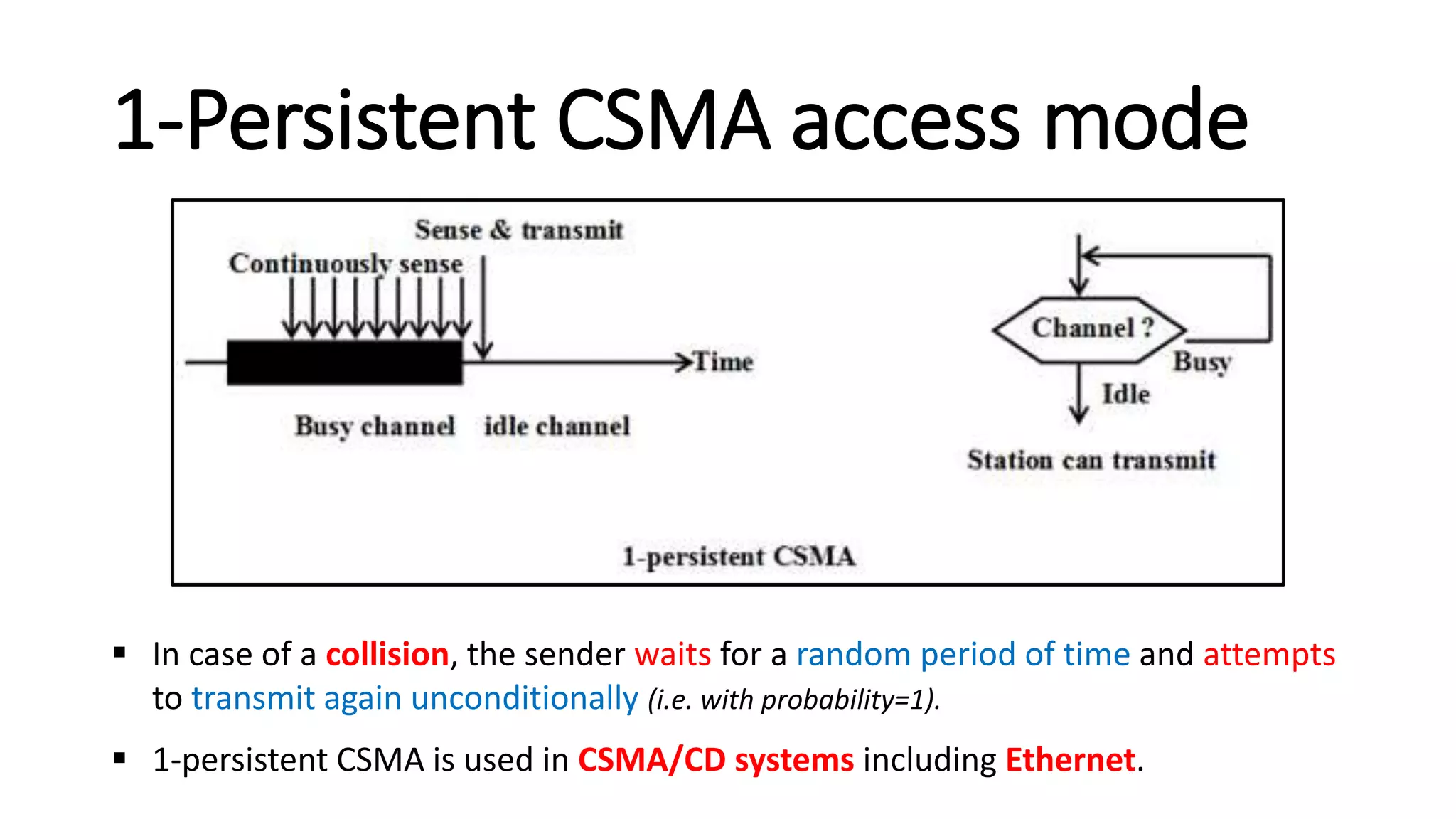
 1-Persistent : an aggressive transmission algorithm
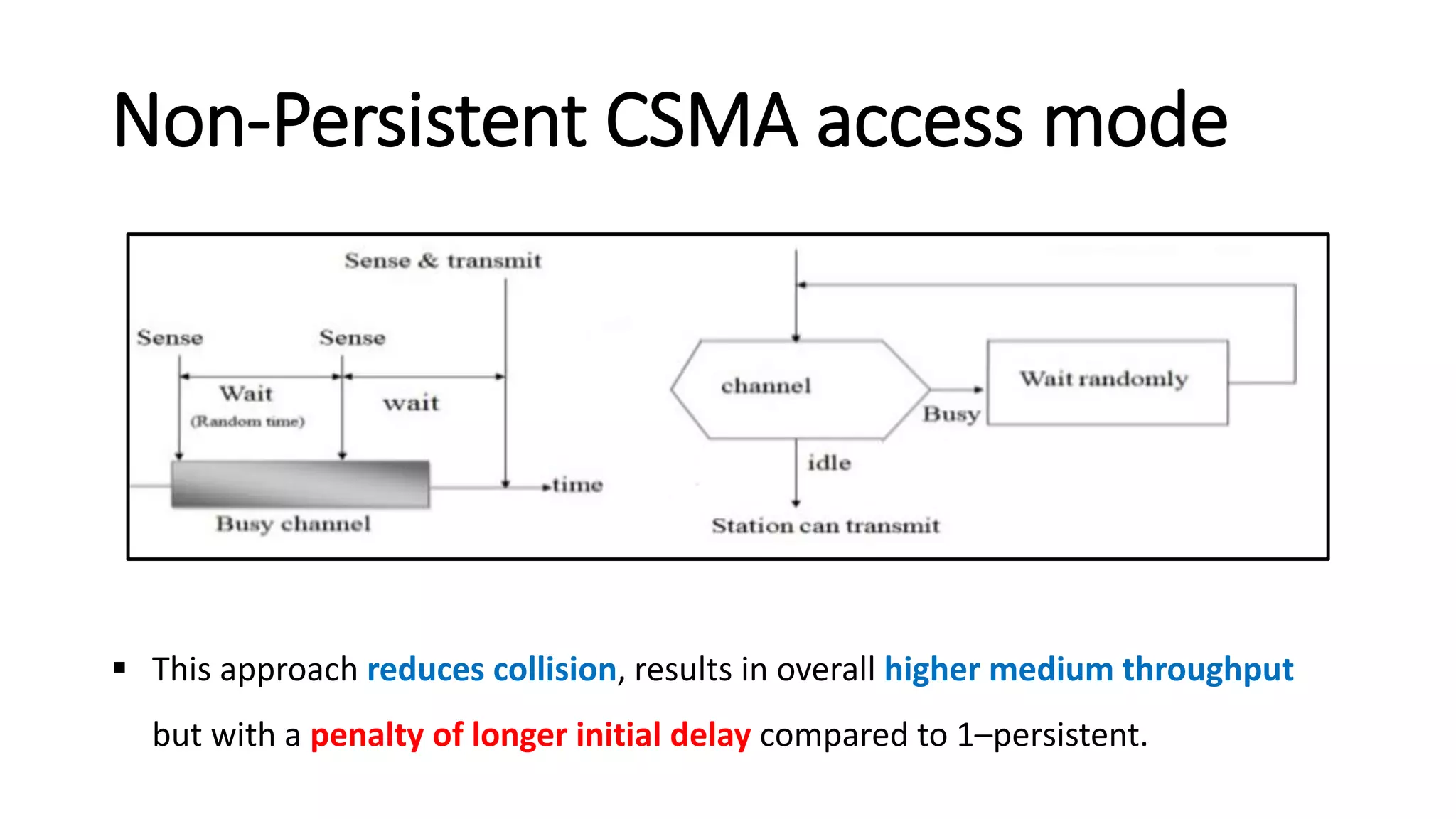
 Non-Persistent : a non aggressive transmission algorithm
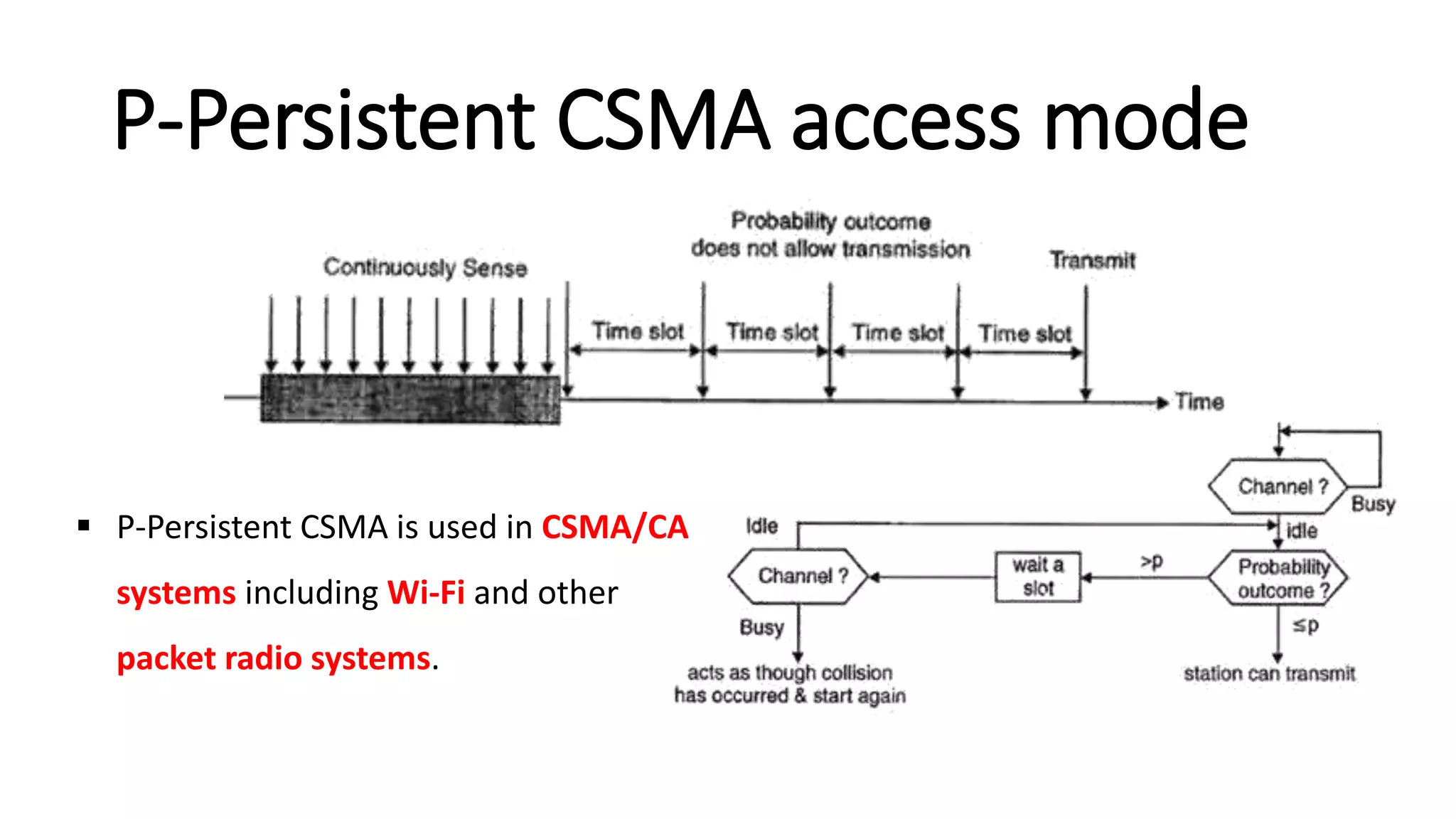
 P-Persistent : an approach between 1-persistent and non-persistent
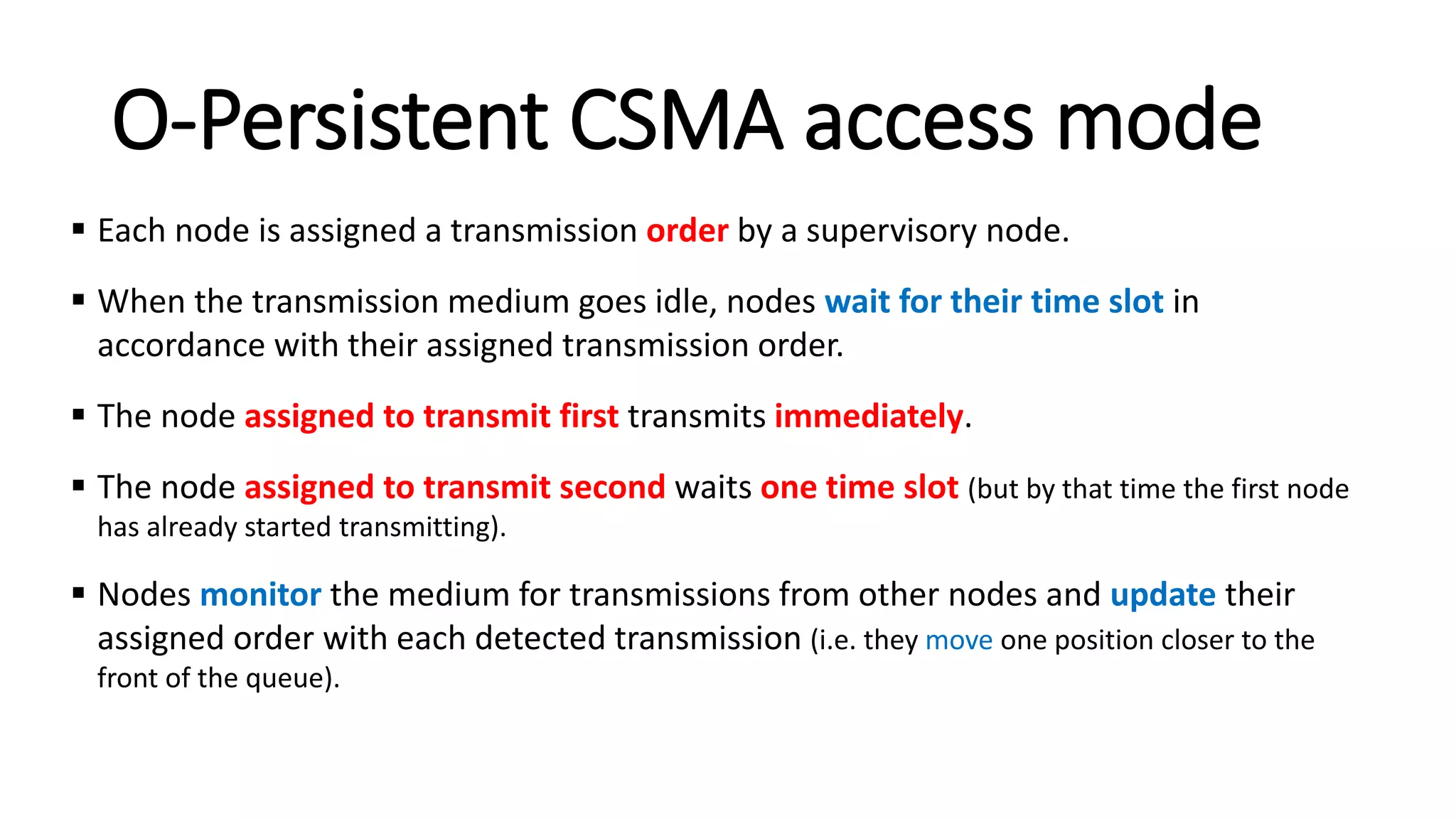
 O-Persistent: Each node is assigned a transmission order by a supervisory node
1-Persistent CSMA access mode
 In case of a collision, the sender waits for a random period of time and attempts
to transmit again unconditionally (i.e. with probability=1).
 1-persistent CSMA is used in CSMA/CD systems including Ethernet.
Non-Persistent CSMA access mode
 This approach reduces collision, results in overall higher medium throughput
but with a penalty of longer initial delay compared to 1–persistent.
P-Persistent CSMA access mode
 P-Persistent CSMA is used in CSMA/CA
systems including Wi-Fi and other
packet radio systems.
 Each node is assigned a transmission order by a supervisory node.
 When the transmission medium goes idle, nodes wait for their time slot in
accordance with their assigned transmission order.
 The node assigned to transmit first transmits immediately.
 The node assigned to transmit second waits one time slot (but by that time the first node
has already started transmitting).
 Nodes monitor the medium for transmissions from other nodes and update their
assigned order with each detected transmission (i.e. they move one position closer to the
front of the queue).
O-Persistent CSMA access mode
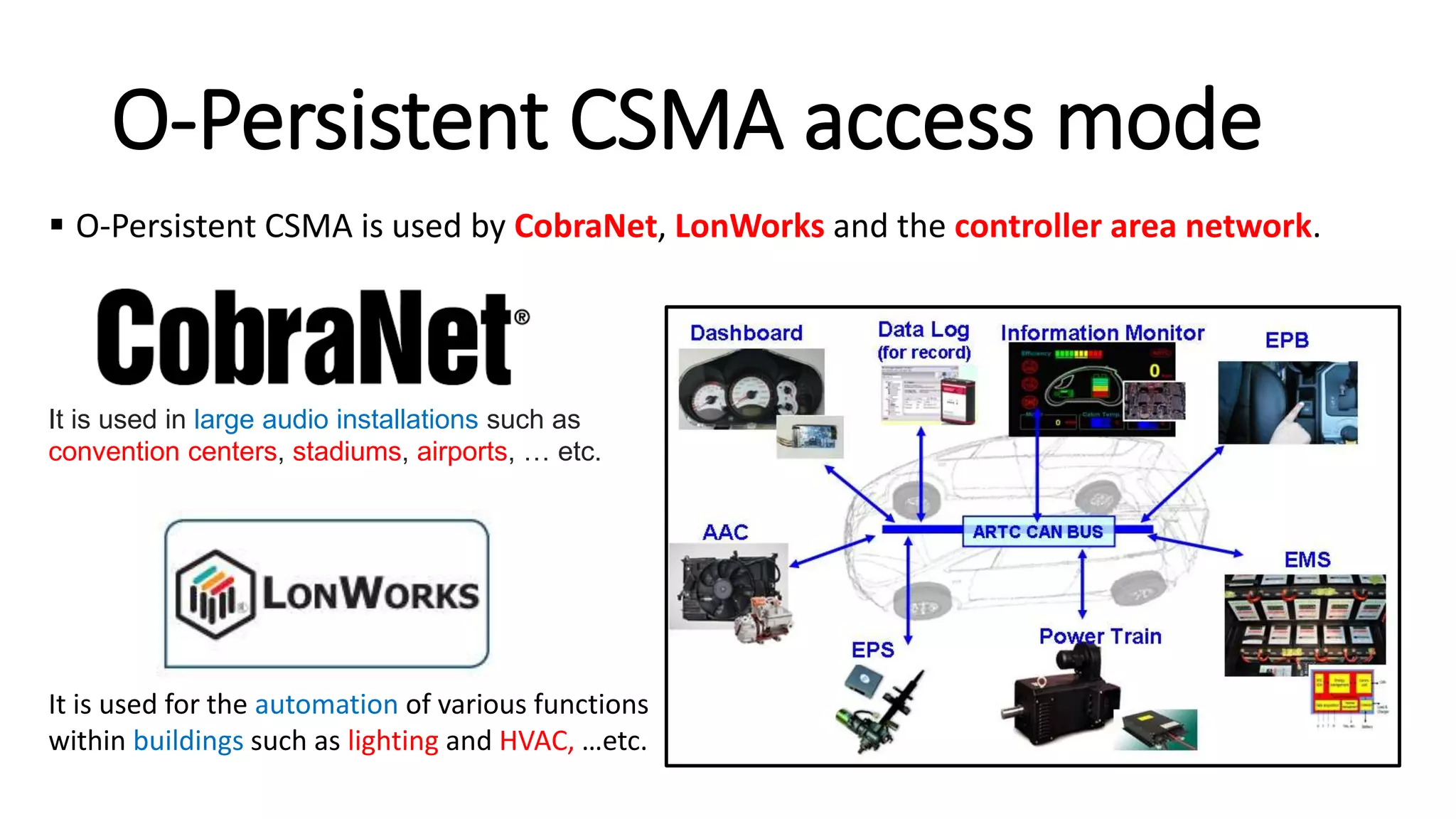
 O-Persistent CSMA is used by CobraNet, LonWorks and the controller area network.
It is used for the automation of various functions
within buildings such as lighting and HVAC, …etc.
It is used in large audio installations such as
convention centers, stadiums, airports, … etc.
CSMA Protocol Modifications:
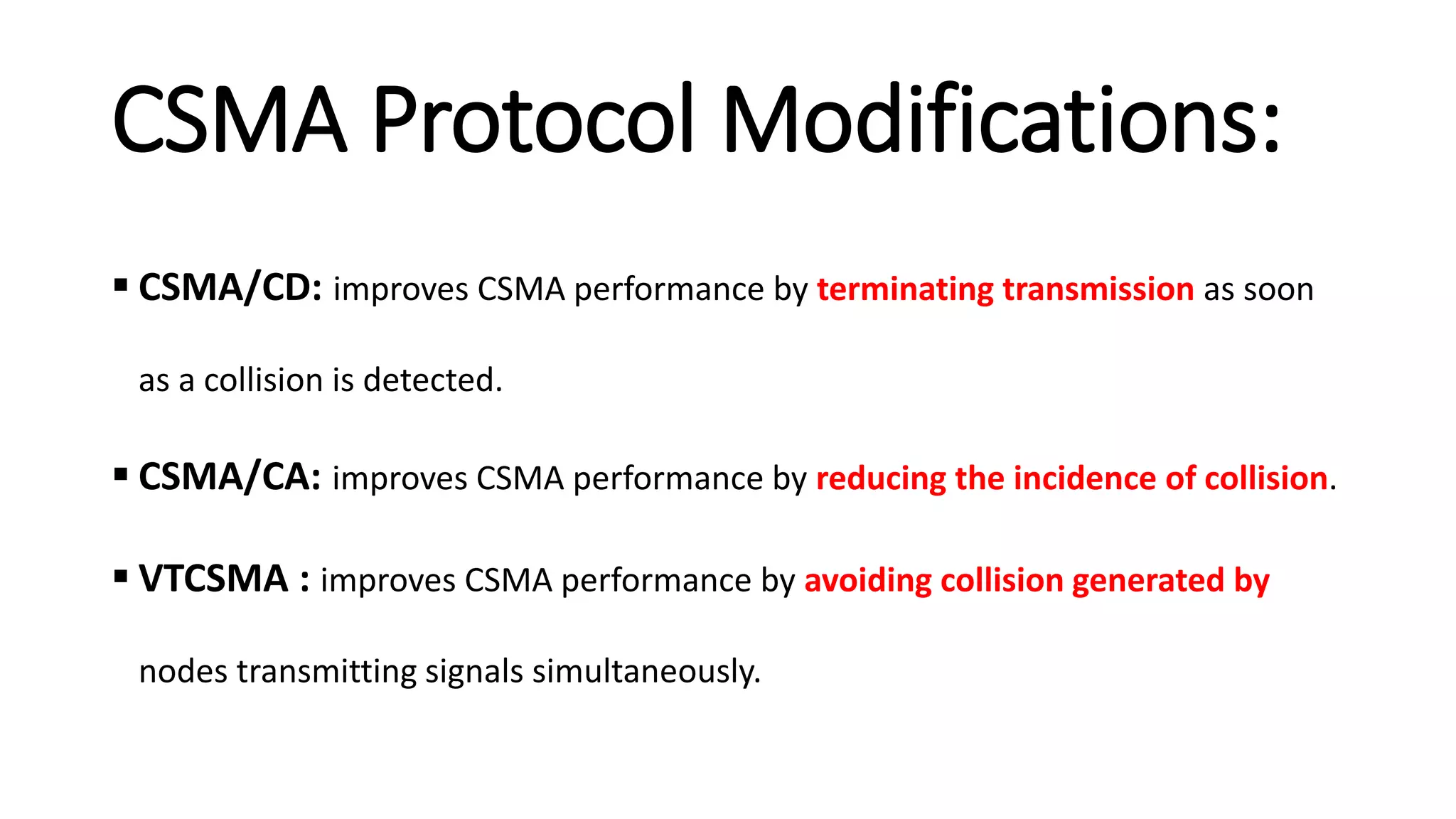
 CSMA/CD: improves CSMA performance by terminating transmission as soon
as a collision is detected.
 CSMA/CA: improves CSMA performance by reducing the incidence of collision.
 VTCSMA : improves CSMA performance by avoiding collision generated by
nodes transmitting signals simultaneously.
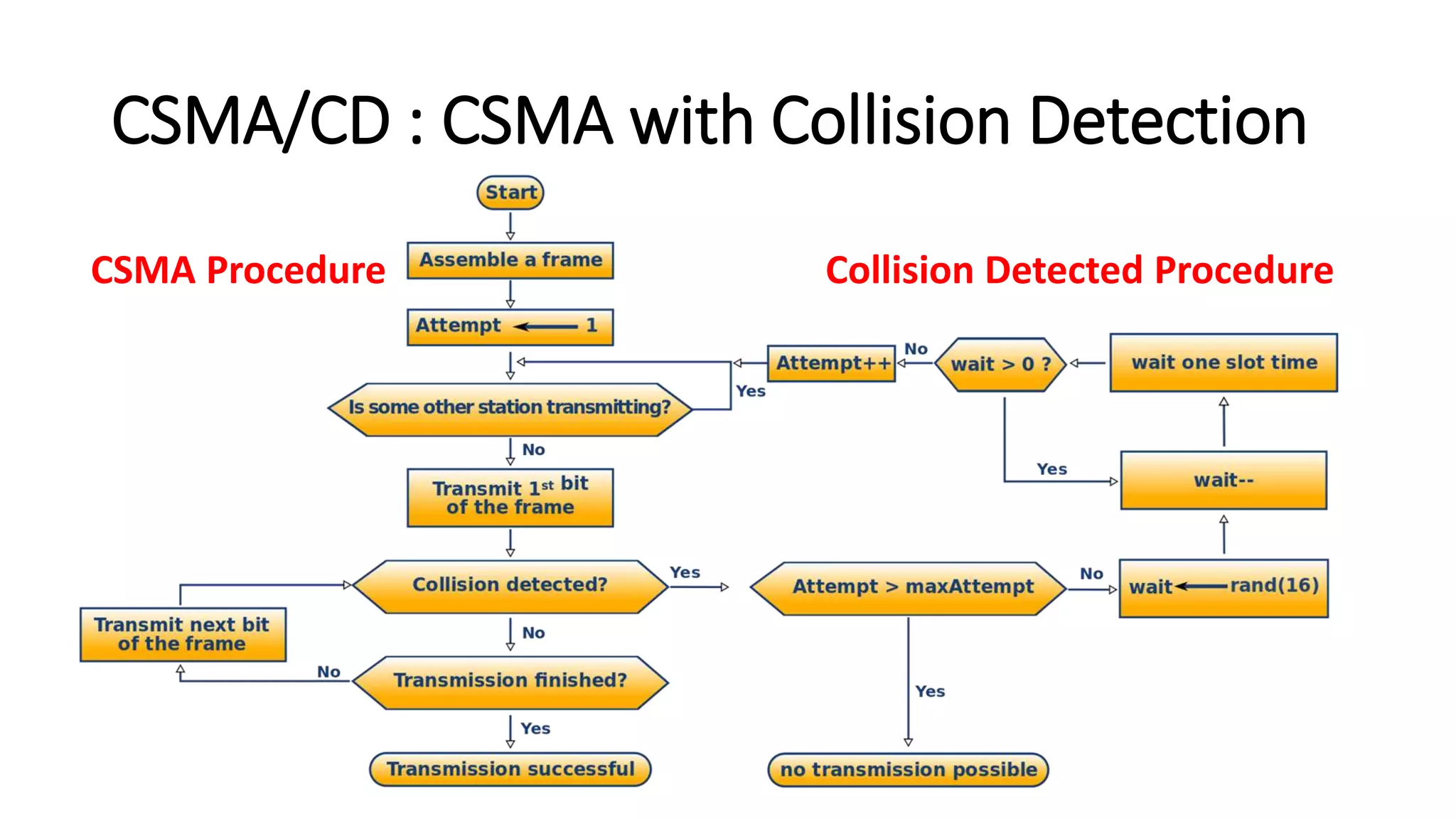
CSMA/CD : CSMA with Collision Detection
CSMA Procedure Collision Detected Procedure
CSMA/CD Applications
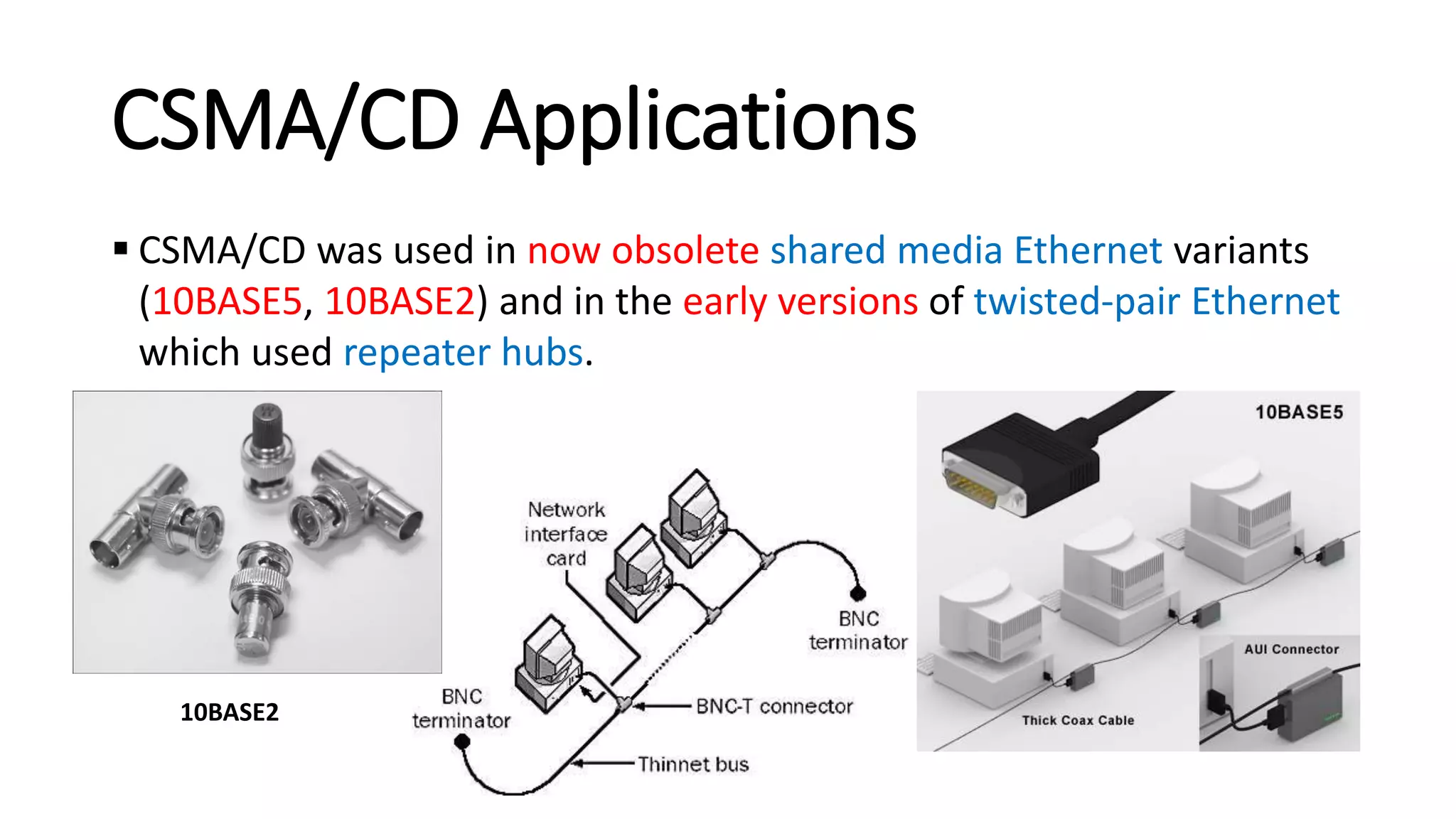
 CSMA/CD was used in now obsolete shared media Ethernet variants
(10BASE5, 10BASE2) and in the early versions of twisted-pair Ethernet
which used repeater hubs.
10BASE2
CSMA/CD Applications
 Modern Ethernet networks, built with switches and full-duplex
connections, no longer need to utilize CSMA/CD because each collision
domain is now isolated.
 CSMA/CD is still supported for
backwards compatibility and for
half-duplex connections.
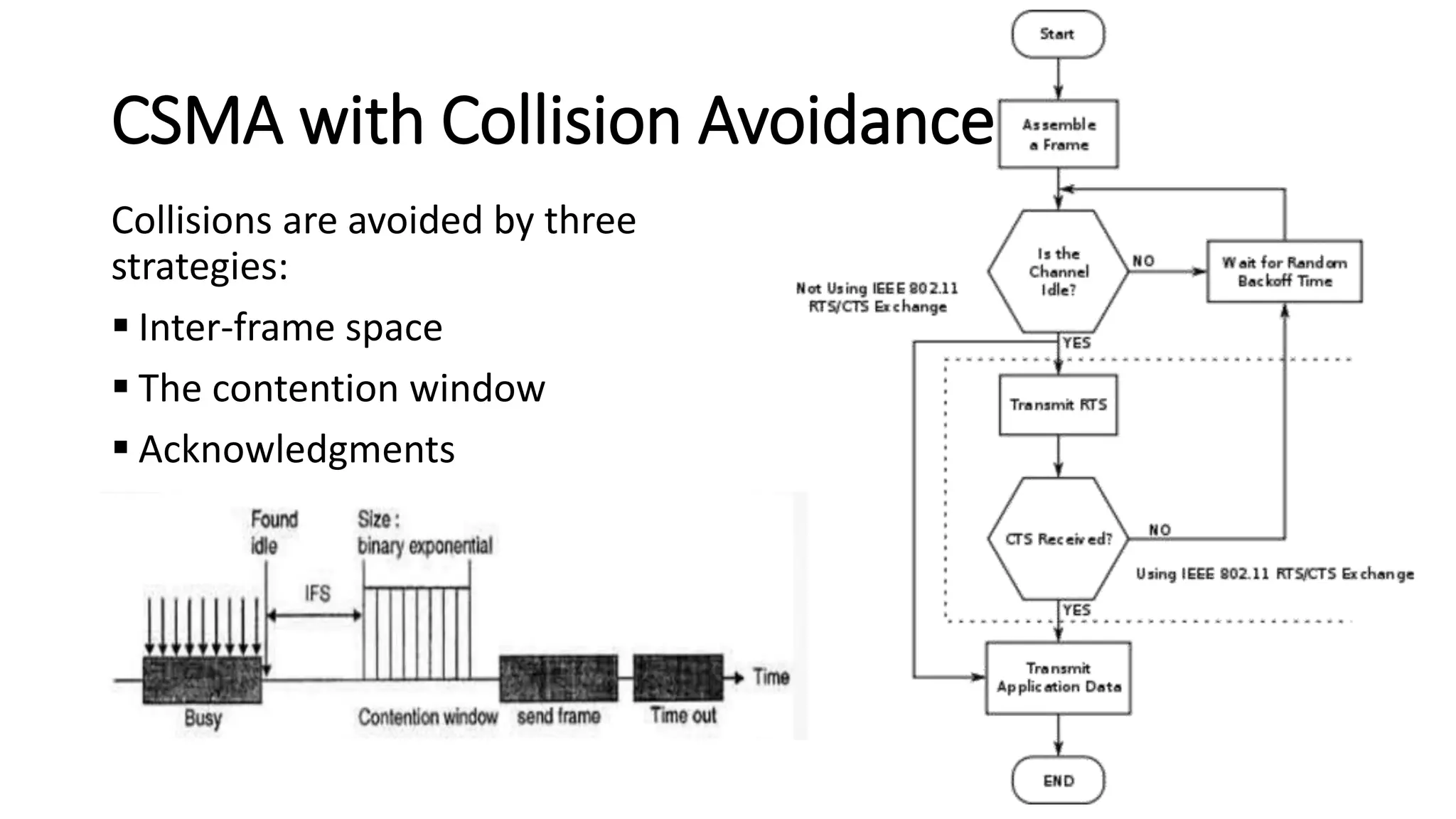
CSMA with Collision Avoidance
Collisions are avoided by three
strategies:
 Inter-frame space
 The contention window
 Acknowledgments
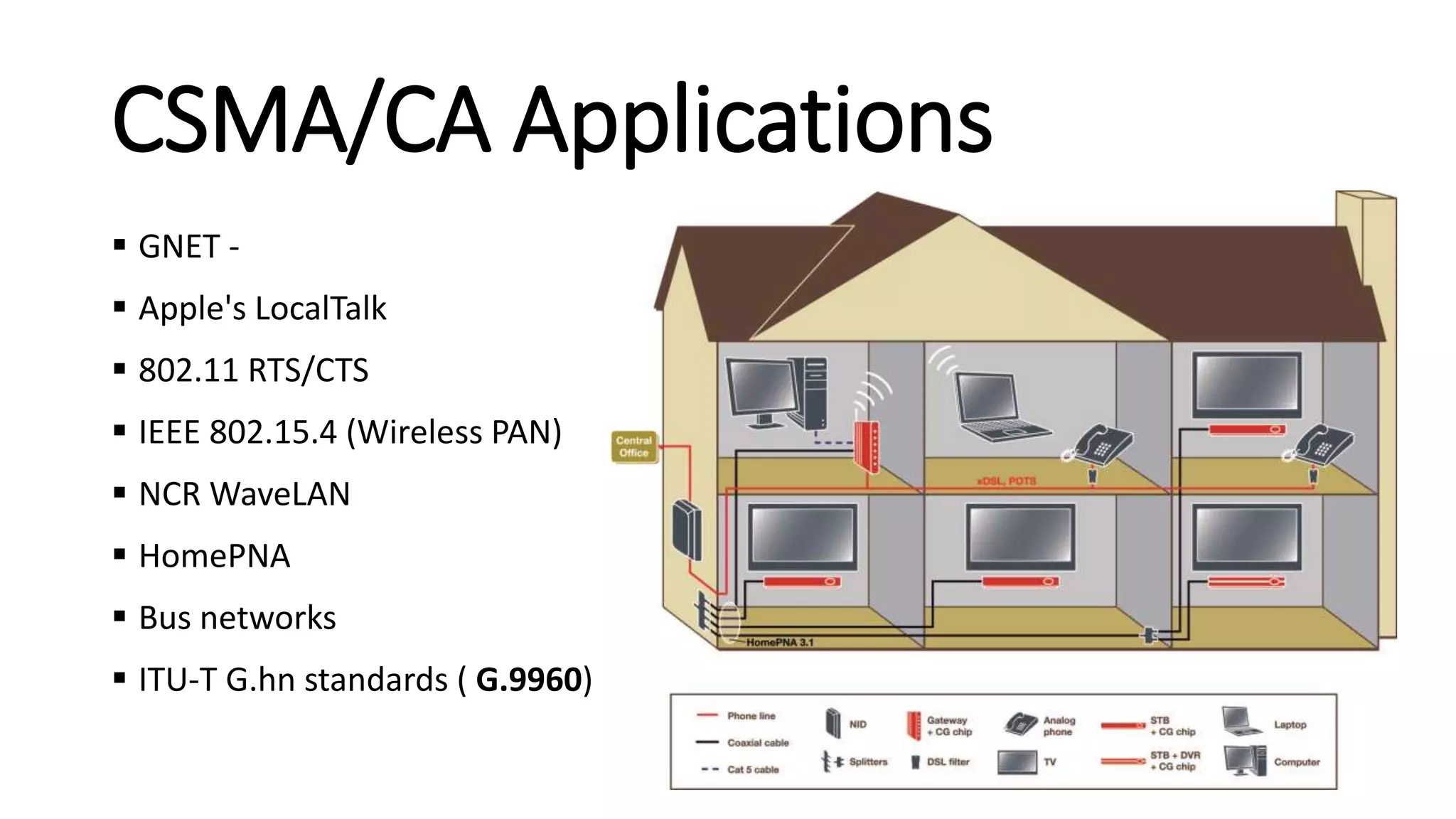
CSMA/CA Applications
 GNET -
 Apple's LocalTalk
 802.11 RTS/CTS
 IEEE 802.15.4 (Wireless PAN)
 NCR WaveLAN
 HomePNA
 Bus networks
 ITU-T G.hn standards ( G.9960)
VTCSMA : Virtual time CSMA
 Designed to avoid collision generated by nodes transmitting signals simultaneously.
 It used mostly in hard real-time systems (such as mission-critical applications)
 It uses two clocks at every node, a virtual clock VC and a real clock RC which tells "real time".
 When the transmission medium is sensed to be busy, the VC freezes.
 When the transmission medium is free, VC is reset.
 Calculating VC runs faster than RC when channel is free
 VC is not initiated when the transmission medium is busy.
MATLAB Code
Mohammed Abuibaid
Live & Breathe Wireless

Carrier Sense Multiple Access (CSMA)

  • 1.
    BTM509 Digital DataCommunication Systems KOCAELI UNIVERSITY Graduate School of Natural and Applied Sciences Prepared By: Mohammed ABUIBAID Email: m.a.abuibaid@gmail.com Submitted to: Dr. Halil YİĞİT Electronic and Communication Engineering Carrier Sense Multiple Access AcademicYear 2015/2016
  • 2.
    Presentation Outline 1. Introductionto CSMA 2. CSMA access modes 3. CSMA Protocol Modifications 4. MATLAB code of CSMA/CD
  • 3.
    Introduction video CSMA AccessModes - 1-Persistent - Non-Persistent - P-Persistent - O-Persistent CSMA Protocol Modifications - CSMA with collision detection - CSMA with collision avoidance - Virtual time CSMA CSMA/CD & CSMA/CA made simple – Youtube
  • 4.
    CSMA access modes 1-Persistent : an aggressive transmission algorithm  Non-Persistent : a non aggressive transmission algorithm  P-Persistent : an approach between 1-persistent and non-persistent  O-Persistent: Each node is assigned a transmission order by a supervisory node
  • 5.
    1-Persistent CSMA accessmode  In case of a collision, the sender waits for a random period of time and attempts to transmit again unconditionally (i.e. with probability=1).  1-persistent CSMA is used in CSMA/CD systems including Ethernet.
  • 6.
    Non-Persistent CSMA accessmode  This approach reduces collision, results in overall higher medium throughput but with a penalty of longer initial delay compared to 1–persistent.
  • 7.
    P-Persistent CSMA accessmode  P-Persistent CSMA is used in CSMA/CA systems including Wi-Fi and other packet radio systems.
  • 8.
     Each nodeis assigned a transmission order by a supervisory node.  When the transmission medium goes idle, nodes wait for their time slot in accordance with their assigned transmission order.  The node assigned to transmit first transmits immediately.  The node assigned to transmit second waits one time slot (but by that time the first node has already started transmitting).  Nodes monitor the medium for transmissions from other nodes and update their assigned order with each detected transmission (i.e. they move one position closer to the front of the queue). O-Persistent CSMA access mode
  • 9.
    O-Persistent CSMA accessmode  O-Persistent CSMA is used by CobraNet, LonWorks and the controller area network. It is used for the automation of various functions within buildings such as lighting and HVAC, …etc. It is used in large audio installations such as convention centers, stadiums, airports, … etc.
  • 10.
    CSMA Protocol Modifications: CSMA/CD: improves CSMA performance by terminating transmission as soon as a collision is detected.  CSMA/CA: improves CSMA performance by reducing the incidence of collision.  VTCSMA : improves CSMA performance by avoiding collision generated by nodes transmitting signals simultaneously.
  • 11.
    CSMA/CD : CSMAwith Collision Detection CSMA Procedure Collision Detected Procedure
  • 12.
    CSMA/CD Applications  CSMA/CDwas used in now obsolete shared media Ethernet variants (10BASE5, 10BASE2) and in the early versions of twisted-pair Ethernet which used repeater hubs. 10BASE2
  • 13.
    CSMA/CD Applications  ModernEthernet networks, built with switches and full-duplex connections, no longer need to utilize CSMA/CD because each collision domain is now isolated.  CSMA/CD is still supported for backwards compatibility and for half-duplex connections.
  • 14.
    CSMA with CollisionAvoidance Collisions are avoided by three strategies:  Inter-frame space  The contention window  Acknowledgments
  • 15.
    CSMA/CA Applications  GNET-  Apple's LocalTalk  802.11 RTS/CTS  IEEE 802.15.4 (Wireless PAN)  NCR WaveLAN  HomePNA  Bus networks  ITU-T G.hn standards ( G.9960)
  • 16.
    VTCSMA : Virtualtime CSMA  Designed to avoid collision generated by nodes transmitting signals simultaneously.  It used mostly in hard real-time systems (such as mission-critical applications)  It uses two clocks at every node, a virtual clock VC and a real clock RC which tells "real time".  When the transmission medium is sensed to be busy, the VC freezes.  When the transmission medium is free, VC is reset.  Calculating VC runs faster than RC when channel is free  VC is not initiated when the transmission medium is busy.
  • 17.
  • 18.
    Mohammed Abuibaid Live &Breathe Wireless

Editor's Notes

  • #6 1-persistent CSMA is an aggressive transmission algorithm. When the transmitting node is ready to transmit, it senses the transmission medium for idle or busy. If idle, then it transmits immediately. If busy, then it senses the transmission medium continuously until it becomes idle, then transmits the message (a frame) unconditionally (i.e. with probability=1).
  • #7 Non persistent CSMA is a non aggressive transmission algorithm. When the transmitting node is ready to transmit data, it senses the transmission medium for idle or busy. If idle, then it transmits immediately. If busy, then it waits for a random period of time (during which it does not sense the transmission medium) before repeating the whole logic cycle (which started with sensing the transmission medium for idle or busy) again.
  • #8 This is an approach between 1-persistent and non-persistent CSMA access modes. When the transmitting node is ready to transmit data, it senses the transmission medium for idle or busy. If idle, then it transmits immediately. If busy, then it senses the transmission medium continuously until it becomes idle, then transmits a frame with probability p. If the node does not transmit (the probability of this event is 1-p), it waits until the next available time slot. If the transmission medium is still not busy, it transmits again with the same probability p. This probabilistic hold-off repeats until the frame is finally transmitted or when the medium is found to become busy again (i.e. some other node has already started transmitting). In the latter case the node repeats the whole logic cycle (which started with sensing the transmission medium for idle or busy) again.
  • #12 Procedure: It is complete when the frame is transmitted successfully or a collision is detected during transmission. Is my frame ready for transmission? If yes, it goes on to the next point. Is medium idle? If not, wait until it becomes ready Start transmitting and monitor for collision during transmission Did a collision occur? If so, go to collision detected procedure. Reset retransmission counters and end frame transmission. Collision detected procedure: It is complete when retransmission is initiated or the retransmission is aborted due to numerous collisions. Continue transmission (with a jam signal instead of frame header/data/CRC) until minimum packet time is reached to ensure that all receivers detect the collision Increment retransmission counter Was the maximum number of transmission attempts reached? If so, abort transmission. Calculate and wait random backoff period based on number of collisions. Re-enter main procedure at stage 1. The jam signal or jamming signal is a signal that carries a 32-bit binary pattern sent by a data station to inform the other stations of the collision and that they must not transmit.
  • #15 Request to Send/Clear to Send (RTS/CTS) may optionally be used at this point to mediate access to the shared medium. The Access Point only issues a Clear to Send to one node at a time. Transmission: if the medium was identified as being clear or the node received a CTS to explicitly indicate it can send, it sends the frame in its entirety. Unlike CSMA/CD, it is very challenging for a wireless node to listen at the same time as it transmits. Continuing the wireless example, the node awaits receipt of an acknowledgement packet from the Access Point to indicate the packet was received and check summed correctly. If such acknowledgement does not arrive after a timely manner, it assumes the packet collided with some other transmission, causing the node to enter a period of binary exponential backoff prior to attempting to re-transmit.
  • #16 GNET: an early proprietary LAN protocol. NCR WaveLAN - an early proprietary wireless network protocol. G.hn:  G.9960 which provides a way to create a high-speed (up to 1 Gigabit/s) local area network using existing home wiring (power lines, phone lines and coaxial cables).