 BSCS-5th Semester-2021
 ASSIGMENT :Carrier-sense multiple
access with collision detection
(CSMA/CD)
 Prepared By: Mr. Bahadar sher
 University of Malakand Dir Lower
 Whatsapp 03439278286
Carrier-sense multiple access with collision
detection (CSMA/CD)
 CSMA/CD is a media access control (MAC)
method used most notably in early Ethernet
technology for local area networking.
 It uses carrier-sensing to defer transmissions until no
other stations are transmitting.
 This is used in combination with collision detection in
which a transmitting station detects collisions by
sensing transmissions from other stations while it is
transmitting a frame.
Carrier-sense multiple access with collision
detection (CSMA/CD)
 When this collision condition is detected, the station
stops transmitting that frame, transmits a jam signal,
and then waits for a random time interval before
trying to resend the frame.
Carrier-sense multiple access with collision
detection (CSMA/CD)
Carrier-sense multiple access with collision
detection (CSMA/CD)
 In networking technologies that use CSMA/CD
as their access method, a station first «listens»
to the network media to make sure there is no
signal already present from another station
before it tries to place its own signal on the
media.
 If a carrier signal is detected on the media,
which indicates that a station is currently
transmitting a signal, no other station can
initiate a transmission until the carrier stops
How it works
the following procedure is used to initiate a transmission.
The procedure is complete when the frame is transmitted
successfully or a collision is detected during transmission.
 Is a frame ready for transmission? If not, wait for a
frame.
 Is medium idle? If not, wait until it becomes ready.
 Start transmitting and monitor for collision during
transmission.
Procedure
 Did a collision occur? If so, go to collision detected
procedure.
 Reset retransmission counters and complete frame
transmission.
Procedure
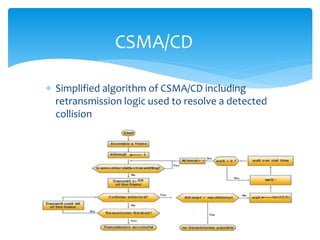
 The following procedure is used to resolve a detected
collision. The procedure is complete when
retransmission is initiated or the retransmission is
aborted due to numerous collisions.
 Continue transmission (with a jam signal instead of
frame header/data/CRC) until minimum packet time is
reached to ensure that all receivers detect the collision.
 Calculate and wait the random back off period based
on number of collisions.
 Re-enter main procedure at stage 1.
Procedure
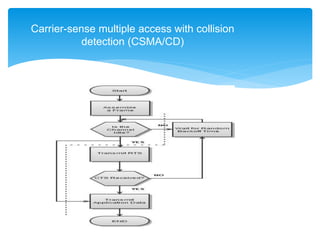
 Simplified algorithm of CSMA/CD including
retransmission logic used to resolve a detected
collision
CSMA/CD
 CSMA/CD was used in now-obsolete shared media
Ethernet variants (10BASE5, 10BASE2) and in the
early versions of twisted-pair Ethernet which
used repeater hubs.
 Modern Ethernet networks, built
with switches and full-duplex connections, no
longer need to use CSMA/CD because each
Ethernet segment, or collision domain, is now
isolated. CSMA/CD is still supported for backwards
compatibility and for half-duplex connections
Applications
 The IEEE 802.3 standard, which defines all
Ethernet variants, for historical reasons still
bore the title "Carrier sense multiple access
with collision detection (CSMA/CD) access
method and physical layer specifications"
until 802.3-2008, which uses new name "IEEE
Standard for Ethernet".
Applications
Thanks for your attention !
DEPARTMENT OF COMPUTER SCIENCE

Carrier-sense multiple access with collision detection (CSMA/CD)

  • 1.
     BSCS-5th Semester-2021 ASSIGMENT :Carrier-sense multiple access with collision detection (CSMA/CD)  Prepared By: Mr. Bahadar sher  University of Malakand Dir Lower  Whatsapp 03439278286 Carrier-sense multiple access with collision detection (CSMA/CD)
  • 2.
     CSMA/CD isa media access control (MAC) method used most notably in early Ethernet technology for local area networking.  It uses carrier-sensing to defer transmissions until no other stations are transmitting.  This is used in combination with collision detection in which a transmitting station detects collisions by sensing transmissions from other stations while it is transmitting a frame. Carrier-sense multiple access with collision detection (CSMA/CD)
  • 3.
     When thiscollision condition is detected, the station stops transmitting that frame, transmits a jam signal, and then waits for a random time interval before trying to resend the frame. Carrier-sense multiple access with collision detection (CSMA/CD)
  • 4.
    Carrier-sense multiple accesswith collision detection (CSMA/CD)
  • 5.
     In networkingtechnologies that use CSMA/CD as their access method, a station first «listens» to the network media to make sure there is no signal already present from another station before it tries to place its own signal on the media.  If a carrier signal is detected on the media, which indicates that a station is currently transmitting a signal, no other station can initiate a transmission until the carrier stops How it works
  • 6.
    the following procedureis used to initiate a transmission. The procedure is complete when the frame is transmitted successfully or a collision is detected during transmission.  Is a frame ready for transmission? If not, wait for a frame.  Is medium idle? If not, wait until it becomes ready.  Start transmitting and monitor for collision during transmission. Procedure
  • 7.
     Did acollision occur? If so, go to collision detected procedure.  Reset retransmission counters and complete frame transmission. Procedure
  • 8.
     The followingprocedure is used to resolve a detected collision. The procedure is complete when retransmission is initiated or the retransmission is aborted due to numerous collisions.  Continue transmission (with a jam signal instead of frame header/data/CRC) until minimum packet time is reached to ensure that all receivers detect the collision.  Calculate and wait the random back off period based on number of collisions.  Re-enter main procedure at stage 1. Procedure
  • 9.
     Simplified algorithmof CSMA/CD including retransmission logic used to resolve a detected collision CSMA/CD
  • 10.
     CSMA/CD wasused in now-obsolete shared media Ethernet variants (10BASE5, 10BASE2) and in the early versions of twisted-pair Ethernet which used repeater hubs.  Modern Ethernet networks, built with switches and full-duplex connections, no longer need to use CSMA/CD because each Ethernet segment, or collision domain, is now isolated. CSMA/CD is still supported for backwards compatibility and for half-duplex connections Applications
  • 11.
     The IEEE802.3 standard, which defines all Ethernet variants, for historical reasons still bore the title "Carrier sense multiple access with collision detection (CSMA/CD) access method and physical layer specifications" until 802.3-2008, which uses new name "IEEE Standard for Ethernet". Applications
  • 12.
    Thanks for yourattention ! DEPARTMENT OF COMPUTER SCIENCE