UNIT-II
Wireless Medium
Access Control
Contents
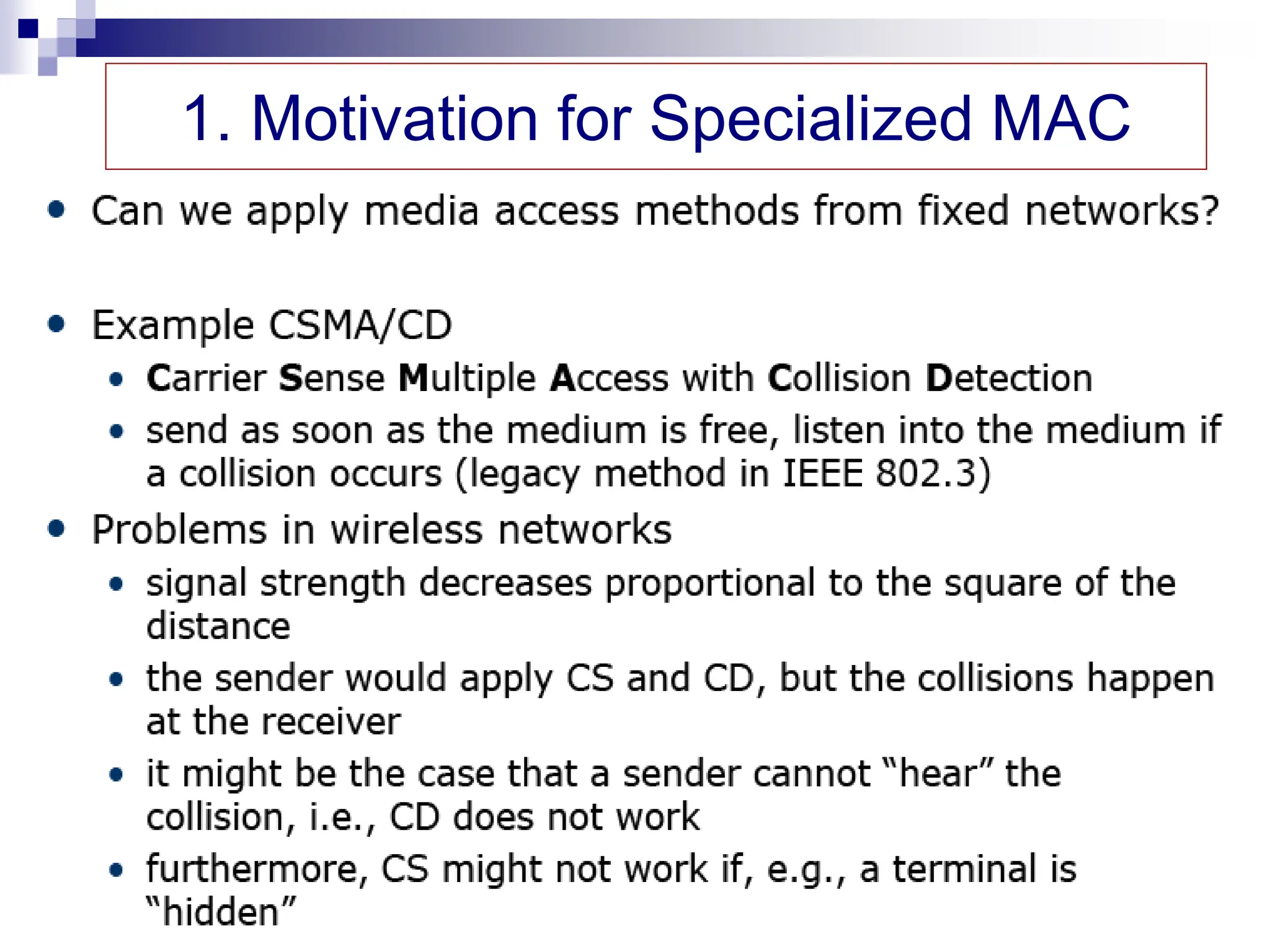
1. Motivation for Specialized MAC
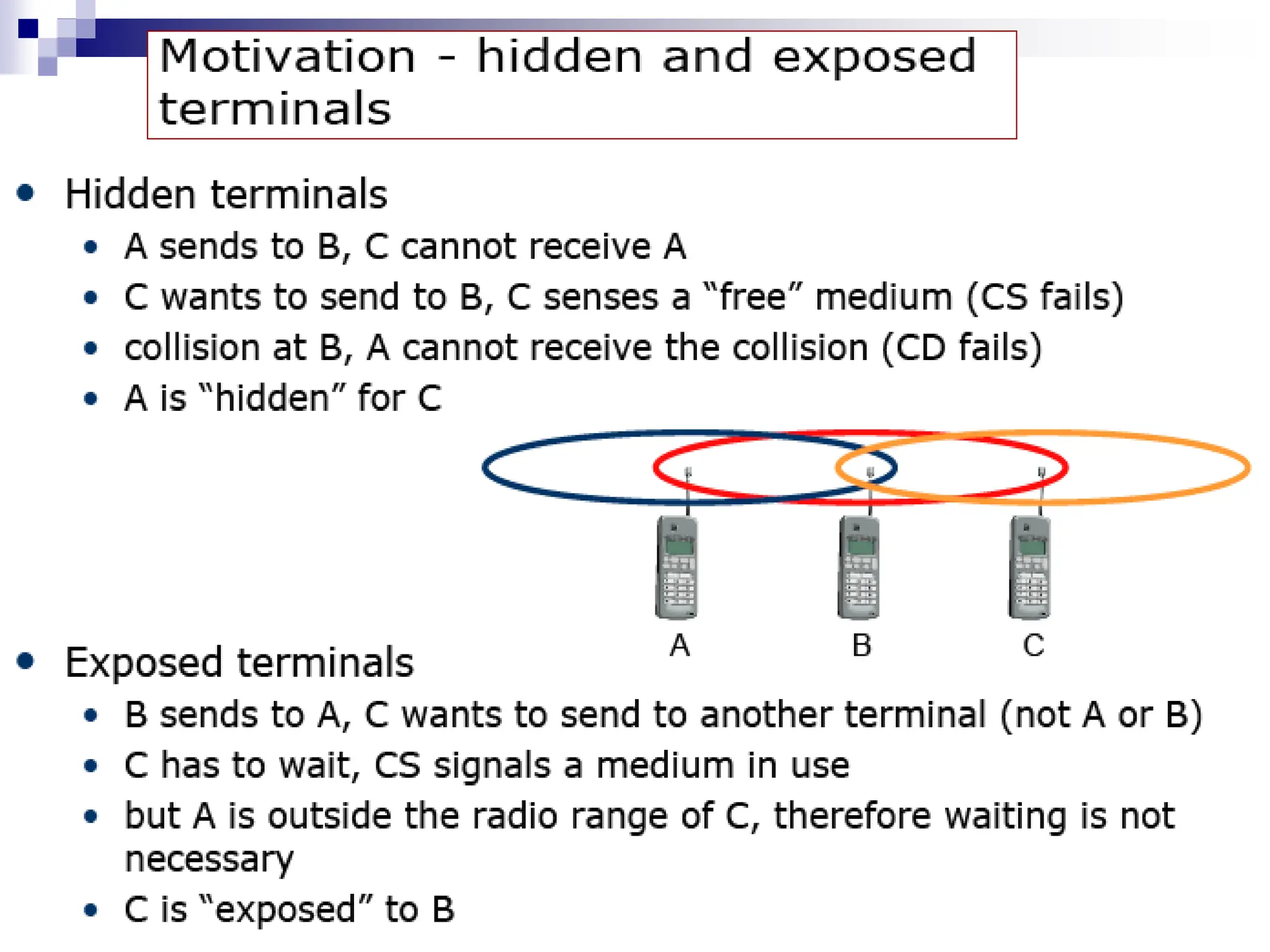
• Hidden and Exposed Terminals
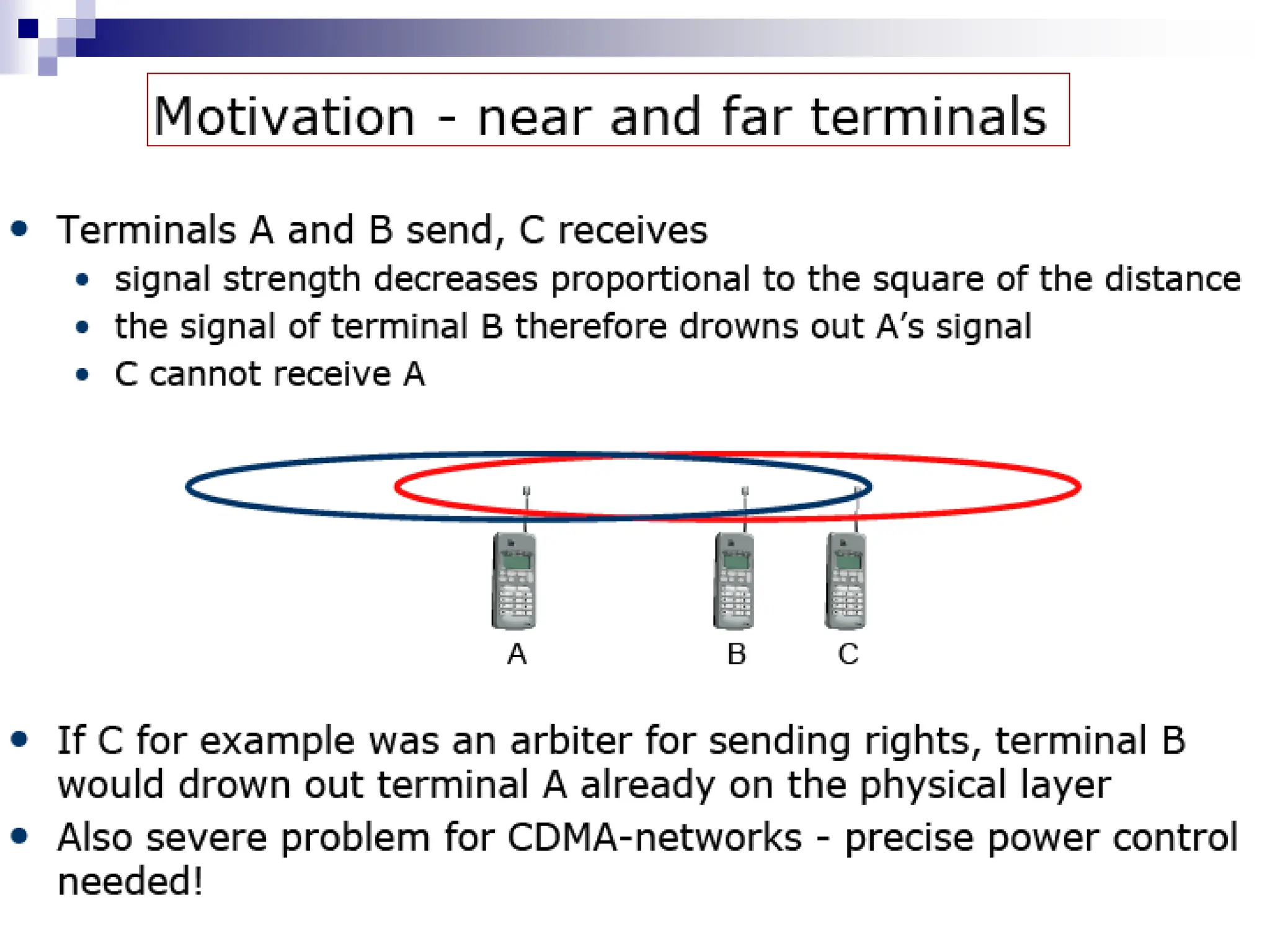
• Far and Near Terminals
2. Access Methods
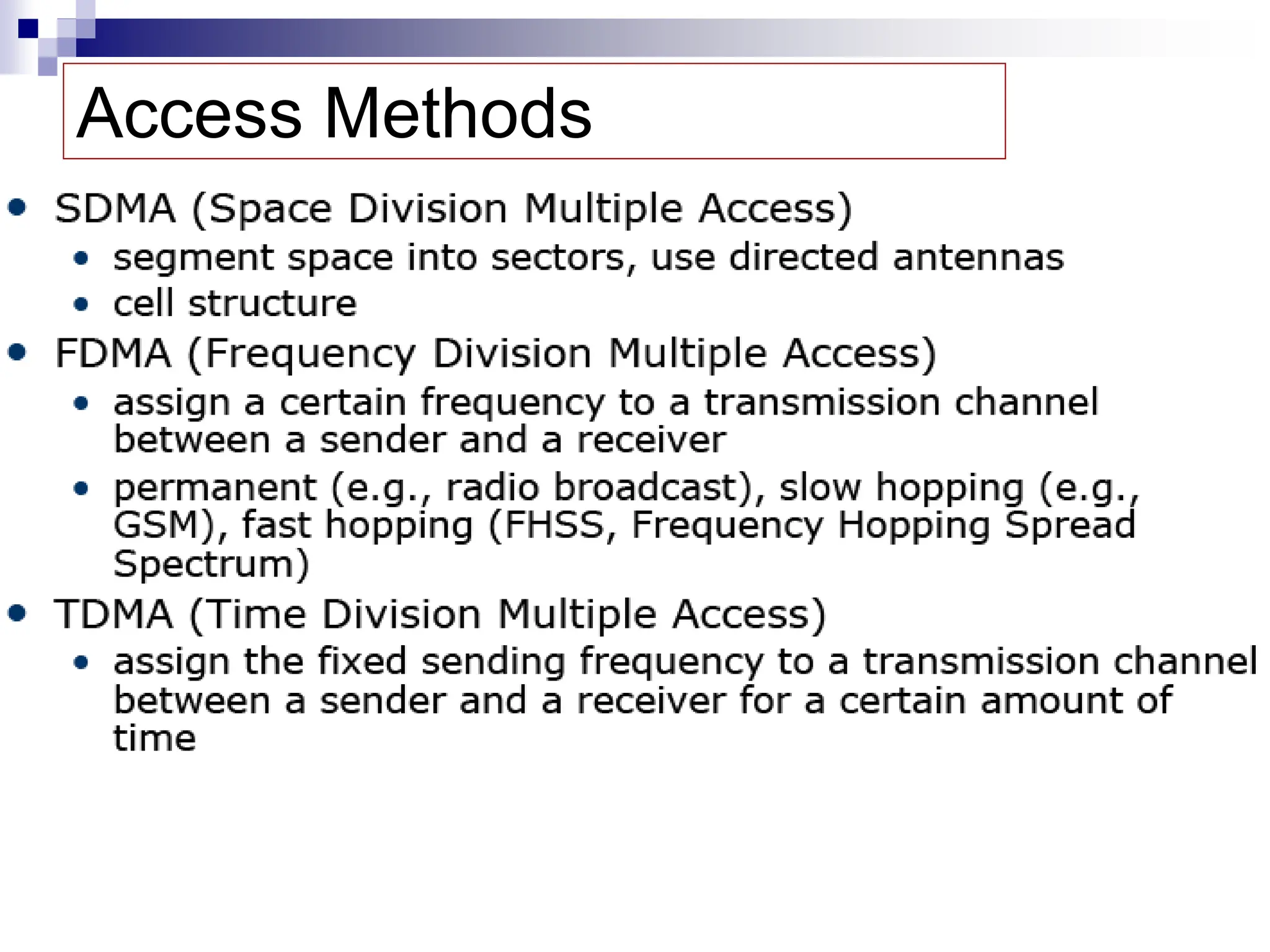
• SDMA
• FDMA
• TDMA
• CDMA
1. Motivation for Specialized MAC
MULTIPLEXING
 A fundamental mechanism in
communication system and networks
 Enables multiple users to share a medium
 For wireless communication, multiplexing
can be carried out in four dimensions:
space, time, frequency and code
Access Methods
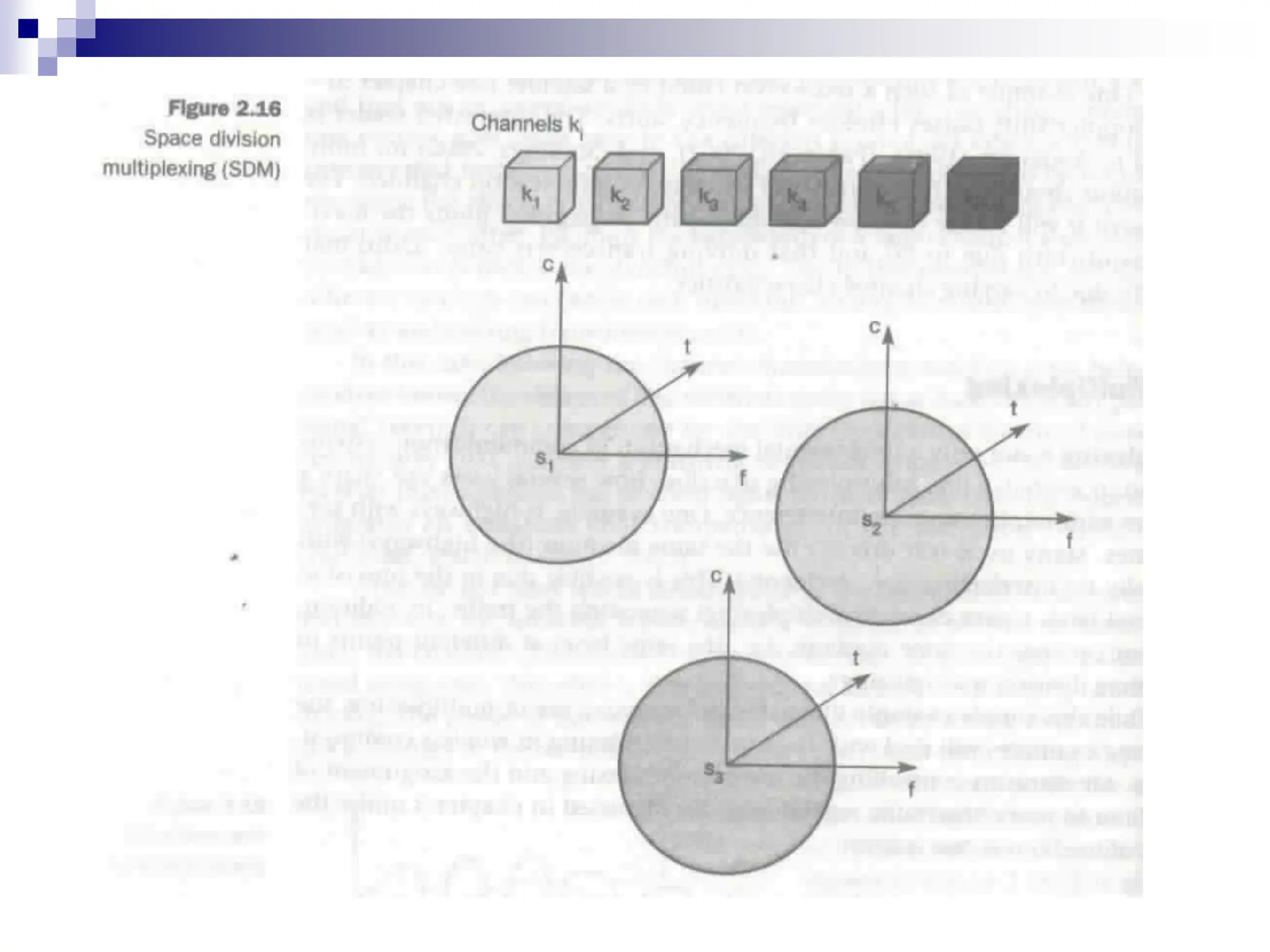
1. Space Division Multiple Access
(SDMA)
 Channels are assigned on the basis of
“space” (but operate on same frequency)
 The assignment makes sure that the
transmission do not interfere with each
(with a guard band in between)
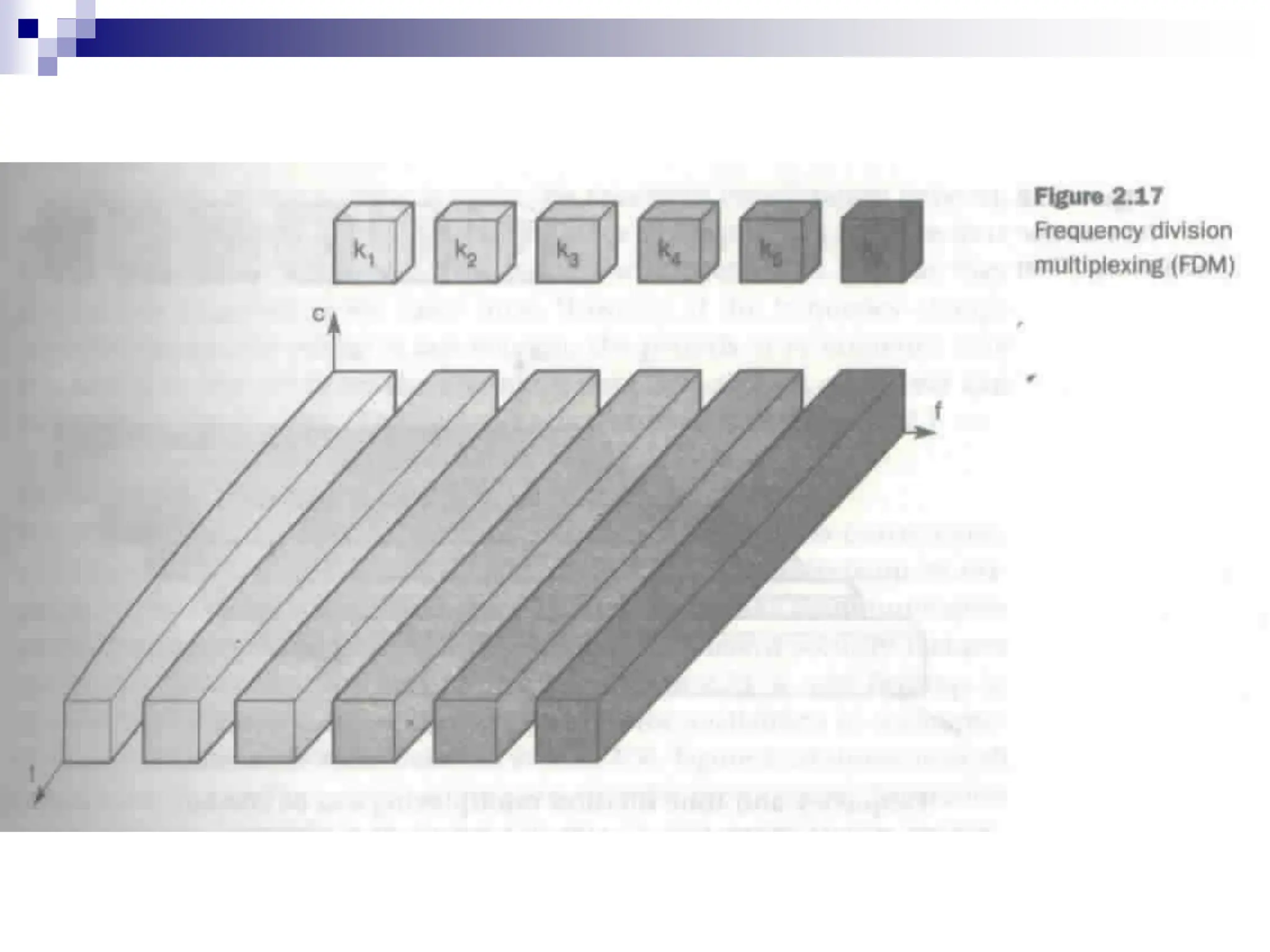
2. FDMA: Frequency Division
Multiple Access
 Frequency domain is subdivided into
several non-overlapping frequency
bands
 Each channel is assigned its own
frequency band (with guard spaces in
between)
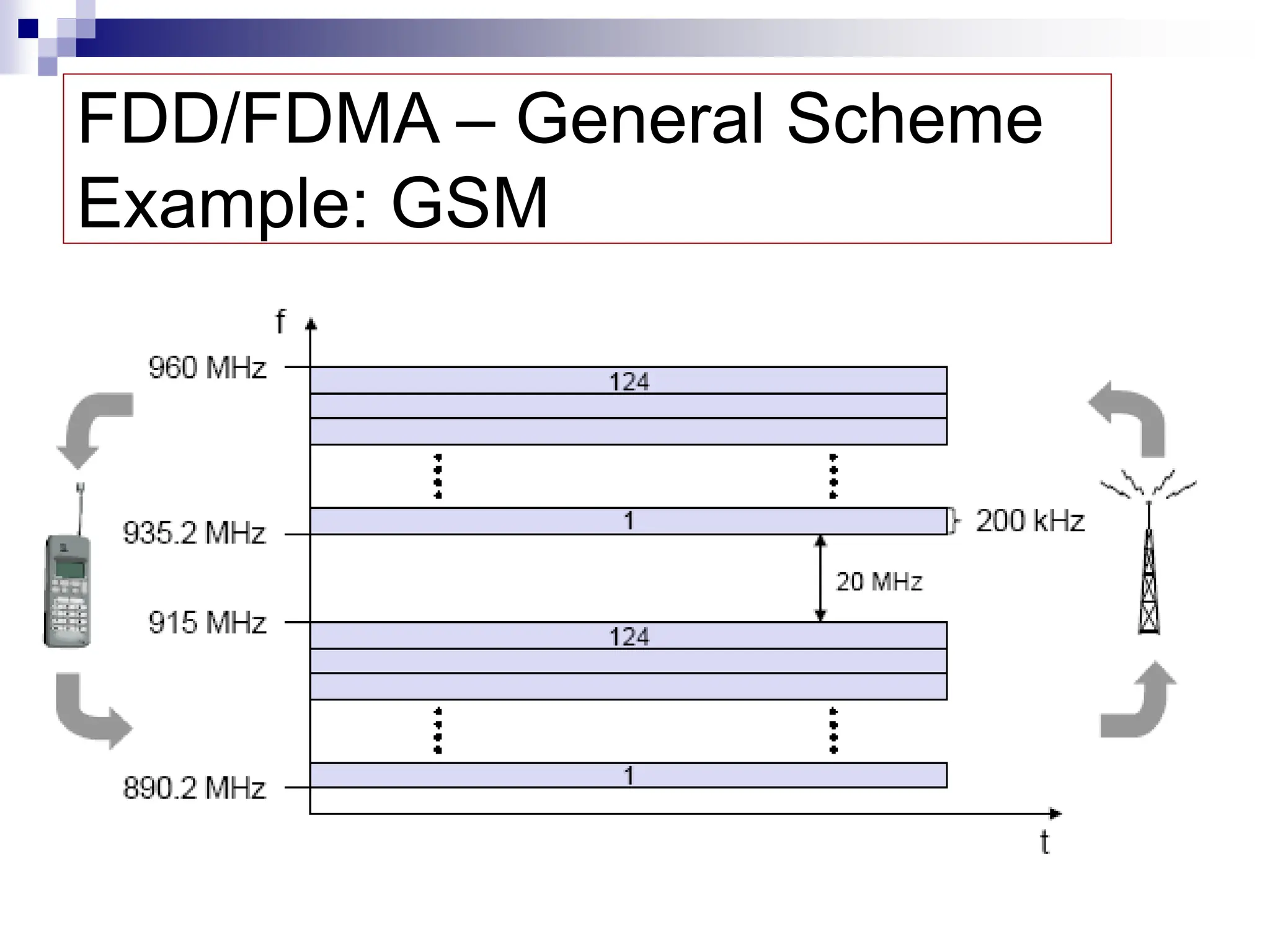
FDD/FDMA – General Scheme
Example: GSM
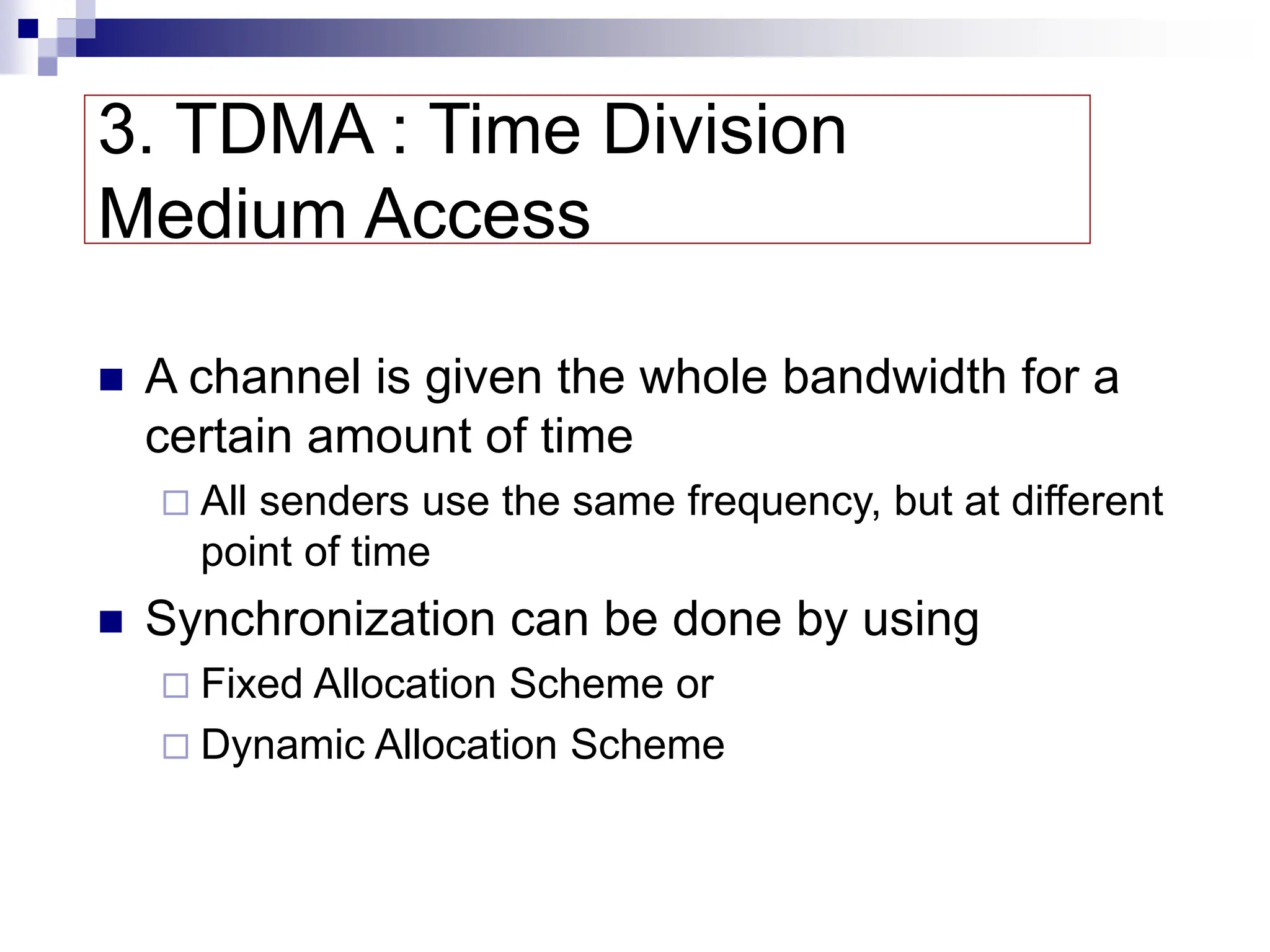
3. TDMA : Time Division
Medium Access
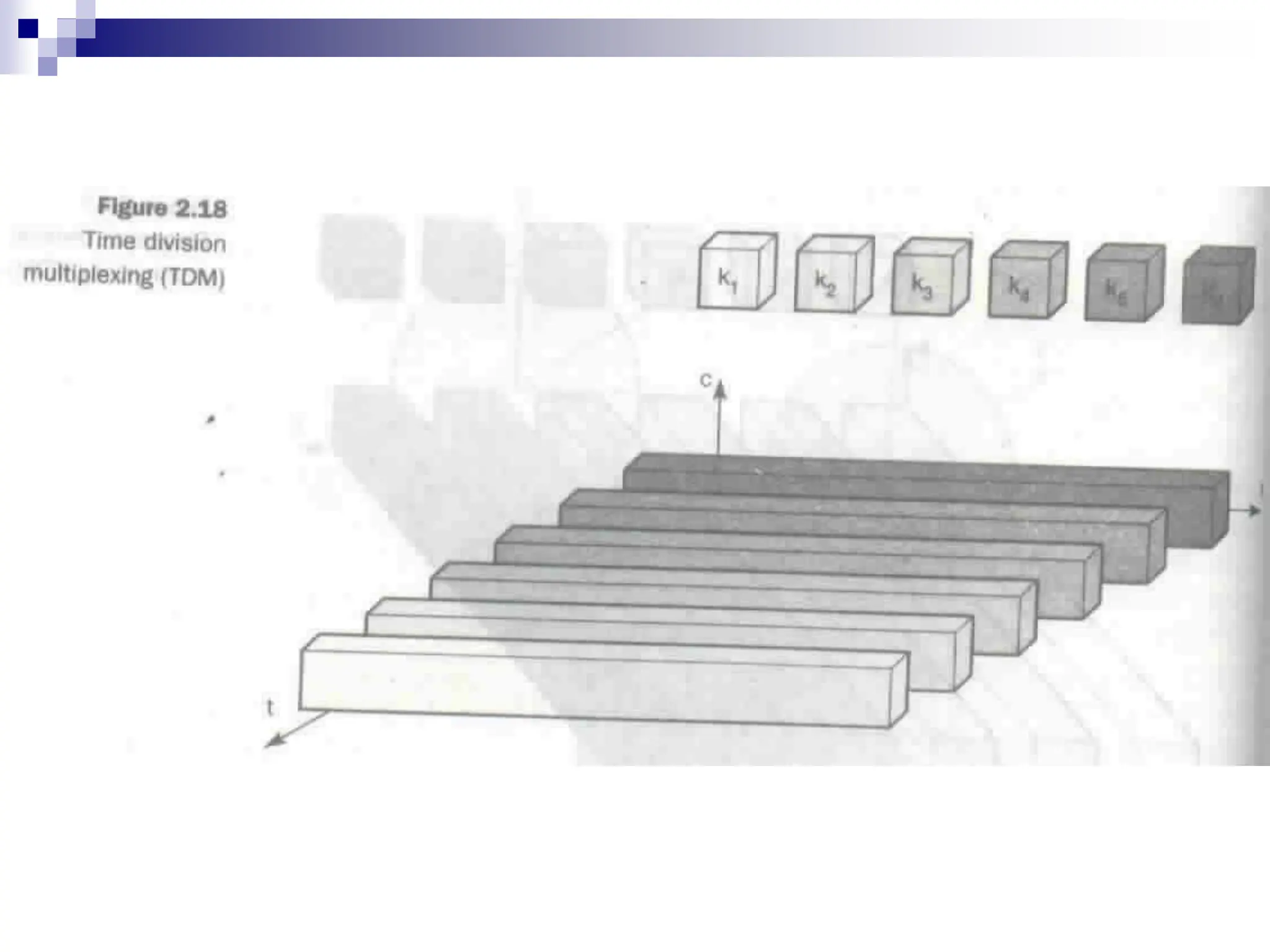
 A channel is given the whole bandwidth for a
certain amount of time
 All senders use the same frequency, but at different
point of time
 Synchronization can be done by using
 Fixed Allocation Scheme or
 Dynamic Allocation Scheme
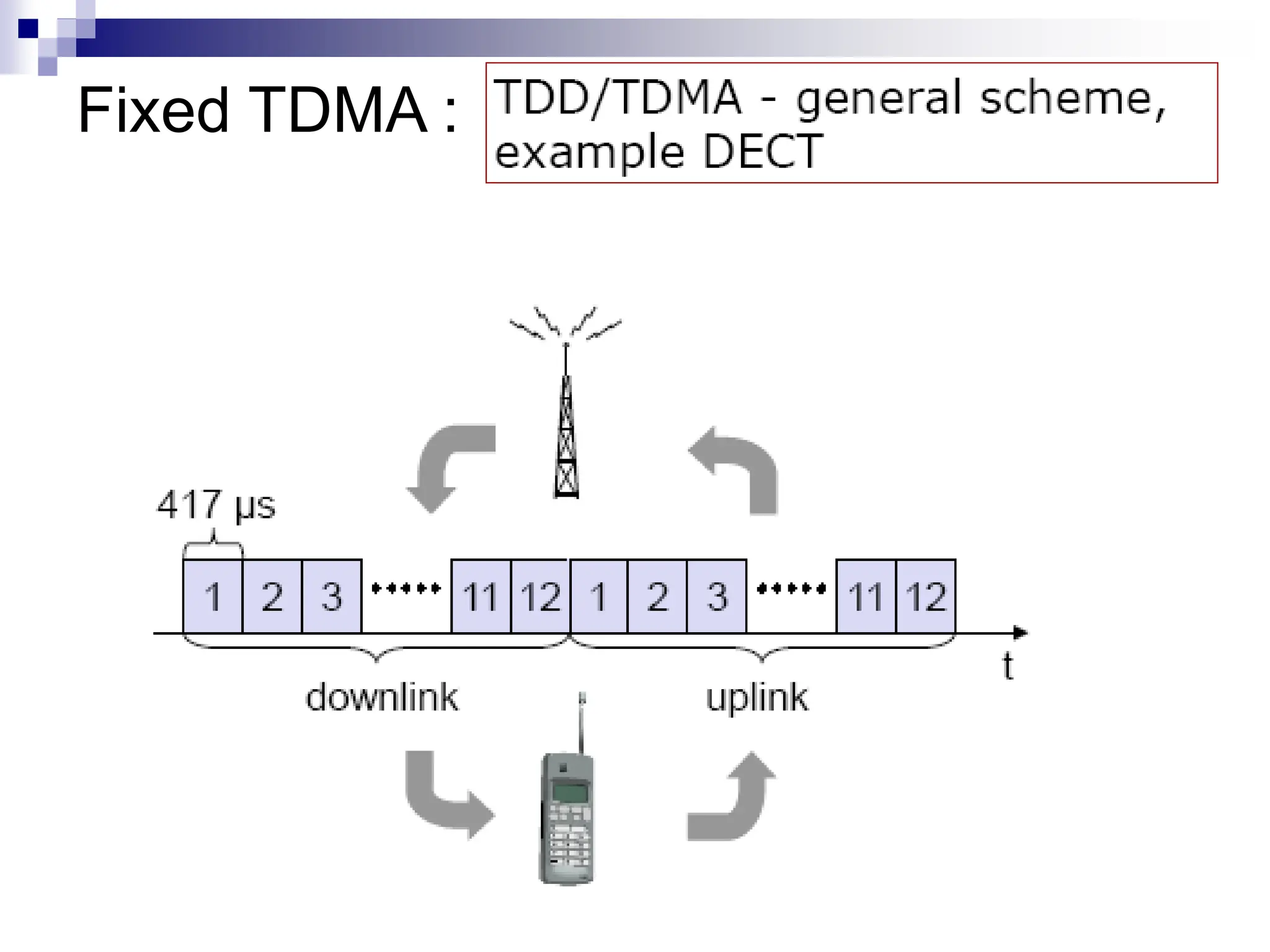
Fixed TDMA :
TDMA Schemes
1. Fixed TDM
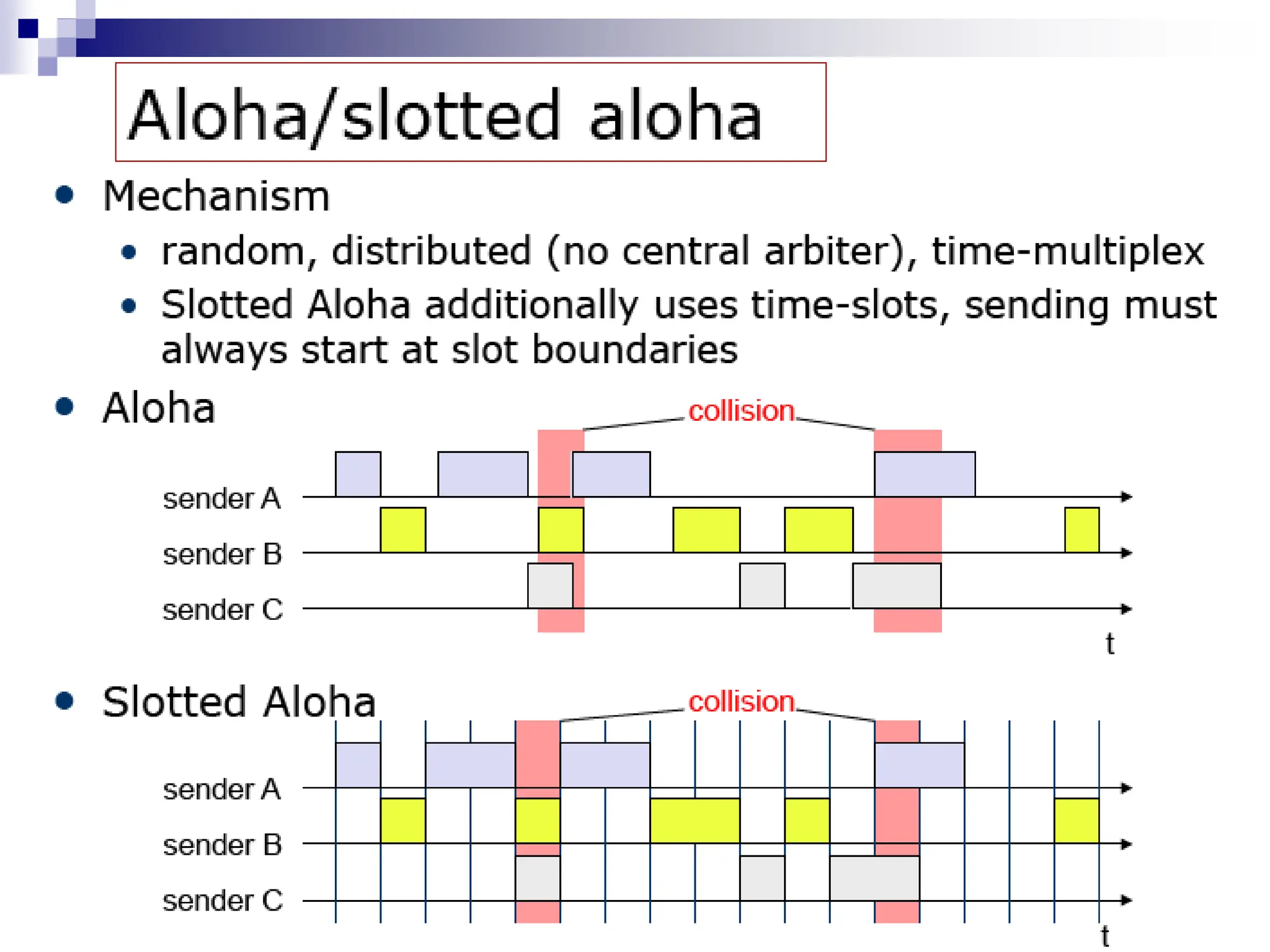
2. Aloha (Classical)
3. Slotted Aloha
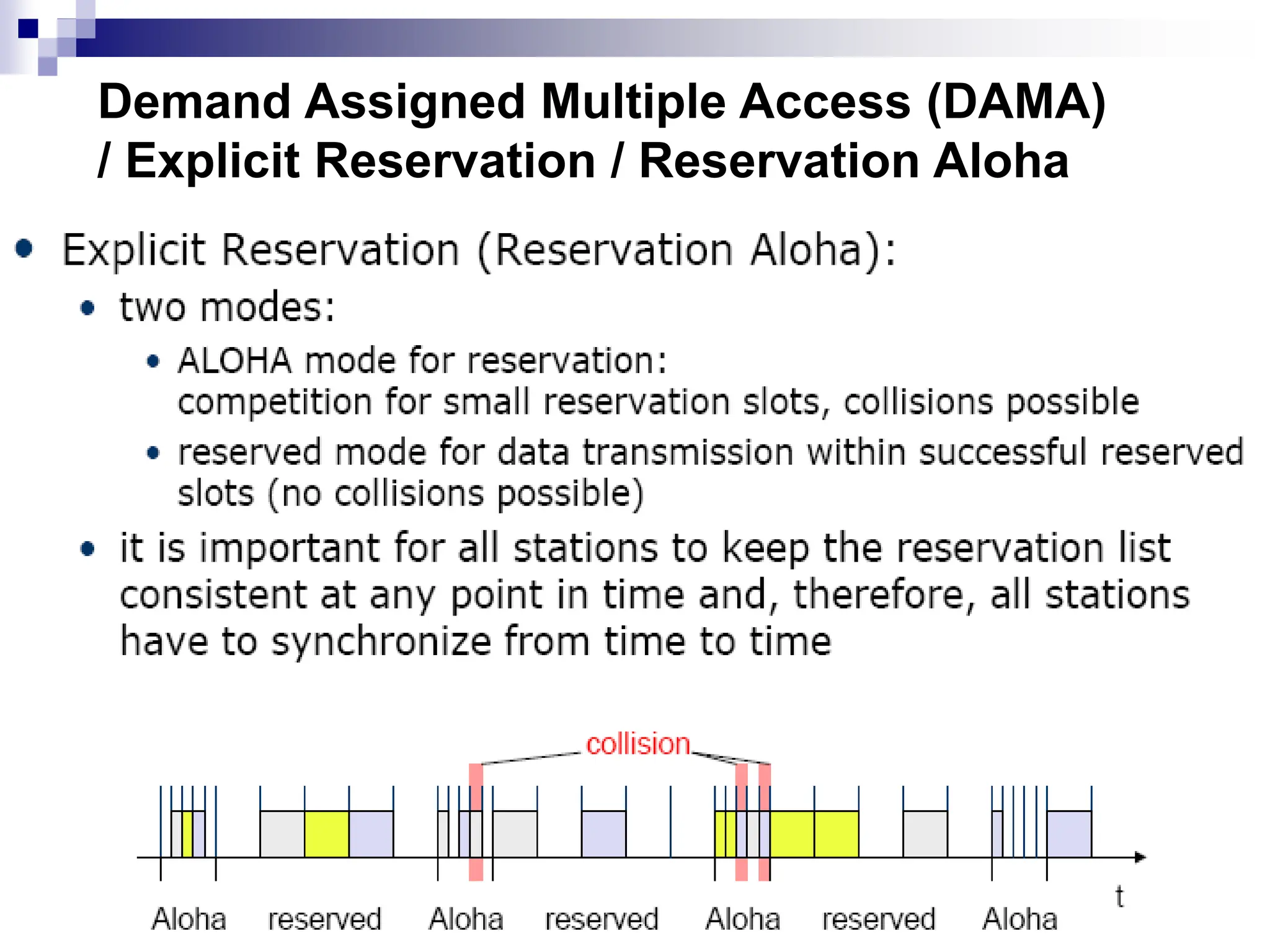
4. Reservation Aloha (Explicit)
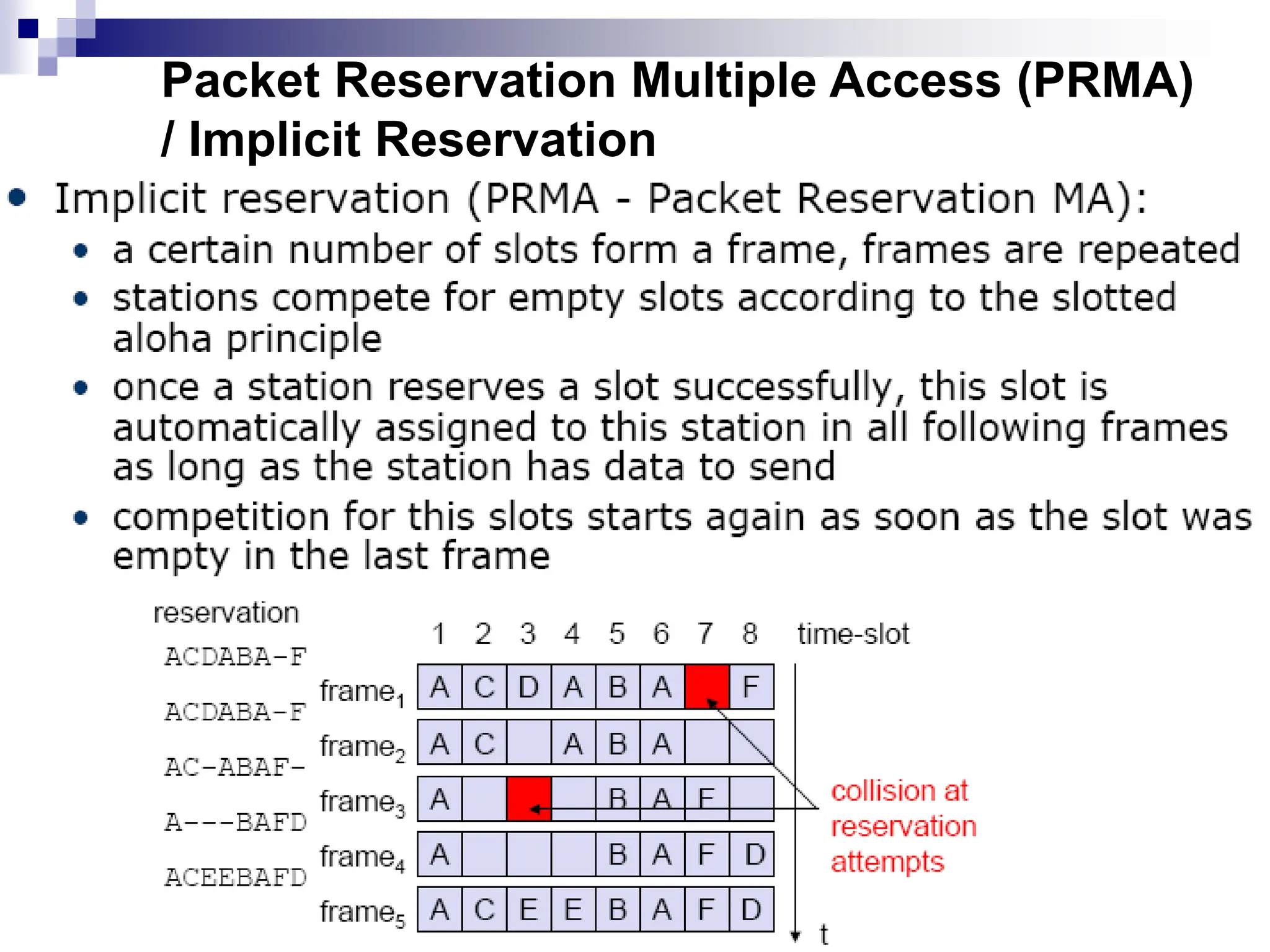
5. PRMA (Implicit Reservation)
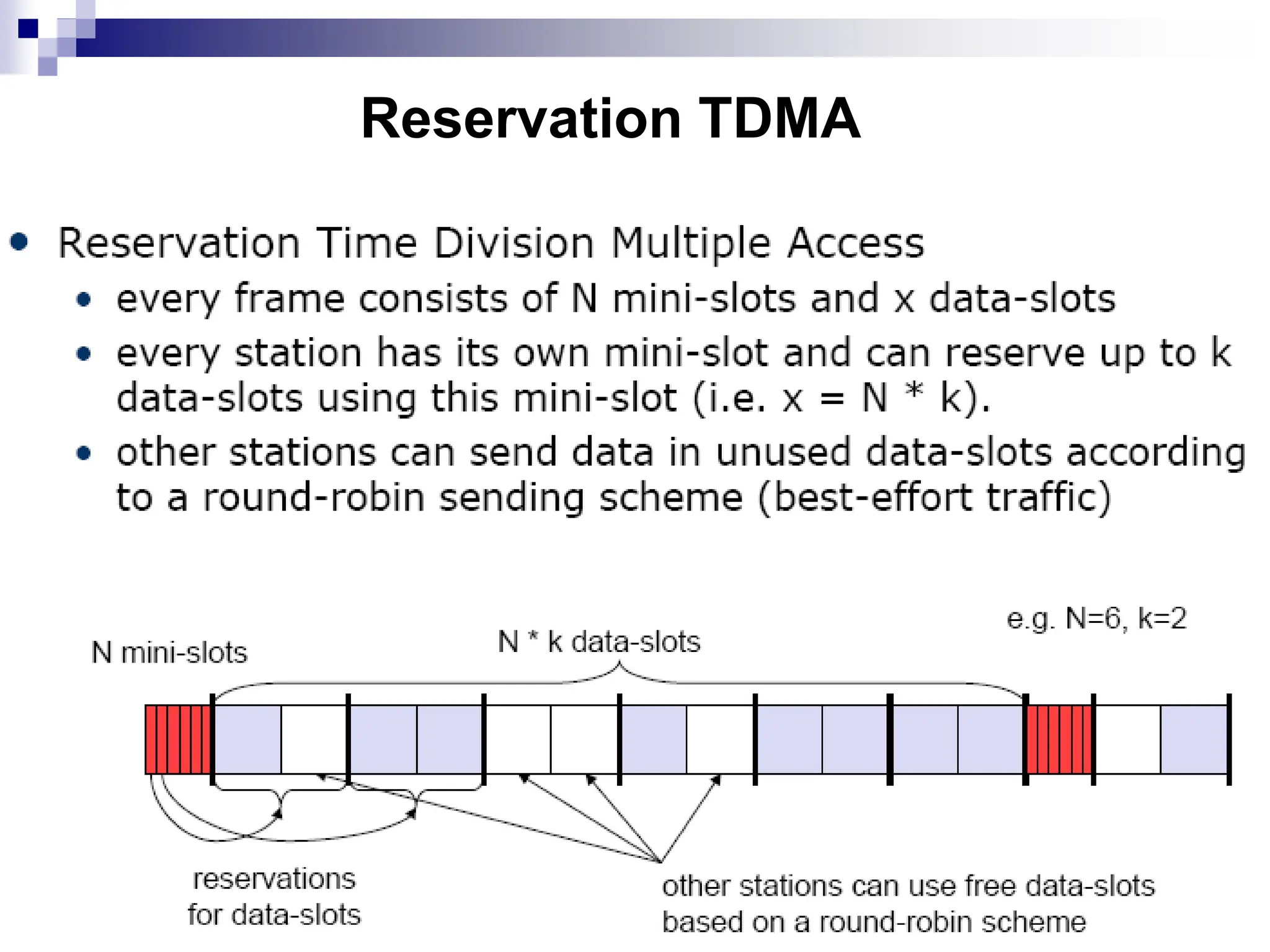
6. Reservation TDMA
7. CSMA
8. MACA
9. Polling
10. ISMA
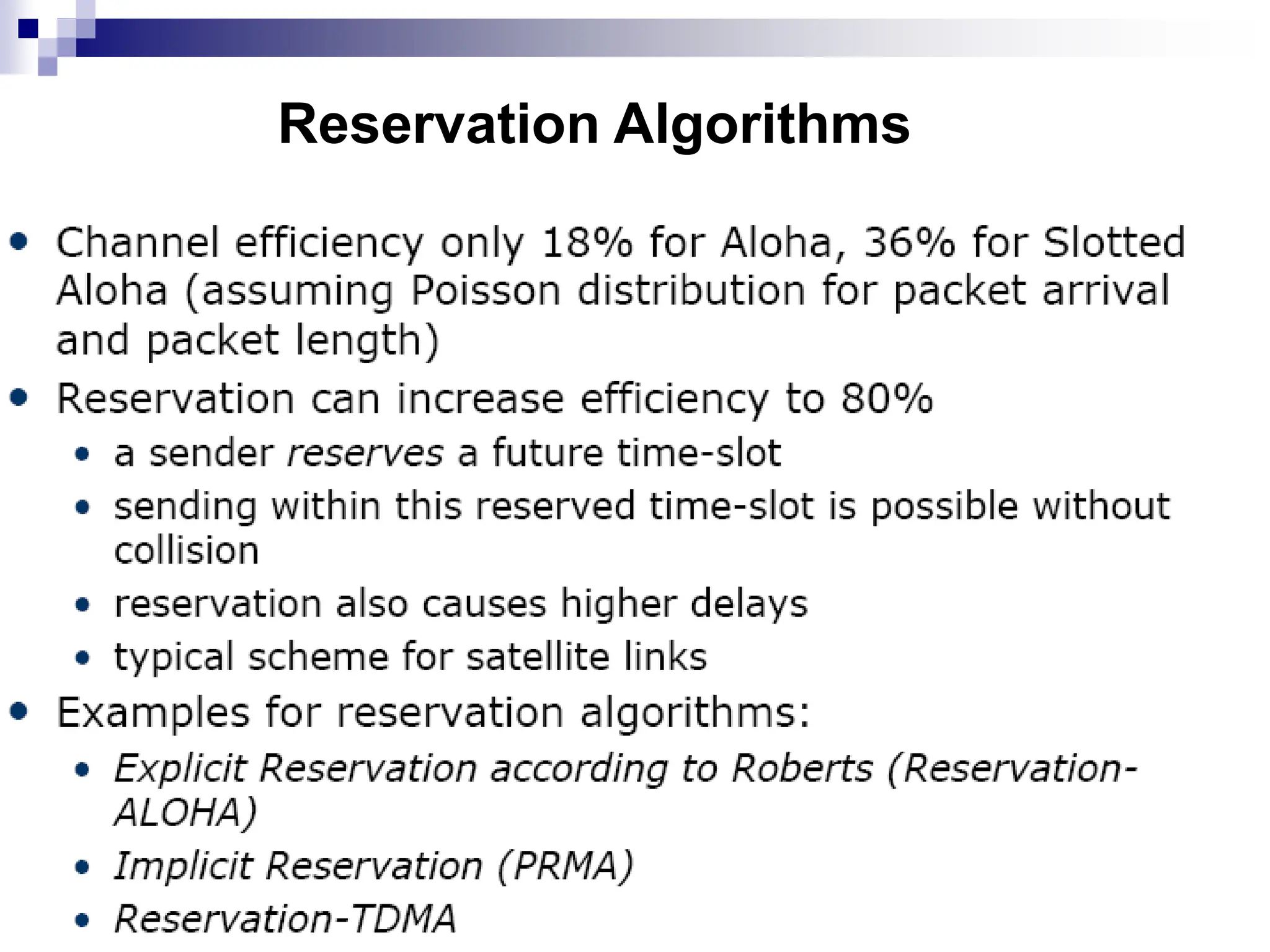
Reservation Algorithms
Demand Assigned Multiple Access (DAMA)
/ Explicit Reservation / Reservation Aloha
Packet Reservation Multiple Access (PRMA)
/ Implicit Reservation
Reservation TDMA
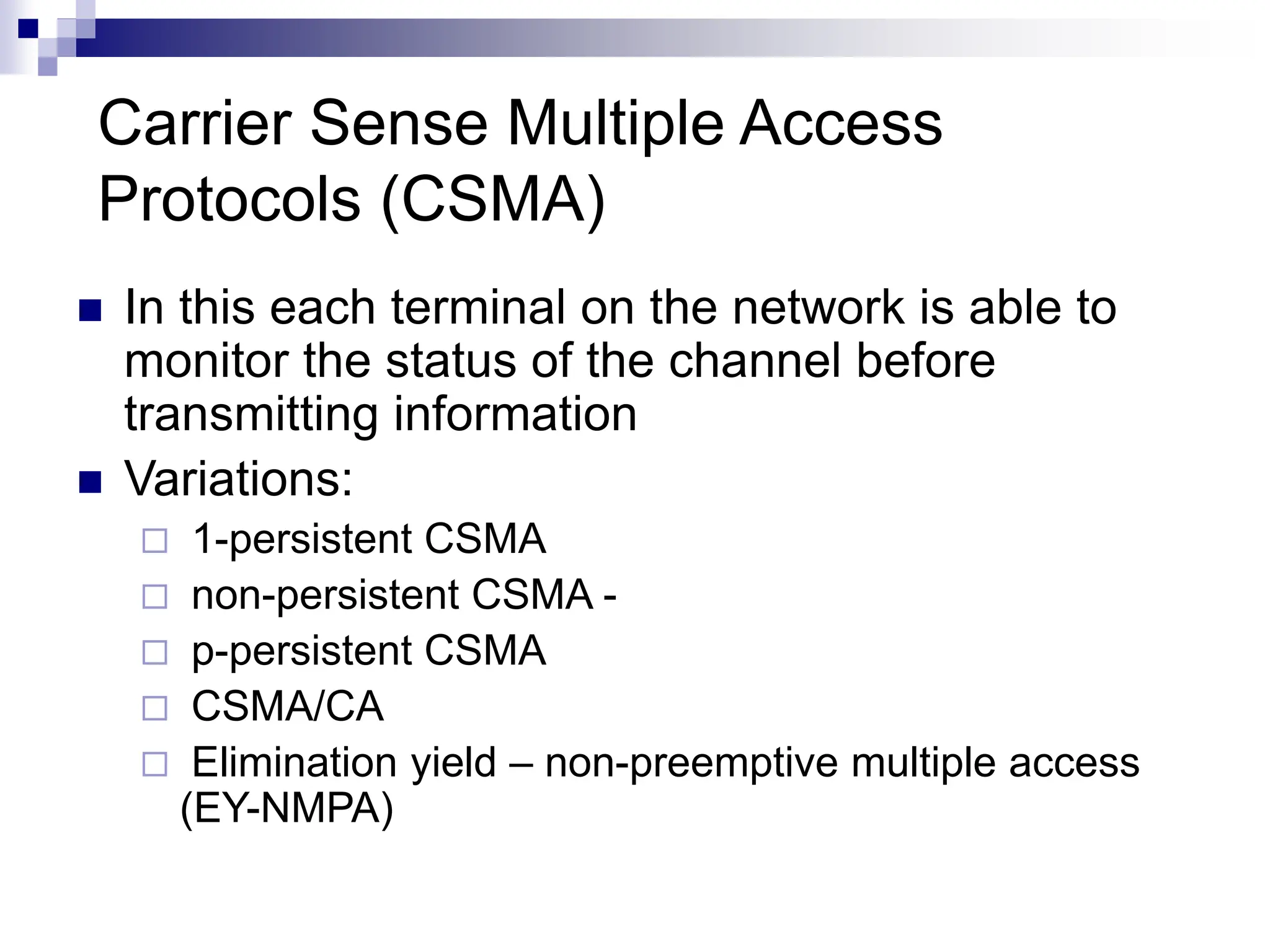
 In this each terminal on the network is able to
monitor the status of the channel before
transmitting information
 Variations:
 1-persistent CSMA
 non-persistent CSMA -
 p-persistent CSMA
 CSMA/CA
 Elimination yield – non-preemptive multiple access
(EY-NMPA)
Carrier Sense Multiple Access
Protocols (CSMA)
 sense channel when want to transmit a
packet, if channel is busy, then sense
continuously, until the channel is idle, at
this time, transmit the frame immediately.
 Problem : “high collision rate”.
1-persistent CSMA
 Sense channel when want to transmit a packet,
if channel is idle, then transmit the packet
immediately. If busy, run back-off algorithm
immediately to wait a random time and then re-
sense the channel again.
 Problem : when the channel becomes idle from
busy, there may be no one of waiting stations
beginning the transmission, thus waste channel
bandwidth.
Non-persistent CSMA
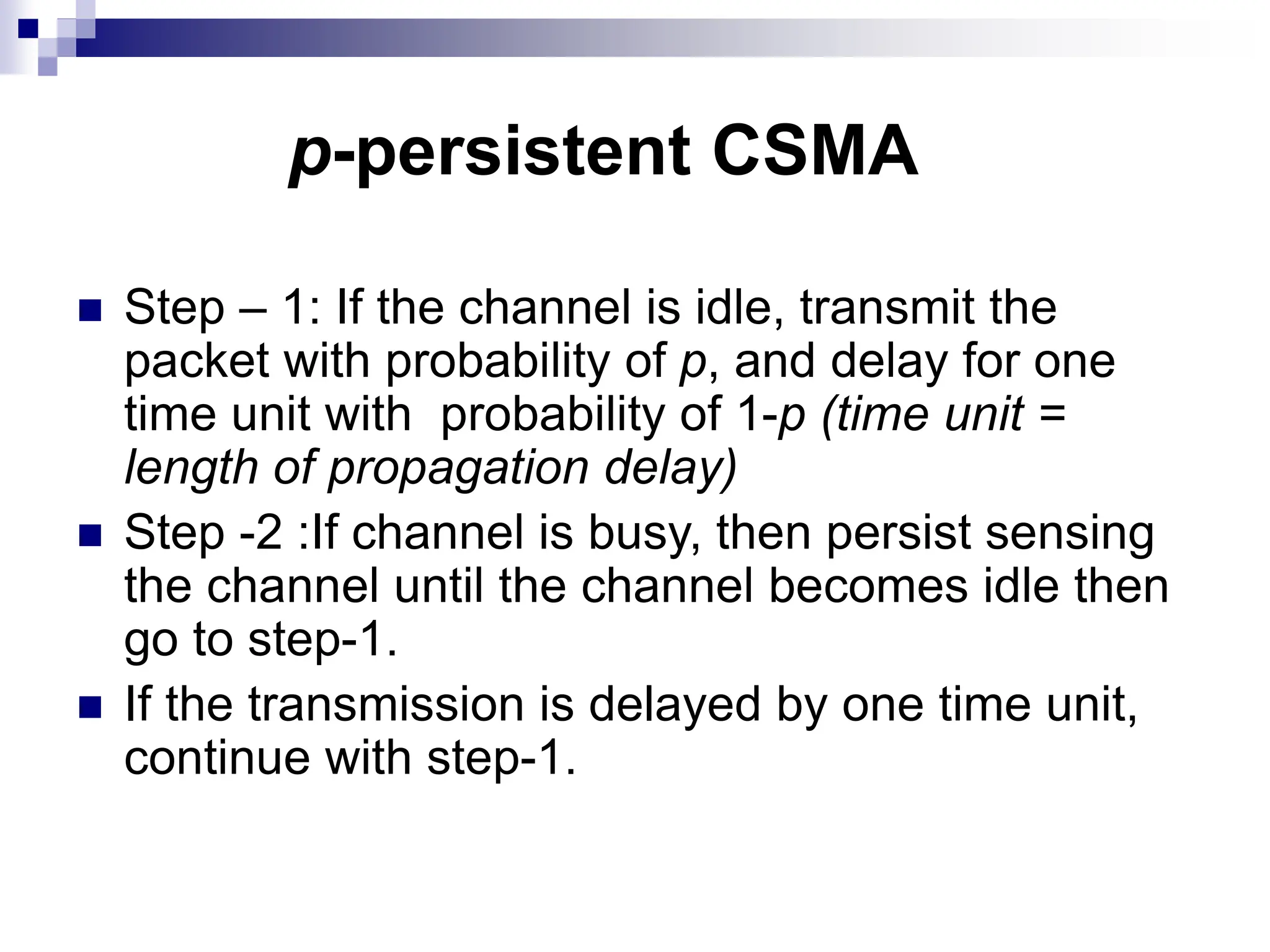
 Step – 1: If the channel is idle, transmit the
packet with probability of p, and delay for one
time unit with probability of 1-p (time unit =
length of propagation delay)
 Step -2 :If channel is busy, then persist sensing
the channel until the channel becomes idle then
go to step-1.
 If the transmission is delayed by one time unit,
continue with step-1.
p-persistent CSMA
 CSMA/CA: Sensing the carrier is combined
with a back-off scheme in case of a busy
medium to achieve some fairness among
competing stations.
 In EY-NMPA: Priority scheme included to
access the medium.
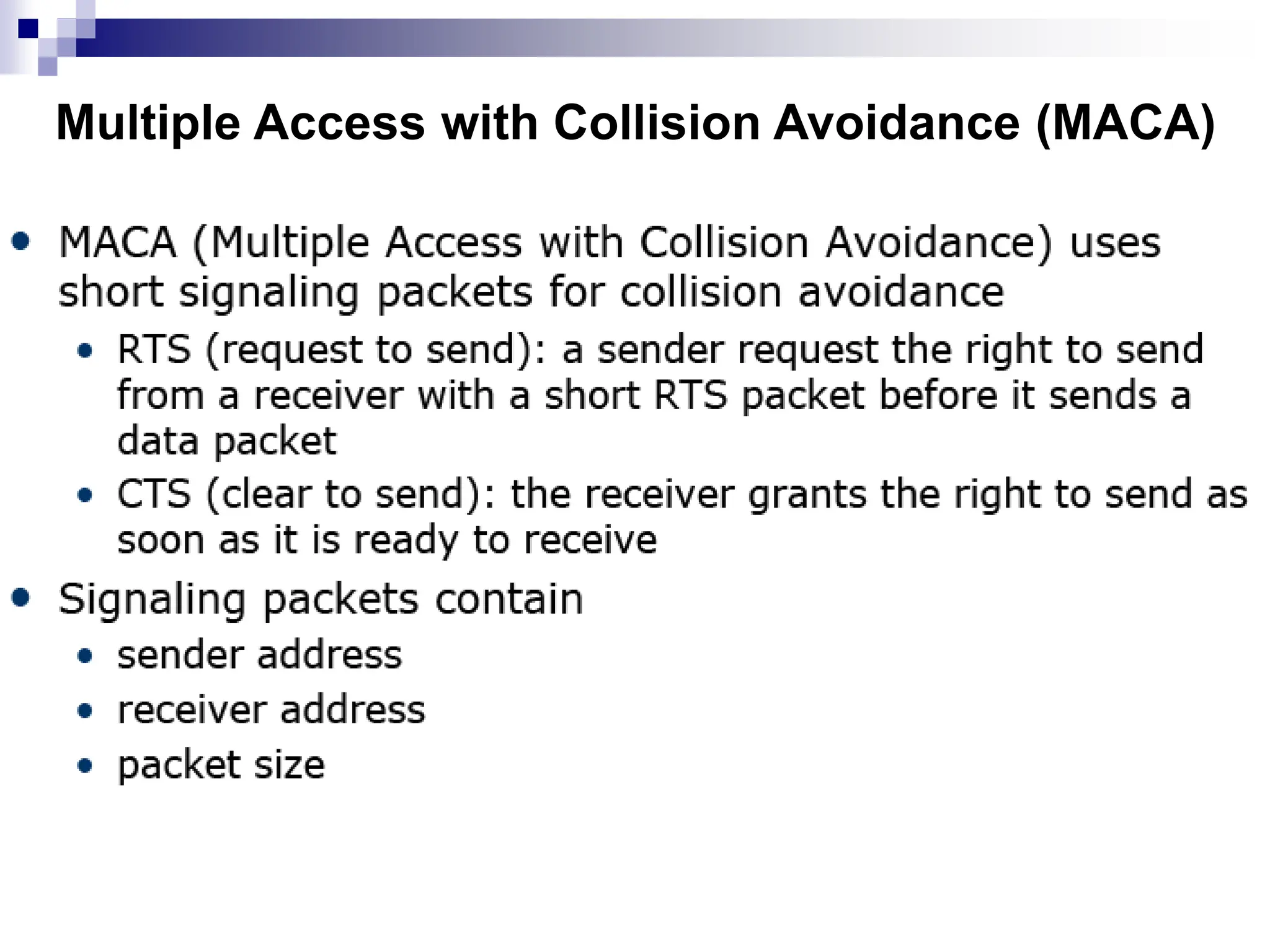
Multiple Access with Collision Avoidance (MACA)
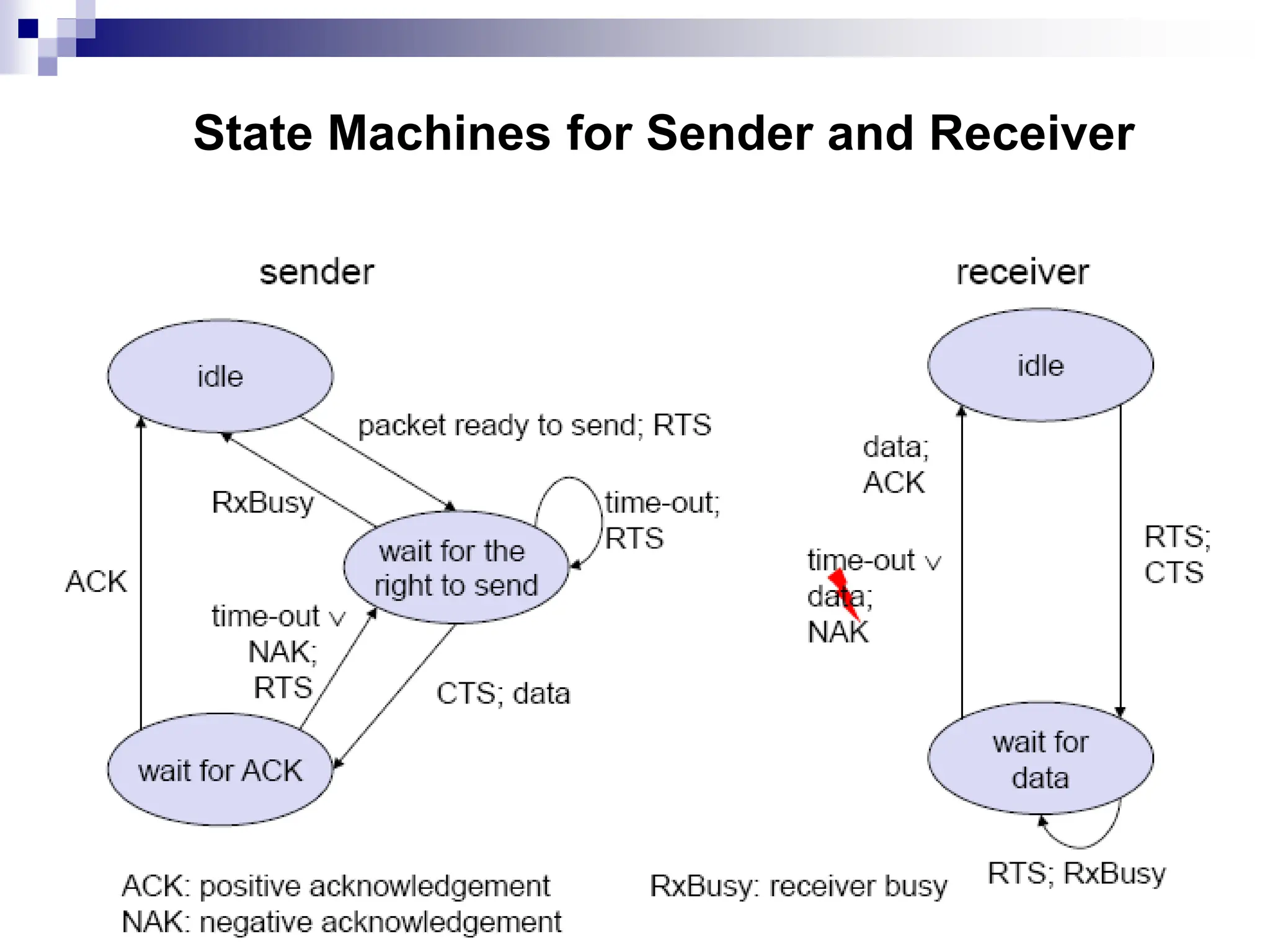
State Machines for Sender and Receiver
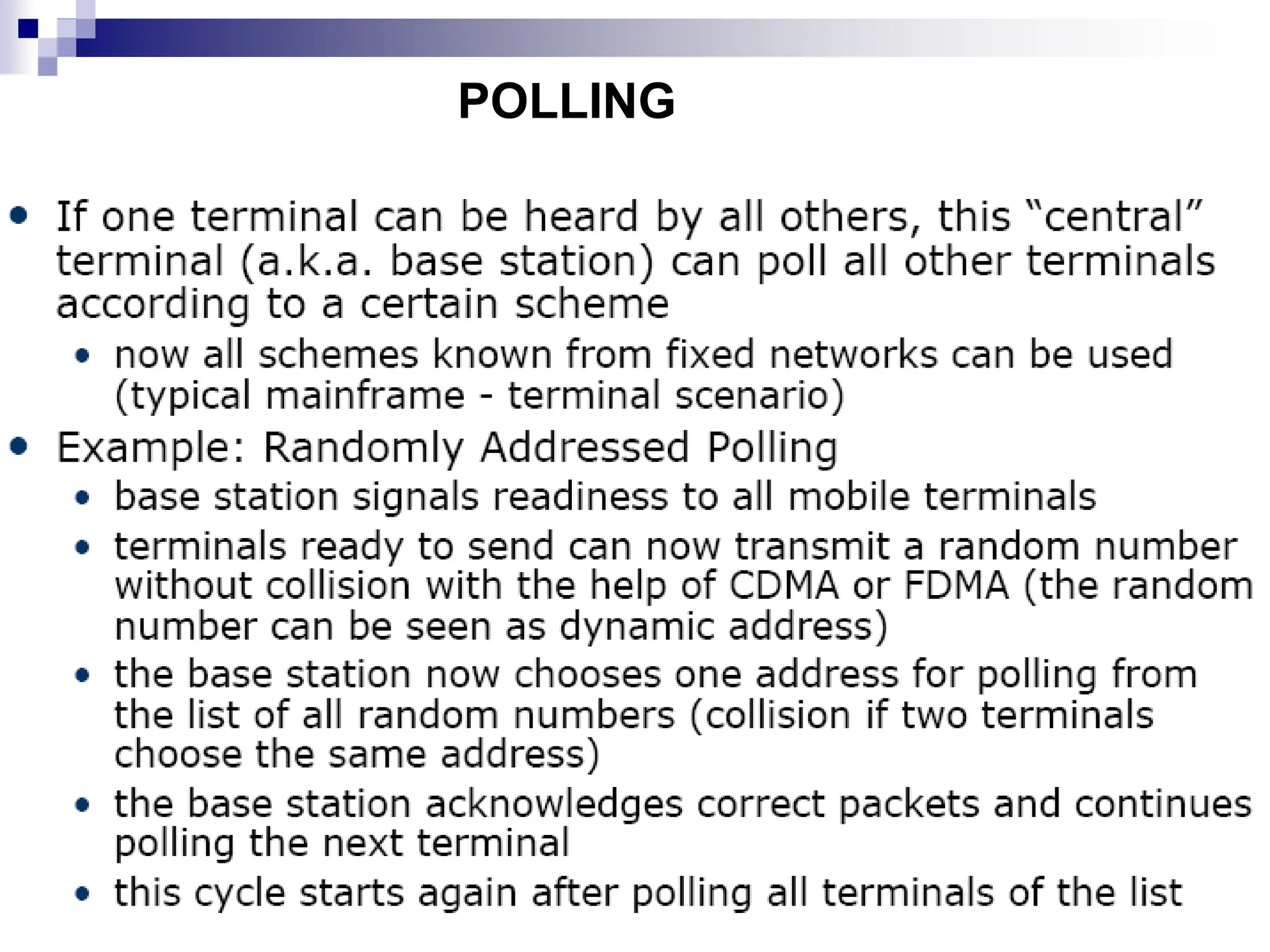
POLLING
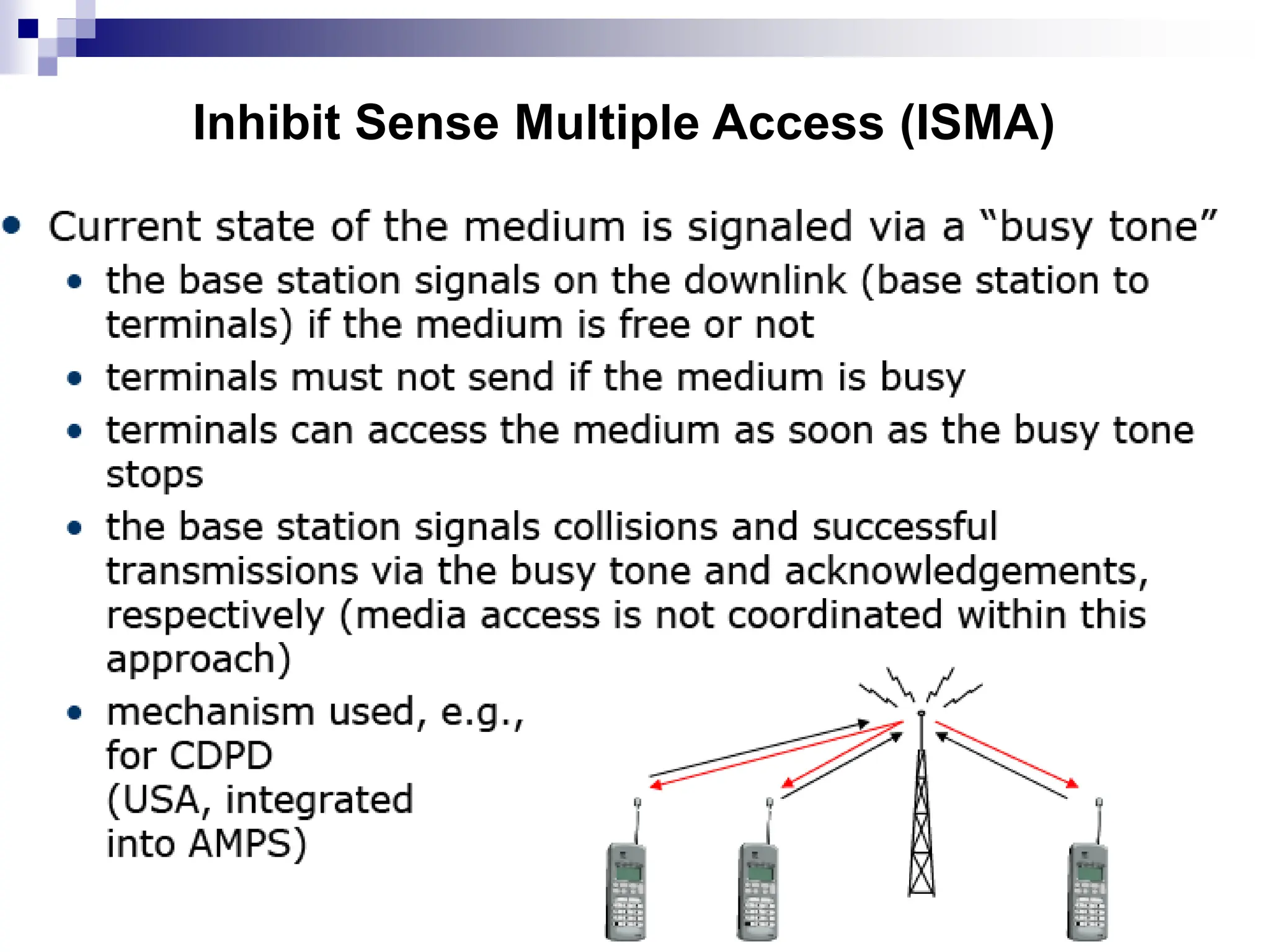
Inhibit Sense Multiple Access (ISMA)
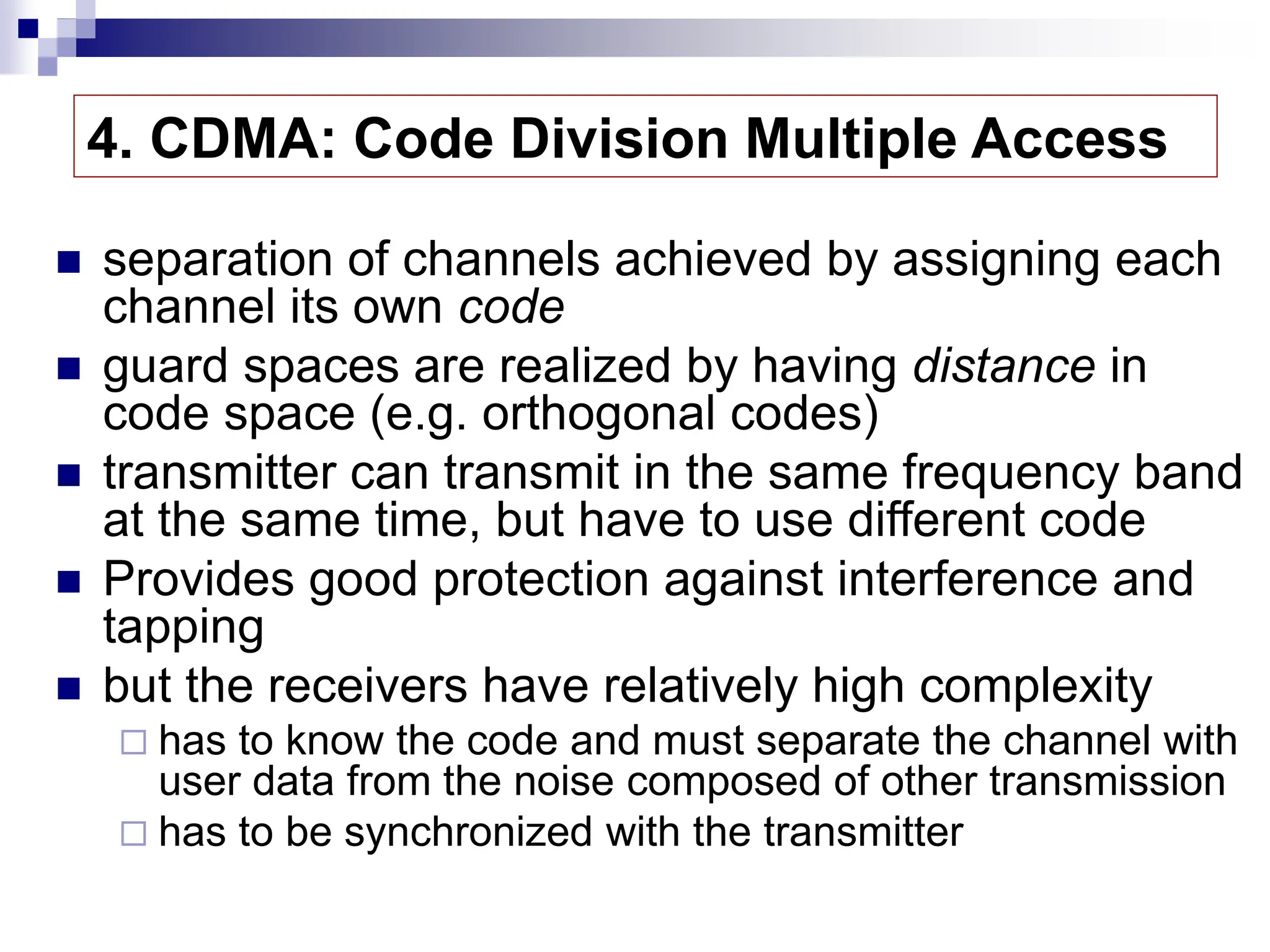
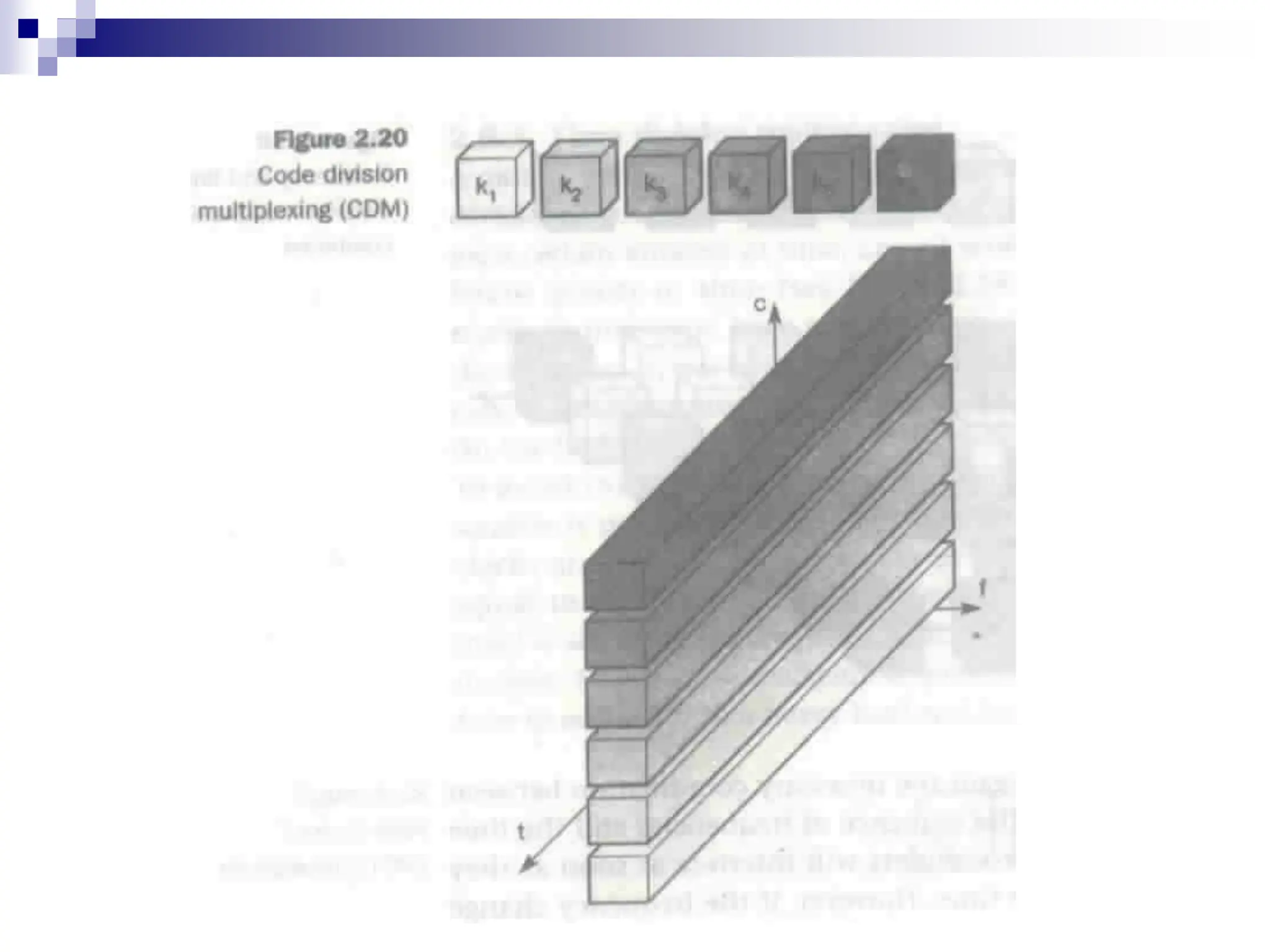
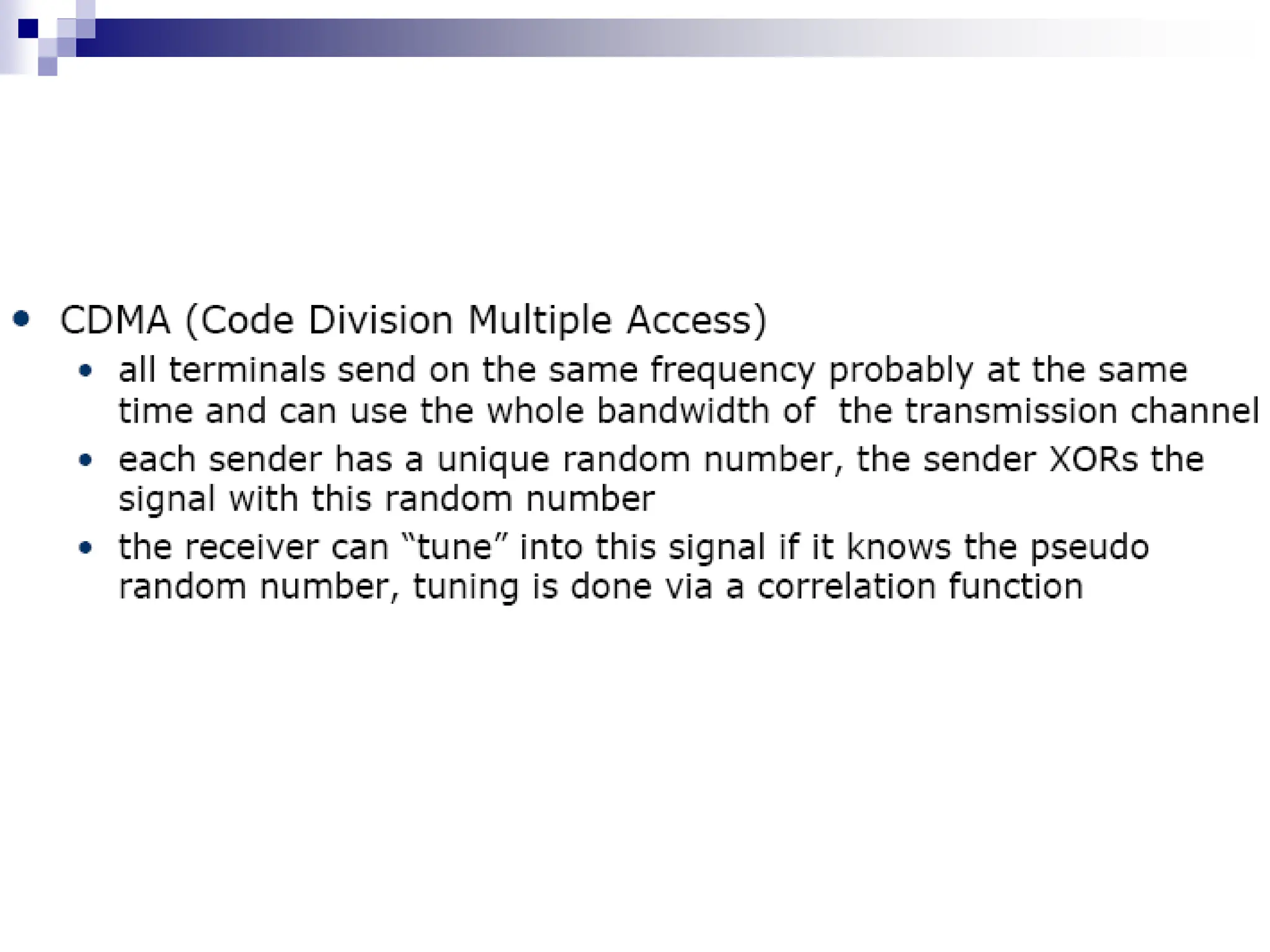
4. CDMA: Code Division Multiple Access
 separation of channels achieved by assigning each
channel its own code
 guard spaces are realized by having distance in
code space (e.g. orthogonal codes)
 transmitter can transmit in the same frequency band
at the same time, but have to use different code
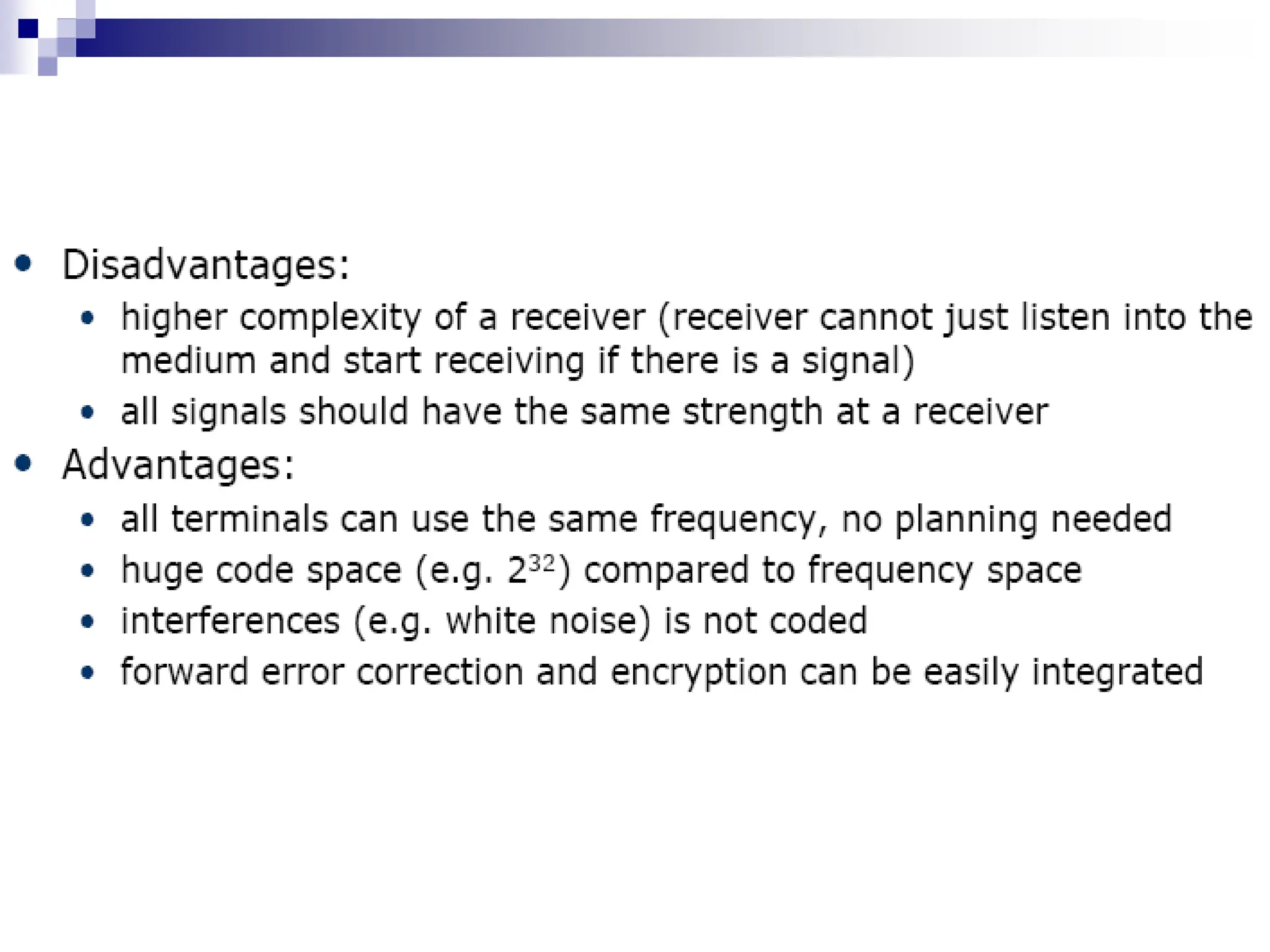
 Provides good protection against interference and
tapping
 but the receivers have relatively high complexity
 has to know the code and must separate the channel with
user data from the noise composed of other transmission
 has to be synchronized with the transmitter
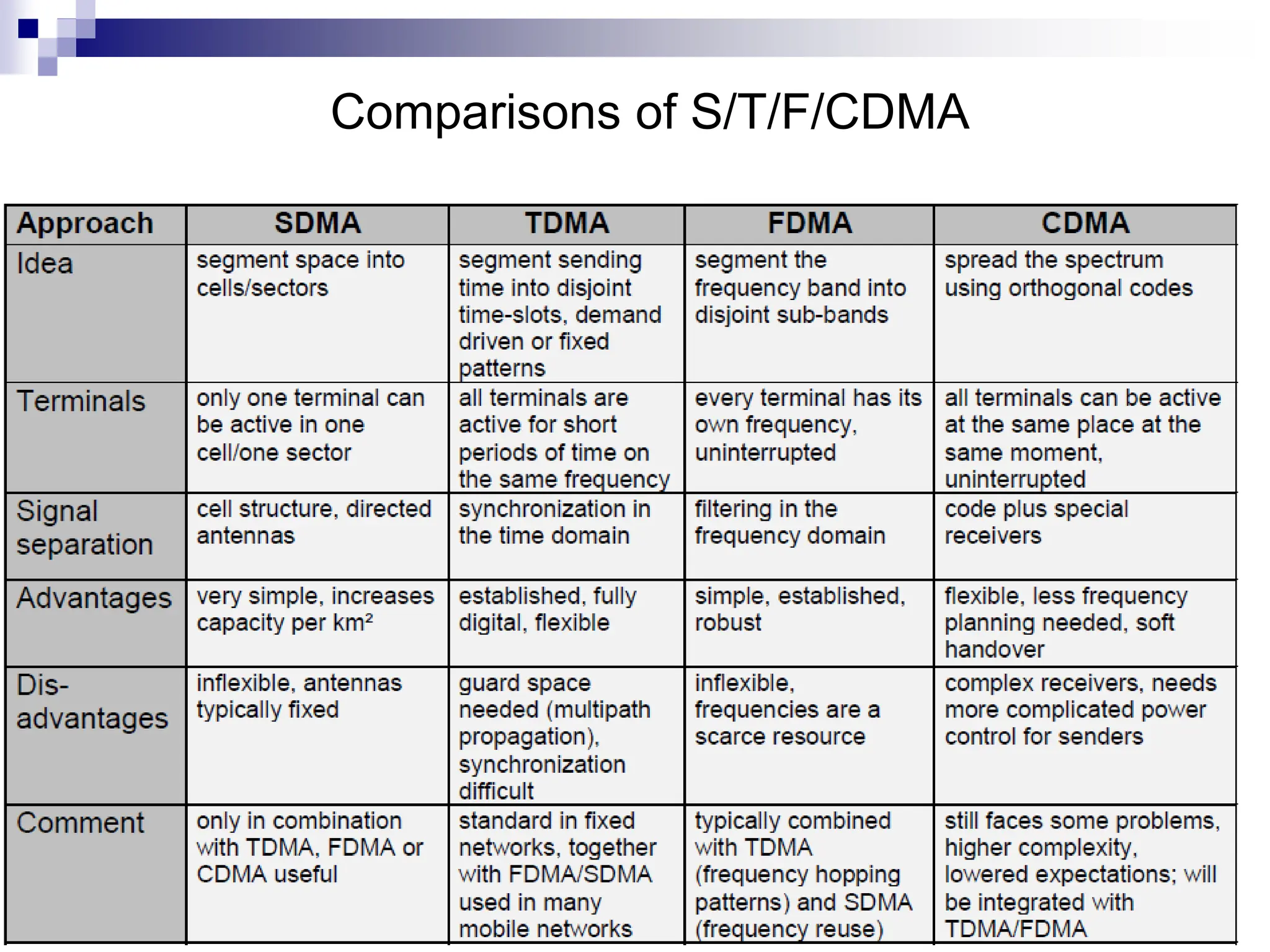
Comparisons of S/T/F/CDMA

Wireless medium Access Control-multiple terminals need to communicate at the same time

  • 1.
  • 2.
    Contents 1. Motivation forSpecialized MAC • Hidden and Exposed Terminals • Far and Near Terminals 2. Access Methods • SDMA • FDMA • TDMA • CDMA
  • 3.
    1. Motivation forSpecialized MAC
  • 6.
    MULTIPLEXING  A fundamentalmechanism in communication system and networks  Enables multiple users to share a medium  For wireless communication, multiplexing can be carried out in four dimensions: space, time, frequency and code
  • 7.
  • 8.
    1. Space DivisionMultiple Access (SDMA)  Channels are assigned on the basis of “space” (but operate on same frequency)  The assignment makes sure that the transmission do not interfere with each (with a guard band in between)
  • 10.
    2. FDMA: FrequencyDivision Multiple Access  Frequency domain is subdivided into several non-overlapping frequency bands  Each channel is assigned its own frequency band (with guard spaces in between)
  • 12.
    FDD/FDMA – GeneralScheme Example: GSM
  • 13.
    3. TDMA :Time Division Medium Access  A channel is given the whole bandwidth for a certain amount of time  All senders use the same frequency, but at different point of time  Synchronization can be done by using  Fixed Allocation Scheme or  Dynamic Allocation Scheme
  • 15.
  • 16.
    TDMA Schemes 1. FixedTDM 2. Aloha (Classical) 3. Slotted Aloha 4. Reservation Aloha (Explicit) 5. PRMA (Implicit Reservation) 6. Reservation TDMA 7. CSMA 8. MACA 9. Polling 10. ISMA
  • 18.
  • 19.
    Demand Assigned MultipleAccess (DAMA) / Explicit Reservation / Reservation Aloha
  • 20.
    Packet Reservation MultipleAccess (PRMA) / Implicit Reservation
  • 21.
  • 22.
     In thiseach terminal on the network is able to monitor the status of the channel before transmitting information  Variations:  1-persistent CSMA  non-persistent CSMA -  p-persistent CSMA  CSMA/CA  Elimination yield – non-preemptive multiple access (EY-NMPA) Carrier Sense Multiple Access Protocols (CSMA)
  • 23.
     sense channelwhen want to transmit a packet, if channel is busy, then sense continuously, until the channel is idle, at this time, transmit the frame immediately.  Problem : “high collision rate”. 1-persistent CSMA
  • 24.
     Sense channelwhen want to transmit a packet, if channel is idle, then transmit the packet immediately. If busy, run back-off algorithm immediately to wait a random time and then re- sense the channel again.  Problem : when the channel becomes idle from busy, there may be no one of waiting stations beginning the transmission, thus waste channel bandwidth. Non-persistent CSMA
  • 25.
     Step –1: If the channel is idle, transmit the packet with probability of p, and delay for one time unit with probability of 1-p (time unit = length of propagation delay)  Step -2 :If channel is busy, then persist sensing the channel until the channel becomes idle then go to step-1.  If the transmission is delayed by one time unit, continue with step-1. p-persistent CSMA
  • 26.
     CSMA/CA: Sensingthe carrier is combined with a back-off scheme in case of a busy medium to achieve some fairness among competing stations.  In EY-NMPA: Priority scheme included to access the medium.
  • 27.
    Multiple Access withCollision Avoidance (MACA)
  • 29.
    State Machines forSender and Receiver
  • 30.
  • 31.
  • 32.
    4. CDMA: CodeDivision Multiple Access  separation of channels achieved by assigning each channel its own code  guard spaces are realized by having distance in code space (e.g. orthogonal codes)  transmitter can transmit in the same frequency band at the same time, but have to use different code  Provides good protection against interference and tapping  but the receivers have relatively high complexity  has to know the code and must separate the channel with user data from the noise composed of other transmission  has to be synchronized with the transmitter
  • 36.